Successful language comprehension often involves not only understanding discourse in the moment but also in later remembering what is read or spoken about. Thus, understanding the mechanisms underlying second language (L2) processing requires knowing not only how target-language sentences and discourses are processed in real time but also how they are represented in memory. However, the bulk of L2 processing research to date has examined whether and how L2 learners differ from native speakers in online processing of sentences (e.g., Felser & Roberts, Reference Felser and Roberts2007; Felser, Roberts, & Marinis, Reference Felser, Roberts and Marinis2003; Frenck-Mestre & Pynte, Reference Frenck-Mestre and Pynte1997; Jackson & Bobb, Reference Jackson and Bobb2009; Juffs & Harrington, Reference Juffs and Harrington1996; Lee, Lu, & Garnsey, Reference Lee, Lu and Garnsey2013; Marinis, Roberts, Felser, & Clahsen, Reference Marinis, Roberts, Felser and Clahsen2005; Papadopoulou, Reference Papadopoulou2005; Papadopoulou & Clahsen, Reference Papadopoulou and Clahsen2003; Roberts & Felser, Reference Roberts and Felser2011; Williams, Reference Williams2006) or discourses (Felser & Cunnings, Reference Felser and Cunnings2012; Felser, Sato, & Bertenshaw, Reference Felser, Sato and Bertenshaw2009; Hopp, Reference Hopp2009; Pan & Felser, Reference Pan and Felser2011; Pan, Schimke, & Felser, Reference Pan, Schimke and Felser2015; Patterson, Trompelt, & Felser, Reference Patterson, Trompelt and Felser2014; Roberts, Gullberg, & Indefrey, Reference Roberts, Gullberg and Indefrey2008). Little is known about whether an L2 discourse is encoded and represented in memory differently from a native language (L1) discourse, nor why any such differences might exist.
Here, we examine how L2 learners process cues to one particular influence on discourse representation: cues to a contrast between one element and its alternatives. In L1-English processing, prominence cues, such as a contrastive pitch accent in speech or font emphasis in written text, prompt comprehenders to encode a set of alternatives to the prominent element and later rule out those alternatives when remembering the true facts of the discourse (Braun & Tagliapietra, Reference Braun and Tagliapietra2010; Calhoun, Reference Calhoun2009; Fraundorf, Benjamin, & Watson, Reference Fraundorf, Benjamin and Watson2013; Fraundorf, Watson, & Benjamin, Reference Fraundorf, Watson and Benjamin2010; Reichle & Birdsong, Reference Reichle and Birdsong2014). For example, you need to push the RED button, not the blue button helps L1 comprehenders rule out the mentioned alternative blue button in their later memory, but not the unmentioned green button.
We explore whether L2 learners of English encode and represent an alternative set in their discourse representation in the same way as native speakers do. We also examine what kind of alternatives L2 comprehenders consider in cases where they do encode an alternative set in response to prominence cues. In examining these issues, we illuminate not only how L2 learners encode alternatives in discourse but also what kinds of variables constrain L2 discourse processing more broadly.
PROCESSING AND REMEMBERING PROMINENT MATERIAL IN L1 AND L2
The pattern of prominence with a discourse may imply something about how entities in the discourse relate and how they should be remembered. In English spoken sentences, one way a word can be made prominent is by producing it with a pitch accent, a phonological construct acoustically characterized by increased duration and intensity and by different patterns of tonal excursion. Namely, many theories of intonation (such as the ToBI system for intonational transcription of English) distinguish multiple types of pitch accents: among others, the H* accent involves a high tonal target on the stressed syllable of an accented word whereas the L + H* accent involves a high tonal target preceded by a steep rise from an initial low tone (Beckman & Ayers, Reference Beckman and Ayers1997). The L + H* pitch accent has been argued to mark contrastive information whereas H* tends to be associated with information that is new to the discourse (Pierrehumbert & Hirschberg, Reference Pierrehumbert and Hirschberg1990). The contrastive reading of the L + H* accent is supported by eye-tracking studies, which demonstrate that L1-English listeners encode an alternative set in response to an L + H* accent and use it to anticipate a referent that contrasts with a previously mentioned one (Ito & Speer, Reference Ito and Speer2008; Watson, Tanenhaus, & Gunlogson, Reference Watson, Tanenhaus and Gunlogson2008; see also Weber, Braun, & Crocker, Reference Weber, Braun and Crocker2006, for evidence from German). Crucially, contrastive L + H* accents not only guide online processing but also appear to facilitate memory for discourse by strengthening a distinction between a true statement (i.e., what happened) and its alternatives (i.e., what did not happen) (Fraundorf et al., Reference Fraundorf, Watson and Benjamin2010).
High-proficiency L2 learners also use prominence cues to evoke a contrast between a prominent element and its alternatives. This has been observed with contrastive pitch accents in both L2-Dutch (Braun & Tagliapietra, Reference Braun and Tagliapietra2011) and L2-English (Lee & Fraundorf, Reference Lee and Fraundorf2017) as well as with structural prominence cues, such as clefts, in L2-French (Reichle, Reference Reichle2010a; Reichle & Birdsong, Reference Reichle and Birdsong2014). For instance, Reichle and Birdsong (Reference Reichle and Birdsong2014) examined English speakers’ event-related potential responses while they read cleft sentences in L2-French. Each target sentence (e.g., It is a hammer that we see on the table) was paired with a question in which the critical noun in the focus-marking position received either noncontrastive informational focus (e.g., What do we see on the table?) or contrastive focus (e.g., Is it a glass or a hammer that we see on the table?). Just like native French speakers, high-proficiency L2 learners showed increased anterior negativity, which indexes an increase in working memory load (e.g., Cowles, Reference Cowles2003; Kluender & Kutas, Reference Kluender and Kutas1993; Lee & Garnsey, Reference Lee and Garnsey2015; van Berkum, Brown, & Hagoort, Reference Van Berkum, Brown and Hagoort1999), in the contrastive-focus condition as compared to the informational-focus condition. This result was interpreted as indicating that high-proficiency L2 learners evoked a contrast set to the focused word, requiring greater working memory resources to hold those alternatives active.
However, even high-proficiency L2 learners may not show fully native-like behavior in processing prominence cues (Akker & Cutler, Reference Akker and Cutler2003; Braun & Tagliapietra, Reference Braun and Tagliapietra2011). For example, Braun and Tagliapietra (Reference Braun and Tagliapietra2011) had German-speaking L2 learners of Dutch listen to Dutch sentences containing a sentence-final prime word (e.g., flamingo), which was produced either with a contrastive double-peak contour or with a noncontrastive hat-pattern contour. As soon as the prime word was heard, a visual target word that was either contrastively related (e.g., pelikaan, “pelican”) or unrelated (e.g., beroemdheid, “celebrity”) to the prime word was presented. Just like native Dutch speakers, high-proficiency L2 speakers showed a priming effect for contrastively related targets after hearing the prime word with a double-peak contour. However, unlike native speakers, German-speaking L2 speakers showed the same effect even after hearing a noncontrastive hat-pattern contour. Given that both double-peak and hat-pattern contours signal contrast in German, this result suggests that high-proficiency L1-German learners of Dutch immediately encoded a set of alternatives in response to a contrastively focused word in L2 speech, but that in doing so, they transferred their L1 mapping of prosody to contrastive meaning (see Archibald, Reference Archibald1997, for evidence of L1 transfer in the production of L2 prosodic focus).
Further evidence that L2 learners’ processing of prominence is not entirely native-like behavior comes from Lee and Fraundorf (Reference Lee and Fraundorf2017), who tested L2 learners’ memory for prominent information. Lee and Fraundorf had Korean-speaking L2 learners of English listen to short discourses, such as (1) below, each of which established two alternative sets (e.g., British–French, Malaysia–Indonesia) before referring to one referent from each set, underlined in (1) for illustration purposes only. Later, participants’ memory for those critical words was tested using a probe recognition task in which participants judged statements as true or false. Three different types of probes appeared: correct statements ([2a]), false statements about the contrastive alternative ([2b]), and false statements about an unmentioned item ([2c]).
(1) Both the British and the French biologists had been searching Malaysia and Indonesia for the endangered monkeys. Finally, the British spotted one of the monkeys in Malaysia and planted a radio tag on it.
(2)
a. The British scientists found the endangered monkey.
b. The French scientists found the endangered monkey.
c. The Portuguese scientists found the endangered monkey.
The critical words in the original discourse were manipulated for pitch accent type (contrastive L + H* vs. noncontrastive H*). Lee and Fraundorf evaluated three different hypotheses about how contrastive accents might benefit L2 learners’ memory. The granularity account proposes that contrastive accents improve memory by enhancing the representation of the prominent item itself, such as British in (1) above; this would enhance rejections of both kinds of false statements, both of which are inconsistent with British. By comparison, the contrast representation account proposes that the effect of the contrastive L + H* accent over the noncontrastive H* is to lead comprehenders to remember something about the specific salient alternative in the original discourse (i.e., that it was not the French who found the monkey), which would enhance rejections only of the alternative probes and not of the unmentioned probes. Finally, the shallow representation account Footnote 1 proposes that even when an L + H* accent evokes a set of contrasting alternatives (e.g., the set of British and French), a lack of cognitive resources for L2 processing makes it difficult for L2 learners to fully integrate into their representation of the discourse which member of the alternative set is the correct item and which is the contrast item. Thus, this account predicts that the contrastive accent would not facilitate rejections of the alternative probes and might even impair them. However, having brought to mind the contrast between the two items in the alternative set (British and French) should enhance a distinction between those items and an unmentioned item (e.g., Portuguese), facilitating rejections of the unmentioned statements.
Native English speakers’ behavior appears to be described by the contrast representation account; that is, the L + H* accent facilitates rejections exclusively of the alternative statements (Fraundorf et al., Reference Fraundorf, Watson and Benjamin2010). However, high-proficiency Korean-speaking L2 learners of English showed different effects: the L + H* accent did not help them reject the contrastive alternative; rather, it impaired rejections of the contrastive alternative. For these learners, the L + H* accent facilitated rejections of the unmentioned items, consistent with the shallow representation account. In sum, although a contrastive pitch accent improved memory for L2 discourse to some extent by enhancing a distinction between elements inside and outside an alternative set, it failed to lead L2 learners to encode in memory the salient alternative as fully as native speakers do.
EXPLAINING L1-L2 DIFFERENCES IN DISCOURSE PROCESSING
The results reviewed above suggest that at least some aspects of L2 discourse processing and memory may not function in a native-like manner. What might underlie these L1-L2 differences?
One possibility is that L2 learners show non-native processing of pitch accents because they fail to acquire the mapping between a specific pitch accent type in their L2 and its discourse function. This could well explain the Braun and Tagliapietra (Reference Braun and Tagliapietra2011) results, in which L1-German learners of Dutch appeared to inappropriately transfer their L1 prosodic knowledge. Similarly, it is possible that the absence of pitch accenting as a focus-marking device in Seoul Korean, which marks contrastive focus prosodically by placing an accentual phrase boundary before a focused word and dephrasing words following it (Jun, Reference Jun1993, Reference Jun2005; Ladd, Reference Ladd2008), may have prevented the L1-Korean learners of English in Lee and Fraundorf (Reference Lee and Fraundorf2017) from grasping the discourse function of contrastive pitch accents in L2 speech. More generally, even if there is no negative transfer from L1, it is possible that L2 discourse processing may be intrinsically disadvantaged if it qualitatively differs from L1 processing, as has sometimes been proposed for other aspects of L2 processing, such as syntax (e.g., Clahsen & Felser, Reference Clahsen and Felser2006a, Reference Clahsen and Felser2006b).
Another possibility, however, is that even if L2 learners have knowledge of a particular cue to discourse processing, for instance, that the L + H* pitch accent has a contrastive meaning, the availability of cognitive processing resources may constrain whether they actually incorporate that knowledge into their discourse representation in a native-like way. L2 processing is known to be more resource demanding than L1 processing (McDonald, Reference McDonald2006; Segalowitz, Reference Segalowitz2003), and a lack of cognitive resources may lead to non-native performance in various aspects of L2 development (e.g., Ardila, Reference Ardila2003; Harrington, Reference Harrington1992; Hopp, Reference Hopp2010; Kilborn, Reference Kilborn1992; Sorace & Serratrice, Reference Sorace and Serratrice2009). Furthermore, even native speakers’ performance may become similar to that of non-native speakers under temporally demanding conditions (e.g., Hopp, Reference Hopp2010; McDonald, Reference McDonald2006). That is, the fleeting nature of running speech may require L2 listeners to devote a majority of their cognitive resources to processing the segmental content, leaving insufficient resources for fully processing prominence cues. Thus, for instance, the L2 learners in Lee and Fraundorf (Reference Lee and Fraundorf2017) may not have had sufficient opportunity to fully integrate into their discourse representation which item was the contrastive alternative.
There are many reasons to think that cognitive resource constraints may be one source of L2 learners’ non-native-like processing of prominence cues in spoken discourse. First, processing a prosodic cue itself is likely computationally intense because it requires integrating information across different levels of linguistic representation such as syntax or discourse structure (Dekydtspotter, Donaldson, Edmonds, Fultz, & Petrusch, Reference Dekydtspotter, Donaldson, Edmonds, Fultz and Petrusch2008; Dekydtspotter, Edmonds, Fultz, & Renaud, Reference Dekydtspotter, Edmonds, Fultz and Renaud2010). Second, there is evidence that it is time consuming and resource demanding to encode salient alternatives. L1 reading times suggests that although words marked as prominent are better remembered, they also require longer processing times in initial discourse processing (Fraundorf et al., Reference Fraundorf, Benjamin and Watson2013). In addition, both native speakers and high-proficiency L2 learners show event-related potential signatures of increased working memory load in conditions that evoke contrastive alternatives (Cowles, Reference Cowles2003; Reichle, Reference Reichle2010a; Reichle & Birdsong, Reference Reichle and Birdsong2014). Lastly, working memory capacity constrains the effects of prominence cues even for L1 comprehenders (Fraundorf, Watson, & Benjamin, Reference Fraundorf, Watson and Benjamin2012).
In this study, we test whether L2 learners are intrinsically disadvantaged in comprehending contrast in L2 discourse or whether non-native-like processing partially reflects online processing demands. We do so by testing whether L2 learners exhibit similar non-native processing and memory with a less temporally demanding cue to prominence: font emphasis when reading written text. Compared to listening, reading has been argued to require fewer computational resources for low-level processes, such as phoneme decoding and word recognition, because readers can take as long as desired (Almor & Eimas, Reference Almor and Eimas2008). L2 learners tend to comprehend written text better than speech (Reves & Levine, Reference Reves and Levine1988). If L2 learners’ non-native processing of spoken prominence reflects online processing demands, an absence of time pressure should leave more resources for drawing interferences about salient alternatives. By contrast, if there are intrinsic deficits in comprehending a discourse in L2, then a change of modality or presentation speed should be irrelevant. Thus, examining L2 learners’ processing of written discourse can reveal the generality and driving factors of L2 learners’ non-native discourse processing: can L2 learners fully specify in memory, as native speakers do, which is the salient alternative under less cognitively demanding conditions?
CONSTRAINING AN ALTERNATIVE SET
Thus far, we have considered whether L2 comprehenders encode and represent a set of alternatives in response to prominence cues. A related but separate question is how a set of alternatives, if encoded, is constrained. That is, what makes something constitute one of the salient alternatives worthy of remembering as part of a discourse? This question has been examined in L1 processing (e.g., Byram Washburn, Kaiser, & Zubizarreta, Reference Byram Washburn, Kaiser and Zubizarreta2011; Fraundorf et al., Reference Fraundorf, Benjamin and Watson2013), but much less is known about how an alternative set is constrained in L2 comprehension and whether it proceeds based on the same constraints as for native speakers.
Theories of discourse (e.g., Chafe, Reference Chafe1974; Prince, Reference Prince1981) delineate multiple constraints on the salience or activation of referents. Here, we focus on one potential constraint: plausibility as an alternative. In discourse (1) above, the intended set of alternatives is fairly unambiguous: not only are the British and French scientists the only groups searching for the monkey, they are the only scientists mentioned in the discourse. Now consider discourse (3) below, which establishes a contrastive pair (e.g., new Mexican and Indian restaurants) but also mentions another, noncontrastive item (e.g., an existing Italian restaurant) before referring to one of the contrasting items, the Mexican restaurant. Although both Indian and Italian are members of the same semantic category as Mexican and were established in the discourse, only Indian is contextually plausible as an alternative to Mexican (i.e., the critic could have visited the Indian restaurant instead, but not the Italian restaurant). If mere mention is enough to establish an item in the alternative set, then emphasizing Mexican should lead comprehenders to remember both Indian and Italian as salient alternatives. By contrast, if the set of alternatives is constrained based on contextual plausibility, then only Indian should be remembered as a salient alternative.
(3) A new Mexican and a new Indian restaurant had recently opened. Both were waiting to hear whether or not the local food critic would like their desserts and specials. They were nervous because the critic was notoriously harsh and disliked even the popular entrees at the local Italian restaurant. The critic originally planned to dine at both new restaurants during the week. But he caught a cold and could only visit the Mexican restaurant, where he awarded the specials a favorable review.
Prior work suggests that L1 comprehenders constrain the set of alternatives based on contextual plausibility (Byram Washburn et al., Reference Byram Washburn, Kaiser and Zubizarreta2011; Fraundorf et al., Reference Fraundorf, Benjamin and Watson2013), rather than semantic category membership (e.g., Blok & Eberle, Reference Blok and Eberle1999) or prior mention (Fraundorf et al., Reference Fraundorf, Benjamin and Watson2013). For example, Fraundorf et al. (Reference Fraundorf, Benjamin and Watson2013, Experiment 3 tested memory for discourses like (3) and found that, for native English speakers, emphasizing the critical word (e.g., Mexican) in the continuation of the original discourse facilitated later rejections only of the contrast item, and not of the merely mentioned item. This finding suggests that the set of alternatives encoded in response to prominence was narrowly constrained to include only alternatives plausible in the situation model of the discourse (Zwaan & Radvansky, Reference Zwaan and Radvansky1998) rather than every referent mentioned (see also Byram Washburn et al., Reference Byram Washburn, Kaiser and Zubizarreta2011).
However, it is yet unclear whether L2 comprehenders constrain alternative sets using the same or different criteria as native speakers. Lee and Fraundorf (Reference Lee and Fraundorf2017) provide some general evidence that Korean-speaking L2 learners of English do not rely on semantic category membership in defining alternative sets: a contrastive accent facilitated rejections of an unmentioned item (e.g., Portuguese) but not of a contrastive alternative (e.g., French) even though both were members of the same semantic category as the correct item (e.g., British). However, because only a plausible alternative was mentioned in the original discourse, their design does not reveal whether L2 learners restricted this alternative set based on plausibility as an alternative or on mere mention in discourse. We distinguish these possibilities in the current work using a different set of test probes that separately test a plausible alternative and a merely mentioned item.
PRESENT STUDY
In the present study, we test how a prominence cue affects memory for written discourse among L1-Korean speakers with moderate or high proficiency in English. Our goals were (a) to determine what underlies L2 learners’ non-native encoding of salient alternatives in spoken language comprehension by examining whether this phenomenon generalizes to written text and (b) to test how L2 learners constrain a set of alternatives.
Self-paced reading of written text allows comprehenders to slow down as much as necessary to process the discourse. Thus, if processing limitations underlie L2 learners’ non-native-like processing of a prominence cue in speech, our self-paced reading paradigm should make it easier for L2 learners to process the literal text, and as a result, allow them to have more resources for representing and remembering salient alternatives to prominent information. Consequently, they should obtain a more native-like discourse representation; namely, prominence should facilitate L2 learners’ rejections specifically of the contrastive alternative on the memory test, as seen with L1 learners. By contrast, if L2 learners’ non-native performance stems from more intrinsic deficits in L2 discourse processing, prominence cues would affect L2 learners’ memory differently from native speakers even in self-paced reading. Specifically, to mark prominence in written text, we use font emphasis.Footnote 2 Fraundorf et al. (Reference Fraundorf, Benjamin and Watson2013) have demonstrated that emphasizing words with capitals or italics has similar effects on later memory as contrastive pitch accents. Here, we use capitalization exclusively (see also Fraundorf et al., Reference Fraundorf, Benjamin and Watson2013, Experiment 3) to make our study comparable to Lee and Fraundorf (Reference Lee and Fraundorf2017) insofar as each involves prominence cues unavailable in L1-Korean: while italicization is available for changing the appearance of letters in Korean, the Korean writing system does not distinguish between lowercase and uppercase letters.
The use of written text also provides an additional check on the role of processing limitations in L2 discourse memory. In order for this account to be plausible, L2 learners, like native speakers, should take longer to process emphasized words than nonemphasized words. Otherwise, it is implausible that the processing-time demands of emphasized words account for any L1-L2 differences.
If L2 learners are able to encode a set of alternatives, a second goal of the present study is to query how that set is constrained. Native speakers appear to construct a set of alternatives based on plausibility in the situation model (Byram Washburn et al., Reference Byram Washburn, Kaiser and Zubizarreta2011; Fraundorf et al., Reference Fraundorf, Benjamin and Watson2013); if L2 learners do the same, font emphasis should affect rejections only of the contrast items, not of the merely mentioned items. By contrast, if font emphasis helps L2 learners reject any type of item mentioned in the discourse, it would suggest that L2 learners define the alternative set based on mere mention in the discourse. Investigating how L2 learners define an alternative set may thus further indicate whether L2 learners differ from native speakers in the way they use prominence cues to encode and represent a discourse in memory.
METHOD
Participants
Sixty native Korean speakers participated in the experiment for payment. All participants had learned English as an L2 and resided in Seoul at the time of testing. None of the participants had stayed in an English-speaking country for longer than 6 months before the age of 15.
We assessed participants’ English proficiency using the same multiple-choice test as in Lee and Fraundorf (Reference Lee and Fraundorf2017). In the test, participants chose one of three response alternatives for each of 40 blanks in a passage. The participants also self-rated their English proficiency on a 6-point scale (6 = native-like), in reading, writing, speaking, and listening. The proficiency test had moderate reliability (Kuder–Richardson coefficient of reliability = .65), and each participant’s test score was significantly correlated with the average self-rating, r = .46, F (1, 58) = 15.4, p<.01.
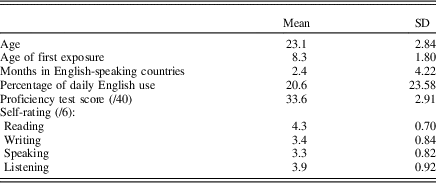
Based on a previously used criterion (Lee & Fraundorf, Reference Lee and Fraundorf2017), 7 participants whose multiple-choice test scores were less than 29 (out of 40) were considered as “low proficiency” and were excluded from analysis. We excluded these participants to reduce the possibility that any differences we observed in participants’ memory performance simply reflected an inability to process the literal text. Four additional participants were excluded due to technical problems. This left 49 L1-Korean speakers with moderate or high proficiency in English (10 males, 39 females) for analysis. Table 1 summarizes their biographical information, proficiency test scores, and self-rating scores.
Summary of the participants’ biographical information (means and standard deviations)

Note: The percentage of daily English use was self-computed by each participant relative to all daily language activities including reading.
Materials
In the study phase, participants read 36 written discourses (available in Appendix C of Fraundorf et al., Reference Fraundorf, Benjamin and Watson2013). Each discourse began with a context passage that (a) established two pairs of contrasting alternatives and (b) introduced another merely mentioned item for each pair of alternatives. This merely mentioned item was from the same semantic category but was mentioned in a context that made it an implausible alternative for the contrasting pair. For example, in (3) above, the food critic plans to visit both the Mexican and the Indian restaurants (one pair of contrasting alternatives) but is not planning to visit the Italian restaurant because he has already reviewed it (a merely mentioned item). Similarly, the critic plans to review the desserts and specials (another pair of contrasting alternatives) but has already reviewed entrees (the corresponding merely mentioned item). The inclusion of the merely mentioned item allows us to test how an alternative set is defined in L2 processing; does it include all mentioned referents, or just the alternatives that are plausible in the discourse?
The context passage was then followed by a continuation passage that critically referred to one item from each contrasting pair; for example, in (3), the critic visited only the Mexican restaurant (but not the Indian restaurant) and reviewed the specials (but not the desserts). Half of the critical words received font emphasis and half did not. The assignment of words to emphasis conditions was counterbalanced across experimental lists.
The written discourses were constructed so that the two critical words in the continuation (e.g., Mexican and specials) never appeared as the first or last word in a punctuation-marked clause because clause boundaries have a large effect on reading times and could overwhelm the effects of interest (Reichle, Warren, & McConnell, Reference Reichle, Warren and McConnell2009). In addition, the two critical words never appeared as the first or last word in a line of text when the stimuli were displayed in the self-paced reading task because line breaks could similarly distort reading times (Rayner, Reference Rayner1998).
Two other controls concerned how we established the two contrasting alternatives in the context passage. If the first of these two items was always the one mentioned in the continuation passage, readers might be able to predict the outcome of the continuation even before reading it. Thus, the stimuli were balanced so that in half of the stimuli, the critical word mentioned in the continuation was the one that appeared first in the context passage (e.g., Mexican appears before Indian in [3]), and in half the critical word appeared second in the context passage. Similarly, the two contrasting alternatives within a pair (e.g., desserts and specials) were also matched in orthographic length so that the reader could not anticipate which would be mentioned in the continuation passage simply based on the width of the mask in the self-paced moving window task.
For the subsequent recognition memory test, two sets of memory probes were constructed for each discourse. One set of probes tested one of the critical words (e.g., Mexican) and one tested the other (e.g., specials), such as (4) and (5). For each critical word, three possible probes were presented by varying one word in the probe sentence to refer to either the correct item (true), the contrastive alternative (false), or the merely mentioned item (false).
(4)
a. Because the food critic caught a cold, he only visited the Mexican restaurant. (correct probe)
b. Because the food critic caught a cold, he only visited the Indian restaurant. (contrast probe)
c. Because the food critic caught a cold, he only visited the Italian restaurant. (merely mentioned probe)
(5)
a. The food critic gave a favorable review to the specials at one of the new restaurants. (correct probe)
b. The food critic gave a favorable review to the desserts at one of the new restaurants. (contrast probe)
c. The food critic gave a favorable review to the entrees at one of the new restaurants. (merely mentioned probe)
Each participant saw only one of the three memory probes for a given fact; the assignment of items to probe types was counterbalanced across lists and was fully crossed with whether the critical word received font emphasis at the time of study. (No font emphasis ever appeared in the memory probes.) This resulted in a 2 × 3 × 2 design of font emphasis × probe type × group (L1 vs. L2), with the first two variables varying within subjects and the last between subjects.
Our primary interest was comparing the two types of false probes: the contrastive alternative (e.g., Indian in the above example) and the merely mentioned item (e.g., Italian). To ensure that this comparison was independent of lexical properties such as frequency or imageability, we counterbalanced across experimental lists which word was the contrastive alternative and which was the merely mentioned item (i.e., a different participant would instead see Italian as the contrastive alternative and Indian as the merely mentioned item). As our primary interest was in participants’ ability to reject the false statements, we did not counterbalance the word used as the correct probe in order to avoid a combinatorial explosion of lists.
Procedure
The experiment consisted of a study phase followed by a test phase. Participants were instructed in English that they would read 36 stories and that their memory of these stories would be tested after reading all of them; the exact format of the memory test was not described in advance. In the study phase, participants read the stories one word at a time at their own pace, in a noncumulative moving-window self-paced reading paradigm. Each trial began with the first word displayed at the left side of the screen and with the other words masked by lines matched in length. Pressing the space bar caused the next word to be displayed and the previous word to be reverted to a line. There was no visual separation between the context passage and the continuation passage of each discourse. The order of the stories was randomized.
The test phase was administered after participants had read all of the 36 stories. Participants saw 72 statements about the stories that they had read (2 statements about each story). The participants’ task was to judge whether each probe was true or false based on what they had read; participants were instructed to choose “false” if they thought that any part of the statement was false. The test probes were presented one at a time; after the participant made the “true” or “false” judgment, the next probe was immediately presented. The test probes were presented in a different random order.
RESULTS
To examine whether and how font emphasis affects L2 learners’ memory differently from that of native speakers, we compared our L2 group directly to the native speaker group from Fraundorf et al. (Reference Fraundorf, Benjamin and Watson2013) for accuracy of recognition memory. We also analyzed initial reading time to test whether L2 learners, like L1 comprehenders, require additional online processing time for words marked as prominent. All modelsFootnote 3 reported below were fit in the R environment for statistical computing using the lme4 package (Bates, Maechler, & Bolker, Reference Bates, Maechler and Bolker2012).
Initial reading time
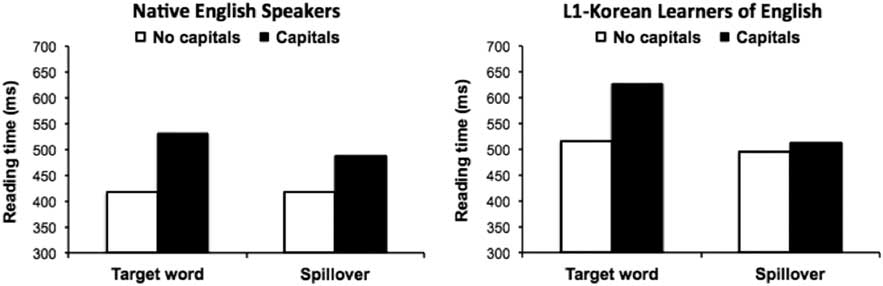
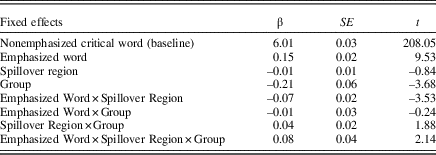
We analyzed reading times to examine whether emphasized words were processed differently from nonemphasized words when initially reading the discourse. Reading times were analyzed in a linear mixed-effects model (Baayen, Davidson, & Bates, Reference Baayen, Davidson and Bates2008) with font emphasis (capitals vs. no capitals), region (target word vs. spillover), group (L1 vs. L2), and their interactions as fixed effects. To correct positive skew, the dependent measure was computed as log-transformed reading times on the target and spillover words. The font emphasis and region variables were dummy coded to test their effects relative to the reference level (the nonemphasized critical word). The group variable was coded using mean-centered contrast coding. In all models of log reading times reported below, we included as random effects by-participant random intercepts and slopes for font emphasis, region, and their interaction and by-item random intercepts and slopes for font emphasis and region. A by-item random slope for the interaction between font emphasis and region was excluded because it did not improve the model fit (p>.05). Figure 1 displays reading times on the target and spillover words as a function of font emphasis, separately for native English speakers (Fraundorf et al., Reference Fraundorf, Benjamin and Watson2013) and for L1-Korean learners of English. Table 2 presents parameter estimates for the model of log reading times for both L1 and L2 comprehenders.
Mean reading time on target words and spillover words as a function of font emphasis for native English speakers (Fraundorf et al., Reference Fraundorf, Benjamin and Watson2013) and L2 learners.

Fixed effect estimates for the model of log reading times for both L1 and L2 comprehenders (N = 13,968, log-likelihood: –6909)

Note: SE, standard error. t-values greater than 2 are treated as significant (Baayen, Reference Baayen2008).
There was a main effect of group on online reading time (t = –3.68), indicating that L2 learners read the target and spillover words more slowly than native English speakers (t = –3.68). The effect of font emphasis was significant (t = 9.53) such that capitalized critical words (M = 541 ms) were read more slowly than those with no capitals (M = 462 ms). There was a three-way interaction among font emphasis, region, and group (t = 2.14), indicating that the effect of font emphasis on the spillover region varied across groups.
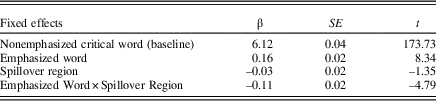
To decompose this three-way interaction, we analyzed just the L2 learners’ log reading times in a model with font emphasis (capitals vs. no capitals), region (target word vs. spillover), and their interactions as fixed effects. Table 3 displays parameter estimates for the model of log reading times just for L1-Korean learners of English.
Fixed effect estimates for the model of log reading times for L2 comprehenders (N = 7,056, log-likelihood: –3482)

Note: SE, standard error. t-values greater than 2 are treated as significant (Baayen, Reference Baayen2008).
Like native English speakers, L2 learners read the target word more slowly as a function of font emphasis. However, while the effect of font emphasis persisted beyond the target word in native English speakers, the same effect was limited to the target word in L2 learners, as revealed by a significant interaction between font emphasis and region (t = –4.79). The presence of font emphasis led L2 learners to stay longer on the target word compared to its absence, and this effect disappeared by the spillover region.
In summary, L2 learners required more time to process emphasized words, despite the emphasized words being the same lexical items in the same syntactic context. This makes it at least possible that, in scenarios where L2 learners do not achieve native-like processing of prominent words in spoken language comprehension (e.g., Braun & Tagliapietra, Reference Braun and Tagliapietra2011; Lee & Fraundorf, Reference Lee and Fraundorf2017), it is because L2 learners are less well equipped to deal with the time demands of processing prominent words while listening to running speech. If so, we should see more native-like effects on memory in the current self-paced reading task, which allowed L2 learners as much time with the font-emphasized words as needed.
Recognition memory
Analytic strategy.
In the memory test, the accurate response is “true” for the correct probes whereas it is “false” for the contrast and merely mentioned probes. Thus, assessing memory performance using proportion accuracy for each probe type confounds participants’ sensitivity to the truth value of particular probes with their response bias, or overall preference (or dispreference) to respond “true.” As in prior studies using this paradigm (Fraundorf et al., Reference Fraundorf, Watson and Benjamin2010, Reference Fraundorf, Benjamin and Watson2013; Lee & Fraundorf, Reference Lee and Fraundorf2017), we thus adopted a detection-theoretic analysis, which allows sensitivity to be distinguished from response bias both conceptually and empirically (Green & Swets, Reference Green and Swets1966; Macmillan & Creelman, Reference Macmillan and Creelman2005; see also Murayama, Sakaki, Yan, & Smith, Reference Murayama, Sakaki, Yan and Smith2014; Wright, Horry, & Skagerberg, Reference Wright, Horry and Skagerberg2008, for applications of detection theory to multilevel models). In this analysis, the proportion of “true” responses (rather than the proportion of accurate responses) is used as the dependent variable. Response bias is then reflected in the baseline rate of “true” responses whereas sensitivity to the truth value of the probes (i.e., veridical memory for the discourse) is reflected by a higher rate of “true” responses to correct probes than to the false probe types. Variables that enhance memory sensitivity are reflected in significant interactions between those variables and the probe type.
The model of “true” responses included font emphasis (capitals vs. no capitals), probe type (correct vs. contrast vs. merely mentioned), group (L1 vs. L2), and their interactions as fixed effects. To examine whether participants’ later memory was modulated by online reading time, initial reading time, and its interaction with the other variables were also included in the model as fixed effects. Specifically, we used residual reading time (Ferreira & Clifton, Reference Ferreira and Clifton1986) rather than raw reading time to prevent the effect of font emphasis from being confounded with inter-subject differences in reading speed or inter-item differences in word length. The predicted reading time was computed using a regression model predicting log-transformed reading time based on word length and each participant’s baseline reading speed (across all words in the materials). Residual reading time was then computed as a difference between the predicted reading time and the actual reading time. Fraundorf et al. (Reference Fraundorf, Benjamin and Watson2013) included residual reading time averaged over the target and spillover words in the model of native speakers’ memory because initial reading time on both the target and spillover words was modulated by font emphasis during L1 reading. By contrast, for L2 readers, font emphasis influenced initial reading time just on the target word alone (as discussed above); thus, we included residual reading time on the target word as our reading-time measure in the model of L2 learners’ memory. In 1.1% of the L2 trials, residual reading time for the target word was more than 3 SD above or below the participant mean. Those trials were excluded from further analysis.
The font emphasis variable was coded using mean-centered contrast coding to yield tests equivalent to the main effects in an analysis of variance. The probe type variable was coded using effect coding to perform two planned comparisons testing participants’ sensitivity in rejecting false statements. In the first comparison, the rate of “true” responses to the contrast probes was compared to the overall (mean) rate of “true” responses. The second comparison tested the rate of “true” responses to the merely mentioned probes relative to the overall rate of “true” responses. In both comparisons, the variable was coded such that a positive coefficient indicated more correct rejections. Residual reading time was mean-centered to assess the effect of the other variables at an average reading time for the target word.
The models of “true” responses reported below included by-participant and by-item random intercepts, and by-participant and by-item random slopes for probe type as random effects: random slopes for the other variables and their interactions with probe type did not significantly improve the model fit (all ps >.05).
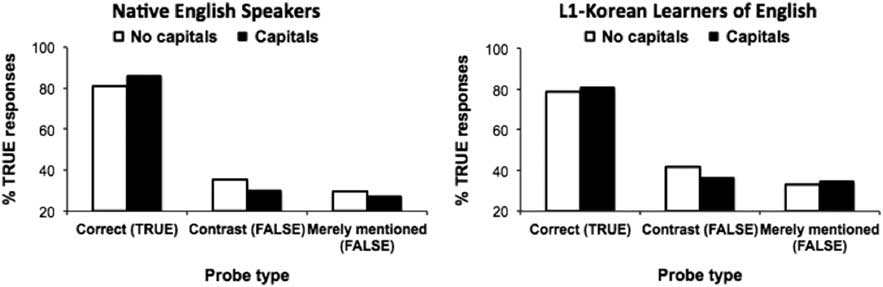
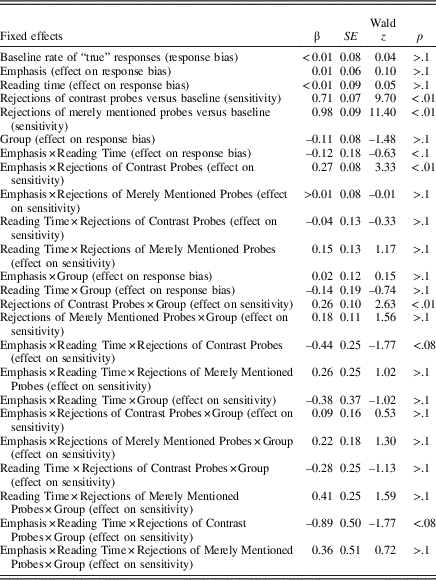
Figure 2 presents the mean rate of “true” responses as a function of font emphasis and probe type, separately for the native speaker group (Fraundorf et al., Reference Fraundorf, Benjamin and Watson2013) and the L2 group. Table 4 presents parameter estimates for the model of “true” responses for both L1 and L2 comprehenders.
Mean rate of “true” responses as a function of font emphasis and probe type for native English speakers (Fraundorf et al., Reference Fraundorf, Benjamin and Watson2013) and L2 learners.

Fixed effect estimates for the model of “true” responses for both L1 and L2 comprehenders (N = 6,911, log-likelihood: –3740)

Note: SE, standard error.
When both L1 and L2 comprehenders were considered, the rate of “true” responses to each of the two types of false probes was significantly lower compared to the overall rate of “true” responses (contrast probes: z = 9.70, p<.01; merely mentioned probes: z = 11.40, p<.01), indicating that participants could successfully distinguish the false statements from the correct statements. There was also a significant interaction between group and rejections of contrast probes (t = 2.63, p<.01). L2 learners made fewer correct rejections of contrast probes than native speakers, indicating that L1-Korean learners of English were less successful at rejecting probes referring to salient alternatives. However, there was no significant interaction between group and rejections of merely mentioned probes, revealing that the groups of participants did not significantly differ in their ability to reject items merely mentioned in the original discourse.
The critical tests here are whether and how rejections of the false probes were affected by font emphasis and whether the effect varied across groups. The results showed that font emphasis facilitated rejecting the contrast probes, collapsed across L1 and L2 groups (z = 3.33, p<.01). Crucially, the effects of font emphasis on rejections of the contrast probes were similar between L1 and L2 groups, as revealed by the absence of a significant interaction among font emphasis, rejections of alternative probes, and group (z = 0.53, p>.1).
Moreover, for both L1 and L2 learners, the effect of font emphasis was specific to rejecting the contrast items. There was no effect of font emphasis on rejections of the merely mentioned probes, nor was there a significant interaction with group (all ps>.1). There was also no effect of initial reading time nor were there significant interactions (all ps>.1).
Further, the same pattern of results (i.e., an effect of font emphasis only in rejecting contrast probes) was observed when the analysis was run on just the L2 group (see Appendix A for parameter estimates), confirming that the L2 group exhibited the same pattern as the L1 comprehenders from Fraundorf et al. (Reference Fraundorf, Benjamin and Watson2013).
These data suggest that, unlike contrastive accents, font emphasis led L2 learners to represent a discourse similarly to native speakers, helping them reject exclusively the contrastive alternatives and not the merely mentioned items. The finding that a mnemonic benefit of font emphasis was restricted to rejections of only alternatives that were plausible within the discourse suggests that L2 learners distinguished a salient alternative from an implausible alternative based on a situation model just like native speakers do.
DISCUSSION
Successful language comprehension often requires not only understanding in the moment but also long-term retention of what is heard or read. For native speakers, this process may be enhanced by various cues in the discourse, such as prominence cues that imply the importance of a contrastive alternative (e.g., Braun & Tagliapietra, Reference Braun and Tagliapietra2010; Byram Washburn et al., Reference Byram Washburn, Kaiser and Zubizarreta2011; Fraundorf et al., Reference Fraundorf, Watson and Benjamin2010, Reference Fraundorf, Benjamin and Watson2013; Husband & Ferreira, Reference Husband and Ferreira2016).
Can L2 learners make similar use of these cues to go beyond what is explicitly stated in a discourse and to retain in memory what is inferred? Several past studies have suggested that, highly proficient L2 learners evoke salient alternatives in response to prominence cues in L2 discourse (e.g., Braun & Tagliapietra, Reference Braun and Tagliapietra2011; Lee & Fraundorf, Reference Lee and Fraundorf2017; Reichle & Birdsong, Reference Reichle and Birdsong2014). However, the way they process L2 contrastive pitch accents does not converge with that of native speakers (e.g., Akker & Cutler, Reference Akker and Cutler2003; Baker, Reference Baker2010; Braun & Tagliapietra, Reference Braun and Tagliapietra2011). For example, L2 learners fail to integrate salient alternatives into memory as fully as native speakers do and to later rule them out when remembering the content of the discourse (Lee & Fraundorf, Reference Lee and Fraundorf2017). In the present study, we tested whether such non-native behavior in encoding salient alternatives is intrinsic to L2 discourse processing or whether it may stem from cognitive resource limitations. To do so, we tested whether L2 learners, specifically, L1-Korean speakers with moderate or high proficiency in English, would be able to use a prominence cue to enhance memory in a more native-like way in a task in which online processing demands are reduced compared to listening; namely, self-paced reading, which allows as much time as needed to process each word.
We found two sources of evidence for a role of processing constraints in comprehending prominence in L2 discourse. First, L2 learners, like L1 readers, read words with font emphasis (specifically, capitals) more slowly than nonemphasized words. This means that it is possible that online processing demands account for the non-native-like prominence processing of L2 learners in some circumstances, demands that should be reduced by the present self-paced reading task. Second, more direct evidence came from a recognition memory test in which memory for the discourse was assessed using probes that referred to the correct item, to the salient contrast item, or to a merely mentioned item that was not a plausible alternative. Korean-speaking L2 learners of English were overall less successful at correctly rejecting contrast probes than native speakers, indicating that L2 learners were more confused about which of the members of an alternative set was the correct item. Crucially, however, font emphasis had the same effects on L2 learners’ discourse memory as for native speakers: font emphasis helped L2 learners reject the contrast probes, but not the merely mentioned probes, indicating that L2 learners were native-like in using font emphasis to facilitate memory for discourse.
Previous studies on L2 learners’ processing of prominence cues have focused primarily either on whether they know the mapping between those cues and information structure (Akker & Cutler, Reference Akker and Cutler2003; Baker, Reference Baker2010; Donaldson, Reference Donaldson2012; Reichle, Reference Reichle2010b) or on whether they encode an alternative set in response to contrastive focus (e.g., Braun & Tagliapietra, Reference Braun and Tagliapietra2011; Reichle & Birdsong, Reference Reichle and Birdsong2014). Taking a step further, the present study also provided an answer to how L2 learners constrain an alternative set, if they encode it. The distinct effects of font emphasis on different types of false probes, both of which referred to items mentioned in the original discourse, suggest that an alternative set was constrained by discourse plausibility rather than mere mention in discourse. Taken together with the results above, these results suggest that L2 learners, at least in comprehension of written discourse, are similar to native speakers in how they restrict a set of salient alternatives and represent them in memory.
Native-like and non-native-like processing of prominence
Previous work reported that L2 learners are not always similar to native speakers in encoding and representing salient alternatives in a discourse; for instance, contrastive accents fail to lead L1-Korean learners of English to encode contrastive information fully enough to successfully reject false statements about salient alternatives on later memory (Lee & Fraundorf, Reference Lee and Fraundorf2017).
Our present results with written discourse provide empirical evidence that L2 discourse processing may not be intrinsically disadvantaged. Rather, the non-native-like behavior observed in past studies could have resulted from the cognitive demands of processing a prosodic cue in addition to the segmental content of running speech, an assumption underlying the shallow representation account. We found that prominent words require more reading time than nonprominent words for L2 learners. In addition, once these online processing demands were managed by allowing L2 learners as much time as needed (i.e., using a self-paced reading task), moderate- or high-proficiency L2 learners encode salient alternatives in a native-like way in response to a prominence cue in a written text. We have attributed this discrepancy to the difference in whether the task allows them to have sufficient cognitive resources to process the contrastive information.
The fact that L1-Korean learners of English perform better with a font emphasis cue than a prosodic cue is not attributable to the availability of each prominence cue in L1-Korean. Neither pitch accenting nor capitalization is used to mark prominence in Korean; Seoul Korean lacks pitch accents, and the Korean writing system does not have a distinction between uppercase and lowercase letters. However, one might nevertheless argue that our present results reflect Korean-speaking L2 learners’ distinct sensitivity to different prominence cues in English; that is, perhaps Korean-speaking L2 learners simply have less knowledge about contrastive pitch accents than font emphasis. Some data suggest against this possibility: high-proficiency L1-Korean learners of English were sensitive to the contrastive meaning of an L + H* pitch accent even when they failed to fully integrate the contrast relation into memory (Lee & Fraundorf, Reference Lee and Fraundorf2017; see also Braun & Tagliapietra, Reference Braun and Tagliapietra2011, for further evidence of L2 learners’ sensitivity to L2 contrastive pitch accents). This suggests that the differences in L2 learners’ comprehension of font emphasis and pitch accenting do not stem from differences in their knowledge about the mapping between each prominence cue and contrast. Still, it is possible that L2 learners’ non-native encoding of salient alternatives in response to a contrastive pitch accent in speech may be due at least in part to the inherent difficulty of learning to process the contrastive pitch accent itself. This possibility can only be fully tested in the future by manipulating the prominence cue while holding time pressure constant, or vice versa.
While the current data showed that even moderate-proficiency L1-Korean learners of English evoked a contrast set in response to font emphasis in written discourse, the ability to process contrastive accents in L2 speech appears modulated by L2 proficiency (e.g., Baker, Reference Baker2010; Braun & Tagliapietra, Reference Braun and Tagliapietra2011; Lee & Fraundorf, Reference Lee and Fraundorf2017). For instance, only high-proficiency L2 learners showed memory benefits of an L + H* pitch accent in L2 speech (Lee & Fraundorf, Reference Lee and Fraundorf2017). This suggests that learning to process contrastive pitch accents requires more experience with L2 input compared to capitalization. Given that the L2 learners tested in the current study and Lee and Fraundorf (Reference Lee and Fraundorf2017) all have spent less than a year in an English-speaking country, it is possible that L2 learners with more exposure to L2 speech and higher proficiency may reveal native-like encoding of salient alternatives in response to a prominence cue in L2 speech as well. At least in some cases, L2 learners’ behavior may converge with that of native speakers as a function of increased L2 proficiency or exposure (e.g., Frenck-Mestre, Reference Frenck-Mestre2002; Hopp, Reference Hopp2006, Reference Hopp2009; Reference Hopp2010; Rossi, Gugler, Freiderici, & Hahne, Reference Rossi, Gugler, Freiderici and Hahne2006). Conversely, it is also possible that learners with very low L2 proficiency, whom we did not examine, may face challenges beyond resource limitations and may exhibit representational deficits in their L2 discourse processing.
Reading emphasized words in L2
Using a self-paced reading task, we measured word-by-word reading time while L2 learners were reading the original discourse. The data showed that L2 learners did spend extra time on words emphasized with capitals compared to those with no capitals, indicating that they were sensitive to a font manipulation while reading. Unlike native speakers, L2 learners’ slowdown was restricted to the critical word, revealing no spillover effects. L2 learners’ mean reading time was also overall longer than native English speakers. Thus, one possibility is that the effect of capitalization may not have been carried over to a subsequent region in L2 reading because L2 learners may have spent as much time as required to process capitalized words before moving on to another word.
Consistent with the L1 study using the same stimuli (Fraundorf et al., Reference Fraundorf, Benjamin and Watson2013, Experiment 3), initial reading time had no direct effect on L2 learners’ performance on the later memory test. The absence of an effect of online reading time on later memory performance may simply reflect a lack of statistical power. It may also be due to a lack of variability in online reading time. We would observe a memory difference between words read slowly versus quickly only if readers slowed down in some cases but not others; instead, we observed that participants consistently read emphasized words more slowly. The third possibility is that longer reading time failed to predict better performance on the later memory test because the slowdown stemmed from decoding capital letters rather than from computing the alternative set; this possibility could be tested in future research by manipulating font emphasis for words inside and outside a contrast set. Furthermore, there have been mixed findings across studies as to whether native English speakers show better performance in offline comprehension as a function of longer reading times (Caplan, DeDe, Waters, Michaud, & Tripodis, Reference Caplan, DeDe, Waters, Michaud and Tripodis2011; Christianson & Luke, Reference Christianson and Luke2011; Daneman, Lennertz, & Hannon, Reference Daneman, Lennertz and Hannon2007; Fraundorf et al., Reference Fraundorf, Benjamin and Watson2013; Reder & Kusbit, Reference Reder and Kusbit1991; Ward & Sturt, Reference Ward and Sturt2007). More research is required to draw a firm conclusion about the relation between online processing and offline comprehension in L1 and L2 processing.
We do note that the particular self-paced reading task we chose may also alter reading behavior from natural reading insofar as readers could not regress or return to previous words; this may increase the burden placed on readers to remember the previous words of the text. However, this may be advantageous for the goals of our present study, in which we sought to compare results from self-paced reading to prior results from listening. As it is also not possible to return to previous words when listening to spoken speech, the use of noncumulative self-paced reading makes the memory demands more comparable between tasks.
Sensitivity to discourse-level cues
Previous studies of L2 processing at the discourse level have shown that L1-L2 differences exist, in at least some aspects of discourse processing, such that L2 learners are actually more sensitive to information given explicitly in the discourse than native speakers. For example, L2 learners can use referential discourse context in resolving syntactic ambiguity when native speakers fail to do so (Pan & Felser, Reference Pan and Felser2011; Pan et al., Reference Pan, Schimke and Felser2015). L1-L2 differences are also seen in anaphor resolution. L2 learners tend to rely more on discourse-level cues than syntactic cues in interpreting anaphoric expressions even when the resulting interpretation is syntactically inappropriate (Felser & Cunnings, Reference Felser and Cunnings2012; Felser et al., Reference Felser, Sato and Bertenshaw2009; Patterson et al., Reference Patterson, Trompelt and Felser2014). We did not find that L2 learners were more sensitive to discourse-level cues as these studies have suggested. Instead, we found that L2 learners can use prominence cues at least in written discourse in a native-like manner to infer a contrast between one element and its alternatives, and to later rule out the alternatives when remembering the content of a discourse.
Resource limitations in discourse processing
A growing body of research suggests that L2 learners differ from native speakers in retrieving lexical information (Ardila, Reference Ardila2003) and in using and integrating multiple sources of information online (Hopp, Reference Hopp2006, Reference Hopp2009, Reference Hopp2010; Kilborn, Reference Kilborn1992; Sorace & Serratrice, Reference Sorace and Serratrice2009; for review, see White, Reference White2011) in part because of cognitive resource limitations rather than because of a fundamental difference in processing mechanism and representation. For example, Sorace and Serratrice (Reference Sorace and Serratrice2009) have proposed that L2 learners’ processing limitations may be a source of non-nativeness in integrating discourse/pragmatic information with syntax. The present study extends this finding to the domain of L2 discourse representation by showing that how salient alternatives are represented in memory for L2 discourse may also be constrained by cognitive resources. Further, Fraundorf et al. (Reference Fraundorf, Watson and Benjamin2012) showed that limited cognitive resources cause difficulty allocating attention to information other than the contrastive information even in L1 discourse. The current study, combined with that of Lee and Fraundorf (Reference Lee and Fraundorf2017), takes this finding a step further by showing that limited cognitive resources may also modulate the depth of encoding the contrastive information itself in memory, at least for L2 learners.
Conclusion
It is not possible to attend to and remember everything in a discourse. The present study demonstrates that prominence cues, such as font emphasis, may help L2 comprehenders identify what to attend to and remember from a discourse. Font emphasis facilitates memory for L2 discourse by enhancing a distinction between what happened and salient alternatives that did not happen, just as it does in L1 processing. Further, there is also an L1-L2 convergence in how an alternative set is restricted. These findings suggest that L2 comprehenders may construct a similar kind of discourse representation as that of native comprehenders when sufficient resources are available.
Appendix A
Fixed effect estimates for the model of “true” responses for just L2 comprehenders (N = 3,489, log-likelihood: –1981); the model also included by-participant and by-item random intercepts, and by-participant and by-item random slopes for probe type as random effects