Arboretums are spaces intended for the growth and study of representative varieties of trees and shrubs and public arboretums were founded in a number of Victorian towns either as specialized forms of public park or spaces within larger parks. This reflected the British passion for tree collecting and landscape gardening as well as the drive for rational recreation and urban sanitary reform. Opened in 1852, the Nottingham Arboretum was the centrepiece of one of the most ambitious schemes of mid-Victorian urban improvement as well as being part of the national movement for rational recreation. Although modelled upon urban parks such as those in London and John Claudius Loudon and Joseph Strutt's Derby Arboretum (1840), the Nottingham Arboretum was also part of a more ambitious scheme of urban development inspired by similar ventures in Liverpool, Manchester and Birkenhead. However, the provision of land at Nottingham for building and public recreation was on a larger scale than the enclosures undertaken in these towns. Under the terms of the enclosure act of 1846, the land within the Nottingham borough was increased by one third whilst the arboretum was presented by the Liberal elite as a major civic triumph that would help to propel the town towards the status of regional capital. As well as being intended to foster public health and middle-class suburban residency, public arboretums had special qualities that reflect the importance attached to trees in British culture and society. The arboretum and public walks at Nottingham were partly inspired by a group of writers known as the Sherwood Forest school, and the trees and shrubs were supposed to re-connect urban dwellers with nature, provide peaceful solace in the midst of a manufacturing centre and connect visitors with the past and future of the county. At one level, arboretums and public parks were part of the national move for rational recreation which intended to ameliorate the problems of industrialization and urbanization by providing libraries, mechanics' institutes, museums and similar institutions for the use of all social classes. They were supposed to encourage social and moral changes in society and support the Victorian family as an institution, whilst diverting the working class from debased pleasures.Footnote 1
However, as the development of the Nottingham Arboretum demonstrates, although presented as a triumph and provincial answer to the Great Exhibition, the provision of public gardens and other rational recreational institutions masked considerable mid-Victorian social, political, cultural and intellectual anxieties. As this study shows, these uncertainties are manifest in the arguments that raged during the 1850s at Nottingham concerning questions of access to the arboretum and how it was to be managed, which impacted upon the character of the park, and reveal the contradictions inherent in the concept of rational recreation. Admission charges and strict policing maintained order but discouraged visits from the working class who were supposed to benefit from opportunities for botanical education and purposeful leisure. As the arboretum developed into primarily a public leisure park rather than an arboretum hastened by the abolition of charges, the botanical aspects of the design receded in importance whilst the arboretum became a centre for civic and imperial pride and community celebration.Footnote 2
Sanitation, improvement and rational recreation
The 1846 enclosure act, arboretum and public walks at Nottingham were the result of local social, economic and political developments as well as national legislation. The relatively open character of local government in Nottingham, and the activities of a prominent retail and industrial middle class, meant that the town gained a reputation for radical politics. The nature of the urban economy and the relatively large electorate helped to ensure that there was consistent opposition towards taxation and costly wars, support for parliamentary reform, extension of the franchise, religious freedom and disestablishment. Manufacture and government was dominated by nonconformists, evangelicals and Methodist lace and hosiery manufacturers. The corporation elite were supporters of moderate reform and found some difficulty in containing the popular clamour for more fundamental reforms evident during the parliamentary reform crisis of the 1830s and from the support given to Chartism, and the magistrates had to call on troops and special constables to try and maintain order.Footnote 3
The number of freemen in Nottingham and their power within the corporation restricted early nineteenth-century physical expansion because rights to surrounding common lands were jealously guarded.Footnote 4 Prominent figures were opposed such as the reformer Thomas Wakefield (d. 1871), sheriff in 1815 and mayor in 1835 and 1842, who vowed to strangle this ‘unsightly monster’.Footnote 5 The result was serious overcrowding with a population of 53,000 people contained in an area of less than 1,000 acres by 1832, whilst the middle class gravitated towards the periphery or beyond the borough boundary. The situation was exacerbated by poor drainage in the low lying districts and by the poverty induced by fluctuating trade cycles in the dominant textile industries exposed in a series of reports compiled by medical men and sanitary committees.Footnote 6 As the Liberal Nottingham Review put it, this led to the building of ‘the most unhealthy’ working-class dwellings such as cellars and garrets ‘without a current of air’. Inhabitants were ‘pent up’ yet ‘surrounded with fields of beautiful verdure’ from which they were ‘forbidden to tread’, yet these ‘beautiful sites for country houses and villas’ and ‘eligible situations for factories’ were all ‘sacrificed to the turning in of a few cattle’ for a short time annually. Thousands were huddled into courts and alleys in poor quality dwellings, including 8,000 back to back houses that helped to cause serious health and sanitation problems such as the outbreak of cholera in 1832 which killed 289. As the council sanitary committee put it in 1849, the whole area of Nottingham was ‘smaller in proportion to the numbers dwelling in it than that of perhaps any other place in the kingdom’. Yet by the 1830s Nottingham was the largest English town to have received no comprehensive enclosure and improvement act.Footnote 7
Plan of the Nottingham Arboretum, Illustrated London News, 15 May 1852

The poor sanitary conditions were attacked between the 1820s and 1840s by a local Romantic literary and scientific coterie who advocated the provision of public parks, open spaces and the study of natural history. They became known as the ‘Sherwood Forest’ or Nottinghamshire group of writers in recognition of their celebration of the county landscape, especially the myths, legends and beauty of Sherwood Forest. The group had nonconformist and radical political sympathies, promoting literary and scientific institutions and studies of nature as routes to theological as well as aesthetic understanding, and as a politically egalitarian act of rational recreation. Members included the poet and phrenologist Spencer Hall (1812–85), Richard, Mary, William and Godfrey Howitt and the poets Robert Millhouse and Thomas Miller (1808–74). The group exploited Nottingham social networks, economic support and institutions to undertake their work and provide an initial audience, and the county capital was regarded as part of ancient Sherwood Forest. Indeed, the forest area lying within the borough boundary on common land to the north later known as ‘Nottingham Forest’ was regarded as an outlying remnant of the old forest.Footnote 8
Richard Howitt (1799–1869) was christened by Wylie the ‘Wordsworth of Sherwood Forest’ and kept a pharmacy at the corner of Parliament Street and Newcastle Street. In Hall's view this was ‘quite as much of a Parnassum as a pharmacy, – a house of regular resort for some . . . of whom Nottinghamshire may never see the like again’. Richard's brother Godfrey was physician to the Nottingham General Hospital and an important scientific activist and naturalist, supporter of the Nottingham Literary and Scientific Society, Fellow of the Edinburgh Botanical Society and author of a flora of Nottinghamshire. Strongly influenced by British Romantic poets, some of whom they knew personally, the Howitts also took a large interest in German philosophers such as Schlegel and translated German works into English. By the 1830s partly inspired by their love for Nottinghamshire natural history which was integral to their aesthetic, moral and religious outlook, they had a national reputation as Quaker poets and writers on agriculture and natural history.Footnote 9
In his Book of the Seasons, William Howitt (1792–1879) promoted the study and contemplation of nature as a moral and egalitarian antidote to the ‘calculating spirit of trade’ and the ‘sordid narrowness of soul’ which threatened the ‘spirit of attachment to nature’. As the population became ‘engulfed in great towns’ such as overcrowded Nottingham that hid ‘the sweet face of Nature’ he wanted to ‘breathe into the depth of every street, court, and ally, the natural aliment of human hearts – the love of Nature’. Mary Howitt (1799–1888) emphasized the contrast between rural life with its ‘free range of wide hills and valleys, with the ever changing but ever beautiful sky above them’ and the ‘narrow bounds, noise, and confusion of a town’ with its pollution, ‘its vices, and its misery’. She argued that all had ‘a feeling of the beauties of nature, and the ennobling and deeply religious sentiment which mountains and the solitudes of nature always must excite’.Footnote 10 Re-connection with nature allowed the ‘renewal of that animating fellowship’ with God designed to be ‘maintained between the soul of man and the beauty of the universe’. It was with ‘unspeakable delight’ that William beheld ‘every branch of natural history now prosecuted amongst us with the keenest ardour and success’ and the ‘many able minds engaged in it’ were becoming more aware that their ‘favourite pursuits have a far higher claim to regard’. The Howitts were confident of divine benevolence, William remarking that he felt ‘an animating assurance that Nature will exert a perpetually increasing influence’ as a ‘source of pure and substantial pleasure’ and ‘great moral agent’ bringing the soul into ‘habitual union with the author of Nature’. The Howitt's Quakerism and attitude towards the study of nature inspired their political egalitarianism and made their philosophy attractive to other radicals who did not necessarily share their religious preconceptions and William was elected an alderman on the Nottingham corporation.Footnote 11
With support from the Howitts and their circle and taking advantage of a reduction in the powers accorded to freemen, the reformed Nottingham corporation was more sympathetic towards enclosure than its predecessor, and faced immediate pressure from a committee of landlords advocating a general enclosure bill and from the damning sanitation reports which demonstrated that disease was not primarily caused by poverty. Improvements in the water supply as well as the provision of baths, walks and gardens supported by the borough were advocated and supported by the Liberal ‘merchant hosier’ elite.Footnote 12 One response from Nottingham radicals was the allotment movement encouraged by the formation of two local Chartist land companies and the Baptist minister and historian James Orange, whose ‘Plea for the poor’ of 1841 called for peasant husbandry to be transferred to the midst of urban industrial society by cottage garden companies. Orange aimed to ‘encourage industry, education, temperance and morality’ but the price of land in Nottingham meant that it was more successful in the surrounding villages. National legislation such as the Public Walks Act of 1833 also provided support for enclosure and the provision of public parks and there were calls for a public meeting and complaints that a ‘large manufacturing town like Nottingham is not in possession of some “public gardens” like other places of considerable importance’. The London Zoological Gardens, the botanical gardens of Birmingham, Manchester and Sheffield and other public gardens in Bath, Derby and other places were ‘well supported’ yet ‘sixty thousand industrious people in Nottingham’ had ‘no place of resort after the cares of business’. The opening of the Derby Arboretum also offered inspiration and was featured in local and national newspaper reports and visited by thousands from Nottingham in special trains. Finally, the fact that the Birkenhead improvement bill was going through parliament between 1842 and 1845 with its extensive provision for a municipal public park and high quality housing and had increased the value of land sevenfold had not gone unnoticed.Footnote 13
The strongest supporters of enclosure and public walks and gardens amongst the elite included Thomas Hawksley (1807–93) and William Vickers (1797–1882) and the historian William Felkin (1795–1874), mayor from 1851. Also mayor of Nottingham in 1843, Vickers was a radical, Baptist lace manufacturer with Chartist sympathies and a prominent supporter of local educational associations including the School of Design (1843) and the Mechanics' Institute. Hawksley was engineer to the Trent Water Works and had been largely responsible for the improvements in town water supply during the 1830s. He also had much wider interests and was a prominent supporter of literary and scientific institutions, giving courses of scientific lectures to the Mechanics' Society.Footnote 14 Other supporters of the arboretum on the enclosure committee included other nonconformist and evangelical retailers and textile manufacturers with radical sympathies such as Richard Birkin, William Hannay, Thomas Cullen and Anthony Mundella who ‘propagated the philosophy of social harmony through enlightened government’. Most of these individuals exerted considerable efforts on behalf of rational recreational institutions such as the Nottinghamshire Natural History Society (1836), the People's College and the Mechanics' Institute (1837).Footnote 15
The result was the 1845 Nottingham Enclosure Act which enclosed 1,069 acres and gave the council statutory authority to develop and maintain public walks, gardens and recreation grounds under the auspices of an enclosure committee. Following the recommendation of the committee, the council pressed for the maximum area allowed and some 130 acres was set aside for public grounds. The scheme included an elaborate and extensive series of walks connecting the Forest Recreation Ground with New Radford via the Forest Recreation Walk and leading from the arboretum site westwards through Arboretum Approach on to Sherwood Street. The Forest was landscaped with walks and planted according to a plan originally devised by Joseph Paxton and delineated by Moses Wood, the corporation surveyor.Footnote 16 The walks continued from Mansfield Road along Elm Avenue up to St Anne's Hill where an extended circus was provided and planted with trees around the water company's reservoir so that the view could be admired. Other walks connected St Anne's Hill with St Anne's Well Road via Robin Hood's Chase, the Forest Recreation Ground with Radford, and Queens Bridge with Cremorne Gardens in the Meadows to the south of the town via Queen's Walk which ran past one of the public cricket grounds. St Anne's Hill commanded extensive views to the north, south and west along the walks and back across the arboretum symbolizing the importance attached to the development and linking each section aesthetically and emotionally. From the hilltops of the General and Church cemeteries, patrons, both alive and in death, could look down upon the town, the arboretum and sections of the public walks.Footnote 17 The planned provision of arboretum, parks, walks, cemeteries and sports grounds were perhaps the most ambitious attempt yet made in any English town to integrate specially planned open spaces with urban development.Footnote 18
The opening of the arboretum
The Nottingham Arboretum was officially opened on 11 May 1852 after a delay from the previous summer due to incompleteness of the walks, lack of shelter and the Great Exhibition. Elaborate civic ceremonies took place to celebrate the arboretum and the walks, the local Liberal elite presenting the affair as a civic triumph and symbol of local pride. Events involved a procession of the corporation and inhabitants into the park, fireworks in the Market Place and exhibitions at the Mechanics' Institute and castle. Church bells rang out and employers allowed workers to take the afternoon as a holiday encouraged by the corporation. Special trains brought an estimated 12,000–15,000 from Derby, Birmingham, Sheffield, Lincoln, Grantham and elsewhere. The castle grounds and Mechanics' Institute Museum were also thrown open and garlands, flags and rosettes festooned the streets and hung from windows. The procession began in the Exchange Hall where the corporation assembled and led by bands advanced towards the arboretum with civic dignitaries in full livery, the enclosure commissioners and members of the enclosure committee, the town mace and inhabitants. The festivities continued during the afternoon and evening with the lodges, tunnel, booths and refreshment rooms decorated with flags whilst dancing continued on the grass. The party concluded with fireworks in the Market Place, the largest display since the coronation with some 25,000 present, and a public dinner was held at the Exchange presided over by the mayor, members of the corporation, magistrates and enclosure commissioners.Footnote 19
At the arboretum Felkin delivered a mayoral address emphasizing the historic importance of the park and value it had for social intercourse between the classes, education, health, recreation and family leisure. Although there was some division between Liberals and Tories within the elite, the arboretum was broadly welcomed as an important civic institution that would buttress family life through opportunities for rational recreation and leisure. Felkin emphasized that it was the summation of the enclosure campaign and a response to the rapid population increase and changes in working patterns ‘in all ranks of society’ that had removed workers from the domestic family circle to the factories and warehouses. This ‘isolation of personal enjoyment’ threatened the family by separating fathers, and the arboretum would ‘counteract and remedy’ this by inculcating a ‘higher state of social feeling and enjoyment’, bringing together husbands, wives and children in the ‘midst of the open air and the light of heaven’ where they could socialize in ‘harmony, good feeling, self-respect, and respect to others’. The youth of the future would visit as there were ‘sciences which might be taught or learnt among trees and plants’ so they could ‘study the beauties of nature’ whilst ‘wives and cheerful families’ cavorted and ‘future Kirk Whites’ were inspired. The plants and trees would inculcate ‘higher moral feelings’, the ‘humbler classes’ be weaned from ‘brutal and degrading amusements’ and the masses experience ‘moral and intellectual elevation’ amongst the trees and shrubs. Similarly, a contemporary poem celebrated the conviviality of the day which allowed ‘ten thousands of souls’ to throw off ‘gladly the fetters they hate’. The trees and shrubs would inculcate religious thoughts as those who sat beneath would
This celebratory tone characterized much reporting of the event nationally and locally with the Illustrated London News carrying a long description with plan, maintaining that the arboretum had been ‘most judiciously laid out’ and ‘tastefully planted’. The Nottingham Review, which had supported enclosure, saw the opening as symbolizing the dawn of a new era when Nottingham would ‘take the station she ought to occupy’ as ‘the Queen of the Midland counties’ and contrasting this ‘people's park’ with the development of the duke of Newcastle's private Park estate, ‘one of the chief lungs’ of this ‘manufacturing metropolis’ which could be ‘taken from the people . . . at any time the noble owner may please’. They hoped that copies of their souvenir issue would enjoy a wide circulation so that friends around the country would know ‘of the mighty change which an enclosure is bringing upon the ancient town of Nottingham’. The Nottinghamshire MP John Denison argued that ‘territorial restrictions’ had hitherto prevented Nottingham from progressing and ‘taking up its proper position in the country’, yet now it was able to extend itself and enrich public life with new literary and scientific institutions which marked the change from ‘a provincial into a metropolitan town’.Footnote 21
Although the Liberal Review presented the opening of the arboretum largely as an unmitigated triumph, the Tory Journal was more critical emphasizing public order problems such as the confusion caused by large number of spectators and opportunities for theft. The crowds were replete with ‘knowing dodgers, up to a thing or two’ and the ‘unwashed’ whilst many helped themselves to refreshments without paying, ‘knocking crockery, eatables, and drinkables into one vast irretrievable chaos’. In a column headlined ‘DISGRACEFUL ABUSE OF THE ARBORETUM’, the newspaper described how the police had arrested some youths for fighting over a ball whilst a member of the arboretum committee remarked that on Wednesday evening the arboretum had been ‘transformed into a play ground’ with fighting and crowds of people roaming about ‘at their own sweet will, regardless of shrubs or flowers, or the preservation of the peace’. The mayor too complained of the destruction and misconduct on ‘the property of the public’ which ought to be ‘ever be held sacred’ and the destruction of young plants planted for the benefit of posterity.Footnote 22
Besides inflating civic pride and enhancing Nottingham's status as a regional centre the arboretum and improvements were intended to encourage settlement by enticing businesses and genteel inhabitants. As the enclosure committee contended they would ‘attract residents . . . likely to erect dwellings of the best class’, ‘aid in promoting . . . prosperity as well as social happiness and improvement’ and foster civic pride. As they were ‘more beautiful’ than other towns in the country could boast of they would bring in visitors who would appreciate the ‘importance of the town’ and perhaps move there. In the opinion of Felkin, the enclosure measures and improvements had created suburbs that were ‘ideally suited now for the residence of the gentry’ so that Nottingham would soon become ‘not merely a second Manchester but even in some respects a second London’. As at other Victorian towns where public parks and arboretums were opened such as Walsall, Derby and Lincoln, some middle-class villas were constructed around the arboretum and public grounds and although many were small terraced dwellings, they were still larger than those that had preceded them within the old borough boundary. Together with the contemporaneous development of the duke of Newcastle's Park and Earl Manvers' Sneinton estates and the 1845 Act, the actions of the improvement commissioners facilitated the development of middle-class suburbs. However, it was not fully appreciated how much work the enclosure commissioners were required to undertake, and they were criticized for insufficiently regulating building, or ensuring the quality and size of streets and sewerage systems.Footnote 23
The design of the arboretum
The Nottingham Arboretum was designed by Samuel Curtis (1779–1860) who had been selected by the enclosure committee; however, this had not been without opposition and there was some support for a cheaper plan prepared by Wood, the surveyor, on the grounds that he had already been responsible for most of the practical work. Other landscape gardeners were invited to submit ideas including Paxton, William Pontey and Thomas Hind and it was suggested that a competition with premiums might encourage more designs.Footnote 24 At a meeting in September 1850, the choice of Curtis was justified by William Hannay on the basis that he had transformed Victoria Park ‘from a mere bog to one of the most beautiful spots in England’ and his plan was ‘so excellent’ that there was little point in incurring further expense by inviting other professionals to Nottingham. He saw little similarity between Curtis' and Wood's plans and ‘while he did not wish to deprecate’ Wood's talent, ‘he never knew before that a surveyor must necessarily be a landscape gardener’. In any case, Wood was already overstretched and read an hour long report to the council including proposals for an official to assist him on the grounds that with a further 70 acres of walks and arboretum, corporation property had now become so extensive that it was ‘not reasonable to expect that any gentleman’ on £100 per annum could manage the whole.Footnote 25
Curtis' position as a leading nurseryman and landscape gardener certainly attracted him to the committee, but he also had important Nottinghamshire connections. He married Sarah (1782–1827) the daughter of William Curtis the founder of the Botanical Magazine in 1801 and became sole proprietor in 1827. Curtis published the first study of Camellias, the Beauties of Flora (1806–20), and edited a posthumous edition of the botanical lectures of his father-in-law which had been given to the London Horticultural Society. In 1808 he left Walworth, where he had a nursery, and bought land at Glazenwood, Essex, where he cultivated exotic plants and a comprehensive arboretum of British, American and European trees. He was presented with a medal of honour by the Society of Arts for having planted ‘the most extensive orchard in the kingdom’ and sending them botanical communications, and in 1810 was elected a fellow of the Linnean Society. Between 1816 and 1821 Curtis stayed at Gamston, Nottinghamshire, working as land agent for the duke of Newcastle and completed his work on Camellias which was dedicated to Georgiana Elizabeth the duchess. He remained proprietor of the Botanical Magazine until 1846, when the rights were sold, and after careful investigation obtained land at La Chaire, Jersey, in 1841, where the warm climate offered maximum potential for growing exotic species in the British Isles. In his house and garden at La Chaire, where he moved in 1852, Curtis introduced hundreds of species from Kew and elsewhere taking advice from his friend William Hooker who helped obtain work including the prestigious Victoria Park commission in 1845.Footnote 26
Most of the Nottingham arboretum was laid out in 1850 on a salubrious 17 acre site which occupied the southern part of the Bowling Alley Field through Sherwood Street, using public funds allocated by the enclosure act, a cottage having already been constructed. Curtis visited on 11 September 1850 in the company of the mayor and a sub-committee and submitted his plan soon after, meeting the whole committee twice in October. This original plan featured a tunnel at an estimated cost of £170, £385 for layout, £63 for fees and £570 for two entrance lodges, totalling £1,018 by September 1850. The ground was to be laid out as much as a park or pleasure ground as an arboretum with a ‘large extent of turf’ to be ‘left undisturbed’, the committee emphasizing that the 4,500 specimens of trees and shrubs recommended by Curtis should be ‘as far as practicable, procured in this locality’. Initial funding was to be obtained from the sale of gas shares and from money paid by the bridge estate in relation to St Michael's Row premises, a sum of £2,256, until this money was required to pay off the corporation debt from the general borough fund. By early 1851 there had been considerable progress in planting facilitated by the unusual seasonal mildness. The committee intended to make the collection of rare and popular trees, shrubs and flowers as complete as funds allowed although they had difficulty growing some saplings in the sandy soil and requested that local gardeners and naturalists might ‘contribute a few scarce plants to be labelled with their scientific names’ and the names of donors.Footnote 27
Following Curtis' recommendations, the walks were hollowed out first and the soil used to form the beds and clumps of trees with most of the planting to be completed by the end of November 1851. Curtis considered that little drainage would be required with perhaps just a small drain down the side of the central walk and advised that the work on the walks be conducted ‘under good superintendance’ by day labour. Although the committee had doubts concerning the cost of the tunnel, they accepted Curtis' argument that the expense of bringing gravel from the town or of making excavations and obtaining sand to fill the walks if it was not constructed would equal or exceed the labour for tunnel earthworks. Likewise, the cost of the stone and wrought iron tunnel archway would be small and provide the opportunity for rock and ornamental work. The important position of head gardener was offered to 60-year-old George Hind of Radcliffe-Upon-Trent on the grounds that he had experience of earthwork, levelling, tree planting and gardening, unlike some of the other applicants. Lodges and refreshment rooms in the Tudor Gothic style for the staff and public facilities similar to those at the Derby Arboretum were constructed, including lodges at the main entrance and at the Waverley Street gates at the east extremity of Arboretum Walk. These followed the suggestions of Curtis' plan but were designed by Wood, the surveyor, who also prepared designs for a tool shed and green house. An ambitious and ‘very beautiful’ design by Paxton for enclosure of the corridors of the refreshment house in ironwork and glass was rejected in 1853 because of the projected cost of £2,500.Footnote 28
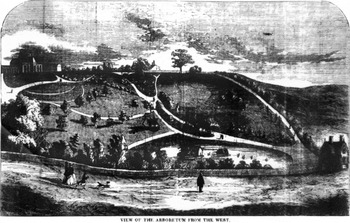
View of the Nottingham Arboretum from the west, Nottingham Review, 14 May 1852

A 15-foot wide path curved through the arboretum from the main entrance at the south-west corner to the lodge on Mansfield Road at the eastern end with a series of paths running off it to all parts of the park, varying from 6 to 20 feet wide. The central path was planted with rows of contrasting cedars, Cedar of Lebanon with its horizontal foliage and Cedrus deodara with drooping foliage. These were alternated with fast-growing limes to provide protection for the young trees, shade and ornament until the slower growing specimens attained maturity. Trees and shrubs generally were selected as being hardy enough to survive the local climate and were arranged in families as at the Derby Arboretum in alphabetical order of botanical names with ‘A’ beginning at the western lodge entrance and proceeding to the left hand along the outer walk. At around 1,010, the number of specimens was about the same as at Derby, each being arranged according to the ‘natural method’ defined as grouping or classifying plants together according to points of resemblance on the basis that bringing similar specimens together would illustrate the principle that external properties were accurate indictors of ‘internal properties’, whilst porcelain labels were attached to each as at Derby, specifying the Latin and English names, date of importation and height. Visitors could make comparisons between orders and families, especially when in flower, and by ‘pursuing a diligent course of study’ inspired by the arboretum, ‘an excellent practical acquaintance’ could be obtained on a subject ‘little understood’ by many urbanites. In contrast to the dead collections of a museum, this ‘access to a living collection of specimens’ would also help gentlemen to select the best trees and shrubs for the ornamentation of their grounds which would save expense and trouble.Footnote 29
Most specimens were supplied as saplings or seeds and planted by local nurseryman J.F. Wood, although the small size of some caused complaints. It was not thought possible to utilize the techniques for transplanting older trees that had helped form estate arboretums such as those at Chatsworth and Elvaston due to the nature of the soil. As the Nottingham Journal argued, every practical arboriculturist ‘must be aware that when large trees are transplanted, there is considerable risk that they may not thrive’ due to the sandy soil and that smaller plants were more likely to become established. Donations were offered by private individuals and members of the corporation whose acts were recorded in a register whilst the avenue of cedars was planted by councillors and their families. Some ‘large and handsome specimens’ were presented by Nottingham inhabitants including two Araucaria imbrecata, a Cedrus deodara, some large hollies by Thomas Cullen, the radical hosier and lace manufacturer, and a large quantity of ‘perennial and herbaceous plants’ for the decoration of borders by Wood the nurseryman.Footnote 30
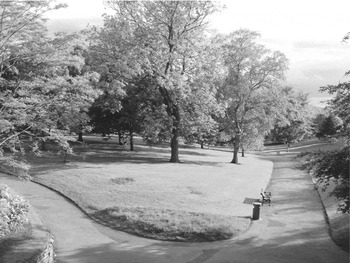
View across the Arboretum from the Addison Street Bridge

Situated towards the summit of a hill, the tunnel was designed to carry a new road over the park. It was very exposed at the beginning and a bed of holly trees was planted in front of the bridge to break and modify ‘the cutting blasts’ which blew through. There were also some large flower borders and near to the tunnel two single full grown trees and a big blackthorn. Seats were placed at intervals and the rest of the grounds were turfed with spaces set aside for dancing. The entrance lodge, designed by Wood to house the lodge keeper, was in the view of the Journal a ‘pretty structure in the Tudor gothic style’ and underscored the civic role of the arboretum with the town arms carved in stone into a chimney pier and three brass tablets over the north bay window. The tablets commemorated the dates of the enclosure act, the role of the council, the date of the arboretum and the names of the enclosure committee. The Tudor-style refreshment rooms, designed by Wood and built by James Ebrank Hall, were intended to be capable of holding up to 1,500 people and featured 100-hundred foot circular corridors on each side covered with sheet iron, providing much needed shelter in the early years. A separate ladies room was placed on the north-east corner of the building whilst adjoining was a refectory opening towards the banqueting room ‘fitted up with counters for the convenience of supplying the guests with refreshments’. The small lake supplied from St Anne's Hill reservoir by the Nottingham Waterworks Company had an irregular form and included two small islands for ducks, one of which had a ‘quaint-looking but pretty hut’ planted with ivy. The company also supplied water for the entire site through an ‘immense length’ of gutta percha tubing which allowed specimens to triumph over the dry sandstone soil.Footnote 31
As we have seen, the principal model for the design and management of the Nottingham Arboretum was the Derby Arboretum, and the enclosure committee looked carefully at the design of various British public parks and gardens and corresponded with the Derby committee who were happy to provide information. There was also an element of civic rivalry between the two towns, exacerbated by their proximity. The Nottingham Journal carried frequent accounts of the Derby Arboretum, Derby Mechanics' Institute and other civic recreational institutions, observing that the former afforded ‘in its collection of rare plants and trees, both instruction and recreation to the scientific botanist, as well as to his more unlearned brother’.Footnote 32 In an article on arboretums in his Magazine of Botany, Paxton had made implicit criticisms of Loudon's design for the Derby Arboretum and suggested that an arboretum was not appropriate for the site. Whilst Paxton argued that arboretums could make excellent public parks and encouraged their foundation across the country, he contended that they were only appropriate for situations that commanded interesting views or included rivers or lakes to command attention and interest. The Derby Arboretum did not offer interesting views of the surrounding country and all the attention was purposefully directed towards the interior with Loudon sculpting a series of undulating mounds to obscure the paths and create an illusion of space. The site for the Nottingham Arboretum, on the other hand, was exactly the kind of space recommended by Paxton for an arboretum. The view from the refreshment rooms allowed the entire site to be surveyed and when there was not too much industrial smoke, a ‘beautiful prospect’ was obtained of all the principal churches, Sneinton and Colwick woods. It was noted that though at 17 acres, the Nottingham Arboretum was larger than the Derby Arboretum, ‘it scarcely appears so extensive’ from the fact that all the boundaries were visible, yet, ‘this is an advantage’ for the ‘charming view of the whole ground’ provided, there being ‘at Derby . . . no landscape view whatever’.Footnote 33
The regulations of the Nottingham Arboretum were, as the committee acknowledged, ‘framed principally after the model’ of those at Derby although they also drew upon procedures at ‘other towns where similar public grounds exist’. In their view, Joseph Strutt's regulations for the Derby Arboretum had worked ‘remarkably well without having been altered except in some trivial matters’ and were therefore recommended by ‘eleven years experience’. Although a little smaller, charges at Nottingham were also based upon those at Derby, and the committee were encouraged by the fact that the Derby committee had amassed enough income from subscription fees and entrance fees to fund a large £3,000 extension, erect a lodge at a cost of £1,000 and still have £500 in the bank. The Derby committee also recommended that a turn stile be obtained for the entrances similar to those at the London Zoological Gardens and Regent's Park, although this was never adopted at Nottingham. The detailed information provided by the Derby committee and their willingness to help suggests that the role of civic rivalry between the two towns should not be exaggerated. Clearly emulation and co-operation were just as important if not greater factors in the development of the Nottingham Arboretum.Footnote 34
The management, status and use of the arboretum
The problems concerning funding and access to the arboretum highlight contradictions between control and popular access inherent in the concept of rational recreation and reflect underlying elite anxieties. These paralleled similar doubts and anxieties expressed by the middle class and gentry which cut across party political lines concerning the efficacy of other rational recreational institutions during the 1850s. They also lay behind attempts to promote new institutions that might be more successful at reaching women and those beyond the school leaving age, notably the promotion of a Nottingham collegiate college by Hugo Reid and the members of the Educational Society. Although intended to elevate ‘the working classes in the scale of moral and intellectual excellence’, it was noted that the ‘great majority’ of Mechanics' Institute members were not mechanics, and that neither the institutions nor the natural history museum were reaching the working classes as the artisan's library had succeeded in doing. There was disagreement as to whether it was necessary to maintain private middle-class access or widen access to encourage social intercourse between all classes.Footnote 35
The rational recreational and botanical pretensions of the Nottingham and Derby arboretums necessitated continuous expenditure to support the provision of hundreds of trees and shrubs, which some critics questioned. However, the Nottingham committee were also attacked by other opponents, especially Tory commentators in the Journal, for seeking cheap alternatives such as using the borough surveyor Wood to carry out work. ‘Oak Sapling’ condemned the incompetence of Wood and the committee on the grounds that ‘committees never have any taste’ but are ‘the evil genius against which the professional man they employ’ had to struggle. Wood displayed a ‘lack of taste, skill and experience’ whilst the decision to use ‘local talent’ contrasted unfavourably with the help solicited from Paxton by the promoters of the Doncaster Pleasure Grounds. Concerns were repeatedly expressed about the expensive alterations necessary at Nottingham, the legality of using corporation funds and the increase in rates required which must be a ‘very strong inducement against hastening on with the works’. Criticisms focused upon the arboretum's appearance, policing problems, access and funding. In sustained attacks during 1851 and 1852 the Journal complained about the plainness of the design with no interesting streams or fountains to provide novel sensations, the disorderly nature of planting, the gas tar walks and the lack of shelter, ‘mazy wanderings’ and ‘serpentine sinuosities to cheat the mind into an idea of vastness’. Wood's refreshment room design also attracted little praise from either the Liberal or Tory newspapers, the Review considering it inappropriate for the surroundings and the Journal describing it was a ‘very terrible looking battlemented centre-piece’ with two circular wings similar to a prison or ‘third rate station house on a leased railway branch’.Footnote 36 However, the strongest supporters of the venture, such as Felkin, were determined to ensure that it would remain an arboretum and that the 4,500 trees and shrubs ‘should be of as many various descriptions as possible’. The mayor reassured the committee that they had ‘endeavoured to obtain for the town the best arboretum at the cheapest possible rate’ whilst accepting that, as the death of some rare trees planted in 1849 and Curtis had warned, some specimens were unsuitable.Footnote 37
The arboretum regulations and admissions charges were intended to preserve order and buttress family life; however, they were never popular. The park was to be open gratis on Sundays, Mondays and Tuesdays except for special fete days when a charge would be levied, with opening times varied according to season. The subscription for individuals was 5s. a year and for boarding school pupils, 2s. 6d. annually, whilst other schools and parties were admitted ‘by special arrangement’. On non-free days the admission charges were 6d. for adults and 3d. for children under 14, children under the age of 9 not being admitted unless accompanied by an adult. Families were especially encouraged to attend as a body and were admitted on any day on payment of a pound annually, including members of their household and guests. Smoking was prohibited in refreshment rooms and grounds along with spirits, liquor, wine and dogs, the regulations being enforced by a park superintendent. On Sunday the arboretum did not open until 12.30 to encourage attendance at church and chapel, whilst refreshments were prohibited.Footnote 38
The Journal led opposition to charges with support from a couple of committee members on the grounds that it was the action of an ‘exclusive clique’ which went against the spirit of the enclosure act and was illegal for a ‘people's park’ intended for ‘the community at large’ in lieu of ‘ancient and extensive privileges’. The fear that intercourse between the classes would cause problems was answered by the argument that the ‘lower classes under proper police and other necessary regulations’, through contact with their ‘superiors’, would by example become elevated in their moral and intellectual condition, the former acting as salt to preserve ‘the masses’ from ‘moral corruption’. The example of the Derby Arboretum, frequently invoked by the committee in support of charging, was rejected on the grounds that it was donated by a wealthy individual. Of the other three local newspapers in Nottingham, the Review was sympathetic to the Liberal council but neutral on this issue, the Guardian opposed the charges and the Weekly Times supported them. Although land usage, institutional access and local government funding were important general political questions, local contingency and political expediency were important factors in these debates and adherence to paternalistic ideas of rational recreation cut across party lines. Tories in Derby, for instance, led the campaign against abolishing the charges for admittance to the Derby Arboretum during the 1860s and 1870s which was supported by local liberals including Edward Strutt and Michael Thomas Bass, the wealthy brewing magnate.Footnote 39
The dispute at Nottingham reached a climax in 1857, fed by inconclusive legal opinions, when a public meeting was held chaired by the mayor in April in response to a requisition signed by 680 names. A paper war was conducted on the issue which the Review likened to an election campaign and speakers against the charges included the physician Dr Thomas Wilson, Rev. William Butler and others who spoke dramatically of being turned away at the gates without tickets and of the real financial value of the arboretum computed at £26,000. It was claimed that ‘all classes of the clergy . . . all classes of surgeons, by the respectable portion of the attorneys, and by the greater proportion of the merchants and manufacturers of the borough’ opposed the charges. The example of successful free parks in Birkenhead, Liverpool and Manchester was adduced, whilst it was argued that the beneficial effects on the working classes such as encouraging a taste for natural history were stymied through exclusivity. The enclosure committee asserted in defence of charges that the arboretum was more than ‘a mere place of recreation’, but an ornamental and botanical institution of a ‘higher class’, a ‘people's garden’ for all classes, where ‘young and old of all ranks can resort’, a buttress to civic pride and ‘an honour and ornament to the town’ which would degenerate if subscription income was not secured. However, despite a petition in favour of charging presented by Edwin Patchitt, solicitor to the improvement commissioners, signed by 1,655 working men, 6,572 from the staple trades, 2,994 ratepayers and 156 bankers, merchants and manufacturers, legal advice to the committee concluded that that it was illegal and that repair and maintenance was only a valid charge on borough funds if luxuries such as the ‘ornamental gardens with costly shrubs, flowers, greenhouses’ and objects of art were not included. The arboretum was henceforth supported from borough funds but staff and embellishments were reduced, all water fowl were returned and the supervision of the arboretum was placed in the hands of the police.Footnote 40
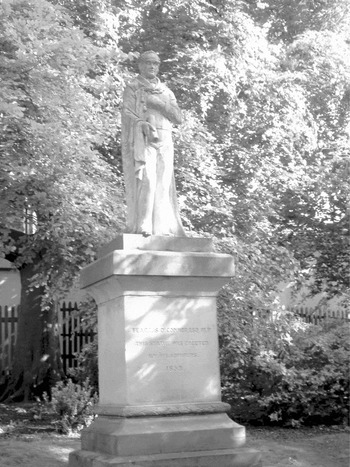
Statue of Fergus O'Connor

Admission charges were justified on the basis that the arboretum was a special and almost sacred space which required financial support for maintenance, repairs and policing, and the committee tried to preserve the neutrality of the arboretum. As Felkin the mayor expressed it in 1852, after some trees had been damaged, the arboretum was ‘the property of the public’ and as such should ‘ever be held sacred’. When young plants were destroyed ‘they were annihilating’ that which in 30 years would be ‘a large and beautiful tree, shedding a beauty on the scene and providing a comfortable shelter for the public’. Similarly, in 1859 the committee described the arboretum as ‘neutral ground’ which ‘should be kept and maintained as such’ and objected to religious sermons in the grounds even on Sundays on the grounds that it was ‘not a desirable place for public preaching’. However, the emphasis upon special neutrality contrasted with the freedoms traditionally available in public open spaces on the urban periphery and exposed contradictions inherent in the concept of rational recreation and arguments within the middle-class elite. It was difficult to combine sober rational recreation, botanical education and middle-class family promenading whilst providing a space for working-class fun and enjoyment as the efforts by the committee to police and control behaviour within the arboretum and public walks reveal.Footnote 41
In July 1852 it was resolved that a notice board be put up in the Queen's Walk cautioning persons from breaking the fences and doing other damage and in August 1853 in response to the fact that several labels in the arboretum had been broken and plants injured, the committee placed notices in the newspapers, the arboretum and significantly the ‘lower parts of the town’, offering rewards for information concerning the perpetrators. In 1856 reports of raucous behaviour included loud talking and the kicking of an India rubber ball by workpeople from a local factory, which was confiscated by park officials, whilst policemen were stationed in the arboretum, especially on festival days, to keep order, and games and sports were forbidden on Sundays by notices. In 1857 it was reported that the gates had been damaged, the tessellated pavements torn up, windows broken, half of the 500 botanical labels destroyed, basting hooks tossed into the lake and birds attacked, whilst youths had carved ‘hieroglyphics’ into trees. The clumps of trees and shrubs also provided cover for sexual activity and the committee complained that ‘the grossest indecency was sometimes witnessed in the walks’. In 1860 it was ordered that a board be placed in the park ‘for the purposes of painting thereon’ the names of those convicted ‘of doing damage to any of the recreation grounds’. Although it is possible that some of these events demonstrate resentment against the charges, they were not a systematic attempt to subvert the authority of the park managers. They are typical of attempts by governing committees of Victorian public parks as representatives of the elite to maintain order and control using park staff and police officers.Footnote 42
The attempts to protect the neutrality of the arboretum are also evident in a dispute in 1858 and 1859 concerning the provision of a statue of Fergus O'Connor, the controversial Chartist leader who had served as MP for Nottingham for a short time. Chartism remained strong in Nottingham after its importance had receded in many other places, partly due to the stagnation and decline of the framework knitting industry, and local Chartists even formed an alliance with Tories to defeat a Liberal candidate in elections. In 1858 and 1859 well-attended meetings supported by some local councillors passed resolutions calling for manhood suffrage, ballot voting, three year parliaments, the ending of property disqualifications and other reform demands. Despite petitions the arboretum committee were not enthusiastic about erecting the statue in the park, noting that it was ‘not an appropriate place for the erection of monuments of a political or sepulchral character’ and a counter petition attacked the character of O'Connor. Under pressure after a council vote in favour, they gave way on the questionable grounds that they wished ‘to encourage the creation of works of art in the Arboretum’ and on condition that they could see the statue, read the inscription and select the site prior to its erection.Footnote 43
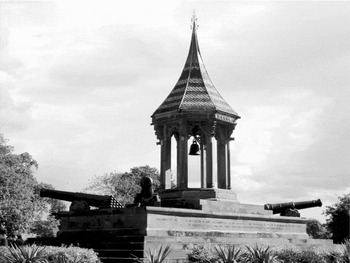
As Chartism receded, the importance of the arboretum for collective civic, national and imperial activity and symbolism increased and is evident in the provision of statues, symbolic furniture and other features. Furthermore, as at Derby, it was rapidly clear that an extension was required and a petition from six local medical men, Thomas Hawksley the engineer and other professionals and businessmen in 1853 supported the move on the grounds that the ‘picturesque and beautiful appearance of the grounds’ and ‘the free circulation of air’ so beneficial to individual health and the growth of the plants were under threat from residential and industrial building. In 1857, as a symbol of their support for the Liberal Palmerston administration's foreign policy and with an eye to trophies that had been obtained for other parks, the council decided to request some Russian guns be procured from the Crimea to be placed in the arboretum. Care was taken to make these appear authentic, with imitation Russian carriages being procured from Woolwich and Colonel Leslie of the Royal Artillery being consulted on positioning and whether they could be fired with safety. The guns were initially placed on bastions on the south side of the flat ground below the refreshment rooms, but in 1862, a building intended to have a Chinese character was commissioned to hold a bell looted from a Chinese Temple during the Opium War and given to the town by the 2nd Nottinghamshire regiment. This ‘Chinese’ temple situated on top of a hill and surrounded by the guns and formal beds was intended to celebrate civic and imperial pride but was a curious amalgam of trophies and commemorations of Indian, Chinese and Crimean campaigns. With its celebration of aggressive imperialism, the temple further demonstrated that the neutrality of the arboretum could not be maintained. It was far removed from the nature poetry, Quakerism and rational recreation of the Nottinghamshire school that had helped to inspire enclosure.Footnote 44
‘Chinese’ bell pagoda and cannon

Conclusion
The development of public arboretums at Nottingham and other Victorian towns, including Derby, Lincoln, Worcester and Walsall, was stimulated partly by the rhetoric of rational recreation and the need to create public open spaces. The choice of an arboretum gave these public parks a distinctive character that was appreciated by founders, patrons and visitors. The special position of trees in British culture offered a sense of permanence transcending the immediacy and contingency of place and time, providing solace in the face of anxieties percolating beneath the veneer of confidence in mid-Victorian England supposedly epitomized by the Great Exhibition. Towns such as Nottingham were undergoing the greatest demographic and physical expansion in their history, whilst received intellectual, political and religious systems were apparently cast into doubt by radicalism and scientific discovery. As some of the supporters of the Nottingham Arboretum observed, visitors could transcend their immediate spatial and temporal position and take comfort from the invocation of past and future. The names of areas covered by the enclosure act and speeches at the opening ceremony evoked memories of the landscape, myths and history of Nottinghamshire, especially Robin Hood and Sherwood Forest, as promoted by the Sherwood Forest group of writers. Felkin noted that the outlaw would have been found ‘passing along the ranges of hills around us, endeavouring, in his rude fashion, to consult the interests of the people at large’. Had he ‘lived to this day’ he would have supported the present British constitution and even the arboretum itself so ‘we should have numbered him to-day among our spectators, or rather he would have been one of the chief actors in this scene’. Similarly, the refreshment room foundation stone laid at a civic ceremony in August 1851 contained a metal box with contemporary coins, a list of the corporation, a plan of the town and a newspaper containing a report of the last council meeting. A slip of parchment stating the objects of the arboretum was also placed in the box, for, as Felkin reminded the audience, ‘the day was far off when the trees they had seen that day would arrive at maturity, but they planted, as Lord Bacon said, for posterity’.Footnote 45