Introduction
Social anxiety refers to persistent fears of situations involving social interaction, social performance, or social situations in which there is the potential for negative evaluation by others (American Psychiatric Association, 2013). Social anxiety may cause considerable personal distress and impairment in social, occupational, or other important areas of functioning (Van Ameringen, Mancini, & Farvolden, Reference Van Ameringen, Mancini and Farvolden2003). Distress is an unpleasant state of mind with psychological symptoms such as being tense, restless, worried, afraid, and irritable. Physical symptoms can include headaches, stomachaches, and dizziness, and some find it hard to relax (Heimberg, Reference Heimberg1995). Those with social anxiety commonly fear social situations, such as public speaking, which is quite common, as one-third of a community sample of adults reported excessive anxiousness when speaking to a large audience (Stein, Walker, & Forde, Reference Stein, Walker and Forde1996). Students with social anxiety are at the greatest risk of dropping out of high school and speaking in front of the class is a common reason for leaving high school prematurely (Van Ameringen et al., Reference Van Ameringen, Mancini and Farvolden2003). Individuals with social anxiety tend to underachieve at work or school, as evidenced by the fact that they are more likely to have a lower income, lower level of education and more likely to be unemployed (Stein, Walker, & Ford, Reference Stein, Walker and Ford1994). Social anxiety can, therefore, profoundly impact individuals’ quality of life (Paul & Moser, Reference Paul and Moser2009).
However, the mechanism of how social situations may lead to psychological and physical distress needs to be better understood. One potential explanation is fear of negative evaluation (FNE), where people with social anxiety worry that others will judge or disapprove of them (Winton, Clark, & Edelmann, Reference Winton, Clark and Edelmann1995). When around others, people with social anxiety search for signs or information that indicate how others view them (Rapee & Heimberg, Reference Rapee and Heimberg1997), may overestimate how negative others might be towards them and fear the consequences that can follow a negative evaluation (Wong, Gordon, & Heimberg, Reference Wong, Gordon, Heimberg and Weeks2014). FNE in relation to social anxiety may have roots in bullying victimisation in childhood, where individuals may start to avoid situations where others might negatively evaluate them. Without intervention, this avoidance can continue or even increase throughout the lifespan (Iverach, Rapee, Wong, & Lowe, Reference Iverach, Rapee, Wong and Lowe2017).
The most researched and established cognitive behavioural models of social anxiety are those proposed by Clark and Wells (Reference Clark and Wells1995) and Rapee and Heimberg (Reference Rapee and Heimberg1997). Both models emphasise maintaining factors for social anxiety: FNE and performance failure, and self-focused attention. Individuals with social anxiety are more likely to show a variety of behaviours to avoid negative evaluations or situations that can evoke them and they have biases towards excessively detecting social evaluative threats (Asmundson & Stein, Reference Asmundson and Stein1994; Buckner, Maner, & Schmidt, Reference Buckner, Maner and Schmidt2010; Mansell, Ehlers, Clark, & Chen, Reference Mansell, Ehlers, Clark and Chen2002; Vassilopoulos, Reference Vassilopoulos2005). Their fear of social evaluation is partly due to a lack of confidence in perceived social skills (Lundh & Sperling, Reference Lundh and Sperling2002) and in part because they believe that their anxiety is both easily noticeable and highly detrimental to their social standing (Bögels, Alberts, & De Jong, Reference Bögels, Alberts and de Jong1996; Bögels & Mansell, Reference Bögels and Mansell2004; Mogg, Philippot, & Bradley, Reference Mogg, Philippot and Bradley2004). The interaction of the excessive FNE, attentional biases, and self-focused attention leads individuals to ignore stimuli that would otherwise disprove their fears. They instead focus on their own heightened emotional state and take that as evidence for their perceived social failure (Hirsch & Clark, Reference Hirsch and Clark2004). Due to the maintaining role that FNE plays in social anxiety, it is a key target for change in cognitive behavioural therapy (CBT; Hofmann & Otto, Reference Hofmann and Otto2017). Empirical studies confirm these theories, showing a positive and moderately strong relationship between social anxiety, FNE, and distress, even though formal mediation testing of FNE was not carried out (García-López, Olivares, Hidalgo, Beidel, & Turner, Reference García-López, Olivares, Hidalgo, Beidel and Turner2001). Also, interventions emphasising exposure and social skills have been found to be effective in reducing social anxiety among youth (Warner et al., Reference Warner, Fisher, Shrout, Rathor and Klein2007).
Studying the role of FNE in a naturalistic setting may be challenging because few individuals with social anxiety are willing to enter anxiety-provoking situations, such as speaking in front of an audience. As people with social anxiety associate public speaking with significant distress, they tend to avoid public speaking whenever possible (Iverach et al., Reference Iverach, Rapee, Wong and Lowe2017). However, virtual reality (VR) can be applied in this situation, which lets individuals enter a virtual environment without being there physically (Steuer, Reference Steuer1992). Users wear an immersive head-mounted audio-visual display unit, coupled to their head movement, to see and hear the computer-controlled environment, and interact with it relatively naturally using wireless hand-held controllers (Bricken & Byrne, Reference Bricken and Byrne1993).
Studies show that VR is effective in eliciting a stress response when participants are asked to give a talk in front of a virtual audience, both when measured as subjective distress (Owens & Beidel, Reference Owens and Beidel2015) or physiological arousal (Kothgassner et al., Reference Kothgassner, Felnhofer, Hlavacs, Beutl, Palme, Kryspin-Exner and Glenk2016; Owens & Beidel, Reference Owens and Beidel2015). Therefore, unsurprisingly, virtual reality exposure treatment (VRET) for social anxiety is equally effective or better than in vivo exposure (Botella, Fernández-Álvarez, Guillén, García-Palacios, & Baños, Reference Botella, Fernández-Álvarez, Guillén, García-Palacios and Baños2017; Bouchard et al., Reference Bouchard, Dumoulin, Robillard, Guitard, Klinger, Forget and Roucaut2017; Chesham, Malouff & Schutte, Reference Chesham, Malouff and Schutte2018; Kampmann, Emmelkamp, & Morina, Reference Kampmann, Emmelkamp and Morina2016), with improvements maintained at 6- and 12-month follow-up (Anderson et al., Reference Anderson, Price, Edwards, Obasaju, Schmertz, Zimand and Calamaras2013; Bouchard et al., Reference Bouchard, Dumoulin, Robillard, Guitard, Klinger, Forget and Roucaut2017). These positive effects appear to be quite strong and can be detected following a single session of VR (Kahlon, Lindner, & Nordgreen, Reference Kahlon, Lindner and Nordgreen2019) and even when the VR is completely administered online, without interaction with a therapist (Lindner et al., Reference Lindner, Miloff, Fagernäs, Andersen, Sigeman, Andersson and Carlbring2019).
However, these VR studies rarely examine the mechanism proposed by cognitive models in detail; that is, the role of FNE. More attention should be paid to this topic, given how central FNE is in social anxiety. The limited work on FNE in this context has shown decreases in social anxiety symptoms and FNE following exposure (either virtual or in vivo) (Bouchard et al., Reference Bouchard, Dumoulin, Robillard, Guitard, Klinger, Forget and Roucaut2017). Another study also found greater decreases in social anxiety and FNE following VR, compared with a control group (Lin et al., Reference Lin, Lee, Cheung, Ling, Poon, Lim and Guan2019). However, these studies did not formally test for mediation in their analyses, or have FNE as their specific focus. Reducing FNE could potentially make these types of treatments even more effective by addressing the central cognition involved. Identifying this mechanism is essential, as it provides intervention targets, both within and outside of the VR environment itself. The purpose of the current study was, therefore, to examine the relationship between social anxiety symptoms, distress, and FNE among students giving a presentation in a VR environment to a virtual audience of people watching them. Participants were told that when they were in front of the virtual audience, they were supposed to give an impromptu talk, which they had little time to prepare for. Participants wore a head-mounted display and headphones, and reported their distress at several time points. It was hypothesised that: (1) distress in the VR environment would be greater among those with greater social anxiety symptoms and (2) FNE would mediate the relationship between social anxiety and distress.
Method
Participants
This experimental study took part at an Icelandic university where participants (N = 58) ranged in age from 19 to 35 years (M = 23.4, SD = 4.1), 70% female. The researchers introduced the study to students in undergraduate classrooms (where participants could receive course credit) and an email was also sent to all students at the university introducing the study. The introduction material briefly outlined the purpose of the study and students were encouraged to attend, especially those who felt that they have suffered from social anxiety or felt anxious speaking in front of others. A schedule with available dates and times was accessible to all students online where interested participants could sign up on a date and time that was convenient for them. Eligibility criteria included being a student at the university and fluency in both spoken and written Icelandic.
Measures and Materials
Social anxiety
This was assessed with two self-report scales, which together form one higher-order factor, social anxiety (Safren, Turk, & Heimberg, Reference Safren, Turk and Heimberg1998). The first was the Social Interaction Anxiety Scale (SIAS), which assesses stress individuals feel around others. The second was the Social Phobia Scale (SPS), which measures fear of being judged or observed by others while doing some kind of performing (Mattick & Clarke, Reference Mattick and Clarke1998). Each scale contains 20 items measured on a 5-point Likert scale. Both scales have shown good divergent validity, high consistency, and high test–retest reliability (Mattick & Clarke, Reference Mattick and Clarke1998). The Icelandic language version of these scales also has good convergent validity and good reliability (Ólafsdóttir, Reference Ólafsdóttir2012). In the present study, internal consistency was high (SIAS Cronbach's α = .91, SPS Cronbach's α = .84). The two subscales have a high correlation (r = .74, p < .001).
Fear of negative evaluation
This was measured with the Brief Fear of Negative Evaluation Scale (BFNE; Leary, Reference Leary1983), a self-report scale with 12-items answered on a 5-point Likert scale. The BFNE was translated into Icelandic and back-translated for this study. BFNE has shown good internal consistency in English (Cronbach's α = .92) and both factorial and construct validity (Rodebaugh, Holaway, & Heimberg, Reference Rodebaugh, Holaway and Heimberg2004). In the present study, internal consistency was high (Cronbach's α = .93).
Subjective distress
Subjective Units of Distress Scale (SUDS) is a single-item self-report measure. It measures distress at a given moment (Bremner et al., Reference Bremner, Staib, Kaloupek, Southwick, Soufer and Charney1999), such as before walking into a VR environment and while in the VR environment. Scores on the scale are from 0 (no distress) to 100 (the most distress possible). SUDS was used to assess subjective feelings of distress. Participants rated their distress three times, at baseline (before entering the virtual environment), standing in front of the classroom door and immediately after giving the presentation.
VR equipment
The head-mounted display used was a first-generation HTC Vive. The device uses two screens, one per eye, each having a resolution of 1080 × 1200 with a refresh rate of 90 Hz. The field of view is approximately 110°. The headset uses a gyroscope, an accelerometer, and 70 infra-red sensors to track the user's movement within the virtual environment. The tracking space, covered by two infra-red light beacons picked up by the Vive headset, was a 4.6 m by 4.6 m space in which the user can freely walk in any direction. The Vive was also fitted with Bose noise-canceling headphones to exclude external sounds.
Virtual environment
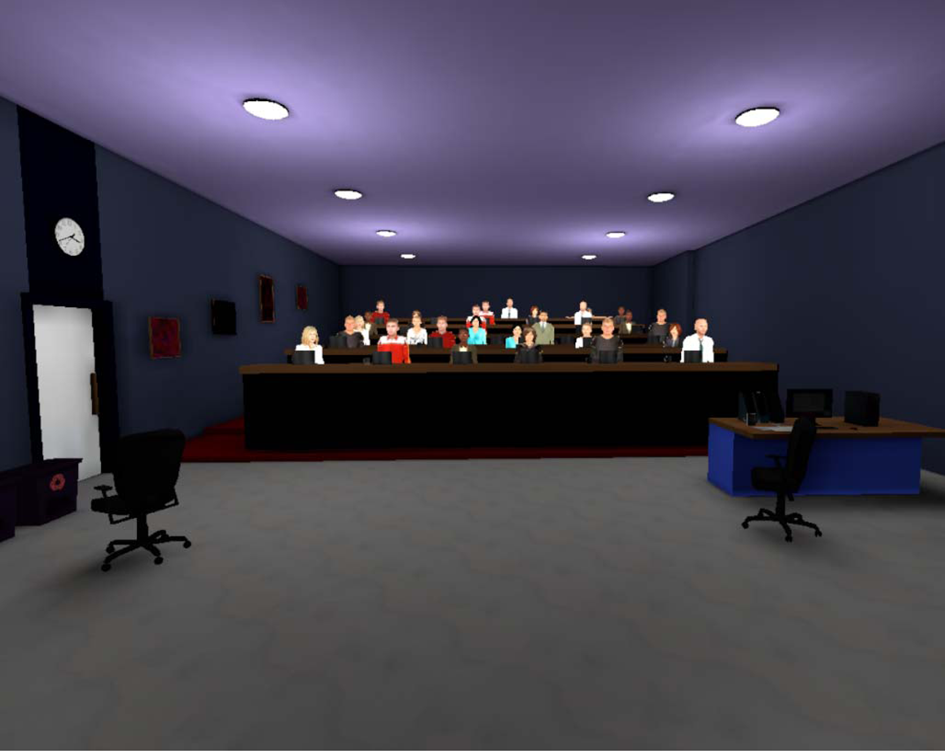
The VR environment comprised a hallway, a classroom, and a door between them. The hallway was an empty corridor with a single door that leads to the front of an auditorium-style classroom, with virtual characters seated by narrow desks arranged in elevated rows towards the back of the room (see Figure 1). All of the characters displayed some relatively subtle idle motion to appear alive, and some of the characters looked directly at whoever would be standing in the front. A background sound played continuously, while participants were in the environment. The sound was a mixture of noises commonly associated with classrooms, for example, shuffling papers, sounds of occasional keyboard typing, and low murmurs. The sound was at a low volume so that it would not be distracting, but loud enough so that there was never a moment of complete silence. As part of the study, participants were asked whether anything in the virtual environment had bothered them or whether they noticed any flaws with the technology, which was not reported by any participants.
Picture of the auditorium-style classroom, as seen from the perspective of the participant.

Procedure
The study took place in a private room at the university. Participants had made an appointment and took part individually. Students who participated in the study had received an email and/or an introduction in class about the study. The study was explained to participants, and written consent obtained. Participants began by answering questionnaires. Then, they were told that they would give an approximately 3-min-long presentation about the university in front of a virtual audience. No notes or other visual aids were allowed in the VR environment. To help them prepare, the participants were given a leaflet about the university and told they could base their presentation on the information it contained, or on their own experience of the university. Participants were given 2 min to prepare on their own. Instructions were given on how to move in the virtual environment, and then, the VR headset and headphones were put in place.
Upon entering the virtual environment, the participant stood in front of a door in an empty hallway. Participants walked straight through the open door and into a classroom with 20 virtual characters seated facing the participant. The participant then gave the presentation to the virtual audience, thanked the audience for listening, and then removed the head-mounted display. Participants rated their distress (1) before entering the virtual environment, (2) standing in front of the classroom door, and (3) immediately after giving the presentation. This project was part of a more extensive study examining the role of wait times on social anxiety, so within the virtual environment, half the group was asked to walk directly into the classroom and begin speaking, but the other half was asked to wait for 2 min before entering the classroom. The two groups did not differ on the variables examined in this project and were, therefore, examined as one group. Finally, we thanked our participants for taking part and informed them that they had now completed their contribution to our study. Permission for the study was obtained from the National Bioethics Committee in Iceland (VSN-18-015).
Data Analysis
To create the social anxiety variable, scores were summed from the SIAS and SPS measures, similar to other work (Mattick & Clarke, Reference Mattick and Clarke1998) and the combined Icelandic version has better psychometric properties than separate scales (Ólafsdóttir, Reference Ólafsdóttir2012). Pearson correlations were carried out to examine the binary relationships between social anxiety, FNE, and distress at different time points. The primary dependent variable was distress during the three experimental periods (i.e., (1) baseline, (2) while standing in front of the classroom door, and (3) after the presentation). The main predictor variable was social anxiety, and the mediator variable was FNE. Baseline distress was included as a covariate in all analyses because higher levels of social anxiety were associated with higher levels of distress during the baseline period (r = .48, p < .0001). The general linear model (GLM), with experimental period (standing in front of the classroom and after presentation) as the within-subject factor and social anxiety as the predictor variable, was used to examine the hypothesis that students with higher levels of social anxiety would report higher levels of distress both while waiting in front of the classroom door and directly after the presentation. GLM was also used to examine if FNE was associated with higher levels of distress in the VR environment. GLM assumptions were either met or corrected for. Lastly, regression mediation analyses were conducted using the Hayes Process tool (Hayes, Reference Hayes2015) with 5000 bootstrapped samples to examine the hypothesis that FNE would mediate the relationship between social anxiety and distress in the VR environment.
Results
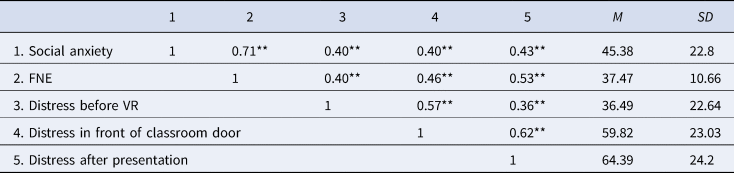
Descriptive information for the study variables is presented in Table 1, along with Pearson correlations. The table shows that distress in the group starts low and then increases when waiting in front of the classroom door, and is even greater just after giving the presentation. The relationships between social anxiety, FNE, and distress are all positive and either modestly or highly correlated.
Descriptive Statistics and Correlations Between Variables

**p < 0.001.
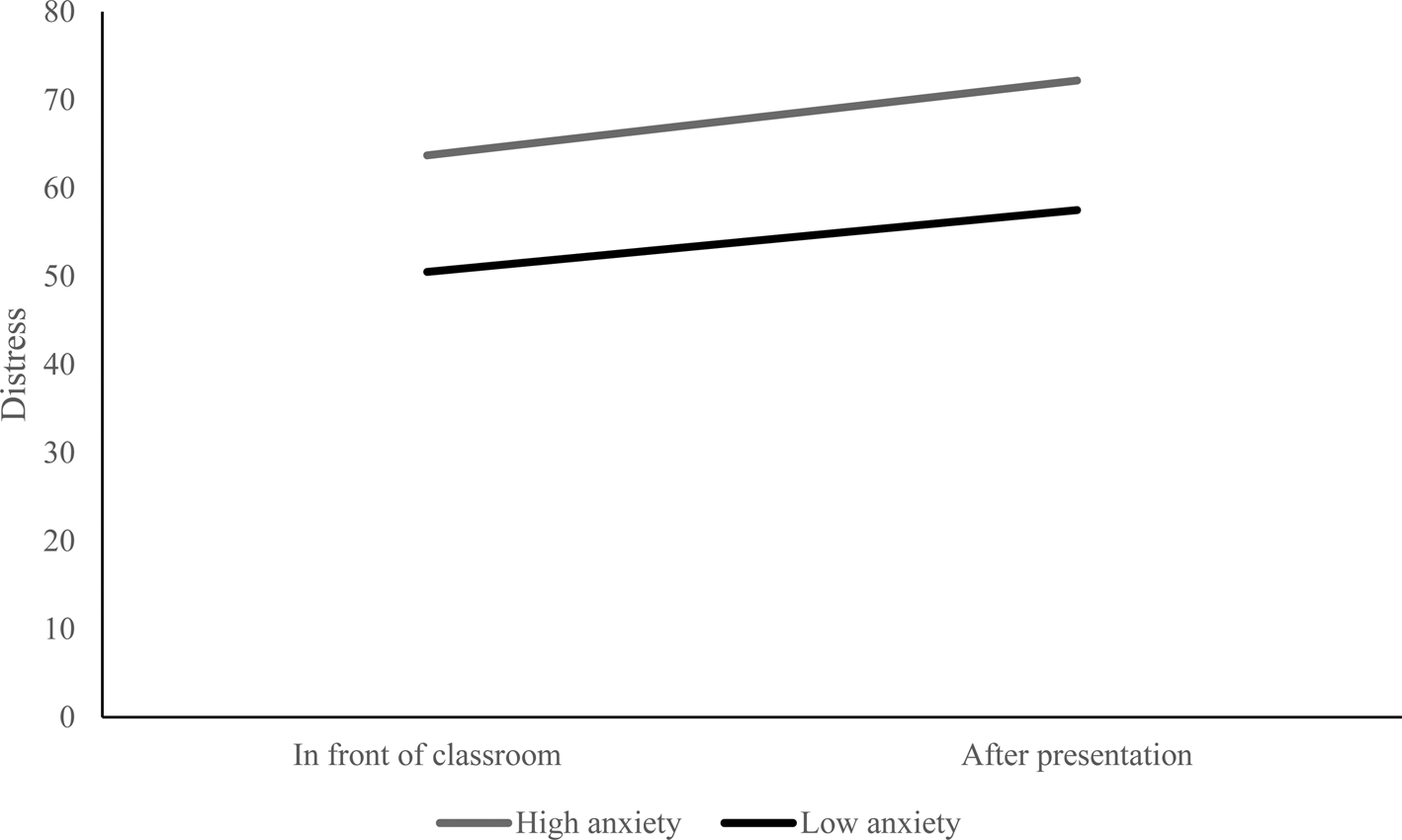
Repeated measures analyses of variance using GLM with experimental periods (i.e., standing in front of the classroom door and immediately after presentation) as the within-subject factor, social anxiety as the predictor variable, and baseline distress as a covariate showed that the main effect for baseline distress was significant (F(1, 48) = 9.09, p = .004) and the main effect for social anxiety was significant (F(1, 48) = 6.08, p = .002). The interaction between experimental period and social anxiety was not significant (F(1, 48) = 1.20, p = .29) indicating that social anxiety was associated with higher distress levels both while standing in front of the door (partial eta-squared (η2 = . 06)) and directly after giving the presentation (partial eta-squared (η2 = .12)). To show this relationship, a median split was performed on the social anxiety variable, and the means are displayed in Figure 2, adjusting for baseline differences.
Distress during the experimental periods for below and above the median on social anxiety (measured with a combination of scores on SIAS and SPS).

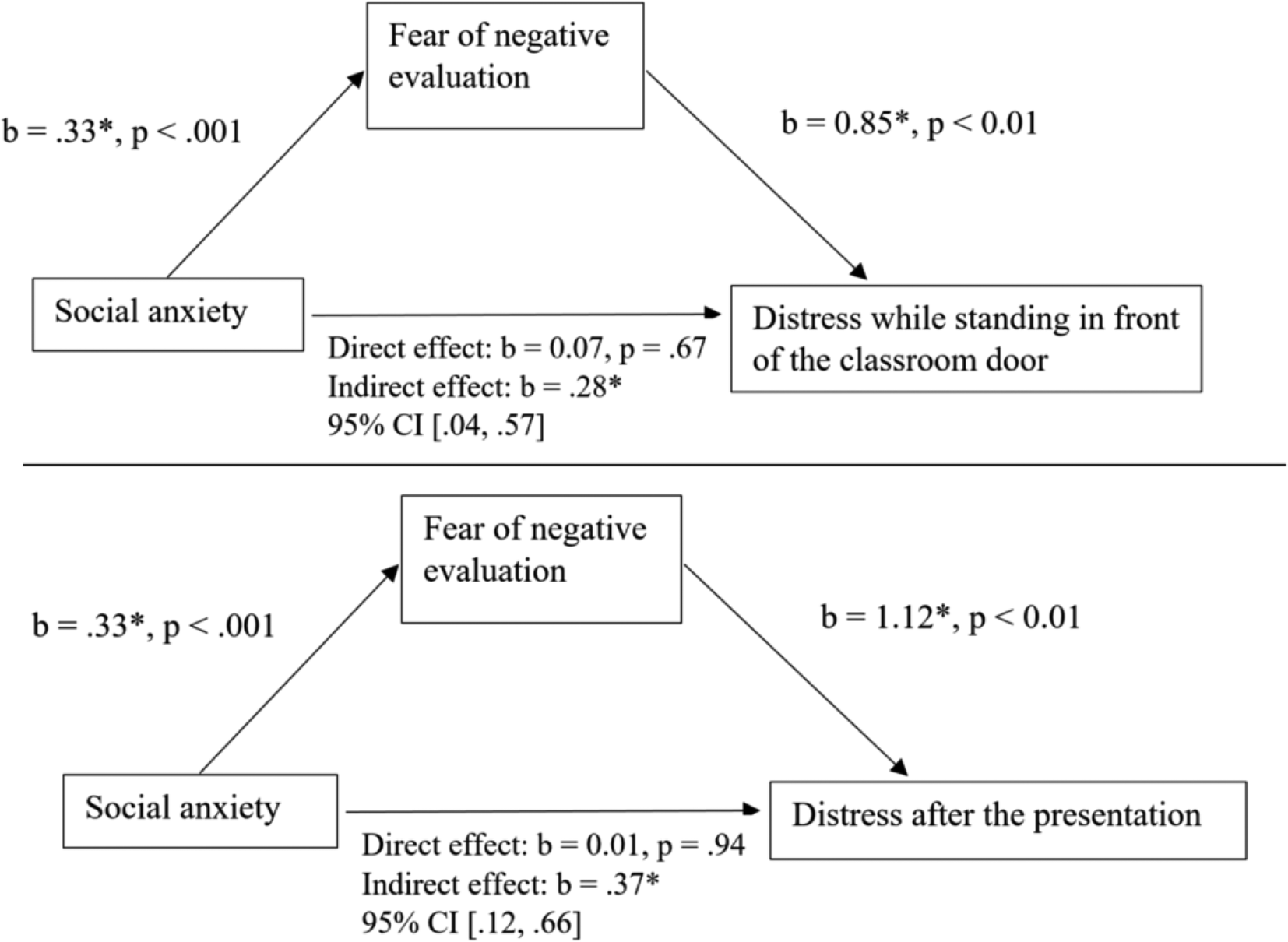
Before testing the mediational hypothesis that FNE would mediate the relationship between social anxiety and distress, we first confirmed, using Pearson correlation, that higher levels of social anxiety were associated with higher levels of FNE (r = .71, p < .0001), and then that higher levels of FNE would be associated with higher levels of distress in the VR environment. GLM with baseline distress as a covariate, experimental periods as the within-subject factor, and FNE as the predictor variable showed that the main effect for distress at baseline was significant (F(1, 48) = 9.34, p = .003) and the main effect of FNE was significant (F(1, 48) = 12.85, p = .001). The interaction between experimental period and FNE was not significant (F(1, 48) = 0.64, p = .42) indicating that FNE was associated with higher distress levels both while standing in front of the door (partial eta-squared (η2 = .21)) and directly after giving the presentation (partial eta-squared (η2 = .20)). Finally, we examined whether FNE mediates the relationship between social anxiety and distress during the experimental periods. Two mediation models were examined, one where participants were in the VR standing in front of the classroom door before performing their presentation, and directly after the presentation. As shown in Figure 3, social anxiety had a positive relationship with distress while standing in front of the classroom door, which was fully mediated by FNE, b = .27, 95% CI [.030, .542]. FNE also fully mediated the relationship between social anxiety and distress directly after the presentation, b = .36, 95% CI [.109, .640).
FNE as a mediator between social anxiety and distress, both while standing in front of the classroom door and after the presentation.

Discussion
The goal of the present study was to examine the relationship between social anxiety and distress among university students in a social environment simulated in VR and to determine whether FNE mediated the relationship between social anxiety and distress. The VR environment was successful in creating a socially stressful situation, which was evidenced by heightened distress both before and after the presentation when controlling for baseline distress. This is consistent with other work showing that VR can induce the stress necessary for exposure treatment, such as for arachnophobia, claustrophobia, and acrophobia (Botella et al., Reference Botella, Fernández-Álvarez, Guillén, García-Palacios and Baños2017; Bruce & Regenbrecht, Reference Bruce and Regenbrecht2009; Carlin, Hoffman, & Weghorst, Reference Carlin, Hoffman and Weghorst1997). The VR application is particularly useful for exposure therapy for people with social anxiety because they may actively avoid public speaking (Iverach et al., Reference Iverach, Rapee, Wong and Lowe2017).
Our finding that social anxiety symptoms were associated with FNE is also in line with previous studies (Sapach et al., Reference Sapach, Carleton, Mulvogue, Weeks and Heimberg2015; Wong et al., Reference Wong, Gordon, Heimberg and Weeks2014; Wong & Rapee, Reference Wong and Rapee2016). For example, Wong et al. (Reference Wong, Gordon, Heimberg and Weeks2014) found that people diagnosed with social anxiety overestimate the negativity with which others might view their performance, overestimate the probability of negative evaluation and fear the consequences that can follow a negative evaluation. Also, the finding that higher levels of FNE were associated with higher levels of distress in the VR environment is partially in line with the study by García-López et al. (Reference García-López, Olivares, Hidalgo, Beidel and Turner2001), who found a positive correlation between FNE and distress. In our study, the relationship between FNE and distress is also stronger just after giving the presentation rather than when waiting in the VR environment, suggesting that FNE from the virtual audience could be inducing even greater distress. Our findings extend previous work by demonstrating that FNE predicts distress among individuals giving a presentation in front of VR characters, suggesting that virtual interventions focusing on FNE might reduce public speaking performance distress.
The central hypothesis of the current study was that FNE would mediate the relationship between social anxiety and distress (while waiting for the presentation and afterward). FNE emerged as a full mediator, as the relationship between social anxiety and distress while standing in front of the classroom door and right after the presentation periods became non-significant when FNE was entered into the model. These findings are consistent with cognitive models of anxiety, which consider an FNE as an essential factor in social anxiety (Heimberg, Reference Heimberg1995; Wong et al., Reference Wong, Gordon, Heimberg and Weeks2014). FNE has previously mediated the relationship between social anxiety and self-esteem (Cheng, Zhang, & Ding, Reference Cheng, Zhang and Ding2015) and eating disorder symptoms (Levinson et al., Reference Levinson, Rodebaugh, White, Menatti, Weeks, Iacovino and Warren2013; Menatti, DeBoer, Weeks, & Heimberg, Reference Menatti, DeBoer, Weeks and Heimberg2015), but to our knowledge, this is the first study to formally test FNE as a mediator between social anxiety and distress in a VR environment.
Using VR in treatment can be an effective alternative to in vivo exposure (Botella et al., Reference Botella, Fernández-Álvarez, Guillén, García-Palacios and Baños2017; Bouchard et al., Reference Bouchard, Dumoulin, Robillard, Guitard, Klinger, Forget and Roucaut2017; Chesham et al., Reference Chesham, Malouff and Schutte2018; Kampmann et al., Reference Kampmann, Emmelkamp and Morina2016). With growing interest in the field and new emerging technology, designing realistic virtual environments is becoming less costly and time-consuming. Using this technology has the potential to attract clients that may have been reluctant to seek treatment due to concerns over in vivo exposure. Showing that FNE mediates the anxiety response of participants in a VR environment adds to the expanding literature around VR-based interventions by indicating that the same cognitive maintenance processes are targeted. If exposure in VR can target the same processes as exposure in vivo, it may lead to it being used as a viable alternative in clinical settings.
The present study has some limitations. Participants were all students at an Icelandic university, and most participants were students in the Psychology department. Therefore, it could be difficult to generalise the results to other groups. It is also possible that students with extremely high levels of social anxiety did not participate in the study. Furthermore, the sample was small, which may have resulted in low statistical power, although significant effects were detected. Finally, the present study only included FNE, but it has been shown that fear of positive evaluation has similar effects to FNE (Sapach et al., Reference Sapach, Carleton, Mulvogue, Weeks and Heimberg2015), so it would be interesting as well to explore those factors together when it comes to social anxiety.
Despite these weaknesses, this is the first study to formally test FNE as a mediator between social anxiety and distress in a virtual environment. The findings indicate that interventions, even those based on virtual social stimuli that aim to reduce FNE among individuals with high levels of social anxiety, may be useful in reducing the impact on the distress of presenting in front of an audience. Future research should, therefore, more systematically employ VR solutions when studying psychological phenomena, as they can be useful in practice to reduce distress, as well as to test components of theoretical models.