Introduction
Maize is a pivotal cereal crop, with 56% of its production (dry grain) primarily used as feed and 13% used for food, amounting to a consumption of 18.5 kg/capita/year (FAOSTAT, 2021). Owing to its ability to thrive in a wide range of agro-climatic conditions, it is cultivated across 160 countries with acreage of 201 mha (FAOSTAT, 2022). Diseases have remained one of the significant setbacks in achieving this crop's potential yield as it is prone to nearly 115 diseases caused by viruses, bacteria, fungi and nematodes, in vivid regions of the world, which leads to significant yield losses (Malik et al., Reference Malik, Gogoi, Hooda and Singh2017).
The current decade has witnessed remarkable growth in maize production, with all sub-regions experiencing significant increases, including Southeast Asia (10.8%), Southern Asia (27.3%), and East Asia (30.6%) (FAOSTAT, 2018, http://faostat.fao.org/site/342/default.aspx). However, maize grown in the Asian tropics, especially during the rainy season, are constrained by an array of diseases, including leaf blights, downy mildew, rust, stalk rots and ear rots. Among the vast spectrum of foliar diseases in maize, one of the most prominent adversaries is maydis leaf blight (MLB). This destructive disease is caused by the necrotrophic fungal pathogen Bipolaris maydis. MLB poses a significant threat, particularly in regions where maize cultivation occurs under warm and humid conditions, typically ranging from 70 to 85°F. These regions encompassing parts of South East Asia (Philippines, Thailand, China, and India) Africa, and the South-eastern United States. In India, MLB incidence has increased considerably, particularly in Himachal Pradesh, Jammu & Kashmir, Meghalaya, Sikkim, Punjab, Haryana, Delhi, UP, Rajasthan, Bihar, Maharashtra, Madhya Pradesh, Gujarat, Andhra Pradesh, Karnataka, and Tamil Nadu (Sharma & Singh, Reference Sharma and Singh2019).
Efficient breeding for disease resistance hinges upon a deep comprehension of the relationships between hosts, pathogens and environment. For this reason, plant breeders often conduct experiments across different locations and years to assess whether environmental factors affect the severity of disease (Piepho, Reference Piepho1996, Madden et al., Reference Madden, Paul and Lipps2007). In this context, GGE biplot analysis based on SREG offers a valuable tool for distinguishing between expected and realized responses of genotypes and assessing the stability of disease resistance through multienvironment trials (METs) (Oladosu et al., Reference Oladosu, Rafii, Magaji, Abdullah, Ramli and Hussin2017). The remarkable characteristic of the SREG model is its capacity to simultaneously identify sets of genotypes and locations exhibiting both noncrossover and crossover GE interactions. Within the framework of SREG-based GGE analysis, this approach provides a comprehensive assessment of how different locations or environments discriminate among genotypes and contributes to determining the mean performance and stability of genotypes across subsets of locations (Yan and Tinker, Reference Yan and Tinker2006).
The screening of foliar diseases is laborious and expensive. Consequently, conducting METs imposes a burden on resource-limited regions. Hence, there is a need to focus on identifying ‘hot spots’ or optimal testing locations and delineating mega environments. Mega environment is defined as a group of homogenous locations with same winning genotype and minimum non-crossover genotype and environment interactions (Gauch and Zobel, Reference Gauch and Zobel1997 and Das et al., Reference Das, Parihar, Saxena, Singh, Singha, Kushwaha, Chand, Bal, Chandra and Gupta2019). It helps to gain insight into the intricate pattern of genotype–environment interactions within a specific region (Singh et al., Reference Singh, Ceccarelli and Grando1999), along with genotype and multiple trait interaction in any said region (Yan and Rajcan, Reference Yan and Rajcan2002). CIMMYT defined a mega-environment as a broad, not necessarily contiguous area, occurring in more than one country and frequently transcontinental, defined by similar biotic and abiotic stresses, cropping system requirements, consumer preferences, and, for convenience, by volume of production (Braun Reference Braun, Rajaram and Van Ginel1996). With the documented loss of 40% in grain yield due to MLB (Malik et al., Reference Malik, Gogoi, Hooda and Singh2017) and recent climatic changes of high heat and humidity, screening for MLB has emerged as integral part of commercial maize breeding. Moreover, there is no report on genotype-by-environmental interaction studies for MLB in a large and diverse set of maize germplasm. Our investigation utilized the CIMMYT Asia Association Mapping Panel (CAAM), which comprises 359 inbred lines for evaluation of MLB disease across different locations and years.
Materials and methods
Planting material and test environments
A diverse set of germplasm stock comprising of 359 maize inbred lines was sourced from the CIMMYT- Asia Regional Office, Hyderabad. The germplasm stock comprised of a set of 87 genotypes as set 1; set of 193 genotypes as set 2, both the sets were of early maturity and set 3 comprising of 79 genotypes of late maturity. The pedigree information of all germplasm sets are provided in supplementary table (Table S1a, b, c). The panel has been derived from different heterotic pools/origins of CIMMYT germplasm pool. The germplasm stock was evaluated by artificial inoculation against MLB. The material was tested for two years, 2020 (Y1) and 2021 (Y2), at two locations, Ludhiana (30.9°N;75.85°E; 733 mm/year rainfall), with average temperature >32 °c and RH >70% and Gurdaspur (32.04°N; 75.40°E; 1167.8 mm/year rainfall) with average temperature >30 °c and RH >67%, during the rainy season (June–September). The two years represented four environments (E1- Ludhiana 2020, E2-Gurdaspur 2020, E3-Ludhiana 2021 and E4-Gurdaspur 2021). Both the regions are humid subtropical but Gurdaspur is sub-Mountain undulated zone, whereas Ludhiana is central plain zone (Fig. 1). In each environment, the experimental layout was an alpha lattice (Patterson and Silvey, Reference Patterson and Silvey1980) design with two replications. Hand sowing was performed in rows, 3 m in length with spacing of 60 cm between rows. The experimental material was artificially inoculated for accurate and reliable disease scoring.
Geographical location of the testing environments in Punjab.

Preparation of culture and artificial inoculation
The most virulent isolate of Drechslera maydis (Dm1) was selected for mass culture for inoculation. Mass multiplication was performed on sterile sorghum grains based on the method given by Lim (Reference Lim1975). The whorl inoculation procedure was performed in the late evening to prevent direct sun exposure and maximum temperature by placing powder from ground sterile grains in whorls. Moisture was provided by spraying water with a knapsack sprayer for spore germination.
Data collection
The disease scoring data were recorded at two intervals, 45 and 55 days after inoculation (DAI), on 10 plants in each genotype with 1–9 scale of Hooda et al. (Reference Hooda, Bagaria, Khokhar, Kaur and Rakshit2018) (Fig. 2).
Symptoms of infection caused by MLB on leaves. (a) Conidiospores of Bipolaris maydis. (b) Lesions at the initial stage after 10 DAI. (c) Formation of streaks, covering entire leaf, giving rise to blighted appearance (55 DAI).

Data analysis and statistical software
Variance components, σ 2G, σ 2(G×E) and σ 2E, for the multi-environmental (individual environments and pooled) phenotypic data as disease score were estimated from analysis of variance (ANOVA) using META-R (Multi Environment Trial Analysis with R for Windows) Version 6.0 developed by CIMMYT (Alvarado et al., Reference Alvarado, López, Vargas, Pacheco, Rodríguez and Burgueño2015). The following linear model was used for analysing the individual environments

where Yijk is the MLB severity, representing phenotypic performance of the kth genotype at the jth block in the ith replication, μ is the overall mean effect, Repi is the effect of the ith replicate, Blockj (Repi) is the effect of the jth incomplete block within the ith replicate, Genk is the effect of the kth genotype and ɛijk is the effect of the error associated with the ith replication, jth incomplete block, and kth genotype. For a combined analysis across years, the following linear model was used:

where Envi is the effect of the ith environment and Envi × Genlis the environment × genotype (G × E) interaction.
Disease score data from all the environments of the germplasm (divided into three sets) were subjected to construction of a GGE biplot according to the model (Yan et al., Reference Yan, Hunt, Sheng and Szlavnics2000; Yan, Reference Yan2002) based on singular value decomposition (SVD). The GGE biplot analysis, also known as a genotype plus genotype–environment interaction biplot analysis, was conducted using a site regression model (SREG) (Crossa et al., Reference Crossa, Cornelius and Yan2002) in GEA-R (Genotype × Environment Analysis with R for Windows). Version 4.1 was developed by CIMMYT (Pacheco et al., Reference Pacheco, Vargas, Alvarado, Rodríguez, Crossa and Burgueño2015).

where Yij is the yield of the ith genotype (i = 1,…,I) in the jth environment (j = 1,…,J); μ is the grand mean; ej are the environment deviations from the grand mean; τn is the eigen value of the PC analysis axis n; γin and δjn are the genotype and environment principal components scores for axis n; N is the number of principal components retained in the model and ɛij is the error term.
GGE biplot tools were skilfully employed in this study to pinpoint maize inbreds that displayed high adaptability while maintaining minimal mean disease scores following the ‘mean vs stability’ framework. The identification of genotypes with low disease scores was facilitated through examination of the average-environment coordinate (AEC) view within the GGE biplot. The two straight lines, (i) the AEC abscissa (vertical) and (ii) the AEC ordinate (horizontal), comprised this biplot graph. The arrow on the AEC abscissa line indicates the ranking of genotypes in increasing order, with a greater value indicating a greater mean score for the trait. In the ‘which won where’ plot, the polygon was formed by connecting the vertex genotypes with straight lines and the rest of the genotypes were placed within the polygon. Additionally, the ‘ranking genotypes’ component of the analysis was determined by highlighting stable lines based on their proximity to the concentric circle within the biplot. The interrelationships among the environments were investigated. This was done by creating lines called environment vectors. The cosine of the angle between two vectors of the respective environments serves as a close estimate of the correlation coefficient between them. When the angle is acute, it signifies a positive correlation (+1), while obtuse angles indicate a negative correlation (−1), and right angles denote no correlation (0) (Yan, Reference Yan2002a). The frequency distributions of the different classes of resistance in each environment were represented by bar plots generated in Excel (V. 2010). Box and violin plots representing comparative disease reactions in the set of lines across the environments were created in Past V.4.13 (Hammer et al., Reference Hammer, Harper and Ryan2001).
Results
Disease reaction of genotypes against MLB
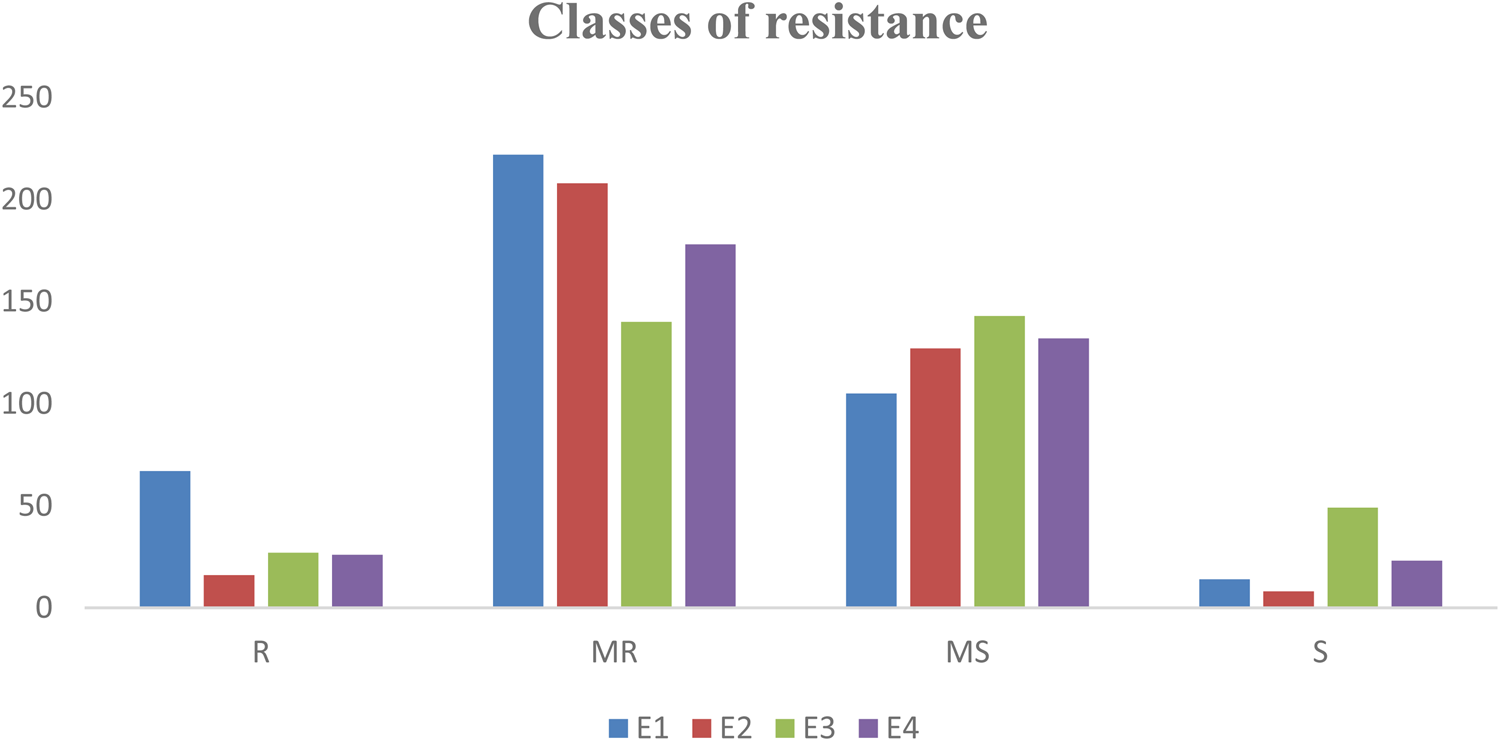
The disease pressure was high for MLB at Ludhiana (Ldh) and Gurdaspur (Grd) in both years (2020, 2021), as observed by the disease severity score >7.9 for the susceptible genotypes across environments at 55 DAI. Genotypes displayed significant variations (P value <0.001) in disease score (DS) on a disease scale of 1–9. The environment wise range of DS of the genotypes at 55 DAI were 2.11–7.93 (E1), 3.23–7.08 (E2), 2.94–8.9 (E3) and 2.54–8.07 (E4), whereas the DS ranged from 3.15 to 7.93 across the environments (based on the combined dataset of the four environments) (Table 1). The genotypes were categorized into different classes according to their resistance status. In Ldh 2020 (E1), 67 were reported as resistant (R), 222 as moderately resistant (MR), 105 as moderately susceptible (MS), and 14 as susceptible (S). In Grd 2020 (E2), 16 were R, 208 were MR, 127 were MS and 8 were S. In Ldh 2021 (E3), 27 were R, 140 were MR, 143 were MS and 49 were S. In Grd 2021 (E4), 26 were R, 178 were MR, 132 were MS and 23 were S (Fig. 3 and Table S2).
ANOVA and descriptive statistics of CAAM panel for MLB disease score

*** P < 0.001, across: combined all four environments (E1: Ludhiana 2020, E2: Gurdaspur 2020, E3:Ludhiana 2021, E4: Gurdaspur 2021), CV-coefficient of variation.
Bar plots depicting the frequency of genotypes in different classes of resistance: R – resistant.
MR – moderate resistant, MS – moderate susceptible, S – susceptible in each environment: E1 – Ldh 2020, E2 – Grd 2020, E3 – Ldh 2021, E4 – Grd 2021.

GGE-biplot analysis for disease score
A total of 359 genotypes were put to comprehensive stability analysis to discern and pinpoint stable sources of disease resistance. The biplot pattern was elucidated through the process of partitioning the singular value (SV) into genotype–environment (GE) scores for each principal component via PC1 and PC2. The G + G × E variation was 82.95% (set 1), 82.5% (set 2) and 77.4% (set 3) (Fig. 4a–c). Generally, the performance of a genotype is considered better than the average if the angle between the environment and the genotype is less than 90°. However, in our case, the value of an individual should be less than the average value because we are considering disease scores and lower scores pertaining to resistance. In Set 1, the angles between inbred 34 and E1, inbred 25 and E1, inbred 71 and E2, inbred 76 and E4 and inbred 44 and E3 are less than 90° and are susceptible to MLB. The other genotypes on the other side of the axis fell into two classes of resistance (R and MR); for example, inbred 58 (VL109178) had the lowest disease score (2.1). Similarly, for Set 2, the angles between inbred 133 and E3, inbred 200 and E2 were less than 90°, and the plants were susceptible; moreover, the genotypes lying on the other side of the axis represented resistant classes. In Set 3, the angle between inbred 77 and environment E1 was less than 90°, and was highly susceptible to disease, with a score of 8.0. Similarly, inbred 71 (VL1018527) was reported to be susceptible in all environment, as the angle between the genotype and the environment was less than 90°. However, the genotypes lying on either side of the axis were resistant or moderately resistant; for example, inbred 46 (VL108806) was a highly resistant line with a score <3.
(a–c) GGE biplot pattern of 359 lines as three sets (set 1, set 2, set 3) in four environments (E1, E2, E3, E4) for the MLB disease score; (d–f) ‘Which won where’ pattern of the GGE biplot, polygon view displaying the genotype main effect plus G × E interaction effect of 359 lines in each set; (g–i) Mean vs. stability pattern of the GGE biplot illustrating the interaction effect of 359 lines for the MLB disease score in each set; (j–l) Ranking genotypes of each set; (m–o) Relationship between environments between.four environments; (p–r) Ranking of environments. There was no transformation of the data (transform = 0), and the data were centred by means of the environment (centring = 2). The numbers correspond to the genotypes.
E1: Ldh 2020, E2: Grd 2020, E3: Ldh 2021, and E4: Grd 2021 (Ldh-Ludhiana and Grd-Gurdaspur).

Polygon view of GGE-biplot
In the ‘which-won-where’ biplot presented in Fig. 4d–f, for Set 1, the following inbreds were present at the vertex: 44, 29, 58, 79, 40, and 34. In the Polygon view, the genotypes fell into four sections, and the test environments fell into two sections. The first section contains test environments E3 (Ldh 2021) and E4 (Grd 2021), and the vertex inbred in this section was 32 (VL1033), which is susceptible to MLB. However, inbred 58 (VL109178), which is plotted farthest on the left side, had the lowest disease scores across the environments. Similarly, inbred 29 (SNL153278) had the lowest MLB scores in E1 (Ldh 2020) and E2 (Ldh 2020). Inbred 34 (VL1012935) was highly susceptible to infection in E1 and E2. In Set 2, inbreds 154, 81, 61, 133, 200, 94, and 116 were present at the vertex. The first section contains test environments E1, E2, and E4. The inbred 154 (VL108867) is susceptible to MLB, with a score of 7.9. However, the inbred 61 (VL1010090) on the left side was moderately resistant (5.0), 116 (VL1043) was resistant (3.0), and 200 (VL1018169) was susceptible, with a disease score of 7.9. The second section included test environment E3. Among the vertex genotypes for E3, inbred 81 (VL108807) and 82 (SNL142288) were moderately resistant (5.3 and 5.8), 133 (VL1250) and 160 (VL107578) were moderately susceptible (7.0, 6.9), whereas inbred 94 (SNL153289) was reported as resistant (3.0). For Set 3, among the vertex inbreds 46 (VL108806) and 86 (VL108335) were resistant, with an average score of 3.0, while inbreds 26 (VL108733), 28 (VL1012763), and 39 (VL1017256) were moderately resistant, with average scores of 3.8, 4.4 and 4.0, respectively.
Mean vs stability and genotype comparison
The ranking of genotypes based on their disease severity score and stability performance for the MLB are presented in Fig. 4g–i. In Set 1, inbreds with the shortest vector length were 58 (VL109178) and 29 (SNL153278), which were resistant, with an average disease score of 3.0. Considering set 2, the inbreds 116 (VL1043) and 118 (VL109579) on the left side were resistant, with an average score of 3.0 across environments. Similarly, inbreds 94 (SNL153289) and 49 (VL0512386) were moderately resistant across environments. Inbreds 118, 116 and 191 (SNL153285) had the shortest vectors, which made them stable. Similarly, in set 3, the inbred line 46 (VL108806) had the shortest vector length and lowest disease score.
Ideal genotype views of GGE biplot
By utilizing the method of ‘ranking genotype’, as depicted in Fig. 4j–l, we can identify an ‘ideal genotype’ in contrast to other evaluated genotypes. Genotypes located closer to the concentric circle in the plot indicate a higher mean disease score, whereas those positioned farther away from the concentric circle are considered resistant. In Set 1, inbreds 29, 58, 1, 12 and 15 demonstrated superior performance and were classified as resistant, while inbreds 47, 50 and 70 (VL109576) exhibited moderate resistance in all environments, with mean disease scores ranging from 3.5 to 4.0. For Set 2, the inbreds located farther from the arrowhead, specifically 116, 118, 191 and 94, exhibited lower disease scores, suggesting a greater level of resistance. In Set 3, genotypes 46, 74 and 86 were reported to be resistant based on their positioning in the plot.
Relationship between environments
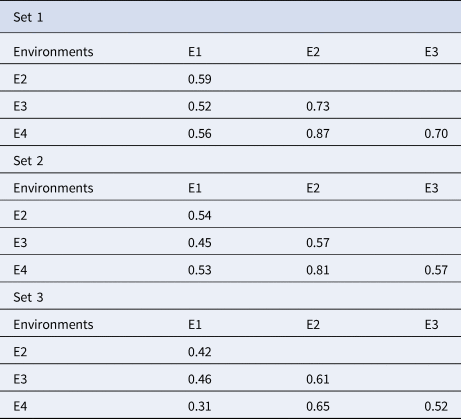
A summary of the interrelationships between the test environments for MLB is visually represented in Fig. 4m–o. Based on the angles between the environmental vectors, it can be inferred that all four environments (E1, E2, E3 and E4) exhibited positive correlations (Table 2) with one another in the context of MLB, as indicated by the acute angles formed between them. A closer examination of the positions of these environments on the biplot revealed that E3 (Ldh 2021) emerged as the most suitable environment for genotype screening, closely followed by E4 (Grd 2021) for all three sets. Notably, the shortest vector lengths were observed for E1 and E2, during 2020. However, it is worth noting that none of the environments were situated near the origin of the biplot.
Correlations between four test environments for MLB disease score

Environments: E1- Ldh 2020, E2-Grd 2020, E3- Ldh 2021, E4- Grd 2021.
Ranking of environments
Furthermore, the ranking of the environments concerning ‘ideal test environment’, as depicted in Fig. 4p–r, highlights that E3 (Ludhiana 2021) was plotted closest to the border of the inner circle in the biplot for all the three sets, signifying its suitability for cultivar evaluation against MLB.
Discussion
Annually, 9.4% of maize is lost to infections caused by pathogenic, bacteria, viruses and fungi, worldwide (Munkvold et al., Reference Munkvold, Arias, Taschl and Gruber-Dorninger2019). MLB stands out as a significant foliar disease in maize (Aregbesola et al., Reference Aregbesola, Ortega-Beltran, Falade, Jonathan, Hearne and Bandyopadhyay2020). Although it's prevalent across many maize-growing regions worldwide, it manifests most severely in hot and humid tropical climates. MLB has notably become a prominent disease in the Indian subcontinent and neighbouring areas, leading to yield reductions of approximately 35–40% (Bruns, Reference Bruns2017). Therefore, while breeding for MLB resistance is essential, screening large sets of germplasm across multiple locations is labour-intensive and cumbersome.
Analysis of variance revealed that the effects of genotype, and genotype × environment interaction variance components are statistically significant. Our study utilized SREG model based GGE-biplot in identifying ideal accessions or genotypes, and evaluating the suitability of testing locations (Karimizadeh et al., Reference Karimizadeh, Mohammadi, Sabaghni, Mahmoodi, Roustami, Seyyedi and Akbari2013). The amount of variability depicted in our study was >70%, which led to the identification stable donors. Chaudhari et al. (Reference Chaudhari, Khare, Patil, Sundravadana, Variath, Sudini, Manohar, Bhat and Pasupuleti2019) utilized SREG method and observed the same amount of variability. Our study presented the MLB disease scoring data of 359 genotype at four test environments (E1, E2, E3, E4) over two years. This study led to the identification of stable donors for MLB: VL109178, SNL153278, VL108806, VL109186, VL1043, VL109579, VL1031, VL108335, VL1012764, and VL109179. These genotypes scored ⩽ 3.0 for MLB across the locations thereby indicating the stability in their expression as depicted by mean vs. ‘stability’ approach and ‘which-won-where’ pattern. This suggests that, in regional breeding programmes, it is preferable to identify hotspots to minimize costs. Moreover, the identified genotypes hold promise as valuable donors of resistance, serving as a foundation for the development of MLB-tolerant hybrid varieties. These findings aligned with the reports of Chaudhari et al., Reference Chaudhari, Khare, Patil, Sundravadana, Variath, Sudini, Manohar, Bhat and Pasupuleti2019, which carried SREG-based GGE biplot analysis on a large training population (utilized for genomic selection) to understand the pattern of GGE and delineate the stable genotypes using mean vs ‘stability’ approach and ‘which-won-where’ pattern against late leaf spot and rust across environments in Arachis hypogea. Additionally, we observed non-crossover interaction for MLB disease scores between environments which lead to the possible categorization of test environments into ‘mega environments’ (Yan et al., Reference Yan, Kang, Ma, Woods and Cornelius2007). Our study reported the existence of a single mega environment (from two locations) and indicated that the reactions of most inbred lines across these environments consistently followed a similar pattern, resulting in similar rankings for genotypes for MLB disease resistance. Notably, a similar division into two mega-environments was also observed by Joshi et al., Reference Joshi, Adhikari, Singh, Kumar, Jaiswal, Pant and Singh2021 in their GGE biplot analysis for MLB in backcross inbred lines (BILs), where they identified two mega-environments from a total of six environments for both the per cent disease index and grain yield. Our findings also corroborated with Sibiya et al. (Reference Sibiya, Tongoona and Derera2013) where no crossover interaction was reported for NCLB, indicating positive associations among the environments. Our findings suggested that for the initial screening of large set of germplasm it may be sufficient to conduct screening at one environment when there is a positive correlation and non-crossover interactions observed for the trait across multiple environments. This approach can help save land, input and labour resources in the initial stages of a breeding programme. The potential genotypes identified can then be validated through multi-site screening and evaluation at a later stage.
The study led to the identification potential stable donors for resistance to MLB which could be considered for developing resistant varieties for both the locations (Ludhiana and Gurdaspur) due to their uniform expression of resistance over the years. However, we also came across the absence of crossover G × E interactions due to correlation between environments which, could plausibly suggest that during the initial screening of a large set of germplasm for MLB, it is possible to choose either of the two environments instead of utilizing both.
Supplementary material
The supplementary material for this article can be found at https://doi.org/10.1017/S1479262124000546.
Data
The data will be provided on request.
Acknowledgements
The authors acknowledge CIMMYT-Asia and Hyderabad for providing the germplasm.
Author contributions
S. S. conceived and supervised the experiment, S. K. N. provided the germplasm, H. K. provided the culture for inoculation, W. U. N. carried out the phenotyping and performed the analysis, W. U. N. interpreted the results and wrote the manuscript. G. S. helped in maintaining the field trail. S. S. finalized the manuscript. All the authors reviewed the manuscript.
Competing interests
The authors declare no competing interests.
Ethical standards
This investigation did not involve any research with animals at any stage of experimentation. In compliance with the IUCN Policy Statement on Research, the material used in the present research was certified to be maize (Zea mays L.), a cultivated species maintained through conventional breeding.
All the experiments were carried out in accordance with relevant guidelines.