Introduction
Nasopharyngeal carcinoma (NPC) accounts for about 0.6 per cent of all malignancies. It demonstrates a distinct gender, racial and geographic distribution, which is reflective of its multifactorial aetiology.Reference Chua, Wee, Hui and Chan1,Reference Ferlay, Soerjomataram, Dikshit, Eser, Mathers and Rebelo2 Risk factors include Epstein–Barr virus, human papilloma virus, tobacco use, alcohol consumption, and several dietary practices including the intake of preserved foods.Reference Chua, Wee, Hui and Chan1 Worldwide, there are around 86 000 cases and 50 000 deaths annually; however, in the western world NPC is rare, with an incidence of only 0.5–2 cases per 100 000, with a 2–3 fold higher risk in males.Reference Chang and Adami3
The most common presenting symptoms are neck lumps, headache, diplopia, epistaxis and facial numbness.Reference Chua, Wee, Hui and Chan1,Reference Suzina and Hamzah4 The classical Trotter's triad of unilateral conductive hearing loss, ipsilateral otalgia or facial pain, and ipsilateral paralysis of the soft palate represents a very rare presentation of the disease. In patients presenting with unilateral serous otitis media, nasopharyngeal malignancy must be considered as a potential underlying cause. It is identified in 0.4–7.4 per cent of patients who present with isolated serous otitis media.Reference Dang and Gubbels5 Furthermore, serous otitis media is the sole presenting complaint in 0–1.5 per cent of nasopharyngeal tumour patients,Reference Gaze, Keay, Smith and Hardcastle6–Reference Robinson8 and is one of the presenting complaints in 26–46 per cent of cases.Reference Dempster and Simpson9
Serous otitis media is a recognised presentation of Eustachian tube dysfunction secondary to post-nasal space pathology. Therefore, examination of the nasopharynx is an essential part of the investigation of any patient presenting with serous otitis media. Whenever a suspicious lesion is identified during nasendoscopy, biopsy is unquestionably warranted. However, the question as to whether biopsy is required in cases of isolated serous otitis media when nasendoscopy findings are normal, so called ‘blind biopsy’, is yet to be answered definitively. The uncertainty involved and concern of missing a cancer diagnosis means that it is common practice in many centres to perform a routine nasopharyngeal biopsy regardless of nasendoscopy findings or the presence of additional clinical manifestations of NPC. At present, there are no guidelines and no clear indications for when a nasopharyngeal biopsy should be performed.
This question has important implications for many aspects of patient care. There is evidence that waiting on an investigation for a possible cancer diagnosis has a significant impact on patients’ psychological wellbeing.Reference Poole, Hood, Davis, Monypenny, Sweetland and Webster10 Furthermore, despite evidence that local anaesthesia and general anaesthesia for biopsies of the post-nasal space have similar sensitivities for diagnosing NPC (95.1 per cent vs 95.6 per cent respectively),Reference Waldron, Van Hasselt and Wong11 surgical skill and equipment availability means that many centres still perform post-nasal space biopsy under general anaesthetic. This has notable financial consequences, as well as ethical implications regarding the risk–benefit of a general anaesthetic.
This 10-year review of adult patients with serous otitis media aimed to determine whether there is a role for blind biopsies of the nasopharynx in this country, which has a low incidence of NPC.
Materials and methods
An electronic patient record search was performed for all histology specimens of the nose, nasopharynx and post-nasal space taken between 2007 and 2017 at the Norfolk and Norwich University Hospital NHS Foundation Trust. The associated patients’ clinic letters, operative notes and histology request forms were analysed to confirm those patients who underwent biopsy of the post-nasal space for isolated serous otitis media. Patients who were aged under 18 years or had other symptoms suggestive of nasopharyngeal carcinoma were excluded from the study. The remaining identified patients were then categorised by their post-nasal space examination as either normal or abnormal, and by their histology results as either normal or abnormal. In our study, we only examined cases of unilateral serous otitis media with effusion in adults.
Results
Of the 601 patients who underwent nasal biopsies as identified from our initial database search, 119 fulfilled the study inclusion criteria. There were 62 (52.1 per cent) men and 57 (47.9 per cent) women, with a median age of 58 years (range, 22–81 years).
Of the 119 patients who underwent post-nasal space biopsy for isolated serous otitis media, the post-nasal space appeared normal on nasopharyngeal examination in 25 patients. Of these 25 patients, 6 (24 per cent) were found to have an abnormality on histology (Figure 1). One patient had vasculitis, one had recurrence of follicular lymphoma and four had new malignancies (two non-Hodgkin's lymphomas, one squamous cell carcinoma and one carcinoma ex-pleomorphic adenoma). Four of these patients were men and two were women, with a median age of 73 years (range, 55–79 years). Of the 94 patients with a normal-looking nasopharynx, none were found to have anything concerning on histology.
Results of post-nasal space examination and biopsies. FNE = flexible nasendoscopy

Discussion
Nasopharyngeal carcinoma (NPC) is one of the most aggressive upper respiratory tract tumours affecting the head and neck. It has a reputation for insidious onset and delayed diagnosis, which results in a poor prognosis.Reference Hara12 One reason for this is that NPC frequently originates from the fossa of Rosenmüller, which is a clinically occult site; hence, by the time patients develop symptoms, the disease is often locally or regionally advanced, with lymph node metastases present in 75–90 per cent of cases at diagnosis.Reference Vokes, Liebowitz and Weichselbaum13
Early diagnosis of NPC has a distinct clinical advantage, as curability falls from over 80 per cent in patients with disease confined to the nasopharyngeal mucosa to less than 20 per cent in cases of advanced disease.Reference Neel and Taylor14 Serous otitis media is a well-recognised presentation and, unlike cranial nerve palsies or lymphadenopathy, may be present while the disease is still confined to the nasopharynx.Reference Gaze, Keay, Smith and Hardcastle6
Diagnosis is also difficult because NPC is notorious for demonstrating minimal mucosal disease while having a large submucosal component.Reference Sham, Wei, Kwan, Chan, Choi and Choy15 Furthermore, apposition of mucosal surfaces around the fossa of Rosenmüller has the potential to hide the primary tumour.Reference Yousem and Grossman16 Therefore, clinicians are often inclined to perform a biopsy when there is nothing concerning visible.
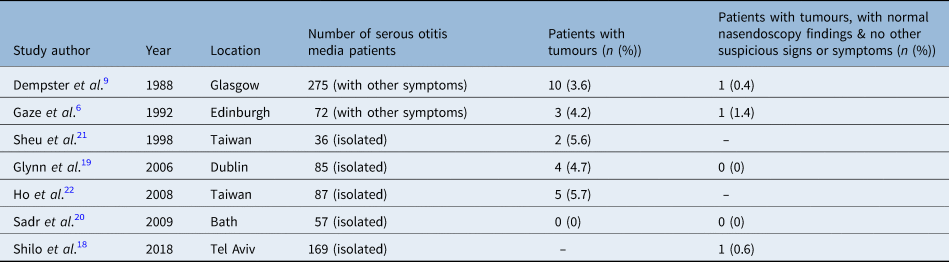
To date, two cases of NPC have been reported that were identified after the biopsy of a normal-looking nasopharynx in patients with isolated serous otitis media.Reference Lee, Weiner and Campbell17 Furthermore, in three studies of 72, 275 and 169 patients presenting with serous otitis media, some of whom also had other symptoms, a tumour was identified in one patient with normal nasendoscopy findings in each study, with no other suspicious signs or symptoms in each study, representing 1.4 per cent, 0.4 per cent and 0.6 per cent incidence rates, respectively.Reference Gaze, Keay, Smith and Hardcastle6,Reference Dempster and Simpson9,Reference Shilo, Abu-Ghanem, Yehuda, Weinger, Fliss and Abergel18 Conversely, in two studies of 85 and 57 patients with isolated serous otitis media, no tumours were identified in patients with normal nasendoscopy findings.Reference Glynn, Keogh, Ali, Timon and Donnelly19,Reference Sadr, Sanati and Prior20 Table 1 summarises the current evidence.Reference Gaze, Keay, Smith and Hardcastle6,Reference Dempster and Simpson9,Reference Shilo, Abu-Ghanem, Yehuda, Weinger, Fliss and Abergel18–Reference Ho, Lee, Chai, Kuo, Wang and Chien22
Summary of current evidence

In conclusion, Eustachian tube dysfunction secondary to underlying malignancy must be considered in all adults presenting with serous otitis media; however, our findings do not support the routine practice of post-nasal space biopsy in low-risk patients in the absence of positive nasendoscopy findings. Before national practice is altered, however, a pan-UK prospective study should be performed, and this could be a topic for consideration by Integrate, the UK ENT Trainee Research Network.
• Serous otitis media is a recognised presentation of Eustachian tube dysfunction secondary to post-nasal space pathology in adults
• This is the largest known retrospective study to investigate whether biopsy is indicated in non-endemic regions
• Over a 10-year period, no nasopharyngeal carcinomas (NPCs) were found in patients with a normal-looking nasopharynx
• In patients considered at high risk of NPC (endemic regions), further evaluation by radiology and biopsies should be considered
• The study findings do not support the routine practice of post-nasal space biopsy in low-risk patients in the absence of positive nasendoscopy findings
Competing interests
None declared