1 Introduction
In all previous surveys of long-distance agreement processes, the assimilating feature is never [labial], [dorsal] or [coronal]. In other words, there are no cases where it is crucially a major place feature that participates in long-distance harmony. In terms of Agreement by Correspondence (ABC; Rose & Walker Reference Rose and Walker2004, Hansson Reference Hansson2010, Bennett Reference Bennett2015, among others), where segments that are similar for some feature(s) [F] correspond, and agree for some other feature(s) [G], the feature [G] is never a major place feature. Ngbaka Minagende fills this typological gap.
Ngbaka Minagende contains co-occurrence restrictions with labials, dorsals and labial-dorsals that are best characterised as follows: labial (and certain dorsal) segments correspond, and agree for major place. This is a distinct pattern from cases previously modelled via spreading of a major place feature, which are more properly cases of minor place harmony, or harmony for features dependent on some major place feature (such as anteriority harmony among coronals, or velar/uvular harmony among dorsals; see e.g. Shaw Reference Shaw, Paradis and Prunet1991, Clements & Hume Reference Clements and Hume1995, Hansson Reference Hansson2010).
The major place harmony patterns interact with a voicing agreement pattern where homorganic voiced and voiceless stops cannot co-occur. These generalisations all naturally fit the schema of ABC, and are supported by a new statistical analysis of Ngbaka Minagende data. While there are no active morphological alternations in the data, robust static restrictions like the ones analysed here crucially inform phonological theory in general (see e.g. Pierrehumbert Reference Pierrehumbert1993, McCarthy Reference McCarthy and Keating1994, Frisch Reference Frisch2011 and references therein), and the Ngbaka Minagende pattern thus fills gaps in Rose & Walker (Reference Rose and Walker2004), Hansson (Reference Hansson2010) and Bennett (Reference Bennett2015) with respect to place harmony.
Additionally, while major place harmony is a natural prediction of ABC, the nature of place features makes other approaches, such as spreading or co-occurrence constraints, especially problematic. The use of co-occurrence constraints (e.g. Sagey Reference Sagey1986, Alderete Reference Alderete1997, Suzuki Reference Suzuki1998, Stanton Reference Stanton, Jesney, O'Hara, Smith and Walker2017) is untenable without changes to either the assumed logical power of constraints or the representation of place features; assuming place features are privative, markedness constraints as usually defined cannot adequately distinguish between simple and complex. Long-distance transvocalic spreading, as discussed by Clements & Hume (Reference Clements and Hume1995), requires treating consonant harmony parallel to vowel harmony, which is empirically problematic (e.g. Casali Reference Casali1995). Even though this is a static distribution in the language, cross-linguistic and statistical evidence is given that this should be treated as assimilation, not dissimilation. For these reasons, capturing the patterns in Ngbaka Minagende requires an active CC-Ident[place] constraint in the ABC framework to make long-distance place agreement possible.
2 Language background
The language investigated in this work is Ngbaka Minagende (Atlantic-Congo; Democratic Republic of the Congo; [nga]), which is in the Gbaya-Manza-Ngbaka subfamily of Atlantic-Congo (Simons & Fennig Reference Simons and Fennig2018). Dictionary data are from Maes (Reference Maes1959). The language described in Thomas (Reference Thomas1963), and subsequently analysed by Sagey (Reference Sagey1986), Mester (Reference Mester1986) and Rose & Walker (Reference Rose and Walker2004), among others, is Ngbaka Ma'bo (Central African Republic; [nbm]), a distinct language in the Adamawa-Ubangi subfamily of Atlantic-Congo (Hammarström et al. Reference Hammarström, Forkel, Haspelmath and Bank2016). Both languages are often referred to as just Ngbaka.Footnote 1 Ngbaka Minagende is spoken by roughly one million speakers, and Ngbaka Ma'bo by roughly 88,000 (Simons & Fennig Reference Simons and Fennig2018). The remainder of this article discusses Ngbaka Minagende.
The Ngbaka Minagende consonant inventory, as described in the introduction to Maes (Reference Maes1959), is given in (1).
(1)


Maes groups the labial-dorsal stops with the other implosives, though it is not clear if this is based on the phonetic realisation or phonological patterning. I follow this in (1); the phonological representation of airstream features on the labial-dorsals is not crucial for the present analysis. Maes (Reference Maes1959) also lists /nʷ/ and /vʷ/ as segments, but these were not present in any of the words considered in this paper.
3 Co-occurrence restrictions in Ngbaka Minagende
Primary evidence for the Ngbaka Minagende patterns comes from a statistical analysis of Maes (Reference Maes1959). The data provide evidence for a static pattern, but not necessarily a process, in the sense of active morphophonological alternations. However, even as a static restriction or morpheme structure constraint, any analysis must account for why roots cannot have disharmonic patterns on the surface. In terms of Optimality Theory (Prince & Smolensky Reference Prince and Smolensky1993), this is due to the necessity of illicit inputs being realised as grammatical outputs, stemming from Richness of the Base, which is assumed here. The same conflation of static restrictions and active processes is found in other surveys as well (Hansson Reference Hansson2010: 153, Rose & Walker Reference Rose and Walker2004: 477, Bennett Reference Bennett2015: 326; see also Kenstowicz & Kisseberth Reference Kenstowicz and Kisseberth1977: 136 for general discussion of this point). In the analysis which follows, the restriction is discussed as a process, involving abstract inputs and outputs, while the data as a whole gives evidence for a harmony pattern. Further, the term harmony is agnostic with respect to an assimilatory or dissimilatory analysis; both are possible, and both require an active CC-Ident[place] constraint, though indirect evidence is given for assimilation in §4.2.1.
The dictionary analysed, Maes (Reference Maes1959), gives Ngbaka Minagende headwords first, which makes parsing much easier, and has transcriptions in (near-)IPA. The dictionary was scanned and run through OCR software (ABBYY FineReader 12), looking for French, Dutch and IPA characters. This resulted in a rich-text document, which was manually checked word for word against the original dictionary by a research assistant.Footnote 2 The Ngbaka Minagende consonants and vowels were checked for accuracy, but there still may be discrepancies in the tone and nasality diacritics (though all forms presented here are correct).
All biconsonantal (CVCV) words (n = 880) were extracted from the entire dictionary. In addition to this providing the minimum number of consonants necessary to establish a co-occurrence restriction, it also rules out most larger polymorphemic forms. The original generalisations for Ngbaka Ma'bo hold within roots only (Thomas Reference Thomas1963), and this is assumed for Ngbaka Minagende as well. However, there may be longer bona fide roots that are excluded in this filtering procedure.
To find evidence of co-occurrence restrictions, O/E ratios, as used by Pierrehumbert (Reference Pierrehumbert1993), were calculated for all stops, sorted by place of articulation. O is the observed number of forms for some combination in the lexicon, and E the number of forms expected in a lexicon of a specific size, assuming free combination of consonants (E = (Obs(C1) × Obs(C2)) / total; Frisch Reference Frisch2011). The analysis here uses O/E values to find categorical restrictions only. The baseline for a categorical restriction was determined by both the O/E value in conjunction with its statistical significance, as indicated in (2).
The significance of these values was calculated with Fisher's exact test via a series of 2 × 2 contingency tables, described in detail in the appendix.Footnote 3 The p-value that results from a 2 × 2 Fisher's exact test is compared to an alpha of 0.00625, which is the standard value of 0.05 adjusted for eight tests (Bonferroni correction; one test for each semihomorganic pair as well as for each homorganic pair).Footnote 4 For present purposes, the interpretations in (2) apply.
(2)

The relevant segments, all oral and nasal stops, were sorted on the basis of the place definitions in (3). All stops and nasals, including implosives and prenasals, are included for each place. (In the discussion of place interactions below, these segment groupings are abbreviated as P, T, K and K͡P respectively.)
(3)

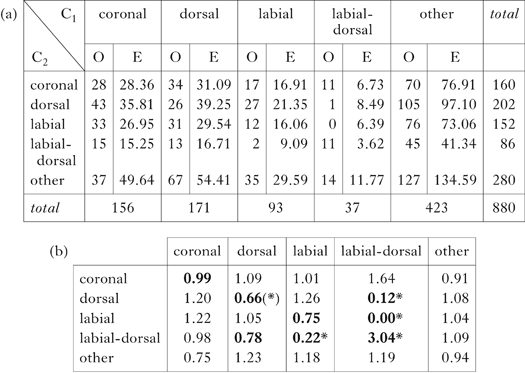
The label ‘other’ was used to encompass all other segments, such as liquids and fricatives at any place of articulation. Based on this definition, observed and expected values are given in Table Ia, and their ratios in Table Ib. Combinations of a labial and a labial-dorsal, in either order, are significantly underrepresented, as are combinations of a dorsal followed by a labial-dorsal. Forms with two labial-dorsals are significantly overrepresented.
(a) Observed and expected values for all oral and nasal stops, by place. The row and column labelled total contain the marginal totals for items in that position; for example, there are 160 coronal consonants in C1 position, as indicated by the rightmost column. (b) O/E ratios for all oral and nasal stops, by place (the bolded values are those tested for significance: * denotes p<0.00625 and (*) denotes p=0.0063).

The restrictions active in Ngbaka Minagende are schematised and discussed below. In discussing the patterns with respect to place, the usual terms homorganic and heterorganic are insufficient. The crucial pairs here, those involving a complex stop (represented as [K͡P) and a simple stop at one of those two places ([K] or [P]), contain both shared and unshared place features. For this reason, these pairs are referred to as semihomorganic, as defined in (4b).
(4)

The first and most robust evidence for place harmony, Place Agreement among Labials in (5), is the absence of semihomorganic labial pairs.
(5)

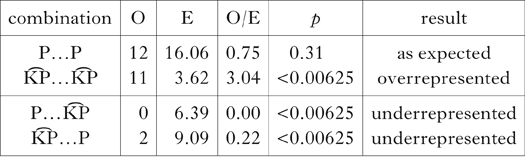
The generalisations for PAL are based on the behaviour of labials and labial-dorsals, as given in Table I above. The relevant information is repeated and reorganised in Table II.
Evidence for Place Agreement among Labials.

The restriction applies regardless of the voicing or (pre)nasality of the segments in question, as illustrated in (6).
(6)

While labial consonants in a root must agree for other place features and for [voice], this is not an instance of total identity (MacEachern Reference MacEachern1999, Gallagher & Coon Reference Gallagher and Coon2009, Hansson Reference Hansson2010: 132, Bennett Reference Bennett2015: 198). In cases of total identity, two segments specified for some feature [F] can co-occur only if they are identical for all other features. One way to frame PAL as a potential case of total harmony is to say that labials can co-occur only if they are identical. However, this is not the case, as simple labials can differ in implosiveness, nasality and prenasality, as the data in (7) show.
(7)

(7a) and (b) show non-identical simple labial pairs and non-identical labial-dorsal pairs respectively. It should be noted, however, that the forms in (c) are counterexamples to PAL, though their existence is not significant. Because non-identical labials can co-occur, place agreement in Ngbaka Minagende cannot be classified as total identity, on empirical grounds, and therefore cannot be modelled by approaches designed to restrict consonant harmony in this way (e.g. Gallagher & Coon Reference Gallagher and Coon2009).
Parallel to PAL, place agreement among certain semihomorganic dorsal pairs also occurs, and is formulated in (8). This is the only long-distance pattern in Ngbaka Minagende which was found to be directional.
(8)

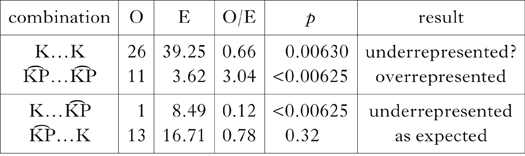
A labial-dorsal stop can appear with a simple dorsal stop only when the labial-dorsal is in root-initial position. When an initial labial-dorsal appears with a medial dorsal, they can disagree in voicing, as shown in (9). (The full list of attested K͡P…K forms is given in the appendix.)
(9)

Additionally, although 26 observed K…K roots are attested in the dictionary, this combination is likely significantly underrepresented, as shown in Table III (O = 26, E = 39.25, p = 0.00630). The p-value of 0.00630 for dorsal pairs is just above significance. The alpha of 0.00625 is the result of the Bonferroni correction, which is known to be conservative (see e.g. Sharpe Reference Sharpe2015). However, while categorical bans were assumed on the other significantly underrepresented pairs, the homorganic dorsal pairs appear much more often, even though they are underrepresented. The grammaticality of these combinations is assumed for the present analysis for two general reasons: the constraints as defined cannot capture a ban on K…K pairs, and the absolute number of these forms attested might suggest that a gradient well-formedness account might be better suited (e.g. Frisch et al. Reference Frisch, Pierrehumbert and Broe2004, Coetzee & Pater Reference Coetzee and Pater2008, Hayes & Wilson Reference Hayes and Wilson2008). Further, the low occurrence of dorsal pairs within a word relates more generally to the phenomenon of similar place avoidance, as discussed in Pozdniakov & Segerer (Reference Pozdniakov and Segerer2007), where languages in general (and especially Proto-Gbaya, in the same family as Ngbaka Minagende) disprefer homorganic segments within a word. Yet the question still remains why this restriction would only apply to simple dorsal pairs for Ngbaka Minagende, and not to any others.Footnote 5
Evidence for Place Agreement among Dorsals.

Finally, all purely homorganic stops pairs must agree in voicing, as in (10). The pattern here is parallel to that analysed by Walker (Reference Walker, Kirchner, Pater and Wikeley2001) for Ngbaka Ma'bo.Footnote 6
(10)

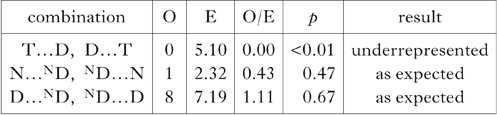
This is supported by the statistically significant fact that homorganic forms that disagree in voicing are unattested in the dictionary, as shown in Table IV, with other potential co-occurrence restrictions.
Summary of voicing and nasal restrictions for all homorganic pairs.

Voicing Agreement is the only non-place pattern tested that was found to be significant.Footnote 7 It is worth noting that no co-occurrence restriction was found between nasals and prenasals (N…ND, ND…N), yet this harmony pattern in Ngbaka Ma'bo has been analysed extensively, by Mester (Reference Mester1986), Sagey (Reference Sagey1986), van de Weijer (Reference Weijer, Bok-Bennema and Cremers1994) and Rose & Walker (Reference Rose and Walker2004), among others. Despite the fact that these are indeed different languages, as discussed in §2, only 2.32 forms of this type are expected, and only one was found. So, while only a single form is attested in the dictionary, and the O/E ratio is less than 1, the difference was not statistically significant. An analysis of a larger dictionary might yield a more robust indication of a ban on these sequences; I take the current result to show no evidence either way.
4 Analysis
The analysis proposed in this paper models Place Agreement among Labials (PAL), Place Agreement among Dorsals (PAD) and Voicing Agreement (VA) in the ABC framework (Hansson Reference Hansson2010, Rose & Walker Reference Rose and Walker2004, Bennett Reference Bennett2015). I utilise the Corr and Ident constraints common in ABC, with their usual behaviour and effects (with refinements noted). The definitions of the place-specific constraints are given in detail, due to the fact that place features are privative and behave as a class (following Sagey Reference Sagey1986, among others). Segments are specified for the feature [±voice] as well as for major place features, as in (11) (for simplicity, labial-dorsals are the only complex segments considered).Footnote 8
(11)

There is no phonological distinction between the two place features of the labial-dorsal segment. This follows from the fact that doubly articulated stops in general have two places of equal phonetic stricture (see e.g. Ladefoged Reference Ladefoged1968, Connell Reference Connell1994, Ladefoged & Maddieson Reference Ladefoged and Maddieson1996). Sagey (Reference Sagey1986) uses a pointer device to single out the labial place feature as an instantiation of abstract primary place (van de Weijer Reference Weijer2011), in order to capture the generalisation that in Ngbaka Ma'bo only PAL occurs (so that only a restriction between ‘primary articulators’ holds). In the analysis of Ngbaka Minagende, such machinery is neither empirically sufficient nor theoretically necessary. This not only simplifies the representation and therefore the candidate space, but also uses an independent mechanism (constraint ranking) to replace the work of specific devices meant to model abstract primary place.
All inputs and candidates are indicated via pairs of segments. Surface correspondence is indicated via subscripted indices, as is standard. Candidates are given as dummy [CxaCx/ya] forms, where C is any of the segments in (11). With only two segments, there are only two possible surface correspondence configurations: they are either in correspondence, or not in correspondence. The exact definition of surface correspondence is therefore not crucial (whether it is a pairwise chain, following e.g. Shih & Inkelas Reference Shih and Inkelas2019, or an equivalence relation, following Bennett Reference Bennett2015).
4.1 Constraints
All constraint definitions are given in a Constraint Definition Language that is based on McCarthy (Reference McCarthy2003), de Lacy (Reference de Lacy2011) and Hyde (Reference Hyde2012), along with an informal paraphrase. For all correspondence-referring constraints (Ident and Corr), the locus is a pair of root nodes (segments), indicated as bullets (•). The condition of the constraint uses the operators ∧ and ¬, with their usual definitions, as well as exclusive-or ⊕. Predicates of the form [F](•) are true iff segment • is associated with feature [F]. A violation is assigned for each locus making the constraint condition be true, following McCarthy (Reference McCarthy2003).
4.1.1 Identity
The evaluation of place identity, whether over input/output or surface correspondence, is crucial to capturing the intended effects of semihomorganicity. Each disparity is counted by an omnibus constraint for all of the major place features [labial], [dorsal] and [coronal]. There is a single CC-Ident[place] constraint operating over surface correspondence, and two directional faithfulness constraints operating over input/output correspondence: IO-Ident[place] and OI-Ident[place]. Each of these polices the removal or addition of place features from input to output respectively. The exclusive-or operator ⊕ ensures that a violation will be assigned when the values of the two segments for a feature are different.
A single Ident constraint for input–output correspondence and surface correspondence is defined via constraint summation to capture the class behaviour of place features, as in (12) (Danis Reference Danis2017): the violation profile of Ident[place] is essentially the sum of the violation profiles of the (hypothetical) constraints Ident[dors], Ident[cor] and Ident[lab]. This is indicated in constraint definitions with multiple instances of the basic schema separated by the addition operator +. This definition is in the spirit of Feature Class Theory (Padgett Reference Padgett1995, Reference Padgett2002). Further extensions of constraint summation and this general definition of identity are explored in Danis (Reference Danis2017).
(12)

The faithfulness constraints in (13) assign violations for features that are removed or added between input and output. IO-Ident[place] assigns violations for place disparities only when the input place feature is present, and OI-Ident[place] only when it is absent. This is based on the directional Ident constraints for nasality in Pater (Reference Pater, Kager, van der Hulst and Zonneveld1999) (see also Rose & Walker Reference Rose and Walker2004: 492). Additionally, McCarthy & Prince (Reference McCarthy and Prince1995) recognise the affinity between Ident in its original formulation and hypothetical Max[F]and Dep[F] constraints. The violation counts assigned by these constraints are shown explicitly in (20), in the analysis of PAL.
(13)

I also adopt both faithfulness and surface correspondence constraints for [voice]: IO/OI-Ident[voice] and CC-Ident[voice]. No IO and OI split of faithfulness for voice is assumed, although it could be if the output of Voicing Agreement in such cases were shown to be D…D. The input/output constraints are equivalent to the standard Ident constraints for binary features, following McCarthy & Prince (Reference McCarthy and Prince1995), and likewise for the surface correspondence versions, following Rose & Walker (Reference Rose and Walker2004), Hansson (Reference Hansson2010) and Bennett (Reference Bennett2015).
4.1.2 Similarity
Similarity (Corr) constraints are those that encourage segments which share a value for some feature to be in surface correspondence. These constraints are crucially defined here over each of the individual place features, in order to capture the place asymmetries in the generalisations. Rather than adopting a similarity scale based on homorganicity (such as in Rose & Walker Reference Rose and Walker2004), I assume that the constraints are based on individual place features (following Bennett Reference Bennett2015), as it is the very notion of homorganicity that is at play. Furthermore, we cannot use a single Corr constraint that encompasses all place features (e.g. Corr[place]); in the final Ngbaka Minagende ranking, members of this set crucially dominate one another. The full definition for Corr[dors] is given in (14); those for Corr[lab] and Corr[cor] are defined in a parallel fashion.
(14)

In addition to Corr[lab], Corr[cor] and Corr[dors], a local conjunction between Corr[dors] and a positional markedness constraint KPMI, defined in (15) (Cahill Reference Cahill2000: 85), is necessary to capture the asymmetry of PAD.
(15)

This constraint enforces correspondence between the members of the disharmonic pair K…K͡P, but not K͡P…K, as shown in (16).
(16)

The constraint assigns a subset of violations of Corr[dors]. Defining the constraint in this way grounds it in the cross-linguistic tendency for labial-dorsals to disprefer word-internal positions, as surveyed by Cahill (Reference Cahill2000) (see also Beckman Reference Beckman1998). However, conjunction itself is not strictly necessary; the constraint can be defined without the connective (see Danis Reference Danis2017).
The purpose of this constraint is to capture the directionality of PAD through the restriction of the correspondence relation itself. While directionality in ABC can also be captured using either positional faithfulness constraints or directional CC-Ident constraints, these make the wrong predictions with respect to the interaction of PAD and VA, as discussed in §4.2.2.
4.1.3 Segmental markedness
Segmental markedness is evaluated per place feature of the segment: complex segments like [k͡p] receive two violations, while all simple segments receive one violation. As all segments in this system are specified for at least one place feature, the distinction in the constraint violations is 1 vs. 2, as in (17), or effectively simple vs. complex. *[+voice] straightforwardly assigns a violation to [+voice] segments, following Lombardi (Reference Lombardi1999), among others.
(17)

4.2 Ranking
The full Ngbaka Minagende ranking support is shown in (18).Footnote 9 All ranking information is shown in comparative tableaux, following Prince (Reference Prince, Carpenter, Coetzee and Lacy2002). Each row of a comparative tableau contains an Elementary Ranking Condition (ERC), where a constraint preferring the winning candidate (W) must dominate all constraints preferring the losing candidate (L). Blank cells indicate that the constraint does not differentiate between that winner/loser pair.Footnote 10
(18)

Detailed rankings for each process are discussed in the following sections. Note that there is one irreducible disjunction in the full ranking: ERC (18g). For /k͡p-k/ to surface faithfully and not be in correspondence, the winner in (18g) must be preferred to [k͡p1ak͡p1a], which is unfaithful but in correspondence. The winner is better both in terms of markedness (*Place) and in not adding place features to the output (OI-Ident[place]), so one of these constraints must dominate Corr[dors]. The existence of this disjunction also relates thematically to similar relationships between Dep and markedness constraints; see Gouskova (Reference Gouskova2007) for a summary.
4.2.1 Place Agreement among Labials
The ranking necessary for Place Agreement among Labials is shown in (19).
(19)

Following the basic ABC schema for long-distance interaction, ERC (19b) demands that Corr[lab] dominate both the markedness constraint *Place and the faithfulness constraint OI-Ident[place], as Corr[lab] prefers the winner where the consonants are in correspondence. All labial pairs, including those with labial-dorsals, correspond. In (19c), CC-Ident[place] must also dominate *Place and OI-Ident[place], as identity of surface segments is more important than removing place features from the input (OI-Ident[place]) or being more marked (*Place).
PAL in Ngbaka Minagende is a static restriction, so there are no active alternations to show what the actual mappings are. The winning candidate is assumed to be [k͡p1ak͡p1a], where [dorsal] is added to the output to satisfy CC-Ident[place]. This candidate is possible because it satisfies IO-Ident[place] by not removing any place features, although it does add one (violating OI-Ident[place]), and is more marked than the faithful candidate. This is expressed in ERC (19a), where the losing candidate is actually a tie between the dissimilation candidate [k1ap2a] and the simple agreement candidate [p1ap1a], where surface identity is satisfied through removing a place feature. The possible agreement and dissimilation optima are summarised in (20).
(20)

The input mapping to any of these choices is still a kind of major place long-distance interaction, whether it is dissimilation, as in (a), or agreement, as in (b) and (c). As Bennett (Reference Bennett2015) demonstrates, most static long-distance interactions have either an agreement or a dissimilation analysis, both caused by the same basic ABC ranking schema where correspondence is demanded for feature [F], and agreement is demanded for feature [G]. Faithfulness rankings for [F] and [G] determine whether the mapping is agreement or dissimilation. It should be noted here that features [F] and [G], which are both major place features, are controlled by the same faithfulness constraints. The dissimilation candidate in (a) and the simple agreement candidate in (b) can only be differentiated in a more articulated theory of markedness.
There are, however, three reasons, given in (21), why [k͡p1ak͡p1a], the complex agreement candidate, is assumed to be the optimum.
(21)

As shown in Table II, [K͡P…K͡P] pairs are significantly overrepresented on the surface. This can be taken as evidence that there are inputs other than /K͡P…K͡P/ that map to [K͡P…K͡P], such as the relevant semihomorganic pairs shown in (22).Footnote 11
(22)

In the analysis given here, these disharmonic semihomorganic pairs all neutralise to the output displaying agreement between complex segments.Footnote 12
Additionally, Iacoponi (Reference Iacoponi2016) discusses a cross-linguistic generalisation where ‘in dominant-recessive consonant harmony, the target is always the marked feature’. In the cases surveyed by Iacoponi, voicing assimilation always maps to [+voice], nasal assimilation to [+nasal], dorsal assimilation to [+high], and so on. Since presence of a place feature is usually assumed to be more marked than its absence (both in theories in which place is privative and in explicit theories of place markedness), complex place agreement fits the generalisation in Iacoponi (Reference Iacoponi2016). This line of reasoning also follows theories of underspecification (see e.g. Steriade Reference Steriade1995, Archangeli Reference Archangeli2011), where it is impossible for the unmarked or default value of some feature to cause agreement, as it is presumably absent from the representation at that stage.
Lastly, kinematic studies of speech error production, specifically Goldstein et al. (Reference Goldstein, Pouplier, Chen, Saltzmann and Byrd2007), show that ‘gestural intrusion errors’ are decidedly more frequent than ‘gestural reduction errors’. Essentially, when a speaker is tasked with repeating a phrase such as English cop top, the [t] is more likely to have an additional dorsal gesture than a reduced coronal gesture. This follows the line of reasoning adopted by Rose & Walker – citing parallel findings in Pouplier et al. (Reference Pouplier, Chen, Goldstein and Byrd1999) – who state that ‘the additive property of speech errors with place is mirrored in consonantal agreement in the respect that place articulations can be added but not removed. Place agreement is avoided, because complex stops are generally dispreferred’ (Reference Rose and Walker2004: 520). Ngbaka Minagende, then, is a case where complex segments are allowed and place agreement is detectible.
For the three reasons outlined above, I analyse the Ngbaka Minagende patterns as a case of complex agreement in terms of the processes in (20). It is important to note, however, that even if Ngbaka Minagende does not display long-distance place agreement, but rather dissimilation, these patterns are still caused by an active CC-Ident[place] constraint.
4.2.2 Place Agreement among Dorsals
Place Agreement among Dorsals is the only pattern found in the Ngbaka Minagende data that requires machinery intended to capture directional processes. It only applies to forms with an initial dorsal and a medial labial-dorsal: K…K͡P, as in (23).
(23)

Again, the winning candidate is assumed to be [k͡p1ak͡p1a], for the reasons given in (21). To capture the asymmetry between semihomorganic dorsal pairs, the constraint Corr[dors]&KPMI demands correspondence from forms where both consonants are [dorsal] and the second is also [labial]. While both Corr[dors]&KPMI and Corr[dors] prefer the winning candidate in (23c), the tableau in (24) shows that Corr[dors] cannot dominate both *Place and OI-Ident[place].
(24)

In order for /k͡p-k/ to surface faithfully, it must not be in correspondence. If it were, it would be subject to PAD. The optimum is indeed not in correspondence: [k͡p1ak2a]. The constraint Corr[dors]&KPMI does not differentiate between any of the candidates in this candidate set, as none of them are of the form K…K͡P.
The fact that K͡P…K forms avoid surface correspondence to escape PAL means they should escape Voicing Agreement as well. As (9) above shows, this prediction is borne out. If the optimum for /k͡p-k/ in (24) were in correspondence, then we would expect VA to apply as well. However, this is not the case. Dorsal semihomorganic forms that disagree in voicing, such as those in (9), surface faithfully for both place and voice, as in (25).
(25)

In ERC (25a), the loser is faithful and in correspondence, and therefore violates both CC-Ident[voice] and CC-Ident[place]. Both constraints prefer the doubly disharmonic winner, as it trivially satisfies surface correspondence identity through lack of correspondence; even though [g͡b1ak2a] has two segments that disagree in voicing, they are not in correspondence, so CC-Ident[voice] is satisfied.
Failure of VA to apply here is the reason why the absence of place agreement on [K͡P…K] forms must be due to non-correspondence. If place agreement were directional, either with directional versions of CC-Ident[place] or through positional faithfulness, then the optimum [k͡p1ak1a] would be in correspondence, but not susceptible to this new, directional place harmony. For instance, an Ident constraint sensitive only to onsets would preserve place in [k͡p1ak1a], but the optimum would also be susceptible to other, non-directional agreement, as there is a single correspondence relationship that holds between segments. Because these forms are not subject to voicing agreement, the lack of place agreement must be due to the lack of correspondence.
4.2.3 Voicing Agreement
Voicing Agreement holds between homorganic consonants, and demands that they agree in voicing, as illustrated in (26). (See also Walker Reference Walker, Kirchner, Pater and Wikeley2001 on Ngbaka Ma'bo.)
(26)

VA applies to all homorganic pairs – Corr[lab], Corr[cor] and Corr[dors] all dominate IO/OI-Ident[voice], as does CC-Ident[voice] (ERCs (26c–e)). Faithful voicing violates CC-Ident[voice] (26b), and the place-dissimilation candidate loses to the voicing agreement candidate (26a). Note that even though Corr[lab] dominates Corr[dors] because of PAD, both constraints still dominate the relevant constraints for VA. While all the ERCs in (26) are disjunctive, IO/OI-Ident[voice] must dominate *[+voice], as shown by (18i).
5 Alternative analyses
This section describes problems with two alternative analyses of the Ngbaka Minagende data: those using co-occurrence constraints, and spreading. First, when using a pure markedness approach, with constraints of the form *X…Y, the illicit semihomorganic pairs, such as P…K͡P, cannot be targeted unless the licit K͡P…K͡P pairs are also targeted; this is an instance of the superstructure problem, as defined by Jardine (Reference Jardine2016) and in the following section. Additionally, while transvocalic spreading can model the patterns here, it requires a representation that conflates the treatment of long-distance consonant spreading with vowel spreading, which, as Casali (Reference Casali1995) shows, makes unsupported cross-linguistic predictions.
5.1 Using co-occurrence constraints
Analyses using co-occurrence constraints, such as that in Sagey (Reference Sagey1986), cannot capture the observed Ngbaka Minagende patterns without abandoning certain non-trivial but common assumptions about phonological theory. These are defined in (27).
(27)

The argument is as follows: on the assumption that place features are privative and markedness constraints are negative, as in (27), any constraint that targets simple segments of place α will also target complex segments containing α. In this case, we want to allow complex homorganic forms of the shape K͡P…K͡P, but ban the semihomorganic forms K…K͡P, P…K͡P and K͡P…P. Each of those banned forms contains a substructure of the allowed K͡P…K͡P.Footnote 13
To demonstrate this explicitly, a simplified version of the co-occurrence restriction used in Sagey (Reference Sagey1986: 265) is given in (28a).Footnote 14 This constraint will undesirably target the form in (28b), which contains the structure in (a).
(28)

This is an instance of the superstructure problem, which is where ‘constraints cannot describe a pattern in which a grammatical substructure – i.e., a substructure that we want to allow in the pattern – is a superstructure of a banned substructure’ (Jardine Reference Jardine2016: 255). The dorsal feature in (28b) is invisible to the constraint in (28a); for the constraint to detect this feature means the constraint must target structures with this feature – exactly what must be avoided. To use co-occurrence constraints to describe the Ngbaka Minagende patterns, either one or both of the assumptions in (27) must be abandoned.Footnote 15 However, there is evidence that each of these assumptions must be upheld. These are discussed in the following sections.
Any analysis that uses co-occurrence constraints of the form *X…Y is affected by this problem, where X and Y are feature specifications that may or may not be identical (see e.g. Alderete Reference Alderete1997, Suzuki Reference Suzuki1998, Pulleyblank Reference Pulleyblank2002, Stanton Reference Stanton, Jesney, O'Hara, Smith and Walker2017). The overall framework that these constraints are implemented in, whether they are language-specific inviolable autosegmental or morpheme structure constraints such as in Sagey (Reference Sagey1986) or rankable and violable constraints such as in Suzuki (Reference Suzuki1998), is not crucial. The only crucial assumptions are about the nature of the representation of place and complex segments, and the way in which the constraints are evaluated, as defined above. The following sections discuss the consequences of abandoning either of these assumptions.
5.1.1 Making place features binary
By eschewing Privativity of Place, simple labials can be marked as [+labial, ―dorsal] (and [―coronal], along with any other relevant specifications), as in (29b). This feature specification is no longer a substructure of labial-dorsals, which would be [+labial, +dorsal], as in (c).
(29)

In this representation, the structure of [P] (and [K]) is no longer a substructure of [K͡P], and the substructure problem is avoided. The constraint in (29a) can explicitly detect the absence of a dorsal articulation accompanying a labial one, due to the presence of the negative value of [dorsal].
Jardine, in treating tonal patterns, proposes a solution to ‘enrich autosegmental representations to include information about local associations which do not occur’ (2016: 255). This allows unassociated tone-bearing units to be targeted by constraints which would otherwise target all tone-bearing units. Negative feature values are essentially information about which features do not occur.Footnote 16
However, Clements & Hume (Reference Clements and Hume1995: 252) observe that ‘unlike most other features, [labial], [coronal], and [dorsal] are treated as privative (one-valued), rather than binary. This is because phonological rules do not appear to operate on the negative values of these categories’ [emphasis mine]. If a co-occurrence constraint model of Ngbaka Minagende were to be adopted, it could be argued that this is indeed a case where a phonological rule (in this case, a constraint) crucially does refer to a negative feature value of a place feature. However, this goes against a general consensus in the literature on place features, since Sagey (Reference Sagey1986). As Clements & Hume (Reference Clements and Hume1995) state, most, if not all, patterns of place behaviour have been modelled without reference to the negative value of a feature. If binary place features are assumed for Ngbaka Minagende, the cross-linguistic predictions are not substantiated.Footnote 17
Formal language-theoretic methods avoid the superstructure problem by computing over strings of segments and thus eschewing feature representations altogether. In the Strictly Piecewise grammars of Heinz (Reference Heinz2010) or the Tier-based Strictly Local (TSL) grammars of Heinz et al. (Reference Heinz, Rawal and Tanner2011) (see also McMullin & Hansson Reference McMullin, Hansson, Albright and Fullwood2015), the pairs [pk͡p], [k͡pp] and [kk͡p] can be targeted without fear of the superstructure problem surfacing, because there is no structure below the level of the segment; the symbols for [p] and [k͡p] can essentially be replaced with α and β. Because there is no subsegmental structure, however, the structural affinity between simple segments and their complex counterparts is lost.
While the TSL languages begin to incorporate featural information through tier projection, their focus is on the structural characterisation of the pattern in terms of the ordering relation necessary to capture it. The present analysis is not incompatible with this, but the goal is more precisely to explain why certain sounds interact in this way, using feature-geometric structure that is more standard in the literature. In essence, while TSL grammars have a general method of projecting certain segments to their own tier, there is currently no established method for representing structural similarities between segments (i.e. why certain segments should pattern together on a tier).
5.1.2 Increasing the power of the constraint logic
To avoid a representation with negative feature values, the logical power of the constraint itself must be increased. Instead of a negative literal, as defined by Jardine & Heinz (Reference Jardine and Heinz2015), the restriction can be defined in terms of first-order logic. A constraint that bans [P] without banning [K͡P] operating over privative features can then be defined as in (30).
(30)

For [P], the root node dominates [labial], but does not dominate [dorsal], so the structure is banned (assuming the same structures as in (28)). However, [K͡P] satisfies the conditional, and the structure is licit. Notice the ‘positive’ nature of the constraint, in that if a [labial] feature is present, there must also be a [dorsal] feature. First-order logic is powerful enough to capture the patterns here; however, Jardine & Heinz (Reference Jardine and Heinz2015) argue that it is too powerful for natural language markedness constraints, and a more restrictive form of logic is required.
The analysis presented here uses ABC, with the caveat that constraints operating on the correspondence relation use a stronger form of logic than negative literals. While they do not discuss surface correspondence, Potts & Pullum (Reference Potts and Pullum2002: 364) show that standard OT faithfulness constraints (such as Ident) can be defined in modal logic, which is less expressive than first-order logic. By design, surface identity constraints like CC-Ident[place] have a clear isomorphism with input/output Ident constraints like IO/OI-Ident[place] (see e.g. Rose & Walker Reference Rose and Walker2004: 493). In short, while Jardine & Heinz (Reference Jardine and Heinz2015) argue that markedness constraints should be defined as negative literals, they explicitly do not discuss faithfulness constraints or the correspondence relation in general. The analysis here preserves Privativity of Place and Negativity of Constraints, allowing a more powerful logic for correspondence constraints, but not for other non-correspondence markedness constraints.
5.2 Spreading
A general alternative to long-distance processes is to assume that they are caused by spreading. Two general types of spreading have been proposed: iterative (strictly local) and transvocalic (spreading under relativised locality). This section will show how only transvocalic spreading, as defined in Clements & Hume (Reference Clements and Hume1995), can capture the Ngbaka Minagende patterns, but also how such formulations have since been criticised on both empirical and theoretical grounds.
In Clements & Hume's model, individual C-place features (but not the C-place node itself) are able to spread past intervening vowels, because of the way in which the No-Crossing Constraint in (31) is defined (1995: 266).
(31)

This is the mechanism that captures well-documented cases of [coronal] spreading: ‘for example, many languages have rules of coronal assimilation in which the coronal node spreads from consonant to consonant across vowels and certain consonants’ (Clements & Hume Reference Clements and Hume1995: 289; see also Shaw Reference Shaw, Paradis and Prunet1991). However, these cases, while analysed as a [coronal] node spreading past intervening segments, do not constitute cases of major place harmony as defined here. These analyses involve a [coronal] feature spreading to another segment with a [coronal] feature; in essence, [coronal] spreading is used as a vehicle for the spreading of [anterior] and [distributed], features which are assumed to be subordinate to the [coronal] feature (see Odden Reference Odden1994). In terms of ABC, this would involve [coronal] segments being in correspondence, and harmony occurring for the feature [anterior] directly. Nevertheless, the representations as defined can also account for certain Ngbaka Minagende patterns.
(32) shows a representation capturing PAL in Ngbaka Minagende, based on the specific definition of the No-Crossing Constraint and the geometry argued for by Clements & Hume (Reference Clements and Hume1995: 297).
(32)

In (32), all [dorsal] features are on a single tier (j). The [dorsal] node of [k͡p] is linked to a C-place node, which is on another tier (k), and the [dorsal] node of the vowel is linked to a V-place node, which is neither on tier k nor on tier j. Because of this, the No-Crossing Constraint in (31) is not violated, meaning individual C-place can spread across intervening vowels, even those of the same place.
While the Clements & Hume model allows individual C-place features to spread past vowels, its predictions and formulations have been criticised. Empirically, Casali (Reference Casali1995) argues that the transparency of an intervening segment of the same place as the spreading feature should not be universally encoded in the model: vocalic spreading of a [labial] feature across a consonant in Nawuri is blocked if the intervening consonant is a plain [labial], such as [m]. Modelling vocalic spreading in Nawuri requires a single place tier for consonants and vowels, Casali argues, yet such a structure would make the spreading in (32) impossible. Additionally, Rose & Walker (Reference Rose and Walker2004: 487) take the general existence of such blocking effects in vowel harmony, and their alleged absence in consonant harmony, as evidence that the latter is formally distinct from the former; one is spreading, the other is agreement.
Theoretically, the notion of tier as used in Clements & Hume (Reference Clements and Hume1995) has been challenged: ‘[Unified Feature Theory] leaves C-Place and V-Place in an indeterminate state where they remain on separate tiers but interact as if on the same tier as needed’ (Halle et al. Reference Halle, Vaux and Wolfe2000: 412). The specific issue at hand is that all place features occupy the same tier, but their immediately dominating nodes, C-place and V-place, occupy different tiers.
Under theories of strictly local iterative spreading, features of segment X can spread to segment Y as long as those features also spread to every segment between X and Y. However, the features assumed to spread this way are usually manner features (such as [nasal]), which are phonetically realised on all intervening segments, or features like [anterior], which are phonologically present on all intervening segments but have no phonetic realisation for non-coronal segments (see e.g. Shaw Reference Shaw, Paradis and Prunet1991, Gafos Reference Gafos1999). In fact, part of the motivation for iterative spreading is the general assumption that consonant place features do not spread: ‘in particular, strict locality (along with other basic assumptions) explains why vocalic place features spread long-distance, while consonantal place features do not’ (Ní Chiosáin & Padgett Reference Ní Chiosáin and Padgett1997: 2). Iterative spreading is – by design – not a viable option to capture the Ngbaka Minagende patterns here.
6 Typological significance
It is not a coincidence that the cases of major place harmony presented here involve segments with complex place. Consonant harmony is characterised by the fact that the two harmonising segments are already similar in some way. In Ngbaka Minagende, place harmony is predicated on place similarity. Semihomorganic consonant pairs (such as [k͡p…p]) share a place feature, so they are subject to Corr constraints based on that place feature. However, though these segments are in correspondence, they are not identical in place, and the corresponding semihomorganic pair thus violates CC-Ident[place]; see (33).
(33)

Place harmony predicated on place similarity can only occur between semihomorganic segments, as these are the only pairs where place similarity (sharing one feature) does not entail place identity (sharing all features). Note that, by the definition of homorganicity, all homorganic combinations also satisfy CC-Ident[place]. In other words, semihomorganic pairs are the only segments that would be in correspondence, due to a constraint such as Corr[lab], while also not satisfying CC-Ident[place], which polices all place features. Therefore, only languages with a phonologically complex segment can potentially exhibit this ‘place-on-place’ harmony.
Clements (Reference Clements, Heine and Nurse2000) actually describes the place restrictions in Ngbaka Ma'bo in terms of a harmony process, stating in passing that ‘in this language, a rule of consonant harmony requires any two [labial] consonants in a simple word to have the same characterisation for [dorsal]’ (2000: 129). However, in discussing the nasal harmony of Ngbaka Ma'bo, Rose & Walker (Reference Rose and Walker2004: n. 26) assume (following Sagey Reference Sagey1986) that labial-dorsals are primarily [labial], abstracting away from complex place and any potential place harmony process. As is shown here, the notion of abstract primary place is not actually advantageous in describing the restrictions, due to the existence of Place Agreement among Dorsals, and both place restrictions are best analysed in terms of a harmony process.
Other potential cases are reported in Cahill (Reference Cahill2006), who cites Ngbaka Ma'bo as well as Kukú (Nilotic, dialect of Bari; South Sudan/Uganda; [bfa]) and Kaanse (or Kaansa: Gur; Burkina Faso; [gna]) as other languages that ban labials and labial-dorsals from co-occurring, but where the ban is generally morpheme-internal. (It is also worth noting here that the existence of PAD goes against the generalisation in Cahill Reference Cahill2006 that co-occurrence restrictions with labial-dorsals always involve other labials.)
The following sections discuss two possible patterns that are potentially also cases of place harmony, but do not involve doubly articulated labial-dorsal stops.
6.1 Luganda
While complex segments are necessary to detect place-on-place harmony, harmony can operate on factors other than place similarity. Similarity conditions for surface correspondence can also be based on nasal, manner and voicing features. In such a case, all nasal segments would correspond, and agree for major place. While this has been argued to be largely unattested, one possible case is described in Katamba & Hyman (Reference Katamba, Hyman and Katamba1991) for Luganda (also known as Ganda: Bantu; Uganda; [lug]), as discussed in Hansson (Reference Hansson2010: 129). One of the co-occurrence restrictions for verb roots is that two heterorganic nasals cannot co-occur; cf. (34), from Katamba & Hyman (Reference Katamba, Hyman and Katamba1991: 179).Footnote 18
(34)

A preliminary generalisation of the Luganda patterns in terms of ABC are that nasals correspond, and agree for place; this also requires a constraint like CC-Ident[place] for place agreement on surface correspondence. There are a number of other interacting restrictions, all described in Katamba & Hyman (Reference Katamba, Hyman and Katamba1991).
One possible confound with the data here is that they can also be analysed as a case of total harmony, which would subsume place agreement (as discussed by Hansson Reference Hansson2010: 219). The total harmony generalisation for Luganda would be that if a root contains two nasals, those nasals are completely identical. One reason why it is difficult to separate total harmony from true major place harmony in this case is that if a segment is a nasal, its other (non-place) features are largely predictable: it is usually voiced, sonorant, and so on. To differentiate total harmony from major place harmony for corresponding nasals, a language would need segment pairs that are both nasal but differ in some non-place feature, such as [voice]. If a voiceless nasal could co-occur with another homorganic nasal, then this would be evidence against total harmony and for major place harmony. Due to the rarity of voiceless nasals, however, true major place harmony is difficult to see in these conditions. Even other phonetically nasal segments like prenasals are sometimes argued to be phonologically non-nasal (e.g. Rice Reference Rice1993). The Luganda pattern, however, is a potential case of long-distance place harmony outside of complex place and place similarity.
6.2 Ponapean
Ponapean (also called Pohnpeian: Oceanic; Caroline Islands; [pon]) displays co-occurrence restrictions between simple labials [p m] and (labio-)velarised labials [pˠ mˠ], as in (35) (Rehg & Sohl Reference Rehg and Sohl1981, Hansson Reference Hansson2010: 82, Bennett Reference Bennett2015: 216).Footnote 19 We can call this Secondary Place Agreement among Labials, to stress its similarity to PAL in Ngbaka Minagende.
(35)

Bennett analyses this pattern as harmony where [labial] segments correspond, and agree for a [labial-velar] feature. Bennett uses the ad hoc feature [labial-velar] to abstract away from the exact type of secondary articulation that is at play, and to show how it fits schematically into the general characterisation of harmony in ABC, though he does cite the similarities between his analysis of backness harmony in Ponapean and the Ngbaka Ma'bo patterns. Hansson (Reference Hansson2010: 78) also discusses Ponapean as a case of secondary articulation harmony, but again abstracts away from the exact representational structure necessary to capture these patterns.
However, assuming the C- and V-place distinctions of Clements & Hume (Reference Clements and Hume1995) and the constraint definitions here, the harmony can be modelled parallel to Ngbaka Minagende, except in the case of V-place [dorsal] features. While Ngbaka Minagende requires a CC-Ident[place] constraint which operates over C-place, a parallel constraint, CC-Ident[V-place], can treat Ponapean harmony in the same fashion. While, like Luganda, Ponapean alone does not provide evidence for major place harmony, once major place harmony is independently attested as in Ngbaka Minagende, we can extend the same machinery to capture secondary place harmony as well.
Because Ponapean is a case of secondary place articulation harmony, which can be represented with V-place features, [±back], or some other feature or mechanism, neither Bennett (Reference Bennett2015) nor Hansson (Reference Hansson2010), strictly speaking, treats these patterns as major place harmony. An anonymous reviewer points out an alternative analysis for Ngbaka Minagende, where a previous state of the language might have contained a Ponapeanesque secondary place articulation harmony, say on sequences like [pʷ…p], with [pʷ] becoming [k͡p] over time; this would result in the patterns attested here, without synchronic major place harmony.
It is common historically for labial-dorsals to derive from sequences of either plain labials or dorsals and back, round vowels, or directly from rounded labials and dorsals, as shown in (36) (Cahill Reference Cahill1999 and references therein).
(36)

However, even in cases where labial-dorsals have derived from a [Ku] or a [Pu] sequence (which is common), for the major place harmony patterns to be the result of historical change, multiple things must have been the case: Ngbaka Minagende must have had secondary place articulation harmony on labials and on dorsals ([pʷ…p] and [kʷ…k]), and both [pʷ] and [kʷ] must have changed to [k͡p]. These assumptions are all speculative, and in the discussion of the historical development of labial-dorsal double articulation, neither Cahill (Reference Cahill1999) nor Connell (Reference Connell1998–99) lists any languages where both of these developments have occurred; languages include either the sound change Kʷ > K͡P or Pʷ > K͡P (or another derivation).Footnote 20 For these reasons, it is more speculative to assume that the patterns present in Ngbaka Minagende are only the historical remnants of a previous secondary place articulation harmony than it is to assume that it is an instance of synchronic major place harmony. Furthermore, synchronic and historical analyses are not mutually exclusive.
7 Summary
This article has shown that Ngbaka Minagende place restrictions are an instance of long-distance major place harmony, filling an empirical gap. The restrictions between segments with simple and complex place (semihomorganic pairs) naturally fit the schema of Agreement by Correspondence via the long-distance agreement constraint for major place features, CC-Ident[place]. Alternative analyses are either impossible in general or involve fundamental changes to phonological theory. Empirically, the data are supported by a new statistical analysis of a Ngbaka Minagende dictionary. Even though this is a static distribution, certain combinations are significantly underrepresented, to the point of a categorical ban, while overrepresented forms provide indirect evidence for the target of certain mappings, such as place harmony itself. Rose & Walker's (Reference Rose and Walker2004) intuition that place harmony is unreported, due not to its theoretical impossibility but to its reliance on otherwise rare complex segments, is supported. As other languages show similar patterns with respect to labial-dorsals, the pattern is perhaps not as rare as originally thought.