Critical analysis, which is defined as the reasoned and logical process of skillfully conceptualizing, applying, analyzing, synthesizing, and/or evaluating information (Scriven and Paul 2001), is at the heart of the research process that propels our profession's knowledge-base forward. In this essay, I describe an effective method that I developed to help inculcate and hone students' critical analysis skills. Indeed, critical analysis skills are crucial foundational skills necessary for all students, especially those who intend to thrive successfully as researchers in our profession.
The method that I have devised is based on the century-old practice of briefing cases, whereby law students, professors, and lawyers dissect the components of individual cases as a mechanism for understanding their underlying rationale and place within a larger realm of legal theory (Sloan 2003). In many respects, political science graduate or advanced undergraduate students need to learn a similar set of skills (Cohen 1993; Alex-Assensoh 2000). For example, most political science seminars are organized around the need to examine the merits of assigned readings and to engage students in the process of ongoing debate through the examination of readings that are focused on a particular research question or research literature. Seminars are also geared toward allowing students to practice the process of knowledge production by engaging a specific literature and building on it. The analysis brief method includes three levels of analysis that graduate students must employ each time they read an essay or book: (i) accurate identification and summary of issues, concepts, themes and methods; (ii) interpretation and analysis; and (iii) synthesis.
The method is illustrated on Tables 1, 2, and 3. Table 1 illustrates the structure of the assignment: column 1 of Table 1 lists the questions that students must address in each of the three aforementioned levels of analysis, while column 2 of Table 1 provides space for student responses.
Article/Book Brief Assignment

In the first stage of the analysis, a brief assignment focuses on accurate identification and summary. Although this aspect of the assignment may appear, at first glance, to be too elementary for graduate students, the simple fact is that many graduate students do not, per se, know how to read scholarly essays accurately (Middendorf and Pace 2004). Many of them also do not understand how to separate the proverbial wheat from the chaff in order to focus on the real substance of the author's argument. The process of identifying the crucial aspects of scholarly essays hones critical analysis skills because it highlights the components of the assigned reading that warrant explicit attention. Additionally, students gain three collateral benefits. First, when the students identify the key aspects of research design in each of the assigned readings, they are simultaneously exposed to the myriad ways that political scientists frame research questions, engage the prior research, propose explanations, explain findings, and link them to the broader research literature. This exposure, in turn, provides them with a second benefit, made up of good models on which to base the research designs that they subsequently complete. Third, when students move beyond identification to summarize—in their own words—various aspects of the research design process, they simultaneously reflect on the research in important ways that serve as a foundation for subsequent analysis as well as a reasoned basis for class discussion.
The second layer of analysis is to evaluate the merits of the articles and books in a systematic way. In this aspect of the analysis, my structured courses endeavor to teach students the important skills of interpretation and analysis, which moves them beyond the disorganized and esoteric critique that often comes from unsystematic analysis. This means that I encourage graduate students to use a technique of questioning that allows them to think along with the assigned writers as though they are engaged in a conversation. Toward that end, I encourage graduate students to revisit each component of the scholarly article or book—indeed, from research question to conclusion—and, also, to critique it by using a series of questions. A step-by-step analysis of each research component provides students with an opportunity to reflect on the viability of each aspect of the research in a deliberate, focused and thoughtful way. Column 1 of Table 2 lists the components of research design, while column 2 lists a sample of the questions that I encourage my students to pose when evaluating the research elements. The list of questions is not meant to be exhaustive, but instead illustrative of the types of questions that should be posed for each component of the research process. For example, I encourage students to think critically about the author's argument and inquire into the assumptions on which the argument is based, the validity of those assumptions as well as the extent to which the article or book includes all of the logical explanatory components.
Sample Questions to Facilitate Systematic Analysis

In the third level of analysis, students use the components of the analytical process described above in Table 2 to discuss how the assigned readings fit into the larger research questions or literature under investigation. The final question on the analysis brief outline (Table 1) asks students to fit the pieces of the research puzzle together. Here, students have an opportunity to explore linkages among articles and/or books and compare as well as contrast research questions, methods, and theoretical propositions. This practice helps students to develop a much more logical, rational, and deliberate approach that inculcates the practice of systematic analysis. The end-result is that graduate students become part of the “intellectual engine” that moves our discipline forward.
Assessing Student Progress
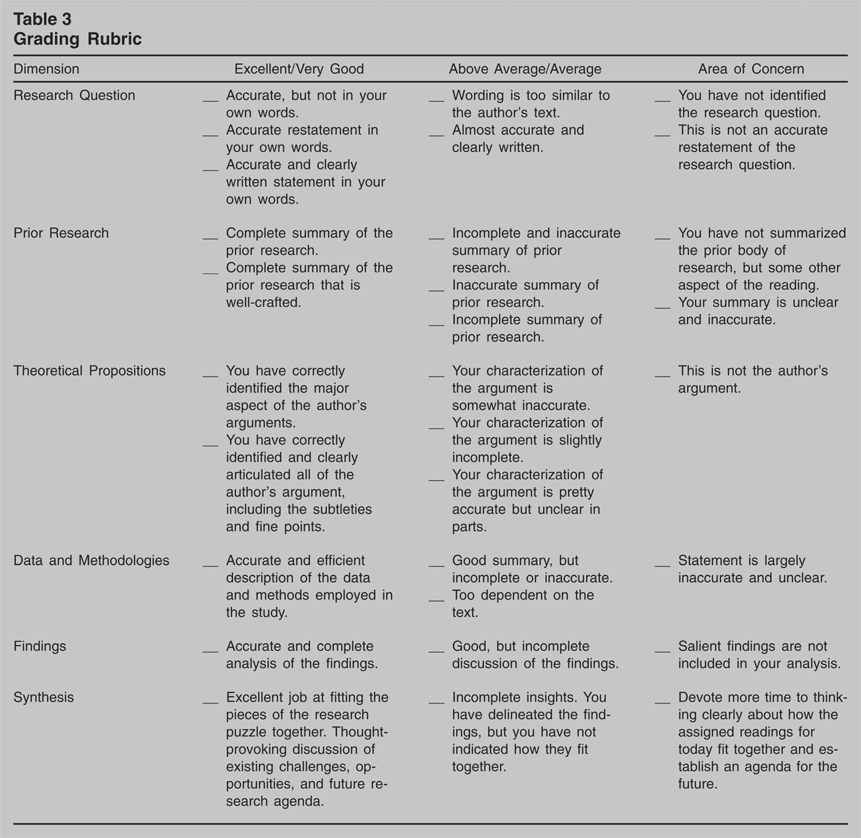
In light of the research literature, which details the power and effectiveness of rubrics, I have devised an assessment rubric to evaluate the analysis briefs (Andrade 2000) that my students complete.1
Rubrics are increasingly common in undergraduate teaching. For examples of how they are used and how they can be adapted to the graduate curriculum, see www.wcer.wisc.edu/archives/cl1/flag/cat/catfram.htm and www.aaup.org/publications/Academe/2005/05nd/05ndlovi.htm.
Grading Rubric

The third column indicates areas of concern for students, who either turn in sloppy or careless work, who do not understand the underlying components of a particular article, or who offer mind-numbing critiques. During the first few weeks, it is common for even the most promising students to have marks or points in the third column, especially if they have not devoted adequate attention to critical reading and careful articulation. The grading rubric, therefore, provides students with specific comments that help them to understand the particular strengths and weaknesses of their critiques. The chart provides an easy way to indicate the student's marks or points by simply checking the appropriate box. Over the course of the semester, students can utilize the grading rubrics to measure their progress in mastering challenging components of the analytical process. In this regard, there is nothing more rewarding than to observe students' hard-won progress, as they slowly but surely improve these important foundational skills, which are among prerequisites for success in our profession.
Anecdotal Assessments of Analysis Briefs as Compared to Weekly Essay Papers
Although the analysis briefs require more time to complete than the weekly “reflection” or “idea” papers that are standard fare in most graduate seminars, students still report three distinct benefits from the analysis brief assignment. First, students credit the analysis brief structure as what forces them to read a lot more carefully. Second, graduate students report that it has helped them to identify the important components of research and, then, to ferret out the important aspects of an author's argument. One student reported that he now completes all reading assignments by using the framework of research components as a guide to understand the author's argument. Third, and most importantly, the method has provided them with the tools to know how to evaluate critically a variety of scholarship, which ranges from qualitative to quantitative studies.
In the past, I used the traditional weekly “idea paper” that is typically assigned in graduate seminars, whereby students were asked to write reflective essays about all of the assigned readings for a particular week. In contrast to these assignments, the analysis brief assignments provide a solid basis for informed class discussions. That is because students worked individually through the important task of reading and understanding the arguments as well as the findings. Consequently, discussions during the class can be geared toward the more productive questions regarding future research agenda or comparative discussions of theory and approaches. Even, students who are reportedly quiet in other graduate seminars are more willing to participate in the class discussions, where the briefs are utilized, because they have been “forced” to think seriously about the arguments and to prepare thoughtful comments in advance of our class meeting. Finally, many graduate students have reported that they have adopted the analysis briefs in other seminars, utilized them to prepare for comprehensive examinations, to keep abreast of changes in their areas of specialization, and, above all, to sharpen several aspects of their dissertation proposals.
Over the years, I have discovered that most graduate students simply need to be shown how to engage critically the research literature, and indeed, it is part of our task as teachers to train them effectively toward that end. When we systematically train our students how to think and write critically, we give an intellectual gift that keeps on giving. Most notably, there is the wonderful creation of new knowledge that our students produce, which moves our profession forward in positive and beneficial ways.
Author Bio
Yvette M. Alex-Assensoh is the author/co-author of three books, an edited volume, and several refereed journal articles in the areas of minority and urban politics. She served as director of Graduate Studies (2002–2003) and as director of Graduate Studies and Admissions (2003–2007) in the political science department of Indiana University–Bloomington.