INTRODUCTION
Traumatic brain injuries (TBI) in childhood result in a variety of adverse outcomes. Children with severe TBI experience significant deficits in cognitive skills, academic performance, and adaptive behaviors in comparison to healthy peers and to children with orthopedic injuries not involving the brain (Fletcher et al., 1996; Yeates, 2000). Significant deficits in social and behavioral functioning are also frequently reported following childhood TBI, including increased aggression, poor temper control, inattention, and hyperactivity (Max et al., 1998; Taylor et al., 1999). These social and behavioral difficulties tend to increase over time, and children with severe injuries often develop clinically significant disturbances (Fletcher et al., 1990; Kinsella et al., 1999).
Social competence is a vital aspect of children's development (Rothbart & Bates, 1998). Children with difficulties in social and behavioral functioning are at risk for a range of negative outcomes, including academic failure, peer rejection, and delinquent behavior (Caspi & Moffitt, 1995; Caspi et al., 1995; Coie & Dodge, 1998; Parker & Asher, 1987). Self-regulation is a major predictor of social competence (Campbell, 1995, Olson et al., 2005). Therefore, the social and behavioral difficulties that commonly occur following childhood TBI may at least partially reflect impairments in self-regulation.
Self-regulation is a multifaceted construct that is often viewed as a biologically based attribute, governed by the prefrontal cortex (Luria, 1973). Saarni (1997) defined self-regulation as the capacity to manage one's own thoughts, feelings, and actions in adaptive and flexible ways across a variety of contexts. Thus, self-regulation can be conceptualized as involving three dimensions, namely, cognitive, emotional, and behavioral self-regulation. Developmental research has typically examined each of these aspects of self-regulation in isolation; that is, studies have focused on cognitive self-regulation (e.g., Dagenbach & Carr, 1994; Dodge et al., 1997), emotional self-regulation (e.g., Cicchetti, 1994; Shields et al., 2001), and behavioral self-regulation (e.g., Barkley, 1997; Krueger et al., 1996). Although cognitive, emotional, and behavioral dimensions of self-regulation can be distinguished conceptually, they are likely to be closely linked (Banerjee, 1997; Lemerise & Arsenio, 2000). Previous studies that have examined multiple dimensions of self-regulation simultaneously have shown them to be correlated (e.g., Eisenberg et al., 1997).
Regulatory deficits including poor inhibitory control, as well as deficits in planning and organization, have been connected to lesions to the orbitomedial and dorsolateral prefrontal cortex (Stuss & Benson, 1986). Thus, abnormalities within the prefrontal cortex are likely to give rise to impairments in self-regulation (Barkley, 1997; Bradley, 2000; Dennis et al., 2001). Disruption to the structure and functional organization of the prefrontal cortex is common following TBI (Bigler, 2001; Wilde et al., 2005). However, research on the outcomes of childhood TBI has paid little attention to the role of self-regulation in children's social and behavioral difficulties.
The overall goal of the present study was to examine the impact of childhood TBI on self-regulation and social and behavioral functioning, and to determine the contribution of self-regulation to the prediction of social and behavioral outcomes. We hypothesized that children with moderate to severe TBI would display poorer social and behavioral functioning than children without TBI. We also hypothesized that children with TBI would demonstrate lower levels of self-regulation than their uninjured peers. We further expected that children with severe TBI would perform more poorly on outcome measures than those with moderate TBI. Finally, we hypothesized that self-regulation would account for significant variance in social and behavioral functioning after controlling for SES, regardless of group membership (i.e., presence or absence of TBI).
METHODS
Study Design and Recruitment
The study used a cross-sectional, retrospective design with two groups, consisting of children with moderate to severe TBI and uninjured children. Sixty children with TBI were recruited from Australia, specifically from three children's hospitals including the Royal Children's Hospital, Victoria, Sydney Children's Hospital, and the Children's Hospital at Westmead, New South Wales. These children were identified via hospital record review. Five additional children with TBI were recruited from primary schools in New Zealand. These children were identified by school personnel as having been assigned a teacher's aide to assist them with completing schoolwork after sustaining a TBI. Information about the study and a consent form were sent to parents of children with TBI who fulfilled the inclusion criteria. Those interested in participating returned the consent form and were then contacted via telephone to schedule an assessment. Children with TBI and their parents (more than two thirds of those originally approached) volunteered to participate in the study.
Uninjured children for the comparison group were first approached in Australia. Difficulties in ascertaining the required sample within the time frame of the study led to the recruitment of uninjured children in New Zealand as well. Within the available time frame, it was possible to recruit 5 children from Australia and 60 children from New Zealand. These children were recruited from local primary schools. Upon gaining permission from school principals, children were given a newsletter, information about the study, and a consent form to take home to their parents or caregivers. On the newsletter, parents were asked whether their child had had a hospital admission and the reason for the admission. Children were excluded from the study if there was any suspicion of head injury associated with the hospital admission. Children were also excluded if they had a history of any learning, attentional, or developmental disorders. The parents of children who were eligible to participate were contacted via telephone and an appointment for an assessment was arranged. The data were obtained in compliance with the regulations of the Ethics in Human Research Committees of the Royal Children's Hospital, Victoria, and the Sydney Children's Hospital and the Children's Hospital at Westmead, New South Wales, Australia, and the School Boards in Australia and New Zealand.
Research Participants
Participants included 65 children with moderate to severe TBI and 65 uninjured children who were matched for age and gender to those with TBI. Children were between 6 and 11 years of age when assessed. They were all attending a mainstream primary school. Participants in both groups were predominantly Caucasian (95%). The remaining 5% of participants in each group were of Asian, Polynesian, or Middle-Eastern descent. All participants spoke English as their first language.
The inclusion criteria for children with TBI were as follows: (1) documented evidence of closed head injury of an unintentional nature (e.g., motor-vehicle accidents, falls, and sporting accidents), (2) time since injury from 2 to 5 years, and (3) medical records with documented evidence of moderate to severe TBI. Severe TBI was defined by the lowest Glasgow Coma Scale (GCS; Teasdale & Jennett, 1974) score of 8 or less. Moderate TBI was defined as a GCS score of 9 to 12, or a score of 13 to 15 accompanied by skull fracture, intracranial lesion, or diffuse cerebral swelling on routine clinical neuroimaging; post-traumatic neurological abnormality; or loss of consciousness greater than 15 minutes. Children were excluded if they presented with any of the following characteristics: (1) previous head injury, (2) documented learning or attention disorder before injury, or (3) history of neurological or developmental disorders. All children with severe TBI (n = 32) had intracranial abnormalities on computed tomography (CT) and/or magnetic resonance imaging (MRI) scans. Among children with moderate TBI (n = 33), 24 (73%) had abnormal findings on CT and/or MRI scans. A summary of the causes of TBI for moderate and severe TBI groups is presented in Table 1. No significant group differences were found in the cause of injury. Motor-vehicle accident was the most common cause of injury, followed by falls. This finding is consistent with the epidemiology of TBI (Kraus, 1995). Children in the TBI group had sustained TBI between the ages of 2 and 9 years.
Causes of TBI

Participants came from widely varying socioeconomic backgrounds as determined from maternal education and occupation. Maternal education was rated using an ordinal scale ranging from 1 (postgraduate degree) to 6 (less than 10 years). Ratings on this scale were standardized across the entire sample. Because participants came from both Australia and New Zealand, occupation was assessed using scales specific to each country. Australian mothers were rated using the seven-point Daniel Scale of Occupational Prestige (DSOP; Daniel, 1983). New Zealand mothers were rated using the New Zealand Socio-Economic Index (NZSEI; Davis et al., 1997), which is modeled on the International Socio-Economic Index devised by Ganzeboom et al. (1992). Scores on this index ranged between 10 and 90. Scores on the two occupation scales were strongly correlated on 20 randomly selected occupations (r = .95; p < .001). Raw scores on the two occupation scales for participants from Australia and New Zealand were standardized separately. The mean z-score for maternal education and occupation were combined to create a composite measure of SES.
Measures
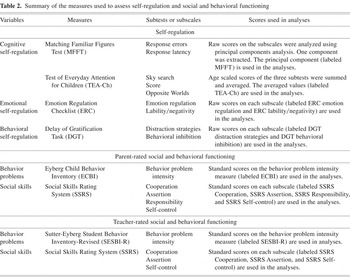
Table 2 provides a summary of the major variables in the study, the measures used to assess each variable, and the scores that were used in the analyses.
Summary of the measures used to assess self-regulation and social and behavioral functioning

Children's social and behavioral functioning
Social and behavioral functioning were examined using the parent-rated Eyberg Child Behavior Inventory (ECBI; Eyberg & Robinson, 1983), the teacher-rated Sutter-Eyberg Student Behavior Inventory-Revised (SESBI-R; Funderburk & Eyberg, 1989), and the parent and teacher versions of the Social Skills Rating System (SSRS; Gresham & Elliot, 1990). These are standardized measures that have been widely used in developmental research and have demonstrated satisfactory reliability and validity (Funderburk & Eyberg, 1989; Gresham & Elliot, 1990). The ECBI assesses the intensity of a variety of behavior problems that children may display at home. Higher scores on this measure represent poorer functioning. The SESBI-R assesses the intensity of behavioral difficulties children may display in school. Higher scores reflect poorer functioning. The SSRS examines everyday social behaviors that enable children to interact with others effectively, including sharing, helping, initiating relationships, giving compliments, and requesting help. The parent-rated SSRS assesses four subscales (Cooperation, Assertion, Responsibility, and Self-control), whereas the teacher-rated SSRS assesses three of the same dimensions (Cooperation, Assertion, and Self-control). Higher scores on the SSRS indicate better social competence.
Children's self-regulation
Children were administered the Matching Familiar Figures Test (MFFT; Kagan, 1966) to assess cognitive self-regulation. The MFFT is widely used to assess cognitive impulsivity or the lack of cognitive control (e.g., Mariani & Barkley, 1997; Olson et al., 1999). Children are required to match a single drawing of a familiar figure to an array of six variants of the figure, only one of which is identical to the target stimulus. Children's performance on this task is recorded on two indices of impulsivity: (1) response errors (i.e., number of errors made before arriving at the correct answer), and (2) response latency (i.e., time taken to arrive at the first response). Principal components analysis extracted one component based on the two indices, and the principal component was used in the subsequent analyses. The MFFT has demonstrated satisfactory reliability and validity (Kagan, 1966; Olson et al., 1999). Higher scores indicate poorer self-regulation.
The Sky Search, Score, and Opposite Worlds subtests of the Test of Everyday Attention for Children (TEA-Ch; Manly et al., 1999) were also used to assess cognitive self-regulation. On Sky Search, children are required to first identify and circle as quickly as possible as many “target” spaceships as possible on a sheet filled with similar distracter spaceships. They then circle the spaceships on another sheet, which contains no distracter spaceships, again as quickly as possible. The time taken to complete the second task is subtracted from the time taken to complete the first task, to control for motor speed. This task, thus, assesses selective or focused attention independent of motor speed.
The Score subtest was chosen to provide a measure of children's capacity to regulate or sustain attention without assistance. This task features laser beam sounds on an audiocassette. Each sound is followed by a silent interval. There are 9–15 sounds per set. Children are required to count and report the total number of sounds heard per set. The task includes a total of 10 sets, each lasting 30 to 40 seconds. Children are given a point for each set that is correctly counted.
Opposite Worlds is a timed task that assesses attentional control. Specifically, the task assesses children's capacity to suppress an automatic verbal response. Children are required to follow the picture of a path in a booklet scattered with the digits “1” and “2”, and to name each digit. On the first trial, which operates under the “same world” rule, participants say “one” for the numeral 1 and “two” for the numeral 2. On the second trial, which operates under the “opposite world” rule, participants are instructed to say “two” for the numeral 1 and “one” for the numeral 2. The amount of time taken to complete each trial is used to score the task. A score based on only the Opposite Worlds trial was used in the current study.
The subtests of the TEA-Ch have demonstrated satisfactory reliability and validity (Manly et al., 1999). An average of the scaled scores of the three subtests was used in the subsequent analyses. Higher scores indicate better cognitive self-regulation.
The parent-rated Emotion Regulation Checklist (ERC; Shields & Cicchetti, 1998a) was used to assess emotional self-regulation. This questionnaire has demonstrated satisfactory reliability and validity in developmental research (Shields & Cicchetti, 1998b; Shields et al., 1994, 2001). The ERC has two subscales: emotion regulation and lability/negativity (Shields & Cicchetti, 1998a). The emotion regulation subscale includes items reflecting appropriate affective displays, empathy, and emotional awareness. Higher scores on this subscale reflect better emotional self-regulation. The lability/negativity subscale includes items reflecting inflexibility, mood lability, and negative affect. Higher scores on this subscale indicate poorer emotional self-regulation.
A 10-minute Delay of Gratification Task (DGT; Mischel & Ebbesen, 1970) was used to assess behavioral self-regulation. The task has been used widely to assess children's capacity to inhibit behavioral responses and to use strategies that help them delay immediate gratification and wait for a more desired reward (Rodriguez et al., 1989; Sethi et al., 2000). Children were videotaped during the task. The experimenter placed a bell and possible rewards (i.e., small candies) in front of the child; two candies on one side of the bell, and one candy on the other side. Children were told that they would receive two candies if they waited for the experimenter to return to the room, but that they would receive only one candy if they rang the bell to summon the experimenter before she returned. Two indicators of behavioral self-regulation were derived from the task: (1) distraction strategies, which is a count of the number of behavioral strategies used to help delay gratification (e.g., looking away from the rewards, restating the rules, playing games with one's own hands and feet), coded using methods used in previous research (e.g., Rodriguez et al., 1989; Sethi et al., 2000); and (2) behavioral inhibition, as indexed by the amount of time waited before receiving the rewards. On both measures, a higher score indicates better functioning.
Data Analyses
First, group differences between children with and without TBI were examined using analysis of covariance (ANCOVA), controlling for SES. Dependent variables included measures of self-regulation (i.e., MFFT, TEA-Ch, ERC emotion regulation, ERC lability/negativity, DGT distraction strategies, and DGT behavioral inhibition), and parent- and teacher-rated social and behavioral functioning (i.e., parent-rated ECBI, SSRS Cooperation, Assertion, Responsibility and Self-control, and teacher-rated SESBI-R, SSRS Cooperation, Assertion, and Self-control). We also examined group differences between children with moderate and severe TBI on these outcome measures, again after controlling for SES. When group differences on the MFFT were examined, age at assessment was also treated as a covariate because raw scores were used in the analyses, and were found to significantly correlate with age. Because raw scores on the ERC and DGT subscales were not significantly correlated with age, the analyses examining group differences on these measures did not control for age.
Next, correlations were examined between the measures of self-regulation and the measures of social and behavioral functioning. Correlations were also examined among the six measures of self-regulation.
Finally, hierarchical regression analyses were conducted to examine the contributions of self-regulation to the prediction of social and behavioral functioning. For each social and behavioral outcome, SES and group membership (i.e., a dummy variable coded for the presence or absence of TBI) were entered in step 1 of the analysis. In step 2, measures of self-regulation (i.e., MFFT, TEA-Ch, ERC emotion regulation, ERC lability/lability, DGT distraction strategies, and DGT behavioral inhibition) were entered collectively as predictors to determine whether self-regulation predicted social and behavioral outcomes.
RESULTS
Group Characteristics
Table 3 summarizes group characteristics. The TBI and comparison groups did not differ significantly in age at assessment, gender, socioeconomic status, or the proportion of Caucasian participants.
Sample characteristics at assessment (total sample)

Group Comparisons on Self-Regulation and Social and Behavioral Functioning
Parents reported significantly greater intensity of behavior problems on the ECBI for children with TBI than for healthy peers. On the SSRS, parents reported that children with TBI displayed poorer social skills. Scores on all four subscales of the parent-rated SSRS were lower for the TBI group than the comparison group. The results are summarized in Table 4.
Summary of group differences on parent-rated social and behavioral functioning, controlling for SES

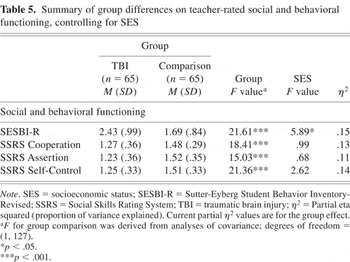
Similar results were obtained for teacher-reported measures of social and behavioral functioning (see Table 5). Teachers reported significantly greater intensity of behavior problems on the SESBI-R for children with TBI than for those without TBI. Teachers also reported poorer social and behavioral functioning among children with TBI on the SSRS. Scores were lower for children with TBI than for their healthy peers on all teacher-reported SSRS subscales.
Summary of group differences on teacher-rated social and behavioral functioning, controlling for SES

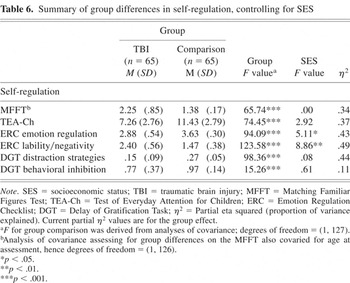
Significant group differences were also obtained on all measures of self-regulation, with poorer functioning demonstrated by children with TBI (see Table 6). Children with TBI had higher scores on the MFFT and lower scores on the TEA-Ch, suggesting poorer cognitive self-regulation. On the ERC, the TBI group had lower scores on the emotion regulation scale and higher scores on the lability/negativity scale, suggesting poorer emotional self-regulation. On the DGT, which assessed behavioral self-regulation, children with TBI used fewer distraction strategies than their uninjured peers. They also terminated the task sooner than the children in the comparison group.
Summary of group differences in self-regulation, controlling for SES

Injury severity was not related to outcomes among the children with TBI. No significant differences were identified between the moderate and severe TBI groups on the measures of self-regulation or social and behavioral functioning.
Prediction of Social and Behavioral Functioning
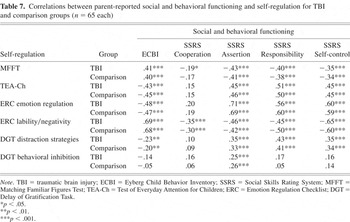
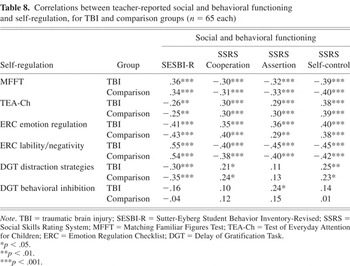
Correlational analyses were conducted to explore the relationships between self-regulation and social and behavioral functioning. Within-group correlations among social and behavioral functioning and self-regulation are presented in Tables 7 and 8 for parent- and teacher-ratings, respectively. Parent- and teacher-rated measures of social and behavioral functioning were significantly correlated with cognitive and emotional self-regulation in both groups, but with only select aspects of behavioral self-regulation.
Correlations between parent-reported social and behavioral functioning and self-regulation for TBI and comparison groups (n = 65 each)

Correlations between teacher-reported social and behavioral functioning and self-regulation for TBI and comparison groups (n = 65 each)

Correlational analyses were also conducted to examine the interrelationships among measures of self-regulation. Significant correlations were found among the MFFT, TEA-Ch, ERC emotion regulation, ERC lability/negativity, and DGT distraction strategies. The correlations ranged from medium (r = .37, p < .01 between TEA-Ch and DGT distraction strategies), to large (r = −.67, p < .01 between ERC emotion regulation and lability/negativity). The DGT behavioral inhibition measure was only correlated with two other self-regulation measures: ERC emotion regulation (r = .22, p < .05) and DGT distraction strategies (r = .60, p < .01).
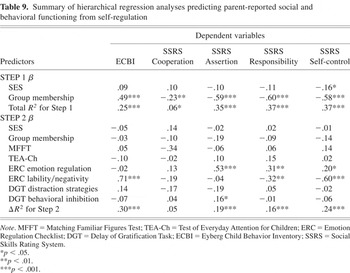
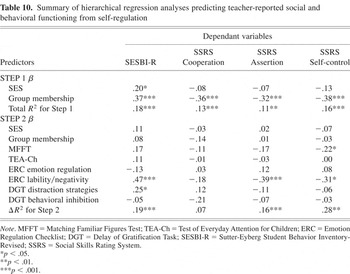
Hierarchical regression analyses were conducted to examine the contribution of self-regulation to the prediction of social and behavioral functioning. The analyses are summarized in Tables 9 and 10 for parent- and teacher-reported social and behavioral outcomes, respectively.
Summary of hierarchical regression analyses predicting parent-reported social and behavioral functioning from self-regulation

Summary of hierarchical regression analyses predicting teacher-reported social and behavioral functioning from self-regulation

Collectively, SES and group membership accounted for significant variance in all parent-reported outcomes (see Table 9). After controlling for SES and group membership, measures of self-regulation collectively accounted for significant variance in all parent-reported outcomes [all F(6,120) > 7.00, ps < .001], except the SSRS Cooperation subscale [F(6,120) = .64, n.s.]. The ERC lability/negativity subscale predicted unique variance in the ECBI (t = 7.38, p < .001). The ERC emotion regulation subscale and the DGT behavioral inhibition subscale each accounted for unique variance in the SSRS Assertion subscale (t = 6.00, p < .001) and (t = 2.00, p < .001), respectively. Further, the ERC emotion regulation and lability/negativity subscales both predicted unique variance in the SSRS Responsibility subscale (t = 3.36, p < .01) and (t = −3.17, p < .01), respectively, and the SSRS Self-control subscale (t = 2.39, p < .05) and (t = −6.51, p < .001), respectively.
SES and group membership also collectively accounted for significant variance in all teacher-reported social and behavioral outcomes. After controlling for SES and group membership, self-regulation measures collectively accounted for significant variance in all teacher-reported outcomes [all F(6,120) > 4.43, ps < .001], except the SSRS Cooperation subscale [F(6,120) = 1.83, n.s.]. The ERC lability/negativity subscale explained unique variance in the SESBI-R (t = 4.02, p < .001). The DGT distraction strategies subscale also predicted significant unique variance in the SESBI-R (t = 2.11, p < .05), although the relationship was not in the expected direction. The ERC lability/negativity subscale accounted for unique variance in the SSRS Assertion and Self-control subscales (t = −3.12, p < .001) and (t = −2.46, p < .01), respectively. The MFFT also predicted unique variance in the SSRS Self-control subscale (t = −2.21, p < .05).
Hierarchical regression analyses were also conducted with interaction terms involving group membership and each of the measures of self-regulation to examine whether the relationships between self-regulation and social and behavioral functioning varied across groups. The interaction terms did not predict significant variance. Thus, the findings are applicable to both children with and without TBI.
Variance Inflation Factor (VIF) and Tolerance are both measures that help identify multicollinearity. VIF values greater than 10, and low tolerance with values that are close to zero indicate that multicollinearity is present. The current VIF values ranged from 1.11 to 3.38, and the tolerance ranged from .30 to .90. Thus, we do not believe that multicollinearity affected the current findings.
DISCUSSION
As hypothesized, children who sustained a moderate to severe TBI demonstrated poorer social and behavioral functioning than children without TBI. Children with TBI scored higher on the parent-reported ECBI and the teacher-reported SESBI-R, suggesting that these children more often engaged in “externalizing” behaviors, including defiance, temper tantrums, destructiveness, and restlessness. Furthermore, children with TBI scored lower on the parent- and teacher-reported SSRS, highlighting difficulties in initiating friendships with peers, giving compliments, requesting help, and helping family members and peers. These findings are consistent with previous research (e.g., Andrews et al., 1998; Michaud et al., 1993; Taylor et al., 1999) and confirm that children with TBI are at risk for poor long-term adaptive outcomes (Kehle et al., 1996; Perrott et al., 1991).
The poor social and behavioral outcomes associated with TBI have been linked to the relative vulnerability of the prefrontal cortex to damage and its impact on core executive or self-regulatory functions (Dennis et al., 2001). As predicted, children with TBI showed greater deficits in self-regulation than their uninjured peers, in the cognitive, emotional, and behavioral domains. Children in the TBI group were more impulsive, easily distracted, and less attentive on cognitive measures. They were also reported by parents to have poorer regulation of emotions; that is, parents described them as displaying less emotional awareness, empathy, and situationally appropriate affect, and to more often exhibit poorly regulated negative affect, including mood swings, flat affect, and socially inappropriate emotional expressions. Behaviorally, on a laboratory-based test of the capacity to delay immediate gratification, children with TBI were more likely to focus on the reward and less likely to engage in effective distraction strategies such as looking away from the reward or self-soothing behaviors. Children with TBI also reached for the reward more quickly, leading to premature termination of the task. These findings are consistent with previous research highlighting regulatory deficits following TBI (e.g., Eslinger et al., 1992; Max et al., 2004; Schachar et al., 2004; Schore, 1996).
Several studies have shown that children with severe TBI often perform more poorly on outcome measures than do children with moderate TBI. We found no significant differences between the moderate and severe TBI groups in this study. However, given that children in the TBI group were assessed 2 to 5 years after injury, the current findings are not entirely surprising. Acute measures of severity, such as GCS scores, do not always predict long-term outcomes following childhood TBI. Other longer-term outcome studies (e.g., Anderson et al., 2001) also have failed to find differences in social outcomes between moderate and severe injuries.
Developmental theorists have linked inadequate regulation to the development and persistence of maladaptive outcomes (e.g., Barkley, 1997; Moffitt, 2003; Olson et al., 1999, 2005). Prior to this study, however, the hypothesized association between self-regulation and social and behavioral functioning had not been examined among children with TBI. Our analyses showed that, after controlling for SES and group membership, the measures of self-regulation made significant collective contributions to the prediction of social and behavioral functioning, as reported by both parents and teachers. The strength of the association was similar for both children with TBI and the healthy comparison group, based on the absence of significant interactions between group membership and self-regulation as predictors of social and behavioral functioning.
Although cognitive and behavioral self-regulation predicted only small amounts of unique variance in social and behavioral outcomes, these forms of self-regulation were assessed directly with the children, whereas the social and behavioral outcomes were rated by parents and teachers. Thus, these findings are independent of any shared method or informant variance. The current measures are less elaborate than those used in previous studies and may not have captured children's cognitive and behavioral regulatory skills adequately. Thus, only small amounts of unique variance were explained. Nonetheless, the contributions of these forms of self-regulation are consistent with the theoretical linkages postulated in the developmental research (e.g., Dodge et al., 1997; Olson et al., 2000; Schachar et al., 1993). Individual differences in cognitive and behavioral impulsivity and inhibitory control, for instance, have been linked to a broad range of developmental outcomes, including social competence (Olson, 1989) and patterns of parent–child interaction (Olson et al., 1990), as well as parent- and self-rated externalizing behavior problems (Olson et al., 1999).
Emotional self-regulation accounted for a larger portion of unique variance in social and behavioral functioning. Similar relations between emotional self-regulation and social and behavioral functioning have been reported previously (e.g., Eisenberg et al., 1997, 2000; Shields & Cicchetti, 1998b), but not in children with TBI. Of course, this association may be partly confounded by shared method and informant bias, because parents rated both emotional self-regulation and social and behavioral outcomes. This finding could explain why the relationships with emotional self-regulation were stronger for parent-reported outcomes than for teacher-reported outcomes. However, emotional self-regulation was still a significant predictor of teacher-reported social and behavioral outcomes, suggesting that the relationship was not entirely attributable to shared informant bias.
Although the current findings are largely consistent with the hypotheses and with previous research, the study is characterized by several methodological limitations. First, healthy children without TBI were selected for the purposes of comparison. The healthy participants did not have a history of traumatic injury and had not experienced the general stress of hospitalization. To control for differences between children who sustain injuries and those who do not, as well as for the experience of hospitalization, a comparison group of children with orthopedic injuries not involving damage to the head could provide useful information (e.g., Taylor et al., 1999).
A second shortcoming was that the TBI sample was recruited predominantly from Australia, whereas the comparison group was recruited predominantly from New Zealand. This was largely a matter of convenience, given the availability of eligible participants at the respective sites. The difference in recruitment rates could potentially have biased the results. However, Australia and New Zealand are culturally very much akin, with similar health and education standards and practices and similar migration patterns (Australian Bureau of Statistics, 2001; National Health Information Management Advisory Council, 2001). Thus, although it would have been preferable to recruit children from only one country or to have matched group sizes within countries, the disproportionate recruitment across countries is unlikely to have been a significant confound.
Another limitation of the study was that general intellectual functioning was not assessed. Thus, we cannot be sure whether children with TBI show selective deficits in self-regulation independent of overall cognitive ability or IQ, or if the association between self-regulation and social and behavioral functioning holds even when controlling for IQ. However, several studies have found that IQ scores do not necessarily account for significant variance in children's social and behavioral outcomes (e.g., Fletcher et al., 1990; Yeates et al., 2004). Several other variables that contribute to social and behavioral outcomes after TBI were not examined in this study, including social problem-solving skills (Janusz et al., 2002) and pragmatic language and discourse skills (Yeates et al., 2001). The inclusion of these variables in the current model may help us better understand children's social and behavioral outcomes following TBI.
Yet another limitation in this study was that premorbid functioning was not assessed. Therefore, we cannot be sure whether children with and without TBI differed in their premorbid self-regulatory and social and behavioral functioning. Suitable measures to assess premorbid self-regulation and social and behavioral functioning must be included in future studies to understand premorbid differences between the two groups, and its contributions to children's postinjury outcomes.
Other study limitations involve measurement issues. Some of the relationships between the measures of social and behavioral functioning and the measures of emotional self-regulation may have been due to overlap in item content. However, the amount of item overlap is limited. Moreover, previous research has demonstrated significant relationships between these variables using different and nonoverlapping measures (e.g., Shields & Cicchetti, 1998b); therefore, the relationships found here are likely to be meaningful. Second, although cognitive and behavioral self-regulation were each assessed directly with the children, parent reports were used to assess emotional self-regulation, and parent and teacher ratings were used to assess social and behavioral functioning. Direct behavioral observations of children's emotional self-regulation and social and behavioral functioning would have been desirable, but were beyond the scope of this study.
Despite these limitations, the present findings contribute to the ongoing study of social outcomes following childhood TBI, and highlight some of the social and regulatory difficulties exhibited by school-age children several years after moderate to severe TBI. More importantly, the study provides evidence that self-regulation contributes to the prediction of children's social and behavioral functioning. One important implication of these findings is that self-regulation may be a core deficit following TBI and act as a mediator between TBI and social and behavioral outcomes. Future studies are needed to test this mediational hypothesis more directly.
ACKNOWLEDGMENTS
The research presented here has no financial or other relationships that could be interpreted as a conflict of interest. The authors acknowledge the contributions of Ms. Naomi Brooks at the Sydney Children's Hospital and Dr. Adam Schienberg at the Children's Hospital at Westmead, New South Wales, Australia, for their support in the recruitment of children with TBI at the respective hospitals. A preliminary version of this study was presented at the annual meeting of the International Neuropsychological Society in Hawaii, USA, February, 2003.