In an interview about his book on plagues, which came out only months before COVID-19 spread across the world, Frank Snowden remarked: “Epidemic diseases reach into the deepest levels of the human psyche. They pose the ultimate questions about death, about mortality.”Footnote 1 Indeed, the current plague that has afflicted us, a respiratory virus, reveals a stark truth about death since it isolates the severely ill from their friends and family members in an ICU bed. The sick must be alone in their suffering and in their possible death, lest they infect others. But are we not all alone in our suffering and death? Is not suffering and death what is most private and individual to each of us? After all, no one dies my death and I do not die anyone else’s. Death belongs to me; it cannot be exchanged as any other thing in my life can be exchanged.
If I can share my books, my things, and my words with others, such is not the case with what afflicts my body: I can point to my pain and I can describe it in detail but no one else but myself can feel it, or so Ludwig Wittgenstein argues in his Philosophical Investigations (1953). Wittgenstein suggests that language as communal and exchangeable cannot convey the individual and non-exchangeable feeling of my pain. A gap separates my pain from the words I use to describe it. The same applies to death: I cannot share my death without turning away from “it” as what is most individual to me because language does not belong to me but to the community. As “outside” the world, my death withdraws as the enigmatic, if not silent “other,” within what is spoken.
And yet we talk and write about death all the time. So what are we doing when we talk and write about death? This is the question that I should like to explore in this essay. Specifically, I shall do so by thinking about several plague narratives that have been written since the ancient period, five to be precise, one from the ancient period (Thucydides’s The Peloponnesian War), one from the late medieval period (Giovanni Boccaccio’s The Decameron), one from the early modern period (Daniel Defoe’s A Journal of the Plague Year), and two from the modern period (Mary Shelley’s The Last Man and Frank Snowden’s Epidemics and Society).Footnote 2 These books not only come from different eras but they also reflect different genres—ancient history, story/fable, reportage, futuristic novel, and contemporary history. By reviewing these diverse books, I wish to ask: Can we write about death, which only afflicts individuals, without stripping death of its individuality? Can we talk about death as “outside” the world through a medium which is inside it? To anticipate, no settled, final answer can be found among the writers I discuss in this essay. While some try to face death, others suggest that any such attempt will fail since we cannot face death without turning away from it.
Before I begin with the most recent plague narrative and the one most reflective of contemporary academic scholarship, the one written by Snowden, I would like to mention, if very briefly for now, the counterargument to my essay. The counterargument admits the basic problem I mentioned above but moves in the different direction of saying, following Epicurus, that death is nothing for us since we cannot speak of anything outside language and since we are always already in the world interacting with others.Footnote 3 It is therefore incoherent even to try to speak about death or nothingness because we never experience the complete nothingness of our own death. For how can we talk about nothingness, absence, silence without turning it into something? How can we talk about what permits no predicate? The response of plague writers is this: if death cannot be thought or spoken, why do we fear it and need the Epicurean counsel to think nothing less of it? Death as unknowable or nothing presents the basic estrangement from the world to which the Epicurean argument responds. Let us now turn to that estrangement as narrated by Snowden and our other plague writers. After discussing them, I will conclude by returning to this counterargument through one of its most compelling proponents, Baruch Spinoza, who suggests that thinking death keeps us narrowly focused on our individual selves. Spinoza reveals the ultimate issue at stake here: to privilege the individual or not as the locus of suffering and death.
Snowden
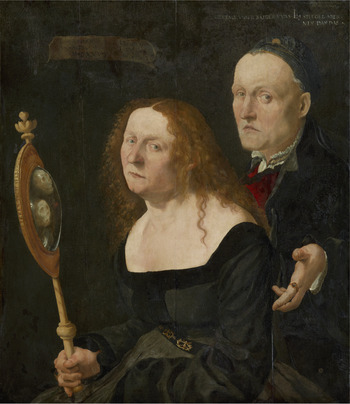
Frank Snowden, a professor emeritus at Yale University and a specialist in Italian history who since the mid-1990s has been publishing books on the history of diseases, writes about death in a manner largely different from the narratives discussed below, which emphasize the breakdown of social conventions and the fragility of human freedom from death. To be sure, he touches on these themes in his expansive history of infectious epidemics from the Justinian Plague of 541 CE to the SARS contagion of 2002; he quotes from Boccaccio and Defoe and discusses several paintings that stress the vanity of human life, including a vanitas painted by Lukas Furtenagel (1505–1546) that depicts an aging, unattractive couple staring outward as they hold a mirror of themselves reflected as skulls (see image 1). An inscription on the mirror reads, “Recognize yourself.” You are death; it is thus vain to want anything more than nothing, as Anton Chekhov might have put it, whom Snowden discusses briefly in his history of tuberculosis. Chekhov, says Snowden, focuses on the impotency of individuals afflicted by a feeling of entrapment to “events beyond their control” (p. 289).
Lukas Furtenagel, The Painter Hans Burgkmair and His Wife Anna, 1529, Kunsthistorisches Museum, Vienna.

But Snowden’s discussion of Chekhov and other artistic responses to death fits into his narrative attempt to order and determine all the events he discusses in a clear and governing structure centered on four “developments”: (1) the public health strategies deployed to combat disease; (2) the intellectual advancement of medicine from the ancient period to the tripartite “revolution” of the physical medical exam, germ theory, and sanitation; (3) the social, religious, and artistic responses to plagues; and (4) the spread of epidemic diseases during wars (p. 5). Art has its place in a clear and determinate order, in a master narrative that serves the telos of utility, as Snowden himself emphasizes when he claims that studying the history of epidemic diseases might be helpful for “the survival of our society, and perhaps even of our species” (p. 3).
This claim suggests a connection between narrative and utility. If we follow Aristotle in defining narrative as a complete and whole account comprised of a beginning, middle, and an end, then the connection between narrative and utility becomes clear. Narratives serve ends, most basically the end of conceiving and understanding things in the world for the purpose of advancing human survival. In the case of Snowden’s history, the scientific narrative that explains diseases as caused by something in our material, “natural” world—identified, in different historical eras, as the imbalance of the humors, the presence of polluted air, or the transmission of harmful microbes into the body—has greater authority over those narratives that explain disease as caused by something outside the world such as Apollo or God. It is not difficult to see why the scientific narrative has greater authority for Snowden as well as for many of us who accept it as correct not least because it offers a useful way of managing a threat to our own individual survival.
Science is useful and therein lies a considerable amount of its authority. Yet, the authority of science is fragile as attested by the competing, non-scientific narratives that make their way into Snowden’s history. For, if its authority were so crushingly obvious as to command absolute obedience, then there would be no “religious and artistic developments” deviating from and undermining its authority.
What a perplexity we have here: science is highly useful, yet it does not wield absolute authority over us. Of course, science turns to the ready-made answer of ignorance to resolve this perplexity. It is our ignorance that holds us back from the liberating truth of science. Within the technical parameters of science itself, science does free us from a specific kind of ignorance. As Snowden shows, we do now know more about diseases than was the case throughout much of human history, and we have made many advances in medicine and technology that protect us in ways that someone in ancient Athens could not even have imagined. Moreover, science has increasingly liberated us from the pernicious tendency to scapegoat “threatening” groups of people such as foreigners and Jews as the begetters of communicable disease (pp. 64–65).
Despite these and other advancements, there are limits to what science can explain such as death. Someone dies. We ask why. Science offers one answer. The person died of COVID-19. An autopsy verifies this conclusion, and it is correct within the particular truths and rules that create the possibility of such an examination into the causality of death. But this conclusion, no matter how technically correct, does not offer an exhaustive answer. Something remains to be answered. The question returns. Why did a virus invade the person’s body in the first place? More answers come to mind. We might say that the person contracted the virus at a holiday party or that the person was living in a town where the virus was spreading rapidly or the like. But none of these explanations tells us why the virus is in the world and why it kills people.
We could go on and on, working through any possible narrative offered by science or, for that matter, any other explanation of disease and death. No matter which one we were to select we would find that, while they command authority among some people, they do not command universal authority among all people because, ultimately, they leave something out that cannot be explained. They all reach a barrier to human thought, and that barrier is death. Why do we die? We have many technically correct answers for that question, but none so far has become or proven itself to be the final answer accepted by everyone, as Snowden’s book shows, wittingly or not. On the one hand, Snowden affirms as correct the scientific answer that everything happens for a predictable reason: “Like all pandemics, COVID-19 is not an accidental or random event. Epidemics afflict societies through the specific vulnerabilities people have created by their relationships with the environment, other species, and each other.… Particularly relevant is the multiplication of contacts with bats, which are a natural reservoir of innumerable viruses capable of crossing the species barrier and spilling over to humans” (p. ix).
On the other hand, his discussion of the social disorder unleashed by plagues in each successive historical era upends the authority of the scientific explanation that he otherwise affirms. Plagues disrupt authoritative answers; they reveal the vanity or emptiness of the narratives that we tell to deflect our attention away from the inscrutability of death. So long as there is death there is dissatisfaction and interruption; so long as there is death there is an excess, an enigma, that prompts the question of why.
Thucydides
Thucydides writes a different historical narrative than that of Snowden, if he writes a historical narrative at all, since, as is well known, he avoids the word “history” in contrast to his predecessor, Herodotus. Interested in developing a genre of his own, he also distinguishes his narrative, his “writing of the war” (sunegrapse ton polemon), from poetry and chronicle on the grounds that his account tells the truth whereas the narratives written by poets and chroniclers turn away from it. The latter are more pleasing to the ear than the former since most people prefer to evade the truth, according to Thucydides. Such a claim must sound unusual to us who are shaped by some 2,500 years of history that have taught us to believe in the goodness and beauty of truth. We want to avoid the truth—how could that be? For Thucydides, it is in fact possible when it comes to the unpleasing truth of suffering and death, to the truth of war and pestilence, which is unpleasing because it is neither good nor beautiful for mortal creatures who want to live. When it comes to “suffering” and “destruction” (pathēma and phthora, p. 14), “so devoid of effort is most people’s search for the truth” (p. 12). Yet, Thucydides stands out as an exception who faces the truth of suffering and death. And therein lies one of the most interesting aspects of his account, an aspect that comes out powerfully in his narrative of the plague that afflicted Athens in 430/29 BCE.
Thucydides speaks what undoes speech, death, or, as he himself puts it, he writes about “a happening that surpasses language.”Footnote 4 The plague surpasses language as an “evil” that “strikes” from outside the world, like a lightning bolt from the heavens.Footnote 5 If there is a deity in Thucydides’s narrative, a daimonion, it is death, a deity that offers no divine support for human institutions and beliefs, a terrifying deity that bursts suddenly and randomly through the walls of the city to destroy the health of its inhabitants.Footnote 6 Death strikes at any time, out of nowhere, and for no reason. In this respect, death gainsays the scientific faith in reasons, the faith that nothing happens by chance or that nothing is without a reason (nihil est sine ratione): “The others, when they were healthy, were suddenly, for no apparent reason, afflicted first in the head by high fever and redness and burning in the eyes, and internally both the throat and the tongue immediately became bloody and emitted an unnatural and foul-smelling breath” (p. 98).
Thucydides goes on to describe the violence inflicted on the body by the plague in a single paragraph. This paragraph has long been celebrated for its “scientific” devotion to the facts; Thucydides supposedly records the symptoms of the disease as if he were a doctor recording notes in a medical file. The anachronism of turning Thucydides into a modern-day doctor or scientist recalls Nicole Loraux’s rejoinder that “Thucydides n’est past un collègue.”Footnote 7 Loraux is right: Thucydides is not our colleague, he is not modern, in the sense, I should like to suggest, that he resists assimilation to the modern, scientific reduction of language to its utilitarian role as the medium through which people exchange information via technical diction and syntax. If language might often serve utility, if it might often be reduced to technē, not all uses of language serve purely as a means of useful communication, particularly poetry or maybe even “history,” at least as written by Thucydides.
One might argue, however, that even poetry serves useful ends if it codifies communal identities and collective structures on which individuals rely to break the loneliness and silence of individuality. A brilliant example in this regard is Exodus when read as a poetic text that brings individuals together into a community through a shared, common narrative of suffering. The same might be said of history. What history does not serve to facilitate and enhance our lives? What history imparts no lesson that we can use to cope better in the world? What history is useless? Perhaps none is useless, and, if that is the case, then Thucydides might have avoided the word history to be freed from the demand to make his narrative useful. Now, we moderns might ask: Why would Thucydides, or anyone, for that matter, want to write a useless narrative?
One answer can be found in Thucydides’s plague narrative, specifically in the three paragraphs that follow his description of the disease’s impact on the body. In those paragraphs, Thucydides narrates the breakdown of Athenian society as its residents showed no respect for the social rules, norms, rituals, and conventions that they had hitherto accepted as useful for their survival. Death had rendered everything useless. No “human technē,” not medicine, not science, not poetry, not art, not history, not religion, was not “vanquished by the evil” of the plague (p. 98). As Thucydides stresses: “No body (soma), weak or strong, showed self-sufficiency (autarkes) against it, but it devastated every sort, cared for by every sort of regimen” (pp. 99–100).
With the plague having vanquished every human technē, Thucydides refrains from producing a useful narrative so as to write about death as what cannot be assimilated into the technical manner of looking at things purely in terms of their benefit or harm to the body, or, in our parlance, in terms of a “cost-benefit analysis.” His aversion to technē affords him the freedom to write about death as what “overwhelms” utility for the sick and dying individual (p. 100). Utility and technē are for the healthy and the living, not for the sick and the dying. Let me explain this point by expressing more precisely the relationship between utility and technē.
Technē is the servant of utility. Anything we produce that serves the utilitarian purpose of facilitating and enhancing our life can be characterized as technē—medicine, carpentry, manufacturing, law, anything that yields to our need to survive, including the need to speak in a grammatically correct sentence so that we can exchange useful information with each other. All these technical aspects of everyday life flourish in a community not overwhelmingly disrupted by war and disease. But they break down when death, as having nothing to do with what is useful and quotidian, strikes fear in individuals who are no longer oblivious to the prospect of their own terminal end. It is that breakdown which Thucydides faces by writing a narrative recalcitrant to the everyday need for utility, by writing a history that focuses on war and death.
Nevertheless, Thucydides wrote an account as a living being with an interest in thinking and speaking about what cannot be thought and spoken about like any other thing in the world. Why think about what cannot be thought, known, or experienced? Why bother with a future possibility that is useless to our lives as always lived in the present? If we recall that war and imperialism are Thucydides’s central themes, we arrive at his interest in death: it is from the unknown nothingness of death that humans flee into the artifice of empire and war. Thucydides suggests that humans respond to death by tragically pursuing “glory” on the battlefield.Footnote 8
Boccaccio
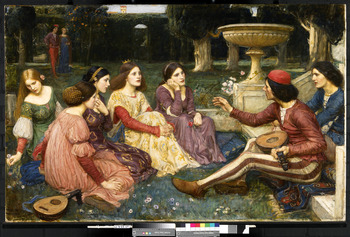
Fleeing from death is violent but seductive as few have shown more unsparingly than Giovanni Boccaccio, if his Decameron, a collection of one hundred stories told by ten Florentines who have fled from their plague-stricken city, can be interpreted as celebrating the evasion of death through art (see image 2). The Decameron, we might argue, exalts the human capacity to hide from death in grand edifices: its ten characters meet in the sanctuary of Santa Maria Novella, where they decide to escape to the countryside and tell each other stories. Just as the church offers comfort and solace from the horror of the plague, so, too, does the story (novella).
John William Waterhouse, The Decameron, 1916. Lady Lever Art Gallery, National Museums Liverpool/Bridgeman Images.

This is a tempting reading of the Decameron, one encouraged by Boccaccio, with his coquettish jocularity and his “light” stories, all framed by his narrative that insists on evading death and embracing the vim of life, of eating, dancing, frolicking, singing, and telling stories. As Boccaccio playfully says, storytelling will offer not only “entertainment” and “pleasure” but also “useful advice” for those afflicted by “love” for life and thus now “melancholy” with the plague ravaging around them (pp. 2–3). A reading, however, of the preface and introduction, to say nothing of the first story, shatters any hope that the Decameron will be useful in terms of administering a meliorative recompense for death. Whatever recompense Boccaccio might claim to peddle turns out to be illusory because there is no consolation for death. For him, there is only the selfish want for consolation that art beguilingly attempts to satisfy. Art conceals the egoism that wants and produces it, the egoism of the individual body, which, with its vulnerability to pleasure and pain, makes humans afraid, fragile, selfish, and cruel.
Art is brittle, no matter how sturdy and magnificent a given artifice might appear. The Church of Santa Maria Novella, strong, grand, and beautiful, stands empty in Boccaccio’s introduction, its purpose of bringing people together having been undermined by the Black Death. Like the Santa Maria Novella, the novella brings individuals together, but it fails to overcome death as what ultimately tears them apart. Boccaccio puts language in question as creating the basis of social order. Art breaks down as the body breaks down.
If Boccaccio’s claim about the fragility of art (technē) bears an affinity with Thucydides, he comes at it from the different standpoint of laughter and mockery. Little humor can be found in The Peloponnesian War, whilst humor abounds in the Decameron. But Boccaccio’s levity cannot be downplayed as entertainment. His laughter in the darkness of the Black Death cuts through the platitudes of the church meeting, the gathering where everyone humorlessly repeats dogmas and truths without question, to reach a bracing point about humor and death. Boccaccio suggests that the vulgar, profane, humorful language of Italian and the “homely” style of prose, not the elevated, sacred, grave language of Latin and the refined style of poetry, offer a more direct medium through which to speak about death.Footnote 9 Humor is more honest—what a contumacious claim to suggest in a Europe dominated by the Christian exaltation of suffering and death as sacrosanct! Death, next to God, is the one thing that should not be taken lightly. One does not laugh in church, but Boccaccio’s narrators initiate their ten-day feast of merriment and laughter in the Santa Maria Novella. Boccaccio is impious; that much is clear by now, but what is the exact connection he makes between laughter, honesty, and death?
The connection consists in the breakdown of social norms by death and humor alike. Similar to Thucydides, Boccaccio stresses the collapse of the sacred during the Black Death that led some Florentines to conclude that the “surest medicine for such an evil disease was to drink heavily, enjoy life’s pleasures, and go about singing and having fun, satisfying their appetites by any means available, while laughing at everything and turning whatever happened into a joke” (p. 7). Like death, humor destroys the authorities once held by a given community as sacred. It imitates death as the ridiculer of all authorities and pieties. And yet, at the same time, humor turns away from death insofar as it gives relief to the living, to Boccaccio’s characters who seek refuge from the plague. As a consolation no different from piety, humor has another side, a selfish and callous side, that Boccaccio faces with unflinching directness. The Decameron spares no story to show humans as selfish and cruel in their futile search for refuge from death as what admits of no refuge. Their bodily want for pleasure and avoidance of pain will bring them to say and do anything to escape from death. Humans will lie, cheat, hate, and deceive if doing so promotes their own interests and survival.
Perhaps a brief turn to the content of the Decameron, its frame narrative and its stories, might be helpful at this point. The stories, all one hundred of them, appear complete in Rebhorn’s translation, along with Boccaccio’s frame narratives that begin and end each day of storytelling. The completeness of this volume is among its greatest virtues since Boccaccio’s layered structure serves as a commentary on piety and humor, on falsehood and truth. The falsehood of avoiding the ugliness of death, selfishness, and cruelty through piety is on full display among the narrators themselves who seemingly obey a routine of pleasant banter, games, eating, and dancing. Serious about their chaste routine (or so they say in the laudatio with which they conclude their storytelling), the narrators comprise precisely the kind of group mentioned above that follows rules without question, except one, who delights in betraying them. There is always one, though this time his name is Dioneo, not Judas, and he betrays the group through humor. Dioneo wants to be freed from the stifling propriety and decorum of the church meeting, and he frees himself from it by mocking the cherished conventions of the group, most egregiously at the end of day five. Prior to that day the group had established a tradition of singing beautiful songs about love at the behest of the monarch put in charge for that day. The Queen on day five asks Dioneo to sing a “nice song” but he has no intention of following her commands. He begins to have fun. “My lady,” replied Dioneo, “if I had a tambourine, I’d give you, ‘Hike up your skirts, Monna Lapa.’” The Queen becomes exasperated, “Stop your joking around, Dioneo, and sing us a nice one” (p. 470). Dioneo ends up complying but not out of respect for the Queen’s authority. He has no respect for any authority because he has no fear of death, the “absolute authority.”Footnote 10 Rather, he mocks the seriousness of death as the font of the oppressive, social rituals that conceal the “nonsense” of human life (p. 301).
Dioneo, so it seems, expresses Boccaccio’s attitude towards death in the Decameron, the irreverent attitude of mockery that permits him the freedom to explore the ridiculous aspects of “the whole ass-sembly” of humankind (p. 671). Boccaccio announces this attitude in the first story of his work, a story about Sir Cepparello, a criminal hired by a rich merchant for his criminal insouciance towards any law whatsoever, in order to recover loans that he had made to some equally criminal people in Burgundy. Sir Cepparello accepts the job and deals with the Burgundians in a gentle and kind manner, at least at first, to complete his job with ease. Things change, though, when he comes down with a fatal sickness for which there is no cure while lodging with two usurers and Florentine brothers living in Burgundy. Showing no compassion for the dying Sir Cepparello, the two brothers worry instead about what to do with his body when he dies. Since they know that Sir Cepparello has racked up one sin after another, they cannot call on a local church to take his body for proper burial nor can they dump it in some garbage pit; if they were to do that, then the good Christians in their town would very likely condemn them as sacrilegious criminals who must be robbed, if not killed. Wanting to save their own skins, the Florentine brothers seem to have no way out of this intractable problem.
Enter the ever-resourceful Sir Cepparello. Having heard of their dilemma and evincing not the slightest bit of worry, he instructs them to bring in a friar to absolve his sins before his death; leave everything to me, he says. Sir Cepparello, who had hitherto been well-behaved in Burgundy, decides to dupe the friar into believing that he is the purest Christian he has ever had the fortune to meet. The friar buys the act, which Sir Cepparello performs with gusto, all to the glee of the two Florentine brothers who, eavesdropping on the confession, can barely contain their laughter. They also can barely contain their astonishment at Sir Cepparello, who fearing nothing, neither God nor death, shows no qualms about mocking even that which, if he were interested in his own self-preservation, he would have taken with the utmost of solemnity. For, if there ever were a moment for pious sincerity, it would be this one with the imminent departure of his soul from his body. But Sir Cepparello mocks such beliefs as hypocritically vain: the pure Christian individual, “if such a one exits,” wants to be selfless for the selfish end of saving its own soul, if not its own flesh with the future promise of resurrection (pp. 26, 28).
Boccaccio mocks religion but also philosophy, most obviously the philosophy of Plato, who makes love (erōs) central to this thought, not to affirm it but rather to overcome it. Platonic love desires to commune with the immaterial, beautiful “ideas” that transcend the material, ugly world below them. The body is lower and defective for Plato. There is nothing beautiful about the body; rather, beauty resides up above, outside the world, in the immaterial ideas that, as such, have nothing to do with creatures that have a beginning and an end. While Plato wants to be freed from the contemptible body to contemplate the eternal ideas, Boccaccio attempts to face the body in all its absurdity and pain.
With this brief comparison to Plato, it might be tempting to think of Boccaccio as celebrating the body as beautiful and as accepting without complaint, along the lines of Job, the suffering and inscrutable “fortune” (fortuna) that God has imposed upon humankind. But Boccaccio’s last story in the Decameron insists on Job’s God as a cruel, patriarchal tyrant who inflicts violence on his creation for no reason, and all the stories before that one challenge the tendency to turn away from the ugliness of death by beautifying or ennobling it (or by evading death altogether through beliefs in immortality). There is no recompense, no justice, no beauty in death; there is only isolation and loneliness for the dying individual leaving the world to which one can respond with either melancholia or humor. Boccaccio prefers the latter, not because it offers more consolation than the former, which, bringing one closer to the merciless freedom from sociality that is death, it does not; he prefers humor as a protest against death, albeit an ultimately futile one.
Defoe
Daniel Defoe was five years old during the Great Plague of 1665 that killed nearly a quarter of London’s population. In 1722, he wrote A Journal of the Plague Year that imagines what it might have been like to have witnessed “the last great visitation” of the contagion in London through his fictional narrator who names himself as “H. F.” at the very end of the book. Though Defoe’s narrator considered the possibility of seeking refuge from London in the countryside, he trusts that God will protect him and decides to stay there throughout the plague. As a seemingly pious Christian who observes the sufferings of his neighbors, Defoe’s narrator could not be more different from Boccaccio’s narrator, not to mention his ten storytellers. Unlike them, H. F. shows no patience for humor or entertainment; instead, he is interested in observing death and ensuring his own survival. What he must do to survive is difficult in the ancient, walled, and compact part of London in which he lives but clear enough: he must stay away from people, even those who seem healthy and have no symptoms, lest they unknowingly “breathe death” upon him, for the plague can spread “insensibly” among the healthy (p. 194).
That the plague spreads insensibly not only poses a problem for H. F.’s survival but also for his curiosity in death as what cannot be spoken. As he himself admits, H. F. writes about what he says eludes speech since language fails to bridge the distance between the living and the dead. His account is about death, yet death remains silent as the limit or border that language cannot cross. While he can hear the screams and shrieks of the dying, he recognizes that a scream or a shriek does not conform to the most basic aspects of language (grammar, syntax, sequence). A scream cannot be described other than through the failure of language to describe it: “I wish I could repeat the very Sound of those Groans, and of those Exclamations that I heard from some poor dying Creatures, when in the Hight of their Agonies and Distresses; and that I could make him that read this hear, as I imagine I now hear them, for the Sound seems still to Ring in my ears” (p. 101). The same goes for what H. F. saw. If visual contact reduces distance for H. F. and allows him to come closer to the pain of the other (p. 103), writing cannot preserve that fleeting closeness: “This may serve a little to describe the dreadful Condition of that Day, tho’ it is impossible to say that any Thing that is able to give a true Idea of it to those who did not see it, other than this; that it was indeed very, very, very dreadful, and such as no Tongue can express” (p. 60).
I would like to discuss these two passages briefly by asking: Why does language fail to express pain, suffering, and death? What is Defoe gesturing at here and throughout his Journal, of which these passages are examples among others that stress the limits of language? Two points come to mind. On the one hand, language, as creating an order or syntax that presupposes sequence, cannot express the “immediacy” of a feeling such as pain or an event such as the plague other than by accessing the present moment after it has “passed” and thereby constructing it into what it is not, that is, into a sequential narrative of activities unfolding in time. The immediate now of the present moment is without sequence, yet language presupposes an understanding of time as sequential. On the other hand, language, as a medium of exchange among individuals that governs nearly all their social interactions, does not lend itself to speaking about death as the non-relational and non-exchangeable end of each individual’s life: the “tokens” that mar the body and indicate imminent death in Defoe’s account are like no other token used in London or in any other city, for that matter, since they belong only to the individual afflicted by them, and they certainly cannot be characterized as useful for the individual dying from them. One person’s tokens, one person’s feelings of terror and isolation, cannot be shared with those of another. Nor is terror and pain experienced, to tie these two points together, in any other temporal moment than that of the present. One feels pain in the present, not in the past or future.
Language seems to leave something out, feeling or affect as ineluctably individuating. In this sense, language is impersonal. Yet, that cannot be entirely correct since there is an immense richness in any language, in its vocabularies, syntax, and style, and all of us, including Defoe, speak and write about feelings, even if only to reveal them as the unassimilable remainder of language. Let me, then, put my point more prudently: language is impersonal in its useful capacity as a medium of communication that, as such, renders individual feelings general and exchangeable in order to communicate them correctly and clearly to the public. When an examiner appointed by the London mayor visits a house, sees “tokens” on a body of someone living in it, and says “this individual has the plague and therefore this house must be shut up,” the examiner has correctly used language for the purpose of communicating a piece of information. The examiner has made the un-sharable and the private sharable and public. The same applies to Defoe’s narrator with the exception that H. F. is aware of the problem, whereas the examiner might not be.Footnote 11 Also, H. F. deploys the richness of the English language to come closer to the individuating terror of death as illustrated in the following passage:
It is here, however, to be observ’d that after the Funerals became so many that People could not Toll the Bell, Mourn or Weep, or wear Black for one another, as they did before; no, nor so much as make Coffins for those that died; so after a while the fury of the Infection appeared to be so encreased that in short, they shut up no Houses at all; it seem’d enough that all the Remedies of that Kind had been used till they were found fruitless, and that the Plague spread itself with an irresistible Fury, so that, as the Fire the succeeding Year, spread itself and burnt with such Violence, that the Citizens in Despair, gave over their Endeavours to extinguish it, so in the Plague, it came at last to such Violence that the People sat still looking at one another, and seem’d quite abandon’d to Despair; whole Streets seem’d to be desolated, and not to be shut up only, but to be emptied of their Inhabitants; Doors were left open, Windows stood shattering with the Wind in empty Houses for want of People to shut them: In a Word, People began to give up themselves to their Fears, and to think that all regulations and Methods were in vain, and that there was nothing to be hoped for but an universal Desolation; and it was ever in the height of this general Despair, that it pleased God to stay his Hand, and to slacken the Fury of the Contagion, in such a manner as was even surprizing like its beginning, and demonstrated it to be his own particular Hand, and that above, if not without the Agency of Means, as I shall take notice of in its proper Place (pp. 164–65).
This sentence totals nearly three hundred words. While the commas and semicolons permit brief pauses, the sentence goes on unrelentingly, like the Journal itself. No sections, no chapters, no pauses break up the constant stream of H. F.’s observations of the plague’s wrath, which Defoe’s capitalization of nouns, such as violence, fury, and despair, emphasize all the more. With such innovations, Defoe depicts the plague as an overwhelming force that engulfs and suffocates London. Only God can stop the plague, but H. F. does not let God intervene for another eighty pages, making him less pious than he might appear at first blush for not letting God stop the plague sooner and, thus, for allowing him to continue his narration of death as terrifying and cruel; indeed, the comforting Christian belief in immortality rarely makes it into his account.
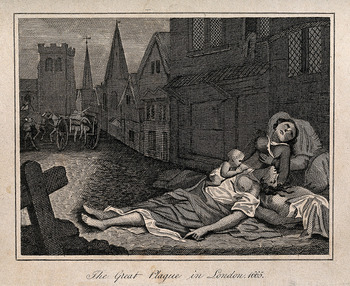
More impiously still, H. F.’s account suggests that suffering does not act as a positive force that fuses people together into a harmonious community; to the contrary, it overwhelms one’s capacity to relate to others. Suffering swallows and isolates the individual, separating the individual from the other to such a degree that all other things in the world, people, streets, buildings, parks, trees, birds, et cetera, become strange and alienating to the dying individual. Suffering renders everything remote and desolate for the individual who, to switch Defoean metaphors, stands by itself on the deserted, sinking island of death (see image 3).
Robert Pollard, The Great Plague in London, 1665. Wellcome Collection. Attribution 4.0 International (CC BY 4.0).

Shelley
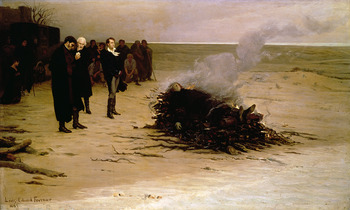
Mary Shelley’s The Last Man (1826) is a plague novel, or better, an apocalyptic novel that imagines the total destruction of the human species by disease with the exception of one single person, Shelley’s narrator, a man named Lionel, who becomes the last human on earth by the novel’s end in the year 2100. Although Shelley did not live through a plague, like Thucydides, Boccaccio, or Defoe, death haunted her life from birth to adulthood. Her mother, Mary Wollstonecraft, a political philosopher known for her defense of women’s rights, died ten days after giving birth to her; her husband, the poet Percy Shelley, drowned off the coast of Italy in 1822; her friend, Lord Byron, another poet, died two years later of disease while fighting for Greek independence; and three of her four children did not survive beyond early childhood (see image 4). Additionally, her father, William Godwin, a political philosopher and novelist, supported the modern, Promethean pursuit of establishing a perfectly just society by eliminating the moral suffering that humans inflict on each other and, more radically, by eradicating the metaphysical suffering of death itself.Footnote 12 Her father’s attraction to the modern pursuit of immortality horrified Shelley and partly inspired the novel that made her famous, Frankenstein (1818).
Though she disagreed with her father on the issue of immortality,Footnote 13 she appreciated his point that death poses the greatest impediment to human perfectibility and happiness. After the death of her first child, Shelley wrote in her journal: “Dream that my little baby came to life again—that it had only been cold and that we rubbed it before the fire and it lived—I awake and find no baby.”Footnote 14
Louis Edouard Fournier, The Funeral of Shelley, 1889. Walker Art Gallery, National Museums Liverpool/Bridgeman Images. Mary Shelley is kneeling to the left.

Written four years after her husband’s death and referring to Defoe, Boccaccio, and other plague writers, The Last Man thinks what Shelley cannot avoid thinking, death, with obvious references to her own life: her two main characters are fictionalized depictions of Percy Shelley and Lord Byron and the novel insists on the failure of human attempts, be they through philosophy, poetry, art, or scientific history, to combat the specter of death, the spoiler of all humans hopes for salvation and justice. If this sounds similar to Boccaccio, it is but with the difference that Shelley develops this point through a futuristic novel that imagines death as isolating and estranging the individual from everything in the world. Nothing remains to comfort the one sole individual left in the world, Lionel, who experiences the death of everyone close to him as the plague rages from one place to the next. For some 250 pages death is everywhere in Shelley’s novel as a “cruel and relentless” destroyer of human life (p. 264) and all the “adornments of humanity” (p. 322). Shelley bids farewell to all the vain pursuits that futilely occupied and distracted humans from death when they were healthy:
Farewell to the giant powers of man,— to knowledge that could pilot the deep-drawing bark through the opposing waters of shoreless ocean,— to science that directed the silken balloon through the pathless air,–– to the power that could put a barrier to mighty waters, and set in motion wheels, and beams, and vast machinery, that could divide rocks of granite or marble, and make the mountains plain! Farewell to the arts,–– to eloquence, which is to the human mind as the winds to the sea, stirring, and then allaying it;–– farewell to poetry and deep philosophy, for man’s imagination is cold, and his enquiring mind can longer expatiate on the wonders of life, for “there is no work, nor device, nor knowledge, nor wisdom in the grave, whither thou goest!” (p. 321; the quote is from Ecclesiastes [Qohelet] 9:10).
With passages such as this one that declare all human activities as vain, it might seem as if Shelley is counselling the “all is vain” wisdom that can be found in Ecclesiastes and in Buddhist writings such as Essays in Idleness and Hōjōki, the wisdom that imparts, especially in the latter case, the doctrine of impermanence (mujō).Footnote 15 This doctrine teaches accepting death and suffering as liberating one from the futile want to leave a permanent trace of oneself through fame, fortune, and empire. Although Shelley melancholically insists on the futility and impotence of human pursuits, she does not express acceptance of death but indignation with its “degradation” of the human to the base want to preserve itself (p. 316): “Once man was a favourite of the Creator, as the royal psalmist sang, ‘God had made him a little lower than the angels, and had crowned him a little lower than the angels, and had crowned him with glory and honour. God made him to have dominion over the works of his hands, and put all things under his feet.’ Once it was so; now is man lord of creation? Look at him—Ha! I see plague!” (p. 316).
Religion, philosophy, and science look up to the heavens to turn away from the degradation of death, yet it interrupts to blind their upward gaze. Such is the case with Shelley’s astronomer Merrival, who throughout The Last Man stares into the sky to calculate the arrival of perfection on earth, only to destroy all his instruments after the plague has killed all his family members. Similarly, Shelley’s suggestion that the plague has undermined the more comforting God of Genesis and Psalms (YHWH) brings her closer to the God (’elohim) of Ecclesiastes, the God that absurdly fates individuals to live ever so briefly in the world before departing it forever. “All is mere breath,” or, in Shelley’s version, all is a “living death” (p. 413). To be born is to die. Reproduction is the absurd cycle of bringing individuals into the world only to let them die in it.Footnote 16 “Did God create man, merely in the end to become dead earth in the midst of healthful vegetating nature?” (p. 398).
Shelley cannot make sense of death; she cannot make sense of the silence and loneliness of the individual that reaches out for language and companionship. Why do we speak and write? Why do we need to be with other people? At several points in The Last Man, Shelley or her narrator, Lionel, ask themselves why they are writing. Neither one is under the flattering illusion that they are writing to leave a trace of themselves or writing to liberate the dead from silence; after all, the dead cannot read and, though words might survive an individual’s death, the individual itself does not. Writing for neither fame nor posterity, they are writing to escape from the crushing loneliness of individuality. In Lionel’s case, writing is all he has because he never finds any survivors, despite his desperate attempt to find one. His desperation raises Shelley’s question once again: Why the need for others? Why is solitude crushing? Shelley’s answer points to the terror of death as the solitary end of each individual’s existence. We turn to language and others to flee from our solitary essence as mortal individuals. Yet, Shelley herself does not want to flee from solitude as essential to each individual and, thus, she attempts to speak silence by writing an apocalyptic narrative about a “voiceless, empty world” (p. 330). One might question this attempt as incoherent or mythical, for no one alive can ever be outside sociality and language to be completely isolated from others. Shelley’s Last Man is as fanciful as Jean-Jacques Rousseau’s Savage Man, or so we might object following the rules of logic. But Shelley and Rousseau do not have any interest in obeying the rules of logic. They admit that their imaginative accounts are conjectures; indeed, they cannot be anything other than conjectures as attempts to think about what cannot be thought—the solitude and silence of death as what is most truly or “naturally” in each of us.
What is most in each of us, death, is not a what or a thing about which we can speak or know; we are in our core silent to ourselves and others, and that silence isolates and terrifies us. Hence, we cry out for companionship by talking and talking. Our garrulity originates from pain:
My labours have cheered long hours of solitude, and taken me out of a world, which has averted its once benignant face from me, to one glowing with imagination and power. Will my readers ask how I could find solace from the narration of misery and woeful change? This is one of the mysteries of our nature, which holds full sway over me, and from whose influence I cannot escape. I confess, that I have not been unmoved by the development of the tale; and that I have been depressed, nay, agonized, at some parts of the recital, which I have faithfully transcribed from my materials. Yet such is human nature, that the excitement of mind was dear to me, and that the imagination, painter of tempest and earthquake, or, worse, the stormy and ruin-fraught passions of man, softened my real sorrows and endless regrets, by clothing these fictious ones in that ideality, which takes the mortal sting from pain (p. 7).
*****
Shelley’s novel, like the other plague narratives discussed above, with perhaps the exception of Snowden’s account, centers on the inexplicable sting of death, on the question of why. Why do we die? And why are we aware of the factum brutum of death? As a way to conclude, I should like to challenge my focus hitherto on death by turning to Spinoza’s counsel that we should think nothing less than of death. Spinoza undermines the narrative attempt to explain death by searching for some kind of answer to why we must die. He cuts the why question off as a symptom of unease and anxiety. When something perturbs us, we ask why. Death perturbs us, prompting us to search for answers when there are none for Spinoza. Nature just is. Things are as they are and there is no purpose or end to the way they are. Death is nothing more than the natural process of nutrients returning to the earth. Death is not an event or an end in nature but the continuation of a neutral process that is neither good nor bad. Such moral evaluations of good and bad arise from our selfish disposition to place nature into a narrative in which we grant a special status to ourselves vis-à-vis other natural things. The afflatus of doctrines that suggests an immortal soul is trapped in our body or that something of ourselves survives death are examples of such vain narratives that flatter our egotistical belief in our exalted place in nature.
The same goes for those narratives that lament or mock our forsaken place in nature as mortal beings aware of our mortality. Spinoza has as little patience with narratives that bemoan, either through tragedy or comedy, our lack of salvation as he does with those that unctuously promote our hopes for salvation. To conceive of nature as either friendly or antagonistic to our interests is to commit the affective error of focusing narrowly on our individual selves as warranting special attention. We merit no such attention; nature cares nothing more for us than it does for a dog or a tree. Like any other thing in nature, we are necessitated and determined beings that live and die in a natural whole that continues on in its eternal and infinite plenitude. Human death is the same as any other.Footnote 17
Spinoza is austere, though not cold. He recognizes the fear and sadness of death for the individual who focuses on it; he recognizes that death as a barrier to human thought creates anxiety and unease. But he refuses to become overwhelmed by sadness and fear as selfish, inward affects that diminish our rational power to look beyond ourselves and work collectively to reduce suffering for all as befitting our capacity for universal thought and cooperation. Fear and sadness make us angry, inciting us to lash out at each other in puerile attempts to avenge the sufferings afflicted on us by “nature.”Footnote 18 Spinoza moves in a different direction by encouraging us to improve our estate collectively to the extent that we can as finite, material beings. To do that, though, we must free ourselves from privileging the finite individual who needs explanations and answers, from the finite individual who, conscious of itself as finite, writes plague narratives.