Introduction
Halyomorpha halys (Stål) (Hemiptera: Pentatomidae), commonly referred to as the brown marmorated stink bug (BMSB), is native to Asia. This pest was first reported in North America in 2001 in Allentown, Pennsylvania, United States of America (Hoebeke and Carter Reference Hoebeke and Carter2003; Hamilton Reference Hamilton2009). More than 10 years later, the population size and distribution have steadily grown. In the United States of America, it has been detected in 42 states, with the greatest agricultural damage reported on fruits in the mid-Atlantic region (United States Department of Agriculture-Agricultural Research Service 2010; Leskey et al. Reference Leskey, Hamilton, Nielsen, Polk, Rodriguez-Saona and Bergh2012a; StopBMSB 2014). The first report of H. halys in Canada was in 2010, in Ontario and Québec (Fogain and Graff Reference Fogain and Graff2011). According to Gariepy et al. (Reference Gariepy, Haye, Fraser and J. Zhang2013), the most likely source of the detections in Canada is the established population in the northeastern parts of the United States of America. Currently, BMSB is established in southern Ontario mainly as a residential pest (Gariepy et al. Reference Gariepy, Fraser and Scott-Dupree2014). In Europe, H. halys was first reported near Zürich, Switzerland, in 2008 (Wermelinger et al. Reference Wermelinger, Wyniger and Forster2008; Wyniger and Kment Reference Wyniger and Kment2010) and there as well, it is considered to be more of a residential than agricultural pest (Mueller et al. Reference Mueller, Luescher and Schmidt2011). It has also been reported in Italy (Pansa et al. Reference Pansa, Asteggiano, Costamagna, Vittone and Tavella2013) and France (Callot and Brua Reference Callot and Brua2013).
In the United States of America, BMSB has not only become a pest of almost unprecedented importance to agriculture (particularly in the mid-Atlantic region) but also represents a household pest of great nuisance because adults seeking winter shelter enter residential homes and other buildings where they release an unpleasant odour from stink glands when disturbed. Decreasing temperatures and day length trigger an aggregation behaviour in which adults congregate on their host plants before entering overwintering sites usually in late September to mid-October. They subsequently remain in diapause until spring, when temperatures and day-length increase, then emerge from overwintering sites to feed and reproduce on host plants.
Halyomorpha halys is highly polyphagous in its feeding behaviour and in the United States of America, it has been reported feeding on more than 100 plant species, including grapes (Vitis Linnaeus species (Vitaceae)), blueberry (Vaccinium Linnaeus (Ericaceae)), cranberry (Vaccinium Linnaeus (Ericaceae)), beans (Phaseolus Linnaeus (Fabaceae)), egg plant (Solanum Linnaeus (Solanaceae)), okra Abelmoschus esculentus Moench (Malvaceae), wheat (Triticum Linnaeus (Poaceae)), (Leskey et al. Reference Leskey, Hamilton, Nielsen, Polk, Rodriguez-Saona and Bergh2012a; Bergmann et al. Reference Bergmann, Bernhard, Bernon, Bickerton, Gill and Gonzales2013), and cowpea (Vigna Linnaeus (Febaceae)), (Ewunkem et al. 2014). In 2010, the rapid increase in population size and spread led to severe crop losses to peaches Prunus persica Batsch (Rosaceae), apples (Malus Miller species (Rosaceae)) (United States Department of Agriculture 2011), sweet corn Zea mays Linnaeus (Poaceae), peppers Capsicum annuum Linnaeus (Solanaceae), tomatoes (Lycopersicom Miller (Solanaceae) and row crops such as field corn and soybean Glycine max Merrill (Fabaceae) (Leskey et al. Reference Leskey, Hamilton, Nielsen, Polk, Rodriguez-Saona and Bergh2012a). Throughout the growing season BMSB goes through host switches, presumably in search of the most nutritious food source (Panizzi Reference Panizzi1997; Funayama Reference Funayama2002). Selection of the proper food plants for growth and development is critical for the development and establishment of this insect.
In view of the high rate of spread, nuisance to homeowners and more importantly the devastation to agricultural produce there is a need to develop management strategies for this pest. Currently, many farmers rely heavily on insecticides with up to fourfold increases in applications (Leskey et al. Reference Leskey, Short, Butler and Wright2012b). This will undoubtedly promote the development of insecticide resistance, environmental pollution and the presence of insecticide residue on produce and commodities. There is an urgent need for alternative strategies to manage this pest. Studies on the biology, host preference, and pest management tactics for the control of an invasive pest such as H. halys would benefit immensely from a rearing method that is capable of producing large numbers of insects of uniform stages on a continuous basis. Laboratory-reared insects represent an important tool for continuous experimental research and other studies. Thus far such studies have relied mainly on field collections (Kawada and Kitamura Reference Kawada and Kitamura1983; Funayama Reference Funayama2006; Nielsen et al. Reference Nielsen, Shearer and Hamilton2008b; Lee et al. Reference Lee, Wright and Leskey2013, Reference Lee, Leskey and Short2014; Abram et al. Reference Abram, Doyon, Brodeur, Gariepy and Boivin2015), which limit them to the summer and early fall growing seasons. Field collection of large numbers of nymphs and adults can be problematic because of immense population fluctuations and the existence of diapause during cold weather.
Medal et al. (Reference Medal, Smith, Fox, Santa Cruz, Poplin and Hodges2012) reported a rearing method using 10–15 pairs of BMSB adults for daily collection of egg masses. Their work succeeded in producing F1 eggs. This is hardly a dependable method for the production of insects at all stages of development, and clearly demands the development of a more sustainable method of rearing. Adding carrots to a peanut-soybean diet had been reported to improve the rearing efficiency of BMSB (Funayama Reference Funayama2006). We developed a rearing method that would facilitate research to increase our understanding of the biology of BMSB and enable researchers to plan and conduct studies that would lead to an efficient management strategy for this pest. Our main objective was to develop a sustained year-round procedure for rearing H. halys that would enable the production of all stages of this insect in numbers that would be sufficient for laboratory or other tests. To do this we evaluated single and multiple food sources and how they impacted survival and development of BMSB. In addition, we determined the effect handling of early instars has during laboratory bioassay.
Materials and methods
Setup of experimental insect
An initial H. halys culture was established at the Integrated Pest Management (IPM) Laboratory at North Carolina A&T State University (NC A&T), Greensboro, North Carolina, United States of America, from 150 adults that were hand-collected from three separate experimental plots. One of the plots, a teaching rain garden located on the NC A&T campus was planted with bell peppers, tomatoes, Lycopersicum esculentum Miller (Solanaceae), squash (Cucurbita Linnaeus (Cucurbitaceae)), broccoli, Brassica oleracea Linnaeus (Brassicaceae), and sunflower, Helianthus annuus Linnaeus (Asteraceae). A second plot was planted with cowpea, Vigna unguiculata Linnaeus (Fabaceae), tomatoes and egg-plant, and bordered on one side by an existing windbreak of princess trees, Paulownia tomentosa (Thunberg) Steudel (Paulowniaceae). The third plot was planted with sweet corn. Both second and third plots were located at the NC A&T research farm in Greensboro, North Carolina (36.0586243°N, 79.7358932°W). Halyomorpha halys adults were collected during October and November 2012. We had observed H. halys at the university farm during the previous year before this study was initiated. Captured insects were placed in a 500 mL transparent polypropylene container with a mesh screen lid (BioServ, Frenchtown, New Jersey, United States of America) containing wet cotton balls and transported to the IPM laboratory where they were placed in cages (30.5×30.5×30.5 cm; BioQuip, Rancho Dominguez, California, United States of America) and maintained at 27±2 °C; 16:8 (light:dark hours) and 70±10% relative humidity. A total of 15 different food substrates were provided, including fresh cherry tomatoes, carrots, Daucus carota Linnaeus (Apiaceae), fresh green beans, sweet corn on the cob, squash, red grapes, red delicious and Granny Smith apples, peaches, pears, (Pyrus Linnaeus (Rosaceae), dry/raw seeds of sunflower, cowpeas and peanuts, Arachis hypogaea Linnaeus (Fabaceae), leaves of butterfly bush, Buddleja davidii Franch (Scrophulariaceae), and leaves of P. tomentosa were provided. Young fresh leaves from butterfly bush plants grown as ornamentals on the university campus, and of princess trees at the research farm were collected as needed during the experimental period. The leaves were provided to the insects without refrigeration and replaced with fresh leaves ad libitum ensuring that the food was always fresh. A dental wick placed in a 50 mL plastic container provided a source of water. Paper towels (Uline Company, Waukegan, Illinois, United States of America) were placed on the floor, sides and also hung inside on the walls and cage ceiling to provide oviposition and aggregation sites. Cages were checked daily, food and water were replenished ad libitum.
Rearing of the BMSB from egg to adult stage on a combination of foods
Development and maintenance of a continuous laboratory culture (CLC) of the BMSB on multiple foods
To establish a CLC the experimental insects described above were checked daily from December 2012 to February 2013 for egg masses, which were harvested and placed in 18.7×7.6 cm transparent polypropylene containers (Pioneer Plastics, Dixon, Kentucky, United States of America) with filter paper (Fisher Scientific, Suwanee, Georgia, United States of America), placed at the bottom. Moist cotton balls fitted in four polypropylene caps 0.9×0.05 cm placed randomly on the container floor provided a source of water for first instars. After hatching the 15 foods mentioned above were placed in the container. They were checked daily and food and water was replenished as needed. As nymphs developed into third instars, they became very active and were therefore transferred to a larger rearing cage (20.3×20.3×20.3 cm) and provided with all food substrates. When nymphs developed to adults, they were again transferred to larger cages (30.5×30.5×30.5 cm) where oviposition and aggregation sites were provided as described earlier. Timely transfer of adults at this stage was important to prevent nymphs in these cages from feeding on any eggs laid by the adults as had previously been observed. To prevent contamination, cages were cleaned weekly with a 10% Clorox® solution, the same solution was used to wash the produce. All fruits and vegetables were obtained from the organic produce section of local grocery stores. As before, cages were checked daily and food and water were replenished as needed. Subsequent generations were maintained using this same method, and data was recorded on the number of generations attained. Insects were reared at 27±2 °C; 16:8 (light:dark hours) and 70±10% relative humidity.
Developmental parameters on the CLC
This experiment was designed to study duration of developmental and adult recruitment in a continuous rearing method. The developmental parameters such as developmental time, weight gained and survival were recorded from egg masses collected daily from the CLC and placed individually in transparent polypropylene containers as described above. A total of 105 egg masses were collected within a five-week period for this study. Data was recorded on the date of oviposition and the number of eggs per egg mass. The developmental stages of live or dead nymphs as well as adult weight were recorded daily. These measurements were chosen because they involved minimal handling of the insects, which was considered critical.
Development of nymphs reared on single and mixed food substrates
Single food substrate (SFS-1) using first instars
Individual egg masses from the laboratory culture were placed separately in a 500 mL transparent polypropylene container with a 90 mm diameter filter paper placed at the bottom. Each container had an opening in the lid to which a mesh screen had been glued. A moist cotton ball fitted in a polypropylene cap (0.9 cm diameter×0.05 cm deep) was placed inside each container. When eggs hatched, one first instar was weighed and placed in a separate 500 mL plastic container having one of the SFS-1 mentioned above. Each treatment was replicated five times, and the experiment was run twice to give a total of 10 insects per treatment. Experiments were monitored daily and data recorded on the date of each moult until adult emergence. In addition, the weight of each insect was recorded at each moult.
Single food substrate (SFS-2) and mixed food substrates (MFS-2) using second instars
Brown marmorated stink bug nymphs typically remain in aggregations during the first instar. Because we observed elevated nymphal mortality in the previous experiment, we wanted to minimise handling of the nymphs during the first instar by starting the transfer at the second instar. For the single food substrate, egg batches were collected from the laboratory culture and placed in 500 mL containers (described earlier) containing each of the respective (single) food substrate. Eggs were allowed to hatch and develop to second instars. One second instar was weighed and then placed in separate 500 mL plastic containers having one of the above food substrates. For the mixed food substrates (MFS-2), egg batches were placed in 18.7×7.6 cm plastic containers containing all the food substrates listed above and allowed to hatch and develop to the second instar. Following that, one second instar was weighed and placed in separate 500 mL plastic containers with one of the composite food substrate treatments. Each treatment (SFS-2 and MFS-2) was replicated five times and the experiments were run twice making a total of 10 insects per treatment. Both sets of food treatments (single or mixed) were monitored daily and data recorded as described in the previous experiment.
Data analysis
The data for adult survival, developmental duration, and weight gain were analysed by one-way analysis of variance (ANOVA) using the general linear model (GLM procedure SAS 9.3, Cary, North Carolina, United States of America). Before the analysis, data on the proportion of nymphs that developed to the next nymphal stage were arcsine transformed to better approximate normality. Square root transformation was performed to normalise data related to the developmental parameters (days to moult and weight gain). Means among the different food substrates were compared using Tukey’s honest significant difference test (P<0.05). Means reported in tables and figures are the actual mean values. Growth index (GI) was calculated as (% adult emergence/total developmental time) as described by Seth and Sharma (Reference Seth and Sharma2001).
Results
Continuous rearing of Halyomorpha halys and developmental parameters
All stages with the exception of the first instars were observed feeding on all 15 food substrates provided in the continuous rearing experiment. Most eggs were laid on paper towel with a few laid on cage walls. First instars were aggregated and remained atop the egg cases and when disturbed, nymphs generally scattered within the container and moved under the paper towel at the base of rearing container; no feeding was observed at this stage. Feeding was first observed after nymphs moulted into second instars and continued at each stage through the adult stage. A total of 3020 eggs were collected from 105 egg masses within five weeks from the CLC for evaluation of the developmental parameters. On average each egg mass had 26±2.1 eggs and the incubation period averaged 6.9±1.2 days. The duration of first through fifth stadia averaged 5.7±0.3, 6.5±0.7, 5.6±0.6, 5.6±0.8, and 10.5±1.9 days, respectively. Total developmental period averaged 33.9±1.9 days and a GI of 2.2±0.2. Out of the 3020 eggs collected from the experimental culture and reared on all 15 food substrates, 91.2% hatched and developed to fifth instars, 88.5% of which developed to adults at the end of the first filial (F1) generation. This resulted in 85.4% survival rate from egg to adult. Out of the 362 eggs obtained from F1 adult females in less than a week, 90.3% hatched and developed into fifth instars from which 88.6% developed into F2 adults resulting in 80.1% survival. After about eight months of continuous laboratory rearing, when the study ended, six filial generations of adults were obtained. Adults lived for more than a year in the laboratory at 27±2 °C, 16:8 (light:dark hours) and 70±10% relative humidity.
Effect of food substrate on the developmental parameters of Halyomorpha halys
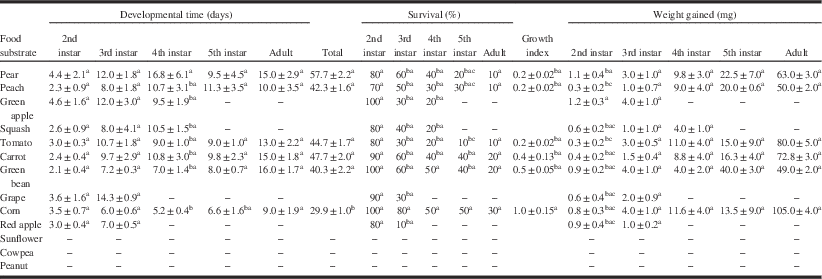
Comparisons of life parameters using H. halys eggs that were allowed to hatch into first instars on individual food substrates and later transferred to develop to adult stage on a single food substrate (SFS-1) are shown in Table 1. All first instars that were fed on dried cowpeas, peanuts, or sunflower seeds died before they could moult into a second instar. The proportion of nymphs that survived on the different single food substrates from first to second, second to third, and third to fourth instars was not significantly different; however, this was significantly different from the fourth to fifth instar (df=5, F=2.93, P<0.0043) with highest survival recorded on corn (Table 1). Overall, the survival rate decreased after the third instar on most of the food substrates (Table 1). The duration of development and weight gained from one instar to the next for second, third, and fifth instars were not significantly different among the different single food substrates but were different among the fourth instar with longest developmental time recorded on peach and the shortest on corn (Table 1). The highest GI (1.0±1.5) was recorded on nymphs that were fed on corn alone throughout their development.
Mean developmental time (days±SE), weight gain, and survival of second instar Halyomorpha hayls reared on a single food substrate as first instar (SFS-1).

Notes: Developmental period taken from second instar to adult.
a,b,cMeans followed by the same letter within the same column are not significantly different (P>0.05; Tukey’s method).
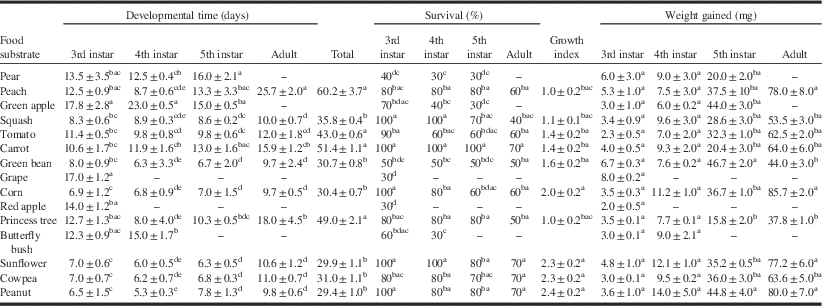
Among eggs that were allowed to hatch and develop to second instar on individual food substrates and then transferred to a single food substrate (SFS-2), the proportion of nymphs that survived to the next nymphal stage was significantly different among the food substrates (Table 2); from second to third instar (df=14, F=3.33, P=0.0001), with 100% survival on carrots, corn, squash, sunflower seeds, and peanut seeds; nymphs from third to fourth instar (df=12, F=4.74, P⩽0.0001), with 100% survival on carrots, squash, and sunflower seeds; nymphs from fourth to fifth instar (df=11, F=3.90, P⩽0.0001), with a 100% survival on carrots and 80% on peach, princess tree leaves, sunflower seeds, and peanut seeds; and nymphs from fifth instar to adult stage (df=9, F=3.24, P=0.0002), with 70% survival on carrots, dried seeds of sunflower, cowpea, and peanut.
Mean developmental time (days±SE), weight gain, and survival of third instar Halyomorpha hayls reared on a single food substrate as second instar (SFS-2).

Notes: Developmental period taken from third instar to adult.
a,b,c,d,eMeans followed by the same letter within the same column are not significantly different (P>0.05; Tukey’s method).
The development time for second instars (SFS-2) to moult from one instar to the next was significantly different at each stage among the different single food substrates (Table 2); from second instars to third instars (df =14, F=6.61, P⩽0.0001) with the shortest developmental time recorded on corn, dried seeds of sunflower, cowpea, and peanut. Granny Smith apple, red delicious apples, and grape had the longest developmental time (Table 2). Among the different food substrates, the developmental period from third instars to fourth instars were significantly different (df=12, F=12.14, P⩽0.0001) with the shortest developmental time recorded on corn, green beans, dried seeds of sunflower, cowpea, and peanut while Granny Smith apple, butterfly bush leaves, and pear had the longest developmental time (Table 2). From fourth instars to fifth instars, the developmental period was significantly different among the different food substrates (df=11, F=4.98, P⩽0.0001) with the shortest developmental time recorded on corn, green bean, dried seeds of sunflower, cowpea, and peanut while pear and Granny Smith apple had the longest developmental time (Table 2). The developmental period from fifth instar to adult was also significantly different (df=9, F=11.84, P⩽0.0001); peach and princess tree leaves had the longest period while corn, green beans, dried, sunflower, peanut seeds, and cowpea seeds the shortest (Table 2). The highest GI was recorded on corn, dried seeds of sunflower, peanut, and cowpea (Table 2).
Weight gain was not significantly different for nymphs that moulted from second to third and third to fourth instars among the different single food substrates, but was significantly different for nymphs that moulted from fourth to fifth (df=11, F=2.17, P=0.0356), with nymphs that fed on green beans, dried peanut seeds, and Granny Smith apple having the highest weight gain; the lowest weight gain was recorded in nymphs fed on princess tree leaves, pear, and carrot (Table 2). Development from fifth instar to adult was significantly different among the different food substrates (df=9, F=2.54, P=0.0243), nymphs that were reared on corn, peach, and dried peanut and sunflower seeds had the highest weight gain, and the least recorded on princess tree leaves, green beans, and squash (Table 2).
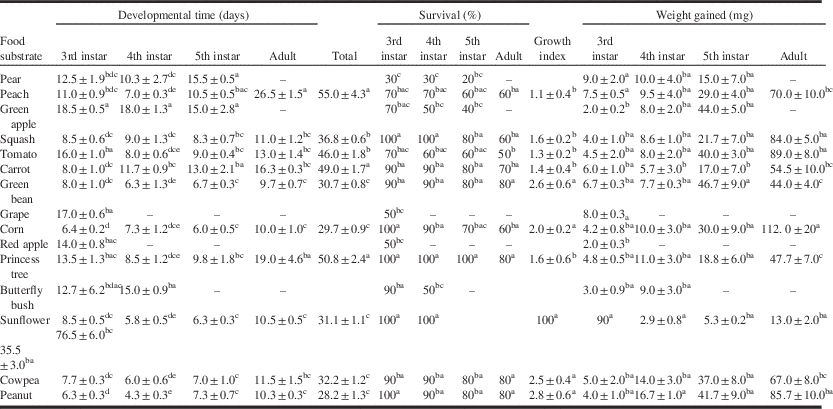
Eggs that were allowed to hatch and develop on a composite of food substrates into second instars and then transferred to single food substrate (MFS-2), produced nymphs that survived differently on the different single food substrates during each instar; development from second to third instar (df=14, F=2.10, P=0.0244) gave 100% survival on squash, corn, leaves of princess tree, and dried sunflower and peanut seeds; while those developing from third to fourth instar (df =12, F=2.79, P=0.003) experienced 100% survival on squash, princess tree leaves, and dried sunflower seeds. Nymphs developing from fourth to fifth instar, had significantly different rates among the different food substrates (df=11, F=2.33, P=0.0123). There was 100% survival on princess tree leaves and dried sunflower seeds; and those developing from fifth instar to adult stage (df =14, F=2.12, P=0.0230) had 90% survival on dried sunflower seeds and 80% on princess tree leaves, green beans, and dried seeds of peanut and cowpea (Table 3).
Mean developmental time (days±SE), weight gain, and survival of Halyomorpha hayls nymphs reared on mixed food substrate (MFS-2) to second instar and transferred to develop to adult on a single food substrate.

Notes: Developmental period taken from third instar to adult.
a,b,c,d,eMeans followed by the same letter within the same column are not significantly different (P>0.05; Tukey’s method).
The time it took for nymphs to moult into the next nymphal stage was significantly different among the food substrates for each of the stages (Table 3). Nymphs developing from second to third instar (df=14, F=4.00, P=0.0011) had the shortest developmental time on corn and dried peanut and cowpea seeds, and the longest was recorded on Granny Smith apple, grapes, and tomatoes. The difference in development time from third to fourth instar was significantly different among the different food substrates (df =12, F=6.81, P⩽0.0001) with the shortest developmental time recorded on dried peanut, sunflower, and cowpea seeds and the longest on Granny Smith apple, butterfly bush leaves, and carrot. Development from fourth to fifth instar was variable (df=11, F=3.69, P=0.0100), and nymphs developed faster on corn, green beans, and dried sunflower seeds; and slowest on Granny Smith apple, carrot, and peach. Development from fifth instar to adult was significantly different (df=9, F=5.97, P=0.0021), with the shortest developmental time on corn, green beans, and dried peanut while nymphs developing on peach, princess tree leaves, and carrot had the longest. The highest GI was recorded for nymphs that were fed a single diet of green beans, corn, and dried seeds of sunflower, peanut, and cowpea (Table 3). Weight gain was significantly different among the different single food substrates for nymphs that moulted from fifth instar to adult (df=9, F=4.36, P=0.0103), with the highest gain in weight recorded on nymphs fed a single diet of corn, tomatoes, and dried peanut seeds and the lowest on nymphs fed green beans, princess tree leaves, and carrot (Table 2).
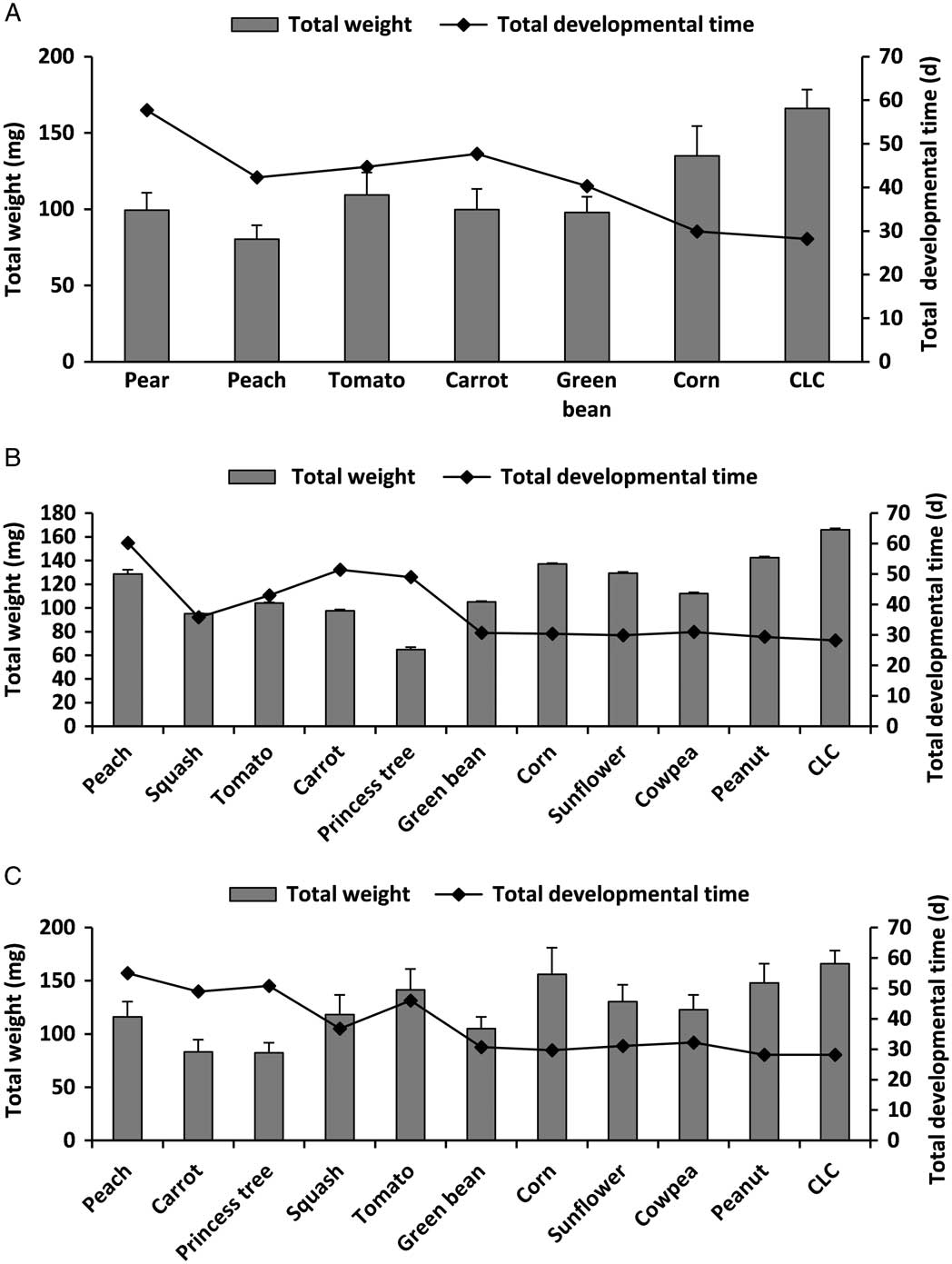
Figure 1A shows that the shortest total developmental time from first instar to adult stage was recorded on insects that were reared continuously on a mixture of 15 different food substrates (CLC) and nymphs that were fed on a single diet of fresh corn. In addition, insects reared continuously on a mixture of food substrates (CLC) had the highest weight. The total developmental time of SFS-2 (second instars reared on a single food substrate) and MFS-2 (nymphs reared on mixed food substrate to second instar and transferred to develop to adult on a single food substrate) was shorter and total weight gained was higher for insects reared on green beans, squash, corn, dried sunflower, cowpea seeds, and peanut seeds (Fig. 1B and 1C). The GI was higher for insects reared on both SFS-2 and MFS-2 for green beans, corn, and dried seeds of sunflower, peanut, and cowpea (Tables 2 and 3) comparable to that of the CLC. The BMSB did not complete development on pear, grape, butterfly bush leaves, or red delicious and Granny apple (Tables 1–3). Generally, insects reared on a single food gained less weight compared with those reared continuously on a mixture of different foods (CLC) (Fig. 1).
Total developmental time and total weight of Halyomorpha halys reared on single and mixed food substrate to adult stage (A) first instars reared on a single food substrate (SFS-1) to adult (B) second instars reared on single food substrate (SFS-2) to adult (C) nymphs reared on mixed food substrate to second instars and transferred to develop to adult on a single food substrate (MFS-2).

Discussion
The BMSB is a highly polyphagous insect with an extensive host plant range that includes tree fruit, deciduous hard woods, ornamental plants, and vegetable crops (Kuhar et al. Reference Kuhar, Kamminga, Whalen, Dively, Brust and Hooks2012; StopBMSB 2014). Several food substrates have been recommended for rearing H. halys including kidney bean (Oda et al. Reference Oda, Nakanishi and Uesumi1981) and a mixture of raw peanut and dry soybean seeds (Moriya Reference Moriya1991). Adult BMSB reared on these foods deposited a lot of eggs (Funayama Reference Funayama2004), but the number that developed to become adult was low (Oda et al. Reference Oda, Nakanishi and Uesumi1981). Our studies of H. halys in North Carolina show that it is possible to maintain a CLC by rearing BMSB from egg eclosion to adult stage on 15 different food substrates. The total development time of the CLC from egg to adult at 27 °C was 33.9±1.9 days with 85.4% survival, a vast improvement over Nielsen et al. (Reference Nielsen, Hamilton and Matadha2008a) report of 35.8±0.5 days and 52.5% survival at the same temperature using beans and peanuts. Our study also indicates a higher survival rate (⩾70%) for H. halys nymphs on single food substrate of carrot, green beans, princess tree leaves, dried sunflower, cowpea seeds, and peanut seeds (Tables 2 and 3). This suggests that certain food substrates may nutritionally be more suitable for the survival of H. halys. Furthermore, it has been suggested that when stink bug nymphs feed on a variety of foods their development is much improved (Oda et al. Reference Oda, Nakanishi and Uesumi1981).
Our results indicate that BMSB reared continuously on a single food gained less weight and had a longer developmental time than those reared continuously on a combination of different foods (Fig. 1A–1C). This supports Funayama’s (Reference Funayama2006) findings of longer developmental periods and reduced weights when BMSB nymphs were reared to adult on a single diet of carrot compared with nymphs reared on a combination of peanut–soybean–carrot diet. It has long been known that a mixture of foods often results in greater fitness than single foods (Bernays and Minkenberg Reference Bernays and Minkenberg1997) an apparently natural tendency among polyphagous herbivores that, for an insect with several host plants, a single plant species may not provide the most beneficial conditions during all parts of the life cycle (Reavey and Lawton Reference Reavey and Lawton1991). A high GI reflects a high nutritional suitability and food use, which are both important for growth and developmental success of insects. A GI of ⩾2 was obtained from nymphs fed multiple foods (CLC), as well as those reared on a single diet of green beans, corn, dried seeds of cowpea, soybean, and peanut (SFS-2 and MFS-2).
The results for the fruits are somewhat surprising because H. halys is known to be a serious pest of fruits, especially apples and pears in the United States of America (Leskey et al. Reference Leskey, Hamilton, Nielsen, Polk, Rodriguez-Saona and Bergh2012a). Brown marmorated stink bug nymphs were unable to complete development when reared on some of the single foods including the butterfly bush leaves, pear, grapes, and Granny Smith and red delicious apples (Tables 1–3). For a polyphagous insect, a single plant species may not provide the most beneficial nutrients during all of its life cycle (Reavey and Lawton Reference Reavey and Lawton1991). These results further underline the importance of the nutritional content of a single food; this case suggests a certain level of nutritional inadequacy for optimal development. During the course of the season, we observed adults and nymphs switch from one host plant to another at the NC A&T State University research farm. This migratory behaviour was reported as related to the phenological stage of the plants (Panizzi Reference Panizzi1997). Variation in the quality of food resources from the different plant parts (leaves, shoots, and fruits) has been shown to play an important role in the performance of phytophagous insects (Scheirs et al. Reference Scheirs, Jordaens and De Bruyn2005). Plants used by pentatomids change with host maturity and phenology, with different plants being attractive at different stages (Bundy and McPherson Reference Bundy and McPherson2000).
We observed that adult H. halys that emerged from overwintering sites during the months of April and May oviposited only on princess tree leaves at the NC A&T State University research farm. Similarly, in the mid-Atlantic region, Nielsen and Hamilton (Reference Nielsen and Hamilton2009) reported that eggs masses were first observed on princess tree leaves in June. At the NC A&T farm, eggs hatched and developed on this tree to the adult stage; nymphs and adults fed on the leaves and later in the season, migrated to nearby crops (cowpea, corn, and soybean). Funayama (Reference Funayama2002) also reported that H. halys oviposited on leaves of apples right after overwintering, and the nymphs that hatched fed on different parts of the plant (shoots, leaves, and fruit). In our laboratory studies survival on princess tree leaves (as a single food substrate) was ⩾80 at each nymphal stage, and nymphs developed to the adult stage; however, the developmental time was long and weight gained was reduced. These observations may suggest that these plants could be one of the early host plants used for oviposition by H. halys.
Our results indicate that when nymphs were transferred to a single food substrate as first instars (SFS-1), they did not perform well, most died before the third instar (Table 1); those that were transferred as second instars (SFS-2 and MFS-2) survived well on dried seeds of sunflower, cowpea, and peanut and survival from one instar to the next was higher when compared with SFS-1. A possible reason for the high mortality of first instars could have resulted from early separation from their aggregation clusters. We also cannot disregard the effect of handling in this outcome. When eggs hatched into first instars, they generally aggregated on top of the egg mass, and later moved to the moist cotton ball or a food substrate near the egg shell without feeding. Generally, pentatomid nymphs remain atop the egg shells after hatching; this behaviour seems to allow the nymphs to acquire symbionts by tapping shells of hatched eggs with their mouth parts as suggested by Panizzi (Reference Panizzi1997) and also reported by Taylor et al. (Reference Taylor, Coffey, DeLay and Dively2014). Separation at this stage could have had an impact on their survival, probably by increasing the rate of desiccation. It has also been reported by McPherson and McPherson (Reference McPherson and McPherson2000) that aggregation behaviour of stink bugs seems to increase the rate of development and also reduce mortality. For example, in the southern green stink bug aggregated first instars survived and developed more rapidly than isolated nymphs (Lockwood and Story Reference Lockwood and Story1986).
Based on our field observations and results reported here, we suggest that laboratory bioassays should use second instars or older. Second, a combination of foods should be used to maintain laboratory cultures. This should be based on the host range determination for the insect. Our culture that was initiated with field-collected adults developed in the laboratory to F6 adults without entering diapause when the study was terminated. This is the first study to have reared H. halys continuously in the laboratory on several food substrates (CLC) beyond the F1 generation. Although adults and nymphs were observed feeding on all the food substrates provided, our results indicate that some food substrates such as corn, green beans, dried sunflower, cowpea seeds, and peanut seeds, were better for growth, development, and/or survival of H. halys.
Acknowledgements
The authors are grateful to James Fry, Beatrice Rodriguez, and several other laboratory assistants for technical assistance. This work was supported with funding from the United States Department of Agriculture – National Institute of Food and Agriculture Project NCX-243-5-10-130-1.