Introduction
In the European Union (EU), because of their relative frequency, certain strains within two serovars (Salmonella enteritidis and S. typhimurium) are considered to be of public health significance. Together, they account for approximately 80% of all the human isolates which have been subject to typing (EFSA, 2009a; 2010a). Other serovars do not individually exceed 1% of the total, although this proportion may vary between and within individual Member States (MS) on a year-by-year basis. Non-S. enteritidis serovars have contributed to over 20% of EU salmonella case hospitalisations, and have resulted in fatalities over the last five years (EFSA, 2009a; 2010a).
Attribution models from two EU MS and outbreak data from the EU (EFSA, 2010a) and elsewhere show that, in relation to eggs from Gallus gallus, S. enteritidis is by far the serovar most frequently associated with human illness. In comparison to S. enteritidis the role of other serovars as causes of egg-borne infections is, in general, considered to be less important. In 2008, S. enteritidis accounted for 88.5% of individual egg-associated cases and 77.2% of egg-associated outbreaks in the EU (EFSA, 2010a). In MS where S. enteritidis is not endemic in the laying flocks, or has been reduced due to targeted controls, the relative contribution from other serovars, including S. typhimurium, may be higher. Additionally, in some MS, outbreaks of non-S. enteritidis serovars associated with eggs could have occurred, but because of the relatively low number of infections, may have gone undetected. Similarly, in parts of the world where S. enteritidis does not appear to have penetrated the national poultry flocks to the same extent as in the EU, other serovars have caused infections associated with poultry and related products (OzFoodNet Working Group, 2009; Broughton et al., Reference BROUGHTON, HEFFERNAN and COLES2010).
A review (EFSA, 2009b) of peer-reviewed scientific literature published in the period 1970 to 2008 reporting on salmonella serovars involved in foodborne outbreaks linked to the consumption of eggs or their products, indicated that S. enteritidis was implicated in nearly 97% of such outbreaks, with S. typhimurium implicated in 1.6%. Potential biases in these figures included differing standards of proof for attribution of infection source, the possibility of the same outbreak being reported more than once, and heavy representation of the USA and Europe compared with the rest of the world.
Context of Salmonella enteritidis
Since the mid-1980s, S. enteritidis has been a major cause of human salmonellosis in Europe and North America (Hogue et al., Reference HOGUE, WHITE, GUARD-PETTER, SCHLOSSER, GAST, EBEL, FARRAR, GOMEZ, MADDEN, MADISON, MCNAMARA, MORALES, PARHAM, SPARLING, SUTHERLIN and SWERDLOW1997; Baumler et al., Reference BAUMLER, HARGIS and TSOLIS2000; Velge et al., Reference VELGE, CLOECKAERT and BARROW2005). S. enteritidis is the serovar most commonly isolated from humans globally (Herikstad et al., Reference HERIKSTAD, MOTARJEMI and TAUXE2002; Vieira, Reference VIEIRA2009; WHO, 2010). Nevertheless there are some major geographical areas where S. enteritidis does not dominate in human infections. In North America S. typhimurium has, for many years, been the principal serovar, although it has been co-dominant with S. enteritidis in some years (CDC, 2008; Vieira, Reference VIEIRA2009). In Australasia S. enteritidis infections of humans are relatively uncommon (WHO, 2010) and are typically associated with foreign travel (OzFoodNet Working Group, 2009). There has been a steady decline in the incidence of isolates of S. enteritidis from humans in the UK from a peak in the late 1990s, although S. enteritidis remains the most common serovar isolated. Other serovars (notably S. typhimurium) have not declined proportionately, so their relative importance has increased over the same period (HPA, 2011).
Poultry products, especially undercooked or raw eggs, have been a major risk factor for human infection with S. enteritidis (Coyle et al., Reference COYLE, PALMER, RIBEIRO, JONES, HOWARD, WARD and ROWE1988; Hogue et al., Reference HOGUE, WHITE, GUARD-PETTER, SCHLOSSER, GAST, EBEL, FARRAR, GOMEZ, MADDEN, MADISON, MCNAMARA, MORALES, PARHAM, SPARLING, SUTHERLIN and SWERDLOW1997; Kist and Freitag, Reference KIST and FREITAG2000; Doorduyn et al., Reference DOORDUYN, VAN DEN BRANDHOF, VAN DUYNHOVEN, WANNET and VAN PELT2006; EFSA, 2010b). Historically, vertical transmission of infection was important in the spread of S. enteritidis within poultry breeding pyramids and by international trade in breeding stock (Lister, Reference LISTER1988; Nakamura et al., Reference NAKAMURA, NAGAMINE, NORIMATSU, SUZUKI, OHISHI, KIJIMA, TAMURA and SATO1993; Baumler et al., Reference BAUMLER, HARGIS and TSOLIS2000; Laconcha et al., Reference LACONCHA, BAGGESEN, REMENTERIA and GARAIZAR2000), providing epidemiological evidence for transovarian infection of chicks by this serovar. Endemic infection of national flocks with S. enteritidis has not occurred in some countries, notably Australia (Murray, Reference MURRAY1994), where egg-associated human outbreaks are dominated by S. typhimurium (OzFoodNet Working Group, 2009).
In many countries improved biosecurity and hygiene in the poultry industry since the mid-1990s, plus legislative pressure and salmonella vaccination (where permitted), have been followed by a reduction in reported incidents of S. enteritidis in poultry and in humans (Wegener et al., Reference WEGENER, HALD, LO FO WONG, MADSEN, KORSGAARD, BAGER, GERNER-SMIDT and MOLBAK2003; Marcus et al., Reference MARCUS, RABATSKY-EHR, MOHLE-BOETANI, FARLEY, MEDUS, SHIFERAW, CARTER, ZANSKY, KENNEDY, VAN GILDER and HADLER2004; Mumma et al., Reference MUMMA, GRIFFIN, MELTZER, BRADEN and TAUXE2004; DEFRA, 2010; EFSA, 2010a). There remains a substantial reservoir of S. enteritidis infection in commercial laying flocks in Europe and other S. enteritidis-endemic regions (EFSA, 2010a; Garber et al., Reference GARBER, SMELTZER, FEDORKA-CRAY, LADELY and FERRIS2003) and persistence of contamination on commercial laying farms is currently considered to be the predominant problem (van de Giessen et al., Reference VAN DE GIESSEN, AMENT and NOTERMANS1994; Davies and Breslin, Reference DAVIES and BRESLIN2003; Carrique-Mas et al., Reference CARRIQUE-MAS, BRESLIN, SNOW, ARNOLD, WALES, MCLAREN and DAVIES2008; Reference CARRIQUE-MAS, BRESLIN, SNOW, MCLAREN, SAYERS and DAVIES2009).
Egg infection by Salmonella
For consumers, the principal risk of Salmonella infection from layer flocks is via the consumption of contaminated eggs. The number of organisms within a fresh, infected egg is typically low (less than 100 organisms), although occasionally greater than a thousand are seen (Humphrey et al., Reference HUMPHREY, WHITEHEAD, GAWLER, HENLEY and ROWE1991; Gast et al., Reference GAST, GUARD-PETTER and HOLT2002). Among eggs from infected flocks, the prevalence of internal or external salmonella contamination appears to vary substantially in studies from the UK, the USA and elsewhere, from less than 0.03% to 1% of eggs overall (Poppe et al., Reference POPPE, DUNCAN and MAZZOCCO1998; Davies and Breslin, Reference DAVIES and BRESLIN2004; De Buck et al., Reference DE BUCK, VAN IMMERSEEL, HAESEBROUCK and DUCATELLE2004). Clustering can result in higher frequencies: for example seven out of a batch of 20 six-egg pools were positive in one UK outbreak investigation in 2002 (Anon., 2002). Table eggs collected from processing and at retail in 15 EU MS during 2008 showed that 0.5% of units (eggs or batches) were salmonella-positive overall, but there was a wide range between results from individual MS, of 0% to 22.6% positive. A higher contamination frequency (1.1%) was found among egg products (Anon., 2002).
Systemic infections of hens with salmonella can result in the infection of the reproductive tract, in both experimental and field studies (Lister, Reference LISTER1988; Barnhart et al., Reference BARNHART, DREESEN, BASTIEN and PANCORBO1991; Hoop and Pospischil, Reference HOOP and POSPISCHIL1993; Corkish et al., Reference CORKISH, DAVIES, WRAY and NICHOLAS1994; Cox et al., Reference COX, BERRANG and CASON2000). Experimental inoculations by a variety of routes, including intravenous, conjunctival, cloacal and vaginal, have resulted in detectable salmonella in the ovaries and oviduct of laying hens, thereby respectively providing routes for in vivo infections of yolk and albumen, (Cox et al., Reference COX, DAVIS, WATTS and COLMER1973; Reference COX, BERRANG and CASON2000; Lister, Reference LISTER1988; Miyamoto et al., Reference MIYAMOTO, BABA, TANAKA, SASAI, FUKATA and ARAKAWA1997; Okamura et al., Reference OKAMURA, KAMIJIMA, MIYAMOTO, TANI, SASAI and BABA2001a; Reference OKAMURA, MIYAMOTO, KAMIJIMA, TANI, SASAI and BABA2001b; Gantois et al., Reference GANTOIS, EECKHAUT, PASMANS, HAESEBROUCK, DUCATELLE and VAN IMMERSEEL2008). In an intravenous infection model (Okamura et al., Reference OKAMURA, KAMIJIMA, MIYAMOTO, TANI, SASAI and BABA2001a), S. enteritidis colonised the caecum and reproductive organs in higher numbers and for longer periods than five other serovars (including S. typhimurium), and was the only one found to have infected eggs internally. When the same serovars were administered vaginally, S. enteritidis was again recovered more frequently and in higher numbers from reproductive organs and egg contents, than the other serovars although in this study S. typhimurium also infected eggs (Okamura et al., Reference OKAMURA, MIYAMOTO, KAMIJIMA, TANI, SASAI and BABA2001b). In an oral inoculation study the serovars S. typhimurium, S. senftenberg and S. thompson appeared to be poor internal colonisers of eggs (Cox et al., Reference COX, DAVIS, WATTS and COLMER1973).
Epidemiological data concur with experimental evidence of the exceptional capacity of S. enteritidis to infect eggs. In a systematic survey of EU laying flock premises only around 50% of salmonella isolates were S. enteritidis (EFSA, 2007b). Nevertheless, in the EU enteritidis remains the pre-eminent serovar in isolates from eggs and egg products (90.3% and 66.5% of reported serovars in 2006 and 2007, respectively) (EFSA, 2007a; 2007b) and among egg-associated outbreaks of salmonellosis (88.5% of cases in 2008) (EFSA, 2010a). Furthermore, the original dissemination of S. enteritidis through the breeding pyramids suggests a substantial capacity for the internal infection of eggs.
Current epidemiological and experimental findings, reviewed recently (Wales and Davies, Reference WALES and DAVIES2011) do not provide a coherent picture of the mechanisms that underlie the difference in behaviour between S. enteritidis and other common serovars in respect of egg infection. Some evidence points to transovarian transmission, but events in the reproductive tract may be significant modifiers or originators of internal infection. Data presented by Keller et al. (Reference KELLER, BENSON, KROTEC and ECKROADE1995) supported a hypothesis that although S. enteritidis infects many forming eggs via the albumen, most of this does not survive through to the laid egg. Thus much S. enteritidis infection of laid eggs may be acquired from the lower reproductive tract and/or cloaca, being drawn in through the shell as the egg cools.
Evidence of this nature has led some investigators to consider that a significant proportion of internal infection of eggs may be acquired across the shell after lay (Cox et al., Reference COX, BERRANG and CASON2000; Guan et al., Reference GUAN, GRENIER and BROOKS2006). The penetration of freshly-laid eggs by S. typhimurium, with infection to the point of hatching, was very successful regardless of whether it was applied by spray or by contact with dry, contaminated litter (Padron, Reference PADRON1990). This suggests that systemic infection of hens is not an absolute pre-condition for eggs to become internally infected by salmonella, provided that the organism comes into contact with the surface of freshly-laid eggs, whether via faecal, vaginal or environmental contamination, and the strain is one that can survive once it has penetrated the eggshell.
In addition to the internal infection of eggs, salmonella may present a hazard as a contaminant confined to the surface of soiled eggshells. It appears to be difficult to reliably differentiate internal egg infection from eggshell contamination (Messens et al., Reference MESSENS, GRIJSPEERDT and HERMAN2005) and survey estimates of the ratio of externally to internally contaminated eggs vary considerably, in the range of 4:1 to 20:1 in large-sample surveys that tested shells and contents separately (FSA, 2004). In a study of eggshell contamination linked to farms in France, serovars found on eggshells included many non-S. enteritidis isolates and reflected those found on the source farm in environmental and faeces samples (Chemaly et al., Reference CHEMALY, HUNEAU-SALAUN, LABBE, HOUDAYER, PETETIN and FRAVALO2009). It is considered by many investigators in areas where S. enteritidis is not endemic that most egg contamination is via soiled eggshells and does not always relate to any single dominating serovar (Greig and Ravel, Reference GREIG and RAVEL2009; EFSA, 2010b).
Eggs that have visible external soiling by faeces or other extraneous matter were significantly more likely to yield salmonella than were clean eggs in one UK survey of catering eggs (Little et al., Reference LITTLE, RHOADES, HUCKLESBY, GREENWOOD, SURMAN-LEE, BOLTON, MELDRUM, WILSON, MCDONALD, DE PINNA, THRELFALL and CHAN2008). A Canadian study found a significantly elevated frequency of salmonella contamination among eggs that were dirty but only if they were also cracked (Poppe et al., Reference POPPE, JOHNSON, FORSBERG and IRWIN1992). Soiling may introduce, but will also protect, salmonella on the egg surface (Braun et al., Reference BRAUN, MAYER and FEHLHABER2002), and it disqualifies an egg from the European ‘Grade A’ class, used for retail and catering supplies (Anon., 2003).
Non-S. enteritidis outbreaks
For the purposes of this review, information on non-S. enteritidis egg-related salmonellosis is divided into reports of egg-associated outbreaks of non-S. enteritidis serovars from England and Wales, the rest of Europe, countries outside Europe other than Australia, and finally, Australia.
England and Wales
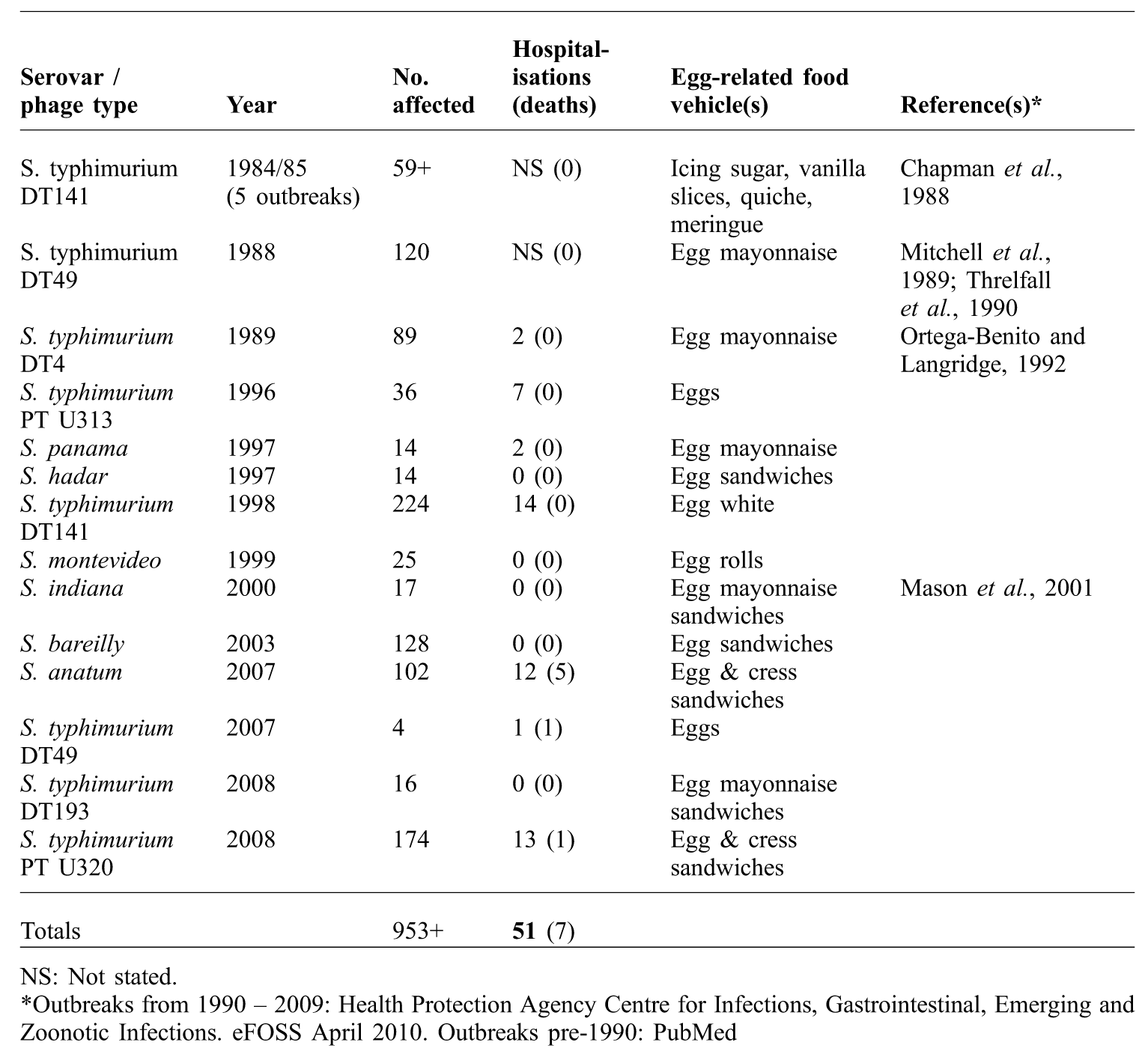
In the 26-year period 1984-2010, 18 outbreaks of infection linked to eggs and involving non-S. enteritidis serovars were identified, including five possibly related outbreaks in the north of England during 1984 and 1985 (Table 1). Over 950 persons have been affected, with at least 51 hospitalisations and seven deaths. Seven serovars have been implicated: S. typhimurium (12 outbreaks), S. panama, S. hadar, S. montevideo, S. indiana, S. bareilly and S. anatum. Within S. typhimurium six phage types were identified - definitive phage types (DTs) 4, 49, 141, 193 and phage type (PT) U320. In five of the outbreaks over 100 persons were affected and in all outbreaks epidemiological investigations implicated eggs or egg products as the vehicle of infection.
Documented and identified outbreaks of infectious intestinal disease caused by non-Salmonella enteritidis serovars and linked to eggs in England and Wales: 1984-2009.

NS: Not stated.
*Outbreaks from 1990 – 2009: Health Protection Agency Centre for Infections, Gastrointestinal, Emerging and Zoonotic Infections. eFOSS April 2010. Outbreaks pre-1990: PubMed
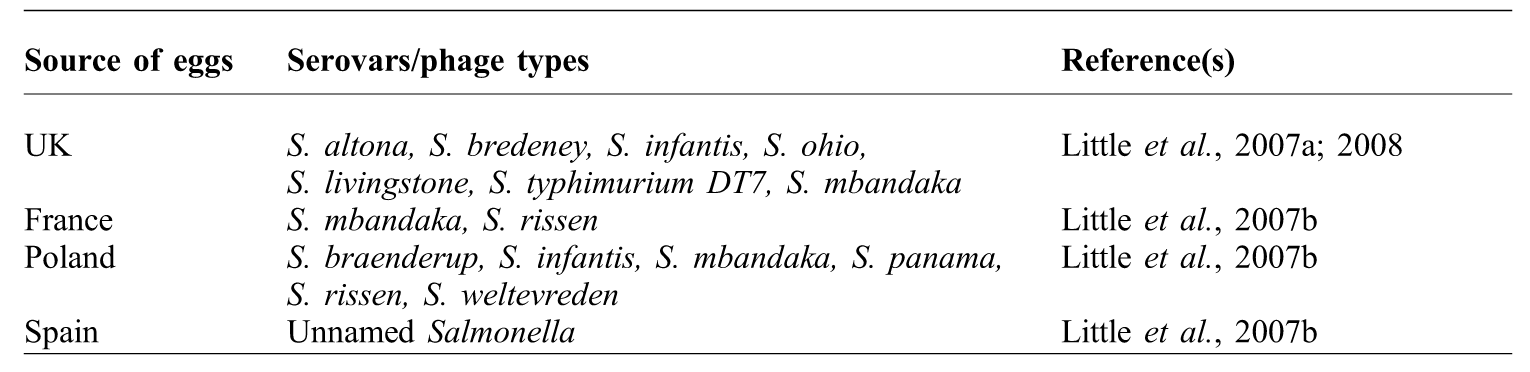
In a series of studies in the UK of contamination of shell eggs with salmonella, involving both UK-produced and non-UK produced eggs, 12 non-S. enteritidis serovars were identified in eggs originating from the UK, France, Poland and Spain. The serovars identified are summarised in Table 2.
Non-Salmonella enteritidis serovars identified in UK studies of contamination of shell eggs with Salmonella, involving both UK-produced and non-UK produced eggs.
Outbreaks outside the UK
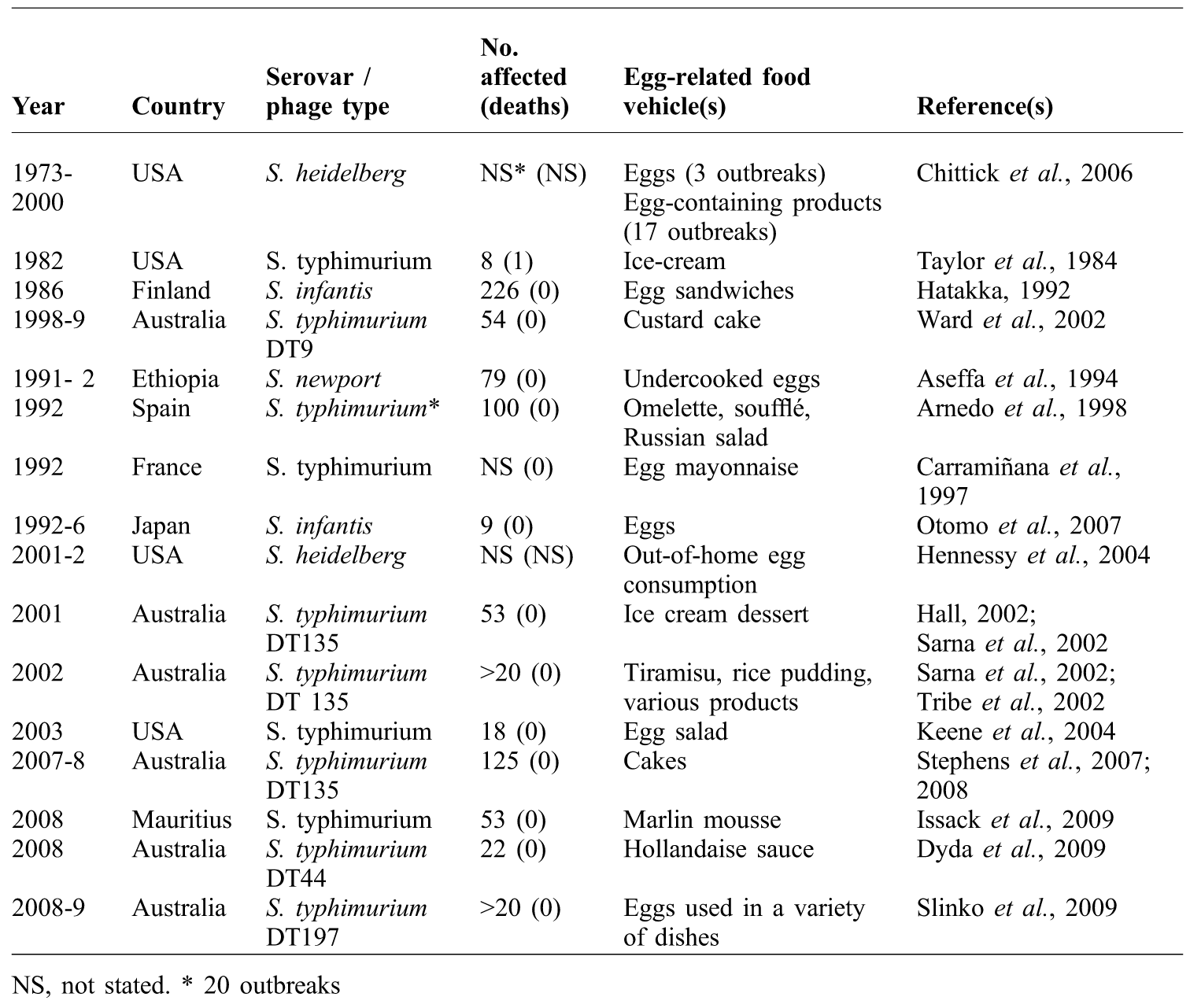
Details of non-S. enteritidis egg-associated outbreaks outside the UK are summarised in Table 3.
Non-Salmonella enteritidis egg-associated outbreaks outside the UK, 1973-2010.
NS, not stated. * 20 outbreaks
In an egg sandwich-related salmonella outbreak in Finland in 1986, 226 people were infected with S. infantis as a result of cross-contamination in a premises supplying food for railway and airline passengers (Hatakka, Reference HATAKKA1992). Eggs were implicated in an extensive outbreak of salmonellosis in the Castellón outbreak of Spain in 1992 (Arnedo et al., Reference ARNEDO, BELLIDO, PAC, CRIADO, USERA, MESANZA, GONZALEZ, PEREZ and CORTES1998). In this outbreak 545 persons were exposed, 100 were symptomatic and 16 were hospitalised. Both S. enteritidis and S. typhimurium were isolated from eggs taken from the farm supplying the food distribution outlets involved in the outbreak. It should be noted that the information provided was insufficiently detailed to link a particular serovar with overt infection. In contrast, in an outbreak of S. typhimurium among pupils in a school in France in 1992, a combination of phenotypic and molecular typing techniques linked isolates of S. typhimurium from cases with isolates from a variety of egg products, including egg mayonnaise, and also with the farm supplying the eggs (Carramiñana et al., Reference CARRAMIÑANA, HUMBERT, ERMEL and COLIN1997).
In an outbreak of S. newport among students in Ethiopia in 1991-2, there was an epidemiological linkage between the consumption of undercooked eggs and illness (Aseffa et al., Reference ASEFFA, MENGISTU and TIRUNEH1994). In this outbreak there were no isolations of the causative organism from food samples. An outbreak of nine cases of S. infantis in Japan in 1996 was linked to eggs from which the same serovar was isolated. Spent hens from the originating farm also yielded S. infantis (Otomo et al., Reference OTOMO, ABE, ODAGIRI, SHIROTO, TAKATORI and HARA-KUDO2007). In an outbreak of S. typhimurium food poisoning in Mauritius in 2008, involving at least 53 persons, laboratory and epidemiological investigations implicated raw eggs used to prepare a dish of marlin mousse, which was consumed by all affected patients (Issack et al., Reference ISSACK, HENDRIKSEN, LUN, LUTCHUN and AARESTRUP2009).
In the USA, between 1973 and 2001 a total of 101 outbreaks of S. heidelberg were associated with food vehicles; eggs were implicated in three and egg-containing products in a further 17 outbreaks (Chittick et al., Reference CHITTICK, SULKA, TAUXE and FRY2006). During that 28-year period, the annual proportion of salmonella outbreaks involving this serovar did not change significantly, nor did the proportion of S. heidelberg outbreaks that were associated with poultry, eggs or egg products. Although not proven, invasion of the egg contents through the shell was considered a possibility. More recently a population-based case-control study has been conducted to investigate an upsurge in sporadic S. heidelberg infection in the early 2000s (Chittick et al., Reference CHITTICK, SULKA, TAUXE and FRY2006). Out-of-home egg consumption was identified as the principal risk factor and recommendations to avoid eating undercooked eggs were disseminated. In 1982 eggs produced locally and used in the preparation of homemade ice cream were implicated in an outbreak of S. typhimurium affecting eight persons on a farm in Wyoming (Taylor et al., Reference TAYLOR, BOPP, BIRKNESS and COHEN1984). One child died and his mother and four siblings were treated in intensive care units. The causative organism was isolated from patients, the food and the hens from which the eggs were sourced. In 2003 pre-prepared egg salad was implicated in an outbreak of S. typhimurium involving 18 individuals in Oregon and Washington states (Keene et al., Reference KEENE, HEDBERG, CIESLAK, SCHAFER and DECHET2004).
In Australia, S. enteritidis is not endemic in the egg laying flocks, presumably due to a different breeding stock (great-grand and grand-parents) population, and sporadic S. enteritidis infections are almost all travel related (OzFoodNet Working Group, 2007). Furthermore, both salmonella and specifically egg-related salmonella outbreaks are not only less predominant than in Europe but also most often implicate S. typhimurium (Greig and Ravel, Reference GREIG and RAVEL2009). There have been several outbreaks reported involving different phage types of S. typhimurium: DT9 (Ward et al., Reference WARD, ANDREWS, GREGORY and LIGHTFOOT2002), DT44 (Dyda et al., Reference DYDA, HUNDY, MOFFATT and CAMERON2009), DT135 (Hall, Reference HALL2002; Sarna et al., Reference SARNA, DOWSE, EVANS and GUEST2002; Reference STEPHENS, COLEMAN and SHAWStephenset al., Reference STEPHENS, SAULT, FIRESTONE, LIGHTFOOT and BELL2007; Tribe et al., Reference TRIBE, COWELL, CAMERON and CAMERON2002), and DT197 (Slinko et al., Reference SLINKO, MCCALL, STAFFORD, BELL, HILEY, SANDBERG, WHITE and BELL2009). These phage types are in general uncommon in cases of infection in Europe. Aggregated data additionally includes egg-associated outbreaks involving S. typhimurium DTs 26var, 102, 126, 135a, 144, 170, 197 and PT U302, plus S. potsdam, S. hadar and S. heidelberg (OzFoodNet Working Group, 2002; 2003; 2006; 2008; 2009). Over 500 cases of non-S. enteritidis egg-associated salmonellosis have been reported since 2000. To a certain extent Australian investigators have related these outbreaks to eggshell contamination, i.e. soiled eggshells, but the consumption of raw shell eggs has been recorded as a causative factor in at least two substantive outbreaks in that country in 2002 (Hall, Reference HALL2002; Sarna et al., Reference SARNA, DOWSE, EVANS and GUEST2002; Tribe et al., Reference TRIBE, COWELL, CAMERON and CAMERON2002) and in recurrent outbreaks in Tasmania in 2005 (Stephens et al., Reference STEPHENS, SAULT, FIRESTONE, LIGHTFOOT and BELL2007).
Conclusions
Although S. enteritidis is without doubt the serovar most commonly implicated in egg-associated outbreaks of salmonellosis in the UK, Europe and North America from 1986 to 2009, other serovars have also been implicated in a number of outbreaks, most notably S. typhimurium belonging to a range of phage types. The numbers of infections caused by such serovars, although small compared to S. enteritidis, are nevertheless quite substantial and on occasion have resulted in hospitalisations and deaths.
There is no evidence to suggest that these serovars have either been established for long periods or transmitted vertically in poultry flocks by the transovarian infection route, although certain strains within some serovars, e.g., S. heidelberg, has been shown to have the capacity for ovarian infection. Furthermore, in most outbreaks with non-S. enteritidis serovars, including S. typhimurium, the possible role of egg shell contamination in terms of direct infection of people handing eggs, contamination of the egg contents when shells are cracked, contamination of the kitchen environment or trans-shell contamination of contents, has not been fully explored.
In Australasia a different situation exists as S. enteritidis does not appear to have become established in poultry flocks. Consequently there have been no known food-borne outbreaks of infection with S. enteritidis, although outbreaks of S. typhimurium associated with undercooked or raw eggs have been recorded.
In the EU, S. enteritidis (as well as S. typhimurium) in laying hens is now subject to harmonised monitoring and control. This is likely to result in a substantial reduction in the prevalence of S. enteritidis in humans in most MS. There are, however, fears that another strain may increase to fill this niche (Foley et al., Reference FOLEY, NAYAK, HANNING, JOHNSON, HAN and RICKE2011) and one group of strains that is rapidly increasing in food animals and humans worldwide is the monophasic group B cluster within S. typhimurium DTs 193 and 120, i.e. S. 4,5,12:i:- and S. 4,12:i:- strains. In addition, different serovars may have different sources, for example feed, breeding stock, rodent pests or persistent environmental contamination. Consequently, differing strategies may need to be developed for control or elimination. It is therefore important that surveillance trends in laying flocks are closely monitored and that suitable biosecurity and vaccination programmes are in place to minimise the risk of incursion of new zoonotic serovars into the egg industry .
Acknowledgements
This review was produced as part of Defra-funded research project OZO332