A central question in the study of democratic government concerns the conditions under which political officials make decisions in line with public opinion. Judicial politics research has established that judges are affected by public opinion, regardless of the institution used to select or retain them (McGuire and Stimson Reference McGuire and Stimson2004; Caldarone, Canes-Wrone, and Clark Reference Caldarone, Canes-Wrone and Clark2009; Casillas, Enns, and Wohlfarth Reference Casillas, Enns and Wohlfarth2011; Canes-Wrone, Clark, and Park Reference Canes-Wrone and Clark2012).Footnote 1 While scholars have established a connection between public opinion and the decisions of public officials, we know little about how the acquisition of additional information about constituent preferences changes their behavior.
Indeed, because public opinion can be difficult (even for scholars) to estimate, particularly at the local level, the possibility exists that public officials misperceive their constituents’ preferences. In the absence of polling data, they may look to their friends, neighbors, and colleagues to gauge public opinion, but those individuals may not provide an accurate reflection of constituency preferences. However, if public officials are given high-quality information about their constituents’ preferences, they should update their beliefs about constituent opinion, and we should observe a change in behavior commensurate with constituent opinion. Thus, the opportunity to assess responsiveness to a clear signal of public opinion provides a unique setting to assess how new information about constituent preferences affects the behavior of public officials.
In this article, I use a unique measure of public opinion—votes on an initiative to legalize marijuana in Colorado—as well as data on the decisions of both prosecutors and judges to assess the presence of behavioral change after receiving a strong, issue-specific, constituency-level signal of public opinion. Analyzing the decisions of both prosecutors and judges in recent marijuana cases in Colorado, I find that both types of officials changed their behavior after the signal. Prosecutors responded only to local-level opinion: those in liberal areas became more likely to dismiss charges, while prosecutors in conservative areas exhibited the opposite behavior. Judges responded to both local and statewide opinion; the general tendency was to sentence more severely after the failed initiative, but the effect size diminishes among judges whose constituents were more supportive of the initiative.
This article expands on previous research by using an innovative measure of issue-specific public opinion, accounting for the potential selection bias created by prosecutors, and modeling directly the decisions of both judges and prosecutors. First, while recent studies (Huber and Gordon Reference Huber and Gordon2004; Gordon and Huber Reference Gordon and Huber2007) have demonstrated that the presence and timing of judicial elections affects the sentences that judges issue, these studies do not include issue-specific public opinion in their empirical analyses. Because the opinions of those citizens who comprise a constituency may vary statewide, a sentence that is popular in one region of the state may be unpopular in another region. By controlling for constituency- and issue-specific public opinion, we can clarify the extent to which judges respond to the opinions of those who have the power to remove them from office as well as the extent to which career concerns affect responsiveness to public opinion. Second, prior research has often assumed that judges’ dockets are randomly selected (Kastellec and Lax Reference Kastellec and Lax2008); these studies do not account directly for the fact that prosecutors, through the exercise of their discretion over which cases to pursue, which charges to dismiss, and which cases to plea bargain, shape the types of cases that judges hear. Without accounting for the fact that prosecutors—who also stand for election—might also respond to public opinion, prior research cannot eliminate the possibility that what appears to be judicial responsiveness to public opinion is merely a downstream consequence of a prosecutor’s responsiveness to public opinion. Finally, when compared with judges—even local judges—prosecutors are vastly understudied. By modeling the determinants of a prosecutor’s decision to dismiss a charge, this article presents some of the first empirical evidence about the forces that affect the use of prosecutorial discretion.
Judges, Prosecutors, and Public Opinion
Scholars have produced a variety of evidence that public opinion affects judicial decision making. At the federal level, scholars have argued that judges attempt to follow public opinion to bolster their legitimacy even though they will never face the electorate. These studies generally assess the extent to which the liberal or conservative nature of the court’s decisions coincides with changes in the general ideological leanings of the public. Taken as a whole, these studies indicate that public opinion affects federal judicial policy (Flemming and Wood Reference Flemming and Dan Wood1997; McGuire and Stimson Reference McGuire and Stimson2004; Epstein and Martin Reference Epstein, Lee and Martin2010; Clark Reference Clark2011; but see Norpoth and Segal Reference Norpoth, Helmut and Segal1994; Giles et al. Reference Giles, Blackstone and Vining2008).
At the state level, there are reasons other than legitimacy to expect that judges will heed public opinion. Because the vast majority of state judges must face voters to retain their seat on the bench, the presence of an electoral connection provides additional incentives for judges to follow public opinion. Here, scholars—typically relying on issue-specific rather than general measures of ideology—have demonstrated that elected judges are generally responsive to the will of the people (Brace and Boyea Reference Brace, Paul and Boyea2008). Still, the type of retention institution used to keep judges in office conditions the magnitude of the effect; Caldarone et al. (Reference Caldarone, Canes-Wrone and Clark2009) show that judges retained through nonpartisan elections are more likely than their counterparts who are reliant on partisan elections to issue abortion decisions that comport with public opinion. Looking at the entire docket, Cann and Wilhelm (Reference Cann and Wilhelm2011) find that judicial responsiveness is contingent on the salience of the case; more visible cases are more likely to induce judicial responsiveness.
The effects of public opinion extend to those judges who are retained using uncontestable retention elections. By definition, these judges are not concerned about facing a challenger when they next seek retention, and the historical record illustrates clearly that judges retained through uncontestable retention elections are, in most cases, unlikely to lose their seat on the bench (Aspin Reference Aspin2011). Still, the presence of these elections affects judicial behavior; Traut and Emmert (Reference Traut and Emmert1998) show that public opinion plays a role in the calculations of California Supreme Court justices’ death penalty decisions, even though those judges merely face uncontested retention elections. Likewise, Canes-Wrone et al. (Reference Canes-Wrone and Clark2012) demonstrate that, at least in abortion cases, retention elections induce a responsiveness to public opinion that mirrors that demonstrated by judges who face contestable elections.
While the bulk of this research has been limited to the decisions of state supreme courts, some literature has addressed the effect of public opinion on the decisions of local judges deciding other types of cases, although this work has predominantly examined the effects of public opinion indirectly by examining the conditions of the electoral process or the effects of the electoral cycle. While some research indicates that judges who will never face a challenger on election day are less responsive to public opinion than are judges who may face challengers at the polls (Gordon and Huber Reference Gordon and Huber2007), other research suggests that even the presence of an uncontestable retention election may induce a judge to heed public opinion. Indeed, Huber and Gordon (Reference Huber and Gordon2004) show that, as the date of their election approaches, Pennsylvania judges who face retention elections issue more punitive sentences.Footnote 2 Finally, Kuklinski and Stanga (Reference Kuklinski and Stanga1979) find that the sentencing behavior of California trial courts changed drastically after a failed 1972 marijuana legalization initiative in California. In particular, comparing the aggregate sentences produced by each county superior court before and after the election, Kuklinski and Stanga find that courts whose constituents favored the legalization of marijuana sentenced defendants more leniently.Footnote 3
Of course, judges are not the only actors in the criminal justice system. In order to rule out the possibility that what looks like responsiveness to public opinion is merely a reaction to the fact that prosecutors chose to bring different types of cases to trial over time, it is important to consider the actions of prosecutors to avoid selection bias (Priest and Klein Reference Priest and Klein1984; Kastellec and Lax Reference Kastellec and Lax2008). If prosecutors, who often are also elected, simultaneously respond to public opinion, what appears to be judicial responsiveness to public opinion may actually be an artifact of the decisions that prosecutors make with respect to the cases that are dismissed, those that are plea bargained, and those that go to trial. Where scholars have attempted to address the effects of prosecutorial discretion, the lack of available data has prohibited a direct exploration of the determinants of prosecutors’ use of discretion. Previous attempts at eliminating the effects of this discretion have proceeded by noting differences in the electoral calendars of judges and prosecutors or through the use of fixed effects in regression analyses. Data limitations have prevented scholars from directly exploring the possibility that the decisions of prosecutors are affected by the same factors as judges. If prosecutors simultaneously respond to public opinion, their actions can manipulate the composition of a judge’s caseload because they make the decision to dismiss a case before a judge has the opportunity to sentence (Huber and Gordon Reference Huber and Gordon2004; Gordon and Huber Reference Gordon and Huber2007).
While prior literature provides clear guidance about the expected relationship between public opinion and judicial behavior, the relationship between public opinion and prosecutorial discretion has been subject to comparatively little empirical scrutiny by scholars. While only a very small literature (Pritchard Reference Pritchard1986) has examined the effect of public opinion on prosecutorial discretion, extant research provides reason to believe that public opinion may sway prosecutorial decision making. Indeed, according to the authors of a prominent criminal procedure textbook, “the prosecutor occupies the most powerful position in the [criminal justice] system by virtue of control over who is prosecuted and who is not. … The prosecutor’s broad discretionary power is subject to one … restriction. Under our system of checks and balances, the prosecutor may always risk rejection by the electorate at the next election” (Haddad et al. Reference Haddad, Marsh, Zagel, Meyer, Starkman and Bauer2008, 903). This electoral connection gives district attorneys an incentive to heed the will of the people if they wish to remain in office; like elected judges, if elected district attorneys fail to follow public opinion, they risk losing their job.
Although public opinion should play a role in their decision making, local-level public officials must determine to which “public” they will respond.Footnote 4 However, their immediate geographic constituency provides an obvious suggestion; in order to remain in office, public officials need to satisfy enough of their geographic constituents to earn a plurality of their votes in the next election. Yet, beyond their immediate constituents, public officials—particularly those who plan to seek higher office—may also respond to the views of a wider constituency. If a judge knows she wants to seek a state supreme court judgeship, for example, she may be particularly attuned to statewide, rather than local, opinion. Thus, career concerns provide one way to determine to what “public” a judge or prosecutor should respond. Tonry (2011) writes that “personal interests of judges and prosecutors influence their behavior. Elected chief prosecutors and elected or politically selected judges may want to be re-elected or re-appointed or to be elected or appointed to a higher office. This at the very least creates risks that individuals’ political or career ambitions will influence how cases are handled” (113). Indeed, an array of scholarship (Baum Reference Baum1994, Reference Baum1997; Bresler Reference Bresler1994; Medwed Reference Medwed2004; Gordon and Huber Reference Gordon and Huber2009) has suggested that both judges and district attorneys act out of concern for their subsequent careers.
Many district attorneys spend only a few years in the prosecutors’ office. Carp, Stidham, and Manning (Reference Carp, Stidham and Manning2007) write that, on leaving the district attorney’s office, many individuals enter private practice, often locally, or seek a local judgeship (185). Thus, when these individuals leave office, their career paths often keep them close to home. As a result, they should respond primarily to local, rather than statewide, opinion. On the judicial front, a variety of authors (e.g., Baum Reference Baum1994, Reference Baum1997) have argued that trial court judges are motivated, in part, by a desire to become appellate judges. A trial court judge in a liberal region in an otherwise conservative state who would like to eventually become a state supreme court justice, for example, may follow the conservative tendencies of his state, rather than his county’s more liberal views, in an attempt to avoid a pattern of decisions that would de facto disqualify him from a seat on the state supreme court. After all, state appellate courts, in most instances, have statewide jurisdictions. Thus, career-minded judges have an incentive to heed both statewide and local public opinion, while district attorneys, whose next jobs are likely also local jobs, have less of an incentive to heed statewide opinion.
Public Opinion and Criminal Cases
The presence of an electoral connection to bind judges and prosecutors to their constituents suggests that these elected officials might heed public preferences with an eye toward reelection, yet the decisions of these officials are often hidden from widespread public scrutiny. While members of the public may know the results of the rare individual local-level felony case that garners the attention of the local newspaper or television station, local judges’ caseloads and the number of potential cases dealt with by local prosecutors are so large that the vast majority of the decisions made by these actors escapes the attention of even those citizens who make some attempt to follow local legal developments.Footnote 5
If the public does not know about the decisions made by local judges and prosecutors, it is difficult for it to hold those officials accountable for those decisions on election day. If most of their decisions are shielded from public view, why should public officials heed popular opinion? The literature on congressional elections and legislative politics provides an answer. While a vast literature in congressional politics has noted that incumbent representatives typically have at least a 90% chance of reelection, congressional scholarship still operates under the assumption that the possibility of an electoral defeat colors nearly every aspect of congressional politics (Mayhew Reference Mayhew1974). Arnold (Reference Arnold, Dodd and Oppenheimer1993) argues that, even though the prospect that any single decision will come back to haunt that legislator in his next election is small, legislators act carefully in all of their actions to prevent the creation of a record that can be used against them.
Judicial elections create similar dynamics. Even in the absence of a challenger, interest groups may work to inform voters about judges’ unpopular decisions, and those actions may hurt their chances of retention. Particularly in retention elections—where challengers are not allowed on the ballot—judges may face an organized campaign by an interest group opposing their retention. In many well-known instances in which voters have declined to retain jurists (e.g., the 1986 campaign against Rose Bird and her colleagues, the 1996 campaign against Tennessee’s Penny White, and the 2010 campaign against three justices of the Iowa Supreme Court), interest groups mobilized voters using claims that jurists’ decisions diverge from public opinion (Wold and Culver Reference Wold and Culver1987; Schotland Reference Schotland2011). Moreover, as elected officials become aware of the possibility of electoral defeat, the effects of public opinion on the use of their discretion may increase. Gibson (Reference Gibson1980) finds that judges who know of other judges who have not been retained in office are more likely to be influenced by the political environment in their sentences.
This fear is heightened in criminal cases, which are particularly salient in judicial elections (Hall Reference Hall2001). As Baum (Reference Baum2003) has noted, “creating the impression that a judge is soft on crime can have great electoral impact” in an impending contest (35). At the same time, the nature of a criminal case suggests that they present an especially strong vehicle for public preferences. According to two scholars, “one characteristic of criminal cases is that they are brought in the name of the government on behalf of the community” (Saltzburg and Capra Reference Saltzburg and Capra1996, 2). In other words, criminal cases represent an affront to the shared norms and values of the community; the mass public is a party to each of these cases, at least theoretically. Given that criminal cases are important issues in judicial campaigns and the public is, at least theoretically, a party to these cases, the preferences of the public should be particularly likely to play a role in the decisions that public officials make in these cases.
Learning about Public Opinion
Thus, existing research provides at least two reasons—legitimacy and the electoral connection—to expect that judges and prosecutors reflect the will of the people in their decisions, and career goals lead to expectations about to which “public” judges and prosecutors should respond. However, while theory leads us to expect that elected officials should reflect public opinion in their decisions, they can only mirror public opinion to the extent that they know what it is. One obvious place for public officials to turn for information about constituent preferences is polling data. Yet, even if a representative survey of a state is conducted, it is rarely representative at the county level.Footnote 6 Thus, for most local-level judges and prosecutors, obtaining polling data on constituents’ preferences is not an option.
In the absence of polling data or some other high-quality source of information, the ability of public officials to gauge public opinion is limited. Of course, public officials have many ways of determining public opinion in the absence of polls. Through conversations with friends, colleagues, the local bar association, and the alleged criminals with whom they work, judges and prosecutors gather some information about how their geographic constituents feel about issues. Still, while they may try to ascertain their constituents’ preferences by talking to their friends and neighbors, they risk the chance that those individuals are a homogeneous segment of their constituency with a biased view of overall constituency opinion.
Given the difficulties inherent in determining local-level public opinion, public officials at this level may have difficulty ascertaining their constituents’ opinions. As a result, their decisions may not optimally reflect public opinion, even though they have strong reasons to follow it. If this is the case, then new information about constituent preferences should cause these public officials to update their own beliefs about constituency preferences, and their decisions should change in a way that tracks more closely with public opinion. In other words, I suggest that the presence of high-quality, constituency-level information about public preferences should reduce the difficulties inherent in assessing the will of the people, and, when provided with clear information about constituency preferences, prosecutors and judges should exhibit responsiveness to that signal by adjusting their dismissal or sentencing patterns in a way that reflects public opinion. In short, I theorize that elected judges and prosecutors change their behavior to reflect public opinion after they are provided with information about constituent preferences.
Moreover, I expect that career concerns will determine to which “public” elected judges and prosecutors respond. Given that prosecutors are most likely to move out of the prosecutor’s office to another local-level position (Carp et al. Reference Carp, Stidham and Manning2007), I expect that prosecutors should respond only to local-level opinion. However, because prior research (Baum Reference Baum1997) suggests that trial judges are often motivated by a desire to move up the judicial hierarchy to a court with statewide jurisdiction as well as a desire to retain their own, local-level, judgeship in the interim, I expect that trial judges should respond to both statewide and local-level opinion. In other words, their responsiveness to public opinion should reflect the statewide electorate’s view on the issue, but the level of responsiveness should be conditioned by their own constituency’s view on the issue.
Research Design
To test these expectations, following Kuklinski and Stanga (Reference Kuklinski and Stanga1979), I leverage the fact that local politicians in some jurisdictions do have access to some widely available, disaggregated public opinion data: the results of ballot initiatives. By examining publicly available election returns on these issues, local politicians have access to public opinion data at the precinct level. The election results are exemplary signals of public opinion for local politicians for a number of reasons. First, initiatives are put on the ballot by members of the public acting either in their capacity as citizens or as members of an organized interest group; an initiative only reaches the ballot once it has some baseline level of public support as demonstrated by the signatures necessary to put the issue on the ballot (Kuklinski and Stanga Reference Kuklinski and Stanga1979). Second, the sample is nonrandom. Typical surveys poll a random sample of the population and ask their opinions on issues, yet, a variety of research suggests that the segment of the public that votes on election day is not a random sample of the population (Wolfinger and Rosenstone Reference Wolfinger and Rosenstone1980). The citizens who vote in initiatives, by contrast, are those constituents who are motivated enough by a particular issue that they are willing to go to the polls and make their voice heard. Elected politicians who have a desire to remain in office have a clear incentive to follow these election returns; if they make decisions contrary to the expressed opinions of those who are mobilized by the issue to go to the polls, they risk losing their jobs. Third, the questions that appear at the polls are often limited to a single issue dimension; rather than requiring a reliance on a general liberal-conservative dimension, initiatives provide issue-specific measures of constituent support for a particular proposition. Fourth, the results of these initiatives are widely publicized in the media, and county-by-county breakdowns of the vote are freely published online by media outlets and state elections offices. This publicity allows judges easy access to information about constituent preferences.
The use of a citizen initiative has another valuable inferential feature: it provides us an opportunity to discriminate easily between local-level and statewide opinion on an issue. Public officials can easily obtain the opinion of their geographic constituents on the issue by looking at the percentage of yes votes received by the initiative in every county in which they have constituents, and they can assess statewide opinion by looking at the overall fate of the initiative: did it succeed or fail? As a result, the use of this initiative provides a unique opportunity to assess the interplay of local- and state-level public opinion.
While Kuklinski and Stanga’s (1979) use of initiative results to measure public opinion is useful, there are limitations to their empirical analysis. First, they are unable to control for the effects of legal factors in sentencing decisions. Kuklinski and Stanga’s dependent variable is a sentence severity score that provides a quantitative representation of the severity of the punishment given to the defendant. This score is the average severity of all of the sentences handed down by a court in a given year without regard to the charge for which the sentence was given. This approach treats sentences for the possession of 1 ounce of marijuana the same as one for the possession of a large quantity of marijuana, without accounting for the fact that the expected sentence for the smaller amount of marijuana is lower. Without controlling for differences in the severity of the cases, Kuklinski and Stanga cannot address the possibility that what appears to be responsiveness may be a reaction to two different pools of cases. If the average case decided by the judges in a county before the initiative is less severe than the average case decided after the election, what may appear to be a move to more punitive behavior on the part of judges may actually be the result of judges’ responding to the legal factors in the case, rather than public opinion. Likewise, the lack of case-specific information reaching back to the prosecutor’s decision about which charges to dismiss does not allow one to rule out the possibility that the types of cases that prosecutors choose to take to trial differ before and after the initiative.
Second, Kuklinski and Stanga’s unit of analysis is not ideal. By analyzing the county-year, they mask the possibility that large individual-level change may occur over time. By averaging the sentences handed down by the dozens of judges in Los Angeles County, for example, they eliminate the possibility that individual judges may be more or less susceptible to public opinion. This is particularly problematic because judicial sentences are handed down by judges, not courts; therefore, the effects of public opinion are felt by judges, not courts.
The Judicial Politics of Marijuana Sentencing in Colorado
The initiative that forms the basis for the analysis appeared on the Colorado general election ballot in 2006. The ballot asked, “Shall there be an amendment to section 18-18-406 (1) of the Colorado revised statutes making legal the possession of one ounce or less of marihuana for any person twenty-one years of age or older?” (Colorado Secretary of State 2007). The proposal failed at the polls; only 41% of voters supported the measure. Still, participation in the election was very high; 97.8% of voters who returned a ballot in the 2006 general election cast a vote on the measure. Moreover, total turnout in this election comprised nearly two-thirds of all active Colorado voters (Colorado Secretary of State 2007).
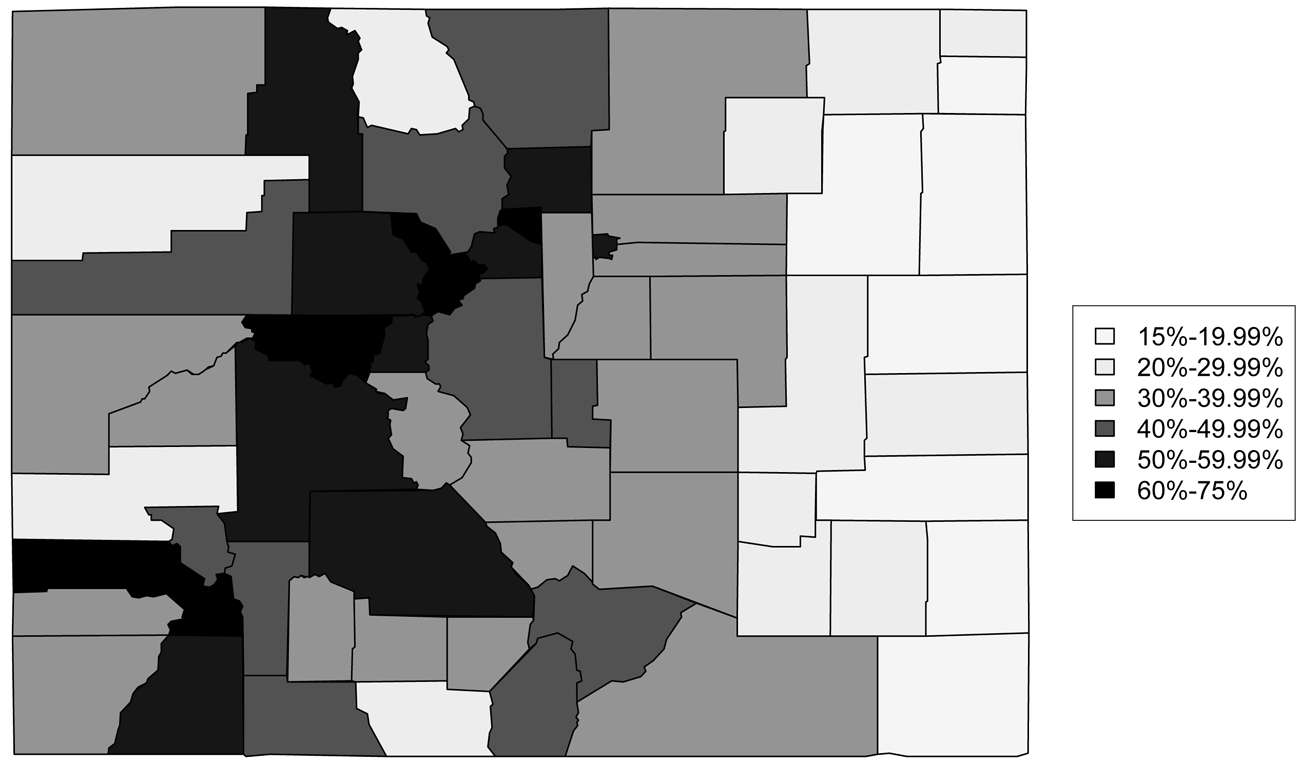
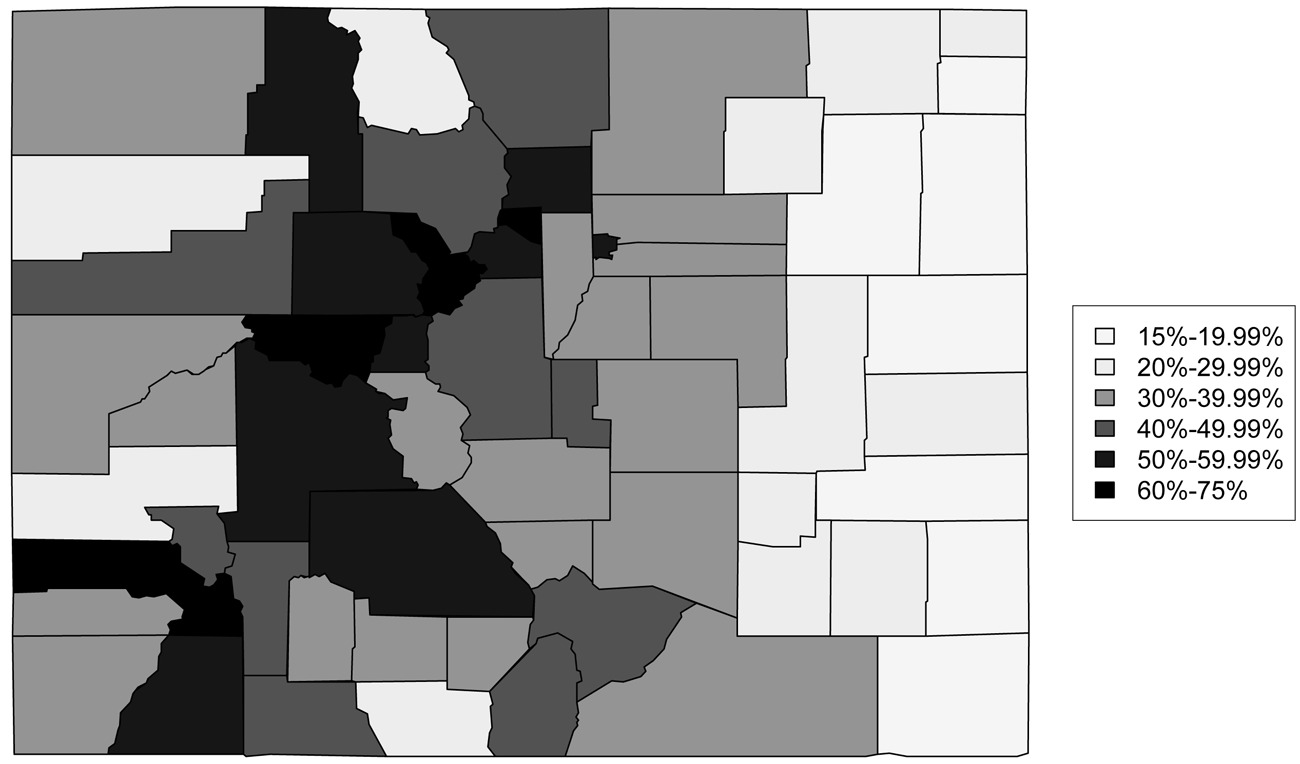
Support for the initiative varied widely by county.Footnote 7 In Kiowa and Washington Counties, only 17% of voters supported the ballot measure; conversely, in Pitkin and San Miguel Counties, over 70% of voters supported it (Colorado Secretary of State 2007). Figure 1 provides a visual account of the vote on the ballot proposition. The figure indicates that support for marijuana legalization was very low in western Colorado, while citizens in central and southwestern Colorado were most likely to support the initiative.
Support for marijuana legalization in Colorado as measured by the 2006 ballot measure. Darker colors indicate more support.
Colorado has 22 district attorneys. District attorneys in the state have jurisdictions coterminous with district judges; each judicial district elects a district attorney who oversees cases in both the county and district courts under her jurisdiction. District attorneys are elected in partisan elections to a term of office lasting 4 years.Footnote 8 Colorado’s district attorneys are term limited; they can serve no more than two full terms in office. Elections to select district attorneys are held in November, so district attorneys appear on the ballot at the same time as judges. However, because the lengths of the terms served by district attorneys and the judges in their districts are different, the terms of judges and district attorneys are staggered.
The state of Colorado uses a two-tiered system of trial courts. Each of the 64 counties in the state has its own county court (staffed by one or more judges), while counties are grouped into 22 judicial districts. Each judicial district contains a district court. While the two courts have overlapping jurisdiction in some cases, district courts tend to have jurisdiction over more severe crimes, while county courts generally hear less severe cases (Rottman and Strickland 2006). Appeals from these courts are heard by the statewide Colorado Court of Appeals. Colorado’s trial court judges are chosen through a commission-based selection process; these judges serve an initial 2-year term and then are subject to uncontestable retention elections at the end of each subsequent 6-year (for district court judges) or 4-year (for county court judges) term (American Judicature Society 2013).
Data
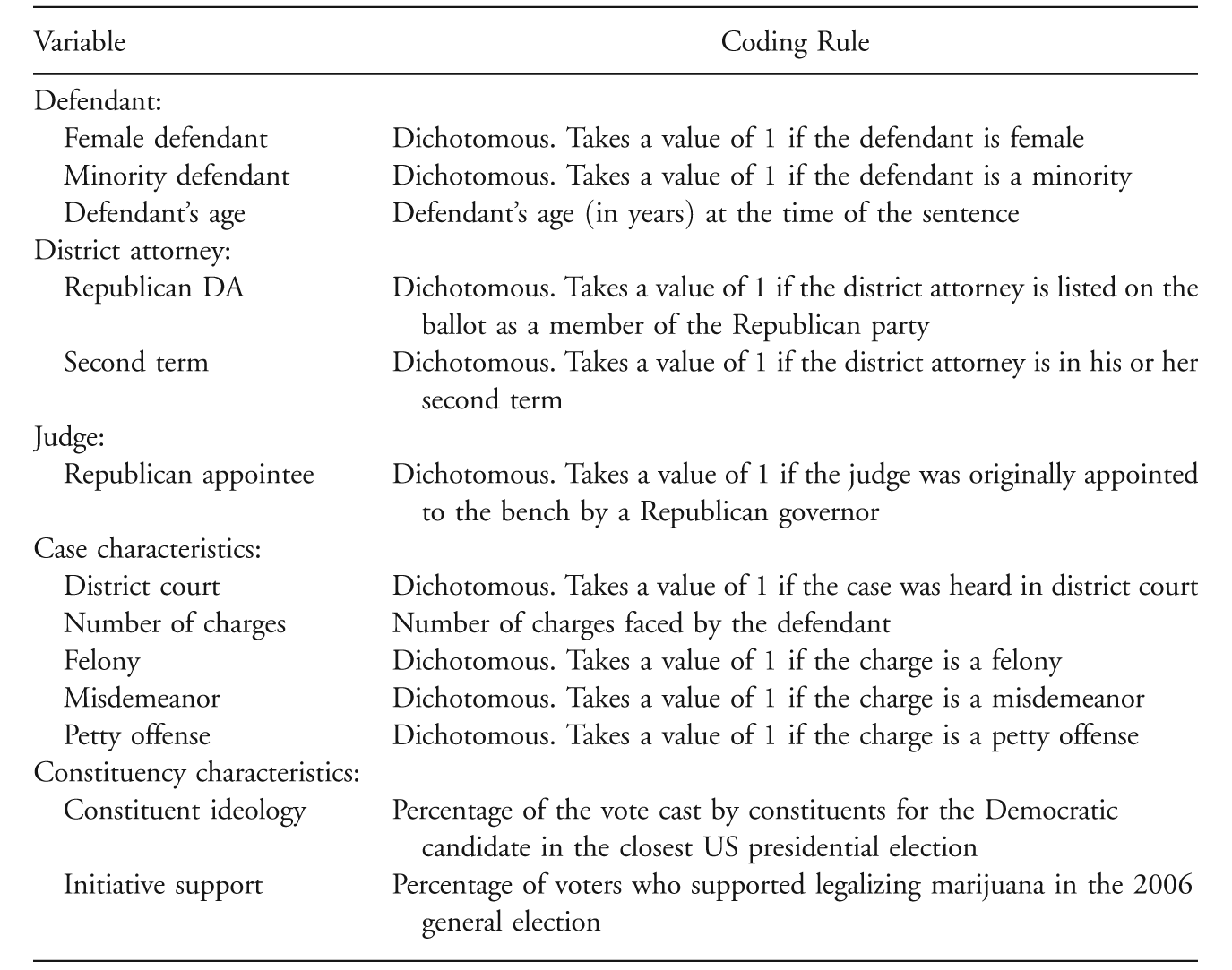
The data for this study come from records kept by the Colorado Judicial Bench. I requested and received data on cases filed in the Colorado county courts and the Colorado district courts regarding alleged violations of Colorado Code Section 18-18-406 (titled “Offenses Relating to Marijuana and Marijuana Concentrate”) between 2004 and 2009.Footnote 9 I estimate separate models to explore the determinants of prosecutorial discretion and judicial behavior. Of course, district attorneys do not sentence defendants; their decision is a dichotomous decision to dismiss a charge or to require the defendant to be tried on this charge. The dependent variable in that analysis is the district attorney’s decision to dismiss a drug charge. Given the dichotomous nature of this variable, logistic regression was employed.
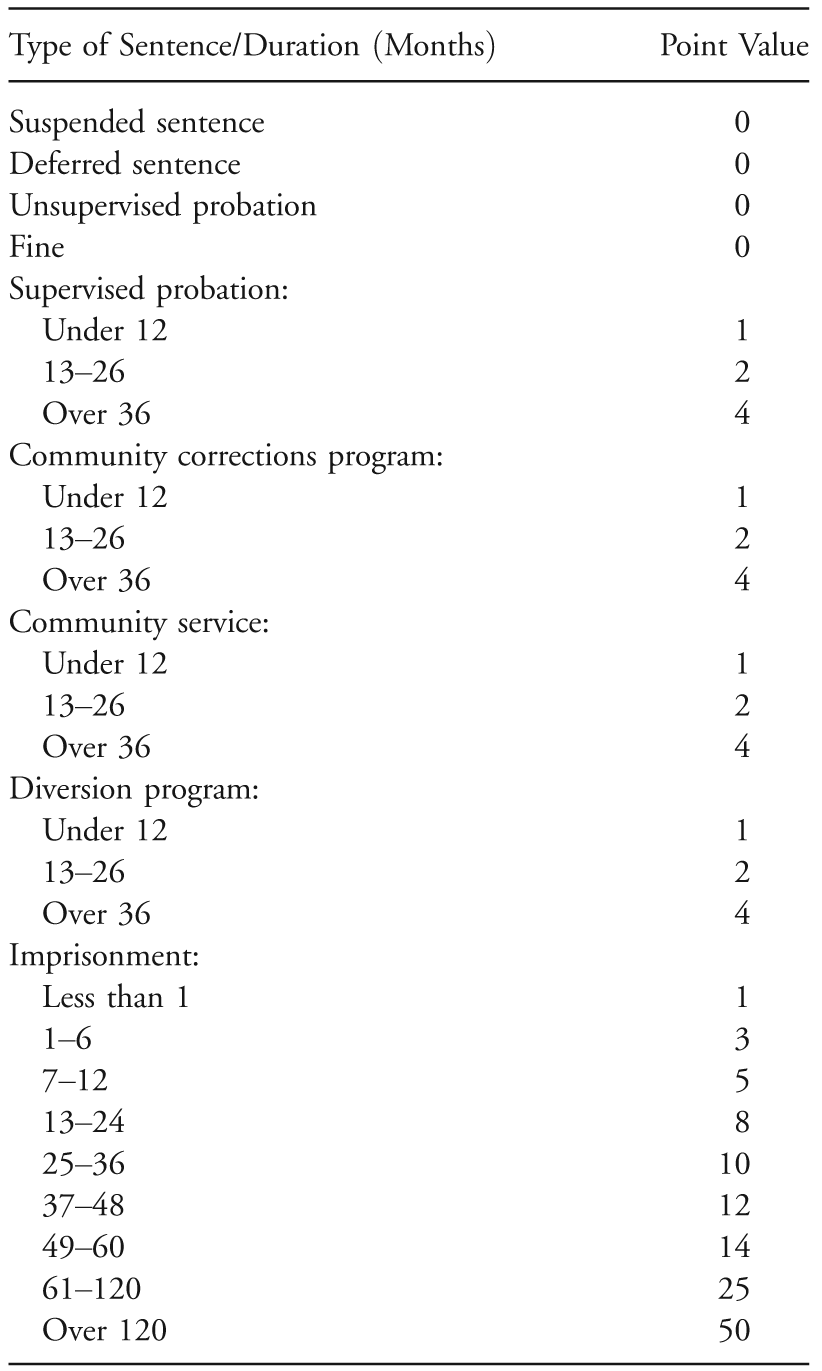
The construction of the dependent variable necessary for the analysis of judicial behavior presents a difficult measurement problem. In drug cases in Colorado, judges have the authority to give sentences with a number of different components; they can require defendants to pay fines, to perform community service, or to go to jail, or they can sentence defendants with a number of other penalties. As is customary in this type of sentencing research (Cook Reference Cook1977; Gibson Reference Gibson1978, Reference Gibson1980; Kritzer Reference Kritzer1979; Kuklinski and Stanga Reference Kuklinski and Stanga1979), the dependent variable for the initial analysis of judicial behavior is a sentence severity scale. This scale solves the problem of “different” sentence types by assigning a numerical point value to each portion of the sentence, and the total sentence severity can be determined by summing each portion of the sentence given to the defendant.Footnote 10 To construct the dependent variable, I updated the scale used by Cook (Reference Cook1977), Gibson (Reference Gibson1978, Reference Gibson1980), Kritzer (Reference Kritzer1979), and Kuklinski and Stanga (Reference Kuklinski and Stanga1979) and printed in the 1968–70 edition of Federal Offenders in U.S. District Courts. Since the Colorado criminal justice system uses punishment types (e.g., placement in community correctional facilities) that were not used by the federal district courts at the time the sentencing scale was created, I incorporated “new” sentencing types in the scale using information provided by the Colorado Department of Corrections and the Colorado Judicial Branch. More information on the sentence severity scale, including the point values assigned to each type of offense, is contained in appendix A.Footnote 11 Because the dependent variable is a nonnegative integer that exhibits evidence of overdispersion, I use negative binomial regression.
To assess the effect of the initiative on elite behavior, the model includes an interaction term between initiative support, a continuous variable representing constituent support for the legalization of marijuana from the 2006 initiative, and a variable indicating whether the case was heard after the initiative (postinitiative).Footnote 12 With this interaction term, it is easy to assess how the behavior of public officials after the initiative differs from their behavior before the initiative. Overall, higher values of initiative support mean higher support for the legalization of marijuana, while lower values indicate the opposite. If judges and prosecutors are responsive to this local-level opinion signal, we should observe a shift in behavior after the initiative toward more punitive sentencing and more aggressive prosecution (as demonstrated by a lower probability the district attorney will dismiss a charge) when constituencies demonstrate a lower desire for the legalization of marijuana and lighter sentences and less prosecution in areas where constituents indicated a higher level of support for marijuana legalization.Footnote 13
Moreover, the interaction term will address the question of when public officials are responsive to local opinion and when they respond to statewide opinion. If prosecutors or judges are primarily responsive to the wishes of their immediate, geographic constituents, then we should observe that judges and prosecutors behave differently before and after the initiative on the basis of how their constituents voted on the initiative: judges or prosecutors in more conservative districts should act more conservatively, while those in more liberal districts should act more liberally. If judges and prosecutors are primarily responsive to local opinion, there should be no across-the-board change indicating that all judges (or all prosecutors) began to sentence more liberally (or more conservatively) regardless of their geographic constituents’ position on the initiative.
If, however, actors are primarily responsive to a larger population (in this case, the will of the Colorado people), we should observe the converse: regardless of their constituents’ views on the initiative, we should observe that judges and prosecutors all act more conservatively (since the initiative was defeated by the Colorado polity writ large). To put it differently, statewide opinion in this instance would be indicated by a finding that judges, regardless of their constituents’ views on marijuana legalization, sentenced more severely after the initiative or that prosecutors, regardless of their geographic constituents’ expressed will, became less likely to dismiss charges.
Of course, responsiveness to statewide opinion and responsiveness to local-level opinion are not necessarily mutually exclusive. It may be the case, for example, that judges exhibit responsiveness to statewide opinion by exhibiting an across-the-board change toward harsher sentences (since the initiative failed), while the magnitude of that change varies by the level of support the initiative received in that judge’s constituency (thereby showing responsiveness to the local level, as well). Indeed, given the hypothesis that judges are responsive to both local and statewide opinion, this is exactly the pattern we should expect to see among judges.
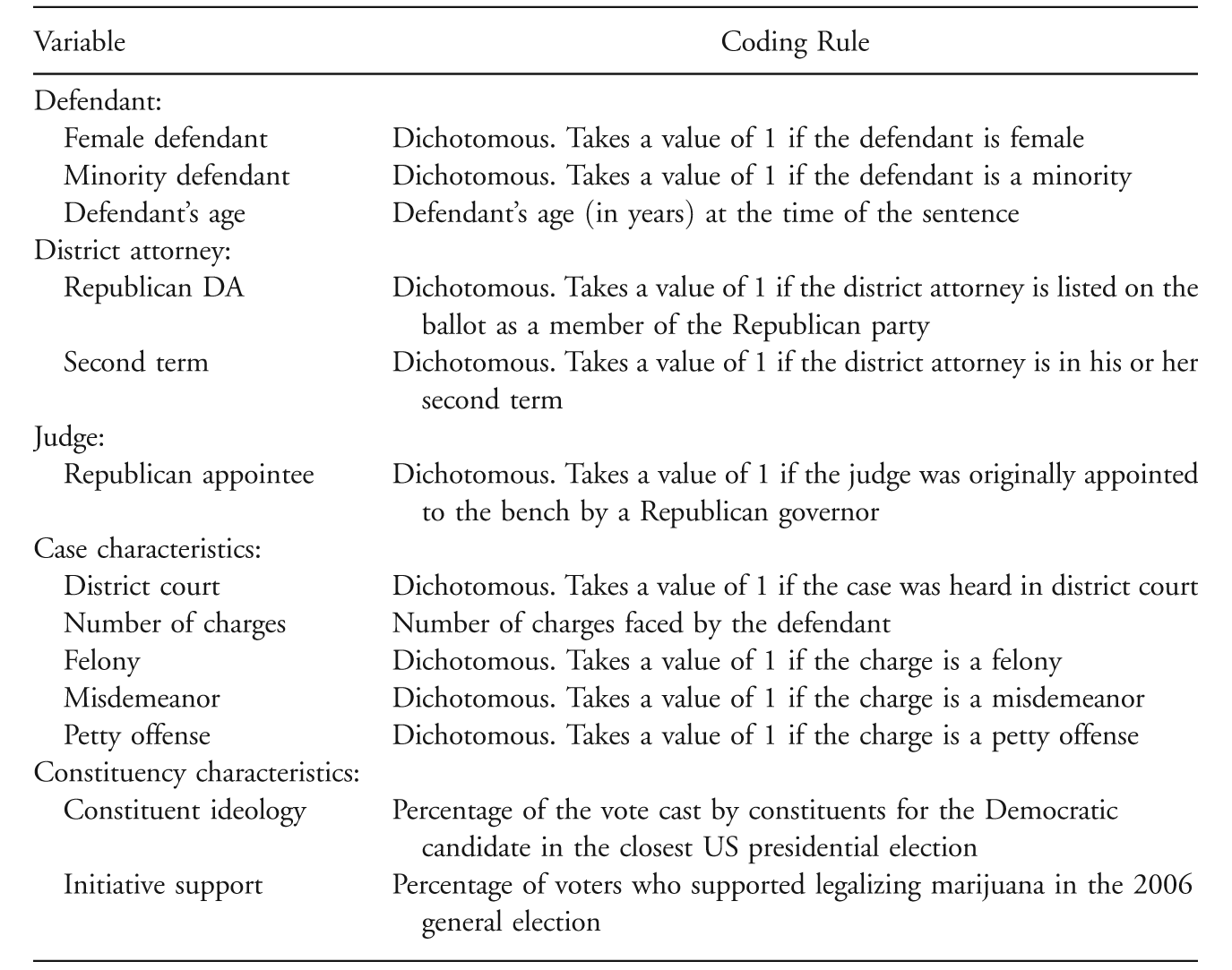
Of course, this interaction cannot account for the potentially confounding effects of the actor’s own ideology and the general ideology of constituents. What may appear to be the effect of the initiative may be due to the public’s overwhelming liberal (or conservative) tendencies or an actor’s own ideological proclivities. To eliminate these possibilities, I included the percentage of the vote won by the Democratic candidate in the closest US presidential election (constituent ideology) and another variable (Republican) to indicate whether the judge was appointed by a Republican governor or whether the prosecutor ran for office as a Republican.Footnote 14 The predictions from both variables are straightforward: judges appointed by Republican governors should sentence defendants more harshly in marijuana cases, and judges with more conservative constituencies should, likewise, sentence defendants more harshly. Likewise, Republican prosecutors should be less likely to dismiss a given charge.
Of course, legal factors should also matter; Colorado statutes place bounds on acceptable and unacceptable sentences for a given crime. To control for variation in the severity of the offense, I include indicator variables denoting whether the charge is a felony, a misdemeanor, or a petty offense. As Colorado law demands, as the severity of the charge decreases, the sentence should, on average, decrease. To further control for statutory effects, I include a variable indicating whether the case was heard in district court instead of county court. While the Colorado district and county courts have some overlapping jurisdiction, harsher cases are heard in district court, while less severe cases are heard in county court (Rottman and Strickland Reference Rottman and Strickland2006). Indeed, the mean sentence severity score for cases heard in district court in the data is 8.94, while the mean severity score for cases heard in county court is 3.89. I expect that judges give harsher sentences to defendants whose cases are heard in district court and that, due to workload considerations, prosecutors should be more apt to dismiss charges from county court.
Additionally, following the criminology literature on the potential importance of defendant characteristics in the criminal justice system (e.g., Unnever, Frazier, and Henretta Reference Unnever, Frazier and Henretta1980; Curran Reference Curran1983; Steffensmeier, Ulmer, and Kramer Reference Steffensmeier, Darrell, Ulmer and Kramer1998), I include the defendant’s age, gender, and minority status in the model, as well. I expect that younger, nonwhite, and male defendants should receive higher sentences and should be less likely to have their charges dismissed.
The empirical models concerning prosecutorial discretion contain two additional explanatory variables. First, I include a variable for the total number of charges in a case. I expect that, as the number of charges in a case rises, the likelihood that one of those charges will be dismissed also rises (after all, dismissing the only charge in a case is akin to dismissing the case entirely). Second, because term-limited individuals may behave differently once they achieve lame-duck status, I include a variable to indicate whether the district attorney is in her second term and is, because of term limits, unable to serve another term. Colorado judges are not term limited, so this variable is not necessary in the judge model.
Readers may note that the model does not contain data on the defendant’s prior criminal history. Records of the defendant’s history with the legal system are not kept by the Colorado judicial system and were, as a result, unavailable for this study. However, appendix D contains the results of a series of analyses conducted to provide evidence that the omission of this variable does not bias the empirical results presented in this article. First, the appendix shows that the empirical results discussed elsewhere hold when the analysis is restricted to those cases that are least likely to involve career criminals: the possession of less than an ounce of marijuana. Second, it is only necessary to control for a variable in an empirical model if it is correlated with both the dependent variable and the key independent variable of interest. In this article, the key independent variable of interest is the interaction between postinitiative and initiative support. Appendix D contains empirical results demonstrating that no demographic variable (gender, minority status, or age) has an effect that is different before and after the initiative.
Given that some aspects of cases, such as the charge and characteristics of the defendant, are specific only to the case at hand while others (e.g., the judge’s or district attorney’s response to public opinion and her party affiliation) are characteristics of the political actor, the data exist at multiple levels of analysis. To appropriately model effects at different levels of analysis while correctly partitioning the variance explained by each level, I estimated multilevel models containing random effects for both the judge (or district attorney) who decided the case (or had the opportunity to dismiss the charge) and the district in which she works (Gelman and Hill Reference Gelman, Andrew and Hill2007).Footnote 15 As such, in addition to modeling the effect of public opinion at the correct unit of analysis, these models can account for sentencing tendencies that are common among judges (or district attorneys) in the same judicial district while simultaneously accounting for individual judges’ (or district attorneys’) tendencies to be more or less lenient than the average judge.
Results and Discussion
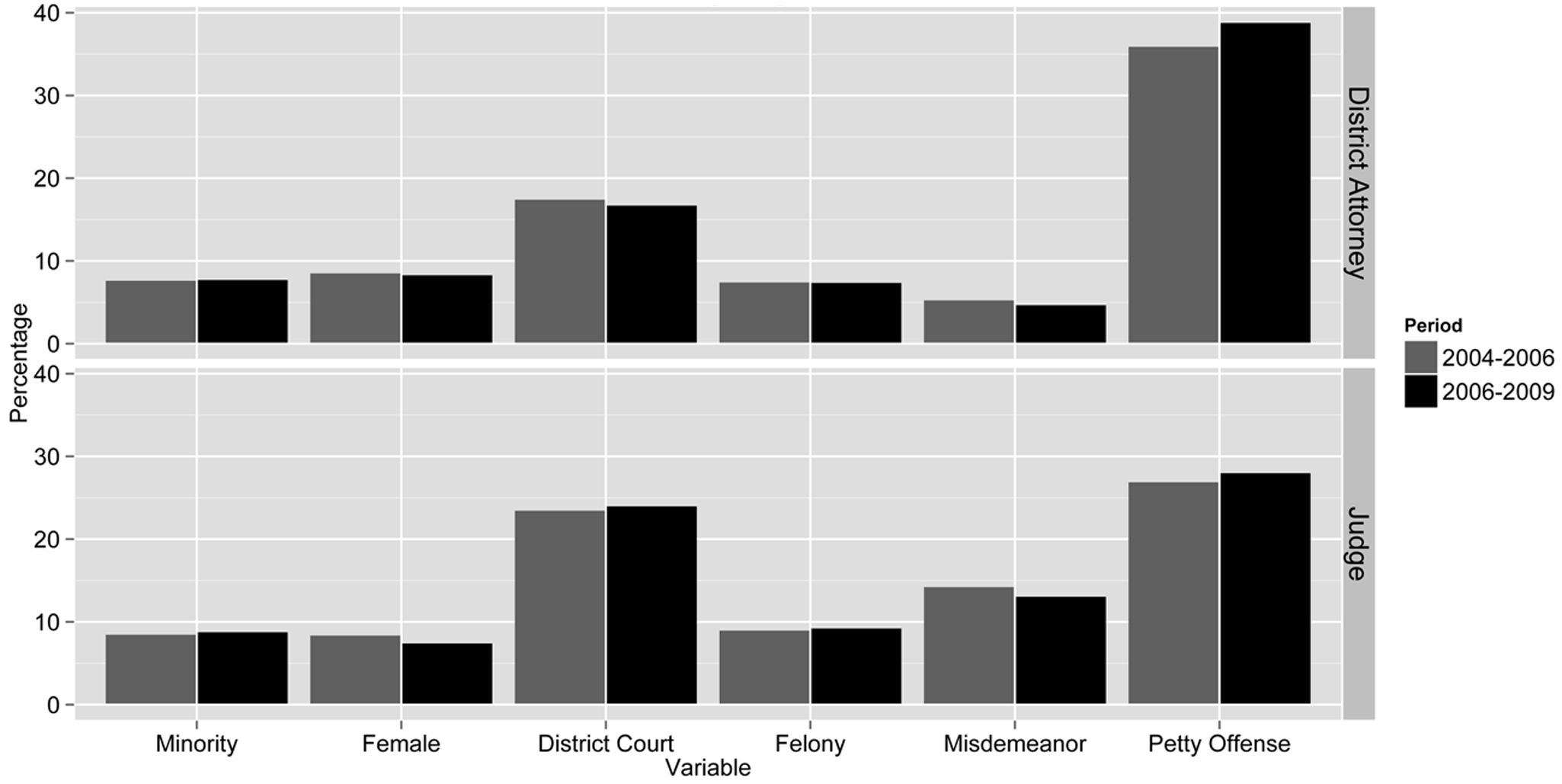
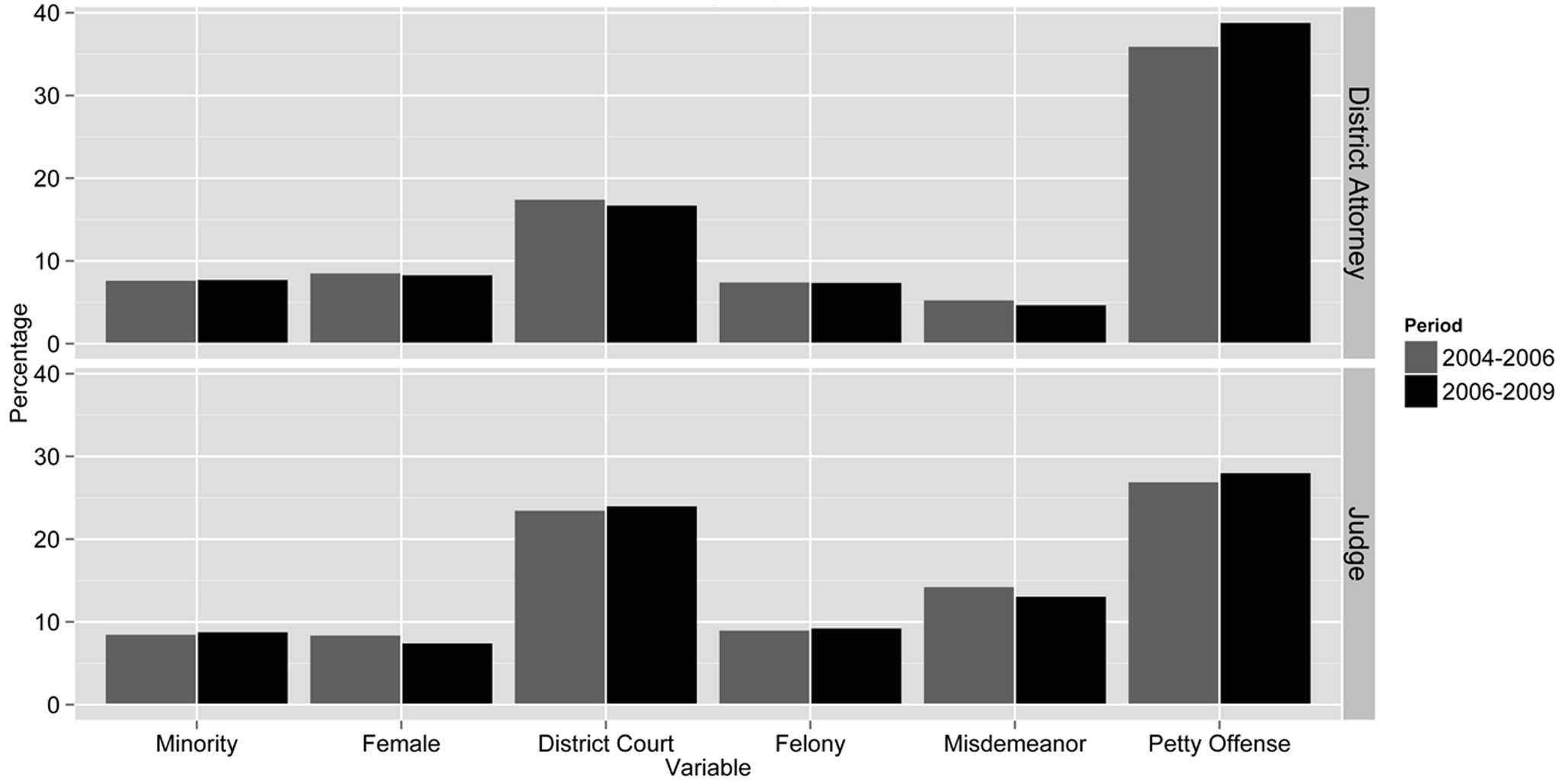
Before discussing the results of the multivariate models, it is essential to establish that the pools of cases are the same in both time periods. After all, if the pools of cases heard before and after the initiative are substantially different, then what appears to be responsiveness to the initiative may be merely a response to the differing pools of cases. Figure 2 displays summary statistics of the full set of cases dealt with by district attorneys (in the top panel of the figure) and judges (the bottom panel) in the three calendar years before and after the initiative. As the figure indicates, there were no substantive differences in the types of cases decided by the prosecutors or judges with regard to the characteristics of the defendants or the severity of the charges. The largest difference is in the percentage of petty offenses heard by prosecutors after the initiative, although the difference is still a slight one.
Distribution of case facts in marijuana cases decided in the three calendar years before and after the initiative
Prosecutorial Discretion
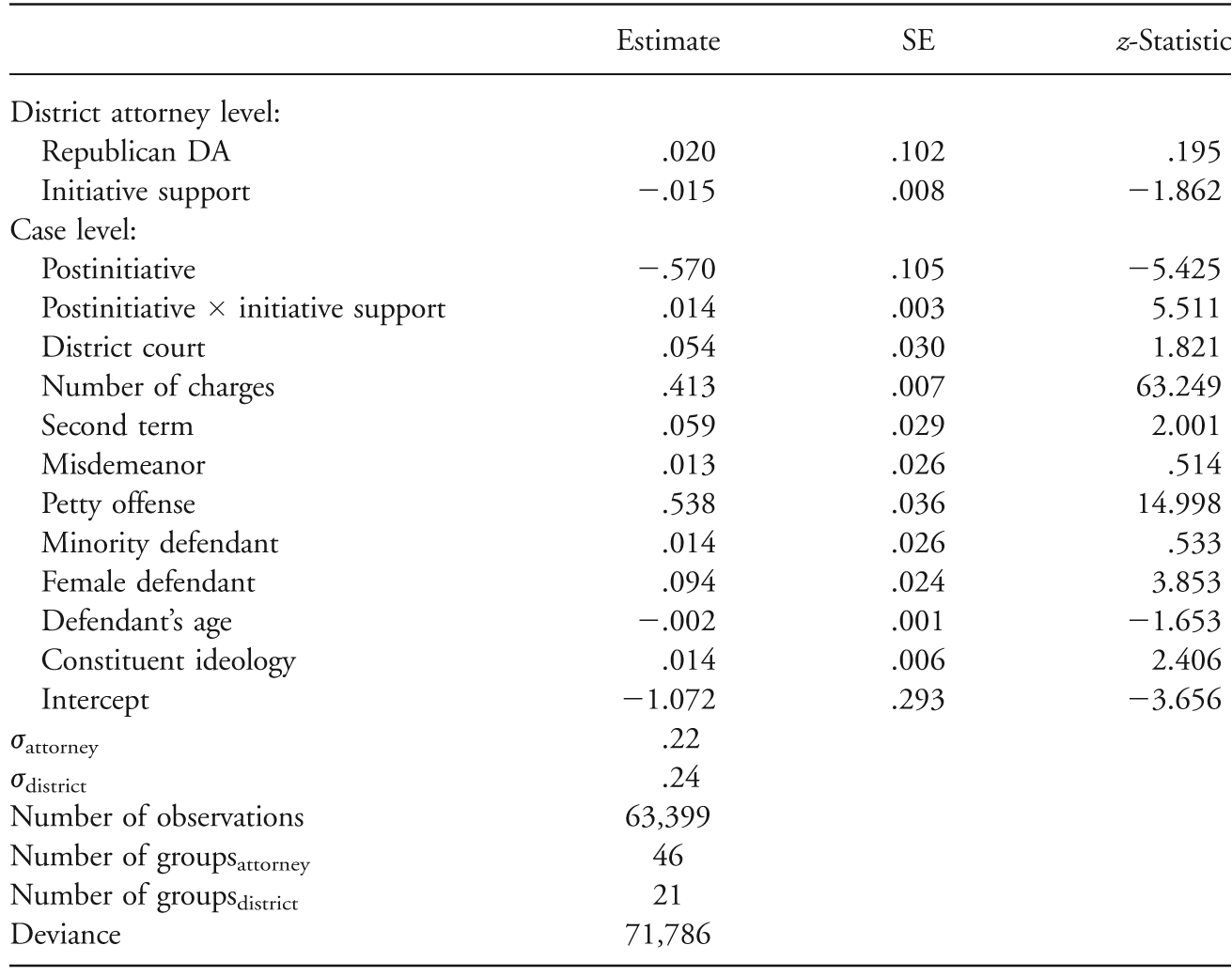
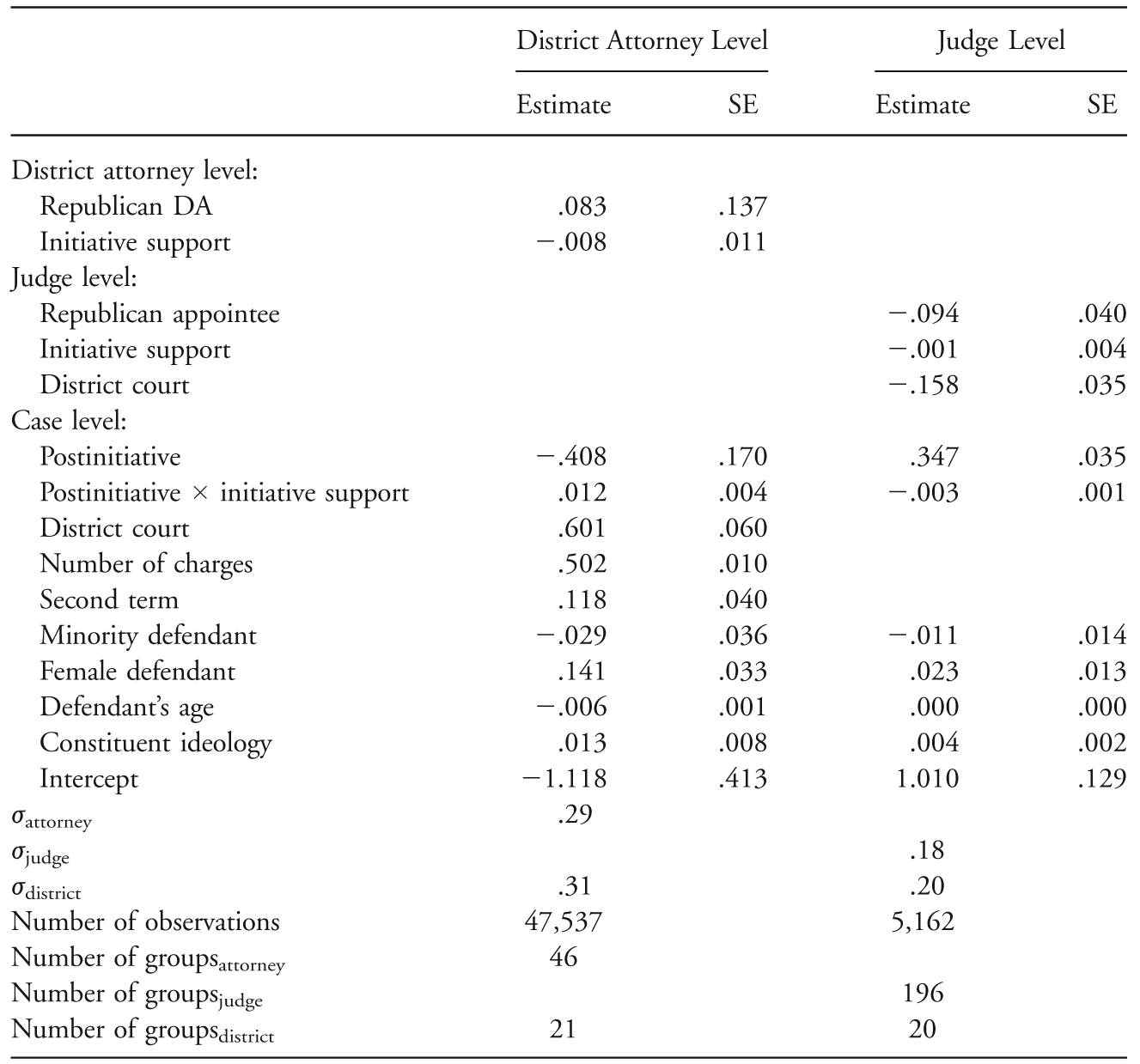
Table 1 presents the results of the multilevel logistic regression model examining the decision of district attorneys to dismiss cases.Footnote 16 To assess the effects of the initiative, we need to look at three coefficients in table 1: initiative support, postinitiative, and the interaction term. However, because this is not a simple linear model, the coefficients given in the table do not provide enough information to determine whether prosecutors changed their behavior after the initiative.
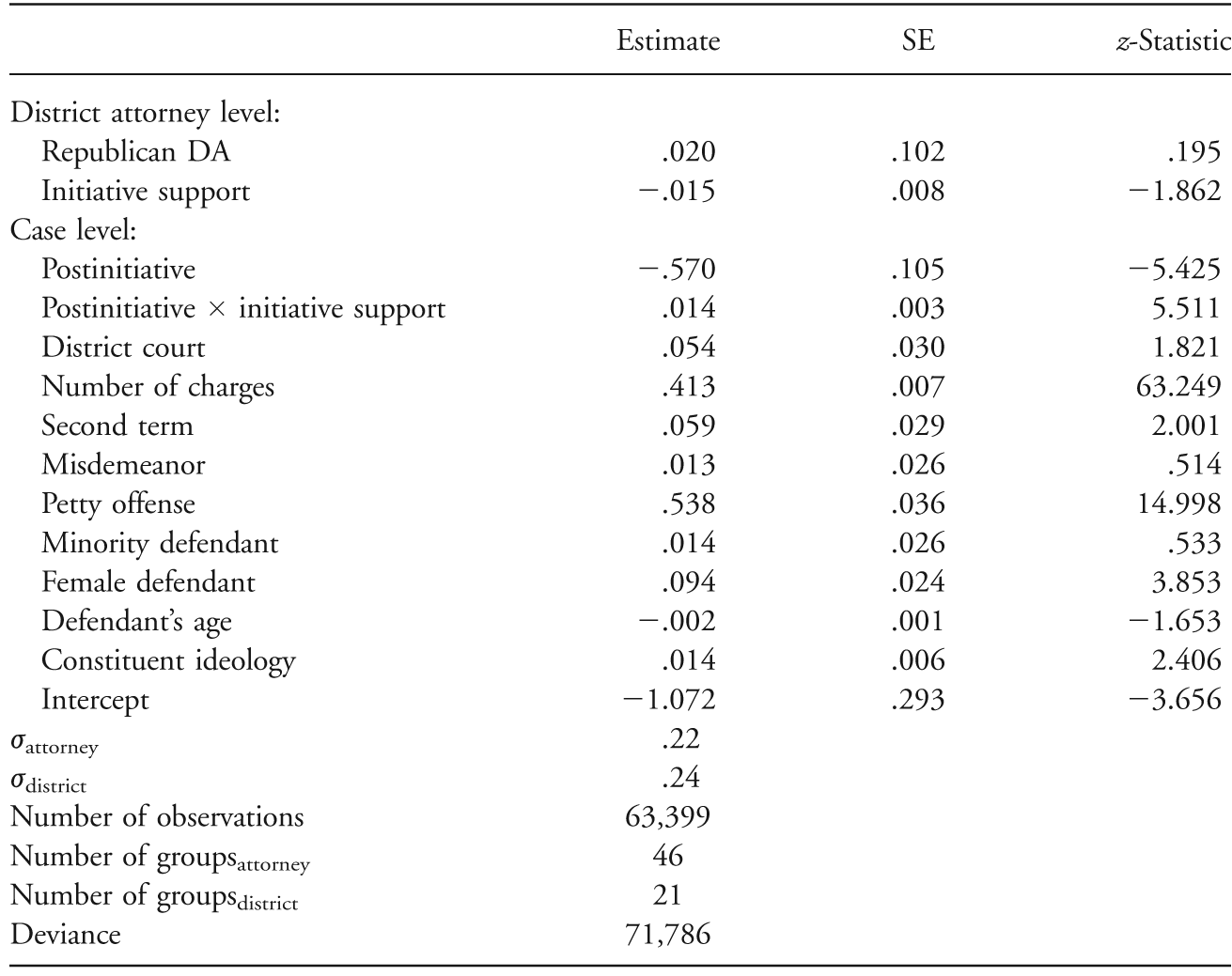
Note—Outcome variable indicates whether the district attorney dismissed a charge. Model includes random effects for district attorney and the district in which he or she works. Felonies are the baseline for charge severity.
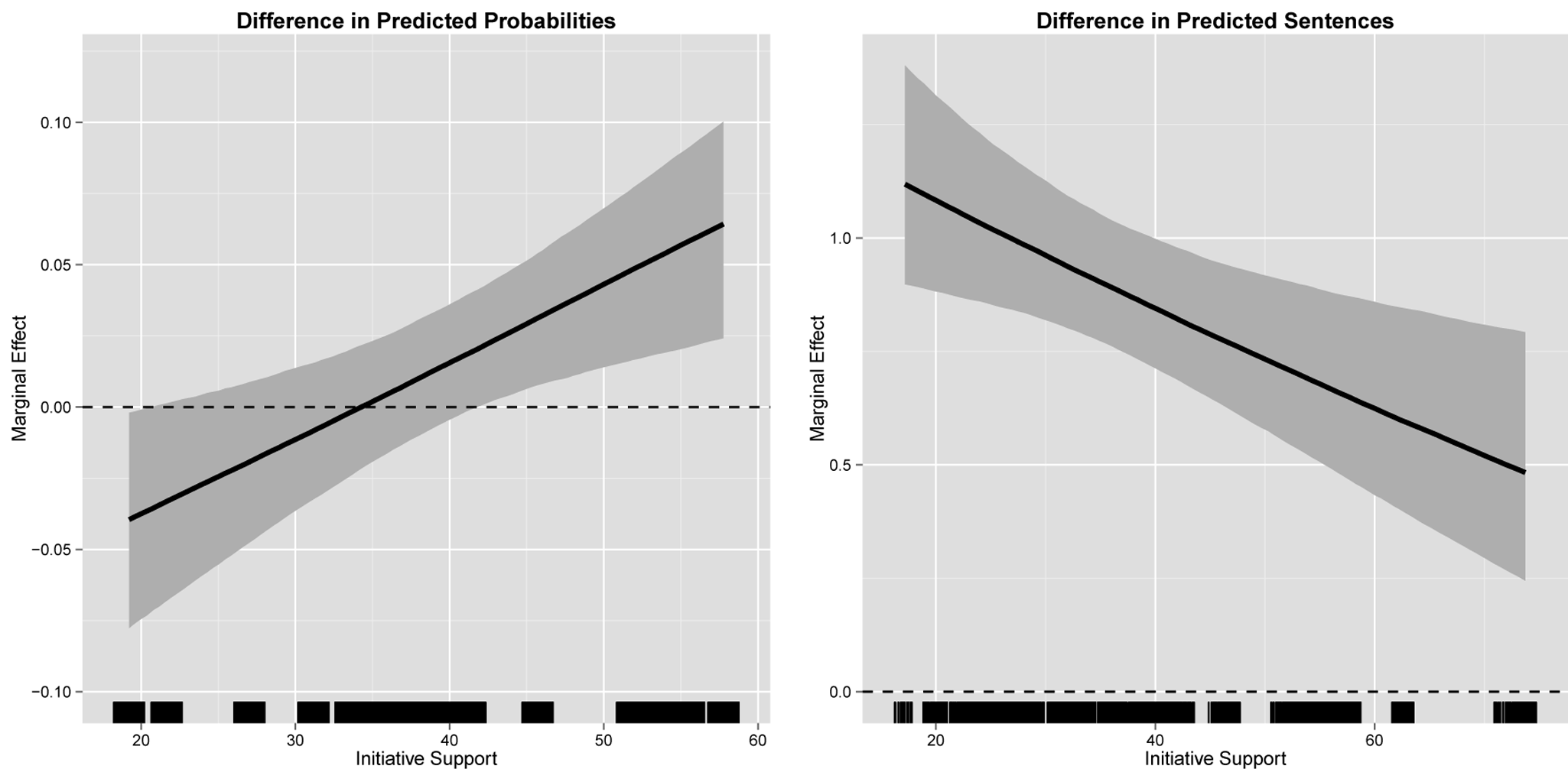
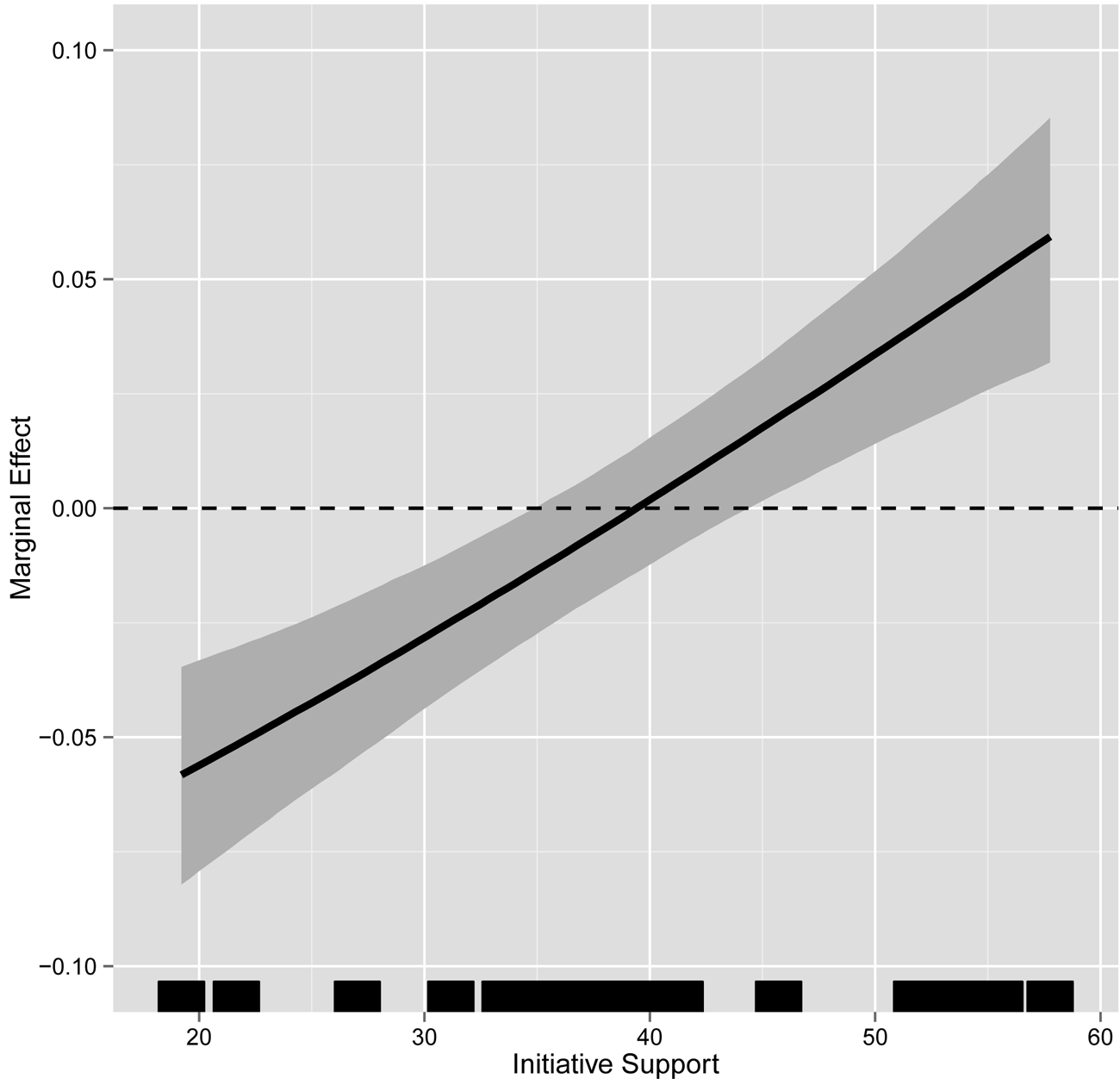
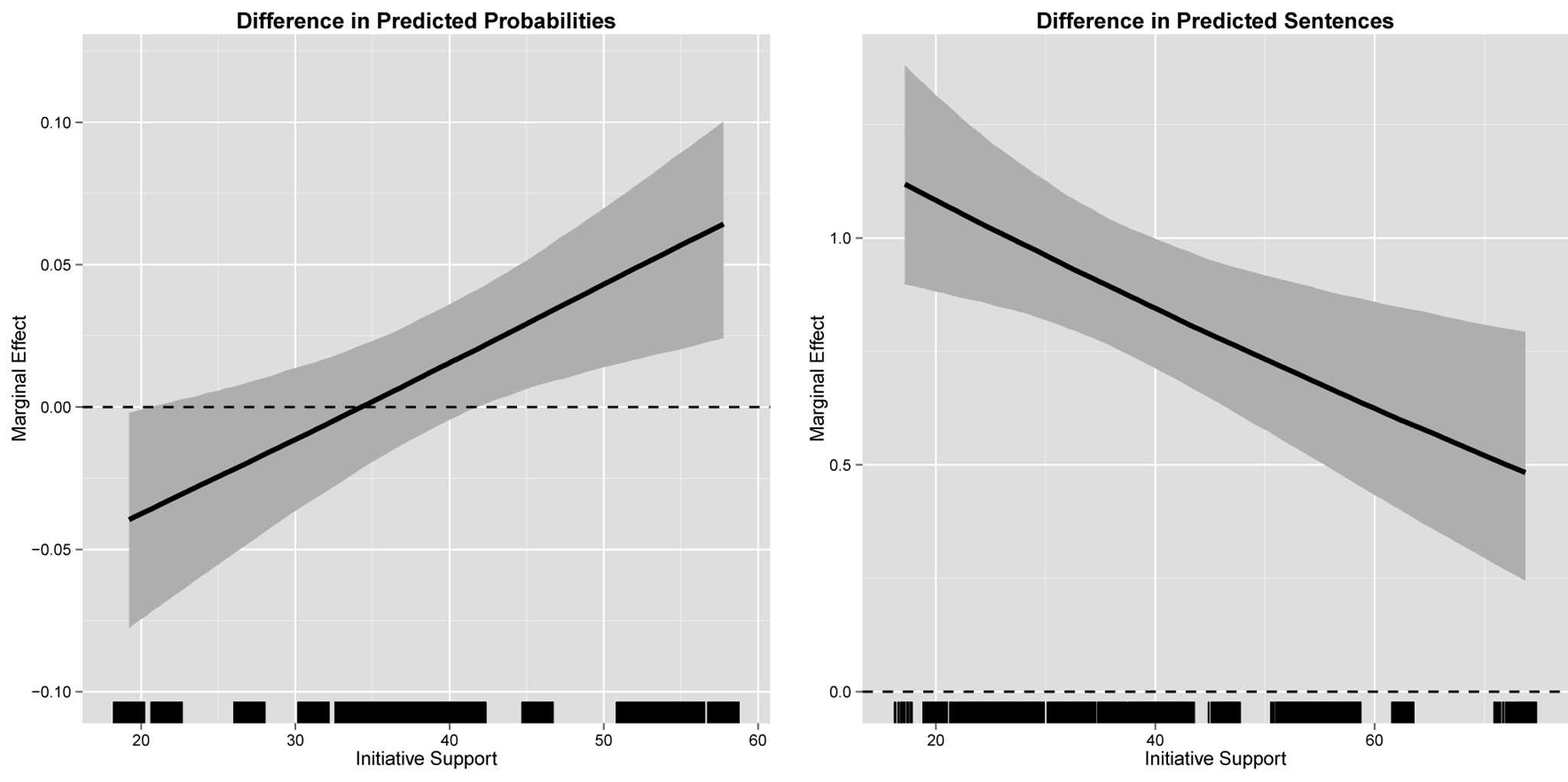
To this end, we look at figure 3 to examine how the initiative vote affected the behavior of district attorneys. This figure shows the difference in the predicted probability that a charge is dismissed between the two time periods; the figure was computed holding all variables at their mean (or modal) values. Positive values of the solid line, thus, indicate that district attorneys became more likely to dismiss charges after the initiative vote, while negative values indicate that they became less likely to dismiss a given charge. The X-axis in the figure is initiative support—the views of a prosecutor’s geographic constituents on the initiative, where higher values indicate more support for the legalization of marijuana.
Difference in predicted probabilities pre- and postinitiative. Values are simulated holding all others at their modal (for categorical variables) or mean values (for continuous variables). Solid line represents the expected difference for petty offenses. As the value of the X-axis increases, constituents’ support for the legalization of marijuana rises. Rug at the bottom illustrates the distribution of cases according to constituents’ level of support for the initiative.
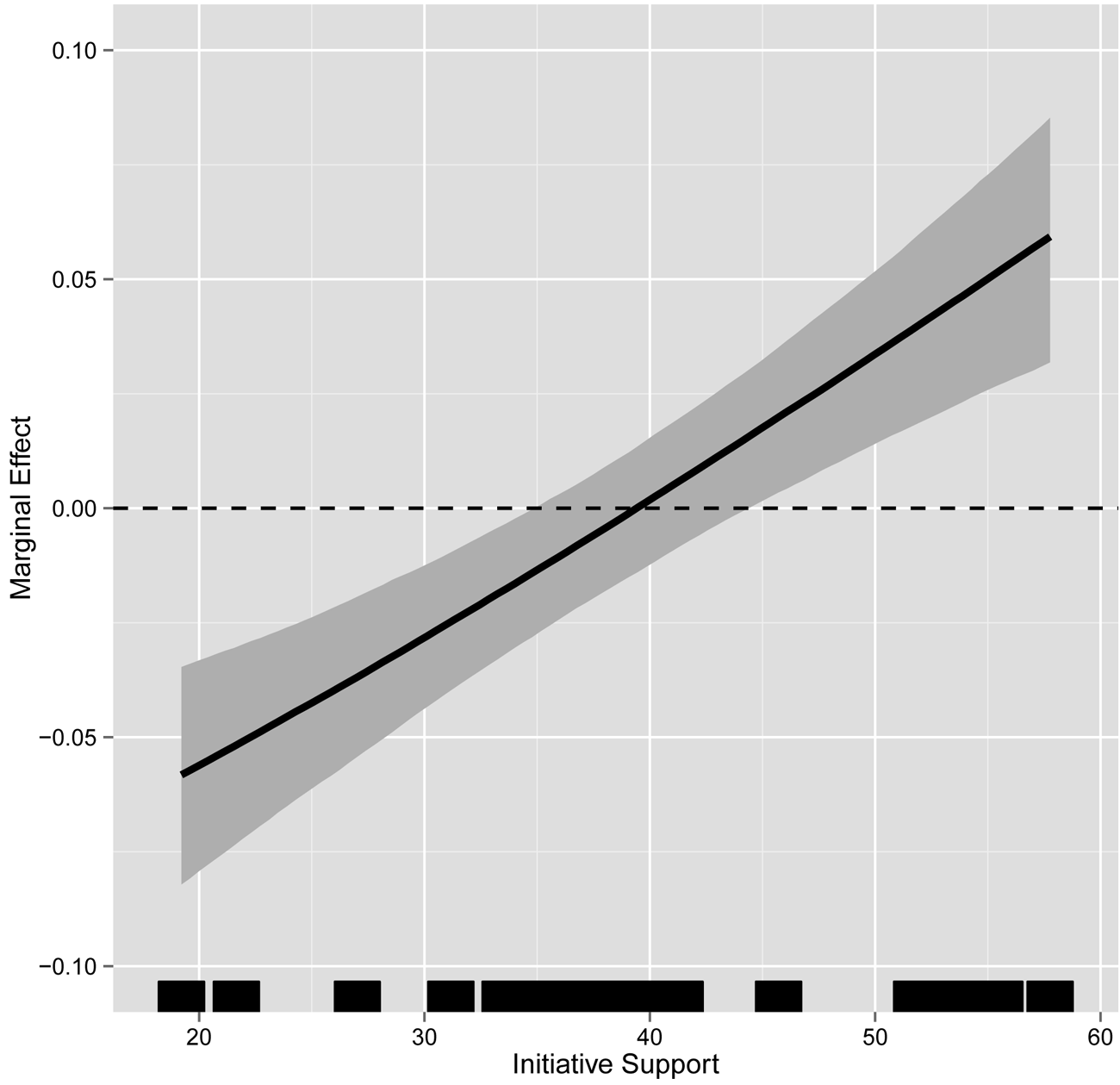
The results strongly suggest that the initiative is associated with a significant change in the behavior of district attorneys. If district attorneys respond to local-level opinion, as support for marijuana legalization increases, district attorneys should be more likely to dismiss charges. This is exactly the story shown in figure 3. When initiative support is low (and constituents therefore were not supportive of the legalization of marijuana), the difference in the predicted probabilities between the two time periods is negative. This indicates that district attorneys in jurisdictions with low support for marijuana legalization became less likely to dismiss a given charge after they saw their constituents’ opinions on marijuana legalization, ceteris paribus.
Conversely, figure 3 shows that, in areas of high support for marijuana legalization, the difference in predicted probabilities effect is positive. This indicates that district attorneys whose constituents support the legalization of marijuana became more likely to dismiss a given charge after the initiative. This effect is substantively meaningful. As figure 3 shows, for some districts, this effect results in nearly a 6% difference in the probability that a case will be dismissed. In short, the conclusions from figure 3 suggest that district attorneys exhibited a statistically significant change in behavior in line with constituent preferences after the initiative.Footnote 17
Having established that prosecutors were responsive to local-level opinion, we turn now to the question of responsiveness to statewide opinion. Recall that responsiveness to statewide opinion would be denoted by a finding that, regardless of their constituent’s position on the initiative, district attorneys would be less likely to dismiss a given charge. In figure 3, that would be indicated by a line that stays below zero for all levels of initiative support. This is not the pattern we observe in the figure. Indeed, as expected given the fact that a prosecutor’s most likely future job is a local-level law firm or judgeship, district attorneys appear to primarily respond to local-level opinion.
The model results also provide insight about the other factors that influence a district attorney’s decision to dismiss a charge. The results indicate that, as the number of charges facing a defendant increases, the probability that one of those charges will be dismissed increases. Additionally, the model indicates that lame-duck district attorneys (those in their second term) are more likely to dismiss a given charge. Finally, examining the characteristics of the defendant included in the model, only the defendant’s gender has a statistically reliable effect; charges facing female defendants are more likely to be dismissed.
In conclusion, this analysis suggests that district attorneys were primarily responsive to local- rather than state-level public opinion. District attorneys in liberal areas behaved more leniently after the initiative, while prosecutors in conservative areas acted more harshly after the initiative. But what effects did the availability of new information have on the decisions of Colorado judges? We next turn to the results regarding judicial sentencing behavior.
Judicial Sentences
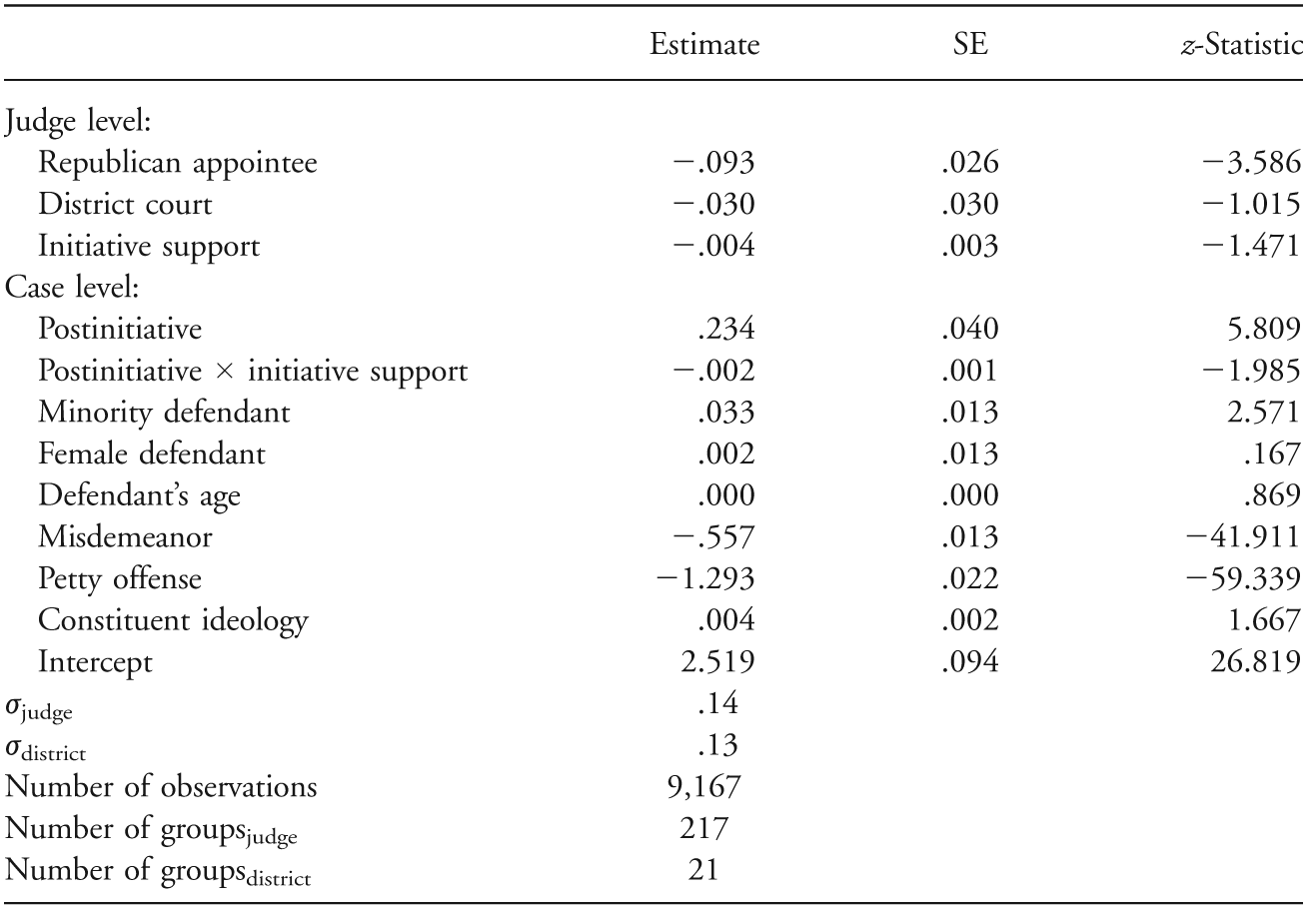
Table 2 displays the results of the multilevel negative binomial model.Footnote 18 Note that the estimated coefficients for the severity of the case indicate that, as required by law, the severity of a sentence decreases with the severity of a crime; defendants who committed misdemeanors and petty offenses received lighter sentences than those who committed felonies. After controlling for the severity of the case, the model indicates that district court judges are not more severe than their counterparts in county court.
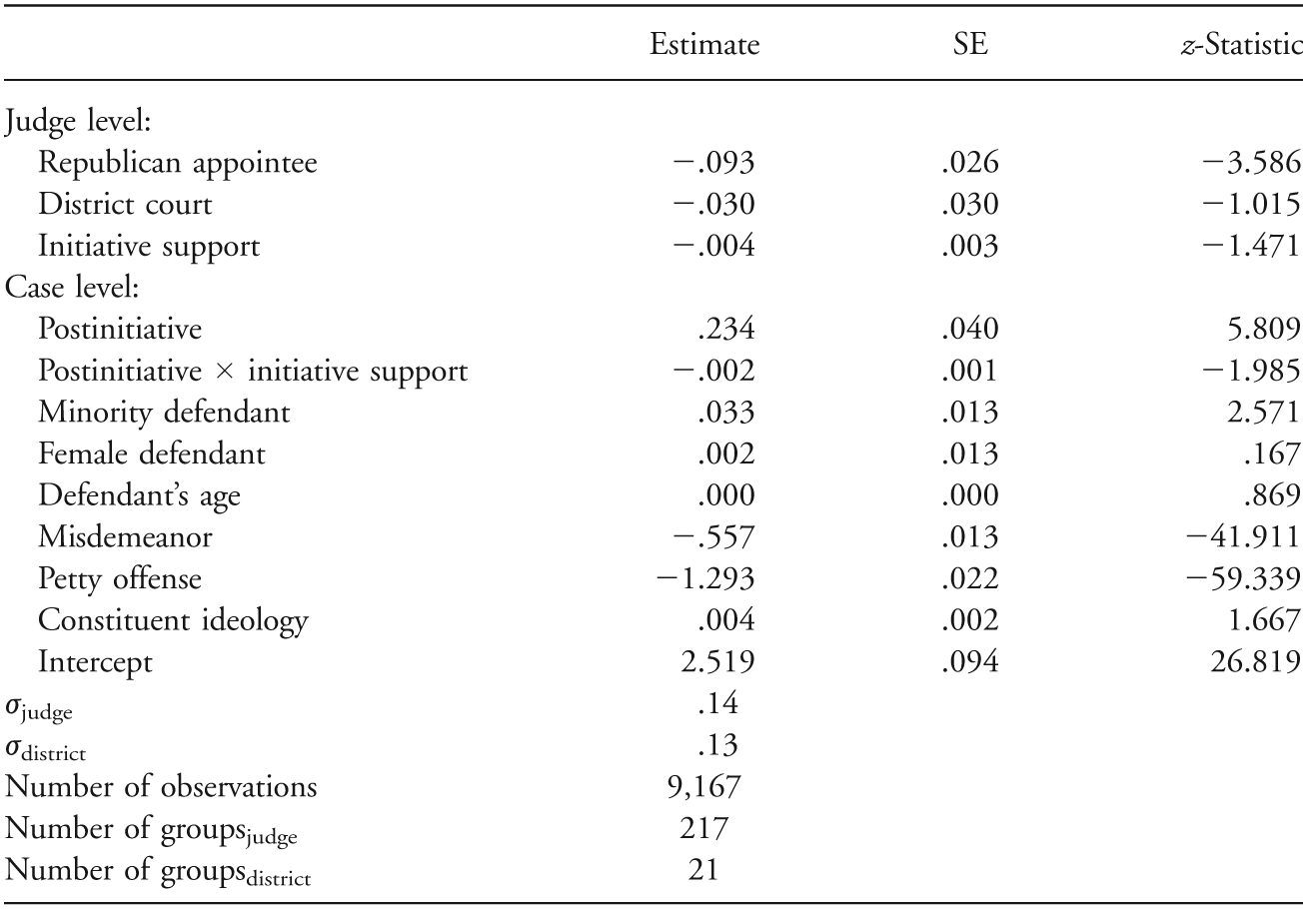
Note—Data include only those judges who sentenced defendants both before and after the initiative. Outcome variable is the scaled sentence given to the defendant. Model includes random effects for judges and districts. Felonies are the baseline category for charge severity.
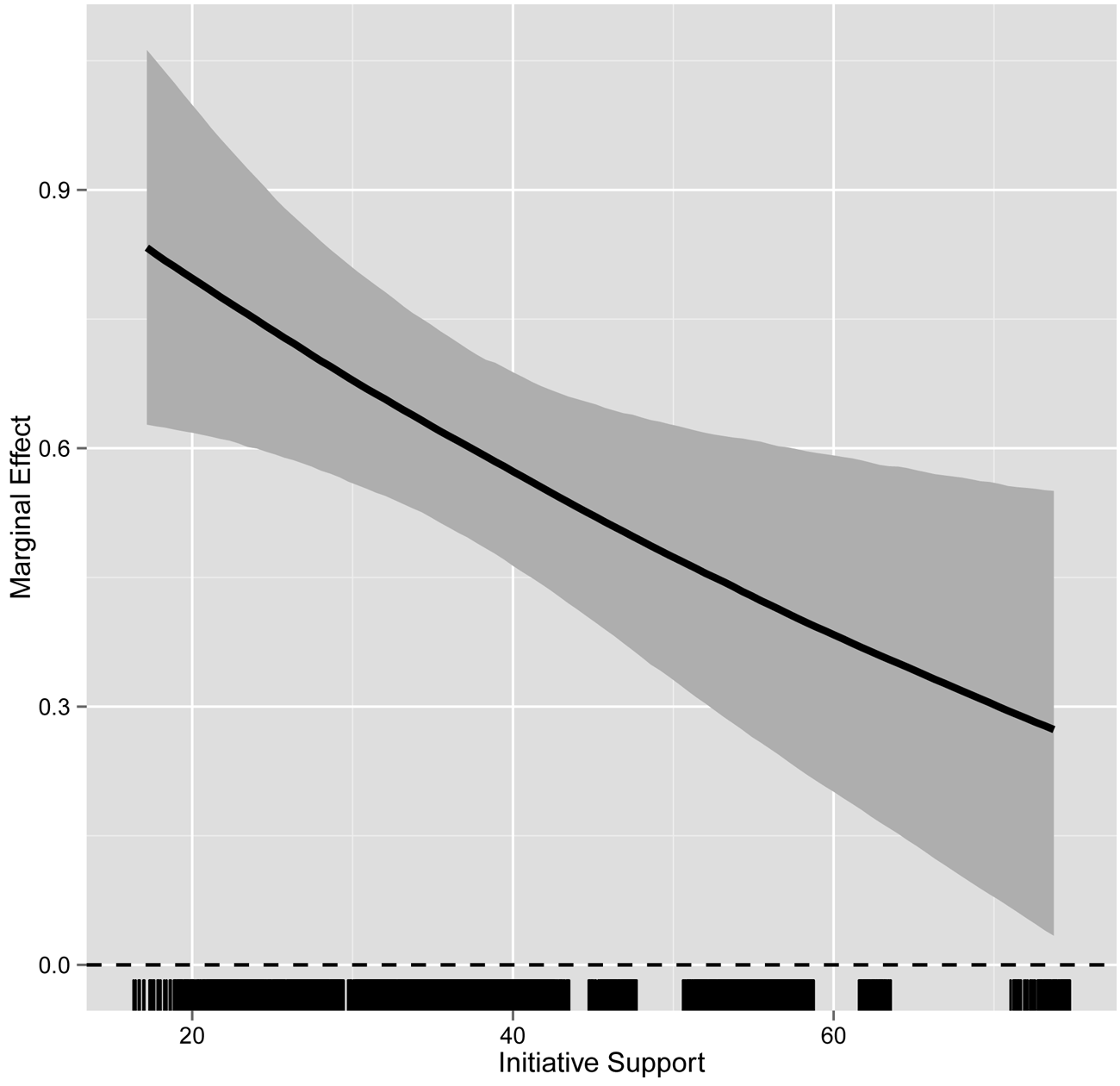
To assess judges’ responsiveness to the initiative, we again turn to the effect of the interaction term. Although the interaction term is significant, the effect is easiest to understand when visualized. Figure 4 plots the difference in predicted sentences after the initiative compared to the expected sentence before the initiative across the range of initiative support. Recall that higher values of initiative support indicate a higher support for the legalization of marijuana, while lower values indicate a more conservative view of the legalization of marijuana. In the figure, the solid line plots the expected difference in the sentence given to a defendant convicted of a petty offense after the initiative vote compared to what sentence he would have received before the vote. Positive values of the marginal effect indicate that judges sentenced more severely after the initiative than they did before the initiative. Higher values of the solid line represent a larger change in expected sentences after the initiative when compared to the period before the initiative.
Difference in predicted sentences. Marginal effect of a case being decided after the initiative. Values are simulated holding all others at their modal (for categorical variables) or mean values (for continuous variables). Solid line represents the expected difference for petty offenses. As the value of the X-axis increases, constituents’ support for the legalization of marijuana rises. Rug at the bottom illustrates the distribution of cases according to constituents’ level of support for the initiative.
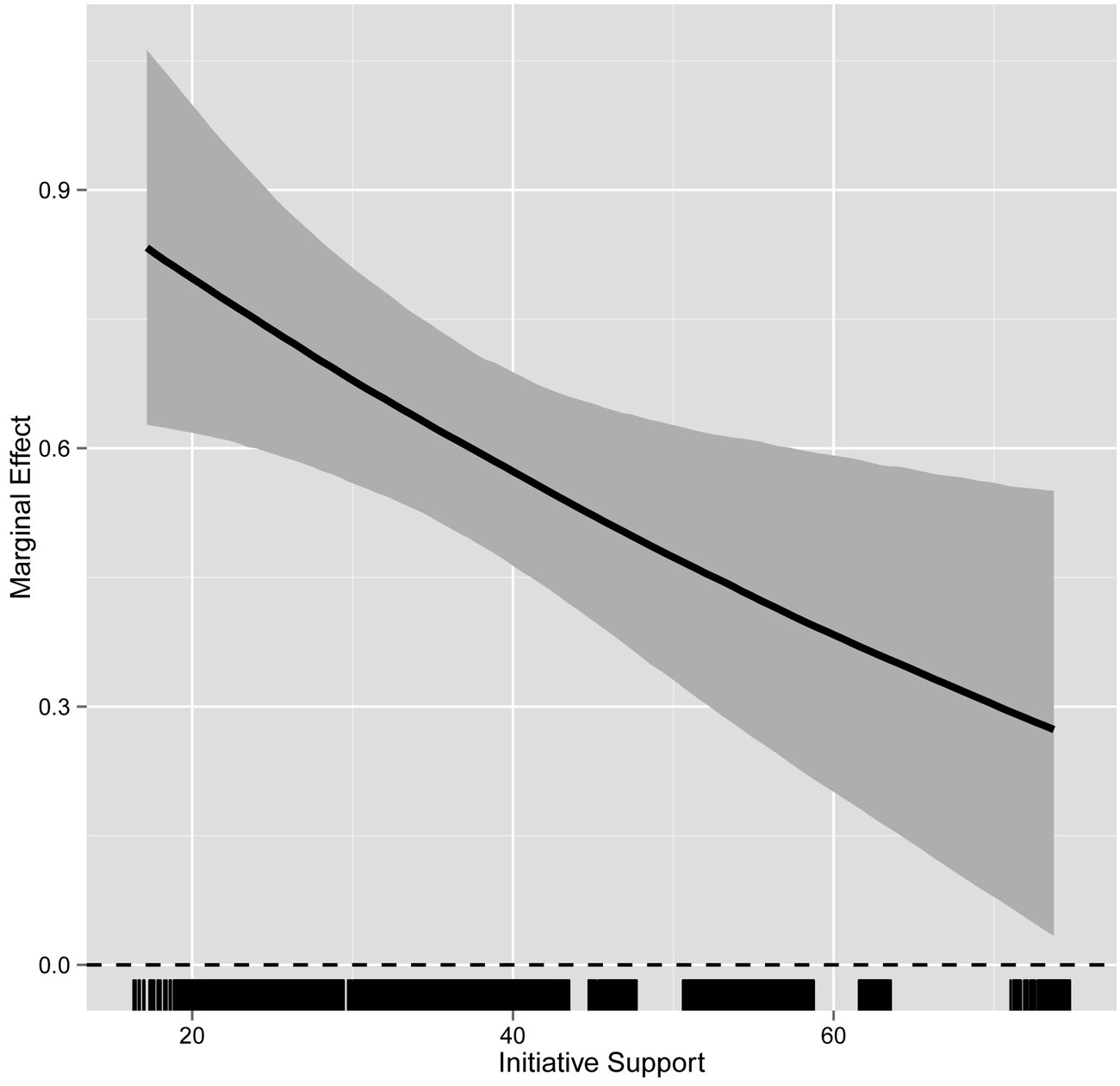
As figure 4 shows, judicial behavior underwent a statistically significant change after the initiative. Plotting the difference in expected sentences between the two periods across the observed values of initiative support, figure 4 shows that, regardless of their constituents’ position on the initiative, judges responded to the Colorado electorate’s unwillingness to legalize marijuana; the figure illustrates that judges exhibited a statistically significant change in sentencing behavior toward harsher sentences after the initiative. This across-the-board shift is evidence of a responsiveness to statewide opinion.
Still, there is also evidence that judges simultaneously responded to local-level public opinion, as the extent of the observed responsiveness is not constant across judges. The negative slope of the marginal effect indicates that, as constituents’ support for the legalization of marijuana increases, judges become increasingly lenient. Additionally, while not readily apparent from table 2, initiative support became a statistically reliable predictor of sentencing after the initiative. The coefficient is −0.006 with a standard error of 0.003 (z-statistic = −2.113). Thus, after the initiative, it appears that judges responded to both local and statewide opinion. Among judges, the general tendency was to sentence defendants more severely after the failed initiative (statewide responsiveness), although the effect size diminishes among judges whose constituents were more supportive of the initiative (indicating local responsiveness).
How meaningful is the effect of constituent support for marijuana legalization on the sentences handed down by judges? When discussing the substantive size of these results, one must remember that there are statutory limits on judicial discretion; obviously, a judge cannot give a defendant a lifelong prison sentence for a single charge of less than an ounce of marijuana. Rather, the variation allowed in these sentences (particularly those for the petty offenses that comprise the plurality of the charges), by law, is very small. Thus, while the numerical size of the coefficients presented in table 2 may appear small, one must remember that the magnitudes are a function of the scaling of the dependent variable.
The effects are substantively important. For the least severe cases in the data set—petty offenses—the expected difference between the two time periods is small; the expected difference in a sentence amounts to up to an additional year of supervised probation. The estimated size of this effect represents a change from the lowest legally allowable sentence to the maximum allowable sentence under Colorado law. For misdemeanors, the expected sentence amounts to about an extra 2 years of supervised probation or an extra 1 or 2 months in prison. For felonies, the difference in the sentence amounts to about an additional 4 or 5 months in prison. However, given the sheer number of cases in the data, the substantive effect of these harsher sentences is marked; while the effect size is relatively small for each case, both the costs to the state of Colorado (in terms of housing inmates in prison and the number of probation officers necessary to meet with the additional inmates placed on probation) and the potential benefits (in terms of the fines collected by the state) magnify quickly given the thousands of cases in the data.
Selection Effects
Readers may be concerned that the conclusions drawn from the empirical analyses are artifacts of a selection effect. In this section, I deal with two possible objections. First, one may be concerned about the possibility that police also responded to the initiative. Second, one may worry that the responsiveness result for judges is driven by a selection effect caused by the fact that district attorneys also changed their behavior after the initiative. I deal with each objection in turn.
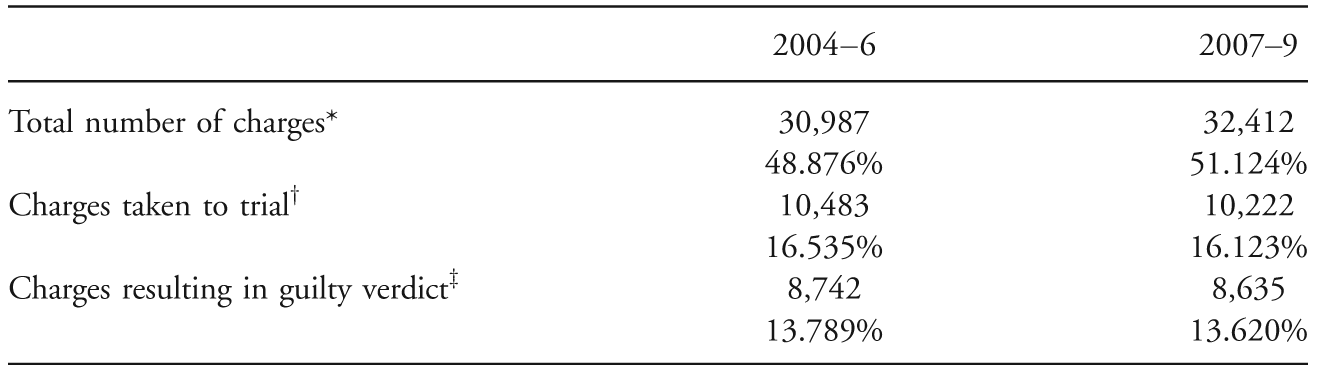
Readers may be concerned that police responded to public opinion strategically, thereby filtering the cases heard by prosecutors and, eventually, by judges. While individual-level policing statistics (that would be desirable out of a concern for ecological inference) are simply unavailable, the summary statistics presented in table 3 provide some relief. Indeed, if, for some reason, police either systematically increased or decreased their rates of arrest after the initiative in a manner correlated with public opinion, then the total number of charges seen in the two time periods would be different. Yet, of the over 60,000 cases in the data set, there is a difference of only 1,425 charges (about 2% of the charges) filed between the two time periods. The data contain no evidence that the initiative results led to a rash of new filings based on the public’s rejection of the initiative; rather, the number of charges in both time periods appears to be remarkably stable.
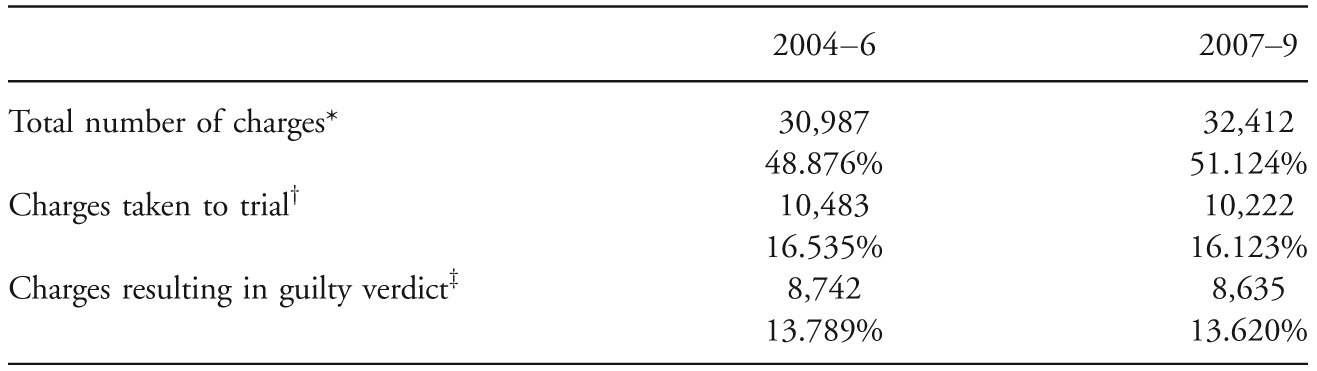
Note—Percentages indicate the portion of the total number of charges in the data; N = 63,399.
* Total number of charges in each time period.
† Cases in which the defendant was acquitted, was found guilty, or pled no contest; a sentence was deferred; or the charge was listed as proven or not proven.
‡ Cases in which the defendant was found guilty of the offense for which he was charged.
Having seen that the initiative affected the behavior of both judges and district attorneys in Colorado, we now examine the extent to which the responsiveness of district attorneys to public opinion has downstream (and potentially biasing) effects on judicial decision making. To address this issue, we return to table 3, which demonstrates that the overall rate of charges filed, charges taken to trial, and charges that resulted in a guilty verdict remained the same over time. Indeed, the number of charges at each stage of the judicial process has remained remarkably stable across time periods. There is no evidence of a potentially biasing shift in the number of charges taken to trial in either period or in the results of those prosecutions, as measured by prosecutor’s win rates.
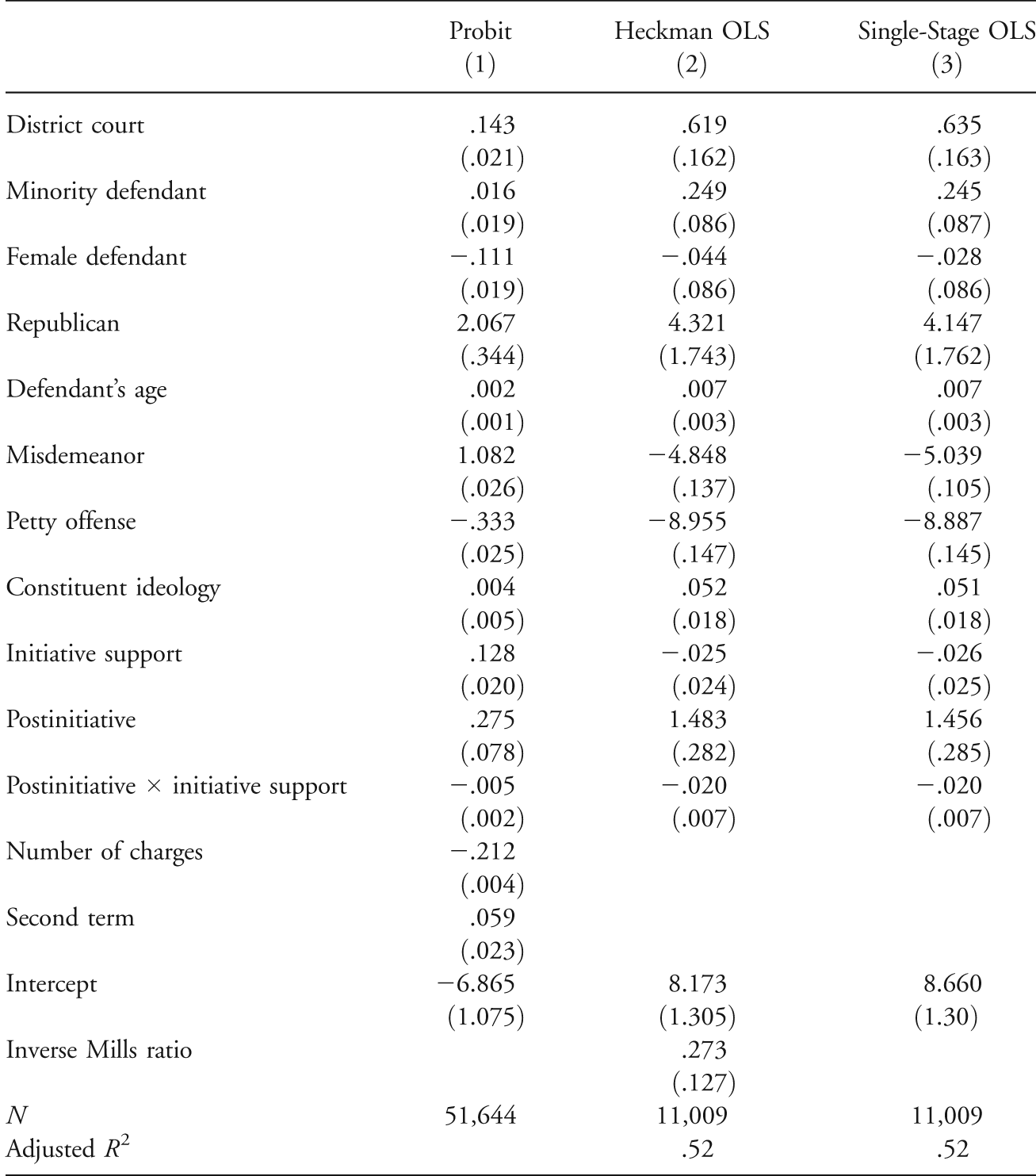
Additionally, I estimated a Heckman selection model to address the possibility that a selection process is at work (Heckman 1979). In a Heckman selection model, the probability that an observation will advance to the second stage is estimated using a probit model, and the probability of inclusion is added to the second-stage linear model as another covariate. In this case, the probability that a charge is not dismissed is estimated in the district attorney model (the first-stage probit) and included in the sentencing model (the second-stage linear model). Appendix B provides the full results of the selection model along with additional information about the estimation.
Although not presented here, the model results provide little evidence that the finding that judges responded to public opinion is driven by prior responsiveness to public opinion on the part of prosecutors. While the inverse Mills ratio is statistically significant, indicating the presence of a statistically discernible selection effect, neither the estimated coefficients nor their marginal effects differ in any discernible way in the Heckman selection model as they do in a standard single-stage model. Thus, the model indicates the statistical presence of a selection effect, although the substantive impact of that effect is negligible, at best.
Discussion and Conclusion
In short, these results indicate that the 2006 initiative is associated with an important shift in prosecutorial and judicial behavior toward the will of the people. Both judges and prosecutors exhibited responsiveness to the results of the initiative that put their dismissal decisions more in line with the will of their constituents. Moreover, the results of a series of analyses, including a selection model, indicate that, while a statistically significant selection effect existed between the dismissal decisions of the prosecutors and the sentences issued by judges, there is no evidence to suggest that a failure to account for prosecutorial discretion would have had any effect on the substantive conclusions one could draw about the effect of public opinion on judicial behavior.
Moreover, while both judges and district attorneys in Colorado respond directly to public opinion, they respond to different “publics.” Indeed, while district attorneys sentenced in proportion to their geographic constituents’ wishes (becoming less likely to dismiss a given charge in areas where constituents do not favor the legalization of marijuana and more likely to dismiss a given charge in areas where constituents are likely to support the legalization of marijuana), judges, across all levels of support for the legalization of marijuana, began to sentence defendants more harshly, which is expected given judges’ concern for career advancement and Colorado voters’ collective rejection of the ballot measure. However, this responsiveness was not the same across all judges; the difference in the magnitude of the responsiveness across different levels of local constituency opinion suggests that judges’ sentences also responded to local public opinion.
Because they examine only a single state and a single issue area, care must be taken when generalizing from these findings, yet these results, taken in tandem with Kuklinski and Stanga (Reference Kuklinski and Stanga1979), Traut and Emmert (Reference Traut and Emmert1998), Huber and Gordon (Reference Huber and Gordon2004), and Canes-Wrone et al. (Reference Canes-Wrone and Clark2012), indicate that judges selected through appointment and retained through periodic retention elections respond to issue-specific public preferences. Yet, it is clear that information about constituent preferences is essential; before the initiative, there was no evidence that judges’ decisions were affected by public opinion. Public opinion became a reliable predictor of sentencing only after judges received information about constituent preferences. These results suggest that access to information is a crucial precursor to judges’ abilities to respond to public opinion. Whereas legislators have myriad ways to gauge constituent preferences, judges traditionally do not have access to those resources. If one wishes one’s judges to be more responsive to public opinion, these results would suggest that one seek to develop new ways for judges to learn about public preferences.
These results also have important implications for the debate about the effects of judicial elections on the balance between judicial independence and judicial accountability. Bonneau and Hall (Reference Bonneau and Gann Hall2009) have written that “accountability is ‘a product of electoral competition, produced by the willingness of challengers to enter the electoral arena and the propensity of the electorate not to give their full support to incumbents’” (78; emphasis added). These results challenge that argument; they suggest that candidate competition is not a necessary precondition to judicial accountability; judges’ decisions may reflect the public will if they merely face retention elections and have good quality information about constituent preferences. If one component of judicial accountability is a predisposition to decide cases in a manner that comports with majority will, it appears that Colorado judges respond to issue-specific public opinion even though they face a very low probability of defeat on election day, particularly when they have good information about constituent preferences. In this way, the results indicate that judicial elections may induce even lower-court judges deciding routine cases to heed public opinion.
These findings suggest that future work needs to examine the conditions under which various methods of selection, retention, and retirement alter the representative nature of judicial institutions. By understanding the conditions under which the institutions that regulate who becomes a judge, how judges retain their seats, and when (or if) judges are required to leave the bench affect judges’ propensities to respond to public opinion, scholars will gain a clearer picture of the role that courts play in the larger political environment. By comparing and contrasting the effects of these institutions on judges with the effects that these institutions have on legislators, governors, and bureaucrats, scholars can begin to build more nuanced theories to explain, generally, under what conditions these rules affect the ability of American federal, state, and local government to represent the will of the people.
Moreover, future scholarship should explain how judges learn about public opinion and under what conditions the public’s signal is strong enough to entice judges to heed the public will. The high level of voter turnout and wide range of public support made the Colorado initiative a very strong signal for judges to follow; future work could illustrate which signals are informative to judges and which are not. This type of research could potentially discriminate between two theoretical explanations that are observationally equivalent in this study: judges may have already known the level of constituent support for the issue before the initiative but only became enticed to respond to it after the initiative. Conversely, judges may not have known their constituents’ preferences before the vote and then adjusted their behavior given new information about public preferences.
Appendix A: Sentence Severity Scale
As discussed in the main text, the sentence severity scale used as the outcome variable in the sentencing analysis follows that used by Cook (Reference Cook1977), Gibson (Reference Gibson1978, Reference Gibson1980), Kritzer (Reference Kritzer1979), and Kuklinski and Stanga (Reference Kuklinski and Stanga1979) in their prior work on the relationship between public opinion and judicial decision making. The scoring system comes from a Bureau of Justice publication entitled Federal Offenders in U.S. District Courts and is found in table A1.
As evidence of the validity of this measure, compare the mean and median values of the sentence severity increase at each level of charge severity. Petty offenses have a median and a mean of 3.71, misdemeanors have a median of 7.00 and a mean of 7.01, and felonies have a median of 11.00 and a mean of 12.06. Thus, the measure appears to correctly classify more severe charges as resulting in more severe punishment.
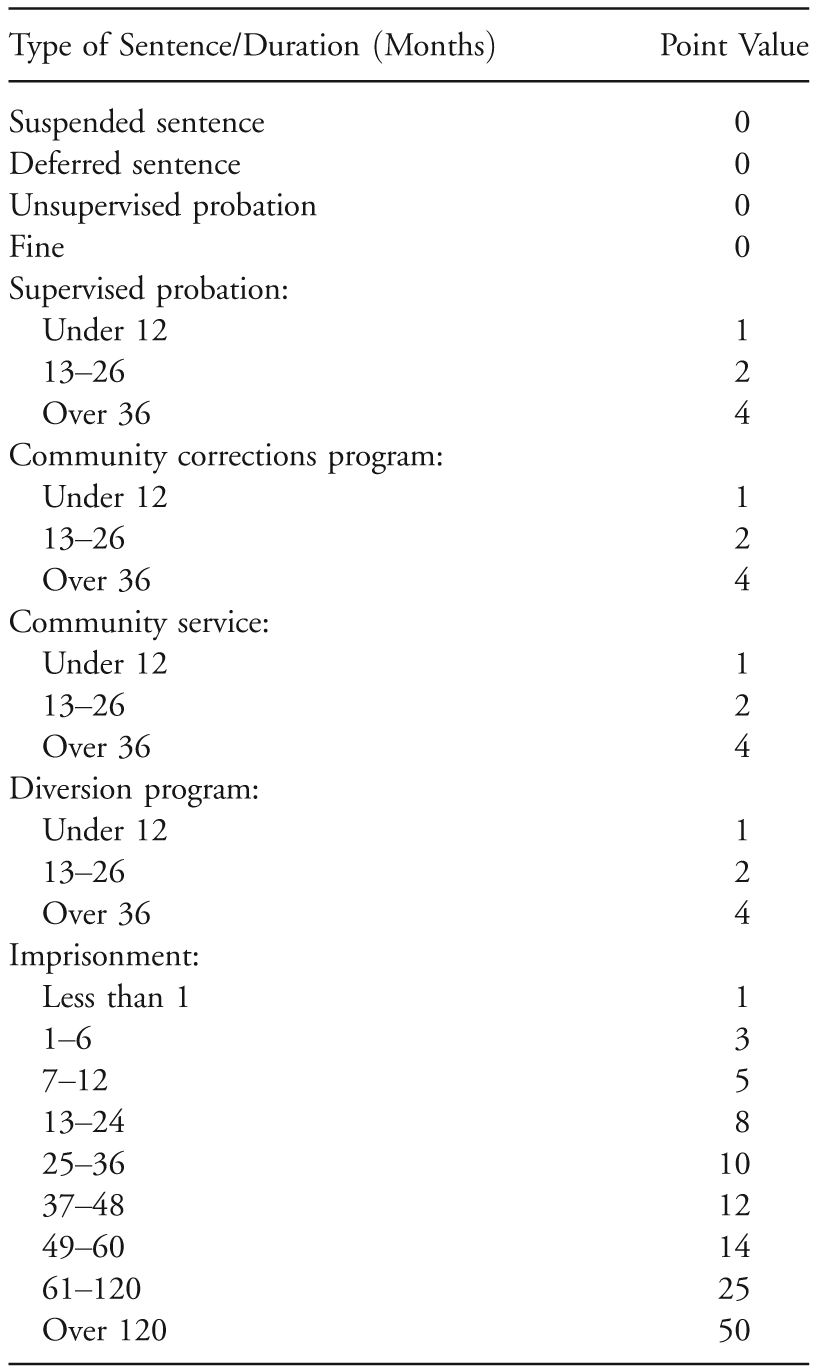
Note—Used to compile the outcome variable for the sentencing model. Point values come from Federal Offenders in U.S. District Courts.
Appendix B: Full Heckman Results
This appendix presents the full results of the selection model presented in the body of the article; Heckman selection models have enjoyed a great deal of use in the state judicial politics literature (Langer 2002; Bonneau and Hall 2009). The model was estimated using the sampleSelection package in R. There are a few important points to keep in mind with this analysis. First, the Heckman selection model implemented in R is a single-level model; thus, these models were estimated with fixed effects for judge/district attorney rather than varying intercepts. Since each judge or district attorney serves in a single district, fixed effects for judge/district attorney and district are perfectly collinear and therefore cannot both be included in the model.
Second, the Heckman selection model uses a probit model in the first stage and a simple linear model in the second stage. The sentencing models estimated elsewhere in this article use a negative binomial model rather than a linear model. However, the range of the estimated counts is quite large, suggesting that the a linear model may also be appropriate. Moreover, as discussed in the body of the article, Freedman and Sekhon (2010, 138) demonstrate that “the usual Heckman two-step procedure should not be used” to estimate a model where the second stage is something other than a linear regression.
Finally, the routine drops all “selected” observations that have missing values in the second stage. In other words, the selection model drops those cases in which a defendant was found not guilty at trial or when a judge dismisses the charge facing the defendant. In the multilevel district attorney model, these charges are included, as the district attorney would not know what the judge would do when the charge goes to trial.
Still, the results, presented in table B1, lead to the same substantive conclusions as a single-stage model that does not account for selection effects. Table B1 provides the estimated coefficients for the Heckman model in columns 1 and 2 as well as an analogous simple linear regression that does not correct for selection effects (col. 3). The magnitude and reliability of the estimated coefficients is nearly identical in both the second stage of the Heckman model and the single-stage ordinary least squares model. Thus, even when the inverse Mills ratio is included in the model, the estimated coefficients do not lead to a conclusion that differs in any meaningful way from the conclusions presented in the portion of the article that deals with judicial and prosecutorial behavior individually.Footnote 19 Moreover, although not presented here, the marginal effect plots lead to substantively similar conclusions to those pictured in figures 3 and 4. Thus, the model indicates the statistical presence of a selection effect, although the substantive impact of that effect is minuscule.
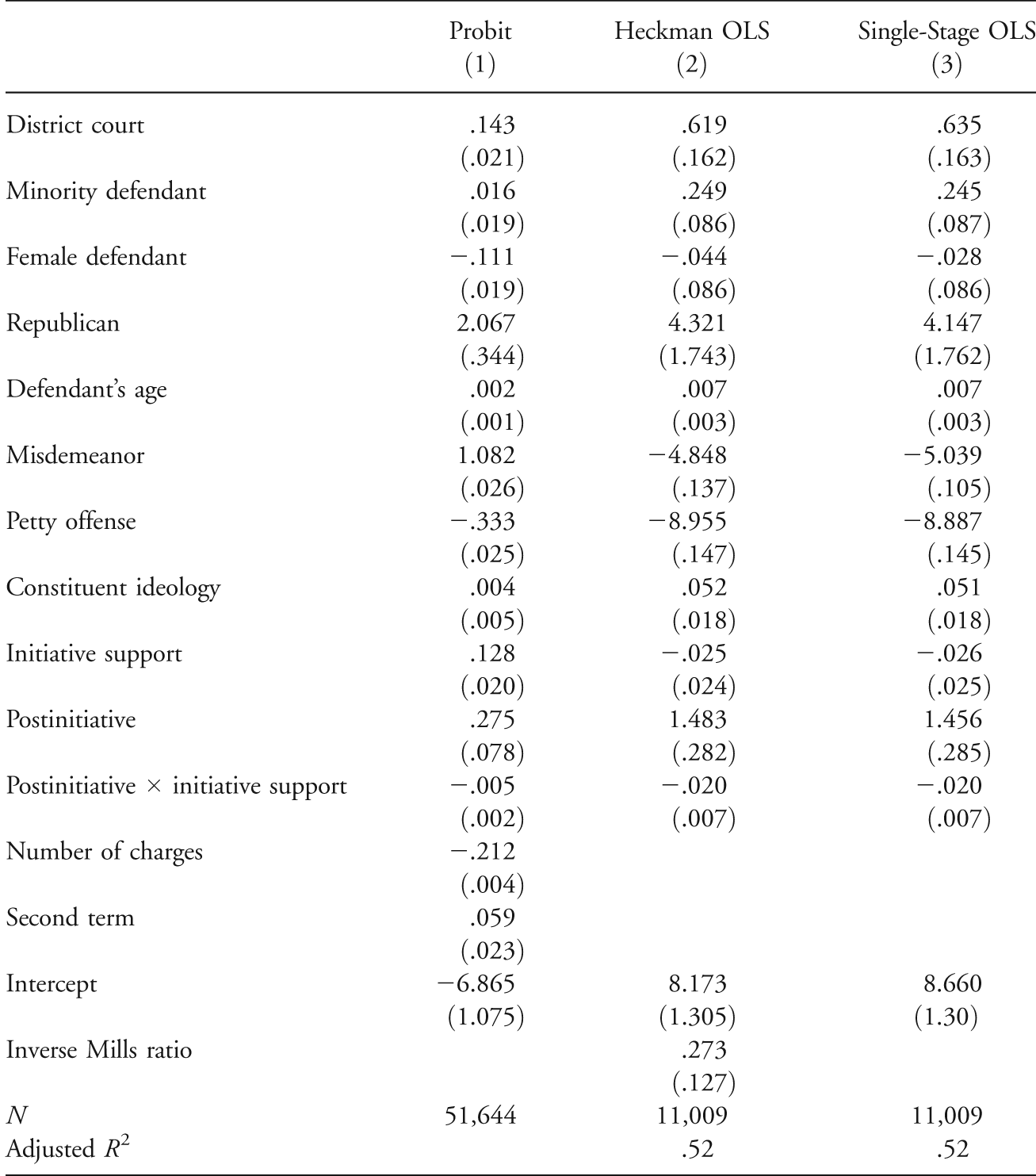
Note—Because the outcome variable in the first stage of a Heckman selection model indicates whether the observation moves to the second stage, the outcome variable for “Probit” indicates whether the charge was not dismissed (this is the opposite of the outcome variable in the logits presented above). Outcome variable for ordinary least squares (OLS) data is the scaled sentence. Models include fixed effects for district attorney/judge (not shown here). Standard errors in parentheses.
Appendix D: Omitted Variables
Readers may note that the empirical models omit variables, such as the defendant’s prior criminal record, or may believe that the empirical models oversimplify the decisional environment facing prosecutors. To this end, this appendix provides evidence that the omission of these factors has no biasing effect on the conclusions presented in the article.
First, there is no denying that the decisional calculus of prosecutors is multifaceted; they must determine whether to dismiss, plea bargain, or bring a charge to trial. Undoubtedly, there are a number of factors that one might believe affect prosecutorial decision making that are not included in the empirical model. Yet, the omission of these variables is troubling only if their effects differ between the time periods and are correlated with the prosecutor’s decision to dismiss a case. Analysis of the data provides very little suggestion that these sorts of external factors affected the caseload of district attorneys in a way that systematically differed in the two time periods. I assess this possibility in two ways. First, as shown in the upper panel of figure 2, the percentage of charges that exhibit a given case characteristic is nearly identical in both time periods. If anything, there is a slight increase in the percentage of petty offenses in the data. But, aside from that, the percentages are nearly identical in both time periods. Second, if these case characteristics had differential effects by time period, there would be an increased reason for concern. Yet, as the models presented below demonstrate, only one of the case characteristics (again, petty offenses) has a differential effect in the two time periods. Finally, as discussed in the text of the article, the rate of charges filed and guilty verdicts is stable in both time periods, suggesting a lack of some drastic change in prosecutorial fortunes that could bias the results.
Readers may note that the model does not contain data on the defendant’s prior criminal history. Records of the defendant’s history with the legal system are not kept by the Colorado judicial system and were, as a result, unavailable for this study. The only way such information would be available would be to travel to individual county clerks’ offices in the state to seek information about every defendant in the data. As such, this information is unavailable for the data discussed in this article. However, to ensure that the omission of this variable does not bias the empirical results presented throughout the article, I have conducted a series of empirical analyses.
As Fox (2008) notes, a control variable must be included in the model if it “(1) is a cause of Y, and (2) is correlated with an explanatory variable in the regression equation” (112). Here, the key independent variable of interest is the interaction between initiative support and postinitiative. While a defendant’s prior criminal record may be a cause of the sentence he receives, the results presented here show that there is no evidence that it would be correlated with the key explanatory variable of interest.
First, examining the distribution of cases in figure 2, one can see that the pool of cases stayed the same in both time periods. In fact, the two pools of cases are nearly identical on every observed variable, including characteristics of the defendant such as minority status, gender, and age. As a defendant’s prior criminal record is—like age, race, and gender—a characteristic of the defendant, there is no evidence that the distribution of prior criminal records is correlated with the interaction term.
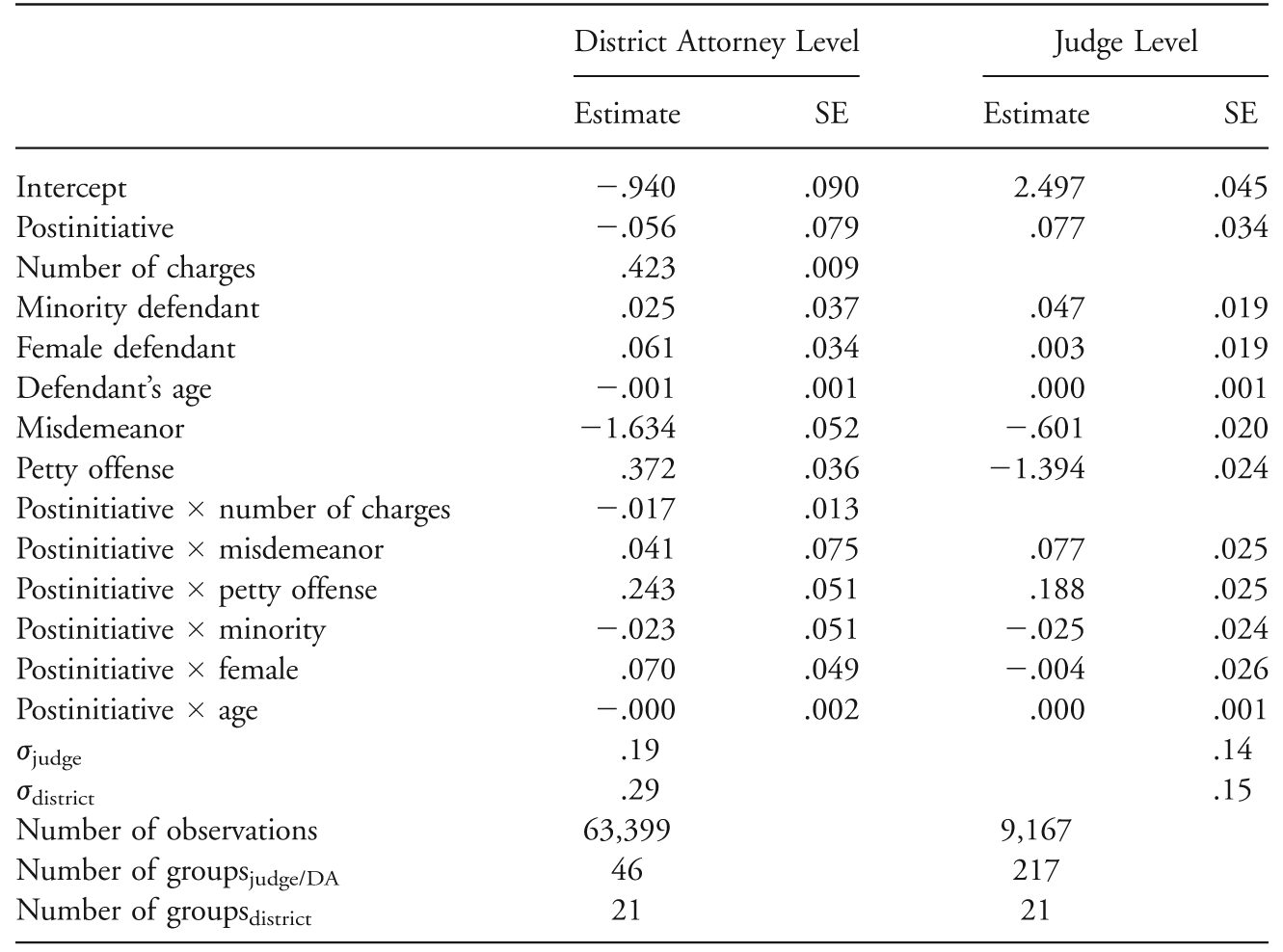
Second, there is no evidence that the observed demographic characteristics have different effects in the two time periods. If the omission of a prior criminal record is problematic, the issue would stem from the fact that it had a different effect in the two time periods. As table D1 shows, a model including interaction terms between the observed characteristics of the defendant and postinitiative yields no statistically significant coefficients on the interaction terms that include the demographic characteristics of the defendant. Thus, not only is the pool of defendant characteristics the same in both time periods, but those characteristics have the same effect in both time periods. Again, this is evidence that the exclusion of the defendant’s prior criminal record is not problematic.
Finally, I examine whether the empirical results hold for the pool of cases for which we expect defendants’ prior criminal records to be most similar: the possession of less than 1 ounce of marijuana. These empirical analyses also serve another function. Readers may be concerned that the empirical results discussed above are too broad; while the initiative text asked voters whether they wanted to “[legalize] the possession of one ounce or less of marihuana for any person twenty-one years of age or older,” the empirical analyses presented above examine all marijuana cases, including those for which defendants were charged with the possession of more than 1 ounce of marijuana (Colorado Secretary of State 2007). In this set of analyses, I reestimate the models described above on the subset of cases in which the defendant was charged with the possession of 1 ounce or less of marijuana—the same subset of cases that would have been affected by the passage of the initiative. Table D2 presents multilevel models for district attorneys and judges in these cases.
Figure D1 plots the marginal effects for district attorneys and judges. In both cases, the marginal effects are very similar to those discussed in the article body and shown in figures 3 and 4. The patterns are identical, although the confidence interval in the left-hand figure crosses zero for a larger swath of the range of initiative support.
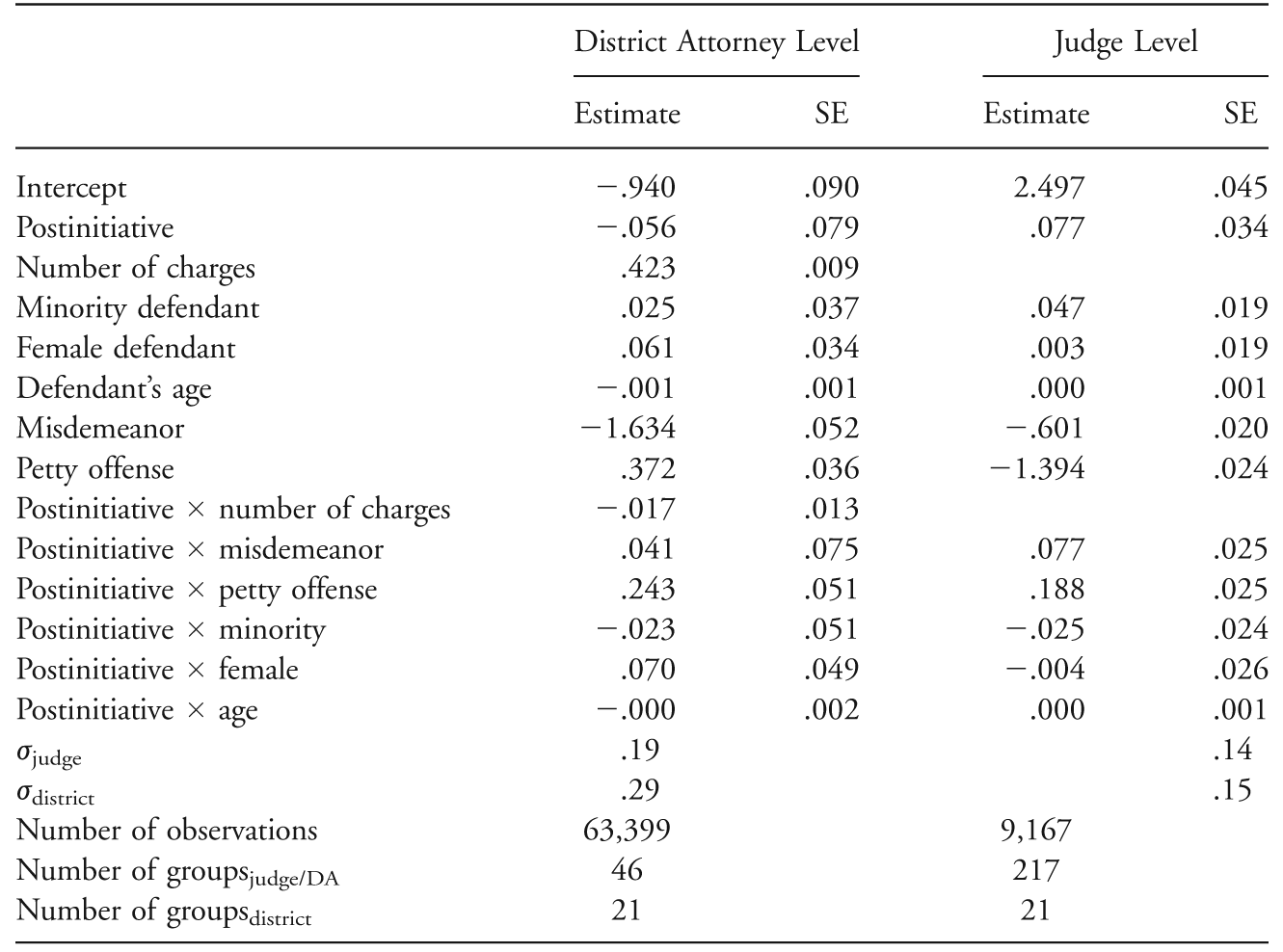
Note—Multilevel negative binomial model with random effects for district and judge.
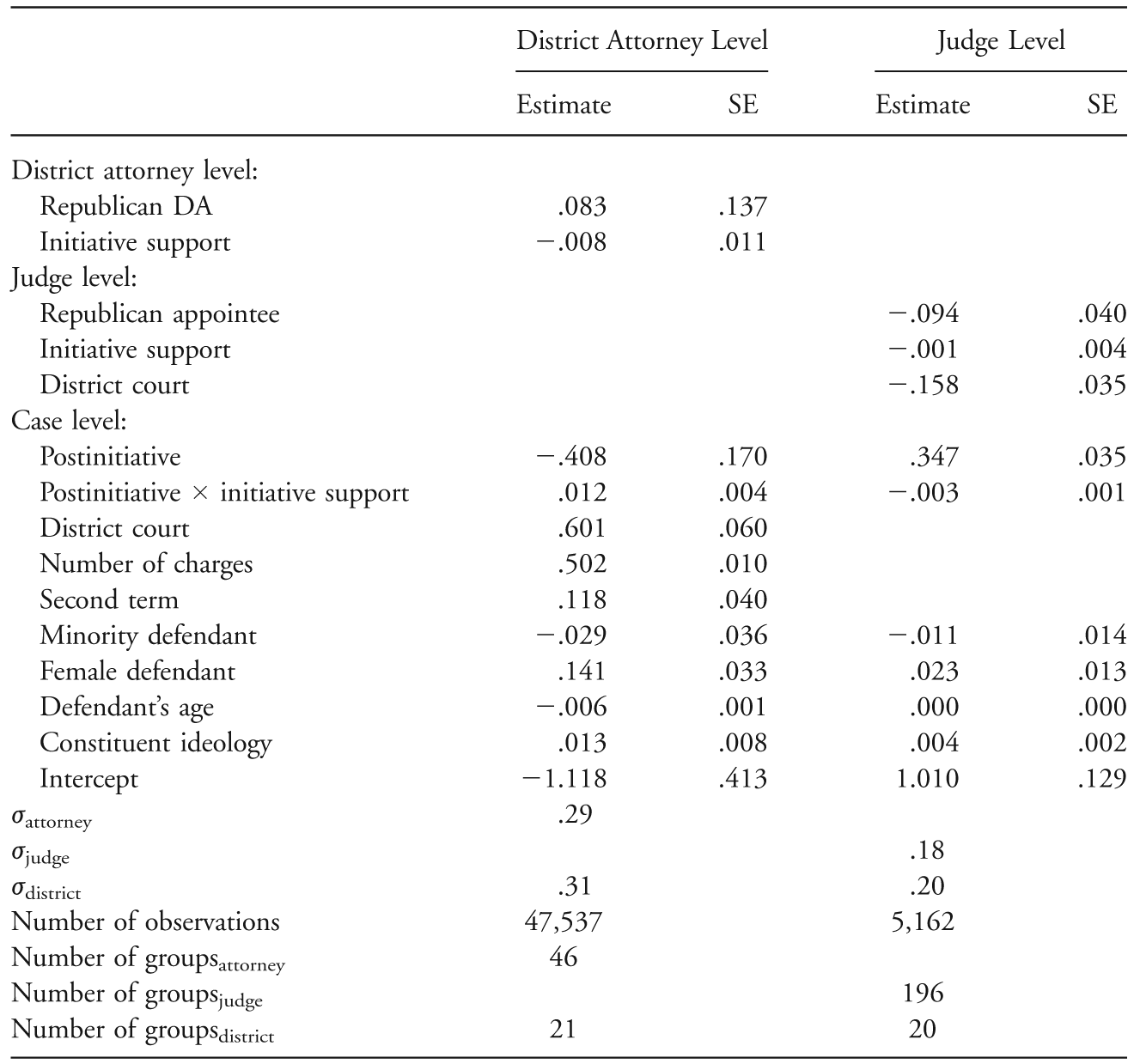
Note—Outcome variable in the district attorney analysis indicates whether the district attorney dismissed a charge. Model includes random intercepts for both district attorneys and districts. For judges, the outcome variable in the analysis is the scaled sentence given to the defendant. Model nests cases within judges within districts and includes random intercepts for both judges and districts.
Marginal effect of a petty offense being decided after the initiative. Values are simulated holding all others at their modal (for categorical variables) or mean values (for continuous variables). As the value of the X-axis increases, constituents’ support for the legalization of marijuana rises. Rug at the bottom illustrates the distribution of cases according to constituents’ level of support for the initiative.