

Introduction
Observed phenotypic correlations between quantitative traits of dairy animals allow prediction of a future correlated response in a trait that is difficult to measure early enough in the productive life of the animals. Conformation traits can, therefore, be used as early predictors of key dairy production traits even in commercial breeds provided the predictions are adapted for the specific breeds (de Haas, Janss and Kadarmideen, Reference de Haas, Janss and Kadarmideen2007). These associations are also as relevant in traditional cattle farming systems of developing countries like Ethiopia, where farmers rely on visual appraisal as well as their recollection of milk production trends in trying to select replacement stock for breeding. However, phenotypic correlation per se does not reveal the nature and extent of genetic correlation between the traits, as phenotypic correlation is a function of both genetic and environmental causes of correlation such that neither the magnitude nor the direction of genetic correlation can be predicted from phenotypic correlation alone (Falconer, Reference Falconer1989). On the other hand, there are indications that when conformation traits with known medium to strong heritabilities have significant positive correlations with milk production traits, the observed correlations between body measurements and milk production traits can be used to predict milk yield both in cattle (Kadarmideen and Wegmann, Reference Kadarmideen and Wegmann2003; Dechow et al., Reference Dechow, Rogers, Klei, Lawlor and VanRaden2004) and goats (Waheed and Khan, Reference Waheed and Khan2011).
If these associations can be verified in traditional cattle production systems, where systematic performance records do not exist, conformation traits that can be measured pre-lactation can provide a more objective way of selecting a replacement breeding stock. Recent studies showed that the traditional breeding practices of Ethiopian farmers, in which performance records are neither used nor collected, depend on visual appraisal of selected body conformation traits (Wuletaw, Reference Wuletaw2004; Wuletaw, Ayalew and Sölkner, Reference Wuletaw, Ayalew and Sölkner2006), such as teat size, navel flap width and length, dewlap width, and neck length. On that basis, Wuletaw (Reference Wuletaw2004) argued that these conformation traits can effectively be employed as indirect indicators of milk production potential, and hence as criteria for identifying a desirable breeding stock. Objective assessment of these presumed relationships is the first step in developing useful tools to inform decision-making in the selection of breeding cows and bulls. Along this line, this study set out to investigate the phenotypic correlations between particularly selected conformation traits and milk off-take of indigenous cattle breeds under the traditional management system of north-western Ethiopia.
Materials and methods
Description of study area
The study was conducted in Fogera district of South Gondar zone, and Wogera and Dembia districts of North Gondar zone of the Amhara Regional State of north-western Ethiopia. These three districts (Woreda) were selected because of the known cattle breeds that are found in large population sizes. In addition, an earlier exploratory study (Wuletaw, Reference Wuletaw2004) reported that these cattle breeds have desirable milk producing attributes such as higher milk off-take and longer lactation length, and that the communities use body conformation traits to evaluate milk production potential of heifers and cows.
The natural breeding tract of the Fogera breed extends from 1 774 to 2 410 m above sea level, with mean annual rainfall and average temperature of 1 216 mm and 25.5 °C, respectively (IPMS, 2005). The capital of Dembia district, Kola-Diba, is located 775 km north of Addis Ababa and 35 km from its zonal capital city of Gondar. The total area coverage of the district is 3 724 km2, with an estimated human population of 291 000. The altitude ranges from 1 700 to 2 700 m above sea level. The average annual rainfall of this district is 930 mm. The temperature varies from 18 °C to 29 °C (DWAO, 2011).
The capital of Wogera district, Amba-Giworgis, is located 778 km north of Addis Ababa and 40 km from its zonal capital city of Gondar. The total area coverage of the district is 1 821 km2. Its human population is 232 000. The altitude of the district ranges from 1 600 to 3 000 m above sea level. The average annual rainfall is 500 mm. The temperature varies from 10 °C to 28 °C (BSA, 2009).
Sampling procedure
This study was conducted on three dominant indigenous cattle breeds of the study area – the Fogera, Dembia and Wogera. Prior to the actual data collection work, a rapid (one-shot) exploratory field visit was carried out to gather general information regarding indigenous knowledge about how body conformation traits are used by cattle farmers as proxy indicators of milk production potential of heifers and cows. This was followed by a randomized data collection on a total of 225 cows with one to three parities. Data collected includes current milk off-take, stage of lactation and parity. The sample farmers were also asked whether or not they are willing to participate in the study. This dataset provided the basis for selecting at random a well-balanced set of 126 indigenous lactating cows from the study area for further data collection. These cows were registered and an identification number is given in preparation for repeated data collection on body conformation traits and milk off-take.
For the repeated data collection, the herd of experimental Fogera cows maintained at the Andassa Livestock Research Centre, near Bahir Dar, was employed, with the view to reducing possible confounding effect of the level of management on the relationship between the key variables. However, for the other two breeds, there were no experimental station herds anywhere in the study area or outside. Therefore, observations were made on-farm from the randomly selected farmers' cattle herds. The feeding systems were mostly grazing on natural pasture both for the station herds of Fogera cows and the on-farm herds of Dembia and Wogera cattle. No supplemental feed was provided to the sample cows. The housing systems were open barn.
Data collection
Collection of milk off-take data
Milk off-take data were collected from each registered and identified cow as per the following protocol:
-
• cows that calved only in May and June 2011 were included;
-
• milking and recording started one month after calving;
-
• calf suckling was also allowed for 20 s, mainly for the purpose of milk let down;
-
• to the extent possible milking continued until the udder was considered empty to ensure complete milking;
-
• volume of milk off-take from every milking session was measured by a given graduated cylinder and recorded in a given format; and
-
• milk off-take was recorded every 7 days on a specific test day for ten consecutive weeks.
Trained enumerators from the villages were used to milk and record data.
Measuring and observing conformation traits
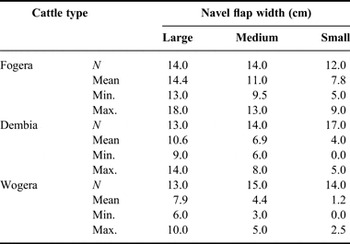
The same cows selected for milk off-take recording were also used to collect data on body conformation traits. The quantitative conformation traits recorded were: navel flap width, navel length, teat length and width, body length, pelvic width, dewlap width, and height at wither, as described in detail by Wuletaw (Reference Wuletaw2004). Visual observation was also made on some qualitative conformation traits of sample cows. These were udder size, teat tip shape, size of milk vein and neck size and shape. A standard data sheet was used to record data on all sample cows. In recognition of the relative high importance farmers attach especially to width of navel flap, as well as the broad within and between breed variations in this measured trait, sample cows were divided into three within breed categories as in Table 1.
The number of sample cows by navel flap size category.

Data analysis
Each of the quantitative traits was assessed using descriptive statistics prior to correlation analysis between milk off-take and measured conformation traits by using Pearson's square correlation. SPSS version 17.0 (SPSS, 2007) was employed to analyse the data.
Results and discussion
Qualitative conformation traits and milk off-take
The mean of milk off-take was compared independently under each selected qualitative conformation traits and for each cattle type. The conformation traits considered were udder size, teat tip shape, size of milk vein, udder attachment, and neck size and shape.
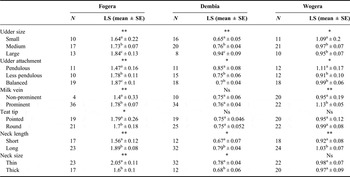
Unlike the case for Wogera breed, the mean of milk off-take of Fogera cattle steadily increased from small to medium and large size of udder (P < 0.01) (Table 2). Cows that had pointed teat tips are good milk yielders than those with round teat tips (P < 0.05) (Table 2). Similarly milk off-take in Dembia cattle varied significantly with the size of udder (P < 0.01). For Dembia and Wogera cattle, the mean of milk off-take did not vary with whether the teat tip was pointed or round (P > 0.05) (Table 2).
Least squares means ( ± SE) of daily milk off-take in litres by breed type and categories of conformation traits.

**Significant at (P < 0.01), *significant at (P < 0.05), ns = non significant, N = number of cows. a,b,cLS means within each column not bearing a common superscript differ significantly at P < 0.05.
Generally prominent milk veins appeared to be associated with higher average milk off-take in Fogera and Wogera cattle (P < 0.01), but this does not hold for Dembia cattle (P > 0.05) (Table 2). Longer neck indicated significantly higher milk off-take than short ones in all the three breeds but the association with the neck size was less distinct, although thicker neck tended to suggest less milk off-take.
Quantitative conformation traits and milk off-take
Phenotypic correlation between milk off-take and conformation traits of Fogera cattle
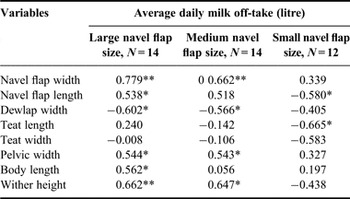
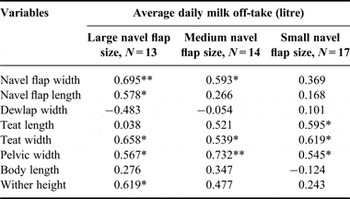
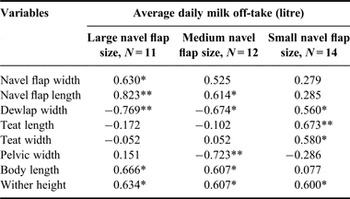
Navel flap width under the large category was highly and significantly correlated with milk off-take in Fogera (r = 0.78, P < 0.01) and Dembia cattle (r = 0.695; P < 0.01); a similar but less strong correlation was also observed in both breeds in the medium navel flap-size category (Tables 3 and 4). Similarly a significant correlation of navel flap length with milk off-take was observed but only in the large navel-size category. A significant but negative correlation of these variables was observed in the small navel flap category of Fogera cattle (Table 3). These indicate that larger sizes of navel flap width and length are associated with higher milk off-take, supporting the traditional practice of farmers using navel flap size as an indicator of better milk off-take in indigenous cows.
The phenotypic correlation (r) between milk off-take and some selected conformation traits of Fogera cattle breed.

N, number of cows; r, Pearson's correlation.
*Correlation is significant at the 0.05 level (two-tailed).
**Correlation is significant at the 0.01 level (two-tailed).
The phenotypic correlation (r) between milk off-take and some selected conformation traits of Dembia cattle.

N, number of cows; r, Pearson's correlation.
*Correlation is significant at the 0.05 level (two-tailed).
**Correlation is significant at the 0.01 level (two-tailed).
Dewlap width was significantly negatively correlated with milk off-take in both Fogera and Wogera cattle, especially under the large navel flap category (Tables 3 and 5). It was interesting to note that this negative association was also identified by farmers during formal interviews.
The phenotypic correlation (r) between milk off-take and some selected conformation traits of Wogera cattle.

N, number of cows; r, Pearson's correlation.
*Correlation is significant at the 0.05 level (two-tailed).
**Correlation is significant at the 0.01 level (two-tailed).
In Fogera cattle, the correlations between teat length and milk off-take were negative and significant especially within the small navel flap category. The other important conformation trait in Fogera and Dembia cattle was pelvic width which had strong and positive correlations with milk off-take in the large and medium navel flap categories (Tables 3 and 4). All focus group discussion sessions also identified a wide and slightly elevated pelvic width as a good indicator of milk yield.
Withers height and body length were also positively associated with high milk off-take in the large navel flap category in Fogera cattle (Table 3).
Phenotypic correlation between milk off-take and conformation traits of Dembia cattle
Milk off-take was positively correlated with navel width in Dembia cattle under large and medium navel flap categories (r = 0.69 and 0.59, P < 0.01 and 0.05, respectively) (Table 4). However, this correlation was weaker and non-significant in the small navel flap category of cows. Like in Fogera, the Dembia communities also believe that the navel flap size is a good indicator of high milking cows.
In Dembia, the correlations of dewlap size and teat length with milk off-take were not statistically significant (P > 0.05) (Table 4), but teat width showed strong positive and significant correlations with milk off-take across three categories of the navel-flap size. A similar strong association was also observed with pelvic width, which was consistent with the outcomes of the focus group discussions that showed pelvic width as a tool to identify especially desirable dry cows and heifers.
Wither height correlated significantly with milk off-take only under the large category of navel-flap size (r = 0.62, P < 0.05).
Phenotypic correlation between milk off-take and conformation traits of Wogera cattle
Generally the phenotypic correlation between navel width and milk off-take was positive in Wogera cattle, but the only significant correlation was in the large category (r = 0.63, P < 0.05) (Table 5). Navel length in the large and medium categories of navel-flap size showed high and significant correlations with milk off-take (r = 0.82 and 0.614, P < 0.01 and 0.05, respectively). Under the small category, the phenotypic correlations were small and non-significant.
The association of dewlap width with milk off-take was extremely variable but a strong ranging from a very negative to strong positive values (r = −0.769, −0.674 and 0.560, P < 0.05) (Table 5).
In the current study, body length was found to be strongly and significantly correlated with milk off-take under large and medium categories, but almost close to zero under the small category. Wither height maintained strong positive and significant association with milk off-take in all groups (Table 5).
Discussion
The findings of this study that showed strong positive correlation of milk off-take with udder size in both Fogera and Dembia cattle are consistent with those of Yakubu (Reference Yakubu2011) in Nigeria on Bunaji milking cows. However, Atkins, Shannon and Muir (Reference Atkins, Shannon and Muir2008) stated that a large udder does not always mean high milk yield, as was also observed in this study on Wogera cattle. Similarly Atkins, Shannon and Muir (Reference Atkins, Shannon and Muir2008) reported on a recent study in Canada that dairy cows which have strongly attached and well-balanced udder will support high and persistent production over the cows' lifetime. This is in contrast to the report by Van Dorp et al. (Reference Van Dorp, Dekkers, Martin and Noordhuizen1998), which showed that in Holstein cows pendulous udder cows are more milk yielders than cows that have balanced udder, indicating possible breed differences in the type of associations observed.
Yakubu (Reference Yakubu2011) reported in Nigeria large but variable (r = 0.538 to 0.766) association of milk yield with some quantitative conformation traits in Bunaji cows, as was observed in the present study, indicating that these associations could be breed specific and variable. Kuczaj et al. (Reference Kuczaj, Pawlina, Kruszyński and Akińcza2000) reported a coefficient of correlation of 0.30 between the milk yield and height at withers in black-white cows. The current study obtained high and variable correlation values between milk off-take and wither height both for Fogera and Wogera cattle (r = 0.66–0.43). An earlier study by Rogers et al. (Reference Rogers, Hargrove, Lawlor and Mole1991) also reported phenotypic correlations of 0.2 and 0.27 with the teat width and teat length, which is similar but weaker than those reported for Dembia cattle in the present study.
Conclusion
Statistically significant phenotypic correlations exist between some body conformation traits and milk off-take in Fogera, Dembia and Wogera but the type and strength of these associations are variable, indicating not only breed specificity of these associations but also the fact that phenotypic correlation is an interplay of genetic as well as an environmental covariance. The important conformation traits in this regard are udder and teat size, navel flap width, dewlap width, withers height, pelvic width and body length. The conventional wisdom of traditional cattle farming communities in using these traits to assess the milk production capacity of cows is therefore reasonable, even if the farmers do this by visual appraisal rather than objective measurements, although the underlying genetic relationships between the traits are more differentiated. The findings of this study indicate that these traditional subjective practices can be improved by scientifically verifying their validity for the specific breeds and introducing convenient ways of objectively measuring these traits and using this information as an additional tool in selecting desirable breeding animals.
Acknowledgements
This study is part of a graduate study at Bahir Dar University, Ethiopia. The Aksum University is acknowledged for providing study leave during the study time. The Amhara Regional office for GIZ-SLM (Sustainable Land Management) and Bahir Dar University provided finance for the conduct of the field work.