A persistent dilemma in many post-colonial states is the tension between national projects that are truly multi-ethnic and inclusive and projects that attempt to privilege one community's status over others. Recent scholarship on autochthonous movements in African states, particularly Ivory Coast and the Democratic Republic of the Congo, has stressed the ways that nation-building elites deal with this tension through the creation of ethnic myths of election that imply a privileged status for ethnic communities that profess some sort of indigenous character.Footnote 1 Studies of politics in bipolar states have also stressed the inherent problems of crafting broadly inclusive nations when one community's political elites insist upon asymmetric group claims benefiting professedly indigenous majorities. As noted by R. S. Milne and David Chappell, bipolar states like Malaysia, Fiji, and Guyana often emerged as a consequence of colonial era policies that provided privileged status to certain communities who were perceived as having an enduring attachment to a particular territory.Footnote 2 As part of this status, such groups were protected from economic competition in the modern economy, often through the retention of traditional economic institutions or through co-optation of ethnic leaders. Rather than promoting economic participation by indigenous majorities in the colonial economy, occupying powers enlisted the aid of ethnic minorities, brought in new ethnic communities through immigration programs, or engaged in a mix of these strategies. A significant consequence of these colonial policies was the economic empowerment of minority ethnic groups who emerged as critical actors in the post-colonial economy.Footnote 3 At the same time, in the post-colonial world, excluded majorities retain strong incentives to appeal to their indigeneity and to view the post-colonial state as the principal vehicle of their nationalist aspirations. In this regard, titular communities in bipolar states (Fijians in Fiji, Sinhalese in Sri Lanka, Malays in Malaysia) are keen to assert symbolic ownership of the state, particularly vis-à-vis economically-dominant minority communities.Footnote 4
In light of these communally-defined economic disparities, ethnically-based redistributive policies (EBRs) are used in several bipolar states to provide opportunity to economically peripheralized groups. In contrast to affirmative action programs in advanced industrial democracies, however, EBRs in post-colonial states often are implemented to benefit politically dominant majority ethnic groups who, despite their privileged political position, do not demonstrate comparable dominance in the economic sector.Footnote 5 Here I suggest that EBRs in post-colonial states are not solely intended to ameliorate economic gaps or to generate opportunities for political patronage, but rather are also a policy tool used by governing elites to advance a narrative of state ownership, and by extension, a decidedly non-liberal notion of democratic citizenship.Footnote 6 The implementation of EBRs sends a powerful message about which groups' welfare is to be prioritized by the state and, while such policies are often justified through a rhetoric of economic equality, they are more forcefully attached to claims of ethnic hierarchy that are intimately linked to narratives of an indigenous national project.
This has powerful implications for our understandings of democratic transition and the negotiation of the tensions between inclusive citizenship and nationalist exclusion in post-colonial states. Andreas Wimmer has noted that while “there is no zero hour of the politicization of ethnic differences,” the very recent creation of nation-states in many parts of the world can generate incentives for the re-characterization of new communities who can claim the mantle of political legitimacy.Footnote 7 Building on this insight, I argue that EBRs are used not merely as tools of economic development or wealth transfer, but are also used to re-craft the national project in ways that delimit the scope of “deserving”/“indigenous” nationals from “undeserving”/“foreign” nationals. While both types of nationals are citizens and ostensibly possess equality before law, the distinction establishes a transcendent type of abstract citizenship that privileges a constructed autochthonous citizenry over a supposedly contaminated “sojourner” citizen who only claims juridical status in the nation as a consequence of international law.Footnote 8 Significantly, while the underlying tropes that enable the construction of such identifications may seem self-evident to many citizens, there is substantial evidence that ostensibly united ethnic groups will frequently fail to act as homogenous political groups. Most social scientists accept the underlying dynamic of intra-group fractionalization, focusing on such things as the construction of group identity,Footnote 9 the problem of ethnic outbidding,Footnote 10 and conflicts over the symbolic dimensions of nation-building.Footnote 11 A perceived ethnic affiliation does not imply that individuals will necessarily see their interests as best served from coordination with their co-ethnics. EBRs generate incentives that, however imperfectly, provide a tangible manifestation of the abstract nature of the autochthonous group.
I argue that such policies reflect a second-best strategy of post-colonial state-building in ethnically bipolar societies. In light of the need to produce, as quickly as possible, a cogent nation-project, it is not surprising that political elites use what resources are immediately available to them. In this case, the availability of pre-existing mythologies of indigenousness allows political entrepreneurs to craft policies that can enable such mythologies as a political tool. Such efforts have significant implications regarding democratization in bipolar states. EBRs can be used to build democratic majorities and may even minimize incentives for ethnic extremism. At the same time, however, the properties of democracy make the sustenance of such indigenous majorities unlikely over the long-term, increasing the likelihood that indigenous privileges will be imperiled by electoral competition and that ethnic conflict will thus be exacerbated. In this regard, EBRs have decidedly anti-liberal implications. Indeed, as means of political inclusion, they reflect the tensions between, on one hand, international and domestic demands for political participation and equality before the law and, on the other hand, the compulsion for modern states to forge viable collective identities principally centered on the nation.Footnote 12 As Eric Kaufmann and Oded Haklai note, the building of such national projects requires that public policy delimit precisely who the nation-state exists to serve and, by implication, who the nation-state does not exist to serve, thereby generating potentially exclusionary measures.Footnote 13
In what follows I expand on the complex relationships between post-colonial nation-building and asymmetric policy claims in bipolar societies, and then outline the logic whereby policies of ethnic redistribution are used by political elites to engender a sense of indigenous national identity. In the broadest terms, my analysis of Fiji and Malaysia draws upon and seeks to extend the work done by Wimmer and by Kaufmann and Haklai, particularly by focusing on the difficulties faced by post-colonial states when trying to reconcile the felt need for a defensible national project with international and domestic pressures for participatory politics I will then explore these ideas by examining the use of EBRs in Malaysia and Fiji, two post-colonial states that share important characteristics including ethnic bipolarity, persistent internal and external demands for democratic transparency, recurring autochthonous claims advanced by professedly indigenous elites, and the presence of economically-dominant minority communities.
Malaysia and Fiji hardly exhaust the universe of ethnically bipolar post-colonial states, and there are some obvious ways in which they are distinctive, most especially Fiji's persistent dilemmas with social upheaval and military intervention in politics. At the same time, ethnic division and conflict—about distributional politics, culture, and the symbolic meaning of the state—are pervasive features of politics in post-colonial settings. To this extent, a consideration of the cases of Malaysia and Fiji has broader implications for thinking about a range of other cases distributed across the globe, including South Africa, Zimbabwe, post-Saddam Iraq, and Nigeria. Employing a comparative case-study approach, this article's two cases are intended to outline the persistent tensions between nation-building efforts based on inclusive claims about the post-colonial state's inherent pluralities and nation-building efforts that, for whatever reason, reach for the low-hanging fruit of autochthonous claims.Footnote 14
Democracy and Ethnicity in Bipolar Societies
As noted, until quite recently ethnic fragmentation was regarded as an obstacle to democracy by many social scientists. Alvin Rabushka and Kenneth Shepsle provide one of the most damning critiques of democracy's prospects in the developing world, noting that democratic competition produces incentives for elite outbidding.Footnote 15 Several more recent accounts stress the complexity of the interactions among democratic rules and ethnicity. A wide literature suggests that democracy and ethnic diversity in the post-colonial world need not yield normatively unappealing outcomes. Among political scientists, this perspective is most powerfully advanced by scholars of electoral engineering who seek to reconcile identity-based divisions and democratic procedure.Footnote 16 While the electoral engineering scholarship has yielded a sometimes spirited debate about the specific formal mechanisms for ethnic conflict management, each of the main approaches begin with the assumption that ethnic diversity is not a sufficient condition to explain communal violence. Instead, they argue that voters and political parties will, under certain conditions, respond to institutional incentives in a way that limits the strength of extremist claims.
Extremist claims are, by definition, outside the purview of “normal” politics. That said, there are clear examples in bipolar states when such claims possess powerful political purchase. Donald Horowitz observes how extremist rhetoric is often intimately linked to collective fears of group survival in light of demographic or political changes that imperil a group's status or special position.Footnote 17 It is this idea of group survival, and its attachment to claims of communal preeminence, that figure prominently in the discourses surrounding the nation-project in bipolar countries. The formal institutions governing society are but one part of the puzzle that helps to explain cooperation and conflict under democracy in bipolar states. Of equal importance is the persistence of social norms that privilege one ethnic community over other groups. Horowitz illustrates how ethnic myths are forged out of communal groups' claims to legitimacy by virtue of such controversial justifications as indigenousness and prior occupation, perceived right to succeed the colonial power, or historic dominance in the pre-colonial era. Ethnic mythologies of this sort are inconsistent with the norms underlying democratic competition since they only grant democratic legitimacy to ethnic parties from privileged communities. Under truly competitive democratic rules, these ethnic myths can generate incentives for conflict by giving professedly indigenous ethnic communities a readymade set of symbols and expectations around which to organize.
Related to questions about the links between democracy building and ethnic myths is the effort to develop an overarching sense of national identity in plural societies. Discussions pertaining to nationalism often explore the artificiality of distinctions between purely civic and ethnic forms of the nation and I will not discuss them fully here. Rather, it is sufficient to note that all forms of nationalism are beset by a struggle between notions of broader inclusion predicated upon the ideals of liberalism and nationalist exclusion that is based on collective assumptions about precisely which groups can participate in the nation project and which groups cannot.Footnote 18 A consistent critic of theories that attribute the emergence of nationalism to purely statist sources, Anthony Smith argues that all nationalist ideologies are built on an ethno-symbolic foundation linked to a dominant ethnic core, which he refers to as an “ethnie.” Ethnies consist of a “named human population with myths of common ancestry, shared historical memories, one or more elements of shared culture, a link with a homeland and a measure of solidarity, at least among elites.”Footnote 19 In contrast to nations, which are cultural groupings defined in terms of their connection to a territorial homeland, ethnies are defined by their links to common myths and memories.
The notion that modern states have a dominant ethnic core bears quite heavily on questions of how best to incorporate participatory elements into post-colonial states. As noted, most post-colonial states are characterized by some degree of ethnic pluralism and, to the extent that colonial policies compartmentalized ethnic communities into different social roles, this diversity manifests itself in a tendency for ethnic communities to organize along party lines in order to pursue their interests. That said, one ethnic party pursuing its constituents' interests can be interpreted by some members of the dominant ethnic community as an effort to usurp its control. While such fears are almost always unfounded, Kaufman suggests that ethnic myths can activate latent group acrimonies and can move ethnic conflict from rivalry to all-out warfare.Footnote 20 Again, Horowitz makes note of the “fear of extinction” among many ethnic groups in the post-colonial world,Footnote 21 a point echoed by Smith.Footnote 22 Fear of extinction does not merely imply the gradual weakening of the group's cultural significance, but goes so far as to assume the physical disappearance of the group as well. Consequently, it becomes even more important to make sure that national symbols denote which group “owns” the country. The concept of ethnic ownership is not limited to national symbols, although as Paul Brass and Marc Howard Ross make clear, these symbolic dynamics are potentially explosive.Footnote 23 In this vein, Wimmer notes that the capacity to make demands on the state for collective goods also yields powerful incentives to claim state ownership.Footnote 24 Ironically, the very attempt at forging a national identity linked to the myths of the dominant ethnic core can exacerbate underlying ethnic tensions, making a civic nationalism a largely impossible goal to achieve. To the extent that civic nationalism underlies any truly competitive democratic order in a multi-ethnic society, it immediately becomes clear that bipolar societies are at a distinct disadvantage, a notion borne out by empirical accounts advanced by Milne and Benjamin Reilly.Footnote 25
There exists a deep inconsistency between the rules that inform procedural democracy on one hand, and the expectations of majority groups adhering to ethnic myths privileging their perpetual dominance on the other. Indeed, ethnic myths are based on a notion of certainty about the “special position” of dominant ethnies. Democracy, however, is anything but certain. Instead, democracy is predicated upon the institutionalization of uncertainty. In a well-functioning democracy, we do not know who will win an election until ballots are counted, results verified, and winners publically announced.Footnote 26 Attempts to reinforce group hegemony through the manipulation of democratic institutions through practices like malapportionment may provide dominant majorities with a sense of security, but it can never truly guarantee that elections will deliver results consistent with ethnic myths. This is particularly problematic since ostensibly indigenous communities are riven with their own internal cleavages that may prevent them from voting as a unified bloc.
It is here that we encounter the foundational dilemma of many bipolar states. If we do not know the impacts of breaking the informal norms underlying ethnic myths of indigenousness, then conventional models of democracy are poorly equipped to deal with the consequences if the “wrong” ethnic party wins an election. There is no formally designated procedure for conflict management in such cases. Ultimately, the rules of democracy cannot enforce the expectations of majority groups in bipolar societies where ethnic hierarchies and their attendant mythologies of group dominance have taken hold. Ethnic bargains such as those crafted in Malaysia ostensibly try to solidify colonial-era ethnic roles by characterizing economically successful minority communities as perpetual “middlemen,” while allowing elections as a means to contest power between differing sets of indigenous elites. As Tan notes, such bargains fail in the face of demands for political equality and economic development.Footnote 27 Further, efforts to constitutionally engineer moderation, while potentially fruitful and one of the few tools available to policymakers to make democracy work, are woefully unable to augment such expectations. Consequently, we observe ex-post tinkering by ethnic elites that undermines the spirit of intergroup cooperation underlying electoral engineering efforts. Horowitz, for example, notes how the Fijian experience with the Alternative Vote (AV) was less an example of the limitations of AV as a tool of moderation, but rather resulted from efforts on the part of Fijian negotiators to retain decidedly anti-centripetalist institutions like communal voting districts and constitutional rules that gave any party earning at 10 percent of the vote share a position in the government.Footnote 28 I very much agree with this claim and suggest that it reflects precisely the tensions between ethnic myths used by elites to reinforce their position and the professed desire to implement truly democratic institutions aimed at generating interethnic moderation.
Ethnic Redistribution and the Creation of an Indigenous National Imaginary
Given these uncertainties, a second-best strategy for dominant elites is to try to craft, however imperfectly, a more politically homogenous autochthonous identity through the use of preferential policies. One of the important aspects of modern political systems, but most especially democratic ones, is the distribution of resources among members of society. Questions of democracy and redistribution have yielded a broad and varied literature ranging from macro-historical accounts that tend to downplay identities in lieu of class affiliations among society,Footnote 29 to broadly empirical works that assess redistributive policies in light of their ability to ossify democratic practices,Footnote 30 and to theoretical treatments that seek to connect the broadly illiberal tenets of procedural democracy with normative questions of fairness.Footnote 31 While these approaches are all vastly different, it is worth noting that they proceed from the notion that it is difficult to sustain stable democratic order in the context of immense economic and political disparities.
A key dilemma with these political-economy accounts of democratic and authoritarian change is that they assume, with the exception of Carles Boix, not merely the homogeneity of the two main class groupings, but also that the primary goal of groups is purely pecuniary.Footnote 32 Put bluntly, I suggest that groups in post-colonial societies do not organize simply to get money and resources. Indeed, these often may be among the least relevant goals of mobilization. Rather, following Horowitz, Wimmer, and Kaufman, I suggest that they seek a particular form of security and status derived from reifying their position as a privileged community, especially in light of dominant minority communities.Footnote 33 Before proceeding, outline here the scope and nature of ethnic redistribution policies.
EBRs in many bipolar countries tend to follow the array of policy tools outlined by Esman:Footnote 34
• Expansion of education opportunities for majority communities
• Language policies that increase the economic and social utility of majority group languages
• Growth of bureaucracy and government employment favoring majority candidates
• State economic enterprises that preferentially hire majority group members
• Financial incentives such as business loans that foster ethnic capitalists
• Preferential employment policies that give private enterprises incentives to hire majority group members
Critically, Esman suggests that such programs try to achieve balance between providing economic assets to traditionally poorer communities and retaining incentives for economic investment by ostensibly wealthier minority communities. The scope of such policies rarely expropriates property and wealth from minorities. Indeed, a key characteristic of many bipolar societies is a political economy where indigenous elites are intimately dependent upon the retention of the neoliberal economic institutions that ostensibly work against the rank-and-file members of their own ethnic group.
If, as contemporary political-economy of democracy accounts suggest, the purpose of EBRs is to acquire rents and benefits for dominant majorities, we should observe the implementation of such programs immediately after independence (or at whichever point such majorities emerge as politically dominant). Indeed, the ability to organize majorities for material gain is a central assumption that underlies these accounts of democratic change.Footnote 35 If, however, EBRs also serve decidedly non-pecuniary goals, then we should expect to see two things. First, we should see EBR implementation follow something akin to a punctuated equilibrium. EBRs are only fully implemented when some sort of event compels majority ethnic groups to reify their myths of indigenousness through the creation of policies that assert their dominance. In other words, EBRs are introduced only after an economically powerful minority attempts to redefine the nation-state project as truly multiethnic, thereby challenging the privileged status of professedly indigenous majorities. Once unstated yet broadly accepted myths of ethnic dominance are upset, majority group members have incentives to stake their claim to dominating the future agenda of nation-state development. Efforts by economically dominant minorities to intrude upon the nation-state project as equal actors confirm latent fears that these minorities are bent upon not merely controlling economic assets, but political institutions as well.
Second, EBRs will be evaluated along a more complex set of evaluative criteria than merely transferring wealth. By the measure of truly redistributive criteria, EBRs are only successful if the targeted majorities are significantly better off in the years following implementation and, to be fair, many EBRs do succeed at increasing the overall economic status of many beneficiaries. That said, the relative—as opposed to absolute—wealth of different groups rarely changes substantially. In contrast, I suggest that the “success” of EBRs follows both a pecuniary-rational logic and a value-rational logic that privileges the special position of professedly dominant majority groups. On one hand, as Gomez and Jomo note, such policies are defended by those who stand the most to lose, usually a relatively small number of politically connected entrepreneurs who benefit from the economic largesse of state-led development.Footnote 36 At the same time, however, EBRs are intimately attached to ethnically exclusive projects that stress the asymmetry of group claims. In this regard, I hypothesize that EBR programs are retained despite the fact that they are only marginally successful at redistributing wealth from economically successful minorities. In the face of ostensible policy failure, affirmative action programs are more forcefully attached to tropes of autochthonous identity. Based on their stated policy goals EBRs are roundly unsuccessful at reducing the gap between wealthy communities and poorer majorities. Nevertheless, they are retained precisely because they are a policy that illustrates the dominant position of majorities who are able to implement such programs in “their” state.
A second theoretical justification for the implementation of EBRs is that they provide an effective avenue for provision of patronage. This hypothesis suggests that ethnic redistribution, while publically presented as a means to increase the economic status of historically marginalized indigenous communities, allows politicians claiming the autochthonous mantle to stabilize a support network among elites. While elites may garner the lion's share of benefits of such programs they retain popularity owing to the residual benefits accrued by the majority of indigenous citizens who are only marginally empowered. Such networks invariably generate charges of nepotism. EBRs in Malaysia, as characterized by Gomez and Jomo, are policy tools that enable the perpetuation of cronyism among economic and political leaders.Footnote 37 Indeed, the charge of corruption is a common complaint among many observers of EBRs. In South Africa, for example, beneficiaries of the government's Black Economic Empowerment (BEE) programs are often derisively referred to as BEE-illionaires for their abilities to convert political connections into lucrative rent-seeking opportunities.Footnote 38 Similarly, ethnically-based redistribution in Nigeria under the federal system has generated immense opportunities for corruption.Footnote 39 Such policies are typically justified by the social inequalities generated by the colonial era (or in the case of South Africa, the apartheid state) and the need to forge a more equitable distribution of wealth. That said, the benefits of such programs end up being concentrated in the hands of a relatively small number of individuals.
Are EBRs and the attachment of an ethnically exclusive national project to their propagation merely “rhetorical cover” for a set of policies that serve as mechanisms for patronage distribution? This is a fair question, but it begs the question of what is it that makes claims of autochthonous identity so powerful rather than some other set of ascriptive characteristics. Why is it that political cronies immediately gravitate to ethnic appeals to provide rhetorical cover for their greed and why do their less-well-off constituents so quickly accept these justifications? The answer is that states are scarce and with only a handful of exceptions they tend to be resilient to significant geographic changes through secession or partition. If such policies are merely opportunities for elite-enrichment masked as populist programs then the extension of such policies based on economic status, as opposed to purely ethnic status, should be less controversial; however, this is not the case. In part, this is because in many post-colonial states with powerful legacies of economic disenfranchisement there is a perception that ethnic affiliation and class are powerfully correlated. It is scarcely a revelation, for example, to note that the apartheid era produced incredibly unjust differences in wealth in modern South Africa and that such differences are largely forged around race.
Taken together, EBRs are used by post-colonial states who feel the dual pressures of building viable national identities on one hand and international and domestic calls for democracy on the other. In light of the numerous difficulties presented by this dilemma, nation-building elites bent on retaining the privileged position of titular majorities opt for a second-best solution by advancing asymmetric notions of group legitimacy. EBRs, by virtue of their privileging one community over another (despite constitutional provisions ensuring equality before law) establish clear lines about precisely which groups' welfare the state exists to advance.
EBRs in Malaysia and Fiji Compared
Malaysia and Fiji each achieved independence under more or less open democratic procedures. Indeed, Malaysia's initial experiment with democratic government has been characterized as an example of consociational democracy by more than one observer, suggesting that it gave at least some effort to implementing the institutions most scholars associate with democracy in plural societies.Footnote 40 Nevertheless, in each case democratic practices were ultimately imperiled by the insistence of ethnic entrepreneurs that any post-colonial government reify the status of professedly indigenous groups. Moreover, in both states we observe the existence of an ethnic minority (Chinese in Malaysia and Indo-Fijians in Fiji) who are felt, often incorrectly, to wield disproportionate control of economic assets. Finally, both countries have been the subject of multiple comparative studies owing to their shared colonial histories and demographic characteristics.Footnote 41 In what follows I outline the way that claims of ethnic hierarchy by professedly indigenous groups have been articulated in the Malaysian and Fijian cases; analyze how such claims have been linked to demands for ethnically-based redistribution through EBRs following a direct challenge to extant ethnic hierarchies; and assess the success of these EBRs in terms of their stated economic objectives and in terms of their ability to generate a broader sense of autochthonous identity.
The Roots of Asymmetric Claims
Colonial policies in both Malaysia and Fiji are directly linked to the creation of myths of ethnic election on the part of Malays, who are characterized as the bumiputera (“sons of the soil”), and ethnic Fijians, who are characterized as the taukei (“true owners of the land”). Significantly, however, these myths were almost universally restricted to ethnic elites during the colonial period. In the face of the need for mass political organization we observe the deployment of such myths and the creation of parties structured around asymmetric ethnic claims. In Malaysia, the British engaged in a strategy of governing the Malay population under neo-traditional political institutions, thereby keeping them out of direct competition with larger agricultural firms.Footnote 42 As part of this arrangement, Malay elites were provided access to education and employment in the colonial bureaucracy where nationalist aspirations began to emerge in the early twentieth century. Chinese participation in the colonial enterprise was mainly economic and, as noted by Freedman, was generally internally organized around kin associations.Footnote 43 Malay nationalism accelerated following World War II. In light of perceived Malay cooperation with Japanese occupying forces during the war, the British were keen to give assurances to Chinese residents, many of whom provided the only viable resistance, that their citizenship status would be protected as the colony moved towards self-government. The threat to establish a post-colonial Malayan Union that made residency, and not indigenous ethnic identity, the highest level of political membership galvanized Malay elites and provided incentives to mobilize the broader Malay population under the aegis of bumi identity. Indeed, the United Malay National Organization (UMNO), historically the most dominant of Malaysia's political parties, formed in 1946 as a direct consequence of the need to mobilize Malay opposition to the Malayan Union plan.
Given the fractious nature of interethnic relations during the colonial period, Malay elites were insistent that any independent state be seen as the manifestation of a sovereign Malay nation, a nation characterized by the special position of the bumiputera.Footnote 44 Article 153 of the Constitution compels the government to act such that it safeguards the special position of the Malays. In the initial years of independence, Article 153 was used to justify a number of policies including rudimentary affirmative action in civil service hiring and educational scholarships, but is largely viewed as a statement of political and cultural dominance attached to the notion of ketuanan melayu (“Malay supremacy”). The article is intimately linked to what has been called the “Malaysian social contract”; the granting of citizenship to Chinese and Indian communities in exchange for their acquiescence to Malay political privilege. In exchange for their compliance, the Chinese were effectively allowed a free reign in economic matters.Footnote 45
Similarly, Fijian state-builders have struggled to reconcile international demands for democratic governance with perceptions among some Fijians that the state should promote the nationalist aspirations of the professedly indigenous taukei over claims of the Indo-Fijian community who are often characterized as vulagi (“foreigners”). Lal notes that the years preceding independence witnessed the rise of an autochthonous Fijian ideology predicated on the concept of the “paramountcy of Fijian interests.”Footnote 46 As in Malaysia, much of the discussion about asymmetric group claims benefitting the Fijian population was initially restricted to the politically-connected chiefly elite.Footnote 47 Ostensibly designed to ensure that the indigenous Fijian population—and more specifically the chiefly establishment—would be protected from potentially catastrophic cultural changes introduced by economic and political transformation, the paramountcy doctrine was cited frequently in the early-to-mid twentieth century.Footnote 48 Principally, however, the concept of paramountcy was largely limited to establishing separate administrative apparatuses for indigenous and non-indigenous communitiesFootnote 49 and to provide guarantees that Fijian lands would be secured for the welfare of the indigenous population.Footnote 50
In the 1960s the doctrine assumed new salience as a tool of establishing an ethnic political hierarchy not dissimilar in spirit to those advanced in Malaysia. In part, this change was the result of Britain's reluctance to leave Fiji without establishing an inclusive democratic polity. Norton has provided among the most thorough examinations of how the Colonial Office in London navigated the ostensibly intractable morass that separated the chiefly elite (who were ambivalent about any move to self-government) and Indo-Fijian political parties that possessed powerful advantages in terms of size and organizational capacity.Footnote 51 Owing both to their legitimate sense of attachment to an independent Fiji and to the broadly inclusive ideologies of the labor movements that were foundational in the creation of Indian political parties, Indo-Fijian elites insisted on common roll franchise. During the 1950s, the Colonial Office attempted to persuade the Fijian chiefly establishment of the importance of designing a common-roll electoral system.Footnote 52 Leading chiefs, particularly Ratu Sakuna, were reluctant to listen to British requests. Sakuna was unwilling to give suffrage to non-chiefly Fijians, let alone to a community that outnumbered the taukei. This reluctance was partly the result of administrative reforms of the 1940s that reinvigorated the authority of the chiefs under the aegis of neo-traditional institutions such as the Fijian Affairs Board. Nevertheless, by the early 1960s Fijian elites relented on the issue of granting suffrage provided that a unique voting system based on both communal and cross-voting electoral districts be constructed, thereby allowing some institutional mechanism that, perhaps naively, was perceived as insulating indigenous political dominance.Footnote 53 Not surprisingly, electoral politics in Fiji immediately began to adhere to a decidedly ethnic basis with Fijian politicians running on platforms stressing the inalienable position of Fijian control. Sir Kenneth Maddocks, the Governor of Fiji throughout the 1960s wrote to the Colonial Office that “we are now being confronted with the consequences arising from the fact that, since Cession, two policies have been pursued which have always been inconsistent. Namely, recognition in theory, by pronouncements and by implication, that the Deed of Cession conferred a moral obligation on the British Government to regard Fijian interests as paramount, and the preference given in fact to the promotion of economic development … (which has taken place largely independent of the Fijians) and has led to the Indians becoming established in a dominant position.”Footnote 54
Linking Asymmetric Claims to Policy
The development of ethnic mythologies of indigenous dominance did not immediately result in the creation of redistributive policies, although comparatively nascent forms of affirmative action were present. What is critical is not simply the existence of ethnic redistributive programs, but rather the extent to which these policies were either strengthened or specifically attached to autochthonous national projects that delimited an asymmetric notion of citizenship. Instead calls for enhanced redistribution occurred when myths of ethnic election held by indigenous elites were challenged under the aegis of electoral democracy. In both Malaysia and Fiji we observe the implementation of EBRs following a perceived challenge to the political dominance of professedly indigenous groups. While a few rudimentary affirmative action practices were implemented in Malaysia prior to the 1970s,Footnote 55 it is significant that the EBR programs most strongly attributed to Article 153 were only enacted following the turbulence of the mid- to late-1960s, a period characterized by the inclusion of Singapore in the Federation of Malaysia and, following the expulsion of Singapore in 1965, substantial electoral losses on the part of Malaysia's ruling Alliance coalition in 1969. Prior to the 1969 elections, UMNO dominated Malaysian politics through a series of deft alliances with cooperative Chinese and Indian parties, most significantly the Malaysian Chinese Association (MCA) and the Malaysian Indian Congress (MIC). The MCA, viewed by many Chinese voters as a patronage machine beholden to UMNO, faced significant electoral threats in the 1960s as competing ethnic parties challenged the cultural and political supremacy of the Malay majority. The contentious issue of Chinese vernacular education and the challenges raised years before by the People's Action Party's (PAP) demand for a pan-ethnic Malaysian identity resulted in the MCA losing substantial electoral support in the 1969 parliamentary elections. UMNO fared little better, losing ground to other Malay parties in light of outbidding pressures aimed at Prime Minister Tunku Abdul Rahman's ostensibly “moderate” stances towards Chinese language instruction. Taken together, the Alliance won only 48 percent of the vote and 66 seats in the legislature.Footnote 56 On May 13 Chinese opposition supporters, celebrating their successes, were attacked by a group of Malays in Kuala Lumpur, setting off ethnic riots that by conservative estimates killed approximately 800 people. In the wake of this violence, the government declared emergency rule, established a Malay government under the control of UMNO elites, and effectively ended the Alliance model of consociational democracy.
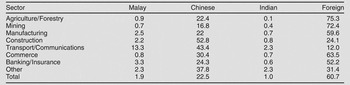
Following the dissolution of the Alliance the new Prime Minister, Rahman's more conservative deputy Abdul Razak Hussein, immediately identified Malay economic subservience as a core bone of contention. Table 1 indicates the distribution of share capital in 1970. It is immediately clear that Malays were at a decided disadvantage vis-à-vis their Chinese countrymen. To that end, the government implemented the New Economic Policy (NEP) in 1971Footnote 57 with the stated purpose of separating race from economic function, giving Malays a 30% stake in the country's economy by 1990. Significantly, there was no notion of separating race from political function.
Malaysia: Ownership of key industries in 1970

Source: Gomez and Jomo Reference Gomez and Jomo1997.
Consistent with Esman's framework for ethnic redistribution, the NEP and its subsequent policy refinements have included a broad array of tools intended to simultaneously improve the economic position of Malays while encouraging continued economic growth. Specifically, these programs include, or have historically included, preferential access to civil service jobs, the creation of capital holding firms for Malays, requirements that publicly listed firms demonstrate 30 percent bumi ownership, government loan programs that favor the creation of indigenous capital, and increased access to post-secondary education.Footnote 58 Included in the initial NEP legislation were provisions outlawing public scrutiny of these pro-Malay policies.Footnote 59
Beyond the implementation of the NEP, successive Barisan Nasional (BN) governments have tightly controlled elections through processes of malapportionment and district delimitation. Ostensibly independent, Malaysia's Electoral Commission (EC) has persistently recast the electoral landscape such that UMNO and its BN allies are assured a legislative majority.Footnote 60 While opposition parties can run vigorous campaigns and win elections, media coverage is frequently biased in favor of the BN government and a number of legal mechanisms allow for security forces to hector and harass individuals and groups who question the tenets of BN dominance and UMNO political privilege. At root, post-1969 Malaysia is best characterized as a state where political dialogue can occur, but only to the extent that the dominance of UMNO is not challenged. Given this, it is not surprising that many observers characterize modern Malaysia as a hybrid or competitive authoritarian regime.Footnote 61
Despite these institutional mechanisms intended to assure BN political dominance, a variety of dynamics have occasionally conspired to put the coalition at risk at the national and regional levels, particularly in the elections of 1987, 1999, and 2008. Consistent with this article's contention that the political utility of EBRs assumes particular salience during moments of legitimate political contestation, we observe especially vociferous defense of the NEP and its policy successors during these campaigns. In part, this is a consequence of NEP's unintended consequences of empowering a politically connected bumi minority and the creation of factions within UMNO itself. Biased electoral institutions, tight media controls, and policies that allow police wide powers to limit opposition organization provide the basis for UMNO's persistent control over Malaysia's semi-democratic system.Footnote 62 That said, I argue that intimately linked to these elements of the hybrid regime are economic redistribution programs intended to convey a powerful message about the distinctly autochthonous character of the Malaysian nation-state project, principally through its attachment to the trope of ketuanan melayu. Malay economic weakness relative to the Chinese was not new. Indeed, Malaysia's history prior to 1971 was characterized by the image of the rural Malay, steadfastly linked to his or her kampung, and largely disinclined to participate in the “modern” economy. This compels us to ask why the rhetorics of economic parity and the implementation of public policies intended to advance such claims accelerate throughout the 1960s and 1970s. I suggest that EBR programs in Malaysia, just as in a number of other bipolar states, are a consequence of professedly indigenous majorities trying to assert cultural and political dominance in such a way as to make broad claims on the system contingent upon an abstractly higher level of citizenship.Footnote 63 This autochthonous claim is not sustainable under purely democratic rules. Nevertheless, post-colonial states desire the veneer of democracy in order to satisfy both international demands for participatory politics and domestic claims about legitimate consent. Hence, EBR policies are used as part of a broader policy regime to assert an ethnic hierarchy justified through frames of economic equity.
As in Malaysia, Fiji's history of EBR implementation is relatively scant throughout the 1970s, although a small number of programs were in place.Footnote 64 Consistent with the arguments advanced so far, I suggest this is due in large part to the general absence of credible threats to the traditional dominance of Fijian parties. Throughout the 1970s and 1980s the dominant Fijian party, the Alliance Party, generally commanded substantial support among Fijian voters. Only in the face of a threat to indigenous political privilege do we observe the deployment of the rhetoric of ethnic redistribution, almost universally justified through claims of asymmetric ethnic legitimacy and attached to the special yet decidedly underspecified position of the taukei. One important factor in Fiji's ethnic political economy was the constitutional status of land ownership. Derived from the 1874 Deed of Cession, Fijian lands not already sold off were administered through the Native Land Trust Board (NLTB) and the revenues derived from its leases would be distributed to Fijian villages.Footnote 65 In practice, the actual revenues derived from the leasing of lands have proven uneven in terms of the benefits to Fijian villages and have yielded considerable accusations of mismanagement and corruption.Footnote 66
Far more ambitious affirmative action programs were implemented following the 1977 elections and most especially the 1987 and 2000 coups that toppled governments perceived as being dominated by Indo-Fijians. The 1977 constitutional crisis occurred when the political dominance of the Alliance Party was threatened by the emergence of a stridently pro-taukei nationalist movement. The Fijian Nationalist Party (FNP) advanced a decidedly exclusivist agenda on the floor of the legislature in 1975, going so far as to demand the repatriation of all Fijians of Indian descent. This outbidding strategy was effective, although by splitting the Fijian vote it had the unintended consequence of allowing the dominant Indo-Fijian party, the National Federation Party (NFP), to win the election outright. It is significant to note that the NFP's leader, S.M. Koya, was reluctant to name a cabinet, apparently recognizing the breach in Fiji's unstated political protocol.Footnote 67 The crisis was averted when, in the face of Koya's apparent inability to name a cabinet, President Ratu George Cakobau declared Alliance leader Kamisese Mara as the interim prime minister until fresh elections could be held. In these elections, Mara's Alliance won handily, thereby preserving the image of Fijian dominance of the political system.Footnote 68 In the wake of the crisis, professedly moderate members of the Alliance conceded to a number of redistributive programs aimed at improving the prospects of a Fijian business class in the late 1970s and early 1980s. As Sutherland notes, these programs collectively focused on the provision of increased access to higher education and state assistance to indigenous business ventures, including the creation of the Fiji Investment and Development Corporation and the re-strengthening of older institutions like the Fiji Development Bank.Footnote 69
As in 1977, the 1987 coup was precipitated when Alliance dominance was jeopardized by intra-Fijian fractures that effectively split the Fijian ethnic vote and allowed the newly formed Fijian Labour Party (FLP) to claim victory by forming a coalition with the Indian-dominated National Federation Party (NFP). In the face of these challenges, Fijian elites cited economic subservience as a key source of indigenous grievance. Interestingly, however, it was the economic empowerment of a small number of Fijians throughout the 1970s owing to their increased participation in the booming sugar economy that precipitated the growth of an indigenous labor movement that threatened to split the Fijian bloc. Lal characterizes the modest (9.6 percent) Fijian support for the FLP as “significant” in terms of tipping the scales against the Alliance.Footnote 70 The FLP characterized itself as a multicultural party based on a decidedly leftist ideology forged from the powerful union movement in the Fijian sugar belt. The veneer of the party's multiethnic foundation was ostensibly buttressed by the fact that an indigenous Fijian, Timoci Bavadra, took the reins as prime minister under the coalition government. That said, the fact that an overwhelming majority of Fijians voted against the FLP, coupled with the party's focus on bread and butter issues that downplayed the potency of nationalist rhetorics did little to sustain popular support among Fijians.
The 1987 coup that toppled the Bavadra government ushered in a period of intense elite contestation, particularly regarding the role played by traditional Fijian institutions. The interim government established a Constitutional Review Committee (CRC) to devise a constitution that would preserve Fijian paramountcy. On July 25, 1990 President Ratu Penaia Ganilau announced the implementation of the constitution, a document that was clearly discriminatory to Indo-Fijians, expanding the size of the legislature but heavily tilting it in favor of Fijians.Footnote 71 Unlike the 1970 Constitution which mixed communal and common-roll electoral districts, the 1990 Constitution enacted a system comprised exclusively of communal districts, ostensibly intended to eliminate the possibility that cross-voting could result in Indo-Fijians winning seats in Fijian cross-voting districts.Footnote 72 Finally, the Constitution required that the office of Prime Minister be reserved for an ethnic Fijian.
Significantly, the new constitution included specific clauses requiring ethnic redistribution. Ganilau justified these clauses by noting that Fijians had historically been very generous to the Indian population by allowing them to lease indigenous lands. Nevertheless, he suggested that festering resentments pertaining to the unequal distribution of wealth lay at the heart of the matter, arguing that “the dominant position of indigenous Fijians under the new Constitution could be viewed as a counterbalance to the dominance of Indians in commerce, finance and advanced education.”Footnote 73 The implementation of enhanced affirmative action was cast as a central component of national reconciliation. As of 1987, economic resources were very clearly tilted towards Indo-Fijians. Of the roughly 700 companies listed under the Registrar of Companies at the time of the coup, approximately 50 percent were controlled by Indians. In contrast, Fijian-owned firms represented only 15 percent of the listed companies.Footnote 74 The low-interest business loan programs and preferential access to scholarships that defined pro-Fijian affirmative action were considered insufficient. To this end, the government devised a policy paper that suggested, among other things, the injection of F$20 million into the Fijian Holdings Limited (FHL), the organization that served as the holding company for indigenous Fijians.Footnote 75 Efforts to bolster Fijian involvement through enhanced investment opportunities did little to address the core issues that hobbled the emergence of a viable indigenous capitalist class; however, as Robertson and Sutherland note, ordinary Fijians lacked the available capital to invest in FHL and the company tended to benefit only a small percentage of Fijian elites.Footnote 76
In the wake of the 2000 civilian putsch that toppled Mahendra Chaudhry's FLP government, Interim Prime Minister Laisenia Qarase's SDL government announced yet another set of affirmative action proposals. Guided by the mantra “50/50 by 2020,” so called by virtue of the stated goal of equalizing ethnic ownership of assets within 30 years, the introduced measures were simply slightly augmented versions of past policies. Based on this, Robertson and Sutherland observe the following:
First, on the evidence of performance, there is little reason to expect that this Blueprint is any more likely to redress the economic disadvantage of the majority of ordinary Fijians. Second, it relies very heavily on government funding, much of it in the form of grants. But government money comes from taxpayers. And a great deal of that, if not the bulk, is paid by non-Fijian taxpayers. In the interests of helping disadvantaged Fijians and ensuring political stability, they may not mind this, but the question that needs to be asked is this: if implemented, how is it to be demonstrated that the Blueprint actually helps disadvantaged Fijians? The Blueprint is silent on this issue.Footnote 77
Economic Empowerment, Patronage, or Something Else?
Analysts of contemporary Malaysia and Fiji have discussed at length the shortcomings of ethnic redistribution. Critiques of EBRs tend to revolve around two key issues; the inability of professedly indigenous communities to match the perceived performance of other ethnic groups even many years after the implementation of EBRs, and the propensity for such programs to engender nepotism and malfeasance. Despite the apparent limitations of such programs, political entrepreneurs in both states cling to the retention of these policies, and in some instances, their enhancement. I argue that the ostensible success or failure of such policies in terms of enhancing indigenous economic performance is utterly irrelevant. EBRs are not intended to “succeed” by purely pecuniary standards. Rather, the very fact that they are enacted and attached to the overall national project demonstrates how the postcolonial nation-state project compels particular communities to craft autochthonous ideals of citizenship. They succeed precisely because they exist in the first place.
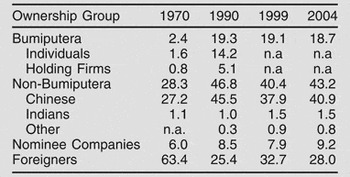
A key dilemma with economic justifications for ethnic redistribution in both Malaysia and Fiji, and a dynamic that compels us to reassess the motivations underlying EBR implementation, is the persistent economic gaps between bumi and non-bumi and taukei and non-taukei populations. Despite nearly 40 years of implementation, the economic status of Malays vis-à-vis the Chinese population has scarcely been equalized. Indeed, in many respects the economic position of the Chinese has strengthened considerably. It is clear that the NEP and its subsequent policy refinements have increased the economic well-being of most Malaysian's regardless of race, but it has roundly failed in its stated goal of increasing bumi ownership of the economy to 30 percent. Table 2 provides a cursory overview of wealth distribution in Malaysia in the years 1970 (the year immediately following the collapse of consociational democracy), 1990 (the year specified as the date to achieve 30% bumi ownership), 1999 (two years after the Asian financial crisis), and 2004 (the most recently available data pertaining to wealth distribution). Chinese ownership of the economy increased substantially, despite the active engagement of the UMNO-dominated government to ameliorate the gap in wealth between bumi and non-bumi populations. In addition, NEP has been consistently criticized in terms of the corruption and nepotism it is felt to generate.Footnote 78
Ownership of share capital—Malaysia

Source: Adapted from Gomez and Jomo Reference Gomez and Jomo1997 p. 168 to include Eighth Malaysia plan
In light of recent electoral challenges as well as public outcry against elements of the NEP/NDP, the government of Prime Minister Najib Tun Razak has promoted the 1Malaysia program, a platform that seeks to advance a multi-racial national identity and legitimize the Malaysian government through a focus on reducing corrupt practices. That said, the plan ostensibly suggests that the inherent tensions in Malaysian society are purely a consequence of poor governance—that if government actions were based on transparency and services were of efficient and effective quality, then non-bumis would more readily acquiesce to the principles of ketuanan melayu. Indeed, the New Economic Model (NEM) of 2010 retains virtually all forms of affirmative action, focusing on eliminating the inefficiencies of such programs while expanding the size of the service sector. While opposition parties have derided the NEM as a continuation of unjust economic policies, it is equally important that Malay nationalist interest groups have approached any discussion of the limitations of ethnic redistribution as a direct attack on the foundations of the Malay nationalist project. Specifically, the growth of groups like Perkasa demonstrates the powerful ways that Malay nationalists equate pro-Malay economic policies with the very foundation of the national project.Footnote 79
As in Malaysia, Fiji's experiences with affirmative action have yielded few tangible successes, although as Cottrell and Ghai note, Fijians have increasingly dominated the civil service in the years since the first coup.Footnote 80 That said, domination of the bureaucracy does little to address the persistent gaps in ethnic participation in the private sector. Prior to the 1987 coup Fijians held 39 percent of lower-level professional positions and only 17 percent of senior-level positions. Over 20 years later, these figures remain virtually unchanged, despite the previously noted injection of substantial capital into the FHL. Ratuva notes that the FHL has done a poor job of picking winning companies while overwhelmingly benefiting politically-connected elites. More importantly, the FHL does not represent or promote a Fijian business class.Footnote 81 Instead, it simply acts as a means for well-placed Fijians to reap the rewards of the stock market. Finally, the last published report of the FHL shareholders suggests that the primary beneficiaries of the company are the FAB and the Fijian Trust Fund, two organizations with tenuous connections to ordinary Fijians.Footnote 82
Beyond this, the FDB has provided loans for Fijians to develop an indigenous business sector. Fijian nationalists have persistently argued that the government does too little to foster an indigenous business class. In reality, successive Fijian governments have attempted to develop incentives for Fijian business growth since the 1980s.Footnote 83 In FY2004, for example, the FDB issued 1,105 loans totaling F$76.45 million and, at the end of the fiscal year, held loan portfolios totaling F$281.18 million.Footnote 84 Nevertheless, there has been little shift in ownership patterns compared to the pre-1987 era when Fijian ownership of registered companies was less than 15%. By 1997, of the 101 companies registered under the Tax Free Zones policy, a scant 10% were owned by Fijians.Footnote 85 In the face of largely unchanged indicators of Fijian economic participation, Qarase's SDL government proposed the continuation of affirmative action policies following its 2006 electoral victory.Footnote 86
Facing such an ostensible policy failure, why are these programs continued? At root, EBRs in Fiji are only partly about the economic empowerment of the traditionally marginalized Fijian citizen. Of equal significance is the way that Fijian elites consistently attach the ideals of affirmative action programs to claims about the autochthonous character of the nation-state project. Sutherland and Robertson quote former Finance Minister Berenado Vunibobo who noted at a 1995 economic summit that
the Fijians seem to have developed the feeling that by having political power, they are the master of the house. It doesn't work that way. You have to have a significant say in influencing the economy … but at the end of the day the Indian business community could squeeze the country dry if they chose to do so because of their hold on the economic levers. The Fijians realize that now. That is why there is so much input, so much concern, about helping and encouraging Fijians to get into the economic mainstream.Footnote 87
Such statements reinforce the traditional concerns of ethnic domination, discussed by Horowitz, that lie at the heart of nation-state building in many post-colonial states.Footnote 88 More importantly and consistent with the core theme of this article, economic advancement is only relevant insofar as it serves as a potential counterbalance to the threat of Indian encroachment into areas of social life that are deemed integral to the definition of the nation-state project.
Conclusion: Ethnic Redistribution and Its Nation-Building Limits
It is scarcely a revelation to say that post-colonial states are often considered “different.” For some, these differences lie in the plural nature of former colonies, especially in terms of the economic disparities between different communities.Footnote 89 For others, legacies of past domination intrude upon modern politics through a felt need to develop neo-traditional institutions that somehow reconcile a perceived “interrupted” past with the requisites of the current international state system.Footnote 90 For still others, the “unnaturalness” of state boundaries coupled with ethnic heterogeneity make the stability necessary for economic development an impossible goal to achieve.Footnote 91
The argument advanced here suggests that post-colonial states are, in many ways, not substantially different from the advanced industrial democracies to which they are so often contrasted, except that more “advanced” polities have over time effectively transcended local and parochial loyalties through the construction of national “imaginary communities.” In contrast, contemporary post-colonial states face similar challenges without the luxury of a long-term horizon, in a world in which time and space are dramatically compressed.Footnote 92 Indeed, the successful political enforcement of common identity may be the very thing that makes modern states modern. As Kaufman and Haklai make clear, however, the “success” of such states is often achieved through the creation of a dominant ethnicity whose attachment to the national project is rhetorically detached from conceptions of ethnic hierarchy and instead justified either through accepted hegemonic discourses (i.e., the French have always been the central people of France) or through patterns of assimilation.Footnote 93 The processes that allowed this to occur in advanced industrial democracies took place over long periods of time and were by no means conducted in a transparent or just fashion.Footnote 94 Similarly, Wimmer argues that exclusionary practices underlie the foundation of virtually all polities that successfully merge national projects and state projects. Put another way, Wimmer and Kaufmann and Haklai suggest that autochthonous movements are generally rare in open-order states precisely because the position of the dominant ethnicity is not perceived as a persistent cleavage of political contestation.
A key dilemma in many post-colonial states is that the evolution of the tropes of citizenship occurs in situations where demands for political and economic participation run headlong into the decidedly non-liberal processes associated with crafting coherent national identities.Footnote 95 In light of pressures to craft a negotiable national project, it is not surprising that substantial competition emerges to define the boundary of national membership, and that these contests center around claims to indigenous or autochthonous identity that lie ready at hand. Contrary to myths of primordialism, such indigenous identities are not and have never been a given; they were created and fostered by colonial era policies that linked local communities to neo-traditional institutions. The formation of these institutions and the empowerment of local elites charged with the maintenance of local order furnished the common interests of elites and colonial officials in the crafting of narratives of commonality.Footnote 96 Indeed, in Malaysia and most especially FijiFootnote 97 we continue to observe cleavages in the professedly indigenous community that persistently bedevil efforts at collective action. Perceptions of indigenous commonality, however imperfect, were enforced by the presence of ostensibly “foreign” communities whose initial purpose in the colonial polity was largely economic.
EBRs in Malaysia and Fiji are a consequence of the felt need to assert the preeminence of a constructed ethnic core in post-colonial states. This ethnic core's welfare is considered to be paramount in policy debates, as a way of ameliorating differences in economic status, but more significantly as a way of constructing an ethnic hierarchy that privileges a certain type of autochthonous citizenship. In both Malaysia and Fiji, political entrepreneurs characterize their inalienable right to rule through the concepts of ketuanan melayu and the paramountcy of taukei welfare, tropes that are intended to encompass the otherwise abstractly-defined higher levels of citizenship felt to accrue to professedly indigenous communities. To this end, we observe calls for enhanced ethnic redistribution most frequently during periods of legitimate political contestation that place perceived indigenous dominance at risk. In Malaysia, this was most manifest in the wake of the 1969 crisis, but has also occurred following electoral challenges in 1987, 1999, and 2008. In Fiji, demands for EBRs are similarly attached to periods of intra-Fijian political heterogeneity that encourage the formation of governments perceived as “too Indian.”
Interestingly, in both Malaysia and Fiji, EBR policies have consistently failed to achieve their stated goals. Indeed, in both cases there are persistent criticisms that EBR policies have only bred corruption and malfeasance, while generally failing to forge an indigenous entrepreneurial class. Nevertheless, such programs are retained and often strengthened despite their ostensible failings. The key reason for this appears to be that they provide a tangible manifestation of indigenous privilege that underlies the idealized national project. Many post-colonial states struggle with the dilemma of “who belongs,” making efforts at stable governance difficult to achieve, especially under competitive democracy. Conflicts in Ivory Coast, Congo, and Sri Lanka have all echoed the strong pull of claims of autochthonous identity, with powerful groups promoting the idea that legal citizenship in post-colonial states is a poor substitute for a perennial attachment to some sort of idealized national identity. Indeed, a recent International Crisis Group report on the Ivorian crisis highlights the ends to which a party claiming autochthonous membership will go to ensure that democratic procedures produce the “right” outcomes, with Laurent Gbagbo's Presidential Majority party running on a slogan of “we win or we win” and his supporters using SMS messages to characterize opposition figures as foreign criminals bent on domination.Footnote 98 In such contexts, the very efforts at crafting idealized national identities are apt to generate exclusionary politics in societies where the promises of modernity have failed to ameliorate dilemmas of scarcity.
These exclusionary notions are clearly inconsistent with the long-term flourishing of liberal democracy, and indeed wherever they become hegemonic they promote an acrimonious politics of ethnic resentment and antagonism, though not necessarily violence. That said, they are the consequence of structural and legal realities that compel nation-state builders to distribute the fruits of economic largesse in a way that sustains manageable political communities in the face of powerfully centrifugal ethnic mythologies of dominance. Indeed, a key implication of the discussion presented here is that the complex history of modernization has created an intractable distance between those states that had already established and “hegemonized” their dominant ethnic cores prior to the end of colonialism, and those that were unable to do so. In the former types of state, the implications of redistributive policy are left to scholars studying normative issues of fairness or positivist theories of public policy provision. In the latter type of state, conceptions of fairness and policy efficiency are at best secondary and at worst irrelevant. In these states, still in the process of becoming, what matters most is the rhetorical character of such redistributive programs in constituting a dominant ethnic-national core. Do these programs allow for the propagation and sustenance of myths of ethnic election? Do they exist to allow one group to establish an abstractly higher level of social claim-making over other groups? Are they attached just as much to questions of “who owns the state” as they are to questions of “what does fairness look like?” To the extent that the answer to such questions is affirmative—as I have argued above—then scholars of redistributive policy-making in post-colonial states will need to complement attention to “who gets what, when, and how” with attention to the prior question of what the state stands for and who it purports to represent.