Introduction
Although China provides a unique opportunity to examine the effects of rapid socio-economic change on depression, Chinese epidemiological studies of depression have been limited. Two national surveys of mental disorders, conducted in 1982 and 1993, revealed very low, but increasing, lifetime prevalence (0.46% and 0.83% respectively) of affective disorders (Twelve Region Psychiatric Epidemiological Study Work Group, 1986; Wang et al. Reference Wang, Wang, Shen, Zhang, Li, Chen, Huang, Tu, Ning, Fu, Ji, Liu, Wu, Luo, Zhai, Yan and Meng1998). Both surveys examined manic-depressive psychosis and depressive neurosis based on the ninth revision of the International Classification of Diseases (ICD-9) rather than major depressive disorder (MDD) as defined by the Diagnostic and Statistical Manual of Mental Disorders (DSM) system. Consequently, it is difficult to compare past prevalence estimates in China with surveys conducted in other countries, of which most used the latter system. Moreover, the two surveys focused on prevalence estimates and the most basic sociodemographic correlates. They did not examine key epidemiological and policy-relevant issues such as age of onset, symptom severity, number and duration of illness episodes, cohort effect, co-morbidity, impairment, or treatment.
No national survey of depression has been conducted in China for over a decade. Although one survey in a southern coastal city known as Shenzhen using the same methodology as the two national surveys revealed an implausibly low point prevalence of 0.03% for depression (Cheng et al. Reference Cheng, Gao, Zhang, Tang, Lu, Yang, Cai, Hu, Li, Li, Zhang and Huang1999), most other regional surveys have suggested a higher prevalence of depression. For example, a survey (n=14 639) in a coastal province called Zhejiang revealed that the point prevalence of MDD was 4.3% (Shi et al. Reference Shi, Zhang, Xu, Phillips, Xu, Fu, Yuan, Zhou, Wang, Zhang and Yu2005). In this study, psychiatrists were rigorously trained to conduct the Structured Clinical Interview for DSM-IV-TR (SCID; First et al. Reference First, Spitzer, Gibbon and Williams2002) to ascertain cases of DSM-IV MDD. Nonetheless, apart from showing that being female (relative risk=1.8) and having rural residence (relative risk=1.6) were risk factors, further analysis of the epidemiological profile of depression from that survey is not available. Another survey was conducted in a north-eastern province called Liaoning in which public health doctors administered an early version of the Chinese Composite International Diagnostic Interview (CIDI; version 1.0) to 13 358 respondents. Other than demonstrating a 12-month prevalence of 2.01% for mood disorder and basic sociodemographic risk factors (namely, being female and urban in residence), no information has been reported from that survey on the epidemiological profile of major depressive episode (MDE; Pan et al. Reference Pan, Jiang, Yang, Na, Fu, Yu, Yu, Liu, Liu, Wang, Li, Yan and Zhang2006). Using a later version of the Chinese CIDI (version 2.1), a survey (n=5033) in a south-western city (Kunming) showed a lifetime prevalence of 1.96% for major depression. Again, the survey has not provided further epidemiological information such as the distribution of symptom severity, impairment or treatment (Lu et al. Reference Lu, Ruan, Huang, Yao, Dang and Gao2008).
Because of differences in sites of survey, case definitions, sampling, and types of interviewers used, it is difficult to conclude from the above surveys whether the prevalence and profile of depression have been changing in China. As debates over the prevalence of depression in Chinese people continue (Parker et al. Reference Parker, Chan and Hadzi-Pavlovic2007), it is desirable to obtain a detailed analysis of the epidemiological profile of depression among Chinese people. The World Mental Health (WMH) Survey in metropolitan China, using multi-stage complex sampling and trained lay-interviewers, provides additional epidemiological information on the prevalence and correlates of major depression that have not been reported in previous Chinese surveys (Lee et al. Reference Lee, Tsang and Kwok2007b). Basic WMH in metropolitan China findings on the 1-year and lifetime prevalence of all mental disorders have been reported elsewhere (Shen et al. Reference Shen, Zhang, Huang, He, Liu, Cheng, Tsang, Lee and Kessler2006; Lee et al. Reference Lee, Tsang and Kwok2007b). The present study describes a more detailed profile of MDE.
Method
The method employed in the WMH surveys relevant to this report has been described in detail elsewhere (Kessler et al. Reference Kessler, Bergland, Chiu, Demler, Heeringa, Hiripi, Jin, Pennel, Walters, Zaslavsky and Zheng2004; Shen et al. Reference Shen, Zhang, Huang, He, Liu, Cheng, Tsang, Lee and Kessler2006; Lee et al. Reference Lee, Tsang and Kwok2007b). Here we provide a brief overview of the key methodological features.
Sample
The survey was based on a multi-stage clustered area probability sample of household-dwelling adults aged 18–80 years in the metropolitan areas of Beijing and Shanghai (Shen et al. Reference Shen, Zhang, Huang, He, Liu, Cheng, Tsang, Lee and Kessler2006). The final completed numbers of 5201 interviews were 2633 in Beijing and 2568 in Shanghai. Interviews were administered face to face by trained lay-interviewers in the homes of the respondents between November 2001 and February 2002. The response rates were 74.8% (Beijing) and 74.6% (Shanghai). The interviews were in two parts. Part I was administered to all 5201 respondents, and included the core diagnostic assessment. Part II, which was administered to all Part I respondents with any core disorder and a 25% probability subsample of other Part I respondents (n=1628), included information about correlates and disorders of secondary interest. All respondents provided written informed consent prior to the interview. Training and assessment of interviewers, sampling and field procedure were undertaken according to the standardized procedures of the National Comorbidity Survey Replication (Kessler et al. Reference Kessler, Bergland, Chiu, Demler, Heeringa, Hiripi, Jin, Pennel, Walters, Zaslavsky and Zheng2004) as in the surveys conducted by other participants of the WMH Consortium (Demyttenaere et al. Reference Demyttenaere, Bruffaerts, Posada-Villa, Gasquet, Kovess, Lepine, Angermeyer, Bernert, Girolamo, Morosini, Polidori, Kikkawa, Kawakami, Ono, Takeshima, Uda, Karam, Fayyad, Karam, Mneimneh, Medina-Mora, Borges, Lara, Graaf, Ormel, Gureje, Shen, Huang, Zhang, Alonso, Haro, Vilagut, Bromet, Gluzman, Webb, Kessler, Merikangas, Anthony, Korff, Wang, Alonso, Brugha, Aguilar-Gaxiola, Lee, Heeringa, Pennell, Zaslavsky, Ustun and Chatterji2004).
Measures
The WMH version of the World Health Organization CIDI (Kessler & Üstün, Reference Kessler and Üstün2004) is a fully structured diagnostic interview for assessing mental disorders including MDE according to both the ICD-10 and DSM-IV diagnostic systems. DSM-IV criteria are used in the current report. Core disorders included anxiety disorders (panic disorder, agoraphobia without panic disorder, specific phobia, social phobia, generalized anxiety disorder, post-traumatic stress disorder, separation anxiety disorder), impulse-control disorders (conduct disorder, intermittent explosive disorder) and substance-use disorders (alcohol abuse with or without dependence, drug abuse with or without dependence). Diagnostic hierarchy and organic exclusion rules were applied in making all diagnoses. Schizophrenia and other non-affective psychoses were excluded because previous studies have shown that they were overestimated in interviews administered by lay-interviewers (Kessler et al. Reference Kessler, Berglund, Demler, Jin and Walters2005). This might not lead to the underestimation of the overall prevalence of mental disorder because studies have indicated that the vast majority of respondents with non-affective psychosis met criteria for CIDI anxiety, mood, or substance disorders and would consequently be captured as cases (Kendler et al. Reference Kendler, Gallagher, Abelson and Kessler1996).
The CIDI was translated into Chinese using the standard World Health Organization protocol in which a team of survey experts completed the initial translation and a separate team carried out an independent back-translation to confirm preservation of the meaning of the original English version. Harmonization was then used to adjust for discrepancies in meaning between the translation and back-translation. Blind clinical reappraisal interviews were administered to a mixed convenience sample of 95 psychiatric patients and 77 normal controls using the SCID. Mood disorder diagnosis generated from the SCID had generally good concordance with the CIDI diagnoses, with area under the receiver operator characteristic curve being equal to 0.83 (Huang et al. Reference Huang, Liu, Zhang, Shen, Tsang, He, Lee, Kessler and Üstün2008).
The depression section in the CIDI included the Quick Inventory of Depressive Symptomatology Self-Report (QIDS-SR; Rush et al. Reference Rush, Carmody and Relmiz2000), which assessed symptom severity in MDE during the worst month of the previous year. Transformation rules developed for the QIDS-SR were used to convert its scores into clinical severity categories mapped onto the Hamilton Rating Scale of Depression (HAMD; Hamilton, Reference Hamilton1960) categories of none (i.e. not clinically depressed), mild, moderate, severe, and very severe. Previous research has documented very high concordance between the QIDS-SR classifications and HAMD ratings (Rush et al. Reference Rush, Trivedl, Ibrahim, Carmody, Arnow, Klein, Markowiz, Ninan, Kornstein, Manber, Thase, Kocsis and Keller2003). The HAMD, in turn, has been found to be a reliable and valid measure of depression severity and is widely used in Chinese psychiatric studies (Xie et al. Reference Xie, Shen and Zhang1984).
The Sheehan Disability Scale (SDS) (Leon et al. Reference Leon, Olfson, Portera, Farber and Sheehand1997) assessed the extent to which depression interfered with functioning in work, housework, relationship and social roles in the worst month of the past year. Responses were scored with a 0 to 10 visual analogue scale and severity was classified as none (0), mild (1–3), moderate (4–6), severe (7–9) and very severe (10). A question at the end of the SDS series also asked respondents to estimate the number of days in the past year (365 days) when they were totally unable to work or carry out their normal activities because of their depression.
Chronic physical diseases were assessed in Part II with a standard chronic conditions checklist. The checklist included symptom-based conditions (e.g. frequent headache) as well as salient conditions (e.g. hypertension). Respondents were asked to report if they ever experienced each of the symptom-based conditions and whether a medical professional ever diagnosed them with each of the salient conditions. Prior research has demonstrated fairly good correspondence between self-reports about chronic physical conditions such as diabetes, heart disease and asthma, and general practitioner records (Kriegsman et al. Reference Kriegsman, Penninx, Van Eijk, Boeke and Deeg1996).
All respondents to Part II of the survey were asked about receiving treatment for emotional problems in the previous year and, among those who received treatment, the type of treatment they received. Sectors of treatment were distinguished according to the mental health sector (in-patient treatment or out-patient treatment with a psychiatrist, psychologist, other mental health professional, or a social worker or counselor in mental health specialty setting, or use of a hotline), general medical sector (out-patient treatment with a primary care physician, other medical specialist, nurse, or other health professional), human services sector (such as religious or spiritual advisor, or social worker in any setting other than mental health sector), and the complementary–alternative medical sector (any other types of healer, internet support group, or self-help group).
Finally, a standard battery of sociodemographic variables (e.g. age, gender, employment status, education, and income) was administered to all respondents. The age information, in conjunction with information reported in the depression section on age of first onset of lifetime MDE, was used to study inter-cohort variation in risk. Other sociodemographic data were used to provide descriptive information about the distribution of MDE in the population.
Statistical analysis
We used weighting to adjust for differential probabilities of selection within households, for the over-sampling of Part I cases into the Part II sample, and for residual discrepancies between the sample and official population statistics on the cross-classification of sociodemographic variables. Cross-tabulations were used to calculate prevalence, co-morbidity, symptom severity, impairment and treatment. Logistic regression analysis was used to study sociodemographic correlates of prevalence and treatment. The logistic regression coefficients were transformed to odds ratios (ORs) for ease of interpretation. Confidence intervals (CIs) of the ORs were estimated using the Taylor series linearization method (Wolter, Reference Wolter1985) through the sudaan software package (release 8.0.1, January, 2002; Research Triangle Institute, Research Triangle Park, NC, USA) in order to adjust for the fact that the sample was clustered and the cases were weighted. Multivariate significance was evaluated using Wald χ2 tests based on coefficient variance–covariance matrices that were adjusted for design effects using the Taylor series method. Discrete-time survival analysis (Efron, Reference Efron1988) with person-year as the unit of analysis was used to study cohort effects, which included evaluation of interaction between cohorts and time-varying predictors such as age and education (Lee et al. Reference Lee, Tsang and Kwok2007b). Statistical significance was evaluated using 0.05-level two-sided design-based tests.
Results
Prevalence of MDE across gender and age groups
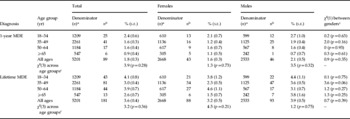
The prevalence estimates for 1-year and lifetime MDE in the total sample were 1.8% (95% CI 1.2–2.4%) and 3.6% (95% CI 2.8–4.4%) respectively. The ratio of 1-year:lifetime prevalence was approximately 0.5 (Table 1). Males in the 35–49 years age group were estimated to have a higher lifetime prevalence of MDE than females in the corresponding age group at trend level (3.6% v. 2.3%, p=0.06). The two genders did not differ in either lifetime or 1-year prevalence in any other age group. Regarding age, there was no significant difference among age groups in 1-year prevalence. Controlling for age, gender and time-varying factors such as education and marital status, cohort was a significant predictor of lifetime risk of MDE (Wald χ2=54.8, p<0.01), with risk significantly elevated among more recently born respondents (those born in 1967 or later compared with earlier cohorts).
Prevalence of 1-year and lifetime MDE

MDE, Major depressive episode; s.e., standard error; df, degrees of freedom.
a Total cases among each age group.
b Cases of 1-year and lifetime MDE among the age groups.
c 3 df tests for significant difference across age groups and 1 df tests for significant difference across genders; odds ratios and significance tests are not presented for the models where the size of the subsample is <15, or the count of the dependent variable is <5.
Sociodemographic correlates of 1-year MDE
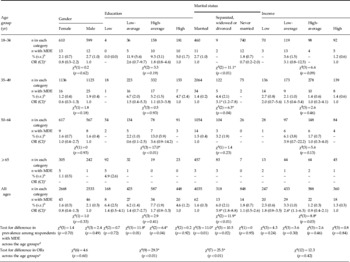
None of the sociodemographic variables we considered was independently associated with MDE in the total sample (Table 2). However, significant associations were found within age group. Separated, widowed and divorced respondents were more likely to have MDE than those married in the 35–49 years age groups; this subgroup also had higher prevalence of MDE than other age groups and the marital subgroup. For respondents having low-average education or above, those in the younger age group (18–34 years) had higher prevalence of MDE than older age groups. By contrast, for respondents in the 50–64 years age group, those with high-average or low education seemed to have higher risk of MDE. As for income, respondents having low-average income exhibited an elevated risk of MDE in the total age group sample but significant likelihood was not shown for particular age groups.
Sociodemographic correlates of 1-year MDE by ageFootnote a
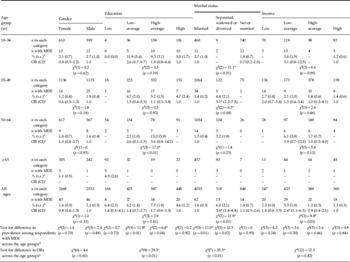
MDE, Major depressive episode; s.e., standard error; OR, odds ratio; CI, confidence interval; –, low cell size.
a Bivariate model; each demographic in separate models.
b Percentage of people with MDE in each category.
c ORs are estimating the likelihood of 12-month MDE with each demographic variable as predictors; ORs are not presented for the cells where the count of respondents within the demographic category is <15, or the count of respondents with MDE is <5.
d Significance tests across cohorts with corresponding predictor categories for difference in prevalence, controlling for the same demographics. No n restriction for tests across cohorts; results for rows with multiple small cells may be unstable.
e Significance tests of interaction between cohorts and corresponding predictor categories for difference in OR, controlling for the same demographics. No n restriction for tests across cohorts; results for rows with multiple small cells may be unstable.
* Significant (p<0.05).
History of depression across gender and age groups
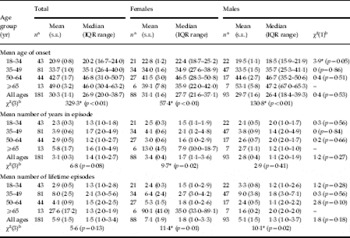
The mean age of onset of MDE for the entire sample was 30.3 years (Table 3). While the age of onset was generally later for older age groups, there was no significant difference between genders and among age groups on the mean number of years having MDE or the mean number of lifetime MDE episodes, except for the following. First, females with 1-year MDE in young adulthood (18–24 years) had later age of onset than males in the same age group. Second, those in the middle age group (35–49 years), for both males and females, had a larger number of lifetime episodes. Third, the group of five elderly females (⩾65 years) with 1-year MDE had the largest mean number of years having MDE in their lifetime and largest mean number of lifetime episodes.
History of depression between genders and among age groups

s.e., Standard error; df, degrees of freedom.
a Cases with lifetime major depressive episode
b 3 df tests for significant difference across age groups and 1 df test for significant difference across genders; odds ratios and significance tests are not presented for the models where the size of the subsample is less than 15, or the count of the dependent variable is <5. Significance tests also omitted if dependent variable has no variation (all 0s or all 1s).
* Significant (p<0·05).
Symptom severity, role impairment, and suicidality
The distribution of severity among respondents with 1-year MDE was 15.7% (s.e.=6.7%) mild, 51.8% (s.e.=8.0%) moderate, 25.3% (s.e.=5.8%) severe and 6.4% (s.e.=3.1%) very severe. The mean number of days out of role because of MDE in the year before interview among 1-year cases was 27.5 days. The number of days out of role is associated with the QIDS-SR measure of symptom severity: mild, 7.4 days, moderate, 23.2 days, severe, 31.7 days, very severe, 95.5 days. Percentage of respondents who reported severe or very severe impairment in at least one of the role domains on the SDS was 37.6% among those with mild QIDS-SR scores; 35.0% among moderate, 46.6% among severe, and 62.0% among very severe (p=0.2). The overall percentage of 1-year cases with severe or very severe SDS scores was 40.1%. Respondents with different symptom severities did not differ in terms of having one or more co-morbid 1-year DSM-IV disorders (total average, 26.9%; mild, 22.4%; moderate, 34.0%; severe, 21.8%; very severe, 0%).
Suicidality was common. Among those reporting 1-year MDE, 9.8% (s.e.=5.4%) reported suicide ideation (OR 3.2 compared with respondents who were not depressed), 12.9% (s.e.=4.9%) reported suicide plans (OR 5.8) and 11.0% (s.e.=3.8%) reported suicide attempts (OR 3.8) in their lifetime. The number in each cell was too small for cross-tabulation analysis of age group and suicidality. Suicidal ideation and middle adulthood (35–49 years) included enough sample in the cell and showed significant association (OR 4.7, 95% CI 1.8–12.2, Wald χ2=10.7, p<0.01).
Role impairment by 1-year MDE across gender and age groups
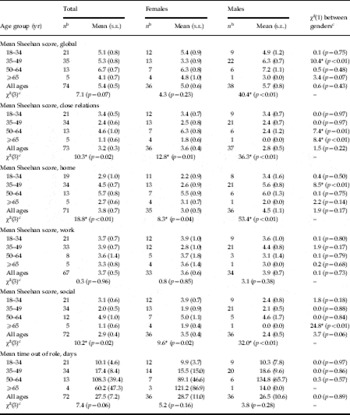
All respondents with 1-year MDE reported some degree of role impairment in at least one domain on the SDS because of depression (Table 4). With regard to global functioning in the 35–49 years age group, males were not only more impaired than females, but also more impaired than males in other age groups. For close relationships, females reported more impairment than males in the older age groups (50–64, ⩾65 years). Females in the 50–64 years age group and males in the 18–34 years age group reported more impairment than other age groups in their own gender respectively. Regarding social functioning, both genders in the 50–64 years age group reported more impairment than other age groups. Likewise, both males and females in the 50–64 years age group reported more impairment at home than other age groups. Moreover, males in middle adulthood (age 35–49 years) reported more impairment at home than middle-age females. For the domain of work, there was no significant difference between genders and among age groups.
Role impairment by 1-year MDE shown by mean Sheehan scoreFootnote a by age×gender category
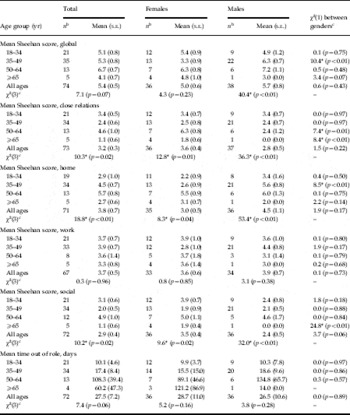
MDE, Major depressive episode s.e., standard error; df, degrees of freedom.
a 0, no interference; 1–3, mild interference; 4–6, moderate interference; 7–9, severe interference; 10, very severe interference.
b Cases with a valid Sheehan severity score or no. of days out of role, among those with 1-year MDE.
c 3 df tests for significant difference across age groups and 1 df tests for significant difference across genders; odds ratios and significance tests are not presented for the models where the size of the subsample is <15, or the count of the dependent variable is <5. Significance tests are also omitted if the dependent variable has no variation (all 0s or all 1s).
* Significant (p<0.05).
We also cross-tabulated gender and age group for those reporting 1-year MDE and severe impairment as indicated by an SDS score of ⩾7 (results available upon request). Males in the 35–49 years age group were more likely than their female counterparts to report severe global impairment and impairment in the home domain; females in the 50–64 years age group were more likely to report impairment in close relationships than females in other age groups. As for mean days out of role, respondents in the 50–64 years age group reported substantially more impairment (108.3 days) than other age groups; the difference was significant at trend level (p=0.06).
Mental and physical co-morbidity of 1-year MDE
Co-morbidity was high between 1-year MDE and any other DSM-IV disorders (OR 22.0, 95% CI 9.8–49.7, Wald χ2=58.3, p<0.01). Over half (52.5%, s.e.=8.3%) of those with 1-year MDE reported any other mental disorder(s). Anxiety disorders were the most commonly associated group of disorders (OR 28.8, 95% CI 11.9–69.6, Wald χ2=58.3, p<0.01); 39% (s.e.=8.9%) of those reporting 1-year MDE reported any of them. The association strengthened [χ2(2)=34.6, p<0.01] with increasing age (age 18–34 years, 22.6%, OR 10.2; age 35–49 years, 36.9%, OR 43.7; age 50–64 years, 67.4%, OR 70.7). Specifically, generalized anxiety disorder (OR 8.9) and specific phobia (OR 3.7) were associated with MDE, especially in the age range of 35–49 years (OR 20.3 and OR 4.6 respectively). Substance-use disorders were significantly associated with 1-year MDE (OR 7.5), as was intermittent explosive disorder in the age range of 18–34 years (OR 6.7, Wald χ2=6.6, p=0.01). There was no other significant association between MDE and other mental disorders (detailed cross-tabulation for all surveyed mental disorders in all age groups is available upon request).
One-year MDE was also associated with any physical conditions (OR 3.2, CI 1.3–8.0, Wald χ2=6.3, p=0.01). Of those with MDE, 76.8% (s.e.=6.7%) reported at least one physical condition. The youngest age group (18–34 years) reported the largest number of physical conditions including frequent or severe headache (17.5%, OR 6.2), back or neck pain (46.9%, OR 4.8), other chronic pain (31.1%, OR 7.7) and seasonal allergy (23.9%, OR 3.7). They were also more likely to report three or more physical conditions (28.4%, OR 12.2). There were specific associations between particular age groups and physical conditions, such as middle adulthood and heart disease (16.1%, OR 2.9), or late adulthood and arthritis or rheumatism (67.2%, OR 8.0). Headache and MDE were associated in all age groups and the association increased with age [χ2(2)=17.2, p<0.01]. The strength of association between MDE and physical conditions was not as strong as between MDE and other mental disorder, but such associations were of a greater variety (detailed cross-tabulation is available upon request).
One-year treatment among age groups and sociodemographic correlates of receiving treatment
Only 22.7% (s.e.=9.7%) of those with any severity of 1-year MDE sought treatment in the same year. Specifically, 18%, 5.2% and 12.4% were treated in the general medical, mental health, and complementary–alternative medical sectors respectively. Respondents in middle adulthood (35–49) were the least likely to be treated [χ2(3)=13.7, p<0.01]. Among the 29 respondents who reported severe impairment, only one received treatment in the complementary–alternative medical sector. None was treated in any other sector.
Because of small cell sizes for treatment and no respondent with severe impairment received treatment from the mental health sector, only a few associations were found between receiving any treatment and sociodemographic correlates. Respondents with 1-year MDE and low-average income (40.4%, OR 23.3) were more likely to receive any treatment in the same year compared with higher income groups [χ2(2)=8.6, p=0.01].
Discussion
Our prevalence estimates of DSM-IV MDE (1.8% 1-year and 3.6% lifetime) are intermediate between previous national epidemiological surveys (<1% lifetime for affective disorder) (Twelve Region Psychiatric Epidemiological Study Work Group, 1986; Wang et al. Reference Wang, Wang, Shen, Zhang, Li, Chen, Huang, Tu, Ning, Fu, Ji, Liu, Wu, Luo, Zhai, Yan and Meng1998) and recent regional surveys (Shi et al. Reference Shi, Zhang, Xu, Phillips, Xu, Fu, Yuan, Zhou, Wang, Zhang and Yu2005; Pan et al. Reference Pan, Jiang, Yang, Na, Fu, Yu, Yu, Liu, Liu, Wang, Li, Yan and Zhang2006; Lu et al. Reference Lu, Ruan, Huang, Yao, Dang and Gao2008) in China. Given the rapid social change and marked regional diversity in the country and the methodological differences across the surveys, such within-country variation is expected (Kessler et al. Reference Kessler, Berglund, Demler, Jin, Koretz, Merikangas, Rush, Walters and Wang2003). Whether the causes are substantive, methodological, or a combination of both, it would appear that the prevalence of depression found in Chinese surveys remains in the low-average range of worldwide estimates (Andrade et al. Reference Andrade, Caraveo-Anduaga, Berglund, Bijl, De Graaf, Vollebergh, Dragomirecka, Kohn, Keller, Kessler, Kawakami, Kiliç, Offord, Ustun and Wittchen2003; Demyttenaere et al. Reference Demyttenaere, Bruffaerts, Posada-Villa, Gasquet, Kovess, Lepine, Angermeyer, Bernert, Girolamo, Morosini, Polidori, Kikkawa, Kawakami, Ono, Takeshima, Uda, Karam, Fayyad, Karam, Mneimneh, Medina-Mora, Borges, Lara, Graaf, Ormel, Gureje, Shen, Huang, Zhang, Alonso, Haro, Vilagut, Bromet, Gluzman, Webb, Kessler, Merikangas, Anthony, Korff, Wang, Alonso, Brugha, Aguilar-Gaxiola, Lee, Heeringa, Pennell, Zaslavsky, Ustun and Chatterji2004). This finding is congruous with a previous cross-national survey which demonstrated that the prevalence of depression was lower in Taiwan and Korea than non-Asian countries (Weissman et al. Reference Weissman, Bland, Canino, Faravelli, Greenwald, Hwu, Joyce, Karam, Lee, Lellouch, Lepine, Newman, Rubio-Stipec, Wells, Wickramaratne, Wittchen and Yeh1996), and the finding of significantly lower rates of depression in Chinese residents than matched non-Chinese subjects in a large US community survey (Parker et al. Reference Parker, Chan and Hadzi-Pavlovic2007).
Although the WMH surveys used the same survey instrument, within-country variations in methodology and diagnostic threshold could preclude a meaningful cross-national comparison of prevalence (Chang et al. Reference Chang, Hahm, Lee, Shin, Jeon, Hong, Lee, Lee and Cho2008; Henderson & Andrews, Reference Henderson and Andrews2008). Thus, it is instructive to examine the characteristics of depression in Chinese people beyond prevalence. For example, the ratio of 1-year:lifetime prevalence of MDE among our respondents was approximately 1:2. This is broadly consistent with surveys (range 1:3 to 2:3) conducted in American, Asian and European countries using a similar methodology (Andrade et al. Reference Andrade, Caraveo-Anduaga, Berglund, Bijl, De Graaf, Vollebergh, Dragomirecka, Kohn, Keller, Kessler, Kawakami, Kiliç, Offord, Ustun and Wittchen2003). This consistency confirms that major depression is an episodic and often chronic disorder in the community. Another cross-nationally consistent finding is about increased suicidality and impairment. Although our respondents with MDE reported lower QIDS symptom severity and less severe impairment in SDS life-domains than their US counterparts, they demonstrated a comparable number of days out of role due to their depression (Kessler et al. Reference Kessler, Berglund, Demler, Jin, Koretz, Merikangas, Rush, Walters and Wang2003).
Regarding sociodemographic correlates and risk factors, most of our findings were cross-nationally consistent. The significant associations, such as among younger adults (age 18–49 years) and between disrupted marital status and MDE, are known epidemiological findings (Kessler et al. Reference Kessler, Berglund, Demler, Jin, Koretz, Merikangas, Rush, Walters and Wang2003). Likewise, the non-significant association between age and 1-year MDE prevalence and an earlier age of onset in females than males were consistent with Western surveys (Andrade et al. Reference Andrade, Caraveo-Anduaga, Berglund, Bijl, De Graaf, Vollebergh, Dragomirecka, Kohn, Keller, Kessler, Kawakami, Kiliç, Offord, Ustun and Wittchen2003; Marcus et al. Reference Marcus, Young, Kerbera, Kornstein, Farabaugh, Mitchell, Wisniewski, Balasubramani, Trivedi and Rush2005). Although the age of onset of our sample was somewhat older (30.3 years) than the typical age period (early twenties) found in Western surveys, the finding still speaks for depression as typically an illness of young adult onset. That the mean number of lifetime episodes we found was similar to other surveys further attests to depression as being a recurrent disorder (Andrade et al. Reference Andrade, Caraveo-Anduaga, Berglund, Bijl, De Graaf, Vollebergh, Dragomirecka, Kohn, Keller, Kessler, Kawakami, Kiliç, Offord, Ustun and Wittchen2003).
Our findings on psychiatric co-morbidity were also consistent with Western studies in showing that anxiety disorders, especially generalized anxiety disorder, were most commonly associated with depression (Weissman et al. Reference Weissman, Bland, Canino, Faravelli, Greenwald, Hwu, Joyce, Karam, Lee, Lellouch, Lepine, Newman, Rubio-Stipec, Wells, Wickramaratne, Wittchen and Yeh1996; Andrade et al. Reference Andrade, Caraveo-Anduaga, Berglund, Bijl, De Graaf, Vollebergh, Dragomirecka, Kohn, Keller, Kessler, Kawakami, Kiliç, Offord, Ustun and Wittchen2003; Kessler et al. Reference Kessler, Berglund, Demler, Jin, Koretz, Merikangas, Rush, Walters and Wang2003). This is also true of the finding of significant co-morbidity between depression and a range of physical conditions, especially chronic pains (Radat & Swendsen, Reference Radat and Swendsen2005).
One cross-nationally discrepant finding is the insignificant gender difference in both the 1-year and lifetime prevalence of MDE, including across different age groups. In the 35–49 years age group specifically, males (3.6%) demonstrated an even higher lifetime prevalence of MDE than females (2.3%). It is noteworthy that a smaller than expected gender difference in the prevalence of depression was repeatedly found in community surveys in China (Wang et al. Reference Wang, Wang, Shen, Zhang, Li, Chen, Huang, Tu, Ning, Fu, Ji, Liu, Wu, Luo, Zhai, Yan and Meng1998; Shi et al. Reference Shi, Zhang, Xu, Phillips, Xu, Fu, Yuan, Zhou, Wang, Zhang and Yu2005; Lu et al. Reference Lu, Ruan, Huang, Yao, Dang and Gao2008) as well as in Chinese communities in the USA (Takeuchi et al. Reference Takeuchi, Chung, Lin, Shen, Kurasaki, Chun and Sue1998), Taiwan (Hwu et al. Reference Hwu, Yeh and Chang1989) and Hong Kong (Chen et al. Reference Chen, Wong, Lee, Chan-Ho, Lau and Fung1993; Lee et al. Reference Lee, Tsang and Kwok2007a). Moreover, although clinical prevalence studies are biased by help-seeking behavior, a lack of gender difference was often found among psychiatric and general hospital out-patients with depression in China (Kleinman, Reference Kleinman1982; Zhang et al. Reference Zhang, Li, Wang, Man, Wang and Phillips2006). Future research should examine whether gender-related differences in social role, endurance and reporting of affective psychopathology contribute to the atypical gender pattern of depression found in Chinese people. Given the unstable gender comparison found in our oldest age group (⩾65 years), future studies need to be carried out in a larger sample of elderly metropolitan China respondents.
Perhaps the finding of the most public health concern in the present study is the very low treatment rate of MDE. This is despite the fact that Beijing and Shanghai already have better health care resources than most other parts of China. In particular, nearly none of the respondents with severe depression received any treatment. This is congruous with a cross-national study showing that China exhibited one of the greatest unmet needs for treatment among the WMH participating countries, being only better than Nigeria with regard to treatment rate (Wang et al. Reference Wang, Aguilar-Gaxiola, Alonso, Angermeyer, Borges, Bromet, Bruffaerts, de Girolamo, de Graaf, Gureje, Haro, Karam, Kessler, Kovess, Lane, Lee, Levinson, Ono, Petukhova, Posada-Villa, Seedat and Wells2007). Psychiatric stigma and low mental health literacy may not be the only explanations for the situation. This is because help seeking among our respondents with MDE was uniformly low across both psychiatric and non-psychiatric (e.g. general medical doctors, spiritual advisers, herbalists, acupuncturists, and any other healing professionals) professional treatment sectors. The low treatment rate is also likely to be due to diminishing medical insurance coverage and the increasingly self-financed system of medical care in China following recent economic reforms.
Our study has the following limitations. First, China is heterogeneous and consists in particular of about 75% of rural areas. Consequently, our findings may at best be generalized to a quarter of the Chinese population. Second, lifetime occurrence of depressive symptoms and age of onset were assessed by retrospective self-report without independent validation. Although systematic reviews have shown that adults can recall past experiences with sufficient accuracy (Wells & Horwood, Reference Wells and Horwood2004), recall bias could arise from forgetfulness, stigma-induced concealment, or other unknown sources. Third, we have not conducted any validation study of the SDS in Chinese populations even though judgment of the different domains of functional impairment may vary across cultures. Fourth, because of the low treatment rate, the small number of sample during cross-tabulation of specific sociodemographic variables limited the power of analysis on correlates of treatment. Finally, the WMH CIDI diagnosis of MDE is based on the DSM-IV, which requires depressed mood and loss of interest as mandatory core symptoms for diagnosis. Since Chinese and other Asian people with depression may experience cognitive impairment and somatic symptoms as core symptoms (Kleinman, Reference Kleinman1982; Chang et al. Reference Chang, Hahm, Lee, Shin, Jeon, Hong, Lee, Lee and Cho2008), the present study might have excluded subthreshold or atypical cases of depression that would otherwise have qualified for being a case and treatment in a clinical setting. With these caveats, the present study is the first of its kind to provide a range of epidemiological findings on depression in China that should be re-examined in future surveys.
Acknowledgements
The Chinese WMH Survey Initiative is supported by the Pfizer Foundation in conjunction with the World Health Organization WMH Survey Initiative. We thank the WMH staff for assistance with instrumentation, fieldwork, and data analysis. These activities were supported by the United States National Institute of Mental Health (R01MH070884), the John D. and Catherine T. MacArthur Foundation, the Pfizer Foundation, the US Public Health Service (R13-MH066849, R01-MH069864 and R01 DA016558), the Fogarty International Center (FIRCA R01-TW006481), the Pan American Health Organization, Eli Lilly and Company, Ortho-McNeil Pharmaceutical, Inc., GlaxoSmithKline, Bristol–Myers Squibb and Sanofi Aventis. A complete list of WMH publications can be found at http://www.hcp.med.harvard.edu/wmh/
Declaration of Interest
None.