, jīng 稤 and the miscopied form lǜe 掠, originated from its radical character jīng 京, meaning “warehouse, granary”, and that jīng 椋 was widely used in Koguryŏ, Paekche, Silla and Japan. Historical documents during the Koryŏ period also attest to the use of jīng 椋. The authors have reconstructed the lexical form of jīng 椋 as the disyllabic pre-Old Korean **ku

Previous studies and relevant data on jīng 椋
Historians and linguists from Korea, Japan, and China have discussed at length the origin and early-period usage of the sinograph jīng 椋Footnote 1 on the Korean Peninsula and in Japan, especially after many pieces of mokkan (木簡, “wooden slips/tablets/documents”) were unearthed in Korea and Japan.
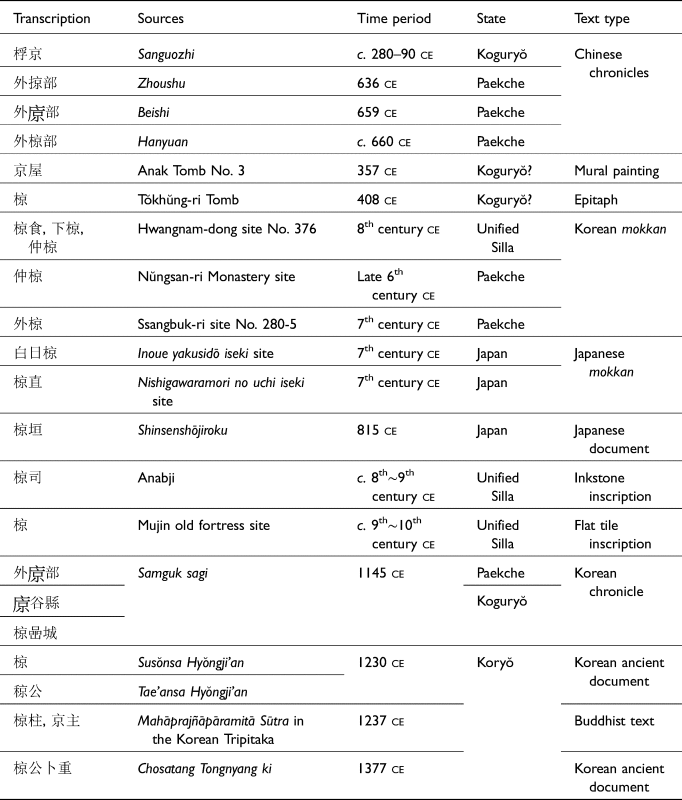
Initially, Inaba (Reference Inaba1936), utilizing various primary sources from China, Korea, and Japan, argued that the vernacular Japanese reading (kun'yomi 訓読み, “semantic reading”) of jīng 椋 was kura (クラ [ku.ra]) in ancient Japan as a kokuji (國字 コクジ, “Japanese national kanji”) meaning “warehouse, granary”. Inaba further pointed out that the occurrence of jīng 椋 in jīngbù 椋部, the name of the Paekche bureau recorded in Chinese and Korean chronicles and historical documents, was related to the word fújīng 桴京 from Koguryŏ, as recorded in the “Account of Eastern Barbarians” (Dongyi zhuan 東夷傳), in the “History of the Wei” (Weìshu 魏書) of the Records of the Three Kingdoms (Sanguozhi 三國志, c. 280–90 ce, Chen Reference Chen1962). Table 1 summarizes the various sources from China, Korea and Japan discussed below.
Primary sources for jīng 椋 from China, Korea, and Japan

Specifically, the word fújīng 桴京 occurs in the sentence 無大倉庫, 家家自有小倉, 名之為桴京 (“People [in Koguryŏ] do not have a large warehouse. Every family has a small granary, it is called fújīng”). In Chinese lexicology, the character fú 桴 means “ridge pole, raft”, a meaning that could potentially allude to the wooden structure of a granary. Consequently, fújīng 桴京 may either be a semantographic Chinese literal translation which has a vernacular reading in the language or languages of Koguryŏ, or a phonetic rendering of an underlying disyllabic word or phrase as a Chinese loanword.
However, the Paekche bureau attested as jīngbù 椋部 in the Records of the Three Kingdoms was written with several variations in later sources. These include: as wàilǜebù 外掠部 in the History of the Zhou (Zhoushu 周書, Linghu 636 ce [Reference Linghu1971]), where this lǜe 掠 (“to rob”) could be an incorrect form of jīng 椋 since the radicals mù 木 (“tree, wood”) and shǒu 扌 (“hand”) were frequently mixed in Chinese calligraphy, especially in the cursive script; as wàijīngbù 外椋部 in a Chinese reference book called Literature Garden (Hanyuan 翰苑, c. 660 ce); and as wàijīngbù 外 部 in the History of the Northern Dynasties (Beishi 北史, Li 659 ce [Reference Li1974]). This rendering of wàijīngbù 外
 部 was also adopted in the later Korean source, the History of the Three Kingdoms (Samguk sagi 三國史記, Kim 1145 ce [Reference Kim1928]). Certainly, this jīng
 could be another variant (yitizi 異體字) of jīng 椋 widely used on the Korean peninsula.
Moreover, another Koguryŏ toponym from the “Geography Treatise” (Chiri-ji 地理志) of the Samguk sagi used jīng  in the phrase
 谷縣,一云首乙吞 (“Jīnggŭ county was called shǒuyǐtūn [during the Koguryŏ period as its previous name]”). This jīng
 is attested in the rime book called Collected Rimes (Jiyun 集韻, 1037 ce), 《廣雅》: ‘倉也.’ 音 ‘居卿切,’ 與‘京’同音 (“The Expanded Erya Footnote 2 [Guangya 廣雅, 227–232 ce] recorded the meaning granary as cāng 倉. Its fanqie 反切 spellingFootnote 3 is jūqīng qiè 居卿切, the same as the phonetic reading of jīng 京”). Thus, we can infer that jīng
 was still used during the Koryŏ period (918–1392 ce) when the Samguk sagi was completed, with the meaning of “granary”. Additionally, another Koguryŏ toponym recorded as Kyŏng'am-sŏng (椋喦城, Kyŏng'am fortress) in the “Chiri-ji” used jīng 椋.
Later, after more and more excavations and decipherment of mokkan in Korea and Japan during the 1970s, Yi Sŏng-si (Reference Yi1997, Reference Yi2005) deemed jīng 椋 as a sinograph originally from the Koguryŏ area on the Korean peninsula, which had then spread to Paekche, Silla, and finally Japan. Shortly after, Kim (Reference Kim2008), Lee (Reference Lee2013), Dai (Reference Dai2016), Kwon (Reference Kwon2018, Reference Kwon2021b), and Lee (Reference Lee2019) further agreed with Yi's assessment. Among these, Dai (Reference Dai2016) argued that jīng 椋 had originated from the character jīng 京, based on two pieces of evidence. One being the word jīngwū 京屋 as the earliest attestation, referring to a warehouse for meat occurring in a mural painting from Anak Tomb No. 3 (安岳三號古墳, 357 ce) in South Hwanghae province. The other one being jīng 椋, which occurred in the epitaph from the Tŏkhŭng-ri Tomb (德興里古墳, 408 ce) in South P'yŏng'an Province (see Figure 1(a) and Table 1).
Jīng 椋 in different types of sources from China, Korea, and Japan
Sources: (a): Chu Reference Chu1972: Fig. 59
(b) Ch'angwŏn Research Institute of Cultural Heritage 2006: 200, fig. 281
(c) Ch'angwŏn Research Institute of Cultural Heritage 2006: 218, fig. 300
(d) Pak, Chŏng, and Yun Reference Pak, Chŏng and Yun2008: 185, fig. 2
(e) Kyŏngju National Museum. (eds) 2002: 48, fig. 61
(f) Lim Reference Lim1989: 104, fig. 5

Generally, previous studies on mokkan from Korea and Japan agreed that jīng 椋 meant “warehouse, granary” in Old Korean (hereafter OK). There are several well-established Korean mokkan fragments bearing the sinograph jīng 椋. The first piece (Figure 1(b)) is from Unified Silla around the eighth century, and was excavated at Hwangnam-dong (皇南洞) site no. 376, Kyŏngju, in 1994. According to the Dictionary of Korean Sinographs on Mokkan (Son Reference Son2011), the text on the front was determined to read 五月廿六日, 椋食 內之, 下椋有 … (“On 26th May, the grain in the warehouse [?] inside, there are … in the warehouse below”) and on the back 仲椋食有廿?二石 (“The warehouse in the middle has twenty-two? dan 石 (Chinese units) of grains”). In total, jīng 椋 occurred three times, separately, in the words jīngshí 椋食 (“the grain in the warehouse”), xiàjīng 下椋 (“the warehouse below”) and zhòngjīng 仲椋 (“the warehouse in the middle”). The second piece (Figure 1(c)) is from Paekche dating to around the end of the sixth century, excavated at the Nŭngsan-ri (陵山里) Monastery site, Puyŏ, in 2002. The specific part of the inscriptions was 三月 仲椋… (“In March, the warehouse in the middle …”). That is, jīng 椋 occurs once in the word zhòngjīng 仲椋 (“the middle warehouse”). The third piece (Figure 1(d)) is also from Paekche and dates from around the seventh century. It was excavated in Ssangbuk-ri (雙北里) site No. 280-5, Puyŏ, in 2008. The front inscription was 外椋卩鐵 (“outside warehouse bureau, iron”). Jīng 椋 is attested in the name of the Paekche bureau wàijīngbù 外椋卩. The simplified sinograph bù卩 is a vernacular variant of the bù 部 (“bureau”).
Additionally, one inkstone unearthed from Anabji (雁鴨池) in East Kyŏngju was inscribed with jīngsī 椋司 (“official of the warehouse”) (Figure 1(e)). And one flat tile from the Unified Silla unearthed at the Mujin (武珍) old fortress site in Kwangju was inscribed with the variant of jīng 椋 (Figure 1(f)).
Regarding the Japanese mokkan, 22 pieces contain the sinograph jīng 椋Footnote 4. For instance, according to Inukai (Reference Inukai2011), a piece of mokkan bearing jīng 椋 was unearthed in the Inoue yakusidō iseki (井上藥師堂遺跡) site, Ogori, Fukuoka prefecture, and probably made in the seventh century. The inscription is deciphered as 寅年白日椋稻遣人 (“in the year of yin [the third of the twelve earthly branches], white sun warehouse sent people”). Here the word báirìjīng 白日椋 (“white sun warehouse”) is interpreted as a name for that warehouse, which combines the word báirì 白日 and jīng 椋.
Another important piece, unearthed in the Nishigawaramori no uchi iseki (西河原森ノ內遺跡) site, Shiga prefecture, was inscribed in the latter half of the seventh century and on the front reads 椋直伝之… (“the official of the warehouse said…”). Regarding the word jīngzhí 椋直 (“the official of the warehouse”), Kim (Reference Kim2008) argued that it corresponded to the OK word cāngzhí 倉直, which has the same meaning – “official of the warehouse”. Certainly, not only this word cāngzhí 倉直, but also, as mentioned in Inaba (Reference Inaba1936: 7), a similar family name probably originated from the Korean peninsula called kura kaki (椋垣, クラカキ >クラガキ, > kuragaki; via rendaku 連濁, “sequential voicing”) which was recorded in the New Selection and Record of Hereditary Titles and Family Names (Shinsen shōjiroku 新撰姓氏錄, Fujiwara et al. 815 ce [Reference Fujiwara no Otsugu, Fujiwara no Sonohito and Saeki1981]), and has the same kun'yomi as kura kaki (倉牆, クラカキ), kura kaki (倉垣, クラカキ) and kura kaki (藏垣, クラカキ). Jīng 椋 in the family name kura hito (椋人) in Western Old Japanese (WOJ) corresponds to its Man'yōgana (万葉仮名)Footnote 5 form kura (久良, クラ) in kura hito (久良毘登, クラヒト). Meanwhile, according to Tsukishima (Reference Tsukishima2007, vol. 3: 174), the kunten (訓點) glossing of different kinds of kanji (漢字, カンジ) such as sō (倉, ソウ), zō (蔵, ゾウ), and kyō (京 キョウ), ko (庫, コ) are all attested by reading the same kun'yomi, kura (クラ), meaning “warehouse, granary”.
Importantly, according to Kwon's (Reference Kwon2018, Reference Kwon2021b) textual field work on Buddhist texts and various Korean historical documents during the Koryŏ period, jīng 椋 was deemed as a variant of its radical character jīng 京, while having the same Sino-Korean reading as jīng 京. Specifically, according to Kwon (Reference Kwon2021b), jīng 椋 occurred in two different versions of the Buddhist text Mahāprajñāpāramitā Sūtra (大般若波羅蜜多經), in the Korean Tripitaka (高麗大藏經, c. 1237 ce). Figure 2 (a-e) shows how the character appears in the Wŏljŏng Temple (月精寺) version, which was reprinted in 1856, and the Tong'guk University (東國大學校) version, which was reprinted in 1963. We can note that the same carver's name on different pages was written as jīngzhù 椋柱 in both versions, such as page 56:02, 56:12 and 56:20; however, they were corrected as jīngzhŭ 京主 on pages 56:17 and 56:19. Thus, we propose that the alternation between jīngzhù 椋柱 and jīngzhŭ 京主 is the core piece of evidence to consider the Sino-Korean pronunciation of jīng 椋 and jīng 京 during the Koryŏ period as being the same. Meanwhile, we infer that jīng 椋 was used consistently until the end of the thirteenth century.
Jīng 椋 in two different versions of the Korean Tripitaka
Source: Taken by the author Kwon In-han (In Kwon Reference Kwon2021b: 218–19)

Furthermore, according to Kwon (Reference Kwon2021b), jīng 椋 is well attested in the Korean documents Investigation Report of Susŏn Temple (Susŏnsa Hyŏngji'an 修禪寺形止案, c. 1230 ce; Lee Reference Lee1987: 62) and the Investigation Report of Tae'an Temple (Tae'ansa Hyŏngji'an 大安寺形止案, c. 1230 ce). In the former, jīng 椋 occurred in the Literary Sinitic sentence 鍮銅樓椋參間丙向 (“There are three brass warehouses in the building, and the direction is bing [the third heavenly stem]”). In the latter, it occurred as its variant jīng 稤 in the sentence 稤公房梗四間 (“Four rooms for the official of the warehouse”). The left radical hé 禾 (“rice plant”) of variant jīng 稤 is either a scribal error or variant of the radical mù 木, by adding one stroke at the top. In addition, this jīnggōng 稤/椋公 occurred in the Korean name jīnggōng-bŭzhòng (椋公卜重) in A Crossbeam Memo at the Josadang Shrine (Chosdang Tongnyang ki 祖師堂棟樑記, 1377 ce; see Lee Reference Lee1987: 236), which was discovered in the Pusŏksa Monastery (浮石寺), Yŏngju (榮州), North Kyŏngsang province. We propose that the initial word jīnggōng 稤/椋公 is a title referring to the official of the warehouse in this monastery during the Koryŏ period, and bŭzhòng 卜重 is likely his name.
1. A new analysis of the origin of jīng 椋
In order to analyse the origin of jīng 椋, initially, it is necessary to examine its status in Chinese historical lexicology. According to the “Explaining Trees” (Shimu 釋木) section in the first surviving Chinese dictionary Approaching Elegance (Erya 爾雅, c. third century bce,Zong, Chen, and Xiao Reference Zong, Chen and Xiao2003: 1122), jīng 椋 was glossed as 椋, 即來 (“Jīng is called jílái”). In other words, jīng 椋 was defined as a disyllabic word (i.e. lianmianci 連綿詞, “binding word”) jílái 即來, the name of a tree.Footnote 6 Shortly after, during the Jin dynasty Guo Pu 郭璞 (276–324 ce) annotated the Erya as 椋, 材中車輞也 (“The wood of jīng was used for making the rims of wheels”).
Meanwhile, the earliest sinograph dictionary Explaining Graphs and Analyzing Characters (Shuowenjiezi 說文解字, 121 bce) also stated that 椋, 即來也 (“Jīng meant jílái.). In the rime book Broad Rimes (Guangyun 廣韻, 1008 ce, Yu Reference Yu2008), jīng 椋 was recorded as 椋, 木名 (“Jīng is a tree name”). However, jīng 椋 was arranged in the small rime group of liáng 良 which implies that its fanqie spelling should be lǚzhāng qiè (呂張切; The consonant of jīng 椋 follows the consonant of lǚ 呂, the vowel and tone follow those of the character zhāng 張). That is, jīng 椋 and liáng 良 had the same pronunciation during the Middle Chinese (MC) period (Yu Reference Yu2008: 171–2). Hereafter, the Jiyun adopted the same definitions from the Erya and the Shuowenjiezi.
In sum, as a tradition in the Chinese historical lexicology, jīng 椋 referred to “the name of a tree”, not “warehouse, granary”, and it had the same pronunciation as jīng 京, later being pronounced the same as liáng (良 MC [ljaŋ]; Schuessler Reference Schuessler2009: 84).
However, according to Collections of Glosses of Sinographs (Zong, Chen, and Xiao Reference Zong, Chen and Xiao2003: 72), we can confirm that the radical character jīng 京 has four main meanings: “artificial hill, high mound”; “large square granary”; “grand, big”; “capital, metropolis”. Focusing on the second meaning, in the Shuowenjiezi it states that a round granary is called qūn 囷, and a square one is called jīng 京. According to Inaba (Reference Inaba1936: 18), the usage of the jīng 京 meaning “large square granary” was attested in the Writings of Master Guan (Guanzi 管子, 475–221 bce), and in the “Biography of Canggong” (Canggong zhuan 倉公傳) of the Records of the Grand Historian (Shiji 史記, c. 90 bce). Additionally, in the Annotation and Proofs of the expanded Erya (Guangya shuzheng 廣雅疏證, Wang Reference Wang1795 ce), the pre-eminent scholar Wang Niansun (王念孫, 1744–1832 ce) deemed that jīng 京, yú 庾, lǐng 廩, lù 廘, kuài 廥, gòng 㔶, xiān 廯 and qūn 囷 occurring in the “Explaining Buildings” (Shigong 釋宮) section of the Guangya had the same meaning as cāng 倉, that is, “warehouse, granary” (Zhang 2019: 503–4).
Hence, in the present article we further argue that jīng 椋 meaning “warehouse, granary” was independently created from its radical character jīng 京 on the ancient Korean Peninsula, probably Koguryŏ. First, if jīng 椋 was borrowed from Chinese, there should be some evidence of jīng 椋 referring to a tree on the peninsula or in Japan, but there is no such evidence. Second, if jīng 椋 was created from its radical character jīng 京, then jīng 椋 should not refer to a tree on the peninsula, but rather to a granary or warehouse, and it does. More importantly, during the Koryŏ period it was interchangeable with jīng 京 “granary”, as argued in Kwon (Reference Kwon2021b). Third, it is reasonable to address why jīng 椋 was created, or reinvented, on the Korean Peninsula. Adding the radical mù 木 to jīng 京 “granary” could serve to disambiguate the two meanings of “granary” jīng 京 and “capital” jīng 京. Based on the contemporary occurrence of jīngwū 京屋 from Anak Tomb No. 3, and jīng 椋 from the inscription 食一椋記之 (“The grains recorded in one warehouse”) of the Tŏkhŭng-ri Tomb (Figure 1(a)), we propose that jīng 京 and jīng 椋 coexisted as variants in the fifth century in Koguryŏ and possibly other areas of the Korean Peninsula. Besides, Holm (Reference Holm2013: 66) refers to the phenomenon of non-Chinese creating “new” sinographs resembling pre-existing obscure sinographs as “reinvention”. This obscure jīng 椋 denoting the name of a tree in the Erya is thus a mere coincidence with the reinvented “granary, warehouse” jīng 椋.
In summary, jīng 椋 originated from its radical character jīng 京 “warehouse, granary”, and it was widely used in Koguryŏ, Paekche, Silla, Japan and Koryŏ. Jīng 椋 had its miscopied form lǜe 掠 and its variant jīng  .
2. A lexical reconstruction of jīng 椋
Regarding the lexical reconstruction of jīng (椋), we consider three aspects: whether jīng 椋 is related to Old Chinese (OC) readings; how to reconstruct jīng 椋 in OK internally; and how to reconstruct jīng 椋 in OK externally by utilizing the kun'yomi of jīng 椋 in WOJ kura (クラ).
First, it is certain that the OK lexical form of jīng 椋 and its phonological reconstruction are not related to OC. In OC, the initial of jīng 京 has been reconstructed as the consonant cluster *kr-, and the whole syllable was OC *kraŋ (Schuessler Reference Schuessler2009: 76). By Later Han Chinese (LHan) this OC consonant cluster *kr- simplified to consonant *k-. The potentially relevant initials of jīng 椋 should be either [k-] or [l-]. In Chinese historical phonology, there were two groups of characters that share the same phonological series as jīng 京. One group had the onset [k-] in the Groups of the Initial Jiàn (jianmu 見母) in MC, including characters such as jǐng 景 (“scenery”), jīng 鯨 (“whale”), jīng 鶁 (“a bird name”), jīng 婛 (“a character used for female names”), jīng 猄 (“a deer name”) and jīng 麖 (“black deer”). The other group had the onset [l-] in the Groups of the Initial Lái (Laimu 來母) in MC, such as liáng 涼/凉 (“cool”), liàng 諒 (“excuse”), liàng 晾 (“sun-dry”), lǜe 掠 (“rob”), liáng 䣼 (“mixed starch”) and liàng 鍄 (“a percussion instrument”). However, [l-] is unlikely the consonant of jīng 椋, because jīng 椋 and jīng 京 were interchangeable and both of them had the same initial consonant [k-]. In spite of this, the vowel of jīng 椋 is still not certain since Sino-Korean readings in pre-OKFootnote 7 could be different from Modern Standard Sino-Korean (MSSK),Footnote 8 in which jīng 椋 and jīng 京 have the same reading kyŏng (경 [kjǝŋ]; MC [kjɐŋ]).
Second, the correspondence between jīnggŭ  谷 and shǒuyǐtūn 首乙吞/呑 in the same toponym of Koguryŏ is the only piece of evidence that could be utilized to reconstruct the lexical form of jīng 椋 in OK internally. Here, the phonogram tūn 吞/呑 (“to swallow”) should be a variant of character gŭ 谷 (“valley”), which due to the similar shapes, were frequently mixed in OK texts. This is explicitly stated in the case of another toponym of Koguryŏ in the “Chiri-ji” (vol. 37) of the Samguk sagi, 習比谷, 一作呑 (“Xíbǐ-gŭ, gŭ 谷 is also written as its variant gŭ 呑”). The exact meaning of gŭ 谷/呑 in OK is still undeciphered, but scholars generally agree that it had a similar meaning to Chinese “valley” (Lee and Ramsey Reference Lee and Ramsey2011: 78, and Vovin Reference Vovin2010: 25, 142).
Regarding the phonological relation between jīng  and shǒuyǐ 首乙, Inaba (Reference Inaba1936: 20) reconstructed shǒuyǐ 首乙 as *sulr; Beckwith (Reference Beckwith2004: 81, 150) reconstructed as *śur~śuir, and Lee (Reference Lee2019: 13) deciphered as *sul (술 [sul]). However, they should all be rejected. We argue that the shǒu 首 (MC [śjǝuB/C]) of shǒuyǐ 首乙 was not a phonogram, but a semantogram meaning “head”,Footnote 9 and yǐ 乙 (the second of the ten Celestial Stems) represented a coda [-l] as a common phonogram in OK. This shǒuyǐ 首乙 corresponded to the Korean word kol (골, [kol], “head”) and kori (고리, [ko.li], “head”), as well as in the compound words mŏlidkol (머릿골, [mǝ.lit.k'ol], “head”) and kolch'i (골치, [kol.tʃhi], “head”). Kori (고리) is attested as a Late Middle Korean (LMK) word in the Translation of “Old Cathayan” (Pŏnyŏk Nogŏldae 翻譯老乞大, 1517 ce; 1: 28) and kol [kol] is attested in the word kolch'i (골치) in the Collection of Sinographs to Enlighten the Ignorant (Hunmongjahoe 訓蒙字會, Ch'oe 1527 ce [Reference Ch'oe1971]: 54, 206). Hence, the phonological reading of jīng
 in OK could be reconstructed as *kol.
Separately, the Korean word kotjip (곳집, [kos.tʃhip]) meaning “granary” is attested in the Translation of “Interpreter Pak” (朴通事諺解 Pak T'ongsa ŏnhae, 1677 ce; 2:56). We propose that kotjip is a compound from *kol-s-chip by combining the native Korean words kol (골, [kol], “warehouse, granary”) and chip (집 [tʃip], “house”), while undergoing the elimination of the lateral coda [-l] and the addition of a possessive -ㅅ- [-s-]. This is in opposition to a compound from *kù (庫, 고 ko, “storehouse”)-s-chip by combining the Chinese loanword kù 庫 and the Korean word chip (집), because in the history of Korean morphology, there is no evidence that kù 庫 was ever a monosyllabic word. Besides, if the sound change *kol-s-chip > ko-s-chip had existed, the tone of ko- in ko-s-chip is still unknown. However, theoretically LMK kol and OK *kol with a rising tone reflecting an earlier disyllable pre-OK **koL.raH would be highly possible.
Third, the kun'yomi of jīng 椋 in WOJ is kura (クラ [ku.ra]). It is uncertain whether WOJ kura was from a pre-Old Japanese (OJ) *ku.ra or a pre-OJ *ko.ra, because there is no pre-raising (i.e. pre-OJ *o > u) attestation of the word in Japanese sources. As a result, we suppose that WOJ kura should be a simple and direct borrowing from the reading of jīng 椋 in pre-OK, either **kuL.raH or **koL.raH. However, there is need for further discussion on two points: whether externally the first vowel of pre-OK **Cu/o.Ca (C = consonant) was **u or **o; and how pre-OK **Cu/o.Ca changed to OK **CoC (i.e. pre-OK **kuL/oL.raH > OK *kolR). Fortunately, we have two related words to consider as valid arguments: “bear” and “crowd”.
2.1 “Bear”
The Chinese chronicle History of the Liang (Liangshu 梁書, 636 ce; Yao Reference Yao2020: vol. 54), records the phonograms gùmá 固麻 (MC [kuoC-ma]) occurring in the name of the Paekche capital xióngjīn 熊津 (“bear ferry”) as corresponding to the semantogram xióng 熊 (“bear”). Subsequently, in the Chronicles of Japan (Nihon shoki 日本書紀, Toneri et al. 720 ce (Reference Toneri and Yasumaro1994); vol. 14, 26), compiled in the eighth century under Toneri Shinnō 舍人親王 and Ō no Yasumaro 太安萬侶, the word “bear” was recorded as phonograms jiŭmá 久麻 in the same toponym of Paekche, kuma nori (久麻怒利, クマノリ) and komu nari (久麻那利, コムナリ).Footnote 10 This word “bear” in WOJ was a simple and direct borrowing from pre-OK (Vovin Reference Vovin2005: 128; Reference Vovin2010: 32, 143).
However, in the Nihon Shoki, jiŭmá (久麻) has two kinds of katakana reading, glossed kuma (クマ [ku.ma]) and komu (コム [ko.mu]). If we treat the phonogram jiŭ 久 as a preserved Paekche spelling, it could represent a Paekche pre-OK **kwə or **ko (cf. The Lhan reading *kwuəB in Schuessler (Reference Schuessler2009: 95)). Such a Paekche pre-OK [kwə] or [ko] would be borrowed into pre-OJ as *ko, which then became OJ Go-on (吳音) reading ku after raising of *o to u. The raising of Proto-Japonic (PJ) *o > u in pre-OJ before the Suiko period (592–628 ce) has been convincingly demonstrated by Miyake (Reference Miyake2003), who provides philological evidence. Meanwhile, the other reading kuma may be considered as a later reading from Paekche that was incorporated into WOJ as a loanword without sound change.
Alternatively, Kōno (Reference Kōno1987: 77) argues the first reading komu to be a later form that developed from the Korean (Silla?) borrowed into pre-OJ in the monosyllabic form kom after the Korean had already dropped the final vowel a. However, this word was preserved as koma (고⋅마, [ko.maH]), an earlier disyllabic form in the Korean alphabet hangul (한글), in the Song of the Dragons Flying Through Heaven (Yongbi ŏch’ŏn ka 龍飛御天歌, 1445~1447 ce, vol. 3: 15. See Han'gŭl hak-hoe Reference Han'gŭl hak-hoe1992: 4866), but as a monosyllabic form kom (:곰, [komR]) in the Hunmongjahoe (Ch'oe 1527 ce [Reference Ch'oe1971]: 45, 187). Komu could be from a dialect reading while corresponding to pre-OK **koma in Silla.
Hence, regarding the “bear” in pre-OK and OK, we propose that there are two possible diachronic sound changes. First, vowel **o of pre-OK **koma raised to **u in Paekche, and then changed to monosyllabic OK *kom diachronically, as a result of undergoing the contraction of two syllables, as the formulation pre-OK **Co.Ca > **Cu.Ca > OK *CoC. Second, pre-OK **ku.ma in Paekche and pre-OK **ko.ma in Silla had coexisted as different dialect readings on the ancient Korean Peninsula and both were borrowed into pre-OJ. In other words, Paekche was a pre-OK dialect with **uFootnote 11 corresponding to Silla **o in Han-type languages. And the pre-OK **ko.ma in Silla survived and experienced syllabic contraction, that is pre-Ok **Co.Ca > OK *CoC. In the present article, we suppose that the later one is simpler and more elegant. By analogy, we infer that jīng (椋) probably could be read as pre-OK **kuL.raH in Paekche and as pre-OK **koL.raH in Silla.
2.2 “Crowd, throng, group”
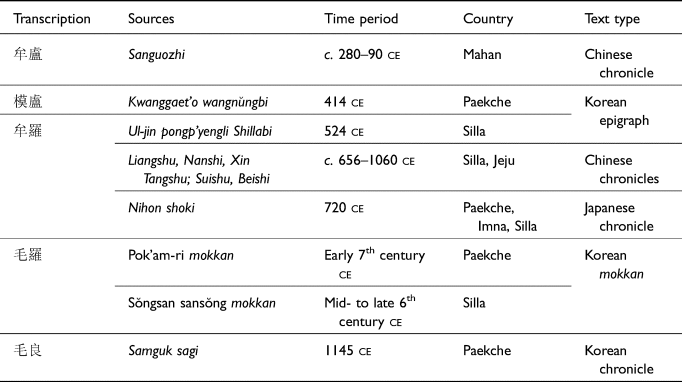
The other word, we speculate, has the meaning of “crowd, throng, group” (Table 2 lists five phonographic renderings). Initially, in the toponyms of Mahan (馬韓) from the Sanguozhi, this word was recorded with the phonograms móulú 牟盧 (Lhan *mu-lɑ > MC [mjǝu-luo]) in the name of the polities, zīlí-móulú-guó 咨離牟盧國 (“zīlí-throng?-state”) and móulú bēilí-guó 牟盧卑離國 (“throng?-community-state”). Móulú 牟盧 further occurs in the toponym of Paekche móulú-chéng 牟盧城 (“throng?-city”) in the Gwanggaeto Stele (Kwanggaet'o wangnŭngbi 廣開土王陵碑, 414 ce. See Hŏ Reference Hŏ1984: 6–7). The same inscription separately attests phonograms mólú 模盧 (LHan *mɑ-lɑ > MC [muo-la]) in fortress names of jiù-mólú-chéng 臼模盧城 (“jiù-throng?-city”) and gè-mólú-chéng 各模盧城 (“gè-throng?-city”). This mólú 模盧 is likely a variant of móulú 牟盧.
Phonographic renderings of “crowd, throng, group”

The same underlying word also occurs as móuluó 牟羅 (MC [mjǝu-la]) in the toponym of Silla, jūfá-móuluó 居伐牟羅 (“big community-throng?”) from the inscription of the Ul-jin pongp'yŏngni Silla Stele (蔚珍鳳坪里新羅碑, 524 ce. See Kwon Reference Kwon2021a). Meanwhile, this móuluó 牟羅 occurred in various Chinese chronicles, One is in the pre-OK appellation for the city of Silla, jiàn-móuluó 健牟羅 (MC [kjɐn-mjǝu-la], “big throng?”; 健 > LMK k’ŭn큰) in the History of the Liang, the History of Southern Dynasties (Nanshi 南史, Li 659 ce [Reference Li1975]: vol. 54) and the New History of the Tang (Xin Tangshu 新唐書, Ouyang, 1060 ce [Reference Ouyang1975]: vol. 220). The other is in the previous name of Jeju Island, dān-móuluó-guó 聃/躭牟羅國 (“dān?-throng?-state”) in the History of the Sui (Suishu 隋書, Wei 656 ce [Reference Wei2019]: vol. 81) and the Beishi (Li 659 ce [Reference Li1974]: vol. 94).
Importantly, this móuluó 牟羅 also occurred in the Nihon Shoki (vol. 17, 19) in toponyms of all the southern Korean polities. They are in the toponyms of Paekche, puna mura (布那牟羅, フナムラ, “puna throng?”); toponyms of Mimana (任那) including kushi mura (久斯牟羅, クシムラ, “kushi throng?”), ishiki mura no sashi (伊斯枳牟羅城, イシキムラノサシ, “ishiki throng city”), kure mura no sashi (久禮牟羅城, クレムラノサシ, “kure throng? Fortress”), toriki mura (騰利枳牟羅, トリキムラ, “toriki throng?”) and mushiki mura (牟雌枳牟羅, ムシキムラ, “mushiki throng?”); and the toponym of Silla kuda mura (久陀牟羅, クダムラ, “kuda throng?”). As we know, móuluó 牟羅 corresponds to WOJ mura (ムラ, [mu.ra]) in Man'yōgana, and it is the kun'yomi of sinograph cūn 村 (“village”). We consider it reasonable to incorporate a Chinese administrative unit cūn 村 into WOJ, while still keeping its pre-OK reading and recording as phonograms móuluó 牟羅.
In addition, the same word was attested as máoluó 毛羅 (MC [mâuC-la]) in Korean mokkan. Thereupon, one piece is from Paekche around the early seventh century, which was excavated at Pok'am-ri (伏巖里) Tombs in Naju (羅州) in 2008. The other is from Silla around the mid- to late sixth century ce, which was excavated at Sŏngsan sansŏng (城山山城) fortress site in Ham'an (咸安) in 2017 (See Kwon, Kim, and Yun Reference Kwon, Kim and Yun2015). Furthermore, the word meaning “village” was attested as máoliáng 毛良 (MC [mâuC-ljaŋ]) in the toponym of Paekche, máoliáng-fūlǐ 毛良夫里 (“throng? Community”; MC [mâuC-ljaŋ-pju-ljɨB]) in the “Chiri-ji” (vol. 36, 37) of the Samguk sagi. The phonogram liáng 良 represents OK *ra, the same as the phonogram occurring in the hyangga (鄉歌, “local songs”)Footnote 12 and in Man'yōgana as ra (良, ラ, [ra]) (Lee Reference Lee1998: 79).
Overall, móulú 牟盧, mólú 模盧, móuluó 牟羅, máoluó 毛羅 and máoliáng 毛良 could be different phonograms recording the same Korean word. Thus, is it possible to reconstruct their pre-OK pronunciations? Or even what kind of sound change would have occurred among different phonograms before LMK?
First, we deem móu 牟 as either pre-OK **mu or **mo.
According to Kwon (Reference Kwon2021b: 8), móu 牟 occurring in the king's name of Silla inscribed as móujízhì 牟即智 from the inscription of the Ul-jin pongp'yŏngni Silla Stele mentioned above, corresponds to its variant pseudo-lìng 另 (“another, separate”) in the queen's name of Silla lìngjízhì 另即智 which was inscribed on the Ul-ju ch’ŏnjŏnni Stele (Ul-ju ch’ŏnjŏnli sŏsŏk 蔚州川前里書石, 525–539 ce). We propose that this pseudo-lìng 另 is a graphic error for móu 牟 because the real sinograph lìng 另 is not attested until the rime book Collected Rimes of Five Kinds of Sounds (Wuyin jiyun 五音集韻, 1212 ce), and its lexical usage is attested even later, in the Qing dynasty (see The editorial board of Great Dictionary of Sinographs 2010: 621). In addition, it is impossible for a Korean word to begin with a liquid as lìng 另 if we assume the initial lawFootnote 13 to have existed in the history of the Korean language.
Importantly, pseudo-lìng 另 occurred in the official name of Silla recorded as lìnglìzhì 另力智, which is attested both in the inscriptions from the Land Occupation Monument of Chinhŭngwang in Ch'angnyŏng (昌寧真興王拓境碑, 561 ce) and Campaign Monument of Chinhŭngwang in Ma'ullyŏng (磨雲嶺真興王巡狩碑, 568 ce) (See Hŏ Reference Hŏ1984: 35–36, 40–42). And this pseudo-lìng 另 corresponded to the phonogram wŭ 武 (“martial”; MC [mjuB]) in the same name wŭlìzhì 武力智, which was inscribed on the Silla Chŏksŏng Stele in Tanyang (丹陽新羅赤城碑, before 551 ce, Hŏ Reference Hŏ1984: 33–34). Hence, we argue that móu 牟, its variant pseudo-lìng 另, and their homonymic phonogram wŭ 武 might have the same phonological reading.
However, we should note that móu 牟 had three instances of fanqie spellings in the Jiyun. They are: mífú qiè 迷浮切, LHan *mu; mòhòu qiè 莫後切, LHan *moB; and mòhóu qiè 莫候切, LHan *moC. Though the Jiyun was completed in 1037 ce and while it is not clear what substratum influence may underlie the different fanqie spellings, we could suppose that móu 牟 does not necessarily represent pre-OK **mu, but might also represent pre-OK **mo.
Second, the phonogram wŭ 武, with its LHan *muɑB reading, belongs to the *-uɑ rhyme class that merged with the LHan *-uo rhyme class into the rhyme yú (yuyun 虞韻; MC [-ju]) in Chinese historical phonology. It is likely that *-uɑ merged with *-uo before raising to [-ju], that is wŭ 武 LHan *muɑB > *muoB > MC [mjuB]. Thus, this pre-OK phonogram wŭ 武 might also represent pre-OK **mu or pre-OK** mo.
Third, the phonogram mó 模 (LHan *mɑ > MC [muo]) in mólú 模盧 has an o-vocalism. The phonogram máo 毛 (LHan *mɑu > MC [mâu]) in máoluó 毛羅 could also have an o-vocalism in early Sino-Korean. Though máo 毛 represents mo (モ, [mo]) in Man'yōgana, we cannot determine for certain its pre-OK and OK reconstruction before the eighth century. However, it is simpler and more elegant to assume that máo 毛 was mo, as in modern Sino-Korean, since there is no evidence that Korean ever had syllables ending in *-aw. Thus, it is likely that LHan *mɑu was pronounced in pre-OK as **mo and represented pre-OK **mo, as MC [mâu] was borrowed as Sino-Korean mo. There is no independent evidence for LHan *-ɑu characters being read with **-u in pre-OK.
Fourth, the reflexes of this word in LMK are attested as well. They are words meaning “group”, such as mure (무레; < mul#e 물에, where mul [물] is a noun and e [에] is a locative case suffix) in the Detailed Articles on the Record of Sakyamuni (Sŏkposangjŏl 釋譜詳節, 1446 ce; vol. 51: 5) and A Vernacular Interpretation of the Sūraṁgama sūtra (Nŭngŏm kyŏng ŏnhae 楞嚴經諺解, 1461 ce; vol. 9: 103), and mul (물) in the Wŏrin sŏkpo [月印釋譜, a book combining the Songs of the Moon's Imprint on the Thousand Rivers (Wŏrin ch’ŏn'gang jigok 月印千江之曲) and the Detailed Articles on the Record of Sakyamuni together, 1459 ce; vol. 2: 24] and the Pak T'ongsa ŏnhae (vol. 1: 41) (See Nam Reference Nam1997). The latter mul (물) should have a rising tone, not a high tone in LMK, if it came from an earlier disyllabic word pre-OK or OK *mu.ra or *mo.ra.
However, in Modern Standard Seoul Korean (MSSLK), this LMK mul (물) remained not only as a prefix mol- (몰-) “to all in one place” in verbs, such as molmol- (몰몰-, “put something all in one place”), molmil- (몰밀-, “push all in one place”), molbak-(몰박-, “fix all in one place”), but also as a root mol- (몰-) in certain compounds, including molmae (몰매, “group beating”), molp'yo (몰표, “overwhelming vote”), etc. Besides, the words such as moeho- (뫼호-, “to gather, to accumulate”) in the Nŭngŏm kyŏng ŏnhae (vol. 8: 118) and moho- (모호-, “to gather, to accumulate”) in the Translation of “Old Cathayan” (Nogŏldae ŏnhae 老乞大諺解, 1670 ce; Ch'o, vol. 1: 13. See Nam Reference Nam1997) have their reflexes in MSSLK: they are transitive verb mo’ŭ- (모으-, “to gather, to accumulate”), passive verb mo'i- (모이-, “to gather, to meet, to get together”) and noun mo'im (모임, “meeting, get-together”).Footnote 14
Regarding the Korean words meaning “crowd, throng, group”, we propose that pre-OK **mu.ra and **mo.ra have coexisted as dialect differences in Paekche and Silla. Pre-OK **mu.ra in Paekche might directly have reflexes in LMK mul as a result of the contraction between two syllables, while MSSLK mol- could be a substratum from pre-OK **mora in Silla by undergoing the same syllabic contraction as the formulation pre-OK **mu/o.ra > OK *mu/ol.
Therefore, according to the examples of the words “bear” and “crowd, throng, group” discussed above, we infer that the readings of jīng 椋 in pre-OK and OK could be reconstructed and they could have experienced similar sound changes by analogy. That is pre-OK **kuL.raH and **koL.raH both existed while **u in Paekche corresponding to **o in Silla, and OK *kolR survived as a Sillaic substratum form in Korean language history.
3. Conclusion
In this article, we conclude that the relevant data on the usage of the sinograph jīng 椋 have all been collected, and its origin and lexical form have been analysed and reconstructed on the basis of textual examination using various primary sources from China, Korea and Japan. Jīng 椋, and its variants jīng  , jīng 稤 and miscopied form lǜe 掠, all originated from its radical character jīng 京 “warehouse, granary”, and it was widely used in Koguryŏ, Paekche, Silla, and Japan. Meanwhile, the usage of jīng 椋 was attested in historical documents during the Koryŏ period. The lexical form of jīng 椋 could be demonstrated convincingly as disyllabic pre-OK **kuL.raH in Paekche and **koL.raH in Silla, and monosyllabic OK *kolR as a survived Sillaic substratum by undergoing the syllabic contraction and liquid change **-r- > *-l; that is pre-OK **koL.raH > OK *kolR. The kun'yomi of jīng 椋, WOJ kura (クラ, [ku.ra]) is a well-preserved loan from either pre-OK **kuL.raH or **koL.raH.
Competing Interests
None
Acknowledgements
The authors are grateful to anonymous referees, professors and friends including Wang Weihui 汪維輝, Yao Yongming 姚永銘, Zhen Dacheng 真大成, Andrew Logie, Nathan Loggins, Walter Strömberg and Ye Yanpeng 葉雁鵬. This article benefited greatly from their very valuable insights and detailed comments. All mistakes and shortcomings that remain are the authors’.
Abbreviations
- LHan
= Later Han Chinese
- LMK
= Late Middle Korean
- MC
= Middle Chinese
- MSSK
= Modern Standard Sino-Korean
- MSSLK
= Modern Standard Seoul Korean
- OC
= Old Chinese
- OK
= Old Korean
- OJ
= Old Japanese
- PJ
= Proto-Japonic
- pre-OK
= pre-Old Korean
- WOJ
= Western Old Japanese
 is not attested in the Guangya as cited in Inaba (
 is only attested in the Jiyun; however, it is possible that the Jiyun's editors had cited an earlier version of the Guangya.