1. Introduction
After a c. 1 Ga hiatus in the sedimentary record, the reappearance of Neoproterozoic iron formations (IFs) may imply a reprise of anoxic, ferrous deep oceans. It is also evident that IFs are often sandwiched by glaciogenic lithologies, suggesting that they are closely associated with the earlier Cryogenian (Sturtian) glacial epoch (c. 725 Ma) (Klein & Beukes, Reference Klein and Beukes1993; Klein & Ladeira, Reference Klein and Ladeira2004; Baldwin, Turner & Kamber, Reference Baldwin, Turner and Kamber2012; Cox et al. Reference Cox, Halverson, Minarik, Le Heron, Macdonald, Bellefroid and Strauss2013). An association between the Neoproterozoic IFs and glaciation is also a central component of the Snowball Earth model (Hoffman et al. Reference Hoffman, Kaufman, Halverson and Schrag1998; Hoffman & Schrag, Reference Hoffman and Schrag2002). The model provides a scenario that a worldwide ice-covered ocean allowed hydrothermal iron to accumulate which supplies a possible source of iron for IFs. Recent geochemical research involving rare earth elements (REE) and Nd isotopes has shown that the low-temperature hydrothermal source or leaching from the continental margin supplies a significant iron source (Halverson et al. Reference Halverson, Poitrasson, Hoffman, Nedelec, Montel and Kirby2011; Cox et al. Reference Cox, Halverson, Poirier, Le Heron, Strauss and Stevenson2016), at least for the IFs of Australia, Canada and America. Nevertheless, it is generally accepted that the widespread Neoproterozoic glaciations played a key role in the distribution and deposition of these IFs. However, the environmental conditions, iron sources and formation mechanisms leading to Neoproterozoic IFs are still highly debated.
Due to the development of continuous Cryogenian successions in South China, its sediment record is ideal for reconstructing the environmental context during this period. However, less attention has been paid to the syn-glacial sediment containing the iron formation in contrast to the postglacial sediments (Feng et al. Reference Feng, Chu, Huang, Zhang and Chang2010; Li et al. Reference Li, Love, Lyons, Scott, Feng, Huang, Chang, Zhang and Chu2012). In South China, some iron formation was deposited during the waning period of the Sturtian glaciation, immediately overlying the Chang'an diamictite and belonging to the lowest part of the Fulu Formation (Zhang, Chu & Feng, Reference Zhang, Chu, Feng, Arnaud, Halverson and Shields-Zhou2011). In the Nanhua basin, the widely distributed IF (Fulu IF) is a remarkable signature for regional stratigraphic correlations. As IF holds great potential as a window to Neoproterozoic ocean chemistry, here we present major and trace element measurements, including REE measurements from the Fulu IF, to identify deposition environment and sources of iron as well as regional and possibly global implications.
2. Geological setting and stratigraphic characteristics
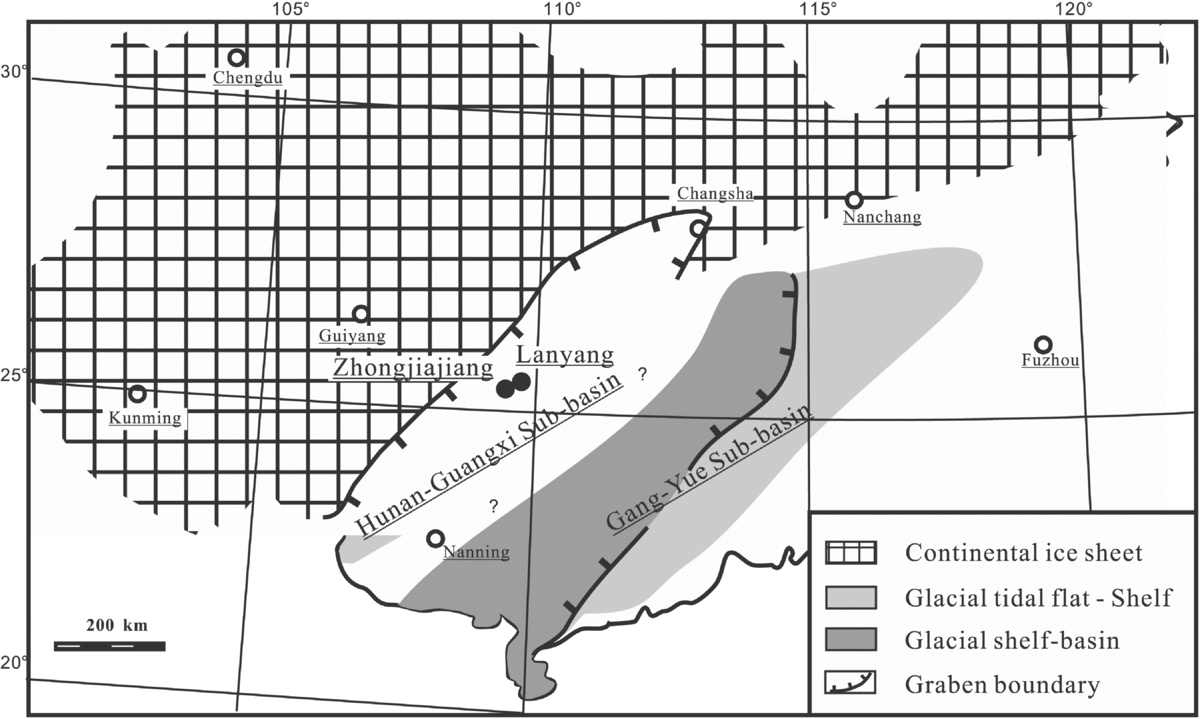
During the break-up of Rodinia, major rift basins formed along the SE and W margins of the South China Craton (Wang & Li, Reference Wang and Li2003). In South China, the Cryogenian successions deposited in the Hunan–Guangxi Sub-basin consist of the Jiangkou Group, Datangpo Formation and Nantuo Formation (Zhang, Chu & Feng, Reference Zhang, Chu, Feng, Arnaud, Halverson and Shields-Zhou2011) (Fig. 1). In the northern part of the sub-basin, the Fulu sandstone is underlain by the Gucheng diamictite, which may be proglacial sediments (Zhang, Chu & Feng, Reference Zhang, Chu, Feng, Arnaud, Halverson and Shields-Zhou2011). Transgressive postglacial black shale of the Datangpo Formation overlies the Fulu Formation and records the termination of glacial conditions. In the southern part of the sub-basin, the early glaciogenic successions up to 1 km thick consist of the Chang'an and Fulu formations, corresponding to the waxing/maximum and waning stage of glaciation respectively (Zhang, Chu & Feng, Reference Zhang, Chu, Feng, Arnaud, Halverson and Shields-Zhou2011).
Tectonic and palaeogeographic context for the Nanhua Basin during the deposition of the Chang'an Formation (after Wang & Li, Reference Wang and Li2003). Solid circles represent the studied section including Lanyang (GPS location: 26°08′56N″109°45′06′E) and Zhongjiajiang section (GPS location: 26°05′23″N 109°42′48′E).

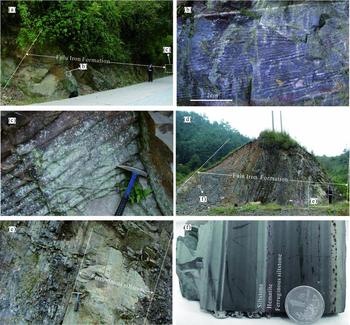
Following the deposition of the Chang'an diamictite, the iron formation appears at the base of the Fulu Formation. In this study, two adjacent sections c. 2 km apart were examined, Lanyang and Zhongjiajiang (Fig. 1). The IF in the Lanyang section reaches a maximum thickness of c. 50.4 m and is composed primarily of hematite, interbedded with laminated siltstone (Fig. 2a, b). The IF in the Zhongjiajiang section is c. 21.9 m thick (Fig. 2d) and consists of laminated iron formation. Laminations of IF are defined by alternating layers of almost pure hematite and siltstone (Fig. 2e, f).
(a) Lower part IF at the Lanyang section. (b) Dark purple layers are hematite. Light purple layers are jasper (iron-rich chert). (c) Wave ripple in the sandstone sandwiched in iron formation in the Lanyang section, indicating deposition above wave base. (d) Outcrop of IF in the Zhongjiajiang section. (e) Detail observation of ferruginous siltstone. (f) Banded ferruginous siltstone and hematite from sample 2.5 in the Zhongjiajiang section.

The maximum age of the Fulu IF comes from a U–Pb zircon age of 715.9±2.8 Ma on tuffuceous siltstone from the Gongdong Formation underlying the Jiangkou diamictites (Lan et al. Reference Lan, Li, Zhu, Chen, Zhang, Li, Lu, Liu and Tang2014). The age from South China implies a synchronous onset of the Sturtian glaciation at c. 716 Ma in at least three palaeocontinents at different latitudes: Arabia–Nubia, Laurentia and South China (Bowring et al. Reference Bowring, Grotzinger, Condon, Ramezani, Newall and Allen2007; Macdonald et al. Reference Macdonald, Schmitz, Crowley, Roots, Jones, Maloof, Strauss, Cohen, Johnston and Schrag2010a ; Rooney et al. Reference Rooney, Strauss, Brandon and Macdonald2015). The minimum age of the Fulu IF is based on a recent U–Pb zircon age of 691.9±8.0 Ma from a tuffaceous siltstone bed within the upper Xieshuihe Formation (Lan et al. Reference Lan, Li, Zhang and Li2015). Therefore, the Fulu IF is constrained to be between c. 716 and 691 Ma.
3. Sample and methods
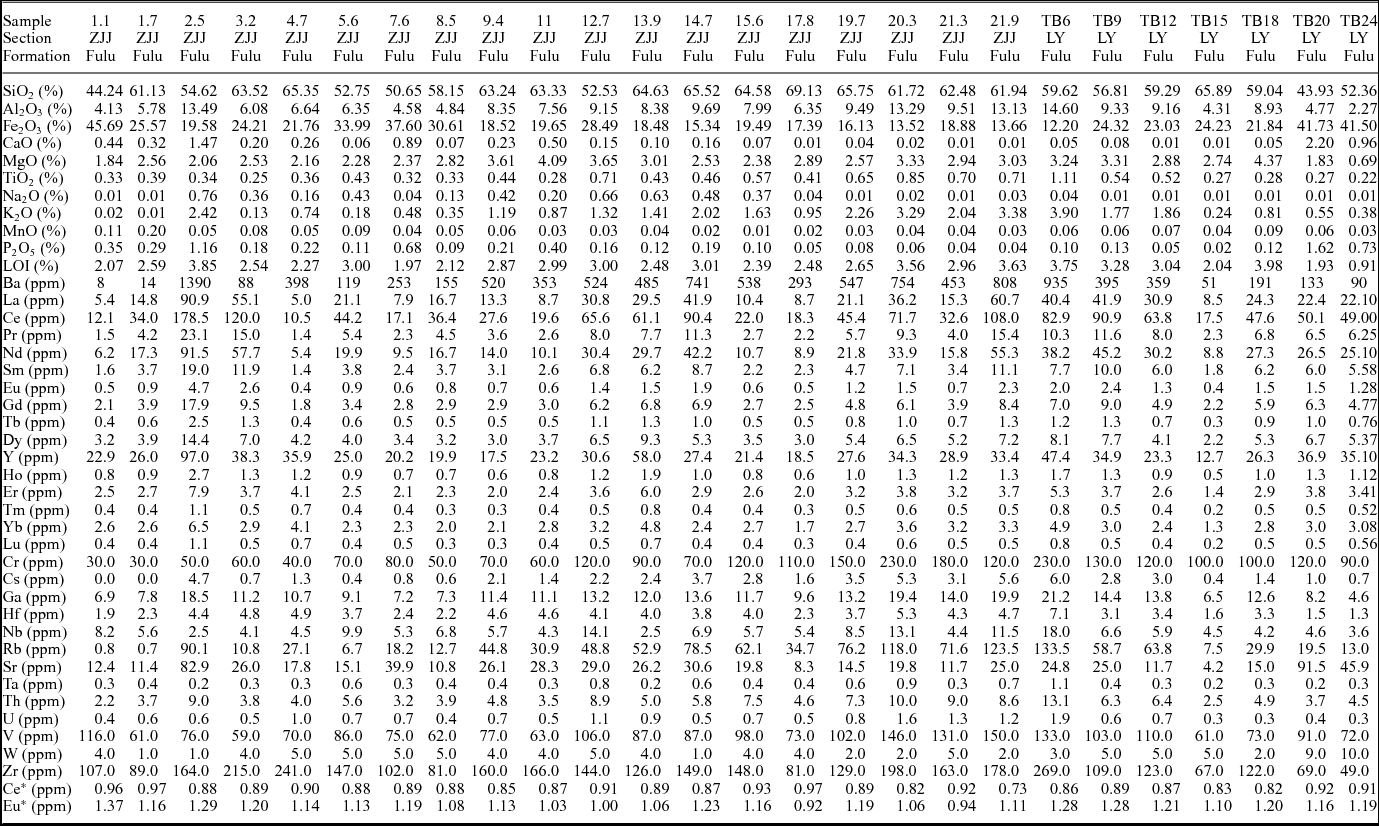
A total of 26 samples from the iron formation of two sections (Zhongjiajiang, Lanyang) were selected for geochemical analysis. The major and trace elements of samples were analysed at the ALS Chemex Company of Guangzhou, China. Table 1 lists the chemical compositions of 26 samples. Sample (0.2 g) is added to lithium metaborate flux (0.9 g), mixed well and fused in a furnace at 1000°C. The resulting melt is then cooled and dissolved in an HNO3 (4%)/HCl (2%) solution. This solution is then analysed by inductively coupled plasma – mass spectrometry in order to obtain trace element data. Loss on ignition (LOI) of samples was determined by heating powders at 1000°C for 2 hours. The decreased weights of the powders were then calculated. In addition, a sample (0.9 g) is mixed with 9.0 g of lithium borate flux (50%–50% Li2B4O7–LiBO2). The mixtures are then fused in an auto-fluxer between 1050 and 1100°C. Major elements were analysed by X-ray fluorescence spectrometer using these fusion glasses.
Summary of major and trace element data on Fulu IF samples

ZJJ:Zhongjiajiang section; LY: Lanyang section.
In this study, rare earth elements + yttrium (REY) data are normalized against Post-Archaean Average Shale (PAAS – subscript SN; Mclennan, Reference Mclennan1989). Normalized REY anomalies (*) are quantified following the methods of Lawrence & Kamber (Reference Lawrence and Kamber2006), and are defined as Ce*=CeSN/(PrSN*PrSN/NdSN), Eu*=EuSN/(SmSN*SmSN*TbSN)1/3. In order to distinguish real shale normalized anomalies on Ce and Eu, this equation avoids using La and Gd, which can be enriched by natural processes and may cause apparent depletions in Ce and Eu anomalies (Lawrence & Kamber, Reference Lawrence and Kamber2006; Ling et al. Reference Ling, Chen, Li, Wang, Shields-Zhou and Zhu2013, and references therein).
4. Results and discussion
4.a. Detrital or authigenic component?
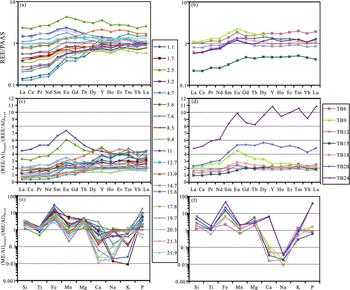
Major element data have generally been applied to distinguish between detrital and hydrogenous deposits. Figure 3 demonstrates that major elements from Fulu IF are significantly enriched in iron relative to the average shale, suggesting that most iron may come from the authigenic deposition from water mass. For the other major elements, Mn, Mg and P of most samples are also enriched compared to average shale. In contrast, Ca, Na and K are depleted relative to average shale.
REY patterns (PAAS-normalized) for the IF of the Zhongjiajiang section (a, c, e) and the Lanyang section (b, d, f), southwestern Hunan, South China. Normalization values of PAAS after McLennan (Reference Mclennan1989).

Iron formation can preserve the information of ocean chemistry, so we expect that this authigenic chemistry can be displayed by REY pattern of IF. Modern seawater exhibits a strong light rare earth elements (LREE) depletion (Elderfield & Greaves, Reference Elderfield and Greaves1982; Piepgras & Jacobsen, Reference Piepgras and Jacobsen1992; Zhang & Nozaki, Reference Zhang and Nozaki1996), which is believed to result from the preferential scavenging of the LREEs (with respect to the middle and heavy REEs). Most of these reported REE data from the Fulu IF of South China share a small characteristic depletion in LREE when normalized to the PAAS composite (Fig. 3). Such LREE depletion is similar to that of modern seawater due to interaction with seawater, suggesting that the REE data in iron formation may preserve an authigenic imprint of contemporary seawater.
4.b. Sources of iron
Considering the Superior-type IFs are always deposited in the shelf area where detrital materials were largely supplied, the high iron contents of the IFs compared to the detrital materials may indicate a mixture from multiple sources (i.e. detrital and authigenic sources). Several possible authigenic sources could be suggested: high-temperature hydrothermal fluids (>250°C), low-temperature hydrothermal alteration of oceanic crust (<250°C), or the leaching of iron from continental margin sediments. The following sections present detail constraints on the sources of iron from the geochemical perspective.
4.b.1. Major elements constraint
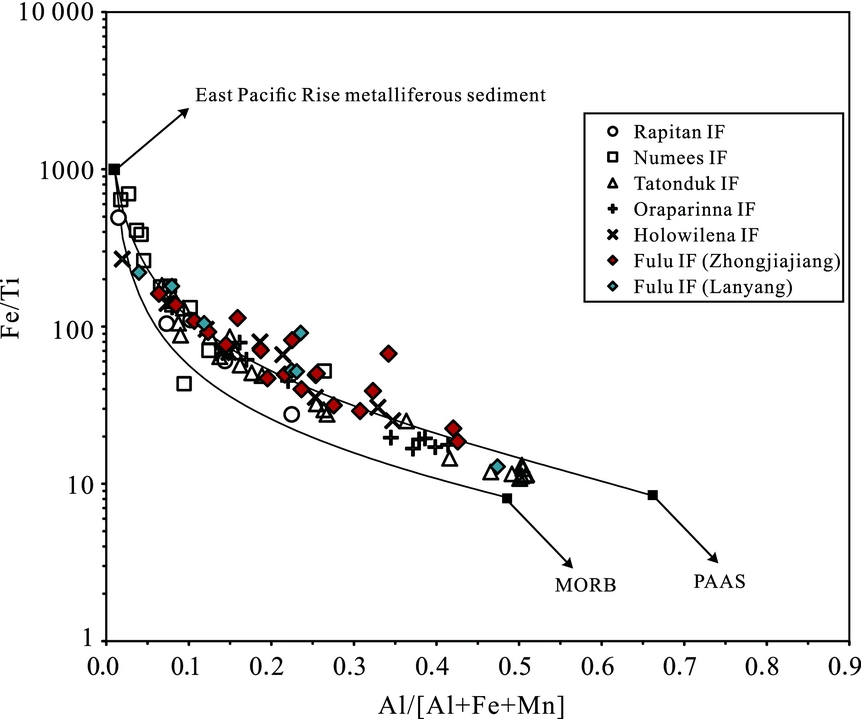
Hydrothermal fluids are characterized by high Fe/Ti and Fe/Al ratios (Bostrom et al. Reference Bostrom, Peterson, Joensuu and Fisher1969; Bostrom, Reference Bostrom1970; Gurvich, Reference Gurvich2006) due to Al being a 3+ and Ti a 4+ cation, which are both highly insoluble in seawater and resistant to hydrothermal alteration. Therefore, using the major element ratios of Fe/Ti and Al/(Al+Fe+Mn), Bostrom et al. (Reference Bostrom, Peterson, Joensuu and Fisher1969) and Bostrom (Reference Bostrom1970) found that near-ridge metalliferous sediments are a mixture of a hydrothermal end-member and detrital material. Based on the major element relationships discussed above, we have plotted Fe/Ti vs Al/(Al+Fe+Mn) along with binary mixing curves between a pure hydrothermal precipitate (East Pacific Rise metalliferous sediments) (Marchig & Gundlach, Reference Marchig and Gundlach1982) and PAAS (Fig. 4). The detrital component seems to be typical clays as represented by the PAAS (Nance & Taylor, Reference Nance and Taylor1976; Taylor & McLennan, Reference Taylor and McLennan1985) rather than continental flood basalt (CFB) composite. Therefore, the detrital materials deriving from weathering of CFB did not contribute to iron sources for Neoproterozoic IFs as suggested by Cox et al. (Reference Cox, Halverson, Minarik, Le Heron, Macdonald, Bellefroid and Strauss2013) (Fig. 4).
Plot of Fe/Ti vs Al/(Al+Fe+Mn) (wt%) for Neoproterozoic IF samples (modified from Bostrom, Reference Bostrom1970). Mixing curve calculated from the end-member compositions of hydrothermal precipitates from East Pacific Rise (EPR) (Bostrom, Reference Bostrom1970), composite shale (PAAS) of Taylor & McLennan (Reference Taylor and McLennan1985) and MORB data (Gale et al. Reference Gale, Dalton, Langmuir, Su and Schilling2013).

Figure 4 shows that the contribution from clay detrital loads is significant for iron sources of the Fulu and other iron formations. This is consistent with the field observations from the Fulu IF that the hematite precipitation was mainly interrupted and diluted by deposition of mud/silt rather than chert (Fig. 2c, e, f), presumably due to a more proximal depositional environment. Similarly, the Tatonduk, Oraparinna and Holowilena IFs contain detrital components to a significant extent. In contrast, the Raptian and Numees IFs contain lower detrital components as suggested by the mixing model (Fig. 4), which is consistent with the common deposits of cherts for the Rapitan IF (Baldwin, Turner & Kamber, Reference Baldwin, Turner and Kamber2012). A likely extra source from the iron formations is hydrothermal fluids.
4.b.2. Eu anomaly
Interpretations of iron sources for IF using REE patterns and other geochemical proxies like Nd isotope composition are based on the assumption that REE and Fe pathways were coupled during transport and deposition of materials for IF, although this assumption has not been independently tested. The presence or absence of an Eu anomaly (Eu*) is especially sensitive to hydrothermal inputs because Eu abundance in hydrothermal fluids is a function of solution temperature (Danielson, Moller & Dulski, Reference Danielson, Moller and Dulski1992). Remarkably positive Eu anomalies are often observed in the high-temperature fluids and therefore can be used to identify a high-temperature hydrothermal component (or lack thereof) in authigenic deposits (e.g. Olivarez & Owen, Reference Olivarez and Owen1991). Large Eu anomalies are commonly observed in Archaean marine chemical sediments (e.g. Danielson, Moller & Dulski, Reference Danielson, Moller and Dulski1992; Bau & Moller, Reference Bau and Moller1993; Bau & Dulski, Reference Bau and Dulski1996; Planavsky et al. Reference Planavsky, Bekker, Rouxel, Kamber, Hofmann, Knudsen and Lyons2010 and references therein), even in Superior-type IFs, indicating long-distance transport of REY in anoxic ancient oceans. In contrast, most Palaeoproterozoic Superior-type (sediment-hosted) IFs manifest a smaller to absent Eu anomaly (Kato, Yamaguchi & Ohmoto, Reference Kato, Yamaguchi, Ohmoto, Kesler and Ohmoto2006). The lack of Eu anomalies in modern seawater and significantly small positive Eu anomalies in Proterozoic BIFs relative to Archaean ones suggest the prevalence of more oxidized post-Archaean oceans with minor high-temperature hydrothermal input into the seawater (Planavsky et al. Reference Planavsky, Bekker, Rouxel, Kamber, Hofmann, Knudsen and Lyons2010).
Samples from the Fulu IF contain a slightly positive Eu anomaly calculated from adjacent Sm and Tb concentrations (i.e. Eu*=EuSN/(SmSN*SmSN*TbSN)1/3). The Eu anomaly ranges from 0.92 to 1.37 (1.14 average), similar to the other syn-glacial IFs (Table 1; Cox et al. Reference Cox, Halverson, Minarik, Le Heron, Macdonald, Bellefroid and Strauss2013). Obviously, Neoproterozoic IFs are characterized by slightly positive Eu* during the Cryogenian period. In other words, some global factors rather than local factors like dilution from detrital components control the common geochemistry. It is noted that the Numees and Rapitan IFs with small detrital loads (Fig. 4) also show similar slightly positive Eu anomalies. Nevertheless, slightly positive Eu anomalies from Neoproterozoic iron formations imply that a high-temperature hydrothermal imprint is in fact preserved in these Neoproterozoic IFs. The slightly positive Eu anomalies may result from the development of oxidization of the deep ocean like the modern ocean. In this case, the injected REEs are scavenged by precipitating hydroxides at the site of the hydrothermal vents. However, our compiled data of Ce anomalies in this study show that oxygen would be depleted in deep ocean during the glacial period although some local areas may be oxidized (see Section 4.c). Thus, we can envision that iron linked to the high-temperature fluids would be easily transported to the shelf area. Therefore, iron from high-temperature fluids can be excluded for the formation of IFs, and some other sources should be considered.
4.b.3. Other possible iron sources
Sediments are another important source of iron to the modern oceans (Elrod et al. Reference Elrod, Berelson, Coale and Johnson2004; Scholz et al. Reference Scholz, Severmann, Mcmanus and Hensen2014; Severmann et al. Reference Severmann, Lyons, Anbar, Mcmanus and Gordon2008). Indeed, even for the Archaean and Proterozoic banded iron formation, a large component of the iron is biologically recycling from continentally derived sediments and compatible with the benthic iron shuttle in modern anoxic basins and oxygen minimum zones (Li, Beard & Johnson, Reference Li, Beard and Johnson2015). If leaching from continental sediments provides the major component for the IF, the negative iron isotope would be expected in IFs like some of the Archaean ones (Li, Beard & Johnson, Reference Li, Beard and Johnson2015). However, most Neoproterozoic iron formations have positive iron isotope (δ56Fe) values (Halverson et al. Reference Halverson, Poitrasson, Hoffman, Nedelec, Montel and Kirby2011; Cox et al. Reference Cox, Halverson, Poirier, Le Heron, Strauss and Stevenson2016). In South China, the Fulu IF from the Fengmu section (adjacent to the Zhongjiajiang section) has positive iron isotope (δ56Fe) values ranging from 1.08‰ to 1.48‰ (Yan et al. Reference Yan, Zhu, Tang and Zhu2010) despite sparse iron isotope data. Therefore, the leaching process from the sediments of the continental margin cannot be a significant contributor to the iron source of the Fulu IF.
Another possible iron source may come from the low-temperature hydrothermal alteration of oceanic crust. In contrast to high-temperature solutions, they do not display positive Eu anomalies, as suggested by Bau & Moller (Reference Bau and Moller1993). Therefore, Halverson et al. (Reference Halverson, Poitrasson, Hoffman, Nedelec, Montel and Kirby2011) proposed that the iron sources may come from the low-temperature hydrothermal alteration of oceanic crust. Indeed, the widespread Neoproterozoic glaciations are conducive to the low-temperature hydrothermal alteration of oceanic crust suggested by geochemical modelling (Le Hir et al. Reference Le Hir, Ramstein, Donnadieu and Godderis2008). Accordingly, more iron resulting from low-temperature hydrothermal alteration will supply the major iron sources for the formation of Neoproterozoic IFs. The low-temperature hydrothermal alteration of oceanic crust will produce the fluids with primitive Nd isotope compositions, presenting an alternative explanation for the Nd isotope of Neoproterozoic IF similar to mean composition of ocean-ridge basalts (MORB; Cox et al. Reference Cox, Halverson, Poirier, Le Heron, Strauss and Stevenson2016).
4.c. Ce anomaly and marine redox structure
True negative Ce anomalies, as defined in the equation Ce*=CeSN/(PrSN*PrSN/NdSN), are shown in Table 1. In the modern ocean, seawater contains a prominent negative cerium anomaly with respect to Chondritic Uniform Reservoir (CHUR; Elderfield & Greaves, Reference Elderfield and Greaves1982; Zhang & Nozaki, Reference Zhang and Nozaki1996). Given dissolved oxygen, Ce3+ in marine water is sequestered as CeO2 or Ce(OH)4 largely by Mn-hydroxides and oxyhydroxides (Elderfield et al. Reference Elderfield, Hawkesworth, Greaves and Calvert1981). This relative depletion in Ce results from the oxidation of Ce3+ to Ce4+ and incorporation into ferromanganese nodules and crusts (Elderfield et al. Reference Elderfield, Hawkesworth, Greaves and Calvert1981; Nath et al. Reference Nath, Roelandts, Sudhakar, Pluger and Balaram1994), which conversely preserve strong positive cerium anomaly. Thus Ce is sensitive to the redox state of the water column, because under oxic conditions it is preferentially converted to Ce4+ and removed from seawater, whereas under anoxic conditions it should behave like its neighbouring REEs. Based on the observation from laboratory experiments, Mn oxides preferentially scavenge Ce in contrast to iron oxyhydroxides in the pH range relevant to marine conditions (Koeppenkastrop & Decarlo, Reference Koeppenkastrop and Decarlo1992; De Carlo & Wen, Reference De Carlo and Wen1997; Ohta & Kawabe, Reference Ohta and Kawabe2001). However, marine sediments rich in authigenic iron have been shown to provide a qualitative record of seawater REY patterns (e.g. Bau & Dulski, Reference Bau and Dulski1996; Bau, Reference Bau1999; Slack et al. Reference Slack, Grenne, Bekker, Rouxel and Lindberg2007). For instance, particles from Mn-lean hydrothermal plumes essentially record a seawater REY pattern (e.g. Sherrell, Field & Ravizza, Reference Sherrell, Field and Ravizza1999). Thus Mn-lean iron formation may record the contemporary seawater chemistry.
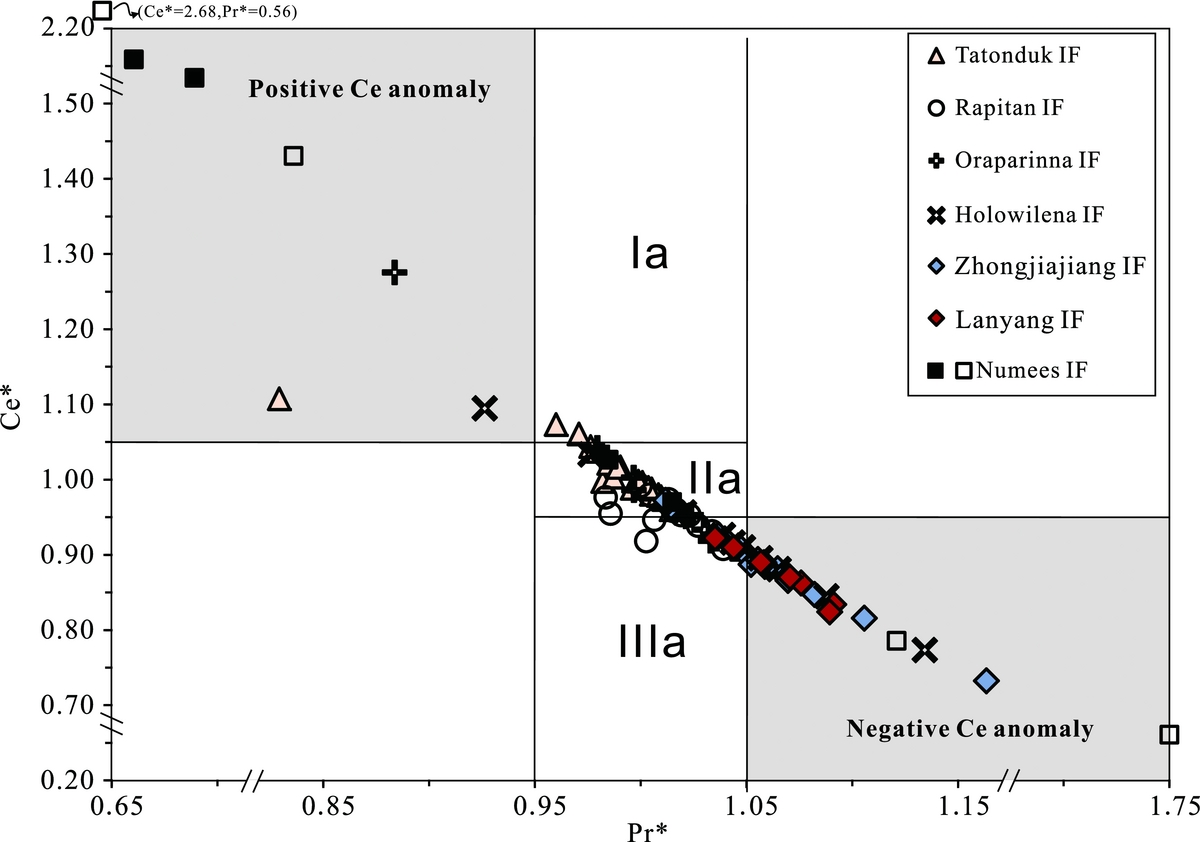
Based on the above summary, in this study a shift from non-existent to slightly negative Ce anomalies for the Fulu IF samples (Fig. 5; Table 1) indicates dynamic redoxcline change. Specifically, the presence of slightly negative Ce anomalies in the hematite-rich units may imply mildly oxidizing conditions in shallow waters, due to limited Ce oxidation and sorption onto Mn and Fe oxyhydroxides. In contrast, few to no Ce anomalies develop in anoxic and suboxic waters due to reductive dissolution of Mn–Fe oxyhydroxides. This redoxcline shift may be coupled to the change of sea level, which is consistent with the field observation like wave ripples above wave base and jasper layers below wave base in the Lanyang section (Fig. 2b, c). In addition, given the occurrence of slightly negative Ce anomalies of the Zhongjiajiang IF, the similar redox condition would be deduced due to the close proximity of the Zhongjiajiang and Lanyang sections.
Ce* vs Pr*. Previous data are from Cox et al. (Reference Cox, Halverson, Minarik, Le Heron, Macdonald, Bellefroid and Strauss2013, Reference Cox, Halverson, Poirier, Le Heron, Strauss and Stevenson2016) and Halverson et al. (Reference Halverson, Poitrasson, Hoffman, Nedelec, Montel and Kirby2011). Solid squares represent Mn-rich iron formation. Open squares represent Mn-lean iron formation. Field Ia: negative La anomaly, no Ce anomaly; field IIa: neither Ce nor La anomaly; field IIIa: positive La anomaly, no Ce anomaly.

In contrast, most IF samples from other continents except for Numees IF consistently show little to no Ce anomaly (Fig. 5), suggesting that the IFs were mainly deposited in oxygen-depleted (suboxic or anoxic conditions) waters. The common occurrence of dropstones and the lack of siliclastic deposits in the Numees, Rapitan, Tatonduk, Oraparinna and Holowilena IFs indicate that the iron formations were deposited in a distal deep ocean (Macdonald et al. Reference Macdonald, Strauss, Rose, Dudas and Schrag2010b ; Cox et al. Reference Cox, Halverson, Minarik, Le Heron, Macdonald, Bellefroid and Strauss2013). Therefore, the deep ocean during the glacial period will be characterized by oxygen-depleted (suboxic or anoxic) conditions.
In addition, it is noteworthy that the Numees IF shows remarkable variation of Ce anomalies compared to other IFs. For samples with low manganese concentrations (c. 0.1%) Ce anomalies are highly variable, ranging from 0.26 to 2.53, while the manganese-rich (c. 5%–30% Mn) Numees IF shows small or moderately large positive Ce anomalies ranging from 0.97 to 2.18 (Fig. 5) (Halverson et al. Reference Halverson, Poitrasson, Hoffman, Nedelec, Montel and Kirby2011; Cox et al. Reference Cox, Halverson, Minarik, Le Heron, Macdonald, Bellefroid and Strauss2013). Due to limited contribution from detrital loads (Fig. 4), the Numees IF may be deposited in the deep ocean. Thus the large range of Ce anomalies in the Mn-lean Numees IF may indicate that the deep ocean was ventilated. In addition, Mn-rich IF with moderately large positive Ce anomalies is analogous to the ferromanganese nodules and crusts in the modern deep ocean, also suggesting that the deep ocean may be oxidized. Therefore, spatial heterogeneity in deep ocean redox conditions may occur during the glacial period, although the deep ocean during the glacial period may be dominated by anoxic conditions.
5. Conclusions
In this study, the Fulu iron formation (Lanyang and Zhongjiajiang sections) was investigated through major and trace element geochemistry.
(1) Major elements data suggest a binary mixing between detrital loads and hydrothermal sources for the Fulu IF. The REY pattern reveals that the IF preserved the ocean chemistry during the glacial period.
(2) The Fulu IF is characterized by slightly positive Eu anomalies similar to other Neoproterozoic IFs, implying that a high-temperature hydrothermal imprint is in fact preserved in these Neoproterozoic IFs, whereas a major source of iron may be derived from the low-temperature alteration of oceanic crust as suggested by Halverson et al. (Reference Halverson, Poitrasson, Hoffman, Nedelec, Montel and Kirby2011).
(3) Compared to IFs from other continents, the Fulu IF is characterized by a slightly negative Ce anomaly, implying that the iron formation took place across an iron chemocline separating weakly oxic surface water from oxygen-depleted deep ocean in the Nanhua basin during the glacial period.
Acknowledgements
This research was supported by the National Natural Science Foundation of China (NSFC) (40603021, 41072145) to L.F. and the Chinese National ‘973’ Project (2013CB835005) to X. H. Li. The manuscript benefited greatly from the reviews of Prof. Hongfei Ling and an anonymous reviewer.