


Introduction
Recent research has deepened our understanding of Central Asia’s pivotal role in trans-Eurasian cultural exchange; long before the celebrated Silk Roads of the late second century BC and beyond, Central Asia had already witnessed the expansive and sometimes rapid spread of artefacts (Chernykh et al. Reference Chernykh, Korochkova and Orlovskaya2017; Guo Reference Guo2022), crops (Spengler Reference Spengler2019; Endo et al. Reference Endo2023; Ren et al. Reference Ren, Li, Zuo, Li, Storozum, Wang and Jia2024), domesticated animals (Taylor et al. Reference Taylor2021; Librado et al. Reference Librado2024), technologies (Lindner Reference Lindner2020) and artistic styles (O’Sullivan & Shao Reference O’Sullivan and Shao2022). Yet, the geography of Central Asia is not naturally conducive to cultural exchange; its daunting deserts, towering mountain ranges and scattered oases pose, and would have posed, formidable barriers to both local and regional communication. This contrast raises intriguing questions about the mechanisms through which local communities facilitated cultural exchange in prehistory.
To the north, the flatter terrain of the Eurasian Steppe could have facilitated the migration of prehistoric pastoralists and the expansion of their interaction spheres. While migrations could explain episodic cultural changes in Central Asia throughout prehistory (Narasimhan et al. Reference Narasimhan2019; Anthony Reference Anthony2023), interactions among steppe pastoralists, which intensified with the development of horseback riding and wheeled vehicles, established a more stable means of trans-regional cultural exchange in the first millennium BC (Kuz’mina Reference Kuz’mina2008; Ventresca Miller & Makarewicz Reference Ventresca Miller and Makarewicz2019). Another mechanism for exchange is through the networked interaction of mountain pastoralists in the Inner Asian Mountain Corridor (IAMC) model (Frachetti Reference Frachetti2012). This model proposes that the seasonal gatherings and dispersals of mountain pastoralists, resulting from their vertical transhumance, led to the formation of extensive interaction networks along mountain ranges in the Bronze Age (c. 3000–1000 BC, Frachetti et al. Reference Frachetti, Smith, Traub and Williams2017).
In addition to more informal down-the-line exchange among all communities, the mechanisms mentioned above have shaped current understandings of prehistoric long-distance cultural exchange in Central Asia. However, none of these mechanisms adequately explains cultural exchange between the numerous oasis communities of Central Asia, particularly those found in eastern Central Asia. Exotic objects such as nephrite jade axes, cowry shells and copper and bronze items suggest that regional and inter-regional interactions existed among these communities (Høisæter Reference Høisæter2017). Yet, the lack of direct insights into underlying mobility patterns confounds the conceptualisation of interaction dynamics. The prehistoric inhabitants of these oases do not fall into the category of either steppe or mountain pastoralists. Textual records from shortly after the official commencement of the Silk Roads (Ban Reference Ban1962) and recent archaeological findings (Dang et al. Reference Dang, Li, Zhang, Xu, Li, Tian and Zhang2022) suggest that many of these communities in eastern Central Asia developed urban centres and engaged heavily in farming, alongside pastoralism. It is evident, then, that the mobility patterns of the inhabitants of these oases cannot be easily projected from ethnographic observations of ‘typical’ pastoralists or farmers (Barth Reference Barth1961).
To effectively address this challenge, it is necessary to implement multidisciplinary approaches to study the mobility patterns of these prehistoric oasis communities. Isotopic analysis—particularly strontium and oxygen isotope analyses of human and animal skeletal tissues—has emerged as an important tool for achieving this goal, revealing that ancient pastoralists in nearby Mongolia, Kazakhstan and Kyrgyzstan generally had much smaller mobility ranges than previously assumed (e.g. Gerling Reference Gerling2015; Ventresca Miller et al. Reference Ventresca Miller, Winter-Schuh, Usmanova, Logvin, Shevnina and Makarewicz2018; Machicek et al. Reference Machicek2019; Milella et al. Reference Milella2022), that sedentary and mobile lifeways often coexisted in strongly integrated societies in highland environments (Hermes et al. Reference Hermes2022) and that Bronze Age communities in the large oases of western Central Asia exhibited diverse mobility patterns that varied across time and space (Kroll et al. Reference Kroll2022). However, due to limitations such as the absence of comprehensive isotopic baselines, the vast potential of isotope analysis for tracing human mobility in other parts of Central Asia—particularly in scattered oasis communities where communication was more challenging (e.g. the Tarim Basin)—remains largely unexplored.
This study focuses on the Zaghunluq Cemetery, located in a typical oasis in the south-eastern Tarim Basin, Xinjiang Uygur Autonomous Region, China, dating from the sixth century BC to the first century AD, as a case study. We employ multi-isotope (strontium 87Sr/86Sr, oxygen δ18O, carbon δ13C and nitrogen δ15N) analysis of human tooth enamel bioapatite and dentine collagen to explore mobility patterns within local subsistence strategies. By examining these findings, this research aims to deepen our understanding of oasis community interaction networks in Central Asia and their connections to broader Eurasian exchanges.
Archaeological context
Zaghunluq (38°07′16″N, 85°28′29″E) is a large cemetery located on the periphery of the Qiemo oasis which is nurtured by the Cherchen River and situated on the southern fringes of the Taklamakan Desert (Figure 1). Encompassing a 5km2 area, the burial grounds are segmented into five distinct groups, denoted as Zaghunluq 1 to Zaghunluq 5. Initial exploration of the cemetery began in 1928 when Folke Bergman (Bergman et al. Reference Bergman, Sylwan, Konow and Ljungh1939) conducted investigations as part of the Sino-Swedish Expedition (1927–1935). Subsequent excavations by local cultural heritage management agencies took place in 1985, 1989, 1996 and 1998 (XUARM et al. 2003; XUARM 2016).
Location of the Zaghunluq Cemetery (red star) and other archaeological sites mentioned in this study (figure by authors).

A total of 169 burials from three phases (Phase 1 to Phase 3) have been unearthed—167 in Zaghunluq 1 and two in Zaghunluq 2. Phase 2, encompassing 138 burials at both Zaghunluq 1 and Zaghunluq 2, represents the main body of the cemetery (XUARM 2016; Figure 2). Six recently published radiocarbon dates from human bones position Phase 2 in the late Early Iron Age and the Han dynasty (545 cal BC–cal AD 61 at 95.4% confidence level, see online supplementary materials (OSM)) (Kumar et al. Reference Kumar2022). Within this phase, most of the burials (n = 134) can be further classified into two groups (Shao Reference Shao2008): Group A burials (n = 114) consist of rectangular vertical pits with or without terraces, accommodating no more than five individuals and simple grave goods; Group B (n = 20) comprises cleaver-shaped burials, usually containing more than 10 individuals, accompanied by rich and diverse grave goods (Figures 3 & 4). Analysis of the material culture suggests that the initial burials in both groups occurred in the Early Iron Age (c. 1000–200 BC), with Group A generally pre-dating Group B, although there is a clear chronological overlap between the two.
Schematic map showing the distribution of individuals sampled in this study. Note that the distance between Zaghunluq 1 and Zaghunluq 2 is artificially reduced. See OSM for the complete designations of burials (figure by authors).

Burials from Zaghunluq Cemetery: a) burial of 96QZIIM2; b) burial of 96QZIM24, preserved in situ at the Zaghunluq Museum (figure by authors).

Zaghunluq serves as an ideal focus for our investigation for three reasons. First, the community it represents likely typifies oasis communities in late prehistoric eastern Central Asia in terms of subsistence patterns and associated mobility. The Book of Han 漢書 (Hanshu) states that communities in Qiemo along with those of other oases further west in the Tarim basin “all cultivate the five grains. Their land, vegetation, livestock, and weapons are similar to those of the Han” (Ban Reference Ban1962: 3879). Although this description might overemphasise the similarities between the lifeways of oasis communities and the Han, we can confidently infer that the communities in Qiemo and other oases in the Tarim shared similar lifeways. Second, the presence of mummies, such as the ‘Chärchän Man’ (Kamberi Reference Kamberi and Mair1994), and grave goods (Figure 4), such as harps, silk fabric and glass beads, strongly suggest the active participation of the Zaghunluq community in long-distance cultural exchange (XUARM et al. 2003; XUARM 2016). Third, the proximity of the Zaghunluq Cemetery to the Kunlun Mountains and the Altyn Tagh (approximately 70km) presents an intriguing opportunity to examine the relationship between oasis communities and the interaction networks of mountain pastoralists, as outlined in the IAMC model. While direct evidence for seasonal vertical transhumance of pastoralists is currently lacking, we infer that the IAMC model also likely applies in the nearby mountains, given the vertical distribution of pastures (Lei & Zhang Reference Lei and Zhang1997) and the early appearance of mobile pastoralists in the Kunlun Mountains (Wagner et al. Reference Wagner2011).
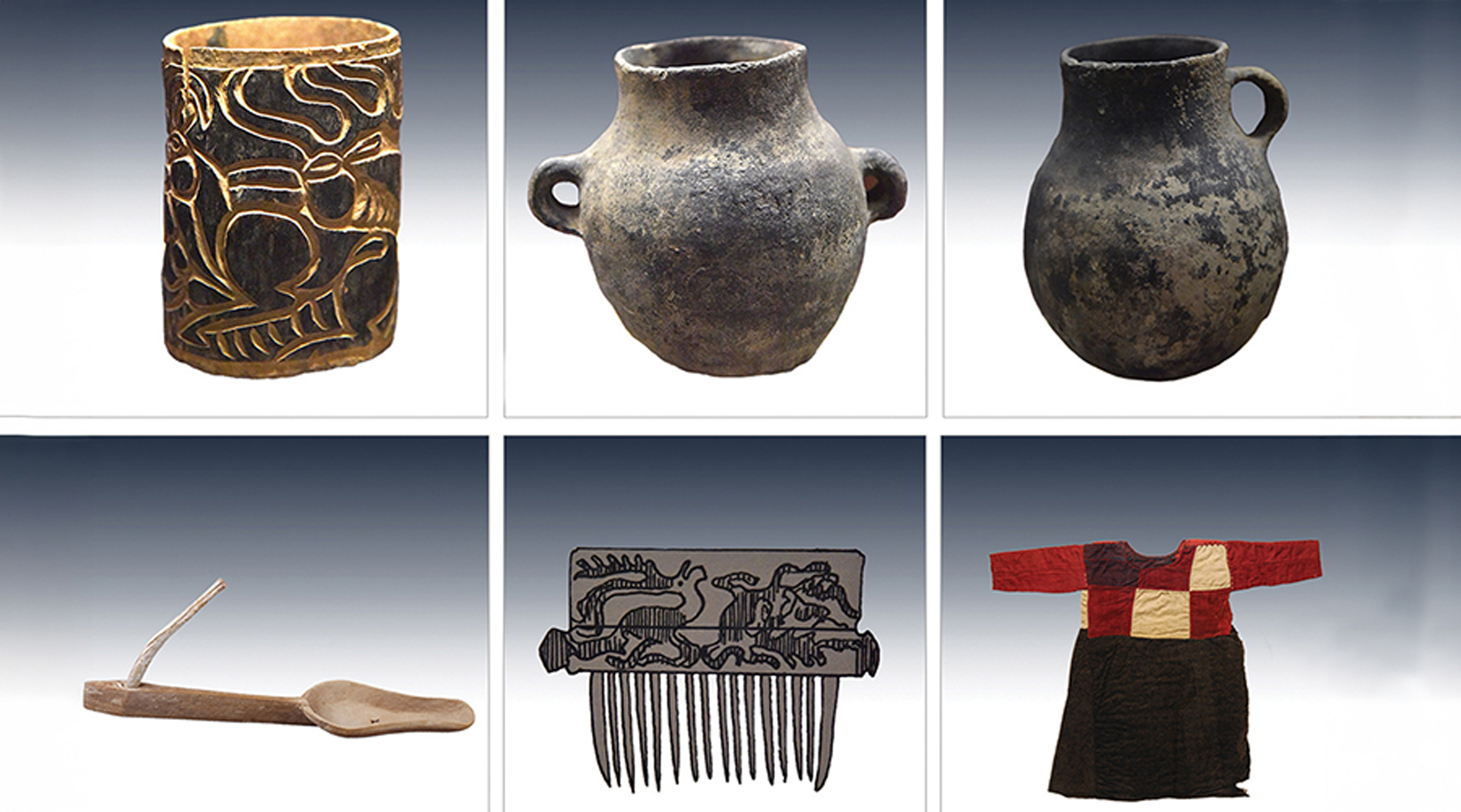
Grave goods from Phase 2 burials at Zaghunluq Cemetery: a) lacquered wooden cylinder (M24:12), height 111mm; b) double-handled jar, height 190mm, rim diameter 115mm; c) single-handled jar, height 180mm, rim diameter 93mm; d) harp (M14:20), length 867mm; e) wooden comb (M14:33), height 52mm, width 98mm; f) woollen dress (M55G:17), length 630mm, hem width 560mm (figure by authors).

Materials and methods
This study incorporates four types of isotope analysis (87Sr/86Sr, δ18O, δ13C and δ15N) to explore the subsistence and mobility patterns of the Zaghunluq people (details of isotopic background can be found in the OSM). To explore mobility and diet during the main phase of the site, we collected 33 dental samples from individuals interred in the Phase 2 burials from both Zaghunluq 1 and Zaghunluq 2 (Figure 2). All individuals sampled were adults, aged approximately 18–35 years at death. Nearly half of the samples originated from second molars (n = 16), with the remaining coming from third molars (n = 6), first premolars (n = 6) and first molars (n = 5). These teeth form during the age ranges of 3–8, 9–14, 2–5 and 0–3, respectively (AlQahtani et al. Reference AlQahtani, Hector and Liversidge2010), and therefore record isotopic exposure during these life stages. In the laboratory, tooth dentine and enamel underwent initial surface cleaning before being sampled with a clean diamond-tipped dental drill and a saw blade. Strontium isotope analysis was conducted on enamel bioapatite, stable carbon and oxygen isotope analysis on enamel carbonate, and stable carbon and nitrogen isotope analysis on dentine collagen (see OSM for details).
We also collected 21 modern plant samples, both on and away from the site, and integrated 10 published data points, primarily from modern plants near the cemetery (Wang & Tang Reference Wang and Tang2020), to establish strontium isotope baselines for the locale. Applying random forest (RF) regression models (Bataille et al. Reference Bataille, Crowley, Wooller and Bowen2020), we then predicted the bioavailable 87Sr/86Sr isoscape across the Tarim Basin based on new and published environmental and archaeological animal 87Sr/86Sr data, along with 24 environmental predictors. We also modelled the tooth enamel oxygen isoscape using cokriging methods (Pellegrini et al. Reference Pellegrini, Pouncett, Jay, Parker Pearson and Richards2016; Willmes et al. Reference Willmes2018), integrating archaeological data spanning the Bronze Age to the Western Jin dynasty (c. 2000 BC–AD 316) with the modern mean annual precipitation isoscape (Terzer et al. Reference Terzer, Wassenaar, Araguás-Araguás and Aggarwal2013). Bayesian spatial assignment of these data using the assignR package (Ma et al. Reference Ma, Vander Zanden, Wunder and Bowen2020) then allowed the geographic probability of origins for outlier individuals to be calculated (for full methods see OSM).
Results
Isotopic analysis
The atomic C:N ratios of all human dentine collagen samples, falling within the range of 3.1 to 3.4, indicate excellent collagen preservation conditions (DeNiro Reference DeNiro1985) (Table S1). The relatively elevated δ15N values in these collagen samples (δ15Ncoll), spanning from 11.3‰ to 15.7‰ (mean = 13.7‰; SD = 1.2‰), suggest a diet rich in 15N-enriched foods such as meat, dairy and/or aquatic resources. The relatively low δ13C values of the dentine collagen samples (δ13Ccoll), ranging from −19.4‰ to −14.7‰ (mean = −18.1‰; SD = 1.3‰; Figure 5a), and those of the enamel carbonate samples (δ13Cca), ranging from −14.7‰ to −8.9‰ (mean = −12.1‰; SD = 1.3‰), collectively imply that most of the analysed individuals consumed primarily C3-based food. Only four individuals exhibit considerable C4-based food intake in their diets (Figure 5a & b). A discriminant function analysis, incorporating δ13Cca, δ13Ccoll and δ15Ncoll (Froehle et al. Reference Froehle, Kellner and Schoeningerp2012), further suggests that most individuals’ diets consisted almost exclusively of C3-based foods, while a few outliers’ diets included around 30 per cent C4-based foods (≥65% C3 protein, Figure 5c). Overall, with only a few exceptions, most of the analysed individuals from Zaghunluq therefore seem to have relied on C3-based foods, aligning with the prevailing C3 local vegetation, though the influence of aquatic freshwater resource consumption on δ13C variability remains difficult to discern at present.
Isotopic results from Zaghunluq compared with published data from contemporaneous sites in Xinjiang and adjacent regions (see OSM for references): a) δ13Ccoll against δ15Ncoll; b) δ13Ccoll and δ13Cca plotted against dietary regression lines based on experimental feeding research (Kellner & Schoeninger Reference Kellner and Schoeninger2007); c) bivariate plot from discriminant function analysis based on experimental feeding studies (Froehle et al. Reference Froehle, Kellner and Schoeningerp2012). Note that this experimental model did not include estimates of freshwater resource consumption (figure by authors).

The 87Sr/86Sr ratios in plants taken from within a 10km radius around the cemetery range from 0.71076 to 0.71095. Beyond this radius, between 10km and 20km, the ratios vary from 0.71095 to 0.71103, and, between 20km and 50km, they span from 0.71091 to 0.71124 (Figure 6). The most significant variation is observed between the foothills (typically exceeding 0.71100 in both the Kunlun Mountains and the Altyn Tagh; see Figure 7a) and the nearby cemetery (ranging between 0.71076 and 0.71095) (Figure 7b). This distinction can be attributed to the geological conditions of the Proterozoic-Palaeozoic metamorphic and granitic terrains of the Kunlun and Altyn Tagh (Wang & Tang Reference Wang and Tang2020), which generally exhibit higher 87Sr/86Sr ratios compared to the Quaternary sediments found in the cemetery area.
Strontium and oxygen isotope values from human tooth enamel at Zaghunluq Cemetery. Dashed lines represent the 87Sr/86Sr range of plants at different distances from the cemetery (figure by authors).

Bioavailable 87Sr/86Sr isoscape across the Tarim Basin: a) 87Sr/86Sr isoscape constructed using a random forest modelling approach with baseline data from this research and published studies; b) spatial variations of plant 87Sr/86Sr ratios in the Zaghunluq area (figure by authors).

The 87Sr/86Sr ratios measured in all 33 human enamel samples, spanning from 0.70938 to 0.71123, generally conform to the local strontium baseline based on sampled plants, although anomalies are evident. Twenty-six samples exhibit values which align with those expected within a 10km radius of the cemetery. Of the remaining seven samples, four display ratios ranging from 0.71099 to 0.71123, falling within the range observed in the 20–50km radius of the cemetery. The remaining three samples (individuals M24C, M65J and M104D), exhibit lower 87Sr/86Sr ratios (0.70938, 0.71046 and 0.71061, respectively), extending beyond the observed range of plants from the cemetery area and the foothills (Figure 6).
The δ18O values of enamel carbonate samples (δ18Oca) display notable variability, spanning from –6.6‰ to –2.3‰, with a mean of –5.1±1‰ (Figure 6). In our data interpretation, we employed a non-conservative approach to establish the regional δ18O range, using oxygen isotope values from modern surface water/groundwater (Wang et al. Reference Wang2013) and mean annual precipitation (Terzer et al. Reference Terzer, Wassenaar, Araguás-Araguás and Aggarwal2013) in the south-eastern Tarim Basin as primary proxies. However, considering the potential impact of climate and hydrological change over time on δ18O baselines, we used high-resolution δ18O records from the Chongce ice cores in the Western Kunlun Mountains (Pang et al. Reference Pang2020), near the Zaghunluq Cemetery, to estimate the δ18O difference between the period of cemetery use and the present day. The ice-core records show that the δ18O values of precipitation between the two time periods differ by approximately 0–1‰ with a mean of –0.16‰ (see OSM). Therefore, we subtracted 0.16‰ from the modern water δ18O range of the south-eastern Tarim Basin to adjust to the period of the Zaghunluq Cemetery. Additionally, we increased the uncertainty of the oxygen isoscape by 1‰ to account for climate change when assessing the geographical probability of origins for individuals (see results in Figure 8). We acknowledge that this is still not an ideal situation, with long-term assessment of δ18O in the ecosystems of the region a crucial area for future study. Within the framework mentioned above, we identified two samples with δ18Oca values (Figure 6), originating from individuals M65C and M41A, that fall outside the local range. Notably, the87Sr/86Sr ratio for M65C also falls beyond the 50km radius of the cemetery.
Spatial assignment of four outlier individuals from the Zaghunluq Cemetery using strontium and oxygen isotopic data (figure by authors).

Isoscape modelling results
Our isoscape model suggests six predictors heavily influence bioavailable 87Sr/86Sr ratios across the Tarim Basin (see OSM). The 5-fold cross-validated random forest regression demonstrated noteworthy explanatory power, accounting for 65 per cent of the variance (R2 = 0.65) with a low root-mean-square error (RMSE) of 0.0013. Residuals predominantly fall within the tight range of –0.001 to 0.001, signifying relatively accurate predictions of 87Sr/86Sr ratios. The prediction indicates a distinct south-north gradient in the 87Sr/86Sr isoscape across the Tarim Basin (Figure 7a). δ18Oca values also reveal a contrast between northern and southern Xinjiang (see OSM). These substantial spatial variations in strontium and oxygen isotopes across the landscape facilitate investigations into both short-distance and long-distance human movements.
Discussion
Overall, our findings suggest that the inhabitants of Zaghunluq likely maintained a sedentary lifestyle, consistent with expectations for an agropastoralist community. This limited mobility negates the possibility that the entire community actively participated in the interaction networks of mountain pastoralists, as outlined in the IAMC model (Frachetti Reference Frachetti2012; Frachetti et al. Reference Frachetti, Smith, Traub and Williams2017). Nevertheless, it does not necessarily follow that they engaged in sedentary pastoralism either, as the Qiemo Oasis does not have the rich pasture resources to support year-round grazing, unlike the southern Ural Mountains steppe, where sedentary pastoralism is believed to have been practised (Stobbe et al. Reference Stobbe, Gumnior, Rühl and Schneider2016). Most of the strontium isotope values for individuals from Zaghunluq (26 of 33) are consistent with the range defining the environmental baseline within a 10km radius of the site, indicating a settled way of life. Three individuals have exceptionally low ratios and are even less likely to have spent substantial periods of time in the mountainous areas that have higher 87Sr/86Sr baselines. Vertical transhumance seems plausible only for the remaining four individuals, who have relatively high 87Sr/86Sr ratios; engaging in such practices could result in mixed 87Sr/86Sr ratios falling between those of the mountainous areas and the vicinity of the cemetery. If that is the case, the Zaghunluq community likely had an integrated system of agropastoralist production (Hermes et al. Reference Hermes2022), with the ratio of mobile pastoralists within the community being only around 12 per cent (four out of 33). Alternatively, these four individuals could have lived about 20–50km from the cemetery on the sloping plains during their childhood, where similar 87Sr/86Sr ratios are observed (Figure 7b). It is also plausible that they engaged in seasonal animal herding on pasturelands in the foothills rather than in higher elevation areas.
The individuals buried at Zaghunluq do, however, defy characterisation as typical sedentary farmers with limited daily activity radii. Stable carbon isotope analysis reveals a predominantly C3-based diet, with some individuals consuming a mixed C3/C4 diet. This pattern was likely due to regular consumption of wheat (Triticum sp.) and a mixed wheat and foxtail millet (Setaria italica)-based diet, with both crops being identified in macrobotanical analysis of the cemetery (Li Reference Li2021). Local farming is further supported by the presence of grinding stones and wooden agricultural implements in the cemetery (XUARM 2016) and by textual records such as the Book of Han 漢書 (Ban Reference Ban1962). Horse and sheep/goat skulls, horse bones, cattle horns, leather and woollen artefacts, and desiccated alfalfa leaves—likely used as animal fodder—found in the cemetery attest to the community’s involvement in animal husbandry (XUARM 2016; Chen et al. Reference Chen, Wang, Power and Jiang2020). The identification of bows, arrows, quivers, fish bones, duck nets and a fox leg also reveal hunting and fishing as likely components of the local economy (XUARM 2016). The overall elevated δ15Ncoll values of the sampled individuals, even compared to many contemporaneous mobile pastoralist communities, are atypical for a sedentary agropastoralist community (Figure 5a). This difference might partly reflect the arid local climate (Schwarcz et al. Reference Schwarcz, Dupras and Fairgrieve1999) and the consumption of both animal products and aquatic resources. Simultaneous engagement in both arable farming and animal herding would have required frequent exploration of pasture resources outside of the farming zones, perhaps further upstream or downstream of the Cherchen River, or in the desert surrounding the oasis, to prevent the animals from damaging crops. Hunters would also have preferred similar environments for capturing wildlife. Both subsistence strategies would require the Zaghunluq community to have a relatively larger daily activity radius than typical farming communities.
This radius likely provided the Zaghunluq community with an advantage in establishing enduring connections, or ‘strong ties’ (see Easley & Kleinberg Reference Easley, Kleinberg, Easley and Kleinberg2010), with neighbouring communities. During animal herding and hunting activities, they would potentially have encountered mountain pastoralists who typically established their camps in the foothills, as noted ethnohistorically by Przhevalsky (Reference Przhevalsky1879), as well as counterparts from nearby communities. Thus, it is reasonable to infer that the Zaghunluq community could benefit from both the interaction networks of mountain pastoralists along the mountain ranges (IAMC) and the networks between oasis communities. The distinctive, black-coated pottery discovered at Zaghunluq is also prevalent in other oases along the southern rim of the Tarim Basin (XUARM et al. 2003; Figure 4c), and its origin may be traced back to the Chust culture (1500–900 BC) in the Ferghana Valley of western Central Asia (Shao Reference Shao2008). The transfer and dissemination of this artistic style might be attributed to the strong ties that the Zaghunluq community maintained with neighbouring oasis communities.
Expanding beyond local connections, four of the analysed individuals within the Zaghunluq community suggest more distant links. These individuals exhibit strontium or oxygen isotope values that deviate from the local baseline. The dual probability assignments (Figure 8) for these outliers suggest that two individuals (M104D and M41A) likely originate from areas in proximity to the cemetery, though the possibility that they came from the Lop Nur region—more than 300km north-east of Zaghunluq—cannot be ruled out. The remaining pair (M65J and M24C) almost certainly spent time in distant regions during childhood. M65J, an adult female with a high δ18O value and low 87Sr/86Sr ratio, possibly came from the Lop Nur region; distinctive δ13C and δ15N values for this individual also align with those from the slightly later Yingpan Cemetery in the Lop Nur region (Figure 5a) (Wang Reference Wang2017). The extremely low strontium and oxygen isotope values of the adult male M24C are consistent with parts of the eastern Tianshan Mountains or western Central Asia, pointing to a broader geographic connection for the Zaghunluq community.
Such connections with far-flung areas can hold profound significance, akin to the ‘weak ties’ concept in complex network theory (Granovetter Reference Granovetter1973; Easley & Kleinberg Reference Easley, Kleinberg, Easley and Kleinberg2010). The distance between two seemingly unrelated nodes within a complex network is often much shorter than conventional expectations, a phenomenon known as the small-world effect (Watts & Strogatz Reference Watts and Strogatz1998). One manifestation of this effect occurs in networks where certain nodes maintain weak connections with far-flung nodes. These weak ties serve as conduits for information exchange and cultural interactions that transcend local boundaries. In the case of Zaghunluq, individuals with ties to distant regions potentially played crucial roles as essential weak ties, enabling the community to engage in networked cultural exchanges with far-flung areas despite an overall local or regional community focus. This dynamic connectivity likely contributed substantially to the complexity and richness of the ancient Central Asian cultural landscape.
We can already observe the potential influence of these weak ties in the archaeological record at Zaghunluq. The outliers, M24C and M65J, were discovered in Group B burials, which overall postdate those in Group A. While Group A burials typically contained a modest quantity of locally crafted items, primarily pottery, Group B burials show a notable increase in exotic objects, such as harps (likely produced locally but borrowing designs from West Asia), silk fabric (from East Asia), lacquer wares (from East Asia) and items featuring steppe-style animal motifs (XUARM et al. 2003; Shao Reference Shao2008; Figure 4). This temporal shift could potentially be attributed, at least in part, to the impact of cultural exchange facilitated by weak ties, like those seemingly established by individuals M24C and M65J.
These findings prompt a reassessment of interaction networks among oasis communities in Central Asia, particularly around the opening up of the Silk Roads. The Zaghunluq case underscores the likelihood that these communities actively participated in intricate interaction networks. The expansive daily activity radii resulting from animal herding and hunting practices likely played a pivotal role in fostering robust connections with both mountain pastoralists and neighbouring oasis communities. Additionally, through the migration of certain individuals—potentially facilitated by intermarriage between different groups—these communities could sustain more distant, weak ties with other regions.
Conclusions
Through a comprehensive multi-isotopic investigation conducted at the Zaghunluq Cemetery, this study reveals the participation of a specific Central Asian oasis community in intricate interaction networks from the late Early Iron Age to the Han dynasty, a crucial period for the formation of Silk Road connections. Although they were largely sedentary and engaged heavily in arable farming, the inhabitants of Zaghunluq were also actively involved in animal herding, with hunting and fishing likely integral to their economy. These activities necessitated the exploitation of pasture resources on and beyond the oasis periphery, fostering their participation in interaction networks with neighbouring oasis communities and pastoralists that lived along the IAMC. Moreover, the Zaghunluq community maintained weak ties with distant regions, some possibly forged through individual migrations. These weak ties could have substantially expanded the scope of cultural transmission within their networks. Complementing the networks of pastoralists, the diverse and complex interaction networks among oasis communities revealed through this study contribute to a more nuanced understanding of the intricate dynamics of cultural transmission in ancient Central Asia. The study further serves to highlight the need for more extensive sampling of modern plants, wild and domestic fauna, and particularly freshwater fish in Central Asia to overcome current limitations in isotope baseline generation for the further elucidation of community subsistence strategies and the impact of aridity on stable carbon and nitrogen isotope values in human bones.
Acknowledgements
We would like to thank the editor and the two anonymous reviewers for their valuable comments and suggestions, which greatly improved our manuscript. We are also indebted to Dr Xinzhou Chen for his insightful suggestions during the revision process.
Funding statement
This work was funded by the National Natural Science Foundation of China (Grant Nos. 42072210; 42402192), the Chinese Academy of Sciences (Grant No. IGGCAS-201905) and the Fundamental Research Funds for the Central Universities (Grant Nos. YJ202366; 63243010). PR would like to thank the Max Planck Society for funding.
Online supplementary material (OSM)
To view supplementary material for this article, please visit https://doi.org/10.15184/aqy.2025.45 and select the supplementary materials tab.



