Introduction
Asset-based policy has received increasing attention worldwide as a promising direction for domestic policy development (Orton and Rowlingson, Reference Orton and Rowlingson2007; Sherraden, Reference Sherraden1991). Supplementing traditional income support social programmes, asset-based policy promotes household saving and asset accumulation. For example, in the United States, employer-sponsored retirement plans (such as 401k and 403b) and Individual Retirement Accounts (IRA) have been in practice to promote security after retirement; and the Individual Development Account (IDA) programme has been implemented in more than 40 states to encourage low-income families to build assets (Warren and Edwards, Reference Warren and Edwards2005). In the United Kingdom the universal Child Trust Fund, a savings and investment account for children, was initiated in 2005 (Loke and Sherraden, Reference Loke and Sherraden2006). In Singapore the Central Provident Fund, a comprehensive social security savings plan, has become increasingly successful over several generations (Loke and Sherraden, Reference Loke and Sherraden2006). There is also a growing recognition of asset-based policy in developing countries. In Uganda an experimental study involving Child Development Accounts demonstrated that family economic empowerment interventions can effectively reduce HIV risk for orphans (Ssewamala et al., Reference Ssewamala, Alicea, Bannon and Ismayilova2006). In Indonesia, a pilot project similar to IDA is underway as a major asset-based poverty alleviation policy initiative that has received significant resources from the government (Sherraden and Zou, Reference Sherraden and Zou2006). Additionally, asset-building demonstration projects have spread to other countries, including Australia, Canada and Peru.
Despite similar goals of these programmes – to encourage saving and asset accumulation – the incentives and institutional structure may vary in different social contexts. For instance, with an average match rate of about 2:1, participants of the IDAs programme in the USA accumulated approximately $700 per year in IDAs for purposes such as funding a first home, education or a small business (Schreiner et al., Reference Schreiner, Clancy and Sherraden2002). The Child Trust Fund in the UK entitles children born on or after 1 September 2002 to receive a £250 voucher from the government to start an account, with an additional £250 for low-income families (UK Parliament, Reference Parliament2004). In addition to matching deposits and government seed funds, institutional incentives can also include – but are not limited to – direct deposits, tax-free earnings, and achievable savings goals. As suggested by Beverly and Sherraden (Reference Beverly and Sherraden1999), institutional factors of asset-based programmes – including access, information, incentives, facilitation, expectations, restrictions and security – may contribute to the success of the aforementioned policies. Empirical evidence from IDA programmes supports this perspective (Schreiner and Sherraden, Reference Schreiner and Sherraden2007).
To include low-income populations in asset building, it may be especially important to provide incentives because poor people tend to take current needs as a priority and, in the short run, saving has less marginal effect on their wellbeing. Inclusion of the poor in asset accumulation is a major challenge for the development of asset-based policy. This case study will explore how institutional mechanisms are built into the Hutubi Rural Social Security loan programme (a local policy initiative in northwest China), and how the programme has successfully promoted asset building in rural areas. The current study specifically focuses on the innovative approach taken by this programme independently developed in a rural community, combining both microcredit and saving to serve rural people's financial needs in the local area.
Hutubi is a remote county located 70 km west of Urumqi in the Xinjiang Uygur Autonomous Region of northwest China. The county has 24 ethnic groups with a total population of 207,200, of which 31,000 live in rural areas. Most rural households in this county engage in farming and livestock raising. In 2004, the county's per capita annual net income for rural households was ¥5,510 (approximately US$689), significantly lower than its urban counterparts: ¥9,422 at the national level and ¥7,503 at the provincial level (National Bureau of Statistics of China, 2004).
As part of Hutubi rural social security, which is mainly based on individual savings, the loan programme allows peasants to deposit their social security accounts to obtain loans for the purposes of purchasing livestock and farming tools. Compared with saving solely for old age, the loan programme provides additional incentives for peasants to invest in productive assets, such as tools, equipment and livestock (Siegel and Alwang, Reference Siegel and Alwang1999), which in turn encourages more participation in rural social security. Through analysis of administrative data supplemented with the interview data, this study explores how the loan mechanism was developed and its consequences for Hutubi rural social security and peasants.
Background
Rural social security in China
Peasants in Hutubi County, like those in other areas of rural China, did not have any form of social security programme until 1992 (Béland and Yu, Reference Béland and Yu2004; China Ministry of Civil Affairs, 1992). Different from the traditional pay-as-you-go social security system in most welfare states, China's rural social security is an asset-building programme relying mainly on personal savings in individual social security accounts. The China Rural Social Security Scheme of 1992 allows peasants aged between 20 and 60 to participate voluntarily in rural social security by contributing a portion of their (after-tax) income to individual old-age accounts. Individuals are allowed to withdraw funds from their accounts when they reach 60 years of age or encounter emergencies, such as natural disasters. What makes it different from saving for self-insurance is that:
• The government provides a guaranteed annual interest rate for rural social security funds, which is no less than that provided by commercial banks.
• Rural social security is supplemented by collective contributions made by villages or rural enterprises, depending on the local economic situation, as matching funds for individual accounts.
Collective entities (for example, villages and rural enterprises) that make contributions receive tax credit. The proportion of collective contributions may vary. Collective contributions, however, are not available in many economically underdeveloped areas. Consequently, in reality, rural social security funds are raised mainly by individual contributions. This policy is managed at the county level by the local rural social security office. Rural social security funds cannot be used for direct investment (for example, investment in real estate or the stock market) (China Ministry of Civil Affairs, 1992). In most cases, the funds can only be saved in a bank account.
Rural social security aims to provide economic security to elderly people in rural areas. However, this policy has had shortcomings from its inception. First, individual contributions are too low to ensure economic security in old age. The individual contribution is set at an extremely low level of between ¥2–20 (US$0.25–2.5) per month (China Ministry of Civil Affairs, 1992). At this level, peasants can barely accumulate even a minimal level of financial resources to meet economic needs in later life. For example, a 50-year-old individual who started contributing the maximum of ¥20 per month in 1994 would receive ¥50 per month beginning in 2004 (given the fixed bank savings interest rateFootnote 1). That would be an annual social security income of ¥600, roughly equal to the 2004 rural poverty line (¥627) (Peng and Song, Reference Peng and Song2002). The benefit of rural social security is woefully low. Although the county government can adjust individual contributions depending on the local economic situation, individual contributions set by the programme cannot create much security for rural populations.
Second, structural incentives for asset accumulation do not seem to be very effective. Collective contributions to match savings is the major incentive provided by this policy. However, in reality the majority of programme participants do not receive matching funds from collective entities (Wang and Zhang, Reference Wang and Zhang2006; Xu, Reference Xu2006). Matching occurs mostly in rich rural communities on the south-east coast. In other words, the so-called matched collective contribution has no significant effect on rural social security participation in Hutubi County.
Third, rural social security funds are constrained from investment. Rural social security funds cannot be used for any form of direct investment. The only legitimate ways to keep funds from depreciation in value are either to save as bank savings or to purchase low-risk bonds or securities issued by the central government. The rapid economic growth in China in the last decade, however, has been accompanied by bank savings interest rates decreasing over time, while the inflation rate has been increasing since 1996, which makes rural security funds vulnerable to depreciation (Peng and Song, Reference Peng and Song2002). In many places, interest earned by rural social security funds is not even sufficient to cover managerial expenses of the programme.
Thus, institutional incentives provided by rural social security are quite weak, and this has limited its effectiveness in encouraging peasants to save for their old-age security. Eventually, a peasant's commitment to rural social security depends on his/her concern about economic prospects and desire to balance current consumption and saving for later life. In the short history of rural social security, the absence of effective incentives has regretfully led to a sharp decline in the number of participants, dropping from over 80 million (approximately 10 per cent of the total rural population) in 1998 to 54 million (approximately 6.8 per cent) in 2003 (Peng and Song, Reference Peng and Song2002; State Council of the People's Republic of China, 2004). Afflicted by many challenges in management, most rural areas, including Hutubi County, stopped recruiting new participants into the rural social security programme in 1999.
Rural social security loan programme in Hutubi
The Hutubi rural social security loan programme was initiated in 1998 by a local rural social security office, with the goal of addressing some of the above institutional flaws. This programme allows rural social security participants to use their own and/or other people's social security accounts as legal collateral to take out loans through cooperation between the Hutubi Rural Social Security Office and local banks. Essentially, the loan should be less than 50 per cent of the total amount deposited in social security accounts, and must be used for physical assets related to agricultural production (Hutubi County Bureau of Civil Affairs, 2005). The interest rate on social security loans is the same as the concurrent interest rate provided by commercial banks. For example, a peasant can access a loan up to ¥5,000 when depositing three social security accounts totalling ¥10,000.
Initially, Hutubi rural social security officials reached out to villagers with the loan programme information. Word of mouth was also a marketing strategy, recalled several participants in our in-depth interviews.Footnote 2 On-site activities were later substituted by distributing programme brochures among villagers. Despite the increasing popularity of the loan programme, in the meantime there were also challenges mostly attributed to the fact that the local rural social security office was not among designated financial institutions to provide such financial services. Fortunately, a resolution was made with support from the local government and the Ministry of Labour and Social Security.
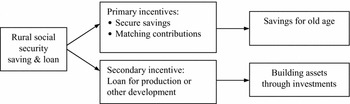
To examine the Hutubi loan programme in the framework of asset theory (Sherraden, Reference Sherraden1991), it appears that this programme, as an extension of the existing social security policy, has created a scenario with dual incentives and dual asset building (Figure 1). Suggested by asset theory, policy designs with careful consideration of incentives for asset building can encourage people (including the poor) to save. In China's rural social security scheme, secure savings and matching contributions provide primary incentives for peasants to build assets for old age. The loan programme creates an additional incentive (access to loans) and an additional goal (investments in agricultural assets or other investments such as children's education or building a house).
Dual incentives and dual asset building

It is argued in this framework that, with effective incentives and goals provided, the loan programme will yield positive outcomes for peasants.
• Participating peasants are given opportunities to access microcredit. Compared to conventional access to loans by using land/houses as collateral or by applying for a group loan with at least four other families joining together, the Hutubi loan programme offers unique institutional benefits for peasants to access and obtain small loans.
• Peasants benefit from this loan programme for more investment in agricultural production, which hopefully will bring more physical assets.
• Loans as an incentive can result in substantial increases in social security savings, which is precisely consistent with the goal of asset policy.
Finally, from the perspective of the programme administrator, the creation and implementation of the loan programme have expanded investment options of the rural social security funds and increased interest gains. ‘This programme is taking “dead assets” and making them “alive”’, said Mr Guo Xincai, creator of the Hutubi loan programme.
Data
Data used in this study were obtained by a research team from Washington University's Centre for Social Development in the summer of 2006. This research team, in partnership with the Chinese Academy of Social Sciences to evaluate this programme, is interested in three types of data: the administrative data, the in-depth interview data and the survey data (the latter two are underway). The current study primarily focuses on the Hutubi rural social security loan programme administrative data, which contain detailed information about each loan since 1998, including the borrower's demographics, the loan amount, the interest rate and the expected and actual loan term.
The administrative data cover 1,286 cases of loans between 1998 and 2006. In this study, a loan refers to the money borrowed by a rural social security participant, with the social security account(s) being deposited. No loan exceeds 50 per cent of the total balance (the rate was increased to 70 per cent in 2005). The borrower may also use the social security accounts of their relatives, neighbours or friends for the purpose of a loan. In reviewing the data, we decided to exclude 23 loan cases in which the borrower was not an individual but an agency or a company. Consequently, the analysis uses a final sample of 1,263.
Programme statistics
Demographic characteristics
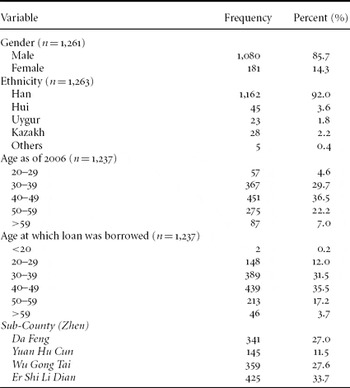
Most of the borrowers are male (n = 1,080, 85.62 per cent; only 14.4 per cent – n = 181 – are female, see Table 1). In most households, the husband is the head, who takes out a loan on behalf of the whole family. Ethnicity breakdown shows that over 90 per cent of borrowers are Han and less than 8 per cent are from the three major minority groups in the local area: Hui (3.6 per cent), Uygur (1.8 per cent) and Kazakh (2.2 per cent). The percentage of minority participants is lower than the overall share of ethnic minority populations in Hutubi County (22.4 per cent) (Xinjiang Bureau of Statistics, 2005). Borrowers are from the four subcounties (Zhen) of Hutubi County: Da Feng, Yuan Hu Cun, Wu Gong Tai and Er Shi Li Dian.
Demographic characteristics of borrowers

The distribution of borrowers' current age (as of 2006) is as follows: 4.6 per cent (n = 57) are aged 20–29; 29.7 per cent (n = 367) are between 30 and 39; the largest group are between 40 and 49 (n = 451, 36.5 per cent); and fewer than 10 per cent (n = 87, 7 per cent) are aged 60 and over. This age distribution is slightly different from that when the loans were taken out. Two borrowers were under the age of 20 when they took out the loan, and 12 per cent (n = 148) were between the ages of 20 and 29. This percentage is much higher than that in the current age distribution.
Loan information
Loan amount
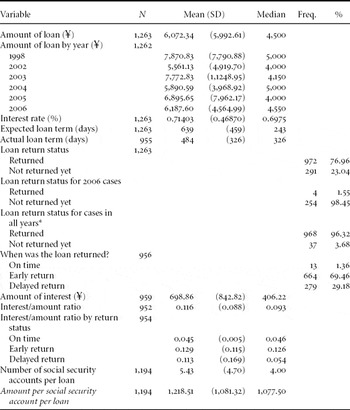
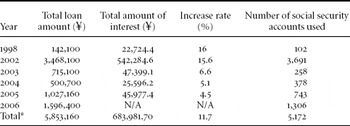
The average amount of loan is ¥6,072 (SD = ¥5,993), and the median is ¥4,500 (Table 2). Given the county's net per capita income of rural households of ¥5,510 per annum in 2004, with the loan programme it is possible to borrow an amount almost equivalent to annual net per capita income. It is noted that the average loan sizes are far greater than we would expect, given the maximum amount of money that each participant can save in the account. This is because each loan is generally granted on the basis of the combined savings of several social security accounts. A more detailed discussion of this will be provided later.
Loan information

Note: *Excluding 2006.
Interest rate
The rate of interest is the same as the bank loan interest rate, which is regulated by the People's Bank of China, the central bank in China. Between 1998 and 2006, the interest rate on loans ranged between 0.53 and 0.81 per cent. About 46 per cent (575) of cases pay interest of 0.70 per cent. The amount of interestFootnote 3 paid ranges from ¥9 to ¥5,974.
The ratio between the amount of interest paid and the amount of the loan suggests cost–benefit analysis for borrowers. The average of this ratio turns out to be 0.116 (SD = 0.088) and the median is 0.093, which indicates that a typical borrower has to repay about 10 per cent of the loan as interest.
Clearance
The average expected loan term is 639 days (SD = 459), longer than the average of the actual loan term (484 days), the number of days between the date of receiving the loan and the date of repaying the whole loan plus interest. In other words, most of loans were repaid earlier than expected. As of 31 July 2006, 972 loans (77 per cent) had been repaid. If we exclude loans in 2006,Footnote 4 the return rate is much higher (96 per cent). Of those returned, nearly 71 per cent were repaid prior to the contractual date. It took 279 borrowers (29 per cent) longer than expected to repay loans, at the cost of paying more interest at a higher (punitive) rate.
Social security accounts
On average, each loan involves 5.47 social security savings accounts. This suggests that most borrowers used social security savings in addition to their own. It is perhaps not surprising that the number of social security savings accounts and the amount of the loan are highly correlated (r = 0.71, p<0.001). More information will be available as we divide the amount of the loan by the number of savings accounts. The mean of this new variable is ¥1,281 (SD = ¥1,081), and the median is ¥1,077, which indicates on average how much a borrower can borrow from each deposited social security savings account.
Dual incentives and dual asset building: a closer look
The administrative data, combined with in-depth interviews and some other information, allow us to see in detail the successful outcomes of the dual incentive and dual asset-building structure. We will examine the number of loans processed over the years, loans for productive assets, savings in the individual accounts, number of participants and trends in the social security funds, in the framework of dual incentives and dual asset building.
Number of loans increased
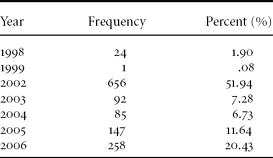
As shown in Table 3, the number of loans varies across years. Over 50 per cent of loans (n = 656) were issued in 2002 and about 20 per cent (n = 258) in 2006. No information is available for 1999, 2000 and 2001 because the loan programme was suspended in these years due to procedural controversies between government entities in the local area. Fewer than 100 loans were taken out in 1998 and 2004. With the procedural issues resolved, 2002 witnessed a significant increase in total amounts of loans, loan interest, and number of social security accounts, exceeding all the other years (see Table 4).
Loans by year (N = 1,263)
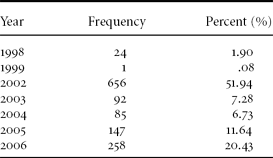
Loans by year

Note: *Not including 2006.
Peasants' physical assets increased
Peasants take out loans mainly to purchase physical assets related to agricultural/pastoral production (97.7 per cent). The majority (56.8 per cent) used the loan to buy livestock (cows and sheep); other investments included seeds (38.4 per cent), electrical farming equipments (1 per cent), small businesses (0.9 per cent) and transportation tools (0.6 per cent) (Zhang, Reference Zhang2006). When loans are used for agricultural and/or pastoral production, it can be expected that household assets will increase. For example, a peasant who borrows ¥16,000 to purchase two cows can expect to have a monthly income of ¥1,000 or even more.
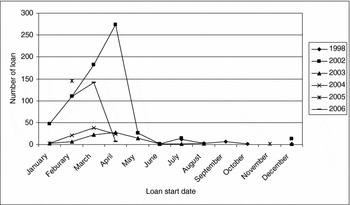
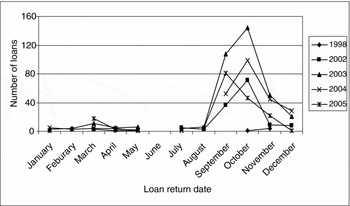
As loans are mostly used for agricultural/pastoral purposes, the data show a strong seasonal pattern in the loan start and return dates each year. Generally speaking, the loan start dates are concentrated in the planting season (March, April, May), while the loan return dates tend to be in the harvest season (September, October, November) (Figures 2 and 3).
Loan start date by year

Loan return date by year

Savings in individual social security accounts increased
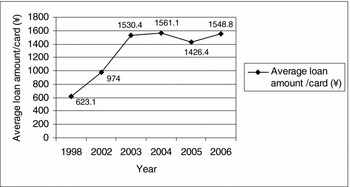
While this information is not directly available from the administrative data, the increase in individual social security savings accounts may be reflected in the loan information. Essentially, the total amount of loan available to a borrower depends on the number of social security accounts deposited and the amount of saving in each account. In other words, the ratio between the amount of loan and the number of deposited accounts by year can provide an estimate of savings in a typical individual account. The data (Figure 4) show that this ratio increased from ¥623 in 1998, to ¥974 in 2002, to ¥1,530 in 2003, and to ¥1,561 in 2004, indicating that the average amount of savings in individual accounts has increased over the years. By this measure, savings in a typical account in 2004 were nearly 2.5 times that in 1998.
Average loan amount per social security account by year

Retention of participants
As mentioned above, between 1998 and 2003 the rural social security roll in the nation dropped from 80 million to 54 million (CASS, 2000; Tang, Reference Tang2006). In 1997, a year before the loan programme was initiated in Hutubi, the total number of participants of rural social security decreased by nearly 15 per cent from over 10,000 to about 8,600. In the subsequent eight years, however, the number of participants remained steady at 8,600. This may indicate that the creation of the loan programme has become an effective way to retain participants.Footnote 5
Social security fund increased
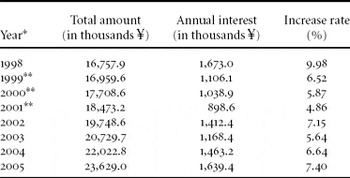
While rural social security has been in recession nationwide since 1998, the Hutubi Rural Social Security Fund has grown at the rate of 7 per cent each year, from ¥12 million (about US$1.5 million) in early 1998 to ¥24 million (about US$3 million) by the end of 2005, ‘outperforming the meagre bank interest rate of 2.25 per cent’ (Bai, Reference Bai2005). By 2005, the fund had already doubled through compound interest (Bai, Reference Bai2005). As shown in Table 5, during the three years of suspension of the loan programme (1999–2001), the increase rate of the rural social security fund was less than during the other years. In other words, the loan programme successfully generated interest gains that protected the social security fund against inflation and contributed to long-term stability.
Hutubi rural social security fund by year

Notes: *As of the end of each year.
**The loan programme was suspended in these three years.
Discussion
The Hutubi rural social security loan practice by the local government has attracted considerable interest from policy-makers. Authorised by the China Ministry of Labour and Social Security, Hutubi resumed its rural social security programme in 2005 by recruiting new participants. In carefully reflecting on the Hutubi practice, implications and limitations can be identified.
Policy implications
Asset-based policy in rural China
The Hutubi loan programme has provided a example of good practice for developing household assets in other underdeveloped rural areas. For instance, Tongjiang County of Sichuan province initiated a similar programme based on the Hutubi model. In a larger social context, the success of the Hutubi loan programme has demonstrated the possibility of developing asset-based policy, integrating both social protection and social investment. As China is making efforts to eliminate urban/rural inequality, this loan programme points to some elements that should be considered in asset-based policy development in rural China.
• Locality. Essentially, this loan programme was a local effort to cater for peasants' needs for loans. Given the unevenness of rural development across the nation, asset policy adapted to local socioeconomic situations can serve local people's interest better. To achieve success, a universal asset building policy should take locality into account.
• Support from stakeholders. The Hutubi loan programme, although originally conflicting with other financial policies, was successfully implemented with support from stakeholders, including the local government and banks. Policy formation following a bottom–up pattern is likely to encounter challenges as such and would benefit from community partnerships of various stakeholders.
Microcredit scheme in poor rural areas
In many developing countries, the lack of well-established financial services and microcredit has limited peasants' access to formal sources of loans from commercial banks (International Fund for Agricultural Development, 1993). This is believed to be one of the major causes of rural poverty around the world (International Fund for Agricultural Development, 1993). In recent years, there has been growing recognition of the role of microcredit programmes for poverty alleviation in rural areas (United Nations Department of Economic and Social Affairs, 1998). In a sense, the Hutubi rural social security loan programme has revealed the dynamics between microcredit and asset building. On the one hand, microcredit can lead to asset building. Physical assets essential for farming and raising livestock often exceed a peasant's current liquidity, which makes asset acquisition unlikely to happen without microcredit. Microcredit loans provided by the loan programme afford peasants the opportunity to purchase productive assets for asset building. In addition, access to microcredit has resulted in the growth of savings in the social security accounts. On the other hand, the loan programme suggests that access to loans, depositing social security accounts, loaning, using the capital for production investments, and paying back loans can provide a practical avenue for peasants to improve their circumstances and also build credit. This gives peasants the possibility to access more microcredit and other financial services. There emerges a benign reciprocal cycle between asset ownership and microcredit.
The poor and financial skills
Evidence indicates a positive relationship between financial skills and asset building (Zhan and Schreiner, Reference Zhan and Schreiner2005). For most rural populations, limited financial opportunities in rural areas may have formed insurmountable institutional barriers for the poor to improve financial skills. This reinforces the fact that poor people lack the financial knowledge and experience necessary to access the capital market. Several participants mentioned that in reaching a decision about taking out a loan, they generally considered the sum needed, compared interest rates, and learned about the borrowing process. They also carefully considered strategies in case loans could not be repaid on time. All of this indicates that programme participants are ‘rational’ investors with certain financial skills. The Hutubi loan programme, although not intended as formal financial education, appeared to help the individuals involved improve their financial skills and understand the financial system better.
Effects of assets on risk taking
In most cases, investment in physical assets for production can lead to better economic wellbeing. Combining savings with loans provides a foundation for risk taking, which can lead to greater economic benefits. However, investment is not always successful. For example, by depositing five social security accounts a peasant in the in-depth interview obtained a loan to buy two cows for a small milk business; he sold them two years later at a loss, as little profit was made from the business. While the investment turned out to be unsuccessful, the household seemed to manage without losing other assets, such as savings and land, and they even considered taking out another loan from the programme in the spring of 2007.
Social network
The importance of social networks is implicitly reflected in the loan programme in that it allows peasants to draw on the social security accounts of family members, relatives and friends for loans. While the current data do not provide information on the role of social networks, the in-depth interview data indicate that each participant either borrowed from or lent to others' social security accounts. In most cases, participants' relatives, friends and neighbours are willing to lend social security accounts, requesting nothing in return. This may be viewed as a prospective exchange when lenders themselves would consider borrowing social security accounts for loans. Social networks expand an individual's access to financial resources on the one hand, and on the other hand pose social pressure on this individual to make proper use of the loan and return the loan to restore the social security account.
Limitations
Despite the apparent successes of the Hutubi rural social security loan programme, its limitations should also be noted.
Potential risk
The current loan programme has a high repayment rate (96 per cent) for several reasons. The use of loans is strictly defined. In most cases, it has to be invested in physical assets for production. Availability of loans is primarily based on an individual's social network, which imposes pressure for repayment. Peasants are well aware of the consequence of failing to repay. Although the loan programme is a low-risk policy for local administration, it can be risky for individuals. Borrowers who fail to repay, risk losing social security benefits. In this regard, the loan programme has elements conflicting with social security itself. Of course, if the loan programme generates greater wealth among farmers, this implies greater security in old age.
Loan as incentive
In the Hutubi programme, the loan has indeed become an effective incentive for peasants to join in rural social security and to build household assets. Note that all of this occurs where the rural financial system is underdeveloped, with existing financial services minimally accessible to most peasants. If this situation changed and the financial system improved, the loan programme as an incentive for asset building might be weakened to some degree.
Equity issues
In order to include people on low incomes in asset accumulation, asset-building programmes in some countries have made progressive institutional arrangements for the poor. For instance, in the USA, matching rates tend to be higher in IDA programmes where the population is poorest (Sherraden et al., Reference Sherraden, Johnson, Clancy, Beverly, Schreiner, Zhan and Curley2000). The Child Trust Fund in the UK provides more seed fund for low-income families. By contrast, the Hutubi loan programme is self-selected with voluntary participation, and no institutional arrangement is made to favour the poor. In theory, anyone can take part in rural social security and the loan programme. In reality, however, only peasants with more economic resources are likely to participate.
Another potential equity issue is the disproportionate participation of males (86 per cent) compared to females in the loan programme. Unfortunately, the administrative data do not provide further information on intrahousehold decision-making and allocation processes. Our in-depth interview data, however, indicate that borrowing from the loan programme was mostly a decision made jointly by the couple in the household, although usually it was the male adult (classified as the head of the household) who actually took out the loan. For example, a man borrowed a loan for a small transportation business managed by himself, his wife, their son and their daughter-in-law. In other words, the gender representation in the loan programme may not necessarily mean that women are disadvantaged in the household. This assertion, however, should be treated with caution, and further research is needed to examine if there is any gender effect on the borrowing pattern and how loans are used.
Conclusion
The Hutubi rural social security loan programme is apparently successful in developing policy incentives to encourage asset building in a rural area of China. Incentives tailored to local situations can serve the local people very well. Structural incentives, when appropriately designed and practically implemented, can encourage the poor to build assets. In the rural context of Hutubi, matching funds are not feasible because of the limited financial capacity of the local government; tax benefits are not feasible either because this is not compatible with the existing tax system. But access to small loans and rudimentary financial services fit peasants' financial needs. Like Hutubi, most rural areas of the developing world have limited financial services for peasants. The Hutubi loan programme shows that asset building is possible when proper financial services are offered. This may be a good model for other rural areas in China and other developing countries.
Acknowledgement
This study is the first part of a multi-method inquiry into the Hutubi Community social security policy innovation being conducted in a research partnership between the Centre for Social Development (CSD) of Washington University in St Louis and the Chinese Academy of Social Sciences (CASS). The authors are grateful to Yang Tuan and Zhang ShiFei of CASS. Li Zou of CSD facilitated fieldwork for this study. The entire research team is indebted to Guo Xincai and his staff at the Hutubi social security office for their exceptional hospitality, openness and assistance in data collection. Finally, this study was made possible through funding from the Levi-Strauss Foundation; the authors thank Sharon Tan and Daniel Lee for their support.