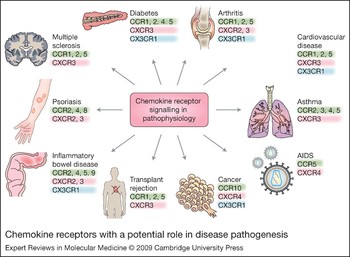
Autoimmune and inflammatory diseases – including diabetes, multiple sclerosis, rheumatoid arthritis and asthma – affect millions of individuals each year and place a huge health burden on our society. Pharmaceutical companies have poured billions of dollars into research and development to try to identify safe and effective drugs to treat these diseases. A major focus of interest for pharmaceutical companies has been inhibition of chemokine receptors (Ref. Reference Ribeiro, Horuk, Hannan and Engelhardt1). Chemokines, working through their cell-surface receptors to induce chemotaxis, are involved in orchestrating the immune response and they play a central role in host defence (Ref. Reference Baggiolini2); however, inappropriate activation of this network has been implicated in the pathogenesis of a number of diseases including diabetes (Refs Reference Carvalho-Pinto3, Reference Kikuchi4), rheumatoid arthritis (Refs Reference Haringman5, Reference Sawai6), multiple sclerosis (Refs Reference Trebst7, Reference Eltayeb8, Reference Rottman9, Reference Fife10, Reference Fife11), psoriasis (Refs Reference Vestergaard12, Reference Gombert13), inflammatory bowel disease (Refs Reference Yuan14, Reference Singh15), asthma (Refs Reference Santella16, Reference Gauvreau17), cardiovascular disease (Refs Reference Liehn18, Reference Combadiere19), transplant rejection (Refs Reference Schnickel20, Reference Horuk21), cancer (Refs Reference Jamieson22, Reference Zlotnik23) and acquired immune deficiency syndrome (AIDS). (Refs Reference Doranz24, Reference Feng25) (Fig. 1). Chemokine receptors belong to the rhodopsin family of G-protein-coupled receptors (GPCRs) (Ref. Reference Murphy26). More than 40% of all marketed therapeutics act on GPCRs (Ref. Reference Hopkins and Groom27) and they figure prominently in the lists of top-selling prescription drugs (Ref. Reference Lamb28).
Chemokine receptors with a potential role in disease pathogenesis. Chemokine receptors that have been identified as playing a potential role in the pathogenesis of specific diseases are indicated (for selected references see the first paragraph of the main text). The receptors are classified according to the chemokines that they bind: CXC chemokines have a single amino acid between their invariant N-terminal cysteines; in the CC class the first two cysteines are adjacent; CX3C chemokines have three amino acids separating the N-terminal residues; and the final C class has only a single cysteine.

The cost of bringing a new drug to market is more than US$800 million (Ref. Reference DiMasi, Hansen and Grabowski29). This high expense can be partly attributed to the fact that for every successful marketed drug that a company produces, thousands of others in research and development fail (Ref. Reference Schuster, Laggner and Langer30). Drugs in development can fail for several reasons, including general toxicity, poor drug-like properties or limited clinical efficacy, but a recent analysis suggests that the latter accounts for greater than 40% of failures in the clinic (Ref. Reference Schuster, Laggner and Langer30). Limited clinical efficacy can be ascribed to a variety of possible causes, but this review focuses on just one of these: the inherent redundancy of the molecular target in the human disease as a potential problem in drug discovery. This is illustrated with reference to the recent spate of failures of chemokine receptor antagonists in the clinic.
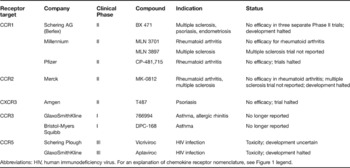
A number of chemokine receptor antagonist programmes have been terminated in clinical trials (Table 1), and several of these antagonists failed in Phase II clinical studies because they did not meet their clinical endpoints (Refs Reference Zipp31, Reference Brown32, Reference Vann33, Reference Braddock34, Reference Johnson35). Each of these trials involved small-molecule antagonists that blocked only one chemokine receptor. For example the antagonist BX 471, developed by Schering AG (Berlex), was specific for the chemokine receptor CCR1 and failed to demonstrate any efficacy in a Phase II trial for multiple sclerosis (Ref. Reference Zipp31). Multiple sclerosis is an extremely heterogeneous disease (Ref. Reference Sospedra and Martin36) and several chemokines and their receptors have been reported to play a role in driving the pathophysiology (Fig. 1). Thus, depending on the expression and activation of these receptors in patients with multiple sclerosis, more than one chemokine receptor may have to be inhibited for an antagonist to show efficacy in a clinical trial.
Failed clinical trials reported for chemokine receptor antagonists

Abbreviations: HIV, human immunodeficiency virus. For an explanation of chemokine receptor nomenclature, see Figure 1 legend.
Polypharmacology
Indeed, for the treatment of complex multifactorial diseases it has been suggested that so-called promiscuous compounds, which target more than one receptor or enzyme, might be more effective therapeutics than specific drugs that block a single target (Refs Reference Frantz37, Reference Roth, Sheffler and Kroeze38). This new paradigm has been called polypharmacology (Ref. Reference Overington, Al-Lazikani and Hopkins39).
Numerous examples of clinically accepted promiscuous drugs exist, of which aspirin is the most classically cited. Aspirin is effective therapeutically in a variety of situations, including as an anti-inflammatory agent (reducing fever, and aches and pains) and in cardiovascular medicine, where it has platelet-thinning effects and given chronically is useful in preventing heart attacks (Ref. Reference Vainio and Morgan40) It is well known that these beneficial effects of aspirin probably derive at least in part from its inhibition of specific cyclooxygenase (COX1 and 2) pathways, which lead to the inhibition of prostaglandin and thromboxane synthesis (Ref. Reference Katler and Weissmann41). However, the anti-inflammatory effects of aspirin could also be due to its ability to generate novel anti-inflammatory mediators known as aspirin-triggered 15-epilipoxins (Ref. Reference Serhan, Haeggstrom and Leslie42).
Combination therapies (cocktails of several drugs taken together that target different proteins) are already used to treat cancer and AIDS, since no single drug alone would be effective in treating these complex diseases. For the treatment of AIDS for example, cocktails of several reverse transcriptase inhibitors, protease inhibitors and fusion inhibitors are given (Ref. Reference Clavel and Hance43). The disadvantage of combination therapies is that each drug that is part of the combination has to go through safety testing and optimisation for ADME (‘absorption, distribution, metabolism and excretion’) prior to testing in the clinic. Thus, this would increase drug development costs and time taken for drug approval. In this context, perhaps a single drug that hits multiple targets might be more effective in the treatment of complex autoimmune diseases. The advantages and disadvantages of promiscuous drugs that target more than one receptor are reviewed below, together with examples of dual-specific chemokine receptor antagonists.
Successful receptor-promiscuous drugs
To anyone familiar with screening nonpeptide drug libraries to identify molecules specific for a particular GPCR, the concept of receptor-promiscuous drugs is certainly not new. In fact, all too often drugs that target multiple receptors are discovered from such screening campaigns. Although this is not usually desirable because of off-target effects, it can in some cases be beneficial therapeutically. The use of receptor-promiscuous drugs has made an impact in treating very complex diseases like schizophrenia, mood disorders and cancer (Ref. Reference Roth, Sheffler and Kroeze38); such diseases involve a variety of molecular mechanisms and respond well to a multitarget approach. Two examples, discussed below, serve to illustrate the success of this approach.
The first example is the antipsychotic drug olanzapine (Zyprexa, Eli Lilly), with sales in 2002 alone of US$4 billion. Importantly, this tricyclic benzodiazepine binds with high affinity to more than a dozen GPCRs from separate families (Ref. Reference Bymaster44). Its promiscuity is important for its activity since attempts made to tailor the drug to be more specific result in a loss of potency without reducing its side effects (Ref. Reference Roth, Sheffler and Kroeze38). In this case, the ability of the drug to block serotonergic and dopaminergic receptors is probably an advantage, as it is thought that both receptors play a role in schizophrenia (Ref. Reference Roth, Sheffler and Kroeze38). One caveat with promiscuous compounds is potential off-target actions; for example, olanzapine effectively targets the histamine receptor H1 and this has undesirable side effects such as weight gain (Ref. Reference Kroeze45).
The second example is the cancer drug sutent marketed by Pfizer to treat mainly kidney and gastrointestinal cancers (Ref. Reference Mendel46). Sutent has been shown to inhibit multiple receptor tyrosine kinases, including the platelet-derived growth factor (PDGF) receptor, vascular endothelial growth factor (VEGF) receptor, KIT and FLT3 (Ref. Reference Mendel46). In a recent report, the contribution of each of these receptor kinases in promoting tumour growth was examined individually with specific receptor kinase inhibitors. These studies showed that the promiscuous drug sutent was more efficient in inhibiting tumour growth than was blocking single receptor kinases with specific inhibitors, thus suggesting that its beneficial therapeutic effects derived mainly from its ability to target and inhibit multiple receptor kinases (Ref. Reference Potapova47). Sutent is a positive example of a promiscuous drug that is therapeutically very effective – in inducing remission and long-term survival in patients with kidney and gastrointestinal cancer (Ref. Reference Cella48).
Based on the examples above, it is obvious that small-molecule drugs can bind to multiple proteins. If this receptor promiscuity could be suitably harnessed in the design of dual inhibitors of GPCRs, it could be a useful approach in treating several diseases. For example, the design of dual inhibitors that could target both of the chemokine–HIV coreceptors – CXCR4 and CCR5 – would lead to very powerful therapeutics to treat AIDS. Similarly, antagonists that could inhibit the sphingosine 1-phosphate receptor 1 (S1P1) and the chemokine receptor CCR2 might be very effective antiatherogenic agents, given the beneficial effects of S1P1 modulators and CCR2 gene deletion in animal models of atherosclerosis (Refs Reference Tolle49, Reference Charo and Taubman50). Although the idea is attractive, the probability of discovering dual-GPCR inhibitors might at first be considered highly unlikely given the huge diversity in the range of ligands that act on GPCRs, and it might be expected that the success of this approach would rely entirely on the similarity of the receptor binding pockets of the GPCRs in question. In fact, as shown by the examples below, this is not the case. The rationale for discovering promiscuous nonpeptide ligands utilises a variety of approaches and ideas, and this review merely skims the surface; for a more exhaustive treatment see the excellent reviews on this topic provided by Refs Reference Roth, Sheffler and Kroeze38 and Reference Morphy, Kay and Rankovic51.
Dual GPCR antagonists by design
AT1–ETA antagonist
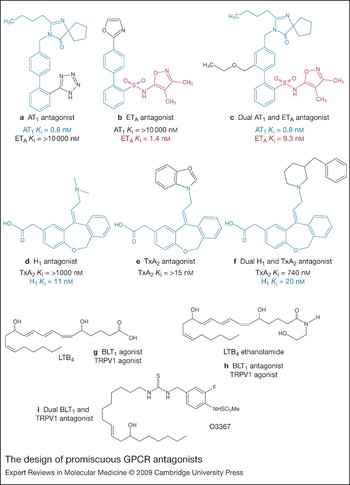
A classic example of a strategy to design dual GPCR inhibitors is that taken to discover potent antagonists for the type 1 angiotensin II receptor (AT1) and the type A endothelin receptor (ETA). The ligands for these receptors – angiotensin II and endothelin – are potent vasoconstrictors, and dual antagonists of these two receptors should be of greater benefit in the treatment of pulmonary hypertension, congestive heart failure and arteriosclerosis. Although the overall sequence identity of AT1 and ETA is low (only 19%), it has proven possible to design antagonists that bind both receptors with high affinity (K i in the low nanomolar range). This work originated from the observation that biphenylsulphonamides were highly potent and selective ETA antagonists (Fig. 2b) and bore a structural similarity to the biphenyltetrazole structures that are often found in AT1 antagonists (Fig. 2a). By merging together some of the key structural elements present in an AT1 antagonist with those of a biphenylsulphonamide ETA antagonist, a scaffold was provided that had potent antagonist activity against both receptors (Refs Reference Murugesan52, Reference Murugesan53) (Fig. 2c). Losartan (an AT1 antagonist) and SB-290670 (a dual ETA–ETB antagonist) each decreases blood pressure in a spontaneously hypertensive rat model of hypertension (Ref. Reference Kowala54). As might be expected, combinations of these antagonists given together are additive in decreasing blood pressure (Ref. Reference Kowala54). In line with these data, a dual AT1–ETA antagonist was shown to be more efficacious than an AT1 blocker at lowering blood pressure in spontaneous hypertensive rats (Ref. Reference Kowala54). We may soon learn whether such dual antagonists will be clinically useful since the pharmaceutical company Pharmacopeia has licensed a dual AT1–ETA antagonist (PS433540) from Bristol-Myers Squibb and announced through a press release that its Phase IIa clinical trial with the compound yielded positive efficacy and safety results in patients with stage 1 and stage 2 hypertension (http://www.pharmacopeia.com/wt/page/press/pr_1210796712).
H1–TxA2 antagonist
Histamine and thromboxane play an important role in the pathogenesis of asthma, and thus dual inhibitors of their receptors might provide potent anti-inflammatory compounds to treat this disease. The development of dual antagonists for the histamine receptor H1 and the thromboxane A2 receptor (TxA2) (Ref. Reference Ohshima55) was based on the observation that compounds discovered to be potent antagonists to both of these receptors contained a common benzoxepin core (Fig. 2d and e). Judicious replacement of the benzimidazole group, crucial for the TxA2 receptor antagonist activity (Fig. 2e), with a tertiary amine (Fig. 2f) resulted in a dual antagonist that was active at both of these receptors.
Clearly this approach, and the one just discussed above, worked well because highly potent templates to both receptors that had common core structures existed and these were tractable enough to allow a hybrid molecule that could interact with the binding pockets of both receptors to be designed. These examples suggest that promiscuous antagonists can be discovered for receptors that do not even share a similar binding domain.
The design of promiscuous GPCR antagonists. (Legend; see previous page for figure.) (a–c) The design of dual antagonists for the angiotensin II receptor (AT1) and the type A endothelin receptor (ETA). This approach is based on the idea that a phenylsulphonamide core is a central component of a class of potent and selective ETA antagonists (b). The biphenyl core of these compounds has a structural similarity to the biphenyltetrazole core of AT1 antagonists, including irbesartan (a). These observations allowed the design of potent AT1 and ETA dual receptor antagonists (e.g. c). The ETA antagonist core is shown in red; the AT1 antagonist scaffold is shown in blue. (d–f) The design of dual anatagonists for the receptor for thromboxane A2 (TxA2) and the histamine receptor H1. The rationale for the design of antagonists to these two receptors is based on the idea that they contain a common benzoxepin core, shown in blue. (g–i). The design of leukotriene B4 receptor (BLT1) and vanilloid receptor (TRPV1) dual antagonists. This approach is based on the idea that LTB4 (and other lipoxygenase metabolites of anandamide) can activate TRPV1 and BLT1. Since similar structures can activate very different receptors, it was reasoned that the design of a single antagonist that inhibits them both might prove to be feasible. For O3367, BLT1 antagonist K i = 60 nm (inhibition of LTB4-induced chemotaxis); TRPV1 antagonist K i = 1100 nM (inhibition of capsicin-induced Ca2+ flux).

BLT1–TRPV1 antagonist
A recent study described the design of potent antagonists that were dual inhibitors of both the leukotriene B4 (LTB4) receptor BLT1 (a GPCR activated by LTB4) and the vanilloid receptor TRPV1 (a ligand-gated, nonselective cation channel) (Ref. Reference McHugh56). The premise for the design of these dual antagonists arose from the observation that LTB4 (and other lipoxygenase metabolites of anandamide) can activate TRPV1 and BLT1 (Ref. Reference McHugh56). Since both of these receptors play an important role in inflammation, it was reasoned that the design of a single antagonist that inhibits them both should be very useful therapeutically. The rationale for designing the dual antagonist came from the observation that LTB4 ethanolamide (Fig. 2 h) had antagonist properties on BLT1 and agonist properties on TRPV1. These results led to the synthesis of pharmacophores that were structurally similar and proved to be interesting compounds that could be good starting points to design more highly potent antagonists of both receptors (Ref. Reference McHugh56) (Fig. 2i). In this case, the two receptors targeted by the antagonist belong to two very different classes and are not likely to share similar active sites.
Serendipitously discovered dual GPCR antagonists
Dual antagonists can also be discovered serendipitously, as recently described for a dual antagonist of the chemokine receptor CCR3 and the histamine receptor H1 (Ref. Reference Suzuki57). These receptors both play an important role in atopic diseases such as asthma and atopic dermatitis. CCR3 is activated by the chemokines CCL11, CCL24 and CCL26, which are upregulated in the allergic response, regulating the recruitment of eosinophils from the blood into tissues such as the lung where they mediate inflammation. By contrast, H1 is activated by the biogenic amine histamine, which is one of the primary mediators of the type 1 hypersensitivity response; it induces vasodilation, bronchoconstriction and smooth muscle cell activation, culminating in an allergic response. Inhibitors of H1 have found use clinically in the treatment of hay fever and allergies, but have not been very effective in treating asthma (Ref. Reference Simons and Simons58).
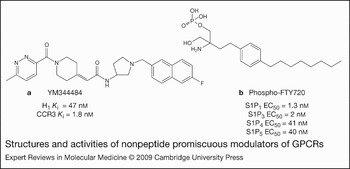
Thus, the antagonism of this receptor pair by a single drug might prove to be a more effective therapeutic to treat T helper 2 (Th2)-like inflammatory diseases such as asthma. Interestingly, these two receptors have limited homology (less than 14%) and are activated by totally unrelated ligands (a protein and a biogenic amine), yet are both potently inhibited by a single nonpeptide, YM-344484 (Fig. 3). This compound inhibits both the CCL11-induced Ca2+ influx in human CCR3-expressing cells (K i = 1.8 nm) and histamine-induced Ca2+ influx in H1-expressing PC3 cells (K i = 47 nm) (Ref. Reference Suzuki57). This example serves to reinforce the idea that it is not even necessary for the target proteins of a promiscuous drug to have identical binding sites, since it is quite likely that YM-344484 inhibits CCR3 by allosteric inhibition, as do most chemokine receptor antagonists (Ref. Reference Vaidehi59). Furthermore, it also illustrates the point that it is possible to obtain dual antagonists even for GPCRs that have highly dissimilar ligands. These dual H1–CCR3 antagonists, and others like them identified in the near future, should open up new therapeutic opportunities for the treatment of allergic disease, perhaps offering alternatives to current standard therapies that employ high levels of steroids (Ref. Reference Barnes60), with their associated drawbacks.
Structures and activities of nonpeptide promiscuous modulators of GPCRs. (a) YM344484 is a potent antagonist for the histamine receptor H1 and the chemokine receptor CCR3 (Ref. Reference Suzuki57). The discovery of this compound demonstrates that it is possible to find dual antagonists for receptors that have totally different ligands and presumably different binding pockets. (b) FTY720 is a sphingosine 1-phosphate receptor agonist. Although not specifically developed to act on multiple sphingosine 1-phosphate receptors, phosphorylated FTY720 potently binds to four out of the five S1P receptors (Refs Reference Clemens61, Reference Brinkmann92).

A cautionary note should be added here about problems that could arise in developing promiscuous GPCR drugs. FTY720, which is endogenously converted in vivo to the active metabolite phospho-FTY720 (Fig. 3), has found clinical use in transplantation medicine and in the treatment of multiple sclerosis. Currently FTY720 is in Phase III clinical trials for multiple sclerosis based on very positive Phase II data. Although not originally developed as a promiscuous drug, recent studies show that FTY720 is, as the phosphorylated form, a potent promiscuous agonist at four of the five S1P receptors (Ref. Reference Clemens61). It is likely, but not known for certain, that the beneficial effects of FTY720 derive from its potent promiscuous effects. Unfortunately, however, the action of FTY720 on the receptor S1P3 induces unwanted cardiovascular effects that include bradycardia, and thus a narrower-spectrum S1P receptor agonist might be more desirable for clinical development. Based on this example it needs to be borne in mind that receptor-promiscuous drugs do carry the danger of potentially deleterious off-target effects on other proteins or GPCRs.
Promiscuous chemokine receptor antagonists
GPCRs bind a diverse array of ligands, including peptides, lipids, nucleotides, amino acids, fatty acids, metals, light and odourants, all of which can activate the receptor (Ref. Reference Fredriksson62). It is unlikely that this activation is accomplished by engagement of a single common binding site, although this has been postulated for the class A or rhodopsin receptors in the past (Ref. Reference Schwartz and Rosenkilde63). This wide range of ligands more than likely binds to distinctly different receptor domains and induces signalling by changing the conformation of the GPCRs, which then triggers the G-protein pathways. For example, chemokines, which are proteins, trigger this conformational change by binding mainly to the extracellular loops of the receptor (Ref. Reference Blanpain64). By contrast, the biogenic amines bind to a helical cavity that encompasses transmembrane helices III, V, VI and VII for some ligands (Ref. Reference Ji, Grossmann and Ji65). Interestingly, nonpeptide antagonists to the chemokine receptors are mainly allosteric inhibitors and bind to the biogenic-amine-like domains of the receptor, probably altering the conformational switch so that the chemokines can no longer activate their receptors (Refs Reference Vaidehi59, Reference Watson66).
Since the examples discussed above suggest it is possible to discover antagonists that will block totally unrelated receptors, it should be feasible to generate dual antagonists for chemokine receptors. In fact, there are already parallels for this in the cunning strategies that infectious organisms have come up with to circumvent the immune response (Ref. Reference Ahuja, Gao and Murphy67). Chemokines and their receptors play an important role in host defence, and infectious agents such as viruses and parasites have generated cellular antagonists and/or binding proteins to block the action of chemokines and their receptors (Refs Reference McFadden68, Reference McFadden and Murphy69). Interestingly, virtually all of these natural antagonists of the chemokine system are promiscuous, including tick saliva proteins (Ref. Reference Frauenschuh70), viral chemokine-binding proteins (Refs Reference McFadden68, Reference McFadden and Murphy69) and viral chemokines (Refs Reference McFadden68, Reference McFadden and Murphy69).
Examples of dual chemokine receptor antagonists
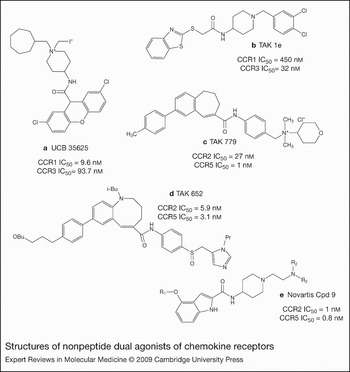
The design of promiscuous chemokine receptor antagonists should be aided by the number of dual antagonists that have already been described in the literature (Fig. 4). These are mostly to the highly related receptors CCR1 and CCR3, which share around 59% sequence identity (Refs Reference de Mendonca71, Reference Vedani72), or to CCR2 and CCR5, which share around 72% sequence identity. A 2-(benzothiazolylthio)acetamide compound from Takeda (Fig. 4b) binds to both CCR1 and CCR3 with high affinity, displacing CCL3 with an IC50 of 450 nm for CCR1, and CCL11 with an IC50 of 32 nm for CCR3 (Ref. Reference Naya73). Similarly, the antagonist UCB 35625 (Fig. 4a) is a potent antagonist for both receptors, inhibiting CCL3-mediated chemotaxis by cells expressing CCR1 with an IC50 of 9.6 nm, and CCL11-mediated chemotaxis by cells expressing CCR3 with an IC50 of 93.7 nm (Ref. Reference Sabroe74). For CCR2 and CCR5, the two compounds TAK 779 and TAK 652 (both from Takeda; Fig. 4c and d) are potent inhibitors of this receptor pair (Refs Reference Baba75, Reference Seto76). Recently, Novartis reported at a meeting that it was pursuing dual CCR2–CCR5 inhibitors (Ref. Reference Miltz77). Lead optimisation was based on a highly lipophilic benzothiophene identified from a high-throughput screen to yield a third-generation 4-substituted indole series (e.g. Fig 4e). This compound had high potency on human and rodent CCR2 and CCR5, no toxicity and good pharmacokinetic properties. The compound was efficacious in an in vivo peritoneal monocyte migration assay in the rat and in a mouse colitis model, as well as in an acute mouse experimental autoimmune encephalomyelitis model of multiple sclerosis.
Structures of nonpeptide dual agonists of chemokine receptors. (a, b) UCB 35625 (Ref. Reference Sabroe74) and TAK 1e (Ref. Reference Naya73) are dual CCR1 and CCR3 antagonists. (c–e) TAK 779 (Ref. Reference Baba75), TAK 652 (Ref. Reference Seto76) and Novartis compound (Cpd) 9 (Ref. Reference Miltz77) are potent dual CCR2–CCR5 inhibitors. These antagonists demonstrate that it is possible to generate small molecule inhibitors that act on more than one chemokine receptor.

The challenge to medicinal chemists will be to design dual-receptor antagonists that are effective in targeting totally unrelated receptors such as CCR5 and CXCR4 to generate drugs that would be very effective as antiretroviral agents in treating patients with AIDS. An obvious question arising from such an approach is whether it is possible to generate dual antagonists that are able to accommodate the receptor binding cavities of such different chemokine receptors as those of the CC and CXC classes. The answer to this may be yes, given the recent disclosure of a dual CXCR2–CCR2 receptor antagonist (Ref. Reference Walters78): although CXCR2 and CCR2 belong to two different chemokine receptor classes and have less than 20% sequence homology, a series of thiazolo[Reference Kikuchi4,Reference Haringman5-d]pyrimidines were found to be potent dual chemokine receptor antagonists. One of these compounds, 30a, inhibited calcium transients in cells expressing CXCR2 and CCR2 with IC50s of 1 nm and 8 nm, respectively.
Will dual chemokine receptor antagonists be therapeutically effective?
With the exception of the CCR5 antagonist, which is a registered antiretroviral agent, chemokine receptor antagonists have not lived up to their therapeutic promise (Refs Reference Ribeiro, Horuk, Hannan and Engelhardt1, Reference Pease and Horuk79, Reference Ribeiro and Horuk80). Chemokine receptor redundancy has been proposed as one reason, among many, to account for these failures. The approach of simply targeting one receptor may not be enough. Given the absence of good clinical markers of disease, there is not always a simple way to stratify patients in clinical trials into appropriate groups that will respond to treatment (i.e. groups showing activation of a particular receptor pathway). In the absence of such clinical markers, promiscuous receptor drugs have been proposed here as one possible approach to target complex heterogeneous diseases like multiple sclerosis. In support of this idea, examples of successful promiscuous drugs like olanzapine have been discussed, and evidence has been presented that shows it is possible to generate dual-receptor antagonists of GPCRs, including chemokine receptors. Furthermore, promiscuous drugs that target receptors with very different binding pockets and with very little homology to each other can clearly be generated. Given that it is possible to come up with promiscuous chemokine receptor antagonists, what evidence is there that targeting more than one receptor is beneficial? The evidence for this is scant and summarised below.
It is well established that chemokines play a role in atherogenesis; however, inhibition of individual chemokines or chemokine receptors has had only limited effects in animal models of disease, suggesting that blocking multiple receptors might be required for efficacy. In line with this, two recent reports show that blocking multiple chemokines and/or chemokine receptors is extremely effective in treating atherosclerosis (Refs Reference Combadiere19, Reference Saederup81). In the first study, combined inhibition of CCL2 (a CCR2 ligand), CX3CR1 and CCR5 in a hypercholesterolaemic, atherosclerosis-susceptible apolipoprotein E (ApoE)-deficient mouse model of atherosclerosis led to a reduction in circulating monocytes despite a persistent hypercholesterolaemia (Ref. Reference Combadiere19). These effects were associated with an almost complete reduction in atherosclerosis. In the second study (Ref. Reference Saederup81), the authors reported a four-arm atherosclerosis study in CX3CL1 (the ligand for CX3CR1), CCR2 and ApoE triple-knockout mice. The triple-knockout mice showed a marked reduction in macrophage accumulation in the artery wall together with a gross reduction in the development of atherosclerosis. The overall conclusion from these two studies is that blocking multiple chemokine receptors is much more effective in animal models of atherosclerosis than blocking a single receptor, and it underscores the potential benefit of promiscuous chemokine receptor antagonists as useful therapeutics.
A model of intimal hyperplasia in response to femoral arterial injury was examined in transgenic mice that were induced to express M3 (Ref. Reference Pyo82), a herpes virus protein that binds and inhibits multiple chemokines of all classes including CC, CXC, C and CX(Reference Carvalho-Pinto3)C (Ref. Reference Parry83). Induction of M3 expression resulted in a 67% reduction in intimal area and a 68% reduction in intimal:medial ratio after femoral artery injury. By contrast to these data, targeted deletion of a single chemokine, CCL2, in an identical model resulted in only a 29% reduction in intimal hyperplasia (Ref. Reference Kim84), suggesting that multiple chemokines and receptors are involved in the pathophysiology. Thus, these data underscore the therapeutic utility of pan-specific chemokine blockade and suggest that blocking more than one chemokine can be therapeutically advantageous, at least in this animal model.
The benefits of blocking two totally unrelated chemokine receptors – CCR5 and CXCR3 – both of which are important proinflammatory receptors in autoimmunity, were recently illustrated using knockout mice and receptor-neutralising antibodies (Ref. Reference Schnickel20). Both CCR5 and CXCR3 have previously been shown to play a role in organ transplant rejection, mainly by inducing infiltration of T cells into the transplanted organs (Refs Reference Gao85, Reference Hancock86). A heterotopic heart transplantation model in BALB/c to B6/129 mice deficient in CCR5 was carried out in the absence and presence of neutralising antibodies to CXCR3 (Ref. Reference Schnickel20). Recipient mice were then assessed daily for allograft function by abdominal palpation, and graft survival was confirmed by laparotomy. The donor hearts in the CCR5-deficient control group were all rejected at 6 days post-transplantation. The survival of the donor hearts in the CCR5-deficient mice receiving control antibody and in the wild-type mice receiving anti-CXCR3 antibodies was prolonged to 29 and 34 days, respectively. However, the animals receiving a combined blockade of CXCR3 and CCR5 had a greater than 15-fold prolonged allograft survival compared with the control group; all of the allografts survived for greater than 100 days, after which the study was terminated. In addition, the donor hearts did not display any of the signs that are characteristic of chronic rejection. In summary, these studies demonstrate that blocking the chemokine receptors CCR5 and CXCR3 with dual antagonists could be beneficial in acute organ transplantation rejection.
Concluding remarks
It has been suggested here that chemokine receptor redundancy could be, at least in part, responsible for some of the recent clinical failures in chemokine receptor antagonist programmes. Demonstrating clinical efficacy with a specific antagonist to a single receptor is difficult because we do not yet possess the ability to separate patients into chemokine-receptor-specific subpopulations for a specific disease. This approach, sometimes called personalised medicine, was elegantly pioneered by Genentech to identify and treat the subpopulation of HER2-expressing breast cancer patients with trastuzumab (Herceptin), an antibody to HER2 (Ref. Reference Bacus and Yarden87). About 25% of breast cancer patients overexpress the EGF receptor family member HER2, and the same antibody to the receptor that is used to treat this cancer was initially used to identify this subpopulation, making it easier to stratify patient groups in clinical trials. Detection of HER2 overexpressers allowed smaller clinical trials for a shorter duration, saving drug-development money and allowing demonstration of strong proof of efficacy. If we had the ability to do this with chemokine receptors, then perhaps single specific antagonists would be more effective. In the absence of such information, promiscuous chemokine receptor antagonists, or indeed combination therapies with several specific antagonists, could perhaps overcome the problem of receptor redundancy. This approach should be more successful than previous ones, and could provide ultimate benefit in treating complex autoimmune diseases. With the examples discussed here and the progress being made in solving the three-dimensional structure of GPCRs (Refs Reference Palczewski88, Reference Cherezov89, Reference Rasmussen90, Reference Rosenbaum91), polypharmacology applied to the chemokine receptor field could, in the near future, be a very interesting and novel way to generate effective therapeutics.
Acknowledgements and funding
I thank the peer reviewers of this review for helping to increase its clarity.