Background
Obstructive sleep apnea (OSA) is characterized by repetitive episodes of partial or complete upper airway obstruction during sleep (American Academy of Sleep Medicine, 2014). Symptoms of this disorder include snoring, daytime sleepiness, frequent awakenings, and disrupted sleep (Mannarino, Di Filippo, & Pirro, Reference Mannarino, Di Filippo and Pirro2012). The prevalence of OSA ranges from 9% to 38% in the general adult population (Senaratna et al., Reference Senaratna, Perret, Lodge, Lowe, Campbell, Matheson and Dharmage2017). Sleep apnea has been associated with multiple difficulties such as cardiovascular disease, diabetes, excessive daytime sleepiness, impaired cognitive functioning and cancer (Alchanatis et al., Reference Alchanatis, Zias, Deligiorgis, Liappas, Chroneou, Soldatos and Roussos2008; Ayalon, Ancoli-Israel, & Drummond, Reference Ayalon, Ancoli-Israel and Drummond2010; Ayas, Taylor, & Laher, Reference Ayas, Taylor and Laher2016; Davies & Harrington, Reference Davies and Harrington2016; Owens et al., Reference Owens, Gold, Gozal, Peppard, Jun and Lippman2016). The developmental progression of symptoms is not clear in young people (Lumeng & Chervin, Reference Lumeng and Chervin2008) so it is important to study sleep apnea early in life with the hope of gaining knowledge to prevent the continuation of symptoms into later adulthood (Tsubomatsu et al., Reference Tsubomatsu, Shintani, Abe, Yajima, Takahashi, Ito and Himi2016).
Only a few studies have focused on genetic and environmental influences associated with apnea. A pioneering study in an adult population found a higher concordance for snoring in MZ (0.67) than DZ (0.50) twins (Ferini-Strambi et al., Reference Ferini-Strambi, Calori, Oldani, Della Marca, Zucconi, Castronovo and Smirne1995). Another study in a middle-aged sample reported a heritability of 0.52 for disruptive snoring (Desai, Cherkas, Spector, & Williams, Reference Desai, Cherkas, Spector and Williams2004). The heritability of the apnea−hypopnea index (i.e. number of apnea and hypopnea events per hour of sleep), ranges from 0.23 to 0.37 in adult populations (de Paula et al., Reference de Paula, Alvim, Pedrosa, Horimoto, Krieger, Oliveira and Lorenzi-Filho2016; Patel, Larkin, & Redline, Reference Patel, Larkin and Redline2008). However, both the frequency of sleep apnea and the severity of its consequences increase across the lifespan (Deng, Gu, Li, Liu, & Gao, Reference Deng, Gu, Li, Liu and Gao2014). Additionally, key correlates of apnea symptoms, such as smoking and BMI, also show important age-related variations. Heritability is a population statistic so estimates could also vary as a function of age. This has been found in research focusing on different variables, such as IQ – for which heritability increases with age (Haworth et al., Reference Haworth, Wright, Luciano, Martin, de Geus, van Beijsterveldt and Plomin2010). No prior studies have investigated the role of genetic and environmental influences on apnea symptoms specifically in young adults. However, analyzing the genetic architecture of apnea symptoms in young people could help researchers ascertain its age-varying nature and provide clues about the conceivable differential weight of genetic and environmental factors in the development of apnea symptoms (Bliwise, Reference Bliwise2009).
In addition, the relationship between apnea symptoms and symptoms of internalizing and externalizing behaviors has not yet been investigated in young people, using a genetically informative design. This is despite the fact that sleep disruption may exacerbate/cause internalizing/externalizing symptoms. Although causality has not yet been determined, associations have been reported between sleep apnea and depression (Sharafkhaneh, Giray, Richardson, Young, & Hirshkowitz, Reference Sharafkhaneh, Giray, Richardson, Young and Hirshkowitz2005), anxiety (Rezaeitalab, Moharrari, Saberi, Asadpour, & Rezaeetalab, Reference Rezaeitalab, Moharrari, Saberi, Asadpour and Rezaeetalab2014), and behavioral problems (Chervin, Dillon, Archbold, & Ruzicka, Reference Chervin, Dillon, Archbold and Ruzicka2003; Guilleminault, Korobkin, & Winkle, Reference Guilleminault, Korobkin and Winkle1981; Xanthopoulos et al., Reference Xanthopoulos, Gallagher, Berkowitz, Radcliffe, Bradford and Marcus2015). Such analyses can demonstrate the extent to which the overlap in symptoms is due to genetic and environmental influences, paving the way for further studies to elucidate the specific factors underlying shared etiology.
As an initial effort to address these knowledge gaps, three objectives are proposed. Specifically, we: (1) estimate the magnitude of genetic and environmental influences on self-reported apnea symptoms (including the principal apnea symptoms: snorting/gasping during sleep, loud snoring and breathing difficulties/stops breathing during sleep) in a representative sample of young adults; (2) investigate the magnitude of the relationship between self-reported apnea symptoms and internalizing/externalizing behaviors; (3) explore genetic and environmental influences on the associations between self-reported apnea symptoms, internalizing behaviors and externalizing behaviors to examine the degree of overlap in genetic and environmental factors contributing to these phenotypes.
Methods
Sample
The sample comprised 1556 young adults from wave 4 of the G1219 twin/sibling study (McAdams et al., Reference McAdams, Gregory, Rowe, Zavos, Barclay, Lau and Eley2013). At wave 4 the sample was 61.6% female and mean age was 20.3 (range 18–27; s.d. = 1.8). Participants came from 896 families comprising 75 monozygotic (MZ) male (65 complete) pairs; 76 dizygotic (DZ) male (53 complete) pairs; 155 MZ female (125 complete) pairs; 138 DZ female (111 complete) pairs; 232 DZ opposite sex (163 complete) pairs; 44 male–male sibling (Sib) (28 complete) pairs; 68 female–female Sib (44 complete) pairs; 89 opposite sex Sib (56 complete) pairs. Thirty-five participants that had missing zygosity or age information were excluded.
Measures
Apnea symptoms were measured through three questions based on the core symptoms of apnea: ‘During the past month, how many nights or days per week have you had, or been told you had, the following symptoms?’ (a) ‘snorting or gasping during sleep’; (b) ‘loud snoring’; (c) ‘your breathing stops or you choke or struggle for breath during sleep’ with six response options (‘never’/‘do not know’ (coded as ‘no sign of symptoms’ = 0), ‘rarely: less than once per week’ (coded 1), ‘sometimes: 1–2 times per week’ (coded 2), ‘frequently: 3–4 times per week’ (coded 3), ‘always: 5–7 times per week’ (coded 4). Cronbach's alpha in the current sample for these three questions was 0.78. We also made a composite score of the sum of these three items (ranging from 0 to 12). Online Supplementary Tables S1 and S2 show the frequency distribution of responses for each item and the composite sleep apnea symptoms score, respectively. The composite scores were positively skewed (skew statistic = 3.2) and did not approximate normality after transformation. Since only 25.5% of participants showed any sleep apnea symptoms, and the proportion of those obtaining each ordinal score was small (from 0.1 to 9%), the variable was dichotomized, focusing on those with no symptoms (a score of 0, n = 1120, 74.5%) and those with symptoms (i.e. a score of 1 or more, n = 383; 25.5%). Eighteen participants had missing apnea data and therefore, they were excluded for the apnea analyses.
Depression was measured using the Short Mood and Feelings Questionnaire (SMFQ) (Angold et al., Reference Angold, Costello, Messer, Pickles, Winder and Silver1995). It is a 13-item measure using a three-point likert scale (0 = not true to 2 = true). This measure includes key symptoms of depression such as ‘I felt miserable or unhappy’ over the previous two weeks. This questionnaire has previously shown good psychometric properties (Costello & Angold, Reference Costello and Angold1988; Costello, Benjamin, Angold, & Silver, Reference Costello, Benjamin, Angold and Silver1991), and Cronbach's alpha in the current sample was 0.90 (Gregory et al., Reference Gregory, Buysse, Willis, Rijsdijk, Maughan, Rowe and Eley2011).
Anxiety was measured using the anxiety scale of an age-appropriate version of the Revised Child Anxiety and Depression Scale (RCADS) (Chorpita, Yim, Moffitt, Umemoto, & Francis, Reference Chorpita, Yim, Moffitt, Umemoto and Francis2000). The measure has 36 items (responses ranging from 0 = never to 3 = always). These items measure DSM-IV symptoms of anxiety in five different categories (separation anxiety; social anxiety; obsession/compulsion; panic/agoraphobia and general anxiety). Cronbach's alpha in this sample was 0.94 (Gregory et al., Reference Gregory, Buysse, Willis, Rijsdijk, Maughan, Rowe and Eley2011).
Externalizing behavior was measured using items from the scales of rule-breaking and aggression from the ‘adult self-report form’ (Achenbach & Rescorla, Reference Achenbach and Rescorla2003). The aggression subscale includes 15 items, and the rule-breaking subscale comprises 14 items. Two further items (‘I damage or destroy my own things’ and ‘I damage or destroy things belonging to others’) were included that were previously utilized in versions of the questionnaire for younger age groups (to allow comparison with the data collected at this wave and previous waves). Four items related to depression were excluded from the aggression subscale to avoid item overlap, since depression was also included in the analyses. The item ‘I have trouble keeping a job’ was excluded because it was deemed age inappropriate (our youngest participants were 18 years old and more than 40% were in full-time university education). Hence, the final scale comprised 25 items (one item is common for both subscales). For each item, participants were required to respond on a three-point scale (0 = ‘not true’ to 2 = ‘very true’). Therefore, the scale ranges from 0 to 50 where a higher score represents greater externalizing behaviors. The specific items included in this version of the scale were used in a previous report from this sample and Cronbach's alpha was 0.85 (Barclay, Eley, Maughan, Rowe, & Gregory, Reference Barclay, Eley, Maughan, Rowe and Gregory2011).
Other variables
Data regarding sex, age, smoking status (i.e. Do you smoke?), and BMI [weight (kg)/height (m2)] were also collected through self-reported measures. BMI and smoking variables were included as covariates given their known association with the prevalence and intensity on respiratory symptoms (Krishnan, Dixon-Williams, & Thornton, Reference Krishnan, Dixon-Williams and Thornton2014).
Statistical analysis
Twin studies allow the disentanglement of genetic and environmental influences on a single variable or multiple variables (Knopik, Neiderhiser, DeFries, & Plomin, Reference Knopik, Neiderhiser, DeFries and Plomin2017). Comparing MZ twins (who share 100% of their DNA) and DZ twins (who share on average, 50% of their segregating genes) the total variance in a phenotype can be decomposed into genetic and environmental factors. Genetic influences include additive genetic factors (a 2) which are the sum of allelic effects across multiple genes; and non-additive genetic influences (d 2) which includes the effects of dominance and epistasis. On the other hand, environmental factors can be decomposed into common shared-environment (c 2) which represents the influences that make members of the same family more alike; and non-shared environment (e 2) which refers to unique experiences for each individual (Verweij, Mosing, Zietsch, & Medland, Reference Verweij, Mosing, Zietsch and Medland2012) – plus measurement error. Since it is not possible to estimate C and D at the same time in genetic model-fitting, parameters were chosen based on the pattern of correlations. An ADE model is usually selected when the DZ correlation is lower than half of the MZ correlation. In contrast, an ACE model is selected if the DZ correlation is greater than half of the MZ twin correlation (Verweij et al., Reference Verweij, Mosing, Zietsch and Medland2012). Nested submodels (e.g. AE) were compared against the full models (e.g. ACE) to determine if any of the components could be dropped without a significant decrease in model fit. During this process, components responsible for twin resemblance (i.e. additive genetics, A; shared environment, C and/or non-additive genetics D) are dropped consecutively and the reduced models are compared with the full model. Following the principle of parsimony, if a reduced model with fewer parameters does not provide a significantly worse fit than the full model, the nested model is selected. For example, if an ACE model is compared with the nested submodel (AE), the latter is presented when the comparison shows no significant decrease in model fit. Models were evaluated using the −2 log-likelihood-ratio χ2 test (−2LL) and the Akaike's information criterion (AIC) (Akaike, Reference Akaike1987). Lower AIC values indicate a superior fit to the data.
Four univariate genetic models were fitted (three continuous variables: depression, anxiety and externalizing behavior; and one dichotomous variable: presence/absence of apnea symptoms). Additionally, we fitted a multivariate Cholesky model (transformed into a correlated factor solution) (Loehlin, Reference Loehlin1996) for all the variables (apnea symptoms, depression, anxiety and externalizing behaviors) in order to estimate the genetic and environmental influences shared between these phenotypes. We also tested whether there were variance differences between twins and siblings by calculating an additional biometric variance component (twin effect) which accounts for the increased resemblance between DZ twins compared to siblings due to shared environmental effects. This component was not significant in any model so we treated siblings in the same way as dizygotic twins. All the continuous variables (depression, anxiety and externalizing behaviors) were +1log transformed to reduce positive skewness (skewness ranged from 1.06 to 1.67 before transformation and from −0.23 to −0.82 after transformation).
Results
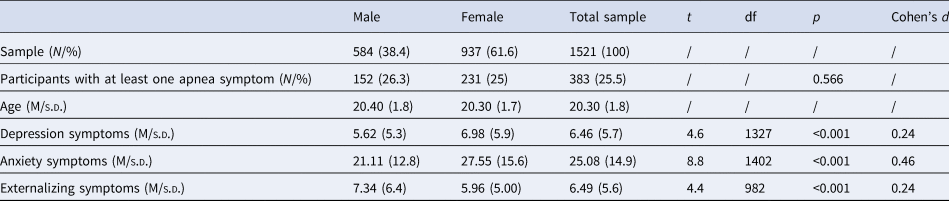
Descriptive statistics are presented in Table 1. Women had higher scores than men for depression and anxiety whereas men had higher scores than women for externalizing behaviors. Twenty-six percent of the sample had at least one symptom of apnea, and there were no sex differences in apnea symptoms (Table 1). No differences in the prevalence of symptoms of apnea were found based on marital status, living with parents or living alone.
Descriptive statistics and sex differences in main variables

df, degrees of freedom; M/s.d., mean/standard deviation; p, p value; t, t Student.
Apnea symptoms were measured by three single questions referring to principal symptoms of apnea in the past month, ranging from 0 = ‘no sign’ to 4 = ‘ always’. Those participants who responded to all items as ‘never’ or ‘do not know’ were not classified as having at least one apnea symptom. Depression, anxiety and externalizing behaviors were measured using RCADS (Revised Child Anxiety and Depression Scale), SMFQ (Short Mood and Feelings Questionnaire) items from the scales of rule breaking and aggression of the adult self-report form, respectively. Higher scores represent increased levels of depression, anxiety and externalizing behaviors.
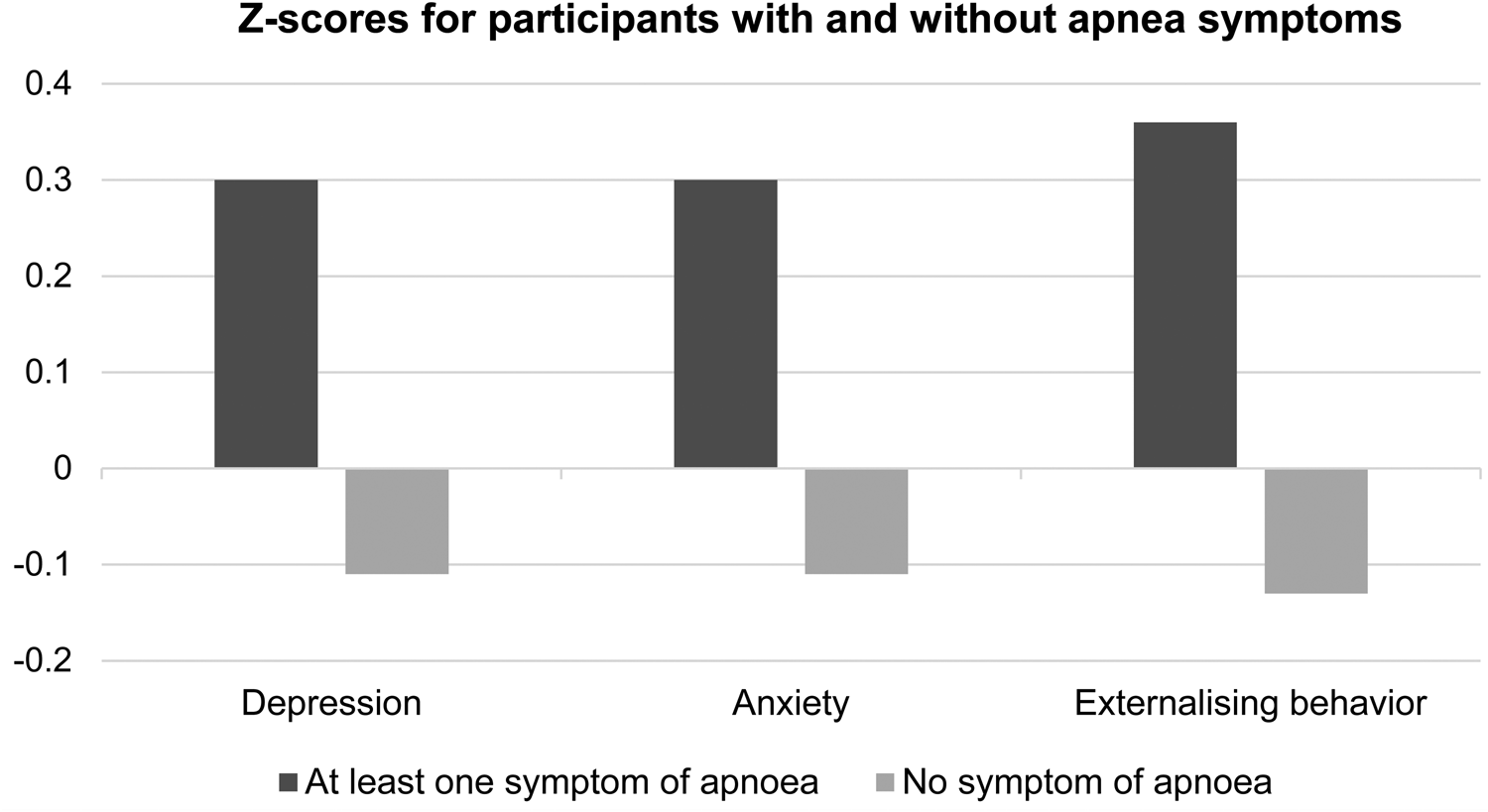
Phenotypic correlations for the variables included in the multivariate genetic analysis were moderate (apnea symptoms and depression, r = 0.25; 95% CI 0.18–0.31; symptoms of anxiety, r = 0.22; 95% CI 0.15–0.29, and externalizing behaviors, r = 0.29; 95% CI 0.22–0.35). Figure 1 shows the higher z-scores for depression, anxiety and externalizing behaviors for participants with at least one symptom of apnea as compared to participants without apnea symptoms.
Mean differences for participants with and without apnea symptoms. Note. All differences were significant p < 0.001.

Univariate genetic analyses
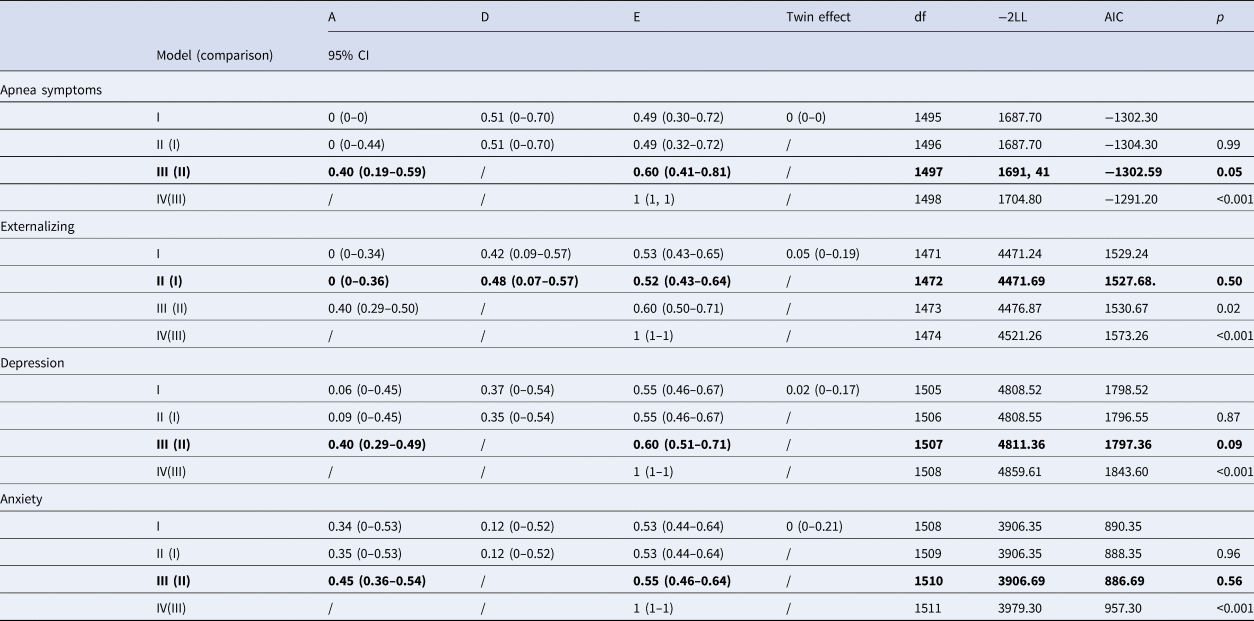
Intra-pair correlations were higher for MZ twins (0.44−0.55) than DZ twins/siblings (0.05−0.20) for all the variables included in the genetic analyses. Table 2 shows results from univariate genetic models.
Univariate analyses

Note. A, additive genetic influence; D, dominant genetic influence E, non-shared environmental influence; −2LL, negative 2 log likelihood; AIC, Akaike's information criterion; CI, confidence interval; df, degrees of freedom; p-value, significance value of the likelihood-ratio χ2 test; rDZ, dizygotic correlations; rMZ, monozygotic correlations. TW, twin effect component on the variance. Bold text indicates best fitting models.
Model legend: I: ADE + TW; II: ADE; III: AE; IV: E.
Monozygotic intrapair correlations were 0.53, 0.45, 0.44 and 0.49 for apnea symptoms, externalizing, depression and anxiety, respectively.
Dizygotic intrapair correlations were 0.05, 0.12, 0.14 and 0.20 for apnea symptoms, externalizing, depression and anxiety, respectively.
The AE model was presented for apnea symptoms (as there was no significant difference as compared to the full ADE model). Heritability was estimated at 0.40 (95% CI 0.19–0.59). The rest of the variance was attributable to non-shared environmental factors. Given known correlates of sleep apnea (Krishnan et al., Reference Krishnan, Dixon-Williams and Thornton2014; Patel et al., Reference Patel, Larkin and Redline2008), we performed a sensitivity analysis including BMI and smoking as covariates in the model. Estimates from this model were similar to those from the basic model, with estimates of A = 0.40 (0.17, 0.61) and E = 0.60 (0.39, 0.83). A sex-limitation model was also tested. No sex differences were found in the distribution of the variance (p = 0.121).
Depression and anxiety also fitted to AE models with moderate heritability values [0.40 (95% CI 0.29–0.49) and 0.45 (95% CI 0.36–0.54) respectively]. For externalizing behavior an ADE model provided the best fit, with genetic factors accounting for 0.48 (95% CI 0.07–0.57) of the variance (Table 2).
Multivariate analysis
In the multivariate genetic model, the AE model provided the best fit. Estimates of variance components were similar to those of univariate analyses, with the exception of externalizing behavior due to the change of model (from ADE to AE) (online Supplementary Table S3).
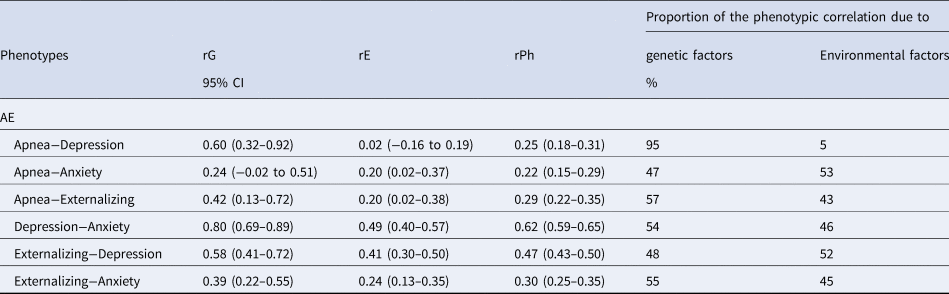
All genetic correlations were significant (p < 0.05) except for that between anxiety and apnea (rA = 0.24; 95% CI −0.02 to 0.51). Moderate−high genetic correlations were found between apnea symptoms and depression (rA = 0.60; 95% CI 0.32–0.92); and between apnea symptoms and externalizing behaviors (rA = 0.42; 95% CI 0.13–0.72). Environmental correlations were all significant except for the correlation between apnea symptoms and depression. The remaining environmental correlations ranged from 0.20 to 0.49. Approximately half of the phenotypic correlations were explained by genetic factors, except for apnea symptoms and depression, where a larger proportion of the association was explained by genetic factors (95%) (Table 3).
Correlations from the multivariate analysis

CI, confidence interval; rE, environmental correlation; rG, genetic correlation; rPh, phenotypic correlation.
Analyses were re-run whereby ‘do not know’ for the apnea question was re-coded as missing data. Similar results were found.
Conclusions
This study contributes to the small body of twin research focusing on apnea symptoms by confirming the relevance of genetic factors in its etiology. Additionally, the study offers new insights regarding the origin of the associations between apnea symptoms and both internalizing and externalizing behaviors.
Genetic and environmental influences of self-reported apnea symptoms
Our results indicate that a significant proportion of the variance in apnea symptoms in young people is explained by genetic factors. Our heritability estimate is at the upper end of the range found in previous studies with adult samples (de Paula et al., Reference de Paula, Alvim, Pedrosa, Horimoto, Krieger, Oliveira and Lorenzi-Filho2016; Patel et al., Reference Patel, Larkin and Redline2008). This could be because our sample is younger than others used to estimate the heritability of apnea symptoms. Other studies have also found large heritability values for variables related to sleep apnea, such as snoring or airway anatomy (Desai et al., Reference Desai, Cherkas, Spector and Williams2004; Ferini-Strambi et al., Reference Ferini-Strambi, Calori, Oldani, Della Marca, Zucconi, Castronovo and Smirne1995; Kang, Sung, Song, & Kim, Reference Kang, Sung, Song and Kim2018).
Phenotypic associations between apnea symptoms and internalizing/externalizing behaviors
We found significant modest associations between apnea symptoms and both internalizing and externalizing behaviors. Apnea symptoms were associated with higher levels of depression. Our results are consistent with previous literature in adults (Harris, Glozier, Ratnavadivel, & Grunstein, Reference Harris, Glozier, Ratnavadivel and Grunstein2009; Sharafkhaneh et al., Reference Sharafkhaneh, Giray, Richardson, Young and Hirshkowitz2005), extending this conclusion to young people. A similar picture can be found for anxiety. In our sample, young adults with apnea symptoms exhibited higher levels of anxiety, which is consistent with previous results in adults (Rezaeitalab et al., Reference Rezaeitalab, Moharrari, Saberi, Asadpour and Rezaeetalab2014). Finally, as expected, we also found a higher score for externalizing behaviors for those reporting apnea symptoms. Although few studies have investigated this relationship in children, such studies report that conduct problems are more frequent in those with sleep-disordered breathing (Chervin et al., Reference Chervin, Dillon, Archbold and Ruzicka2003; Guilleminault et al., Reference Guilleminault, Korobkin and Winkle1981). In summary, the available evidence points to a relationship between apnea symptoms and both internalizing and certain externalizing behaviors.
Several mechanisms could account for the associations between apnea symptoms, depression, anxiety and externalizing behaviors. For example, disrupted sleep (which occurs in those experiencing sleep apnea) has been linked with an altered function of corticolimbic circuitry in young people, which has been associated with an impairment of affective reactivity and regulation (Blake, Trinder, & Allen, Reference Blake, Trinder and Allen2018). This would mean that apnea could potentially cause or exacerbates internalizing/externalizing disorders. It has also been suggested that poor sleep quality may disrupt reward-related brain function which is a relevant factor in the development of depression (Casement, Keenan, Hipwell, Guyer, & Forbes, Reference Casement, Keenan, Hipwell, Guyer and Forbes2016).
Anxiety and sleep apnea could also be related through specific processes, such as injury in specific brain areas related to emotional regulation such as the amygdala, hippocampus, and cingulate, insular, and prefrontal cortices caused by untreated sleep apnea (Kumar et al., Reference Kumar, Macey, Cross, Woo, Yan-Go and Harper2009) or an altered function of the hypothalamic−pituitary−adrenal axis (HPA) (Trakada, Chrousos, Pejovic, & Vgontzas, Reference Trakada, Chrousos, Pejovic and Vgontzas2007). The HPA axis also plays an important role in these processes, including aggressive behavior, and its relationship to sleep (Kamphuis, Meerlo, Koolhaas, & Lancel, Reference Kamphuis, Meerlo, Koolhaas and Lancel2012). Additionally, poor sleep has been related to an altered function of the prefrontal cortex or serotonin system which could potentially increase the risk of externalizing behaviors (Kamphuis et al., Reference Kamphuis, Meerlo, Koolhaas and Lancel2012).
Genetic and environmental influences on the association between phenotypes
Our results suggest that the associations between apnea symptoms, depression, anxiety and externalizing behaviors may be explained by both genetic and environmental factors. Of note, our results show different patterns of results for the different associations being assessed. There is a moderate genetic correlation for the association between depression and apnea symptoms. In contrast, the environmental correlation between these two phenotypes was estimated close to 0. Consequently, the relationship between depression and apnea symptoms was explained almost entirely by genetic factors, which implicates a pleiotropic effect although the possibility of causality cannot be ruled out (Bartels, de Moor, van der Aa, Boomsma, & de Geus, Reference Bartels, de Moor, van der Aa, Boomsma and de Geus2012). In contrast, the genetic correlation between apnea symptoms and anxiety was smaller and not significant and the environmental correlation was of a similar magnitude yet marginally significant. This suggests that, contrary to depression, there might not be a substantial role for a set of genes influencing both phenotypes. For externalizing behaviors and symptoms of sleep apnea, we found significant genetic overlap although lower than that between symptoms of sleep apnea and depression. The environmental correlation between apnea symptoms and externalizing behaviors was also significant. However, our ADE model estimated a substantial though non-significant contribution from non-additive genetic effects. Our analyses may be underpowered to distinguish additive and non-additive genetic effects. Our estimation of A in the AE multivariate model should therefore be interpreted as broad-sense heritability, incorporating both non-additive and additive genetic effects. Hence, we have to be cautious when interpreting our results regarding the composition of genetic contribution to phenotypic variance. These data support the notion that apnea partially shares genetic influences with depression, anxiety and externalizing behavior. Future research is needed to determine the direction and causality of these associations and to identify the specific genes involved.
Comparisons with other studies are difficult since our study is the first to examine these associations from a behavioral genetic perspective. However, other studies from our group have shown substantial genetic associations between depression, anxiety and externalizing behaviors and other sleep phenotypes such as sleep quality (Barclay et al., Reference Barclay, Eley, Maughan, Rowe and Gregory2011; Gregory et al., Reference Gregory, Buysse, Willis, Rijsdijk, Maughan, Rowe and Eley2011). These patterns of results support the notion that symptoms of sleep apnea relate differently with the various internalizing and externalizing symptoms and that the origin of specific associations may differ. This information should be considered when conducting further research about these relationships and when considering treatments, as useful information to consider in the case conceptualization. In addition, future research should aim to identify potential mediators of the genetic correlations between apnea symptoms and these phenotypes. For instance, genes affecting obesity could indirectly affect both depression and apnea.
Limitations
This study has several strengths such as the large sample of twins and siblings of both sexes, focusing on an understudied age range with regards to sleep apnea symptoms, and the employment of a wide set of measures. However, it also has limitations. First, apnea symptoms were assessed using self-report, which may lack accuracy, and produce false positives and negatives as compared with polysomnographic indexes (Kapuniai, Andrew, Crowell, & Pearce, Reference Kapuniai, Andrew, Crowell and Pearce1988). However, self-reported measures have shown to be acceptable predictors of objectively measured OSA, such as when using questionnaires such as STOP-BANG (El-Sayed, Reference El-Sayed2012; Laranjeira, Barbosa, & Rabahi, Reference Laranjeira, Barbosa and Rabahi2018). Our three single-items are similar to questions from the STOP-BANG (and other widely used questionnaires). Other items from the STOP-BANG were not asked in our questionnaire (e.g. high blood pressure, age <50 years) and some were not relevant for a sample of young people. For example, daytime sleepiness is a correlate of sleep apnea – yet young people (including those without sleep apnea) are often sleepy (Millman, Adults, & Adolescence, Reference Millman2005) and self-reported measures of sleepiness correlate poorly with objective measures of OSA in adolescents (Weaver, Kapur, & Yueh, Reference Weaver, Kapur and Yueh2004). Replication of our results in studies measuring apnea using polysomnography would be of benefit.
Summary
This work has expanded our knowledge about genetic influences on apnea symptoms. Our results suggest a significant genetic influence on variation in apnea symptoms in young adults. Furthermore, this study has examined the magnitude of the relationships between apnea symptoms and internalizing/externalizing behaviors, finding modest associations between those traits for which genetic/environmental influences differ depending on the specific associated variable. The main findings of this study are that: (a) there is a significant genetic influence on variation in apnea symptoms; (b) There are modest relationships between apnea symptoms and internalizing/externalizing behaviors; and (c) the genetic/environmental origin of these associations appears to be different for depression, anxiety and externalizing behaviors.
Supplementary material
The supplementary material for this article can be found at https://doi.org/10.1017/S0033291719004070.
Financial support
Jjmv was supported by a predoctoral scholarship from the Fundación Séneca (19814/FPI/15). G1219 study: Waves 1–3 funded by the WT Grant Foundation, the University of London Central Research fund and a Medical Research Council Training Fellowship (G81/343) and Career Development Award (G120/635) to Thalia C. Eley. Wave 4 supported by the Economic and Social Research Council (RES-000-22-2206) and the Institute of Social Psychiatry (06/07–11) to Alice M. Gregory.
Conflict of interest
Djb is working as a consultant for Bayer, BeHealth Solutions and Emmi Solutions. He is receiving license fees for the Pittsburgh Sleep Quality Index (PSQI), the Daytime Insomnia Symptoms Scale (DISS) and the Brief Behavioral Treatment of Insomnia (BBTI). He is associated with the CME Institute. Non-financial Disclosure: None. AMG: Financial Disclosure – Alice Gregory is an advisor for a project sponsored by Johnson's Baby. She has written two books: Nodding Off (Bloomsbury Sigma, 2018) and The Sleepy Pebble and Other Stories (Flying Eye Books, 2019). She is a regular contributor to BBC Focus magazine and has contributed to other outlets (such as The Conversation, The Guardian and Balance Magazine). She occasionally receives sample products related to sleep (e.g. blue light blocking glasses) and has given a paid talk to a business. Non-financial Disclosure – none. TCE: is part funded by a program grant from the UK Medical Research Council (MR/M021475/1). This study presents independent research (part-) funded by the National Institute for Health Research (NIHR) Biomedical Research Centre at South London and Maudsley NHS Foundation Trust and King's College London. The views expressed are those of the author(s) and not necessarily those of the NHS, the NIHR or the Department of Health. JJMV, NLB, RR, RP and JRO declare no conflict of interest.
Ethical standards
Informed consent was obtained at wave 1 of the G1219 longitudinal twin/sibling study from parents/guardians of all adolescents under 16 years and from the adolescents themselves when 16 years and over. At wave 4 (which took place in 2007 and is the focus of this current report), we traced participants who had taken part in wave 2/3 and sent them a questionnaire booklet. Ethical approval for different stages of this study has been provided by the Research Ethics Committees of the Institute of Psychiatry, South London and Maudsley NHS Trust, and Goldsmiths, University of London.