Implications
Although high ambient temperature depresses the performance of growing rabbits, this work revealed differences between genetic groups in susceptibility to heat stress. Heat stress decreases slaughter weight but increases dressing percentage. Reduced slaughter weight is unfavorable to the producer whose income depends upon the kilograms of live rabbits marketed. Higher slaughter yield may be favorable to the processing industry. Rabbits maintained at 30°C during the post-weaning period provide less colored meat with reduced juiciness when cooked. Choosing acclimated lines and taking measures to control the environment are recommended to minimize the impact of heat stress on rabbit production.
Introduction
Heat stress impacts animal metabolism and performance. Rabbits are very sensitive to heat stress because they cannot sweat and have to rely on vasomotor control and panting to dissipate excess body heat (Cheeke, Reference Cheeke1987). If such means are not sufficient, then physiological traits deteriorate and disturbances in metabolism occur (Cervera and Fernández-Carmona, Reference Cervera and Fernández-Carmona2010). The zone of thermo neutrality for the rabbit is between 21°C and 25°C according to Cheeke (Reference Cheeke1987), but the recommended range of ambient temperature, under laboratory conditions, is from 16°C to 22°C, with relative humidity around 60% to 70% (National Research Council, 1996). The elevation of ambient temperature above this level influences the maintenance of thermal balance, leading to physiological adjustments and changes in the biochemical profile (Chiericato et al., Reference Chiericato, Ravarotto and Rizzi1994 and Reference Chiericato, Boiti, Canali, Rizzi and Ravarotto1995) that may compromise performance (Marai et al., Reference Marai, Habeeb and Gad2002; Zeferino et al., Reference Zeferino, Moura, Fernandes, Kanayama, Scapinello and Sartori2011) and affect carcass and meat quality traits.
In Southeastern Brazil, seasonal variation in air temperature and humidity results in a predominantly cool and dry season from April to September that has a favorable effect on the performance of growing rabbits, and a warm and more humid season from October to March that may limit their performance (Barbosa et al., Reference Barbosa, Scapinello, Martins, Mendes, Sugohara and Saito1992; Moura et al., Reference Moura, Costa and Polastre2001).
Carcass and meat quality traits, such as tenderness and color, are critical for consumer acceptance (Dalle Zotte, Reference Dalle Zotte2002). Differences in carcass and meat quality traits exist among genetic groups or strains (Lukefahr et al., Reference Lukefahr, Hohenboken, Cheeke and Patton1983; Dalle Zotte and Ouhayoun, Reference Dalle Zotte and Ouhayoun1998; Goméz et al., Reference Goméz, Baselga, Rafel and Ramon1998) and have arisen as a consequence of intensive selection for growth rate (Piles et al., Reference Piles, Blasco and Pla2000; Ramírez et al., Reference Ramírez, Oliver, Pla, Guerrero, Ariño, Blasco, Pascual and Gil2004; Pascual and Pla, Reference Pascual and Pla2007). Rearing systems (Dalle Zotte et al., Reference Dalle Zotte, Princz, Metzer, Szabó, Radnai, Biró-Nemeth, Orova and Szendrö2009) and stress factors, such as duration of transport and stocking density during transport, (Lambertini et al., Reference Lambertini, Vignola, Badiani, Zaghini and Formigoni2006; María et al., Reference María, Buil, Liste, Villarroel, Sañudo and Olleta2006) have also been related to changes in meat quality traits in rabbits. However, differences in carcass and meat quality traits among genetic groups during heat stress have not yet been identified (Chiericato et al., Reference Chiericato, Rizzi and Rostellato1993, Reference Chiericato, Rizzi and Rostellato1996a and Reference Chiericato, Rizzi and Rostellato1996b).
Enhanced knowledge on how heat stress impacts carcass and meat quality traits would be of great value for the advancement of rabbit meat production in tropical regions. Although meat sensory properties are crucial for the consumer's choice (Dalle Zotte, Reference Dalle Zotte2002), the effect of heat stress on those traits is not well known. Therefore, this study had the objective of investigating the effects of heat stress on dressing percentage, carcass and meat quality traits of purebred and crossbred Botucatu rabbits.
Material and methods
The Ethics and Animal Use Committee from the Faculdade de Medicina Veterinária e Zootecnia approved animal procedures used in this experiment (Protocol No. 01/2007).
A total of 96 rabbits, males and females, half from the Botucatu genetic group and half from crossbreds, were used in this study. The latter were products of crosses between New Zealand White (NZW) bucks and Botucatu does. The Botucatu strain has four decades of local adaptation to the Southwestern region of São Paulo state. The strain has been selected for growth rate and litter size under those conditions for the last two decades, which may have led to some degree of warm acclimation. The NZW bucks were descendents from the founders imported from Oregon State University into the Universidade Estadual de Maringá, Paraná state, in 1989. Therefore, NZW crossbreds were chosen as standards for the purpose of this study.
The animals were randomly assigned to a completely randomized design with a 2 × 3 factorial arrangement of treatments (two genetic groups and three temperatures: 18°C, 25°C and 30°C) and 16 replicates. At weaning (35 days), rabbits were housed in three identical chambers (5.0 × 3.0 × 2.65 m), the first at 18°C, the second at 25°C and the third at 30°C. Ambient temperatures were kept constant throughout the day. Sixteen cages (0.60 × 0.50 × 0.45 m), each containing two animals from the same genetic group, were housed in each chamber. Average daily air temperature and relative humidity were determined according to Müller (Reference Müller1989), based on values recorded at 0900, 1400 and 2100 h. The temperature–humidity index (THI) was also determined according to Kelly and Bond (Reference Kelly and Bond1971). A commercial pelleted diet (Specialties Line – Nutricoelho, Purina®) and water were provided for ad libitum consumption. A 12L : 12D photoperiod (from 0900 to 2100 h) was used for the study.
Animals were slaughtered at 10 weeks of age on 2 consecutive days, 48 rabbits per day, after a 12-h fast. The number of rabbits slaughtered each day was balanced according to ambient temperature and genetic group, but the two rabbits housed in the same cage were slaughtered on the same day because of fasting management. Bleeding followed physical stunning and the distal parts of legs, skin, commercial carcass (includes head, thoracic viscera, liver and kidneys), thoracic viscera (heart, lungs, trachea, esophagus and thymus), liver, kidneys and dissectible fat (scapular, perirenal and inguinal deposits) were collected and weighed (Blasco and Ouhayoun, Reference Blasco and Ouhayoun1996). Commercial carcass percentage relative to slaughter weight (dressing percentage) was computed. Percentages of distal parts of legs and skin were also computed relative to slaughter weight, whereas percentages of thoracic viscera, liver, kidneys and dissectible fat were calculated relative to the commercial carcass weight. After 24 h at 4°C, reference carcass (no head or viscera) was weighed, and its percentage relative to slaughter weight and the yield of retail cuts (forelegs plus thoracic cage, loin and hind legs) relative to the reference carcass weight were obtained.
Muscle pH was recorded on the carcass surface of the longissimus muscle 24-h postmortem, and on the dissected muscle 48-h postmortem using a Hommis® (São Paulo, Brazil) peagameter, model 238, with an attached Digimed® glass probe (model CF1, São Paulo, Brazil). The probe was inserted directly into the muscle to an approximate depth of 3 mm. Instrumental analyses were performed on the longissimus muscle to assess meat sensory properties. The objective color was recorded at two points using a Konica Minolta colorimeter model (CR-400, Tokyo, Japan) and the CIELAB system (Van Laack et al., Reference Van Laack, Liu, Smith and Loveday2000). Lightness (L*) varying from black (0) to white (100), redness (a*) varying from green (−60) to red (+60) and yellowness (b*) varying from blue (−60) to yellow (+60) were evaluated. For these measurements, samples were previously exposed to air for 30 min at 15°C (Van Laack et al., Reference Van Laack, Liu, Smith and Loveday2000).
Water-holding capacity (WHC) was measured according to Hamm (Reference Hamm1960), based on the amount of water released when a 10 kg force was applied, for 5 min, on a 0.50 g longissimus muscle sample. The percentage of water loss was calculated from the sample weight difference before and after the application of pressure. The equation (WHC = 100 − % water loss) was then employed to estimate the WHC of the sample.
For cooking loss, the right and left portions of the longissimus muscle were simultaneously weighed, vacuum packed in plastic bags and cooked for 45 min in a water bath at 85°C. After cooling to ambient temperature, samples were dried in paper towels and weighed. The percentage of cooking loss was estimated from the sample weight difference before and after cooking (Honikel, Reference Honikel1987).
The same samples used for cooking loss determination were employed for shear force measurement. Samples were cut into at least five pieces measuring 1 × 1 × 2 cm (rectangular section 1 × 1 and 2 cm along the fiber axis), which were positioned with their muscle fibers perpendicular to the blades of a Warner-Bratzler®, TA.XT plus – Texture Analyser® (Stable Micro Systems®, Haslemere, UK; American Meat Science Association, 1995) for shredding.
ANOVA of carcass and meat quality traits was performed with the GLM procedure of SAS (SAS, 2003). The model included the fixed effects of genetic group, ambient temperature and the genetic group × ambient temperature interaction, along with the random error effect. Slaughter age was used as a covariate in the model. When the genetic group × ambient temperature interaction was not significant (P > 0.05), the main effect of ambient temperature level (18°C, 25°C and 30°C) on each dependent variable was tested using linear and quadratic contrasts. In these cases, regression coefficients were also estimated.
Results
Average daily ambient temperature and relative humidity during the experimental period were 18.4°C and 63.9% in the first chamber, 24.4°C and 80.2% in the second chamber and 29.6°C and 75.9% in the third chamber. Minimum and maximum temperature averages in the chambers in the same order were: 17.8°C and 20.3°C, 22.7°C and 25.1°C and 27.4°C and 29.2°C, respectively. Thus, temperatures were maintained within acceptable limits from the target values. Relative humidity, on the other hand, oscillated because of the lack of resources for its control in the three chambers. THI values ranged from 62 to 66 in the first chamber, from 72 to 75 in the second chamber and from 80 to 83 in the third chamber (Zeferino et al., Reference Zeferino, Moura, Fernandes, Kanayama, Scapinello and Sartori2011), attesting that the joint effects of temperature and humidity provided appropriate conditions in the chambers, despite the variation in relative humidity.
Genetic group × ambient temperature interaction effects were detected on slaughter, commercial and reference carcass weights (Table 1), but not on dressing percentage or any other carcass or meat quality trait. Contrasts between genetic groups under each temperature level revealed that purebred rabbits were heavier at slaughter and gave heavier commercial and reference carcasses than crossbreds at 30°C, but no differences between genetic groups for these traits were observed at lower ambient temperatures.
The effects of GG × Ta interaction on slaughter and carcass weights in rabbits

GG = genetic group; Ta = ambient temperature; RSD = relative stock density.
a,bPurebred Botucatu rabbits and crossbred New Zealand White × Botucatu rabbits.
c,dDiffer (P < 0.01) for GG × Ta interaction effect.
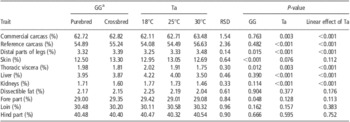
Rabbits from the two genetic groups performed equally well with respect to percentages of commercial and reference carcasses (Table 2). However, higher percentages of distal parts of legs and skin were found in the crossbreds. Conversely, thoracic viscera were relatively heavier in Botucatu rabbits than in the crossbreds. No differences between the two genetic groups were detected regarding the relative proportions of liver, kidneys or dissectible fat. In contrast, carcass forepart percentage was slightly higher in the crossbreds, but no differences between genetic groups were found for the other two retail cuts.
The effects of GG and Ta on dressing percentage and carcass traits in rabbits

GG = genetic group; Ta = ambient temperature; RSD = relative stock density.
aPurebred Botucatu rabbits and crossbred New Zealand White × Botucatu rabbits.
No quadratic effects of ambient temperature (P > 0.05) were detected on carcass traits. Ambient temperature showed linear effects on the percentages of commercial and reference carcass, distal parts of legs, thoracic viscera, liver and kidneys. Percentages of commercial and reference carcass and distal parts of legs increased with ambient temperature. For each degree Celsius increase in ambient temperature, there were corresponding increases of 0.113 ± 0.033% (P < 0.001), 0.200 ± 0.051% (P < 0.001) and 0.019 ± 0.003% (P < 0.001), respectively, in those traits. No effect of ambient temperature on the percentage of skin was detected.
The proportions of thoracic viscera, liver and kidneys had a linear, but negative, relationship with ambient temperature (Table 2). Reductions of 0.022 ± 0.006% (P < 0.01) in the percentage of thoracic viscera and of 0.059 ± 0.010% (P < 0.001) and 0.025 ± 0.007% (P < 0.001), respectively, in the percentages of liver and kidneys were observed per degree Celsius increase in ambient temperature. Percentages of dissectible fat and of carcass retail cuts were unaffected by the ambient temperature.
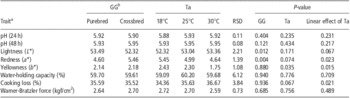
No differences in meat pH were detected between genetic groups or across temperature levels (Table 3). Meat color differences were found between genetic groups. Lightness was greater in purebred rabbits, whereas redness was greater in the crossbreds. No genetic group effects were detected on any other meat quality traits (yellowness, WHC, cooking loss or shear force).
The effects of GG and Ta on meat quality traits in rabbits

GG = genetic group; Ta = ambient temperature; RSD = relative stock density.
aEvaluated on the longissimus muscle.
bPurebred Botucatu rabbits and crossbred New Zealand White × Botucatu rabbits.
No quadratic effects of ambient temperature (P > 0.05) were detected for meat quality traits. Ambient temperature showed linear effects on meat redness, yellowness and cooking loss. Redness and yellowness diminished with increasing ambient temperature, as revealed by the linear contrasts (Table 3). There was an average 0.068 ± 0.031 (P < 0.05) decrease in redness for each degree Celsius increase in ambient temperature, but the linear regression coefficient of temperature on yellowness only approached significance (−0.051 ± 0.026, P = 0.056). Cooking loss, on the contrary, increased linearly with ambient temperature: it increased by 0.183 ± 0.084% (P < 0.05) for each degree Celsius increase in the ambient temperature. Correlations between redness (a* value) and cooking loss (r = −0.33) and yellowness (b* value) and cooking loss (r = −0.36) were significant (P < 0.05). Other meat quality traits such as WHC and shear force did not change with changes in ambient temperature.
Discussion
Purebred Botucatu rabbits were heavier at slaughter than crossbreds at 30°C, but at lower ambient temperatures, both genetic groups performed similarly. This genetic group × ambient temperature interaction was also found for commercial and reference carcass weights. These results corroborate those of Zeferino et al. (Reference Zeferino, Moura, Fernandes, Kanayama, Scapinello and Sartori2011), who studied the performance of these same rabbits during the growth phase and reported superior mean BW and weight gain of purebred Botucatu rabbits compared with crossbreds, under intense heat stress. This difference was attributed, at least partially, to the four-decade acclimation period and to the selection program to which the purebred rabbits have been subjected. Indeed, physiological adaptations, which resulted in a higher capacity for heat dissipation, such as increased ear temperature and respiratory rate, were detected in Botucatu rabbits (Zeferino et al., Reference Zeferino, Moura, Fernandes, Kanayama, Scapinello and Sartori2011). In addition, lighter skins in purebred rabbits, as detected in the present study, may have contributed to body heat dissipation.
In contrast to the present study, Chiericato et al. (Reference Chiericato, Rizzi and Rostellato1996a and Reference Chiericato, Rizzi and Rostellato1996b) did not find differences in carcass and meat quality traits among genetic groups under different temperatures, when working with three genetic groups (the NZW breed and two commercial hybrids) and two ambient temperatures (20°C and 28°C).
No genetic group × ambient temperature effects (P > 0.05) were detected on other carcass and meat quality traits; therefore, the main effects were considered separately. Differences in carcass composition between genetic groups could be, at least partially, attributed to breed characteristics as described by Chiericato et al. (Reference Chiericato, Rizzi and Rostellato1993) and Pla et al. (Reference Pla, Hernández and Blasco1996) using different strains and commercial hybrids. Relatively thicker skins in crossbreds, in the present study, could be because of the contribution of the NZW sire breed. Compared with the crossbreds, more developed thoracic viscera in Botucatu rabbits, on the other hand, may be related to the adaptation to heat stress manifested as increased panting (Zeferino et al., Reference Zeferino, Moura, Fernandes, Kanayama, Scapinello and Sartori2011). A combination of three carcass yield traits (higher percentages of distal parts of legs, skin and forepart) suggested that the crossbreds were less mature at slaughter than the purebreds, considering an anterior–posterior gradient of body growth described in rabbits by Pascual et al. (Reference Pascual, Pla and Blasco2008).
Elevated ambient temperature decreased feed intake and depressed the performance of growing rabbits (Marai et al., Reference Marai, Habeeb and Gad2002; Zeferino et al., Reference Zeferino, Moura, Fernandes, Kanayama, Scapinello and Sartori2011). Consequently, increasing ambient temperature depressed slaughter weight at a fixed market age and the weights of commercial and reference carcass. At the same time, it augmented commercial and reference carcass percentages. A possible explanation for the positive linear relationship of commercial carcass percentage with ambient temperature would be lighter gastrointestinal tracts because of lower feed intake (Zeferino et al., Reference Zeferino, Moura, Fernandes, Kanayama, Scapinello and Sartori2011). For the reference carcass percentage, apart from what was already mentioned for commercial carcass, its positive linear relationship with ambient temperature could be attributed to the severe depression in the relative proportions of metabolically active organs, such as thoracic viscera, liver and kidneys, as heat stress increased. Overall, these findings are in agreement with those by Chiericato et al. (Reference Chiericato, Rizzi and Rostellato1993), who found lower slaughter weight and relative proportions of heart, liver and kidneys associated with a higher carcass yield in summer (average ambient temperature 26.6 ± 2.8°C) when compared with winter (average ambient temperature 11.1 ± 0.9°C) in Northern Italy. Similar to the present study, Chiericato et al. (Reference Chiericato, Rizzi and Rostellato1993) did not find differences in the proportions of carcass retail cuts because of season, but they did find a higher amount of dissectible fat in winter.
The pH values of the longissimus muscle 24 and 48-h postmortem fell within the normal range (Hulot and Ouhayoun, Reference Hulot and Ouhayoun1999) in both genetic groups and under all three ambient temperatures. Meat with pH above 6.0 has been considered unsuitable for storage, because it may favor the development of proteolytic microorganisms (Dalle Zotte, Reference Dalle Zotte2002). An effect of ambient temperature on pH was not detected in the present study, but María et al. (Reference María, Buil, Liste, Villarroel, Sañudo and Olleta2006) reported higher 24 h pH in winter than in summer.
Meat color differences found between genetic groups were more pronounced than among ambient temperatures. They could be partially explained by the selection program to which the Botucatu rabbits have been subjected (Moura et al., Reference Moura, Costa and Polastre2001; Garreau et al., Reference Garreau, Piles, Larzul, Baselga and De Rochambeau2004). Long-term selection for growth rate may have influenced myofiber metabolism (Bianospino et al., Reference Bianospino, Moura, Wechsler, Fernandes and Dal-Pai-Silva2008) and, consequently, meat color, increasing lightness and decreasing redness. Line differences with respect to meat color traits have been reported, especially when selection for fast growth was practiced (Ramírez et al., Reference Ramírez, Oliver, Pla, Guerrero, Ariño, Blasco, Pascual and Gil2004; Pascual and Pla, Reference Pascual and Pla2007).
According to Dalle Zotte (Reference Dalle Zotte2002), meat quality traits appeared to be less influenced by thermal conditions than growth performance and carcass traits, but studies on this subject are rather scarce. In the present study, redness and yellowness of meat were slightly reduced as ambient temperature increased, whereas cooking loss increased linearly with ambient temperature. In fact, these differences in meat quality traits were small and could go undetected by the consumer.
The amount of myoglobin in muscle determines color (Newcom et al., Reference Newcom, Stadler, Baas, Goodwin, Parrish and Wiegand2004), indicating that high ambient temperature may have decreased meat pigment content. Chiericato et al. (Reference Chiericato, Rizzi and Rostellato1996b) described increased lightness and decreased redness at 28°C (compared with 20°C) in three different muscles, including the longissimus. Their yellowness results, however, were not consistent in different muscles: it was lower at the higher temperature in the biceps femoris, but higher in the longissimus muscle. María et al. (Reference María, Buil, Liste, Villarroel, Sañudo and Olleta2006) reported that season had much more effect on meat quality than transport time. Their results were also in partial agreement with those from the present study: higher values for redness, but lower for yellowness in winter (average outside temperature = 11°C) compared with summer (average outside temperature = 28°C).
A higher cooking loss, found as a consequence of the increasing temperature in the present study, may result in decreased juiciness of meat. Overall, changes in meat quality traits indicated a small, but consistent, negative impact of high ambient temperature on meat sensory properties.
Conclusion
Purebred Botucatu rabbits were heavier and gave heavier carcasses at high ambient temperature because they showed higher heat tolerance than the crossbreds. Heat stress had analogous effects on carcass composition and meat quality traits in purebred and crossbred Botucatu rabbits. It increased carcass yield, probably by reducing the relative weights of metabolically active organs. Small negative effects on meat color and cooking loss were also recorded. Therefore, management and environmental measures should be taken to minimize the negative effects of heat stress during the pre-slaughter phase.
Acknowledgments
The authors wish to thank Dr David R. Ledoux (Animal Sciences Division, University of Missouri, Columbia, USA) for English language checking and editing. Cynthia P. Zeferino and Claudia M. Komiyama received research assistantships from CNPq and FAPESP, Brazil, respectively. A. S.A.M.T. Moura and J. R. Sartori are recipients of productivity scholarships from CNPq. This project received financial support from FAPESP, Brazil.