Decades of research have demonstrated that broad knowledge of word meanings is essential to many academic outcomes, most notably reading proficiency (e.g., NICHD, 2000; RAND Reading Study Group, 2002; Snow, Burns, & Griffin, Reference Snow, Burns and Griffin1998). Given the well-established importance of vocabulary knowledge, there is reason to worry that students who come from homes in which a language other than English is spoken, a population known as language minority (LM) learners, will struggle to gain the levels of English vocabulary knowledge necessary to succeed academically. Cross-sectional studies have found consistently that LM learners tend to demonstrate limited second-language vocabulary knowledge (e.g., Droop & Verhoeven, Reference Droop and Verhoeven2003; Garcia, Reference Garcia1991; Proctor, August, Carlo, & Snow, Reference Proctor, Carlo, August and Snow2005). However, few studies have investigated individual growth in vocabulary knowledge over time in these learners, raising questions about whether they are approaching or falling further behind expectations as they progress through school. Moreover, very few studies have investigated the underlying skills that are associated with their vocabulary growth.
One skill hypothesized to be associated with vocabulary growth is morphological awareness (e.g., Anglin, Reference Anglin1993; McBride-Chang et al., Reference McBride-Chang, Twila, Jeung-Ryeul, Hua, Fletcher and Stokes2008; McBride-Chang, Wagner, Muse, Chow, & Shu, Reference McBride-Chang, Wagner, Muse, Chow and Hua2005; Stahl & Nagy, Reference Stahl and Nagy2006). Morphological awareness is defined as “the ability to reflect on and manipulate morphemes and word formation rules in a language” with morphemes defined as the smallest meaningful unit within a word (Kuo & Anderson, Reference Kuo and Anderson2006, p. 161). Researchers hypothesize that children with well-developed morphological awareness who encounter novel complex words such as continuous, popularity, or guidance in spoken language or in text will be able to extract the meaning of these words with relative ease by recognizing their relationship with more common terms like continue, popular, and guide. Although cross-sectional studies conducted with monolingual speakers of various languages reveal a strong correlation between morphological awareness and vocabulary knowledge (Anglin, Reference Anglin1993; Carlisle, Reference Carlisle2000; McBride-Chang et al., Reference McBride-Chang, Wagner, Muse, Chow and Hua2005; Nagy, Berninger, & Abbott, Reference Nagy, Berninger and Abbott2006), very few studies have investigated the relationship between these skills as they develop over time (McBride-Chang et al., Reference McBride-Chang, Twila, Jeung-Ryeul, Hua, Fletcher and Stokes2008), particularly for LM learners.
In this study, we aimed to investigate the concurrent development of vocabulary knowledge and morphological awareness between fourth and seventh grade for Spanish-speaking LM learners. Using four waves of longitudinal data on a cohort of learners, we sought to describe students’ individual growth trajectories in these two skills, as they relate to one another. This study was designed to shed light on the extent to which Spanish-speaking LM learners’ language development approaches or falls behind expectations during early adolescence and to investigate the potentially reciprocal relationship between individual growth in vocabulary and in morphological awareness in this population.
VOCABULARY KNOWLEDGE AND DERIVATIONAL MORPHOLOGICAL AWARENESS
Although conceptualizing word knowledge is a complex task (Stahl, Reference Stahl1999), researchers commonly operationalize vocabulary knowledge as the proportion of a given sample of words that a student can define, provide a synonym for, or identify with a corresponding picture (Pearson, Hiebert, & Kamil, Reference Pearson, Hiebert and Kamil2007). In this sense, vocabulary knowledge is operationalized as the relative size of a student's lexicon, sometimes referred to as breadth of vocabulary (Stahl, Reference Stahl1999), and it is this definition that guided the present study. Broadening of students’ vocabulary knowledge occurs across the life span and is thought to result, in large part, from independent word-learning processes that occur during reading and listening (e.g., Anglin, Reference Anglin1993; Nagy, Anderson, & Herman, Reference Nagy, Anderson and Herman1987).
Like vocabulary knowledge, morphological awareness involves word-level meaning. However, it is characterized as a meta-linguistic ability (i.e., it involves procedural knowledge about words and the rules that govern their formation), whereas vocabulary knowledge is characterized as a linguistic ability (i.e., it involves declarative knowledge of words; Kuo & Anderson, Reference Kuo and Anderson2006). Among the several facets of morphological awareness, awareness of derivational morphology (i.e., the linguistic system by which words differing in parts of speech or aspects of meaning are related) is particularly relevant for understanding language development for early adolescents. Derivational morphological awareness is demonstrated when students manipulate derived words, recognize connections between different morphological forms of a word, and produce new derivations of known words. Among morphological tasks, extracting a base word from a derived word that does not share its part of speech (e.g., popular from popularity) may have special relevance for accessing the meaning of novel derived words encountered while reading.
For early adolescents, skills in manipulating derived words are more likely than other morphological skills to be a source of individual differences. Whereas inflectional morphological awareness, which is students’ understanding of adding suffixes to change the number of a noun (e.g., cat to cats) or the tense/aspect of a verb (e.g., play to playing), is generally mastered by most children in the primary grades (Kuo & Anderson, Reference Kuo and Anderson2006), derivational morphological awareness continues to develop through the middle and high school grades (Mahony, Reference Mahony1994; Nagy et al., Reference Nagy, Berninger and Abbott2006; Nagy, Diakidoy, & Anderson, Reference Nagy, Diakidoy and Anderson1993). Because of the role that derivational morphological awareness is thought to play in deciphering and acquiring new words encountered in spoken and written language, it is hypothesized to be an important factor in facilitating vocabulary acquisition. At the same time, having a wide vocabulary provides children with many more examples from which they may be able to derive morphological rules, raising the possibility of a bidirectional relationship.
DEVELOPMENT OF MORPHOLOGICAL AWARENESS AND VOCABULARY KNOWLEDGE
Cross-sectional studies conducted with monolingual English speakers have provided some evidence that development of these two skills may be intertwined, particularly during the postprimary grades. For instance, in one of the most widely cited studies, Anglin (Reference Anglin1993) compared first, third, and fifth graders on their knowledge of a relatively large and representative sample of words from an unabridged dictionary. Anglin found large differences in the number of words known by fifth and third graders, and that a large majority of the words known exclusively by the fifth graders were derived words. Similarly, Carlisle (Reference Carlisle2000) found that fifth graders performed better than third graders on morphological decomposition and derivation tasks and demonstrated a stronger relationship between morphological awareness and knowledge of the meanings of morphologically complex words. In another cross-sectional study with children in kindergarten and second grade, McBride-Chang et al. (Reference McBride-Chang, Wagner, Muse, Chow and Hua2005) found that morphological awareness predicted oral receptive vocabulary knowledge, after controlling for phonologically processing and reading measures. Finally, in a study comparing three groups of students of different ages, Nagy et al. (Reference Nagy, Berninger and Abbott2006) found that the relationship between morphological awareness and reading vocabulary was strongest for fourth and fifth graders (r = .83), compared to those found for a group of sixth and seventh graders (r = .72) and for a group of eighth and ninth graders (r = .67). Despite being conducted with students of differing ages and with different measures, these studies provide converging evidence for the concurrent relationship between vocabulary knowledge and morphological awareness, while also identifying important confounding variables that may explain this relationship, including phonological awareness and word-reading ability.
Although these studies raise hypotheses about developmental changes in the relationship between these skills, their cross-sectional designs limit their ability to address questions about change directly. For instance, it is unclear whether the large differences in vocabulary size between third and fifth graders found by Anglin (Reference Anglin1993) are due to rapid vocabulary growth or to differences between cohorts. Similarly, given that the age-related differences in the strength of the concurrent relationship between vocabulary knowledge and morphological awareness found by Nagy et al. (Reference Nagy, Berninger and Abbott2006) are small, there is reason to suspect that such differences could result from random cohort effects rather than genuine developmental changes. Of the handful of longitudinal studies that have investigated morphological awareness, the majority have focused on reading (Byrne et al., Reference Byrne, Olson, Samuelsson, Wadsworth, Corley and DeFries2006; Carlisle, Reference Carlisle and Feldman1995; Deacon & Kirby, Reference Deacon and Kirby2004; Deacon, Wade-Woolley, & Kirby, Reference Deacon, Wade-Woolley and Kirby2007) or spelling outcomes (Chiliounaki & Bryant, Reference Chiliounaki and Bryant2007; Bryant, Nunes, & Bindman, Reference Bryant, Nunes and Bindman2000; Nunes, Bryant, & Bindman, Reference Nunes, Bryant and Bindman1997, Reference Nunes, Bryant and Bindman2006), rather than vocabulary acquisition.
In one recent study that directly investigated the relationship between morphological awareness and vocabulary acquisition over time, McBride-Chang et al. (Reference McBride-Chang, Twila, Jeung-Ryeul, Hua, Fletcher and Stokes2008) examined longitudinal associations between vocabulary knowledge and compound morphological awareness across three monolingual language groups (Cantonese, Mandarin, and Korean speakers). Using two waves of data collected over 1 year with 663 young children (who were approximately 4.5 to 5.5 years old at Time 1 and 5.1 to 6.5 years old at Time 2), they found that morphological compounding at Time 1 significantly predicted vocabulary knowledge at Time 2, controlling for Time 1 vocabulary knowledge, age, nonverbal reasoning, phonological awareness, and phonological memory skills. Moreover, they found evidence for the inverse relationship, that is, Time 1 vocabulary knowledge significantly predicted Time 2 morphological awareness, controlling for Time 1 morphological awareness. Although conducted with young children from non-Latinate language backgrounds, this longitudinal study provides a valuable foundation for the current study as well as some of the best evidence to date for what McBride-Chang and colleagues call the “bidirectional bootstrapping” of morphological awareness and vocabulary acquisition (p. 438).
ENGLISH LANGUAGE DEVELOPMENT IN LM LEARNERS
LM learners, by definition, enter school having had less exposure to English at home than native English speakers, so it is unsurprising that they demonstrate below-average levels of English oral language proficiency in early childhood (e.g., Manis, Lindsey, & Bailey, Reference Manis, Lindsey and Bailey2004; Páez, Tabors, & López, Reference Páez, Tabors and López2007; Swanson, Sáez, & Gerber, Reference Swanson, Sáez and Gerber2006). However, in the absence of longitudinal studies extending beyond the primary grades, it is less clear whether these deficiencies persist into the upper elementary and middle school grades and if so, whether their severity changes over time. Longitudinal designs are particularly important for research with LM learners because cross-sectional data on this population can suffer from pronounced cohort effects, if the LM learners sampled are a subset of the population that are receiving specialized services for language acquisition or if immigration patterns lead to confounding differences among cohorts (Short & Fitzsimmons, Reference Short and Fitzsimmons2007).
One large and growing subgroup of LM learners consists of the US-born children of Spanish-speaking immigrants (Batalova, Fix, & Murray, Reference Batalova, Fix and Murray2007), the majority of whom are instructed predominately in English in US schools. Although cross-sectional studies have demonstrated deficiencies in levels of vocabulary knowledge and morphological awareness in this subpopulation (e.g., Carlo et al., Reference Carlo, August, McLaughlin, Snow, Dressler and Lippman2004; Kieffer & Lesaux, Reference Kieffer and Lesaux2008), none to our knowledge have investigated rates of individual growth in these skills. Given the complex processes and varied experiences that contribute to language development, there is reason to expect that there will be great variability in rates of individual growth in vocabulary knowledge and morphological awareness within this subpopulation. Therefore, there is a need for research that can describe the degree of variability in individual rates of growth in language skills and investigate underlying skills that are associated with more rapid or slow growth in vocabulary, particularly for students who are at risk for language-based academic difficulties.
CURRENT STUDY
In the current study, we aimed to extend the existing research on morphological awareness and vocabulary knowledge to the at-risk and growing population of Spanish-speaking LM learners. At the same time, we aimed to address the methodological limitations of the existing studies by directly examining the relationship between students’ true rates of growth in morphological awareness and in vocabulary knowledge from fourth to seventh grade, using latent growth modeling. (“True” is used here and throughout this article in the psychometric sense of a “true score,” that is, a score free of measurement error as opposed to an “observed score,” which is the combination of a true score and some positive or negative value for measurement error.) By modeling true growth in these two skills explicitly and simultaneously, we can determine whether students who demonstrate more rapid growth in one skill also demonstrate more rapid growth in the other. Such an analysis has the benefit of providing reliable estimates of true growth in each skill and of the relationship between them, and thus represents a substantial improvement over the autoregressive techniques used in prior longitudinal studies of morphological awareness (e.g., Deacon et al., Reference Deacon, Wade-Woolley and Kirby2007; Deacon & Kirby, Reference Deacon and Kirby2004; McBride-Chang et al., Reference McBride-Chang, Twila, Jeung-Ryeul, Hua, Fletcher and Stokes2008; Nunes et al., Reference Nunes, Bryant and Bindman2006). In so doing, this study contributes to our understanding of the concurrent development of these two important aspects of language proficiency and represents a first step toward a fuller description of normative development for this population, by looking as expectable growth for one group of Spanish-speaking LM learners under typical educational conditions. Specifically, we addressed two research questions:
1. What are the average rates of growth in morphological awareness and in vocabulary knowledge between fourth and seventh grade for a cohort of Spanish-speaking LM learners?
2. Do Spanish-speaking LM learners with more rapid rates of growth in morphological awareness also demonstrate more rapid rates of growth in vocabulary knowledge?
METHOD
Sample
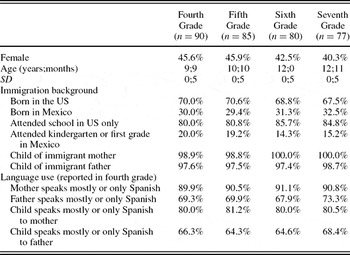
This study was conducted in the context of a larger longitudinal research project investigating the language and literacy development of Spanish-speaking LM learners (see Crosson, Lesaux, & Martiniello, Reference Crosson, Lesaux and Martiniello2008; Kieffer & Lesaux, Reference Kieffer and Lesaux2008; Lesaux, Crosson, Kieffer, & Pierce, Reference Lesaux, Crosson, Kieffer and Pierce2011). Longitudinal data was collected on a sample of 90 LM learners from Spanish-speaking homes who were followed from Grade 4 though Grade 7 (approximately age 10 to age 13). Participating students were originally recruited from three elementary schools and then transitioned to 16 different middle schools in an urban district in southern California. Attrition from the sample was small across the 4 years of the study, yielding 77 students with complete longitudinal data. The 13 students who were lost to follow-up at one or more time points were not significantly different from the 77 students with complete data on any of the fourth grade demographic or achievement measures (all ps > .05). Descriptive statistics on sample demographics are displayed in Table 1. As shown, the sample comprises largely US-born children of Mexican-origin immigrants.
Descriptive statistics on child demographic variables measured in fourth grade for the original sample in fourth grade and the analytic sample in each subsequent grade

During elementary school, the participating students attended Spanish–English transitional bilingual programs, in which students received early literacy instruction in both Spanish and English for a portion of each day with increasing amounts of English instruction with each grade level. In fifth and later grades, all students were instructed entirely in English in structured English immersion classrooms. The participating schools served a student population characterized by generally low socioeconomic status (i.e., in the three original elementary schools, 90% to 100% of students received free or reduced lunch).
Measures
Student were assessed annually in the winter of their fourth, fifth, sixth, and seventh grade years. The same combination of standardized and researcher-created instruments was administered to students individually on each occasion.
Vocabulary knowledge. Children's oral vocabulary knowledge was assessed with the Peabody Picture Vocabulary Test—Revised (PPVT; Dunn & Dunn, Reference Dunn and Dunn1997), an adaptive instrument in which students choose a picture from four choices that corresponds to a word presented orally. As a listening measure, the PPVT was considered to be sensitive to the receptive vocabulary knowledge that is most likely to come into play in recognizing the meaning of morphologically complex words while listening or reading. Although not designed to measure knowledge of derived words specifically, the items do contain a substantial portion of morphological complex words. In the item sets completed by approximately 80% of the current sample in Grades 5 and 6, approximately half of the targeted words were morphologically complex, with one-third of all items including derived words and one-sixth including inflected words. The PPVT yields raw scores that represent the number correct out of a total of 204 possible items, and that are equatable from age to age. The publisher of the PPVT reports estimated alternate-forms reliability of 0.95 and estimated internal consistency reliability of 0.95.
Morphological awareness. Children's morphological awareness was measured using the morphological decomposition task, an instrument developed based on previous research (Carlisle, Reference Carlisle2000). In this task, students are provided with a morphologically complex word (e.g., complexity) and asked to extract the base word (e.g., complex) to complete a sentence (e.g., the problem is ___________). Consistent with Carlisle (Reference Carlisle2000), each item required students to identify a base word that was more frequent than the given derived word. Item analyses using Rasch methods indicated that the difficulty of the items was due in large part to the transparency of the morphological relationship (i.e., whether decomposing the word required a phonological and/or orthographic shift) and the frequency of the derived word, rather than frequency of the base word (details available from the first author). Test administrators read the word and sentence aloud to minimize the influence of word reading skills, and students responded with a written answer. Trained research assistants scored written answers to the task dichotomously using a detailed scoring guide that included a rubric along with sample correct and incorrect responses. Responses were scored as correct if they provided the correctly spelled form of the word or a phonetically justifiable version of the word form, such as posess for possess or durible for durable. Responses were scored as incorrect if they were morphologically unrelated words such as have for possess or hard for durable, when they were incorrectly decomposed responses such as poss or dura, or when they were ambiguous responses such as possese and durabil. In this way, we protected in part against the confounding of variation in students’ ability to spell the base word with true variation in morphological awareness. Several prior studies attest to the validity of tasks using this paradigm, including evidence of convergent and divergent validity in native English-speaking (Carlisle, Reference Carlisle2000) and LM populations (Carlo et al., Reference Carlo, August, McLaughlin, Snow, Dressler and Lippman2004; Kieffer & Lesaux, Reference Kieffer and Lesaux2008) and evidence of construct validity based on the fitting of confirmatory factor analytic models (Wagner, Muse, & Tannenbaum, Reference Wagner, Muse, Tannenbaum, Wagner, Muse and Tannenbaum2007).
The task included 25 items in fourth grade; in later grades, additional, more difficult items were added to avoid ceiling effects (5 additional items in fifth grade, another 10 additional items in sixth grade, and another 5 additional items in seventh grade) and thus capture the upper range of the ability distribution. As a result, the students did not complete all of the 45 total items in all grades. Therefore, we used Rasch scaling methods (Bond & Fox, Reference Bond and Fox2007) to develop vertically equated developmental scale scores for the morphological awareness task. To conduct the vertical scaling, a common-item equating approach was used in which the overlapping items administered on multiple occasions were used to anchor the scale and the set of item-level data for each occasion was treated as if it had come from an independent, nonequivalent sample of students.Footnote 1 The Rasch-estimated reliability of the ability measurement at each wave was good (0.79 in fourth grade, 0.84 in fifth grade, 0.84 in sixth grade, 0.80 in seventh grade) as was the estimated interrater agreement (96% agreement, Cohen κ = 0.90).
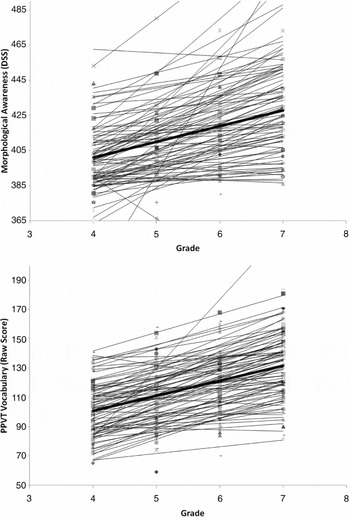
The left panel of Figure 1 presents empirical growth plots (Singer & Willett, Reference Singer and Willett2003) displaying change in children's morphological awareness in the resulting Rasch-estimated developmental scale scores. In this figure, each line represents a growth trajectory for a single child in the sample, fitted using ordinary least squares regression. As displayed in this panel, the empirical growth trajectories for children's morphological awareness do not display evidence of constrained variation at the upper ranges, indicating that the Rasch scaling process was successful in minimizing ceiling effects in later grades. As shown, the majority of empirical growth trajectories also demonstrate an upward trend over time as one would expect.
Empirical growth plots for morphological awareness and vocabulary knowledge, with each student's ordinary least squares regression-fitted trajectory represented as a thin gray line and the interpolated mean trajectory represented as a thick black line (n = 90). DSS, Developmental Scale score; PPVT, Peabody Picture Vocabulary Test.

Control measures. Control measures included standardized, norm-referenced assessments of word reading accuracy, nonword decoding accuracy, sight word reading efficiency, and phonological awareness. Word reading accuracy was measured using the Woodcock Language Proficiency Battery—Revised (WLPB-R) letter-word identification subtest (Woodcock, Reference Woodcock1991), in which participants are asked to read a list of English words of increasing complexity. Nonword decoding accuracy was measured using the WLPB-R word attack subtest (Woodcock, Reference Woodcock1991), in which participants are asked to read a list of decodable nonwords of increasing complexity. Word reading efficiency was measured with the Test of Oral Word Reading Efficiency (TOWRE; Torgesen, Wagner, & Rashotte, Reference Torgesen, Wagner and Rashotte1999), in which participants are asked to read a list of real English words as quickly and accurately as possible in 45 s. These three reading measures were very highly correlated with one another at each occasion, and thus were used to create a single latent composite variable to represent word reading ability, which was then used in subsequent models. Phonological awareness was assessed using the elision subtest of the Comprehensive Test of Phonological Processing (Wagner, Torgesen, & Rashotte, Reference Wagner, Torgesen and Rashotte1999), in which students hear English words and are asked to remove phonological units (syllables and phonemes), to produce new words orally.
Data analytic approach
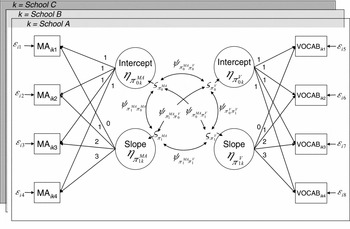
We addressed the research questions with multiple-group latent growth modeling, using the LISREL, Version 8.7 and MPLUS, Version 4 software to model students’ latent growth trajectories in morphological awareness and vocabulary knowledge simultaneously (Bollen & Curran, Reference Bollen and Curran2006). Figure 2 presents a path model representing the relationship between the hypothesized growth trajectories in morphological awareness and vocabulary knowledge between fourth and seventh grade. The left-hand side of the figure displays a four-indicator two-factor measurement model that represents the development of a child's morphological awareness as a linear function of time. This model links hypothesized latent constructs (displayed as circles) representing true initial status ( ) and true rate of change (
 ) in morphological awareness (MA) for a child in school k to the observed indicators of morphological awareness on each of the four occasions of measurement (labeled MAik 1 through MAik 4). Similarly, the right-hand side of Figure 2 displays a four-indicator two-factor measurement model that represents the development of vocabulary knowledge for a child in school k as a linear function of time. This model links hypothesized latent constructs representing the child's true initial status (
 ) and true rate of change (
 ) in vocabulary (V) knowledge to observed measurements of a child's vocabulary knowledge (labeled VOCABik 1 through VOCABik 4) on each occasion of measurement. In the center of the path model are double-headed arrows representing residual covariances (
 ) that capture the hypothesized reciprocal relationships among the individual growth parameters describing linear change in morphological awareness and vocabulary knowledge. To account for the initial clustering of students within three elementary schools, we used a multiple-group approach in which the same hypothesized latent growth model was fitted for three groups of children corresponding with the three elementary schools originally attended, as represented by the three overlapping planes (labeled k = School A, k = School B, k = School C) in Figure 2. In an approach that is analogous to the fixed effects of school approach in regression, we allowed the parameters for the latent mean intercept for each skill to differ by school.Footnote 2 We also investigated whether the latent mean slope for each skill should be allowed to differ by school, but found that these two parameters did not differ by school and thus constrained them to be the same across schools in subsequent models.Footnote 3 It is worth noting that the substantive findings below are robust to the inclusion or exclusion of these school effects. As recommended by Bollen and Curran (Reference Bollen and Curran2006), we used the full information maximum likelihood approach to account for the small amount of missing data due to attrition; in this approach, the variance–covariance matrix to be analyzed in subsequent model fitting is estimated using maximum likelihood estimation based on all available information.
A path diagram representing the hypothesized multiple-group parallel process latent growth curve model for morphological awareness and vocabulary knowledge.

After fitting the full hypothesized model, we removed covariance terms that were not statistically significant, as indicated by likelihood ratio tests, and then evaluated the magnitude and statistical significance of particular parameters of interest. Specifically, we answered the first research question by estimating the latent mean slope for each skill, thereby simultaneously determining the average true rates of growth in morphological awareness and in vocabulary knowledge. To answer the second research question, we evaluated the magnitude and statistical significance of the covariance term  to determine whether students who demonstrate more rapid true rates of growth in morphological awareness also demonstrate more rapid true rates of growth in vocabulary knowledge, when compared to students with less rapid true rates of growth in morphological awareness.
RESULTS
Exploring growth in vocabulary knowledge and in morphological awareness separately
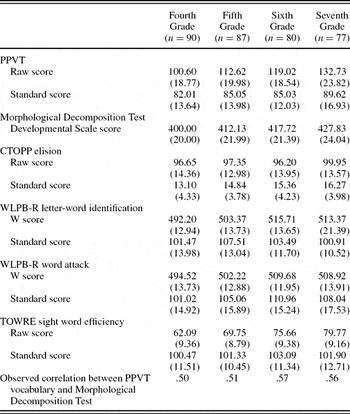
Prior to fitting the theoretical model for the simultaneous development of morphological awareness and vocabulary knowledge, we conducted preliminary analyses to describe the observed performance in the two outcomes and to determine the appropriate functional form for growth trajectories in each outcome separately. Table 2 provides sample means and standard deviations for the students’ observed scores on the language and reading measures, by grade. Across the time period studied, students performed approximately a standard deviation below the national average (i.e., near a standard score of 85) in vocabulary knowledge, but near or slightly above the national average on the phonological awareness and word reading control measures. As displayed in the bottom row of the table, sample bivariate correlations between observed measures of each construct on each occasion indicated that morphological awareness and vocabulary knowledge were moderately correlated at each time point (rs = .51–.57), with a slight increase in this observed cross-skill relationship over time.
Sample means (standard deviations) and correlation coefficients for observed scores on vocabulary knowledge and morphological awareness and the phonological awareness and reading control measures by grade

Note: PPVT, Peabody Picture Vocabulary Test; CTOPP, Comprehensive Test of Phonological Processing; WLPB-R, Woodcock Language Proficiency Battery—Revised; TOWRE, Test of Oral Word Reading Efficiency.
To determine which function of time best represented growth in each outcome, we inspected empirical growth plots of each outcome as a function of time for each child and fitted a series of unconditional growth models, separately for each outcome. The top and bottom panels of Figure 1 display the empirical growth plots in morphological awareness and in vocabulary knowledge, respectively, with trend lines fitted for each child using ordinary least squares regression. Results of fitting unconditional linear growth models for each skill separately confirmed that true growth in each skill was positive between fourth and seventh grade. For vocabulary knowledge, the mean true rate of growth was positive and statistically significant (change in −2 log likelihood [Δ−2LL] = 204.843, df = 1, p < .001). Inclusion of a quadratic term to capture potential curvilinearity in true growth did not improve goodness of fit (Δ−2LL = 0.311, Δdf = 1, p = .577). Similarly, for morphological awareness, the mean true rate of growth was positive and statistically significant (Δ−2LL = 166.769, Δdf = 2, p < .001),Footnote 4 and inclusion of a quadratic term for curvilinearity did not improve goodness of fit (Δ−2LL = 2.935, Δdf = 1, p = .087). It is worth noting that the covariance between the true intercept and true rate of growth was not statistically significantly different from zero for either vocabulary knowledge (Δ−2LL = 0.807, Δdf = 1, p = .369) or for morphological awareness (Δ−2LL = 0.271, Δdf = 1, p = .603); thus, we did not include these covariances in subsequent models.
Model for concurrent development of morphological awareness and vocabulary knowledge
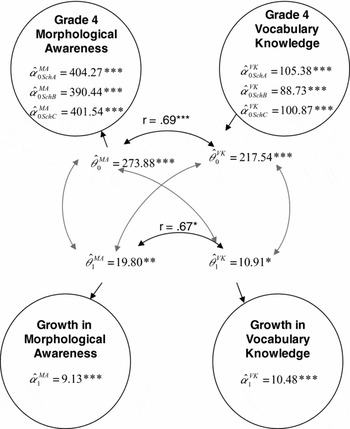
To address the two research questions, we fitted a sequence of multiple-group parallel process (i.e., growth on growth) latent growth curve models to the data, starting with the full hypothesized model displayed in Figure 2 and removing parameters that were not significant. Figure 3 presents the fitted model for the concurrent development of vocabulary knowledge and morphological awareness, along with estimates for the average true growth parameters (true intercept for each school and true slope represented by  ), estimates for the variance in each true growth parameter (represented by
 , covariances among the latent growth parameters found to be statistically significant (represented by black double-headed arrows with corresponding intercorrelations), and covariances found to be nonsignificant and thus fixed to zero (represented by gray double-headed arrows). Of course, this fitted model also contained measurement models for the latent growth trajectories in each skill, as specified in Figure 2, which are not displayed in Figure 3 for clarity. To address each of the research questions, we drew on this model by interpreting the magnitude and direction of the relevant parameter estimates. Given our interest in specific parameter estimates, we emphasized the results of tests of the statistical significance of the relevant parameters rather than the overall goodness of fit of the hypothesized model.Footnote 5
A path diagram for latent variables from the fitted multiple-group parallel process latent growth curve model for morphological awareness and vocabulary knowledge, with associated fitted parameter estimates for means (alphas), variances (thetas), estimated cross-skill covariances (black), and nonsignificant covariances fixed to zero (gray; n = 90).

Average rates of growth. To address the first research question, which concerned the mean rates of true growth in morphological awareness and in vocabulary knowledge (VK) associated with a year of maturation and schooling, we drew on the estimates for the average true slope in each outcome across students ( and
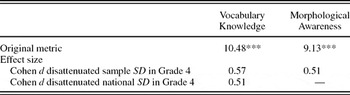
 ). As displayed in Figure 3, on average, students demonstrate positive and statistically significant rates of true growth in both vocabulary knowledge and morphological awareness. The estimated true rate of growth for vocabulary knowledge was 10.48 raw score points per year whereas the estimated true rate of growth for morphological awareness was 9.13 developmental scale score points per year. To support a more meaningful interpretation of whether these rates of true growth can be considered rapid or slow, we reexpressed these estimates as standardized effect sizes by dividing them by their respective true fourth-grade standard deviations (see Table 3).Footnote 6 Reexpressed in this way, both rates of true growth were equivalent to approximately half of a true standard deviation a year, suggesting relatively rapid true rates of growth in both skills.
Estimates for the mean annual true rate of growth in vocabulary knowledge and morphological awareness obtained from the latent growth model in their original metrics and reexpressed as effect sizes (n = 90)

*** p < .001.
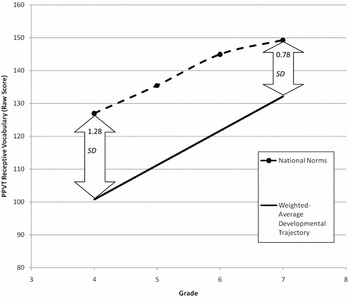
In addition, for the standardized measure of vocabulary, we were interested in comparing the estimated mean true growth trajectory to that of a student performing at the national average, based on norming data provided by the test publisher. Figure 4 displays fitted true growth trajectories in vocabulary knowledge for a prototypical child in the sample and contrasted this trajectory to the national grade norms. For the sake of simplicity, we fitted this trajectory based on a weighted average of the latent growth parameter estimates across the three schools (i.e., by weighting the elevation of the true growth trajectory by the proportion of students in the sample who attended that school). We also estimated effect sizes for the vertical difference in elevation between the fitted true growth trajectory and the national-average observed values in fourth and seventh grade, using true standard deviations of the outcome for the norming sampleFootnote 7 at those grades (displayed within the arrows in Figure 4). As shown, the students in the current study demonstrated true vocabulary levels that were far below observed national norms across the years studied. However, the nationally average norms display a curvilinear pattern not found with the students in the current study, indicating a decelerating rate of growth over this period. As a result, although the estimated true rate of growth for the students in the current study appears to be similar to the observed trend for a nationally average child between fourth and fifth grade, it appears to be greater than the observed national trend in later years, yielding decreasing differences in elevation over time (from 1.28 SD to 0.78 SD).Footnote 8 A post hoc linear contrast confirmed that the estimated true rate of growth for the sample is statistically significantly greater than the linear rate of growth that one would expect between fourth and seventh grade for a nationally average child, based on the norming data.Footnote 9
The fitted true growth trajectory in vocabulary knowledge for a prototypical child using a weighted-average across schools contrasted with cross-sectional national norms from the test publisher, with associated standardized mean differences based on within-grade national true standard deviations (n = 90).

Relationship between rates of growth in morphological awareness and in vocabulary knowledge. To address the second research question, whether students with higher true rates of growth in morphological awareness also had higher true rates of growth in vocabulary knowledge, we evaluated the magnitude and direction of the covariance parameters representing the cross-skill relationships. We found a strong positive relationship (r = .67) between rates of true growth in morphological awareness and rates of true growth in vocabulary knowledge, indicating that students with more rapid true growth in one skill also demonstrated more rapid true growth in the other (as shown in Figure 3). This relationship was statistically significant (Δ−2LL = 6.966, Δdf = 1, p = .008). Similarly, the relationship between true initial (Grade 4) status in morphological awareness and true initial status in vocabulary knowledge was strong (r = .69) and statistically significant (Δ−2LL = 39.296, Δdf = 1, p < .001). It is also worth noting that the relationships between true initial (Grade 4) status in each skill and true rates of growth in the other skill were found to be weak (r = .02 for Grade 4 morphological awareness with growth in vocabulary knowledge; r = .12 for Grade 4 vocabulary knowledge with growth in morphological awareness) and not statistically significant (Δ−2LL = 0.290, Δdf = 1, p = .590 and Δ−2LL = 0.010, Δdf = 1, p = .920, respectively).
Robustness to the inclusion of control variables
In a robustness check, we conducted additional analyses to determine if these findings remained the same when including several control variables that had been used in prior studies. Below, we briefly explain the role of control variables in parallel process latent growth models for readers who may not be familiar with these techniques, and then provide the results of these additional analyses.
Control variables in parallel process latent growth modeling. The role of control variables in our latent growth modeling approach to longitudinal analyses is somewhat different from that of control variables in cross-sectional regression or autoregressive models with two waves of data. Specifically, because individual rates of growth (i.e., slopes) are estimated after subtracting out the individuals’ initial statuses (i.e., intercepts), correlations between rates of growth in two domains may be less sensitive to the inclusion or exclusion of predictors that have time-invariant effects. Control variables with time-invariant effects are often related to individuals’ initial statuses and thus may change correlations between intercepts, but this individual variation in initial statuses that is related to individual-level control variables can be partitioned away from the variation in true rates of growth. Thus, unlike regression estimates from cross-sectional and autoregressive models, the growth on growth estimates from latent growth modeling are less likely to be changed by including Time 1 control variables. Nonetheless, in the interest of aligning our study with prior studies that have used other methods and have identified valuable control variables, such as phonological awareness and word reading ability (e.g., Deacon et al., Reference Deacon, Wade-Woolley and Kirby2007; Deacon & Kirby, Reference Deacon and Kirby2004; McBride-Chang et al., Reference McBride-Chang, Wagner, Muse, Chow and Hua2005, Reference McBride-Chang, Twila, Jeung-Ryeul, Hua, Fletcher and Stokes2008), we present our results with and without the inclusion of these variables measured in fourth grade (i.e., at Time 1).
In contrast, a growth on growth correlation can be sensitive to the inclusion of time-varying predictors, such as growth in word reading ability and growth in phonological awareness between fourth grade and seventh grade in the current study. However, by fitting unconditional growth models to each of our four control variables individually, we found that there was no significant variation in rates of growth for any of the control variables (for growth in Comprehensive Test of Phonological Processing elision, p = .686; for growth in TOWRE sight word efficiency, p = .528; for growth in WLPB-R word attack, p = .507; for growth in WLPB-R letter–word identification, p = .938; details of the analyses are available from the first author). Although the sample did show positive growth in each of these skills, the individual growth trajectories were found to be parallel across children. This indicates that it is highly unlikely that any correlation between variation in vocabulary growth rates and variation in morphological awareness growth rates could be explained by confounding variation in phonological awareness growth rates or in word-reading growth rates in this sample.
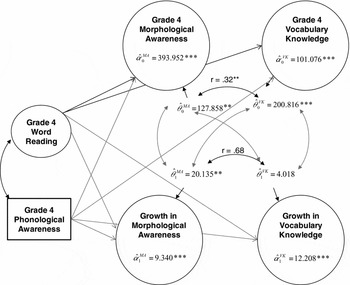
Model controlling for Grade 4 phonological awareness and word reading ability. Consistent with the explanation above, results indicated that the growth on growth correlation was robust to the inclusion of Grade 4 phonological awareness and Grade 4 word reading ability. As shown in the fitted model in Figure 5, we included regression paths between each of the four growth parameters and Grade 4 phonological awareness (represented as a square to indicate that this is a single observed indicator) as well as between the growth parameters and Grade 4 word reading ability (represented as a circle to indicate that this is a latent composite comprising three observed indicators not shown: WLPB-R letter-word identification, WLPB-R word attack, and TOWRE sight word efficiency).Footnote 10 Grade 4 phonological awareness did not significantly predict initial status or rate of growth in either vocabulary knowledge or morphological awareness (ps = .217–.959), as shown by the gray single-headed arrows indicating nonsignificant paths included in the model. The word reading ability composite significantly predicted students’ initial status in vocabulary knowledge (p < .001) and in morphological awareness (p < .001), as shown by the black single-headed arrows, but did not significantly predict students’ rates of growth in either skill (for morphological awareness, p = .178; for vocabulary knowledge, p = .695) as shown by the gray single-headed arrows. (Note that these nonsignificant paths remain in the model.) Including these Grade 4 control variables did lead to a decrease in the magnitude of the concurrent correlation between Grade 4 vocabulary knowledge and Grade 4 morphological awareness (rs = .69–.32). However, the growth on growth correlation in this model (r = .68) is essential the same as in the model without these controls (r = .67). These results are what we would expect, assuming these controls have time-invariant effects, for the reasons described above.
A path diagram for the fitted parallel processes latent growth curve model for morphological awareness and vocabulary knowledge including control variables, with associated fitted parameter estimates for means (alphas), variances (thetas), significant cross-skill covariances, and regression paths (black) and nonsignificant covariances and regression paths (gray; n = 90).

Fitted growth trajectories in morphological awareness and vocabulary knowledge
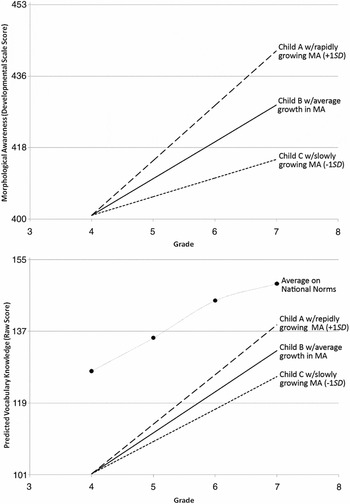
To illustrate this correlation of .67 between true rates of growth in morphological awareness and in vocabulary knowledge, we display fitted true growth trajectories for three hypothetical children that have prototypical values in Figure 6. The plot on the top of Figure 6 displays fitted true growth trajectories in morphological awareness for three prototypical children, all of whom had sample-average initial morphological awareness in fourth grade and attended an “average” elementary schoolFootnote 11: (a) Child A (represented by the long-dashed line) who displays rapidly growing morphological awareness, that is, a true rate of growth that was 1 SD above the mean true rate of growth for the sample; (b) Child B (represented by the solid line) who displays sample-average growth in morphological awareness; and (c) Child C (represented by the short-dashed line) who displays slowly growing morphological awareness, that is, a true rate of growth that was 1 SD below the mean rate for the sample. Note that these prototypical values do not represent subgroups of children but rather are reasonable contrasting values in the continuous distribution of our sample data that were purposefully chosen to isolate the growth on growth correlation from the intercept on intercept correlation. Although it is unlikely that we would find three children with exactly the same intercept and with growth rates that differ in precisely this way in our sample, these values are consistent with the distribution of the data and with the lack of correlation between intercepts and slopes in each domain; they were chosen as reasonable values to illustrate the isolated effect of growth, holding the intercept constant. The gray reference lines are separated by the equivalent of 1 SD true fourth-grade standard deviation. As shown, these differences in true rates of growth in morphological awareness translates into substantial differences in total gains between fourth and seventh grade; the rapidly growing student gains approximately 40 developmental scale score points (>2 SD true fourth-grade standard deviation) across this time period, whereas the slowly growing student gains approximately 15 developmental scale score points (<1 SD true fourth-grade standard deviation).
A panel of fitted true growth trajectories in morphological awareness and corresponding predicted growth trajectories in vocabulary knowledge for three prototypical children: a child with rapidly growing morphological awareness (long dashed line), a child with average growth in morphological awareness (solid line), and a child with slowly growing morphological awareness (short dashed line). Each of these children have average initial morphological awareness and average initial vocabulary knowledge, calculated as a weighted composite of the initial status across the three schools, along with nationally average values for vocabulary knowledge provided as a reference (n = 90). Note that the distance between the gray reference lines in each plot equals 1 SD true fourth-grade standard deviation for each respective outcome. MA, morphological awareness.

The plot on the bottom of Figure 6 displays the fitted true growth trajectories in vocabulary knowledge that one would expect for the same three prototypical children (as indicated by the long-dashed, solid, and short-dashed lines), given the correlation between true rates of growth in the two skills of .67.Footnote 12 All of the three trajectories were fitted for children with average true initial morphological awareness, average true initial vocabulary knowledge, and attending average elementary schools, but with differing true rates of growth in morphological awareness. Given the cross-skill relationship, these differing true rates of growth in morphological awareness thus translate into differing true rates of growth in vocabulary knowledge. As shown, Child A, who displays rapid true growth in morphological awareness, is predicted to have rapid true growth in vocabulary knowledge (i.e., gaining 38 raw score points on the PPVT between fourth and seventh grade), whereas Child C who displays slow true growth in morphological awareness is predicted to have slow true growth in vocabulary knowledge (i.e., gaining 25 raw score points on the PPVT during this period). Although the scales for the two plots are not directly comparable, the separation between the gray reference lines in each plot represent a 1 SD true fourth-grade standard deviation in the level of their respective outcomes. Thus, Child A can be expected to gain slightly more than 2 SD true fourth-grade standard deviations in vocabulary knowledge between fourth and seventh grade, whereas Child C can be expected to gain approximately one and a third true standard deviations in vocabulary knowledge during this period.Footnote 13
Another way of interpreting the differential growth to be expected from these three prototypical children is to compare them to the expectations for a monolingual child performing at the observed national average based on the publisher-provided norms for this standardized measure, which is represented by the round dots and thinly dashed line in the bottom plot of Figure 6. As shown, the true trajectory for Child A moves substantially closer to the observed values for an average monolingual child by seventh grade, whereas the true growth trajectory for Child C remains roughly parallel to and far below the observed national average across the period studied. When the differences between fitted values for each prototypical child and the national averages are reexpressed as effect sizes based on the within-grade true standard deviations of the norming distribution, Child A narrows the gap from 1.28 SD true standard deviation in fourth grade to 0.48 SD true standard deviation in seventh grade while Child C remains more than 1 SD true standard deviation below the mean across the time period studied.
DISCUSSION
In the current study, we sought to build on the existing research on the relationship between morphological awareness and vocabulary knowledge by examining the relationship between true rates of growth in these two skills for a growing population that is at elevated risk for academic difficulties: Spanish-speaking LM learners. In so doing, we also sought to describe the development of these skills in this population during a particularly crucial and understudied developmental period: from the upper elementary school years in which a large number of new morphologically complex words are thought to be learned (Anglin, Reference Anglin1993) through early adolescence when the language demands of school become increasingly academic and sophisticated (e.g., Fang & Schleppegrell, 2006).
Three key findings emerged from this study, each with implications for understanding and promoting language development for Spanish-speaking LM learners. First, on average, these learners demonstrated rapid, linear true growth in both morphological awareness and vocabulary knowledge between fourth and seventh grade. Second, despite this growth, the LM learners remained more than three-quarters of a standard deviation below national norms in vocabulary knowledge through seventh grade. Third, true rates of growth in the two skills were strongly and positively correlated (r = .67), such that students with more rapid true growth in morphological awareness also demonstrated more rapid true growth in vocabulary knowledge. Given this relationship, a prototypical student with average performance in fourth grade and a high true rate of growth in morphological awareness (i.e., 1 SD above the mean in the distribution of true rates of growth) was predicted to have a true growth trajectory in vocabulary knowledge that narrowed the gap with observed national norms to within half a true standard deviation by seventh grade.
Together, these findings provide both cause for concern and reason to be optimism about the language development and ultimate academic outcomes of Spanish-speaking LM learners. Their consistently low levels of average vocabulary knowledge through early adolescence indicate that educators should attend to the oral language development of this population. In the absence of intensive and sustained intervention, a majority of these learners are unlikely to achieve language proficiency levels necessary to meet the academic demands of school, including reading and writing grade-level texts. In contrast, the average LM learner did narrow, although by no means close, the gap with national norms for monolingual English speakers, while some LM learners made sufficiently rapid progress to approach national norms. In addition, the finding that true growth in vocabulary relates to true growth in morphological awareness provides reason to be optimistic that this reciprocal developmental process may be valuable as a point of leverage for instruction.
Extending the research base
Researchers citing cross-sectional studies that compare older and younger learners (e.g., Anglin, Reference Anglin1993) have suggested that the upper elementary grades are a period of rapid growth in knowledge of morphologically complex words for native English speakers. Using longitudinal data, the present findings suggest that LM learners demonstrate relatively rapid true growth in both vocabulary knowledge and morphological awareness in the upper elementary grades and that this true rate of growth continues through seventh grade. By “relatively rapid,” we mean that the true rates of growth found for the current sample were significantly higher than those we would expect based on data from the standardized norming sample (as indicated by the linear contrast reported above). Specifically, the sample's average rate of growth in vocabulary (d = 0.57) is somewhat faster than the expectation for an average monolingual speaker between fourth and fifth grade and between fifth and sixth grade (d = 0.40 and 0.44, respectively) and is nearly three times the estimate for an average monolingual speaks’ true rate of growth from sixth to seventh grade (d = 0.19). As shown in Figure 4, these differences in rates of growth between the current sample and expectations based on the norming sample are due in part to the fact that the norms suggest a decelerating rate of vocabulary acquisition after fifth grade, whereas the current sample of LM learners continue at the same rate of growth into sixth and seventh grade.
This suggests that the relatively rapid vocabulary growth between third and fifth grade hypothesized for native English speakers may extend into the middle school years for LM learners. One explanation for the continuation of this rapid development may be that the LM learners’ more underdeveloped vocabularies at the beginning of this developmental period allow them to grow as a result of exposure to oral and basic written English. Acquiring the words to move from a third-grade level vocabulary to a fifth-grade vocabulary may be easier than acquiring the more sophisticated and abstract words necessary to move from a fifth- to a seventh-grade level, even if the number of words learned is the same. In contrast, if this rapid growth is in part a consequence of students becoming independent readers by the end of third grade, the strong word reading skills displayed by LM learners in the present sample and in other studies (for a review, see Lesaux, Koda, Siegel, & Shanahan, Reference Lesaux, Koda, Siegel, Shanahan, August and Shanahan2006) may facilitate reading practice and thereby facilitate growth in vocabulary (e.g., Cunningham & Stanovich, Reference Cunningham and Stanovich1997). This hypothesis is compatible with the idea that morphological awareness facilitates vocabulary acquisition, because morphological decomposition may be one mechanism by which students learn new vocabulary from independent reading and thereby benefit for increased practice. A threshold of adequate word reading skills may be necessary for students to use this mechanism, but once they reach this level, as most of the present sample did by fourth grade, variation in word reading may no longer explain the relationship between morphological awareness and vocabulary acquisition, as indicated by our model that controlled for word reading skills.
Despite their relatively rapid rate of growth, the Spanish-speaking LM learners studied ultimately demonstrate levels of English vocabulary knowledge that are far below average and will constrain their success in meeting the language demands of middle school. This finding concurs with other research conducted with LM learners in the elementary grades (e.g., Carlo et al., Reference Carlo, August, McLaughlin, Snow, Dressler and Lippman2004; Manis et al., Reference Manis, Lindsey and Bailey2004; Proctor et al., Reference Proctor, Carlo, August and Snow2005) and extends this finding to the middle-school grades. Given that this cohort of learners has attended school in the United States for 6 to 7 years by the time they reach seventh grade, their persistent deficiencies in vocabulary suggest that time and exposure to English alone are not sufficient to allow them to catch up with expectations for native English speakers. This suggests the pressing need for targeted language interventions for these learners, particularly in the upper elementary and middle school grades.
The finding that true rate of growth in morphological awareness is related to true rate of growth in vocabulary knowledge supports the conclusions of previous studies (e.g., McBride-Chang et al., Reference McBride-Chang, Wagner, Muse, Chow and Hua2005, Reference McBride-Chang, Twila, Jeung-Ryeul, Hua, Fletcher and Stokes2008; Nagy et al., Reference Nagy, Berninger and Abbott2006) while extending them to an individual growth framework. In particular, the finding of strong cross-skill relationships between both the elevations and slopes of developmental trajectories concurs with evidence of cross-skill correlations at one time point, while providing stronger evidence for an interrelated developmental process. This is because a growth on growth correlation, compared to a cross-sectional correlation, is less attenuated by measurement error and may account for the potential confounding of time-invariant third variables under certain conditions. We illustrated this advantage by showing how the growth on growth correlation was essentially the same in magnitude and significance whether or not we included two important control variables suggested by previous research (phonological awareness and word reading ability).
Of course, there remain potential time-varying third variables (or stable variables with time-varying effects) that may account for the relationship between growth in morphological awareness and in vocabulary knowledge. Although we found no variation in true rates of growth in phonological awareness and word reading ability and thus have little reason to believe that variable growth in these skills explained the growth on growth relationship, there are certainly other cognitive and linguistic skills, such as nonverbal intelligence, that may demonstrate heterogeneous growth during this period and that may explain this relationship.
We also found that true initial (fourth-grade) level of morphological awareness did not predict later true rate of growth in vocabulary knowledge nor did true initial level of vocabulary knowledge predict later true growth in morphological awareness. This finding casts doubt on the causal hypothesis that early morphological awareness facilitates later growth. It also diverges somewhat from the findings of McBride-Chang et al. (Reference McBride-Chang, Twila, Jeung-Ryeul, Hua, Fletcher and Stokes2008), in which later vocabulary knowledge was found to be predicted by morphological awareness, controlling for earlier status in vocabulary knowledge and vice versa. This divergence may be due to differences between the two studies in methods and/or in the populations studied. Regarding methods, the present study had a smaller sample size than did McBride-Chang and colleagues, and thus our null result may be due to our more limited power to detect small effects. In addition, the latent growth analyses used in the present study may be, under some conditions, more appropriately conservative in detecting such effects than the autoregression methods used by the previous study; because analyses with two waves of data conflate true initial status and true growth with measurement error (Singer & Willett, Reference Singer and Willett2003), they may be more sensitive to disturbances at one of the two testing occasions than growth analyses using three or more waves of data. Regarding the populations studied, it is likely that developmental relationships between morphological awareness and vocabulary knowledge are different for the young children in McBride-Chang et al. than for the early adolescents in the current study, or that that differing language backgrounds of the two samples contributed to the divergent results. It is also possible that the LM learners in the current sample had not yet reached a sufficient threshold in second-language development by fourth grade to initiate the reciprocal process found for monolinguals. This explanation is consistent with the growth on growth relationship, in that it indicates that it is the developmental processes underway between fourth and seventh grade that drive the morphological awareness-vocabulary relationship rather than students’ levels when they enter this period.
Limitations and directions for further research
Given the relatively few studies that investigate morphological development and vocabulary acquisition over time, additional longitudinal research is needed to replicate these findings using different measures, samples, and populations of learners. It is possible that the rapid true growth in vocabulary found for the LM learners in the current study is specific to the receptive, multiple-choice measure of vocabulary knowledge used in this study. For instance, if LM learners’ rapid growth is due to the accumulation of shallow representations of many new words, then they may demonstrate slower growth on a different measure that was designed to tap deeper knowledge of the words, such as a productive definition task. In addition, although the PPVT has the advantage of providing norm-referenced scores, a researcher-created measure tapping knowledge of exclusively morphologically complex words may have been more sensitive to the relationship between morphological awareness and vocabulary knowledge. Similarly, the close relationship found between true growth in morphological awareness and true growth in vocabulary knowledge may be specific to the morphological decomposition task used; it is possible that a morphological task that utilized nonwords or one that tapped compounding skills would capture weaker relationships with vocabulary. In addition, measuring LM learners’ skills in their native language as well as in English may provide more insight into these processes. Finally, although the present study allowed for speculative comparisons between the current sample of LM learners and native English speakers by using norms from standardized measures and findings from previous studies, questions about differences or similarities between the two populations are better addressed in studies that directly sample and compare the two groups.
Although the current study provides the basis for hypotheses about reciprocal causation between morphological awareness and vocabulary knowledge in this population, it cannot establish a causal relationship, because of its nonexperimental design. Future longitudinal research can build on these findings by including additional time-varying control variables, such as general cognitive development. More important, future experimental research using randomized designs is necessary to test causal models for these relationships. In particular, experiments that seek to test whether direct instruction can influence the morphological organization of the lexicon are essential to knowing whether educators can intervene in this reciprocal developmental process. To date, a few well-designed intervention studies have been conducted with native English speakers (e.g., Baumann, Edwards, Boland, Olejnik, & Kame'enui, 2003; Bowers & Kirby, Reference Bowers and Kirby2009; Nunes, Bryant, & Olsson, Reference Nunes, Bryant and Olsson2003) and LM learners (Carlo et al., Reference Carlo, August, McLaughlin, Snow, Dressler and Lippman2004; Lesaux, Kieffer, Faller, & Kelley, Reference Lesaux, Kieffer, Faller and Kelley2010), but the evidence on this question remains sparse and incomplete.
Implications for practice
Despite these limitations, the findings from the current study raise important implications for instructional practice to address the needs of Spanish-speaking LM learners in urban schools. First and foremost, the persistently low levels of vocabulary knowledge demonstrated by this population through early adolescence highlight the pressing need for targeted, systematic, and sustained intervention. Although Spanish-speaking LM learners do appear to demonstrate positive vocabulary growth between fourth and seventh grade that is more rapid that expectations for monolingual English speakers, there is little chance that this process alone will be sufficient to bring most of the learners to grade level, given the magnitude of their vocabulary deficiencies and the limited time left in school for adolescents.
The low levels of vocabulary knowledge demonstrated in fourth grade for this population of US-educated LM learners raise the need for increased instructional attention to oral language skills in the primary grades, a period in which class time is more often dominated by instruction in phonics and generalized reading comprehension strategies (e.g., Gamse, Bloom, Kemple, & Jacob, Reference Gamse, Bloom, Kemple and Jacob2008). However, the recommendation for early language intervention should not relieve educators in the upper elementary and middle school grades of responsibility for accelerating the language development of their students. Given the increased language demands of academic learning in later grades, there is also a clear need for a sustained, focused, and explicit instructional emphasis on language development between fourth and eighth grade. The magnitude of this problem, in both the severity of vocabulary deficiencies and the number of students affected, implies that a concerted effort to improve instruction across the elementary and middle school years will be necessary to prepare LM learners to read to learn successfully in high school and beyond.
In addition to highlighting the need for intervention in oral language skills, the findings from the current study provide preliminary guidance about the content of such intervention. Given that average children acquire between 2,000 and 3,000 words annually (e.g., Nagy et al., Reference Nagy, Anderson and Herman1987), children with substantial deficiencies in vocabulary must acquire many more words each school year to catch up. As a result, language instruction in the middle grades cannot stop at teaching new words, but must also equip students to be more effective independent word learners (Carlo et al., Reference Carlo, August, McLaughlin, Snow, Dressler and Lippman2004; Stahl & Nagy, Reference Stahl and Nagy2006). The strong relationship between growth in morphological awareness and growth in vocabulary knowledge suggests that instruction in morphological awareness may be particularly effective in promoting students’ capacity to acquire words independently. At the same time, the strong correlation between students’ levels of vocabulary knowledge and morphological awareness and their low vocabulary levels suggests that this population of US-educated Spanish-speaking LM learners may present deficiencies in morphological awareness, as has been found in recent studies with LM learners (Carlo et al., Reference Carlo, August, McLaughlin, Snow, Dressler and Lippman2004; Droop & Verhoeven, Reference Droop and Verhoeven2003; Lesaux et al., Reference Lesaux, Kieffer, Faller and Kelley2010). This suggests that improving this population's morphological awareness is an essential element of instructional attempts to accelerate word learning and remediate the vocabulary deficiencies that will otherwise constrain students’ academic achievement. In our research, we have recently articulated and begun to test guiding principles that can render such morphology instruction effective for linguistically diverse adolescents (Kieffer & Lesaux, Reference Kieffer and Lesaux2007, Reference Kieffer and Lesaux2010; Lesaux et al., Reference Lesaux, Kieffer, Faller and Kelley2010).
CONCLUSION
In this longitudinal investigation of English morphological awareness and vocabulary knowledge in Spanish-speaking LM learners, we found that this population demonstrated relatively rapid growth in both skills between fourth and seventh grade. For vocabulary, this growth continued in the middle school years at a faster rate than we might expect based on monolinguals norms, but despite this, the sample remained far below expectations, raising the need for improved language instruction for this population. We also found that rates of growth in morphological awareness were strongly related to rates of growth in vocabulary, suggesting that students’ development, whether rapid or slow, in each skill is closely intertwined with development in the other. These findings raise important questions about the extent to which these rates of growth can be accelerated through instruction and about whether this relationship can ultimately be leveraged to improve the academic outcomes of LM learners.
ACKNOWLEDGMENTS
This research was supported by a Spencer Dissertation Fellowship and a Jeanne S. Chall Research Fellowship from the International Reading Association (to M.J.K.). The collection of data used in this study was supported by grants awarded (to N.K.L.) from the National Institute of Child Health and Human Development (R03 HD049674-01), the William and Flora Hewlett Foundation, and the Milton Fund at Harvard Medical School. We thank John Willett and Daniel Koretz for their methodological guidance and Catherine Snow, Daniel Berry, and Jeannette Mancilla-Martinez for their feedback on earlier drafts of this manuscript. We also thank Amy Crosson, Cara Wells, Breeanna Murphy, Megan Bankard, Edoho Awaih, Carol Barry, and Terry Walter for their contributions to this research. Finally, we thank the administrators, teachers, and students whose participation made this work possible.
 ) reported above to disattenuate measurement error from the observed standard deviation (σobserved), using the formula
 .