TWO EARLY GRAVES IN THE KERAMEIKOS
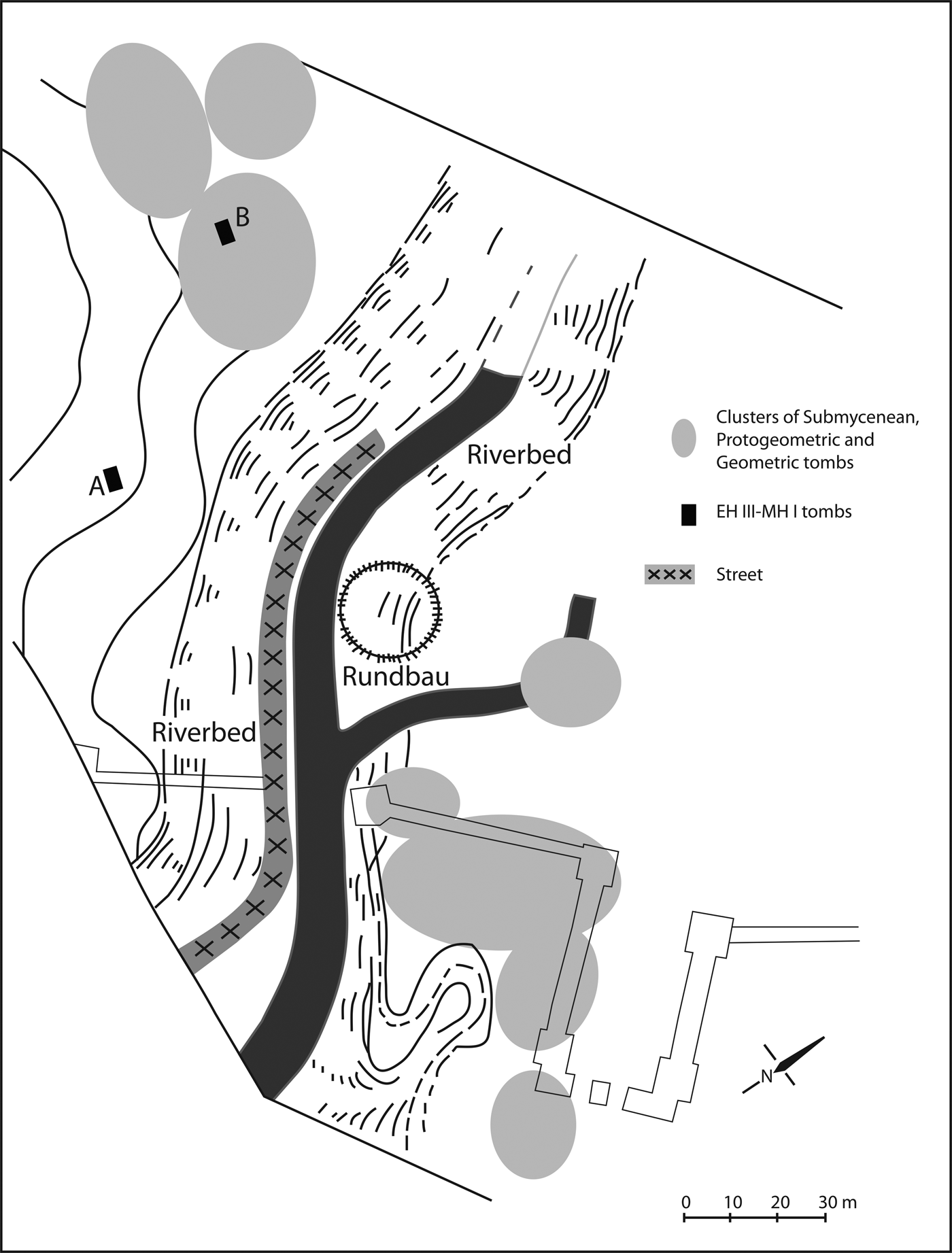
The extensive Early Iron Age, Archaic, Classical and later burial grounds of the Athenian Kerameikos (Fig. 1) were preceded by two considerably earlier but solitary tombs. Both were located on the south bank of the Eridanos (Knigge Reference Knigge1991, 14–16 figs 4–5) and both were thought to date sometime close to the beginning of the second millennium bc. Labeled Tombs A and B (Fig. 2), the graves were some 60 m apart, with the larger stone-constructed Tomb A considered the earlier of the two, which came to be known as the ‘frühhelladisches Kammergrab’ below the Südhügel. Nothing of the contents of Tomb A survived, and, as such, its precise date remains unknown, though on the basis of tomb type, discussed in more detail below, the grave can reasonably be assigned to the later stages of the Early Helladic (EH) period (Knigge Reference Knigge1976, 4–7 fig. 4, pl. 3). The grave goods recovered from Tomb B, however, were not only diagnostic, but imported from various parts of the Aegean. Although published in short reports in the Archäologischer Anzeiger, the contents of the tomb deserve closer scrutiny and discussion, and it is this grave that forms the core of this study.
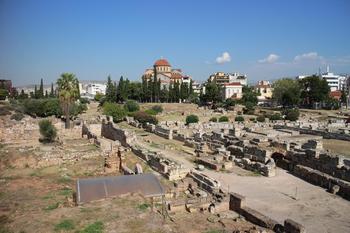
General view of the Athenian Kerameikos from south-east (photo J. K. Papadopoulos, September 2018).

The Kerameikos from the end of the third millennium to the end of the 8th century bc (after Knigge Reference Knigge1991, 15 fig. 4; reformatted and inked by A. Balitsari).

Excavated in 1936, the importance of Tomb B – originally labeled Grab 1936 HTr 28 (HTr = Hagia Triada) – was quickly appreciated by its excavator, Karl Kübler. He described the tomb as the oldest uncovered up to that time in the Kerameikos, and a welcome addition to the small number of then-known closed pre-Mycenaean contexts in Athens (Kübler Reference Kübler1936, 197–8, with reference to Della Seta Reference Della Seta1922, 278–9; Skias Reference Skias1902; Shear Reference Shear1936, 20–1). He dated the tomb to the later stages of the Middle Helladic (MH) period, based largely on the form of the foot of the one-handled cup 4, which he considered reminiscent of Minyan ware, though he compared the technique of the decoration to Middle Minoan (MM) Kamares ware; this said, he considered the fabric of the vessel Argive (Kübler Reference Kübler1936, 198, 205–6 fig. 19; Stichel Reference Stichel1978, 63 n. 26). As for the other two vessels in the tomb, he compared the lidded spherical pyxis, 1 and 2, to a vessel from Aphidna, published by Sam Wide (Reference Wide1896, 394, pl. XIV:1) and shown to Kübler by Gabriel Welter; despite the poor preservation of the vessel, Kübler (Reference Kübler1936, 198) pointed out its Cycladic vicissitudes. As for the red-polished bowl, 3, Kübler described it as a late version of the widely used Early Helladic bowls of similar form, and he compared it to a smaller wheelmade bowl that was, at the time, recently found in a Protogeometric grave in the Athenian Agora (subsequently published in Papadopoulos Reference Papadopoulos and Vlachou2015, 211–12 fig. 16; Papadopoulos and Smithson Reference Papadopoulos and Smithson2017, 324–5, 327 figs 2.226–7, T45-7, 842–4 fig. 6.41, which is Middle to Late Protogeometric, and where Mycenaean, Protogeometric and Geometric comparanda are assembled and discussed). In terms of other pre-Mycenaean fragments from the Kerameikos excavations, Kübler noted a krater foot and another sherd of Grey Minyan pottery, a wall fragment preserving matt-painted decoration and a small fragment of an Early Helladic vessel with a high handle.
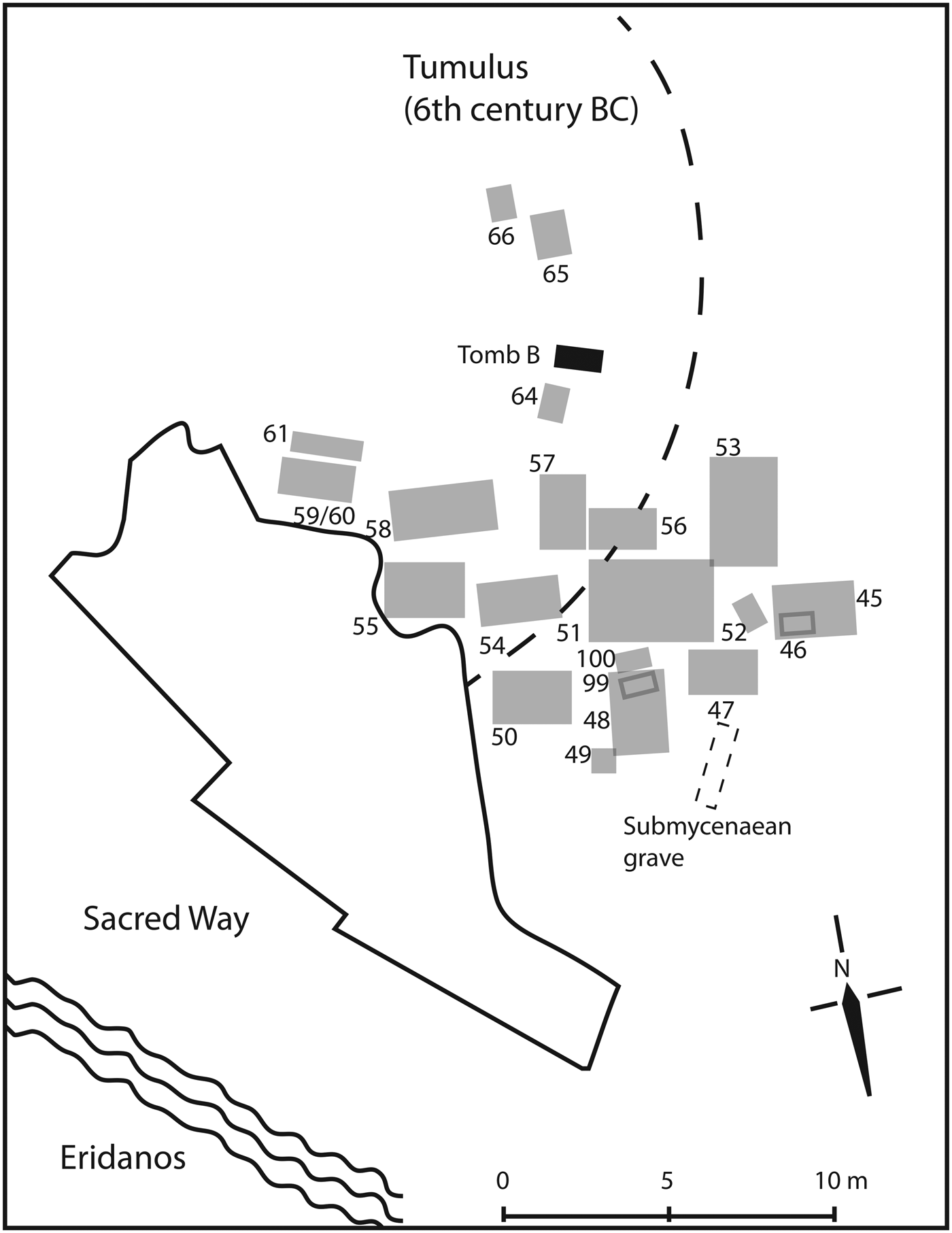
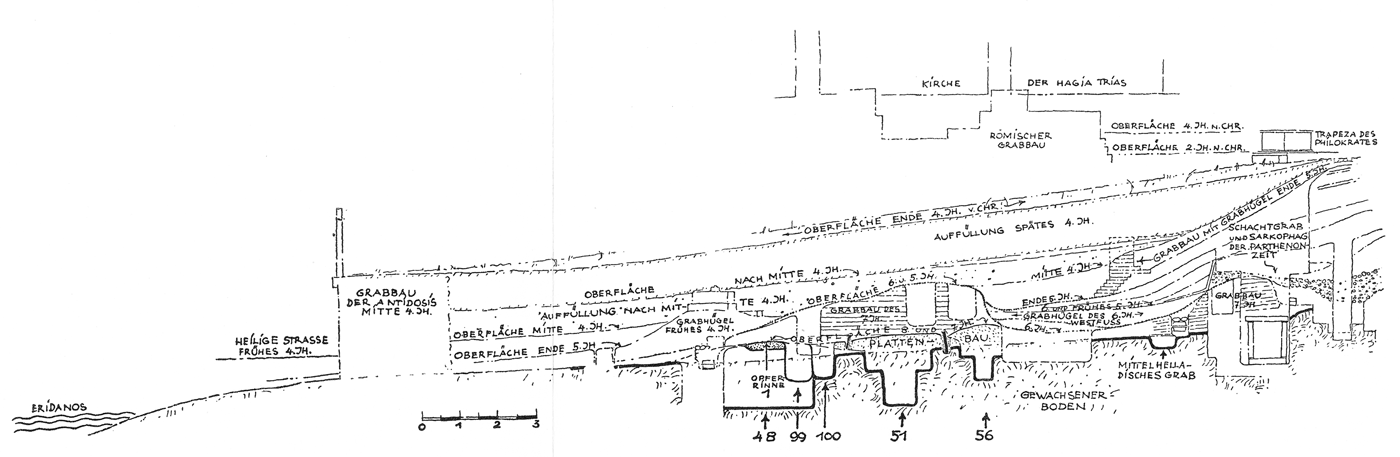
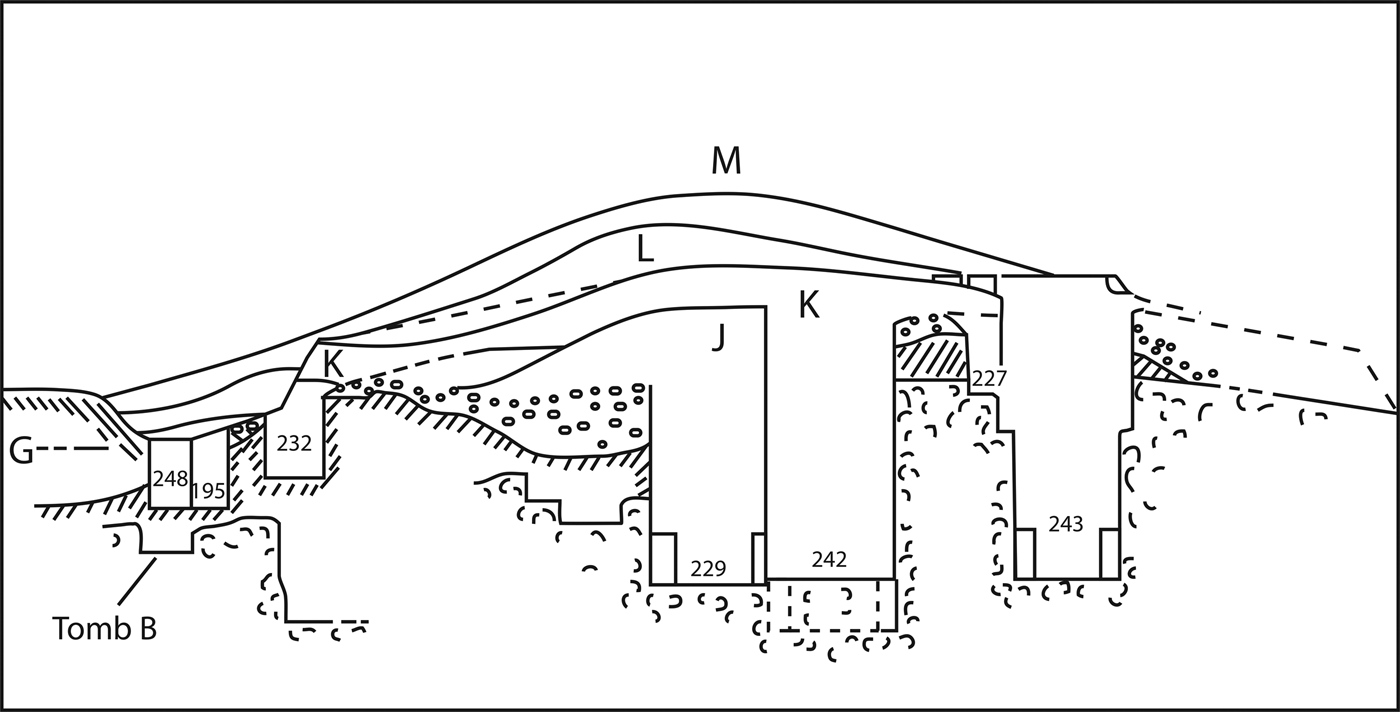
As for the burial itself, Kübler (Reference Kübler1936, 198) noted that the skeleton had been largely destroyed by later graves and had all but disappeared, except for a few bone fragments. Kübler did not publish an illustration of the tomb in his 1936 preliminary report, but in 1954 he provided an outline of the plan of the tomb, together with a section, in relation to the Protogeometric tombs along the south bank of the Eridanos (Kübler Reference Kübler1954, Beil. 2, 4:1) (Figs 3–4). The same area, with additional Late Geometric through early-sixth-century bc tombs and other related features, was illustrated by Kübler (Reference Kübler1959, Beil. 1) in a later Kerameikos volume. Over a decade later, Kübler (Reference Kübler1976, Beil. 23:1) provided a detailed section of Hügel M – which overlay Hügel J, K, L – which showed the later tombs that were located, either directly or partly, above the Middle Helladic Tomb B (Fig. 5). The culprits were Tombs 195, an infant/child inhumation in a clay tub (Kinderbestattung in Tonwanne), and 248, laconically labeled a ‘Bestattung’ with no offerings (Kübler Reference Kübler1976, 55–6, 74); Kübler further noted that Tomb 249, an infant/child enchytrismos in an amphora, also overlay the Middle Helladic grave. A plan of these three tombs was presented by Kübler (Reference Kübler1976, Beil. 11), together with other nearby graves immediately to the north-north-east of Hügel L; these tombs date to the period from the middle of the sixth to the end of the fifth centuries bc. As far as we know, there is no published photograph of the Middle Helladic Tomb B.
The cemetery along the south bank of the Eridanos showing the solitary MH Tomb B in relation to the Protogeometric graves (after Kübler Reference Kübler1954, Beil. 2; reformatted and inked by A. Balitsari).

North–south section through the Protogeometric cemetery along the south bank of the Eridanos and the Middle Helladic Tomb B, together with Protogeometric Tombs 48, 51, 56, 99, 100 (Kübler Reference Kübler1954, Beil. 4:1).
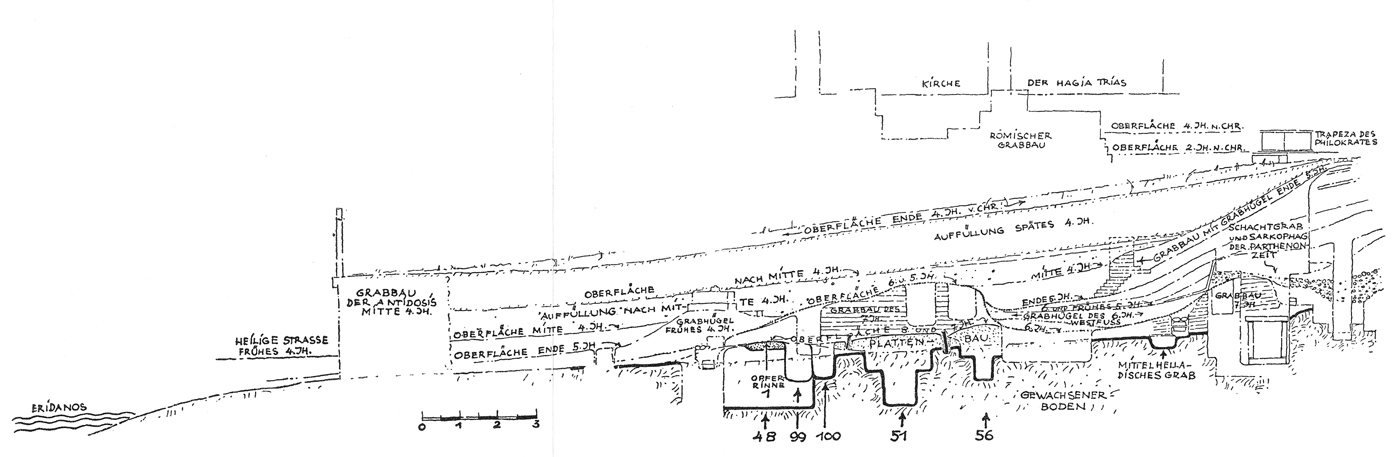
Section through Hügel M, showing the locations of the MH Tomb B below Tombs 195 and 248, as well as Tombs 229, 242, 243, which date from the middle of the 6th to the end of the 5th century bc (after Kübler Reference Kübler1976, Beil. 23:1; reformatted and inked by A. Balitsari).

In 1978, Rudolf Stichel, who largely focused on metal finds from the Kerameikos graves, presented further details of the tomb, especially the bronze objects which had not been hitherto noted in the literature. Most importantly, Stichel (Reference Stichel1978, 63–4) took the opportunity to return to Kübler's Reference Kübler1936 diary (‘Tagebuchaufzeichnungen’) and quoted the following entry, which is worth presenting here in full:
Reckteckige Grube, Breite 60 cm, Länge, soweit noch festzustellen, 1.40 m. Schneidet in den gewachsenen Boden ein, und zwar 10 cm in die Oberfläche des roten Stereo und darüber durch die hier 20 cm dicke Schicht der Sandabschwemmung, die über dem Stereo liegt und die natürlichen nach Süden ansteigenden Hügel herabgeschwennt ist.
Die Oberfläche der Stereo-Sandschicht ist die zum Grab gehörende Oberfläche. Das Grab hat also eine Tiefe von 30–35 cm gehabt. Von irgendeinem Erdmal über dem Grab ist nichts mehr festzustellen, da das Grab von jüngeren Gräbern (Kerameikos VII, 1 [Kübler Reference Kübler1976], nos. 195, 248, 249) von oben her angeschnitten ist bis auf einem Rest von etwa 10 cm Tiefe.
Im Grab Rest eines Kinderskelettes, Schädelreste im Osten. Alle Knochen höchst zerfressen, die meisten, so auch der Schädel, zu Pulver zerfallen oder ganz aufgezehrt. Nur wenige Splitter haben noch einige Form. Die Länge des Skeletts ist infolgedessen nicht festzustellen. Knochenreste sind gefunden bis in eine Entfernung von 1.40 m von der östlichen Schmalseite.
In der Südost-Ecke der Grube ein Metallreif, ein Ringchen auf der Skelettmitte, damit zusammen sin Spinnwirtel. Auf der nördlichen Skelettseite in der Nordost-Ecke der Grube ein rotpolierter handgemachter Napf, daneben gegen den Nordrand des Grabes eine Pseudo-Kamarestasse, gegen den Schädel zu, hin zum Ostrand der Grube ein handgemachtes Gefäß mit Ösen aus grauem Ton, schwarz poliert und mit weiß gefüllter Gravierung, dicht dabei ein Deckel in derselben Technik, Politur braun. Alle keramischen Funde sind sehr zerdrückt, die weichen (Napf und Gefäß mit Ösen) am meisten, vom Deckel nur geringe Reste erhalten.
The tomb is thus a simple rectangular pit, at least 1.40 m long and 0.60 m wide, and approximately 0.30–0.35 m deep.Footnote 1 The tomb pit was partly cut into the sandy alluvium of the Eridanos and partly into the adjacent natural bedrock. Nothing of a tomb cover survived – whether stone slabs (Cavanagh and Mee Reference Cavanagh and Mee1998, 26) or wooden beams with clay sealing (e.g., Protonotariou-Deilaki Reference Protonotariou-Deilaki2009, 209, case δ) – on account of the disturbances caused to the upper parts of the burial for the opening of the later graves already noted. Such pit graves are very common during the Middle Bronze Age all over the Greek mainland.Footnote 2
Kübler noted the poorly preserved remains of a skeleton of a child, with scraps of the skull indicating that the cranium was to the east. The bones had largely disintegrated, with only a few splinters preserving any semblance of the original form of the bone. Consequently, the original length of the skeleton cannot be determined. There is no mention as to the disposition of the deceased, whether supine or contracted. We hasten to add that without the study of the bioarchaeology of the deceased, conclusions as to the age or even the number of the deceased should be taken cum grano salis. There are simply too many cautionary tales in the case of cemetery populations that have been anthropologically analysed to warn against making assumptions as to the identity of the deceased without the proper analysis of the physical remains (see esp. Papadopoulos and Smithson Reference Papadopoulos and Smithson2017, 655–78; Liston Reference Liston2017).
The two metal objects, a bronze bracelet (6) and the poorly preserved remnants of an unidentified bronze object, perhaps a ring (7), were found, together with the terracotta spindle-whorl or bead (5); the bracelet is said to be in the south-east corner of the pit, with 7 found, evidently in situ, at the center of the skeleton, together with 5. As for the pottery, the red-polished handmade bowl (3) was found on the north side of the skeleton in the north-east corner of the pit; the one-handled cup (4) – considered by Kübler as ‘pseudo-Kamares ware’ in his diary, and as an imitation of Kamares in his 1936 published report (Kübler Reference Kübler1936, 198) – was placed next to the north edge of the grave, whereas the spherical lidded pyxis (1–2) was found near the skull towards the east edge of the pit. All of the pottery was fragmentary and very poorly preserved.
In our study of the material from the tomb in the Kerameikos Museum in 2016, both of the metal objects (6–7) and the fragmentary lid of the pyxis (2) could not be located by the museum staff. The remainder of the material from the tomb we were able to study and redraw, and it is presented and discussed in detail in the following section of this paper.
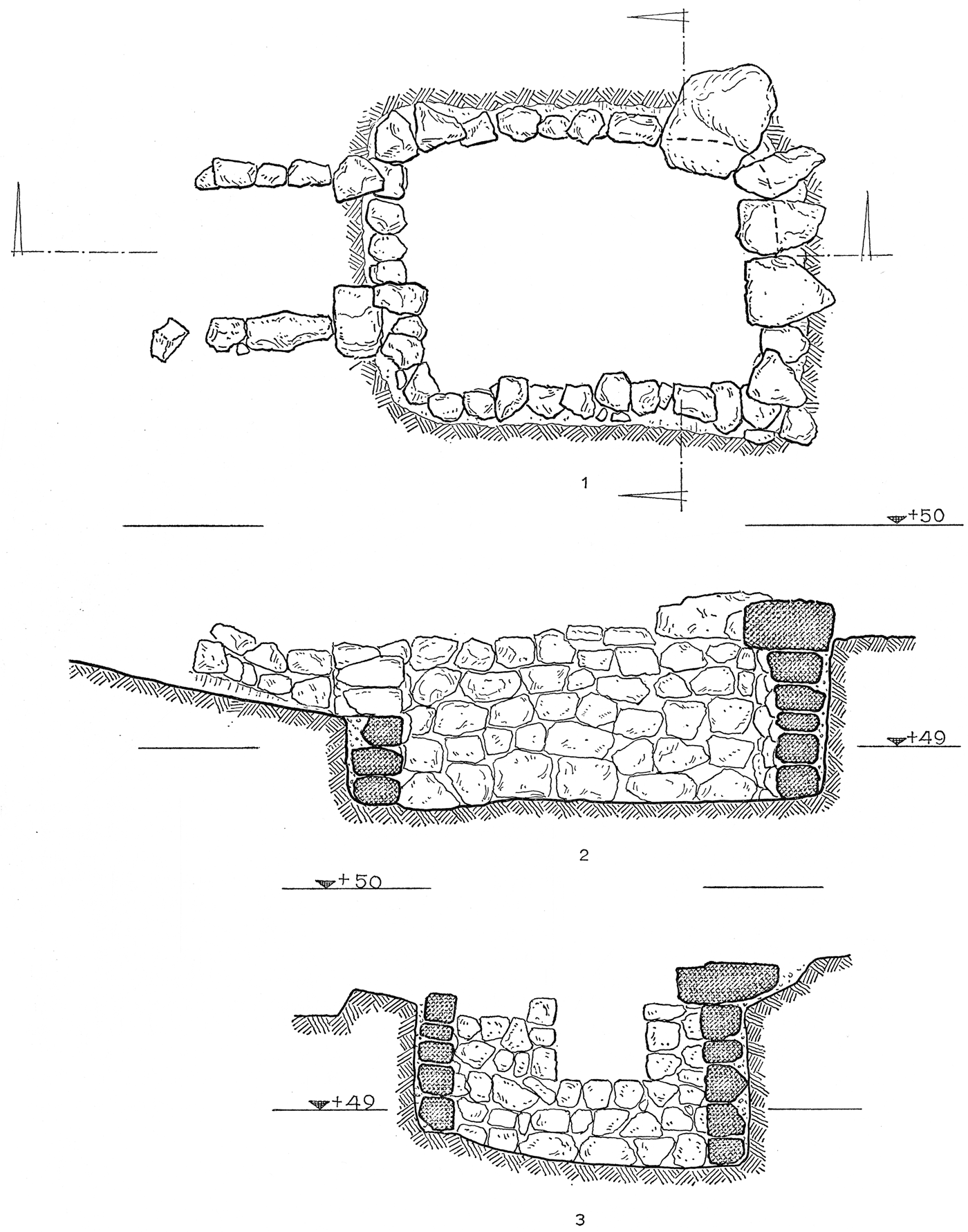
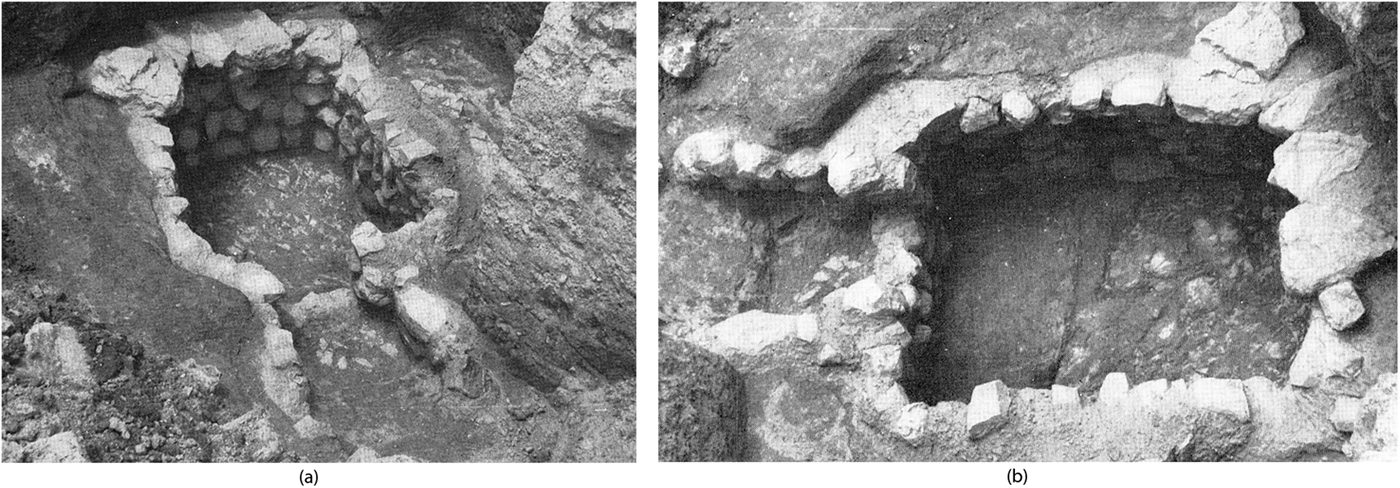
The other Bronze Age burial in the Kerameikos is thought to be earlier, and is more impressive than Tomb B. Referred to as Tomb A, the grave was located below the much later Südhügel (Fig. 6). It was excavated in 1963, with a plan and elevations drawn by Gottfried Gruben (Fig. 7).Footnote 3 Fully described and illustrated by Ursula Knigge (Reference Knigge1976, 4–6 fig. 4, pl. 3), the tomb – a Kammergrab, or chamber tomb – was built of unworked limestone fieldstones, oriented roughly east–west and measured 1.70 x 1.15 m, with a narrower opening to the east, approximately 0.50–0.60 m wide, described by the excavator as a ‘prothyron’, which was at a slightly higher level than the main chamber of the tomb (Fig. 8a–b). The upper walls and roof of the built tomb had collapsed into the burial and were subsequently scattered in the main chamber. Nothing was encountered, however, of any human remains or grave offerings, and, as such, there is no evidence to establish a firm date for the feature. In the absence of associated finds or stratified deposits, Knigge compared the form of the Kerameikos tomb to graves of similar shape and construction uncovered in the Early Helladic north cemetery at Aghios Kosmas (Mylonas Reference Mylonas1959, 82–3 figs 58–60 [Grave 6], and 93–4 fig. 81, drawings 19, 32, 48 [Grave 14]) and the more recently excavated tombs at Tsepi-Marathon (Marinatos Reference Marinatos1970, esp. 5–9 figs 4–5; Pantelidou-Gofa Reference Pantelidou-Gofa2005). On the basis of these comparanda, Knigge dated the tomb to the beginning of the second millennium bc.
The Südhügel behind the Gesandtenstelen (photo J.K. Papadopoulos, September 2018).

The Early Helladic Chamber Tomb A (Kammergrab). Plan and elevations by Gottfried Gruben (Knigge Reference Knigge1976, 5 fig. 4), courtesy DAI Athens.
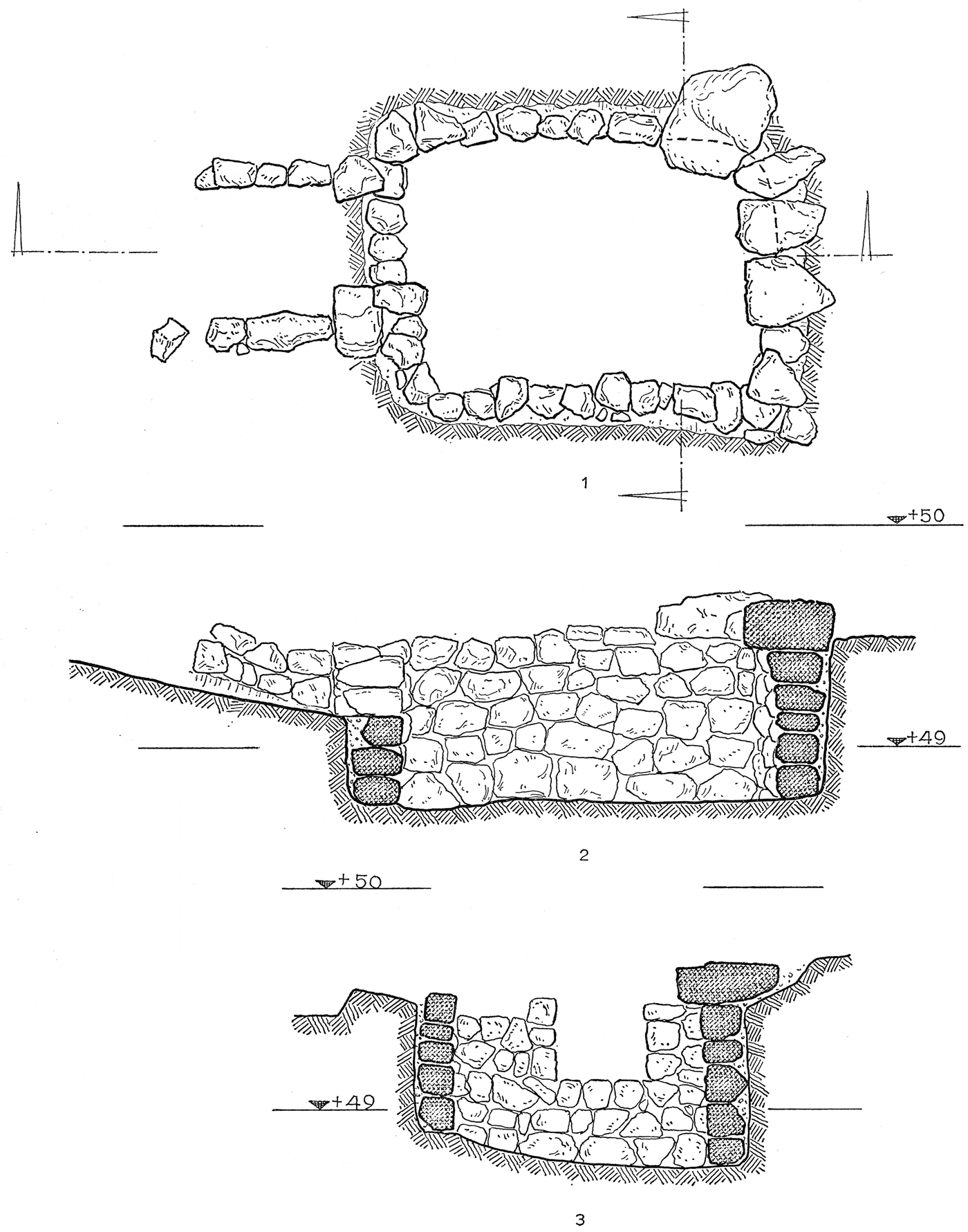
Two views of the Early Helladic Chamber Tomb A under the Südhügel: a) from south-east; b) view from above north-north-east. Photos courtesy DAI Athens.

In addition to the Middle Helladic pottery from Tomb B, and the fragmentary stray finds of Early and Middle Helladic date noted above by Kübler, Knigge (Reference Knigge1976, 7) added the following prehistoric pieces: the fragments of a Middle Helladic storage jar, probably of Aiginetan fabric, found in 1964 south of the Sacred Way as a Streufund, and the Early and Middle Helladic pottery (mostly Grey Minyan) from the 1972 excavations below the Rundbau (Knigge Reference Knigge1974, 194 fig. 24; 1976, 7 n. 18). Tomb A is the only constructed feature from the Bronze Age in the Kerameikos.
THE FINDS FROM TOMB B (1936 HTr 28)
The pottery
Despite being found in fragmentary condition it was possible to restore almost all of the clay vases either partly or wholly. As already mentioned, not all of the offerings could be found in the storerooms of the Kerameikos Museum. However, the detailed study of those still preserved and exhibited among the prehistoric collection, with the help of comparanda from other MH settlement and/or burial contexts within and beyond Attica, indicates the early MH date for the inhumation.
In the catalogue entries that follow, the density of inclusions is estimated according to the Munsell Soil Color standards.
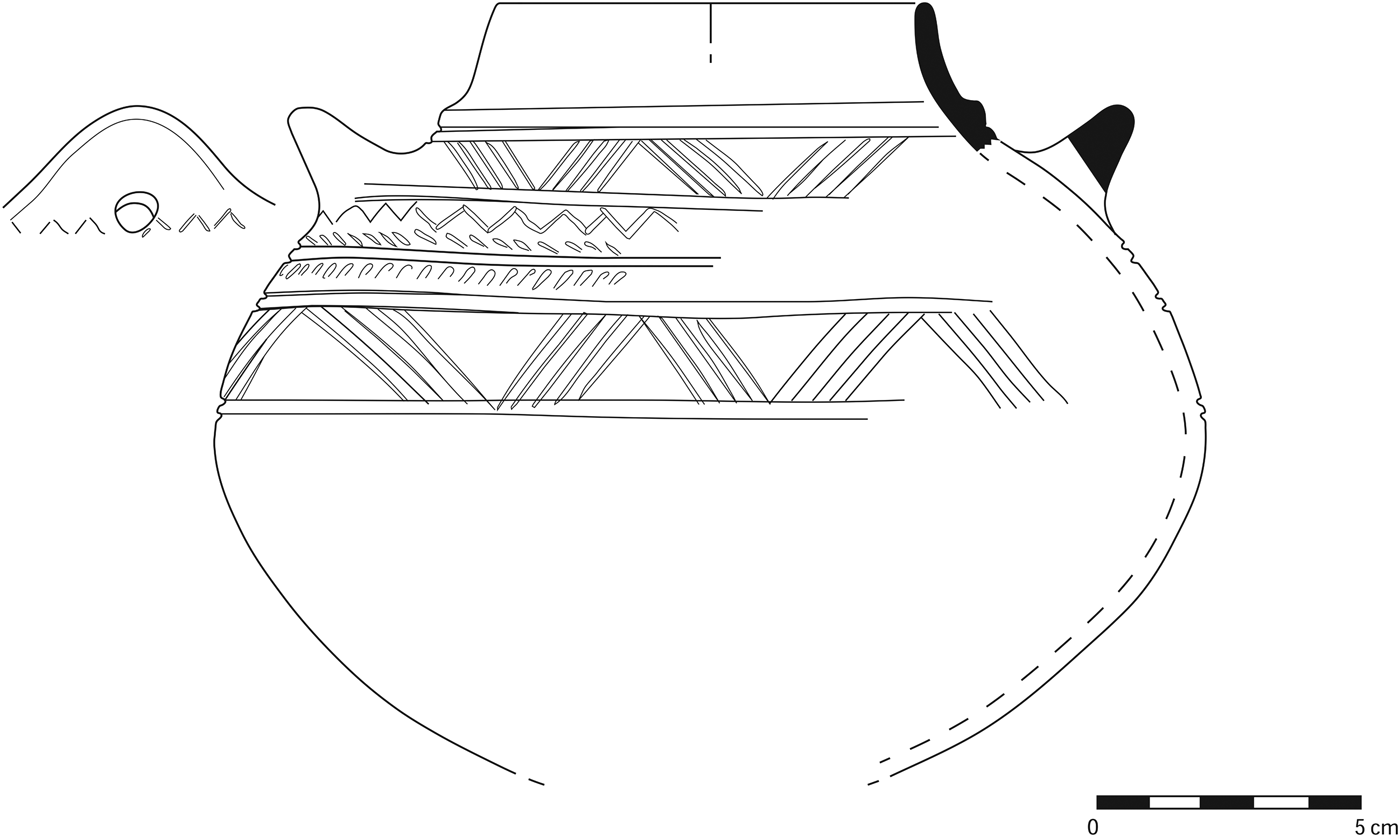
1. Spherical pyxis (Figs 9, 10)
Inv. number: 643.
p.H.: approx. 0.125 m; est. Diam. (rim): 0.077 m.
Mended from approximately 72 fragments, more than half of vessel restored with plaster.
Handmade pyxis with spherical body, straight neck and rim with rounded section. Two vertically pierced lug handles are set on top of the shoulder. Base not preserved.
Incised and plastic decoration. One rib-band around the bottom of the neck. The body bears horizontal zones with incised patterns: groups of parallel opposed diagonals (in alternating directions), zig-zags and herringbone pattern.
Semi-fine fabric with few silver mica and stone inclusions (5–7%) of rounded/sub-rounded shape, mainly whitish and less commonly reddish, the size of which does not exceed 0.003 m. Small voids (<0.001 m) with evidence that burning may have been the cause due to the firing of organic temper.
Core fired close to 10 YR 7/2 (light grey), surfaces close to 10 YR 7/1–6/1 (light grey–grey).
The exterior surfaces, even though badly worn (and perhaps burnt?), preserve traces of heavy burnishing with the colour close to 5 YR 3/1 (very dark grey).
As noted above, the lid, which had never been issued a separate inventory number from the pyxis, could not be located in the Kerameikos Museum and depot, and is thus missing. The description follows that given by Stichel (Reference Stichel1978, 65, no. 4).
2. Lid (missing)
No inv. number.
Diam.: 0.10 m.
Only a few fragments preserved. Handmade, of brown–grey fabric, unevenly fired with brown burnished surfaces. It consists of a flattened disc, provided with a perpendicular salient feature around it. Incised decoration on the top: groups of strokes radially arranged, two concentric circles and groups of slanting strokes.
The closest parallel for the spherical pyxis 1 from the Kerameikos comes from the Aphidna Tumulus in north-east Attica (Wide Reference Wide1896, 394, pl. XIV:1; Hielte-Stavropoulou and Wedde Reference Hielte-Stavropoulou, Wedde and Hägg2002, 22 fig. 1:NM 10.749; Forsén Reference Forsén, Philippa-Touchais, Touchais, Voutsaki and Wright2010a, 228, 233 fig. 1:2), as noted by Kübler himself, where it was found with many other vases inside Pithos III, and dated to the late EH II–EH III phase (Forsén Reference Forsén, Philippa-Touchais, Touchais, Voutsaki and Wright2010a, 225–7). Both pyxides share significant similarities in terms of shape, the elaborate incised decoration on the shoulder, and the burnishing of the surfaces.
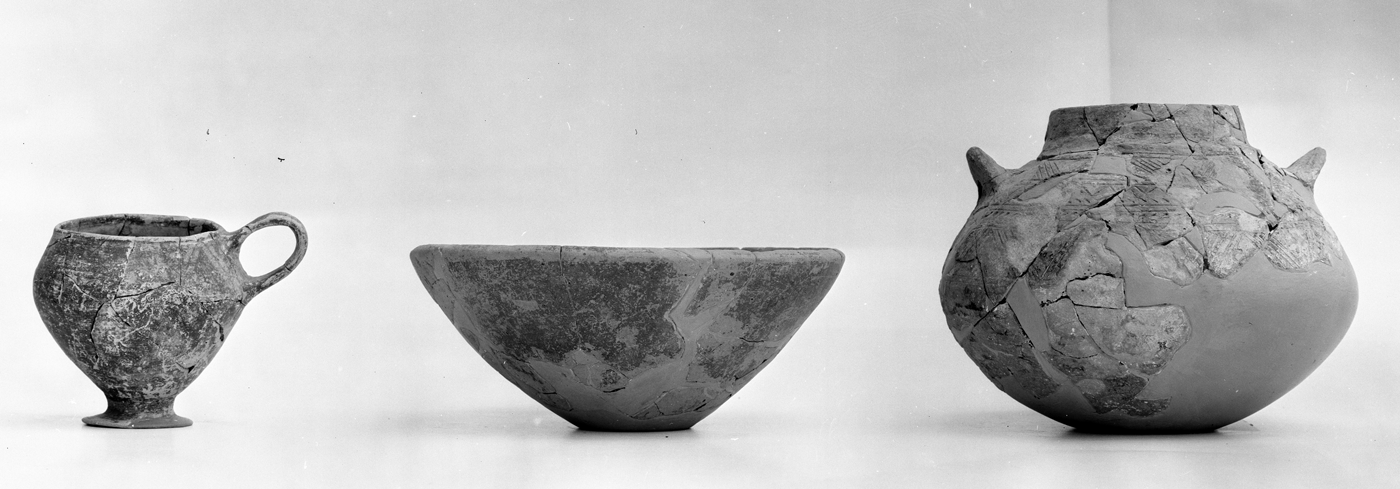
The three MH vessels from Tomb B. From left to right: 4 (inv. 645), 3 (inv. 644), 1 (643). Photo courtesy DAI Athens.

Spherical pyxis (1). Drawing Anne Hooton, inked by A. Balitsari.
The few differences between the vessels mainly concern the decorative patterns, which display more variation in the Aphidna pyxis (circles, hatched L-shaped patterns). The fact that the Aphidna pyxis is provided with a low conical foot makes it very possible that the same should also apply for the Kerameikos example, the bottom of which is now missing and restored with plaster. In both cases, the pyxides were accompanied by lids with elaborate incised decoration and common motifs (groups of oblique lines, concentric circles). Unfortunately, it was not possible to locate the Kerameikos lid 2 in the storerooms of the museum, so any information we have for it is based exclusively on the description provided by Stichel.
The same set of vases (footed pyxis and lid) was also discovered in Grave 4 of Tumulus I at Vranas-Marathon in north-east Attica (Marinatos Reference Marinatos1970, 13, pl. 16β). In contrast to the Kerameikos and Aphidna examples, the pyxis from Vranas is Grey Minyan and it bears no decoration, while some typological features, especially its biconical and sharply carinated body, indicate an advanced phase of development, probably the MH II phase.Footnote 4
Interestingly enough, the closest comparanda for the Kerameikos pyxis and lid are found in grave contexts, suggesting some kind of standardisation in burial offerings during the EH III–early MH period.
Related pyxides and lids with various surface treatmentsFootnote 5 are also found in the Athenian Agora (Immerwahr Reference Immerwahr1971, 58, 72–3, pl. 16, nos 253–5), as well as beyond Attica, in Early Bronze Age II–IIIFootnote 6 contexts in the Cyclades (Rambach Reference Rambach2000, 75, pls V–VIII, esp. VIII:3, Chalandriani tomb 172) and other sites on the Greek mainland, including Lerna,Footnote 7 as well as Kolonna on Aigina (MH I; this is also known as Phase H) (Gauss and Smetana Reference Gauss, Smetana, Felton, Gauss and Smetana2007, 73 fig. 5: XXVII-40). All of these pots, many of which are found in graves, are strongly related to Cycladic traditions. Consequently, the vases previously discussed in the burial contexts of Attica – particularly the ones from Kerameikos and Aphidna – could also be considered as imports.Footnote 8 Although they exhibit some common features,Footnote 9 they also have a different surface treatment (burnished, not painted or slipped), which may be either of chronological significance or possibly the result of their being locally produced in Attica following local taste. This would not be unlikely, since similar locally produced lids were also identified on Aigina (Wünsche Reference Wünsche1977, 55–7 figs 36–7: nos. 53, 55; Gauss and Smetana Reference Gauss, Smetana, Brodie, Doole, Gavalas and Renfrew2008, 337).
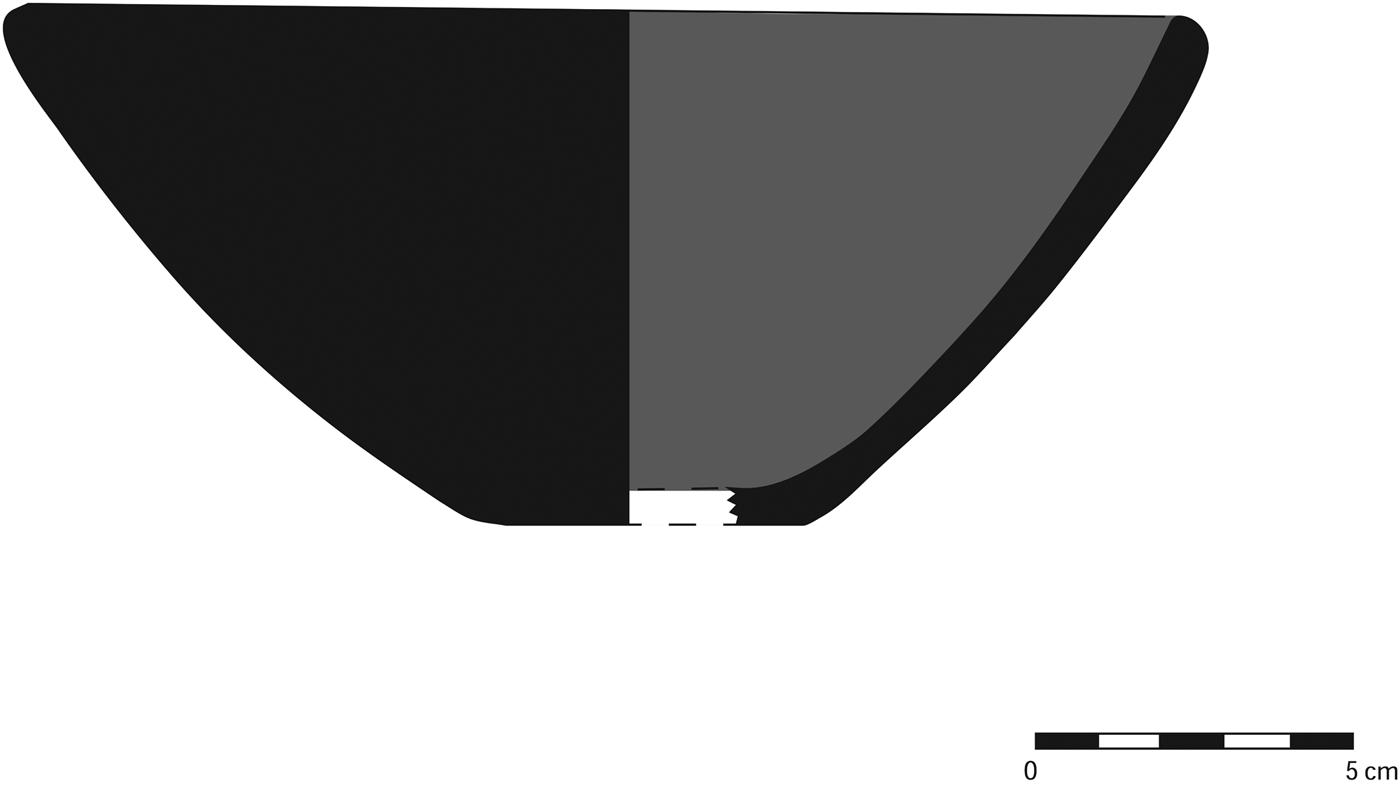
Inv. number: 644.
H.: 0.077–0.078 m; Diam. (rim): 0.018 m; est. Diam. (base): 0.046–0.048 m.
Mended from approximately 40 fragments. About 30% of vessel restored with plaster. Base almost entirely missing.
Conical body with straight walls, flattened rim, slanting on exterior and flat base. Handmade (the uneven wall thickness suggests the presence of coil-built technique).
Semi-fine fabric with few (5–7%) rounded/sub-rounded stone inclusions of whitish, black and reddish colour, with max. size of 0.001 m. Small flakes of gold mica are also visible on the surfaces, especially near the base.
Surfaces fired close to 7.5 YR 7/6–6/6 (reddish yellow).
Both interior and exterior surfaces slipped and burnished. Base is missing, so it remains unknown whether the underside was also slipped and burnished inside and out. Slip close to 10 YR 4/8 (red).
The shape of 3 is not particularly common during the MH period. On Aigina, similar bowls with the same surface treatment (solidly painted and burnished in red colour) are only attested in MH I (Phase H) (Wünsche Reference Wünsche1977, 42–4, pls VI–VII: nos 34–8, 40; Gauss and Smetana Reference Gauss, Smetana, Felton, Gauss and Smetana2007, 62, 72 fig. 4: 8b/11-8). Another example, also Aiginetan, was found at Lerna, in a deposit considered mixed, with pottery of the transitional Phase IV/V (EH III/MH I) and Phase VA (MH I).Footnote 10 Both fabric – with the most prominent feature being the presence of some golden mica flakes – and surface treatment support the identification of the Kerameikos bowl as an Aiginetan import.
Bowl (3). Drawing Anne Hooton, inked by A. Balitsari.
We may also look for some earlier counterparts in deposits assigned to the Early Bronze Age II–III period in central Greece (Spencer Reference Spencer2007, 162–5) and the Cyclades, including the islet of Dhaskalio (Keros) as the most recent example,Footnote 11 where similar bowls are commonly found in Phases B–C, synchronous with the Kastri-Lefkandi I phase (late EH II) (Rutter Reference Rutter1979, 33 fig. 1:1). Since the Early Bronze Age examples are usually red-slipped, it is probable that the MH I Aiginetan bowls follow an earlier established tradition.
4. One-handled cup (Figs 9, 12)
Inv. number: 645.
Recently published in Banou and Bournias Reference Banou and Bournias2014, 29–30.
H.: 0.080–0.088 m; Diam. (rim): 0.062–0.071 m; Diam. (base): 0.045–0.048 m.
Almost entirely restored from approximately 27 fragments, with only few plaster fills on body and foot.
Ovoid body with inturned and slightly upturned rim and rounded lip section. The body stands on a low splaying foot, hollowed underneath. The one handle of rectangular section is vertically attached from shoulder to rim. The irregular profile and uneven wall thickness confirms its handmade character.
The exterior surface, the foot underneath, the inside face of the handle, as well as the top of the rim inside are covered with black (occasionally reddish-brown) lustrous slip. White-painted decoration (Light on Dark), extremely fugitive, consists of horizontal bands and double-outlined lozenges with dot rosettes between them.
Fine fabric with no visible inclusions. Core fired close to 7.5 YR 7/4 (pink), interior surface fired close to 10 YR 8/3–8/4 (very pale brown).
The one-handled cup 4 is clearly related to Middle Minoan ceramic traditions in terms of both shape and decoration. Without the help of chemical analysis, however, it is difficult to say whether the vessel is an actual product of a MM workshop on Crete or an imitation produced on the Greek mainland, since Minoanising ware – otherwise called Lustrous Decorated – is considered to have been possibly produced in more than one location of the north-east (Gauss and Kiriatzi Reference Gauss and Kiriatzi2011, 140–1) and south Peloponnese, if not on Kythera itself (Jones and Rutter Reference Jones and Rutter1977; Jones Reference Jones1986, 423–4; Zerner Reference Zerner, Taylour and Janko2008, 205–6). Despite the fact that the Lustrous Decorated pottery exhibits some differentiating features in comparison to MM (Kiriatzi Reference Kiriatzi, Philippa-Touchais, Touchais, Voutsaki and Wright2010, 695–6), as far as the fine tableware is concerned there are no essential differences. The small vases, and especially the cups, seem to replicate almost precisely the Minoan prototypes, and it is, therefore, not always easy to distinguish between the Minoan and the Minoanising wares, based solely on macroscopic criteria (Zerner Reference Zerner1978, 170–8 [Lerna]; Philippa-Touchais Reference Philippa-Touchais2003, 34–5 [Aspis]).
Cup (4). Drawing Anne Hooton, inked by A. Balitsari; photo courtesy DAI Athens.

In terms of shape, the closest comparanda for the Kerameikos cup are found in House B of Knossos (Momigliano Reference Momigliano1991, 223, 226 figs 24:34, 27:70), in deposits dated to the EM III/MM IA phase.Footnote 12 In terms of decoration, similarities are mostly traced, according to Momigliano (Reference Momigliano1991, 229, with notes), with pottery assigned to the MM IIA–IIIA period. However, the same decorative motifs (lozenges with dot rosettes) also occur in the Woven Style (MM IB), with the white paint combined with red (MacGillivray Reference MacGillivray1998, 59–60 fig. 2.1:16). On Crete, polychrome decoration is chronologically significant because its appearance is associated with the beginning of the MM IA phase (Hood Reference Hood1966, 110; Momigliano Reference Momigliano and Momigliano2007, 79–80). Despite the fact that the Kerameikos cup follows a decorative pattern attributed to the MM IB phase, the absence of the red paint could be seen as a sign of earliness, indicating a transitional stage of development.
As far as the Greek mainland is concerned, the record for Minoanising ware is both limited and fragmented, so it is hard to trace exact parallels for shape and decoration. At Lerna, at least one fragment of a low foot is attributed to early MH I (Zerner Reference Zerner1988, 6 fig. 24:2). Related cups with ovoid body and inturned rim, with or without spout, are attested in the MH I phase, but they are usually provided with flat or ring bases (Zerner Reference Zerner1978, 168; Reference Zerner1988, 6 fig. 24:3–14). During the same phase, decoration is usually Light on Dark and the most common painted patterns are oblique lines hanging from a horizontal band around the rim and more horizontal bands on the lower half of the body (Zerner Reference Zerner1978, 169). Dot rosettes are not represented. Cups of the same profile but usually with plastic ‘barbotine’ decoration have also been found in Phase II of the Aspis (late MH I–early MH II) (Philippa-Touchais Reference Philippa-Touchais2003, 10–11 fig. 3).
At Ayios Stephanos in southern Laconia, Minoanising cups bear the same profile, but despite their fragmentary condition there is no evidence for their being provided with a low foot. They are mainly associated with the MH I phase, decorated in Light on Dark as well, and considered MM IA imitations. Interestingly enough, the combination of white and red paint is commonly attested during the MH II phase (see Zerner Reference Zerner, Taylour and Janko2008, 202, ‘Decoration’ and ‘Shapes: Angular Cup’). On Kythera, cups and goblets, as well as isolated foot fragments with slipped surfaces, are found in the MM IA Deposit γ (Coldstream Reference Coldstream, Coldstream and Huxley1972, 92 fig. 37:2–3).
To sum up, the available evidence that we have so far from the better preserved stratified contexts of MH sites in southern Greece support a date for the Kerameikos cup in the MH I/MM IA period.Footnote 13
There are, however, certain problems with the identification of the provenance of the Kerameikos cup, and more especially in deciding whether it is an actual Cretan import or a Minoan imitation. On the one hand, low-footed cups seem uncommon across the Greek mainland and, as such, the Kerameikos cup could be related more closely with some Knossian workshop rather than Minoanising ware. On the other hand, the vessel exhibits some features rather atypical for Minoan production: the rim is not thinning but it is of rounded section, flaring outwards; there is a distinct bulge on the floor of the interior, and the red paint is evidently absent, despite the fact that it is an important characteristic of the same patterned decoration in the MM IB Woven Style of Knossos. As noted above, the latter feature may result from its slightly earlier date,Footnote 14 but other details are potentially more telling and cannot be easily overlooked since they are closely related to the operational sequence of its manufacture technique.
Although for the time being we cannot pinpoint the exact location of its provenance, the detailed and comparative examination of the manufacturing techniques of both MM (Jeffra Reference Jeffra2013) and Minoanising potting traditions may shed more light on the origin of the Kerameikos cup.Footnote 15 Here we must also stress that even if it is a product of some mainland workshop, Athens and Attica should be excluded as the possible location for such a workshop, since the presence of Minoanising ware is almost absent in the wider region north of the Argosaronikos Gulf.Footnote 16 Consequently, whether Minoan or Minoanising, the Kerameikos cup was certainly imported to Attica from the south.
Small finds
Among the other finds that accompanied the deceased in Kerameikos Tomb B, only the clay spindle-whorl or bead was located in the storerooms of the Kerameikos Museum. Unfortunately, all the bronze objects could not be found, including the bracelet, which was evidently much better preserved than many other metal finds. Consequently, for the metal objects we rely solely on the original information provided by Stichel.
5. Spindle-whorl, bead or button (Fig. 13)
Inv. number: 646.
H.: 0.016 m; Diam.: 0.03 m; Diam. (hole): 0.005 m; Weight: 13 gr.
Preserved almost intact.
Biconical with slightly convex sides, roughly flat bottoms.
Finished (smoothed) surfaces.
Semi-coarse fabric rich in silver mica and angular stone inclusions (10%), with max. size of 0.003 m., mainly grey schist fragments and whitish transparent particles (quartz?). Colour: 2.5 YR N3 (very dark grey).
Dubbed a spindle-whorl by Stichel, the small terracotta could have served as spindle-whorl or bead and, perhaps less so, a button. Similar terracottas elsewhere in the prehistoric Aegean have been variously classified as spindle-whorls, beads or buttons, designations that cover the range of likely possibilities (see, e.g., Heurtley Reference Heurtley1939, 165 fig. 35:p, 203 fig. 67:l–ee, 213 fig. 83:l–o, 231 fig. 104:a–l, 240 fig. 112:h; Popham, Sackett, and Themelis Reference Popham, Sackett and Themelis1979–80, 83; McDonald, Coulson, and Rosser Reference McDonald, Coulson and Rosser1983, 287; Wells Reference Wells1983, 80; Barber Reference Barber1991, 39–78). Context can sometimes provide a clue, especially in well-preserved tombs (Papadopoulos Reference Papadopoulos2005, 553–5; Papadopoulos and Smithson Reference Papadopoulos and Smithson2017, 90, 131, 514, 644, 663–4, 675, 863, 872–5, 940, 953–5); for example, a single terracotta, or several encountered in a row on the upper torso, might reasonably suggest a necklace of beads worn around the neck, whereas a solitary example found in, on, or near an outstretched hand might suggest a spindle-whorl or a bead worn on the wrist, but not a button. A classic case of using context to determine the function of such terracottas was noted by George Mylonas (Reference Mylonas1948, 73), with reference to Mycenaean burial customs: ‘That the bodies laid dressed is indicated by the discovery of a great number of buttons (often called spindlewhorls) attached to the clothes.’ In another interpretation, Spyridon Iakovidis (Reference Iakovidis1977; see also Iakovidis Reference Iakovidis1969–70, vol. 2, 277–81; Furumark Reference Furumark1972, 89) proposed a function as dress weights (cf. Barber Reference Barber1991; Rehak Reference Rehak1996). Although Kübler noted the approximate location of the terracotta, the state of preservation of Tomb B was such that it remains difficult to determine the function of 5 from its context.
Spindle-whorl, bead or button (5): drawing Anne Hooton, inked by A. Balitsari.
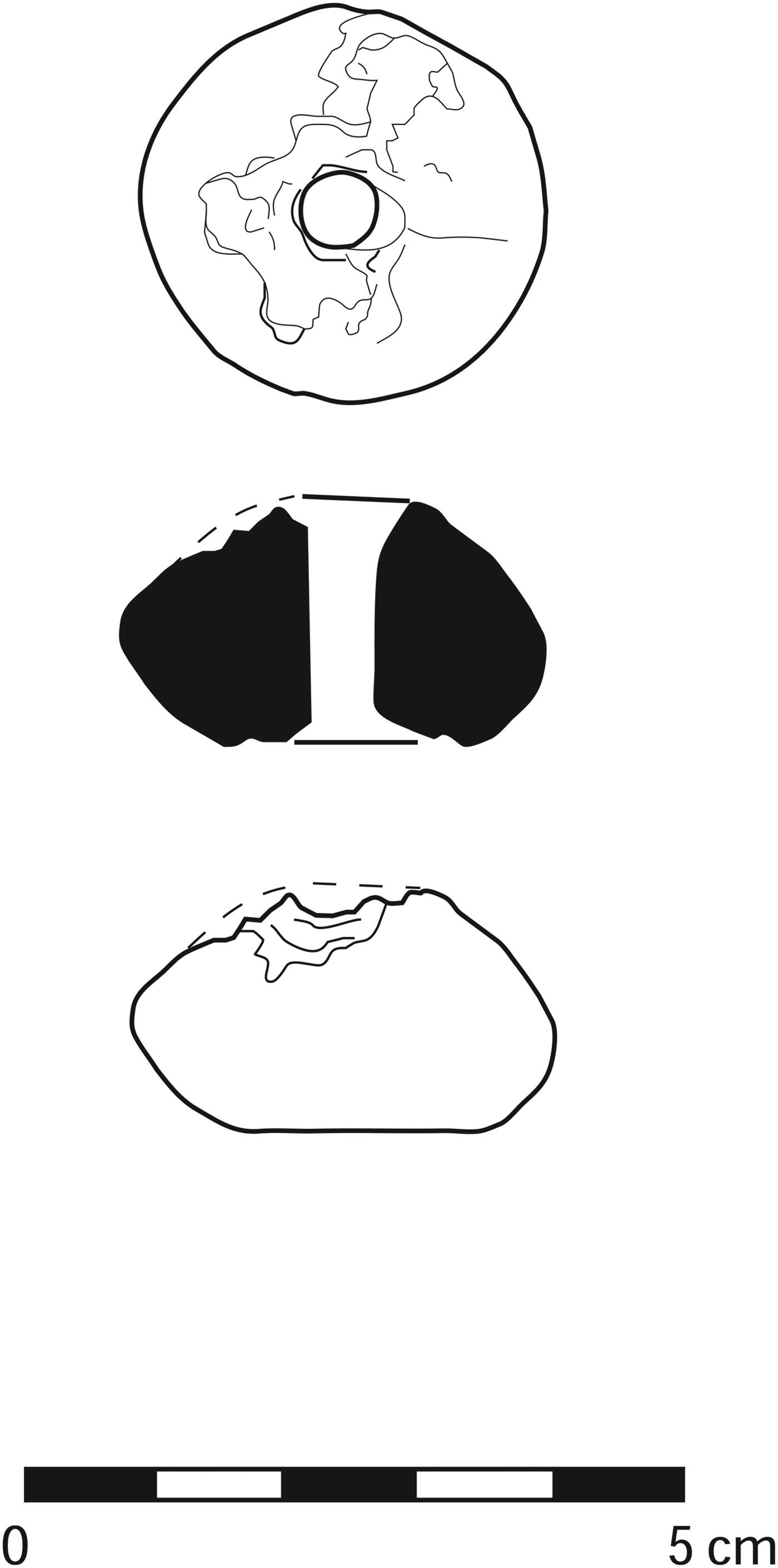
Spindle-whorl or bead 5 is of roughly biconical form, which was very common during all periods of Aegean prehistory (Smith Reference Smith, McDonald and Wilkie1992, 681–2). According to some experimental research, its weight (13 gr.) was appropriate for the weaving of relatively fine threads, assuming, of course, that it is a spindle-whorl and not a bead (see Barber Reference Barber1991, 52).Footnote 17
If a spindle-whorl, and in the absence of anthropological remains retrieved from the grave, the terracotta could possibly be associated with a female burial, since weaving is a common female occupation diachronically (Barber Reference Barber1991, 283–98). The osteological analyses conducted in a number of Early Iron Age cemeteries in Italy confirms the close relationship that existed between female burials and textile tools placed as offerings in graves (Gleba Reference Gleba2008, 173–4). However, given the lack of similar systematic analyses for Aegean Bronze Age cemeteries, and taking into consideration the possibility of the spindle-whorl being placed as an offering by a woman and not for a woman, such a scenario remains clearly hypothetical. In Aegean Early Iron Age cemeteries where systematic analyses have been combined with bioarchaeological data, such terracottas could be associated with both females and males (Papadopoulos Reference Papadopoulos2005, 381–2, with full references).
The descriptions for the two missing pieces, together with the drawing for 6 follows Stichel (Reference Stichel1978, 65–6 fig. 38, no. 6, and 66, no. 7).
6. Armfreif (Bracelet?) (missing) (Fig. 14)
Inv. number: M 306.
Diam.: 0.055 m; Diam. (wire): 0.035 m.
Thin bronze wire of rounded section, 1.5 times twisted around itself. Both ends appear to have been hammered flat and rolled over.
7. Unidentified metal object(s) (missing)
No inv. number.
Heavily corroded bronze fragments that consist of pieces of wire (the longest is 0.04 m) of varying thickness, one of which is spiral-form and the rest U-shaped.
Designated an ‘Armreif’ by Stichel (Reference Stichel1978, 66), the latter observed some similarities with Type V of Branigan's classification for related Bronze Age metal artefacts, with comparanda from contexts of Troy II (Early Bronze Age II) (cf. Branigan Reference Branigan1974, 44, pls 33, 40, nos 2580–1). However, the way that the wire appears to have been hammered flat towards the ends and then rolled over has no exact parallels among similar items of personal ornament.Footnote 18 Having not had the occasion to inspect the piece in the flesh, further details are difficult to glean from the drawing alone. But if we are right in assuming that the terminals were hammered flat and rolled over, then the bracelet is closely related in technique, though not function, to the ubiquitous Rollenkopfnadel or Rollennadel, that is, a dress pin with a shaft, circular in section, tapering toward a point at one end, the opposite end hammered flat and rolled over to form the head. This type of pin enjoys a venerable prehistory in the Aegean. The most recent overview of this type of pin is by Claus Reinholdt (Reference Reinholdt2008, 123–4, pls 9–10, nos 005–8, 128, pl. 14, 135–7, pls 21–3). The earliest published example, in almost pure copper, comes from ‘Chalcolithic’ Sitagroi in north-east Greece, associated with Phase III, which is broadly dated 3800–2700 bc (Elster and Renfrew Reference Elster and Renfrew2003, 305 fig. 8.1f, pl. 8.2a). There is a similarly early example from Lerna, Phase IVB, which is Early Bronze Age (Kilian-Dirlmeier Reference Kilian-Dirlmeier1984, 25, pl. 1 no. 20), another from the prehistoric settlement under the Heraion on Samos (Milojcić Reference Milojcić1961, 53 no. 13), three examples from Early Bronze Age Thermi on Lesbos (Lamb Reference Lamb1936, 167, 178 fig. 48, pl. XXV, nos 32.15, 32.35, 32.46), and one from Phylakopi on Melos (Cherry and Davis Reference Cherry, Davis, Renfrew, Brodie, Morris and Scarre2007, 413–14 fig. 10.4, no. 707). Middle Bronze Age examples are known from Palamari on Skyros (Parlama et al. Reference Parlama, Theochari, Bonatsos, Romaiou, Manos, Philippa-Touchais, Touchais, Voutsaki and Wright2010, 289 fig. 13 [middle]). Consequently, a date for 6 late in the Early Bronze Age or early Middle Bronze Age is in keeping with the chronology of the earlier Rollenkopfnadeln. The type is well attested in the Late Bronze Age Aegean, as it is in the Early Iron Age, including examples from Athens and Salamis (references in Papadopoulos et al. Reference Papadopoulos, Morris, Bejko and Schepartz2014, 342–3). By the Geometric and Archaic periods, the type is found at many sites in Greece in both bronze and iron (Kilian-Dirlmeier Reference Kilian-Dirlmeier1984, 206–7, pl. 84, nos 3383–3407; further references in Papadopoulos et al. Reference Papadopoulos, Morris, Bejko and Schepartz2014, 343), and the type is found all over the Balkans and the Italian peninsula, as it is elsewhere in Europe and the ancient Near East (Papadopoulos et al. Reference Papadopoulos, Morris, Bejko and Schepartz2014, 343–4).
Bronze bracelet (6). Digital drawing by A. Balitsari (after Stichel Reference Stichel1978, 66 fig. 38).

As for the function of 6, there is little clear evidence from Kübler's description. According to Hector Catling (Reference Catling1964, 230–2), such objects are normally referred to as bracelets when the diameter is less than 0.080 m and as an armlet or anklet when the diameter is 0.080 m and above. With a diameter of 0.055 m, 6 certainly qualifies as a bracelet, and its relatively small size would be in keeping with a bracelet for a child, as Kübler thought, or a slim-boned adult (female?).
The date of the grave goods of Tomb B
The study of the clay offerings found in the Kerameikos tomb indicate an early MH date for the interment, most probably MH I,Footnote 19 and possibly a slightly later stage of the period, given the Middle Minoan IB parallels for the decorative motif of the one-handled cup (4). In contrast to some researchers who argue in favour of the heterogeneous character of pottery assemblages, which indicate that pots were possibly not deposited together (Forsén Reference Forsén, Philippa-Touchais, Touchais, Voutsaki and Wright2010a, 226 n. 14), we believe that this pottery group may represent a single episode of deposition. Firstly, as Kübler dutifully noted, all of the pots were found inside the grave – more precisely in the north-east corner (see Stichel Reference Stichel1978, 63–4) – and not in the fill, which would strengthen their association with the surrounding area, outside the tomb. Secondly, a closer study of the available evidence from several burial and stratified settlement contexts at other sites reveals that during the MH I phase related vases are all present, demonstrating that the pots could have been simultaneously placed within the grave, along with the dead, or within a relatively short period of time, in the case of the grave being used for more than one interment. Additionally, a date in MH II should be excluded, not only because of the lack of any diagnostic MH II features within the assemblage under discussion, but also because the available comparanda can hardly be placed latter than the MH I phase.
ATTICA IN THE EH III–MH I PERIOD
On the basis of the available evidence,Footnote 20 the EH III phase is represented by a limited number of sites across Attica and with only very few pots, which lack clear and straightforward stratigraphical association with any building remains. In Athens, pottery dating to the EH III phase was recognised in the Athenian Agora (Immerwahr Reference Immerwahr1971, 56–8, 71–3, pl. 16, nos 247–55), on the North (Forsén Reference Forsén1992, 109, with full discussion) and South Slope of the Acropolis (Venieri Reference Venieri, Wright, Polychronakou-Sgouritsa, Papadimitriou and Fachardforthcoming) and possibly in the Academy of Plato (Stavropoullos Reference Stavropoullos1956, 53–4; Eliopoulos Reference Eliopoulos, Wright, Polychronakou-Sgouritsa, Papadimitriou and Fachardforthcoming). In the latter context, however, the EH III pottery of the apsidal building excavated in the area remains unpublished. Beyond Athens, a few EH III pot fragments were also found in Eleusis (Cosmopoulos Reference Cosmopoulos2014, 199 nos 23–7), Thorikos (Mine 3: Spitaels Reference Spitaels, Mussche, Bingen, Servais and Spitaels1984, 166–70; Docter et al. Reference Docter, Monsieur, Nazou, Put, Gelder, Iossif and Iossif2010, 43), possibly Brauron (Forsén Reference Forsén1992, 118–19), Raphina (Theocharis Reference Theocharis1953, 116–17 figs 12–13; Forsén Reference Forsén1992, 120–3; Maran Reference Maran1998, vol. 1, 86–7), the Rowing Center of Marathon (Kapetanios Reference Kapetanios, Wright, Polychronakou-Sgouritsa, Papadimitriou and Fachardforthcoming) and finally, as already noted, Aphidna. The identification of EH III material is primarily based on well-known parallels in terms of shapes (i.e., ouzo cups, tankards) and wares (Patterned Painted Dark on Light/Light on Dark, Fine Grey Burnished) of Lerna IV, as well as on some Cycladic pottery, namely pyxides and lids, considered to be of EC III date, the definition of which remains a matter of long debate.Footnote 21
The identification of the MH I phase is even more obscure. Given the available evidence of other sites of central and northern Greece, there is a substantial degree of regionality that had developed in the pottery.Footnote 22 For regions like Attica, which lack type-sites with continuous stratigraphic evidence from the Early to the Middle Helladic period, the MH I phase is practically unknown and can easily be overlooked. Thus, the MH I pottery can only be identified on the basis of a) imports or well-known parallels in stratified deposits of other sites, outside of Attica, as in the case of Kerameikos Tomb B, and b) a focus on shapes and features that are neither EH nor mature Minyan, to use Dickinson's terms. The only MH I pots that have been recognised thus far are those in Tumulus I of Vranas (Pantelidou-Gofa et al. Reference Pantelidou-Gofa, Touchais, Philippa-Touchais and Papadimitriou2014, 49–58), Athens (askoi/duck vases)Footnote 23 and Thorikos (Papadimitriou Reference Papadimitriouforthcoming).
The situation described above – especially the stratigraphic hiatus – is strongly related to the settlement patterns which changed dramatically towards the end of the EH II period for much of the southern Greek mainland.Footnote 24 For some areas, however – not least Laconia (Rutter Reference Rutter and Cullen2001, 123 n. 115)Footnote 25 – with an apparent EH III lacuna in the archaeological record, the gap may be largely illusive, in part due to some longer-lived EH II pottery traditions, in contrast to the north-east Peloponnese, where new shapes and wares had already made their appearance at the same time. Something similar could also be the case for Attica, although more systematic excavations and radiocarbon dating is needed from sites with potential continuous stratigraphic sequences, from EH into the MH period.Footnote 26 This said, such a hypothesis is not unlikely given the fact that there are settlements, like Tiryns (Weiberg and Lindblom Reference Weiberg and Lindblom2014), Pevkakia (Maran Reference Maran1992) and possibly Kolonna on Aigina (Pullen Reference Pullen and Shelmerdine2008, 37; Forsén Reference Forsén and Cline2010b, 54),Footnote 27 in which changes occur less rapidly during the transitional EH II/III phase compared to the same period at Lerna. Given the regional character of the early MH pottery, it could be argued that the EH III–MH I lacuna in Attica (and possibly the south-east Peloponnese) reflects a lacuna in our own state of research rather than a devastation of previously inhabited areas.
Some positive evidence suggesting that the EH III–MH I was a relatively flourishing period, despite the low visibility of its material culture, is the construction of more elaborate burial structures, especially at the Aphidna tumulus (EH II/III), Tumulus I at Vranas (MH I–II) (Pantelidou-Gofa et al. Reference Pantelidou-Gofa, Touchais, Philippa-Touchais and Papadimitriou2014, 58) and Kerameikos Tombs A and B, the latter clearly non monumental but certainly important, because of the significant amount and variety of offerings placed within it in comparison to other early MH graves. As for the pottery itself, especially that imported, quite apart from its significance for the relative chronology of the related contexts, its presence also signals a substantial degree of extroversion on the part of the local communities. What is particularly impressive about Kerameikos Tomb B is that almost all of its pottery is either imported from the islands or significantly influenced from island potting traditions.
The interconnections of Attica with the islands is not something new, especially when bearing in mind the long-lived Cycladic influences, particularly from Keos (Wilson Reference Wilson and Fossey1987), exhibited in both pottery and burial customs, from the Late Neolithic/Early Bronze Age and throughout the Early Bronze Age I–II.Footnote 28 Perhaps the most striking feature of Tomb B is the Minoan(ising) cup, given the limited, almost non-existent distribution of this ware north of Eleusis (see above). Even in the north-east Peloponnese, where Minoan(ising) wares were far more common compared to Attica and the rest of central Greece, such vases were not normally chosen for accompanying early MH inhumations.Footnote 29 Despite the fact that our knowledge for the beginning of the MH period at Attica is extremely limited, the rarity of the cup and its placement as a grave gift adds to its symbolic value. At the same time, it signifies participation of Attica in a different sphere of external contacts and consumption choices, compared to the north-east Peloponnese, especially the Argolid, which is better explored archaeologically.
As discussed elsewhere, during the Middle Bronze Age, Attica seems to participate in the ceramic traditions of central Greece, including Euboia and Boiotia, and not the north-east Peloponnese. Especially as far as the tableware is concerned, it was presumed that the preference for Grey Minyan pottery, which exhibits more uniform features compared to the painted wares, may reflect the fact that the ceramic material culture played only a small role in terms of social differentiation, potentially manifested through the consumption of visually distinct pots (Spencer Reference Spencer2007, 204–11; Balitsari and Papadopoulos Reference Balitsari and Papadopoulos2018, 255). But the apparent absence of Minoan(ising) wares in Attica may be explained differently.
THE ARGOSARONIKOS GULF AND THE MINOANS AT THE BEGINNING OF THE MH PERIOD
The apparent lack of mainland MH pottery on the island of Crete – where there is only one known Grey Minyan fragment so far identified from Knossos (Rutter and Zerner Reference Rutter, Zerner, Hägg and Marinatos1984, 79, 81: Appendix I.A.1) and a couple of Aiginetan Red Slipped and Burnished sherds from Kommos (Betancourt Reference Betancourt1990, 71 fig. 15, pl. 5, no. 120) – may well provide grounds for assuming that Crete was primarily interested in raw commodities rather than finished objects, and certainly not ceramics. Interestingly enough, Minoan(ising) pottery is more abundant, as we have seen, in the Argolid (see also Rutter and Zerner Reference Rutter, Zerner, Hägg and Marinatos1984, 79), despite the fact that the region is poor in metal resources and other raw materials. In contrast, the metalliferous regions of Attica, especially Laurion, should have, at least theoretically, attracted the direct interest of the Minoans, who slightly later (MMII/MM IIIA) traveled as far as Samothrace in the north Aegean in their quest for metals (Matsas Reference Matsas1991; Reference Matsas1996). Undoubtedly, the increased demand for copper immediately before and shortly after the establishment of the First Palaces on Crete (Renfrew Reference Renfrew1972; Reference Renfrew2011; Tomkins and Schoep Reference Tomkins, Schoep and Cline2010, 69) led the Minoans in search of metals not only in the Aegean but across the eastern Mediterranean.
Caution is needed, however, for the late Prepalatial and the Old Palace era. On the one hand, different networks may have functioned rather than a single central channel of delivery, as in the case of the New Palace period, for which the evidence supports a palace/elite-driven trade network, controlled mainly by Knossos. On the other hand, it is open to question whether at the same time Minoan commodities reached the Aegean directly or were subsequently circulated via partly overlapping local exchange networks (Cadogan and Kopaka Reference Cadogan, Kopaka, Philippa-Touchais, Touchais, Voutsaki and Wright2010). But even with this in mind, the presence of Minoan(ising) pottery, even in limited quantity, for the first time and at the very beginning of the Middle Helladic period in the wider region of the Argosaronikos deserves further discussion and elaboration.
As far as Laurion is concerned, despite the intensive exploitation of its ores during ancient and modern times (not least in the nineteenth century ad), and despite the problems concerning the lead isotope analysis for determining the provenance of metal objects (Georgakopoulou Reference Georgakopoulou2005, 57–60), it is commonly accepted that Laurion was exploited diachronically and, more or less, systematically, already from the Late Neolithic period (Stos-Gale and Gale Reference Stos-Gale, Gale, Hägg and Marinatos1984, 62; Gale, Kayafa, and Stos-Gale Reference Gale, Kayafa and Stos-Gale2009). Apart from the post-depositional processes and the later large-scale exploitation of the metal resources of Laurion that all but destroyed most vestiges of the prehistoric remains, the negative evidence for securely dated metallurgical residues at Thorikos,Footnote 30 including during the late EH/early MH period, should not be considered conclusive. This is because the spatial distribution of mining and metallurgical activities – within the same place or even between different regions and sites – very much depends on the organisation of production, and whether metals were traded as ores or as ingots.Footnote 31
During the Middle Bronze Age I–II, transactions of Crete with the Aegean islands and the Greek mainland were probably opportunistic, perhaps conducted within a framework of gift exchange, especially for finished products,Footnote 32 since there is no evidence for institutionalised control over the natural resources (Davis and Gorogianni Reference Davis, Gorogianni, Brodie, Doole, Gavalas and Renfrew2008, 346), with the possible exception of Samothrace. With regard to Attica, the questions that arise are: who participated in this exchange and was this driven directly from Crete? It is interesting to note that among the earliest Middle Bronze Age pottery recognised from Stais's excavations at Thorikos are a few Cycladic imports, or Cycladic ceramic influences, but nothing Minoan (Papadimitriou Reference Papadimitriouforthcoming). Consequently, if Laurion did attract some attention because of its silver-lead and copper ores, this probably came directly from the nearby islands of the Aegean, which may have played an intermediate role, but not Crete itself. Given the fact that Ayia Irini on Keos was re-inhabited no earlier than the Middle Bronze Age II period, the closest and most dominant candidate for holding some kind of direct, but also occasional, interaction with the local communities of Attica, during the earlier MH period, is Kolonna on Aigina, the only site which at the same time (i.e., City VIII/Phase H; see Gauss and Smetana Reference Gauss, Smetana, Felton, Gauss and Smetana2007, 62) provides evidence for contacts with the Cyclades, Crete (Gauss, Lindblom, and Smetana Reference Gauss, Lindblom, Smetana, Gauss, Lindblom, Smith and Wright2011, 81; Gauss Reference Gauss, Czerny, Hein, Hunger, Melman and Schwab2006, 437–8) and the Argolid.Footnote 33 The exchanges taking place in the wider area of the Argosaronikos Gulf were probably determined and defined by Aigina, which may have also participated in the exchange of metal ores originating from Laurion. This may explain why Minoan(ising) pottery is almost absent from Attica but commonly found in the Argolid.Footnote 34 Moreover, the Argolid shows a clear preference for painted pottery, locally produced as well as imported, especially Aiginetan. In other words, and at least during the MH I phase, it was only Aigina that might have functioned as the middleman of the Argosaronikos district. Moreover, the construction of the Large Building Complex at Kolonna at the beginning (Phase H) of the MH period (Gauss, Lindblom, and Smetana Reference Gauss, Lindblom, Smetana, Gauss, Lindblom, Smith and Wright2011, 78–81) and the contemporary fortification wall strengthens the idea of the leading position of Aigina in the wider region. Consequently, the presence/absence of Minoan imports around the Argosaronikos Gulf is not necessarily indicative of the degree of Minoan interest, but should be viewed in terms of, first of all, the local tastes observed in the consumption of pottery and, secondly, the intensity of interactions with Aigina.Footnote 35
After the re-establishment of the settlement at Ayia Irini (Period IV) on Keos, during the Middle Bronze Age II period, it is possible that the Laurion mines entered a new phase of more systematic exploitation (Crego Reference Crego, Philippa-Touchais, Touchais, Voutsaki and Wright2010; Abell Reference Abell2014, 553; Gorogianni Reference Gorogianni, Gorogianni, Pavúk and Girella2016, 138), resulting in the intensification of interconnections between Attica and the Aegean islands. It is interesting that the new settlement of Ayia Irini seems to have been founded by different groups originating from various places, including Aigina and Crete. The physical presence of the Minoans at the settlement of Ayia Irini demonstrates Crete's growing interest in natural resources (Abell Reference Abell2014, 560; Gorogianni Reference Gorogianni, Gorogianni, Pavúk and Girella2016, 144) and possibly the developing transformation of the metal trade, from a simpler exchange stage to a more institutionalised level, sometime near the end of the Middle Bronze Age (Papadimitriou and Kriga Reference Papadimitriou, Kriga, Alberti and Sabatini2013, 11–14).
CONCLUSIONS
The MH Tomb B in the Kerameikos is thus unique, not only for being the only surviving burial of the period to the north-east of the Acropolis of Athens, but also because of its date in the MH I phase, as well as its relatively rich offerings, uncommon for other graves of this early date. On the one hand, the presence of the Cycladic pyxis and the lid (1–2), also found in synchronous burial contexts in the tumuli of Vranas and Aphidna in north-east Attica, demonstrates the existence of common burial practices, whether or not in monumental structures. On the other hand, the identification of additional imported pottery, including the Aiginetan bowl (3) and the Minoan(ising) cup (4), clearly suggests the very early MH interconnections with the Aegean islands that Athens and Attica developed as early as MH I.
Of special importance is the Minoan(ising) one-handled cup (4). It is the only one thus far discovered in Athens, and it adds both to the importance of the grave and its occupant, but simultaneously provides evidence for some sort of contact of Athens and Attica with Crete or with other regions with Minoan-like wares. Despite our limited knowledge for the early MH period in Attica, we propose that Attica possibly retained closer relationships with the Aegean islands, rather than with Crete itself. Moreover, we also suggest that the cup is something of a smoking gun, as its appearance here may well point to Crete's growing interest in the metals of Laurion, whatever the processes of exchange, whether directly with Attica (Thorikos) or indirectly, via Aigina. This further cements the interconnectedness of Athens and Aigina in the Argosaronikos Gulf, but also the potential role that Attica played in interconnections between the Greek mainland and the Aegean. The development of the trade-networks in the Argosaronikos Gulf, partly through Aigina, may go a long way in explaining the striking contrast between the Argolid and Attica: the former lacks any natural resources of real value, but Minoan(ising) pottery there is frequent; the latter has the metal ores of Laurion, but clear evidence of interconnections with Minoan Crete, by way of Minoan(ising) pottery, is almost absent, except for the Kerameikos tomb. The re-establishment of Ayia Irini (Period IV) on Keos, during the Middle Bronze Age II period, signals a new phase of more systematic, and possibly more institutionalised, exploitation of the Laurion mines, as well as Attica's more intensive involvement in external networks.
ACKNOWLEDGEMENTS
First and foremost, we wish to thank the Director of the Kerameikos Excavations, Jutta Stroszeck, her staff, as well as the staff of the Ephoreia, for all their assistance in facilitating our work at the museum and site. We are grateful to the Fotoabteilung of the German Archaeological Institute at Athens, and especially Joachim Heiden and Katharina Brandt for their help in procuring the photos in the Archives of the DAI. The drawings of the pottery and other finds presented in Figs 10–13 were made by Anne Hooton, but inked by Anthi Balitsari. We would also like to thank our colleagues and friends Nikolas Papadimitriou and Jeremy B. Rutter for their comments on our text and the fruitful discussions we shared on various subjects related to this paper. We are also grateful to the two anonymous BSA reviewers for their careful reading of our paper. All errors that remain are, of course, our own.