

1. INTRODUCTION
What do snakes, rivers, and roads have in common? In Chinese, they are all preceded by the classifier tiáo. Classifiers (CLs) are one of the common features found in Asian languages such as Chinese, Japanese, Vietnamese, Khmer Chrau, Thai, and Burmese. Classifiers categorize classes of nouns and emphasize some particular properties of the corresponding real-world entities. For example, tiáo highlights the long, thin, curving characteristics of the objects it is associated with.
Noun classifiers in Chinese are obligatory. A noun classifier must occur with a numeral (e.g. yī ‘one’, sān ‘three’, wǔ ‘five’) and/or a determiner (e.g. zhè ‘this’, nèi ‘that’), or certain quantifiers (e.g. jǐ ‘how many’, měi ‘every’) before a noun. Such a construction is defined in Chinese as liàngcí duǎnyǔ ‘classifier phrase’. Its basic structure can be illustrated by the following schema:
(DETERMINER) + NUMERAL + CLASSIFIER + NOUN
Example (1) is an illustration of the schema:
(1)


It is commonly observed that classifiers reveal the physical features of the objects that the nouns they modify denote such as shape, size, thickness, length, and other perceptual properties. Classifiers are categorized on the basis of such understanding. For instance, apart from the unmarked general classifier gè, special classifiers are divided into shape classifiers and function classifiers. Shape classifiers indicate objects that typically have a long, flat, or spherical dimension, such as gēn for sticks and cables, and zhāng for tables and other objects characterized by a surface. Function classifiers are used with words for animals, clothing, buildings, vehicles, and machines. It should be noted that classifiers as a special category in the Chinese language were first found in the ancient Chinese documents dated back about three thousand years (Hong 2004). They were all used with words for concrete objects. However, in the modern Chinese language, classifiers have been developed and are also used with abstract nouns such as ‘idea’, ‘thought’, and ‘news’. For the purpose of investigating the acquisition of prototypical classifier use by children and adults, this study is restricted to classifiers associated with physical objects only. A list of commonly used classifiers and their associations with the features of the corresponding real-world entities or matters is found in the Appendix. However, some classifiers are interchangeable, and thus dividing the classifier system into categories is rather complex. Native speakers of Chinese seem to have an intuitive sense as to which classifier is applicable to which type of noun. For instance, we may hear native speakers of Chinese say *yì tiáo yáng or *yì tóu yáng instead of yì zhī yáng ‘one cl sheep’ (Erbaugh Reference Erbaugh and Slobin1992:385) (possibly because both tiáo and tóu are classifiers used with nouns denoting to animals), but they would never use the classifier wèi to define animals as in *yí wèi yáng ‘one cl sheep’, nor would they misuse jiàn (e.g. yí jiàn máoyī ‘a cl sweater’) for gēn (e.g. yì gēn zhēn ‘a cl needle’), or kuài (e.g. yī kuài bǐnggān ‘a cl biscuit’) for bǎ (e.g. yī bǎ dāo ‘a cl knife’). This is because for each noun type the corresponding classifier type creates a taxonomic system (Huang & Ahrens Reference Huang and Ahrens2003:355); wèi can only be associated with nouns denoting human beings, tiáo and tóu with nouns denoting certain animals, gēn with nouns denoting something that has a longitudinal shape, and kuài with nouns denoting something that has a rectangular shape. Native speakers seem to know that these classifiers are categorical markers dividing nouns denoting real-world entities into different linguistic categories.
The Chinese classifiers that are interchangeable always have similar semantic connotations. Although native speakers may have difficulty describing the rules for using classifiers, they appear to follow them effortlessly. In contrast, no studies have shown that L2 speakers can easily gain an equal ability to make intuitive choices of lexical items that have embedded meanings (Putnam Reference Putnam and Gunderson1975; Chien, Lust & Chiang Reference Chien, Lust and Chiang2003; Gershkoff-Stowe & Smith Reference Gershkoff-Stowe and Smith2004; Clahsen & Felser Reference Clahsen and Felser2006). This is possibly because there are no straightforward rules to follow with respect to classifier phrases. Native speakers acquire intuitive connections between nouns and classifiers at an early age while L2 speakers usually learn them formally. This difference leads to my assumption that first language exposure to classifiers influences the ontological categories that people perceive in a Whorfian fashion and that L2 learners do not have the same ontological categories as L1 speakers. To address the question, I carried out a three-month investigation of 30 native Swedish speakers who were students of Chinese, and then I compared their classifier learning results with the classifier application of 30 Chinese–Swedish bilingual children. One might also want to compare the adult L2 learners to monolingual Chinese L1 children, but in this study I have opted for bilinguals, with the same language pairing as the adults. The bilingual children have acquired both languages at an early age and it is thus not unreasonable to assume that their natural development of linguistic concepts is similar to that of native speakers of Chinese as well as native Swedish speakers. Having the bilingual children as a control group allows me to take into account the theoretical arguments on the issues of child language development and foreign language learning (e.g. Fundamental Difference Hypothesis) and restrict my research questions to whether L2 adults learn new linguistic concepts in a way similar to that of bilingual children and whether their learning strategies are observably different. More specifically, my goal is to find out whether adult learners of Chinese whose native language does not have a classifier category use different learning strategies than bilingual children whose L1 is Chinese. I assume that there would be not only a difference between the adult participants and the children in their learning strategies but also between the adults with a low level of Chinese language proficiency and those with a high level of proficiency. The difference would be observable. The investigation of such differences should provide guidelines for Chinese language learning as an L2. It would also address research questions about bilingual development and L2 acquisition with the L1 and the L2 belonging to different language families.
2. METHODOLOGY
2.1 Participants and their Chinese proficiency
2.1.1 The bilingual child group
Thirty Chinese–Swedish bilingual children (11 boys and 19 girls; age range: 6–15; mean age: 9.06) were recruited from Lund and Stockholm in Sweden for this study. Eleven children (8 boys and 3 girls) born in China had moved to live in Sweden before age four. The rest were born and lived in Sweden. They all spoke Chinese with their parents at home and used Swedish at school. They received Chinese lessons at school as hemspråk ‘home language’ or ‘mother tongue’ once a week as part of their education curriculum. Their spoken Chinese all sounded as native as the production of monolingual Chinese speakers, though a few (three 6-year-olds and the 15-year-old) showed a lack of vocabulary when asked to describe their daily school activities as a Chinese language proficiency check.
2.1.2 The adult group
Thirty-nine students learning Chinese as their major or minor at Lund University and Stockholm University volunteered to participate in this study. They were Swedish–English bilinguals and none of them had learned any other classifier languages. Their levels of Chinese proficiency were ranked as ‘low’, ‘medium’, and ‘high’ based on a general language proficiency test designed by myself, which included a vocabulary test, translation of sentences from Swedish into Chinese, and an oral description of their student life and hobbies. The test results largely matched the levels of the Chinese courses they enrolled in at university. I eventually excluded the data from five participants at the low level, two at the medium level and one at the high level because they either failed to come back for the last test session or had too limited vocabularies. The remaining 30 participants (21 male and 9 female; age range: 21–30; mean age: 25.7) were evenly distributed among the above-mentioned three levels (10 at each level) ranked according to their proficiency test results. The rankings basically accorded with their levels of learning at university and their experiences with using the language in a natural environment. For instance, all the ten adults at the high level were Chinese major students who had studied and traveled in China for a period of between one and two years.
2.2 Data collection and procedures
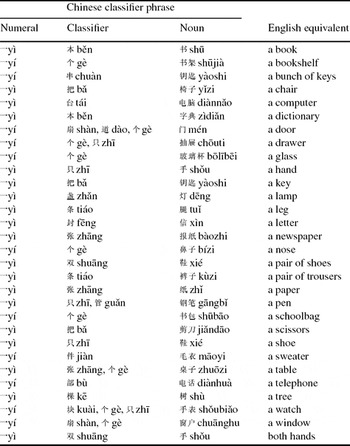
Two experimenters, the author of this paper and her research assistant, who are both native speakers of Chinese, tested the participants separately for their application of Chinese classifiers. As a control group, thirty 6–15-year-old Chinese–Swedish bilingual children (mentioned above) were also tested. Before the test, six items presented on picture cards with a classifier phrase written at the bottom (e.g. a picture of a flower labeled with the Chinese classifier phrase yì duǒ huā ‘a cl flower’) were shown and described to each participant as warm-up trials. In the test, thirty lexical items (see Table 1) were chosen as target stimuli, which were prepared and shown on paper cards. All the items were daily or commonly seen and used items. In addition, the classifiers associated with these noun items were carefully taken into account. They included the general classifier gè, specific classifiers that can only be applied to one type of noun item, and classifiers that can be applied to more than one type of noun item. I made such choices in order to see if a slight change in the degree of the participants’ familiarity with the noun items would make any difference in their learning results. The types of their associated classifiers would cause different degrees of challenges. I worked on the assumption that the classifiers associated with nouns that are commonly used in daily communication would be the easy ones for both the adult learners and the bilingual children to master and that those that can be applied to more than one type of noun item would be the difficult ones. The experimenter presented the items to each child in a random order and asked him/her to name each with a classifier phrase (e.g. for the item shū ‘book’, participants were expected to produce yì běn shū ‘one cl book’ as a correct classifier phrase). The test was conducted in a context-free manner; that is, participants were required to produce only a classifier phrase based on an object shown. Enough time was given for the participants to think before they answered. This arrangement allowed the participants to focus on their classifier production and thus prevented them from giving an answer due to a slip of the tongue.
Nouns and classifier phrases tested as learning outcome.

The adult participants were given exactly the same test as the bilingual children, but the adults were given warm-up trials and informed of the test one month ahead of the test, and then given the test three times at one-month intervals. This design took advantage of the fact that the adult participants were taking full-time intensive Chinese courses, during which they could reasonably be expected to be making some leeway in their acquisition of Chinese. It allowed me to observe what progress the adult learners actually made during the whole of the two-month period and to find out which learning strategies they used.
One month before the first test session started, participants were informed of the test they were going to be given. After the first test session, they were scheduled to come back twice for the same test with a four-week interval. In the last two sessions of the test, all procedures were the same except that ten additional items were added to each session and they were shuffled to prevent the participants from simply memorizing the correct classifiers learnt from the previous session.
After each test, the experimenter reviewed the test results with each participant and raised questions on their incorrect uses, such as ‘Why do you think tiáo is a correct classifier for gāngbǐ “pen”?’, ‘What made you decide to use dào with chuānghu “window”?’. This review was done for the purpose of obtaining a more insightful understanding of the participants’ production and the reasons behind their usage.
Both the child and adult participants’ responses were audio-recorded, transcribed, and coded by the two experimenters.
3. RESULTS
The classifiers produced by both the children and the adults were analyzed and assigned to four types: correct usage, improper usage, incorrect usage, and failure. The correct usage was determined before the test and counterchecked with classifier dictionaries and grammar books. Here it should be noted that certain nouns can be associated with two or three classifiers. For example, mén ‘door'can be used with shàn, dào or gè and they are all correct. In such a case, I did not discriminate participants’ choices. As long as one of them was used, I counted it as correct usage. Improper usage refers to the use of the general classifier gè in a phrase that is understandable but unidiomatic. Gè in Chinese is one of the early classifiers that appeared in ancient Chinese and was used with any noun that did not have a specific classifier. Now it may be used to replace specific classifiers of many nouns. However, although gè can be applied to many different types of nouns, it may sound improper when associated with certain items (e.g. using gè instead of tiáo to refer to a river as in *yí gè jiāng). Distinct from improper usage, incorrect usagelabels all usages that are totally wrong. For instance, zhāng used in *yì zhāng shūjià ‘one cl bookshelf’ is not acceptable though zhāng can be associated with furniture (e.g. yì zhāng zhuōzī ‘one cl table’, yì zhāng chuāng ‘one cl bed’). Failure includes those cases in which the participants failed to produce a classifier phrase after being shown the item and given enough time to give an answer.
The results did not show any statistically relevant co-variation with the place of birth of the children or with the place of study for the adults. Therefore, the data were aggregated.
3.1 Children's results
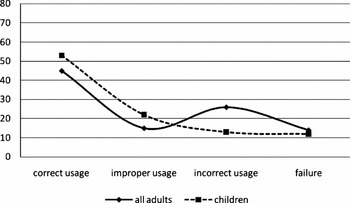
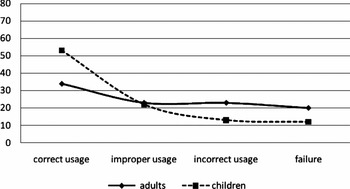
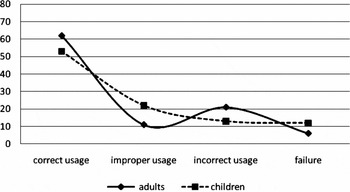
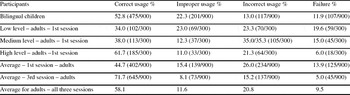
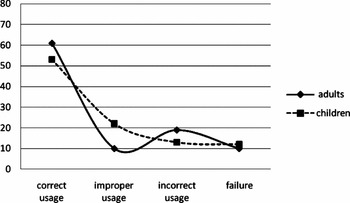
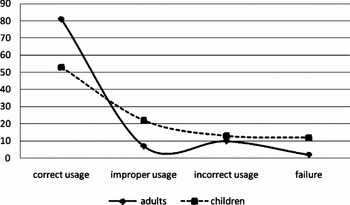
The bilingual children performed better than the adults in general (see Figures 1, 2, 3 and Table 2). The children produced more correct usage on average (53%) than the adults at the first test session (45%). I chose to compare the children's results with the adults’ first test session results because at the first session the test contents were as new to the adults as they were to the children. Compared with the adults’ 34% correct usage at the low level and 38% correct usage at the medium level, the children's results were generally better, though the high-proficiency adults outperformed the children by 9%. Concerning classifier failure, only the high-proficiency adults failed fewer cases than the children (6% vs. 12%). The number of years living in China seemed to have played a role in the bilingual children's correct association of nouns with classifiers. Nine children out of 11 who were born and stayed in China in their first three years of life showed better results than the other children (63% correct usage).
Children's performance compared with all adults’ in the first test session.

Children's performance compared with low-level proficiency adults’ in the first test session.

Children's performance compared with high-level proficiency adults’ in the first test session.

Bilingual children's classifier production compared with adults’ learning results (raw figures in parentheses).

The overall scoring of the improper usage of the classifier gè by children and adults is 22% and 15%, respectively, which may suggest that the children overuse gè more than the adults do. However, when we compare the low-proficiency adult group with the child group, the scoring is 23% and 22%, which is not statistically significant. Besides, the child group used gè improperly about fifty percent more than the adults at the medium and high levels. For adults, the higher their level of Chinese proficiency was, the more correct a sense they seemed to have acquired about the appropriateness of associating gè with an item. One notable difference between the children's and the adults’ choices of gè observed during testing was that, unlike the adult participants, a few children chose gè because they did not want to fail or because they knew gè was a general classifier. The bilingual children, unlike the adult learners, had been speaking Chinese on a daily basis at home and I thus suspect that they heard gè used more frequently than most of the specific classifiers. Thus, when they failed to make an ontological feature connection of a noun item with a classifier, the frequent input of gè superseded the process of their meaning interpretation.
With respect to incorrect usage, the child group produced the lowest percentage (13%) compared to the adults at all three levels. The adults at the medium level, in particular, made more wild guesses (35%), even though most of the time they knew they would not be correct. The children, on the contrary, showed more confidence and hesitated less when they used incorrect classifiers. This shows that the semantic overlap of classifier categories makes the boundaries vague and thus remained a challenge to bilingual children. After all, bilingual children are different from monolingual children. As the bilingual children were only tested once, I could not show how much and how fast they would improve if also given a three-month period of learning. Nevertheless, I am tempted to predict that their improvement would be far better than the adult group's and plausibly they would use all the classifiers tested correctly by the third test session. After all, there were only 30 classifiers targeted as goals.
What is also worth mentioning is that none of the children knew what a classifier was before the test. However, in the warm-up trials, when they were asked to count an item they saw on a picture card (e.g. a dog, a cat), they all quickly made a classifier phrase, such as yì tiáo gǒu ‘one cl dog’ and yì zhī māo ‘one cl cat’. After it was clear that they were going to be tested, they became interested and eager to tell what they believed to be correct. Most of them did not hesitate much in confirming that the classifiers they used were correct. They could all give a reason why they used a particular classifier with an item during the discussion after the whole test was completed. I will provide further discussion on the children's performance in Section 4.
3.2 Adults' results
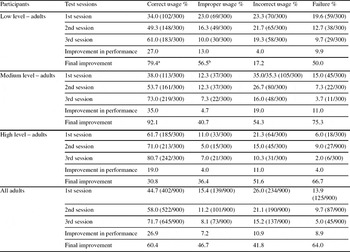
The adult participants at all three levels of Chinese proficiency increased their correct usage from the first test session to the last. The participants at the different levels showed the following increase in correct usage: from 34% to 61% at the low level, from 38% to 73% at the medium level, and from 62% to 81% at the high level (see Table 3, pages 208–9). The child group outperformed the adults at the low and medium levels in their first test session, and thus the adults’ average performance was poorer than the children's from the beginning, even though the adults at the high level produced more correct classifier phrases throughout the three test sessions. Thus, the ranking of the adults’ Chinese proficiency into three levels correlated with their levels of competence in classifier application.
Adults' classifier production in all three sessions and their improved performance (raw figures in parentheses).

a Final improvement in correct usage:
b Final improvement in improper usage, incorrect usage and failure:
Of the improper usage of gè, the adults at the low level showed the most frequent uses (23%) at all three test sessions, but statistically they were also the group that improved most from the first session to the last. Still their improper use of gè remained the highest (10%) in the end when compared with that of the adults at the medium and high levels (7%). The adults at the medium level performed similarly in the first and second test sessions (12%) to the adults at the high level in the first session (11%) and both groups eventually improved in the last session (7%). During the test, I found that the adults with a higher Chinese proficiency made more attempts to reason whether or not the general classifier gè should be applied to a certain noun. (‘If we can use gè with “table”, then I should try gè with “chair”, too’); that is, they showed some theoretical and analytical considerations in their application of gè. In a way this shows that the advanced adult learners tended to use more of their analytical abilities to make assumptions, while the learners with a low competence were found to use gè in most of the situations when they could not think of a classifier that they would be sure about and did not want to fail.
Incorrect classifier application was found mostly in adults at the medium level in the first test session (35%), but this group also improved most in the last test session compared with the adults at the other two levels of proficiency. Similarly, the adults at the high level improved at about the same rate as adults at the medium level, showing 23% incorrect usage in the first test session, which dropped to 19% in the last. There was not much progress across the three sessions among the adults at the low level. They made more wild guesses, which accumulated 23% incorrect uses at the first test session, 22% at the second, and 19% at the last. They did not seem to have learned how to appreciate the semantic relations between noun items and classifiers. This shows that the adult participants’ general Chinese proficiency played a role in their understanding of the classifier system.
Failure cases still occurred in the last test session. The adults at the high level failed only a few cases (6%) but still gave up on the same items at the last session (e.g. yì zhī xié ‘one cl shoe’ and yì zhǎn dēng ‘one cl lamp’). These results are surprising because in terms of lexical learning, I assumed that failure would not occur in L2 learners who had already gained the competence of speaking the language as a daily tool. As expected, the adults at the low level failed the most cases (20%) and the adults at the medium level the second most (15%) in the first test session. The medium-level group improved the most in terms of the decreased number of failed cases in the end (4%). The adults at the medium level tended to avoid failure by giving to the other noun items a classifier they had used earlier, which was found to be a typical behaviour of this group.
In sum, the figures in Table 3 show that the adults’ performance in classifier usage matched their levels of Chinese language proficiency in general and that the adults at all three levels improved their classifier uses within the two months of their participation in the study. Of all the adult participants, the adults at the low level made the second highest increase of correct usage (79.4%), the biggest decrease of improper usage (57%), and the lowest decrease of incorrect usage (17%) and failure (50%). The adults at the medium level achieved the highest increase of correct usage (92%), reduced the most the incorrect use (54%) and failure cases (75.3%). The adults at the high level improved the least in the category of correct usage (31%), though they used the correct classifiers the most (62%) in the first session compared with the adults at the other two levels. Similarly, they also made the least decrease of improper usage (36%) compared with the other adults in the first and last test sessions. By comparing the improvement percentage distribution with the average performance rate of the adults at all three levels (see Table 3), I found that the lower the level of an adult learner, the less competent he or she was in using the classifiers correctly and that the higher the level of an adult learner, the slower he or she improved in correct and proper uses. My interpretation of this difference is that the learners with a low level of Chinese proficiency were not ready yet to understand the complexity of the classifier system. They still basically relied on the general classifier gè in most of the cases. The adults’ performance at the medium level of proficiency added convincing evidence. They were the learners who had recent experiences studying in China and who showed higher abilities in spoken Chinese than the learners at the low level of proficiency. Within the two months, they were the group that improved the most in all four categories. This seems to indicate that a relatively high level of Chinese proficiency is a necessary prerequisite for quick learning of classifiers. In contrast, the learners with a high level of Chinese proficiency showed: a ‘the better the proficiency, the slower the improvement’ phenomenon. They performed the best in the first test session but their improvement slowed down and they tended to show more stabilized errors counted as both improper and incorrect usages.
Considering the fact that L2 learners can usually learn a great number of words within a month or two at the beginning of learning, the adult participants in this study showed a slow learning speed. With only about 30 classifiers and a few more commonly used lexical items involved, I had expected that most of the learners, if not all, would have reached the ceiling rate of correct usage. The lack of a native-like intuition of the implicit semantics of specific classifiers and low motivation could account for the failure of the high-proficiency adults to speed up their learning.
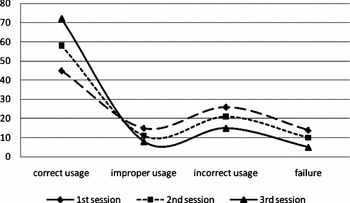
The adults’ average incorrect usage (26%) was13% higher in the first test session than that of the children (13%), and the adults’ average failure (14%) in the first test session was 2% higher than that of the children. Over the two-month period, the adults at all three levels improved in all the four examined categories (see Figure 4). Yet, if we compare the performance of the low- and high-level groups in the last session with that of the bilingual children, I find that the adults’ improvement particularly in certain categories was not great. The adults at the low level were only slightly better than the children in using the general classifier gè properly (see Figure 5) and the adults at the high level still had 10% of incorrect usage, which was only slightly better (3%) than the children (see Figure 6). Looking at the adults’ average performance for all sessions, we can see that the adult learners were only 1–5% better than the child group in the categories of correct usage, improper usage, and failure. Their incorrect uses were 62% more than those of the child group. As we can see, some differences are not statistically significant, and yet the general results show that classifiers are indeed a difficult category for the L2 adult participants. A short period of intensive learning proved helpful for the adult learners to improve their usage, but I suspect that their improvement might regress over a short period of time if they were to stop learning the language actively. Mastering the use of classifiers may require an overall understanding of the implicit semantic associations with noun items as well as a motivation for improvement.
All adults’ improvement over three test sessions.

Low-level proficiency adults’ performance at the third test session compared with children's.

High-level proficiency adults' performance at the third test session compared with children's.

4. DISCUSSION
4.1 Typical correct and incorrect classifiers used by adult participants
The adult participants at all three levels showed different degrees of slow improvement in classifier learning. The adults with a high level of proficiency had 62% correct usage in the first test session and improved to 81% within two months. The adults with a low level of proficiency produced only 34% correct classifier phrases in the first test session and managed to improve to 61% in the last test session. Considering the limited number of classifiers tested and the two-month learning interval given, I would say that the adult participants’ improvement was slow and insufficient compared to their general Chinese competence. As seen in Table 1, all the noun items tested were simple vocabulary items for all the participants. However, the classifiers associated with them may not be easy or familiar to the learners. In Swedish there is no need to add another category between a numeral and a noun. For example, en fisk and två fiskar in Swedish are yì tiáo yú ‘one cl fish’ and liǎng tiáo yú ‘two cl fish’ in Chinese, consisting of three parts instead of two. The Chinese equivalent with one word between a numeral and a noun presents not only a new grammatical category that is missing in Swedish, but also a semantic concept that is generated from the nouns it is associated with.
The only four noun items that were found to be 100% correct in the adults’ production were yì běn shū ‘a cl book’, yì běn zìdiǎn ‘a cl dictionary’, yì shuāng shǒu ‘a pair of hands’, and yì shuāng xié ‘a pair of shoes’. However, yì zhī shǒu ‘one cl hand’ and yì zhī xié ‘one cl shoe’, which were tested as contrasting with, respectively, yì shuāng shǒu ‘a pair of hands’ and yì shuāng xié ‘a pair of shoes’, were found to be no more than 10% correct. This contrast could be due to the fact that the Swedish equivalents of naming both hands happen to have exactly the same structure: ett par händer ‘a pair of hands’ and ett par skor ‘a pair of shoes’, while when naming one hand and one shoe, the similarity disappears. The semantic indication of shuāng in Chinese functions more like a measure word which finds its equivalent in Swedish as par, while zhī, whose function is to indicate one part of a natural pair, is new to the Swedish speakers. This contrast indicates that the participants mixed the concept of a classifier with a measure word. This is probably the reason the Swedish speakers repeatedly applied shuāng to trousers and scissors. The measure word par in Swedish is used for trousers and pair in English is used for both trousers and scissors, but in Chinese, the concept of having two identical parts, i.e. the concept of pairing, is never applied to trousers, nor to scissors. Instead, the classifier tiáo, used to denote the shape of an item, is applied to trousers, and the classifier bǎ, used to refer to the function of an item that has a handle to hold on to, is applied to scissors. In Section 4.4, I will present more details of the mixed concepts of measure words with classifiers.
Classifier learning is a language-specific process, and that area of participants’ linguistic knowledge from Swedish, English, and other European languages did not seem to help learners handle ‘the exotic concepts involved’ (Lee Reference Lee1996:151). Their correct uses of classifiers were mainly those of the most commonly used items and those acquired at the beginning of their Chinese learning, such as běn for bound volumes, as in yì běn shū ‘a cl book’ and yì běn zìdiǎn ‘a cl dictionary’, and gè for most common nouns. These are also typical classifiers that language teachers use as examples in teaching. The test results show that simplicity and frequency of usage in daily communication were the main contributions to the high production of the classifiers tested. A few items, such as yì tái diànnǎo ‘a cl computer’ and yí gè shūbāo ‘a cl school bag’ were scored poorly in the first test session, but significant improvement was observed in the later sessions. Most of the adult participants were able to make a quick association between certain nouns and classifiers, but not with others. This result shows that frequent exposure to the items in daily life facilitates memorizing and mastering the associated classifiers, but a simple memorization strategy would not help much in correct classifier usage in general.
4.2 Adults' improvements in their learning of specific classifiers
In general, the adult participants showed a steady improvement in classifier usage within the two months of the experiment. Particular improvement was found in their uses of the specific classifiers required for noun items such as computer, trousers, pen, and sweater. This result accords with my predictions that more specific classifiers would be acquired prior to more general ones and that frequent occurrence of a certain usage in a pragmatic discourse helps the understanding of a new concept.
The other type of classifier production that was improved significantly includes those that were acquired by the participants from other noun items that share the same classifiers. For example, zhāng used for a newspaper and paper is also used for a table and bǎ for a key is also for scissors. All participants had previously learnt zhāng in yì zhāng zhuōzi ‘a cl table’ and bǎ in yì bǎ dāo ‘a cl knife’. By the time the last test session ended, all participants had correctly applied zhāng to a newspaper and paper, and bǎ to a key. This shows that the embedded semantic association of zhāng with something flat or something that has a flat and thin surface, and of bǎ with something that has a handle to hold onto was successfully acquired by the participants with the help of their previously frequent uses of classifiers with other familiar noun items. But such a success was observed only for the applications of these two classifiers.
Strategically, the adult participants with low and medium levels of Chinese proficiency tended to learn classifiers using a top–down approach more efficiently than the adult participants with a high level of proficiency. By a ‘top–down approach’ I mean that an approach within which the adult participants’ strategy was either (i) to conduct an essentially theoretical analysis of the classifier system by first putting together the classifiers they had learned and then making a categorical match with noun items (typical of the adult participants with a high level of Chinese proficiency), or (ii) to adopt a grammatical, rule-based solution by applying the general classifier gè or one that they believed was categorically correct so that they could at least produce a syntactically correct classifier phrase. They tried to allocate individual nouns to conceptual categories where the same classifier is associated with a number of nouns. The only type of reasoning that most adult participants displayed was based on the classification of nouns. They argued that, for example, tái was used with a TV set, and thus it was correct to use it with a computer, a telephone, and a lamp; zhāng was linked to a bed, and thus it was correct to link it to a table, a chair, and a bookshelf because they were all furniture, etc. However, this strategy was found inefficient and misleading in classifier learning because the boundaries between categories of classifiers are typically overlapping and fuzzy. A cognitive understanding of the embedded semantic properties becomes crucial when conceptual logic fails for the categorization of classifiers.
In addition, improvements over different types of items were found among the participants at all three levels of Chinese proficiency. The participants at the low and medium levels were found to improve more on those classifiers that were more commonly used, while the learners at the high level had remarkable improvements on the classifiers that are semantically unclear and complicated. For instance, the participants at the low level had no improvement across the three sessions on yì zhī shǒu ‘a cl hand’ nor yì zhī xié ‘a cl shoe’. Instead of zhī, they continued to use gè in the last test session, even though they had been corrected in the first and second sessions. This should not come as a surprise if we take the following two facts into account: One is that the adult participants in general perceived classifiers as a grammatical category; the other is that the general classifier gè initially acquired by the learners gave them a kind of psychological relief because they knew they could always use it to make a syntactically correct classifier phrase even if it would be semantically odd. The participants’ promiscuous use of difficult classifiers and their habitual dependency on the general classifier gè also serve as evidence for this. Therefore, with reference to Krashen's (Reference Krashen1987, Reference Krashen1988, Reference Krashen2003) Natural Order Hypothesis, specific classifiers associated with less commonly used words in pragmatic discourses were not the priority for the learners with a low level of Chinese proficiency. At this point, correction of non-target-like L2 productions proved to be ineffective, similar to what other L2 researchers have found (e.g. Dulay & Burt Reference Dulay and Burt1974; Fathman Reference Fathman1975; Makino Reference Makino1980; Schwartz Reference Schwartz1993; Truscott Reference Truscott1996, Reference Truscott1998).
In contrast, major improvements in the application of gè and zhī were found among the participants with a high level of Chinese proficiency. Gè and zhī are among the most commonly used classifiers, but their semantic associations with nouns are generalized, non-binding (e.g. they may refer to different semantic properties of different nouns), and faintly perceptible (e.g. they do not categorically indicate the shape or function of the noun items), and thus their classifying function is at the minimum. Therefore, a categorizing strategy in acquiring and distinguishing classifiers becomes ineffective in this case. Similar to native speakers of Chinese, the participants at the high proficiency level were found to have relied on both a semantic and a cognitive basis in handing such cases. The strategies they applied to make distinctions among classifiers were reasonable and relatively effective. In addition, most of the participants at the high level were found to have improved significantly with respect to the use of fēng in yì fēng xìn ‘a cl letter’, bù in yí bù diànhuà ‘a cl telephone’, and kē in yì kē shù ‘a cl tree’, all of which carry classifying functions and whose semantic associations are specific. This indicates that there are strategic differences in classifier learning among the adult learners. Their levels of Chinese proficiency in general seem to play a big role in dividing them into slow and quick classifier learners.
On average, the correct application of classifiers in the last session (see Table 3) was still rather low, which was unexpected and surprising. By the end of the test, it was clear that classifier learning was a difficult task for the adult participants at all three levels of Chinese proficiency.
4.3 Follow-up discussions with the participants
There was a follow-up discussion with every participant after each test session. Each participant was asked what method they used in their classifier learning. Most adult participants reported that they managed to make a match between a classifier and a noun mainly by rote memorization and by applying what they had learnt previously about classifier classifications. For the commonly used classifiers with a clear classifying function, memorizing their correct associations with nouns should be easy, and this was basically how their correct usage was increased. But for the less frequently used and semantically unclear classifiers whose classifying functions are at minimum, rote learning was difficult. Some of the participants pointed out that rote learning was the last strategy they applied when feeling that a classifier was so abstract that its meaningful connection with a noun was undetectable. As previously noted, participants were somewhat surprised and disappointed with their own performance. They did not expect that they could be at a loss so often when requested to produce only simple classifier phrases. It seems that their lack of cognitive understanding of the relation between nouns and classifiers and the overlapping boundaries of classifier categorizations were the main barriers to their classifier learning.
The child participants, on the other hand, were found to have much more to say when asked to give reasons for their classifier uses. The younger children (6–9-year-olds) often used gestures when describing the classifier functions. A few even used what they had learned from their Swedish classes to reason about their Chinese classifier use. For example, I did not know why a few children used miàn, in *yí miàn chuānghu ‘one cl window’, whose correct noun association should be a mirror and a wall, until they explained that their Swedish teacher told them a window was flat like a mirror and functioned like a wall. The children obviously applied the general knowledge acquired in their Swedish classes to their understanding of Chinese classifiers. However, the correct classifier for a window is shàn, not miàn, though semantically miàn would match quite well with a window. These interesting and wrong connections again proved that the children took classifiers as meaningful elements.
4.4 A misleading pedagogic strategy: A possible factor in the slow learning of classifiers
During the recruitment for this experiment and in follow-up discussions with the participants, I was surprised to find that more than half of the participants had not heard the word ‘classifier’ or of the classifier concept before that time. An inquiry of the participants about their teachers’ instruction proved that they had indeed learnt what they now knew as ‘classifiers’ in the beginning lessons at school. However, what they knew from participating in the present study as ‘classifier’ was defined by their textbooks and taught by their teachers as måttsord ‘measure words’. This was confirmed by a review of the textbooks compiled for foreign learners of Chinese both in Sweden and in China. For instance, the little handbook called 汉 语 量 词 学 习 手 册 Hànyǔ Liàngcí Xuéxí Shǒucè (published by Beijing University Press in 2002 and reprinted in 2006) has an English title Chinese Measure Words without Tears (a direct translation should be A Handbook for Learning Chinese Classifiers). The first sentence of the book's English preface reads: ‘A foreign student is usually terrified by the sight of a large number of measure words in Chinese’. In the whole book the word ‘classifier’ is not used once and thus measure words and classifiers are all mixed together. From a pedagogical point of view, the textbook authors may have thought it would be a good strategy to combine classifiers with measure words in that measure words are language universals and combining them with classifiers would make an easy start for beginners. However, the basic function of measure words is to denote a measure of length, weight, area, or volume, such as lǐ ‘mile’ in wǔ lǐ lù ‘five miles’, liǎng ‘ounce’ in sān liǎng yínzi ‘three ounces of silver’, chǐ ‘foot’ in wǔ chǐ bù ‘five feet of cloth’, and shēng ‘liter’ in yì shēng niúnǎi ‘one liter of milk’. Such measure word phrases in Swedish have exactly the same structure as those in Chinese. Some special measure words (MEs) are also found to express the same occurrence of an event, as in (2), or to contain measures as in (3).
(2)
(3)
>Mixing two concepts as a teaching strategy may be helpful for adult learners at the beginner level, but it prevents them from seeing a clear picture of the fundamental differences between the two concepts. Syntactically, two basic rules separate the two types of words:
(i) a classifier can be substituted by the general classifier gè, while a measure word cannot;
(ii) a measure word can have the modifier particle de inserted before its head noun, while a classifier cannot.
According to Tai (Reference Tai, Ho and Tzeng1994:481), ‘while a classifier is used to “categorize” an object in reference to its salient perceptual properties, a measure word is used to “measure” the quantity of an object or a collection of objects’. Tai's clarification is clear and helpful for adult learners to understand classifiers from a semantic and cognitive perspective. What I claim here is that there are no measure words in Swedish that can also function as classifiers in the Chinese sense. As the function of measure words is to merely quantify but never to classify entities, the mixed treatment of two concepts as a teaching strategy may have caused more difficulties in the adult learners’ comprehension and acquisition of classifiers. In this study, I found that even the adult participants with a high level of Chinese proficiency treated classifiers as measure words. As a result, they did not give classifier learning enough attention, nor did they treat it as a new concept that constitutes a grammatical category of its own. When they found it hard to make an association between a noun and a classifier, they attempted to apply a top–down strategy to make a categorical analysis. But they found themselves lost quickly or learning ineffectively because textbooks and classroom teaching usually did not provide enough examples for them to be able to learn effectively.
4.5 A comparison of adults’ and children's reasoning in classifier application
Discussions with the adult participants revealed that they found it hard to take a classifier as a meaningful element that has a semantic connection with the related nouns. To them, a classifier phrase is a syntactic construction in which the classifier is in the middle to link a numeral and a noun. Learning classifiers by categorically analyzing nouns and noun types was effective for a few nouns, but not all, because their meanings were not explicitly defined in dictionaries, and one classifier could be applied (apparently) unreasonably to quite different types of nouns due to the fuzzy boundaries of the classifier system. As a safe strategy, they chose to learn certain classifier phrases by rote.
When children were asked how they learned to use classifiers, they basically could not give a clear answer, but most of them could give reasons for a particular classifier to be used with a particular noun. This shows not only a difference between child language acquisition and adult language learning but also a different, cognitively-driven process in the bilingual children (Gao & Malt Reference Gao and Malt2009). In Swedish there are many grammatical morphemes that do not carry word meanings of their own, such as the gender articles en and ett, the suffixed endings -en or -et for the definite form in the singular (e.g. bilen ‘are’), the bound morphemes -ar for the plural form (e.g. bilar ‘cars’) and -arna for the definite form in the plural, etc. By contrast, few grammatical morphemes in Chinese are bound. Even particles and aspect markers are imbued with independent meanings. In a different context they may even function as full words with their own senses (Gao Reference Gao2001). But the Swedish grammatical morphemes can never function in an unbound manner. This typological difference may have influenced the Swedish adult learners of Chinese in their learning of classifier phrases as non-semantically based syntactic structures. Once its semantic implications are ignored, a classifier does seem to have a function similar to a bound morpheme. However, the children brought up in a bilingual environment who had been exposed to Chinese on a daily basis were not influenced by the Swedish language in this respect. The result of the adult learners’ learning strategy was observed in their incorrect applications such as tào in *yí tào yǐzi ‘a cl chair’ and zhī in *yì zhī shūjià ‘a cl bookshelf’. The correct classifier for ‘a chair’ bǎ, which has the semantic implication that a chair is something that one can use a hand to hold on, while a bookshelf is not associated with a specific classifier but the general classifier gè. This may indicate that the semantic transparency that alludes to the orderliness of classification (Craig Reference Craig1986:286) was not perceived by the adult learners. I found that a big difference between the adults’ and the children's strategies was that children's classifier choice was mainly based on their perception of individual features of the noun items and that if they could not rely on the perceptual features of the noun items, they tended to make inferences by recalling the classifiers used with other nouns denoting the same kinds of real world objects and then confidently made a choice, while the adults either made a guess based on categorical classifications of noun concepts, or made a wild guess, or gave up their efforts.
The question of whether adults learn a second or foreign language in the same way that children normally acquire their first language or second language has been addressed within different theoretical frameworks from different perspectives (e.g. Schwartz Reference Schwartz1986; Krashen Reference Krashen1987; Bley-Vroman Reference Bley-Vroman, Gass and Schachter1989; Unsworth Reference Unsworth, Haznedar and Gavruseva2008; Hyltenstam Reference Hyltenstam and Cronqvist2009). Bley-Vroman's (Reference Bley-Vroman, Gass and Schachter1989:42) view that ‘child language development and foreign language learning are in fact fundamentally different’ (Fundamental Difference Hypothesis) is still debatable, but our adult participants’ learning approach did reflect a fundamental difference from that of the bilingual children. Whether this difference was solely because they were learning new words of a new language category in L2 or because their levels of language proficiency played too big a role needs further investigation.
One striking difference between the adults and children concerned their incorrect uses of classifiers. In most cases, children's incorrect choices of classifiers seemed to be the result of some item-based or feature-based reasoning, while this did not seem to be the case with the adult participants. The children's applications look like the results of case-by-case reasoning on the basis of one kind or another of the featured properties of the noun items rather than simple misapplications. For example, some children incorrectly used the classifier tào with the word for a watch, which is a homonym of the verb tào ‘put on/wear’. When asked why they thought tào was correct to be used with ‘a watch’, their answer was that it was ‘because a watch is something that you can put on’, imitating the putting-on action at the same time. The adult participants, on the other hand, basically treated classifiers as abstract grammatical elements and made no similar efforts. When they were reluctant to give up, in most cases they tried those classifiers which they had used earlier during the test. In many studies on second language acquisition (e.g. Gregg Reference Gregg1984; White Reference White2003; Doughty & Long Reference Doughty and Long2005; Ritchie & Bhatia Reference Ritchie and Bhatia2009), it has been found that there are fundamental differences between children and adult learners in terms of learning approaches. This study suggests that bilingual children may have the advantages of a native-like acquisition of new concepts in their L2 while adult foreign language learners may handle them as inaccessible concepts and must learn them by rote (Liu Reference Liu1985; Erbaugh Reference Erbaugh and Slobin1992; Hu Reference Hu1993; Uchida & Imai Reference Uchida and Imai1999; Gao Reference Gao2001; Yoshida & Smith Reference Yoshida and Smith2005; Kuo & Sera Reference Kuo and Sera2009).
In addition, the children's correct applications of special classifiers present a successful connection in the conceptual system between the visual form of the referential items and appropriate linguistic descriptions. It is reasonable to assume that the conceptual system, supported by the cognitive process of visual object recognition – an ability acquired by children at a very young age (Smith Reference Smith2009), learns classifier concepts like tiáo and gēn or zhāng and miàn by viewing a physical object as having a long shape (e.g. yì tiáo tuǐ ‘a leg’, yì gēn huāngguā ‘a cucumber’) or containing a smooth flat surface (e.g. yì zhāng zhuōzi ‘a table’, yí miàn jìngzi ‘a mirror’) while simultaneously receiving a linguistic input (a classifier phrase),which describes the scene in mind. Thus, it is also a cognitive process that correlates concrete objects with linguistic expressions. I regard this as a characteristic of Chinese, a classifier language that has a language-inherent classification of objects. Native speakers of the language may perceive and memorize objects with an unconscious process of linguistic classifications, and thus judge them as being similar or not, based on whether they share the same classifier (Zhang & Schmitt Reference Zhang and Schmitt1998).
An experiment carried out by Yoshida & Smith (Reference Yoshida and Smith2005) with two-year-old native Chinese and American children on an artificial-noun-learning task shows that the Chinese children's perception of solid and nonsolid objects indeed had a correlation with the association of classifiers. This study also shows that by teaching infants associations between words and perceptual properties, they will change not only what is known about the words, but also what is known about the correlations among the perceptual properties. Similarly, studies on the acquisition of spatial expressions in Korean and English by Bowerman (Reference Bowerman1996) and Bowerman & Choi (Reference Bowerman, Choi, Gentner and Goldin-Meadow2003) show that children's L1 semantic development of the language-specific domain is built up along with their gradual understanding of the relationship between nonlinguistic and linguistic structuring of space. These findings are relevant and help us understand why our Swedish adult learners face constant difficulty in learning classifiers when following a grammatically rule-based learning strategy. Plausibly, a conceptually- as well as perceptually-based language-specific system is yet to be completed in the mind of the adult learners. Instead, other measures may lead them to the competence that Slobin (Reference Slobin1996:75) describes as follows: ‘There is a special kind of thinking that is intimately tied to language – namely, the thinking that is carried out, on-line, in the process of speaking’.
4.6 Children's application of specific classifiers
The classifiers that the bilingual children applied correctly were found to be mostly specific classifiers that are applicable to one type of noun item, classifiers that are associated with noun items that are familiar to children, and classifiers that are applied to noun items for objects with a longitudinal shape. For example, most of the children knew that zhāng was the correct classifier for a piece of paper, but only a few knew that it was also correct for a piece of newspaper, given that zhāng is used for objects with flat and thin surfaces. This shows that the children were able to associate a classifier with a single lexical item that they were more familiar with but they were not ready yet to link the same classifier to different categories especially when the boundaries are fuzzy and more than one classifier can be associated with a single noun (e.g. the classifier fèn, instead of zhāng, is used with newspaper when the newspaper is presented as a whole edition). This failure might also be due to their application of a bottom–up approach in classifier acquisition, where they master the specific classifiers instance-by-instance, without sorting out the classifier categorization system. Those classifiers that are specific to a single type of items such as běn for books and dictionaries, and kē for trees and plants, and zhāng for paper were found to be used correctly by almost all the children. These items are valuable and important things for school children.
In contrast, the classifier tái in connection with computers, which was used correctly by the adult participants, was unknown to the younger children in the group and even the older ones did not use it as confidently as they used běn with books. This may be due to the fact that there are different types of computers nowadays (e.g. desktop, laptop). Also, it may be because the correct classifier tái for a computer is also used for a number of other appliances such as a radio, a TV set, a machine, etc. A computer does not categorically belong to any of them and the children may have failed to realize that these items actually all have a flat bottom to stand on.
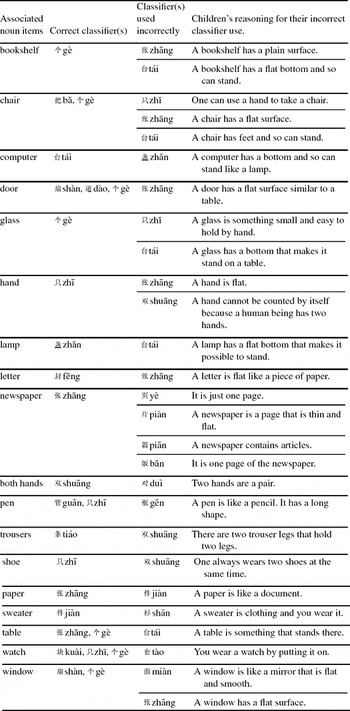
It was also found that the children made more mistakes on the objects with a feature of flatness rather than length. Studies on infant behavior and development show that infants first acquire the ability to recognize one-dimensional stimuli and then relatively abstract two-dimensional ones (DeLoache, Strauss & Maynard Reference DeLoache, Strauss and Maynard1979; Berenthal Reference Berenthal1996). I suspect that this ability might also influence the classifier–object association by children who acquire a classifier language like Chinese. They may have an earlier and more impressionistic perception of the classifiers referring to length than those referring to flatness. In addition, there are more classifiers in Chinese that can be applied to flat objects than those to long-shaped objects. This may further complicate the formation of the learners’ conceptual system of flat objects. If we look at the children's typical incorrect uses of the classifiers listed in Table 4, we can see that most of the objects have a feature of flatness rather than length, which accords with Erbaugh's (Reference Erbaugh1986) predicted development order. Certainly, there are fewer classifiers for long-shaped objects (tiáo, gēn, dào, zhī, etc.) than those for flat and spherical/circular objects (zhāng, kuài, bǎ, miàn, tái, piàn, tuán, etc.). This could indicate that the acquisition of Chinese classifiers in child language might follow a sequential order, though further research is needed to determine this. More significantly, the children's incorrect classifier applications reflect a cognitively-based semantic complexity; that is, the processes of the real-world entities/situations are cognitively developmental human activities that are reflected in the semantic structure of language (Clark Reference Clark and Moore1973, Reference Clark2004). Accordingly, the cognitively simpler terms are expected to be acquired prior to the more complex ones. To form such a complexity, children may need a step-by-step development in consciousness (Zelazo Reference Zelazo2004; Gao & Zelazo Reference Gao, Zelazo, Overton, Müller and Newman2008) where, at higher levels, they become aware of the multi-dimensional extensions of the classifier semantics. In this study I observed that some children who applied tái to a computer correctly tended to use it with the items that have a flat bottom (table, lamp, bookshelf, etc.), and those who correctly used shuāng with both hands applied it to trousers wrongly, and still those who applied zhāng to a table correctly used it with the things that have a flat surface (chair, hand, wall, letter, window, door, etc.), and so on.
Bilingual children's typical uses of incorrect classifiers and their reasoning.

Indeed, there are differences between monolingual and bilingual children in their acquisition of classifiers. Such differences should occur at an earlier age than the youngest children (six-year-olds) in this study. It is likely that monolingual children form this linguistic category as part of their cognitive system in an easier and more stable way, while bilingual children may spend a longer time perceiving and conceptualizing the domain-specific elements, as shown by Wei & Lee (Reference Wei and Lee2001) in a study on Cantonese–English bilingual children's acquisition of Cantonese classifiers.
5. CONCLUSIONS
Three kinds of data were used as the empirical source of this study: (i) a count of correct, incorrect, improper, and failure uses of Chinese classifiers by L2 adults and bilingual children; (ii) data concerning what kinds of mistakes were made (e.g. what lexical items) and what types of classifiers were used correctly; and (iii) interviews with the participants where they reflected on how they learned to use classifiers and why they used particular ones. The results of the experiments with both adults and children carried out at two universities and in two locations were consistent with each other. My main findings are that the adult learners exhibited a top–down learning fashion, where learners with a low level of Chinese proficiency conceived of the classifiers as grammatical elements and did not learn their semantics, and learners with a high level of Chinese proficiency made a theoretical analysis based on the conceptual classifications of nouns and a limited number of rule-based classifier–noun combinations they knew. On the other hand, the children used a cognitive bottom–up approach where they connected the classifiers with ontological categories; that is, they did not formulate any preconceived rules to follow but instead judged a noun item by its perceptual features and then made a match to the embedded semantic meanings of a classifier to come up with a classifier phrase. The findings may serve as a base to further understand the reasons behind the fact that the adult participants hardly took a classifier as a meaningful component that has a semantic and cognitive motivation in association with noun referents. The adults’ top–down learning approach limited their horizon to a cognitive basis for synthesizing pieces of knowledge of noun referents and forming them into a cohesive whole. By taking a classifier as a ‘measure word’, the adult participants apparently focused more on its grammatical function. As a result, the adult participants in the study all showed that their classifier production lagged far behind their general Chinese proficiency.
In contrast, the bilingual children showed little problem with intelligibility of classifiers. It seems that the adult participants took classifiers as elements for constructing syntactic rules. But the bilingual children's applications indicate that their thinking was not confined to simple grammatical knowledge but involved knowledge sharing across categories including non-linguistic features from real objects. It seems that the children usually managed to match their perception of non-linguistic objects with the linguistic units, while most of the adults took the learning as a task to make an output of a set of linguistic strings and assumed that it would be easily achieved by simple memorization. Following the belief of Benjamin Whorf and Edward Sapir that thought and language are very closely related (Whorf Reference Whorf and Carool1956), a successful application of classifiers may not be fully observed until the way of thinking is adjusted. Perhaps only then can the learners extract the complex semantic clues of classifiers. Based on these data, I would like to claim that unlike noun acquisition, classifier acquisition may require a slow step-by-step and bottom–up process, which may hold true for both children and adults.
In brief, the Chinese classifier category is a cognitively-based semantic category that requires learners to understand its cognitive and semantic motivation in association with noun items. For the Swedish adult participants whose native language does not have this category, it is likely that an early understanding of this new concept plays a major role in achieving correct use of Chinese classifiers.
ACKNOWLEDGEMENTS
I would like to thank the Wallenberg Foundation and Nanyang Technological University (NTU) for providing funding for this research, NJL editors and three anonymous NJL reviewers for their insightful comments and constructive suggestions on earlier drafts of this paper, NTU-URECA student Shixiao Ouyang for her assistance in data collection in Stockholm, and the adults and children for volunteering to participate in this study.
APPENDIX. Commonly used classifiers and their associated nouns denoting the real-world objects

Note: The classifiers were selected on the basis of their frequency of occurrence in the Contemporary Chinese Corpus compiled by the Center of Chinese Linguistics at Peking University; http://ccl.pku.edu.cn:8080/ccl_corpus/index.jsp?dir=xiandai.