Introduction
Informed consent is an essential process in surgery where the risks, benefits and alternatives of a particular procedure are discussed with a patient. Discussion of such information is necessary for patients to reach a decision suitable for their individual circumstances. Inadequate consent often in the form of failing to warn patients of particular complications is a significant source of litigation in healthcare and has been increasing over the years. In 2022, claims relating to consent cost the United Kingdom’s National Health Service (NHS) approximately £78 million.Reference Ainsworth, Hussain, Houten, Martin, Toh and Rao1 In septorhinoplasty, issues relating to consent were the second most common cause of litigation.Reference Ross, Arwyn-Jones, Navaratnam, Pendolino, Randhawa and Andrews2
Documentation of the consent process having happened is used as evidence of consent being given by a patient. In the NHS, often the traditional paper consent forms use generic (not procedure-specific), handwritten forms. As a result, the quality of the information provided is subject to the individual clinician and therefore prone to user error. Limitations of traditional consent forms include incomplete documentation, illegible writing and variable reporting of complications.Reference Wong, Hussain, Toh, Rao and St John3–Reference Rahman, Clamp and Hutchinson5 Heilbronn et al. report rhinoplasty complications such as unsatisfactory results and need for revision were recorded in only 83.3 per cent and 75.0 per cent, respectively.Reference Heilbronn, Cragun and Wong6 Similarly, Raja and Talwar have previously raised concerns that the current consent process for endoscopic sinus surgery may be substandard medicolegally due to underreporting of complications such as reduced sense of smell, damage to the nasolacrimal duct and facial paraesthesia.Reference Raja and Talwar7 This is also further complicated due to a mismatch in what doctors feel necessary to disclose and what patients want to know.Reference Wolf, Chiu, Palmer, O’Malley, Schofield and Taylor8, Reference Wolf, Malekzadeh, Berry and O’Malley9
Procedure-specific consent forms and electronic consent (eConsent) have both been highlighted as potential ways to improve documentation of the consent process.Reference St John, Scott, Irvine, Pakzad, Leff and Layer4, Reference St John, Ezzat, Holford, Rizki, Hogben and Leff10–Reference Courtney and Royle12 Procedure-specific consent forms standardise documentation allowing for more consistent documentation of benefits, risks and alternatives across clinicians. In a review of the literature, Norvill et al. have found that procedure-specific consent forms were associated with improved documentation and legibility when compared to traditional generic consent forms.Reference Norvill, Bent, Mawhinney and Johnson11 eConsent has also emerged recently as a method of further improving the consent process through improving information provision, reducing error rates and increasing patient satisfaction.Reference Wong, Hussain, Toh, Rao and St John3, Reference Ellis, Barcroft, St John, Loughran, Kyrgiou and Phelps13, Reference Dyke, St-John, Shah, Walker, Loughran and Anakwe14 This involves the generation of consent forms, often procedure specific, displayed on an electronic device. Moreover, they eliminate issues relating to printing and storage associated with paper consent forms resulting in potential cost savings to providers.Reference Houten, Hussain, Martin, Ainsworth, Lameirinhas and Coombs15 eConsent forms can be remotely sent to patients ahead of their surgery potentially allowing for more focused discussions on the day of surgery providing time saving benefits to providers.Reference Trang, Decker, Gonzalez, Pierce, Shui and Melton-Meaux16
In this two-cycle audit of the consent process, our primary aim was to assess the quality of documentation for two rhinology procedures frequently undertaken at our tertiary ENT service: septorhinolasty and functional endoscopic sinus surgery (FESS) pre- and post-implementation of eConsent. Our second aim was to produce a baseline in which future practice at our centre could then be compared against.
Materials and methods
Review of consent forms
We assessed paper and electronic consent forms for patients undergoing two surgeries: septorhinoplasty and FESS. Consent forms for other procedures were not assessed. Data collection took place over September–November 2023 (first cycle) and April–May 2024 (second cycle) with data being collected retrospectively and prospectively, respectively.
Patients were identified from a manual review of theatre lists stored on our electronic health record system, Epic (Epic Systems, Madison, WI), in the specified date range. OPCS 4 codes were used to guide patient selection (Supplementary Table 1).
eConsent was implemented across surgical services at our centre towards the end of November 2023 with increasing adoption taking place over the next four months. This was directly embedded into our existing electronic health record system allowing for immediate addition into the individual patient’s notes upon completion. Patients were able to sign electronically on the day of surgery through the use of electronic tablets provided to patients or remotely after being sent to them via email and accessed through a secure link. Patients were able to receive a copy of consent forms signed on the day if requested.
The electronic platform at our centre allowed for clinicians to input their own information that they wish to disclose to patients as with previous paper consent forms or use a procedure-specific consent form for the procedures (Supplementary Material 2). The contents of the procedure-specific consent forms were agreed following discussion and consensus among six consultant rhinologists at our centre. In addition to including information relating to the benefits, risks with corresponding frequencies and alternatives, a hyperlink to the relevant ENT UK patient resource was also included
Quality of consent documentation was assessed based on written documentation of the following aspects of the procedures: indication and benefit, risks and alternatives of the procedure. The mention of specific complications was compared against a pre-specified list based on the Getting it Right First Time (GIRFT) consent forms. GIRFT is a national quality improvement programme in England. Forms were also assessed for the mention of frequency of specific complications occurring.
Clinician survey
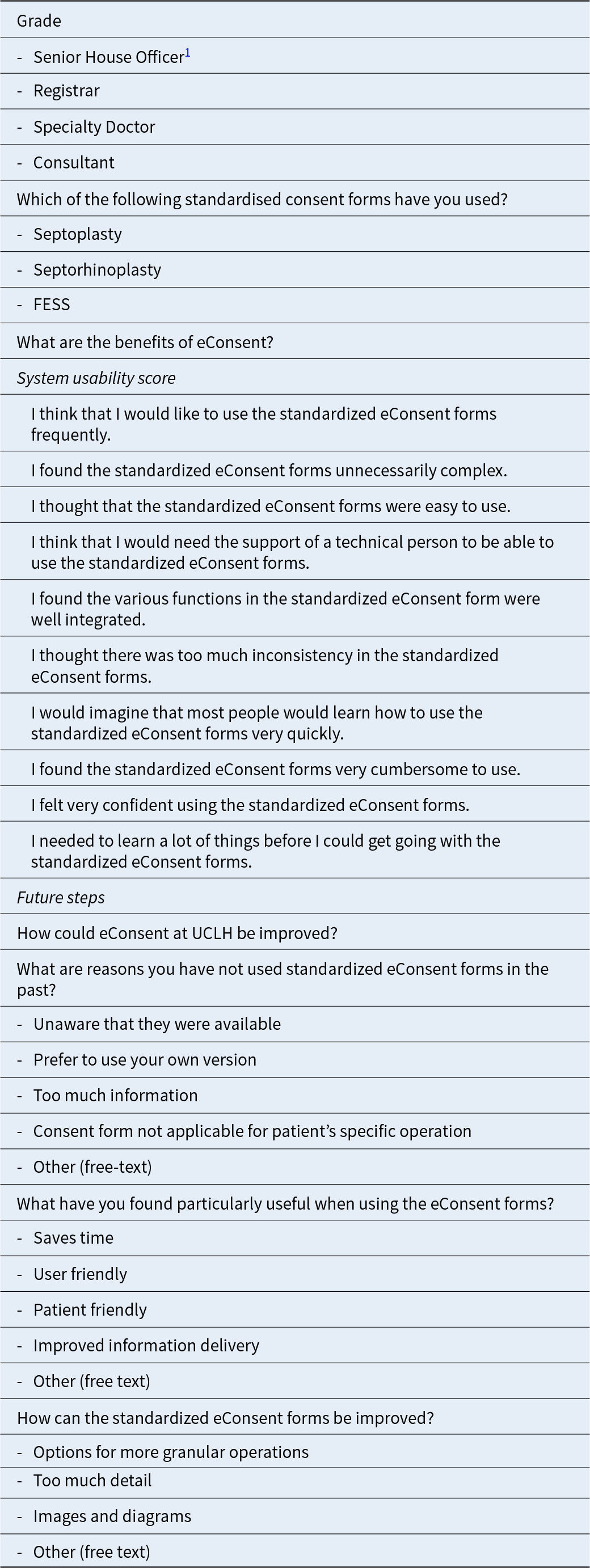
A survey produced in Microsoft Forms (Microsoft, Redmond, WA) was distributed in our local rhinology department (Table 1). The survey was composed of a series of five-point Likert-scale and free-text questions assessing user sentiment towards eConsent and our procedure-specific consent forms. The System Usability Scale (SUS) was used to assess the overall usability of the procedure-specific consent forms and eConsent as a whole.Reference Brooke17
User survey distributed to clinicians in the Rhinology DepartmentReference Ainsworth, Hussain, Houten, Martin, Toh and Rao1

Table 1 Long description
The table summarizes a clinician survey about standardized electronic consent forms in a rhinology service. It records respondent grade (from senior house officer through consultant) and which standardized consent forms they have used, including septoplasty, septorhinoplasty, and functional endoscopic sinus surgery. It also captures perceived benefits of electronic consent and a system usability score section using agreement statements about frequency of use, complexity, ease of use, need for technical support, integration, consistency, speed of learning, cumbersomeness, confidence, and required training. Additional items ask about future steps, how electronic consent could be improved locally, and reasons for not using standardized forms previously, such as lack of awareness, preference for personal versions, too much information, or poor fit for a specific operation. The table lists what users found useful, including time saving, user friendliness, patient friendliness, and improved information delivery, plus free-text options. Suggested improvements include more granular operation choices, reducing excessive detail, and adding images or diagrams. No numeric results are provided in the table text shown, so the direction and strength of usability ratings and the most common selections cannot be quantified from this extract.
Note: This included those at a foundation year 2 level, core surgical trainees and trust grade doctors.
eConsent = electronic consent; FESS = functional endoscopic sinus surgery; UCLH = University College London Hospitals.
Statistical analysis
Patient electronic records were accessed from Epic (Epic Systems, Madison, WI) and data extracted using a data collection tool designed in Microsoft Excel (Microsoft, Redmond, WA). Statistical analysis was performed in Microsoft Excel and RStudio. The distribution of continuous data was assessed using the Kolmogrov–Smirnov test and through visual inspection of the distribution. Parametric data were assessed using the unpaired t-test, while non-parametric data were assessed with the Mann–Whitney U-test. Binary outcomes were assessed using the chi-squared test or Fisher’s exact test, depending on the number of values available. A p-value less than 0.05 was considered as significant.
Ethical approval
This study was registered as an audit and quality improvement project at the Royal National ENT and Eastman Dental Hospitals; therefore, review by a formal ethics board was waived.
Results and analysis
Septorhinoplasty
In septorhinoplasty, a total of 61 and 80 consent forms were reviewed pre- and post-eConsent with a slight female predominance (n = 73; 51.7%). The intended benefit of the procedure was documented in 98 per cent and 97 per cent of paper and eConsent forms, respectively. Evidence of discussion of risks was documented in 94 per cent and 100 per cent of paper and eConsent forms, respectively. There was a statistically significant increase in the number of risks documented on the eConsent form compared to traditional paper consent (median difference = 4; p-value < 0.001). Reporting on the frequency of individual risks and alternatives to surgery was also improved (p-value < 0.001). Overall uptake of the procedure-specific consent form in the second cycle was 71 per cent. A summary of results as it pertains to septorhinoplasty can be found in Table 2.
Summary of results of quality of consent documentation between the first and second cycle for septorhinoplasty

Table 2 Long description
The table compares how often key consent elements and specific risks were documented in two audit cycles for septorhinoplasty, with a p-value for each comparison. Overall documentation was already high for intended benefit (97% to 98%) and for any risks being documented (94% to 100%), with no clear evidence of change. The largest improvements were documenting alternatives to surgery (0% to 73%) and describing the frequency of risks (2% to 71%), both with very small p-values. Many individual risks were recorded more often in the second cycle, including need for dressings or packing or splints or sutures (21% to 78%), swelling (13% to 81%), skin changes (33% to 99%), and loss or change of smell or flavour (60% to 96%), each with very small p-values. Several risks were already commonly documented and changed little, such as significant bleeding (97% to 99%) and visual dissatisfaction (94% to 100%). The median number of risks discussed increased from 10 to 14 with a very small p-value. Percentages reflect documentation rates and do not indicate how often complications occurred.
FESS
In FESS, a total of 85 and 66 consent forms were reviewed pre-and post- implementation of eConsent, respectively, with a slight male predominance (n = 79; 52.3%). The intended benefit of the procedure was documented in 98 per cent and 94 per cent of paper and eConsent forms, respectively. Evidence of discussion of risks was 100 per cent in both cycles. Overall uptake of the procedure-specific consent form was 53 per cent. There was no statistically significant difference in the number of risks documented between the two cycles (p-value = 0.18). The only statistically significant improvements were in the reporting of frequency of risks (p-value < 0.001) and alternatives to surgery (p-value < 0.001). A summary of results as it pertains to FESS can be found in Table 3.
Summary of results of quality of consent documentation between the first and second cycle for FESS

Table 3 Long description
The table compares how often specific consent elements and individual risks were documented for functional endoscopic sinus surgery in a first versus second audit cycle, with p-values for change. Overall documentation of risks was complete in both cycles at 100 percent, and the median number of risks discussed stayed at 9 in both cycles. The largest improvements were recording alternatives to surgery, increasing from 0 percent to 45 percent, and describing how often risks occur, increasing from 0 percent to 53 percent; both changes were statistically significant. Intended benefit documentation remained high, decreasing slightly from 98 percent to 94 percent without a significant difference. Several individual risks were consistently documented at very high rates in both cycles, including significant bleeding and sinusitis at 100 percent in each cycle, and recurrence of symptoms at 92 percent in each cycle. Some items changed modestly without clear statistical evidence of a difference, such as nasal packing from 28 to 41 percent and loss of smell from 79 to 88 percent. Discomfort decreased from 98 percent to 86 percent and cerebrospinal fluid leak documentation decreased from 98 percent to 89 percent, both showing statistically significant differences. One p-value is not available for sinusitis, so statistical comparison for that row cannot be interpreted.
CSF = cerebrospinal fluid; FESS = functional endoscopic sinus surgery.
Clinician survey
A total of 11 individuals completed the survey, the majority of whom were registrars (n = 5; 45.5%), followed by consultants (n = 4; 36.3%), senior house officers (n =1; 9.1%) and specialty doctors (n = 1; 9.1%). Benefits of eConsent that were highlighted included improved information delivery (n = 6), standardised information on procedure-specific forms (n = 6) and being more time-efficient (n = 5). Areas for improvement included addition of videos/diagrams (n = 3), further training (n = 2) and procedure-specific forms for additional procedures (n = 2). In those who did not regularly use the procedure-specific forms (n = 6), not being aware they were available was the most common reason (n = 4; 66.6%) with two respondents preferring to use their own or feeling the procedure-specific consent form had too much information. The SUS score for the standardised eConsent forms was 85.3, indicating high usability.
Discussion
Summary of findings
In this two-cycle audit of consent documentation, we found that the implementation of eConsent resulted in significantly improved documentation across a number of domains, in particular for septorhinoplasty. Across both procedures, the documentation of frequency of complications occurring and alternatives to surgery significantly improved. Improvements in the documentation of risks was significantly improved for septorhinoplasty, however, was largely similar across the two cycles for FESS. The results of our clinician survey were largely positive, with a number of benefits of eConsent and procedure-specific consent forms highlighted. The new consent process was rated as being highly usable with a SUS score well above the generally accepted mean benchmark of 68.Reference Sauro, Lewis, Sauro and Lewis18
Our findings regarding the benefits of procedure-specific consent forms are in line with previously reported results that demonstrate an improvement in the quality of documentation.Reference Norvill, Bent, Mawhinney and Johnson11 Improvements in documentation practices in the consent process were greater with septorhinoplasty than FESS. This could possibly be due to indications for FESS being both diagnostic and therapeutic; therefore, clinicians preferring to use a more personalised approach when generating eConsent forms. However, this was not noted by any respondents to our clinician survey. Use of such a personalised approach, though resulting in variability, may more accurately reflect the consent discussion had and, therefore, be in line with the Montgomery ruling, which favours a patient-centred approach. Further cycles could further refine the procedure-specific consent forms to allow for options to include or exclude pre-specified information based on the individual patients’ circumstances.
To the best of our knowledge, this is the first study exploring the impact of eConsent in the quality of consent documentation in rhinology. Though the complications assessed are not directly comparable across studies, reporting rates of risks in our FESS consent forms were similar to Raja and Talwar’s review of FESS consent forms.Reference Raja and Talwar7 As in other specialties, the quality of documentation largely improved with eConsent.Reference Wong, Hussain, Toh, Rao and St John3, Reference St John, Scott, Irvine, Pakzad, Leff and Layer4, Reference Dyke, St-John, Shah, Walker, Loughran and Anakwe14 The benefits discussed in the user survey such as time and cost savings have also previously been demonstrated quantitatively in practice and simulation studies.Reference Houten, Hussain, Martin, Ainsworth, Lameirinhas and Coombs15, Reference Trang, Decker, Gonzalez, Pierce, Shui and Melton-Meaux16 Cost savings arise through the elimination of printing, transport and storage of physical consent forms with Houten et al. reporting paper consent forms costing approximately £0.90 more per consent episode than eConsent. Furthermore, the elimination of these aspects of the paper consent process may also result in a reduced carbon footprint. Such benefits to the environment could be further realised through the use of carbon neutral providers for digital storage of information, energy efficient electronic equipment in the healthcare setting and reliance on renewable energy sources to power the relevant electronic health record system.Reference Houten, Hussain, Martin, Ainsworth, Lameirinhas and Coombs15, Reference Kwon, Essayei, Spencer, Etheridge, Venkatesh and Vengadesan19
The digital nature of eConsent allows for simpler integration of other forms of information delivery such as visual aids and videos, the most commonly suggested improvement in our survey. Videos and visual aids are both widely used interventions for the purpose of improving patient understanding and retention of information pertaining to a procedure.Reference Jalal, Chatzopoulou, Marcus and Pandit20, Reference Glaser, Nouri, Fernandez, Sudore, Schillinger and Klein-Fedyshin21 For both procedures, audio/video interventions have previously been found to improve patient comprehension and satisfaction while also reducing anxiety associated with the procedure.Reference Hakimi, Standiford, Chang and Wong22–Reference Siu, Rotenberg, Franklin and Sowerby25 Incorporation of interactive components for patients can further improve patient understanding, with interactive digital interventions having previously been found to be among the most effective interventions to improve the consent process.Reference Glaser, Nouri, Fernandez, Sudore, Schillinger and Klein-Fedyshin21
Despite the potential to improve the quality of documentation through eConsent and procedure-specific consent forms, this should not act as a substitute for a suitable discussion of the procedure with the patient. The importance of an individualised discussion has increased in recent years since the Montgomery ruling which stated that doctors have a duty to disclose material risks including those in which the individual is likely to attach significance to. Though procedure-specific consent forms may document discussion of said risks, they may have not actually occurred. As previously described by Norvill et al., to date, no study has reported the impact of procedure-specific consent forms on legal proceedings. Detailed discussion is especially important given that patient engagement with eConsent forms and the information provided is generally brief.Reference Trang, Decker, Gonzalez, Pierce, Shui and Melton-Meaux16, Reference Hannabass and Lee26 As a result, eConsent and procedure-specific forms should complement rather than replace traditional verbal consent discussions. St John et al. and Dyke et al. have already reported eConsent led to significantly improved patient perception of shared decision making in surgery which reflects the benefits of eConsent beyond simply documenting information.Reference St John, Ezzat, Holford, Rizki, Hogben and Leff10, Reference Dyke, St-John, Shah, Walker, Loughran and Anakwe14
Strengths and limitations
As a tertiary centre, our audit benefits from a relatively high volume of cases within each study period. The retrospective nature of our first cycle limits the impact of the Hawthorne effect on individual performance. Furthermore, the assessment of complications to be included in consent forms was based on standards agreed both locally and nationally. As we assessed the implementation of eConsent relatively early, we may not be able to capture more long-term improvements in documentation, but this may be undertaken in further audit cycles. Data over a more long-term period may also allow for analysis of other factors contributing to quality of consent documentation such as timing of consent or the grade of clinician completing consent.
Future research
Future research in this area would benefit from patient feedback on eConsent in rhinology through measures of patient understanding (e.g., knowledge questionnaires) and shared decision making. The latter is particularly vital given the previously reported lack of shared decision-making studies in rhinology.Reference Karadaghy, Vukas and Villwock27 A further third cycle of our work could study the impact of incorporating patient education videos and visual aids into our consent forms and assessing their impact or the impact of utilising a multistage consent process where patients are able to better reflect on the information provided before signing. There may also be potential to utilise national level data on national complications rates of surgery from studies that have used administrative data sets.Reference Navaratnam, Pendolino, Andrews, Saleh, Hopkins and Randhawa28 Surgeon level data on outcomes which is available on platforms such as the National Consultant Information Programme29 could also be integrated into consent forms. This has already been used to study outcomes in colorectal surgery.Reference Galla, Okoye, Booth, Young, Taib and Williams30 Furthermore, a consensus statement on information to discuss in rhino(septo)plasty has recently been published which provides an excellent framework based on expert opinion.Reference Hellings, Bertossi, Cingi, Claeys, Constantinidis and Conti31 Similar work in FESS would benefit the creation of future standardised consent forms.
• Procedure-specific consent forms and electronic consent (eConsent) have previously been demonstrated to improve the consent process through reducing user variability and error rates whilst improving information delivery and patient satisfaction
• Our study is the first to the best of our knowledge assessing the impact of eConsent on quality of consent documentation in rhinology and utilising validated usability measures
• We demonstrated eConsent improved quality of consent documentation, particularly for septorhinoplasty
• User feedback was largely positive with a System Usability Score well above the industry average
Conclusion
The implementation of eConsent with procedure-specific consent forms in our centre has led to significant improvements in consent documentation in septorhinoplasty with more modest improvements in FESS. These changes were well received by clinicians with a number of practical and cost-saving benefits highlighted. Future research should focus on patient perspectives regarding eConsent and the incorporation of multimodal interventions embedded within the electronic interface to facilitate shared decision making in the consent process.
Supplementary material
The supplementary material for this article can be found at https://doi.org/10.1017/S002221512610468X.
Financial support
This research received no specific grant from any funding agency, commercial or not-for-profit sectors.
Competing interests
The authors declare none.
Ethical standards
This work was approved as part of an audit and quality improvement project at our centre and therefore formal review by an ethics board was not sought.