1. Introduction
For almost three decades, the World Trade Organization (WTO) has not only functioned as a competent organization to liberalize trade, but has also recognized the importance of sustainable development when promoting international trade.Footnote 1 With the restart of negotiations on fisheries subsidies, the WTO aims to strengthen disciplines on fisheries subsidies to advance the United Nations (UN)' Sustainable Development Goal (SDG) 14.6.Footnote 2 However, the negotiations encounter a number of significant challenges, and one of the primary challenges lies in the appropriate and effective special and differential treatment (SDT) granted to developing and least developed countries (LDCs).Footnote 3 At the 12th Ministerial Conference (MC12) held in 2022, the WTO adopted the Agreement on Fisheries Subsidies (AFS), the first WTO agreement focusing on environmental sustainability. The AFS moderately addresses SDT for developing countries and LDCs by recognizing the peace clause concerning the prohibition on subsidization of illegal, unreported, or unregulated fishing,Footnote 4 due restraint in raising matters involving an LDC Member,Footnote 5 notifications,Footnote 6 and targeted technical assistance and capacity building.Footnote 7 Notwithstanding the achievement, the divergence with respect to SDT largely remains due to the ongoing controversies surrounding the heterogeneity of Members eligible to claim SDT.Footnote 8 At the MC13 held in 2024, WTO Members failed to conclude the second wave of negotiationFootnote 9 by formulating disciplines that include SDT provisions.
As a traditional approach for developing and LDC Members to be justifiably excused from certain duties or obtain preferential rights in a non-reciprocal way so as to protect their right to development,Footnote 10 SDT has been widely accepted by the WTO and up to 155 SDT provisions can be identified in all WTO agreements.Footnote 11 Nevertheless, as a single undertaking, the Marrakesh Agreement and its Annexes also aim at building a single-tier system of rights and obligations.Footnote 12 In this sense, SDT ostensibly violates the fundamental principles of reciprocity and non-discrimination entrenched in the WTO, and thus it is merely regarded as a transitional tool rather than a development tool, and should be stringently restricted in terms of application.Footnote 13 Furthermore, SDT is designated based on a dichotomy, dividing WTO Members into two groups, namely developing countries, including LDCs, and developed countries. Such a binary classification appears to be problematic in practice in that the status of developing countries is self-claimed.Footnote 14 Given the scarcity of unequivocal standards or criteria of objectives and scopes of SDT, negotiation concerning SDT easily spirals into an unproductive debate.Footnote 15 The negotiation on fisheries subsidies reflects the intricacy of SDT. Although negotiators are motivated by the need to reduce capacity-enhancing subsidies and restore global fishery stock, the consensus reached is quite limited on the scope of preferential treatments that can be enjoyed by developing countries for development.Footnote 16 Since effective disciplines on fisheries indubitably require all major subsidizers, including some developing countries, to participate in the action plan,Footnote 17 it becomes essential and necessary to design an appropriate and effective approach to SDT when regulating fisheries subsidies and ensuring that these regulations generate positive effects on the sustainability of marine fish stocks and fisheries.
This article is a response to such cutting-edge legal research relating to dynamic interplay and reconciliation between SDT and fishery sustainability. It argues that the focal point of fisheries subsidies negotiations is the protection of fisheries resources, which is different from traditional trade issues, and accordingly the core concepts and obligations under the rules have distinctive traits. Considering that fishery sustainability is deemed as the principal goal of fisheries subsidies disciplines, SDT in sustainable resource management has to work differently than SDT in other trade agreements. In accordance with sustainable development, conditions should and can be embedded into the AFS to balance WTO Members' economic growth, societal needs, and environmental responsibilities. The article consists of five primary sections. In the second section, the article makes critical inquiries into the current approach to SDT and its shortcomings. By elucidating the inherent limitation of SDT as a development tool, it contends that SDT should be dynamic, negotiable, and limited to a justifiable and rational degree. Following the third session that traces the AFS negotiation and its failure to embody more conditions in SDT provisions, the article then develops an analytical framework that contrasts SDT in sustainable resource management and traditional trade. In acknowledging sustainable development as the fundamental and common objective of the AFS, the fourth section maintains that fishery sustainability entails a conditionality approach that sets multi-dimensions of conditions to strike a balance between economic, societal, and environmental needs of developing countries. Based on data, models, and cases, the fifth section examines how a conditionality approach can better foster three pillars of sustainable development, namely economic growth and diversification, social development, and environmental protection. In the sixth section, the article probes into potential conditions that should be embedded in SDT in practice, and further elaborates the rationale and feasibility of a variety of conditions.
2. Claimed Unconditional SDT and Its Limitation
2.1 Claimed Unconditional SDT
Traditional SDT provisions are designed to address development needs of all developing countries, without defining which Member is eligible for a ‘developing country’ status. In the General Agreement on Tariffs and Trade (GATT) period, the Tokyo Round introduced the Enabling Clause to the GATT, allowing developed countries to voluntarily provide preferential treatment through the Generalized System of Preferences (GSP) program.Footnote 18 During the Uruguay Round, SDT provisions are broadly codified in various WTO Agreements whereby all developing and LDC Members can have a relaxation in their trade commitments. As classified by the WTO Secretariat, there are six types of SDT provisions contained in WTO agreements, i.e. (a) provisions aimed at increasing the trade opportunities of developing countries; (b) provisions that require WTO Members to safeguard the interests of developing countries; (c) flexibility of commitments, of action, and use of policy instruments; (d) transitional time-periods; (e) technical assistance; and (f) provisions relating to LDCs.Footnote 19 Half of the SDT provisions have expired, and the remaining are mostly ambiguous, non-applicable, or unenforceable, since they do not generate rights and obligations.Footnote 20 In 2001, the Doha Round aimed to enhance the clarity and effectiveness of SDT provisions by addressing the development aspect of developing countries through revising trade rules. Nevertheless, the terms of the ‘Doha Development Agenda’ were relatively vague, and WTO Members failed to agree on the meanings of, and the role played by, ‘development’.Footnote 21 After fruitless negotiation, the Doha Round reached an impasse, and there has been no substantial breakthrough regarding the SDT reformation since then.
Some developing Members use the term ‘unconditional’ to describe the existing SDT mechanism, emphasizing that all developing Members are eligible to enjoy preferential treatments under the SDT, and they have the right to designate themselves as a ‘developing country’.Footnote 22 Developing Members' vision for future negotiations is that SDT would be ‘an unconditional and treaty-embedded right’.Footnote 23 Indeed, the WTO has not limited any developing Member's right to be able to utilize SDT provisions, except for a few SDT provisions baring selective criteria.Footnote 24 Currently about two thirds of Members enjoy the status of developing countries based on their claims.Footnote 25 However, it is also noteworthy that the ways in which a developing Member is able to utilize SDT still depend on some treaty-embodied conditions, such as time limits for the transitional period, or conditions to accept technical assistance from developed Members. Accordingly, the ‘unconditional’ claim may not refer to the exercise of SDT rights, but refers to having no conditions to limit or even decline the priori eligibility for developing countries to access SDT by self-designation. By contrast, as some developed Members have proposed, certain developing countries shall be ruled out from SDT exemptions based on certain conditions. For instance, the graduation approach supported by the United States (US) suggests that a member of the Organization for Economic Co-operation and Development (OECD), a G20 member, or a ‘high-income’ country classified by the World Bank should not be eligible for SDT in current and future WTO negotiations.Footnote 26 This graduation approach sets important conditions to disregard the eligibility of some developing countries to enjoy SDT. In brief, the unconditional approach indicates that access to the SDT is decided by WTO Members, rather than any objective conditions. Once a Member claims itself as a developing country, it has access to SDT exemptions designated for developing Members.
2.2 Limitation in General
2.2.1 Binary Classification of Countries Based on Unclear Standards
The unconditional SDT has given rise to many contestations. SDT essentially results from the binary classification of countries, dividing WTO Members as developing countries or developed countries without providing a clear standard. SDT provisions lack specificity to address the diverse needs of developing countries. As elaborated by the Appellate Body (AB) in EC–Tariff Preferences, ‘the development financial and trade needs of developing countries’ required that each developing country's particular needs should be assessed according to an objective standard.Footnote 27 The AB also recognized that the different needs of developing countries might vary over time, and that it was important to fulfil those interests shared by sub-categories of developing countries based on their particular needs.Footnote 28 However, SDT provisions fail to provide specific objective criteria to assist the assessment of particular needs. For instance, Article 10.1 of the WTO Agreement on Sanitary and Phytosanitary Measures requires developed countries to ‘take account’ of developing countries' needs, without specifying any criteria or conditions to actually address those needs. These ambiguous and general SDT provisions generate the aspirational nature and hollowness of most of them in practice.Footnote 29
2.2.2 Trade Distortion
Granting flexibility to developing countries often leads to trade distortion that negatively affects international trade. One component in the framework of SDT is to provide developing countries with greater, but still limited, policy space to adopt trade-distorting measures that would otherwise be unpermitted under WTO rules.Footnote 30 Without clear and objective conditions to limit such policy flexibility, SDT has substantial difficulties in controlling the distortive effects on international trade caused by trade policies. For instance, in the sector of agriculture, many emerging economics, including China, India, Indonesia, Philippines, and Turkey, have become major subsidizers and claim that their trade policies could be exempted from relevant WTO disciplines via SDT.Footnote 31 The subsidies incentivizing agricultural production lower the price of agricultural products to maintain a competitive edge. Over time, such flexibility would result in inefficiency and be detrimental to trade liberalization and fairness.Footnote 32 Besides, developed countries as preference-giving countries may implement SDT provisions arbitrarily, giving rise to legal instability in the international trading system. For example, while the US offers unilateral tariff preferences to African countries through the African Growth and Opportunity Act, the preferential scheme has been revised several times by discretion and caused uncertainty in implementation.Footnote 33 In the long run, SDT without clear standards and conditions would likely harm its effectiveness and trade stability. Thus, the traditional approach to SDT is not effective to promote trade fairness and stability.
2.3 Limitation in the Fisheries Context
2.3.1 Narrower Gap between Developed Countries and Developing Countries
An unconditional approach of SDT would foreseeably hinder the effectiveness of fishery disciplines, considering the narrower gap between developed countries and developing countries. In recent years, many developing countries have major fishing powers in the global sea as reflected in Figure 1. In 2020, the marine capture of the top 25 fishery countries had reached 80% of the global production.Footnote 34 The statistical data indicate that the gap between a developed country and a developing one may be narrower in the fisheries context. In addition, it is estimated that harmful subsidies to fisheries provided by developing countries account for 72% of global fisheries subsidies.Footnote 35 Against this background, without the substantial involvement of major subsidizers, including developing countries, the disciplines on fisheries subsidies cannot achieve the ambition to enhance sustainability. Besides, based on the requirement of substantial equity in international trade, simply exempting major fishing countries from taking relevant responsibility cannot achieve a fair and equitable result. Blanket and unconditional exemption may even reduce incentives for some WTO Members to implement new rules.
Top 25 fishing countries and their estimated harmful subsidies. Source: FAO; Skerritt and SumailaFootnote 36.

2.3.2 Adverse Impact on Fish Stock Depletion
Given the fish stock depletion, an unconditional SDT would likely cause a new round of tragedy of the commons. As reported by the Food and Agriculture Organisation (FAO), biologically unsustainable fishing levels have been increasing since the 1970s, reaching 35.4% in 2019, and the maximally sustainably fished stocks levels also increased to 57.3% in 2019.Footnote 37 The situation is caused by free competitions among countries, considering fishing resources as part of the common resources, so that every country can harvest them without taking responsibility. If this existing and growing trend cannot be reversed, all Members’ fishing industry will be frustrated with non-sustainability in the near future. Thus, the environmental deterioration calls for effective fisheries disciplines that can limit the fishing powers of both developed and developing countries. If all developing countries get access to the exemption of obligations against fisheries subsidies without conditions, they might enter into a new vicious circle. Their competition by using subsidies to maintain or enlarge enormous trade advantages in the fisheries market would cumulatively deepen the fish stock depletion. New fishery disciplines, which effectively enhance sustainable fishery and restore the global fish stock, can barely be successful if all major subsidizers, including developing countries, do not actively engage in the restraint on fisheries subsidies.
In brief, as an instrument designed to provide more flexibility for developing countries in the process of trade liberalization, SDT has been weaved into various WTO agreements. However, the scarcity of conditions on access to SDT has several limitations, including, but not limited to, failing to address different groups of developing country Members' needs, and lack of clarity and predictability on its content and scope. In the fisheries sector, the traditional one-size fits-all design of SDT is proven to be incompatible with the goal of concluding effective fisheries disciplines to preserve the ocean. As a compromised counterpoise by reconciling the right to development with the responsibility to preserve the ocean, the content and scope of SDT should be dynamic and negotiable to ensure fishery sustainability. During negotiations, WTO Members proposed and eventually agreed on certain conditions to limit the access of SDT for developing countries, with the ambition to reform the SDT mechanism in the WTO. However, the AFS was half-finished at the MC12, since WTO Members still failed to make a major step forward to agree on the future path of reform.
3. AFS Negotiation and Its Partial Failure to Embody Conditions in SDT Provisions
SDT in the context of fisheries subsidies demonstrates a longstanding and perplexing tension between sustainability of the fishing industry and the development priority of developing countries. The creation of the WTO Committee on Trade and Environment (CTE) in 1995 signified the increasing impetus to enhance environmental benefits by removing certain trade obstacles, which covered fisheries subsidies.Footnote 38 In later discussions under the CTE, WTO Members emphasized the trade and environmental benefits of eliminating fisheries subsides, while also considering the important roles of fisheries sectors for developing countries, including LDCs.Footnote 39 The potential tension of these two aspects awaited to be eased in later negotiations. However, in the Doha Declaration, WTO Members only concluded that negotiations of fisheries subsidies should take into account the importance of the fisheries sector to developing countries.Footnote 40 The subsequent Hong Kong Declaration merely recalled the Doha commitment to enhancing the supportiveness of trade and environment, while recognizing appropriate and effective SDT as an integral part of the negotiation.Footnote 41 In brief, these negotiation efforts did not provide a way to achieve an effective SDT goal.
Following the Ministerial mandate in the Hong Kong Declaration, the Chairman circulated a consolidated text in 2007, which allowed: (i) LDC Members to be exempted from the obligation to prohibit subsidies under Article I, and (ii) developing countries other than LDC Members to subsidize fishing performed on an inshore basis in small scale, and larger exemptions on certain types of subsidies, subject to the establishment of an effective fisheries management system.Footnote 42 In 2008, the Negotiating Group on Rules updated the debate among WTO Members concerning the fisheries subsidies negotiation, suggesting that participants preferred to limit the scope of SDT, instead of seeking an unconditional and unlimited exemption.Footnote 43 However, divergent views remained on many issues, such as the full carve-out from the disciplines for LDCs, the conditions of exemption from the disciplines for developing countries other than LDC Members, and other basis on which to structure the exemption.Footnote 44 Due to the lack of consensus on SDT provisions and other issues, the negotiation went into a deadlock.
In 2015, 28 WTO Members jointly circulated a ministerial statement during the Nairobi Ministerial Conference, in which they committed to reinvigorate the work on establishing ambitious and effective disciplines on fisheries subsides.Footnote 45 Since then, WTO Members have renewed momentum to finalize binding rules on fisheries subsidies. However, rigorous debate on SDT continued and slowed the conclusion of the AFS. Some developed countries criticized the self-designation of developing countries and the unfairness of SDT. For example, the US contended that self-identifications of some Members, such as Mexico, Singapore, and China, were unsupportable, given their economic power.Footnote 46 In response, developing countries emphatically claimed their needs to promote development and ensure inclusiveness. China and India, among others, maintained in a joint statement on SDT in 2019 the principle that all developing countries had unconditional rights to SDT in WTO rules and ‘must be allowed to make their own assessment’ regarding their developing status.Footnote 47 Such a claim received support from a number of WTO Members. For instance, in a later communication in 2022, the African Group, and India and Cuba reaffirmed the non-negotiable right to SDT for all developing countries and used the widening gap between developing and developed countries to justify the continuous need for SDT.Footnote 48
According to the May 2021 Draft of the AFS, if a developing country has a high gross national income per capita and a large share of the annual global marine capture fish production, in conjunction with other conditions, it would be opted out from exemption under Article 5.Footnote 49 This approach, known as the de minimis approach, aims to preserve the room only for small developing countries and for LDC Members to provide harmful subsidies within their exclusive economic zones. As the debate goes on, this approach has been changed in different versions. In the November 2021 Draft, developing countries are allowed to provide harmful subsidies within their exclusive economic zones in the transitional period. In addition, a developing country can enjoy exemption under Article 5 if two positive conditions are satisfied: (i) annual share of the global volume of marine capture production does not exceed 0.7%, and (ii) subsidies to fishing or fishing-related activities at sea do not exceed US$ 25 million annually.Footnote 50 The 2022 Draft further modifies and specifies that a developing country may be re-included in the exemption if it can meet relevant conditions again.Footnote 51
Nevertheless, due to unresolved controversy on the SDT, the final agreement adopted at the MC12 failed to establish disciplines on harmful subsidies as well as its exemption. The MC12 version of the AFS enshrines WTO Members’ commitments to: (i) not provide any subsidy to support illegal, unreported, or unregulated fishing, with a two-year transitional period for developing Members, including LDCs; (ii) not provide any subsidy for fishing activities regarding an overfished stock, with a two-year transitional period for developing Members, including LDCs; (iii) not to provide other subsidies, which are provided to fishing activities outside of the jurisdiction of a coastal Member or a coastal non-Member and outside the competence of a relevant Regional Fisheries Management Organization or Arrangement.Footnote 52 WTO Members also agree to provide targeted technical and capacity-building assistance to developing Members by establishing a WTO funding mechanism.Footnote 53 However, disciplines on prohibiting harmful subsidies, which is one of the most important disciplines under the AFS, remains to be discussed. In 2024, the MC13 did not move forward on the reformation of SDT provisions, merely reaffirming SDT as an integral part of WTO agreements.Footnote 54
It can be inferred from the fisheries subsidies negotiation that SDT is one of the essential issues that slow down the negotiation pace and weaken the ambition of the AFS. WTO Members attempt to limit the scope of SDT exemption by proposing positive or negative conditions, which mainly focus on economic power (such as gross national income per capita), fishing power (such as annual volume of marine production), or the scale of fishing activities. These proposals are struggling to achieve the balance between providing flexibility to developing countries for their development needs and maintaining the effectiveness of WTO fisheries subsidies disciplines that aim to ensure fishery sustainability. As pointed out by the Norway Representative, what matters is to respond adequately to the specific development needs of developing countries.Footnote 55 The following sections explore why conditionality is an approach to framing SDT based on fishery sustainability, and further proposes conditions that address specific development needs of developing countries in a sustainable way.
4. Conditionality as an Approach to Framing SDT Based on Fishery Sustainability
4.1 Sustainable Development as a Common Objective of the AFS
Sustainable development generally refers to development that meets the needs of the present without compromising the ability of future generations to meet their own needs.Footnote 56 As an essential feature of international law, sustainable development has been explicitly included in an increasing number of treaties as a source of obligation.Footnote 57 For instance, the Comprehensive and Progressive Agreement for Trans-Pacific Partnership (CPTPP) has recognized the promotion of sustainable development as one of the important objectives.Footnote 58 Sustainable development may also be evolved into a binding principle of customary law.Footnote 59 As elaborated by Judge Weeramantry in his separate opinion in Case Concerning the Gabčíkovo-Nagymaros Project, ‘general recognition among states of a certain practice as obligation’ gave the principle of sustainable development the nature of customary law.Footnote 60 At the present time, sustainable development is arguably regarded as one of the general principles of international environmental law,Footnote 61 and generates normative impacts.Footnote 62 Accordingly, sustainable development should be deliberately taken into account as one of the deciding factors when designing disciplines addressing an environmental-related issue. The WTO regime, which exists subject to public international law relating to treaties, is also shaped by these relevant constituent instruments under public international law.Footnote 63 Particularly, the Preamble of the Marrakesh Agreement explicitly mentions ‘sustainable development’ as one of the objectives. Thus, the underlying rationale and requirement of sustainable development are indispensable when negotiating SDT provisions under the AFS.
Sustainable development in the contemporary world is conspicuously reflected in UN's 17 SDGs and 169 targets. As a policy tool, SDGs are grounded in international law, orchestrating the common objective of sustainable development.Footnote 64 Such a paradigm has had, and will continue to have, an impact on the trade policy- and rule-making process in the WTO regime. Particularly, unlike traditional subsidies disciplines under WTO law, the AFS is fundamentally driven by the objective to achieve sustainable development. Back to the Uruguay Round, when the Agreement on Subsidies and Countervailing Measures (SCM Agreement) was negotiated, the objective was to maintain the balance between the use of subsidies and countervailing duty measures,Footnote 65 without explicitly taking into account environmental sustainability. The designation of SDT provisions under the SCM Agreement primarily focuses on transitional periods,Footnote 66 and exemption of de minimis actionable subsidies.Footnote 67 Article 8 of the SCM Agreement provides that some subsidies for social costs, assisting disadvantaged regions, and other social or environmental purposes are non-actionable, but the provision has expired.Footnote 68 The failure of WTO Members to extend this provision indicates that the need to address environmental and social issues under the SCM Agreement remains questionable.Footnote 69
In the fisheries sector, it is agreed that fisheries subsidies may not only cause trade effects, but also generate environmental and societal effects, including adverse impacts on the resilience of fish stocks, biodiversity, and food security.Footnote 70 The goal of the AFS, as elucidated in the 2021 Consolidated Draft, is to create comprehensive and effective disciplines to ‘address fisheries subsidies that harm sustainability’.Footnote 71 The notion of sustainability is cardinally linked with sustainable development, emphasizing the theme to live within limits so that the natural resources system can produce goods and services indefinitely.Footnote 72 Although the final version of the AFS adopted at the MC12 does not provide for a preamble to specify its aims and objectives, sustainable development is definitely reflected from its legal texts, such as Article 3 which prohibits subsidies contributing to illegal, unreported, or unregulated fishing, and Article 4 which aims to eliminate subsidies for fishing regarding an overfished stock. Through these disciplines, the AFS is designated to enhance the management of fishery stock and ease the overexploitation of fishery resources, eventually enhancing fishery sustainability. Therefore, it becomes evident and essential to align the content and scope of SDT provisions with sustainable development.
4.2 Linkage between Sustainable Development and Conditionality
Under the conceptual pillar of sustainable development, the common but differentiated responsibilities (CBDR) principle is one of the primary principles addressed in the International Law Association (ILA) New Delhi Declaration,Footnote 73 which acknowledges that all countries share a common responsibility to protect the environment, but such a responsibility should be differentiated based on the level of development and capacity of each country.Footnote 74 The principle has been incorporated into a number of international environmental agreements, and received support from developed and developing countries.Footnote 75 Earlier embodiments of this principle are based on a two-tier approach to categorize parties as developed countries and developing countries. However, it is intriguing that the dichotomy has been gradually eased in agreements due to the increasing emphasis on individual national contributions and needs. For instance, under the Paris Agreement, developing countries are given more flexibility in their differentiated Nationally Determined Contributions (NDCs) which outline their commitments to reducing greenhouse gas emissions, taking into account their special circumstances and needs. Although the ‘developed/developing’ categorization of countries is still relevant, the Paris Agreement is designed to reflect the responsibilities of countries in the light of different national circumstances.Footnote 76 Besides, the Trade Facilitation Agreement (TFA), which entered into force in 2017, also stipulates that LDCs are only responsible to undertake their responsibilities to the extent ‘consistent with their individual development’, which reflects the essential criteria of the CBDR principle.Footnote 77 Through recognizing the differing levels of responsibility and capacity of each country, the CBDR principle represents a crucial step towards achieving more substantial equity in climate policy.
Similarly, the raison d’être of SDT also lies essentially in differentiation. In the international trade regime, equity requires equal treatment of ‘similarly situated’ countries.Footnote 78 In other words, countries that are substantially different are entitled to claim different treatments. The most convenient differentiation is apparently the general binary classification between developed and developing countries. While such a country-based approach seems to be justifiable, it not only fails to address disparate and intricate circumstances of different countries, but also barely affects the effectiveness of its implementation, and may even lead to substantial inequity. Under the WTO, the TFA has made an important step to address equity. Based on the provisions under Section II, developing countries fall into the scope of three groups: (a) those having no transitional period to implement the TFA; (b) those having a transitional period before being obligated to implement the TFA; and (c) those having a transitional period and can require the acquisition of implementation capacity.Footnote 79 This progressive evolution of SDT aims to enhance the level of equity by considering developing Members' multiple needs to effectively enforce the Agreement. It also suggests that the equity requires re-evaluation of more specific conditions of countries and an amended design of the boundary of differentiated obligations.
Setting conditions is precisely based on the concept of equity, which is also linked to the foundation of sustainable development. The two main goals of sustainable development are to achieve both inter-generational equity and intra-generational equity.Footnote 80 The attainment of intra-generational equity denotes the rights of all people within the current generation to fair access to the Earth's natural resources. As stated by Hans Kelsen, the concept of equality refers, de facto, to the equality of capacity for duties and rights, rather than equality of duties and rights.Footnote 81 By the same token, equity means the equity of capacity of duties and rights, and thus countries are treated fairly and justly based on their abilities and resources to address sustainability challenges, rather than relying on an equal distribution of duties and rights. Specifically, in the fisheries sector, it is submitted that from the inter-generational perspective, developed countries have historically developed their fishing capacities and caused environmental deprivation.Footnote 82 Such an historical ecological debt requires developed Members to undertake different and more responsibilities. This could be an historical justification for the existence of SDT provisions under the AFS. Likewise, the intra-generational perspective indicates that SDT provisions should also consider developing Members' diverse needs and transform different national circumstances into treaty obligations according to the CBDR principle.
While the right to SDT based on a binary classification reveals part of different capacities and conditions between developed and developing countries, it conceals the differentiated circumstances among various developing countries. As developing countries are a diverse group, access to SDT claimed by developing countries should be reconciled with each country's circumstances and echoed with the requirement of the CBDR principle. Against this background, setting important conditions becomes a necessary and feasible way to ensure that each Member's responsibility can be shared equitably under the AFS. Overall, sustainable development is one of the fundamental and common goals of the AFS, providing indispensable guidance when considering the nature and scope of the SDT. The CBDR principle and the concept of equity emphasize the necessity to take a nuanced and context-specific approach to addressing sustainability challenges.
5. A Conditionality Approach to Fostering Three Pillars of Sustainable Development
5.1 Environmental Protection and Economic Growth
To ensure the effective implementation of sustainable development, the UN Conference on Sustainable Development identified in 2012 three core pillars of sustainable development, namely ‘economic growth and diversification, social development, and environmental protection’.Footnote 83 The three pillars have been widely accepted and adapted into substantive obligations.Footnote 84 In the fishing industry, efforts have been made to handle these pillars through effective fishery managementFootnote 85 or fisheries subsidies reform.Footnote 86 However, in the rule-making process, it remains unclear whether the AFS with its SDT provisions can still achieve all three pillars of sustainable development. This section questions how the conditionality approach potentially shapes the scope of preferential treatments for developing countries so that all three pillars can be complementary in a balanced and integral manner.
The pillars of environmental protection and economic growth appear to be conflicting, as it is commonly perceived that rebuilding the fisheries stock from an overexploited one will reduce the short-term profitability of fishermen. Nonetheless, the conflict is not inherent, since economic development may benefit from a good foundation of natural resources in the long run.Footnote 87 When it comes to fisheries subsidies, the subsidies can contribute to economic growth and job creation in the fishing industry, whereas subsidization contributing to overcapacity and overfishing (harmful subsidies) may also cause harm to the environment.Footnote 88 Article 5 of the proposed Draft of the AFS sets forth the prohibition on harmful subsidies for the purpose to prevent overfished stocks. However, this article was removed from the MC12 adopted version in that WTO Members failed to agree upon a way to ease the tension between economic need and environmental protection. For many developing countries, harmful subsidies still play a role in stabilizing and enhancing fishing capacity and revenue, and accordingly they should be partially exempted from the general prohibition on harmful subsidies.
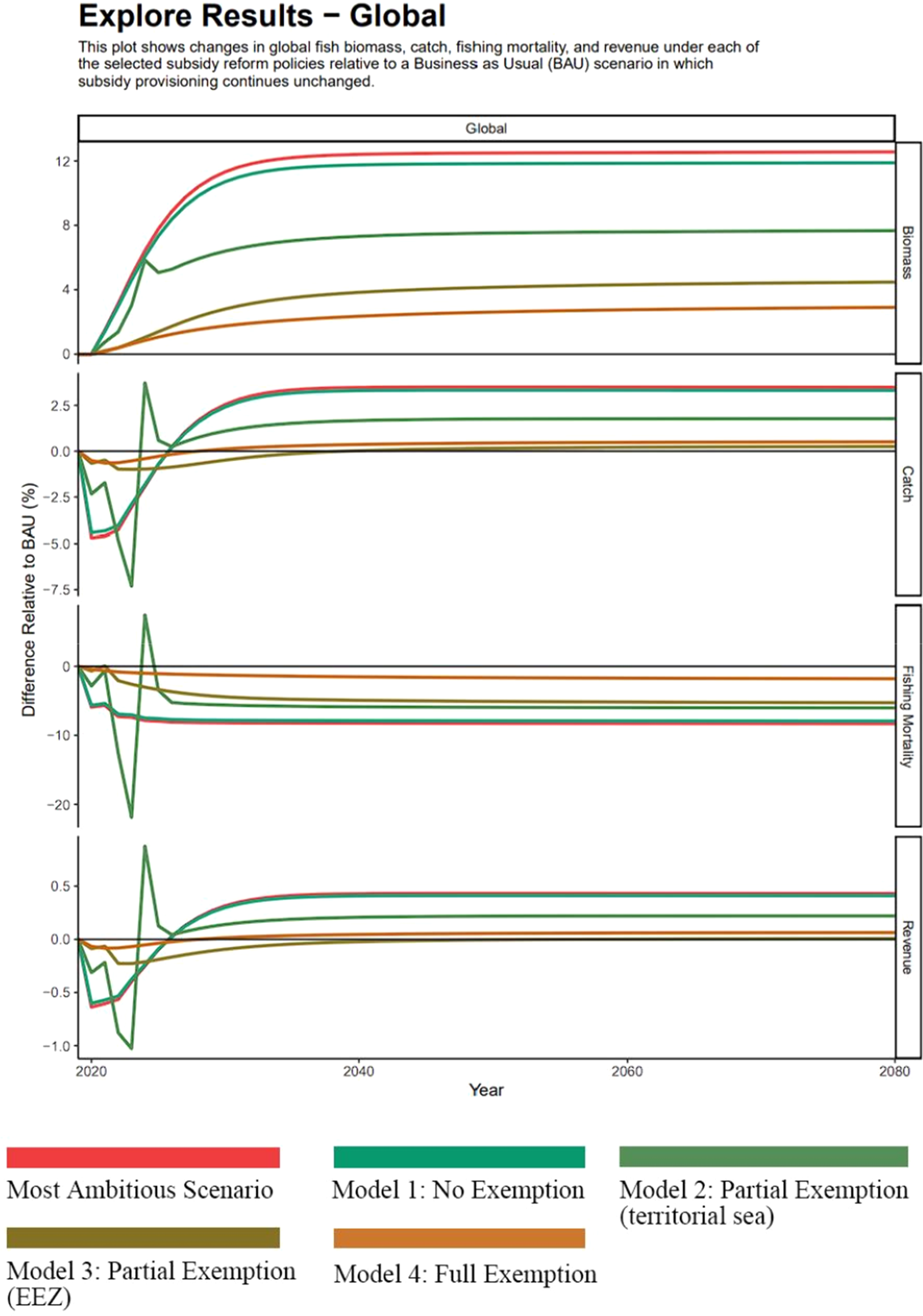
Against this backdrop, a conditionality approach that defines the scope of SDT of harmful subsides is conducive to easing the tension between economic growth and environmental protection by identifying the extent of exemption. This article utilizes the modeling results of different proposals generated by the SubsidyExplorerFootnote 89 to provide quantitative evidence. As demonstrated in Figure 2, four different models representing four levels of SDT predict the potential results. In these models, changes in Biomass and Mortality are two key indicators of the healthiness of fishery stock, while changes in Catches and Revenue indicate the change in fishery capacity. Amongst the four models, Model 1 represents a proposal of no exemption. Under this approach, no developing country, including LDC Members, is exempted from the obligation to prohibit all types of harmful subsidies. The result shows that the rebuilding of fishery stock will be positive, as Biomass will increase and Mortality will decrease significantly. However, the fishing industry will experience a sharp decline in the short term but then increase along with the stock. By contrast, Model 2 suggests a partial but equal exemption proposal that all vessels within developing countries' exclusive economic zones are exempted. In this model, the fishery stock is increasing, though much less than in Model 1. Nevertheless, such a positive change can unlikely be transformed into economic growth. Another partial exemption model is to exempt all vessels within developing countries' territorial seas from the obligation, as demonstrated in Model 3. Compared with Model 2, both fishery capacity and fishery stock in Model 3 will be less positive in the future. Thus, Model 3 also fails to reconcile the need to effectively restore fishery stock and increase fishery capacity. Finally, Model 4 indicates the result of full exemption, i.e. that all vessels of developing countries are exempted. If this proposal is adopted, the changes in fishery stock and fishery capacity are slight, maintaining the status quo for a few years. To sum up, Model 1 indicates the ‘trade-off’ effect in the short term and a ‘win–win’ scenario in the long run; Model 2 reflects a scenario of ‘win–lose’ between marine ecology and economy; Model 3 is similar to but less successful than Model 2; and Model 4 is the worst by showing a ‘lose–lose’ scenario.
Global simulation model results of four exemption proposals.
Source: SubsidyExplorer.

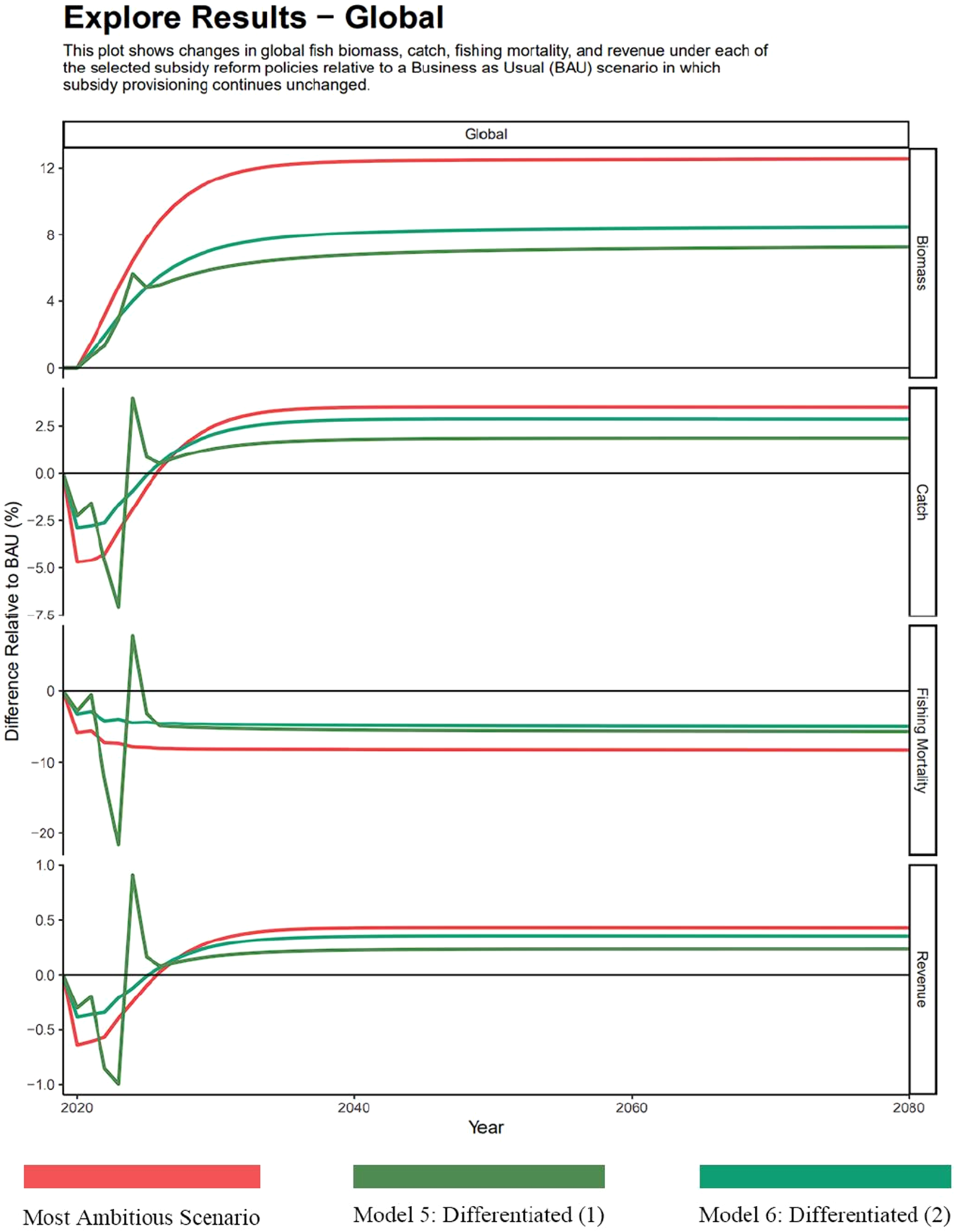
All aforementioned models cannot smoothly and significantly achieve the two goals completely, and they reflect that equal exemption for all developing countries is problematic in the sense that they fail to balance each country's specific needs and responsibilities. Thus, an alternative approach to overcoming these potential drawbacks should be explored. An approach that proposes differentiated SDT provisions for different countries seems to be feasible. The approach can be reflected in Model 5 and Model 6 (see Figure 3). Model 5 allows for a full exemption for LDCs, while leaving out some developing countries from exemption based on their marine capture production. Likewise, Model 6 exempts LDCs from the obligation, while merely permitting developing countries (excluding LDCs) to grant harmful subsidies in their territorial sea. These two models have an explicitly positive impact on fishery stock, as compared to the other most ambitious scenario which is designed by SubsidyExplorer as a reference scenario in which all subsidies with the potential to be capacity enhancing are removed, and they have a less negative impact on the fishing industry. It can be thus inferred that the need for environmental protection and economic growth is better balanced, provided that a conditionality approach that entails differentiated exemptions is adopted.
Global simulation model results of two differentiated exemption proposals. Source: SubsidyExplorer.

The conditionality approach defines the scope of SDT on harmful subsidies by identifying the extent of exemption based on the risks it would impose upon the fishery environment. It opts for a middle way, exempting only certain fisheries activities subsidized by some developing countries on the basis of the conditions of their fishing industry. First, it is proposed that once a developing country's fishing capacity reaches a certain level, its responsibility to protect the environment should prevail over its economic needs, and thus it cannot grant harmful subsidies for fisheries activities. As concluded by the FAO, fishing capacity is defined as the amount of fish (or fishing effort) that can be produced over a period of time (e.g., a year or a fishing season) by a vessel or a fleet if fully utilized (normal but unrestricted use) and for a given resource condition.Footnote 90 Fishing capacity can be assessed in either an input-based approach (e.g., the numbers of vessels or their effort applied) or a more convenient and simplified output-based approach (e.g., marine capture). Significant governmental subsidies that artificially boost the economic benefits of fishing companies, including those provided by developing countries, may increase fishing capacity at the expense of stock sustainability.Footnote 91 With greater capacity, countries shall bear more responsibilities to promote the achievement of SDGs. Accordingly, opting out developing countries from SDT exemption based on their annual global volume of marine capture becomes a tenable option to be embodied into the AFS. Members are suggested to endeavour further to agree upon the specific amount of annual marine capture, combined with other supplementary fishing capacity criteria, to limit the scope of SDT.
Second, for areas exposed to a high risk of overfishing or just recovering from previously high levels of fishing mortality, harmful subsidies cannot be temporarily granted by developing countries in these areas due to the priority of environmental protection. According to the Kobe Plot, which is a widely employed four-quadrant diagram to assess fishery stock, where actual fishing mortality is above the maximum sustainable yield and biomass is below the maximum sustainable yield for biomass, overfishing is likely to be occurring.Footnote 92 Based on the Kobe Plot, an illustrated situation is that harmful subsides can potentially increase capacity and effort, moving fisheries to a country where ‘overfishing’ occurs.Footnote 93 Therefore, granting of harmful subsidies to support fishing in these areas should be reduced or avoided so as to control the risks of stock depletion. In other words, fishing activities that can be subsidized by eligible countries are limited to fishing activities concerning a healthy stock that is not subject to a great risk of overfishing. Such a mechanism requires the WTO and relevant international organizations to monitor global fishery stock and deliver warnings and guidance to Members in granting harmful subsidies.
Third, if a developing country proves that effective fishery management can reduce the risks inherent in harmful subsidies, it may be allowed to grant certain subsidies in limited circumstances. The actual effect of fisheries subsidies not only depends on the specific type of subsidies, but also relates to different management regimes.Footnote 94 Although Members may apply various management approaches to subsidies to achieve their desired results, a responsible management includes, by and large, criteria relating to science-based assessments, regulatory limits, surveillance, and effective enforcement.Footnote 95 Effective fishery management can minimize the adverse effect of some harmful subsidies, or even transform the environmental effect into a positive one. For instance, while cost-reducing subsidies are ordinarily considered as harmful, individual quota-based management is able to minimize the negative effect on stocks.Footnote 96 Besides, subsidizing infrastructure programmes are generally detrimental to stocks, except where the management system can end the race for fish, and the fishery is clearly less than fully exploited.Footnote 97 Thus, negotiators may figure out a positive list to include certain types of subsidies permitted to be granted by developing countries under effective management. The burden of proof of effective management should be borne by developing countries attempting to utilize these types of subsidies. Such an approach can also encourage developing countries to reform and modernize their domestic fishery management strategies, thereby contributing to the global sustainable fisheries governance.
Under the conditionality approach, a set of conditions concerning fishing capacity, fishery stock, and the management regime can be developed to assess whether a developing country is eligible for the exemption and the extent to which such exemption is permitted. Accordingly, whether a developing country can enjoy SDT depends on its conditions, instead of a declaration of a developing country per se. For example, developing countries listed in the Top 25 fishing countries may be opted out from exemption because they have less urgent needs for the growth of fishery production and have more resources to overcome the short-term difficulties in the economy. However, through reforming fishery management strategies, those developing countries may still be eligible again to provide certain type of harmful subsidies. Differentiated treatments based on conditions are not discrimination, since the development needs of different developing countries are not ‘like’. While developing countries' development rights should be respected, whether and to what extent such rights can be exercised hinges on the specific conditions of each country. Eligibility is a dynamic mechanism to control the risks of overfished stock. By adopting and applying the conditionality approach, environmental protection and economic growth can be achieved complementarily and effectively.
5.2 Environment Sustainability and Social Development
Another potential conflict of pillars takes place when simultaneously satisfying environmental protection and social development. Marine fisheries are essential for food security, livelihood, and well-being in many communities around the world.Footnote 98 Particularly, fisheries play fundamental social roles in some developing countries. One the one hand, fisheries subsidies in the form of financial support targeting these social objectives apparently have positive impacts on food security and poverty alleviation, whereas they may also generate harmful effects on the environment. On the other hand, reducing financial support to rebuild the ecological system may create detrimental effects on the social stability in developing countries.
Among all types of fisheries activities, small-scale fisheries (SSF), including in subsistence and artisanal fisheries, distinctly demonstrates potential conflict. SSF commonly refers to activities such as working from shore or small boats in coastal waters.Footnote 99 Early literature primarily focusses on whether and how should preferential treatments be granted in the context of SDT.Footnote 100 However, it is noteworthy that the vast majority of SSF exists in developing countries where poverty rates are high and higher quality nutrition is strikingly needed.Footnote 101 The overlap between SSF and the priority of development in developing countries suggests that they cannot be examined separately.Footnote 102 SSF is essential for coastal communities in developing countries to ensure the supply of food and to maintain livelihoods. Despite these crucial social functions, SSF has a vulnerable nature in that SSF fishermen have fewer resources and support to address potential threats. Thus, governmental support remains important to stabilize SSF activities. With the introduction of new disciplines against fisheries subsidies in the AFS, governmental support would likely be reduced or even eliminated, which indubitably affects vulnerable SSF populations in the short term. Moreover, long-term recovery of fishing ecology does not automatically transform into the improvement of the well-being of communities.Footnote 103 Therefore, flexibility towards SSF, especially when taking place in developing countries, should be considered as a necessary and essential component in the broad context of SDT.
The sequentially practical problem is that it is perplexing for negotiators to define a proper scope of SSF flexibility. The distinction between ‘small’ and ‘large’ in scale is ordinarily relative, and thus different countries may apply various standards and thresholds. If divergent national definitions are adopted, while respecting each country's self-determination for their own needs, it would incorporate an exceeding degree of flexibility into the disciplines.Footnote 104 For example, by including certain large-scale fishing into the scope of SSF, a Member is able to tactically circumvent its obligations under the AFS. A common definition in the Agreement will make a clearer scope of exemption, but consensus is difficult, if not impossible, to reach during intense bargaining. The dilemma has rendered the negotiation regarding SSF that is slow and unproductive, leading to no relevant provision contained in the AFS to address SDT for SSF.
Facing the dilemma, it is submitted that negotiators can allow national definitions but also introduce an illustrative list of the features commonly accepted for SSF into agreements.Footnote 105 Features concerning the vessels' size or length involved in SSF, its purpose for local consumption, and relatively low capital can be considered to define SSF.Footnote 106 In this way, all Members' definitions would be restrained by the features in a closed list. Such a compromise tends to limit the flexibility towards SSF, and thus reduce obstacles to negotiation in the rule-making process.
In addition, given the potential trade-off tension between social development and the other two pillars, a number of essential conditions, which decide whether the granting of subsidies towards SSF is legitimate, should be considered. First, the purpose of SSF shall be limited to subsistence or artisanal, and is not for industrial development. Subsistence fisheries refer to non-commercial fisheries whose catch is predominantly consumed by the persons fishing it.Footnote 107 Artisanal fisheries intend to sell the catch, mainly in the local community.Footnote 108 Both types of fishing activities are essential for local communities, and thus subsidies provided to subsistence or artisanal fisheries at a small scale may be tolerated to an extent. In contrast, fisheries with high capital put into vessel moderation, port construction, or fuel purchase, and for mass commercialization, shall be excluded from the scope of SSF, irrespective of their vessel size. Limiting the purposes of SSF would better ensure that subsidized fishing activities are meant to satisfy social needs, such as food security and nutrition, rather than becoming disguised supports for industrial development.
Second, it is also important to take account of the situation of fishery stock in coastal waters when subsidizing SSF. If the fishery stock of subsidized fishing areas is unknown or even overexploited, it would be illegitimate to provide further subsidies for SSF. Subsidizing fishing activities on overexploited waters would artificially increase the marine production and reduce fishing resources more rapidly, making fisheries unsustainable in the long run. The shortage of fisheries would eventually endanger livelihoods and food security, leading to a ‘lose–lose’ scenario. In response to overexploitation, governments should not provide further subsidies, and should guide fishermen to reduce their fishing harvest. Besides, unknown fishery stocks make it difficult to assess the harmful effect of SSF subsidization. It would also significantly increase the risk of overexploitation and thus should not be allowed. By setting a condition, governments are encouraged to assess the fishery stock within their own jurisdiction, together with scientific institutes, and reasonably limit the amount of SSF subsidization to avoid overexploitation. Based on this approach, the need for social development and ecological balance can be better achieved.
Through applying economic, societal, and environmental conditions to define and limit the scope of subsidies for SSF, it becomes evident that the conditionality approach is more feasible to achieve the reconciliation between economic development, social needs, and environmental protection. This is because it necessarily takes into account the diverse needs of different countries, and the differentiated needs to reduce SSF vulnerability naturally, leading to divergent treatments of Members' rights and obligations. Notably, the conditions can play a crucial role in controlling potential harms to the environment, and further avoiding a vicious circle of competition between countries. On the contrary, granting unconditional access to SDT to certain developing countries, given their large volume of subsidies, would severely undermine the efficacy of new rules and cause increasing harmfulness to achieve environmental objectives.Footnote 109 In a nutshell, setting conditions to provide for flexibility towards SSF can be a preferential way to reconcile and ultimately achieve goals of environmental protection and social development under the AFS and enhance its effectiveness.
6. Potential Conditions Embedded in the ASF and Their Rationale
6.1 Prerequisite for Setting Conditions
It is acknowledged that the GATT was found on the embedded liberalism compromise in ideology, which was multilateral in character and its multilateralism would be predicated upon domestic interventionism,Footnote 110 and incorporated a variety of flexibilities in formulating norms to meet the needs of countries to improve social welfare. SDT represents one of such norms, aiming to integrate developing countries into the global trading system. Accordingly, embedding conditionality in SDT to achieve fishery sustainability should be proceeding in accord with the prerequisite of self-designation of ‘developing country’ status. A country itself is one of the best entities to assess its own development situation, as it has sufficient data and most relevant interests. Other country or entity may make unobjective and unfair assessment due to interest conflicts. Without explicit functions and objectives, the WTO as an international organization for trade development has no basis to develop criteria or rules in determining a country's general development status. Given that many developing countries have reiterated that developing countries should be allowed to make their own assessments regarding their own developing country status,Footnote 111 a consensus reached by all WTO Members on relinquishment of right to self-designate developing country status is seemingly challenging, even if possible.
A number of approaches have been put forward to substitute the self-designation rule. The graduation approach discussed at the beginning of this article proposes that a developing country, satisfying certain criteria, could be graduated from developing country status. Nevertheless, these criteria simply focus on economic output or incomes, which is neither sufficient nor comprehensive enough to reflect the development needs of a country. In addition, there are criteria other than listed groups that cannot be measured by a single objective index or ranking.Footnote 112 India, for example, has low per capita and is 132nd in the Human Development Index,Footnote 113 but is still a country deemed as an advanced developing country. Divides between the developing and developed world have widened in some areas, while new divides, such as those in the digital and technological spheres, are becoming more pronounced.Footnote 114 Thus, the complexity of development makes negotiations on graduation criteria thorny and high-cost.
It is also noteworthy that there is a recent trend that rule-making in the world trade regime increasingly focuses on subgroups of developing countries, especially LDCs. By the 2010s, ‘LDC-only’ legislation accounted for more than 60% of all SDT-inclusive publications.Footnote 115 The distributional consequence is that the majority of developing countries other than LDCs cannot be covered by new SDT provisions. Since the common identity as developing countries becomes weaker, the granting of SDT to narrower groups of developing countries potentially increases competition for SDT among all developing countries.Footnote 116 For the AFS, while maintaining the self-designation of developing country status, the diverse development needs of different subgroups of developing countries should be considered when setting conditions to exercise SDT exemption, instead of merely granting SDT to LDCs. As shown in Figure 4, the conditions proposed in the next session are intended to limit the ways in which developing countries can exercise their SDT rights to achieve sustainable development but not to cancel the self-designation nature of developing countries.
Proposed conditions for the next round of the AFS negotiation.

6.2 Potential Conditions
6.2.1 Considering Different Situations to Address Developing Countries’ Diverse Economic Needs
Developing countries have diverse economic needs which arise due to their unique socio-economic conditions, governance and institutions, and stage of economic development. It is critical to addressing specific economic needs to design effective rules that promote sustainable economic growth and development. In the context of SDT in the AFS, there are at least three different economic needs. The first one is development priority for poor countries, typically for LDCs which are low-income countries confronting severe structural impediments to sustainable development. LDCs are formally listed by the UN according to a country's income, human assets, and economic and environmental vulnerability.Footnote 117 It is not only important to grant a transition period for LDCs to gradually enhance fishery management and transform their subsidization strategy, but is also necessary to allow them the greatest degree of flexibility under relevant disciplines.Footnote 118
The second need relates to populous countries. Large population means vast nutrition needs and food demand. Taking China as an example, its marine production in 2022 reached 11,770,00 tones, which is the highest in the world. However, the per capita supply of marine fishing is 8.3 kilogram, which is significantly lower than many developing countries (see Table 1). The WHO recommends the consumption of one to two servings of fish a week,Footnote 119 and the European Food and Safety Authority (EFSA) recommends that adults consume 300 g of fish a week.Footnote 120 China's marine production can only supply around 159 g of fish a week, which is not sufficient for nutritional needs. To maintain the level of food supply and food security, populous countries are motivated to firstly increase the production of aquaculture, and secondly support marine fishing activities to maintain fishing output. If overfishing and overcapacity subsidies are not permitted, food supply and food security for the whole population would be threatened. Therefore, it becomes essential to address populous countries' needs by allowing for certain capacity-enhancing subsidies with the purpose of satisfying basic nutrition needs or filling the gap between marine fish supply and nutritional consumption.
TOP 25 marine power and their per capita marine production supply (sources: FAO and World Bank)Footnote 122

The third need concerns developing countries that have vulnerable fish resources and industry due to climate change. The United Nations Framework Convention on Climate Change (UNFCCC) stipulates that developed countries shall assist developing countries that are particularly vulnerable to the adverse effects of climate change.Footnote 121 As climate change can enormously injure local fisheries resources and marine production, it requires further assistance and policy support to restore fishing capacity. Caribbean countries have proposed a ‘small vulnerable economy’ differentiated strategy, under which small and dependent economies should be granted more flexibility to protect their trade interests. However, the proposal has not received formal acceptance by the WTO. Different from the concept of small vulnerable economies, this article does not aim to divide developing countries into subgroups. Instead, for any developing country encountering vulnerable fishing resulting from climate change, it may initiate temporary subsidization programs to enhance fishing stability and to resume fishing production. Developing countries attempts to initiate the programs should include reports and evidence to prove rationality and necessity, which will be subject to stringent fisheries vulnerability assessments.
6.2.2 Developing Sub-category Lists of Overfishing and Overcapacity Subsidies
The scope and type of subsidies contributing to overcapacity and overfishing are not without controversy in the drafting process of the AFS. The 2021 Consolidated Draft consists of a chapeau containing the main prohibition of subsidies that contribute to overcapacity and overfishing in general, followed by an illustrative list of eight types of subsidies that presumably contribute to overcapacity or overfishing.Footnote 123 The eight types of subsidies include: (a) subsidies to construction, acquisition, modernization, renovation or upgrading of vessels; (b) subsidies to the purchase of machines and equipment for vessels; (c) subsidies to the purchase/costs of fuel, ice, or bait; (d) subsidies to costs of personnel, social charges, or insurance; (e) income support for vessels or operators or the workers they employ; (f) price support of fish caught; (g) subsidies to at-sea support; and (h) subsidies covering operating losses of vessels or fishing or fishing-related activities.Footnote 124 Nonetheless, the list has been removed from the final version. The reason is partially that it is not fully justifiable to list all these subsidies into one category, since they may have different effects on fishing efforts and fish stock. For instance, subsidies to variable inputs, such as fuel, ice, or bait, are most likely to increase fishing effort and provoke overfishing, and subsidies to fixed inputs, such as construction and modernization subsidies, are most likely to increase fleet capacity.Footnote 125 By contrast, support subsidization based on fishers' incomes or support to fishery management are less likely to increase capacity or effort.
More importantly, the list probably generates an excessive scope for overfishing and overcapacity subsidies, given that the list is illustrative rather than exhaustive. The excessive scope of the list shrinks developing countries' policy flexibility to utilize subsidies to achieve important objectives such as fisheries sustainability. For example, subsidies for fisher assistance, vessel buybacks, and rural fisheries community development are categorized as ‘ambiguous subsidies’, since they have a potential to lead to either sustainable management or overexploitation of the fishery sources.Footnote 126 However, such subsidies fall within the ambit of Article 5.1(e) of the Consolidated Draft and are thus prohibited. According to the OECD, good subsidies include fisheries subsidies consisting of general services, such as fisheries protection services and fisheries management, local area weather forecasting, and the cost of navigation and satellite surveillance systems designed to assist the fishing fleets.Footnote 127 Although these good subsides are an essential support for navigation, they may be prohibited pursuant to Article 5.1(g) the Consolidated Draft.
This article proposes a more feasible ‘positive enumerations and negative exceptions’ approach to addressing the excessive scope by further dividing the listed overfishing and overcapacity subsidies into different groups. In terms of positive enumerations, subsidies that would directly increase fishing capacity and provoke overexploitation, including supports to inputs or outputs of fishing activities, can be categorized as ‘prohibited subsidies’ that cannot be provided by any country. This sub-category generally includes, but is not limited to, subsidies to the construction, acquisition, moderation of vessels, subsidies to the purchase of machines and equipment for vessels, and subsidies to the purchase of fuels. As for negative exceptions, subsidies that merely have a potential to generate harmful effects, including income support, vessel buybacks, rural fisheries community development support, and support for general services, can be allowed for developing countries. To limit their potential harmful effects on fisheries stocks, the condition to grant such subsidies is that they should be managed at a biologically sustainable level. An alleged Member shall bear the burden of proof that a respondent Member has violated this condition. The underlying rationale is that the harmful effect on fisheries stocks caused by subsidies provided by a developing country can only be established when there is sufficient evidence of the harmful effect, rather than a presumption. In this way, the AFS would encourage developing countries to change their subsidization structure, providing more subsidies that can directly increase fishers’ income and community support, and fewer subsidies that would completely harm fish resources. Such a condition would also motivate developing countries to improve fishery management to avoid potential harmful effects and possible WTO disputes.
6.2.3 Ensuring Flexibility for Subsidies to Support SSF
SSF is important for developing countries, as 97% of the world's fishers live in developing countries, of which 90% are engaged in the small-scale sector.Footnote 128 Particularly, in China a large proportion of the vessels are small-sized concentrating in nearshore waters, and approximate 75% of people engaged in marine fishing are traditional fishers who have been fishing for generations, living in remote rural areas with low education levels, and highly depending on fishing income.Footnote 129 SSF generates income and economic growth, provides nutritional sources, and maintains the identity, culture, and the wellbeing for millions of families in developing countries.Footnote 130 The UN Fish Stock Agreement (UNFSA) has recognized the need to avoid adverse impacts on, and ensure access to fisheries by, subsistence, small-scale and artisanal fishers.Footnote 131 During the AFS negotiation, many Members proposed flexibility towards SSF activities. LDC Group contended that disciplines on fisheries subsidies did not prevent developing countries providing subsidies to fishing activities related exclusively to artisanal and small-scale fisheries or to the subsistence and livelihood of the fishermen and their families.Footnote 132 To ensure that disciplines on fisheries subsidies do not put the necessary support to SSF at risk, it is essential to allow developing countries to provide overfishing and overcapacity subsidies to SSF. Such an exemption is also beneficial to increase social equity by encouraging developing countries to provide more support to poor fishers and local communities development, instead of industrial large-scale fishing activities.
As elucidated in Section 5.2, consensus over a common definition or the scope of SSF is difficult to achieve during bargaining. One alternative is that the common features and maximum scales allowed are explicitly listed, while each developing country can add selective features to further make their own definition within the allowable scope under the AFS. It is noteworthy that granting subsidies to SSF by developing countries is not without any limitation. While SSF is important to satisfy social needs in developing countries, it should not come along at the expense of environment. Accordingly, to reduce environmental risks, future negotiations may further consider several conditions to limit the scale of subsidization towards SSF. The first option is to limit the type of subsidies supporting SSF. Based on the sub-categorizing of harmful subsidies examined in the above section, it is not legitimate for developing countries to provide subsidies under the ‘positive enumeration’ list, due to the purposes of SSF. Providing flexibility on SSF is for social needs, such as life-supporting and local food security, instead of boosting economic growth. As subsidies under the ‘positive enumeration’ list would clearly increase fishing capacity, they are commonly used to support fisheries industry growth. In contrast, subsidies under the ‘negative exception’ list, such as income support or rural fisheries community development support, are better matching with the social needs of SSF. Therefore, limiting the type of subsidies toward SSF is more feasible than a blanket exemption.
The second potential condition concerns the fishing area of SSF. Given the small size of vessels used in SSF, most fishing activities would be conducted in coastal seas within territorial waters or exclusive economic zones. Accordingly, subsidies provided to these coastal waters can cover most of the SSF. However, if the fish stock in coastal seas is overexploited, then the subsidizing Member is responsible to withdraw the subsidies and take appropriate measures to stop further overexploitation. Thus, developing countries have to improve fishery management systems so as to avoid potential overexploitation caused by own subsidization policies, and the subsidies provided for SSF will potentially be managed and controlled at a biologically sustainable level.
6.2.4 Establishing Buffering Zones of Subsidization for Fishing Activities in Impending Overfished Stock
In accordance with the AFS, subsidies regarding overfished stock should not be provided by any country.Footnote 133 As proposed above, it is justifiable for developing countries to utilize this type of subsides under certain conditions. To mitigate the risk resulting from such subsidies, it becomes essential to establish an alarm mechanism to stop subsidization before the stock has been overfished. This article further proposes to establish buffering zones in certain fishing areas through an area-based management tool.
A significantly innovative approach to protecting marine resources under the recent International Legally Binding Instrument under United Nations Convention of Law of the Sea for the Conservation and Sustainable Use of Marine Biological Diversity beyond National Jurisdiction (BBNJ Agreement) is the establishment of the Marine Protected Areas (MPAs) as an area-based management tool. Particularly, high seas with impaired biological diversity can be determined as MPAs where certain activities are limited or prohibited.Footnote 134 Since the BBNJ Agreement and the AFS have the equivalent objective to protect the ocean and enhance sustainable development, similar area-based management tools can also be established under the AFS to limit the subsidization of fishing activities. More specifically, areas of overfished stocks can be marked as ‘Red’ so that no subsidies can be granted for fishing activities in the areas. Areas of fish stocks that are confronting the danger of being overfished, by using reference points such as maximum sustainable yield, are marked as ‘Yellow’. Subsidies for fishing activities in these areas should be gradually reduced, except for those beneficial subsidies for the environment. Lastly, areas that have a health stock are marked as ‘Green’, and thus subsidies that are allowed under the AFS can be provided as stipulated.
To establish such an area-based management tool, it requires the involvement of coastal countries and coordination of relevant regional fisheries management organizations or agreements. For coastal countries, as they have the jurisdiction of their territorial sea and exclusive economic zones, it is their right and responsibility to assess the fish stocks and submit their assessment to the Committee on Fisheries Subsidies. For high seas, the fish stock assessment should mainly be completed by relevant Regional Fisheries Management Organizations or Arrangements so as to provide guidance for developing countries’ subsidization programs. For instance, FAO has regularly assessed and reported the biological sustainability of fish stocks.Footnote 135 Similar assessment can be conducted in a more detailed and elaborated way to provide guidance for subsidization. Meanwhile, all WTO Members can assist in assessing fish stock to dynamically monitor fisheries resources. By establishing such a management tool, both surveillance of fish stock and cooperation among WTO Members can be strengthened.
Based on the tool, exercising SDT rights by developing countries is subject to a condition that the healthiness of fish stock should be ensured. Although developing countries’ various economic and social needs should be addressed and protected, such protection cannot be achieved on the basis of an economic–environmental trade-off. In other words, SDT rights have to be exercised in a manner whereby fish stocks are not depleted at an irreversible and unsustainable level.
6.2.5 Encouraging Developing Countries to Contribute on Fish Stock Restoration
Under SDG Goal 14, restoring of fish stock and enhancement of fishing sustainability are part of the important goals to achieve.Footnote 136 Efforts required not only include implementing disciplines on subsidies regarding overfished stock or overfishing and overcapacity subsidies, but also include environmentally beneficial programs for resources reservation. This is because subsidies for fisheries management and fisheries research are beneficial for natural resources.Footnote 137 Accordingly, environmentally beneficial subsidization programs should be encouraged in the AFS. Developing countries can provide beneficial subsidies to restore fish resources in the high sea or within their own jurisdiction. Besides, local communities can also be inspired to provide local support for fishery resource recovery programmes. Especially for those fish stocks that are marked as ‘Red’ or ‘Yellow’, financial support to stock recovery would be beneficial, if not necessary, to repay ecological debts and for future resource utilization.
6.2.6 Enhancing Technical Assistance to Facilitate Transformation
According to the AFS, developed countries are encouraged to provide targeted technical assistance and capacity building assistance to developing countries on a voluntary basis.Footnote 138 Such a provision is in line with the purpose to improve capacity for treaty implementation and facilitate transition. Nevertheless, if it is merely voluntary-based, technical assistance may not truly target developing countries’ needs. In practice, it is necessary to specify the contents and procedures of technical assistance to improve the delivery of technical assistance.Footnote 139 Notably, under the TFA, developing Members falling into Category C are allowed to accept assistance and support for capacity building from donor Members with mutually agreed terms.Footnote 140 In the fisheries context, WTO Members may adopt similar categorization, allowing certain developing Members and LDC Members to receive technical assistance. Besides, it will be beneficial to further illustrate the types of capacity-building and transfer of marine technology, which should include, inter alia, technical assistance on fish stock assessment, environmental-friendly fishing techniques, and assistance on fishery management. These illustrative examples can be provided in the AFS, serving as a guidance for WTO Members to make mutual agreements on technical assistance. In terms of procedures, the need of developing countries should be submitted to the WTO, and other countries can decide to respond to it. In this manner, technical assistance will become a country-driven, transparent and responsive mechanism that is more supportive for development needs of developing countries.
7. Conclusion
Unlike the SCM Agreement which focuses on efficiency and comparative advantage, the AFS represents a new trade paradigm shifting to the promotion of sustainable development and particularly delivering on SDG 14.6. As a part of ongoing efforts to address overfishing and ensure long-term viability of marine resources, the AFS seeks to contribute to the broader goals of fishery sustainability. Recognizing appropriate and effective SDT as a right for all developing countries, the exercise of such a right cannot hinder the pursuit of sustainable development. Although each country is entitled to make self-assessments regarding its development status, the CBDR principle and substantial equity denote that a developing country's specific needs should be taken into account when applying SDT in practice, which essentially justifies a conditional application of SDT.
Aimed at avoiding the oversimplified North–South division, a conditionality approach sets multi-dimensions of conditions in a flexible, adaptive, and integrated way that takes into account local economic, social, and environmental needs of different developing countries. In general terms, potential conditions embedded in SDT, which include, inter alia, developmental needs of LDCs, populous countries, and vulnerable economies, sub-category lists of overfishing and overcapacity subsidies, SSF flexibility, area-based management tools, and technical assistance to facilitate transformation, permit eligible developing countries to legitimately grant certain fisheries subsidies only when the economic, environmental, or societal harms can be prevented, mitigated, or at least controlled. These conditions not only demonstrate a delicate equilibrium by reconciling a diversity of interests of various developing countries, but also reflect a more rational and acceptable counterpoise between the current development need of developing countries and fishery sustainability for future generations. As SDT will be one of the most controversial issues in the second wave of negotiation on new disciplines, a conditionality approach can act as a middle way for WTO Members to negotiate a more comprehensive and effective AFS.