Introduction
Identifying risk factors for the development of post-traumatic stress disorder (PTSD) is important for understanding and ultimately preventing the disorder. Two meta-analytic studies (Brewin et al. Reference Brewin, Andrews and Valentine2000; Ozer et al. Reference Ozer, Best, Lipsey and Weiss2003) show that although quite a few risk factors have been identified, most have small effect sizes for the predictive value of who develops PTSD (Brewin et al. Reference Brewin, Andrews and Valentine2000; Brewin, Reference Brewin2005). Empirically supported risk factors include demographic variables (gender, age at time of trauma, socio-economic status, education, ethnicity), pre-traumatic experiences (prior trauma history, psychiatric history, child abuse, adverse childhood events, family psychiatric history), peritraumatic experiences (trauma severity, dissociation, acute stress disorder, high heart rates), and post-traumatic experiences (social support and life stress) (Bryant et al. Reference Bryant, Harvey, Guthrie and Moulds2003). Peritraumatic risk factors appear to have the greatest predictive power in who develops PTSD in that trauma severity and symptoms of acute stress disorder (ASD) are among the only risk factors that have shown medium or large effect sizes (Brewin et al. Reference Brewin, Andrews and Valentine2000; Ozer et al. Reference Ozer, Best, Lipsey and Weiss2003; Liberzon et al. Reference Liberzon, Abelson, Amdur, King, Cardneau and Henke2006a). Most studies have used a retrospective design, which raises issues regarding the accuracy of participant recall. The few studies that have used a prospective design, tracking individuals from the time of the trauma, have also identified peritraumatic risk factors including trauma severity and ASD symptoms to have the greatest predictive value for PTSD (e.g. Mayou & Bryant, Reference Mayou and Bryant1993; Shalev et al. Reference Shalev, Peri, Canetti and Schreiber1996; Bryant et al. Reference Bryant, Harvey, Guthrie and Moulds2003; Liberzon et al. Reference Liberzon, Abelson, Amdur, King, Cardneau and Henke2006a). The small effect sizes and the dearth of research using prospective designs has led researchers to conclude that there must be other risk factors or combinations that are more promising (Brewin et al. Reference Brewin, Andrews and Valentine2000).
One potential peritraumatic risk factor for the development of PTSD is the experience of pain at the time of the trauma. Pain and PTSD have shared neurobiological pathways (Asmundson et al. Reference Asmundson, Coons, Taylor and Katz2002; McLean et al. Reference McLean, Clauw, Abelson and Liberzon2005). Individuals with PTSD have been shown to have a low pain threshold, lower β-endorphin levels, and decreased production and release of methionine-enkephalin and, possibly, stress-induced analgesia (Friedman, Reference Friedman2000; Schwartz et al. Reference Schwartz, Bradley, Penza, Sexton, Jay, Haggard, Garlow and Ressler2006). The ventral basal ganglia dopamine neurotransmitter system has been implicated in stress response, negative emotion, and pain regulation (Scott et al. Reference Scott, Heitzeg, Koeppe, Stohler and Zubieta2006), suggesting that pain and the negative affect and stress associated with the response to trauma may share similar neurobiological mechanisms. One recent study suggests that the mu-opioid neurotransmitter system, implicated in responses to stress and suppression of pain, is lower in certain brain regions in individuals with PTSD than in non-traumatized and traumatized without PTSD control groups (Liberzon et al. Reference Liberzon, Abelson, Amdur, King, Cardneau and Henke2006b). Thus, it is possible that the neurobiological mechanism that predisposes individuals to respond with high scores to a pain scale may reflect a vulnerability to developing PTSD.
The mechanism that triggers acute pain may also serve to encode the memory of the trauma and trigger a PTSD-related process. Research on memory has shown that memories of painful events are readily retrievable (Morley, Reference Morley1993), indicating that strong encoding occurred at the time the pain was experienced. Subsequent pain may trigger trauma reminders of pain felt at the time of trauma (Asmundson et al. Reference Asmundson, Coons, Taylor and Katz2002). This model would offer some explanation as to why chronic pain and PTSD frequently co-occur (Sharp & Harvey, Reference Sharp and Harvey2001; Asmundson et al. Reference Asmundson, Coons, Taylor and Katz2002) and why prevalence of PTSD is particularly high when the chronic pain results directly from a traumatic event (Hickling & Blanchard, Reference Hickling and Blanchard1992; Taylor & Koch, Reference Taylor and Koch1995; Asmundson et al. Reference Asmundson, Norton, Allerdings, Norton and Larsen1998; Otis et al. Reference Otis, Keane and Kerns2003). In addition, peritraumatic pain may be an indicator of trauma severity, encompassing other risk factors such as the amount of injury sustained and the likelihood of death at the time of the trauma.
Few studies have examined the role of peritraumatic pain in the development of PTSD. In children with burns, the level of pain following the burn was a risk factor for developing PTSD in those who also experience separation anxiety during hospitalization or acute parental stress (Saxe et al. Reference Saxe, Stoddard, Hall, Chawla, Lopez, Sheridan, King, King and Yehuda2005; Stoddard et al. Reference Stoddard, Saxe, Ronfeldt, Drake, Burns, Edgren and Sheridan2006). Peritraumatic pain was a risk factor for PTSD in a sample of survivors of motor vehicle accidents (Kuhn, Reference Kuhn2004) and severe facial injury (Glynn et al. Reference Glynn, Shetty, Elliot-Brown, Leathers, Belin and Wang2007). Although pain and PTSD appear to share some neurobiological factors and frequently co-occur, the exact nature of the relationship, including the directional nature, is not yet well understood. Currently, peritraumatic pain has received little attention as a potential risk factor for the development of PTSD. If it is a risk factor, it would be simple to measure – in fact, this is typically already done as part of the routine medical assessment. Other peritraumatic risk factors, such as ASD or dissociation, require more extensive measurement that may not be feasible in all settings.
The goal of this study was to assess whether self-reported pain at the time of hospital admission for a traumatic injury increased the risk of PTSD diagnosis at 4 and 8 months post-injury. Specifically, hypotheses were (1) peritraumatic pain would increase the odds of PTSD at 4 and 8 months post-trauma, and (2) peritraumatic pain would be a proxy measure for later pain that acts as a reminder of the trauma and of trauma severity.
Method
Participants
Potential participants were men and women aged ⩽65 years who were admitted to the University of California San Diego (UCSD) Level 1 Surgical Trauma Center during the 15-month period from September 2002 to December 2004. Admission to this service reflected a severe physical injury requiring specialized, emergent trauma care. Some patients were admitted and discharged overnight or on weekends when the study was incompletely staffed, and therefore could not be screened for study participation prior to their discharge. Data for these subjects is not available. Drop-out rates for this observational study were 7% at 4 months and 20% at 8 months. All data were collected by a nurse who was trained in the administration of the instruments.
Subjects were excluded from participation if they (1) were too medically unstable to participate; (2) did not speak English; (3) were aged ⩽18 years or ⩾65 years; (4) had suffered a head injury that rendered them unconscious for more than 10 min; or (5) were taking psychotropic medications prior to injury. Medically unstable exclusion criteria were applied on a case-by-case basis in discussion between the study nurse, the trauma surgeon, and the study psychiatrist. Medically unstable subjects were usually too ill to participate in the informed consent process. Subjects with more severe head injury were excluded for similar reasons. Psychotropic medications were considered a possible confounding variable, and were excluded for that reason.
Twenty-four subjects who would have been eligible elected instead to enroll in a pharmacological PTSD prevention study (which enrolled a total of 48 subjects; Stein et al. in press) that was run in parallel with this study. Of 342 eligible, accessible subjects, 115 (33%) were willing to participate in this study. These individuals participated in the 1-, 4- and 8-month outcome assessments and their naturalistic course is the subject of this report.
All participants gave informed written consent to participate in this study, which was approved by the UCSD Human Research Protection Program.
Measures
24–48 h post-trauma
Peritraumatic Pain was assessed using the McGill Pain Questionnaire – Short Form (MPQ-SF; Melzack, Reference Melzack1987). This measure assesses quality and intensity of current pain, is widely used and has excellent psychometric properties (Melzack, Reference Melzack1987). MPQ-SF total score is a sum of 15 adjective, some describing the affective nature and others the sensory nature of the pain experience. MPQ-SF affective pain and MPQ-SF sensory pain scores which are components of the total score were also computed. The affective subscale consists of four items (e.g. sickening, fearful) and the sensory subscale consists of 11 items (e.g. throbbing, shooting) which use a 4-point likert scale (0, none; 3, severe). Participants also completed a visual analog scale (MPQ-SF VAS) anchored from 0 (no pain) to 10 (worst possible pain) typically referred to as the MPQ-SF VAS. The MPQ-SF also contains a measure of pain intensity which was not assessed. Peritraumatic pain was measured within 48 h of the traumatic event, while participants were still hospitalized for the traumatic injury. Reliability (Cronbach's α) in this data was 0.88 for total peritraumatic pain, 0.83 for sensory pain, and 0.73 for affective pain.
Past psychiatric history
Participants were asked if they had ever received counseling or therapy and if they had ever taken psychiatric medication. If they endorsed either item, they were coded as having past psychiatric history (Cronbach's α=0.53).
Perceived life threat
Participants were asked if, at the time of the injury, they believed their life was in danger or that they were going to die. If they endorsed either item, they were coded as having experienced a perceived life threat (Cronbach's α=0.73).
Intense emotions at the time of the trauma
Participants were asked if, at the time of the injury, they felt either helpless or terrified. If they endorsed either item, they were coded as having experienced intense emotions (Cronbach's α=0.69).
Trauma severity
This was measured using the New Injury Severity Score (NISS; Osler et al. Reference Osler, Baker and Long1997). The NISS is a modified version of the Injury Severity Score (ISS; Baker et al. Reference Baker, O'Neill and Haddon1974) which has been the standard summary measure of human trauma since the 1970s. The ISS was defined as the sum of the squares of the single highest injury score in each of the three most severely injured body regions. The ISS was limited by the fact that in patients with multiple injuries in a single body region, the ISS considered only one of the injuries within that region. Therefore, the NISS was modified so that it is the sum of the squares of the highest injury scores of a patient's three most severe injuries, regardless of body region. The NISS outperforms the ISS in power to predict mortality and has excellent psychometric properties (Osler et al. Reference Osler, Baker and Long1997). Psychometric properties for the current study were not assessed because the NISS was computed by the surgical trauma team.
1 month post-trauma
Acute Stress Disorder Structured Interview (ASDI; Bryant et al. Reference Bryant, Moulds and Guthrie2000). The ASDI is a 19-item, dichotomously scored interview that is based on DSM-IV criteria (APA, 1994). The interview shows good test–retest reliability (0.88), sensitivity (0.91) and specificity (0.93).
Prior trauma history
This was assessed using the Life Events Checklist, a well-standardized measure (LEC; Gray et al. Reference Gray, Litz, Hsu and Lombardo2004). Participants were read a list of 18 possible traumatic experiences (including an ‘other’ category) and asked in a yes/no format if they had ever experienced any of these events prior to their recent traumatic injury. Participants were coded as having experienced sexual trauma if they endorsed having experienced sexual assault (rape, attempted rape, made to perform any type of sexual act through force or threat of harm) or other unwanted or uncomfortable sexual contact. The trained interviewer assessed whether the latter experience met criterion A for PTSD. If participants endorsed domestic violence, physical assault, assault with a weapon or captivity, they were coded as having experienced physical assault.
4 and 8 months post-trauma
Post-traumatic stress disorder was assessed using the PTSD module of the Composite International Diagnostic Interview (WHO, 1997). For participants to be coded as having a diagnosis of PTSD, they were required to meet all criteria, including functional impairment. Psychometric properties range from good to excellent (Andrews & Peters, Reference Andrews and Peters1998).
Analysis plan
Logistic regression was used to compute unadjusted odds ratio for each of the previously identified risk factors measured in this study, each of the MPQ-SF pain scores, and PTSD status at 4 and 8 months post-injury. The previously identified risk factors that were measured in this study are listed in Table 1 (many but not all previously established risk factors were measured). When peritraumatic pain was a significant predictor, stepwise logistic regression models were run with peritraumatic pain in the first block, pain at the time of the follow-up (using follow-up pain score and opiate use) in the second block, non-peritraumatic risk factors that had significant unadjusted odds ratios in the third block, and peritraumatic risk factors that had significant unadjusted odds ratios in the fourth block to determine odds of developing PTSD. ASD was reported in several ways: as total ASD symptom score, ASD diagnosis, and total individual ASD symptoms cluster scores (e.g. dissociation, re-experiencing, etc.). If more than one of these methods of computing ASD significantly increased the odds of PTSD diagnosis, we only included ASD total score in the model. These predictors could not be entered into the model concurrently because they consist of overlapping items. Pain at time of the follow-up PTSD assessment point and opiate use were included to assess whether peritraumatic pain was better explained by chronic pain as a reminder of the traumatic event, or whether it made a unique contribution.
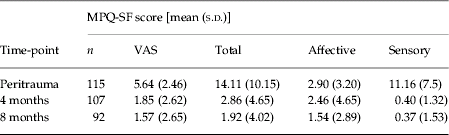
MSQ-SF pain scores within 48 h of the trauma, at 4 months, and 8 months

MPQ-SF, McGill Pain Questionnaire – Short Form; VAS, visual analog scale.
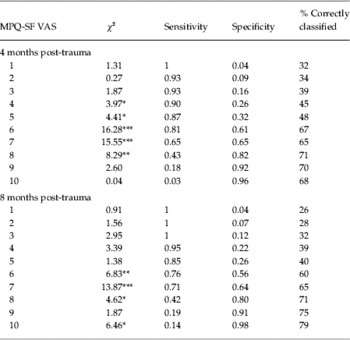
Receiver-operating characteristics (ROC) curves and χ2 tests were used to determine sensitivity, specificity, and percent correctly classified for each cut-score on the MPQ-SF VAS (0–10) immediately following the injury at 4 and 8 months. A ROC curve is a plot of the true positive rate (sensitivity) against the false positive rate (1 – specificity) for the different possible cut-points of a diagnostic test. Thus, the ROC curve is a visual representation of the tradeoff between sensitivity and specificity. Any increase in sensitivity will be accompanied by a decrease in specificity.
Results
Participant characteristics
Participants (n=115) were primarily male (63%), mostly employed (83%), and mostly Caucasian (47%) or Hispanic (30%). Eleven percent were African-American, and 9% were Asian. Mean age was 36 years and average years of education was 13. Approximately an equal proportion of participants was single (42%) and married or living with a partner (43%). An additional 10% were separated or divorced and 4% were widowed. The majority of participants were admitted to the surgical trauma center due to accidents involving motor vehicles (66%). Other types of traumatic events included burns (5%), falls (6%), occupational injuries (4%), recreational injuries (e.g. jet skiing accident, hang gliding accident, 3%), stab wounds and gunshot wounds (10%), and assault (3%). Females were more likely to develop PTSD than males (52% v. 15% at 4 months [χ2(1, 107)=16.65, p<0.0001], and 35% v. 15% at 8 months [χ2 (1, 92)=5.32, p<0.05]).
Almost the entire sample (94%) reported having experienced a traumatic event prior to the index physical injury, 51% reported having been physically assaulted, and 16% reported having been sexually assaulted. These rates are higher than trauma rates in the general population (Kessler et al. Reference Kessler, Sonnega, Bromet, Hughes and Nelson1995). Thirty-seven percent reported having been in psychotherapy or on psychotropic medications in their lifetime. This is also higher than treatment rates reported in the general population (Kessler et al. Reference Kessler, McGonagle, Zhao, Nelson, Hughes, Eshleman, Wittchen and Kendler1994). Mean peritraumatic pain scores at each visit can be seen in Table 1.
PTSD at 4 months post-trauma
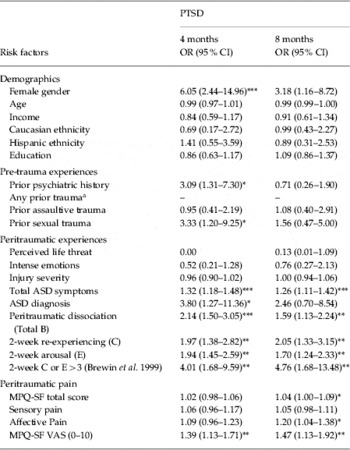
Unadjusted odds ratios showed that the MPQ-SF VAS, gender, prior psychiatric history, prior sexual trauma, ASD total symptoms, ASD diagnosis, and symptoms of dissociation, re-experiencing, and arousal during the first month following the traumatic event significantly increased the odds of having a PTSD diagnosis (Table 2). Participants with PTSD at 4 months had significantly higher peritraumatic MPQ-SF VAS ratings than participants without PTSD [mean (s.d.)=6.87 (2.16), and 5.05 (1.43) respectively; F(1, 106)=12.01, p<0.001]. Being ⩾0.5 s.d. above the mean on MPQ-SF VAS (i.e. having a score ⩾6.87) was associated with a more than fivefold increase in odds of developing PTSD (OR 5.62, 95% CI 2.29–13.78, p<0.0001).
Unadjusted odds ratios for risk factors for developing PTSD at 4 and 8 months post-trauma

OR, Odds ratio; CI, confidence interval; ASD, acute stress disorder; MPQ-SF, McGill Pain Questionnaire Short Form; VAS, visual analog scale.
a Unable to compute odds associated with ‘Any Prior Trauma’ because 94% of participants reported prior trauma.
* p<0.05, ** p<0.01, *** p<0.001.
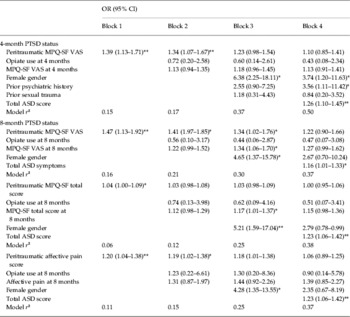
The correlation between MPQ-SF VAS at 4 months and PTSD status at 4 months was r=0.53, p<0.0001 and 14% of participants were taking opiate pain medication. Table 3 shows that peritraumatic MPQ-SF VAS remained a significant predictor when opiate use and pain rating at 4 months was added to the stepwise logistic regression model, but was no longer significant when gender, prior psychiatric history, prior sexual trauma, and total ASD symptom score were added to the model.
Stepwise logistic regression model to predict PTSD status at 4 and 8 months post-trauma

OR, Odds ratio; CI, confidence interval; ASD, Acute stress disorder; MPQ-SF VAS, McGill Pain Questionnaire visual analog scale.
* p<0.05, ** p<0.01.
PTSD at 8 months post-trauma
Peritraumatic MPQ-SF total score, affective pain, and VAS, gender, total ASD symptoms, and symptoms of dissociation, re-experiencing, and arousal during the first month following the traumatic event significantly increased the odds of having a PTSD diagnosis (Table 2). Participants with PTSD at 8-months had significantly higher peritraumatic MPQ-SF VAS ratings than participants without PTSD [mean (s.d.)=7.04 (1.98) and 5.26 (2.32), respectively; F(1, 91)=10.11, p<0.01]. Being ⩾0.5 s.d. above the mean on peritraumatic MPQ-SF VAS (i.e. having a score ⩾6.87) was associated with an almost sevenfold increase in odds of developing PTSD (OR 6.84, 95% CI 2.31–20.20, p<0.0001).
The correlation between MPQ-SF VAS at 8 months and PTSD status at 8 months was r=0.42, p<0.0001 and 10% of participants were taking opiate pain medication. Peritraumatic MPQ-SF VAS was still a significant predictor of PTSD at 8 months when MPQ-SF VAS and opiate use at 8 months and gender were added to the model. Once total ASD symptoms were added to the model, none of the other predictors in the model significantly predicted PTSD diagnosis (Table 3).
MPQ-SF total score was no longer a significant predictor when MPQ-SF total score at 8 months and other significant risk factors (gender and total ASD score) were added to the model. Only ASD total score was a significant predictor in the final model. Affective pain score remained a significant predictor of PTSD when opiate use, 8-month affective pain score, and gender were added to the model, but not when total ASD score was added to the model (Table 3).
Logistic regression models to predict PTSD status at 4 and 8 months including gender, peritraumatic pain, and the interaction term of gender by peritraumatic pain showed that the interaction term was not significant, therefore the role of gender was not examined further.
Sensitivity, specificity, and correct classification
Whether a particular cut-off score on the MPQ-VAS was best able to discriminate those who had diagnoses of PTSD at 4 and 8 months from those who did not was assessed. To do so, for each of the two follow-up time points, (1) a ROC curve between MPQ-VAS and PTSD diagnostic status was calculated and (2) χ2 tests at each of the 10 possible cut-points (e.g. a score equal to 10 versus scores <10, a score ⩾9 versus<9, and so forth) and then sensitivity, specificity, and the percent of participants that each cut-point classified correctly were calculated. Sensitivity was calculated as true positives divided by the sum of true positives plus false negatives. Specificity was calculated as true negatives divided by the sum of true negatives plus false positives. Correct classification was calculated as the sum of true positives plus true negatives divided by the total n.
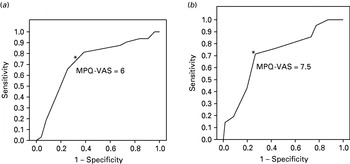
At 4 months post-trauma, the ROC curve shows that a MPQ-VAS score of ~6 maximizes sensitivity relative to specificity (Fig. 1). Consistent with the ROC curve, Table 4 shows that a cut-off score of ⩾6 maximizes sensitivity relative to specificity, with 65% of participants classified correctly. At 8 months post-trauma, the ROC curve shows that a score between 7 and 8 maximizes sensitivity relative to specificity (Fig. 1), with 65% of participants classified correctly (Table 4).
Receiving operator characteristic (ROC) curve for peritraumatic pain rating to predict PTSD status at (a) 4 months and (b) 8 months. * Indicates the value that maximizes sensitivity relative to specificity. MPQ-VAS, McGill Pain Questionnaire visual analog scale.

Sensitivity, specificity, and efficiency of peritraumatic MPQ-SF VAS cut-off scores for PTSD at 4 months (n=107) and 8 months (n=92) post-trauma

MPQ-SF VAS, McGill Pain Questionnaire visual analog scale.
* p<0.05, ** p<0.01, *** p<0.001.
Discussion
Results of this study show that peritraumatic pain is a risk factor for PTSD in a mixed gender sample recruited from a level 1 surgical trauma center. An increase of 0.5 s.d. from the mean in peritraumatic pain rating increased the odds of PTSD at 4 months by more than fivefold and at 8 months by almost sevenfold, indicating a large effect size (Sanchez-Meca et al. Reference Sanchez-Meca, Marin-Martinez and Chacon-Moscoso2003). A single item regarding amount of pain at the time of hospital admission for traumatic injury correctly classified 65% of participants. Assessment of many PTSD risk factors involves long measurement or the measurement of psychological constructs not normally assessed in emergency treatment settings. Pain rating is a single item that is typically already measured as part of the routine medical assessment.
Only peritraumatic VAS rating increased the odds of PTSD at 4 months post-trauma, while at 8 months, VAS, MPQ-SF affective score, and total score increased the odds of later PTSD. Whereas proximally (at 4 months) there are many factors influencing PTSD, as time passes stronger memory encoding maintains the symptoms. The fact that affective pain rating predicted later PTSD indicates that patients likely to develop PTSD were already making negative appraisals of their pain (i.e. interpreting the pain as tiring, punishing, sickening, and/or fearful). Several researchers have proposed that the way in which one cognitively processes traumatic experiences (in particular, negative and catastrophic appraisals) may influence PTSD development (Ehlers et al. Reference Ehlers, Mayou and Bryant1998; Engelhard et al. Reference Engelhard, van den Hout, Arntz and McNally2002; Bryant, Reference Bryant2005). Peritraumatic pain may lead to more negative evaluations of the trauma memory and more distress associated with the trauma, thus mediating this relationship.
The hypothesis that peritraumatic pain is a risk factor because later pain acts as a reminder of the trauma and a cue for PTSD symptoms was not supported. Although later pain also increased the odds of having a PTSD diagnosis in some cases, peritraumatic pain remained significant even when controlling for later pain. The hypothesis that peritraumatic pain may be an indicator of trauma severity also was not supported. The correlation between the MPQ-SF VAS and trauma severity was not significant (r=0.11). Trauma severity was not a significant risk factor in this study, possibly because most patients who end up in a level 1 surgical trauma center have high trauma severity (i.e. there is range restriction in the data).
Alternatively, the experience of pain appears to be associated with strong memory encoding, possibly similar to the process by which emotionally salient events have strong encoding (e.g. Schelling, Reference Schelling2002). This is supported by evidence from memory research showing that memories encoded during pain are strongly encoded and easily retrievable (Seltzer & Yarczower, Reference Seltzer and Yarczower1991; Morley, Reference Morley1993). In a recent study of traumatic memories, peritraumatic pain was the most salient features of the memory at 1-week and 6-month follow-up (Schelling, Reference Schelling2002). This would suggest that the heightened memory due to the experience of pain may lead to a greater risk of later PTSD. Although the mechanism by which peritraumatic pain is caused is not yet clear, results of this study lead to the supposition that more aggressive treatment of pain [with either pharmacological (e.g. opiates) or psychological treatments] might prevent or reduce the burden of PTSD. These hypotheses regarding PTSD etiology, prevention and treatment can be tested in future studies.
The prospective design of this study allowed for further examination of previously established risk factors for PTSD. Consistent with prior research (Brewin et al. Reference Brewin, Andrews and Valentine2000; Ozer et al. Reference Ozer, Best, Lipsey and Weiss2003), peritraumatic symptoms of dissociation and other ASD symptoms had the strongest relationship with PTSD. The only demographic variable that was significant was gender. The only other variables that had significant predictive power were history of sexual trauma and prior psychiatric treatment. Converting the odds ratios found in this study to the effect size r used in meta-analytic studies (as suggested by Sanchez-Meca et al. Reference Sanchez-Meca, Marin-Martinez and Chacon-Moscoso2003) showed that, similar to meta-analytic findings (Brewin et al. Reference Brewin, Andrews and Valentine2000; Ozer et al. Reference Ozer, Best, Lipsey and Weiss2003), effect sizes in the present study were small (OR <2 or r<0.20), with the exception of ASD scores which had a medium effect size (OR >2 or r>0.20) and gender and being 0.5 s.d. above the mean on the VAS, which had a large effect size (OR >3.75 or r>0.37). These findings add further evidence that acute stress symptoms are a strong predictor of later development of PTSD. This study examined individuals who had experienced a discrete traumatic experience leading to hospitalization. It is not clear whether these findings would apply to individuals who experience ongoing traumatic stressors such as domestic violence or combat experience.
This study has several limitations that suggest the findings should be interpreted with caution. A larger sample size would have allowed for testing of more complex models about how different risk factors may interact with each other. Selection bias is possible given the relatively low participation rate (only 33%). This, along with the small sample size, preponderance of males, and very high rate of previous trauma history show the need for future studies to demonstrate the generalizability of these results. PTSD for prior traumas was not assessed. Not all previously identified risk factors for PTSD development, such as social support and stress following trauma, were assessed. There is very little information on some risk factors that were assessed. For past psychiatric history, only whether someone had received prior counseling or taken psychiatric medication is known. Someone may have received counseling without having a psychiatric condition. Similarly, intense emotions at the time of the trauma were measured only by asking if participants felt helplessness or terror at the time of the trauma. Other than medication use, data on treatments received during the follow-up interval were not collected, thus it was not possible to adjust for impact of psychological treatment. It is not known whether assault victims were sexually assaulted. Information on length of hospital stay was also not collected. Pain experiences prior to the traumatic event were also not assessed, so it is not possible to determine if having pain going into a traumatic event increases the likelihood of developing PTSD. It cannot be confirmed that the baseline VAS rating was in regard to the injury, although admission to a trauma center, the nature of the reported injuries (motor vehicle accidents), and the much higher mean VAS at baseline than at subsequent assessment points several months later would suggest that it was.
This study adds to the knowledge of the complex interplay between pain and PTSD. A recent review of prospective studies on developing PTSD highlights that there may be multiple pathways by which PTSD is developed (Bryant, Reference Bryant2003). Peritraumatic pain alone or in combination with other factors appears to play a role in the development of PTSD, at least for some individuals exposed to trauma. Peritraumatic pain appears to have a unique role as a risk factor in PTSD development, and is not simply a proxy for trauma severity or later chronic pain. If these findings are replicated, high levels of peritraumatic pain could be used to identify individuals at elevated risk for PTSD following traumatic injury. Such individuals could be targeted for more careful monitoring for the persistence of PTSD symptoms, and for early intervention if warranted.
Acknowledgments
The authors are grateful to Carol Kerridge R. N., M. P. H., for her tireless efforts in coordinating this study and to Gregory Norman, Ph.D., for help with statistics. This study was supported by a grant from the National Institute of Mental Health (R21 MH62037) to M. B. S. and an NIAAA K-23 award to S. B. N.
Declaration of Interest
None.