


1. Introduction
Values, social norms, and beliefs have been identified as being crucial in governing individuals’ behaviors (Guiso et al., Reference Guiso, Sapienza and Zingales2006; Bisin and Federico, Reference Bisin and Federico2021; Persson and Tabellini, Reference Persson and Tabellini2021). Religion represents one of the most enduring sources of such norms. Evidence from public opinion surveys illustrates a continuing relevance of religion in modern societies: three-quarters of U.S. adults say religion is at least “somewhat” important in their lives, while in Western Europe the majority of people still identify as Christian, including 71% in Germany and 80% in Italy (Cooperman and Sahgal, Reference Cooperman and Sahgal2018). Despite the undeniable importance of religion, empirical studies showing the effect of religious values and precepts on politicians’ decisions are still lacking.
In the existing literature, this influence of religion on social norms and political behavior is typically captured through the concept of religiosity, defined as the strength and salience of religious beliefs and practices (Bentzen, Reference Bentzen2021). Recent developments in political science have highlighted the significant role of religiosity in shaping voters’ decisions (Tilley, Reference Tilley2015; Huber and Mohamed, Reference Huber and Mohamed2023; Smith and Boas, Reference Smith and Boas2024). In this regard, scholars conventionally characterize religion’s electoral influence as conservative (Kotler-Berkowitz, Reference Kotler-Berkowitz2001; Fink, Reference Fink2008; Campbell et al., Reference Campbell, Green and Layman2011, Reference Campbell, Layman, Green and Sumaktoyo2018; Castles, Reference Castles2019).Footnote 1 Religion and welfare state spending have been found to be substitute mechanisms that insure individuals against adverse life events (Scheve and Stasavage, Reference Scheve and Stasavage2006). More recent work underlines the role religiosity plays as an important driver of voter mobilization (McClendon and Riedl, Reference McClendon and Riedl2015; Tuñón, Reference Tuñón2019; Pulejo, Reference Pulejo2024).
But how do religiosity and religious values affect politicians’ decisions once in office? Existing literature has already examined how politicians’ policy choices vary based on their personal characteristics. Within the context of a standard citizen-candidate model, factors such as gender (Ferreira and Gyourko, Reference Ferreira and Gyourko2014; Holman, Reference Holman2014), social class (Carnes and Lupu, Reference Carnes and Lupu2015; Kirkland, Reference Kirkland2021), and race (Hopkins and McCabe, Reference Hopkins and McCabe2012; Nye et al., Reference Nye, Rainer and Stratmann2015) have all been identified as significant predictors of politicians’ behavior. However, the extent to which religiosity shapes the decision-making processes of policymakers remains unclear.
Scholars have studied the effect of having religious politicians in Islamic contexts (Yadav, Reference Yadav2023), finding an effect on violence (Nellis and Siddiqui, Reference Nellis and Siddiqui2018) and female education (Meyersson, Reference Meyersson2014). However, these works do not explain the role of religiosity in politicians’ individual decisions, but they rather assess the effect of having politicians from parties with a strong religious agenda. This paper aims to fill this gap, showing that religiosity directly shapes the preferences of local administrators and policymakers.
The outcome of interest in this paper is debt repayment, a key aspect of fiscal policy that shapes governments’ ability to deliver public services. I find that Italian mayors who grew up in highly Catholic families tend to repay more debt. The mechanism is grounded in two complementary channels. The first is specifically Catholic: Church doctrine has long framed debt repayment as a matter of justice, duty, and moral responsibility. While Catholicism has not consistently opposed public borrowing, it has emphasized that obligations must be honored and that debt should not be shifted onto others. These teachings imply that Catholic mayors should feel a stronger moral pull to reduce liabilities, rather than simply avoid new ones. The second mechanism is broader and not specific to Catholicism: a large literature shows that religiosity is correlated with greater risk aversion (Iannaccone, Reference Iannaccone1998; Noussair et al., Reference Noussair, Trautmann, Van de Kuilen and Vellekoop2013; Yadav, Reference Yadav2023), which may manifest in a more cautious fiscal stance.
Italy represents an ideal setting to test the hypothesis. Catholicism in Italy is indeed an institutionalized moral system embedded in schools, media, and local civic life. This makes Italy a “most likely” case for detecting whether doctrinal norms translate into observable patterns of fiscal conduct. At the same time, the country exhibits substantial individual variation in religious intensity, offering meaningful within-country leverage to address the research question. From a comparative perspective, Italy occupies an intermediate position between more secularized Northern European democracies and countries where public institutions themselves are explicitly shaped by religion. The mechanisms identified in this paper are arguably not uniquely Italian, but may extend to other Catholic contexts such as Spain, Portugal, or Mexico.
Determining the causation between religiosity and political decisions is complex. While some politicians might be influenced directly by religious beliefs, other factors like constituents’ expectations, political ideology, and party affiliation could also play significant roles. To causally identify the effect, I use a close-election regression discontinuity design (RDD) in Italian municipalities separating candidates as religious vs. nonreligious. I use heterogeneity in candidates’ first names to measure religiosity. The approach reflects existing tendencies in inferring culture from parents’ choices, where the idea is to use first names to proxy parents’ worldviews. Existing work has used this approach to study a variety of parents’ values, such as individualism (Knudsen, Reference Knudsen2019), the strength of black ethnic identity (Fryer and Levitt, Reference Fryer and Levitt2004), nationalism (Assouad, Reference Assouad2020), and religiosity (Andersen and Bentzen, Reference Andersen and Bentzen2024). I contribute to this literature by exploiting local heterogeneity in municipalities’ patrons’ names. Given the importance and the heterogeneity of local patrons, I code as religious those candidates sharing their first name with the patron saint of their municipality.
Before applying the measure in empirical analyses, I conduct a thorough set of tests to validate its accuracy. I show that individuals named after their town’s patron saint are overrepresented among religious figures and Christian-Democratic leaders, more likely to follow the Pope on X, share last names with priests, and emphasize religious activities on their Curriculum Vitae (CVs). This documentation supports the idea that patron names are associated with a stronger emphasis on religious involvement.
Empirical results show that mayors likely raised in Catholic environments significantly increase their debt repayment compared to nonreligious mayors. The estimated effect is substantively large: Catholic mayors increase debt repayment by about 30%, roughly one-third of a standard deviation of the outcome variable. This magnitude is on par with the fiscal effects of major institutional reforms such as external auditing or populist turnover. The analysis reveals three key findings on the heterogeneity of religiosity’s effect on debt repayment. First, religious mayors repay significantly more debt when they are term-limited, suggesting that the absence of re-election pressures allows them to prioritize Catholic values over political concerns. Second, the influence of religiosity on debt repayment is notably stronger among low-educated mayors, perhaps due to a deeper adherence to Catholic teachings shaped by upbringing. Third, the effect is stronger when the borrowing costs are higher, consistent with the idea that moral duty and risk aversion operate jointly rather than in opposition.
This paper provides three main contributions. First, the results provided in this paper add a novel dimension to the large body of research on substantive representation that demonstrates that politicians’ personal characteristics systematically shape the policies they pursue once in office. Existing studies established the effect of social class and occupation on politicians’ fiscal priorities (Carnes and Lupu, Reference Carnes and Lupu2015, Reference Carnes and Lupu2023; O’Grady, Reference O’Grady2019; Kirkland, Reference Kirkland2021), of gender on welfare and social service provision (Chattopadhyay and Duflo, Reference Chattopadhyay and Duflo2004; Schwindt-Bayer, Reference Schwindt-Bayer2006; Ferreira and Gyourko, Reference Ferreira and Gyourko2014; Holman, Reference Holman2014), and of race and ethnicity on patterns of public spending (Hopkins and McCabe, Reference Hopkins and McCabe2012; Nye et al., Reference Nye, Rainer and Stratmann2015). More recent work highlighted the role of age (McClean, Reference McClean2025) and education (Curto-Grau and Gallego, Reference Curto-Grau and Gallego2021; Mitra, Reference Mitra2025), as well as sexual orientation (Reynolds, Reference Reynolds2013). This study introduces religiosity as a previously overlooked component of politicians’ personal characteristics, showing that religious values and precepts can directly influence the policy decisions of elected politicians.
Second, the paper contributes to a large literature on religion and politics. In particular, this study seeks to expand the knowledge of the relationship between religiosity and policy-making (Chaudhary and Rubin, Reference Chaudhary and Rubin2016), and the consequences of ideology alignment with non-state actors (Hungerman, Reference Hungerman2005; Bracco et al., Reference Bracco, Lockwood, Porcelli and Redoano2015; Kleider et al., Reference Kleider, Röth and Garritzmann2018). Previous research has mainly focused on morality policies (Minkenberg, Reference Minkenberg2002; Fink, Reference Fink2008; Knill et al., Reference Knill, Preidel and Nebel2014), overlooking other important dimensions of public policy.
Third, a novel index for religiosity, based on matching individuals’ names with those of the patron saint of their municipality, is proposed and validated. This index holds great promise to constitute a complement to the one recently proposed by Andersen and Bentzen (Reference Andersen and Bentzen2024). Namely, it provides a way to capture religiosity in more recent times and for a different set of countries, potentially expanding the scope of future studies in the economics of religion aimed at quantifying the effect of individuals’ religiosity on socioeconomic outcomes.
2. A theory of Catholicism and debt
This section develops a framework linking Catholic religiosity to municipal debt policy, with particular attention to repayment behavior. Public debt is a multidimensional domain that includes both the decision to accumulate new liabilities and the timing and effort devoted to servicing existing ones. The argument developed here focuses on repayment as the most meaningful site of moral choice for Catholic officeholders. The following subsections distinguish between two conceptually related but analytically distinct pathways. The first is rooted in specifically Catholic teachings that frame repayment as a matter of moral duty and commutative justice. The second reflects a broader connection between religiosity and greater risk aversion, which may translate into more fiscally cautious behavior.
2.1. Catholic doctrine and the duty to repay debt
Debt has long carried a negative moral connotation in Catholic thought. The Catholic Church itself historically prohibited the practice of charging interest on loans, but these rules were frequently ignored. To address this, the Church hierarchy launched preaching campaigns, sending mendicant friars to travel from town to town. These friars warned usurers that unless they repented and fully repaid the interest they had collected, they would face eternal damnation. Many of these sermons, which have survived, are filled with vivid accounts of divine judgment on those who did not repent (Graeber, Reference Graeber2011).Footnote 2 This attitude contributed to a durable moral framework in which the repayment of what one owes—rather than the accumulation of new debt—was framed as a matter of justice, duty, and personal rectitude, a view still echoed in contemporary Catholic teaching.
Catholic teachings emphasize the importance of responsible stewardship of resources and fulfilling one’s obligations. The Bible itself and other sacred texts underline the importance of repaying or canceling debt for a good Christian. “If anything is borrowed, it should be paid back. If what is borrowed is lost or injured, full restitution must be made. (Exodus 22:14)” and “The wicked borrows but does not pay back, but the righteous is generous and gives. (Ps 37:21)” are two examples of passages from the Bible that stress the importance of repaying debt even more than not contracting it as part of being a good Christian.Footnote 3 The Catechism of the Catholic Church explicitly frames the repayment of debts as a matter of commutative justice—a moral obligation to honor contracts and return what is owed.Footnote 4 It condemns the unjust retention of property and emphasizes that promises must be kept and debts paid.Footnote 5 These principles suggest that Catholic individuals who internalize these teachings may view public debt not merely as a technical issue but as a question of moral responsibility and personal rectitude.
A growing body of research in moral psychology shows that religiously grounded values are not merely symbolic commitments but cognitive structures that shape how individuals process choices, weigh trade-offs, and define what kinds of actions are acceptable. In particular, when attitudes become moralized, they engage cognitive mechanisms oriented not toward utility maximization but toward rule adherence, duty fulfillment, and the avoidance of moral transgression. Tetlock et al. (Reference Tetlock, Kristel, Elson, Green and Lerner2000) show that sacred values activate a “sacred-value protection” mindset in which trade-offs are no longer evaluated in instrumental terms, but instead trigger moral outrage and strong deontological resistance to violating internalized norms. Similarly, Skitka (Reference Skitka2010) argues that “moral convictions” supply nonnegotiable standards that guide behavior independently of policy content, political ideology, or material interests. These mechanisms have also been shown to translate directly into political behavior. Ryan (Reference Ryan2014) demonstrates that individuals holding moralized attitudes are systematically less willing to compromise, and more punitive toward political actors who deviate from moral principles. Applied to public finance, this literature suggests that once debt repayment becomes moralized—as a matter of duty, commutative justice, or moral stewardship—political actors may treat it as a nonnegotiable obligation rather than a discretionary fiscal tool. Thus, Catholic mayors need not consciously refer to biblical passages or catechismal doctrine; instead, their religious upbringing may embed moralized cognitive dispositions that make the honoring of public debts feel obligatory.
Although the previous considerations mainly refer to the notion of private debt, some words can be used specifically to describe the relationship between Catholicism and public debt. Historical evidence shows that Catholic authorities were not categorically opposed to sovereign debt—indeed, the Papal States themselves issued and managed public debt over centuries, often quite effectively (Strangio, Reference Strangio2013).Footnote 6
Finally, it is true that debt repayment is not among the most visible or explicitly Catholic policy priorities. Contemporary Catholic engagement in public life is far more closely associated with issues such as abortion, family policy, or religious education. If we nonetheless observe systematic differences in fiscal behavior between religious and secular mayors, this suggests that Catholic values exert an indirect but meaningful influence: not only in overtly moralized domains but also in the routine stewardship of public resources.
Taken together, these teachings suggest that if the dominant channel is a moral duty to honor commitments, rather than an aversion to borrowing per se, the clearest behavioral implication is that Catholic mayors should devote greater effort to repaying liabilities, but we should not necessarily expect them to issue less new debt. We should then observe an effect on debt repayment, but little to no effect on debt accumulation.
2.2. Risk aversion and religiosity
A second mechanism linking religiosity to debt repayment is risk aversion. A growing body of research in psychology, economics, and political behavior finds that highly religious individuals are significantly more risk-averse than their less religious counterparts (Dohmen et al., Reference Dohmen, Falk, Huffman, Sunde, Schupp and Wagner2011; Leon and Pfeifer, Reference Leon and Pfeifer2013; Noussair et al., Reference Noussair, Trautmann, Van de Kuilen and Vellekoop2013). This correlation is often explained in two complementary ways. First, religious individuals may self-select into religiosity as a coping mechanism: belief in a higher power offers existential security in uncertain environments, thereby appealing more to those who are naturally anxious or risk-averse (Norris and Inglehart, Reference Norris and Inglehart2011). Second, religious institutions socialize adherents into more cautious behaviors through teachings, rituals, and community norms that emphasize prudence, self-restraint, and long-term accountability (Miller and Hoffmann, Reference Miller and Hoffmann1995; McCleary and Barro, Reference McCleary and Barro2006). A comprehensive review of these competing explanations—and their application to political elites—can be found in Yadav (Reference Yadav2023), which discusses how personal religiosity may shape risk preferences even in high-stakes, high-uncertainty professions like politics. Alternative theories do exist. Some work argues that religiosity may encourage risk-taking when individuals believe they are divinely protected or feel spiritually authorized to pursue ambitious goals (Kupor et al., Reference Kupor, Laurin and Levav2015). However, empirical replications of these claims are mixed (Gervais et al., Reference Gervais, McKee and Malik2020).
Previous research established clear correlations between the intensity of religious beliefs and financial behaviors. The correlation has been studied in the context of private households (Renneboog and Spaenjers, Reference Renneboog and Spaenjers2012; Noussair et al., Reference Noussair, Trautmann, Van de Kuilen and Vellekoop2013), corporations (Sipon et al., Reference Sipon, Othman, Zulkifli and Radzi2014; Jiang et al., Reference Jiang, John, Li and Qian2018; Cebula and Rossi, Reference Cebula and Rossi2021), and local governments (Chen et al., Reference Chen, Murgulov, Rhee and Veeraraghavan2016).
The argument that connects religiosity to attitudes toward debt requires a second step: that risk aversion shapes debt attitudes. A growing literature shows that more risk-averse actors consistently favor lower indebtedness. Evidence from corporate finance demonstrates that risk-averse CEOs actively reduce firm leverage even when incentivized to take risks (Milidonis and Stathopoulos, Reference Milidonis and Stathopoulos2014). Experimental work confirms that individuals with higher risk aversion avoid risky financial choices, including positions involving potential losses or leverage (Eckel et al., Reference Eckel, Johnson, Montmarquette and Rojas2007). At the household level, survey data show that risk-averse respondents accumulate significantly less unsecured, secured, and total debt (Brown et al., Reference Brown, Garino and Taylor2013). Similarly, Dutch survey evidence reveals that risk-averse households are less likely to take on mortgages or other leveraged assets (Donkers and Van Soest, Reference Donkers and Van Soest1999).Footnote 7
2.3. Additional effects: theory and expectations
The theoretical framework implies that the impact of religiosity on debt repayment should vary systematically across institutional and individual contexts. Specifically, two predictions arise naturally.
First, the effect of religiosity should be stronger among non-reelectable mayors, i.e., those who are term-limited. Repaying debt often requires cutting expenditures or forgoing politically rewarding investments, which can be electorally costly. A religious mayor who is still eligible for reelection may face a trade-off between adhering to Catholic fiscal norms and preserving electoral support. In contrast, non-reelectable religious mayors are freer to act on their values, unconstrained by the need to appeal to voters. Thus, the moral obligation to repay debt is more likely to translate into policy when electoral incentives are weaker.
Second, the effect of religiosity should be more pronounced among less educated mayors. A large body of work in sociology and political psychology suggests that religiosity tends to exert a stronger behavioral imprint among individuals with lower formal education, who are more likely to internalize religious norms and less likely to filter them through secular or rationalist worldviews (McCleary and Barro, Reference McCleary and Barro2006; Glaeser and Sacerdote, Reference Glaeser and Sacerdote2008; Berger, Reference Berger2011; Putnam and Campbell, Reference Putnam and Campbell2012). Empirical studies have shown that education is negatively associated with religious literalism (Caplovitz and Sherrow, Reference Caplovitz and Sherrow1977), religious participation (Norris and Inglehart, Reference Norris and Inglehart2011), and susceptibility to clerical influence (Lipset, Reference Lipset1960). More recent political science work has also found that higher education correlates with a decline in religiosity’s political salience (Campbell et al., Reference Campbell, Green and Layman2011; Margolis, Reference Margolis2018), while less educated individuals often rely more heavily on religion as a source of identity, moral guidance, and political orientation (Djupe and Gilbert, Reference Djupe and Gilbert2008). If my religiosity proxy captures internalized Catholic beliefs, we should expect it to influence fiscal behavior more strongly among those with lower educational attainment.
Third, borrowing costs create an additional source of heterogeneity, though one for which theoretical expectations are less clear-cut. If Catholic mayors are more financially risk-averse, then the incentive to reduce liabilities should be stronger when borrowing is expensive, since high interest rates increase the fiscal risks associated with leaving debt outstanding. In this case, religiosity should matter more in high-cost environments. However, if the moral-duty mechanism is the primary driver, then Catholic mayors should repay more debt regardless of market conditions, because the obligation to “honor what is owed” does not depend on financial incentives.
Last, repaying more debt can be an electorally costly action for legislators (Saiegh, Reference Saiegh2009; Aguiar and Amador, Reference Aguiar and Amador2014). Prioritizing debt repayment often means that less money might be available for public services, and voters may feel the impact of reduced services or delayed projects, which can lead to dissatisfaction and lower support for the politicians (Dahl and Polyarchy, Reference Dahl and Polyarchy1971; Chappell Jr and Keech, Reference Chappell and Keech1985; Svolik, Reference Svolik2013). Additionally, debt repayment is a long-term strategy that often doesn’t yield immediate, visible benefits. Repaying debt could then lead to worse electoral performance in the following elections. For these reasons, a potential trade-off between obeying the religious Catholic precepts and maximizing voters’ consensus might exist.
Rational religious politicians would then focus budget cuts on areas that have minimal direct impact on voters, such as administrative expenditures, in order to minimize electoral negative consequences. This logic is not unique to religiosity: incumbents facing electoral pressure often adapt fiscal adjustments to minimize political costs. Empirical evidence shows that electorally vulnerable governments strategically delay or soften austerity measures to avoid voter punishment, and when they do implement debt reduction policies, they tend to shift cuts toward less salient or politically costly spending categories (Hübscher and Sattler, Reference Hübscher and Sattler2017; Hübscher et al., Reference Hübscher, Sattler and Wagner2021).
3. Data
3.1. Debt in Italian municipalities
The case of Italian municipalities constitutes a perfect laboratory to assess the effect of religious values on debt attitudes for two reasons. First, Italy is known for its deep-rooted Catholic traditions, which significantly influence cultural and social norms (Carroll, Reference Carroll1992). Beyond high Catholic identification (roughly 80% self-identifyFootnote 8), Catholic education is formally offered in public schools and staffed by Church-appointed teachers; major national media outlets and publications (e.g., Vatican Radio, Sat 2000, L’Osservatore Romano, Avvenire) disseminate Church teaching; and patron-saint festivities, parish associations, and liturgical calendars structure much of local civic life (Vignoli and Salvini, Reference Vignoli and Salvini2014). In other words, when individuals are Catholic in Italy, they tend to be intensely Catholic—making this a most likely case to test whether doctrinal prescriptions about debt, prudence, and stewardship translate into concrete fiscal decisions. At the same time, within-country variation in religious practice and devotional intensity allows us to study heterogeneity in the strength of Catholic commitment, not just its presence.
Second, the Italian local electoral system grants mayors meaningful policy discretion. Italian municipal governments feature a directly elected local council, and an executive committee appointed by the mayor, with elections held every 5 years. Municipalities are responsible for a wide set of services, from primary schooling to local police, waste management, public roads and infrastructure, social services, and security. As a result, municipal governments enjoy large degrees of financial autonomy and they are responsible for the procurement of goods and services. Executive power is highly concentrated (Bellodi et al., Reference Bellodi, Morelli and Vannoni2024). Municipal spending is financed primarily through local fiscal revenues (87%), with transfers from the central government accounting for the remaining 13%. Municipalities may borrow only to finance investment expenditures, subject to strict quantitative limits.Footnote 9 Because Italian municipalities can borrow only to finance capital investments, their debt decisions operate within relatively strict legal and fiscal boundaries. This institutional structure limits short-term political discretion over borrowing, but still leaves room for meaningful differences in how mayors manage and repay existing obligations.
Fiscal revenues come from two main sources: local taxes, of which the property tax is the most important, and local fees. One of the mayor’s main responsibilities is to propose the annual provisional and final budgets, which are then submitted to the municipal council for approval by majority vote. Mayors exercise substantial executive authority and discretion over tax collection, tax rates, and budget allocations (Vannutelli, Reference Vannutelli2022).Footnote 10
The main outcome variable of the empirical analysis is Debt Repayment. The measure used in this paper follows the approach developed by Bellodi et al. (Reference Bellodi, Morelli and Vannoni2024). It captures the fiscal sustainability of local administrations by evaluating the municipality’s ability to reduce existing residual liabilities. Specifically, debt repayment is defined as the ratio between disposed and accumulated liabilities within a given year, where residual liabilities refer to the gap between committed and actual payments. For example, if a municipality carries €2,000 in liabilities from the previous year and accumulates €3,000 in new liabilities during the current year, the debt repayment ratio reflects the extent to which the municipality offsets those liabilities through payments. Higher values of the indicator thus imply better fiscal performance, as they signal that the administration is repaying more debt than it is incurring. Importantly, this measure adjusts for the stock of inherited liabilities. In doing so, it captures the trajectory of fiscal behavior, whether the administration is reducing or compounding its fiscal burden, rather than simply reflecting the level of debt inherited from past administrations. Each mayor is associated with the mean debt repayment during the 5 years of his term. The variable has a mean of 1.08 and a standard deviation of 1.01. Figure A.1 shows the spatial distribution of the variable in Italian municipalities. Higher levels of debt repayment are more prominent in the north of the country.
3.2. Measuring individual religiosity
3.2.1. Index definition
In Catholicism, Anglicanism, and Eastern Orthodoxy, a patron saint is a saint who is regarded as the heavenly advocate of a nation, town, craft, activity, class, clan, family, or person. The devotion to the patron saint has characterized Italian cities since late antiquity and has shaped their institutional, political, and social development over the centuries. Nowadays, each Italian municipality has a patron saint, who is constantly referred to in the official liturgy, and annually celebrated by the local community in a dedicated religious festival called Festa Patronale. In most cases, the chosen saint had a connection to the place. For example, the saint may have been born or died, lived and preached, left his relics, or performed miracles in the municipality. Information about each Italian municipality’s patron saint was collected from multiple official and historical online repositories.Footnote 11 Across the country, I identify 1,008 unique patron saints. Some municipalities adopt the same patron: for example, 14.8% celebrate Maria, 5.2% Giovanni, 3.8% Michele. In 610 municipalities, two patron saints are officially recognized. My index for candidates’ religiosity is based on the correspondence between candidates’ first names and the first name of the patron saint of their municipality. Namely, I define a mayoral candidate as “religious” if his/her first name corresponds to the one of the patron saint of his/her municipality. Specifically, I code a candidate as “religious” if her name matches the one of the patron of the municipality where she was born or the one of the municipality where she runs for mayor.Footnote 12 Since most saints are men, I code as “religious” also female candidates whose first name is the feminine of the name of their town’s patron. Additionally, in elections where multiple top candidates share a religious name, I compare the most voted religious candidate to the most voted nonreligious candidate. This results in identifying 1,535 unique religious candidates (about 2.4% of the total candidates)—of which 537 are elected mayor at least once—running in 1,239 unique municipalities (15.6% of all Italian municipalities).
The rationale for this index is that cultural values affect the way parents name their children (Hacker, Reference Hacker1999; Fryer and Levitt, Reference Fryer and Levitt2004; Knudsen, Reference Knudsen2019; Assouad, Reference Assouad2020), and that religiosity is known to be one of the main traits that parents wish to pass on to their offspring (Francis and Brown, Reference Francis and Brown1991; Francis, Reference Francis1993; Masera, Reference Masera2021) through vertical transmission (Bisin and Verdier, Reference Bisin and Verdier2001). Indeed, using several waves of the International Social Survey Program, Masera (Reference Masera2021) shows that being raised by religious parents who participated in Church activities is strongly correlated with being religious as an adult, even after controlling for many observables.
As any other name-based index, my measure is not immune from the occurrence of both false positives—i.e., candidates named after a patron whose parents are not religious—and false negatives—candidates not named after the patron whose parents are religious. Yet, the assumption behind my index is simply that parents who name their child after a patron saint are on average more religious than those who do not. Specific occurrences of false positives and false negatives will—if anything—introduce attenuation bias into my estimates.
Figure A.2 shows the distribution of towns with at least one candidate matching the patron’s first name during my sample period. To account for the fact that not all names are equally common in Italy or in specific towns, I will also use a weighted version of the index, which gives more relevance to relatively uncommon names. Section A.1.2 in the Appendix gives more details on how such weights are built. Table A.1.2 shows the names with the highest weights.
To the best of my knowledge, this is the second instance of a name-based religiosity index in the literature, after the one proposed in Andersen and Bentzen (Reference Andersen and Bentzen2024). The Andersen–Bentzen index is based on the similarity between individuals’ names and the names of medieval churches or medieval religious figures. In a highly religious context like Italy, this index is likely too broad to identify religiosity, especially in the last two decades.
The external validity of this measurement strategy extends beyond the Italian case. Patron-saint devotion represents a widespread feature of Catholicism, making the approach applicable to several other national contexts. Across countries, these devotions continue to structure public ritual and local identity. In Portugal, for instance, Santo António is celebrated as the patron of Lisbon, while São João is honored as the patron of Porto, each commemorated with large-scale annual observances that structure local calendars and collective identities.Footnote 13 In Croatia, the Festivity of Saint Blaise, patron of Dubrovnik, is so central to civic culture that UNESCO lists it as Intangible Cultural Heritage.Footnote 14 In Spain, virtually every town celebrates the feast day of its own santo patrón with annual processions and local holidays.Footnote 15 In Mexico, the cult of local saints (santos patronos) remains deeply rooted in parish life, blending Catholic liturgy with indigenous ritual forms (Ragon, Reference Ragon2002). The logic of the measure can also be extended to other religious settings that feature localized naming conventions linked to deities, temples, or other sacred referents. In Hindu societies, for instance, the namkaran (naming) ceremony often assigns children names derived from family or local temple deities.Footnote 16 Likewise, in Muslim-majority regions, names frequently reflect local religious institutions and revival movements (Pepinsky et al., Reference Pepinsky, Kuipers and Joel2025).
3.2.2. Index validation
To evaluate the accuracy of my religiosity index, I check the prevalence of patron saints’ names within four groups of highly religious individuals: (i) 409 Italian bishops; (ii) 118,405 members of the 306 diocesan boards of Azione Cattolica Italiana (ACI, henceforth) for the period 1920–1991;Footnote 17 (iii) 97,672 Christian Democratic (DC) local politicians in office between 1986 and 1994; and (iv) 42,010 Italian priests, deacons and nuns, in office as of March 2024. I then compare the share of individuals named after the patron saint among religious individuals with the share of individuals named after the patron saint among (i) mayoral candidates and (ii) the entire Italian population.Footnote 18 Figure 1 presents the results of these exercises.
Share of individuals named after patron saint of their birthplace, by category.

These comparisons strongly support the idea that being named after the local patron predicts individual religiosity. Indeed, the plot shows that patrons’ names are highly prevalent among the Catholic hierarchy (bishops and priests), and among both lay and religious Catholic activists (ACI members and DC local politicians). By way of contrast, the pool of mayoral candidates and the general population feature a significantly lower share of people named after patron saint of their birthplace.
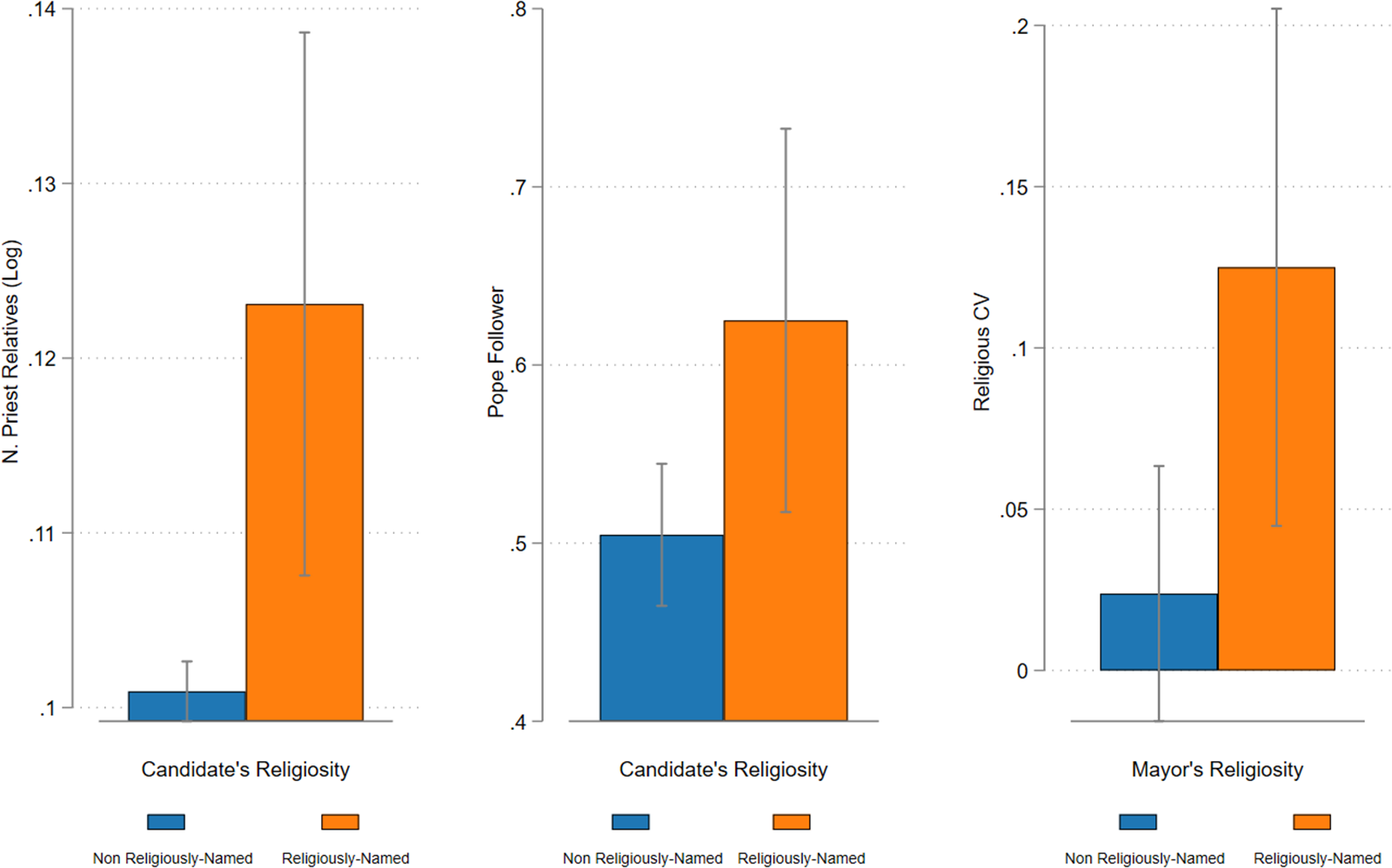
To further buttress the predictive power of my proxy for religiosity, I conduct three additional tests. First, I build an original dataset with the demographics of 42,010 Italian priests, deacons, and nuns, in office as of March 2024. Then, to proxy for a candidate’s family ties to the local Catholic hierarchy, I match her to all the priests within her diocese who share her last name. The left panel of Figure 2 shows that—according to my proxy religious candidates have significantly more family ties to the local Catholic hierarchy than their nonreligious colleagues.
Religiously named candidates and religiosity measures.

Second, I collect a novel dataset of X accounts of mayoral candidates. I identified and verified 58 accounts of religious candidates and 430 accounts of nonreligious candidates. To measure religiosity, I code whether each of these 488 verified mayors’ accounts follows the official account of the Pope (@Pontifex). The idea is that following the Pope on X implies an interest in religious messages and updates, indicating that a person values staying informed about the Pope’s guidance and perspectives. The central panel of Figure 2 shows that religious candidates are more likely to follow the Pope, with a probability of 62.5% against a probability of 51% for nonreligious candidates.
Third, I collect the curriculum vitae of 921 mayors and build a religious dictionary to identify the presence of religious activities in the curriculum.Footnote 19 Examples of these activities include catholic-inspired associationism, catechism at the local parish, or collaborations with the religious newspaper Avvenire. To increase confidence in my results, I limit the control pool of CVs to those of mayors who ended up in close elections where a religious candidate was also running. This restricts the sample to 90 CVs, 48 for religious mayors and 42 for nonreligious mayors. The right panel of Figure 2 documents how religious mayors are far more likely to mention religious activities in their curricula (13% against 3%).
To complement these descriptive exercises, the Appendix (Tables from A.2 to A.4) presents the upshots of more systematic regression analyses, using Ordinary Least Squares (OLS) models and, whenever feasible, RDD estimates. The results of these additional tests confirm that carrying the patron’s name of one’s birthplace is a good predictor of individual religiosity.
3.3. Additional data sources
I obtained data on all municipal elections, mayoral candidates, and their party affiliations from the Historical Electoral Archive of the Ministry of the Interior (1989–2020). I used the Database on Local Administrators for other information on mayors (e.g., job, gender, and level of education), local councilors, and members of the executive committee (1998–2020). I collected information about the patron saint of each municipality from different sources.Footnote 20 Data for Giunte Diocesane have been shared by Pulejo (Reference Pulejo2024). Information on Italian bishops has been collected from the official website of the Italian Episcopal Conference. Budget data for all Italian municipalities from 2005 to 2014 have been scraped from the repository of the Local Finance Directorate at the Ministry of the Interior.
4. Empirical strategy
The main goal of this paper is to assess whether electing a religious mayor—as proxied by her name—increases debt repayment in a given municipality. Clearly, the success of religious mayors depends on many observable and unobservable features of a municipality, which may, in turn, affect debt repayment as well. One obvious confounder is the overall level of fiscal conservatism among the population, which is likely to increase the supply of right-wing-religious candidates and boost their electoral performance, while also increasing debt repayment in the municipality.
To address this issue, I employ a politician-characteristic regression discontinuity (PCRD) design, following similar RDD applications to Italian municipal elections (Pulejo, Reference Pulejo2025). PCRD is a close-election RDD (Imbens and Lemieux, Reference Imbens and Lemieux2008; Lee and Lemieux, Reference Lee and Lemieux2010), isolating the effects of a characteristic of the winning candidate—here, religiosity. My regression equations have the form:
 \begin{align}
DebtRepaymen{t_{i,t}} & = \beta ReligiousMayo{r_{i,t}}+\gamma\, f(Margin{)_{i,t}}+\lambda {\left( ReligiousMayor\cdot Margin \right)_{i,t}}\nonumber\\
& \quad+\theta {Z_{i,t-1}^\prime}+\psi {X_{i,t-1}^\prime}+{\tau_t}+{\phi_p}+{\epsilon_{i,t}},\end{align}
The parameter of interest is β, i.e., the effect of electing a religious mayor on debt repayment by municipality i over term t. Given the PCRD setup, the coefficient βˆ measures this effect at the cutoff of 0 margin of victory of the most voted religious candidate (Margini,t), thus comparing municipalities where she narrowly won with those where she narrowly lost. Equation (1) also has province fixed effects (ϕp) and election-year fixed effects (τt), so it compares municipalities close to the cutoff within the same province, holding elections in the same year.
The vectors Zi,t− 1 and Xi,t− 1 contain pre-election characteristics of the mayor and the municipality,Footnote 21 respectively. Finally, f (Margini,t) is a polynomial in the margin of victory of the most voted religious candidate, also interacted with the indicator for she winning the election (ReligiousMayori,t). In the paper, I present results using a linear polynomial approximation. The size of the bandwidth around the cutoff is determined through the data-driven approach of Calonico et al. (Reference Calonico, Cattaneo and Titiunik2014), with a triangular kernel. Robust, bias-corrected standard errors are clustered at the municipality level. The analysis is implemented using the Stata package rdrobust (Calonico et al., Reference Calonico, Cattaneo, Farrell and Titiunik2017). In the appendix, I show that the results are robust to different specifications of the default options of the package. The main analysis covers the period 2002–2019, corresponding to the availability of municipal balance sheet data on debt repayment. The auxiliary analysis on public goods provision is based on data available for 2005–2014. All results are therefore interpreted within these respective time spans.
4.1. Identification checks
Threats to internal validity can be classified into two groups: standard threats to RDD and possible effects of compensating differentials (Marshall, Reference Marshall2022). The main assumption is that municipalities where a religious candidate slightly won against a nonreligious candidate are comparable to municipalities where a religious candidate slightly lost against a nonreligious candidate. To assess whether this is likely to hold, Figure A.3 presents the results from estimating Equation (1) using as outcomes several geographic and socioeconomic characteristics of municipalities measured prior to the election. Reassuringly, none of the RDD coefficients are significant at the 0.05 level, with the exception of longitude,Footnote 22 indicating that municipalities just above the cutoff are indeed comparable to those just below. Also, the margin of victory of the best-performing religious candidate shows no jumps around 0, as confirmed by the formal test proposed by Cattaneo et al. (Reference Cattaneo, Jansson and Xinwei2018), displayed in Figure A.4.
On top of evaluating these standard RDD assumptions, I test for an additional identifying condition that is specific to PCRD designs. Marshall’s (Reference Marshall2022) critique of RDD close-election estimations arises from the fact that these types of RD close-election estimators identify the effect of the specific characteristic of interest and all compensating differentials—candidate-level characteristics that ensure elections remain close between candidates who differ in the characteristic of interest. To overcome such threat, the same Marshall (Reference Marshall2022) offers two possibilities: either (a) being a religious candidate does not affect the margin of victory in close races or (b) no other characteristic ensuring that religious candidates end up in a close race is affecting debt repayment. Since the first possibility is unlikely to hold, I perform the same RDD with religiosity as the explanatory variable on a battery of mayor-specific variables. The idea is that if I am capturing the compensating effects of other mayors’ characteristics, I should observe a jump at the cutoff. Figure 3 displays the results of estimating Equation (1) using as an outcome a set of mayoral attributes. Only one outcome is unbalanced: narrowly elected religious mayors are more likely to be above the median of the age distribution. To assess whether this affects the identification, I check whether this age differential matters for my outcome of interest. Table A.5 in the Appendix shows RDD estimates of the effect of narrow victories of above-median age candidates on debt repayment. Reassuringly, all the coefficients are small and insignificant. Given these checks, I am confident in interpreting βˆ from Equation (1) as the effect of electing a religious mayor on debt repayment in a municipality.
Threats to PCRD—other characteristics of religiously named mayors.

5. Religious mayors and debt repayment
Table 1 shows the main results. In column (1), I show the specification without controls and fixed effects. The coefficient is positive and significant at 5%. Unsurprisingly, adding controls and fixed effects improves the precision of the estimation. In column (2), I include province fixed effects and, indeed, the coefficient becomes highly significant. In column (3), a battery of controls is added, and the estimation remains unchanged. The coefficient of interest ranges between 23% and 31%, approximately equal to one-third of a standard deviation of the outcome variable. The estimated effect of electing a religious mayor, an increase between approximately 0.2 and 0.3 in repaying debts accumulated in the current year, is sizable. For comparison, Bellodi et al. (Reference Bellodi, Morelli and Vannoni2024) show that electing a populist mayor decreases the same measure by 0.05, while Vannutelli (Reference Vannutelli2022) reports that the random assignment of municipal auditors raises debt repayments by about 9%. The magnitude of the religiosity effect is therefore larger than the impact of major institutional reforms or ideological traits, underscoring the real-world relevance of personal moral orientations in shaping fiscal behavior. Table A.6 in the Appendix displays the results when additional mayor-level controls are added. Table A.7 displays the results controlling for the religiosity of councilors and the religiosity of aldermen.
Religious mayors and debt repayment

Table 1 Long description
Debt repayment is reported for three models, with one row for Religiously Named Mayor and additional rows for mean and standard deviation of the dependent variable, sample sizes, bandwidth, fixed effects, and controls. The Religiously Named Mayor estimates are 0.23 with two stars, 0.33 with three stars, and 0.31 with three stars, with standard errors 0.12, 0.10, and 0.10 shown in parentheses. Mean Depvar is 0.96 in all three models. SD Depvar is 0.55, 0.57, and 0.56. Observations are 1140, 1140, and 1110. Effective Obs. Left are 326, 293, and 246, and Effective Obs. Right are 281, 258, and 217. Bandwidth values are 0.19, 0.17, and 0.15. Fixed Effects are listed as no for the first model and yes for the second and third, while Controls are no for the first and second models and yes for the third.
Notes: RDD estimates of β from Equation (1), with linear polynomial fit, triangular weighting kernel, and data-driven optimal bandwidth selection (Calonico et al., Reference Calonico, Cattaneo and Titiunik2014). The mean and standard deviation of the dependent variable are measured within the left half of the optimal bandwidth selected by the algorithm for each model. Controls: Log population, area, latitude, longitude, gender of the mayor, age of the mayor, year FEs, and province FEs. Robust bias-corrected standard errors clustered at the municipality level in parentheses.
*** p< 0.01, ** p< 0.05 .
Figure 4 visually displays the RDD results with polynomial degree one. The positive jump in the cutoff is clear and evident. Figure A.5 presents the same specification without fitted lines, following best practices for visual inference recommended by Korting et al. (Reference Korting, Lieberman, Matsudaira, Pei and Shen2023).
Religiously named mayors and debt repayment, RDD plot.

5.1. Additional results and mechanisms
To shed light on which of the two non-rival mechanisms, Catholic moral duty or religiously rooted risk aversion, is more likely to drive the main result, I conduct a set of additional analyses.
To start, I conduct three heterogeneity tests, meant to further investigate the dynamics behind the baseline effects of Table 1. First, to inquire about the possibility of a trade-off between political concerns and religious values, I re-estimate Equation (1) separately for municipalities whose sitting mayor can run for reelection and municipalities with a term-limited mayor.Footnote 23 Since debt repayment reduces the possibility of providing public goods, it can be an electorally costly action for mayors. Religious mayors could then face a trade-off between providing public goods and complying with their inner Catholic values. If this is indeed the case, I would expect a higher effect of religiosity on debt repayment when the mayor cannot run for further elections due to the term limit. Interestingly, this is exactly what I see in the left panel of Figure 5. When mayors cannot run for further elections, the effect on debt repayment is more than twice larger than the effect when mayors can run for further elections.
Religiously named mayors and debt repayment, heterogeneities.

Second, to further test my theory that Catholic values translate into attitudes toward debt, I separate mayors into high- vs. low-educated. For the reasons explained in Section 2.3, Catholic values should play a bigger role among low-educated religious mayors. The effect of religiosity on debt repayment in this subset of individuals should then be higher. The middle panel of Figure 5 confirms the intuition: low-educated religious mayors repay between two and three times more debt than high-educated ones.
Third, I examine whether the effect of electing a religious mayor varies depending on the borrowing environment faced by municipalities. Here, the idea is straightforward: if risk aversion plays any role, the effect of religiosity on repayment should strengthen in periods when borrowing is financially more costly. I classify years according to whether the Euribor rate, Italy’s key benchmark for municipal variable-rate borrowing, was above or below its median, and I re-estimate the baseline RDD in each subgroup. The right panel of Figure 5 uses the average Euribor rate over the 5-year municipal term to categorize administrations. This measure reflects the borrowing environment experienced during office. Two patterns emerge. First, religious mayors repay significantly more debt both when borrowing costs are low and when they are high. Second, the magnitude of the effect is larger in high-Euribor years. This gradient is consistent with a modest role for risk considerations: when borrowing is more expensive, the benefits of reducing outstanding liabilities increase, and religious mayors appear somewhat more responsive to these incentives. Importantly, however, the effect does not disappear when borrowing costs are low. The presence of a strong and robust effect across both environments suggests that the baseline finding is not driven exclusively by risk preferences. Instead, risk aversion may amplify the effect at the margin, but a more stable underlying mechanism, one compatible with Catholic conceptions of duty, obligation, and financial rectitude, appears to be doing most of the work.
Tables A.8, A.9, and A.10 in the Appendix report the full tables. These results should, however, be interpreted with caution, given the smaller effective sample size—particularly in the term limit specification. Tables A.11 and A.12 in the Appendix propose further suggestive evidence that risk aversion, and more specifically Catholic identity, translate both into risk aversion and attitudes toward debt using the European Social Survey data and the ITANES data.
Second, I analyze whether religious mayors differ from secular mayors in the amount of new debt accumulated during their term. Table 2 shows RDD estimates using Equation (1). Across all three specifications, the point estimates are very small and statistically indistinguishable from zero. This null finding is informative. If religiosity primarily operated through a general aversion to taking financial risks, we would expect religious mayors to take on less new debt. Instead, the results show no detectable difference in debt accumulation. This pattern aligns more naturally with a mechanism rooted in Catholic moral obligations that emphasize repaying past obligations rather than reducing new credit intake.
Mayor’s religiosity and debt accumulated

Table 2 Long description
Debt Accumulated is reported for three models with a single coefficient row labeled, Religiously Named Mayor. The coefficient values are minus 0.01 in the first model, 0.00 in the second model, and 0.03 in the third model. The standard errors shown in parentheses are 0.06, 0.05, and 0.05 for the three models, respectively. Observations are 1,146 in the first and second models and 1,116 in the third model. Effective Obs. Left are 524, 540, and 471, and Effective Obs. Right are 389, 396, and 357. Bandwidth values are 0.23, 0.21, and 0.17. Fixed Effects are listed as no for the first model and yes for the second and third models, while Controls are listed as no, no, and yes.
Notes: RDD estimates of β from Equation (1), with triangular weighting kernel and data-driven optimal bandwidth selection (Calonico et al., Reference Calonico, Cattaneo and Titiunik2014). The mean and standard deviation of the dependent variable are measured within the left half of the optimal bandwidth selected by the algorithm for each model. Controls: population (Log), area, latitude, longitude, sex of the mayor, age of mayor, year FE, and province FE. Robust bias-corrected standard errors clustered at the municipality level in parentheses.
6. Robustness checks and alternative explanations
A detailed set of robustness checks is reported in Appendix Tables A.13–A.22. First, Appendix Tables A.13–A.15 present the name-frequency robustness exercises: constructing a continuous religiosity index that downweights common names, restricting the sample to high-salience religious names, and redefining religiosity using only birthplace patron-saint matches—all of which yield estimates that are highly consistent with the main results.
Second, a full set of standard RDD robustness checks—including lagged outcomes, higher-order polynomials, alternative kernels, placebo cutoffs, varying bandwidths, Coverage Error Rate (CER) bandwidth selectors, jackknife exclusion tests, power analyses, and alternative clustering and FE structures—is reported in Appendix Tables A.16–A.22 and Figures A.6–A.8. These checks consistently show that the estimated effect of electing a religious mayor on debt repayment is substantively stable across specifications.
Finally, Appendix A.1.11 examines whether the findings might be explained by factors other than religiosity, including partisanship, local embeddedness (Paci, Reference Paci2023), mayoral nativity, or differential tax revenues. Tables A.23–A.26 and Figure A.9 indicate that none of these factors explain the main effect on debt repayment.
7. Religious mayors and public goods provision
Repaying municipal debt can be electorally challenging for mayors because it often requires reducing funds for public services and infrastructure projects, which directly impacts residents’ quality of life. This reduction can lead to voter dissatisfaction and decreased support.
Religious mayors, guided by Catholic values emphasizing moral responsibility and financial stewardship, could then face a dilemma: balance their commitment to debt repayment with the practical need to maintain voter support. To navigate this trade-off, a rational approach for religious mayors is to minimize the electoral cost of a reduction in public goods while adhering to their values.
To shed light on this possibility, I collected data on municipality expenditures in administration, social, environment, transportation, education, culture, sport, tourism, police, justice, economic development, and productive services from official balance sheets. I then re-estimated Equation (1) using each of these variables as the dependent variable. If mayors face a trade-off between Catholic values and electoral incentives, then I should observe a decrease in the less costly budget item: expenditures for administration, i.e., the sum of all the expenses incurred for the offices that coordinate the internal activities of the municipal body. This result is consistent with the idea that religious mayors are more likely to cut budget items that have no direct effect on any particular constituency. Figure 6 presents RDD estimates of the effect of electing a religious mayor on various categories of municipal public spending per capita. The results show a statistically significant reduction in administrative spending per capita, with no significant differences in most other categories. In other words, religious mayors don’t change the composition and the level of public good provided.
Religiously named mayors and public good provision.

Table A.27 allows us to quantify the reduction of expenditure in Administration per capita: a religious local administrator reduces about 96 euros per capita of the expenditures needed for the functioning of the institutional bodies, compared to other municipalities in the same province. Figures A.10 and A.11 visually show the result. Table A.28 repeats the RD with expenditure in Administration per capita as the dependent variable performing the estimation with second-degree polynomial.
Finally, to further validate that the religiosity index captures a genuinely moral dimension of policymaking, I examine whether religious mayors also behave differently in policy domains characterized by moral content. Using the full Autorita’ Nazionale Anticorruzione (ANAC) procurement archive, I identify municipal spending linked to (i) reproductive rights and gender and (ii) LGBTQ+-related inclusion, based on two original keyword dictionaries. As shown in Table A.29 in Appendix A.1.13, religious mayors allocate substantially less funding to pro-abortion initiatives, and somewhat less to pro-LGBTQ projects. While not the focus of this paper, these results reinforce the interpretation that the estimated effects on debt repayment reflect the activation of moral commitments rooted in Catholic values.
Lastly, Table A.30 shows the equilibrium effect on the probability of being reelected. The result suggests that religious mayors successfully balance their inner values with electoral incentives, as I do not observe any meaningful effect.
8. Discussion and conclusion
This paper provides causal evidence that religiosity shapes fiscal behavior, showing that mayors raised in more Catholic environments display a stronger preference for debt repayment. Leveraging close elections in Italian municipalities, I demonstrate that narrowly elected Catholic mayors allocate resources more prudently, repaying significantly more debt than their nonreligious counterparts. These findings suggest that religiously grounded moral commitments—particularly the Catholic emphasis on duty, prudence, and risk aversion—can influence real policy choices even within secular democratic institutions.
Understanding whether and how religiosity affects policymaking is increasingly important in light of the global resurgence of religion in public life. In many countries, including the United States, India, and parts of Europe, religious identity has become a central dimension of politics. Yet while scholars have long examined how gender, ethnicity, or class shape political outcomes, the role of religion remains comparatively understudied. Given how pervasive religious beliefs are in shaping individual worldviews, uncovering their influence on fiscal decisions offers a crucial window into how personal values enter the policy process.
Several limitations of this paper warrant caution. Although Italy offers an ideal setting to study Catholicism, it is also an exceptionally religious country, and the external validity of the findings should therefore be interpreted carefully. Moreover, religiosity may still correlate with unobserved characteristics, such as civic duty or regional socialization, that are difficult to isolate completely. The name-based measure, while validated, inevitably captures religious upbringing imperfectly; nonetheless, it can be readily adapted to other contexts, such as Mexico or Latin American countries, where Catholic patronal traditions remain widespread. Furthermore, one could argue that municipal debt is not a particularly salient electoral issue in local elections, which may make this an easy case for observing moral effects on fiscal behavior. As such, the findings should be interpreted primarily as evidence of how moral motivations shape fiscal responsibility in a low-discretion environment, with future work needed to assess whether similar dynamics emerge where debt policy carries higher political visibility and electoral costs. Future research could then examine whether similar mechanisms operate in non-Catholic contexts. In particular, Protestant traditions, where attitudes toward debt and economic discipline historically diverge from Catholic teachings, offer an especially interesting comparison. Extending the analysis to other faiths and political systems would help determine whether the moral dimension of fiscal behavior observed here reflects a broader link between religion and public governance, rooted in risk aversion, or a distinct feature of Catholic moral doctrine.
Acknowledgements
I am deeply indebted to Massimo Pulejo for extensive advice throughout this project. I benefited from comments from Daniel Baquero-Mendez, Anna Gryzmala-Busse, Lorenzo Maria Casale, John Huber, Munroe Kim, Gwyneth McClendon, Pablo Querubin, Emma Rosenberg, Arturas Rozenas, Shanker Sathyanath, Joachim Voth, and participants at the GPE Seminar at NYU, MPSA 2024, and ASREC 2024. I thank Paul Bose for sharing the X data with us and matching candidates to their accounts.
Supplementary material
The supplementary material for this article can be found at https://doi.org/10.1017/psrm.2026.10126.



 Open access

