Introduction
This article explores the strength and character of intergenerational family norms in a European comparative context. We concentrate on the relationship between adult generations, and do so from both sides – as filial obligations vis-à-vis older parents, and as parental obligations vis-à-vis adult children. Comparisons are made between countries along the geographic diagonal across Europe, from Norway, Germany and France in the North West, to Romania, Bulgaria, Russia and Georgia in the South East. The selection of countries is motivated by their participation in the United Nations-sponsored Generations and Gender Survey (GGS) (United Nations Organization (UNO) 2005a).
Family ties are not only multi-dimensional but also multi-directional, therefore intergenerational norms not only refer to filial obligations vis-à-vis older parents but also vice versa. Whereas adult children's responsibility towards older parents have been studied rather intensively (e.g. Brody et al. Reference Brody, Johnson, Fulcomer and Lang1983; Burr and Mutchler Reference Burr and Mutchler1999; De Valk and Schans Reference De Valk and Schans2008; Gans and Silverstein Reference Gans and Silverstein2006; Lee, Peek and Coward Reference Lee, Peek and Coward1998), only few have studied older parents' responsibility towards adult children (De Vries, Kalmijn and Liefbroer Reference De Vries, Kalmijn and Liefbroer2009; Finch and Mason Reference Finch and Mason1993). Beyond these studies, parental norms nearly always refer to small children, or are embedded in the grandparent role, but people do not grow out of the parent role as they age. Naturally the role changes, but parents may worry and feel responsible for children even in old age. As Rossi and Rossi (Reference Rossi and Rossi1990) observed, in the United States of America (USA), if parents help their children during childhood they maintain these helping patterns when children grow up. Moreover, filial norms have been studied mostly in the West of Europe and to some extent between the North and South (Daatland and Herlofson Reference Daatland and Herlofson2003), but few, if any, have compared intergenerational norms between the West and East of Europe. This article combines the two missing perspectives by exploring the strength and character of both filial and parental norms along the geodetic line between the North West and South East of Europe.
Background
Previous research has shown that the southern European family is tighter and more collectivistic than the northern European (Reher Reference Reher1998). The same goes for the eastern family relative to the western family, says Hajnal (Reference Hajnal, Glass and Eversley1965) . Both authors argue that European family forms and cultures have developed over centuries and are quite stable, yet also changing in response to recent circumstances. Their distinctive forms are remarkably resilient and are basic features upon which social policies and welfare states are formed, rather than vice versa (Reher Reference Reher1998). The idea of a systematic variation in family forms and relations along the geographical axes of Europe has considerable support (e.g. Hagestad and Herlofson Reference Hagestad and Herlofson2007; Hank Reference Hank2007, Höllinger and Haller Reference Höllinger and Haller1990; Kalmijn and Saraceno Reference Kalmijn and Saraceno2008; Kohli and Albertini Reference Kohli, Albertini and Saraceno2008). While there is less agreement as to explanations, we would expect to find stronger and more unconditional support for intergenerational family norms in the South East than in the North West of Europe.
The strength and character of family norms are hardly produced by geography itself, however, although climate and living conditions may have been influential in forming family and living arrangements. Differences are more likely rooted in history and religion, and follow the historical lines of Christianity and Islam, Catholicism and Protestantism (Höllinger and Haller Reference Höllinger and Haller1990; Reher Reference Reher1998). Influences from the Roman Empire may be observed, for example in family and inheritance laws. Later, more or less dramatic political events may have had repercussions for the family, such as the two World Wars and the subsequent Iron Curtain. The repressive communist era in East Europe may have forced people to seek protection in the family, and then most likely in more traditional family forms (Szydlik Reference Szydlik1996). In contrast, Scandinavian countries developed generous welfare policies that reduced dependency upon the family and the normative control of these dependencies (Esping-Andersen Reference Esping-Andersen1999).
More recently, the assumed stability of these forms has been disputed, and whether or not a recent convergence across Europe can be observed is debated (Murphy Reference Murphy2008). Up-to-date descriptions are therefore required. Reliable comparative data about the strength of family norms are few, particularly by which to compare the East and West of Europe. Even less is known about the character of these norms. The family culture position, as represented by Reher (Reference Reher1998), Hajnal (Reference Hajnal, Glass and Eversley1965) and others (e.g. Laslett Reference Laslett1983), is not explicit about what kind of family ties are said to be tighter or looser, whether they be normative, affective or something other. Adjectives such as stronger and weaker, tighter and looser are most likely a reference to norms. It is then a matter of intergenerational norms being stronger and tighter in the South and East of the continent. Whether the same goes for other qualities of the relationship, such as affection, is not an issue here, as this article concentrates on the normative dimension, and more specifically on the norms about the relationship between adult children and older parents.
Knowledge about filial norms may be vital for assessing the potential for family care, even if norms are only guidelines for action, and compete with other motivations in actual behaviour. Correlations between the pertinent norms and actions are in fact quite moderate, at least when both norms and sanctions are mild and the competing obligations many, as in Scandinavia where the female labour-force participation rate is high (Lowenstein and Daatland Reference Lowenstein and Daatland2006). Norms are in any case important factors in the exploration of family care, including parental norms, as older parents are not only objects of filial attention (or negligence), they are agents in their own right, and may influence the relationship directly and indirectly. A number of European studies have demonstrated that older parents help adult children and grandchildren with money and instrumental help (Kohli and Albertini Reference Kohli, Albertini and Saraceno2008, Reference Kohli and Albertini2009; Kohli and Künemund Reference Kohli, Künemund, Bengtson and Lowenstein2003). Parents are in fact net providers to children for most of their lives, although the roles tend to invert in very old age. Parents may then need care from children, but may try to balance this against monetary help in return when their income allows it (Katz et al. Reference Katz, Daatland, Lowenstein, Bazo, Ancizu, Herlofson, Mehlhausen-Hassoen, Prilutzki, Bengtson and Lowenstein2003). Some agree to both filial and parental norms, and thus subscribe to an ideal of reciprocal responsibility.
Parents may also influence the relationship more indirectly. Whilst family care was long considered a natural choice, even by researchers (e.g. Cantor and Little Reference Cantor, Little, Binstock and Shanas1985), studies as far back as the 1960s documented that many older people do not lightly accept help from others, even from their own children, and fear to be a burden on them (e.g. Brody et al. Reference Brody, Johnson, Fulcomer and Lang1983; Brody, Johnson and Fulcomer Reference Brody, Johnson and Fulcomer1984; Rosenmayr and Köckeis Reference Rosenmayr and Köckeis1963; Shanas Reference Shanas1960). They want their children to be independent, and they prefer independence for themselves as long as they can. When this is no longer possible, they may want professional services instead of family care, and prefer residential care over moving in with a child when these options are available, and more so the better and the more available the services are (Daatland Reference Daatland1990; Wielink, Huijsman and McDonnell Reference Wielink, Huijsman and McDonnell1997). To what extent these are genuine preferences or are responding to (lack of) opportunity is not always clear (Connidis Reference Connidis1983). Parents may resist filial care out of concern for their children, or because they have poor faith in filial responsibility. Nor is it clear to what extent living with a child in old age is a preferred choice and not simply forced by circumstances (i.e. lack of alternatives). All in all, care preferences seem to be closely correlated with the actual care arrangements: services tend to be popular when and where they are available and of a good standard, while family care is the preferred choice when this is not the case (Blome, Keck and Alber Reference Blome, Keck and Alber2009).
The traditional arrangement has been for children to take responsibility for older parents when they are in need. Long-term care services are fairly recent inventions, although countries in North West Europe (e.g. in Britain and Scandinavia) have a long history of public responsibility as an alternative to family care (Laslett Reference Laslett1983). Family care is the modal form even today in most countries, and in particular where families are strong and welfare states weak. Adult children have then also a legal responsibility for older parents, which is no longer the case in North West Europe (Millar and Warman Reference Millar and Warman1996), where independence tends to be valued, even in old age. Expectations on adult children will be low(er) than in the ‘tighter’ families of South and East European families, and older parents tend to protect their children against burdens, and thus to de-obligate rather than to obligate them. Reciprocity norms will be weak and add to the low(er) expectations of older parents on their children. Finch and Mason (Reference Finch and Mason1993) summarised these expectations well when they stated that North West European families have a tradition that allows room for individual adaptations, and that gives priority to the nuclear unit when younger generations are ‘starting’ a family (i.e. a priority for the ‘downward generations’). In the more traditional South East European family cultures, older parents probably find it natural to be taken care of by their adult children, and even to accept a dependent role when they become older. They tend to expect and rely on filial duty, and they will endorse reciprocity norms, implying that children are obliged to pay back for what they have received earlier in life.
Research questions and hypotheses
In this study, we expect to find stronger family norms the further east and south in Europe one examines. We also expect to find differences in the characteristics of norms. They should be more unconditional (closed, strict) in the strong family area, and more open to negotiations in the weaker family area (the North West). Moreover, the norms should be differently balanced between generations in the two regions, with filial norms and a stronger priority for the higher (or older) generations in the South East, whereas in North West Europe parental norms and the comparative priorities will favour the downward (or younger) generations. The differences may be rooted in cultural norms, in structural conditions, and in social policy (such as the type of welfare state regime), but culture, structure and policy will in each case tend to work in the same direction – this study does not separate one from another. A recent analysis of a related matter, the frequency of family contacts, suggests that the geographic location (‘culture’) explains most of the variance (Murphy Reference Murphy2008).
That within-country variation will be larger where norms are weaker is more or less self-evident, as individual preferences have more influence when norms are less strict. Less evident is how the differences are played out. We assume that they will reflect needs and orientations in the population, and therefore vary with gender, age, education, family (generational) location, and employment status. Women are assumed to be more family-oriented than men in all countries, and should then be ‘biased’ towards the modal form in each region, i.e. towards filial responsibility (higher generations) in the East and towards parental responsibility (younger generations) in the West. An earlier study by the authors (Daatland and Herlofson Reference Daatland and Herlofson2003) found women to be less supportive of filial obligations than men in North West Europe (England and Norway), which was interpreted as a protective attitude of mothers towards adult children, a trait that was less evident further south in Europe (i.e. in Spain).
Age may influence the support for family norms in two capacities, but both are expected to work in the same direction. First, older cohorts are expected to be more traditional than the younger, and therefore to be relatively more in support for obligations towards older generations (i.e. filial norms). Second, age is also an indicator for the location in the lifecourse, where certain needs are more or less important. Parental norms become salient with parenthood among younger adults – they compete with filial norms in midlife, while filial norms become more relevant later in life. If people respond to norms according to their self-interest, this should be reflected in the within-country support for them: the older should favour filial norms (obligations towards older generations), particularly if they are parents themselves and in need of filial care and attention. Finally, education and employment are expected to reduce support for family norms. Education tends both to stimulate individualism and to make people more economically independent, and for both reasons is expected to reduce support for family norms. And finally, employment represents a conflicting obligation to the family, and may serve as a ‘legitimate excuse’ (cf. Finch Reference Finch1989). Paid work should therefore reduce the support for filial if not parental obligations, and probably more so for women than for men.
Data and measurements
The data for this comparative study were obtained from the Generations and Gender Programme (GGP) Data Archive (UNO 2005a). Currently, survey data from the first wave are available for seven countries: Bulgaria, France, Georgia, Germany, Hungary, Romania, Russia and The Netherlands. For the analyses reported in this article, Hungary and The Netherlands had to be omitted because of missing or non-comparable variables regarding family responsibility norms. The data set for Norway at the time of the analysis was available only to Norwegian researchers, but is soon to be included in the GGP Data Archive. The national panel surveys were carried out among representative samples of community-based people aged 18–79 years in each country, with the sample sizes varying from 9,967 in Germany to 14,882 in Norway. The sizes of the national samples in the multivariate analyses are lower because of item non-response. In Norway, the filial responsibility scale was included in a telephone interview, whereas the questions about parental responsibility were part of a postal questionnaire that was returned by 72 per cent of the telephone sample. This explains the difference in sample size between filial and parental responsibility in Norway. The data collection was in 2004 in Bulgaria and Russia, in 2005 in Germany, France and Romania, in 2006 in Georgia, and in 2007–08 in Norway.
Dependent variables
Measures of popular support for filial and parental obligations served as the dependent variables. They were measured in terms of the degree of (dis-)agreement with two linked questions about filial and parental obligations, respectively, phrased as statements (items) one could be more or less in (dis-)agreement with. For filial obligations: (a) children ought to provide financial help for parents when their parents are having financial difficulties; and (b) children should adjust their working lives to the needs of their parents. For parental obligations: (c) parents ought to provide financial help for their adult children when the children are having financial difficulties; and (d) if their adult children were in need, parents should adjust their own lives in order to help them.
A five-category response scale from ‘strongly disagree’ through ‘neither yes nor no’ to ‘strongly agree’ was employed. The degree of support for the norms was indicated by the percentage in favour (agreement) of each item. The mean aggregate score could vary from ‘0’ (strongly disagree with all four items) to ‘4’ (strongly agree with all). Reliable indexes should ideally be based on at least three or four related items and not, as in this case, just two. The two filial responsibility items were in fact drawn from a four-item scale in the GGS questionnaire, but as only two of the items were also phrased from the parental perspective, we were left with an index based on two items only. The correlation between the short (two-item) and the long (four-item) index for filial norms was however strong (around +0.9 in each country). The reliability of the scales was on this basis judged reasonable.
We were not primarily interested in each concrete item. They were taken as indicators of a more general normative orientation towards filial and parental responsibility. The results section below shows that one item in each pair attracted far more support than the other, indicating that one had a more general (open) character, and was therefore less demanding to comply with. The difference in agreement scores between the two items was taken as an indicator of the closed or open character of the norms. To what extent the responses to the items reflect norms or attitudes can be discussed. They were phrased as norms, but there is no indication whether or not they are sanctioned. We shall return to this issue in the discussion. Another critical issue is whether or not the prevalence of agreement with the normative statements is a valid measure of cultural norms. To the extent that countries (and cultures) are represented by their populations, we suggest such an assumption is reasonable.
Independent variables: macro level
In this study, the country was taken as the basic unit at the macro level. Country differences may be cultural, structural or both. Populations are different along with policies, finances and cultures. The three set of factors will probably work in the same direction, and we are not able to disentangle one from the other. Culture is, however, assumed to be central when studying normative family orientations, and generally speaking, as policies and structures are more local (national) and recent than cultures, the findings point to a cultural explanation if they are consistent with equally general dimensions, such as the geographical axis explored here.
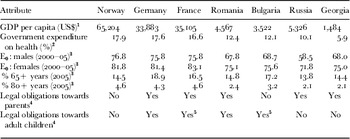
Some contextual details about the selected countries are presented in Table 1. They differ in terms of demography, health, economy and social policy. Norway is by far the wealthiest, with a per capita gross domestic product (GDP) of US $65,204, nearly double that of Germany and France, and the GDPs of the eastern countries are far lower than in any of the western states. The three western countries also have more generous health policies, with general government expenditure on health being 17–18 per cent of total government expenditure, whereas in the eastern countries it is 12 per cent or less. The expenditure contrast is even more striking when we take into consideration that health is far poorer in the East, as indicated by average life expectancy at birth, which ranges from 76 years (men) and 83 years (women) in France, to 59 and 72 years in Russia. Finally, Norway stands out as the only country without any legal support obligations between adult generations. Living arrangements also vary by the countries, with a far higher prevalence of multi-generation shared households in the South East than in the North West. According to the GGS database, among 40–55-year-olds, 19 per cent lived with a parent or parent-in-law in Bulgaria and 29 per cent in Georgia, compared to only 2 or 3 per cent in Norway, Germany and France (not detailed in Table 1).
Attributes of seven European countries, circa 2005

Notes and sources: GDP: gross domestic product. 1. Source: International Monetary Fund (2009). 2. General government expenditure on health as per cent of total government expenditure. Source: World Health Organization (2010). 3. Mean life expectancy at birth. Source: UNO (2009). 4. Multilinks Database on Intergenerational Policy Indicators (Keck, Hessel and Saraceno Reference Keck, Hessel and Saraceno2009). 5. Legal obligations of parents while adult children are still studying (France, Bulgaria).
Independent variables: micro level
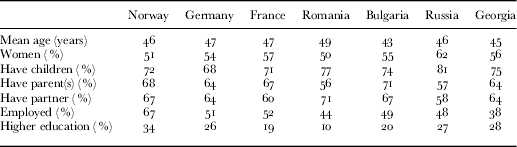
Within-country variation was modelled with gender, age, education, family (generational) position, and employment status as explanatory factors. Most of the factors included are represented as dummy variables: women versus men, high versus low or medium education, partnered versus single, with or without child(ren), and with or without parent(s) alive. Employment status was operationalised as active or not, without separating full-time and part-time employment. Age in years was a continuous variable. Table 2 gives descriptive information for all the independent variables in the analysis.
Independent variables in the analyses, seven European countries, 2004–08
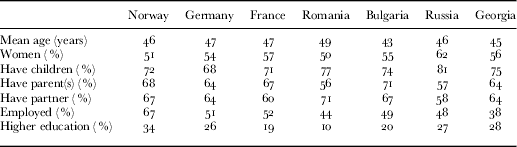
Source: Generations and Gender Survey (UNO 2005 a). For details, see text.
Findings
The findings are presented in two sections, first as descriptions of the between-country variation, and second as analyses (multiple regressions) of within-country variation by gender, age, education, family (generational) position, and employment status.
Country differences
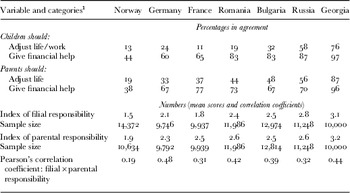
Table 3 shows that, as hypothesised, the countries line up quite neatly along the geographical diagonal across Europe from ‘low’ (Norway) to ‘high’ (Georgia) support for family norms, and similarly for both filial and parental responsibility. Country differences were larger, however, for filial responsibility, between a low score of 1.5 (on a four-point scale) for Norway, and a high score of 3.1 for Georgia. Parental norms were stronger than filial norms in all three western countries (Norway, Germany, France), whereas the two norms attracted more or less the same support in the four eastern countries. The findings thus correspond quite closely to the hypotheses as far as norm strength is concerned, but only partially so for the balance of up and down (older and younger) generations in the two (eastern and western) regions of Europe. Filial norms were clearly stronger in the East (as measured here), while there were more moderate country differences in parental norms, with Norway clearly lower and Georgia clearly higher than the countries in between. As expected, parental norms were relatively stronger in the North West, whereas filial norms were stronger the further the country is to the South East. The two norms are inter-related, but seem to represent distinct dimensions, as the correlations between the scores on filial and parental responsibility are quite moderate, varying between +0.19 (Norway) and +0.48 (Germany).
Public support for filial and parental responsibility in seven European countries

Note: 1. The upper section shows percentages in agreement with items indicating filial and parental responsibility. The lower section shows scores on indexes of filial and parental responsibility. See text for details about the items and indexes.
Generally speaking, we find considerable support for family obligations in all countries, even in Norway, but also widespread recognition of the limits to responsibility, more so towards the North West. We suggest this is an expression of the ambivalent nature of family norms (Connidis and McMullin Reference Connidis and McMullin2002; Lüscher and Pillemer Reference Lüscher and Pillemer1998). Intergenerational norms in contemporary families are characterised by mixed feelings and competing expectations, where norms are merely guidelines for action, with considerable room for negotiating how and to what degree they should be respected (Finch Reference Finch1989; Finch and Mason Reference Finch and Mason1993).
More specifically, adult children are seen to have at least some responsibility for older parents even in the North West (e.g. to provide financial help if in need), but they are not expected to adjust their working lives to parental needs, except in Georgia and Russia, where considerable majorities support even the most radical formulation of filial obligations. Norms are in this sense more unconditional (closed) in these two countries, which is also true for Romania and Bulgaria as far as parental obligations are concerned. Family norms seem to have a more open character in the three western countries. They are not only more generally endorsed in the strong (South East) family areas, they tend also to be more unconditional (closed) there. This is in particular the case for filial norms, as illustrated by the fact that difference in support for the open and closed items within each pair is in general larger for filial than for parental responsibility.
The more open character of filial norms in the western countries may also be illustrated with reference to the remaining two items of the four-item filial responsibility scale (not included in the analyses because they had no parallel from the parental perspective). Norway, Germany and France have majorities (53–79%) in support of filial obligations for ‘care when older parents are in need’, but fewer (13–44%) find it reasonable for adult children to ‘take dependent parents into their household’. The four eastern countries had majorities (71–99%) in support of both these items, and moderate differences between the less demanding (‘care when older parents are in need’) and the more demanding formulations (‘take dependent parents into the household’) of the norm.
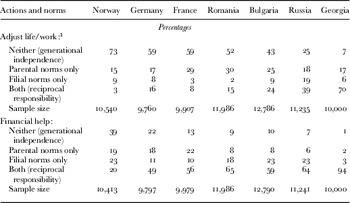
The western ideal seems to be one of generational independence: both generations should be able to live their own lives, but be available to the other when needed, and then within limits. Parents should be more inclined to adjust to the needs of adult children than the other way around, indicating that if in conflict, the needs of (adult) children (i.e. parental obligations) have priority over the needs of (older) parents (i.e. filial obligations). This is illustrated in Table 4, which presents the responses to the two norms. Some agree to both norms and subscribe to an ideal of ‘reciprocal (mutual) responsibility’. This seems to be the modal form in Georgia (70–94%), and has high prevalence in the other eastern countries. The opposite adaptation is that of ‘intergenerational independence’ (do not agree with either filial or parental responsibility). This is a frequent adaptation in Norway, somewhat less frequent in France and Germany, and even less so further east. Between the two symmetrical adaptations are those that support one or the other, i.e. either parental or filial obligations.
Support for filial, parental and reciprocal norms in seven European countries

Notes: 1. The table indicates the relative support for four types of adaptations: (1) generational independence, indicated by neither support to filial nor to parental norms, (4) reciprocal responsibility, indicated by support for both filial and parental norms. In-between these two adaptations are those who (2) support parental norms only, and (3) those in support of filial norms only. For further discussion, see text.
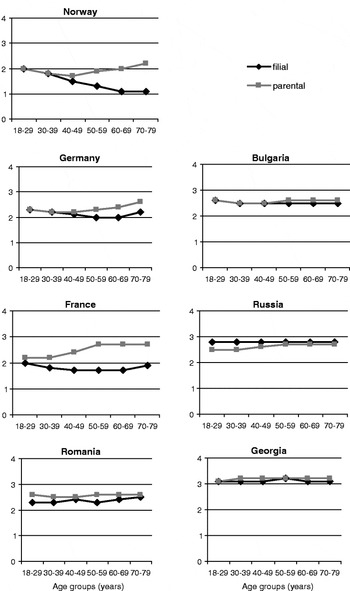
The general tendency is for the support for parental responsibility to be relatively stronger in the West, and filial responsibility to be relatively stronger in the East. The trend is not consistent, however, and therefore only partially supports the hypothesis that family norms are differently balanced between generations in the two regions, with filial norms and the stronger priority of the older generations in the South East, and parental norms and the priority of the younger generations being stronger in the North West. The findings more closely match expectations if we consider only the older cohorts (aged 50 and over). The three western countries have increasing support for parental obligations with age, whereas the support for filial responsibility is decreasing or stable. Consequently, parental responsibility is consistently higher than filial responsibility among older cohorts in the West, but not so in the East, where the two norms seem to attract the same level of support. This is illustrated by the seven national plots in Figure 1.
Family responsibility scores (filial and parental) by age: seven European countries, circa 2004–08.

Within-country variation
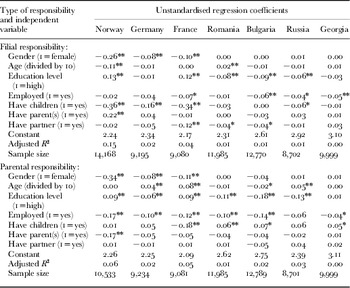
It might be useful at this stage to reiterate the expected findings. First, there should be more within-country variation in the North West where family norms are weak(er). Second, women were assumed to be more family-oriented than men, and to more clearly represent the modal ideal in each region. Women should therefore ‘lean’ towards parental responsibility in the West and towards filial responsibility in the East. Third, older people were assumed to be more traditional and therefore to be more in support of filial obligations than younger people. Age-related needs were expected to work in the same direction, as filial responsibility should be in older people's self-interest. The impact of family roles may vary: parenthood (having children) should activate parental obligations when children are small, but may raise expectations on children later in life when adult children are potential sources of support. Being an ‘adult child’ (having parents alive) should make filial obligations more salient, but are balanced against other commitments such as work. Finally, both being in employment and having more education were expected to reduce the support for family norms, because the latter was expected to stimulate individualism, and the former to be a competing family obligation. The findings of the regression analyses for each country of the strength (degree of support) of filial and parental norms are summarised in Table 5.
Ordinary least-squares regression of support for filial and parental norms on gender, age, education, employment and family (generational) status by country

Note: The ages of the sample ranged from 18 to 79 years.
Significance levels: * p⩽0.01, ** p⩽0.001.
The results show clearly more within-country variation in the West as expected, and in particular in Norway, as indicated by the comparatively high explained variances (R 2). The effects of gender, age and family position were only partly as expected. Women were found to be less in support of family obligations than men, but only in the North West, and equally so as far as filial and parental norms are concerned. There was no gender difference in the South East region, where the two norms attracted more general support. Norway stands out not only for having the lowest support for family norms, but also because women were the main protagonists of this position. The lower support for filial norms among (western) women is seen in the negative coefficients in Table 5. A few lines of interpretation may be useful. Women scored 0.26 points lower on filial responsibility than men in Norway (when the other variables were controlled for). Age was entered in the model as a continuous variable with a ten-year unit (age divided by 10), implying that for every additional ten years of age, the support for filial norms is reduced by 0.11 in Norway. Other coefficients can be interpreted similarly.
Older people did not expect more from adult children (filial responsibility) than younger people, except in Romania; indeed, they expected less from children than the younger in some countries (e.g. Norway). Parental norms did, however, attract higher support with increasing age in the western region, as most clearly illustrated in Figure 1. The higher support for parental obligations with age in this region, and the stable or lower expectations regarding filial obligations here, indicate that older people seemed to be motivated by altruism rather than self-interest in these countries, i.e. they acknowledged their own parental duties rather than adult children's filial duties.
Attitudes to family norms also varied with family status, but mainly in the western region, and then seemingly also in response to altruism more than self-interest, as the presence of children (i.e. parenthood) reduced expectations of them in the sense that parents were less supportive of filial obligations than non-parents, particularly in Norway and France. Parents in the western region appeared to have a protective attitude towards children, and to de-obligate rather than obligate them. In Norway, being an adult child seemed to stimulate their filial responsibilities vis-à-vis their parents (+0.22), but reduced expectations of them (−0.17). This pattern was statistically significant only in Norway, but the tendency was similar, but weaker in some other countries.
Taken together, the findings – and adaptations – seem to be motivated by a concern for others (altruism, solidarity) more than self-interest: the presence of children tends to increase parental obligations for children (except in France), but not filial obligations in return. The presence of parents tends to increase filial obligations for parents, but not parental obligations in return. These patterns were, however, not consistent across the countries. They were most evident in Norway. Whether or not they have more general applicability requires further exploration, as similar findings for the USA have been reported by Logan and Spitze (Reference Logan and Spitze1995). Finally, education and employment seemingly had mixed effects. Education had the expected effect (less family commitment) only in the eastern region, while in the western region if anything the opposite appeared to be the case. Employment seemed to have a more general impact as a legitimate excuse for family duties in the sense that the employed were less supportive of both filial and parental obligations.
Discussion and conclusion
Several studies have explored the variation in family norms between the South and North of Europe, but only a few have compared the West and East. By doing so, this article has amplified the description of the European family. Moreover, most previous studies have concentrated on filial responsibility. By including parental responsibility and the comparison of family obligations up and down the generational line, the present study has contributed to their conceptual understanding. The findings indicate that popular support for intergenerational responsibility norms vary across Europe, being low(er) in the North West and high(er) in the South East. The results thus give general support to the family culture hypothesis (e.g. Hajnal Reference Hajnal, Glass and Eversley1965; Reher Reference Reher1998), that norms are tighter and families stronger towards the East and South of the continent.
That said, the findings raise questions about what is meant by stronger and weaker families, and by tighter and looser family norms. For one thing, family norms vary not only in degree, but also in the priority given to different generations. In the South East, the family tends to give comparatively greater priority to the older generation and to filial responsibility up the generational line, whereas in the North West the priorities of the downward generations are stronger (i.e. parental responsibility). Filial norms are considerably stronger in the South East, consistent with a more patriarchal family model, whereas differences between the countries are more moderate for parental norms, with Norway and Georgia the exceptional cases in each direction.
The direction of intergenerational norms has to our knowledge not been an issue in the family culture debate. Intergenerational relationships have generally been assessed by how strong or weak filial norms are, but filial norms are only one of the two components of the relationship, and are a more valid indicator for the traditional family than for its modern forms in which priorities differ. Women and older people tend to be less supportive of filial obligations in the North West – which many will probably see as a counter-intuitive finding – but this is not because they are less family oriented than men and younger people. Women and elders are likely to be the more family oriented in both regimes, but to lean towards the modal pattern in each area. The lower support for family norms among women than men in the West indicates a female (or maybe maternal) resistance to the duty-driven family. Women may be more negative about family norms out of concern for their family, because they have a better understanding of what these actually mean and imply, and because they are reluctant either to assume or to become a family burden if it can be avoided.
We take these patterns as responses to opportunities, more specifically to the availability of alternative or supplementary services in the more generous welfare states in North West Europe. The female resistance to family responsibility norms is strongest in Norway, where service levels are highest. The level of support for family responsibility in general, and for filial responsibility in particular, is for these reasons a poor indicator of family cohesion and intergenerational solidarity in more developed welfare states. Lower support for family obligations among women than men has previously been reported for Scandinavia and England (Daatland and Herlofson Reference Daatland and Herlofson2003). This study's findings add Germany and France to the category, and indicate that the countries with less duty-driven families are multiplying. The modern welfare state has moderated the imperative character of family obligations, particularly regarding filial obligations. Other (family) values may have gained precedence, such as autonomy and independence (Kalmijn and Saraceno Reference Kalmijn and Saraceno2008). Parents raise their children to be both independent and obligated, and live with this dilemma (and ambivalence) into later life (Daatland Reference Daatland, Edmondson and Kondratowitz2009).
A considerable part of the observed difference between the East and West may thus be grounded in structural (opportunity) differences. The more or less universal decline in shared households between generations is a case in point (UNO 2005b). So also is the growing preference for services over family care when services are more readily available (Blome, Keck and Alber Reference Blome, Keck and Alber2009; Daatland Reference Daatland1990). Also unexpected was the finding that parents in the western region were less inclined to support filial obligations than non-parents. This is counter-intuitive in the sense that strong filial obligations would have been in their self-interest. Adult children, on the other hand, were more inclined to accept their filial obligations. We suggest that common to these findings is altruism more than self-interest or duty. The image of the ‘stronger’ family in South East Europe needs to be qualified. The stronger norms refer primarily to stronger filial norms, and therefore to a stronger priority for older generations, whereas the priorities for younger generations are relatively stronger in the North West. One reason may be increasing individualism and the loss of status of the older generation(s) following modernisation (cf. Cowgill and Holmes Reference Cowgill and Holmes1972).
The stronger and more unconditional support for filial norms in the eastern region, and the correspondingly low variation among these countries, suggest that they are embedded in a stable and resilient cultural tradition. Norms are weaker in the West, with more room for individual variations by needs and preferences. The possibility of further normative change may on this basis seem more likely in the West. If so, divergence may be more probable than convergence, at least in the short term. In the long term, however, common structural influences, such as population ageing, may lead to similar adaptations and it is very likely towards the more modern (western) form. The current reliance in the South East on family responsibility in general, and on filial responsibility in particular, is hardly sustainable when the population grows even older, and if it is increasingly accepted that women are entitled to the same rights as men.
Further comparative studies should consider other aspects of intergenerational relationships such as association, affection and mutual help (cf. Bengtson and Roberts Reference Bengtson and Roberts1991). Even if the family is probably more important in people's lives in the so-called strong family countries, the implications are both good and bad. One party's right is another's duty, and normative strength may come at the expense of affection and consensus. New waves of GGS data may allow us to explore the role of culture and structure in the formation of the observed patterns, for example by exploring the impact of more recent policy changes on norms and attitudes. This was not possible in the current cross-sectional study.
Finally, there are good reasons to expect considerable challenges to either of the family models explored here if population ageing and welfare retrenchment continue. It is all the more important to explore these developments, and to do so with multi-dimensional perspectives and more precise data and instruments than now available. This article has filled in some of our gaps in knowledge and understanding, first by adding comparative data for the East and West of Europe that supplements the many previous comparisons of the North and South, and second by comparing intergenerational obligations both up the generations (filial norms) and down the generations (parental norms). In doing so, we hope that the paper has made a useful conceptual contribution to this research area. Family norms vary not only in strength, but also in the priority given to different generations, and both components should be studied. We can hardly understand one without reference to the other.