I Introduction
On 25 May 2007, the Italian health authorities reported a case of extensively drug-resistant tuberculosis (XDR-TB) through the EU Early Warning and Response System for infectious diseases.Footnote 1 A person concerned, an American citizen, went travelling in Europe despite the warning notice of the federal Centre for Disease Control and Prevention. First, he flew on a long-haul flight between Atlanta (US) and Paris to marry in Rome and spend his honeymoon in Greece; next, he returned to America on a flight from Prague to Montreal (Canada) to re-enter the US by car through the north-east border. Finally, he was halted and forced to have treatment in New York. The “Tuberculosis Traveller”, as nicknamed by alerted media which did not hesitate to communicate his real name worldwide, alarmed authorities on both sides of the Atlantic and immediately caused tracing of co-travellers on transatlantic flights. Eventually, his story prompted modifications of the US federal quarantine law.Footnote 2 In the EU, the event provoked several meetings of the Commission with the affected Member States, the European Centre for Disease Control and Prevention (“ECDC”), the World Health Organisation (“WHO”), the US, Canada and the Commission’s Delegations in those states, in order to co-ordinate an adequate response. It also “highlighted the need to strengthen the existing mechanism for contact tracing” and added to the debate on the future reform of the control of infectious diseases and epidemiological surveillance in the EU.Footnote 3
Apart from the regulatory effects, the above story neatly shows that when tracing individuals in cases of exposure to a health risk, the exercise of powers by health authorities is likely to be given priority, at the expense of the protection of the fundamental rights. One of the rights which is particularly vulnerable to infringement in this context is personal data protection, including sensitive health data. The latter are shared among public authorities who try either to find the source of a health threat or to protect those who might be affected, and the population at large, from its spreading. That is why the application of any measures which involve sharing of personal data in the name of public health security requires strict material and procedural safeguards to ensure an adequate protection of rights of all affected individuals (data subjects).Footnote 4 The more so, as the public health security agenda assumes that the trade-off between the limitation of individual rights (disclosure of personal data) and a better protection of public health and populations’ safety is unavoidable.Footnote 5 But for this reason it is crucial to ask: is it a fair trade off? Are there sufficient safeguards for lawful limitations of individual rights provided in regulatory acts?
Against this background, the objective of this article is a critical appraisal of the system of rules and safeguards for personal data protection in the EU regime on serious cross-border health threats established by Decision 1082/2013 (the Health Threats Decision). In order to pursue this aim, section II explores the EU tools allowing for exchange of personal (health) data to manage public health and the legal basis for processing of those data under the general EU data protection laws. Section III then examines the legal safeguards for the protection of those data pursuant to the Health Threats Decision. The analysis allows us to specify the shortcomings of the present EU regime for prevention of health threats with regard to data protection in section IV (ie the current incompleteness, insufficient coherence and lack of transparency). The shortcomings are, at least in part, caused by the EU “integrated approach” to health and security applied in the Health Threats Decision.Footnote 6 As a consequence, those phenomena can result in a reduction of the adequate level of protection of individuals’ personal data. In conclusion, I put forward some suggestions for improvements and consider the perspectives for data protection under the EU regime for health threats in case of reforms of public health policy in the name of “all-hazards security”.
II Exchange of personal data as a part of the EU response to health threats
In 2013, the EU adopted the Decision 1082/2013 on Serious Cross-border Health Threats, which aims at preparing and responding to serious health threats (including diseases, bioterrorist, chemical or environmental events), and which restructures and replaces the previous regime on control of communicable diseases.Footnote 7 The Decision – formally a public health measure based on Article 168 TFEU – is an exemplary illustration of the “integrated approach” to health and security in the EU. It consolidated the existing tools and powers of institutional actors (eg the Health Security Committee); introduced some new instruments (eg a joint procurement of medicines); and expanded the scope of the previous regime.Footnote 8 The Health Threats Decision merged the earlier separate policies and programmes (chemical agents, bio-preparedness, and public health) to provide for a co-ordinated, and wider “all-hazards” approach to public health security at the Union level.Footnote 9 This revised EU approach was linked to the security agenda within the new global framework for public health security as created by the WHO International Health Regulations in 2005.Footnote 10
A key novelty of the reformed EU regime for control and prevention from serious, cross-border health threats is the “all-hazards approach”. As noted above, it means that the scope of application of the regime was broadened: it used to apply to communicable diseases only, and now it applies to a wide range of “serious threats” to health.Footnote 11 The material scope of a notion “serious threat” encompasses biological threats, including contagious diseases, antimicrobial resistance and healthcare-associated infections (eg post-hospital treatment viral infections), bio-toxins, or other harmful biological agents, as well as threats of chemical, environmental and unknown origin.Footnote 12 The risks of the threats concerned can be natural or man-made, eg bio-terrorism.Footnote 13 Those events can simultaneously amount to “a public health emergency of international concern” pursuant to the WHO International Health Regulations – in this sense, the Health Threats Decision ensures the appropriate link between the EU and international regimes.Footnote 14
Further, the Health Threats Decision introduces several strategic methods for responding to those threats.Footnote 15 They concern multi-faceted aspects of reacting to potential “all-hazards” catastrophes, ie preparedness planning and response coordination; joint procurement of medicines; information exchange, epidemiological surveillance and monitoring; and finally, recognition of emergency situations.Footnote 16 The general methods are further applied through the respective institutions and tools operating at the EU level pursuant to the provisions of the Health Threats Decision, for example, “a network for the epidemiological surveillance” (Article 6); “ad hoc monitoring” (Article 7); “Early Warning and Response System” (Article 8); and “an alert notification” which can lead to individual contact tracing (Article 9).Footnote 17
In some cases, the measures can entail sharing of personal information between responsible authorities, with the aim of prevention of the public health danger from all types of threats, and eventually result in a (lawful) restriction of the right to personal data protection. Those measures will be analysed closer in the following parts in order to explain their normative character and practical operation. It will allow for the following appraisal of the data protection safeguards, and at the same time, guide the reader through the considerable complexity of the applicable regulatory framework.Footnote 18
1 EWRS and Article 9 alert notification of threats: actors, scope, and operation
The Early Warning and Response System (“EWRS”) for serious, cross-border health threats, which replaced the preceding mechanism that had been established under the Old Surveillance Decision applicable to infectious diseases only, is now based on Article 8 of the Health Threats Decision. EWRS constitutes a constant communication channel between the Commission and competent authorities of Member States, which is administered and coordinated by the European Centre for Disease Prevention and Control in Stockholm.Footnote 19
The key obligation of the EWRS competent authorities is to “notify an alert in the EWRS where the emergence or development of a serious cross-border threat to health” fulfils the normative criteria cumulatively (the statutory conditions).Footnote 20 It has to be done within 24 hours of the authority becoming aware of a threat.Footnote 21 They are obliged to warn the EWRS partners in case of risk to health when: (1) “more than one Member State” is concerned (geographical criterion); (2) there is a high probability of risk based on either of four alternative indicators: an unusual character of event; a level of morbidity/mortality; pace of spreading; or an overall extent (risk factor); (3) “it requires or may require” a coordinated response at the EU level (the subsidiarity principle).Footnote 22 The understanding of a “cross-border” and “serious” character of a threat is defined broadly as “a life-threatening or otherwise serious hazard to health” which spreads or entails a significant risk of spreading across the Member States, and thus requires an EU level response.
The scope of information which authorities are obliged to provide in an Article 9 alert is the widest possible to include “any available relevant information in their possession that may be useful for coordinating the response.”Footnote 23 The Health Threats Decision contains the exemplary enumeration of information which must be provided for the full characterisation of a health threat event and the organisation of an appropriate response. For example: type and origin of the (pathogenic) agent, date and place of the incident or outbreak, means of transmission, methods of detection, toxicological data, risks, implemented/planned public health measures, and – what is the most interesting for the purposes of this text – “personal data necessary for the purpose of contact tracing”, which can also mean personal health data.Footnote 24
From the perspective of data protection, it needs to be explained that the transmission of information within EWRS is carried out via two channels. The first one, the general information channel, enables competent authorities concerned to send an alert message on health threats under obligatory notification to all the national public health contact points in the EU, the Commission, ECDC and WHO. The actors empowered to participate in EWRS include: the Unit responsible for crisis management and preparedness in health within the Commission’s Directorate General for Health (SANTE), the national public health authorities designated to EWRS by the Member State governments (“EWRS competent authorities”), and delegated ECDC and WHO representatives.Footnote 25
The second communication channel of EWRS is the so-called selective-messaging channel. It is used in case of exchange of personal information or personal health data when a contact tracing procedure is applied. The selective-messaging functionality allows communication between the national competent authorities concerned only, and it was created especially as a specific measure to guarantee and implement personal data protection.Footnote 26 The horizontal design of EWRS and its electronic tools warrant that all the responsible actors receive the information immediately and simultaneously, and if the protection of personal data so require, that those data are exchanged only between the interested states.Footnote 27 So, technically, EWRS is an electronic platform with an access limited to international/EU/national competent institutions because of the possible processing of either personal data or other sensitive information about public health security. The process of sending alerts and exchange of any information is always undertaken via designated electronic means. The details of the EWRS functioning, and its operational procedures, are regulated, or awaiting regulation, in the implementing acts of the Commission.Footnote 28
Finally, Article 9 alert notification is a sui generis EU administrative act which can cause several legal effects both at the EU and national level. For example, it can trigger a risk assessment by ECDC (or other EU agency), an obligation to assess risks, co-ordinate actions and manage risks by national competent authorities, and moreover, the ad hoc monitoring and individual contact tracing means, which can also entail the exchange of personal data.Footnote 29
2 Ad hoc monitoring
The Health Threats Decision introduced a new tool, named “ad hoc monitoring”, but until now little has been known about its application and practical operation. The regulation in the Decision is rather laconic (Article 7). The Decision says that it applies to health threats other than infectious diseases, that is, in case of bio-toxic, chemical, environmental or unknown danger. It is activated following the Article 9 alert notification concerning one of those health threats. Member States and the Commission are then required to inform each other about the development of those threats at the national level and on the basis of information from national, internal monitoring systems.Footnote 30 Pursuant to Article 7, para 2, the mandatory information “shall include, in particular”: change in geographical distribution, spread and severity of the threat concerned and of the means of detection, if available.
This tool is supposed to function as a kind of ad hoc surveillance for the above health threats, and for this reason, it requires the mutual co-operation of Member States and the Commission via the channel of EWRS or the Health Security Committee. But it is not clear what will be the exact scope of the shared data, what the relation is between the ad hoc monitoring and the EWRS, and, above all, whether ad hoc monitoring can involve exchange of personal data. That is why it was concluded by the European Data Protection Supervisor that those problems raise questions regarding the protection of personal data.Footnote 31 The required implementing legislation, which could perhaps provide answers to some of the questions, has not yet been adopted by the Commission (see further section IV below).
3 Individual contact-tracing: scope and operation
The procedure of exchanging information between the responsible authorities in order to find and identify infected or potentially infected persons who were put in danger because of contact with, eg a pathogen or a chemical substance, is the next tool of public health control here examined.Footnote 32 Pursuant to the legal definition in Article 3(c), Health Threats Decision, contact tracing means:
“… measures implemented in order to trace persons who have been exposed to a source of a serious cross-border threat to health, and who are in danger of developing or have developed a disease.”
A decision to trace contacts can follow the notification of Article 9 alert, but it can also be initiated earlier, at the national level, and then continued at the EU level through a co-ordinated action of Member States. The ECDC usually issues non-binding opinions on whether contact tracing should be applied for any specific disease and/or event in the course of its risk assessment, but the co-ordination of measures is decided by the Health Security Committee composed of national representatives.Footnote 33 Finally, it is always national competent authorities who, following the EDCD guidelines, ultimately decide, each according to its own procedures and national laws, whether contact tracing should be initiated in its jurisdiction with respect to a particular threat and carried out at national level in a given state. Formally, it is a national, administrative decision(s), although co-ordinated via EU level action.
As explained above, the exchange of data is to take place solely between the Member States affected by a health threat and via the EWRS selective module.Footnote 34 The type of data which are usually shared via EWRS under the contact tracing procedure include both personal data (eg contact details of the person, start of travel, means of transport, and other data related to the person’s travel itinerary and places of stay, including, information on visited persons and destinations, and details of other persons potentially exposed to contamination), and also, very often, sensitive health data, mainly information on alleged infection of sought individual(s) or on the possibility of developing an infection.Footnote 35
The best way to explain the functioning of EU contact tracing is to cite some statistical examples from the Commission reports.Footnote 36 In 2006 there were 138 warnings and 223 comments of national competent authorities notified in EWRS, while in 2007, there were 105 warnings and 157 comments of national competent authorities respectively, nine of which triggered a need to co-ordinate response at EU level and to those the comments related mostly (126/157). In the years 2013–2015, Member States authorities notified 168 warnings and posted 354 comments.
In a number of cases, the contact tracing procedure was initiated including the exchange of personal data across borders. For example, the 2007 Report describes a story of a rabies-infected dog, brought illegally into the EU, which had contacts with many people, including children, in the south of France. The application of contact tracing within EWRS allowed for sending rapid information and the vaccination of affected individuals. Another reported case concerned tracing back passengers of a flight from Thailand who have/might have encountered a co-passenger smuggling into Europe in his hand-luggage two birds of prey, infected with the highly pathogenic avian influenza virus type A/H5N1, and intercepted at the Zaventem airport in Brussels. The next example of contact tracing occurred after several guests who stayed at a hotel in Phuket (Thailand) were diagnosed with Legionnaires’ disease, a serious lung infection. As a result, 284 tourists were identified and contacted with information about the possible exposure and advised to seek medical care should they develop symptoms suggestive of Legionellosis.Footnote 37
The above examples show explicitly that the applied measures realised the goals of ensuring public and individual health. However, they also show that the application of contact tracing measures will always concern the exchange of personal data, and almost always, the sharing of some kind of personal health data, usually without the preceding consent of individuals (because people are sought in the context of a health threat without being aware of it). In those cases, the EU system allows – in the aim of protecting public health and within a prescribed legal framework – for the exchange of personal data, including sensitive, medical data, without the preceding consent of data subjects. This lawful limitation of the right to data protection is based on the legal basis in the general EU data protection laws and on the safeguards included in the Health Threats Decision. Acting in obedience to those laws when personal data are exchanged in the EWRS is essential for the adequate protection of personal information under the EU regime of health threats. Before moving to the analysis of specific data protection safeguards in the Health Threats Decision, it is appropriate to investigate the legal basis for the exchange of personal (health) data in view of the general EU laws for safe data processing.
4 Legal basis for an exchange of personal (health) data in the EWRS pursuant to the EU data protection laws
The general EU Data Protection Directive 95/46/EC applies to the processing of personal data by national authorities (eg within EWRS); and the general Regulation on Data Protection 2001/45 applies to the processing of personal data by the EU institutions (eg the Commission, ECDC).Footnote 38 The Directive will be repealed by the EU General Data Protection Regulation 2016/679 as of 25 May 2018.Footnote 39 These acts establish an EU-wide, horizontal system of data protection which is applicable to all policy fields, and provide legality conditions, general principles, obligations of data controllers, rights of data subjects, etc, which must always be obeyed by Member States (harmonisation of national laws) and the EU institutions respectively.Footnote 40 The laws give a specific enforcement framework to the right to personal data protection as provided for by Article 8(1) of the EU Charter of Fundamental Rights and Article 16(1) of the Treaty on the Functioning of the European Union (TFEU).Footnote 41
In light of the EU Data Protection Laws, the processing of personal data (contact tracing data) within the EWRS must always be justified on the basis of specific legal grounds. In this regard, Article 7 of Data Protection Directive (Article 6, GDPR), and the corresponding provisions of Article 5 of Regulation on Data Protection by the EU, set out the criteria for making data processing lawful and legitimate. Accordingly, an exchange of personal data in a contact tracing procedure can happen only if: (i) responsible authorities act to comply with their obligations to prevent and combat serious cross-border health threats pursuant to the Health Threats Decisions (“processing is necessary for compliance with a legal obligation to which the controller is subject”); and (ii) the exchange is necessary to provide endangered persons with the appropriate care or treatment, with the aim of protecting the health of the individuals concerned and, ultimately, that of EU citizens at large (“processing is necessary in order to protect the vital interests of the data subject”); and (iii) the exchange is done to co-ordinate the response against health threats in the public interest (“processing is necessary for the performance of a task carried out in the public interest”).Footnote 42 In other words, apart from a clear legal basis for an exchange (lawfulness), personal data may be processed in the EWRS only for specified, explicit and legitimate purposes and should not be further processed in a way incompatible with those purposes (the purpose limitation principle).Footnote 43
Moreover, when processing of data within EWRS involves sensitive health data as well (and as explained above, this will mostly, or almost always, be the case), processing must be additionally justified because a higher level of protection is accorded in the EU to the so-called sensitive data, including data regarding person’s health.Footnote 44 That is why EU law contains in principle a prohibition to process any health data which belong to the “special category of data” (Article 8(1), Data Protection Directive; Article 9(1), GDPR; and Article 10(1), Regulation on Data Protection respectively).Footnote 45 The exception to this general prohibition is possible in few situations, ie when a data subject has given an explicit consent; when it is a vital interest of a data subject who is incapable of giving consent; and finally, when processing is required for “preventive medicine, medical diagnosis or healthcare and carried out by healthcare professional obliged to professional secrecy”.Footnote 46
Neither of those statutory exceptions from the Data Protection Directive refers explicitly to the situation of cross-border health threats, simply because when Directive was adopted in 1995 the Health Threats Decision did not exist. The new GDPR (repealing the Data Protection Directive as of May 2018) introduces a specific exception in case of health threats (public interest). The exception applies when:
“… processing is necessary for reasons of public interest in the area of public health, such as protecting against serious cross-border threats to health …, on the basis of Union or Member State law which provides for suitable and specific measures to safeguard the rights and freedoms of the data subject, in particular professional secrecy.”Footnote 47
This development is very important, as it makes the health threats regime more coherent with EU data protection laws, and reinforces the obligation both for the EU and Member States to provide for safeguards of rights of data subjects, especially when it can be very difficult to obtain the explicit consents of data subjects. It is because of both objective conditions (eg data subjects are sought and they do not know they have contacted a source of a threat) and subjective circumstances (eg data subjects are incapable of expressing their consent). The very idea of EWRS functioning relies on the necessity of rapid reaction in situations of exceptional, cross-border health threats which may per se exclude any chance of seeking consent of data subjects. In any case, if it is feasible, authorities should seek to ensure that data subjects have given unambiguous consent for the processing of their personal health details.Footnote 48
Finally, the interpretation of Article 8 of the Charter by the EU Court of Justice (“CJEU”) provides for an additional standard of control for the lawful limitation of the right to data protection in the context of health threats.Footnote 49 The case law on processing of personal health data is scarce. However, the CJEU maintains, making reference to the case law of the European Court for Human Rights, that any transfer of health information by a public authority, may only be justified if: (i) it is “in accordance with the law”; (ii) it pursues an objective which is exhaustively listed; and (iii) it is “necessary” (proportional) to achieve that objective.Footnote 50 CJEU emphasises that “In view of the extremely intimate and sensitive nature of medical data, the possibility of being able to transfer or communicate such information to a third party, even where that party is another European Union institution or body, without the consent of the person concerned, calls for particularly rigorous examination”.Footnote 51 Accordingly, a particular weight will be accorded by the Court to the proportionality assessment of a given action.Footnote 52 Any evaluation, however, will need to be contextualised in relation to a prescribed regime for health threats.
Consequently, in the present context, when a contact tracing measures is scrutinised, the exchange of personal data, especially of sensitive medical data, will be lawful if it is based on specific legal provisions and safeguards (here the Health Threats Decision and its implementing acts), it is undertaken by empowered authorities for the sole purpose of identification of individuals who have been exposed to a threat and to protect them (and others), and finally indispensable (necessary) for the co-ordination of a response against a health threat. The respect for the right to data protection will further depend on the guarantees embodied in the Health Threats Decision. Their analysis follows in the next section.
III The safeguards for lawful exchange of personal data in EWRS under the Health Threats Decision
The gradual development of statutory provisions and institutional solutions to protect personal data in the field of EU policy on health threats has been responsive to the establishment of an increased number of electronic, internet-based, communication tools between national competent authorities. The latter reacted to global risks of, eg diseases and bio-terrorism, fuelled by international mobility and discovery of new pathogens.Footnote 53 The adoption of special WHO rules to tackle international health emergencies (2005) was an additional, external factor which influenced the design of EU solutions.Footnote 54 So the need to ensure populations’ health resulting from the growing public health security agenda, prompted the employment of more technologically-advanced means, which in turn required a better protection of data processing and personal privacy – they can be seen as a mutually reinforcing processes.Footnote 55 The present EU system of data protection in case of public health measures results also from two widespread internal trends. The first one can be identified as a progressive modernisation of the legislative framework regarding the right to personal data protection.Footnote 56 The second one concerns the growth of EU competence and integration in the field of health with the respective results for institutional and policy choices.Footnote 57
This section examines the data protection safeguards in the Health Threats Decision, but it begins with an overview of initial guarantees established for the operation of the old EWRS for infectious diseases. It does so for two reasons: first, to offer the historical background of the new system, second, to show the reader how the guarantees were developed.
1 Data protection in the old EWRS for infectious diseases – an overview of initial guarantees
The initial regulation establishing the EU control system of infectious diseases and EWRS based on the Old Surveillance Decision and the Old EWRS Decision did not entail any specific provisions regarding protection of personal data. These matters were solely regulated by the provisions of the horizontal EU data protection laws (of the Data Protection Directive with obligations for national actors and the Regulation on Data Protection for the EU institutions), but there was no reference to those laws in the health threats regime.Footnote 58
Soon, as mentioned in the introduction to this section, an appealing need to adopt more context-specific legal guarantees for the protection of personal and health data shared via EWRS emerged. The first important changes were introduced in 2004–2005.Footnote 59 In May 2005 a special communication channel was activated within EWRS to transmit messages related to data shared under the contact tracing. An SMS messaging function was also activated in order to transmit to the Commission users a real-time notification by SMS that an urgent message was posted on EWRS.
Second, the Old EWRS Decision was amended in 2009, to raise the standards applicable to data protection when contact tracing was applied.Footnote 60 A new Article 2a, which was inserted into the Decision, provided for a first legal definition of contact tracing, at that time, and for additional requirements of responsible authorities. That is, national competent authorities became statutorily obliged to use only “selective messaging functionality” when communicating personal data for contact tracing purposes. Second, sharing of data became permissible between the Member States affected by a disease only. Further, all the EU/national actors became explicitly bound to comply with the general EU data protection laws while communicating and circulating personal data through EWRS.Footnote 61 Finally, Annex III was added to the Old EWRS Decision containing for the first time the EU-level, indicative list of personal data which can be exchanges via EWRS under contact tracing. The list stipulated five categories of data which could be exchanged when seeking persons exposed to an infectious disease: personal information; travel specifications; contact information, including the names of visited places and persons; information on accompanying persons; and emergency contact details.Footnote 62
Third, the Commission notified the EWRS to the European Data Protection Supervisor (“EDPS”) for an “ex-post” check, in order to ensure that the tool respects an adequate level of data protection.Footnote 63 In his opinion, EDPS indicated several deficiencies in the analysed system, but eventually, he concluded that the EWRS was compatible with the general EU data protection framework provided that his recommendations were implemented.Footnote 64
To remedy the enlisted defects, the Commission issued broad Data Protection Guidelines for EWRS users (2012).Footnote 65 The recommendation contained the explanation of principles for data protection in a given context, the clarification of duties assigned to EU/national actors (“data controllers”), their specific obligations, and the explanation of data subjects’ rights with the necessary references to the EU data protection laws. The Commission recommended that data controllers exchanging personal information in the contact tracing procedure should always assess its need on a case-by-case basis, following a scientific cost-benefit analysis in relation to the nature of the disease and the advantages of its being combatted, and with a due respect to the proportionality of measures, considering whether data-sharing is “strictly necessary” for the purpose of applied measures.Footnote 66 The Old Guidelines also recommended that national competent authorities ensured a technical design of data friendly environment, appropriate information to all data subjects, and an effective protection of their rights at the national level. Regarding the material scope of personal data which could be exchanged, the Commission advised a narrow interpretation of the indicative list from the Annex III to the Old EWRS Decision, stating that it “… should not be seen as granting a blanket and unconditional authorisation to process these categories of data”. Moreover, in order to respect the proportionality principle, the Commission urged national competent authorities to apply an extreme precaution “as regards processing of personal data other than those listed in that Annex, as disclosure is likely to be excessive and unreasonable.”Footnote 67
To sum up, as of 2012, the initial system of safeguards for personal data protection within the EWRS for infectious diseases was based on specific provisions of the Old Surveillance Decision, the Old EWRS Decision (as amended by the Decision 2009/257) and on the Old Commission Data Protection Guidelines. The acts were referenced to and consistent with the EU data protection laws for national and EU authorities (Data Protection Directive and Regulation on Data Protection for the EU institutions). That system was fairly complete and legally consistent to offer an adequate level of data protection on the condition that all the obligations and laws were respected by the relevant actors.
Now, the legal framework has changed. As a consequence of the reform of the EU regime on health threats, starting in 2013, the safeguards for data protection, in the context of their exchange within EWRS, are based on the new Health Threats Decision and its implementing legislation (so far incomplete), and as before, on the general EU data protection laws.Footnote 68 The Decision absorbed in part previous guarantees resulting from the Old EWRS Decision, especially, regarding obligations for competent authorities and the guarantees built in technical structure of the EWRS platform. The only act of the initial system of data safeguards within the health policy which has remained in force is the Old Commission Data Protection Guidelines. Notwithstanding its soft law character, it contains plenty of important explanations for national competent authorities and EU institutions as well as suggestions for best practice in the implementation of personal data protection within EWRS. Yet, it was issued in the context of contagious diseases control, so it still ought to be updated and linked to the new Health Threats Decision.
Let us now turn to the new provisions.
2 Article 16 of the Health Threats Decision and the current personal data protection system
The new Health Threats Decision contains a specific Personal Data Protection Clause (Article 16 “Protection of personal data”). It was included in the Decision to provide for a set of specific safeguards ensuring the safe and lawful exchange of personal data in the application of the Decision, as implemented by Member States at national level and co-ordinated via EU actions.Footnote 69 The legal meaning of Article 16 can be explained as follows.
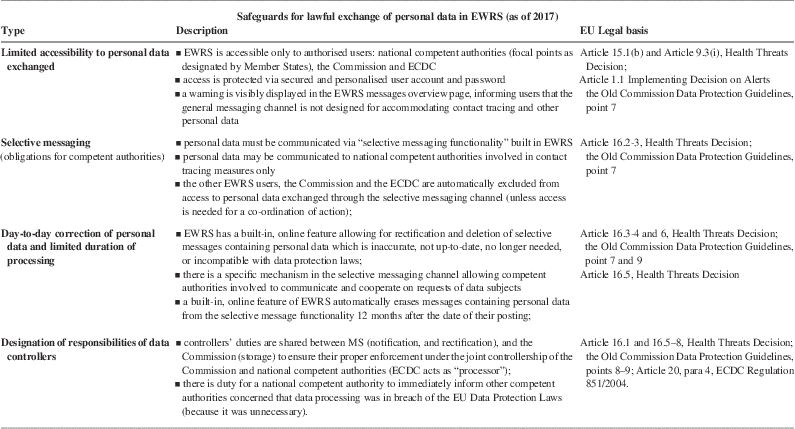
The clause is a lex specialis to the general EU Data Protection Directive (soon: GDPR) and the Regulation on Data Protection by the EU institutions. The purpose of this provision is to implement the EU general data protection principles in the field of public health (relating to purpose limitation, data quality and retention, confidentiality and security).Footnote 70 That is why Article 16 imposes some stricter requirements both on national and EU authorities when they apply the Health Threats Decision, especially when they share personal data in the EWRS under contact tracing procedure. Article 16 contains several context-specific (public health), particular obligations for national competent authorities (eg to use solely the selective messaging functionality of EWRS to communicate personal data) and implementing powers for the Commission (eg to issue guidelines ensuring that the day-by-day operation of the EWRS complies with the general EU Data Protection Laws – to be – “the New Commission Data Protection Guidelines”).Footnote 71 Moreover, it designates the particular responsibilities of data controllers under the Health Threats Decision to ensure their proper enforcement, ie national competent authorities are regarded as data controllers in relation to responsibilities to notify and rectify personal data through the EWRS (information and rectification rights of data subjects); and the Commission acts as data controller concerning storage of personal data.Footnote 72 It is a consequence of the fact that EWRS is an example of joint controllership, where the responsibility for ensuring safe processing of data is allocated, at different levels, between the Commission and the Member States.Footnote 73 Finally, Article 16 also mandates several operative and technical functions of EWRS required for data protection, for example: accessibility to personal data exchanged in the system is restricted to affected Member States only; selective messaging function is mandatory for personal data sharing, and duration of processing is limited. Further, EWRS competent authorities receive login and password from the Commission together with an authorisation for a full access to both channels and the two functions of the EWRS: reading and commenting messages. Since August 2015, the access to EWRS has been granted through the special authentication system of the Commission (ECAS) and through personalised email addresses and passwords, although some Member States expressed preference for access through “generic mailboxes”.Footnote 74 The system of safeguards for lawful personal data sharing within EWRS (as of 2017) is presented and described in detail in Table 1.
Safeguards for lawful exchange of personal data in EWRS (source: own analysis)

It should further be emphasised that, in order to warrant lawful and legitimate data processing, the Health Threats Decision refers in its content more explicitly to the purpose of data exchange and the proportionality of applicable measures. In light of its provisions, national competent authorities are allowed to communicate solely those personal data which are “necessary for the purpose of contact tracing”. In other words, the clear purpose of personal data exchange is established in the Decision in order to provide a yardstick for the assessment of respective measures. This sole aim is the identification of persons who were exposed to a serious health threat and risk developing of a disease or have already developed the disease. Moreover, communication of personal data via EWRS must be “useful” for co-ordination of a response to a serious cross-border health threat. Accordingly, the proportionality of measures will be assessed against this condition, that is, whether sharing of personal data was suitable and necessary to respond to a given threat. It would also often require a reference to scientific evidence based on a specific risk assessment (performed by the ECDC and/or national competent authorities). Further, in case of finding that exchange of personal information was unnecessary for contract-tracing measures, the competent authority concerned must immediately inform other involved authorities.Footnote 75
Further, for matters not regulated in Article 16, responsible actors are obviously obliged to apply the provisions of the general EU data protection laws to ensure safe data processing. Article 16 provides for an explicit reference to that framework.Footnote 76 As already explained above, national competent authorities must respect the Data Protection Directive (and, as from 18 May 2018, GDPR) and EU institutions, the respective Regulation on Data Protection.Footnote 77 The provisions of those acts will apply to the issues not tackled in Article 16, for example, legal definitions relevant for data protection (eg “data controller”, “processing”), provisions establishing information and access rights of data subjects, and obligations to notify and rectify incorrect data in the EWRS.Footnote 78
In sum, and as can be seen in the Table 1 above, the system of data protection safeguards established under the Health Threats Decision provides a broad set of important guarantees to ensure safe processing of personal data.
It also appears that they function well in practice. The Commission Report of 2015 on the implementation of the new Decision contains the optimistic information. First, the system has been technically adjusted to the new material scope of the Decision – “the existing IT tool of the EWRS was expanded to include threats of biological, chemical, environmental and unknown origin”. The new version of this IT tool was put in place in February 2015.Footnote 79 Second, during the 2014 Ebola epidemics in Africa, the selective messaging functionality of EWRS proved to be crucial for the transmission of personal data to support the medical evacuation of patients from the affected countries into the EU.Footnote 80
So far so good. Operationally, the EWRS is said to be adjusted to the provisions of the Health Threats Decision. However, from a normative point of view, including the law enforcement, there are still many issues which raise doubts. The next section proceeds to their critical appraisal.
IV The problems of personal data protection – a critical appraisal
When one carefully scrutinises all the provisions pertinent to the prevention of health threats, and the EU/national websites relevant to this policy, it becomes apparent that there are several shortcomings of the system which can affect the enforcement of personal data protection. Especially, one can imagine that when future use of contact tracing measures and EWRS is necessary on a broad scale, the adequacy of legal protection of data subjects and their rights can be easily affected by those shortcomings.
1 The incompleteness of the regime
It has been repeated several times throughout this article that as a result of the regulatory reform, the new Health Threats Decision has a broader material scope. Today’s regime covers biological (diseases), environmental, chemical, and other health threats, when the 1990s’ regime regarded communicable diseases only.Footnote 81 It is a consequence of the EU “integrated approach” to health and security. Accordingly, the new Decision requires new implementing acts (old implementing legislation is now repealed), but as of September 2017, the Commission has not yet issued relevant implementing provisions (the Health Threats Decision entered into force in 2013).Footnote 82
First, neither Health Threats Decision nor Implementing Decision on Alerts (which repealed the old EWRS Decision) specify an indicative list of personal data that could be lawfully shared for contact tracing purposes. The Old EWRS Decision contained an Annex III, where an indicative list was provided as an important yardstick for the application of the principles of lawful data processing: the purpose limitation and the proportionality evaluation. The relevant guidelines should be adopted by the Commission (Article 16, para 9(b), Health Threats Decision). Second, the Commission should also issue new guidelines ensuring that the operation of EWRS is compatible with the general EU Data Protection Laws (as required by Article 16, para 9(a)). Since 2013, when the new Decision entered into force, the system has been relying on the Old Commission Data Protection Guidelines of 2012 which were issued for the EWRS for infectious diseases. Third, there are no updated or adjusted implementing or delegated measures to Article 6, para 5 of the Health Threats Decision (the list and case definitions for communicable diseases and related health issues); Article 7 para 3 (case definitions to be used for ad hoc monitoring); Article 8 para 2 (procedures for the information exchange and operation of EWRS), and Article 11 para 5 (procedures for uniform implementation of competent authorities’ co-ordination).
The existing gaps in the regulatory system which result from the lack of implementing legislation can easily affect the clarity of data protection safeguards and their accurate enforcement. To give several examples: the current EU legislation does not provide for an indicative list of personal data to be exchanged for contact tracing purposes. The differences between national systems in that respect can affect the system of data protection because it is possible that divergent data are collected or required by different national competent authorities. In effect, it is possible that in various Member States different data are collected in the context of different catastrophic situations, involved diseases and/or other health threats. Some Member States may collect and exchange personal data which, in light of other national systems, will be illegitimate and/or unnecessary. To put it simply, it is contestable whether it is a name, address, and phone number which are necessary for identification of a person, or just a name and date of birth. What about the information on sex and nationality?Footnote 83
Without a harmonised, indicative list stating which personal data can be lawfully exchanged, it can be difficult to agree what data constitute “a minimum threshold” for individuals’ identification under contact tracing measures (NB: only those data of an individual can be communicated which are necessary for the identification of persons who have been exposed to a threat). Previously an indicative list of data which could be exchanged provided a useful framework of reference. The current lack of an EU-wide standard on which personal data can be exchanged for the purpose of contact tracing creates a deficiency in the regime regarding the lawfulness and the legitimate purpose of data processing.
Further, the current legal definition of contact tracing is relatively general. As early as 2010 and 2012, the EDPS recommended that a more structured format for the exchange of contact tracing information should be provided, as well as a clearer definition of contact tracing, indicating its purposes and scope, methods for determination of the persons to be sought, and sources that can be used to obtain contact details, which might be all different for communicable diseases and other health threats.Footnote 84
Moreover, some provisions of the old regime have disappeared. Before the adoption of the Health Threats Decision, the Annex to Old EWRS Decision regulated the criteria obliging to notify an alert within EWRS (for infectious diseases). They guided competent authorities on when to institute an alert and provided for the three-degree diversification of alerts. It remains unclear whether those issues would be regulated in implementing acts or not at all.
Next, at present, the relationship between ad hoc monitoring and the EWRS is not clear, especially, with regard to the specification of types of data which can be processed through the former. The provisions of the Health Threats Decision are not equivocal on this issue and it is not known what measures will be applied to minimise/exclude the chance of processing of personal data (eg through appropriate anonymisation techniques and/or restriction of the processing to aggregate data).Footnote 85 Again, it would be helpful to address all the above matters, at least, in the legislation based on the Health Threats Decision (which foresees appropriate powers to adopt implementing acts).
Finally, the criteria guiding the assessment of proportionality of contact tracing measures should be included in the implementing legislation.Footnote 86 They could address the significance of risk assessment and scientific expert evidence mandating contact tracing, the relationship between national and ECDC/WHO scientific evaluation, if diverse, and case-by-case evaluation of health threats.
To sum up, the first, considerable effect of the lack of adoption of implementing acts to the Health Threats Decision (ie an incomplete regulatory framework) results in the ambiguity of the scope of powers and obligations of EU/national competent authorities (“data controllers”). The second, resulting consequence can be an inaccurate application of data protection safeguards. This, in turn, can lead to a contestation of lawfulness, legitimacy and proportionality of an exchange of personal data in the ERWS and the contact tracing procedure.
2 Insufficient coherence of the regime
The next shortcoming of the health threats regime which can affect the level of personal data protection is its insufficient normative coherence with other EU policies. This will be illustrated through the following examples.
The overall aim of EWRS operating under the Health Threats Decision is to complement the existing information security systems at EU level in order to avoid duplication of information-sharing procedures.Footnote 87 Accordingly, the Decision foresees a progressive linking of all the EU internet-based alert tools with EWRS, with the aim of streamlined communication of various health threats. The new Article 3 of the Implementing Decision on Alerts obliges the Commission to indicate through EWRS the lead system for the information exchange when a serious cross-border threat to health is communicated through more than one Union alert system. Yet, other systems (eg Rapid Alert System for Food and Feed, RASFF; Rapid Alert System for Dangerous Non-Food Products, RAPEX) do not have specific safeguards for the exchange of personal data. Will the lawfulness and legitimacy of processing of personal data be safeguarded in this context? The problematic character of those provisions is in part a consequence of an integrated approach to health and security in the EU (because before, the EWRS applied to infectious diseases only and there was no interest of linking it to other electronic systems).Footnote 88 It is also not clear how the guarantees for adequate personal data protection (which are integral to the electronic platform of EWRS) will be implemented if competent authorities decide that they will communicate within the Health Security Committee in writing.Footnote 89
It is also feared here that the transition between the system of the EU Data Protection Directive and its successor, the system of GDPR, could lead to incoherence between the Health Threats Decision and the respective national laws – which will need to be adjusted to the new GDPR. Until 2017, the Data Protection Directive established total harmonisation in the field of data protection,Footnote 90 but nevertheless, Member States were entitled to some exceptions, including those relating to stricter requirements in national laws for data protection in the EWRS.Footnote 91 The Regulation will substitute those national laws which had been earlier implementing the Data Protection Directive, but also requires new, revised national laws. The final shape and content of national laws is impossible to predict, but there may well be gaps regarding the consistency between national laws allowing for the practical operation of GDPR and the provisions of the Health Threats Decision applicable to exchange of personal data.
3 Insufficient transparency for an individual citizen
Finally, the EU regime for combating health threats suffers from an insufficient degree of transparency for individual citizens. This concerns both ordinary citizens and persons affected by data processing.
To begin with, there is no satisfactory (or simply no) information on the Commission’s website regarding the current EU regime for health threats, conditions for exchange of personal data in the context of EWRS and contact tracing measures. The DG SANTE webpage is divided into two folders: security and health threats; and control of communicable diseases, but the information provided is incoherent and outdated.Footnote 92 Various pages of the Commission’s website list regulatory acts which are no longer in force.Footnote 93 The webpage of ECDC does not provide information on the respective issues either. All the sites are available in English mainly and it is not quite clear how data subjects are informed of the processing of their personal data. For example, there is no information regarding the exercise of access rights of data subjects (including rectification, erasure and blocking), the enforcement of rights against national competent authorities and their different jurisdictions, or at least, name(s) of a contact person in case of need.
Insufficient transparency is problematic because personal data processing in the contact tracing procedure happens between two or more Member States where different competent authorities collect and exchange personal data. It might even not be the country of origin of a given person. Supposedly, each person receives the information about contact-tracing measures and their consequences from national authorities, but what happens if the information is incomplete and/or a person does not understand it (language problem) and/or there is a mistake in the data content? Will it be clear to a person to whom his/her concerns should be addressed? Will it be clear which of his/her personal data have been exchanged, and where they can be accessed/corrected, etc? And what happens if links provided in e-messages do not function properly?
It is difficult to provide definite answers to those questions. The lack of answers contradicts the Old Commission Data Protection Guidelines stating that a clear and comprehensive privacy statement will be available on the webpage dedicated to the EWRS.Footnote 94 It further ignores the recommendation of EDPS.Footnote 95 It also contrasts heavily with the Commission’s original declarations that the reforming process of the previous regulatory framework (for infectious diseases) would lead to the simplification of existing legislation and the improvement of transparency.Footnote 96
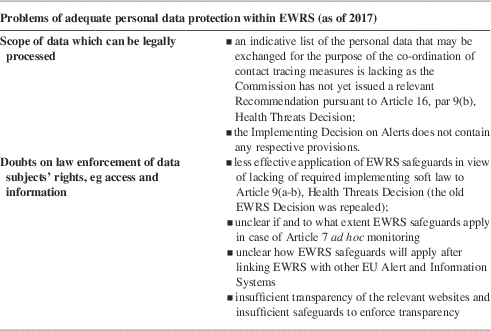
To conclude the overall appraisal, it can be said that the revision of the EU-wide regime for health threats to follow the “integrated approach” has not (yet?) introduced a comprehensive system to warrant personal data protection completely. The problems of an adequate personal data protection in the process of data exchange within EWRS are summarised in Table 2.
Problems of adequate personal data protection within EWRS (source: own analysis)

It is true that the Health Threat Decision and its implementing act establish the framework to ensure that processes of data exchange within EWRS are lawful, but a number of actions are clearly needed to address the above-described incompleteness, insufficient coherence and lack of transparency of the EU regime for prevention of health threats. A basis step to begin with would be to adopt necessary legislative solutions. However, it may not be that easy because of the complexity of the new regime based on the “all-hazards approach”. This is another reason why the health threats regime suffers from the above shortcomings: because it simply takes a very long time to adopt measures (of all kinds) which concern those intricate “all-hazards security” issues.
V Conclusions: what perspectives for data protection under EU regime for health threats?
The detailed analysis in the preceding sections allows for the conclusion that the present EU policy on serious, cross-border health threats appears to prioritise “the integrated approach” to health and security over a complete and coherent system of provisions guaranteeing an adequate level of personal data protection. The shortcomings of the regime (the incompleteness, the insufficient coherence and transparency), which can often be linked to that approach, can affect the enforcement of the broad set of guarantees for the lawful data processing within EWRS, as established by the Health Threats Decision. If the claimed defects in the EU system are not remedied, the reform of the EU policy for health threats undertaken in the name of “all-hazards security” may lead to questioning of the rationale for the reform which involves big costs of adaptation to a broadened scope of application and is undertaken at the expense of adequate protection of personal data. It will further confirm that an increased security agenda for public health policy brings risk to the effective protection of individual rights.Footnote 97
The case of Mr Speaker which was introduced at the beginning of this piece is exemplary in this respect. Ultimately, the authorities did not prove that he was dangerous to public health and the mistakes had been revealed regarding the scientific risk assessment (he was first diagnosed with XDR-TB, and then re-diagnosed with the less-dangerous MDR-TB). Yet, after his transatlantic tracing, all his personal and health data became world famous and he was portrayed by political actors as a threat to public health security. It caused his stigmatisation, hysterical press reactions, and unnecessary public fear.Footnote 98
This case also prompts the observation that a regulatory system which (lawfully) limits the individual right to personal data protection in the name of public health, but suffers from any inconsistency and incompleteness, can be even more vulnerable to infringements and misuse. It can be more easily exposed to politicisation of risk assessments and achievement of sole political gains by powerful actors should health threats arise.Footnote 99 It is also susceptible to the implementation of the politics of fear and further securitisation of public health in the form of unfounded limitation of data protection.Footnote 100 It also makes the scrutiny of legitimacy and proportionality of the exercise of powers of public health authorities and their administrative actions more difficult.
That is why a comprehensive and enforceable system of safeguards for personal data protection is an absolutely basic standard which must be met to ensure that lawful limitations are applied adequately, that any infringements are minimised, and any prohibited interference can be challenged against responsible authorities. The careful attention of policy-makers and the research community should be paid to those aspects of personal data protection in the application of the EU regime for health threats.