1 Introduction
Both substance and computation are central to a formal theory of phonology. SPE (Chomsky & Halle Reference Chomsky and Halle1968) and Optimality Theory (OT; Prince & Smolensky Reference Prince and Smolensky2004) are both formal systems, in that they specify computations over representations. What makes them phonological systems is that their representations – inputs, outputs, candidates, rules, constraints – refer to phonological ‘substance’; that is, representational primitives that are specific to phonology. However, because they are formal systems, they each make claims about the kinds of computations that are possible for the phonological module of the grammar. In SPE, this computation is handled by a rewrite rule formalism, and in OT the central computational mechanism is parallel optimisation through the generation and filtering of candidates.
The value of directly studying the computational properties of phonological patterns is thus to understand the kinds of computations that are performed by the phonological component of the grammar. Jardine (Reference Jardine2016) identifies a computational difference between unbounded processes in segmental phonology and unbounded processes in tone, based on formal language-theoretic (FLT) characterisations of phonological processes as functions (Heinz & Lai Reference Heinz, Lai, Kornai and Kuhlmann2013, Chandlee Reference Chandlee2014). In other words, the space of possible computations for segmental phonology is strictly smaller than that of tonal phonology. Pater (Reference Pater2018) criticises this conclusion for making incorrect predictions about the typology of tone and for being unable to make statements about phonological substance. He instead argues that OT provides a superior answer to both issues. The goal of this paper is to rebut these arguments by clarifying the computational view of phonology and by critically examining the claim that OT is superior in capturing the typology and incorporating phonological substance.
First, Jardine's findings are not a definitive theory of either tonal or segmental phonology, but instead identify important properties that should be maintained by theories of phonology. Thus, when Pater claims that Jardine's characterisations conflate high-tone spreading in Copperbelt Bemba (Bickmore & Kula Reference Bickmore and Kula2013, Kula & Bickmore Reference Kula and Bickmore2015) with truly unattested ‘sour grapes’-type spreading (Wilson Reference Wilson2003, Reference Wilson2006), this is a misrepresentation of the nature of the argument. Whatever our theory of tone may ultimately be, the fact remains that tone commonly includes patterns that are computationally different from those in segmental phonology. A computational view of phonology encourages future phonological theories to build on this fact.
In contrast, the power of optimisation makes it difficult to reconcile OT grammars with the computational nature of phonological processes. The phonological literature has already noted that classic OT theories of spreading make incorrect typological predictions, to the extent that they have motivated significant deviations from the classic OT architecture (Wilson Reference Wilson2003, McCarthy Reference McCarthy, Goldsmith, Hume and Wetzels2010, Rose & Walker Reference Rose, Walker and Goldsmith2011). This can be directly connected to the fact that OT does not constrain the computational properties of processes – an extreme example of ‘mass metathesis’ is given below. For this reason, it is far from clear that Pater (Reference Pater2018) provides a superior characterisation of the typology of spreading. As Pater points out, computational theories and OT are not necessarily incompatible. However, more work needs to be done to show how OT may be reconciled with computational characterisations of the kind highlighted by Jardine (Reference Jardine2019).
Finally, substantive considerations can indeed be incorporated into computational characterisations of phonology. Much as substantive statements are formalised in OT grammars through specifying the content of Con, we can place substantive restrictions on computational characterisations through statements about the substructures and representations to which FLT grammars refer. As detailed below, this is a topic of ongoing research.
This paper is structured as follows. §2 briefly reviews the relevant facts and the computational properties that Jardine (Reference Jardine2016) uses to explain them. §3 shows how OT does not adhere to these properties. §4 explains how substance can be incorporated into computational theories of phonology, and §5 briefly discusses exceptions to the generalisations discussed by both Jardine and Pater. §6 concludes.
2 The computational nature of phonological processes
The result of Jardine (Reference Jardine2016) rests on studying phonological processes as functions from an input string to an output string. This approach reveals that segmental processes are surprisingly limited in the information needed to compute them: there is a bound on the amount any target can ‘look ahead’ in the direction of application of the process in order to know whether or not it will change. This is expressed formally by placing segmental phonology within classes of functions related to the subsequential class of functions, a strict subclass of the regular class of functions for which the output can be computed deterministically by processing the input string from left to right.Footnote 1
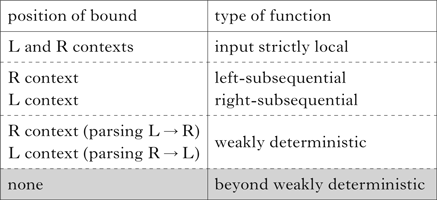
A summary of bounds on processes and how that reflects on their status as functions is given in Table I. Processes with a bound on both on the information to the left and to the right are input strictly local (Chandlee Reference Chandlee2014, Chandlee & Heinz Reference Chandlee and Heinz2018). This is the case for any process which can be written in the form A → B / C _ D, where C and D are of some fixed size. Processes with a bound only on the right context, e.g. unbounded nasal spread in Johore Malay (Onn Reference Onn1980), are left-subsequential. Processes with a bound only on the left context, e.g. long-distance consonant assimilation in Ineseño Chumash (Applegate Reference Applegate1972, Hansson Reference Hansson2010), are right-subsequential. To accommodate bidirectional processes (such as root-control harmony; Baković Reference Baković2000), Heinz & Lai (Reference Heinz, Lai, Kornai and Kuhlmann2013) posit the weakly deterministic class, which extends the subsequential class to include functions consisting of the application of a single subsequential function both from left to right and from right to left.
Summary of types of function, based on the boundedness of the contexts of a target (L=left, R=right). A dashed line indicates a region of complexity strictly more expressive than the region above it. The highlighted region is hypothesised to be excluded in segmental phonology (Heinz & Lai Reference Heinz, Lai, Kornai and Kuhlmann2013, Jardine Reference Jardine2016).

Subsequentiality thus captures fundamental properties of the application of phonological processes. This characterisation has found substantial empirical support. Typological studies have shown that local processes (Chandlee & Heinz Reference Chandlee and Heinz2018), vowel harmony (Heinz & Lai Reference Heinz, Lai, Kornai and Kuhlmann2013), consonant harmony (Luo Reference Luo2017) and long-distance dissimilation (Payne Reference Payne2017) are all at most weakly deterministic. Heinz & Lai (Reference Heinz, Lai, Kornai and Kuhlmann2013) give additional evidence for the weakly deterministic hypothesis in the absence of sour grapes-style spreading (Wilson Reference Wilson2003, Reference Wilson2006). They argue that sour grapes spreading is not weakly deterministic, as it requires unbounded look-ahead both to the left and the right of any potential target.
Even putative examples of ‘non-myopic’ harmony, as in Pater's (Reference Pater2018) example of Central Veneto, can be subsequential. In Central Veneto, a stressed /e/ or /o/ raises when preceding a high final vowel, causing an intervening vowel to raise, as in (1a). That this only applies to stressed mid vowels is shown in (1b). Potential targets are underlined, and high vowels are bolded (data from Walker Reference Walker2010).
(1)


This is considered non-myopic because the intervening vowel must ‘look ahead’ to the preceding stressed vowel to see whether it should raise. However, stress in Central Veneto occurs on either the penult or the antepenult (Walker Reference Walker2010). Thus, for a stressed vowel to find a high trigger for raising, it only needs to look ahead two vowels, and any intervening vowel only needs to look one vowel to either side to determine that it is in the right environment for raising. Thus Central Veneto is also subsequential (in fact, it is input strictly local).
Jardine (Reference Jardine2016) then gives evidence that non-weakly deterministic processes are commonly attested in tone, and thus posits that the weakly deterministic bound must crucially apply only to segmental processes. He cites unbounded tone plateauing (Kisseberth & Odden Reference Kisseberth, Odden, Nurse and Philippson2003, Hyman Reference Hyman2011) and unbounded spreading in Copperbelt Bemba (Bickmore & Kula Reference Bickmore and Kula2013, Kula & Bickmore Reference Kula and Bickmore2015) as examples of processes that require unbounded look-ahead on both the left and the right of any given target. Importantly, while Pater (Reference Pater2018: 151) cites this as a ‘claim’ that tone is formally more complex than segmental phonology, it is actually a fact, as long as we accept that phonology maps underlying forms to surface forms. Segmental phonology is overwhelmingly weakly deterministic, while unbounded tone plateauing and unbounded spreading in Copperbelt Bemba are outside of this space. As these are properties of the functions themselves, this fact holds independently of how they might be represented with a particular grammatical formalism.
Pater (Reference Pater2018) notes a difference between ‘true’ sour grapes and Copperbelt Bemba, and argues that the former is not attested in tone. If this is true, then our ultimate theory of phonology should exclude true sour grapes, even in tone. The right theory may provide a substantive answer, as Pater suggests, or it may provide a computational one. Regardless, it does not change the fact that tone commonly includes non-weakly deterministic processes. Pater's criticism of Jardine (Reference Jardine2016) as not distinguishing between different non-weakly deterministic processes is thus misplaced.
3 Explanation and Optimality Theory
Pater (Reference Pater2018) argues for OT grammars because they can state substantive considerations, and claims to explain in OT why Copperbelt Bemba is attested in tone, but ‘true’ sour grapes spreading is not. However, without a theory of Con or an analysis of its factorial typology, such stipulations are only descriptive restatements of the empirical facts in terms of the framework, not a predictive theory of phonology.
Furthermore, the power of optimisation makes it difficult to reconcile OT grammars with the restrictive nature of phonological processes. Pater (Reference Pater2018: 154) states that ‘most OT theories of unbounded spreading … do not produce sour grapes’; however, the pathological predictions of parallel OT with regards to unbounded spreading are well documented (Wilson Reference Wilson2003, Reference Wilson2006, McCarthy Reference McCarthy, Goldsmith, Hume and Wetzels2010, Rose & Walker Reference Rose, Walker and Goldsmith2011). Thus Pater's claim that he has demonstrated an OT system that ‘can generate the desired typology’ (Reference Pater2018: 155) is not sufficiently supported.
The reason for these issues is clear when we examine the expressive power of optimisation. Even with simple constraints, OT grammars can compute non-subsequential, fully regular functions such as sour grapes (Heinz & Lai Reference Heinz, Lai, Kornai and Kuhlmann2013), as well as non-regular functions such as majority rules (Gerdemann & Hulden Reference Gerdemann and Hulden2012, Heinz & Lai Reference Heinz, Lai, Kornai and Kuhlmann2013) and alphabetical sorting (Lamont Reference Lamont2018).
To give an example, sorting can be produced by Align-based spreading constraints. Take rightward spreading of a [nasal] feature, as discussed in §2. McCarthy (Reference McCarthy, Goldsmith, Hume and Wetzels2010) points out that ranking Align-R([nasal],word) over Linearity predicts metathesis of a blocker and undergoer in order to more optimally align the [nasal] feature. In fact, the problem is worse than McCarthy illustrates: given a string of undergoers and blockers, all blockers are sent to the right edge of the word in a ‘mass metathesis’, so that the winning candidate sorts the form into a nasal portion followed by a non-nasal portion, as in (2).
(2)
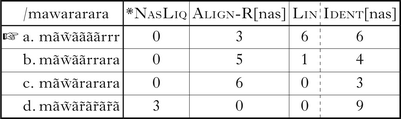
The winning candidate in (2) is [mãw̃ããããrrr], in which Linearity has been massively violated, such that all of the undergoers are ordered before the blockers. This is not even a regular function, because the amount of memory required to compute the output grows with the number of blockers in the input that must be deposited at the end of the word. Thus, while there are OT theories of spreading that do not produce sour grapes, they can still miss the generalisation that segmental spreading is weakly deterministic (and even that it is regular).
Issues like sour grapes and mass metathesis arise because optimisation allows direct comparison of candidates with local changes to candidates with non-local changes. This ‘global’ evaluation of optimisation is, as these examples show, computationally very powerful. It may be possible to rein in the power of OT grammars by carefully choosing the right constraints. We could reject Agree, as suggested by Pater (Reference Pater2018). We would also have to reinterpret Linearity as an inviolable part of Gen, as the violability of Linearity is partially the culprit for the pathology in (2). However, all such modifications ‘conspire’ to capture a generalisation that is stated directly by the weakly deterministic hypothesis.
Furthermore, it does not appear to be the case that OT's problems with unbounded spreading can be solved by simply choosing the right constraint set. To capture the ‘myopic’ nature of spreading, both Wilson (Reference Wilson2003, Reference Wilson2006) and McCarthy (Reference McCarthy, Goldsmith, Hume and Wetzels2010) appeal to significant changes in how OT evaluates candidates. In their review of harmony systems and their analyses, Rose & Walker (Reference Rose, Walker and Goldsmith2011: 268) tellingly note: ‘proposals like those made by Wilson … involve substantial departures from traditional constraint architecture in OT’. The reason that Wilson (Reference Wilson2003) proposes targeted constraints, which only assess a limited set of candidates, is that he finds that previous analyses of harmony in classical OT fail to capture the basic nature of segmental spreading. Weak determinism, in contrast, captures it directly, and provides a metatheoretical bound for future theories to adhere to.
This is not to say that future work cannot develop versions of OT that are compatible with the weakly deterministic hypothesis. In an important sense, Pater (Reference Pater2018: 152) is correct when he states that Formal Language Theory is a ‘general tool for the formalisation and comparison of theories’, and that computational theories of phonology are not necessarily an alternative to OT. Indeed, there is a body of work connecting OT to regular functions (Eisner Reference Eisner1997, Frank & Satta Reference Frank and Satta1998, Riggle Reference Riggle2004).
However, OT's difficulties in capturing the computational nature of spreading highlight the need for further study of the expressivity of OT grammars. Can we characterise a class of constraints that produce non-weakly deterministic (or non-regular) functions under optimisation? Under what conditions, if any, can OT grammars be restricted to weakly deterministic functions? Research addressing such questions could follow that of Tesar (Reference Tesar2014), who proves the conditions necessary for constraint sets to produce typologies that are restricted to output-driven functions. Regardless, analytically studying the computational properties of OT grammars is critically important to evaluating it as a theory of phonology.
4 Substantive explanation and the weakly deterministic hypothesis
Finally, substantive explanation is not at all incompatible with computational theories. Pater assumes that any substance-based explanation cannot be reconciled with the weakly deterministic hypothesis: he states that FLT does not provide ‘a means for the development of substantive theories of constraints’ (Reference Pater2018: 152). However, the hypothesis that segmental phonology is weakly deterministic is inherently a substantive one – it makes predictions about how phonological substance can behave in segmental vs. other domains. There is no real difference between tone and segmental phonology in the substance Pater refers to – in terms of positional licensing, both tone and vowel features have been shown to refer to prominent positions. What the FLT analysis of their difference explains is that vowel features interact with that substance in a different way than tone.
More importantly, substance can be incorporated into FLT grammars through restrictions on the constraints that grammars can choose from, and through the representations over which grammars operate. In other words, one can make substantive stipulations in FLT grammars in much the same way that they are made in OT, or in any other theory of phonology.
This is most obviously true for phonotactic grammars based in FLT, which capture patterns through constraints that specify illicit substructures (Heinz Reference Heinz2010, McMullin & Hansson Reference McMullin, Hansson, Albright and Fullwood2015, Jardine & Heinz Reference Jardine and Heinz2016), just like markedness constraints in OT (de Lacy Reference de Lacy, van Oostendorp, Ewen, Hume and Rice2011). The only difference is that the constraints in these FLT characterisations are interpreted as inviolable. Thus, just as substantive statements can be made in OT by stipulating the content of Con, so we can similarly make substantive statements in FLT phonotactic grammars through stipulations on what constraints are available to grammars. This is also true for processes. For example, we can study the range of functions that perform repairs on particular marked structures (Chandlee et al. Reference Chandlee, Jardine, Heinz, Albright and Fullwood2015). Here, too, we can make substantive statements by specifying which structures need to be repaired.
Furthermore, as with other kinds of phonological grammars, substance can also be incorporated into phonological theories based in FLT through representation. This is implicit in the alphabets of symbols chosen in FLT-based work – Heinz (Reference Heinz2009) uses strings of syllables to characterise stress, Heinz & Lai (Reference Heinz, Lai, Kornai and Kuhlmann2013) assume a vowel tier and Jardine (Reference Jardine2016) uses strings of moras. FLT-based studies of non-string phonological representations are the subject of ongoing research; see Jardine (Reference Jardine2017) for tonal autosegmental representations, and Strother-Garcia (Reference Strother-Garcia2018) for syllable representations. In particular, the reader is referred to Jardine (Reference Jardine2019), who argues that formal grammars defined over autosegmental representations more naturally capture the typology of tonal well-formedness patterns than established formal grammars over strings.
5 Exceptions to the weakly deterministic hypothesis
It should be noted that non-weakly deterministic segmental processes, although extremely rare, are attested. One such, discussed in Jardine (Reference Jardine2016), is an apparent unbounded plateauing vowel-harmony process in Yaka (Hyman Reference Hyman1998). Another, which has come to light since Jardine (Reference Jardine2016) was published, is ATR harmony in Tutrugbu (McCollum & Essegbey Reference McCollum and Essegbey2018), in which unbounded harmonising of low vowels to a following [+ATR] vowel is blocked by a preceding [+high]-initial prefix.
Such patterns are of interest because they challenge a categorical interpretation of the weakly deterministic hypothesis. Indeed, McCollum et al. (Reference McCollum, Baković, Mai and Meinhardt2017) interpret the facts of Tutrugbu as evidence for the weakly deterministic bound as a bias, and not a categorical constraint (see also Avcu Reference Avcu2018). However, it is also the case that neither is evidence for Pater (Reference Pater2018)’s OT-based prosodic licensing explanation of non-myopic processes. Hyman's analysis of Yaka invokes a sour grapes-style analysis, and McCollum & Essegbey invoke a combination of spreading and correspondence constraints. Thus both processes are just as unexpected for existing OT-based theories of spreading. The upshot is that both cases warrant further investigation, regardless of one's theoretical perspective.
6 Conclusion
Phonological processes share non-arbitrary structural properties. A theory of phonology should thus be able to state these properties directly. Segmental processes are, almost without exception, weakly deterministic. This generalisation escapes explanation in OT because, as illustrated in §3, global optimisation makes it difficult, if not impossible, to make any coherent statement about the structural properties of phonological processes in OT.
FLT characterisations of phonology non-trivially capture generalisations that are important to any theory of phonology. At the very least, then, they can serve as constraints on the kinds of computations that phonological theories should allow. Thus, when we look to include substantive considerations, we should do so in a way that is in harmony with computational characterisations. Given the challenges of reining in optimisation, it is not clear that this is possible in OT.