


INTRODUCTION
Gene flow is a major source of genetic variability in plants and animals, and in conjunction with natural selection and genetic drift maintains the evolution of life (Harlan, Reference Harlan1975). In areas where crops are grown geographically close to wild relatives, the species variability and the fitness of the wild populations could be changed. The gene flow from crops to wild species has been studied in various genera such as Brassica, Helianthus, Oryza, Raphanus, Sorghum and Zea (Ellstrand et al., Reference Ellstrand2009). In rice, gene flow is a significant process because this crop is an important staple food and several weedy and wild species can hybridise with cultivated rice. The species O. glaberrima, O. meridionalis, O. rufipogon, O. glumaepatula, O. nivara, and O. longistaminata contain the AA genome, which is the same genome as in O. sativa (Kuroda et al., Reference Kuroda, Sato, Bounphanousay, Kono and Tanaka2007), indicating the potential for hybridisation among these species. However, the most important problem of hybridisation in rice is with weedy rice that largely occurs in most rice-growing regions of America and Europe and is a growing problem in Asia (Chauhan, Reference Chauhan2013).
Weedy rice is a co-specific weed of rice. In the absence of control, weedy rice reduces rice grain yield by 90% in heavily infested areas (Diarra et al., Reference Diarra, Smith and Talbert1985). In the United States, the average losses due to weedy rice infestation are nearly $ 300 ha−1 (Burgos et al., Reference Burgos, Norsworthy, Scott and Smith2008). Several management practices, such as transplanting, no-till and biological control have been proposed to mitigate the establishment of weedy rice (Chauhan, Reference Chauhan2013). However, these practices are either ineffective or have limited applications in large-scale fields. In the 1990s, an imidazolinone-tolerant rice (IMI-rice) line 93-AS-3510 was obtained through ethyl methanesulfonate-induced mutagenesis (Croughan et al., Reference Croughan, Utomo, Sanders and Braverman1996). This line was used to develop the IMI-rice cultivars CL 121 and CL 141 in the United States and IRGA 422 CL and SCS 115 CL in Brazil (Sudianto et al., Reference Sudianto, Beng-Kah, Ting-Xiang, Saldain, Scottd and Burgos2013). A similar process was used to develop the line PWC16 (Wenefrida et al., Reference Wenefrida, Utomo, Meche and Nash2007), which was used to create the IMI-rice CL 161 in the United States and several hybrid cultivars in Brazil. In addition, the IMI-rice PUITÁ INTA CL was also developed in Argentina through artificial mutation (Roso et al., Reference Roso, Jr, Delatorre and Menezes2010a). The point mutations in the ALS (acetolactate synthase, which is also known as acetohydroxy acid synthase) gene that confer resistance to the IMI-rice lines 93-AS-3510 and PWC13, and in the IMI-rice cultivar PUITÁ INTA CL are Gly654Glu, Ser653Asn, and Ala122Thr, respectively (Roso et al., Reference Roso, Jr, Delatorre and Menezes2010a). The introduction of IMI-rice provides the selective control of weedy rice, which, together with other management practices, increased the rice grain yield in Brazil by approximately 2000 kg ha−1. However, several biotypes of weedy rice resistant to ALS-inhibiting herbicides have been identified in paddy fields in the United States (Gealy et al., Reference Gealy, Mitten and Rutger2003; Shivrain et al., Reference Shivrain, Burgos, Anders, Rajguru, Moore and Sales2007), Brazil (Menezes et al., Reference Menezes, Mariot, Kalsing and Goulart2009; Roso et al., Reference Roso, Jr, Delatorre and Menezes2010a), Italy (Scarabel et al., Reference Scarabel, Cenghialta, Manuello and Sattin2012) and Greece (Kaloumenos et al., Reference Kaloumenos, Capote, Aguado and Eleftherohorinos2013). In Brazil, 56% of 228 populations of weedy rice tested were resistant to imidazolinone herbicides (Menezes et al., Reference Menezes, Mariot, Kalsing and Goulart2009). A field study identified that the ALS-resistant alleles present in the herbicide-resistant weedy rice in Brazil are similar to those of the predominant cultivated rice cultivars and indicates that the origin of resistance was associated with gene flow from the rice cultivars (Roso et al., Reference Roso, Jr, Delatorre and Menezes2010a). Subsequently, a paternity exclusion analysis based on simple sequence repeat markers indicated independent evolution and gene flow were the origin of resistance in 1.1 and 98.9% of the weedy rice plants, respectively (Goulart et al., Reference Goulart, Pacheco, Nunes and Merotto2012a). The knowledge of the processes that are involved in gene flow from these cultivars could be useful for identifying the ecological impact for assessing the risk of outcrossing between these different cultivars. These evaluations are also useful for the risk assessment of new mutant-derived or transgenic rice cultivars.
Rice is primarily a self-pollinated species, although several studies have found that the outcrossing rate ranges from 0.01 to 52% depending on the environmental factors, the crop practices, the inherent characteristics of the rice cultivars and weedy rice biotypes, the synchrony of flowering and the distance between the plants (Gealy et al., Reference Gealy, Mitten and Rutger2003; Langevin et al., Reference Langevin, Clay and Grace1990; Shivrain et al., Reference Shivrain, Burgos, Sales, Mauromoustakos, Gealy, Smith, Black and Jia2009). Several studies have demonstrated the occurrence of gene flow from herbicide-resistant rice cultivars to weedy rice using glufosinate-resistant rice lines (Kanya et al., Reference Kanya, Kinyamario, Amugune and Hauser2009; Messeguer et al., Reference Messeguer, Marfà, Català, Guiderdoni and Melé2004; Noldin et al., Reference Noldin, Yokoyama, Antunes and Luzzardi2002) and imidazolinones (Shivrain et al., Reference Shivrain, Burgos, Sales, Mauromoustakos, Gealy, Smith, Black and Jia2009). In the United States, the outcrossing rate to weedy rice was higher in the CL 161 than in CL 121, both inbred cultivars, (Shivrain et al., Reference Shivrain, Burgos, Anders, Rajguru, Moore and Sales2007) and in the hybrid IMI-rice CLXL8 than the inbred cultivar CL 161 (Shivrain et al., Reference Shivrain, Burgos, Sales, Mauromoustakos, Gealy, Smith, Black and Jia2009). The ALS gene point mutation Ser653Asn is present in the cultivars CL 161 and CLXL8, and Gly654Glu is present in the cultivar CL 121 (Wenefrida et al., Reference Wenefrida, Utomo, Meche and Nash2007). However, little is known about the gene flow from the herbicide-resistant weedy rice or the magnitude of this process in the cultivars carrying the different imidazolinone herbicide-resistant alleles in the same environment. Currently, approximately 500000 ha of the IMI-rice cultivar PUITÁ INTA CL, which carries the ALS point mutation Ala122Thr, are grown in Brazil. However, to the best of our knowledge, there are no published studies concerning the level of gene flow from this cultivar either in isolation or compared with the other IMI-rice cultivars. The herbicide resistance to ALS-inhibitors is a common event and fitness penalty associated with different germination rates was found in the IMI-rice cultivars carrying different ALS gene mutations (Goulart et al., Reference Goulart, Matzenbacher and Merotto2012b). In addition, gene flow from the herbicide-resistant weedy rice escapees could be higher than in rice cultivars due to differences in flower morphology. The wild traits of non-domesticated weedy rice could favour the introgression of the resistance allele to other weedy rice populations, due to the higher outcrossing rate observed in wild rice species (Kuroda et al., Reference Kuroda, Sato, Bounphanousay, Kono and Tanaka2007). The evaluation of gene flow among different IMI-rice cultivars is important to characterise the importance of field practices associated with the control of weedy rice escapees, such as sequential herbicide application and hand pulling. In addition, gene flow studies are also useful for emphasising the importance of developing biotechnological strategies related to the containment and mitigation of gene flow in the development of transgenic rice related to herbicides, insects, environmental stresses, neutraceuticals or pharmaceuticals traits. The objective of this study was to quantify the outcrossing rate of imidazolinone herbicide-resistant weedy rice and hybrid and inbred rice cultivars carrying three different ALS alleles using a single donor pollen plant approach to contribute for the risk analysis associated with gene flow in these cultivars.
MATERIALS AND METHODS
The study consisted of a field experiment performed in Cachoerinha, RS, Brazil, where the outcrossing rate was evaluated by sowing pollen-receptor plants in plots and placing pollen-donor plants in the middle of each plot. The outcrossing rate was determined by collecting the seeds of the pollen-receptor plants and screening for the ALS-inhibiting herbicide resistance trait using a seed-soaking bioassay, a foliar whole-plant herbicide spraying assay, and the identification of the ALS gene mutations using SNP molecular markers.
Field experiment
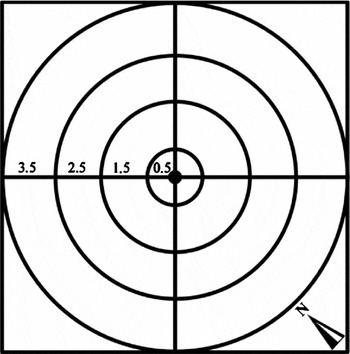
The experiment was performed in a split-split plot design with four replications using the encircle population combination technique with a 3.5 m radius (Figure 1). The pollen-receptor plants were located in the main plots, comprising of the cultivar IRGA 417 and a weedy rice biotype (SWR), both susceptible to imidazolinone herbicides. The pollen-donor plants were positioned in the split plots, comprising of the IMI-rice inbred cultivars IRGA 422 CL and PUITÁ INTA CL, the hybrid SATOR CL, and the weedy rice resistant biotype (RWR). This biotype is resistant to imidazolinone herbicides due to the ALS point mutation Gly654Glu (Roso et al., Reference Roso, Jr, Delatorre and Menezes2010a). The ALS gene mutations present in the cultivars IRGA 422 CL, SATOR CL and PUITÁ INTA CL are Gly654Glu, Ser653Asn and Ala122Thr, respectively. The split-split plots were four distances from the pollen-donor plant (Figure 1). Additionally, each semicircle was sampled for each cardinal direction. The pollen-receptor plants were sown on December 19, 2009 at 85 kg ha−1, with a row spacing of 0.17 m. Permanent flooding was initiated at 21 days after rice emergence. Fertiliser was applied at 97, 70 and 105 kg ha−1 of N, P2O5 and K2O, respectively. Weeds, insects and diseases were controlled with penoxulam and cyalofop-butyl, thiamethoxam, and epoxiconazole and kresoxim methyl, respectively, at the recommended doses. RWR and SWR, similarly the predominant weedy rice populations in Brazil, had red-coloured pericarp, large awns and straw-coloured hulls.
Illustration of a field plot arranged according to the encircle population combination technique. The black circle (middle) represent the place of the pollen-donor plant. The pollen-receptor plants were drill-seeded throughout all semicircles. The numbers indicate the distance from pollen-donor of each semicircle.

The pollen-donor plants were sown in pots in the greenhouse on 5 dates at intervals of 10 days. These pots were moved to the experimental growing area at the three-leaf stage. This procedure was adopted to obtain plants in different stages in order to synchronise the flowering time of the pollen-donor and pollen-receptor plants. When the pollen-receptor plants started to exert panicles, a donor plant in anthesis was positioned into the middle of the appropriate plot. The SWR and IRGA 417 began anthesis on February 19 and March 2, 2010, respectively. The pollen-donor plants were replaced once at the end of their anthesis stage to ensure that the pollen supply to the pollen-receptor plants was maintained until complete flower fertilisation. Each plant donor remained in the field for 12 days. The pollen-donor plants were positioned over a support structure to raise the panicles to a level just above the canopy of the pollen-receptor plants. Immediately after the pollen-receptor plants completed flowering, the pollen-donor plants were removed from the experimental area to avoid seed contamination.
Determination of sample size
Each plot was divided into four concentric circles formed by four sampling distance intervals of 0–0.5, 0.5–1.5, 1.5–2.5 and 2.5–3.5 m and in 4 cardinal directions resulting in 16 samples per plot (Figure 1). All panicles of the pollen-receptor plants were manually harvested, threshed and cleaned. The sample size was estimated according to the procedure proposed by Jhala et al. (Reference Jhala, Bhatt, Topinka and Hall2011), considering the outcrossing frequency of rice at a distance of up to 3.5 m of 0.01% (Chen et al., Reference Chen, Lee, Song, Suh and Lu2004; Messeguer et al., Reference Messeguer, Marfà, Català, Guiderdoni and Melé2004; Shivrain et al., Reference Shivrain, Burgos, Anders, Rajguru, Moore and Sales2007), a confidence level of 95%, and a statistical power of 0.8. Thus, the sample size ‘n’ was estimated as 1989 seeds per sample. Each of the 32 plots (2 pollen-donors, 4 pollen-receptor and 4 replications) contained 16 samples (4 interval of distances and 4 cardinal directions) of 1989 seeds; thus, the total sample size was 1018.368 seeds.
Hybrid identification
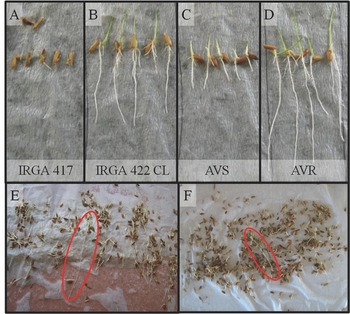
The detection of herbicide-resistant individuals was performed using a seed-soaking bioassay according to Roso et al. (Reference Roso, Merotto and Delatorre2010b). Seeds were soaked in 0.2 mM imazethapyr for 24 h before rolling in germination paper for incubation for five days in a germination cabinet with mean temperature of 25°C and relative air humidity of 65%. The screening of susceptible and resistant individuals was based on the root length of the sampled individuals compared with the known susceptible and resistant controls (Figure 2). Seedlings with root lengths 2.0 cm higher than the susceptible controls were considered resistant. The susceptible controls were the cultivar IRGA 417 and the SWR biotype, and the resistant controls were the cultivar IRGA 422 CL and the RWR biotype (Figure 2).
Illustration of the germination of controls used in the seed-soaking bioassay showing the imidazolinone herbicide-susceptible cultivar IRGA 417 (A), resistant cultivar IRGA 422 CL (B), susceptible red rice (C), and resistant red rice (D), and an illustration of the detection of hybrids in seed samples, which were originated from the pollen-receptor cultivar IRGA 417 and the pollen-donor PUITÁ INTA CL (E) and from the susceptible red rice pollen-receptor and IRGA 422 CL pollen-donor (F).

The seedlings that were identified as herbicide-resistant in the seed-soaking bioassay were planted in 300 ml soil pots for the whole-plant herbicide screening. At the four-leaf stage, the plants were sprayed with 100 g ha−1 imazethapyr. The herbicide was applied using a hand-held sprayer pressurised with CO2 at 207 kPa, and delivered 200 L ha−1 through AD 110.02 spray nozzles. The evaluation of the live plants was performed at 15 days after the treatment. Subsequently, four plants from each pollen-donor and pollen-receptor combination identified as resistant using the procedure described above were randomly selected for screening for the ALS gene mutation associated with imidazolinone resistance. This procedure was performed using SNP molecular marker according to Roso et al. (Reference Roso, Jr, Delatorre and Menezes2010a). These markers can identify the point mutations Gly654Glu, Ser653Asn and Ala122Thr, which are present in the pollen-donor plants IRGA 422 CL and RWR, SATOR CL, and PUITÁ INTA CL, respectively. The DNA extraction, polymerase chain reaction and agarose electrophoresis were performed as described in Roso et al. (Reference Roso, Jr, Delatorre and Menezes2010a). Individuals identified as imidazolinone-resistant through the seed-soaking, whole-plant and SNP assays were considered as originated from an outcrossing event between the pollen-donor and pollen-receptor plants. This determination was based on the expected ratio in the F1 generation of an outcrossing that is 100% heterozygous; in this case, the progeny would be herbicide-resistant because the ALS-inhibiting herbicide resistance trait is governed by an incompletely dominant allele (Shivrain et al., Reference Shivrain, Burgos, Anders, Rajguru, Moore and Sales2007).
Statistical analysis
The quantification of the outcrossing rate was based on the frequency of resistant individuals and the total number of seeds in each sample. The outcrossing rate data were not normally distributed and did not exhibit homoscedastic variances. These problems were not corrected even after performing several data transformations. Therefore, nonparametric methods of analysis of variance (ANOVA) were evaluated. Data originally obtained and ranked organised data were analysed using the parametric ANOVA according to Zimmermann (Reference Zimmermann2004). In this comparison, if both results are similar, then the interpretation should utilise the ANOVA that was performed with the original data; if the results are different, then the analysis of the ranked data should be used because it is more accurate than the analysis of the original data (Mehrotra et al., Reference Mehrotra, Lu and Li2010). The results of both tests were not significant (p > 0.05) for the pollen-donor, the interval of distance or the cardinal direction factors, but were significant (p < 0.01) for the pollen-receptor factor. Because the results of these procedures were similar, the interpretation of the results was based on the ANOVA performed with the original data. The comparison of the outcrossing rate in all combinations of pollen-donor and pollen-receptor pairs was performed through the analysis of least squares, adjusted using Tukey's test. All of the statistical analyses were performed using SAS 9.1 software (SAS Institute Inc, Cary, NC). The interval of distance from the pollen-donor plant was evaluated through regression analysis.
RESULTS AND DISCUSSION
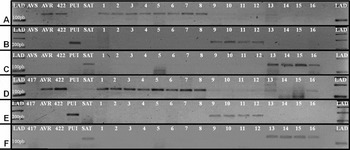
Seed-soaking and the whole-plant herbicide spraying bioassays successfully identified the imidazolinone-herbicide resistant F1 individuals derived from the pollen-receptor plants (Figure 2). The comparison based on the resistant and susceptible controls provided a clear guide for the selection of the F1 individuals (Figure 2). In addition to the phenotypic screening, the presence of mutations in the ALS gene was identified using a SNP molecular marker assay. This analysis confirmed that when the cultivar IRGA 422 CL was used as a pollen-donor and SWR (Figure 3a) or IRGA 417 (Figure 3d) was used a pollen-receptor, the resulting seeds contained the mutation Gly654Glu, which is the same mutation present in the pollen-donor cultivar. Similarly, the ALS gene mutation originally present in the pollen-donor plants was detected in the hybrids that were derived from PUITÁ INTA CL (Figure 3b and Figure 3e) and SATOR CL (Figure 3c and Figure 3f). These results confirmed that all tested herbicide-resistant seeds derived from pollen-receptor plants carried the same mutation present in the respective pollen-donor plants. In addition to gene flow, the origin of the herbicide resistance could be associated with de novo mutations of the ALS gene, which estimated frequency is 10−6 (Délye et al., Reference Délye, Boucansaud, Pernin and Le Corre2009). Seven mutations in the ALS gene have been associated with herbicide resistance in weeds (Massa et al., Reference Massa, Krenz and Gerhards2011), and de novo mutations could appear in any of these locations. However, all the mutations identified in the SNP molecular marker assay occurred in the same position as the mutation associated with the resistance in the respective pollen-donor plant. This result decreases, but does not eliminate the potential origin of resistance associated with de novo mutation instead of gene flow.
DNA banding pattern related to the confirmation of the hybridisation between the pollen-donor and pollen-receptor plants based on the SNP molecular marker and evaluated on 2% agarose gels. The first four lanes represent the controls: SWR (susceptible red rice), RWR (resistant red rice), 422 (IRGA 422 CL), PUI (PUITÁ INTA CL) and SAT (SATOR CL). Lanes 1–16 correspond to the evaluated samples from the pollen-donor treatments: RWR is in lanes 1–4, IRGA 422 is in lanes 5–8, PUITÁ INTA CL is in lanes 9–12, and SATOR CL is in lanes 13–16. Panels A to C refer to the samples obtained from the pollen-receptor SWR plants, and panels D to F refer to the plants from the cultivar IRGA 417 as a pollen-receptor. Panels A and D show the presence of the mutation Gly654Glu in the genotypes IRGA 422 CL and in the resistant red rice. Panels B and E show the presence of the mutation Ala122Thr that occurred in the cultivar PUITÁ INTA CL. Panels C and F show the presence of the mutation Ser653Asp in SATOR CL. LAD, 100 bp ladder (Invitrogen, Carlsbad, CA, USA).

The ANOVA analysis indicated absence of significant interaction among the studied factors. Therefore, data were analysed for each factor separately. The outcrossing rate was different among the pollen-receptor plants. The outcrossing rate of the SWR biotype was higher than to that of the cultivar IRGA 417 (Table 1). This difference might reflect the morphological characteristics of the reproductive structures of the rice cultivar, particularly associated with the characteristics of the stamens and pistils. Some features, such as the protrusion of the stigma, the pistil length, the opening size of the anthers and the number of grains deposited on the stigma are highly correlated with cross-fertilisation in rice plants (Matsui and Kagata, Reference Matsui and Kagata2003). Some of these characteristics might be more prevalent in the weedy rice compared with cultivar IRGA 417, likely favouring the occurrence of outcrossing and gene flow in weedy rice. The proportion of allogamy is typically lower in cultivated rice than in the wild genotypes (Gealy et al., Reference Gealy, Mitten and Rutger2003). In cultivated rice, the stigmas are short, which limits their ability to receive pollen from other individuals (Messeguer et al., Reference Messeguer, Fogher, Guiderdoni, Marfà, Català, Baldi and Melé2001). In contrast, in wild Oryza species the stigma is long and open, favouring the capture of pollen from other spikelets (Song et al., Reference Song, Lu, Zhu and Chen2003). Indeed, Noldin et al. (Reference Noldin, Yokoyama, Antunes and Luzzardi2002) showed that a rice cultivar resistant to the herbicide glufosinate ammonium had lower outcrossing rate as a pollen-receptor compared with weedy rice biotypes. In addition, the indigenous varieties of rice deposited a lower number of pollen grains over the stigma than the genetically improved cultivars reflecting reduced basal opening pore of the anthers (Matsui and Kagata, Reference Matsui and Kagata2003). This result indicates that the characteristics that promote cross-fertilisation might be diminished during the selection process of cultivated rice. This phenomenon explains why the SWR biotype showed a higher outcrossing rate than the cultivar IRGA 417 (Table 1). The genetic aspects associated with self-incompatibility might have a lower effect on the gene flow between cultivated and weedy rice because both plants belongs to the same species.
Estimated outcrossing rate (%) as affected by the different pollen-receptor rice genotypes.

* SWR, red rice susceptible to imidazolinone herbicides.
† Means are significantly different (α = 0.05), F test.
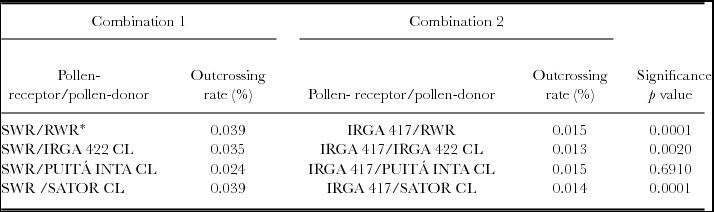
The pairwise comparison of the combinations of pollen-donors with pollen-receptors was performed using the least squares analysis, showing that the outcrossing rate in the combination SWR/PUITA INTA CL was equal to the rate in IRGA 417/PUITÁ INTA CL; for all other combinations, the outcrossing rate was increased when the pollen-receptor was SWR compared to combination in which the pollen-receptor was the cultivar IRGA 417 (Table 2). This result provides additional evidence that weedy rice is more receptive to pollen from other individuals than the susceptible cultivar IRGA 417. Several studies have shown that certain genotypes display a compatibility preference for specific genotypes, and that some genotypes are more efficient pollen-receptors, which results in their superior outcrossing rate. One biotype of weedy rice displayed a higher outcrossing rate than the other weedy rice biotypes in combination with the same glufosinate ammonium resistant rice variety (Noldin et al., Reference Noldin, Yokoyama, Antunes and Luzzardi2002). In addition, several populations of weedy rice exhibited variable compatibility with a imidazolinone-resistant rice cultivar in a cross of emasculated plants through manual pollination to eliminate any phenotypic barriers; in some combinations, the gene flow was five times higher than that with other combinations (Shivrain et al., Reference Shivrain, Burgos, Sales, Mauromoustakos, Gealy, Smith, Black and Jia2009).
Pairwise comparison of the occurrence of the outcrossing rate (%) between the combinations of pollen-donor and pollen-receptor plants obtained by the least squares analysis adjusted by Tukey's test.

* SWR, red rice susceptible; RWR red rice resistant to imidazolinone herbicides.
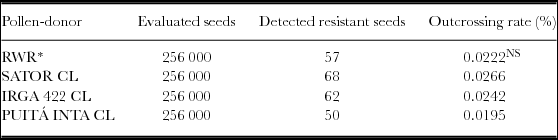
In all of the pollen-receptor and pollen-donor combination treatments, 249 imidazolinone-resistant plants were recovered; the average outcrossing rate was 0.0243%. There was no significant variation in the pollen-donor factor, suggesting that the IMI-rice inbred cultivars IRGA 422 CL and PUITÁ INTA CL, the hybrid SATOR CL, and the RWR performed similarly as pollen-donors (Table 3). It was expected that the RWR and the hybrid cultivars SATOR CL would display a higher pollen-donor outcrossing rate than the other cultivars. The RWR was included to evaluate the gene flow from a weedy rice genotype that is not controlled after herbicide application and would be a source of resistance for susceptible weedy rice individuals. SATOR CL was expected to display a higher outcrossing rate due to its hybrid characteristic, favouring a cross-pollination superior to the inbred cultivars. The RWR should be a good pollen-donor because it is less domesticated than the IMI-rice cultivars (Gealy et al., Reference Gealy, Mitten and Rutger2003). The similar effects observed in all of the IMI-rice cultivars and the RWR as pollen-donors might be associated with the low outcrossing rate found in the present study. In studies performed under field conditions in the USA, the outcrossing rate for the pollen-donor was higher in the hybrid cultivar CLXL8 (1.26%) than in the inbred cultivar CL 161 (0.21%) (Shivrain et al., Reference Shivrain, Burgos, Sales, Mauromoustakos, Gealy, Smith, Black and Jia2009). In this study, the pollen-donor and receptor plants were arranged in rows. Other gene flow studies have been conducted with donor plants in an area of 1 m2 (Noldin et al., Reference Noldin, Yokoyama, Antunes and Luzzardi2002) or 78 m2 (Shivrain et al., Reference Shivrain, Burgos, Anders, Rajguru, Moore and Sales2007) and in plots sown in different proportions (Sanchez-Olguin et al., Reference Sanchez-Olguin, Arrieta-Espinoza, Lobo and Espinoza-Esquivel2009). These approaches provided a large amount of pollen associated with a higher outcrossing rate than in the present evaluation. The experimental approach used in the current study utilised only single pollen-donor plant in the centre of a plot of pollen-receptor plants. The use of a single donor plant in the centre of an area of recipient plants favours the interpretation regarding the occurrence of weedy rice escapees that are resistant to herbicides in rice paddy fields. Furthermore, this design applies to situations where the resistant individuals might be derived from seed contaminants or where a resistant individual originate from a spontaneous mutation in the ALS gene.
Estimated outcrossing rate (%) as affected by the different pollen-donor rice genotypes.

* RWR, red rice resistant to imidazolinone herbicides.
NS Not Significant (p > 0.05).
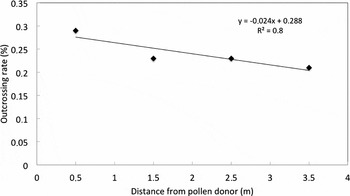
The outcrossing rate decreases along the distance from the pollen-donor to pollen-recipient plants (Figure 4). It is important to emphasise that the distance from the pollen-donor effect obtained in this study is related with the utilisation of the single pollen-donor approach and with the short distance of 3.5 m from the pollen-donor plant. In studies with rice (Yao et al., Reference Yao, Hu, Chen, Li, Yuan, Wang, Qian and Jia2008) and flax (Jhala et al., Reference Jhala, Bhatt, Topinka and Hall2011), the outcrossing rate also decrease with the increasing distance between pollen-donor and pollen-receptor plants. These results occur because the density of pollen incidence on the spikelets of the receptor plants decreases exponentially with the increased distance (Kanya et al., Reference Kanya, Kinyamario, Amugune and Hauser2009). However, several studies have shown that short distances do not significantly affect the outcrossing rate in rice. For example, the average outcrossing rate between transgenic rice resistant to glufosinate ammonium and weedy rice was 0.01% at distances of up to 2.5 m (Messeguer et al., Reference Messeguer, Marfà, Català, Guiderdoni and Melé2004). In another study, the average outcrossing rate between cultivated rice and weedy rice was also 0.01% at a distance of up to 5 m away from donor plants (Chen et al., Reference Chen, Lee, Song, Suh and Lu2004) and of 0.01 and 0.002% at distances of up to 2 m and 5 m from the donor plants, respectively (Shivrain et al., Reference Shivrain, Burgos, Anders, Rajguru, Moore and Sales2007, Reference Shivrain, Burgos, Sales, Mauromoustakos, Gealy, Smith, Black and Jia2009). The effect of distance from the pollen-donor on the outcrossing of rice is primarily associated with genotypic effects, wind direction and other environmental conditions (Yao et al., Reference Yao, Hu, Chen, Li, Yuan, Wang, Qian and Jia2008).
Estimated outcrossing rate (%) as affected by the different distances from pollen-donor on the average of the pollen-donor and pollen-receptor genotypes.

The gene flow from crops to their related species has been primarily studied in relation to population dynamics, transgenic crops and the biodiversity of species in their centres of origin. The main risks of gene flow are changes in the fitness of the hybrid plants through the incorporation of beneficial alleles and increased the hybrid vigour due to spontaneous crosses (Ellstrand, Reference Ellstrand2009). The main disadvantage of gene flow from herbicide-resistant crops to related species, such as rice and weedy rice, resulting in the lack of opportunity of herbicide control similarly to the situation that occurred before the use of the herbicide-resistant technology (Gealy et al., Reference Gealy, Mitten and Rutger2003; Gressel and Valverde, Reference Gressel and Valverde2009). In addition, imidazolinone-resistant weedy rice carrying the ALS mutation Ala122Thr could have a faster germination and fitness advantage compared with plants carrying the Ser653Asn and Gly654Asn mutations (Goulart et al., Reference Goulart, Matzenbacher and Merotto2012b). In crops such as rice, maize, wheat, corn and sunflower, where some cultivars are resistant to ALS-inhibiting herbicides, gene flow can incorporate the herbicide-resistant allele into the relative weed species and change the population dynamics of the weeds due to the fitness effects (Ellstrand et al., Reference Ellstrand2009). The present study quantified the outcrossing rate of cultivated rice and weedy rice and found that gene flow to weedy rice occurs at a higher proportion than in a rice cultivar, indicating that weedy rice is more efficient than rice cultivars in the movement of alleles that could be fixed by selection, resulting in a more adapted population. Additional strategies associated with the control of the resistant allele may be incorporated into the development of herbicide-resistant cultivars, and this control is primarily critical in crops where wild relatives are present as weeds. These strategies could be the containment of gene flow by cleistogamy, chloroplast localisation, male sterility and special promoters, or to the mitigation of gene flow through a tandem construction of the resistant with genes of morphological unfitness or herbicide susceptibility (Gressel and Valverde, Reference Gressel and Valverde2009).
CONCLUSIONS
The outcrossing from weedy rice population and from hybrid and inbred imidazolinone-resistant cultivars carrying the Ala122Thr, Ser653Asn and Gly654Asn ALS mutations occurred equally at a rate of 0.0243%. The outcrossing rate to a susceptible weedy rice population was higher than in the cultivar IRGA 417, indicating that weedy rice is more receptive to pollen from other plants than the rice cultivar. The distance from the pollen-donor plant (up to 3.5 m) decreases the outcrossing rate to the pollen-receptor plants. The control of weedy rice escapes in fields planted with IMI-rice cultivars is essential to eliminate the risk of migration of the herbicide resistance gene to weedy rice. Any herbicide-resistant weedy rice plant that remains in the field will contribute to the spread of resistance through seed production and also act as a source of pollen to other weedy rice plants at levels similar than those provided by the original source of resistance that are the rice cultivars carrying the ALS-inhibiting herbicide resistance alleles. The reduction of the risk of gene flow of herbicide-resistant alleles from cultivated to weedy rice is dependent on the development of strategies to contain and mitigate gene flow and of the elimination of weedy rice escapees.
Acknowledgements
The authors are thankful to the Brazilian Council for Scientific and Technological Development (CNPq) for financial support, to the Rice Institute of the Rio Grande do Sul (IRGA) for field work support, and to Letícia P. Dias for the assistance with the molecular analysis.