Introduction
It is widely recognised that demographic trends in most developed societies challenge the financial sustainability of public health and pension systems. In particular, increased longevity has led to an increase in legal retirement ages, a policy frequently adopted to recover sustainability in pension systems. Such an approach raises the question of what effect a longer working career, or a delayed retirement, may have on health, mental health and cognitive abilities, and it has attracted increasing attention in the economic, medical and psychological literature. From an economic point of view, the impact of a prolonged working career on health and mental health is relevant not only because of its effects on workers' productivity but also because it may have an impact on public health-care costs (Comijs et al. Reference Comijs, Dik, Aartsen, Deeg and Jonker2005). Memory decline, in particular, is associated with a higher probability of developing mental diseases such as dementia, a group of conditions which raise the need for long-term care (concerning Alzheimer's disease, see Sperling et al. Reference Sperling, Aisen, Beckett, Bennet, Craft, Fagan, Iwatsubo, Jack, Kaye, Montine, Park, Reiman, Rowe, Siemers, Stern, Yaffe, Carillo, Thies, Morrison-Bogorad, Wagster and Phelps2011). The effect of retirement on the evolution of cognitive abilities is therefore an important aspect that policy makers should consider when shaping public pension systems.
While descriptive evidence typically supports the idea that retired individuals suffer worse health and cognitive functioning than workers, retirement is an endogenous choice and individuals with worse health or cognitive abilities may retire earlier than healthier individuals. In other words, causality may run in both directions, and it is an empirical task to separate causality from simple correlation. Our work empirically investigates the effect of retirement on memory.
From a theoretical point of view, the effect of retirement on investment in cognitive ability is ambiguous. Using the Grossman model for human capital (Grossman Reference Grossman1972a, Reference Grossman1972b, Reference Grossman, Culyer and Newhouse2000) as a framework to model the individuals' maximisation problem when utility depends on consumption and on generic cognitive capital (Mazzonna and Peracchi Reference Mazzonna and Peracchi2012), an increase in free time upon retirement may lead individuals to raise their investment in cognitive abilities after retirement, because of its effects on life satisfaction captured by the utility function. On the other hand, while total labour market earnings are positively affected by cognitive capital, investment in cognitive capital is not reflected in higher income after retirement, and should therefore be lower. The effect of retirement on the incentives to invest in cognitive capital is therefore theoretically ambiguous.
In the psychological literature, it has been highlighted that the available evidence favours the hypothesis that maintaining an engaged and active lifestyle reduces or even reverses cognitive decline at older ages (Hertzog et al. Reference Hertzog, Kramer, Wilson and Lindenberger2008). A major change in daily activities and lifestyle, such as retirement from work, may result in disuse and decline of cognitive abilities; alternatively, the additional free time may be spent in leisure activities that can preserve cognitive functioning or delay decline. Therefore, it is an empirical question to sort out which effect prevails.
From an empirical point of view, previous studies that relate cognitive functioning and retirement found mixed results. A number of studies (Bonsang, Adam and Perelman Reference Bonsang, Adam and Perelman2012; Mazzonna and Peracchi Reference Mazzonna and Peracchi2012; Rohwedder and Willis Reference Rohwedder and Willis2010) all found a negative causal effect of retirement on cognitive abilities; other studies (Coe and Zamarro Reference Coe and Zamarro2011; Coe et al. Reference Coe, von Gaudecker, Lindeboom and Maurer2012) do not find, on average, a causal relationship between retirement and cognitive functioning.
In this work, we study the evolution of memory for individuals aged 50–70, testing whether retirement from work has an effect on cognitive functioning using the three-wave panel available in the Survey on Health, Ageing and Retirement in Europe (SHARE). As a measure of cognitive ability we use word recall, a measure of episodic memory frequently used in the economic literature (e.g. Bonsang, Adam and Perelman Reference Bonsang, Adam and Perelman2012), as well as in the psychological and neuropsychological literature (e.g. Scarmeas and Stern Reference Scarmeas and Stern2003). While the SHARE data-set has already been used in the literature to estimate the causal impact of retirement on cognitive abilities, in this work we exploit its panel dimension to perform our investigation.
Conducting the analysis on a longitudinal sample allows fixed effects to be controlled for, that is unobservable but fixed-over-time omitted variables, such as innate ability or family background, which may influence retirement as well as word recall. As retirement may be correlated also with time-varying factors that influence cognitive ability, such as health, we apply an instrumental variable (IV) technique to the fixed-effects transformation, using country-specific retirement rules as an instrument. As highlighted in the literature (Bonsang, Adam and Perelman Reference Bonsang, Adam and Perelman2012), fixed-over-time unobservable characteristics, such as country background, may be correlated with country-specific retirement rules. Hence, performing an IV estimation on a panel, which allows time-invariant heterogeneity to be controlled for, strengthens the validity of the conditional independence and exclusion restrictions underlying IV estimation.
Using the panel dimension of SHARE, we find no short-term effect of retirement on memory. When estimating the long-term effect of retirement, however, we find a positive causal effect of years spent in retirement on word recall. We also show that our result is determined not only by the estimator used, but also by the inclusion of a flexible polynomial in age in the estimated equation.
The rest of the paper is organised as follows. The next section reviews the previous empirical evidence. We then describe our empirical strategy and, in the data section, the data-set we used. In the Results section we report our findings. We then discuss the results obtained and the final section concludes the paper.
Cognitive functioning: previous empirical evidence
The measurement of cognitive performance typically distinguishes between two major categories. The first one, also referred to as fluid ability (Cattell Reference Cattell1963), considers aptitude in reasoning, memory and speed, and it captures efficiency or effectiveness of processing at some point in time (Salthouse Reference Salthouse2012). The other one, also known as crystallised ability (Cattell Reference Cattell1963), concerns the cumulative outcome of processing attained by an individual, typically measured in terms of acquired knowledge with tests of general information or vocabulary. While fluid skills tend to peak in early adulthood and to decline thereafter, crystallised abilities tend to be stable over the lifecycle (Salthouse Reference Salthouse2012). In the psychological literature, word recall is a test commonly used for measuring episodic memory, a fluid ability related with many aspects of everyday life, such as the ability to recall information, facts and specific past events about what happened, where and when (Tulving Reference Tulving1993). As word recall is available in the SHARE data-set, we use it in our work as a measure of a fluid skill, for investigating the impact of retirement on cognitive functioning.
The age-related decline of fluid abilities and the evolution of adults' cognitive capital over the lifecycle have attracted considerable attention in both the psychological and, more recently, the economic literature.
In psychological studies, the level and evolution of cognitive capital (or cognitive reserve) is studied both in healthy adults and in its relation to the incidence and severity of Alzheimer's disease (Scarmeas and Stern Reference Scarmeas and Stern2003). Cognitive reserve and its evolution are influenced by IQ, education, occupation as well as general lifestyle (Schaie Reference Schaie1996, and references therein). As highlighted by Schaie's work on the Seattle Longitudinal Study (Schaie Reference Schaie1996), individuals with high socio-economic status who engaged fully with their environment had the least intellectual decline. Cognitive evolution among healthy adults is also affected by individual lifestyle; in particular, changes in everyday activities may result in disuse and consequent decline of cognitive abilities, as synthesised by the ‘use it or loose it’ hypothesis (Salthouse Reference Salthouse1991, Reference Salthouse2006). On the other hand, the same considerations may sustain the hypothesis that an engaged lifestyle, attained through common leisure activities, would result in stable performance or may even reverse age-related changes in cognitive abilities. For example, it has been found that the stimulation provided by typical everyday activities serves to buffer individuals against decline (Hultsch et al. Reference Hultsch, Hertzog, Small and Dixon1999). The authors highlight that causation could run either way, so that high-ability individuals may lead intellectually active lives until cognitive decline in old age limits their activities. Similarly, it has been found that participation in common cognitive activities (in particular, reading newspapers or books) is associated with a slower rate of cognitive decline (Wilson et al. Reference Wilson, Mendes de Leon, Barnes, Schneider, Bienias, Evans, David and Bennett2002). Studies using the SHARE data-set also find that the cognitive function depends on the activities undertaken (Leist et al. Reference Leist, Glymour, Mackenbach, van Lenthe and Avendano2013). They study the effect of periods away from work on cognitive functioning, and find that periods of self-reported unemployment or sickness are associated with lower cognitive function, while maternity and training spells are associated with better late-life cognitive function. In their review on the cognitive development of adults, Hertzog and his co-authors conclude that, ‘on balance, the available evidence favours the hypothesis that maintaining an intellectually engaged and physically active lifestyle promotes successful cognitive aging’ (Hertzog et al. Reference Hertzog, Kramer, Wilson and Lindenberger2008: 1). While these works do not explore the direct effect of retirement on the evolution of cognitive capital, they point out how healthy adults may shape the evolution of their cognitive abilities also in the second half of their lifecycle.
In the economic literature, a few recent studies estimate the relationship between cognitive functioning and retirement. These studies differ in the data used and in the sample definitions, while they all use memory (i.e. word recall) as a measure of cognitive abilities, either alone or in combination with other cognitive indicators. The most important distinction is based on the data used to estimate the causal effect of retirement on cognitive functioning: studies based on cross-sectional data typically rely on the use of an IV technique to estimate the causal effect of retirement on cognitive abilities, using cross-country differences in the eligibility age for retirement benefits as instruments. Such an instrument, however, may be correlated with unobserved characteristics that also influence cognition, such as institutional settings and cultural differences which are likely to be heterogeneous across countries. Conducting the analysis on a longitudinal sample, on the other hand, allows time-invariant heterogeneity to be controlled for and thus strengthens the validity of the conditional independence and exclusion restrictions underlying IV estimation (Bonsang, Adam and Perelman Reference Bonsang, Adam and Perelman2012).
Among the studies using cross-sectional data, Rohwedder and Willis (Reference Rohwedder and Willis2010) use data drawn from the Health and Retirement Study in the United States of America (USA) (HRS, year 2004) and from SHARE wave 1 (also collected in the years 2004–2005), and they find a negative effect of retirement on word recall. Coe and Zamarro (Reference Coe and Zamarro2011) use data drawn from SHARE wave 1, and, while they find a positive effect of retirement status on health, they find no effect on cognition, measured by total word recall or by verbal fluency. While they use cross-sectional data, they control for many individual characteristics, including household income, education and a second-order polynomial in age.
Also the study by Mazzonna and Peracchi (Reference Mazzonna and Peracchi2012) is based on data from SHARE wave 1, but interestingly they argue that retirement may take time to display its effects, and estimate the causal effect of years spent in retirement instead of a binary variable capturing whether an individual is retired. Conditioning on a linear age profile, in most specifications they find a negative effect of retirement duration on cognitive performance.
More recently, Börsch-Supan and Schuth (Reference Börsch-Supan, Schuth and Wise2013) used the SHARE wave 4 data enhanced with information from all available SHARE waves to create a cross-sectional data-set and estimated the relationship between early retirement, cognitive functioning, and the size and composition of social networks. They also used an IV estimator based on early and normal legal retirement ages and found that early retirement reduces cognitive functioning as well as social networks, and reduced social networks in turn negatively influence cognitive functioning. The study compares early and normal retirement pensioners, while working individuals are excluded from the sample, hence identification relies only on the differences between individuals in the number of years spent in retirement at any given age, rendering it difficult to separate the age effect from the time-spent-in-retirement effect.
Bonsang, Adam and Perelman (Reference Bonsang, Adam and Perelman2012) use the US panel data-set HRS to perform fixed-effects IV estimates of the effect of retirement on word recall, with instruments based on legal ages of retirement. They find a significant drop in cognitive abilities, measured by word recall, occurring one year after retirement. Coe et al. (Reference Coe, von Gaudecker, Lindeboom and Maurer2012) also use panel data drawn from the HRS, but they use instruments based on unexpected early retirement windows offers, which are required by law to be unrelated to individuals' health. Using a statistical model to make the difference between permanent and transitory shocks explicit, they find no overall effect of retirement on cognitive performance. However, when they distinguish between white- and blue-collar workers, they find a positive effect of retirement for blue-collar workers only.
Empirical strategy
Our empirical strategy rests on the use of a panel data-set including both pensioners and non-pensioners. In particular, identification of the coefficient of interest (retirement status) relies on the observation of individuals who actually retire during the sample period, so they are observed both when they are working and when they are retired. In our sample, we observe about 1,800 such transitions.
We first estimate the specification in Equation (1):
 $$W{R_{it}} = {\alpha _1}{R_{it}} + {\beta _1}{X_{it}} + {\varepsilon _{1it}} + {\nu _{1t}} + {\mu _{1i}}$$
where WR it is word recall, R it is a dummy variable equal to 1 if the individual is retired and zero otherwise, and we include a common time effect (ν1t ), an individual-specific time-invariant effect (μ1i ) and an idiosyncratic shock (ε1it ). Both μ1i and ε1it might in principle be correlated with R it thus biasing our estimate of α1. We control for individual-specific effects by demeaning. Moreover, we instrument R it in the demeaned equation by the variables discussed below.
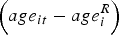
As the literature has emphasised that retirement may take time to display its effect, in Equation (1) we alternatively define retirement status as a dummy variable equal to 1 if the individual has been retired for at least one year, and zero otherwise (as in Bonsang, Adam and Perelman Reference Bonsang, Adam and Perelman2012). In Equation (2), we estimate a specification in which the retirement effect is captured by time spent in retirement, or retirement duration (as in Mazzonna and Peracchi Reference Mazzonna and Peracchi2012), computed as age of individual i at time t minus age of individual i at retirement, interacted with the retirement dummy:
 $$W{R_{it}} = {\alpha _2}\left( {ag{e_{it}} - age_i^R} \right){R_{it}} + {\beta _2}{X_{it}} + {\varepsilon _{2it}} + {\nu _{2t}} + {\mu _{2i}}$$
Where
 $age_i^R $
is equal to the actual age of retirement for individuals already retired, and to the expected age of retirement for individuals who have not retired yet.Footnote
1
In both Equations (1) and (2), the X variables represent time-varying demographic variables which may influence word recall. In all the specifications we include a polynomial in age, a dummy variable indicating whether there were contextual factors disturbing the respondent during the cognitive test and a variable indicating if the respondent has been interviewed in the past, in order to capture learning effects.Footnote
2
In addition to an idiosyncratic shock and individual fixed effects, Equations (1) and (2) include time dummies to control for time effects, ν*t . Time effects are extremely important since they allow the intercepts in Equations (1) and (2) to vary with time and for a time-varying average of the dependent variable. Differences in the difficulty to memorise different lists of words are captured by the inclusion of year dummies in the estimated equation.
In a fixed-effects estimation, when year dummies are included, any variable that varies by one unit in each time period, such as age, is not separately identified, while any non-linear term (such as age squared) is obviously identified. Retirement duration, in Equation (2), also increases by one unit each year, like age, but it is interacted with the retirement dummy R it , which takes value zero for individuals who are not retired. In other words, retirement duration increases each year only for individuals who are retired, hence it is not collinear to a time trend: identification of this variable relies on the presence in the sample of non-retired individuals.Footnote 3
Retirement, and retirement duration, are clearly endogenous variables in this context. Individuals suffering a bad shock in cognitive abilities may select themselves (or be selected by their firms) into early retirement. Following much of the literature (Bonsang, Adam and Perelman Reference Bonsang, Adam and Perelman2012; Mazzonna and Peracchi Reference Mazzonna and Peracchi2012; Rohwedder and Willis Reference Rohwedder and Willis2010), we construct our instruments on the basis of statutory retirement ages. Statutory retirement ages have a great effect on the probability of retirement, while are not linked to cognitive functioning. In our sample, early and normal retirement ages vary according to gender, country, time and cohort, as the first interview year is 2004 and the last one 2011 (with a few observations being collected in 2012). The relevant ages are taken from the tables generated by the Mutual Information System on Social Protection (MISSOC), a network generated by the European Commission, integrated by information provided in various years by the Organisation for Economic Co-operation and Development publication Pensions at a Glance.Footnote 4
With the legal early and normal ages of retirement we can construct four instruments, two for the retirement status dummy and two for retirement duration. The two instruments for the retirement status dummy are dummy variables taking value zero if the individual's age is less than the statutory age for either early or regular retirement.Footnote 5 The instruments for retirement duration are equal to the difference between actual age and legal age of retirement (either early or regular).
In Equations (1) and (2), the endogenous variable to be instrumented is either a dummy or a left-censored variable (as retirement duration is set to zero for working individuals). Estimating the first stage with ordinary least-squares (OLS) is therefore an approximation to the underlying non-linear conditional expectation function. The two-stage least-squares (2SLS) estimates based on an OLS first stage are nevertheless consistent, while 2SLS estimates based on a non-linear first stage are not, as in this case the residuals do not have the same properties of OLS residuals (Angrist and Pischke Reference Angrist and Pischke2009). A possible alternative would be to use the non-linear fitted values as instruments in the second stage (Angrist and Pischke Reference Angrist and Pischke2009). In our case, this procedure is made difficult by the presence of fixed effects, as it is not possible to estimate, say, a Tobit with fixed effects with standard statistical packages.Footnote 6 Later in the paper, however, we also perform our estimation on the pooled sample, and in that circumstance we estimate a Tobit model in the first stage, and use the fitted values as instruments for retirement duration. Following this procedure leaves our results unaffected.
An important issue that we need to consider is the possibility that retesting may affect our estimates (Ferrer et al. Reference Ferrer, Salthouse, Stewart and Schwartz2004). Practice effects in longitudinal studies of cognition have long been recognised (for a review, see Schaie Reference Schaie1996), as individuals who take the memory test more than once, as happens necessarily in panel data, may learn how to respond to the test. Additionally, in our data-set, in the first two waves respondents were asked to recall the same list of ten words. Hence, in our estimated equations we always include a variable capturing the learning effect of retesting, adding a dummy variable that takes value equal to one if an individual takes the test for the second or third time.
Data and sample selection
The data are drawn from SHARE. The first wave was collected in 2004 and 2005, the second in 2006 and 2007, the third in 2008 and 2009, and the fourth in 2011 and 2012. The third wave is called SHARELIFE and it is a retrospective survey which did not collect information on cognition. Hence we used waves 1, 2 and 4 to construct our panel. As we explain later, we also used variables collected in SHARELIFE.
We selected individuals aged 50–70, who were working at the age of 50, who report themselves as either working or retired, living in Austria, Germany, Sweden, the Netherlands, Spain, Italy, France, Denmark, Switzerland or Belgium.Footnote 7 We excluded individuals who returned to work after retirement, since for them the effect of retirement on cognitive abilities could be atypical. As we are interested in the transition between work and retirement, we also excluded individuals who report themselves sick, unemployed or homemaker. In the literature, retirement is often defined in a broader way, including all categories of individuals reporting themselves not working, as this strategy reduces potential sample selection problems. Indeed, using the SHARE data-set, it has been found that women in some countries have a higher tendency of describing themselves as homemakers even though they were working at the age of 50 (Hospido and Zamarro Reference Hospido and Zamarro2014). However, for individuals describing themselves as sick, unemployed or homemaker we cannot ascertain whether the separation from the labour force is permanent or transitory, and the effect of these two conditions on cognitive ability is likely to differ. Hence their inclusion in the sample, even in an IV setting, is not without problems. We present our results using the more stringent definition of retirement; however, when using the broader definition results are unaffected.Footnote 8
The dependent variable in our analysis is total word recall, given by the sum of immediate and delayed recall of a ten-word list. The list of words is the same in waves 1 and 2, while it has been updated in wave 4. Respondents are asked to memorise the list of words and to recall them both immediately and some time after answering other questions on the questionnaire about numeracy ability and verbal fluency. The value of total word recall ranges from 0 to 20.
We define the two main explanatory variables used in the paper, retirement status and retirement duration, on the basis of self-reported status. Retirement status is a dummy variable that is set equal to zero if the individual reports being employed at the time of the interview and it is set to one if the individual reports being retired. The variable retirement duration measures the time elapsed between the year of the interview and the year of retirement. This variable is set to zero for all the individuals who are still employed.Footnote 9
In order to get the information on the year in which the individual retired, for all individuals who are also respondents in SHARELIFE and were already retired at the time of the interview (they represent about 67% of all the retired individuals included in our sample), we refer to the question on when the last job ended reported in SHARELIFE. The information reported in SHARELIFE is in fact more accurate than the one collected in the SHARE waves, since the method used is based on a life history calendar, and the respondent's life is represented graphically by a grid that is filled automatically in the course of the interview. For all the other individuals, who did not participate in SHARELIFE, we refer to the question on when the last job ended, that is variable ep050 in SHARE. If the individual was employed at the time of the previous interview and then retired, question ep050 is not asked but instead the question asked is in what year the individual retired, that is variable ep329 in the questionnaire. When an individual reports an inconsistent retirement year, that is to say when panel consistency is lacking (i.e. in the first wave an individual reports being employed and in the next wave reports retirement before the previous interview), we exclude that individual from the sample (325 individuals).
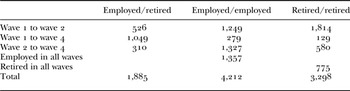
Our final sample is unbalanced and consists of 21,934 observations. The total number of selected individuals is 9,395. For each of them there are at least two observations, and for about 33 per cent there are three observations. As reported in Table 1, within the observation period about 20 per cent of all the sampled individuals transit from employment to retirement and about 55 per cent of them retired between waves 1 and 4.
Transition pattern of all sampled individuals within the observation period

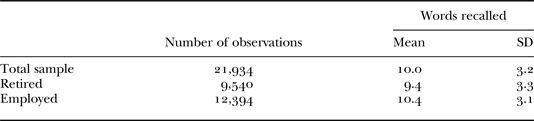
In Table 2, we report some descriptive statistics for our main variable, total word recall. The overall average number of words recalled, in our selected sample, is equal to 10 with a standard deviation of about 3. On average, retired individuals recall one word less than those who are still active in the labour market. Whether there is a causal link between retirement and word recall, however, can only be assessed by estimating Equations (1) and (2) described in the previous section.
Average number of words recalled

Note: SD: standard deviation.
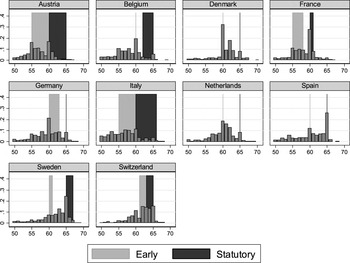
In Figure 1 we show, for each country included in the analysis, the retirement age distribution for our sample, along with early and normal retirement age windows. While there is a lot of variability in retirement age in our sample, the figure highlights how indeed age spikes at legal ages of retirement can be observed in most countries, a feature that highlights especially the importance of early retirement incentives (Gruber and Wise Reference Gruber and Wise2004). The validity of our instruments based on legal retirement ages relies on their ability to predict retirement behaviour, while being unrelated to memory. In our Results section we show that the instruments constructed on the legal retirement ages are indeed strong predictors of retirement behaviour.
Retirement age distribution.

Results
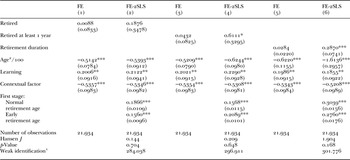
We start by considering the effect of retirement status and years spent in retirement on word recall for our entire sample of individuals aged 50–70. In Table 3 we report our basic specifications, where the variable total word recall is regressed either on retirement status, a retirement indicator equal to one if the individual is retired from work, or on the variable ‘retired at least one year’, an indicator equal to one if the individual has been retired for at least one year. In addition, total word recall is regressed on retirement duration, i.e. number of years spent in retirement. As additional basic controls, we add a second-order polynomial in age; contextual factor, an indicator that takes value equal to one if the respondent was disturbed during the cognitive test and zero otherwise; and learning, a variable that captures the learning effect that might arise by participating repeatedly in the panel, equal to one if the respondent has already participated at least once in the survey and zero otherwise. In subsequent analysis we will discuss in more detail the consequences of choosing a different polynomial in age, as well as of including additional explanatory variables.Footnote 10
The effect of retirement status and duration on word recall – fixed-effects estimates

Notes: FE: fixed-effects estimate. FE-2SLS: fixed-effects two-stage least-squares estimate. Clustered standard errors in parentheses. All specifications include year dummies. See the text for an explanation of columns 1–6. 1. Weak identification is the Kleibergen-Paap rk Wald F statistic; the critical value at 10 per cent is equal to 19.93.
Significance levels: * p < 0.1, ** p < 0.05, *** p < 0.01.
All the estimates in Table 3 control for fixed effects, hence all time-invariant characteristics are controlled for. To take into account common year effects, we also include year dummies. As a consequence, we are unable to separately identify the linear term in age, which is automatically controlled for in the estimation. In this context, the variables of interest, retirement status and retirement duration, are identified because our sample includes also non-pensioners. Indeed, identification of retirement status rests on individuals who transit from work to retirement in the sample period. In our baseline sample, made of 21,934 person-year observations, there are 1,885 individuals who retired from work.
In column 1 of Table 3, we report fixed-effects estimates of our basic relationship including retirement status as a regressor. Its coefficient is very close to and not statistically different from zero. The variable contextual factor is significant and, as expected, has a negative coefficient, while the variable capturing learning, which is equal to one if the respondent has already taken part in the survey, has a positive effect. In the second column we use our instruments, based on statutory normal and early age of retirement, to obtain fixed-effects two-stage least-squares (FE-2SLS) estimates. The coefficient on retirement status increases, with a high associated standard error. The set of instruments we use always rejects the test of under-identification with a p-value of less than 0.01 per cent, hence we do not report it. We report instead the Hansen J statistic, and its p-value, and a weak identification test, to test whether the excluded instruments are only weakly correlated to the endogenous variables. All the specifications in the table pass the diagnostic tests.
As retirement may take time to display its effects, we estimate in column 3 a fixed-effects specification including a dummy variable equal to one if the individual has been in retirement for at least one year. Its coefficient is slightly positive but not significantly different from zero. In column 4 we report the FE-2SLS estimates, and in this case the coefficient increases to 0.6, indicating that indeed the effect is delayed, and it is different from zero at the 10 per cent level.
To capture better the effect of time spent in retirement, in column 5 we estimate the effect of retirement duration, measured as years spent in retirement, on word recall. Its coefficient is positive but small and not significantly different from zero. We next treat retirement duration as endogenous, turning to the fixed-effects IV estimator. In column 6, we report estimates of the basic specification, using normal and early retirement ages to construct instruments for retirement duration as explained in detail in the Empirical strategy section. The coefficient on retirement duration is positive and significantly different from zero at the 1 per cent level.
According to our results, given the average non-linear age trend, individuals after retirement recall about 0.3 words more than when they were active in the labour market, for each additional year spent in retirement. It is important to underline that these estimates indicate that, in the 50–70 age range, memory as measured by word recall tends to decline, in a non-linear way, for both working and retired individuals. After retirement, individuals display a slower decline in memory, relative to their performance before retirement.Footnote 11
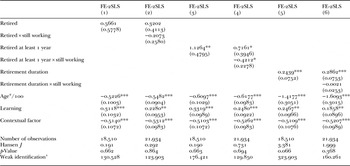
In order to shed some light on our results, we start by testing whether the result is driven by retirees who remain active in the labour market, at least for some time after retirement.Footnote 12 This behaviour could result in individuals scoring better essentially because they are still ‘using their brain’. In Table 4, we check for this possibility in two ways. Firstly, we restrict our sample, excluding individuals reporting themselves as retired but still working (either continuously or in the last four weeks). Secondly, we use the whole sample, adding an interaction term to capture if there is any significant difference in the coefficient of interest (i.e. retirement status, retired for at least one year and retirement duration) due to partial retirement. We show only FE-2SLS estimates, constructed using as additional instruments the interactions of our instruments with a dummy variable taking value equal to one if the individual is partially retired. In the first column, we show that for the restricted sample the impact of retirement status on word recall is higher than the one estimated for the whole sample, but still it is not statistically different from zero. In the second column, we use the whole sample, and we add an interaction term between retirement status and a dummy equal to one if the retired individual is still working. The coefficient of the interaction term is negative, an indication that the effect for individuals who are still active in the labour market is actually reduced, but it is not statistically different from zero.
The effect of retirement status and duration on word recall – robustness to retirement definition

Notes: FE-2SLS: fixed-effects two-stage least-squares estimate. Clustered standard errors in parentheses. All specifications include year dummies. See the text for an explanation of columns 1–6. 1. Weak identification is the Kleibergen-Paap rk Wald F statistic; the critical value at 10 per cent is equal to 19.93.
Significance levels: * p < 0.1, ** p < 0.05, *** p < 0.01.
We next estimate the specification using the variable ‘retired for at least one year’: in this case the coefficient increases with respect to what we found in Table 3, and column 4 shows that this difference is statistically significant, indicating that individuals fully retired for at least one year benefit from retirement, while partially retired individuals have a diminished positive effect (i.e. a reduction of 0.4 in the overall positive effect of 0.7). This difference is statistically different at the 10 per cent level. Finally, we check for a differential effect for retirement duration (columns 5 and 6), but in this case we do not find any difference between fully and partially retired individuals, who benefit in the same way from retirement. Hence we conclude that there is a difference in full/partial retirement only at the beginning of retirement. Importantly, we find that partial retirement, if anything, hampers the positive effect of retirement on word recall.
Overall, these results suggest that our findings are not influenced by partial retirement. As the number of individuals who transit from employment to retirement within the observation period is about 850 in the reduced sample and about 1,850 when the full sample is considered, in the rest of the paper we report results using the full sample for the sake of robustness.Footnote 13
We also found that the variable retirement duration better captures the effect of retirement on word recall, and in the subsequent analysis we propose estimates based on this variable.
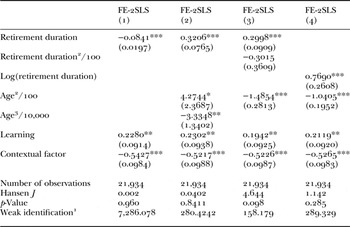
We next check for the robustness of our results, experimenting with different polynomials in age. In Table 5, column 1, we start by reporting the estimates of a specification that excludes any non-linear term in age. As shown in the first column, the coefficient on retirement duration turns negative and significantly different from zero. Failing to recognise the non-linearity of the average age trend induces a bias in the estimate of the coefficient on retirement duration. In column 2 we add a second- and a third-order term in age. These coefficients are both significantly different from zero, and the coefficient on retirement duration turns positive and significantly different from zero. Its magnitude is only slightly higher than that found in Table 3.
The effect of retirement duration on word recall – robustness to age trend

Notes: FE-2SLS: fixed-effects two-stage least-squares estimate. Clustered standard errors in parentheses. All specifications include year dummies. See the text for an explanation of columns 1–4. 1. Weak identification is the Kleibergen-Paap rk Wald F statistic; the critical value at 10 per cent is equal to 19.93.
Significance levels: * p < 0.1, ** p < 0.05, *** p < 0.01.
We further test whether retirement duration itself has a non-linear effect on word recall. In column 3 we add its squared value, which turns out to be negative and non-significantly different from zero. In the last column, we experiment with the logarithm of duration, defined as the logarithm of years spent in retirement for individuals who have retired, and zero otherwise. The positive coefficient we find confirms the positive effect of retirement is higher during the first years of retirement.
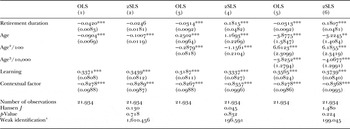
Summing up, we find that retirement duration, conditional on the overall non-linear age profile, has a positive effect on word recall.Footnote 14 We obtain this result by controlling for unobserved heterogeneity and for endogenous retirement (i.e. with a FE-2SLS estimator). In addition, we have shown that including non-linear terms in age in the equation is crucial to obtain the result. To understand why our results differ from previous research using the same data source (Mazzonna and Peracchi Reference Mazzonna and Peracchi2012), we estimate Equation (2) as a pooled regression, hence relying on the cross-sectional dimension of our data and replicating their identification strategy. In Table 6 we show results of pooled regressions, conditional on the same variables as in Table 3 but with the addition of country dummies. In the first two columns we include only a linear term in age and find a negative OLS estimate of retirement duration on word recall, and a negative but not statistically different from zero coefficient when we perform 2SLS estimation (the p-value is 17%). These estimates are very close to those obtained by Mazzonna and Peracchi (Reference Mazzonna and Peracchi2012), although they use only the first wave of SHARE in most specifications.Footnote 15 As a robustness check, we also perform all the 2SLS estimations reported in Table 6, estimating a Tobit model in the first stage, and using the fitted values as instruments for retirement duration (as suggested by Angrist and Pischke Reference Angrist and Pischke2009) and discussed previously in the Empirical strategy section (results not shown for brevity). Following this procedure leaves our results unaffected.
Pooled regressions with retirement duration – robustness to age trend

Notes: OLS: ordinary least-squares estimate. 2SLS: two-stage least-squares estimate. Clustered standard errors in parentheses. All specifications include year and country dummies. See the text for an explanation of columns 1–6. 1. Weak identification is the Kleibergen-Paap rk Wald F statistic; the critical value at 10 per cent is equal to 19.93.
Significance levels: ** p < 0.05, *** p < 0.01.
In the subsequent columns, we add second- and then third-order terms in age, and we find that, while the OLS estimate of the effect of retirement duration on word recall remains negative and significantly different from zero, the 2SLS estimate is instead positive and different from zero. The difference between the estimated average age profiles, which are all declining in the 50–70 age range, is that while in the 50–60 age range the non-linear age profiles are flatter than the linear one, the situation is reversed after age 60, that is when retirement takes place for most people. We conclude that controlling for a flexible polynomial in age and tackling the endogeneity of the retirement decision is crucial to obtain the result we find in this paper.
Discussion
Our results indicate that retirement is not detrimental for cognitive functioning, and that actually in the memory test retired individuals perform better than individuals who have longer working careers. This result is in contrast both with some research conducted on the same SHARE data (e.g. Mazzonna and Peracchi Reference Mazzonna and Peracchi2012), and with some studies conducted in the USA (e.g. Bonsang, Adam and Perelman Reference Bonsang, Adam and Perelman2012). We explain the difference between our study and others using the SHARE data-set with the different methodology used. Our estimates control for flexible polynomial in age and they directly tackle the endogeneity of the retirement decision. Our results are also robust to several different specifications.
One possible explanation of our results could lie in some sort of ‘honeymoon effect’, with an initial positive effect of retirement due to a positive attitude of the retiree towards his or her new status. However, we find that retirement duration captures the effect of retirement on memory better than the indicator variable capturing the transition into retirement, and hence our result applies also to individuals who have been retired for some time. In addition, even when we adopt a different identification strategy, relying on the cross-sectional dimension of our data as in other studies (Mazzonna and Peracchi Reference Mazzonna and Peracchi2012), we find a positive effect of retirement duration. In particular, we find that we can fully explain the differences between our results and those obtained by Mazzonna and Peracchi (Reference Mazzonna and Peracchi2012) with the inclusion of a flexible – as opposed to linear – polynomial in age in the estimated equation, which captures the average non-linear decline due to ageing in our memory measure, word recall.
On the other hand, our identification strategy, based on panel data and hence on actual transitions, is very close to the one adopted by Bonsang, Adam and Perelman (Reference Bonsang, Adam and Perelman2012) for the USA, who found a negative effect of retirement on word recall. This suggests that differences between Europe and the USA in cultures, social norms, labour markets, health systems, and public and private pension systems may drive the result.
Our results put some caution on the raising of the age of retirement as a policy instrument to face the challenges to pension systems posed by ageing societies. If retirement at later ages is detrimental for memory, raising the risk of cognitive impairment and mental diseases, then this aspect should be taken into account when reforming public pension systems. The results we find may also be useful in the debate on active ageing, which is often seen in terms of productivity in the labour market, although this strict view has been criticised (Boudiny Reference Boudiny2013). Even restricting the attention to economic aspects of ageing, our results suggest that longer working careers may raise health-care costs. At the same time, in a broader view of successful ageing, advocated by many authors (e.g. Boudiny Reference Boudiny2013; Clarke and Warren Reference Clarke and Warren2007), we can interpret our results that retiring from the labour force may slow the decline in some cognitive skills in terms of a possible improvement in the quality of life and mental wellbeing.
Conclusions
In this paper we use SHARE to estimate the effect of retirement on cognition. In particular, as a measure for cognition, we use the variable word recall, which is the total number of words, out of a list of ten, recalled immediately and after some minutes.
The exploitation of a panel data-set enables unobserved heterogeneity to be controlled for, which may be correlated with word recall and with the retirement decision, most importantly idiosyncratic cognitive ability, but also cohort, education, family background, and so on. We control for the remaining endogeneity of the retirement decision, exploiting the exogenous variation in early and normal eligibility ages across time, age and gender.
Our main finding is that, conditional on the non-linear negative memory average age path of the typical individual, time spent in retirement has a positive effect on word recall. While we find no short-term effect of retirement on cognitive abilities, when estimating the longer-term effect (i.e. at least one year) of retirement, we find a positive causal effect of years spent in retirement on word recall. Our estimates are based on a fixed-effects 2SLS estimator, with instruments constructed on the basis of early and normal retirement ages. We also show that controlling for a flexible polynomial in age, in addition to tackling the endogeneity of the retirement decision, is crucial to obtain the result we find in this paper.
Acknowledgments
We wish to thank Eric Bonsang, Mariacristina De Nardi, Elsa Fornero, Raymond Montizaan, Federico Revelli, Susann Rohwedder, Mariacristina Rossi, Guglielmo Weber, participants at the 4th International SHARE Users Conference (Liege, 2013), at the Netspar International Pension Workshop (Amsterdam, 2015) and to CeRP-CCA seminars for their useful comments. We are grateful to AGING—Regione Piemonte for financial support. This paper uses data from SHARE wave 4 release 1.1.1, as of 28 March 2013 (doi:10.6103/SHARE.w4.111) and SHARE waves 1 and 2 release 2.6.0, as of 29 November 2013 (doi:10.6103/SHARE.w1.260 and doi:10.6103/SHARE.w2.260) and SHARELIFE release 1, as 24 November 2010 (doi:10.6103/SHARE.w3.100). The SHARE data collection has been primarily funded by the European Commission through the 5th Framework Programme (project QLK6-CT-2001-00360 in the thematic programme Quality of Life), through the 6th Framework Programme (projects SHARE-I3, RII-CT-2006-062193, COMPARE, CIT5- CT-2005-028857 and SHARELIFE, CIT4-CT-2006-028812) and through the 7th Framework Programme (SHARE-PREP, No. 211909, SHARE-LEAP, No. 227822 and SHARE M4, No. 261982). Additional funding from the US National Institute on Aging (U01 AG09740-13S2, P01 AG005842, P01 AG08291, P30 AG12815, R21 AG025169, Y1-AG-4553-01, IAG BSR06-11 and OGHA 04-064) and the German Ministry of Education and Research, as well as from various national sources, is gratefully acknowledged (see www.share-project.org for a full list of funding institutions).