Introduction
Firefighting is a very special profession in China, as firefighters are burdened with heavy daily training as well as random, frequent, and long-lasting tasks, including firefighting, disaster relief (caused by earthquake or tornado), and emergency rescue (such as explosion). The intensive training and tasks lead to various negative psychological outcomes, such as distress, Reference Kales, Soteriades and Christophi1 depression, Reference Chen, Siu and Lu2 acute stress disorder, Reference Yoo, Komura and Matsui3 and posttraumatic stress disorder (PTSD). Reference Ma4
Traumatic events not only cause tremendous psychological trauma to the direct victims of disasters, but also have a great impact on the mental health of those who take part in the rescue work at the first scene. Reference Mitani, Fujita and Nakata5 Posttraumatic stress symptoms (PTSS), including intrusion, avoidance, hyper-arousal, and emotional alteration, 6 are common psychological reactions experienced among firefighters after their participation in emergency rescues and disaster reliefs. Reference Huang, Wang and Li7 The high prevalence rate of PTSD among firefighters has been reported globally (5%–37%). Reference Li, Peng and Chen8 In addition to the emotional indicators, another important psycho-social outcome related to mental health is burnout. Burnout is a highly reported negative psychological outcome among high-stress occupations. Reference Maslach, Schaufeli and Leiter9 Job burnout is a state of exhaustion in emotion, attitude, and behavior accompanied by long-term stress experiences, and it often comes with emotional exhaustion, cynicism, and lower professional efficacy. Reference Maslach, Schaufeli and Leiter9 Research showed that job burnout was commonly reported as an occupational struggle among rescue workers. Reference Argentero and Setti10 In addition, the prevalence rate of job burnout ranged from 3.26% to 57% among rescuers and firefighters. Reference Chatzea, Sifaki-Pistolla and Vlachaki11
Coping styles were found to be significantly associated with PTSS and job burnout. Reference Li, Zhao and Xu12 Research has shown that people’s coping ability predicts their resistance to stress. Reference Elhai, Biehn and Armour13 Firefighters were more likely to choose negative coping strategies and actively escape from stress situations when facing stressful events. Avoidant coping is an attempt to turn away from adverse experiences and emotions. It takes the form of denying or minimizing the result or effects of a specific problem, or choosing not to deal with the problem. Reference Boden, Bonn-Miller and Vujanovic14 Avoidant coping was found to be associated with increased PTSD symptoms after experiencing trauma, as “denying the severity of a problem and trying not to think about it may lead to more recurrent and intrusive recollections of the trauma.” Reference Tiet, Rosen and Cavella15 Meanwhile, individuals adopting an avoidant coping strategy when facing stressful events might be more vulnerable to burnout. Reference Anderson16
It is difficult to change a person’s coping style, owing to the fact that coping styles are stable over time. It is important to examine potential mediators between avoidant coping and PTSS/job burnout. Yet we could not locate a single study in the existing literature that has examined a more complete model of avoidant coping and negative psychological outcomes among firefighters. A few studies have shown that coping strategy may affect the perceived social support and affect mental health, Reference Ognibene and Collins17 indicating the possible mediating role of perceived social support in the relationship between coping strategy and mental health. The network theory of social support regards social support as a potential resource for individuals to deal with stressful events based on the perspective of the utilization in social resources. Reference Heaney and Israel18 Perceived social support has been identified as a strong direct predictor of psychological adjustment. Reference Bámaca-Colbert, Tilghman-Osborne and Calderón-López19 Perceiving high social support enables individuals to have more positive expectations and motivation when facing difficulties, and it is the driving force for individual mental health. Reference Schulz and Decker20 Furthermore, social support is negatively associated with avoidance coping, Reference Wolf, Balson and Morse21 PTSS, Reference Ma, Liu and Hu22 and job burnout. Reference Russell, Subramanian and Russell23
Therefore, this study investigated the relationship of avoidant coping on PTSS and job burnout, and examined the role of social support in this relationship. The hypotheses are that (1) avoidant coping is positively related to PTSS and job burnout among firefighters, and (2) avoidant coping is positively related to PTSS and job burnout through the mediating effect of perceived social support.
Methods
Participants
For this study, we recruited 466 participants from a military firefighter school in China. A total of 431 participants completed the entire questionnaire, with an effective recovery rate of 92.5%. Young adult men are the main force of Chinese firefighting; thus, the participants were all males of ages 20 to 26 years old (M = 21.38, SD = 1.66).
Measures
The PTSD Checklist for DSM-5 (PCL-5)
PTSS was assessed by using the PTSD checklist for DSM-5 (PCL-5), compiled by Weathers and colleagues 6 and revised by Zhou and colleagues. Reference Zhou, Wu and Zhen24 A total of 20 items rated on a 4-point scale ranging from 0 (not at all) to 3 (almost every week) was used to assess the frequency of symptoms in the past 2 weeks. The scale consists of four symptoms: intrusion (5 items), emotion alteration (7 items), avoidance (2 items), and hyper-arousal (6 items). A total score was computed for each subscale. Higher scores indicate higher levels of symptoms. Good internal consistency for the scale has been reported by previous studies. Reference Huang, Wang and Li7,Reference Zhou, Wu and Zhen24 In the current study, Cronbach’s alpha of scale and subscales were between 0.60 and 0.92.
Maslach Burnout Inventory–General Survey (MBI-GS)
Job burnout was measured by the Maslach Burnout Inventory–General Survey (MBI-GS), Reference Maslach and Jackson25 which was translated by Li and Shi Reference Li and Shi26 by using the Brislin method. The MBI-GS consists of 16 items rated on a 7-point scale ranging from 0 (never) to 6 (daily). The scale is composed of 3 dimensions: exhaustion (5 items), cynicism (5 items), and professional efficacy (6 items). With professional efficacy items being reversibly scored, higher scores of MBI-GS indicate higher levels of burnout. The Chinese version of MBI-GS was confirmed with high validity. Reference Li, Hou and Chi27 In this study, Cronbach’s alpha of scale and subscales were between 0.88 and 0.92.
Coping Style Inventory (CSI)
Avoidant coping was assessed by using the subscale of Coping Style Inventory (CSI) compiled by Amirkhan, Reference Amirkhan28 which was revised into the Chinese version by Hou. Reference Hou, Zhou and Chen29 The subscale on avoidant coping consists of 11 items, rated on a 3-point scale ranging from 1 (not at all) to 3 (many). In the current study, the scale had good internal consistency reliability, with a Cronbach’s alpha of 0.83.
Perceived Social Support Scale (PSSS)
Perceived Social Support Scale (PSSS), compiled by Huang and Jiang, Reference Huang, Jiang and Ren30 was adopted to assess perceived social support. A total of 12 items was rated on a 7-point scale ranging from 1 (extremely disagree) to 7 (extremely agree). The scale is composed of 2 dimensions: family endogenous support (4 items) and family exogenous support (8 items). A total score was computed for each factor, with higher scores indicating higher levels of perceived social support. PSSS has been proven to have good validity and reliability with the Chinese population. Reference Kong and You31 In the current study, Cronbach’s alpha of the scale and the subscales were between 0.60 and 0.92.
Procedure and Data Analysis
This study was approved by the Research Ethics Committee of School of Psychology, Nanjing Normal University, and conducted with the permission of the principles of the local fire service. An informed consent form was provided and collected before data collection. Written questionnaires were distributed to firefighters who agreed to participate in the study. Instructions were read to the group. The questionnaires were collected upon completion and data were entered into SPSS by researchers. SPSS 20.0 was used for descriptive statistics and correlation analysis, and AMOS 21.0 was adopted to establish the structural equation models (SEMs) testing the hypothetically mediating model. Additionally, we used chi-square ratio (χ 2/df), the normed-fit index (NFI), incremental fit index (IFI), Tucker-Lewis index (TLI), comparative-fit index (CFI), and the root mean square error of approximation (RMSEA) to evaluate the model fit. Reference Wen, Hau and Herbert32 Bias-corrected bootstrap tests with a 95% confidence interval were conducted to examine the significance of indirect paths with 5000 bootstrap samples.
Results
Prevalence of PTSS and Job Burnout in Firefighters
According to the diagnostic criteria of PTSD in DSM-5, 6 among participants of the current study, 25 (5.80%) firefighters were at high risk of PTSD. According to the diagnostic criteria used by Li, Reference Li and Shi26 1 (0.23%) firefighter was diagnosed with high emotional exhaustion, 30 (6.96%) firefighters met the criteria of high de-personalization, and 10 (2.32%) firefighters suffered from low personal accomplishment.
Correlation of Avoidant Coping, Social Support, PTSS, and Job Burnout
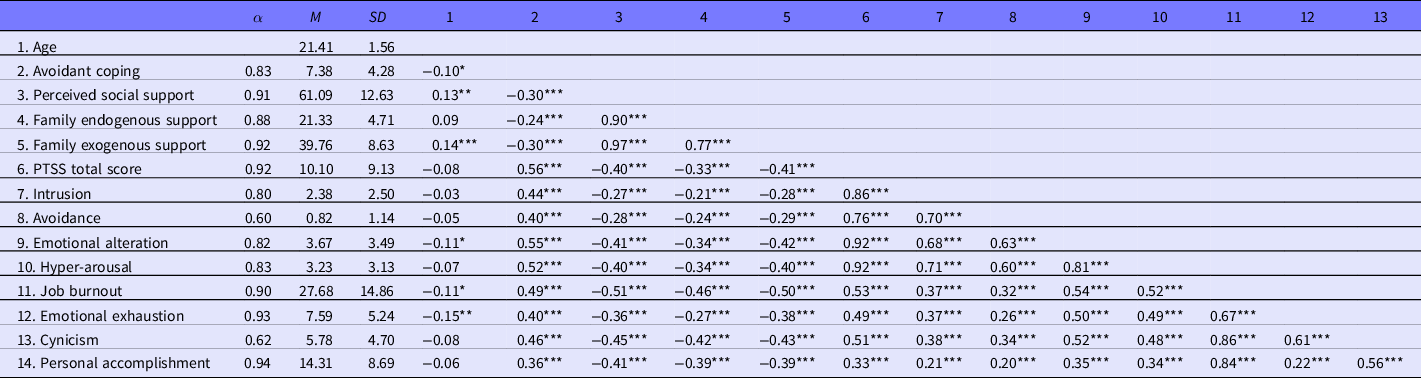
Pearson correlations were computed among avoidant coping, social support, PTSS, and job burnout. The results showed that avoidant coping style was significantly and positively correlated with PTSS at a moderate level (r = 0.56) and positively correlated with job burnout at a weak level (r = 0.49). Social support had a significant correlation with avoidant coping (r = −0.30), PTSS (r = −0.40), and job burnout (r = −0.49) at a weak level. PTSS was significantly and positively correlated with job burnout at a moderate level (r = 0.53) (all Ps < 0.001). The results are shown in Table 1.
Descriptive statistics and correlation of avoidant-coping style, social support, PTSS, and job burnout (N = 431)

Notes: PTSS = posttraumatic stress symptoms; * P < 0.05, ** P < 0.01, ***P < 0.001.
Measurement Model
We first establish a measurement model for PTSS and job burnout, using maximum likelihood (ML) parameter estimation method. The latent variable, PTSS, was estimated by avoidance, emotional alteration, and hyper-arousal, whereas the latent variable job burnout was estimated by emotional exhaustion, cynicism, and personal accomplishment. In this measurement model, the correlation coefficient between PTSS and job burnout was evaluated and the factor load of each latent variable was estimated freely. The fitting index of the measurement model was good: χ 2/df = 3.401, NFI = 0.982, IFI = 0.987, TLI = 0.970, CFI = 0.987, RMSEA = 0.075.
Avoidant Coping Effect on PTSS and Job Burnout
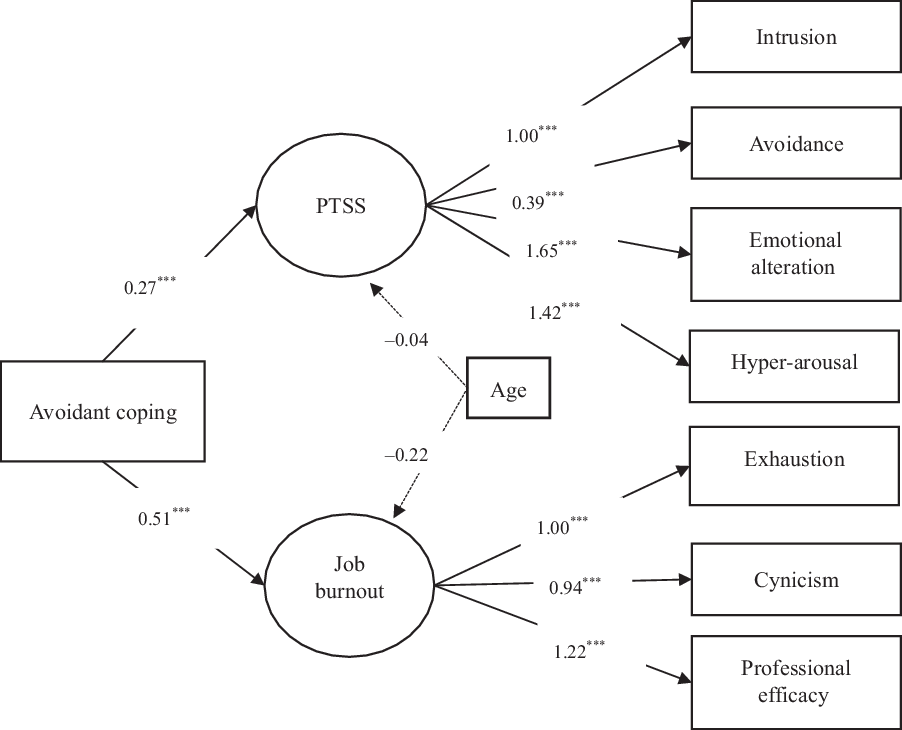
According to the test procedure of mediation effect, Reference Wen, Zhang and Hou33 the direct effect model diagrams and paths between avoidant-coping and PTSS/job burnout were analyzed first. The fitting index of the direct effect model was good: χ2/df = 2.106, NFI = 0.979, IFI = 0.989, TLI = 0.979, CFI = 0.989, RMSEA = 0.051. The analysis of path coefficients of direct effect showed that the path coefficient between avoidant-coping and PTSS was statistically significant (b = 0.27, 95% CI = 0.22 to 0.32), and the path coefficient between avoidant coping and job burnout was also statistically significant (b = 0.51, 95% CI = 0.42 to 0.62). The results are shown in Figure 1.
The relationship between avoidant coping and PTSS/job burnout.

The Mediating Effect of Social Support
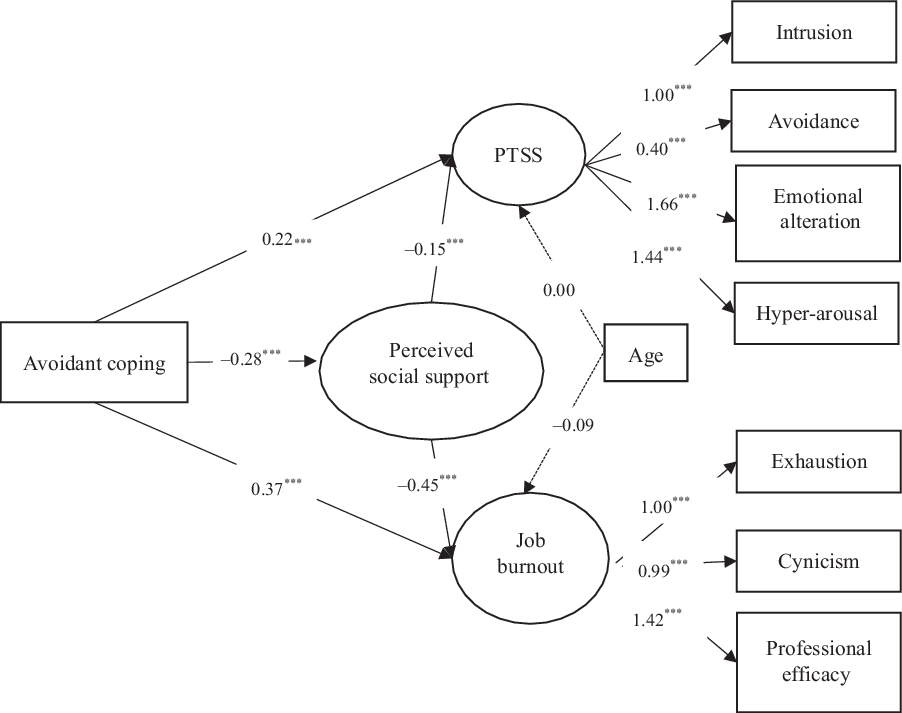
The structural equation model was adopted to test the mediating effect of social support in the relationship of avoidant coping strategy and PTSS/job burnout. The results showed that the fitting index of the model was good: χ2/df = 2.262, NFI = 0.970, IFI = 0.983, TLI = 0.971, CFI = 0.983, RMSEA = 0.054.
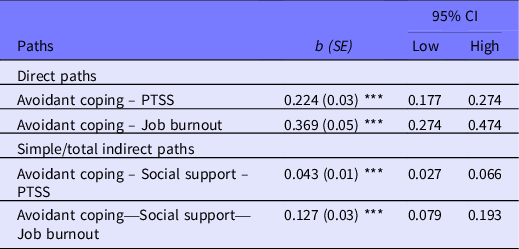
The simple/total indirect effect of avoidant coping on PTSS through social support was significant (b = 0.043, 95% CI = 0.027 to 0.066), and a significant simple/total indirect effect of avoidant coping on job burnout via social support was found (b = 0.127, 95% CI = 0.079 to 0.193). Besides, the direct effects of avoidant coping on PTSS and job burnout were both significant when social support was added in the model (b = 0.224, 95% CI = 0.177 to 0.274; b = 0.369, 95% CI = 0.274 to 0.474), indicating partial mediation. The results are shown in Figure 2 and Table 2.
The mediating effect of perceived social support on the relationships between avoidant coping and PTSS/job burnout.

Bias-corrected bootstrap test of mediating effect (N = 431)

Notes: PTSS = posttraumatic stress symptoms; ***P < 0.001; bootstrap samples were 500.
Discussion
The prevalence rates of PTSD and job burnout among firefighters in this study were lower than the levels reported in previous studies. Reference Li, Peng and Chen8,Reference Chatzea, Sifaki-Pistolla and Vlachaki11 One explanation for this discrepancy could be that there have been no devastating disasters in Nanjing in recent years, and firefighters in Nanjing have not been exposed to great trauma. In addition, Nanjing began to pay attention to the mental health problems of firefighters very early, so our participants were well taken care of compared to the firefighters from other regions.
Avoidant coping style had relationships with PTSS and job burnout, which is consistent with findings from previous research. Reference Anderson16 Theoretically, avoidant coping represents an effort to control and eliminate unpleasant thoughts or emotions, aversive experiences, or traumatic memories. Reference Boden, Bonn-Miller and Vujanovic14 It may be helpful for firefighters to adopt this coping strategy when one has to suppress the trauma response in order to continue the task at hand. Although initially or occasionally effective, avoidant coping could lead to the development of biases in information processing, but it also prevents resolution with respect to stressors; therefore, psychological problems and negative emotions could not be tackled eventually. Reference Trew34 Without making an effort to deal with, manage, or to resolve the stressful situation, one may feel fine temporarily. However, leaving such a situation covered perpetuates the stress conditions and leads to the development of job burnout and PTSS. Reference Georgiou and Fotiou35 In addition, firefighters who frequently endure negative emotions related to rescue and deny those painful experiences demonstrated a kind of depressive thinking, Reference Vázquez, Hervás and Pérez-Sales36 which is likely to lead to “rebound effect” Reference Petrie, Booth and Pennebaker37 and psychological control inverse effect. Reference Wegner38
After further examining the mechanism on how coping strategies affect the mental health of firefighters, we found that avoidant coping can affect PTSS and job burnout through social support. Avoidance leads to negative adjustment and is associated with poor help-seeking behaviors Reference Bryant and Harvey39 ; therefore, it becomes difficult for them to perceive social support, which leads to more PTSS and job burnout. Nevertheless, the result of avoidant coping is not always negative; avoidance-based coping may offer an avenue for growth. Use of social support was found to be significantly related to greater posttraumatic growth. Specifically, social support exerts its influence through positive thinking and cognitive restructuring. Reference Makar, McMartin and Palese40 The reconstruction of thinking can alleviate the depressive thinking caused by avoidant coping. As we mentioned earlier, firefighters who chose avoidant coping strategy may be fine in the short term, but they continue to struggle with the problem for a long time. According to the network theory of social support, Reference Heaney and Israel18 social support is a long-term interaction. This can effectively strengthen firefighters’ mental health due to work pressure in the long run. In this way, social support has an important protective role in the negative effects of avoidant coping on PTSS and job burnout.
Disruption of this path thus appears critical, and developing strategies to deal with these pressures for firefighters is essential. The findings of the study demonstrate the need to take both individual and environmental approaches into account when managing the bad mentality condition and high work pressure among firefighters. On the one hand, if PTSS and job burnout are the results due to one’s choice of negative coping strategies, a solution is needed to avoid this situation. The proper training for firefighters is needed to help them choose approach-based coping. On the other hand, social support should also be valued because of its protective function. Allowing them to communicate with their families and creating a warm working environment for them should be implemented. After the rescue, we should acknowledge the psychological trauma they suffer, and provide timely intervention and guidance.
As we addressed the limitations that exist in this study, we have the following suggestions for future studies. First, this is a cross-sectional study, and a follow-up study could be valuable to enrich the findings on how coping strategy impacts PTSS and job burnout over time. Second, this study showed that avoidant coping had a negative impact on PTSS and job burnout only. Future research can focus the impact of positive coping strategies, as which can provide more evidence and directions for the development of an intervention program. Third, our sample was collected from 1 region of China. Conducting further research in other regions would allow for the collection of additional data. A comparative study would then be beneficial to analyze data collected, allowing for a generalization of findings.
Conclusions
To our knowledge, this is one of the first studies to investigate the relationships between avoidant coping, PTSS, job burnout, and perceived social support among firefighters. Findings indicated that avoidant coping was positively associated with PTSD symptoms and job burnout. Perceived social support played a protective role in the relationships between avoidant coping and PTSS/job burnout.
Funding Statement
This research was funded by the National Social Science Fund of China (grant number: 20CSH068).
Conflict(s) of Interest
The authors declared no potential conflicts of interest with respect to the research, authorship, and/or publication of this paper.