Clostridium difficile infection (CDI) is the most common cause of hospital-acquired infectious diarrhea, and of increasing concern in the community.Reference Dubberke, Butler and Reske 1 – Reference Hebert, Du, Peterson and Robicsek 3 Incidence of CDI varies by country and between clinical settings, with rate and severity recently increasing in high-income countries.Reference Ricciardi, Rothenberger, Madoff and Baxter 4 , Reference Freeman, Bauer and Baines 5 CDI risk depends on patient characteristics, such as older ageReference Louie, Miller and Crook 6 and antibiotic exposure.Reference Stevens, Dumyati, Fine, Fisher and van Wijngaarden 7 – Reference Slimings and Riley 9 Symptoms of CDI range from mild diarrhea to pseudomembranous colitis and toxic megacolon.Reference Chitnis, Holzbauer and Belflower 2 Despite successful treatment rates, approximately 18%–20% of patients experience recurrence within 8 weeks after the first episode.Reference Hebert, Du, Peterson and Robicsek 3
Canadian data estimate disease-attributable mortality as approximately 5.3%–10% in endemic situations, and upwards of 17% in outbreaks.Reference Dubberke, Butler and Reske 1 In the United States, treating CDI cases costs from $8,911 to $30,049 for primary infections, and $13,655 to $18,067 for recurrences.Reference Ghantoji, Sail, Lairson, DuPont and Garey 10 , Reference Nanwa, Kendzerska and Krahn 11 To reduce CDI, infection prevention and control has been emphasized, such as through development and adherence to clinical practice guidelines (CPGs).Reference Sydnor and Perl 12 The CPGs aim to provide evidence-based recommendations to facilitate decision-making, improve patient care, and optimize resource use.Reference Field and Lohr 13 , Reference Hayward, Wilson, Tunis, Bass and Guyatt 14 Several organizations have published handbooks for CPG development (eg, Institute of Medicine); however, studies show that they are not often followed.Reference Shaneyfelt and Centor 15
Considerable morbidity, mortality, and costs are associated with CDI; thus, guidelines on prevention and control, and the scientific evidence on which they are based, deserve close evaluation. Our objectives were to conduct a systematic review of the available CPGs on the prevention of CDI in order to assess their quality, summarize their recommendations, and evaluate the supporting evidence for each recommendation.
METHODS
Search Strategy
Using a comprehensive search strategy developed with a librarian, we searched MEDLINE (1946–2015) and EMBASE (1974–2015), using subject terms and key words, up to January of 2015 (Supplemental Table 1). In addition, we searched 10 gray literature sources (studies published outside of major medical databases) (Supplemental Table 2) and bibliographies of included studies. There were no language or publication status restrictions.
Inclusion Criteria
We included studies that: (1) were CPGs, defined as documents developed by a nationally recognized committee, publicly funded institution, or medical society that provide recommendations for the prevention of CDI; (2) contained a methodology section (eg, study selection, evidence assessment); and (3) were de novo CPGs, or the most updated version. We excluded guidelines on prevention of hospital-acquired infections not specific to C. difficile. One reviewer (L.L.) screened titles and abstracts. Using a standardized form, 2 reviewers (L.L., F.A.) independently screened the full-text studies for eligibility. Disagreements were resolved through consensus, and a third party (B.C.J., D.M.) was available.
Data Extraction and Quality Assessment
Three reviewers (B.S., F.A., L.L.) independently extracted data using a standardized form and used the Appraisal of Guidelines for Research and Evaluation II (AGREE II) instrument to appraise CPG reporting. 16 Before data abstraction, reviewers conducted calibration exercises with 2 experienced methodologists (A.S., B.C.J.) to help ensure consistency and validity between reviewers. The reviewers independently rated CPGs based on 23 items, each on a 7-point Likert scale, across 6 domains: (1) scope and purpose, (2) stakeholder involvement, (3) rigor of development, (4) clarity of presentation, (5) applicability, and (6) editorial independence (Supplemental Table 3).Reference Brouwers, Kho and Browman 17 Item rating differences between reviewers of 3 points or fewer were permitted. If not achieved, a third party methodologist (B.C.J., D.M.) was consulted. Additionally, each CPG was given a score of 1–7 and an indication whether the reviewer would recommend using the guideline (recommended, recommended with modifications, not recommended).
Quality Appraisal of Evidence Used in Guidelines
One reviewer (L.L.) extracted recommendations for prevention and control of CDI, with the strength of each recommendation and evidence in support, when cited. Ten percent of recommendations, with their supporting evidence, were randomly selected and checked by a second reviewer (B.S.). In 3 CPGs, articles referenced for recommendations were extracted as reported. For 1 guideline references were at the end of chapters,Reference Carrico, Bryant, Lessa, Limbago, Litz Fauerbach and Marx 18 and for another from supplement text,Reference Hawkey, Bain and Borriello 19 thus the reviewers came to consensus regarding references used for specific recommendations. Methods used by guideline authors to assign recommendation strength and evaluate the evidence were extracted (Supplemental Table 4). We used the 2011 Oxford Center for Evidence-Based Medicine (OCEBM) Levels of Evidence to rate the levels of evidence of each individual study supporting each recommendation (Supplemental Table 5). 20 Using the OCEBM criteria, we modified the instrument on the basis of study designs found in infection prevention and control literature to facilitate rating of studies (Supplemental Table 6). Extracted studies were rated 1 to 5, where 1 represents the highest level study (eg, meta-analysis of randomized trials), and 5 represents the lowest level (eg, ecological studies). The design could have been rated down owing to study quality, imprecision, indirectness, or inconsistency, or graded up if there were a large or very large effect size.Reference Howick, Chalmers and Glasziou 21
Data Analysis
Agreement for the full-text screening was calculated using the kappa statistic and its 95% CI.Reference Cohen 22 For each guideline, we calculated the AGREE II score for each domain as a percentage of the maximum possible score and standardized range. We considered 60% as a threshold of acceptable quality, as used in previous studies.Reference Acuña-Izcaray, Sánchez-Angarita and Plaza 23 Across all CPGs, we calculated the median domain score and interquartile range (IQR). Interrater agreement for AGREE II scores was calculated using the intraclass correlation coefficient and its 95% CI.Reference Koch 24 Agreement of 0.41–0.60 was considered as moderate, 0.61–0.80 as substantial, and 0.81–1.00 as very good.Reference Kramer and Feinstein 25 All analyses were conducted using Excel 2013 (Microsoft).
RESULTS
Search Results
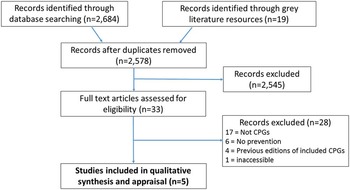
After removing duplicates, 2,578 articles were screened, of which 33 were reviewed in full-text (Figure 1). No additional guidelines were found in gray literature, and all were available from medical databases. Five CPGs were ultimately included (kappa, 0.84 [95% CI, 0.53–1.00]). A third party (D.M.) was consulted once. Reasons for excluding studies are detailed in Figure 1.
Preferred Reporting Items for Systematic Reviews and Meta-Analyses study flow diagram. CPG, clinical practice guideline.

Guideline Characteristics
The included CPGs were developed by (1) the American College of Gastroenterology (ACG),Reference Surawicz, Brandt and Binion 26 (2) the Association for Professionals in Infection Control and Epidemiology (APIC),Reference Carrico, Bryant, Lessa, Limbago, Litz Fauerbach and Marx 18 (3) the European Society of Clinical Microbiology and Infectious Disease,Reference Vonberg, Kuijper and Wilcox 27 (4) the United Kingdom Health Protection Agency/Department of Health (HPA/DH),Reference Hawkey, Bain and Borriello 19 and (5) the Society for Healthcare Epidemiology of America/Infectious Diseases Society of America (SHEA/IDSA)Reference Dubberke, Carling and Carrico 28 (Table 1). All were published between 2008 and 2014. Although 4 were updated, 2 did not update prevention-related information, thus their earlier version was used.Reference Hawkey, Bain and Borriello 19 , Reference Vonberg, Kuijper and Wilcox 27 Three guidelines were from the United States,Reference Carrico, Bryant, Lessa, Limbago, Litz Fauerbach and Marx 18 , Reference Surawicz, Brandt and Binion 26 , Reference Dubberke, Carling and Carrico 28 one from Europe (11 countries),Reference Vonberg, Kuijper and Wilcox 27 , Reference Debast, Bauer and Kuijper 29 and one from the United Kingdom.Reference Hawkey, Bain and Borriello 19
Characteristics Across Guidelines

NOTE. ACG, American College of Gastroenterology; AHA, American Hospital Association; APIC, Association of Professionals in Infection Control and Epidemiology; DH, Department of Health; ECDC, European Centre for Disease Control; ESCMID, European Society for Clinical Microbiology and Infectious Diseases; HPA, Health Protection Agency; IDSA, Infectious Diseases Society of America; NHS, National Health Service; PHE, Public Health England; SHEA, Society for Healthcare Epidemiology of America.
a Has been updated; however, update does not include new information on prevention.
Quality Appraisal of Guidelines
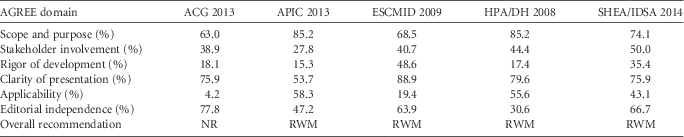
AGREE II scores are presented in Table 2. Overall reviewer agreement was very good (intraclass correlation coefficient, 0.88 [95% CI, 0.83–0.91]). Reviewers resolved all disagreements amongst themselves. We did not contact guideline authors for additional information because CPGs should be stand-alone documents.
Methodological Quality of Included Guidelines: AGREE II Domain-Standardized Scores

NOTE. ACG, American College of Gastroenterology; AGREE II, Appraisal of Guidelines for Research and Evaluation II; APIC, Association of Professionals in Infection Control and Epidemiology; DH, Department of Health; ESCMID, European Society for Clinical Microbiology and Infectious Diseases; HPA, Health Protection Agency; IDSA, Infectious Diseases Society of America; NR, Not recommended; RWM, Recommended, with modifications; SHEA, Society for Healthcare Epidemiology of America.
Domain 1: scope and purpose
The median score was 74.1% (IQR, 68.5%–85.2%), indicating that approximately 74% of the criteria for this domain were met. All CPGs met the 60% threshold. Limitations included insufficient details about the population, such as comorbidities and excluded populations. Strategies for management of increased CDI incidence or outbreaks were reported in all CPGs, though this varied in coverage.
Domain 2: stakeholder involvement
The median score was 40.7% (IQR, 38.9%–44.4%), and no CPG scored above 60%. Author panels included professionals from appropriate disciplines but did not describe authors’ roles. Furthermore, none of the CPGs sought the views of patients (eg, advocacy groups). Lastly, only HPA/DH defined target users (eg, clinicians, trusts) and how they may use the CPG.Reference Hawkey, Bain and Borriello 19
Domain 3: rigor of development
This was the lowest scoring domain, with a median of 18.1% (IQR, 17.4%–35.4%). No CPG scored above 60%. Only the European Society of Clinical Microbiology and Infectious Disease conducted a systematic search for evidence, although study selection criteria were not specified.Reference Vonberg, Kuijper and Wilcox 27 None of the guidelines reported how recommendations were formulated (eg, Delphi method),Reference Steinberg, Greenfield, Mancher, Wolman and Graham 30 although SHEA/IDSA reports that the ways of formulating recommendations were discussed in the “consensus development methods” supplement.Reference Dubberke, Carling and Carrico 28 All but APIC used an approach to assign strengths to their recommendations based on the evidence available.Reference Carrico, Bryant, Lessa, Limbago, Litz Fauerbach and Marx 18 Both ACG and SHEA/IDSA used a modified version of Grading of Recommendations Assessment, Development and Evaluation methods,Reference Surawicz, Brandt and Binion 26 , Reference Dubberke, Carling and Carrico 28 the European Society of Clinical Microbiology and Infectious Disease used a system by the Healthcare Infection Control Practices Advisory Committee,Reference Vonberg, Kuijper and Wilcox 27 and HPA/DH developed their own system (Supplemental Table 4).Reference Hawkey, Bain and Borriello 19 Only the European Society of Clinical Microbiology and Infectious Disease provided a transparent account of their assessment of the scientific literature, using the 2008 OCEBM system.Reference Vonberg, Kuijper and Wilcox 27 Guidelines mostly did not report how evidence affected their development of recommendations (eg, how low quality evidence resulted in strong recommendations). Limitations of the body of evidence for some recommendations were mentioned in SHEA/IDSA, including “Although the quality of evidence to recommend ‘encourage appropriate use of antimicrobials’ to prevent CDI does not meet level 1 criteria […] the CDI panel felt that appropriate antimicrobial use as a CDI prevention measure is essential to any CDI prevention program.”Reference Dubberke, Carling and Carrico 28 In addition, HPA/DH authors provided a detailed list of research gaps that need to be addressed.Reference Hawkey, Bain and Borriello 19 Finally, only SHEA/IDSA stated a procedure for updating the CPG.Reference Dubberke, Carling and Carrico 28
Domain 4: clarity of presentation
This domain obtained a median score of 75.9% (IQR, 75.9%–79.6%). The only CPG that did not meet the 60% threshold was APIC, which did not clearly outline specific recommendations (ie, recommendations were dispersed throughout text).Reference Carrico, Bryant, Lessa, Limbago, Litz Fauerbach and Marx 18
Domain 5: applicability
The median score was 43.1% (IQR, 19.4%–55.6%), with no CPGs scoring above 60%. The most common issue was failing to address potential resource implications (eg, costs) for guideline implementation, followed by lack of detail about potential facilitators and barriers to implementation. However, SHEA/IDSA included a separate section regarding implementation strategies.Reference Dubberke, Carling and Carrico 28
Domain 6: editorial independence
The median score was 63.9% (IQR, 47.2%–66.7%), with 3 CPGs meeting the 60% threshold.Reference Surawicz, Brandt and Binion 26 – Reference Dubberke, Carling and Carrico 28 HPA/DH did not include information on individual authors’ competing interests,Reference Hawkey, Bain and Borriello 19 and APIC had industry sponsorship (a cleaning agent) that the reviewers felt may have influenced the focus of the guideline.Reference Carrico, Bryant, Lessa, Limbago, Litz Fauerbach and Marx 18
Overall evaluation
The overall median score for guidelines was 4 out of 7 (IQR, 4-4). One CPG was categorized as not recommended for use,Reference Surawicz, Brandt and Binion 26 and the other 4 were categorized as recommended, with modifications. Limitations and suggested actions to improve guideline quality are in Supplemental Table 7.
Guideline Recommendations
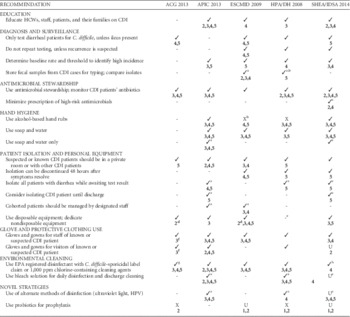
For all CPGs, authors searched for general CDI prevention literature, rather than conducting systematic reviews based on research questions. No CPG authors explained how evidence was selected, or how recommendations were formulated from the available literature. The median number of recommendations per guideline was 40 (range, 9–67), with 202 total recommendations across all guidelines. Reviewers with knowledge of infection prevention strategies (D.M., F.A., L.L.) discussed which key strategies and individual recommendations to include. Strategies were categorized as (1) education, (2) diagnosis and surveillance, (3) antibiotic stewardship, (4) hand hygiene, (5) patient isolation and personal equipment, (6) glove and protective clothing use, (7) environmental cleaning, and (8) novel strategies. Among the 8 categories, 22 key recommendations were selected, included in some or all CPGs, totaling 76 recommendations across all CPGs. When available, each recommendation’s status (recommended, not recommended, unclear) and reviewer-assessed evidence using the OCEBM levels were listed (Table 3). Additionally, recommendation strength and author-assessed evidence were compared with the reviewer-assessed evidence (Supplemental Table 8).
Recommendations Across Guidelines, and Evidence Levels for Each Recommendation

NOTE. ACG, American College of Gastroenterology; APIC, Association of Professionals in Infection Control and Epidemiology; CDI, Clostridium difficile infection; DH, Department of Health; EPA, Environmental Protection Agency; ESCMID, European Society for Clinical Microbiology and Infectious Diseases; HCWs, healthcare workers; HPA, Health Protection Agency; HPV, hydrogen peroxide vapor; IDSA, Infectious Diseases Society of America; SHEA, Society for Healthcare Epidemiology of America.
✓ Recommended
X Not recommended
U Unclear
- Not mentioned
a Recommendation specific for a high incidence/outbreak environment
b Storage of fecal samples in non-outbreak settings is recommended.
c Alcohol-based hand rubs should not be the only hand hygiene measure.
d Disposable thermometers only.
e No specific recommendation, but discusses link to personal equipment and C. difficile spread, and association of using disposable thermometers and reductions in CDI.
f Glove use only.
g 5,000 ppm or greater.
h Data are conflicting as to whether inactivation of spores is necessary to prevent C. difficile transmission, especially in an endemic setting.
Quality Appraisal of Underlying Evidence
For 76 recommendations, 180 unique studies were cited. Most CPG authors referenced previously conducted strategy-specific reviews or guidelines (eg, hand hygiene, isolation precautions). These reviews were not always systematic, and were published in 2007 or earlier.Reference Carrico, Bryant, Lessa, Limbago, Litz Fauerbach and Marx 18 , Reference Surawicz, Brandt and Binion 26 , Reference Dubberke, Carling and Carrico 28 Most evidence was before-after studies, and there were very few controlled trials. To support individual strategies, studies implementing “bundle” strategies (ie, multiple interventions) and/or those conducted to control outbreaks were cited, which introduces bias. Only 2 randomized controlled trials with CDI incidence as an outcome were found; one assessed the impact of treating asymptomatic patients, and the other evaluated using reusable thermometers. Only 1 strategy was supported by a meta-analysis of randomized controlled trials, probiotics prophylaxis, which had more than 20 studies.Reference Goldenberg, Ma and Saxton 31
DISCUSSION
Among the 5 CPGs identified, we found that although the recommendations were similar across guidelines, they were developed inconsistently, and each had considerable methodological limitations. On the basis of AGREE II standards, no CPG met quality thresholds for all 6 domains. Scores for rigor of development, stakeholder involvement, and applicability were the poorest. There were insufficient links between recommendations and supporting evidence, and CPGs were not transparent about how the limitations of the evidence impacted their recommendations, albeit with some exceptions as described in the SHEA/IDSA guideline.Reference Dubberke, Carling and Carrico 28
The rigor of development domain scored low across CPGs. For guidelines to be good-quality and trustworthy, they are contingent on clear research questions and systematic reviews.Reference Steinberg, Greenfield, Mancher, Wolman and Graham 30 None of the CPGs outlined their questions a priori, and only 1 guideline conducted a systematic review, though with limitations (eg, no inclusion/exclusion criteria, no screening results).Reference Vonberg, Kuijper and Wilcox 27 Internationally accepted guideline standards (eg, Grading of Recommendations Assessment, Development and Evaluation; AGREE) suggest a priori questions and structured searches. For example, “For hospitalized patients with suspected or confirmed CDI, does [prevention strategy] compared with [no prevention or alternative strategy] reduce CDI incidence?” Guideline authors underutilized available evidence for drafting recommendations. Four CPGs conducted quality of evidence assessments; however, only 1 was transparent.Reference Vonberg, Kuijper and Wilcox 27 Despite poor reporting (ie, transparency) of evidence to recommendations, and incongruence between evidence quality and recommendations, recommendations were mostly consistent across guidelines. Strong recommendations were often made from low-level evidence without justification (Table 2). The prevention strategy with the highest-level evidence, probiotics, was “not recommended” or “unresolved.” This may suggest that guideline panels depended on nonsystematic, informal consensus-based methods to develop recommendations.
The applicability domain was also poorly addressed, particularly regarding costs and implementation barriers/facilitators. SHEA/IDSA had a very comprehensive strategy for CPG implementation,Reference Dubberke, Carling and Carrico 28 suggesting that more recent guidelines are recognizing its importance. It is critical, however, that guidelines should be rigorously developed before considering their application.
The editorial independence domain scored well, although no guideline was led by an unconflicted methodologist, the gold standard methodology.Reference Guyatt, Akl and Hirsh 32 Among the reported statements for individual authors’ potential conflicts of interest, there were no financial conflicts. Reporting of intellectual conflicts was limited. There was a conflict of interest issue in APIC, where the source of funding was Clorox, a sodium hypochlorite cleaning products company.Reference Carrico, Bryant, Lessa, Limbago, Litz Fauerbach and Marx 18 This may have influenced recommendations because its focus was cleaning strategies centered around hypochlorite solutions, whereas SHEA/IDSA reported this as an area of controversy.Reference Dubberke, Carling and Carrico 28
In evaluating evidence behind the recommendations, there were 3 major limitations. First, most were quasi-experimental studies, which have numerous potential biases, including maturation effects, selection bias, and confounding.Reference Eliopoulos, Harris and Bradham 33 Second, interventions were often conducted during outbreaks, which are vulnerable to regressing to the mean.Reference Stone, Cooper and Kibbler 34 Third, “bundle” strategies—that is, multiple interventions, were common. Although such studies may be conducted owing to feasibility,Reference Eliopoulos, Harris and Bradham 33 guidelines are extrapolated to individual strategy effectiveness based on these studies. None of the guidelines discussed how limitations in the overall body of evidence impacted their decisions assigning strengths of recommendations. Although there a number of handbooks on CPG methodology,Reference Turner, Misso, Harris and Green 35 adherence by guideline development groups is low across numerous disease areas.Reference Kung, Miller and Mackowiak 36
To our knowledge, this is the only critical appraisal of infection prevention and control CPGs. Previous reviews of CPGs for other diseases reported similar limitations, particularly rigor of development, applicability, and editorial independence.Reference Alonso-Coello, Irfan and Solà 37 , Reference Gagliardi and Brouwers 38 Notably, other guideline reviews have remarked on the similarity of recommendations across guidelines despite considerably different methodologies.Reference Al-Ansary, Tricco and Adi 39 A possible reason may be that CPGs are still reliant on expert-based recommendations, supported by selective evidence rather than systematically searched evidence. The current gold standard for recommendation development, Grading of Recommendations Assessment, Development and Evaluation, was used in only 2 guidelines and was considerably modified in both (Supplemental Table 4).Reference Surawicz, Brandt and Binion 26 , Reference Dubberke, Carling and Carrico 28
Two narrative reviews on CDI prevention and control studies similarly commented on limitations of the available literature—for example, lack of randomized controlled trials and controlled time-series designs, as well as the tendency to implement multiple strategies to control outbreaks.Reference Hsu, Abad, Dinh and Safdar 40 , Reference Khanafer, Voirin, Barbut, Kuijper and Vanhems 41 As in many medical subspecialties, it is worthwhile to note that large randomized controlled trials are a relatively recent phenomenon among infection control literature. However, in the absence of high-quality evidence, poor or indirect evidence could be used, and authors should be transparent about limitations and how this impacted recommendations’ development. It has been suggested that when there is poor quality evidence, this is where clinicians need CPGs the most.Reference Steinberg, Greenfield, Mancher, Wolman and Graham 30 A novel decision support tool to assist guideline developers to systematically and transparently develop recommendation from available evidence has been proposed.Reference Brozek, Akl and Falck-Ytter 42
Our study had some limitations. First, although AGREE II is a robust guideline appraisal instrument,Reference Shekelle, Woolf, Grimshaw, Schunemann and Eccles 43 the quality might have been underestimated owing to incomplete reporting. However, there is agreement that transparent reporting of methodology is key for creating trustworthy guidelines.Reference Browman, Somerfield, Lyman and Brouwers 44 Second, we used the 2011 OCEBM Levels of Evidence instrument to rate the evidence for each recommendation, which is a crude measure and does not account for variability in quality across similar study designs. We attempted to account for this by modifying ratings to accommodate the types of quasi-experimental studies encountered. For example, we considered that an interrupted time series study with a historical control was a level 3 study, whereas a prospective interrupted time series with a concurrent control was level 2. However, there are criteria where low quality evidence can warrant a strong recommendation.Reference Andrews, Guyatt and Oxman 45 For example, when evidence is low for benefit of a particular strategy, but high for harm of not implementing any strategy (eg, terminal cleaning of CDI patients’ rooms), a strong recommendation is justified. Third, we checked only 10% of data for the recommendations (8/76 individual CPG recommendations); however, the second reviewer did not find differences in the extractions, thus we feel confident in our methodological approach.
Our study also had several strengths. First, we conducted a comprehensive search, including both medical databases and 10 gray literature sources. Second, 3 reviewers appraised each guideline, each with either methodology or clinical expertise, and the team had high concordance in AGREE II scores. Third, we analyzed the cited evidence underlying each recommendation, which has rarely been evaluated for CPGs.Reference Tricoci, Allen, Kramer, Califf and Smith 46
In summary, there is a considerable need for high quality CPGs because they are often used for patient care. Research suggests that CPGs may reduce inappropriate practices, bridge the gap of research and clinical application, and improve overall quality and safety of healthcare services.Reference Steinberg, Greenfield, Mancher, Wolman and Graham 30 Future guidelines of CDI prevention should be developed using validated methodological standards. Furthermore, there is a need for higher quality primary research on this topic, to better inform recommendations.
ACKNOWLEDGMENTS
Financial support. None reported.
Potential conflicts of interest. All authors report no conflicts of interest relevant to this article.
SUPPLEMENTARY MATERIAL
For supplementary material/s referred to in this article, please visit http://dx.doi.org/10.1017/S0899823X16001045