1. Introduction
Traditionally, the reduction of a scientific theory to another more general one is considered an important conceptual accomplishment (Sklar Reference Teller, Beckermann, Flohr and Kim1967). Yet an answer to the key question ‘what does a convincing philosophical model of reduction look like?’ notoriously eludes us, both in philosophy of physics and in philosophy of mind (Kim Reference Kim1998, Reference Klein2006; Batterman Reference Batterman2002, Reference Batterman and Zalta2008; Bedau and Humphreys Reference Bedau and Humphreys2008). Even a glance at the vast literature on this topic shows that negative appraisals of the available models predominate. For instance, when referring to the initial logical-positivist reduction models, Primas (Reference Reif1998, 83) offers this often-cited, radical assessment: “There exists not a single physically well-founded and nontrivial example for theory reduction in the sense of Hempel & Oppenheim (Reference Hooker1948), Kemeny & Oppenheim (Reference Kim1956), Oppenheim & Putnam (Reference Oppenheim, Putnam, Feigl, Scriven and Maxwell1958) and Nagel (Reference Onsager1961).”Footnote 1 But refinements of these original reductive frameworks have been proposed (Schaffner Reference Sklar1967, Reference Sklar1976; Hooker Reference Humphreys1981), and a number of authors have even suggested that their version of reductionism constitutes a ‘new wave’ in its development (Churchland Reference Churchland1985, Reference Dizadji-Bahmani, Hartmann and Frigg1989; Bickle Reference Bickle1996, Reference Bickle1998).Footnote 2
A constant subject of debate in this literature has been the assumption that a certain type of principle, called by Nagel a ‘bridge law’, enables reductions. As the name suggests, such laws connect terms from the to-be-reduced, less fundamental, phenomenological theory, with terms appearing in the reducing, more fundamental theory of a specified domain.Footnote 3 Thus, if we take—customarily, and roughly—an emergent phenomenon to be one for which its reduction to (or derivation from) its microphysical basis is impossible, then these laws seem to be reductionists’ best friend and emergentists’ worst enemy.Footnote 4 This assumption is corroborated by the stock examples of allegedly successful reductions in physics and psychology. Hence, as expected, the emergentists (i.e., antireductionists) systematically object to these laws, for a variety of reasons.Footnote 5 Furthermore, so vexing is the issue of the bridge laws that Kim, although not fond of the idea of emergence, has motivated the introduction of a new ‘functional’ reduction model by emphasizing the absence of such laws from it (Reference Kim1999, Reference Klein2006).Footnote 6 The ‘new’ reductionists (Churchland, Hooker, and Bickle in particular) vigorously downplay the importance of such laws in reductions as well. However, these views about the role of the bridge principles have recently been met with justified (in my view) skepticism. Endicott (Reference Endicott1998, Reference Fazekas2001), Marras (Reference Marras2002, Reference Nagel2006), Fazekas (Reference Feyerabend2009), and Dizadji-Bahmani, Hartmann, and Frigg (Reference Emch and Liu2010) criticize these approaches and support the contrary position, that these laws are indeed crucial for any reductive project.
In this article, I argue that the role of the bridge laws is actually more puzzling than the above assumption takes it to be. I will discuss an example from physics displaying two important features: (a) it provides a convincing candidate for an emergent phenomenon, as a number of authors, both philosophers and physicists, have argued (Teller Reference Yang and Lee1992; Humphreys Reference Kemeny and Oppenheim1997; Prigogine Reference Primas1997; Lebowitz Reference Lee and Yang1999; Liu Reference Liu1999, Reference Marras2001; Batterman Reference Batterman2002, Reference Batterman2005), and (b) the emergence claim can be traced back to a bridge law. Thus, my main goal in what follows is to investigate a context in which the bridge laws can be seen as responsible for the failure of reduction. Therefore, their role turns out to be precisely the opposite of what the received wisdom has recommended so far: they can also be the emergentist's best friend and the reductionist's worst enemy.
The case under scrutiny here is a class of phenomena called (first-order) ‘phase transitions’, as studied in thermodynamics (TD) and statistical mechanics (SM)—the ‘phenomenological’ and the ‘fundamental’ theories, respectively. These phenomena are quite familiar; substances as common as water appear in nature in diverse ‘phases’ (liquid, ice, and vapor), and a ‘transition’ is the sudden process of change from one phase to another.
The discussions about emergence and reduction in the generalist metaphysics literature have so far ignored these phenomena; for the interesting features they display, one has to turn to the more technical philosophy of physics literature, especially to the analyses of the question as to why TD does not reduce to SM after all. The current article aims to help close this gap, by emphasizing the metaphysical relevance of the issue while relying on a minimum of technical details. Section 2 is a brief overview of the role of the bridge principles in a well-known reductive argument, Nagel's recovery of the TD Boyle-Charles ideal gas law within SM. Then, echoing Primas, I also list the main objections raised by the emergentists to this type of derivation, yet the function of this section is mostly stage setting, to illustrate the working of bridge laws in enabling reductions. Section 3 begins with a quick presentation of the phase transitions case study and then argues for the view that the irreducibility claim made about such phenomena depends on adopting a certain bridge law (as we will see, it is one linking the TD term ‘free energy’ to a SM expression involving the natural logarithm of the partition function).
2. Reduction and Bridge Laws
According to Nagel (Reference Onsager1961, 352), “a reduction is effected when the experimental laws of the secondary science (and if it has an adequate theory, its theory as well) are shown to be logical consequences of the theoretical assumptions (inclusive of the coordinating definitions) of the primary science.” Nagel's own example of a successful application of the model is the reductive explanation of the TD ideal gas (Boyle-Charles) law (PV = kT) within SM. Nagel's reductive argument can be broken down into three stages.
First, there is an ontological identification assumption. A certain volume of gas is taken to be composed of a fixed number of molecules, the basic elements of the ontology of SM. They are not part of the ontology of TD, whose subject matter is the thermodynamical properties of matter in bulk. Although TD is not incompatible with this microphysical ontology, it is, in its standard formulation, silent on it. The second step of the reduction is a derivation. Based on the ontological assumption, and on other assumptions about the nature and interactions of molecules (they are idealized as point particles, subject to elastic and symmetrically distributed collisions, in an isotropic space, etc.), a lawlike statement  is derived within the framework of Newtonian mechanics. Thus, LSM is the mechanical counterpart of the ideal gas law
 . Finally, the third step is the postulation of a ‘bridge law’
 . As is immediately apparent, the insertion of BL1 into LSM yields LTD.
The antireductionist critics of the Nagelian model usually accept steps 1 and 2. Step 1 is an ontological matter, not up to negotiation. Step 2 is mostly a mathematical argument, not assailable either, once some physical assumptions are in place. The antireductionists, however, object to step 3, on a variety of grounds. Some point out that the status of such connecting statements is unclear at best. It is often asked, what do these laws state? Are they supposed to state biconditionals? If so, do they state synthetic connections, that is, physical covariances? Or, are they identification statements, the two terms standing for the same physical object? If so, are these necessary statements or only contingent? And, finally, what about the ‘multiple realizability’ contexts in which the availability of such lawful type-type connections is questionable (Fodor Reference Gross1974)?
Another angle of attack takes its cue from a philosophy of language according to which the meaning of a theoretical term is fixed by its network of relations with other terms of the theory (Feyerabend Reference Fodor1962). If so, step 3 is impossible to take in principle. As any TD textbook informs us (e.g., Reif Reference Schaffner1965), temperature is introduced via the fundamental Zeroth Law of Thermal Equilibrium, defining an equivalence class—two systems, each in equilibrium with a third, are in equilibrium with each other. It is, thus, far from evident what the ‘mechanical’ underpinning of this transitivity relation can be (Primas Reference Reif1998). All such systems “have a property in common, namely the property of being in thermal equilibrium with each other. This property is called temperature” (Guggenheim Reference Hempel and Oppenheim1949, 6). Therefore, given the way the meaning of the concept of temperature is constituted, it is hard to see how this network can be recovered within an essentially mechanical SM. Hence, the two terms linked by a bridge law cannot have the same meaning, and such a ‘law’ cannot exist.
These worries aside, bridge laws are typically understood as playing a role in enabling the reduction of the phenomenological theory to the ‘fundamental’ microphysical theory. Yet in what follows I will try to nuance this view. Having seen the role of a bridge law (in this case, BL1) in facilitating reductions, let's now turn to the case in which such a law seems to block them. More precisely, I will discuss cases in which the principled impossibility of achieving a reduction can be traced back to such a connective. And, as we will see, the reliance on it is not an optional matter but is strongly justified by deeper theoretical and methodological considerations. This should come across clearly during our investigation of the relation between the treatment of (first-order) phase transitions in TD and SM, respectively.
3. Bridge Laws and Phase Transitions
As we saw, phenomena described in physics as ‘phase transitions’ refer to rapid, even sudden, physical transformations such as melting, solidifying, or vaporizing. In undergoing such a transition, substances change their observable properties radically: less familiar examples of such processes involve graphite turning into diamond deep down inside the earth or spontaneous (de)magnetization. A variety of (higher-order) transitions have been identified and studied, but here I will focus on only the so-called first-order transitions, a category complex enough to illustrate the philosophical point.
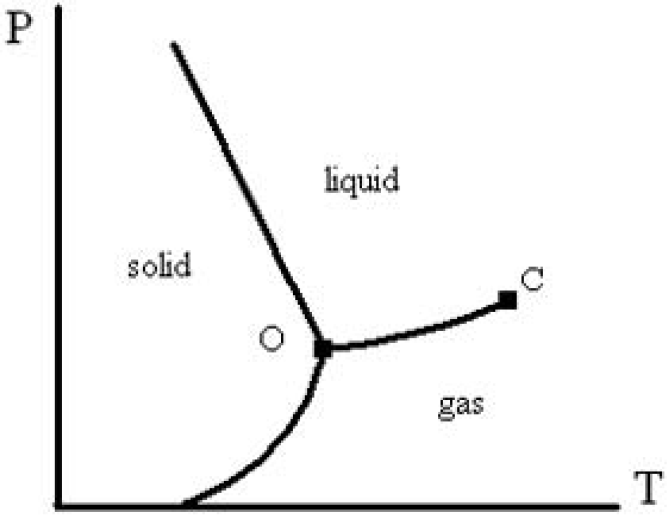
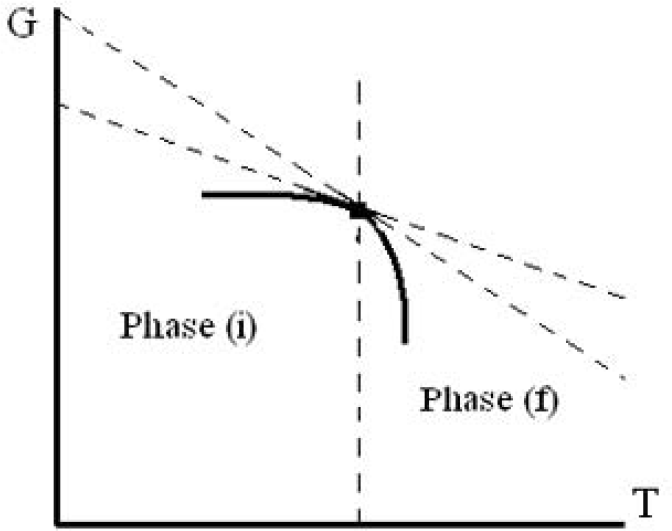
The systematic experimental and theoretical exploration of these phenomena goes back to the nineteenth century. The mathematical apparatus of classical TD proved to be very effective in describing them, and the first important results were obtained by Van der Waals and Maxwell.Footnote 7 Figures 1 and 2 are helpful to understand how TD treats a phase change. Most generally, it occurs when the system crosses one of the so-called coexistence lines separating the phases.
Point O designates the ‘triple point’ of the simple substance, where all three phases coexist; C is the ‘critical point’ beyond which the boundary liquid/gas vanishes.

Gibbs potential plotted as a function of temperature T. Discontinuous change of the first-order derivative is shown. Source: Zemansky (Reference Zemansky1968, 348).

More specifically, a phase transition occurs when the thermodynamic potentials—typically the Gibbs ‘free energy’ G depicted in figure 2—exhibit a certain form of irregular behavior. According to TD, a phase transition can be characterized as follows (Zemansky Reference Zemansky1968, 347):
(PhT) The first derivative of the Gibbs function changes discontinuously.
The system is near equilibrium at every stage in the process. All quantities featuring in this description are macroscopic. The Gibbs free energy G is defined as  , where H is the enthalpy of the system (
 , so
 ), T is its absolute temperature, and S is the entropy. (Another free energy is the ‘Helmholtz’ free energy
 , where E is the internal energy of the system.)
A point where such a discontinuity appears is called a ‘singularity’. A singular point of a TD function is one for which the function cannot be expanded in a Taylor series; a function lacking such points is an ‘analytic’ function (thus a singularity is also referred to as a ‘nonanalyticity’). Such points appear as ‘kinks’, or ‘sharp corners’, on the TD graphs.
Since the above characterization of a phase transition is entirely in macroscopic, thermodynamical terms, a reductionist wants to offer a microscopic, or statistical-mechanical, treatment of it. In order to advance such a treatment, it is just natural to begin by connecting the macroscopic TD terms with their correspondent microscopic SM quantities. Thus, the very first step toward this goal is to appeal to connectors, or to bridge laws. As is well known, in this case the connection is mediated by the so-called partition function Z associated with a SM system. The partition function is a sum  , where Er are the energies of the r (quantum) microstates accessible to the system, and
 (k is the Boltzmann constant).
The Gibbs free energy G is connected to the microscopic level via Z (for the canonical ensemble), as follows:Footnote 8

The expression BL2 is a point of contact, so to speak, between the two theories, TD and SM. It features genuine SM microlevel quantities, since it is expressed in terms of the partition function Z (which is calculable from microscopic information about the system), but also the macroscopic TD quantity, the Gibbs free energy. In virtue of its content, and of its connective role, BL2 is a bridge law.
This is the point where the reductionist's difficulties begin. Given BL2, it is evident that finding a singular point of G amounts to finding a singularity (nonanalyticity) of Z. Yet from the expression of Z, we see that it is a finite sum of analytic functions, and such a sum, as a matter of pure mathematics, is an analytic function. It follows that (a nonvanishing) Z cannot have singularities in it. If so, the implications for the reductionist project are quite dramatic: a macroscopic TD feature of the system—the property ‘undergoing a phase transition’—cannot be modeled within the microscopic SM theory. Importantly, note that this is impossible in principle, not just as a matter of computational complexity.
Before I comment further on the relevance of this result for understanding the role of bridge laws in reduction, it is important to acknowledge that the problem was to some extent solved. Physicists were eventually able to show that Z features singularities (while keeping it nonvanishing), but this achievement came at a price. Omitting all the details, the key to overcoming the difficulty was an idealization move, namely, taking (what is now called) ‘the thermodynamic limit’. More precisely, the physically realistic system was replaced with an idealized version, a system posited as having an infinite number of particles N, and occupying an infinite volume V, while the ratio V/N is fixed and finite. As a matter of pure mathematics, the partition function of such an idealized infinite system in equilibrium (also subject to other stability conditions) can harbor nonanalytic points.Footnote 9
Yet, as is clear, if we stick with the realistic finite SM, its spectacular failure to recover the TD account of phase transitions persuaded many physicists and philosophers that the property in question (‘undergoing a phase transition’) is an excellent candidate for an irreducible, emergent property. Lebowitz, for one, calls phase transitions in equilibrium “paradigms of emergent behaviour” (Reference Lee and Yang1999, S346).
We have now reached the key question of this note: why is this reduction blocked? Let's have a second look at the details of the case. To begin with, we should distinguish between two aspects of the issue, a (purely) mathematical one and a physical one. As we saw, the mathematical aspect is the property of the partition function Z, given by the theorem of real analysis that a finite sum of analytic functions is an analytic function. This is, strictly (i.e., mathematically) speaking, the reason why the free energy function G, in its statistical mechanical form G(Z), cannot feature any singular point.
So, apparently there is a mathematical explanation for the failure of reduction. Yet I think the mathematical impossibility is only a symptom, not the root cause. This is so because the mathematical part of the argument, unassailable as it is, could not even take off the ground without the previous step, namely, the identification of the Gibbs free energy with the expression containing the natural logarithm of the partition function G(Z). It is in this step, I maintain, where the difficulties really crop up. The mathematical property of the free energy function G(Z) would not play any role had this previous step not been taken. And, crucially, this step consists precisely in introducing the bridge law BL2.
But the situation is, however, more complicated, as the reductionist might appeal to several strategies that, if successful, will exonerate the bridge law for the failure, by identifying a different culprit. One such possible reductionist maneuver would be to object to the adoption of this particular bridge law, BL2. The strategy is borrowed, ironically, from the antireductionists: recall that the antireductionist used to ask questions of the type ‘why is temperature correlated with the mean kinetic energy?’—that is, why not with something else? It is Kim who has recently brought this type of objection to the forefront in a different context, asking “Why does pain … correlate with C-fiber excitation, but not [with] another kind of neural state? … Why does pain, not itch or tickle, correlate with C-fiber excitation?” (Reference Klein2006, 552). Similarly, the reductionist might reason as follows: if the analytic, singularity-free quantity Z is what causes troubles for reduction, why not connect the two theories in a different way?
This proposal is problematic. Even minimal familiarity with how thermal physics is currently conceptualized is enough to persuade us that the connection under scrutiny here—between TD and SM quantities via Z—lies at the very heart of this theoretical enterprise. The bridge law BL2 is not an isolated, dispensable relation but a central node in a dense and vast conceptual network (some of it displayed in n. 8). In fact, as is often stressed in the textbooks, all thermodynamical quantities of interest are linked to the microlevel via the partition function (Reif Reference Schaffner1965, 214–16). It is thus expected that the kind of change envisaged by the reductionist (in essence, using a novel way to connect SM and TD) would have a major ripple effect in other regions of the theory, with unforeseeable and possibly unwelcome consequences.
However, the reductionist might wish to avoid such a (dangerous) idea. She could explore another, somewhat subtler possibility, by proposing to look for yet another factor responsible for the failure of reduction. Returning to the stage where the troubles began, one notices that there is an additional element involved in this failure: the assumption that the TD definition of a phase transition (PhT) is to be used as a definition of a phase transition within SM as well. Some noted that this assumption, otherwise extremely natural, is challengeable. As Callender put it, “After all, the fact that thermodynamics treats phase transitions as singularities does not imply that statistical mechanics must too” (Reference Churchland2001, 550).Footnote 10 Clearly, if the PhT definition was not imported within SM, but a different one was used, the troubles would not have occurred.
But which one? This proposal faces difficulties similar to those faced by the first strategy. To be sure, the idea is theoretically coherent: one cannot impose the requirement that the two theories define a phase transition in the same way.Footnote 11 The problem, however, is that SM does not currently have a different way to conceptualize a phase transition; the TD definition PhT is used as a matter of course by SM too. Should a proposal like this be implemented, a rewriting of significant portions of SM would be required. If so, one cannot foresee the larger scientific consequences of working with a different definition; the dangerous ripple effect threatens to appear once again. Thus, in addition to the question regarding ‘what a SM theory of phase transitions looks like without the PhT thermodynamical definition,’ another interesting question is ‘why no such alternative definition (i.e., ‘purely’ SM) has been advanced so far’.Footnote 12
For my purposes here, however, the important question to ask now is whether this additional complication confutes my point that the role of bridge laws is, in this case at least, somewhat of a puzzle for the reductionist. The answer is, I argue, no: by considering these complications, one does not dissolve the riddle but at best realizes that the failure of reduction becomes more of a holistic matter. The conclusion to draw is that the bridge law BL2 might not be solely responsible for blocking the reduction but that it shares the blame with the assumption that the definition PhT has to be used within SM (and of course with the mathematical theorem establishing the analyticity of Z).
4. Conclusion
To be sure, bridge laws are meant to enable reductions. The main function of such connectives is to bring the terms and properties appearing in the ‘nonfundamental’ theory within the scope of the concepts of the ‘fundamental’, lower-level theory. For this reason, the antireductionists have long attempted to undermine the status of these connectors. This article suggests that how we should understand the contribution of the bridge laws to the reductive enterprise is actually a messier business since there are contexts in which the bridge laws seem to play an important part in its failure. If this is so, then some interesting questions can be raised. What will the emergentists make of the impressive series of arguments mounted against bridge laws? Equally interesting is that one can wonder how a reductionist can deal with this situation too—that is, should the reductionist and the emergentist now change roles with regard to bridge laws? Should the reductionist turn into a critic of bridge laws?
 , where
 and
 , also derived in Reif (214). So
 . The partial derivative is taken for constant T.