

I. Introduction
A whole range of trends and events in contemporary global affairs are described more than ever before in cosmopolitan terms. More specifically, the processes that govern today’s constitution-making are shaped by some inescapable measure of cosmopolitanism.
The key question that this article seeks to explore is the degree of presence and ways of manifestation of cosmopolitan law ideals in contemporary constitution-making. Its main thrust is to map the contours and identify the contents of contemporary constitution-making, an exercise that is based on the conceptual parameters of cosmopolitan law as framed in the pioneering work of the eighteenth-century German philosopher Immanuel Kant.
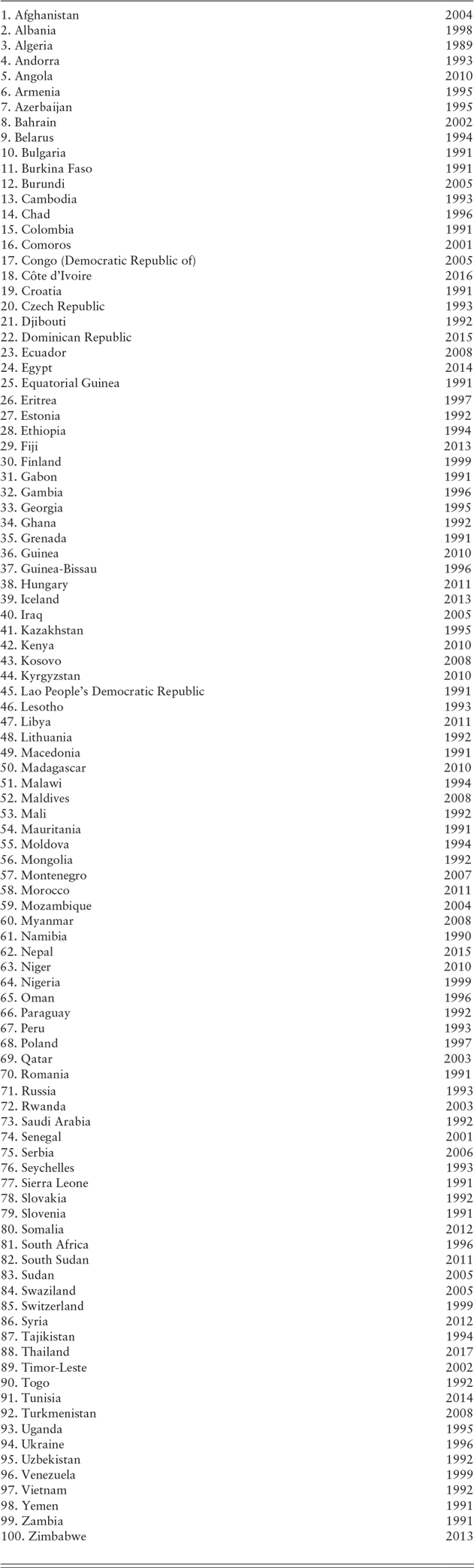
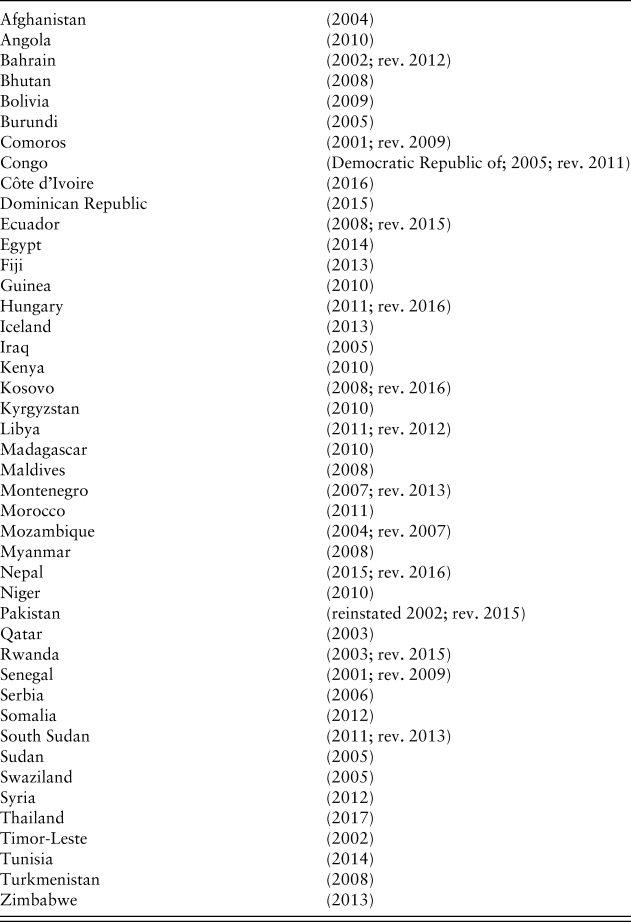
Empirically, the number of constitutions that have changed in rather significant fashion includes more than half the countries of the world in recent decades. Precisely 100 new constitutions were put in place since the fall of the Berlin Wall nearly three decades ago, and an additional three were reinstated.Footnote 1 There are several factual reasons that help explain this magnitude of change. One of the predominant reasons is system or regime change in such countries from Central and Eastern Europe to Indonesia and South Africa. New states also came into existence, thus dictating the conception of new constitutions (e.g., East Timor, Montenegro, Kosovo and South Sudan). Additionally, changes were by-products of specific local factors, such as in Bhutan, Hungary or Myanmar or, most recently, resulting from successive popular uprisings in Arab states (e.g., Morocco, Tunisia, Egypt, Jordan and Libya).Footnote 2 Overall, since 1989, 175 constitutions were either newly adopted or were subject to revisions.Footnote 3 When it comes to this century’s constitution-making process, the empirical results show the adoption of 44 new constitutions since the year 2000,Footnote 4 or adoption and revision (combined) of 155 constitutions since the year 2000.Footnote 5
The underlying emphasis of this inquiry is not so much on the transnational dynamics developed in the interplay of sovereign states with other actors and processes as much as on the internal dynamics of transnational norm-utilisation and the influence and incorporation of cosmopolitan law precepts in domestic legal orders.
This article identifies at least five major strands through which cosmopolitan law ideals express themselves in contemporary constitution-making, forming in turn the major composite cosmopolitan contents that will be subject of discussion and analysis here:
(1) the involvement of the international community in the design and drafting of constitutions and the internationalised constitutional human rights trends;
(2) the incorporation of international law principles in constitutional documents;
(3) the use of international or comparative foreign models as a basis for constitutional design;
(4) the use of international law and foreign domestic law in constitutional interpretation; and
(5) the use of regional or international bodies of adjudication and their jurisprudence as a constitutionally mandated source of law.
This framework sets out the basic principles and supporting practice for each of the five strands. It is more of a conceptual sketch than an exhaustive study, allowing for further, robust and detailed research and study to be pursued on the individualised strands.
These five underlying moments, their meaning and ensuing implications will be explored against the distinct context of persisting claims for a global order based on, or modelled after, the universal precepts of human freedom and justice, on one side, and centralised sovereignty, on the other. Although differences in cosmopolitan positions writ large exist, the common denominator that defines legal cosmopolitanism is a fundamental rejection of international law or global legal order that is predicated solely on the Westphalian model, and that therefore grants absolute overriding authority to the interests of state sovereignty.Footnote 6 As much as it is an enterprise which both reflects and conceptualises contemporary trends, this five-strand framework is meant to serve as a distinct enforcement mode of this essential understanding. In practice, this implies the demand for the effectuation of the following three normative commitments: (1) that the ultimate focus is on individual human beings; (2) that the status of ultimate concern attaches to every human being equally; and (3) that this special status or standing has global appeal (i.e., applies everywhere and for everyone).Footnote 7
Given this article’s choice to confine its ambitions to more contemporary trends, predominantly the twenty-first century or trends immediately predating it, one could observe a relatively surprising phenomenon of the five strands being more prominent in emerging and recent democracies (or those transitioning from authoritarian regimes) than in established democracies. This observation should not be taken to mean that established democracies are rendered incompatible with cosmopolitan ideals. Rather, the contemporary trends are not significantly reflected in the older, established democracies.
A discussion about the principles and parameters of cosmopolitan law will be offered in the next Section II. The following sections will successively elaborate on the five elements contained in the comprehensive typology just presented. This article ends by discussing and expanding upon the Kantian notion of cosmopolitanism, so as to articulate an engrossing vision that is reflective of the evolving realities and expanding global constitution-making practice of the twenty-first century. In pursuit of the very intellectual foundation of the term cosmopolitanism – which is the imagination and courage of its forbearer – it calls for imaginative experimentation that supports a global cosmopolitan regime of law, transforming the emerging pattern of trends identified in the article into a consolidated set of constitution-making standards that are commonly desired and globally shared.
II. Definitions and terminology
The idea of cosmopolitan law is intellectually most closely associated with the work of the iconic German philosopher Immanuel Kant. He introduced cosmopolitan law in one of his most celebrated political writings, Toward Perpetual Peace: A Philosophical Sketch,Footnote 8 and reaffirmed in the Metaphysics of Morals.Footnote 9 The central meaning of cosmopolitan legal order has come to be understood in terms of a transboundary or transnational legal system defined by an obligation of all public officials to fulfil the fundamental rights of every person within their jurisdiction, without regard to nationality or citizenship or any related membership characteristic.Footnote 10
Indeed, one could observe two intertwined, yet distinct Kantian cosmopolitan concepts. The first is the broader concept of ‘cosmopolitanism’, which relates to Kant’s philosophy of history and political theory, and finds perhaps its most articulate expression in his essay Idea for a Universal History with a Cosmopolitan Aim.Footnote 11 The second and incomparably more specific concept is that of ‘cosmopolitan law’, which is also more pertinent to the present inquiry. It ought to be stated that, although made famous or indeed brought into life by Kant, the philosopher himself does not provide a full explanation of what he means by cosmopolitan law.Footnote 12 It thus remains to be discerned from considering and interpreting the philosopher’s views and sources in their totality, as well as against the prevailing historical circumstances of the time.
The three ‘definitive articles’ lay down the principles that make the edifice of cosmopolitan law. The first definitive article concerns the constitutional organisation of the state, which ought to be ‘republican’. The republican system, in Kant’s conception, implied a representative form of government in which legislative and executive powers are separated, equality of citizens is guaranteed, and tyranny or despotism is avoided. The second definitive article deals with the institutionalisation of the right of nations in the form of a ‘federation of free states’. In today’s terms, this condition is operationalised with reference to state membership in international organisations. The third definitive article concerns the rights of men as citizens of the world in a cosmo-political system, a system which is defined by ‘universal hospitality’; in other words, states’ duty to provide ‘hospitality’ to non-citizens. His express definition reads: ‘Hospitality means the right of a stranger not to be treated in a hostile manner by another upon arrival on the other’s territory.’Footnote 13 In his writings, Kant has referred to the notion of hospitality and cosmopolitan Right as encompassing an individual’s freedom ‘to establish a community with all’,Footnote 14 ‘to make public use of one’s reason’,Footnote 15 and to engage in trade and commercial activities enabled by the ‘spirit of trade’ inherent in hospitality.Footnote 16 In Kant’s vision, peoples of the world have in varying degrees entered into a universal community, thus advanced to such a point where a violation of rights in one part of the earth is felt everywhere.Footnote 17 This conception resonates today not only with the global interconnectedness enhanced by modern and hitherto unknown information and communications technology, but also, and perhaps legally more important, the distinct category of international legal obligations known as erga omnes, defined by the International Court of Justice as:
[t]he obligations of a State towards the international community as a whole … By their very nature … [they] are the concern of all States. In view of the importance of the rights involved, all States can be held to have a legal interest in their protection; they are obligations erga omnes.Footnote 18
This Kantian notion of hospitality and the freedoms it demands have spurred a contemporary cosmopolitan discourse that extends to its application as a basis for the cosmopolitan norms of justice, as reflected in the international bill of rights,Footnote 19 or as a basis for recognising fundamental rights.Footnote 20 Kant’s concept of cosmopolitan law has been elsewhere described as ‘an anticipation of the Universal Declaration of Human Rights proclaimed by the United Nations in 1948, laying the theoretical foundations for a model of international society very similar to that cherished by the UN and other international organisations in a number of reform bills’.Footnote 21 Ultimately, legal cosmopolitanism ‘considers each individual as a legal person entitled to the protection of basic human rights in virtue of their moral personality and not on account of their citizenship or other membership status’.Footnote 22 The international bill of rights or indeed the larger core international human rights instruments bind state parties in relation to treating not only their citizens, but also non-citizens, residents and/or other persons within their jurisdictions, in accordance with the terms of those instruments.
The Kantian concept of law is holistic and integrated. It encompasses domestic law (among individuals within a state), international law (among states), and cosmopolitan law (the rights of human beings wherever on the globe they are or might be), each dependent on the other.Footnote 23 This relationship is viewed in terms of a continuum that is defined by the underlying claim to individual freedom. In essence, Kant makes reference to different levels of institutionalising his cosmopolitan conception of Right, however within an overall coherent framework of law. As Katrin Flikschuh puts it ‘Kant does not share the widespread view that we can turn our attention to the issue of cosmopolitan Right only after we have settled the matter of domestic justice. The grounds of cosmopolitan justice are identical with those of domestic justice: both follow from the claim to external freedom of each under conditions of unavoidable empirical constraints.’Footnote 24 In Kantian terms, there are thus laws for all human beings as such (of the kind embodied in the UN Genocide Convention, the Torture Convention, or the Elimination of Racial Discrimination Convention), which cannot be superseded by domestic law, no matter whether such law goes back to the founding of the state.Footnote 25
This article conceives cosmopolitan law in terms that capture both the classical substance of the notion (as reflected in pillars 1 and 2 relating to the internationalised constitutional human rights trends and the incorporation of international law principles in constitutional instruments) and the more contemporaneous procedural traits that help effectuate the cosmopolitan ideals, namely pillars 3, 4 and 5 (i.e., the use of international or comparative foreign models as a basis for constitutional design; the use of international law and foreign domestic law in constitutional interpretation; and the use of regional or international bodies of adjudication and their jurisprudence as a constitutionally mandated source of law). Contemporary cosmopolitan law is henceforth conceived in a somewhat more extensive, albeit necessary, fashion, especially in relation to the advanced pillars 3, 4 and 5, which address the variety of ways and trends – actual or emerging – that the law- and constitution-makers and interpreters now apply and integrate the three kinds of law forming the edifice of law advocated for by Immanuel Kant – toward the continuum among the three that Kant argued for.
This extended version represents a quintessential reinterpretation of Kantian ideas and ideals to the evolving realities of the twenty-first century. In this sense, it falls within the boundaries of moral, legal and political philosophy already been drawn by a broad revival of interest in the Kantian conceptual framework of cosmopolitanism, including specific efforts to build and sustain an extended rights-based cosmopolitanism.Footnote 26 It seeks to outline a framework that transcends the occasional historical setbacks and sceptical objections, while admitting their continuous, albeit gradually unobtrusive presence. This framework is naturally predisposed to be deferential to a bold imagination, such as the one embodied in the Kantian projection of cosmopolitanism, which is both rooted in and survived the historical forces that ran contrary to the cosmopolitan ideals, to reach a point of its ever closer materialisation. The proposed framework is not stricto sensu entirely Kantian and indeed it need not be, in order for it to qualify as a reading of Kantian cosmopolitanism in a new distinct era, the twenty-first century. For instance, Kant is totally silent about such contemporary trends as the use of international law and foreign domestic law in constitutional interpretation or the use of regional or international bodies of adjudication and their jurisprudence as a constitutionally mandated source of law. No institutionalised machinery of the type of regional and international organisations that we know today even existed at the time Kant lived – let alone any express projection of using the jurisprudence of these regional and international institutions as a constitutionally mandated source of law centuries into the future.Footnote 27 In this sense at least, the Kantian cosmopolitan project remains an imaginative enterprise, which is reinterpreted by way of conjoining the classic Kantian cosmopolitan moral and normative principles of universal freedom, human worth and global justice to the emerging and actual contemporaneous constitution-making trends of the kind of using international or comparative foreign models as a basis for constitutional design or using international law and foreign domestic law in national constitutional interpretation. This framework re-imagines Kant, mirroring a conjoined classic and contemporaneous concept of cosmopolitan constitution-making.
Kant’s institutional architecture for the effectuation of cosmopolitan law is open and indeterminate. It is rather open to different paths of constitutional normative structure as far as they can safeguard individual freedoms and as much as they can prevent domination; while the boundaries of pluralism it can tolerate remain empirically open and indeterminate, one thing could be expressed with a higher measure of certainty and that is the absence of a required unitary order. He prescribes no particular form of institution in charge of sanctioning or applying cosmopolitan law in real world practice. As an author puts it:
Kantian cosmopolitanism has no particular predictive institutional complexion, only the requirement that the process must be the result of a free consensus in line with a priori principles of universal public right.Footnote 28
Based on the foregoing considerations, cosmopolitan constitutionalism represents a set of ‘normative and juridical principles of … cosmopolitan Right’.Footnote 29 These principles, translated or transposed into positive law, constitute a universal code of justice that states voluntarily commit to realise universal public Right.Footnote 30
So far, this article has painted a picture with several composite elements of the cosmopolitan law and an open, potentially dynamic structure of implementation, as far as it can safeguard universalistic individual freedoms and comply with the idea that there are moral duties and obligations owed to all human beings based on our exclusive humanity alone, without any reference to ethnicity, race, culture, religion, nationality, political association or other communal particularities.Footnote 31 Within these basic parameters of understanding, predicting and influencing decisions, cosmopolitan ways can be infinitely varied and can most appropriately be located in the intricate workings of individual states.Footnote 32
This article shows that there is, similarly, a plurality of contemporary institutionalised methods that are based on cosmopolitan ideals, which it seeks to define and identify. As explicated by Glenn, the cosmopolitan character of states is inescapably reflected in their law, with constitutionalism as one of its main sources or instruments.Footnote 33 It is within the operative ambits of this fundamental source that this article seeks to build an ensemble of cosmopolitanism’s contemporary forms of expression.
III. The involvement of international community in the design and drafting of constitutions and the internationalised constitutional human rights trends
One particularly unique characteristic of constitution-making in the twenty-first century – although certain more contemporary cases date back to the dawn of the twentieth century – is the involvement of the international community, or powerful segments of it, in shaping new state constitutions; a domain traditionally regarded to be part and parcel of a state and its people. The variety of instances where the international community, or parts of it, have ‘induced, accompanied, steered, or even installed new state constitutions’ could be evidenced in such cases as the constitutions of Cambodia (1993), Bosnia and Herzegovina (1995), South Africa (1996), East Timor (2002), Afghanistan (2004), Iraq (interim Constitution of 2004) and Kosovo (2008).
The role of the international community is particularly intense and larger in post-conflict contexts, which also attracted some form of direct UN involvement, including the provision of interim governing functions such as in the cases of East Timor and Kosovo.
The 1995 Constitution of Bosnia and Herzegovina, for instance, was quite literally prescribed by the Dayton Peace Accords, a general framework peace agreement reached in 1995 by the Presidents of Bosnia and Herzegovina, Croatia, and Serbia, ending the war in Bosnia. Annex 4 of the Agreement contained the Constitution of Bosnia and Herzegovina. Besides the provision for the institutional mechanisms of the legislative, executive and judicial powers, the Bosnian Constitution also contains a catalogue of human rights and fundamental freedoms, and a list of directly applicable international human rights instruments annexed to it.Footnote 34 The Bosnian Constitutional Court attributed ‘constitutional rank’ to all these international instruments.Footnote 35
To a large extent, the 2008 Constitution of the Republic of Kosovo was also built upon the premises of the Comprehensive Proposal for the Kosovo Status Settlement,Footnote 36 succeeding the interim Constitutional Framework for Self-Government in Kosovo, which was designed and adopted by the UN Interim Administration Mission in Kosovo (UNMIK) in 2001.Footnote 37
Just like the Bosnian constitutional model, the Constitution of Kosovo also contains a list of directly applicable international human rights instruments.Footnote 38 Being of constitutional rank, these human rights instruments have supremacy over provisions of laws and other acts enacted by Kosovo’s public institutions.Footnote 39
Another notable characteristic is the requirement of Article 53 of Kosovo’s Constitution, establishing that ‘human rights and fundamental freedoms guaranteed by this Constitution shall be interpreted consistent with the court decisions of the European Court of Human Rights’.Footnote 40 The origins of this provision could be linked to the Interim Agreement for Peace and Self-Government in Kosovo of 1999, known also as the Rambouillet Accords. Article 6(2) of the Accords provides: ‘The rights and freedoms set forth in the European Convention for the Protection of Human Rights and Fundamental Freedoms and its Protocols shall apply directly in Kosovo. Other internationally recognised human rights instruments enacted into law by the Kosovo Assembly shall also apply. The rights and freedoms shall have priority over all other law.’Footnote 41 Again, this provision builds on the Bosnian constitutional model. Moreover, it is phrased in identical terms. Article 2 of Chapter II of the 1996 Bosnian Constitution reads: ‘The rights and freedoms set forth in the European Convention for the Protection of Human Rights and Fundamental Freedoms and its Protocols shall apply directly in Bosnia and Herzegovina. These shall have priority over all other law.’Footnote 42
The model of adopting constitutional clauses that require the application or interpretation of constitutional rights in line with particular international human rights instruments is also followed by East Timor. While the Bosnian and Kosovo cases use the European Convention on Human Rights and ECtHR jurisprudence as a reference point, the East Timorese model makes reference to the Universal Declaration of Human Rights: ‘Fundamental rights enshrined in the Constitution shall not exclude any other rights provided for by the law and shall be interpreted in accordance with the Universal Declaration of Human Rights.’Footnote 43
Indeed, this constitutional requirement of interpretation in conformity with international human rights law is also present in – among many others – cases of Portugal,Footnote 44 RomaniaFootnote 45 and South Africa.Footnote 46 Another example is provided by the Andorran constitution, which declares the Universal Declaration of Human Rights as binding in the state of Andorra.Footnote 47 The Constitution of Angola (2010) expands the reference point, including the relevant regional African Charter on Human and Peoples’ Rights in addition to the Universal Declaration of Human Rights. It provides that the ‘constitutional and legal precepts relating to fundamental rights must be interpreted and incorporated in accordance with’ these instruments.Footnote 48 In the Americas, Argentina’s Constitution provides for an even more expanded list of human rights treaties that have the same rank as the Constitution, namely the American Declaration on the Rights and Duties of Man; the Universal Declaration of Human Rights; the American Convention on Human Rights; the International Covenant on Economic, Social and Cultural Rights; the International Covenant on Civil and Political Rights and its Optional Protocol; the Convention on the Prevention and Punishment of Genocide; the International Convention on the Elimination of All Forms of Racial Discrimination; the Convention on the Elimination of All Forms of Discrimination Against Women; the Convention against Torture and other Cruel, Inhumane or Degrading Treatment or Punishment, and the Convention on the Rights of the Child.Footnote 49
The latter examples demonstrate that in fact, the domestic constitutionalisation of international human rights treaties and related instruments – while distinctly and unmistakably present in internationally influenced constitution-making processes – are part of a larger trend of the ‘globalization of domestic constitutional law’.Footnote 50
Sixty-four constitutions that were either adopted or revised after 1989 – however the majority adopted after 1989 – included references to one or more specific international treaties or instruments concerning human rights.Footnote 51
This trend finds a far more intensified presence among the constitutions that were adopted in the twenty-first century. The Constitutions of Angola (2010),Footnote 52 Burundi (2005),Footnote 53 Comoros (2001),Footnote 54 Democratic Republic of the Congo (2005),Footnote 55 Côte d’Ivoire (2016),Footnote 56 Guinea (2010),Footnote 57 Mozambique (2004),Footnote 58 Niger (2010),Footnote 59 Senegal (2001)Footnote 60 and Timor-Leste (2002)Footnote 61 all contain express provisions to specific international human rights treaties or instruments, notably the Universal Declaration of Human Rights, the two international covenants on civil and political rights, and economic, social and cultural rights, and the African Charter on Human and Peoples’ Rights. Other constitutions make more generalised references to treaties, pacts, conventions and instruments pertaining to human rights or to the principles and obligations of human rights. These include the constitutions of the following countries: Bolivia (2009),Footnote 62 Dominican Republic (2015),Footnote 63 Ecuador (2008),Footnote 64 Egypt (2014),Footnote 65 Fiji (2013),Footnote 66 Iraq (2005),Footnote 67 Kenya (2010),Footnote 68 Kyrgyzstan (2010),Footnote 69 Libya (2011),Footnote 70 Madagascar (2010),Footnote 71 Maldives (2008),Footnote 72 Montenegro (2007),Footnote 73 Morocco (2011),Footnote 74 Qatar (2003),Footnote 75 Rwanda (2003),Footnote 76 Serbia (2006),Footnote 77 Somalia (2012),Footnote 78 South Sudan (2011),Footnote 79 Sudan (2005),Footnote 80 Swaziland (2005),Footnote 81 Tunisia (2014),Footnote 82 Turkmenistan (2008)Footnote 83 and Zimbabwe (2013).Footnote 84
IV. The incorporation of international law principles in national constitutions
As seen in more detail in the Bosnian and Kosovo examples, there is a special cosmopolitan embodiment in contemporary constitution-making influenced by the international community. However, as observed in the previous section, this phenomenon goes far beyond the context characterised by direct international involvement in domestic administration or related influence in internal constitution-making affairs. By way of additional illustration, the Russian Constitution of 1993 enshrines international human rights in a special constitutional clause.Footnote 85 Indeed, there is a whole host of other constitutions that not only enshrine international law and international human rights in their clauses, but also give them priority over domestic law. The ever-increasing incorporation of human rights norms into constitutions can be evidenced either by reference or in transcribed form,Footnote 86 or both, such as in the Bosnian or Kosovo cases.
The incorporation of international law in national constitutions involves a spectrum that is wider than the one limited to human rights treaties and instruments only. It finds expression through constitutional clauses pertaining to the role and status of treaties and customary international law. The specific models notwithstanding, it is nonetheless significant that national constitutions contain another version of incorporation of international law in the domestic constitutional order. As far as the wide range of diversity is concerned, it is perhaps best reflected in a number of European countries’ models.
For example, the Netherlands Constitution ranks international treaties above the Constitution,Footnote 87 and expressly provides that statutes that conflict with international treaties or resolutions of international organisations are invalid.Footnote 88 However, the Dutch Constitution does not give this same status to customary international law, and in fact it is silent about it. In Austria, Germany and Italy, by contrast, customary international law is superior to domestic statutes, but treaties are equal to domestic statutes, with the last-in-time rule determining which is valid.Footnote 89 In practice, however, this lex posterior rule has been relaxed as a result of the ECtHR jurisprudence,Footnote 90 even in such a country as the UK, with its long tradition of parliamentary supremacy.Footnote 91
France provides yet another model, in which treaties have higher status than subsequent legislation. The French Constitution, like that of the Netherlands, is silent on customary international law.Footnote 92 In Switzerland, for example, peremptory norms of international law (jus cogens) are superior to the Constitution, but not other rules of customary international law.Footnote 93
Beyond the European theatre, the United States Constitution establishes a dynamic which is to some extent similar to that of the UK. For instance, customary international law or the law of nations was traditionally viewed as part of the federal common law.Footnote 94 As to treaties, they are constitutionally conceived, as the ‘Supreme Law of the Land’.Footnote 95 although later-in-time statutes can supersede them and, additionally, the self-executing and non-self-executing conception of treaty implementation complicates the formal characterisation contained in the supremacy clause.Footnote 96
These examples, in all their diversity, epitomise the incorporation of international law principles in national constitutions as a constantly present phenomenon and an inherent part of any constitution-making process. In particular, one should note the growing intensity of incorporating and often ascribing higher domestic legal value to at least core international human rights rules and principles, be it by way of reference to specific international human rights instruments or actual transcription, or both variations. Reference to empirical data may be a particularly helpful ally in shedding further light to this trend.
Out of a total of 175 constitutions making references to international law – including treaties, agreements, norms or other international commitments – 166 were either adopted or revised after 1989.Footnote 97 More specifically, the legal status of international treaties in domestic legal order – also determining whether treaties are superior or inferior to the constitution or ordinary law – can be found in the provisions of 127 constitutions, of which 123 constitutions were either adopted or revised after 1989;Footnote 98 whereas some 168 constitutions (of which 160 are either adopted or revised after 1989) provide guidance as to the steps that national authorities must follow for treaty ratification.Footnote 99 Additionally, 60 constitutions that were either adopted or revised after 1989 contain explicit provisions to customary international law, the law of nations, or the generally accepted principles of international law.Footnote 100 The relevant empirical insights paint a picture that is indicative of a consolidated trend of incorporation of international law principles in national constitutions. Domesticating international law principles, along with the associated values that are embedded in the international or even universal system that it encompasses, in turn, represents a critical driving force behind the increasing trend of looking at these principles and values as a constitutive basis for choices made by national constitution-making and constitution-interpreting actors. The contents that define this trend and the way it manifests itself will form part of the next section.
V. The use of international or comparative foreign models as a basis for constitutional design
Constitutional comparison and cross-constitutional interaction at a larger international scale – referred to elsewhere also as ‘constitutional cross-fertilization’Footnote 101 or ‘migration of constitutional ideas’Footnote 102 – has gained particular prominence in recent decades. This popularity and practical significance can be observed in both academia and judicial praxis.Footnote 103
In the arena of human rights, one could speak of a global common denominator already in place of preserving a whole set of basic human rights and liberties enshrined in the multitude of multilateral legal arrangements of prime cosmopolitan value and significant geographic reach. This is the kind of situation that has been described in terms of an intrusion massive of international legal norms and standards in the domestic legal orders.Footnote 104 It represents evidence of an expanding horizon of understanding that is, above and beyond any legal or formal obligation, concerned with the principles of fundamental justice.Footnote 105
This global consensus over the fundamental principles of cosmopolitan justice can be obtained as a result of the rights and freedoms guaranteed in a multitude of widely accepted human rights instruments. At a minimum, they would include: the 1948 Universal Declaration of Human Rights (UDHR), self-proclaimed as ‘a common standard of achievement for all peoples and all nations;’ the 1948 United Nations Convention on the Prevention and Punishment of the Crime of Genocide; the 1949 Geneva Conventions and Their Additional Protocols; the 1951 Convention on the Status of Refugees and its Protocol of 1967; the 1966 International Covenant on Civil and Political Rights (ICCPR); the 1966 International Covenant on Economic, Social and Cultural Rights (ICESCR); the 1979 Convention on the Elimination of All Forms of Discrimination Against Women (CEDAW); the 1965 International Convention on the Elimination of All Forms of Racial Discrimination; the 1984 Convention Against Torture and Other Cruel, Inhuman or Degrading Treatment or Punishment; the 1989 Convention on the Rights of the Child.Footnote 106 These instruments are further supplemented and operationalised by an expanding number of evolving regional human rights systems.
A heightened legal convergence can indeed be observed in various distinct areas. However, the most robust would seem to be transnational human rights law.Footnote 107 This convergence is in the first place explicable by the fact that the very origin of these standards is domestic constitutional law, thus a product which has over time been ‘re-imported’ in international law, ‘has been modified (sometimes diluted) and which has become more or less universalised in a global discourse … human rights were conceived as legal entitlements 200 years ago on the national level’, but that concept made its way into international law only after the horrors of the Second World War.Footnote 108
Narrowing the scope of analysis, most of the articles of UDHR are constructed upon a substantial borrowing from some of the constitutions of the world’s most advanced democracies.Footnote 109 More broadly, and in relation to what has come to be known as the international bill of human rights, it is observed that, ‘[a]s a whole, and with the most notable exceptions of certain parts of the ICESCR, the rights contained in the three general human rights instruments are broadly similar in substance to rights contained in most modern constitutions. Both typically include such civil and political rights as the right to liberty and security of the person; rights against torture, cruel and inhumane punishment, and slavery; the right to vote, rights to freedom of expression and religious practice; and rights to be free from state discrimination on the basis of race, ethnicity, national origin, and gender. Many domestic bills of rights also include some of the core social and economic rights contained in the ICESCR, such as the rights to education, healthcare, choice of work, and a basic standard of living’.Footnote 110
An additionally critical element that has played an indispensable role in the constitutional evolution of many countries has been regional integration in the case of European countries and, more widely, global governance. The most striking and perhaps leading example of this transformation could be said to be that of an old and advanced democracy such as the UK.Footnote 111
Beyond the sphere of human rights, there is also a large degree of cross-fertilisation or migration of constitutional ideas. One such instance is the import of the notion of legitimate expectations into French administrative law from German law. Another prominent example is the German constitutional principle of proportionality, which has arguably exerted influence on judicial principles applied by both the European Court of Justice and the European Court of Human Rights. In return, these courts’ rulings have resulted in this principle’s acceptance in the domestic constitutional order of the UK.Footnote 112
A further novel developing trend is the gradual modification of the constitutional design of supranational entities such as the EU – from one that was based on pure market premises to a rights-based order, as a result of its growing engagement with transnational cosmopolitan features of human rights and fundamental freedoms. EU constitutionalism is thus rooted in the idea of a transnational collective community of shared ideals and interests. As noted by de Búrca and Gerstenberg, ‘The characterisation of the original European Economic Community … as a positivist project of economic integration has been gradually giving way to a complex and comprehensive conception of a transnational legal process, which has recently moved in the direction of a more explicit commitment to a framework of human rights protection.’Footnote 113
The most essential cosmopolitan features are expressed in the institutionalised practice of recognising and allocating welfare benefits on the basis of equal treatment, not only of nationals of the EU Member States and residents, but also other people.Footnote 114 In a distinct, yet related, context, on the same basis of equality, the result has been an obligation on Member States to recognise a right of residence for family members of former residents and non-economically active persons.Footnote 115
Indeed, a retrospective observation of national constitution-making processes offers a timely testimony that constitution-making has always entailed ‘a built-in international dimension’, as perhaps most prominently exhibited in the constitution-making experiences of post-war Japan and post-colonial Korea.Footnote 116 The reason is hardly reducible to only the need of the new or emerging body politic for acceptance by the larger international community. That, however, being one the reasons furnishing the explanatory response, the constitution of a new people often entails blurring the line between inside and outside, a complex interaction with foreign and international actors and contexts, with the ‘others’ that may have an intrinsic value in the identity formation of the putative constituent people in the process of constitution-making.Footnote 117 The conception of the ‘self’ does not emanate exclusively from a nation’s own history and revolutionary project, but is being reproduced and reframed in a sequence of communications among a plurality of domestic and global actors.’Footnote 118
The contemporary constitution-making projects are increasingly made for multi-cultural societies, some of which are, or have been, in conflict.Footnote 119 This new human condition places new and greater expectations that often necessitate the consultation of international or comparative foreign models, expectations ranging from the simultaneous build-up of the nation as well as the state, the provision of at least some of the missing societal cohesion, or protection of minority groups against decisions of the majority that are not compatible with the aspirations for peaceful and mutually fulfilling co-existence.Footnote 120
In the twenty-first century, the involvement of the international community, or segments of it, is most intense where a constitution-making process succeeds some form of conflict, provoking the involvement or intervention of the UN or other States, which in turn translates into constitutional process or design.Footnote 121 These extraordinary – albeit not uncommon situations – aside, international law or indeed the international community now impinges on constitution-making in a variety of other alternative ways. One such modus, as discussed above, is the increasing incorporation of international human rights norms into Constitutions. Additionally, segments of the international community are involved in constitution-making in a range of other ways through, among others, the provision of constitutional advisers by NGOs and under foreign aid programmes.Footnote 122 Indeed, what is more relevant, if not somewhat revolutionary, in connection with the empirical domestication of cosmopolitan values is the understanding of domestic constitutional principles – their application and interpretation – by reference to, and in consonance with, the understanding of those same precepts in the body of law developed by the international community or the law of specific foreign nations. The subsequent section will address this phenomenon.
VI. The use of international law and foreign domestic law in constitutional interpretation
One particular mode of contemporary cosmopolitan law expression is the application of international legal principles and practices by domestic courts when engaged in national constitutional interpretation. Even the seemingly most autonomous and globally powerful polities such as the United States are looking at external sources with greater frequency, as will be observed in this section. The idea is not to place domestic constitutional interpretation under some form of control by international or foreign domestic law,Footnote 123 but rather to conceive of it as a legal resource that enables full and fair constitutional interpretation.Footnote 124
The fundamental intellectual framework that furnishes the moral grounds for this outward-looking institutional enterprise is the engrossing understanding and acceptance of the centrality of human person in the face of law, be it national or transnational.Footnote 125 While this specific segment could benefit from expanded cross-national research of the frequency and substantive role that international law and foreign domestic law plays in national constitutional interpretation, the observation in this article, also for practical reasons, is limited to the US experience. Once could hardly make the case for the US serving as a most representative sample. However, the paramount value of this choice is determined by a somewhat assumptive judgment that the US belongs to a rather supremely autonomous and uniquely influential category of states in global affairs, hence its might is generally perceived as detrimental to any role – much less a significant one – for international law and/or foreign domestic law in constitutional interpretation.
A closer look at the phenomenon indeed results in an unsurprising conclusion that the resort to international or foreign law is ‘highly traditional’,Footnote 126 even for a polity such as the United States. Beginning with Thomas Jefferson’s emphasis in the US Declaration of Independence of the indispensable value of paying ‘decent respect to the opinions of mankind’, a sentiment echoed by James Madison in The Federalist Papers,Footnote 127 and recently demonstrated in a number of US Supreme Court cases,Footnote 128 the tradition and necessity of the search for universal precepts of human freedom and justice has survived the confrontation with sceptical voices.Footnote 129 In Lawrence v Texas, the Supreme Court struck down a law criminalising homosexual sodomy between consenting adults, thus reversing its earlier decision in Bowers v Hardwick. The Court cited three decisions of the European Court of Human Rights, and went on to say that:
[T]he reasoning and holding in Bowers have been rejected elsewhere. The European Court of Human Rights has followed not Bowers but its own decision in Dudgeon v. United Kingdom. Other nations, too, have taken action consistent with an affirmation of the protected right of homosexual adults to engage in intimate, consensual conduct. The right the practitioners seek in this case has been accepted as an integral part of human freedom in many other countries.Footnote 130
Along the same line of reasoning, in Atkins v Virginia, the US Supreme Court noted that ‘within the world community, the imposition of the death penalty for crimes committed by mentally retarded offenders is overwhelmingly disapproved’.Footnote 131 The Court held in this case that executing mentally handicapped persons constitutes cruel and unusual punishment, in violation of the Eighth Amendment. In Roper v Simmons, the Court referred to foreign and international law prohibiting the death penalty for juvenile offenders.Footnote 132 In justifying its position, the Supreme Court noted that the opinion of the world community, short of controlling its outcome, provides ‘respected and significant confirmation’ for the Court’s own conclusion.Footnote 133 It further observed that it does not lessen the fidelity to the Constitution or pride in its origins to acknowledge that the express affirmation of certain fundamental rights by other nations and peoples simply underscores the centrality of those same rights within our own heritage of freedom.Footnote 134
Indeed, the US Supreme Court has recalled a series of previous decisions, testifying to a continuing tradition, of referencing to the foreign and international authorities as instructive for its interpretation. Back in 1958, in Trop v Dulles, the Supreme Court noted that ‘The civilized nations of the world are in virtual unanimity that statelessness is not to be imposed as punishment for crime.’Footnote 135 In a related case and later in time, in Enmund v Florida, the Court made the observation that the ‘the doctrine of felony murder has been abolished in England and India, severely restricted in Canada and a number of other Commonwealth countries, and is unknown in continental Europe’.Footnote 136 It ultimately struck down the felony murder rule. Even federalist critics of the use of international materials in constitutional interpretation have come to admit that, ‘if the universal practice of the world were to recognise a right, that seems powerful evidence that the practice may be ‘‘implicit in the cost of ordered liberty’’ (or, in the specific context of the Eighth Amendment, that it may be ‘‘cruel and unusual’’).’Footnote 137 It is thus neither surprising nor unusual to say that the US Supreme Court has relied on foreign and international law throughout its history.Footnote 138 After all, the fundamental conclusion is dictated by the basic premise that ‘concepts like liberty, equality, and privacy are not exclusively American constitutional ideas but, rather, part and parcel of the global human rights movement’,Footnote 139 the prime exemplar of contemporaneous cosmopolitan law.
By way of calibrating expectations, it ought to be observed that trends in judicial interpretation in the US are not unconditionally supportive of global cosmopolitan trends. In its 2013 decision in the case of Kiobel v Royal Dutch Petroleum Co., the US Supreme Court went on to restrict the application of the Alien Tort Statute (ATS) extraterritorially.Footnote 140 Justifying it on jurisdictional grounds, the majority noted that ‘all the relevant conduct took place outside the United States’Footnote 141 and that for any claim to be supported under the ATS, it must ‘touch and concern the territory of the United States … with sufficient force to displace the presumption against extraterritorial application’.Footnote 142 Applying this standard, the Court dismissed the plaintiffs’ claims against a foreign corporation for the conduct that had occurred outside the United States, holding that Royal Dutch Shell’s ‘mere corporate presence’ did not sufficiently ‘touch and concern’ the territory of the United States to displace the presumption against extraterritoriality. In its considerations, the Court has shown particular sensitivity to ‘significant foreign policy implications’ of its decisions, or potential ‘adverse foreign policy consequences’, including by implication, the potential application of the same standard by courts in the other countries against US citizens ‘for alleged violations of the law of nations occurring in the United States, or anywhere else in the world’.Footnote 143 While it is not of the same value, this outcome would, however, not prevent the possibility for finding alternative, perhaps more proper, forums of jurisdiction. And no matter how unenthusiastic this decision about an unconditional extraterritorial application of the ATS might be, individual judges have recognised that Kiobel ‘is careful to leave open a number of significant questions regarding the reach and interpretation of the Alien Tort Statute’Footnote 144 and, in any event, the Kiobel decision does not impact claims for extrajudicial killing or torture under the Torture Victim Protection Act of 1991. The impact of Kiobel is yet to be measured by practice. For instance, on 20 August 2013, the US District Court for the Southern District of Ohio rejected Defendant Abdi Aden Magan’s Kiobel challenge, holding that ‘as a permanent resident of the United States, the presumption … against extraterritoriality has been overcome in this case’.Footnote 145
The US experience is but one indication of the abundance of judicial practice that is in existence in relation to the use of international law and foreign domestic law as tools for national constitutional interpretation also in other jurisdictions, which remains subject to further research. An alternative model is provided by the tradition embodied in specific constitutional clauses that sanction or ratify the resort to international law and foreign domestic law as part of the domestic constitutional interpretative tools.
What ought to be noted, by way of trend depiction, is the express referencing to international law and foreign domestic law in constitutional clauses of constitutions adopted in the twenty-first century as a mode of interpretation of domestic constitutional clauses. For example, the Constitution of Zimbabwe provides that, when interpreting the constitutional chapter on human rights, a national court, tribunal, forum or body ‘must take into account international law and all treaties and conventions to which Zimbabwe is a party’,Footnote 146 and may also ‘consider relevant foreign law’.Footnote 147 The 2002 Constitution of Timor-Leste, in the context of interpreting fundamental constitutional rights, provides that such rights ‘shall be interpreted in accordance with the Universal Declaration of Human Rights’.Footnote 148 Likewise, the 2004 Constitution of Mozambique provides that the constitutional principles relating to fundamental constitutional rights ‘shall be interpreted and integrated in harmony with the Universal Declaration of Human Rights and with the African Charter of Human and Peoples Rights’.Footnote 149 A similar clause could be found in the 2012 Constitution of Somalia, though with a broader referencing scope, as it prescribes the possibility for national courts to consider ‘international law, and decisions of courts in other countries’, when interpreting fundamental constitutional rights.Footnote 150 Another example is offered by the Constitution of Maldives of 2008: ‘When interpreting and applying the rights and freedoms contained within this Chapter, a court or tribunal … shall consider international treaties to which the Maldives is a party.’Footnote 151 Similar clauses could be observed in the Constitutions of Angola (2010),Footnote 152 Bolivia (2009),Footnote 153 Dominican Republic (2015),Footnote 154 Ecuador (2008),Footnote 155 Fiji (2013)Footnote 156 and Montenegro (2007).Footnote 157
This ensemble of constitutional examples does in no way intend to conclusively ascertain the end result or suggest a particular scale and status of implementation – much less a significantly higher one – but rather seeks to capture the trend, often in statu nascendi, however encouraging and in line with a desired cosmopolitan path. The existence of such outward-looking and universally-framed constitutional clauses is instrumental not only as a basis for expectations of compliance (internal and external), but also as an indication of a worldwide view and emerging pattern of a set of constitution-making standards that are commonly desired and globally shared.
VII. The use of regional or international bodies of adjudication and their jurisprudence as a constitutionally mandated source of law
It is now suggested that there is widespread practice of States incorporating international human rights instruments in their constitutions or, alternatively, prescribing their content. While the mere process of incorporation remains an inherently constitutional process, the dynamics generated are of transnational character. The European Convention on Human Rights represents the typical example of an act whose operation put in motion an entirely new dynamic, doctrinally portrayed as a ‘shadow’ or ‘surrogate’Footnote 158 constitution for states that had no judicially enforceable charters of human rights, including the original signatory countries of Belgium, France, the Netherlands, Switzerland and the UK. It dictated the enactment in a number of countries of new bills of rights, such as in the case of Nordic states in the 1990s, based on, or modelled after, the ECHR.
The UK also adopted the Human Rights Act in 1998, which incorporated the ECHR into the law of the UK, a landmark event of profound magnitude for the UK’s constitutional system. The various descriptions used portrayed this Act in terms of creating a ‘new legal landscape’,Footnote 159 of it as being ‘now part of what is otherwise an unwritten constitution’,Footnote 160 ‘a very important shift in thinking about the constitution … the protection of rights through legal processes, rather than political processes’,Footnote 161 with some even declaring ‘[t]he traditional British constitution … dead’.Footnote 162
The most significant and perhaps novel characteristic of the Human Rights Act 1998 is its requirement on domestic courts to interpret domestic legislation, also of constitutional significance, in accordance with the ECHR and to take into account the case law of the ECtHR:
(1) A court or tribunal determining a question which has arisen in connection with a Convention right must take into account any—
(a) judgment, decision, declaration or advisory opinion of the European Court of Human Rights …Footnote 163and:
(1) So far as it is possible to do so, primary legislation and subordinate legislation must be read and given effect in a way which is compatible with the Convention rights.Footnote 164
The cumulative effect of this radical transformation, not only in the British constitutional system, but also among other ECHR states parties,Footnote 165 has ‘for all practical purposes’ made the European Court of Human Rights the constitutional court of Europe for civil and political rights.Footnote 166
In any event, along the lines of the UK’s Human Rights Act requirement that human rights interpretation by domestic courts must take into account the case law of the ECtHR, there is an observable trend of newly adopted constitutions to require that their human rights provisions are interpreted in accordance with such case law. Kosovo’s Constitution – the newest in the European continent and defined by a uniquely high level of involvement from the international community – perhaps offers the most vivid example of a constitutional model that expressly requires that the human rights and fundamental freedoms recognised by the Constitution ‘shall be interpreted consistent’ with the case law of the ECtHR.
This constitution-making choice, even if less direct and explicit, is ratified by a number of other lately adopted (post-2000) constitutions. In addition to those constitutions referencing international law or international human rights treaties as part of the national constitutional interpretative tools (e.g., Angola, Bolivia, Dominican Republic, Ecuador, Fiji, Maldives, Montenegro, Mozambique), it is worth noting the not so insignificant number of more specific constitutional clauses, authorising the use of both the practice of international institutions that supervise international treaty implementation and decisions of courts in other countries (e.g., Serbia, Somalia, Zimbabwe).
This model, albeit in alternative fashion, is present in the constitutional experience of the group of Baltic countries. Unlike the constitutional examples noted above, however, in the Baltic cases, the duty to be bound by the ECtHR jurisprudence emanates not from any express constitutional provision, but through decisions of the highest countries. In the case of Latvia, the Constitutional Court of the country expressly agreed to be bound by the ECtHR’s case law,Footnote 167 also when it interprets the Latvian Constitution.Footnote 168 Likewise, the Estonian Constitutional Review Chamber of the Supreme Court has acknowledged its own duty to refer to the ECtHR’s case law.Footnote 169
VIII. Conclusion
This article has explored a set of global constitution-making modalities defined by cosmopolitan content. It can henceforth be established that the expression of ideals of cosmopolitan law in constitution-making is not a new phenomenon. However, the presence of cosmopolitan features in constitution-making has gradually intensified and the forms of such expression have constantly expanded.
On the whole, the article submits that, as far as the rights dimension is concerned, Immanuel Kant’s project of cosmopolitan law is a vivid reality. The institutional complexion, not an intrinsic part of Kant’s theory, is in a cross-fertilising and self-experimenting mode, with notable advances observed in particular in the judicial dialogue already in place in the European theatre, more specifically the triangular scheme formed by the ECtHR, ECJ, and national judiciaries of member countries of both organisations.
Whatever the form of the specific relationship between the domestic constitutional orders and the ECHR, or ECtHR jurisprudence, there is an inevitable fact in the ECHR and the case law it has generated, and that is constitutional pluralism with a human rights face; a cosmopolitan constitution-making or constitution-interpreting order that ‘destroyed doctrines that underpinned centralized sovereignty (e.g., legislative supremacy, the monopoly of constitutional courts over the domain of rights protection); and it enhanced judicial power with respect to legislative and executive power’,Footnote 170 on one hand, and on the other, ‘strengthen[ed] rather than weaken[ed] democratic sovereignty’.Footnote 171 Otherwise, a cosmopolitan order that has enabled and nurtured the imagination of an ever-increasing empowerment of the individual through a justice or rights-based approach largely generated by imperfect, yet maturing and overall effective, cosmopolitan constitutional provisions and community of courts, which operate in a universe of competing and cross-fertilising constitutional narratives. As Robert Cover expressed it with eminent eloquence:
No set of legal institutions or prescriptions exists apart from the narratives that locate it and give it meaning. For every constitution there is an epic, for each Decalogue a scripture. Once understood in the context of the narratives that give it meaning, law becomes not merely a system of rules to be observed, but a world in which we live.Footnote 172
The order painted by this article could be perceived through optimistic nuances. Ironically, the source is in the historical deficiencies defined by the most brutal and bizarre failures of the global system (or its absence) – especially in the early 20th century – to articulate and preserve a core set of principles that would guard human lives – the most precious of things – from large-scale abuse and atrocity. It is against this dark picture that, in all imperfections of the system (domestic, international and cosmopolitan), we are able to witness in this century a set of gradually accumulated trends that provide for ‘high hopes’ (as in the title of one of Pink Floyd’s songs); for a system of global law- and constitution-making principles that is capable of inspiring, inducing or inciting imaginary and not-so-imaginary projects that relocate such grand notions as State Sovereignty (Louis Henkin’s ‘S word’) and parochial constitutional projects to simple, smaller creatures: individual human beings. One way of moving forward lies perhaps in what we currently have: promoting, protecting, preserving, and perfecting the achievements already made by the global community, as articulated in the typology of trends this article has identified and presented. Most importantly perhaps, the Kantian philosophical framework is at its core optimistic. When in 1797 Immanuel Kant put forward the cosmopolitan ideal of law that was in sharp opposition to the militant statism of his day. It must have sounded utopian when imagining the order of the day. Judging against those circumstances, and with the benefit of the passage of time, this article evidences no compelling reasons to lose faith in the Philosopher. Au contraire, it ends with a sense of debt for imaginative courage in support of a global cosmopolitan regime of law, one that could be transformed over time, but that retains the core properties of universal human freedom, human worth, equality, and justice.
Acknowledgements
I am grateful to Andreas Føllesdal for his thoughtful and detailed comments on an earlier version of this article. I wish to also thank the participants at the ‘Scholars Workshop: Challenges to Global Constitutionalism’, held in Berlin (5–6 July 2018), organised by Global Constitutionalism and sponsored by Cambridge University Press, PluriCourts and Centre for Global Constitutionalism. The article has benefited from the insightful and thought-provoking questions and comments of the Workshop participants. The final shape of the article is also indebted to the two anonymous reviewers’ comments. The usual disclaimer applies.
Annex
Constitutions adopted after 1989Footnote 173

List of countries whose constitutions were adopted or revised after 1989 (175 constitutions)

List of countries whose constitutions were adopted after year 2000 (44 constitutions)

List of countries whose constitutions were adopted or revised after year 2000 (155 constitutions)