INTRODUCTION
In post-conflict situations, land is a necessary asset for people to rebuild their livelihoods (Rugadya et al. Reference Rugadya, Nsamba-Gayiiya and Kamusime2008; Huggins Reference Huggins, Anseeuw and Alden2010). At the same time, many post-conflict situations are characterised by a high number of land disputes because of displacement, disrupted structures of authority over land, and illegal occupation by powerful actors (Unruh Reference Unruh2003). Therefore, to achieve peace, economic and social recovery, and to prevent land disputes from culminating into new violence, strengthening land governance is considered a key component of post-conflict reconstruction programmes (see Pons-Vignon & Solignac Lecomte Reference Pons-Vignon and Solignac Lecomte2004). Likewise, post-conflict states often consider improving and reforming land governance as an important way of restoring sovereignty and legitimacy (see Peluso & Vandergeest Reference Peluso and Vandergeest2011).
However, the relationship between violent conflict, land governance and continuing instability deserves further investigation. This is because most of the literature explaining the nexus between land and conflict concentrates on re-emphasising the role land plays in violent conflicts. Land issues intersect with other factors like political mobilisation that work together to contribute to violent conflict (Daudelin Reference Daudelin2003; Pons-Vignon & Solignac Lecomte Reference Pons-Vignon and Solignac Lecomte2004). However, there exists a knowledge gap about the impact of violent conflict on land governance itself. Land governance issues resulting from violent conflict are not given appropriate attention in the peace process yet they form part of the reasons for violent conflict to continue or reoccur (Unruh Reference Unruh2004).
Natural resource literature often focuses on the ‘root causes’ of land conflict. A dominant perspective remains that of environmental security which understands conflicts about natural resources as a result of scarcity and competition (see Hardin Reference Hardin1968; Homer-Dixon Reference Homer-Dixon1999). Increasingly, proponents of a political ecology perspective gain more prominence, understanding resource conflicts as power struggles embedded in wider historical processes, contestation and institutional failure (see Peluso & Watts Reference Peluso and Watts2001; Turner Reference Turner2004; Benjaminsen et al. Reference Benjaminsen, Maganga and Abdallah2009; Peluso & Vandergeest Reference Peluso and Vandergeest2011). Such perspectives also highlight that the ways in which land is governed may be a potential cause of conflict (Anseeuw & Alden Reference Anseeuw and Alden2010). They illustrate how many resource conflicts in Africa can be traced to historical policies that assure that particular groups in society reap the benefits of resources and exclude others (see Cotula et al. Reference Cotula, Toulmin and Hesse2004 about the Great Lakes Region, Sudan; Peters Reference Peters2004; Turner Reference Turner2004; Clover Reference Clover, Anseeuw and Alden2010 about Angola).
Moreover, it is only recently that researchers have come to highlight the diverse ways in which violent conflict interacts with land issues. First, violent conflict reshuffles access to land, land ownership and it also creates room for all kinds of ‘injustices’ in the ways in which land is appropriated (Daudelin Reference Daudelin2003; Unruh Reference Unruh2003; Vircoulon Reference Vircoulon, Anseeuw and Alden2010). When land governance is in disarray, various outsiders to the community, including government institutions may come in to appropriate land and this is what may cause land conflicts after violent conflicts. In addition, post-conflict return or resettlement of displaced people often results in competing claims on land and new tenure insecurities. For example, in Rwanda after the 1994 genocide refugees returned and resettled themselves on land without supervision by the state. This resulted in violent occupation of land that did not belong to them and this contributes to the current land disputes in Rwanda (Unruh Reference Unruh2004).
Second, violent conflict may also significantly alter the ways in which land is governed: conflict redefines the rules of access, utilisation and ownership of land. Ambiguity about who is in charge and the rules that apply may result in a situation in which diverse land governing institutions compete for authority over land in post-conflict settings. This in turn may produce tenure insecurity and land conflicts (Clover Reference Clover, Anseeuw and Alden2010), a continuation of instability and even new violence. Distortion of land governance during the war is a significant long-term cost of violent conflict that may take generations to restore (cf. Bannon and Collier Reference Bannon and Collier2003). How these violence-related transformations of land governance precisely work and what they imply for intervention is a topic that needs further analysis (cf. Daudelin Reference Daudelin2003; Ross Reference Ross2004).
In this paper we argue for the need to better understand the long-term impacts of violent conflict on land access and land governance. Though political ecology perspectives on the land-conflict nexus may provide valuable insights into post-conflict land disputes, it is critical to bring in the conflict situation as an explanatory element to better understand conflicts around land and its governance in post-conflict settings. These land conflicts in turn create a space in which territorial struggles and contestations over identity and ethnicity are played out in new ways. Unfortunately, practitioners and policymakers often fail to take account of what violent conflict does to land access and land governance (cf. Clover Reference Clover, Anseeuw and Alden2010; Huggins Reference Huggins, Anseeuw and Alden2010). If the linkages between violent conflict and contestations over land access and ownership in post-conflict settings are not well understood, post-conflict stability may continue to be an elusive dream.
We will make this argument by reflecting on the case of the 2012 eviction of land occupants in Apaa village, in northern Uganda, which was the culmination of a long history of contestations about who are the rightful owners of land in question and which laws apply. The case study is based on ethnographic research in Apaa, which formed part of two years of fieldwork in the period 2011–2013 in northern Uganda, in the context of a larger research project on decentralised land governance in post-conflict settings.Footnote 1 The study employed qualitative methods of data collection. Fieldwork was conducted in Amuru and Gulu Districts in the Acholi sub-region and Adjumani District in West Nile sub-region, all part of northern Uganda. This ensued getting data from both sides and thereby representing the case/conflict from both Acholi and Madi perspectives. This paper builds on 43 interviews, eight focused group discussions, one dialogue meeting on investments in Acholi region, two songs composed about Apaa evictions by a local musician, two community meetings, one workshop, news paper accounts, news broadcasts by Nation Television Uganda (NTV) and Nile Broadcast Services (NBS) Television and field observations by the main researcher who lived within the Acholi villages. People interviewed included politicians, local people, members of the area land committees, local council members, civil servants at districts, traditional leaders, the youth, game rangers in Apaa, representatives from NGOs. Secondary data are based on review of documents, especially court documents, the land laws, for example the 1975 Land Reform decree, the 1998 Land Act, the 1995 constitution, instruments of gazettement and de-gazettementFootnote 2 and other related literature.
The argument is presented as follows: the following section reflects on the contribution of environment security and political ecology perspectives to understand the relationship between land and conflict, and the need in post-conflict settings to complement those with a focus on how violent conflict plays into land access and land governance. We then turn to the case of the Apaa evictions. Applying a political ecology perspective, we demonstrate the historical and political background of the claims made by the different parties involved – the local people, the district authorities of Amuru and Adjumani Districts, and the Uganda Wildlife Authority; the impact of the redrawing of district boundaries and struggles over jurisdiction of various authorities; the role of ethnic identity in local perceptions about those boundaries; as well as the power politics involved. We then argue how the resulting dispute can only be properly understood if one takes account of the diverse ways in which the violent conflict between the Lord's Resistance Army (LRA) and the National Resistance Movement (NRM) government interfered with land distribution and land governance. We show how the LRA/NRM war resulted in the opening up of Apaa to outsiders and a redistribution of land governing power. Post-conflict efforts at decentralisation that aimed to enhance land governance and transform authoritarian governance practices complicated the dispute even further. This brings us to the major argument that – to better understand post-conflict land disputes – political ecology perspectives need to be complemented with a particular focus on the impact of violent conflict on land access and land governance.
ANALYSING LAND, GOVERNANCE AND CONFLICT IN POST-CONFLICT SETTINGS
Theorising about the relationship between conflict and land tends to explain land disputes either in terms of scarcity and competition, or sees land disputes as embedded in wider historical and political developments (Le Billon Reference Le Billon2001; Vlassenroot & Raeymaekers Reference Vlassenroot and Raeymaekers2004; Korf & Funfgeld Reference Korf and Funfgeld2006; cf. Cramer Reference Cramer2006). The proponents of the first explanation underscore the inevitability of competition and conflict in case of a high demand for and limited supply of natural resources. In such a conception the scarcity of land is presented as a ‘root cause’ of violent conflict, which is inevitable, and at best can be averted by putting in place the right institutions (see Van Leeuwen & Van der Haar Reference Van Leeuwen and Van der Haar2016). Such a perspective – which has also become known as ‘environmental security’– reduces the relationship between natural resources and conflict to an issue of a desperate search for survival or human greed (Hardin Reference Hardin1968; Homer-Dixon Reference Homer-Dixon1999; Cf. Peluso & Watts Reference Peluso and Watts2001).
However, such a perspective fails to explain why in certain situations of scarcity and competing interests over natural resources conflicts do not arise. It is precisely this type of question that theorists from a political ecology school of thought seek to clarify. These scholars do not dispute the relevance of scarcity and abundance, but point out that actual scarcity or availability of resources on its own cannot predict the prevalence of conflict. Instead, they consider that resource dependency and conflict-proneness of resources are always socially constructed; and that there is need to understand how certain resources become perceived as scarce or valuable (see van Leeuwen & Van der Haar Reference Van Leeuwen and Van der Haar2016). This requires understanding of the historical, political and social context in which those resources are exploited, the distribution of resources and relations of production that come about and how those turn conflictive (Le Billon Reference Le Billon2001; Peluso & Watts Reference Peluso and Watts2001). In this connection, Cramer & Richards (Reference Cramer and Richards2011: 281) emphasise looking beyond the period immediately preceding the outburst of violence, as many resource-related conflicts have a long history in the making.
This paper starts from such a political ecological perspective. It underscores that the availability of land in itself does not spark off conflicts, but explores how the contested nature of land access is politically and historically formed. It also highlights the importance of the state, its policies and power politics. The management of land is a key area in which the state manifests itself and tries to impose its power over society, not only through the use of violence, but also through legal instruments, and statutory land institutions. Land reform may mean changing the rules of access and ownership of land of the local people or among the local groups. In due course land governance becomes a tool for state expansion and formation. Literature has argued that modern African states in diverse ways continue a colonial project of state expansion and expropriation of local resource users (see Peters Reference Peters2004; Cramer Reference Cramer2006; Peluso & Vandergeest Reference Peluso and Vandergeest2011). States may design rights to resources in such a way that they benefit the state itself (Peluso Reference Peluso1993), thus maintaining control over territory, natural resources and people. As a result, local people might be excluded from accruing benefits from natural resources, and the interaction between state institutions and local people might turn conflictive. Peluso (Reference Peluso1993: 204) illustrates how wildlife conservation and the promotion of nature reserves may in effect enhance a state's control over natural resources and populations, especially those that do not support the government.
Such a perspective also brings out that conflict about land is not so much about the resource itself, but primarily about its governance, regulation and the maintenance of political hierarchies. In short, the governance of land access is embedded in wider power relations. How decisions are made about access, utilisation and ownership may be a source of contestation and resistance, while ambiguity about who is in charge and what rules apply might also lead to land conflict. Further, such a perspective clarifies how land-related conflicts represent or get deeply intertwined with other contestations in society, and how issues such as identity, ethnicity and grievances about those in power may play out in land issues (van Leeuwen & Van der Haar Reference Van Leeuwen and Van der Haar2016). In this connection, to understand the conflictive nature of land access, it is important to consider the different meanings of land to local people. In agrarian African economies, land means more than an economic asset to rural populations; it is simultaneously the basis of their livelihood, and the source of their identity. As a consequence, disputes about land are more than resource conflicts; they may in fact come down to tensions over power, identity and social relations between different social groups, or as efforts to protect livelihoods and certain ways of living (Turner Reference Turner2004).
Nonetheless, such a perspective still considers violent conflict essentially as the outcome of contestation over land. It is only recently that researchers have come to highlight the diverse ways in which violent conflict interacts with land issues. While the ways in which land is governed may create resentment and resistance, violent conflict in itself may have an enormous impact on how land is governed. Violent conflict may reshuffle the rules of access, utilisation and ownership of land. This in turn may produce tenure insecurity and new contestation over land, and even new violence. The gist of this paper is to clarify the impact of violent conflict on land governance which in turn, acts as a catalyst to conflicts about land.
The case of Apaa evictions brings out the necessity of such a perspective. It illustrates the multi-dimensional relationship between land and conflict, illustrating how land conflict in northern Uganda and the competition over land ownership should be understood in the context of a longer history of contested politics of access to land, as well as contestation about who is in charge and what rules apply, and how violent conflict instigates new contestation about land and its governance.
GOVERNANCE, WAR AND LAND DISPUTES: THE APAA EVICTIONS, AMURU DISTRICT
On 13 February 2012, amidst gunshots and tear gas, over 10 police trucks ferried people from Apaa village to Pabbo sub-county offices, in Amuru District. During the forceful evictions carried out by the Uganda Wildlife Authority (UWA) and the police, two people were killed, 25 youths were imprisoned, 2,730 huts were demolished, 1,365 households were displaced and over 6,000 people were evicted from their land (Lawino Reference Lawino2012; Makumbi Reference Makumbi2012; Refugee Law Project (RLP) 2012; Lenhart Reference Lenhart2013). This was the second eviction of the people of Apaa in less than a year. The first eviction in Apaa took place in May 2011, when armed UWA rangers moved around Apaa village demolishing people's huts without explanation or notice of eviction. After the first eviction, people were told to go back to Apaa by their leaders and the land dispute went silent until the second eviction in February 2012.
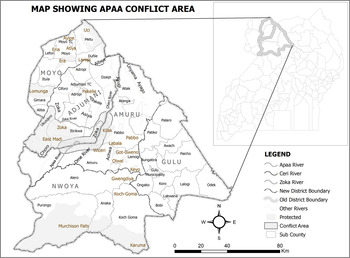
The evictions were the outcome of a long-standing dispute over land ownership and land governing authority. Apaa villageFootnote 3 is the main locality in the disputed area, which comprises about 825 square kilometres, and is found in Pabbo sub-county, Kilak County, Amuru District in northern Uganda. The land in question is at the border between the districts of Amuru and Adjumani (Figure 1). The dispute has come to encompass various actors with conflicting interests: while initially a dispute between the community of Apaa and the UWA, over time, the police, army and the district authorities of Amuru and Adjumani Districts became involved (RLP 2012; Lenhart Reference Lenhart2013). Due to the intervention of various Members of Parliament, the dispute eventually became an issue between two communities, the Acholi and Madi people, and was even seen as an issue between the Acholi and the state.
The Apaa conflict area and other localities mentioned in the case study.

The UWA claims that Apaa is located in the East Madi Game Reserve in Adjumani District, and that the current inhabitants of Apaa are illegally ‘encroaching’ on the game reserve. The UWA has announced that further evictions will be carried out once marking of the district borders between Adjumani and Amuru Districts is complete. On the other hand, the residents of Apaa believe that the land in question is their ancestral land, from which they were displaced over the course of two decades of civil war between the LRA and the NRM government. The local people claim that the UWA leased out the area to a South African investor interested in developing tourism and exporting game meat. Both the District authorities of Amuru and Adjumani maintain that Apaa village falls within their jurisdiction, and that each district is the rightful authority to determine what happens to the land in Apaa. Like the UWA, Adjumani District also claims that the people of Apaa are illegal encroachers that have to vacate the village and the land as those are located in a reserve gazetted for wild animals. Amuru District acknowledges the claims of the local residents to the land on the basis that Apaa is part of the former Kilak Controlled Hunting Area, which was de-gazetted by President Idi Amin in 1972.
How to understand those different claims? One might argue that the problem is basically one of irreconcilable claims on the same, scarce resource, that lead to competition and conflict; or the failure of institutions to properly deal with those unavoidable conflicts (see Turner Reference Turner2004: 864–5). Such an explanation, building around the notion of ‘scarcity’, certainly plays a role in local people's explanations of the conflict. For instance, people interviewed pointed out that land is so central to people's lives that they are willing to die for it: land is both their life and their identity. They would argue that land is a source of livelihood, from land people get food, and an income to pay school fees for their children and medical bills. At the same time, they point out how land defines them, and embodies their ancestry. The Acholi, who inhabit the village claim that their forefathers were born on that land, occupied and started cultivating it. They cannot relocate because past generations were buried on the land. This affiliation between land and ancestry concerns not only the direct family, but also the clans and even the tribe to which people feel they belong. To those interviewees, land disputes were inevitable in northern Uganda, considering that the amount of land was incompatible with the number of claimants.
On the other hand, one could explain the claims of local people in terms of opportunistic competition for scarce resources. In this connection, UWA representatives sometimes pointed out that those residing in Apaa village had prospectively come from other localities after the LRA/NRM war ended because the land was lying idle. Likewise, local people underscore the financial benefits that the UWA and other parties may accrue from the land. For instance, a prominent politician from Adjumani District, who held ministerial posts in the past regimes, was said to have played a key role in driving the evictions in Apaa. In the past, this politician had never made claims that the land in Apaa belonged to Adjumani District. His recent interest in the case is locally attributed to personal benefit he may gain from the 4 billion Uganda shillings deal between the district, the UWA and a South African investor, who will turn Apaa into a tourist destination with safari lodges. Under his chairmanship, discussions in cabinet resulted in a resolution that it was illegal for people to encroach on East Madi Game Reserve, and that the encroachment by the people from Apaa had to be stopped immediately. This resolution was reached prior to a visit to Apaa by the parliamentary commission to establish the facts on the ground. The UWA and other security agencies were then called in to stop the encroachment and protect the game reserve.
However, such stories of scarcity, competition and self-interest are only part of the explanation, and need to be complemented by a more historical and political analysis of the dispute.
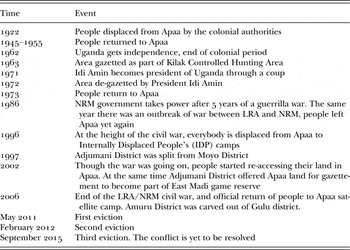
Contestation of local people's claims to the ownership of the land in question has a long history (see Table I). A key historical event occurred in 1922, when for administrative reasons the British forcefully relocated some of the residents of the contested area to Pabbo and Gulu town. The formal justification for the relocation was an epidemic of smallpox and sleeping sickness transmitted by tsetse flies, which had their breeding grounds in Zoka forest.Footnote 4 Between 1945 and 1955 people slowly returned to Apaa, yet did not cross the Ceri River, because of the sleeping sickness quarantine. In 1963 the area was gazetted and it became part of the Kilak Controlled Hunting Area, which occupied an area of ~1,800 square kilometres.Footnote 5 In 1972, Kilak Controlled Hunting Area was de-gazetted by President Amin.Footnote 6 After the revocation, in 1973, descendants of the original residents returned to the land they claimed to be occupied by their ancestors.
A history of population movements and evolution of Apaa conflict

However, their return was short-lived, because in 1986 the LRA/NRM war broke out and the Lord's Resistance Army (LRA) used the forests of Apaa as their training grounds. The government of Uganda then asked the people of Apaa to relocate to Gulu railway-station camp. Though initially not all people relocated, intensification of the civil war in 1996 forced all residents to move to the main Internally Displaced People's (IDP) camp in Pabbo. In May 2002, the area was still insecure, nonetheless, people started to re-occupy and cultivate the land. Instead of residing in Apaa itself, they moved to a satellite camp called Acu, near Apaa, so that they could access their land from a distance. It was not until 2006 and after the Juba peace talks between the LRA and the NRM government that relative peace prevailed, and people finally settled again in Apaa. They were led by the Chief of the Pabbo clan, the Local Council 3 chairman of Pabbo, and an army general currently serving in the Uganda Peoples Defence Forces (UPDF) who is locally described as ‘a son of Pabbo’.
From history, we see that people have always been moving out of and into the area, either because of colonial policies, infectious diseases, government policies for wildlife conservation, or war-related insecurity. Unfortunately, these movements have contributed to ambiguity about who are the rightful owners of the land and the authorities in charge.
The creation of new districts: putting into question the jurisdiction over Apaa land
Confusion about the status of the land and its ownership resulting from the consecutive gazettement and de-gazettement of the game reserve is further compounded by the creation of new districts with unclear boundaries. Apaa finds itself at the boundary between Amuru and Adjumani Districts, which again were split-offs of the districts of Gulu in 2006 and Moyo in 1997 respectively (RLP 2012). However, the boundaries of those new districts were never clearly demarcated, turning the dispute about the gazetted or de-gazetted nature of the land into a conflict over powers of jurisdiction.
To local residents, the division is clear: local people from both Apaa and across the Zoka River (Adjumani) point out that the boundary between Adjumani and Amuru Districts is the Zoka River. In previous elections, residents of Apaa voted for political candidates from Amuru District. During fieldwork, the main researcher observed Amuru District cars traversing the area, and Amuru health workers providing services such as immunisation of children. Likewise, people in Apaa possessed identity cards from Gulu District, from which Amuru District was carved out in 2006.
However, both districts claim authority over the area. To support their claims, they make reference to its status of a gazetted or de-gazetted game reserve. Amuru District claims that Apaa is part of the former Kilak Controlled Hunting Area, which was located within the boundaries of the former Gulu district. Kilak Controlled Hunting Area was de-gazetted on 30 March 1972 under statutory instrument of 1972 no. 55. This converted the area into a place for human settlement. Some residents of Apaa even attained leasehold titles, issued by the Gulu district Land Board. The authorities of Adjumani District, on the other hand, claim that Apaa belongs to Adjumani District. At the beginning of the new millennium, Adjumani District offered the land for gazettement and it became part of East Madi game reserve, and this gazettement was approved by Parliament on 27 March 2002.
As a result of those actions by the two districts, the area now appears to have a dual legal status, being legally recognised as a de-gazetted area, and at the same time as a gazetted game reserve. Either legal status has significant consequences for the extent to which the residents of Apaa are allowed to use the land.
An important role in the ambiguity about which district is in charge, and thus about the status of the land, is played by the Uganda Wildlife Authority. The UWA was created in 1996 and is charged with a mandate to conserve resources within national parks and other wildlife areas, so that people may accrue benefits from wildlife. In 1998, during the LRA/NRM war, the UWA requested the district council of Gulu District to gazette Apaa and LakangFootnote 7 to become a game reserve. According to the UWA, Apaa provides a strategic wildlife corridor between the East Madi game reserve and Murchison Falls National Park, and the UWA wanted to stop ‘encroachers’ (poachers) from killing the animals travelling between these areas. The UWA suggested also that the area had good potential for tourism, if the insecurity resulting from the LRA/NRM-conflict could be resolved. At that time, the UWA recognised that the area was vacant, because most of the land holdings had been abandoned as a result of the LRA/NRM-insurgency. However, Gulu District council did not accept the proposal. The episode suggests that, at that time, UWA acknowledged that the Apaa area was part of Greater Gulu District –and of what later became Amuru District; and not of Moyo District – and of what later became Adjumani District.
Currently, however, the UWA considers the area to be located in Adjumani District. There appears to be a good understanding between the UWA and Adjumani District, and the latter promotes the establishment of the reserve. Repeatedly, UWA has underscored how the land was proposed for gazettement by Adjumani District at the beginning of the millennium. Adjumani District may well be interested in supporting the UWA's perspective on the district boundaries and the establishment of the game reserve for financial reasons as well. Twenty per cent of the total revenue generated from the reserve will go to the district in which Apaa is located, in the form of infrastructure development, such as schools, health centres and roads. The sub-county under which Apaa falls will also get a certain percentage of the revenues. This may entice Adjumani District to claim that Apaa is under their jurisdiction. Moreover, decentralisation seems to further articulate ethnic boundaries and identities between the Acholi and the Madi. Decentralisation means that both communities now each have their own administrators to provide them with development services and resolve their disputes and their own Land Boards to govern land. It is important to note that because of limited funds it has taken a long time for these new districts to establish these District Land Boards that should govern land.
After the violent evictions in February 2012, a resolution was reached by central government to establish and demarcate boundaries between the two districts. On 20 August 2012, surveyors from the Ministry of Lands came to Apaa to demarcate the border between Amuru and Adjumani Districts. On that very same day, people of Apaa had come together to receive the surveyors, Residential District Commissioner (RDC) and district officials to discuss solutions to the Apaa land conflict. When the people in the meeting heard that the surveyors were already putting marker stones demarcating the boundary in such a way that Apaa was included in Adjumani District, they went to the scene, got rowdy and confiscated the tools of the surveyors. The police started firing bullets and tear gas to disperse the crowd and the surveyors returned to Kampala.
Over the same period, community members and some politicians from Amuru District filed the case before the High Court, asking the Court to decide whether Apaa belongs to Amuru or Adjumani District. A court injunction was secured, which halted further evictions, destruction and interfering with land rights in Apaa. At the time of writing, the case was still awaiting an outcome. If the Court grants the authority over Apaa to Amuru District there will be no further evictions of people from Apaa. However, if Adjumani District is granted authority over Apaa then evictions will continue, considering that Adjumani District has already decided the land is to become a game reserve.
Later efforts at surveying the land in May 2015 drew widespread media attention in Uganda and even abroad,Footnote 8 when a group of elderly women stripped naked in front of two government ministers that accompanied the surveyors. The ministers called off the exercise and the land was not surveyed. Four months later, on 7 September 2015, the Member of Parliament representing the people of Apaa was arrested and detained for four days on allegations of inciting violence and organising the people of Apaa to reject planting of mark stones which effectively located Apaa in Adjumani District. At that time, the police and army were deployed in large numbers in Apaa and on 9 September a third eviction was carried out. This left two more people dead, five badly injured with limbs amputated and 30 people from Apaa were arrested. Finally a few mark stones were planted in the area where Adjumani District wanted the boundary to be located. Soon after, on 14 September, a United Nations team and Members of Parliament from other regions of Uganda came to the area for a fact finding mission about the conflict but were denied access to Apaa by the police and army, under orders of the Adjumani RDC. The team then returned to Kampala after a heated conversation with the police and soldiers.
Land, ethnicity and identity
To complicate matters even further, underneath this controversy about territorial demarcations simmer disputes about ethnic identities. Amuru District is mainly inhabited by the Acholi people, while Adjumani District is mainly inhabited by the Madi. Before the colonial period there was rivalry between the two tribes of Acholi and Madi. The Acholi and Madi used to fight in order to expand their territories into the lands of the other group, and Apaa was one of the areas that were contested. On several occasions, the Acholi defeated the Madi and chased them up to a river called Lalopi.Footnote 9 However, the story goes that, tired of these constant wars, and after the death of some Madi Chiefs, elders from both sides decided ‘to bend a spear’: to show reconciliation and put an end to tribal wars. They came to the agreement that the Zoka River would become the boundary between the two groups. Zoka means ‘stop me’: the river had to stop the Acholi from crossing to the Madi side and vice-versa. Both communities could still cross the river on good terms, for instance for hunting, and the improved relationships resulted in intermarriages in Apaa between the Madi and Acholi.
The Apaa land conflict and the contestation over the precise location of the district boundaries reawakened tensions between the two ethnic groups. In Uganda, political constituencies are often mobilised on the basis of ethnic identity. Politicians strategically play on ethnic sentiments or antagonisms to acquire political relevancy and votes during elections. In the case of Apaa, to politicians, representing the dispute in ethnic terms turned out to be an easy way to garner support from one's own ethnic group. Political representatives from both sides strategically played on the memory of past competition and hostility. After the evictions, political leaders from both the Madi and Acholi tribes incited their fellow community members to take up bows and arrows to fight for their land. Acholi leaders pointed out that the game rangers who evicted people from Apaa came from the direction of Adjumani District, and to the local people of Apaa, the ‘people’ responsible for their eviction were Madi. Authorities from Adjumani have complained that the Acholi deny the Madi access to the land in Apaa, stay illegally in Apaa, and should go back to their ‘original homes’. Some claim that, even if the Acholi occupy land in Apaa, it still belongs to Adjumani District.Footnote 10 This introduction of an ethnic dimension in the Apaa conflict was evident for instance in August 2012, when Adjumani District erected signposts in Apaa, welcoming travellers to Adjumani District. This act angered the Acholi residents, who uprooted the signposts, pointing out that Apaa belongs to the Acholi tribe of Amuru District, and not to the Madi tribe of Adjumani District.
THE ROLE OF THE LRA/NRM WAR IN THE CONFLICT ABOUT THE LAND IN APAA
In the preceding sections we explored the historical and political background of the Apaa evictions. As mentioned before, Apaa is located in an area which was heavily affected by the 20 years of civil war between the LRA and the NRM government in northern Uganda. To understand the Apaa evictions properly, an assessment of the impacts of this violent context is necessary.
Displacement opened up space for land grabbing
War creates ‘free’ land, which facilitates land grabbing. During and immediately after war, land appears to be vacant, free or ungoverned due to displacement that took place. This attracts both outsiders and local people to appropriate land. In particular communal land – land which is collectively owned by the community, for example hunting grounds and grazing lands – is vulnerable to such land grabbing (Wiley Reference Wiley2006).
In 1996 at the height of the LRA/NRM insurgency, the NRM government forcefully relocated people to IDP camps in northern Uganda. People were taken from Apaa to Pabbo and Amuru camp, while others were moved to Adjumani District. There is a strong belief among local people that if they had not been displaced to the camps, they would not have been evicted from their land by the UWA. As a result of this displacement their land became apparently vacant. The fact that it was not used contributed to the flourishing of wildlife. Interviewees pointed out that this was the reason why the UWA asked Adjumani District for the gazettement of the land as a game reserve in 2002. When the insurgency ended and people could safely return from the camps, they found that their land had been allocated to a game reserve.
Having been absent, people were not in a position to contest the changes in land ownership, or provide evidence for their previous claims. Officials from Adjumani District claim that the Acholi in Apaa illegally occupied the land after the war and that they should go back to their original lands.Footnote 11 Likewise, the UWA asserts that the people of Apaa cannot prove ownership of the land, and only settled in Apaa after the end of the LRA/NRM war. The UWA claims that the community is in fact composed of a mixture of tribes, coming from different areas, which settled in the area after the war, but should eventually return to their home areas.Footnote 12 However, during interviews and observation by the main researcher, representatives of the Apaa community consistently pointed out that Apaa was occupied by the Acholi tribe, even if a few Acholi men had married Madi wives. Against the argument that the Acholi occupied Apaa illegally, even documents proving land ownership were of no avail: some interviewees possessed valid leasehold titles dating back to the 1970s, but they were nonetheless evicted from their land during the Apaa evictions.Footnote 13
Moreover, the people of Apaa interviewed noticed how the war brought in new stakeholders with an interest in land, and even facilitated the acquisition of land by people from outside. Over the course of the civil war (1986–2006), as part of counter insurgency operations, soldiers from different regions got to know about the potential and expansion of lands in northern Uganda. In particular, people from the south and the wealthy are believed to have acquired land in this way. Indeed during fieldwork, the main researcher visited lands in Apaa that belonged to army generals. The Acholi were convinced that this thirst for Acholi land by external people would not have been there if the war had not occurred and introduced these people to their area.Footnote 14 Moreover, the war also opened up the area. In 1999, the government created numerous security roads in northern Uganda, to patrol and drive LRA rebels out of the region. A security road was constructed through Apaa village as well. Local people believed that this road not only served security interests, but was mainly constructed for the sake of Lake Albert Safaris Company limited,Footnote 15 which wanted to exploit the area as a tourist site and game reserve.Footnote 16
Another important dynamic in post-conflict settings is that land becomes virtually the only source of livelihood, fuelling the potential for land disputes. Interviewees pointed out how during the civil war in northern Uganda, Karamajong cattle rustlers, the UPDF and the LRA rebels took away all their cattle.Footnote 17 When living in the IDP camps people could not access their land and lived on hand-outs. After the war, they felt that the only resource they were left with was land. As elders in a group discussion emphasised: ‘We lost our animals during the war and now we hear that the government took the land too.’Footnote 18 As a result of the war and its impact on local livelihoods, the emotional value of the land had increased as well.
Ambiguity of land governing authority and political competition
Another important consequence of the LRA/NRM war is that land governance institutions are in disarray. This has resulted in ambiguity among government institutions about who is in charge of land governance, and the rules that should apply. On 15 February 2012 the High Court in Gulu issued an injunction and ordered UWA to stop evicting the people of Apaa. However, UWA continued to terrorise the residents of Apaa, by demolishing their huts and confiscating their hoes when they went to their gardens, while soldiers and policemen moved around the village carrying guns. The UWA claimed the court order was void, considering that Apaa is part of Adjumani District, and that the High Court of Gulu district has no jurisdiction there. The example shows contestation between different government institutions, the judiciary and the UWA, about who is in charge of the governance of natural resources. Likewise, the government surveyors went ahead with planting mark stones to demarcate the presumed boundary of Apaa, even before another branch of government –the judiciary– had given its verdict.
This institutional confusion and ambiguity provides important opportunities for politicians to get involved in post-conflict land governance. Through taking positions and putting their weight behind either of the two sides in the conflict they may increase their popularity, and so assure support in the next elections. One politician in Adjumani promised during the elections that he was going to get land for local residents. Residents of Apaa claim that this politician has meddled in the Apaa evictions, precisely to show that he is fulfilling his election promise. Further still, politicians can use their offices (power) to antagonise society by choosing to take sides in land disputes yet they hold public offices that are supposed to serve all citizens. For example, a politician on his way to his constituency would casually park his car and chat with the UWA game rangers in Apaa. Local people would interpret this action to mean that this politician was responsible for their eviction from the land. On the other hand, during a September 2012 community meeting that was called by the Chief of Pabbo to find solutions to Apaa evictions, politicians from the government used the opportunity to intimidate politicians from the opposition who had pointed out the role of government in the evictions, portraying them as sabotaging government programmes. Likewise, politicians from the opposition instead tried to capitalise on the argument that those in power have failed to protect people's rights to land.
Some politicians try to use contestation around land to show that they are more powerful than the institutions responsible for land governance. In a post-conflict situation where the land governance institutions are still weak or struggling to regain authority, they can easily be influenced by strong politicians.
The identity factor in a post-conflict setting
The Apaa evictions turned out to be very problematic as they were re-interpreted locally in terms of larger, ongoing contestations between the Acholi and the Uganda state. The dispute was no longer seen only as a local issue between the UWA, the district authorities and the residents of Apaa, but rather as an issue between the state and the Acholi community at large. Even Acholi people from outside Apaa felt affected by what had happened in Apaa, and referred to the case as an illustration of how the rights of their ethnic community were infringed upon (Lenhart Reference Lenhart2013). In the same way, the people of Apaa interpreted the eviction as a ploy by government to chase them off their land and in the long run wipe out the Acholi tribe because the Apaa conflict is not the only land conflict in Acholiland. As women in Apaa lamented, ‘there is no tribe in Uganda that is tortured like the Acholi and especially the Acholi from Amuru District. … In Kololo and Lakang 10,000 hectares of land have been allotted for sugar cane growing, Wicere is a national forest, Apaa is a game reserve and all are in Amuru district. Where are the Acholi supposed to live?’Footnote 19 The fact that elder women resorted to stripping before the ministers and authorities illustrates how high frustrations have risen. The conflict in Apaa turned into a significant event for defining the relation between people of Acholi and the state. Their attitude towards the state may come to depend strongly on how the land dispute will be resolved by government institutions. Therefore, the evictions are closely connected to the larger issue of the re-establishment of the state in northern Uganda.
DISCUSSION AND CONCLUSION
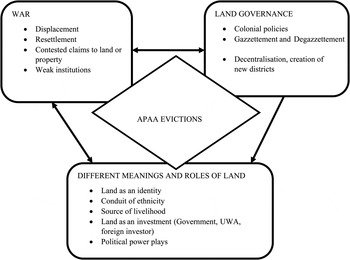
The case of Apaa underscores that to better understand land disputes in post-conflict settings requires one to take into account the impacts of violent conflict on land access and land governance. A political ecology perspective may help explain how post-conflict land disputes are the outcome of contested land governance practices and histories of exclusion and misappropriation. In the case of the Apaa evictions, colonial policies of creating reserves (game and forest reserves) were repeated and reinforced through gazettement and de-gazettement policies after independence, thereby creating uncertainty over land ownership and the laws applicable (Figure 2). The creation of new administrative units (districts) without clearly drawn boundaries resulted in struggles over territory and the jurisdiction of districts. Moreover, in combination with the conflict about Apaa this led to the articulation of tensions about ethnicity and grievances about those in power and the institutions that govern natural resources.
An illustration of the drivers of conflict in the Apaa evictions.

The Apaa conflict has negatively affected the already poor relations between the Acholi and the state. In an attempt by the Ugandan state to demonstrate its control over the Acholi territory, it used heavy violence against the people of Apaa. Local land rights have been negated, in favour of the interests of a foreign investor from South Africa, who is believed to have obtained a lease contract on the contested land of Apaa. In a nutshell: through its institutions (such as the UWA, army), the state uses land governance to regain control over these post-conflict territories. This resonates with Unruh (Reference Unruh2003) who notes that the way the state handles land disputes in post-conflict situations can strongly shape people's perception of (dis)trust in the state.
However, to better understand post-conflict land disputes requires not only to consider how land and its access have resulted in conflict, but also to explore the impacts of violent conflict on land distribution and land governance. The LRA/NRM war significantly reshuffled the rules of access, utilisation and ownership of land. The post-conflict phase brought in various new actors, including diverse new government institutions, the military and foreign investors that appropriated land, claiming that it was vacant. Violent conflict uprooted people from their land and displaced them to IDP camps, and upon their return local land governing institutions had weakened and were not able to deal with the ensuing land disputes and a more powerful presence of the state and army. Land disputes are specifically difficult in post-conflict settings because people may not have trust in land institutions (Unruh Reference Unruh2003; Kobusingye et al. Reference Kobusingye, Van Leeuwen and Van Dijk2016). The case of Apaa strongly brings out that a focus on the impacts of violent conflict on land governance may help to understand why land governance becomes part of wider contestations about power in conflict-affected settings.
In the case of Apaa, politicians used the chaos and confusion brought about by land disputes to promote their own interests, as a result of which land disputes became a playing field in which power relations were fought out by politicians and institutions. As a result, issues such as ethnicity, identity and political power games get a new meaning because of these new actors. This in turn produces tenure insecurity and new land conflicts. In the case of Apaa, while the Acholi and Madi have been coexisting harmoniously for a long time, the land dispute is antagonising these relations again. Therefore, the way in which the Apaa conflict is resolved will have implications for the extent to which peace is restored, or conflict reignites. This all underscores the significant impact that violent conflict may have on land access and its governance, and the importance of taking these dynamics into account when trying to address land conflicts in post-conflict settings.