Introduction
Successful prospective remembering is the ability to correctly recall intentions that have to be performed in the future, which is an important cognitive function in everyday life. Prospective memory (ProM) is a type of executive function that is dependent upon two components, a retrospective component in which there is recall of the intention content, and a prospective component that involves real-time retrieval of the intention content.
The investigation of ProM in individuals with Parkinson's disease (PD) in recent years has received increased attention since frontal executive dysfunction has been commonly reported in PD (Dubois & Pillon, Reference Dubois and Pillon1997). A model of fronto-striatal cognitive degeneration in PD proposed by Owen and colleagues (Owen, Doyon, Dagher, Sadikot, & Evans, Reference Owen, Doyon, Dagher, Sadikot and Evans1998; see for a review, Owen, Reference Owen2004) suggested that higher-level executive functions may be more susceptible than basic mnemonic functions, which are assumed to depend on more ventral frontal regions (Owen, Reference Owen2000; Petrides, Reference Petrides1994). Several studies in literature investigated ProM in PD using event-based (the action is cued by an event) or time-based paradigms (the action is cued by the time). Many of the investigations found impairments in the prospective component of event-based paradigms, with a preserved ability to remember the specific action to be performed (Katai, Maruyama, Hashimoto, & Ikeda, Reference Katai, Maruyama, Hashimoto and Ikeda2003; Kliegel, Phillips, Lemke, & Kopp, Reference Kliegel, Phillips, Lemke and Kopp2005). Specifically, studies found that deficits were related to PD disease severity (Whittington, Podd, & Stewart-Williams, Reference Whittington, Podd and Stewart-Williams2006), task difficulty (Altgassen, Zöllig, Kopp, Mackinlay, & Kliegel, Reference Altgassen, Zöllig, Kopp, Mackinlay and Kliegel2007), and absence of test cuing (Foster, McDaniel, Repovs, & Hershey, Reference Foster, McDaniel, Repovs and Hershey2009). However, there was significant variability between study outcomes that has been attributed to methodological differences including small sample sizes and ProM task construction (Raskin et al., Reference Raskin, Woods, Poquette, McTaggart, Sethna, Williams and Tröster2011). Collectively, these results provide limited conclusions that blur, rather than refine their implications on the impact of PD. The majority of studies enrolled PD subjects with a mean duration of disease illness between 5 and 9 years who were treated with antiparkinsonian drugs. The use of dopaminergic therapeutic agents further confounded study findings given their complex effects on cognitive performance (Cools, Reference Cools2006; Costa, Peppe, Brusa, et al., Reference Costa, Peppe, Brusa, Caltagirone, Gatto and Carlesimo2008).
The present study aimed to investigate, for the first time, ProM in individuals with new onset PD who were untreated (drug naive). Our objective was to better understand prospective remembering functioning in newly diagnosed PD patients. In this way, it will be possible to evaluate, with planned follow-up, the effects of dopaminergic therapy on ProM. Moreover, through these longitudinal studies, we will be able to know the role that ProM may play as prognostic index of cognitive change in PD and/or as potential marker of treatment effects.
Methods
Subjects
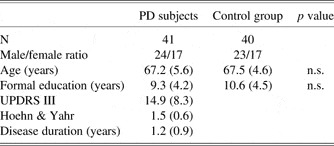
Forty-one Caucasian individuals with idiopathic new onset PD who were drug-naive, and 40 healthy subjects, matched for age and education, took part in this study after providing written, informed consent. All data included in this manuscript was obtained in compliance with the Helsinki Declaration. Parkinson's disease was diagnosed by an expert neurologist on the basis of diagnostic criteria for idiopathic PD (Gelb, Oliver, & Gilman, Reference Gelb, Oliver and Gilman1999). Exclusion criteria for the PD cohort included (a) current mood and anxiety disorder, as assessed by Hamilton anxiety rating scale (Hamilton, Reference Hamilton1959; score ≥ 18) and Hamilton Depression rating Scale (Hamilton, Reference Hamilton1960; score ≥ 18); (b) suspected dementia or global cognitive impairment according to diagnostic criteria for PDD (Goetz, Emre, & Dubois, Reference Goetz, Emre and Dubois2008); (c) history or current evidence of other neurological illnesses; and (d) marked cortical and subcortical atrophy and/or ischemic vascular lesions based on CT or MRI scans. Exclusion criteria for the control group included (a) suspected dementia on the basis of Mini-Mental State Examination (MMSE; Folstein, Folstein, & McHugh, Reference Folstein, Folstein and McHugh1975) score of 24 or less; (b) history of psychiatric or neurological illnesses; and (c) use of medications with central nervous system side effects. The clinical and demographic characteristics of the samples are presented in Table 1.
Clinical and demographic characteristics for the Parkinson's disease (PD) and control groups
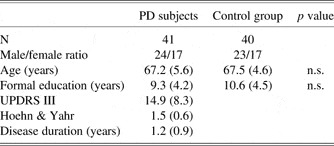
Note. Means and standard deviations in round brackets.
PD = Parkinson's disease; n.s. = not significant; UPDRS = Unified Parkinson's Disease Rating Scale.
Neuropsychological Evaluation
We assembled a comprehensive battery of neuropsychological tasks to assess several cognitive domains relevant to PD populations, and included only tests with available normative data for persons in Italy. Global cognitive status was assessed using the MMSE (Folstein et al., Reference Folstein, Folstein and McHugh1975; Magni et al., Reference Magni, Binetti, Padovani, Cappa, Bianchetti and Trabucchi1996). Short-term attention and memory was evaluated with the digit span (forward condition) (Orsini et al., Reference Orsini, Grossi, Capitani, Laiacona, Papagno and Vallar1987) and Corsi tests (forward condition) (Orsini et al., Reference Orsini, Grossi, Capitani, Laiacona, Papagno and Vallar1987). Retrospective memory was assessed using the Rey Auditory Verbal Learning Task (RAVLT; Carlesimo et al., Reference Carlesimo, Caltagirone and Gainotti1996) and the Rey-Osterrieth Complex Figure Test (ROCF; Carlesimo et al., Reference Carlesimo, Buccione, Fadda, Graceffa, Mauri, Lo Russo and Caltagirone2002), immediate (1 min after copy) and delayed recall (20 min after the copy). Visuo-spatial abilities and nonverbal intelligence were measured with the Raven Coloured Progressive Matrices (CPM-47; Carlesimo et al., Reference Carlesimo, Caltagirone and Gainotti1996). Executive functions were assessed using the Frontal Assessment Battery (FAB; Apollonio et al., Reference Apollonio, Leone, Isella, Piamarta, Consoli, Villa and Nichelli2004), phonemic verbal fluency (Carlesimo et al., Reference Carlesimo, Caltagirone and Gainotti1996), the Trail Making Test (TMT; Giovagnoli et al., Reference Giovagnoli, Del Pesce, Mascheroni, Simoncelli, Laiacona and Capitani1996), and the Stroop Interference Test (Caffarra, Vezzadini, Dieci, Zonato, & Venneri, Reference Caffarra, Vezzadini, Dieci, Zonato and Venneri2002). Constructional praxis was measured with the ROCF copy condition.
Event-Based Prospective Memory Task
We assessed event-based prospective memory using a modified version of the experimental procedure adopted by Katai and colleagues (2003). Initially the subject was instructed to tap the desk whenever the words “nose” and “frog” appeared during a subsequent task. The importance of prospective remembering was stressed during instruction. To prevent overt rehearsal of intention, each subject completed the Number Processing and Calculation Battery Analogical Number Scale task (Delazer, Girelli, Granà, & Domahs, Reference Delazer, Girelli, Granà and Domahs2003). In this task, subjects chose from three alternatives the position corresponding to a given Arabic numeral on an analogical number scale. Then, subjects were given a word-categorization task in which the prospective memory target event was embedded. Participants were presented with 21 single words and they had to choose the right category from three different alternatives. A card reporting the association between a category and a number was visible to the subjects and, for each word presented, they were instructed to verbally report the number of the selected category. For instance, the category called “animals” corresponded to number 1, “body parts” to number 2 and “fruits” to number 3. Two subsequent trials, in which the same 21 words were randomized, were presented to the subjects, for a total of 42 answers. Target events for prospective memory task occurred at the 9th and 14th position in the first trial, and at 1st and 15th position in the second trial. Participants were given one point for each correct prospective memory response (range, 0–4). We considered as correct any answer given in the period before the response to subsequent word.
After completion of the entire task, participants were asked to recall their intended action. The instructions were divided into two parts: tap the desk whenever “nose” appears and tap the desk whenever “frog” appears. A score of one point was assigned (range, 0–2) for each correct recalled part. Because of its easiness, the word categorization task was performed at ceiling. Subjects who performed the right action when the target words appeared but forgot to answer the word categorization, were encouraged by the experimenter to complete their response.
Statistical Analysis
We used analysis of variance (ANOVA) to compare and contrast the PD and healthy cohorts in terms of neurocogntive performance on the full neuropsychological battery. To evaluate performance on the event-based prospective memory task between the PD and healthy cohorts, we used Mann-Whitney U tests. In the PD cohort, Spearman rank-order correlations were used to examine the relationship between prospective memory performance and scores obtained on the neuropsychological battery. Statistical significance was set at a p value of <.05.
Results
Neuropsychological Evaluation
The PD group showed significantly poorer performance than the healthy cohort on the RAVLT immediate (F(1,79) = 13.64; p < .001; η2 = .15) and delayed recall (F(1,79) = 21.66; p < .001; η2 = .22), ROCF copy (F(1,79) = 8.25; p = .006; η2 = .12) and delayed recall (F(1,79) = 5.14; p = .02; η2 = .09), the FAB (F(1,79) = 6.39; p = .01; η2 = .12) and the TMT Part A (F(1,79) = 5.18; p < .02; η2 = .09).
Event-Based Prospective Memory Task
The PD subjects showed poorer performance on the prospective component (M = 1.95; SD = 1.80; Md = 2) relative to the control group (M = 2.80; SD = 1.49; Md = 3); however, this difference was not statistically significant (U = 609; z = −1.93; p = .053; r = .02). On the contrary, both groups showed comparable performances on the retrospective component (M = 1.67; SD = 0.52; Md = 2 and M = 1.77; SD = 0.42; Md = 2, respectively). The maximum score on ProM component (score = 4) was reported by 45% of control group and 35% of PD group; the minimum score (score = 0) was reported by 17.5% of healthy controls and 40% of PD cohort. Typical errors consisted in omission responses; two PD subjects reported false alarm errors, confounding target words.
Prospective Memory and Neuropsychological Performance of the PD Cohort
The PD cohort based on those with impaired (ProM score = 0) or nonimpaired (ProM score >1) ProM performance. Of the PD cohort with impaired performance on the ProM (N = 16), 56% showed deficits in two or more neurocognitive domains, 22% in one domain, and 22% had normal cognitive function. In those PD subjects without impairment on the ProM (N = 25) only 29% presented with impaired performance in one or two cognitive domains.
Regarding associations between ProM and neuropsychological test variables, significant correlations were found with the MMSE, CPM-47, ROCF copy, and TMT Parts A and B. To determine the uniqueness of these associations with ProM, we conducted a follow-up linear regression. The overall regression model was significant (adjusted R 2 = 0.43; p < .05), but only the MMSE emerged as unique predictor of ProM (p = .01). With regard to ProM retrospective component, significant correlations were found with the MMSE, RAVLT immediate and delayed recall, CPM-47, ROCF copy, immediate, and delayed recall, and TMT Part A.
Discussion
This is one of the first studies to investigate event-based prospective memory (ProM) performance in individuals with untreated, newly diagnosed PD. Our findings suggested that the PD group performed worse than the controls on the prospective component of the ProM task and that impaired performance was related to impairment in other domains of cognitive function including attention, memory, and cognitive flexibility. Importantly, global cognitive function was a predictor of ProM impairment, that is patients with lower global cognitive functions show great impairment on ProM. As there was no difference between the PD and healthy cohorts on the retrospective memory score, the poorer performance in event-based prospective remembering is most likely attributed to the failure in self-initiated retrieval of intention, rather than forgetting of content of action.
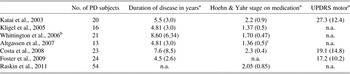
Regarding previous investigations of event-based prospective memory in PD, our PD cohort had a shorter mean duration of disease (1.2 years vs. 5.97 years) (Table 2).
Clinical characteristics of Parkinson's disease groups studied in previous works on prospective memory
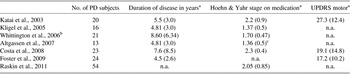
aMeans and standard deviations in round brackets.
bWe have reported the clinical characteristics of the sample classified by the authors as early stage.
cData regarding 11 of 13 patients. All these patients were receiving antiparkinsonian drugs.
PD = Parkinson's disease; UPDRS = Unified Parkinson's Disease Rating Scale; n.a., not available.
While most of these findings are consistent with previous studies, there were some differences that may be due to the use of our experimental paradigms. The paradigm that we used, a modified version of the one by Katai et al. (Reference Katai, Maruyama, Hashimoto and Ikeda2003), demanded high costs in term of cognitive resource as evidenced by performance of the control group that never reached ceiling. Based on results of studies mentioned above, the focus was laid to prospective memory task (Altgassen et al., Reference Altgassen, Zöllig, Kopp, Mackinlay and Kliegel2007) and the ongoing activity encouraged processing of ProM cue (i.e., focal cue condition Foster et al., Reference Foster, McDaniel, Repovs and Hershey2009) to favor prospective remembering.
As regards the retrospective component, our results replicate previous studies (Foster et al., Reference Foster, McDaniel, Repovs and Hershey2009; Katai et al., Reference Katai, Maruyama, Hashimoto and Ikeda2003; Kliegel et al., Reference Kliegel, Phillips, Lemke and Kopp2005) with the exception of Costa's, Peppe, Caltagirone, and Carlesimo (Reference Costa, Peppe, Caltagirone and Carlesimo2008). A possible explanation is that the retrospective component of our task could have been excessively easy, thus inducing an overestimation of PD subjects performance in this domain.
As pointed out by Einstein and McDaniel (Reference Einstein and McDaniel1996) the retrospective component of the task is similar to the ability measured by retrospective memory tests. This statement is confirmed by the positive correlation that we found between these two measures.
Correlation between prospective component and global cognitive function (MMSE) and measure of abstract reasoning and nonverbal intelligence (CPM-47) suggested that intellectual level is linked to the ProM performance. In the same way, the positive correlation between prospective component and the copy of the ROCF, a visuo-constructional task involving executive component, may indicate a common strategical background. Measures of short-term memory and working memory, as evaluated by digit span and serial seven of MMSE, did not show any association with ProM performance.
With respect to cognitive evaluation, our findings suggest that in the early stage of the disease, a subtle cognitive impairment may be present, although the performance does not fall into pathological area.
Limitations of this study included the working memory measures used that are excessively simple and are not able to detect an association with ProM task. This study was strengthened by a quite large sample size and the task used that is derived from one previously published and used in a PD study. A further strength of the present study is the fact that we included early drug naive PD patients, thus minimizing confounding effects from therapeutic treatment with dopaminergic agents that are known to impact neurocognitive function.
In summary, our data suggest that even in earliest stages of disease, before starting antiparkisonian drugs, individuals with PD non-demented may present impairment in event-based prospective memory. These results, as well as those of neuropsychological evaluation, suggest the potential role played by the disruption of fronto-striatal circuitry in modulating the cognitive dysfunction in PD already present in pre-clinical stages. The relevance of ProM construct for the potential implication on instrumental activities of daily living and quality of life, encourage the need to evaluate this aspect since the beginning of disease.
Longitudinal studies will be useful to explore the progression of prospective remembering after the introduction of dopaminergic therapy and to clarify the role of ProM as potential marker of treatment effect and/or as risk factor to further develop dementia.
Acknowledgments
No conflict of interest is declared. This research received no specific grant from any funding agency, commercial or not-for-profit sectors. We are indebted to Silvia Roncoli for her helpful comments on the manuscript.