Natural disasters and terrorist attacks appear to be the weakness points of wire and wireless communication network technologies, for example, 2G, 3G, and 4G, through easy disablement. Natural disasters include earthquakes, floods, tornados, and so on. Examples of recent natural disasters and terrorist attacks include the 2004 tsunami in Indonesia, the 2005 earthquake in Pakistan and Wenchuan earthquake in China (2008), Hurricane Katrina in the United States (2005), the bomb blasts in the cinema halls of Delhi (2012), and the Chapala flood in Socotra Island, Yemen (2015). Disaster prediction to help prepare for and mitigate disaster impact has been discussed.Reference Alsamhi, Samar and Rajput 1
During a disaster, wireless communication linkage plays a vital role in assessing a damage area, collecting data on supplies, coordinating rescue team and relief team activities, saving people’s lives, and accounting for missing people. To establish an efficient and effective wireless communication network for delivering a high quality of voice and data in disaster areas, the spectrum width of wireless channels is the most highly recommendedReference Komnakos, Vouyioukas, Maglogiannis and Constantinou 2 and reserved channel technique.Reference Alsamhi and Rajput 3
Telecommunication solutions are not capable of delivering communication services in complicated emergencies that occur over wide areas. The wireless communication technologies and networks could be either missing or unavailable owing to congestion or damage. The key factors for emergency communication network solutions are rapid deployment, immediate availability, and reliability. However, when a disaster occurs in a large area, it takes weeks or months for cellular communication providers to recover their network. Therefore, wireless communication during a disaster is limited in terms of coverage and capacity because the infrastructure is destroyed.Reference Lee, Ku and Ahn 4
When the infrastructure is destroyed, only space communication technologies can mitigate the impact of the disaster. Therefore, space technologies play a vital role in recovering from all types of catastrophes. They are used for collecting data needed to protect humans and reduce economic losses. In the immediate aftermath of a disaster, the satellite is one of the reliable solutions of communication. 5 Furthermore, a very small aperture terminal technology has been proposed for emergency communication in disaster areas.Reference Simmons, Murphy, Blanarovich, Workman, Rosenthal and Carbone 6 However, delay and launching costs are the reasons for the weakness of satellite communication. Therefore, the use of an aerial platform is the best solution, taking into consideration the merits of satellite and terrestrial wireless communication systems. The categories of the aerial platform include high-altitude platforms (HAP), medium-altitude platforms, and low-altitude platforms (LAP). Mohorcic et al.Reference Mohorcic, Grace, Kandus and Tozer 7 discussed the use of aerial platforms for disaster and emergency situations and showed that such communication significantly enhanced the performance of the rescue teams. Therefore, the aerial platforms play an essential and important role in disaster recovery when all of the communication infrastructures are destroyed. The capability of the aerial platform to deliver communication services, such as E911, to facilitate search and rescue operations is discussed.Reference Mohammed, Arnon, Grace, Mondin and Miura 8
The advantages of HAP are the capability and stable coverage area, survivability,Reference Alsamhi and Rajput 9 mitigation of interference that occurs in wireless communication,Reference Alsamhi and Rajput 10 and the ability to manage the traffic.Reference Alsamhi and Rajput 11 HAP offers an important alternative to support emergency communications after a disaster.Reference Deaton 12 Providing and delivering broadband communication from HAP with the cooperation of ad hoc is a novel approach, and some research has been done to show the performance. The discussion of operation and effectiveness of using ad hoc in HAP payload has been presented.Reference Ahmed and Ramon 13 – Reference Alsamhi and Rajput 15 MaseReference Mase 16 presented the communication needs for evacuees in shelters after a disaster incident. It is essential to develop an emergency communication service to maintain the communication channel between people in shelters, outside shelters, and in the other shelters.
Tethered balloon technology belongs to the LAP family. It operates at an altitude of 200-440 m above the ground.Reference Khaleefa, Alsamhi and Rajput 17 , Reference Alsamhi and Rajput 18 The significant advantages of tethered balloon are the cost of deployment and line of sight, low propagation delay, rapid deployment, fixed station, and especially its use in case of disasters.Reference Alsamhi and Rajput 10 The implementation of the tethered balloon for emergency situations is vital for natural and human-induced disasters.Reference Qiantori, Sutiono, Hariyanto, Suwa and Ohta 19 These advantages of tethered balloon make it a more attractive concept for emergency communication through rapid deployment and for users to operate their existing mobile handsets in disaster regions. Therefore, it represents the best solution for disaster recovery, supporting the relief and rescue teams to perform their tasks effectively and efficiently. The payload of the tethered balloon includes global system for mobile communication (GSM), code division multiple access (CDMA), ad hoc, long term evolution (LTE), universal mobile telecommunication system (UMTS), and so on,Reference Qiantori, Sutiono, Hariyanto, Suwa and Ohta 19 - Reference Bilaye, Gawande and Desai 21 as shown in Figure 1 .
Payload of Tethered Balloon

The emergency relief and rescue teams can perform their tasks under the coverage of tethered balloon to access the Internet, video conference services, and Voice over Internet Protocol. Therefore, tethered balloon is proposed to lift a flying balloon incorporating ad hoc equipment. The aim of this work is to suggest a complete communications solution that can be deployed easily and immediately after/before a disaster, as well as more reliably.
The rest of this article is organized as follows: coverage of tethered balloon is described in the second section; the third and fourth sections describe a proposed tethered balloon for emergency communication system and implementation of the proposed technology in OPNET; results and discussions are given in the fifth section; and, finally, the conclusion is discussed in the sixth section.
COVERAGE OF TETHERED BALLOON TECHNOLOGY
A tethered balloon is a balloon that is tethered to the ground by using ropes. The length of the tethered balloon is limited to the maximum balloon altitude. To maintain the stability of the balloon against the wind, rose ropes are used.Reference Hariyanto, Santoso and Widiawan 22 The number of ropes depends on the wind speed forecast and altitude target.
The operation of a tethered balloon is at an altitude of 200-440 m. The coverage provided by a tethered balloon is 5.5 km radius or 72 km2 from an altitude of the balloon of 440 m.Reference Hariyanto, Santoso and Widiawan 22 Coverage can be extended by increasing the altitude of the balloon, as shown in Figure 2 .
Changing the Coverage of the Tethered Balloon According to the Size of the Disaster Impact Area

The tethered balloon lifts a flying platform by incorporating ad hoc equipment to provide efficient communication services. Disaster destroys all of the communication and electric supply infrastructure. For some people, availability of electricity can be a matter of life and death. Electric power is required for lighting at medical aid stations, for ventilation, and for delivering water to people in shelters. During an earthquake, the power is shut down at the first moments. During a tsunami, the water level remains high for several hours and many people are swept away several kilometers into the sea, passing an urgent need for rescue and relief over the sea. Therefore, the emergency communication system must take into consideration that no support can come via ground transport. Therefore, power transmission technologies such as time-varying electromagnetic fields have to be used.Reference Shinohara 23
Wireless transmission power is the electric power that transmits from the power source to the destination machine without discrete man-made conductors.Reference Bush 24 Wireless power transmission is useful in case of hazards. The machine transmitter is connected to the source of power, and then using an electromagnetic field for power transmission across an intervening space to one or more receivers, it is converted back to electric power and used.Reference Shinohara 23
In 2011, KomerathReference Komerath 25 discussed the role of emergency in the overall lighter-than-air architecture of power beaming. Figure 3 illustrates the architecture power beaming transport from the tethered balloon. A power supply at the ground is used to generate the power and then send it up to the balloon through a tethered device. Afterward, power beams from the balloon to rescue and relief teams’ receiver devices over the disaster area.
Delivering Power From the Tethered Balloon

PROPOSED TETHERED BALLOON FOR EMERGENCY COMMUNICATION SYSTEM
The most important idea in this scenario is the use of ad hoc technology. It allows the rescue and relief teams to move independently in the disaster area and perform their tasks efficiently. When we develop technologies without considering their impact on our environments, disasters increase daily. Natural disasters and terrorist acts have the potential to disrupt the infrastructure of wireless communication networks. Emergency communication is an important specialized field that helps save lives. During an earthquake or a tsunami, there is no way for transport via ground. Under such circumstances, the proposed tethered balloon provides and maintains operable and interoperable wireless emergency communication services during and after a disaster occurrence. As a result, the rescue and relief teams are able to perform their tasks very easily and sequentially, as shown in Figure 4 .
Proposed Technology for Rescue and Relief Teams During Emergency

The proposed technology provides a large coverage area. Therefore, the rescue and relief teams move with a very high-strength signal from the tethered balloon, enabling them to coordinate their rescue activities. High priority has been given to them to perform their tasks smoothly.
The tethered balloon enables providing emergency services effectively and efficiently during a disaster in a proper way. While the balloon reaches the desired altitude, the affected area will be captured via a digital video camera. Then, these images will be sent to the ground station for studying the area of operation and the images provide information to coordinate search and rescue teams with the first responder’s arrival.
IMPLEMENTATION OF THE PROPOSED TECHNOLOGY IN OPNET
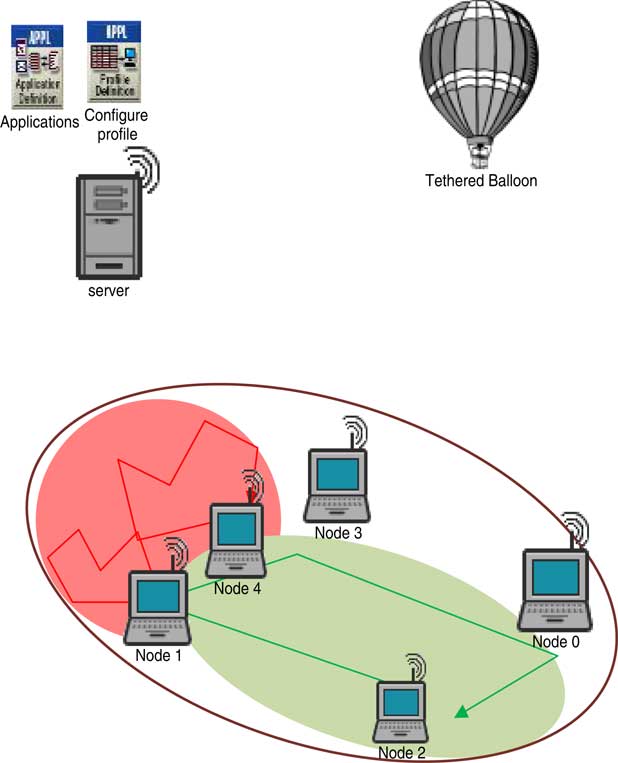
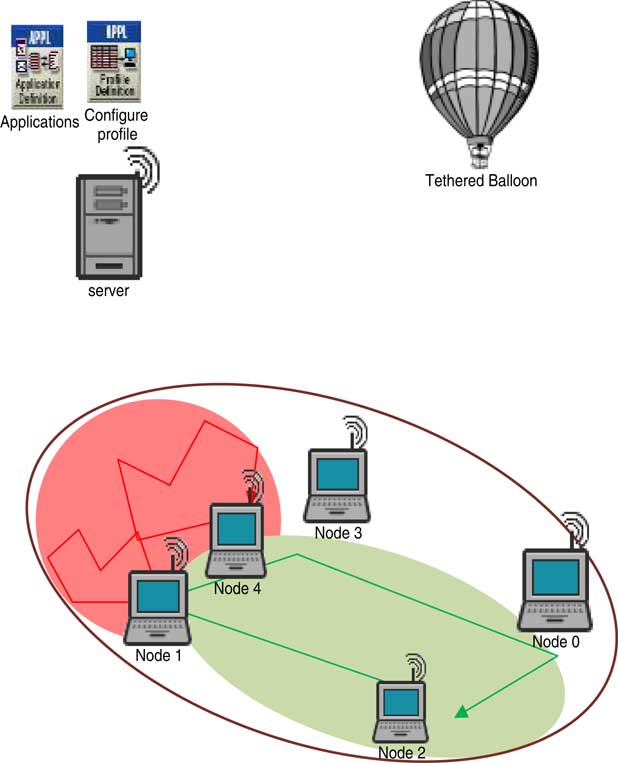
OPNET Modeler can provide different levels of modeling, relying on the requirements and the necessities of the simulation. The operator of this network model can develop several network scenarios to analyze and evaluate the performance of the network. The implementation of the particular proposed emergency network contains a balloon that carries ad hoc base station and 5 nodes, called subscriber stations, which are considered as rescue and relief teams.
The scenario focuses particularly on the performance of the rescue team and provides this team high quality of service (QoS) and the necessary medicine to save people’s lives. The particular scenario consists of 3 teams. The first team works in the disaster area, on the bridge to transfer people from the catastrophic area to the safe area. The second team moves the evacuees from the edge of disaster to the hospital to save their lives. The third team works on monitoring, analyzing the disaster area, and giving order and guiding and directing the rescue team to perform their tasks well. Therefore, the tethered balloon is used to provide the much needed critical communication for relief, rescue, and search, as well as to control and command, as shown in Figure 5 .
Implementation of Rescue and Relief Teams in Emergency Communication Scenario
RESULTS AND DISCUSSIONS
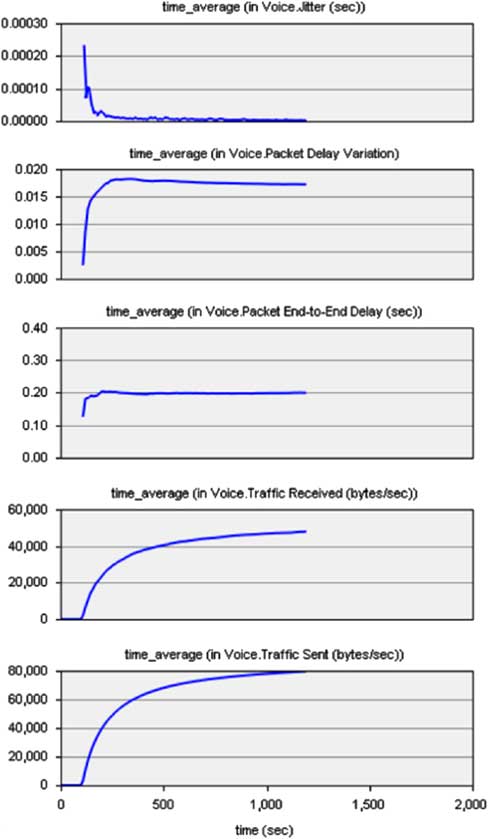
The importance of using a tethered balloon as a space technology for emergency communication services and disaster recovery is discussed in this research. In addition, the most important is the ability of the tethered balloon to carry ad hoc, which is used to support broadband wireless services. Therefore, the communication facilities (calls and Internet) before/during and after the disaster improve significantly. Figure 6 shows the general voice characteristics. Figure 6 shows that jitter decreases as time increases. Negative jitter indicates that the time difference between the packets at the destination node (rescue and relief) is less than the source node. End-to-end delay for a voice packet is measured from the time it is created to the time that it is received. The minimum value of end-to-end delay is 0.1282 to 0.200 seconds.
Voice Network Characteristics

The traffic voice received is 2194.66-47744.4 and the traffic sent is 3444.67-79543.5. The average number of bytes/second is submitted to the transport layers by all voice applications in the particular network. While time increases the packet delay, variation increases until it reaches a maximum value of 0.01722. The average number of bytes/second is forwarded to all voice applications by the transport layers in the network.
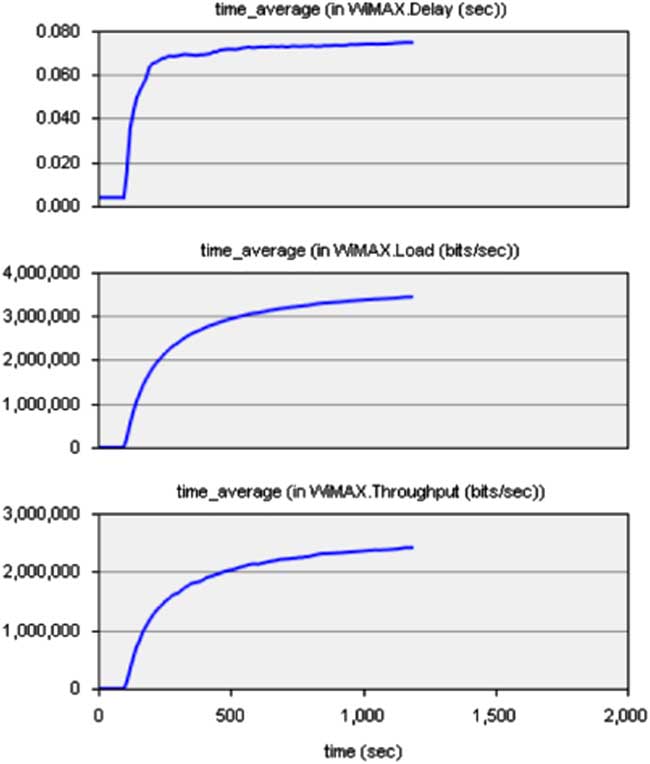
Delay of the of ad hoc in the tethered balloon is 0.003845-0.074777 seconds, as shown in Figure 7 . It represents the end-to-end delay of the packets received by tethered balloon of all ad hoc nodes on the disaster area or on the ground. The load represents the total load (in bits/second) submitted to ad hoc layers in all ad hoc nodes of the network. The load is 34.6667-3442285.893, as shown in Figure 7. Throughput represents the total data traffic (in bits/second) forwarded from ad hoc layers to higher layers in all ad hoc nodes of the network. Throughput is increased from 208 to 2420475.653 bits/second, as shown in Figure 7 .
Network Characteristics

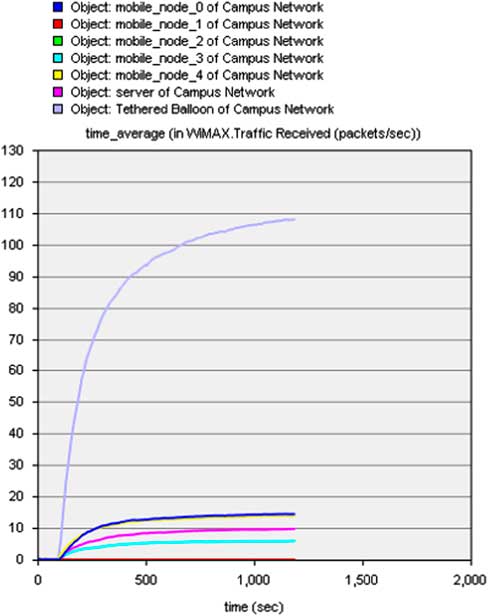
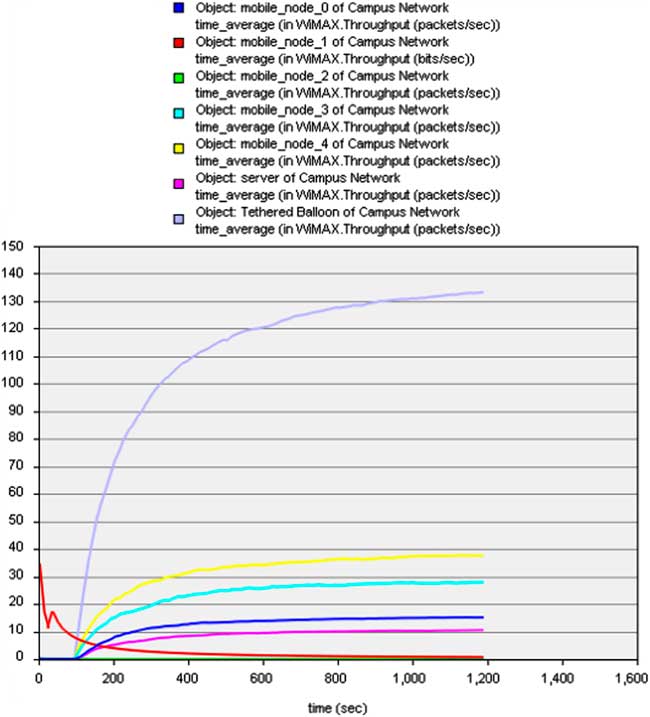
The mobile-based station is represented by node 0 to node 5. Node 1 and node 4 represent the rescue teams. Therefore, the traffic received at node 1 and node 4 is given a higher priority than others, as shown in Figure 8 .
Scenario Traffic Received

Basically, the throughput increases with the increase in packet size through all of the nodes. Therefore, the difference between each number of nodes also increases during the increase of packet size at different times, as shown in Figure 9 . Throughput decreases when the number of wireless nodes increases. Throughput is the total data traffic in bits/second that is successfully received, and then it is forwarded to the ad hoc MAC in the tethered balloon.
Scenario Throughput

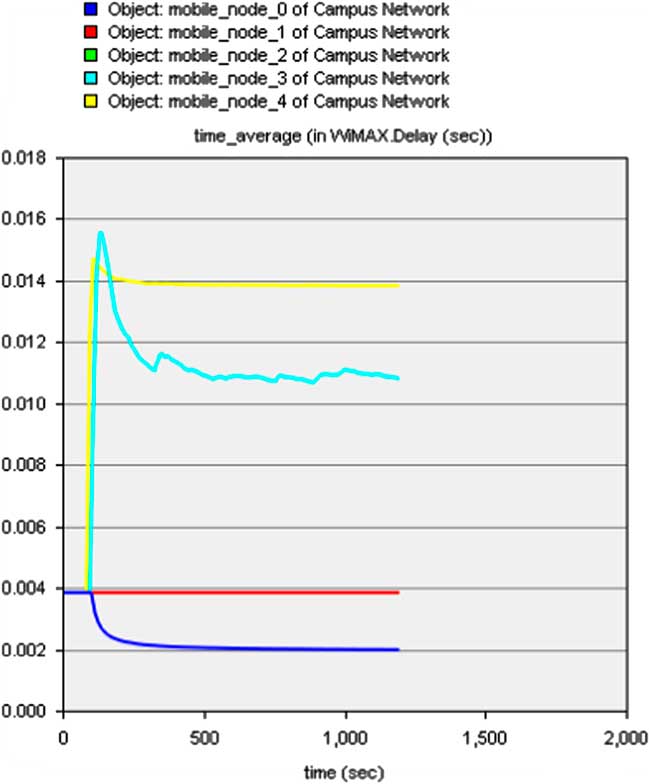
The delay will be affected by an increase in the number of wireless nodes and decreases with the increase of packet size through all of the different number of nodes. The delay was constant at 0.003845 seconds, with time varying from 0 to 84 seconds, as shown in Figure 10 . For node 3, a delay of setup increases between 84 and 156 seconds, and then it decreases between 0.013754 and 0.010809, when time changes between 168 and 1188 seconds. The server decreases from 108 to 1188 when the delay decreases from 0.004504 to 0.002006.
Different Delay for Different Nodes

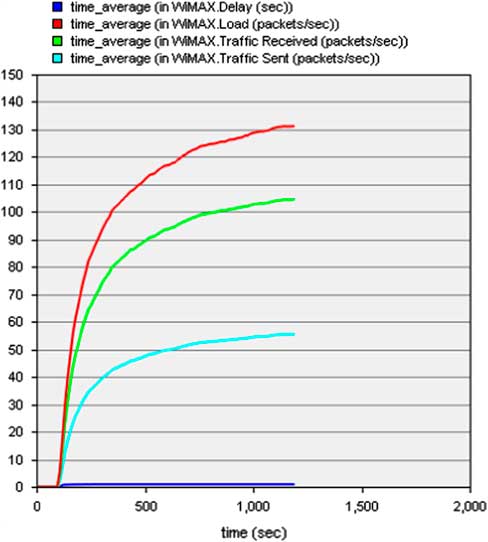
The server characteristics are shown in Figure 11 . Traffic sent and received, as well as load, increases with an increase in time. Traffic received in the server is more than the traffic sent because all mobile users send traffic. However, the delay is still minimum.
Server Characteristics and Parameters

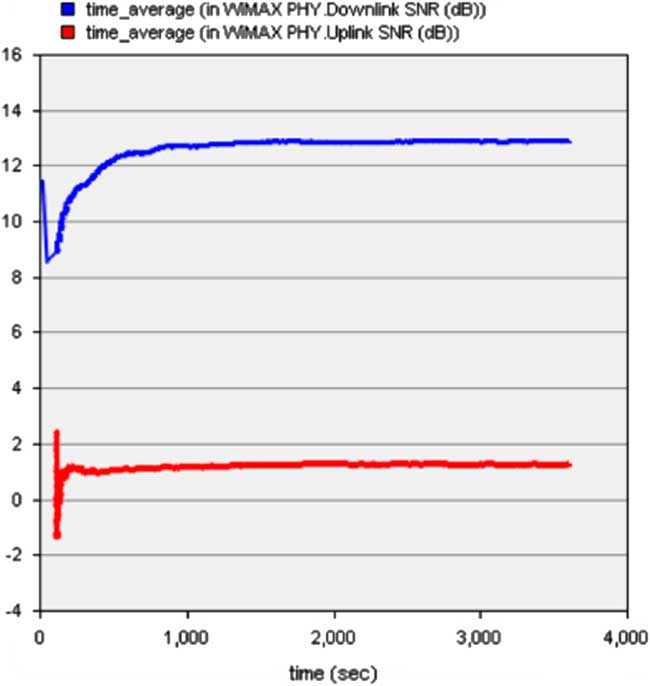
Signal-to-noise ratio (SNR) is measured in decibels. Downlink SNR value represents the packet transmissions through the ad hoc. For rescue and relief nodes, the SNR is measured for all packets arriving from the tethered balloon. Uplink represents the packet transmissions through the ad hoc. For rescue and relief nodes, the SNR is measured at the particular tethered balloon for all packets arriving from rescue and relief ( Figure 12 ).
Uplink and Downlink Signal-to-Noise Ratio

The call admission control is implemented in the tethered balloon, as well as the total capacity of uplink and downlink and the number of admitted calls and rejected calls. In this particular scenario, the number of admitted calls is 30 calls and the number of rejected calls is 0. This means that the QoS from the tethered balloon is significantly effective and efficient.
CONCLUSION
The aerial platform is considered as the essential key for developing an emergency communication system because of its reliability and ease of deployment. A tethered balloon represents the best solution for emergency communication because it is a stable station and it provides a large coverage area. The proposed emergency communication is implemented by using the OPNET model. This study deeply describes the tethered balloon technology for emergency communication and saving people’s lives. The results show that the rescue and relief teams performed their tasks in an orderly manner because they were provided with a high-priority service. The QoS parameters are significantly enhanced effectively and efficiently by using the proposed technology.