Longitudinal investigations have demonstrated the persistence of social–emotional and behavioral problems in the internalizing domains into later life, even when they are identified as early as 12–48 months of age; such symptoms are strongly correlated with the development of significant psychopathology (Briggs-Gowan, Carter, Bosson-Heenan, Guyer, & Horwitz, Reference Briggs-Gowan, Carter, Bosson-Heenan, Guyer and Horwitz2006; Mesman & Koot, Reference Mesman and Koot2001; Roza, Hofstra, van der Ende, & Verhulst, Reference Roza, Hofstra, van der Ende and Verhulst2003). Childhood maltreatment and adversity are established risk factors for internalizing symptoms (Carr, Martins, Stingel, Lemgruber, & Juruena, Reference Carr, Martins, Stingel, Lemgruber and Juruena2013; Hickman et al., Reference Hickman, Jaycox, Setodji, Kofner, Schultz and Barnes-Proby2013; Kim-Spoon, Cicchetti, & Rogosch, Reference Kim-Spoon, Cicchetti and Rogosch2013; Mills, Scott, Alati, et al., Reference Mills, Scott, Alati, O'Callaghan, Najman and Strathearn2013; Norman et al., Reference Norman, Byambaa, De, Butchart, Scott and Vos2012) and associated conditions, such as depression, posttraumatic stress disorder (PTSD), and anxiety, both later in childhood and into adulthood (Benjet, Borges, & Medina-Mora, Reference Benjet, Borges and Medina-Mora2010; Green et al., Reference Green, McLaughlin, Berglund, Gruber, Sampson and Zaslavsky2010; Schilling, Aseltine, & Gore, Reference Schilling, Aseltine and Gore2007; Scott, Smith, & Ellis, Reference Scott, Smith and Ellis2010; Widom, Reference Widom1999; Widom, DuMont, & Czaja, Reference Widom, DuMont and Czaja2007). Individual responses to adversity and the subsequent development and severity of internalizing symptoms or disorders vary considerably, suggesting that there are underlying factors modifying an individual's risk, although little is known regarding what these factors may be, especially in very young children exposed to maltreatment (Lupien, McEwen, Gunnar, & Heim, Reference Lupien, McEwen, Gunnar and Heim2009; Teicher & Samson, Reference Teicher and Samson2013). Identifying these moderating factors is critical for efforts to prevent or alter the long-term sequelae of early-onset internalizing symptoms.
Childhood adversity may have the greatest effects in individuals with genetic variants that influence the neural systems dysregulated in internalizing conditions (Heim & Binder, Reference Heim and Binder2012; Hornung & Heim, Reference Hornung and Heim2014). In addition, some genes may influence response to a broad range of environmental conditions, with alleles that confer risk in the face of environmental stressors but provide benefit under positive conditions (Belsky et al., Reference Belsky, Jonassaint, Pluess, Stanton, Brummett and Williams2009; Belsky & Pluess, Reference Belsky and Pluess2009). Variability in the outcome of some Gene × Environment (G × E) interaction studies is likely due in part to difficulties inherent to designing such studies, which rely on retrospective accounts of adversity in adults or are limited in young children who cannot report their adversity history. The timing and type of exposure to maltreatment and other adversities is likely critical and introduces another source of variability among G × E studies (Pietrek, Elbert, Weierstall, Muller, & Rockstroh, Reference Pietrek, Elbert, Weierstall, Muller and Rockstroh2013). This is probably partially due to developmental changes in attachment relationships and the development of neural systems that underlie the regulation of affect and behavior (Cicchetti & Toth, Reference Cicchetti and Toth2005), suggesting the importance of studying different types of adverse exposures at different developmental periods in elucidating G × E interactions. In addition, families who may be most at risk are relatively inaccessible to research participation due to the effects of concurrent poverty and environmental stress exposure.
G × E Interactions in Maltreated Children, Psychopathology, and Internalizing Symptoms
Several studies in youth have examined how maltreatment exposure interacts with functional genetic variants that are thought to influence neurobiological systems relevant to internalizing disorders (Bellani, Nobile, Bianchi, van Os, & Brambilla, Reference Bellani, Nobile, Bianchi, van Os and Brambilla2012; Nugent, Tyrka, Carpenter, & Price, Reference Nugent, Tyrka, Carpenter and Price2011; Teicher & Samson, Reference Teicher and Samson2013). For example, the serotonin system is important to the development of internalizing disorders such as depression and anxiety, and it is thought to play a central role in stress-induced psychiatric disorders (Shikanai, Kimura, & Togashi, Reference Shikanai, Kimura and Togashi2013). Numerous studies have focused on genetic variants in the serotonin transporter linked polymorphic region (5-HTTLPR) of the serotonin transporter protein gene, which appears to regulate serotonin uptake from the synaptic cleft (Lesch et al., Reference Lesch, Bengel, Heils, Sabol, Greenberg and Petri1996). Consistent with adult studies (Caspi et al., Reference Caspi, Sugden, Moffitt, Taylor, Craig and Harrington2003), Kaufman et al. (Reference Kaufman, Yang, Douglas-Palumberi, Houshyar, Lipschitz and Krystal2004) reported a significant association of 5-HTTLPR genotype with increased depressive symptoms in maltreated children compared to maltreated children with other genotypes or nonmaltreated children with the same genotype, This result has been replicated in other studies in youth and appears potentiated by factors such as low social supports (Aslund et al., Reference Aslund, Leppert, Comasco, Nordquist, Oreland and Nilsson2009; Banny, Cicchetti, Rogosch, Oshri, & Crick, Reference Banny, Cicchetti, Rogosch, Oshri and Crick2013; Kaufman et al., Reference Kaufman, Yang, Douglas-Palumberi, Houshyar, Lipschitz and Krystal2004). Other studies have demonstrated G × E interactions in the development of internalizing disorders involving genetic variants in the serotonergic, dopaminergic, noradrenergic, glutamatergic, and GABAergic systems, other monoamine enzymes, cannabinoids, neuroendocrine, prosurvival factors, and inflammatory mediators (for review of mechanisms, see Mandelli & Serretti, Reference Mandelli and Serretti2013; Nugent et al., Reference Nugent, Tyrka, Carpenter and Price2011).
Because these neurobiological systems are closely interconnected, a number of studies have tested for Gene × Gene interactions between regulatory genes in these systems (Masten & Cicchetti, Reference Masten and Cicchetti2010). Interactions of variants of 5-HTTLPR and brain-derived neurotrophic factor (BDNF) genes were associated with higher depressive symptoms in maltreated but not in nonmaltreated youth (Kaufman et al., Reference Kaufman, Yang, Douglas-Palumberi, Grasso, Lipschitz and Houshyar2006). Similar results for these genes were found in other studies of adolescents and young adults (Aguilera et al., Reference Aguilera, Arias, Wichers, Barrantes-Vidal, Moya and Villa2009; Comasco, Aslund, Oreland, & Nilsson, Reference Comasco, Aslund, Oreland and Nilsson2013; Nederhof, Bouma, Oldehinkel, & Ormel, Reference Nederhof, Bouma, Oldehinkel and Ormel2010). Other work has documented Gene × Gene interactions of 5-HTTLPR with a monoamine oxidase A (MAOA) gene variant in sexually abused youth (Cicchetti, Rogosch, & Sturge-Apple, Reference Cicchetti, Rogosch and Sturge-Apple2007), with a variant of the corticotropin releasing hormone receptor 1 (CRHR1) gene in maltreated children, and with the dopamine receptor D4 (DRD4) gene (Cicchetti, Rogosch, & Oshri, Reference Cicchetti, Rogosch and Oshri2011; Cicchetti, Rogosch, & Toth, Reference Cicchetti, Rogosch and Toth2011). In work aiming to predict resilience in adaptive functioning among 595 maltreated and nonmaltreated low-income children, genetic variants in the 5-HTTLPR, CRHR1, DRD4, and oxytocin receptor genes each gave a relative advantage in resilient functioning in nonmaltreated compared to maltreated children (Cicchetti & Rogosch, Reference Cicchetti and Rogosch2012). Taken together, these results show that neurobiologically guided targets for examining G × E interactions have yielded some potential models by which adversity may modify individual risk of psychopathology. However, these models have been criticized on methodological grounds in some cases and more complete models have been advocated (Keller, Reference Keller2014).
In addition to maltreatment, other forms of childhood adversity, such as parental loss, socioeconomic adversity, and poor social supports, have been linked to the development of internalizing problems (Dunn et al., Reference Dunn, Uddin, Subramanian, Smoller, Galea and Koenen2011; Manly, Kim, Rogosch, & Cicchetti, Reference Manly, Kim, Rogosch and Cicchetti2001). Although some G × E interaction studies have focused on direct childhood maltreatment such as abuse and neglect, others have included more broadly experienced events, such as parental arguing/divorce, poverty, or parent education levels. Evidence supports the existence of differences in the impact of the type of early life stress (Cicchetti et al., Reference Cicchetti, Rogosch and Sturge-Apple2007; Sjoberg et al., Reference Sjoberg, Nilsson, Nordquist, Ohrvik, Leppert and Lindstrom2006). Poor social support predisposes to internalizing symptoms and moderates the effects of childhood maltreatment on internalizing symptoms (Kaufman et al., Reference Kaufman, Yang, Douglas-Palumberi, Houshyar, Lipschitz and Krystal2004, Reference Kaufman, Yang, Douglas-Palumberi, Grasso, Lipschitz and Houshyar2006). In a study examining childhood risk factors for adult psychopathology, participants with childhood parental separation, desertion, or death were significantly more likely to report the subsequent onset of symptoms of a depressive or anxiety disorder. These effects were not fully explained by parental relationships or history of childhood maltreatment, and a family history of depressive or anxiety disorders accounted for the effect of parental separation, suggesting a genetic predisposition contributing to the development of psychopathology after this exposure (Tyrka, Wier, Price, Ross, & Carpenter, Reference Tyrka, Wier, Price, Ross and Carpenter2008). Thus, in addition to maltreatment, exposure to other contextual stressors contributes to risk of developing internalizing symptoms or disorders in genetically predisposed individuals.
Few studies on this topic have included young children and none have included children younger than age 5, so little is known regarding the effects of genetic variants that may potentiate responses to early adversity. While the cumulative effects of stress over time are likely to produce the most robust effects, evidence shows that even very young children develop internalizing symptoms and disorders (Luby, Gaffrey, Tillman, April, & Belden, Reference Luby, Gaffrey, Tillman, April and Belden2014; Scheeringa & Haslett, Reference Scheeringa and Haslett2010; Zeanah, Boris, & Scheeringa, Reference Zeanah, Boris and Scheeringa1997). Studies of young children are critical because early attachment plays an important role in the development of internalizing symptoms, and the neural systems that underlie internalizing symptoms undergo major developmental change during this time (Carrion & Wong, Reference Carrion and Wong2012; Rincon-Cortes & Sullivan, Reference Rincon-Cortes and Sullivan2014).
Inflammatory Cytokines and Internalizing Symptoms
Despite a wealth of evidence implicating inflammation in association with adversity and in the development of depressive and anxiety disorders, almost no work has examined genes that regulate inflammatory proteins in relation to internalizing symptoms or adverse childhood experiences (Mandelli & Serretti, Reference Mandelli and Serretti2013). The inflammatory response is a reaction to acute stress or injury involving release of inflammatory mediators, cellular recruitment, and release of proinflammatory cytokines. Cytokines are a diverse group of messenger proteins that act through intercellular signaling to regulate immune responses in response to injuries; cytokines are also activated in response to psychological stress (Lacy & Stow, Reference Lacy and Stow2011; Robles, Glaser, & Kiecolt-Glaser, Reference Robles, Glaser and Kiecolt-Glaser2005). C-reactive protein (CRP) is an acute-phase protein produced in response to acute infection or injury that is a marker of chronic, low-grade inflammation (Ferri et al., Reference Ferri, Croce, Cofini, De Berardinis, Grassi and Casale2007; Lavie, Milani, Verma, & O'Keefe, Reference Lavie, Milani, Verma and O'Keefe2009). Although this inflammatory response is part of an adaptive response to minimize injury and promote healing in response to acute injuries or threats, excessive inflammation with prolonged and persistent elevation of proinflammatory cytokine levels is associated with a number of psychiatric disorders, including major depressive disorder (MDD) and PTSD (Mills, Scott, Wray, Cohen-Woods, & Baune, Reference Mills, Scott, Wray, Cohen-Woods and Baune2013; Rohleder, Reference Rohleder2014).
Adults with MDD have elevated inflammatory responses and peripheral concentrations of some cytokines, including interleukin (IL)-6, IL-1β, and tumor necrosis factor-α (Dowlati et al., Reference Dowlati, Herrmann, Swardfager, Liu, Sham and Reim2010; Hiles, Baker, de Malmanche, & Attia, Reference Hiles, Baker, de Malmanche and Attia2012; Liu, Ho, & Mak, Reference Liu, Ho and Mak2012), and PTSD in adults is associated with inflammation (Baker, Nievergelt, & O'Connor, Reference Baker, Nievergelt and O'Connor2012; Gola et al., Reference Gola, Engler, Sommershof, Adenauer, Kolassa and Schedlowski2013; O'Donovan et al., Reference O'Donovan, Sun, Cole, Rempel, Lenoci and Pulliam2011; Pace et al., Reference Pace, Wingenfeld, Schmidt, Meinlschmidt, Hellhammer and Heim2012). Several studies have demonstrated elevations of inflammatory markers in adults with a history of childhood adversity (Coelho, Viola, Walss-Bass, Brietzke, & Grassi-Oliveira, Reference Coelho, Viola, Walss-Bass, Brietzke and Grassi-Oliveira2014). In youth, there is now a wealth of evidence showing that adversity is associated with elevations of CRP (Appleton et al., Reference Appleton, Buka, McCormick, Koenen, Loucks and Kubzansky2012; Danese et al., Reference Danese, Moffitt, Pariante, Ambler, Poulton and Caspi2008; Danese, Pariante, Caspi, Taylor, & Poulton, Reference Danese, Pariante, Caspi, Taylor and Poulton2007; Low, Matthews, & Hall, Reference Low, Matthews and Hall2013; Slopen, Kubzansky, McLaughlin, & Koenen, Reference Slopen, Kubzansky, McLaughlin and Koenen2013), and a few studies have also shown higher levels of proinflammatory cytokines (Bertone-Johnson, Whitcomb, Missmer, Karlson, & Rich-Edwards, Reference Bertone-Johnson, Whitcomb, Missmer, Karlson and Rich-Edwards2012; Rooks, Veledar, Goldberg, Bremner, & Vaccarino, Reference Rooks, Veledar, Goldberg, Bremner and Vaccarino2012; Slopen et al., Reference Slopen, Kubzansky, McLaughlin and Koenen2013). We recently found that salivary IL-1β was positively associated with childhood adversity in preschool-aged children (Tyrka et al., unpublished results). Links between inflammatory proteins and internalizing symptoms have also been documented in some, but not all, studies of youth (Mills, Scott, Wray, et al., Reference Mills, Scott, Wray, Cohen-Woods and Baune2013; Slopen et al., Reference Slopen, Kubzansky, McLaughlin and Koenen2013).
To our knowledge, only one study examined genetic determinants of the association among internalizing, adversity, and inflammatory proteins. In adults previously exposed to stressful life events, two promoter variants in the gene for IL18 were associated with onset of depression (Haastrup et al., Reference Haastrup, Bukh, Bock, Vinberg, Thorner and Hansen2012). There is evidence that genes regulating cytokine expression have an important role in the development of inflammatory conditions in association with depression or adversity in adults (Cole et al., Reference Cole, Arevalo, Takahashi, Sloan, Lutgendorf and Sood2010; Kim et al., Reference Kim, Stewart, Kim, Kim, Bae and Kang2013) and adolescents (Cole et al., Reference Cole, Arevalo, Manu, Telzer, Kiang and Bower2011). Prior studies have not examined inflammatory genetic variants in relation to internalizing behavior or adversity in children.
The Role of IL-1β in Stress Neurobiology
As noted above, studies have shown elevated IL-1β in individuals with internalizing disorders associated with childhood maltreatment, suggesting this cytokine may have a role in the development of these disorders (Mitchell & Goldstein, Reference Mitchell and Goldstein2014). Genes that regulate IL-1β may be particularly important in this context because IL-1β plays an important role in stress neurobiology (Dantzer, Reference Dantzer2009). Animal models of stress exposure show increases in IL-1β (Bailey, Kinsey, Padgett, Sheridan, & Leblebicioglu, Reference Bailey, Kinsey, Padgett, Sheridan and Leblebicioglu2009; Caso, Moro, Lorenzo, Lizasoain, & Leza, Reference Caso, Moro, Lorenzo, Lizasoain and Leza2007; Nguyen et al., Reference Nguyen, Deak, Owens, Kohno, Fleshner and Watkins1998; Porterfield, Gabella, Simmons, & Johnson, Reference Porterfield, Gabella, Simmons and Johnson2012; You et al., Reference You, Luo, Zhang, Chen, He and Zhao2011), and in humans, IL-1β increases acutely in response to a variety of stress challenges, including cognitive, social, and sleep-deprivation paradigms (Brydon et al., Reference Brydon, Edwards, Jia, Mohamed-Ali, Zachary and Martin2005; Mastrolonardo, Alicino, Zefferino, Pasquini, & Picardi, Reference Mastrolonardo, Alicino, Zefferino, Pasquini and Picardi2007; Steptoe, Hamer, & Chida, Reference Steptoe, Hamer and Chida2007; Yamakawa et al., Reference Yamakawa, Matsunaga, Isowa, Kimura, Kasugai and Yoneda2009). In animal models, central administration of IL-1β activates the hypothalamic–pituitary–adrenal (HPA) axis, reduces hippocampal BDNF and impairs hippocampal-dependent learning (Koo & Duman, Reference Koo and Duman2008), important processes in the pathophysiology of internalizing disorders (Felger & Lotrich, Reference Felger and Lotrich2013; Mills, Scott, Wray, et al., Reference Mills, Scott, Wray, Cohen-Woods and Baune2013; von Kanel et al., Reference von Kanel, Hepp, Kraemer, Traber, Keel and Mica2007). Furthermore, there is evidence that activation of the IL-1β receptor is necessary for stress to impair neurogenesis (Koo & Duman, Reference Koo and Duman2008).
The Present Study
To summarize, a large body of evidence now implicates inflammatory proteins in the neurobiology of depressive and anxiety disorders in adults. Most of the work in children has focused on a general marker of inflammation, CRP, with little examination of cytokines, such as IL-1β, that are known to be important mediators of the neural response to stress. Almost no work has examined genes that regulate inflammation in relation to stress and internalizing disorders, and the single existing study was in adults. Although the onset of internalizing disorders often occurs later in childhood and adulthood, young children develop internalizing symptoms following adverse experiences, and elucidating these processes during early development may be critical to an understanding of these disorders. Given the documented involvement of IL-1β in neuronal function, stress responses, and MDD, the gene coding for this proinflammatory cytokine is a good candidate for evaluation in relation to internalizing symptoms and exposure to adversity.
The aim of the present study was to examine the role of a genetic variant in the IL1B gene in preschoolers exposed to maltreatment and other forms of adversity in the development of internalizing symptoms, including symptoms of PTSD and MDD, assessed using a structured diagnostic interview. This sample is a unique group of healthy but impoverished preschool-aged children. Children with a recent episode of maltreatment identified through the local child welfare agency and an emergency maltreatment assessment service are compared with children with no indicated case of maltreatment, and effects of additional stressors are assessed.
Methods
One-hundred and ninety-eight families enrolled in this study. One child from each family was included. Children ranged in age from 3 to 5 years (M = 51.6 months, SD = 9 months), and 108 were female and 90 were male. The sample was racially and ethnically diverse: 49 White non-Hispanic, 93 Hispanic, 30 Black, and 26 other races. Most caregivers (n = 184) were biological mothers. Forty-three caregivers had less than a high school degree, 69 completed high school, 68 had some postsecondary education, 17 had a bachelor's degree, and 1 did not provide education information. One hundred and thirteen caregivers were unemployed, and 180 of the families qualified for public assistance. Ninety-five children (48%) had substantiated cases of moderate to severe child maltreatment within the past 6 months as described below.
Procedure
Families with a maltreated child were identified from the local child welfare agency and an emergency maltreatment assessment service via record review. Families of children with no indicated case of maltreatment within the past 6 months were recruited at a pediatric medical clinic during a well-child visit as well as at childcare centers. Based on review of available medical records and parent report, children with a chronic illness, medication use, obesity, and failure to thrive were excluded. Those with acute illness or medication use were included no less than 2 weeks following resolution of illness and discontinuation of medication.
Families completed two home visits and questionnaires between the visits. The current report focuses on the first home visit, during which caregivers completed interviews on child stress exposure and a saliva sample for DNA isolation was collected from the children.
Measures
Child maltreatment status
All families consented to examination of child welfare records to determine maltreatment status. Trained research staff coded the records using the System for Coding Subtype and Severity of Maltreatment in Child Protective Records (Barnett, Manly, & Cicchetti, Reference Barnett, Manly, Cicchetti, Cicchetti and Toth1993). Five maltreatment subtypes and severity scores, ranging from 1 (least severe) to 5 (most severe), were derived. Children with an episode that met the criteria for moderate to severe maltreatment (score of 3–5) within the last 6 months were included in the maltreated group (n = 95). Sixteen children had substantiated cases of physical abuse, 24 sexual abuse, 11 physical neglect/failure to provide, 25 physical neglect/lack of supervision, and 60 emotional maltreatment (emotional maltreatment typically included witnessing domestic violence). The comparison group included children who had never had a substantiated case of maltreatment. Seven children had a remote episode of maltreatment (M = 33 months prior to enrollment, SD = 15 months prior to enrollment). Results were consistent whether these children were in the maltreatment or the comparison group; because they did not meet the criteria for the maltreatment group, they were included in the comparison group.
Contextual stress interview
Caregivers completed a semistructured interview developed in our laboratory to assess the child's experience of contextual stressors in the past 6 months. Categories were as follows: death of a caregiver, separation from a caregiver, frequent change of residence or homelessness, inadequate food or clothing, and other events including witnessing neighborhood violence or parental arrest. Each domain was scored positive if at least one episode occurred. Possible scores ranged from 0 (no stressors) to 5 (stressors in all five domains).
Internalizing behavior problems
Caregivers completed the Child Behavior Checklist for Ages 1.5 to 5 (CBCL; Achenbach & Ruffle, Reference Achenbach and Ruffle2000) to assess internalizing behavior problems. For each of the 100 behaviors, parents assessed their children on a 3-point scale (0 = not true, 2 = very true). We used T scores for data analysis.
PTSD and MDD symptoms
The Diagnostic Infant and Preschool Assessment (Scheeringa & Haslett, Reference Scheeringa and Haslett2010) interview was conducted with caregivers to assess symptoms of PTSD and MDD. Interviews were conducted by trained clinical social workers and a PhD-level psychologist, reviewed in a group supervision format, and scored based upon group consensus. Consistent with the low prevalence of MDD and PTSD diagnoses reported in other studies of children under the age of 6 recruited from low-income mental health clinics (Bufferd, Dougherty, Carlson, & Klein, Reference Bufferd, Dougherty, Carlson and Klein2011; Scheeringa & Haslett, Reference Scheeringa and Haslett2010), none of the children met full DSM-IV criteria for MDD and only one met criteria for PTSD; therefore, the variables for analyses were the number of symptoms of MDD and of PTSD experienced within the past month.
Genotyping
Oragene kits (DNA Genotek, Ontario, Canada) were used to collect saliva, and DNA was extracted according to the manufacturer's protocol. The IL1B G+5810A (rs1143633) single nucleotide polymorphism (SNP) was genotyped by the TaqMan method using an ABI PRISM 7900 Sequence Detection System (ABI, Foster City, CA). This SNP was selected because it has previously been associated with inflammatory phenotypes (Hahn, Cho, Kim, Kim, & Kang, Reference Hahn, Cho, Kim, Kim and Kang2009; Moxley, Han, Stern, & Riley, Reference Moxley, Han, Stern and Riley2007; Solovieva et al., Reference Solovieva, Kamarainen, Hirvonen, Hamalainen, Laitala and Vehmas2009), cognitive function (Sasayama, Hori, Teraishi, Hattori, Ota, Matsuo, et al., Reference Sasayama, Hori, Teraishi, Hattori, Ota and Iijima2011), schizophrenia (Sasayama, Hori, Teraishi, Hattori, Ota, Iijima, et al., Reference Sasayama, Hori, Teraishi, Hattori, Ota and Matsuo2011), and cortisol response to dexamethasone administration (Sasayama, Hori, Iijima, et al., Reference Sasayama, Hori, Iijima, Teraishi, Hattori and Ota2011).
Statistical analysis
Mean differences in demographic characteristics and stress variables were examined using t tests and chi-square. General linear modeling was used for hypothesis testing. Child age, sex, and race (Black vs. all others and Hispanic vs. all others) were included as covariates in all models. Unadjusted means and standard deviations are provided in the text for each group. First, main and interactive effects of child maltreatment and IL1B genotype on child behavioral outcomes were tested. Second, main and interactive effects of contextual stress and IL1B genotype on child behavioral outcomes were tested. Significant interaction effects were probed by examining group differences in child behavioral outcomes.
Results
Sample characteristics
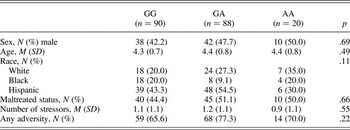
The minor allele frequency (MAF) of the IL1B allelic variant in the sample was 0.32 for our total population, and the distribution conformed to Hardy–Weinberg equilibrium (χ2 = 0.05, p = .82). Our overall sample MAF was not statistically different from the National Center for Biotechnology Information SNP database reported MAF of 0.35 (p = .65). Table 1 shows sample characteristics in relation to IL1B genotype; age, sex, and race did not differ according to genotype. The calculated MAF for Whites, Blacks, and Hispanics were 0.39, 0.27, and 0.32, respectively. The distribution of these alleles conformed to Hardy–Weinberg equilibrium (χ2 = 0.05, p = .82 for Whites, χ2 = 3.0, p = .081 for Blacks, and χ2 = 3.1, p = .081 for Hispanics) and did not significantly differ from MAF reported in the National Center for Biotechnology Information SNP database for these populations of 0.40, 0.23, and 0.35 (ps = .89, .51, and .65, respectively). Low levels of symptoms were identified on the Diagnostic Infant and Preschool Assessment, with a range of 0–6 for MDD (mean = 0.45, SD = 0.95) and 0–15 for PTSD (M = 1.4, SD = 2.6), with similarly low levels of internalizing symptoms on the CBCL (M = 52.7, SD = 8.8). Sex was not associated with MDD, PTSD, or internalizing symptoms. There were no differences in internalizing symptoms on the CBCL or PTSD or MDD symptoms based on race. Age was not associated with MDD symptoms or internalizing behaviors, but there was a trend association with PTSD symptoms (p = .06). Age, sex, and race were controlled in the models as described above.
Descriptive statistics and mean differences by interleukin 1B genotype

Note: The p values indicate a t-test or chi-square significance level.
IL1B genotype, maltreatment, and G × E effects on child behavioral outcomes
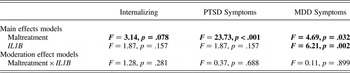
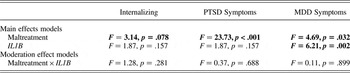
As displayed in the main effects models in Table 2, maltreatment was associated with both PTSD and MDD symptoms, after controlling for race, sex, and age. In comparison with the nonmaltreated children (N = 103), the maltreated group (N = 95) had more symptoms of PTSD (M = 2.35, SD = 3.10 vs. M = 0.54, SD = 1.5) and MDD (M = 0.62, SD = 1.09 vs. M = 0.30, SD = 0.78). Maltreatment also was associated with internalizing behaviors at trend level with more internalizing behaviors in the maltreated group (M = 53.90, SD = 7.87) than among nonmaltreated children (M = 51.61, SD = 9.39).
Main and interactive effects of child maltreatment and interleukin 1B genotype
Note: Moderation effect models included main effects but not shown for parsimony. Child age, sex, and race (Hispanic vs. all others and Black vs. all others) were included as covariates in all models. PTSD, Posttraumatic stress disorder; MDD, major depressive disorder.
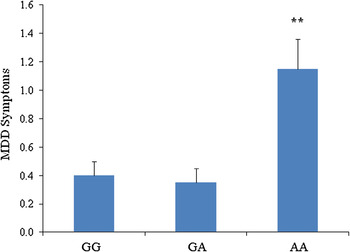
IL1B genotype was associated with MDD symptoms. As illustrated in Figure 1, homozygotes for the A allele had more MDD symptoms (M = 1.15, SD = 1.78) than did carriers of the G allele (M = 0.40, SD = 0.82 for G homozygotes and M = 0.35, SD = 0.76 for GA heterozygotes). In contrast, IL1B was not associated with internalizing behaviors or PTSD symptoms.
(Color online) Association of IL1B and major depressive disorder symptoms. AA homozygotes are significantly different from the other two groups at **p < .01.

In moderation effects models (Table 2), the interaction of maltreatment and IL1B was not a significant predictor of internalizing behaviors, PTSD symptoms, or MDD symptoms.
IL1B genotype, contextual stress, and G × E effects on child behavioral outcomes
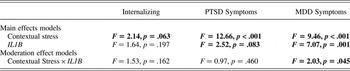
As displayed in the main effects models in Table 3, the number of contextual stressors was associated with both PTSD and MDD symptoms. Children exposed to more contextual stressors had greater PTSD and MDD symptoms. Contextual stress also was positively associated with internalizing behaviors at trend level.
Main and interactive effects of contextual stress and interleukin 1B genotype

Note: Moderation effect models included main effects but not shown for parsimony. Child age, sex, and race (Hispanic vs. all others and Black vs. all others) were included as covariates in all models. PTSD, Posttraumatic stress disorder; MDD, major depressive disorder.
Consistent with the effect of IL1B in the models with maltreatment, IL1B was associated with MDD symptoms. Homozygotes for the A allele had greater MDD symptoms than carriers of the G allele. In models with contextual stress, IL1B was also positively associated with PTSD symptoms at trend level. A homozygotes had more PTSD symptoms (M = 2.35, SD = 3.51) than did GA heterozygotes (p = .027; M = 1.20, SD = 2.12), with G homozygotes at trend level (p = .10; M = 1.39, SD = 2.69).
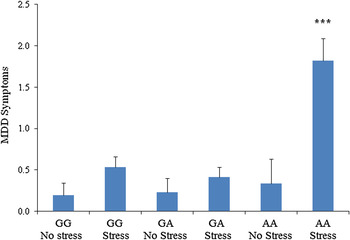
Moderation effect models are also displayed in Table 3. The interaction of contextual stress and IL1B was significantly associated with MDD symptoms (p = .045). As illustrated in Figure 2, children with contextual stress who had the AA genotype had more MDD symptoms than did children who were carriers of the G allele and those who had no contextual stress. Following recommendations of Keller (Reference Keller2014), the significant interaction effect was also tested, controlling for the interaction of each covariate and IL1B, and the interaction of each covariate and contextual stress. None of the eight covariate interactions were significant, and the interaction effect was essentially unchanged (F = 2.06, p = .051). The interaction of contextual stress and IL1B was not associated with internalizing behaviors or PTSD.
(Color online) Interaction of adversity and IL1B. AA homozygotes are significantly different from the other five groups at ***p < .001.

Discussion
To our knowledge, this is the first study to examine the role of the IL1B gene in the development of internalizing symptoms in children. We found that maltreatment and other contextual stressors are associated with symptoms of PTSD and MDD and that a polymorphism in the IL1B gene is associated with depressive symptoms. In addition, the effect of contextual stress was accounted for by an interaction with IL1B genotype, such that only those with the AA genotype had higher depressive symptoms in the context of these stressors.
A growing body of research has established that proinflammatory cytokines have systemic effects far beyond the canonical immune response. As discussed above, evidence from animal and human studies support a role of inflammatory cytokines in the development of MDD (Groer & Morgan, Reference Groer and Morgan2007; Koo & Duman, Reference Koo and Duman2008; O'Brien, Scott, & Dinan, Reference O'Brien, Scott and Dinan2004; Pace, Hu, & Miller, Reference Pace, Hu and Miller2007) and anxiety disorders (Bauer, Wieck, Lopes, Teixeira, & Grassi-Oliveira, Reference Bauer, Wieck, Lopes, Teixeira and Grassi-Oliveira2010; Hoge et al., Reference Hoge, Brandstetter, Moshier, Pollack, Wong and Simon2009; von Kanel et al., Reference von Kanel, Hepp, Kraemer, Traber, Keel and Mica2007) as well as in the broad-ranging adverse health effects of stress-induced inflammation. IL-1β has been linked to MDD in adults and plays a key role in the neural response to stress, but few studies have examined this cytokine in relation to stress exposure or psychiatric symptoms. A study of adolescent suicides found increased activity of IL-1β, IL-6, and tumor necrosis factor-α in the prefrontal cortex (Pandey et al., Reference Pandey, Rizavi, Ren, Fareed, Hoppensteadt and Roberts2012). In a subsample of 40 children from our parent study, we recently found that contextual stressors and traumatic life events were associated with saliva concentrations of IL-1β (Tyrka et al., unpublished results). Only 7 subjects in that subsample had the AA genotype; these subjects had numerically higher saliva IL-1β concentrations than did G allele carriers, but this did not reach significance in the small sample (p = .11). Genetic variants in IL1B may help define a subset of children who, when exposed to maltreatment, have differential IL-1β responses and higher internalizing symptoms.
The rs1143633 SNP is an intronic variant in the IL1B gene. Introns can contribute to the enhancement of translation of gene products, possibly due to mechanisms including transcription initiation, termination, and regulation (Shabalina et al., Reference Shabalina, Ogurtsov, Spiridonov, Novichkov, Spiridonov and Koonin2010). A prior report found that this IL1B polymorphism was associated with cortisol response to dexamethasone challenge in a sample of 179 adults (Sasayama, Hori, Iijima, et al., Reference Sasayama, Hori, Iijima, Teraishi, Hattori and Ota2011). Abnormal function of the HPA axis is well established in association with early stress exposure and internalizing symptoms and disorders (Carpenter et al., Reference Carpenter, Carvalho, Tyrka, Wier, Mello and Mello2007; Carpenter, Shattuck, Tyrka, Geracioti, & Price, Reference Carpenter, Shattuck, Tyrka, Geracioti and Price2011; Hartman, Hermanns, de Jong, & Ormel, Reference Hartman, Hermanns, de Jong and Ormel2013; Lupien et al., Reference Lupien, McEwen, Gunnar and Heim2009; Morris, Compas, & Garber, Reference Morris, Compas and Garber2012; Stetler & Miller, Reference Stetler and Miller2011). The HPA and inflammatory systems are tightly co-regulated, and an effect of this gene in HPA axis activation could be involved in the association between stress exposure and internalizing symptoms and disorders. This SNP has also been associated with decrements in verbal cognitive function in older females (Sasayama, Hori, Teraishi, Hattori, Ota, Matsuo, et al., Reference Sasayama, Hori, Teraishi, Hattori, Ota and Matsuo2011) and with schizophrenia (Sasayama, Hori, Teraishi, Hattori, Ota, Iijima, et al., Reference Sasayama, Hori, Teraishi, Hattori, Ota and Matsuo2011), as well as inflammatory phenotypes, including arthritis and nephropathies (Hahn et al., Reference Hahn, Cho, Kim, Kim and Kang2009; Moxley et al., Reference Moxley, Han, Stern and Riley2007; Solovieva et al., Reference Solovieva, Kamarainen, Hirvonen, Hamalainen, Laitala and Vehmas2009). Thus, this SNP may be functional or linked with a region that has a functional effect on IL1B gene expression.
Our significant effects were seen with symptoms on a clinician-rated interview, but not on the internalizing symptom scale of the parent-report CBCL. Prior work suggests that parent reports may include a degree of bias (Saudino, Wertz, Gagne, & Chawla, Reference Saudino, Wertz, Gagne and Chawla2004; Seifer Sameroff, Dickstein, Schiller, & Hayden, Reference Seifer, Sameroff, Dickstein, Schiller and Hayden2004), which may have contributed to less robust effects in models predicting parent reports of internalizing symptoms than clinician-rated PTSD and MDD symptoms. It is important to note that in the present study, maltreatment and contextual stressors usually directly involved the parent who completed the CBCL, which may have been another source of bias. Consistent with this, CBCL scores were in the normative range, even though most of the children experienced some form of adversity and would be expected to have higher scores. Caregivers also provided the information in the diagnostic interview, but because the assessments were made by trained clinicians, they may be less subject to bias. Internalizing symptoms and clinician-rated MDD symptoms were correlated (r = 0.22, p = .002), indicating overlap but also substantial unique variance.
The IL1B genotype effect in this study was on depressive symptoms, but not symptoms of PTSD. Most of the literature on cytokine associations with psychopathology is on MDD, but there is also evidence of a link with PTSD for several cytokines. PTSD symptoms are tied to the experience of traumatic events, and assessment of symptoms requires knowledge of these events, which is limited in studies of young children.
It is of interest that the interaction of IL1B genotype with stress exposure on MDD symptoms was for contextual stressors, which related to separation, loss, or instability of the child's primary supports or neglect of basic needs. Previous work has shown that the lack of social supports predisposes to the development of internalizing symptoms and that genetic variants can moderate this effect (Dunn et al., Reference Dunn, Uddin, Subramanian, Smoller, Galea and Koenen2011). That the G × E effect was seen for contextual stress but not for maltreatment suggests that maltreatment had a robust effect on symptoms, regardless of genotype, whereas only children who were at risk on the basis of IL1B genotype had depressive symptoms following the more commonly encountered types of stressors assessed with this measure.
The strengths of this study include the careful measurement of adverse experiences, including documented evidence of maltreatment from child welfare records, in-home assessments with both parent- and clinician-rated assessments, and the involvement of an at-risk, impoverished sample. Limitations include the inclusion of only a single SNP (albeit one with numerous previous association reports) rather than a set that tags the entire locus, the relatively small number of children who were homozygous for the minor allele, and the smaller numbers involved in examining G × E effects. However, the sample size is similar to that of other risk allele groups previously published reporting G × E effects (Cicchetti, Rogosch, & Oshri, Reference Cicchetti, Rogosch and Oshri2011). The lack of genetic characterization of ancestry is a further limitation, and this will be addressed in future studies. Children who were on medications or had any chronic medical conditions were excluded from the study, and the sample as a whole had few internalizing symptoms. However, the effect sizes seen were robust, and it is possible that adversity and IL1B genotype may predict the development of greater numbers of symptoms and internalizing disorders over time. These findings should be considered preliminary until replicated.
In summary, the current study is the first to demonstrate that a polymorphism in the IL1B gene is associated with depressive symptoms in children. In addition, we found that the effect of contextual stress was accounted for by an interaction with IL1B genotype, such that only those with the AA genotype had higher depressive symptoms in the context of these stressors. The results of this preliminary study will be helpful in elucidating the effects of genetic variation in the IL1B and other inflammatory cytokine genes on internalizing symptoms and as a moderator of the effects of childhood adversity.