Introduction
In the current era of volatility, uncertainty, complexity, and ambiguity, crisis events have been observed as taking place more frequently, including natural crises, such as COVID-19, which had an immense impact on many companies; political crises, such as the recent war in Ukraine; and industry crises, such as the effect of China’s ‘Double Reduction Policy’ on the education and training sectors. These salient, unexpected, and potentially disruptive external crisis events may substantially threaten an organization’s chances of goal accomplishment (Bundy, Pfarrer, Short, & Coombs, Reference Bundy, Pfarrer, Short and Coombs2017) when they occur outside the organization. Drawing on psychological perspectives on crisis (Pearson & Clair, Reference Pearson and Clair1998), it is evident that crises elevate uncertainty and challenge employees’ information-processing capacities, leading to potential disruptions in their sense of value and control. These disruptions, in turn, can significantly influence employees’ emotional well-being and work outcomes (Morgeson, Mitchell, & Liu, Reference Morgeson, Mitchell and Liu2015), with a notable effect on work productivity. The emphasis on employee work productivity, defined as the quantity and quality of tasks and outputs completed in relation to the time and resources used (Campbell, Reference Campbell, Dunnette and Hough1990), is particularly vital because it is a critical barometer for understanding how employees are affected by and adapt to crises.
Although prior studies have examined the influence of individual-level factors, such as self-leadership and receiving gratitude (Marques-Quinteiro, Vargas, Eifler, & Curral, Reference Marques-Quinteiro, Vargas, Eifler and Curral2019; Ni, Song, Zheng, Zhu, Zhang, & Xu, Reference Ni, Song, Zheng, Zhu, Zhang and Xu2022), and organizational factors, such as resilience and socially responsible human resource management, on employee productivity during crises (Kim, Reference Kim2020; Vu, Reference Vu2022), the existing literature predominantly focuses on either short-term disruptions or long-term consequences, often neglecting the dynamic and evolving nature of productivity during a crisis. However, crises are prolonged and changing processes, and it is critical to examine the fluctuations in work productivity across the various stages of a crisis – before, during, and after its onset. Given the dynamic nature of this process, understanding why some employees recover swiftly from crisis-induced setbacks whereas others continue to grapple with productivity loss is essential for identifying the individual and organizational factors that enable employees to adapt and navigate crises effectively.
In this study, we applied the Conservation of Resources (COR) Theory (Hobfoll, Reference Hobfoll1989; Hobfoll, Halbesleben, Neveu, & Westman, Reference Hobfoll, Halbesleben, Neveu and Westman2018) to examine how employees navigate and respond to crises. According to the COR Theory, crises often trigger uncertainty, a common stressor (DeGhetto, Russell, & Ferris, Reference DeGhetto, Russell and Ferris2017; Rosen et al., Reference Rosen, Dimotakis, Cole, Taylor, Simon, Smith and Reina2020; Usman, Cheng, Ghani, Gul, & Shah, Reference Usman, Cheng, Ghani, Gul and Shah2021), which leads to resource loss and typically results in productivity decline. However, as employees adapt to these challenges, they may gradually replenish their resources (e.g., time, energy, and attention), which helps slow the decline in productivity. This process unfolds over time, with employees accumulating and mobilizing resources to cope with ongoing challenges. Furthermore, the COR Theory asserts that employees with higher personal and social resources are better equipped to manage uncertainty, thereby mitigating productivity loss during crises (Hobfoll, Freedy, Lane, & Geller, Reference Hobfoll, Freedy, Lane and Geller1990). Therefore, this study posits that factors such as organizational tenure (OT) and leader–member communication frequency (LMCF) play a critical role in helping employees counterbalance the downturn in productivity during crises.
Investigating the dynamics of work behavior across different stages of a crisis event presents considerable challenges for traditional methodologies, such as surveys and experiments (D’Aveni & MacMillan, Reference D’Aveni and MacMillan1990; Lampel, Shamsie, & Shapira, Reference Lampel, Shamsie and Shapira2009; Pfarrer, DeCelles, Smith, & Taylor, Reference Pfarrer, DeCelles, Smith and Taylor2008). These challenges arise due to the unpredictable nature of crises, making it impractical to conduct pre-event surveys or to frequently assess employees throughout the unfolding and aftermath of a crisis. Moreover, reliance on self-reported or observer-reported data can introduce inaccuracies because these methods depend on individuals’ recall, which may fail to capture the dynamic fluctuations in employees’ behavior during a crisis. In the extant literature, while some studies have used objective company records to examine employee performance (e.g., Bruggen, Reference Bruggen2015; Liu & Raghuram, Reference Liu and Raghuram2022; Wang, Lu, & Siu, Reference Wang, Lu and Siu2015), the records are typically retrospective and aggregated, which constrains their ability to capture granular, real-time fluctuations in performance during crises. Given the unprecedented nature and scope of recent crises, this study employed an innovative approach by leveraging high-frequency unobtrusive behavioral data (e.g., digital trace data, time-stamped task outputs) to map dynamic productivity trajectories during crises.
Specifically, we focused on a sample from a high-tech off-campus tutoring company in China and assessed fluctuations in employee work productivity following the introduction of the Double Reduction Policy, a crisis widely recognized as a significant disruption to the off-campus tutoring industry. By utilizing objective data from the company’s office automation (OA) system, we adopted a discontinuous growth model (DGM) (Lang & Bliese, Reference Lang and Bliese2009) to rigorously analyze changes in work productivity trajectories before and after the crisis event. This methodology enabled us to capture the real-time effects of the crisis on employee performance, offering a unique opportunity to observe how work productivity fluctuates in response to a significant crisis. Although behavioral data provide valuable insights, they do not account for the psychological processes that underlie employees’ responses to crises. To complement our quantitative analysis, we conducted in-depth interviews with 22 employees who experienced the implementation of the Double Reduction Policy firsthand. This qualitative phase explored the subjective psychological responses and adaptive behaviors of employees, helping bridge the gap between objective behavioral data and the nuanced psychological processes that influence how employees navigate and adapt to crises.
This research aims to make several contributions to the extant literature. First and foremost, it enriches the understanding of the dynamic nature of employee work productivity during crises. By extending our analysis to include precrisis employee responses, our research illuminates the full spectrum of productivity changes before, during, and after a crisis event, highlighting previously unexplored anticipatory behaviors. Our study not only contributes to the crisis management literature but also augments the body of research examining the effect of external events on the within-person variability of employee performance/productivity (e.g., Abdulsalam, Maltarich, Nyberg, Reilly, & Martin, Reference Abdulsalam, Maltarich, Nyberg, Reilly and Martin2021; Hendricks, Hancock, Caldas, Ostermeier, & Cooper, Reference Hendricks, Hancock, Caldas, Ostermeier and Cooper2024). Second, our study introduces a novel methodological approach to investigating workplace behaviors in the face of crises. By leveraging unobtrusive data from enterprise social media (ESM) and OA systems, we provide a methodologically sound and objective analysis of how crises influence employee productivity. This innovative use of behavioral data in crisis research not only offers new insights into the immediate impacts of crises on work productivity but also paves the way for future studies to utilize similar approaches for a more nuanced understanding of organizational behavior in challenging times. Finally, this study contributes to the performance dynamics literature by investigating how employees’ work performance varies within individuals during different phases of a crisis. By drawing on the COR Theory, we show that personal resources (e.g., OT) and social resources (e.g., LMCF) mitigate the negative effects of external crises on employee productivity.
Theoretical Background and Hypotheses
Crisis Event: The Promulgation of the Double Reduction Policy
On July 24, 2021, the Chinese central government released a policy document called ‘Opinions on Further Reducing the Burden of Homework and Off-Campus Training for Compulsory Education Students’. These ‘Opinions’ and the related regulations became known as the ‘Double Reduction Policy’, referring to the reductions in the total amount and time of commitment required for school homework and in the burden of off-campus or after-school training programs. This policy was intended to improve the overall quality of on-campus education, but it has brought high levels of uncertainty and potential harm to off-campus tutoring institutions because it includes several requirements for after-school private tutoring activities. For example, ‘institutions are not allowed to use holidays, weekends to organize “subject-based” training programs’, and ‘all subject-based training institutions are banned from conducting IPOs (initial public offerings)’. Accordingly, the stock prices of related companies listed in the US, Hong Kong, and other markets plummeted. The promulgation of the Double Reduction Policy is an external crisis for off-campus tutoring institutions.
Uncertainty and Work Productivity
In times of crisis, employees face heightened uncertainty as they navigate shifting expectations, ambiguous futures, and potential threats to job stability. These conditions can lead to significant fluctuations in their resources, ultimately influencing performance outcomes. However, the relationship between uncertainty and work productivity is complex and highly context-dependent. Uncertainty is often conceptualized as a stressor that depletes cognitive and emotional resources, making it difficult for employees to maintain focus and productivity (Hobfoll, Reference Hobfoll1989). Empirical research largely supports this view, indicating that uncertainty – particularly in the form of job insecurity – can lead to cognitive strain, emotional exhaustion, and diminished motivation, which in turn impairs task execution and output quality (Darvishmotevali & Ali, Reference Darvishmotevali and Ali2020; Usman et al., Reference Usman, Cheng, Ghani, Gul and Shah2021).
Conversely, some studies suggest that moderate uncertainty may elicit adaptive responses, prompting employees to engage in proactive problem-solving or increased effort to secure job stability (Griffin & Grote, Reference Griffin and Grote2020). For instance, employees may adopt ‘opening and closing behaviors’ to regulate their exposure to ambiguity while aligning their actions with organizational demands (Griffin & Grote, Reference Griffin and Grote2020). Additionally, individual and contextual factors – such as psychological capital and perceptions of organizational justice – can moderate the effects of uncertainty, either buffering its negative consequences or enhancing employees’ ability to adapt productively (Godinić & Obrenovic, Reference Godinić and Obrenovic2020; Wang et al., Reference Wang, Lu and Siu2015). Given these divergent perspectives, it is crucial to examine how uncertainty interacts with specific contextual factors to shape productivity trajectories. Understanding these dynamics can provide deeper insights into how employees manage uncertainty when facing crisis and its implications for work productivity.
Employees’ Work Productivity Trajectories After the Crisis
The enactment of the Double Reduction Policy represents an unforeseen and abrupt challenge for off-campus training companies, triggering a substantial increase in uncertainty among employees (Brashers, Reference Brashers2001). Uncertainty arises because crises disrupt the established norms, routines, and expectations essential for daily operations (Bundy et al., Reference Bundy, Pfarrer, Short and Coombs2017). This crisis likely heightened concerns among employees regarding their organizations’ future and the broader industry, fueling speculation about downsizing, restructuring, and affecting long-term career trajectories. The influx of ambiguous information, disruption to standard work processes, and looming threats to job security collectively fostered an atmosphere of heightened uncertainty, which might deplete employees’ resources needed to manage the changes associated with this crisis.
In the initial phase after a crisis, employees often grapple with incomplete information, conflicting reports, and an unclear understanding of the crisis’s impact on their roles and responsibilities. This uncertainty can lead to cognitive strain, compelling employees to expend considerable mental energy interpreting ambiguous situations, predicting outcomes, and determining actions without clear guidance (Morgeson et al., Reference Morgeson, Mitchell and Liu2015). According to the COR Theory, this cognitive overload represents a depletion of valuable resources – such as time, energy, and mental resilience – that are critical for maintaining work productivity (Hobfoll, Reference Hobfoll1989). Work productivity, defined as the quantity and quality of task outputs contingent on time and resource investments (Campbell, Reference Campbell, Dunnette and Hough1990), may decline as employees struggle to focus and execute tasks effectively. In addition, the psychological burden of navigating uncertainty – spanning anxiety, stress, and demotivation – further depletes these resources, leading to a pronounced decline in productivity as employees attempt to sustain engagement and performance amidst unresolved uncertainty (Obrenovic, Du, Godinic, Baslom, & Tsoy, Reference Obrenovic, Du, Godinic, Baslom and Tsoy2021).
However, the decline in productivity is not a static outcome but part of a dynamic process shaped by employees’ adaptive responses to imposed conditions (Marques–Quinteiro et al., Reference Marques-Quinteiro, Vargas, Eifler and Curral2019) and proactive efforts to manage and mitigate uncertainty (Brashers, Reference Brashers2001). Within this intricate context, employees employ active strategies to reduce uncertainty while seeking to conserve and replenish their resources. These strategies include seeking pertinent information, soliciting support from leaders and colleagues, developing new work routines, or engaging in job crafting (Demerouti, Veldhuis, Coombes, & Hunter, Reference Demerouti, Veldhuis, Coombes and Hunter2019). By reducing uncertainty, these actions help protect and restore critical resources, enabling employees to better adapt to the new reality imposed by the crisis.
This dual approach reflects a nuanced strategy in which employees simultaneously adopt proactive measures – such as rigorous information-seeking and leveraging relationships for support – and adaptive measures, which involve accepting the situational constraints and adjusting expectations and behaviors accordingly. This concurrent engagement allows employees to reduce uncertainty, thereby conserving and rebuilding the resources necessary for productivity. As employees navigate this period of adjustment, they gradually refine their understanding of their roles and the broader organizational context. Furthermore, as organizations devise and implement effective strategies and management protocols to address the crisis, the initial surge in uncertainty regarding work processes and potential downsizing is expected to diminish, which, in turn, should alleviate the strain on resources and help restore productivity. Taken together, we propose the following hypothesis:
Hypothesis 1 (H1): Employees’ work productivity will initially decline after a crisis event (a), yet this decline will gradually slow down over time (b).
Moderating Roles of LMCF and OT
According to the COR Theory, during organizational crises, the depletion of essential resources can severely hinder employees’ ability to perform effectively. In these high-stress environments, employees can rely on personal and social resources to manage external threats, such as uncertainty, and mitigate the negative impacts of the crisis on their productivity (Hobfoll et al., Reference Hobfoll, Halbesleben, Neveu and Westman2018). The COR Theory suggests that individuals naturally strive to conserve their existing resources while seeking to accumulate new ones to safeguard their well-being and productivity (Halbesleben, Neveu, Paustian-Underdahl, & Westman, Reference Halbesleben, Neveu, Paustian-Underdahl and Westman2014). The preservation and effective utilization of these resources are essential for employees to cope with the heightened stress and uncertainty that often accompany crises. Within this framework, two key factors are particularly important for resource conservation during times of crisis: LMCF and OT. LMCF serves as a crucial social resource, and OT represents an important personal resource. They act as stabilizing forces, allowing employees to conserve and replenish the resources necessary to navigate crises effectively. By preserving their emotional and cognitive energy, employees are better positioned to maintain productivity during the turmoil caused by external crises.
Leader–member communication frequency
In the literature on resources and leadership, leader–member communication has been theorized to be an essential source of resources (Ergodan & Bauer, 2015). The research underscores that adequate leader–member interaction is foundational to job communication, highlighting the indispensable role of leadership in shaping positive work outcomes (Erdogan & Bauer, Reference Erdogan, Bauer, Bauer and Erdogan2015). Empirical evidence further emphasizes that communication between leaders and their team members can significantly influence how employees perceive and navigate crises (Matta, Scott, Koopman, & Conlon, Reference Matta, Scott, Koopman and Conlon2015). Psychological views on crisis (Pearson & Clair, Reference Pearson and Clair1998) suggest that inadequate leadership communication can often precipitate or exacerbate crises, pointing to the necessity for leaders to provide essential support and timely information to help employees manage the challenges posed by such events (Hu, He, & Zhou, Reference Hu, He and Zhou2020).
Therefore, LMCF serves as a crucial mechanism for resource acquisition and uncertainty management, enabling employees to navigate ambiguous situations more effectively (Jian & Dalisay, Reference Jian and Dalisay2018). By facilitating frequent communication, transparent dialogue and information exchange are ensured. Employees become equipped with the necessary insights to construct a well-informed and coherent understanding of the crisis, including its implications for their roles and the broader organizational strategies for crisis management, enabling employees to recalibrate their expectations and approaches to work in line with the evolving circumstances (Tao, Lee, Sun, Li, & He, Reference Tao, Lee, Sun, Li and He2022). The provision of clear, accurate, and actionable information by leaders transforms the perceived enormity of the crisis into a series of manageable challenges. This considerably reduces job-related uncertainty, helps employees regain resources, and enables them to focus on maintaining or even enhancing their productivity in the face of adversity (Lepore, Ragan, & Jones, Reference Lepore, Ragan and Jones2000).
Moreover, LMCF not only diminishes the cognitive load imposed by uncertain situations but also cultivates a culture of collective intelligence and mutual support (Godinić & Obrenovic, Reference Godinić and Obrenovic2020), fostering an environment of psychological safety, where employees feel valued and supported. This psychological safety is crucial for encouraging innovation and adaptive behavior among employees, allowing them to contribute constructively to the organization’s crisis response efforts (Edmondson, Reference Edmondson1999). Moreover, strategic information sharing regarding crisis management plans and potential effects on the workforce further solidifies trust in leadership, reinforcing employees’ confidence in navigating through the crisis effectively (Men, Reference Men2014). Thus, LMCF stands as a critical factor in the crisis management process because it buffers against the depletion of employees’ cognitive and emotional resources. It highlights the significance of leader–member communication in protecting employees against the adverse effects of crises on work productivity. Taken together, we propose the following hypothesis:
Hypothesis 2a (H2a): The adverse effects of a crisis event on employees’ work productivity will be stronger for employees with low leader–member communication frequency (LMCF), such that any decline in work productivity will be sharper among employees with low LMCF, with an inflection point occurring at lower levels of work productivity among employees with low LMCF.
Organizational tenure
Organizational tenure, representing the duration of an individual’s employment within their current organization, plays a significant role in shaping employees’ perceptions, experiences, and approaches to navigating the uncertainties that crises cause (Ng & Feldman, Reference Ng and Feldman2010). Employees with extensive tenure in the organization are equipped with various strategies for managing uncertainty owing to their exposure to different situations, including prior crises (Mom, Fourné, & Jansen, Reference Mom, Fourné and Jansen2015). In particular, the length of employment in a person’s current organization is likely to influence the ease with which personal resources are developed, thereby affecting the changes in patterns of employees’ work productivity after a crisis event.
Employees who have accumulated longer tenure within their organizations bring a wealth of experience and insight that is particularly invaluable in times of uncertainty and crisis. Their extended service period has exposed them not only to the organization’s typical operational rhythms but also to its historical responses to unforeseen challenges and crises. This exposure grants them a unique historical perspective, enabling them to recall past strategies and outcomes employed by the organization to navigate turbulent times (Ng & Feldman, Reference Ng and Feldman2010). Such a perspective enhances their ability to predict potential organizational responses and anticipate possible outcomes during new crises. The depth of understanding and familiarity with the organization’s crisis management protocols and resilience mechanisms, accumulated over the years, equips these employees with a nuanced comprehension of how similar situations may unfold and be addressed (Tierney & Farmer, Reference Tierney and Farmer2002).
Furthermore, this rich reservoir of experiential knowledge contributes substantially to fostering a sense of preparedness among long-tenured employees. Being privy to the organization’s past successes and learning from previous setbacks allow them to mentally and practically prepare for dealing with current crises. This preparedness is not only about having a plan of action but also involves having the confidence to execute these plans effectively (Sonnentag & Frese, Reference Sonnentag, Frese and Kozlowski2012). This confidence stems from their lived experiences of seeing the organization survive and their developed skills and adaptability, honed through years of navigating the organization’s dynamic landscape (Carmeli, Brueller, & Dutton, Reference Carmeli, Brueller and Dutton2009). This adaptability is crucial for maintaining performance and productivity, especially when external crises threaten to disrupt the status quo. Their ability to swiftly adapt to changing circumstances, pivot strategies, and apply lessons learned from past crises ensures operations continuity and minimizes productivity disruptions. Taken together, we propose the following hypothesis:
Hypothesis 2b (H2b): The adverse effects of a crisis event on employees’ work productivity will be more pronounced for those with shorter organizational tenure (OT), such that the decline in work productivity will be sharper among employees with shorter OT, with an inflection point occurring at lower levels of work productivity in comparison to employees with longer OT.
Study 1
Methods
Participants and procedures
Data were collected from a Chinese technology and education company whose primary business is off-campus training. This company developed its own collaborative office software to facilitate employees’ daily work by offering features such as instant communication, an enterprise address book, schedule management, online meetings, shared documents, and other collaborative office functions to meet various user needs. All back-office employees use this collaborative office software for their work tasks. The company’s human resource manager allowed access to the corporate database under a strict confidentiality contract. This access included employees’ gender, age, tenure, and other demographic information. We were also granted access to employees’ message interaction data concerning the leader of the lowest team level and the relevant subordinates. The information was provided at weekly granularity from the collaborative office software. The Double Reduction Policy was released during the week of July 25, so access to the company database was requested from July 4 through October 2, covering a period of 13 weeks.
In total, 900 records were extracted, relating to 342 team members and 69 team leaders from the Efficiency Department. It is a large division with over 1,000 employees, whose tasks primarily involve software development and data analysis to support employee work and improve efficiency. Among the 69 leaders, 43.48% were female, and the average company tenure was 2.44 years (SD = 2.25), with 89.86% holding a bachelor’s degree or higher. Of the 342 team members, 48.25% were female, with an average company tenure of 2.28 years (SD = 2.15), and 83.92% held a bachelor’s degree or higher.
Measures
Work productivity (WP). In the workplace, an individual’s work productivity encompasses the speed and efficiency with which work tasks are performed (Campbell, Reference Campbell, Dunnette and Hough1990). Based on this definition, work productivity was measured by an objective index obtained directly from the corporate database. The company calculated each employee’s level of productivity based on objective records such as employee attendance, working hours, scheduled meetings, working documents, and daily and weekly reports. The data were calibrated several times using subjective evaluations, performance evaluations, and other standards. The company has used the index for a long time, demonstrating its validity as an appropriate indicator of work productivity. The extracted data on employees’ work productivity were thus used directly to calculate the average score for work productivity each week.
Leader–member communication frequency (LMCF). The average communication frequency between a team member and their leader after the ‘Double Reduction Policy’ event (from July 25 to October 2, 2021) was calculated based on the records of messages sent and received in each leader–member dyad. Weekly communication frequency was calculated for analysis.
Organizational tenure (OT). Each employee’s tenure with the company was obtained from the corporate database.
Analytic strategy
Given the significant influence of the Double Reduction Policy event, discontinuous growth modeling analyses (DGM, Bliese & Lang, Reference Bliese and Lang2016) were applied. We used the ‘nlme’ package in R (Pinheiro, Bates, DebRoy, & Sarkar, Reference Pinheiro, Bates, DebRoy and Sarkar2014) and applied a restricted maximum likelihood estimation. DGM is an extension of the basic growth model, making it possible to examine the effect of a significant event by modeling the trajectory of a variable both before and after the event (Bliese, Adler, & Flynn, Reference Bliese, Adler and Flynn2017). Using DGM, this study was able to estimate whether and by how much the Double Reduction Policy event changed work productivity by testing whether the slope at the time of and after the event differed from the slope before the event (Bliese, Adler, & Flynn, Reference Bliese, Adler and Flynn2017).
Following Bliese and Lang (Reference Bliese and Lang2016), the set of time terms involved in the DGM was coded initially (Table 1). The term TIME was used to capture the natural baseline rate of change or slope of work productivity. The first time point was thus assigned a value of ‘0’, and one point was added for each subsequent week (i.e., 1, 2, 3, …, 12). As the unit for ‘time’ in the study is a week, the transition period (TRANS) was specified as the shortest period possible to provide the most precise estimate of the event variance (Bliese & Lang, Reference Bliese and Lang2016). The TRANS term was then coded as either 0 (before the event) or 1 (on and after the event), thus allowing estimation of how the implementation of the Double Reduction Policy event changed the outcomes. POST was used to capture the slope trajectory after the policy’s implementation. For the first three periods examined, POST = 0, 0, 0, and POST = 0, 1, 2, …, 9 for the final 10 periods. The possibility of quadratic changes before and after policy implementation was considered using two quadratic terms: TIME.SQ and POST.SQ, which are the squares of their corresponding terms (Lang & Bliese, Reference Lang and Bliese2009). The POST.SQ term was thus set to 0 before and during the policy implementation, with any changes modeled only after the transition period. The intercept was set to a constant of 1 to offer an estimate of the start period.
Coding of time variables in discontinuous growth models

Notes: Date 2021.07.04 refers to the week starting from 2021.07.04, other times are the same. The week of 2021.07.25 was when the ‘Double Reduction Policy’ was promulgated.
To more fully develop an understanding of the nature of a change process, Bliese and Lang (Reference Bliese and Lang2016) suggested testing both absolute and relative change in DGMs. Different coding schemes are required. Absolute coding methods examine absolute changes, such as whether employee work productivity declined or increased to produce a negative or positive trajectory immediately after the implementation of the Double Reduction Policy. By contrast, relative coding methods examine changes compared with any previous trajectory, such as identifying upward or downward trends relative to the pre-event period. The time variable (TIME.A = 0, 1, 2 prior to the crisis event and 2, 2, 2, …, 2 in the last 10 periods) and its quadratic term (TIME.A.SQ, Table 1) were thus coded as absolute terms. Aside from specific numerical differences and interpretations, the substantive conclusions were consistent regardless of whether relative or absolute coding was used.
DGM also enabled testing for individual differences in trajectories over time by regressing the Level 2 (between-person) slope over time across the individual difference variables (Bliese & Ployhart, Reference Bliese and Ployhart2002). With this approach, we could examine whether differences observed in the slopes after the event were explained by the hypothesized predictors.
Following the recommendations for the DGM procedure, we initially regressed the random slopes of the focal construct (work productivity) on time (week) at Level 1 (within-person). At Level 2 (between-person), these random slopes were regressed on LMCF and OT. As suggested by Bliese and Lang (Reference Bliese and Lang2016), the Akaike Information Criterion (AIC) and Schwarz’s Bayesian Information Criterion (BIC) were used as indices to compare the various alternative specifications.
ResultsFootnote 1
Descriptive statistics for correlations among all variables are presented in Table 2. As this shows, the average LMCF was 13.71 per week, and employee work productivity fluctuated weekly, suggesting natural changes over time in response to the Double Reduction Policy event.
Means, standard deviations, and correlations variable

Notes: *p < 0.05; **p < 0.01; Gender: 0 = male, 1 = female; OT = organizational tenure; LMCT = leader–member communication frequency; WP = work productivity; N = 900.
Initially, a null model (intercept-only model) was specified to allow the estimation of the intraclass correlation coefficient (ICC). The ICC for work productivity was 0.62, indicating that 62% of the variance in work productivity lay between units, with the remaining 38% affected by individuals’ capabilities and characteristics over time.
The next model to be estimated featured a random intercept for every employee. This model allowed us to examine how each employee varied in terms of overall levels of work productivity based on the assumption that the parameter estimates for TIME, TRANS, and POST apply to every employee. Accordingly, two unconditional models (Model 1 and Model 2) were developed to capture the relative and absolute changes in work productivity (see Table 1). The quadric terms of time were then modeled in Model 3 and Model 4 for relative and absolute changes, respectively. Compared with the linear models, the quadratic models showed a better fit in terms of having a lower −2log likelihood (−2LL) test result (97,100.76 < 97,116.51) and AIC (97,116.76 < 97,126.51), although the BIC was higher for the quadratic model than the linear model (97,175.69 > 97,171.47). AIC and BIC are designed to balance model fit and complexity, but the emphasis on penalizing complexity differs between the two criteria. When the true model is assumed to be complex, AIC is favored over BIC. Thus, the quadratic model was selected as having the best fit. As this study focuses on differences in trajectories for post-event changes under different levels of moderating factors, we deemed the absolute model of TIME (i.e., Time.A) as more appropriate and thus used it for later analyses.Footnote 2
H1a predicted a significant decline in work productivity after a crisis event. The findings in Table 3 (Model 4) show that, in the starting week of data collection, the average level of work productivity (the intercept) across different employees was 68.47. The linear time trend was not significant (γ = − 1.11, n.s.), although the quadratic trend was significant (γ = 1.40, p < 0.05). Moreover, the results showed a significant increase in employee productivity (γ = 2.13, p < 0.01) during the week of the Double Reduction Policy promulgation. The negative parameter for POST (γ = − 1.53, p < 0.01) indicated a later decline in work productivity. Therefore, H1a was supported.
Discontinuous growth models with alternative specifications of time

Notes: *p <0.05, **p<0.01, ***p < 0.001. Abbreviations: −2LL = −2 log-likelihood; AIC = Akaike information criterion; BIC = Bayesian information criterion.
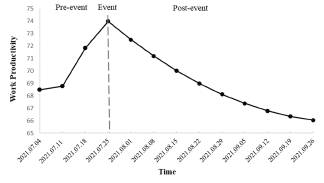
H1b posits that the decline after a crisis in work productivity will gradually slow down (potentially leading to recovery) over time. As shown in Table 3, after the event, employee work productivity showed a significant absolute decline (γ = − 1.53, p < 0.01), with a significant quadratic term (γ = 0.07, p < 0.01). The average trajectory of work productivity across all participants during the 13 weeks demonstrated a possible U-shaped trajectory after the event, as shown in Figure 1. Productivity first decreased and then slowed down the decrease. Thus, H1b was supported.
Trajectories of work productivity over the course of the 13 weeks

The moderating effects
The analysis of the main effects at Level 1 mainly describes the trajectory of employee work productivity over time. To test H2a and H2b, Level-2 (between-person) predictors were added to test how individual differences influence changes in work productivity trajectories over time.
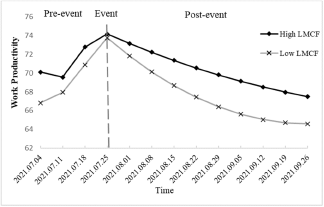
H2a suggests that for those employees whose LMCF is higher, work productivity will decrease less after a crisis event – the estimates of LMCF*POST.SQ interactions were significant (γ = −0.00, p < 0.05; Table 4). To interpret the resulting interaction, the trajectories of employees with high LMCF levels (+1SD) were potted alongside those of employees with low LMCF levels (−1SD). As depicted in Figure 2, after the crisis event, employees with higher LMCF showed a slower decreasing trend in productivity than those with lower LMCF. Moreover, the inflection value occurred at a lower level of work productivity when the LMCF was low (64.05) compared to the cases when the LMCF was high (inflection value = 68.74). H2a was thus supported.
Moderating effect of leader–member communication frequency (LMCF) on work productivity trajectory

Moderating effects of level-2 predictors on work productivity trajectory

Notes: *p < 0.05, **p < 0.01, ***p < 0.001. LMCF = leader–member communication frequency. −2LL: −2log likelihood; AIC: Akaike Information Criterion; BIC: Bayesian Information Criterion.
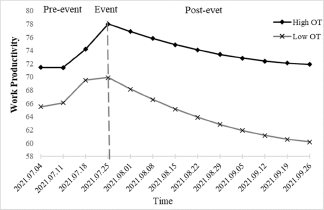
H2b indicates that the adverse effects of a crisis event on employees’ work productivity will be stronger for employees with shorter OT. The results in Table 4 showed that there was a significant OT*TRANS interaction (γ = 0.70, p < 0.01), indicating that, during event onset, there was a significant difference between high OT and low OT cases. However, after the event, the interactions between OT and time variants were insignificant (OT*POST: γ = 0.13, n.s.; OT*POST.SQ: γ = −0.01, n.s.; Table 4). Figure 3 depicts the temporal trajectory plotted for higher (+1 SD) and lower (−1 SD) levels of OT. The figure illustrates no significant difference in the decreasing trends between high OT and low OT cases. However, it also can be seen from Figure 3 that the inflection value occurred at a higher level of work productivity when OT was high (inflection value = 71.79) relative to that seen at low levels of OT (inflection value = 59.80). H2b was thus partially supported.
Moderating effect of organizational tenure (OT) on work productivity trajectory

Discussion
Analysis of longitudinal objective data from a large corporation’s OA system uncovered a distinct productivity trajectory: a marked initial decline followed by sustained deterioration during the crisis. Among the investigated moderators, LMCF and OT were hypothesized to shape productivity patterns, potentially attenuating crisis impacts. Notably, although OT demonstrated significant buffering effects at crisis onset, its moderating effect decayed progressively throughout the crisis timeline. This attenuation suggests that the systemic disruption caused by China’s Double Reduction Policy may have neutralized the conventional protective benefits of accumulated organizational experience.
The limited temporal efficacy of OT raises critical implications for crisis management theory. First, it challenges assumptions about the transferability of historical organizational knowledge during unprecedented disruptions. The crisis’s distinctive attributes – including its sector-spanning scope, regulatory abruptness, and magnitude of institutional upheaval – appear to have created discontinuity conditions where prior experience offered diminishing returns. Second, this finding implies that crisis typology mediates the value of tenure. In high-velocity, multi-domain crises characterized by regulatory shocks (such as the Double Reduction Policy), institutional memory may become less predictive of adaptive capacity than real-time sensemaking or leadership responsiveness.
In addition to hypothesis testing, our investigation extended to mapping productivity trajectories during the precrisis period, revealing a slight upward trend preceding the crisis onset. As shown in Model 4 (Table 3), while the linear term (TIME.A) proved nonsignificant (γ = − 1.11, p > 0.05), the quadratic term demonstrated significant positive coefficients (γ = 1.4, p < 0.05). A plausible explanation rooted in the COR Theory (Hobfoll, Reference Hobfoll1989; Hobfoll et al., Reference Hobfoll, Halbesleben, Neveu and Westman2018) is that employees may enter a state of anticipatory vigilance when sensing impending industrial crises – such as forthcoming restrictive policies. This heightened awareness, often fueled by informal information networks and industry speculation (Seidel, Hannigan, & Phillips, Reference Seidel, Hannigan and Phillips2020; Zouaghi, Sánchez, & Martínez, Reference Zouaghi, Sánchez and Martínez2018), could drive temporary productivity surges as workers strategically ‘stockpile’ measurable achievements and financial gains before anticipated resource constraints (Halbesleben et al., Reference Halbesleben, Neveu, Paustian-Underdahl and Westman2014).
Notably, our quantitative evidence remains inconclusive regarding two critical aspects: First, we cannot definitively confirm this anticipatory mechanism by analyzing the existing data. Second, while we theorized that crisis-induced resource depletion triggers emotional/cognitive cascades affecting productivity, no direct evidence emerged from our quantitative analyses. To address these limitations and explore alternative mechanisms connecting crisis dynamics to work outcomes, we implemented a sequential mixed-methods design. The qualitative phase involved semi-structured interviews with 22 employees, focusing on participants’ lived experiences of (1) perceptual and behavioral shifts during crisis progression and (2) how leader communication patterns and OT moderated these adaptations. This methodological triangulation enhances ecological validity while enabling systematic examination of psychological processes that quantitative models alone could not capture.
Study 2
Sample and Procedure
We conducted interviews with 22 individuals who had experience in the off-campus tutoring industry and had undergone the implementation of the Double Reduction Policy. The participants were selected using a snowball sampling technique, starting with initial recruits from a professional MBA program and expanding through recommendations from the MBA students. The interviews were transcribed, with an average duration of approximately 30 minutes. The interviewees had an average age of 28.55 years (VAR = 7.73), and 77.3% were female. Among the interviewees, the majority (63.6%) were employees affected by the ‘Dual Reduction Policy’, including 16 employees, 3 junior managers, 2 middle managers, and 1 senior manager. The duration of their employment with the company ranged from 10 months to 13 years. The interviewees represented various positions: teachers, sales and operations personnel, product business managers, human resources professionals, and CEOs. Among them, six interviewees are from the company we investigated in Study 1 to better understand their experiences, feelings, thoughts, and adaptive behaviors during the crisis. To strengthen the generalizability of our findings, we expanded our sample to include employees from various companies within the off-campus training sector. This is because while the Double Reduction Policy impacted the entire industry, how different companies and their employees responded to the crisis could vary. By expanding our sample, we could capture a broader range of behaviors and psychological responses and distill the common patterns among employees across different companies.
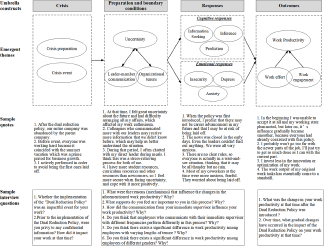
We created an interview protocol to facilitate discussions on the influence of the ‘Double Reduction Policy’ on working productivity and its reasons. First, we inquired whether the interviewees considered the implementation of the ‘Double Reduction Policy’ as a significant event in their work and career development. Next, we sought to understand how the policy affected their work productivity and the underlying mechanisms by asking questions such as: How did the implementation of the Double Reduction Policy impact their work? How did these influences change? What were the reasons behind these changes? Additionally, we asked specific questions regarding boundary conditions. The responses from the interviews were thematically analyzed using established methods (Lee, Reference Lee1999; Miles & Huberman, Reference Miles and Huberman1994). The resulting themes were categorized into five umbrella constructs: crisis, perception, boundary conditions, responses, and outcomes (Figure 4).
Results of thematic analyses (qualitative study)

Major Findings
Perception of the implementation of the Double Reduction Policy as a significant event
We asked interviewees whether the policy affected their work, to which 95% confirmed its significance. For instance, interviewee 11 stated, ‘Yes, after the implementation of the Double Reduction Policy, our entire company was abandoned by the parent company’. Interviewee 10 mentioned, ‘The impact of the Double Reduction Policy on my work was significant because I couldn’t see a clear direction for my career development’.
Effect of the Double Reduction Policy on employee productivity before the crisis
To explore the trend of employee work productivity prior to the event, we inquired about the attitudes and behaviors of interviewees before the policy’s implementation. Specifically, we asked whether they had access to any confidential information and how it influenced their work during that time. Of the interviewees, 86% admitted receiving some information related to the forthcoming government policy aimed at restricting the off-campus tutoring industry before the enforcement of the Double Reduction Policy. However, they indicated that the messages they received were vague and general. Moreover, most interviewees stated that the actual impact of the policy on the industry exceeded their initial expectations based on the confidential information. For instance, some interviewees mentioned, ‘At first, I didn’t think this event was severe because, over the years, our country has also issued many similar policies that did not hurt our industries too much (Interviewee 4)’.
Furthermore, some interviewees even anticipated a positive effect on their companies based on the information they received. For instance, interviewee 18 stated, ‘I anticipated that the implementation of future policies would regulate the development of small training institutions, which would positively affect the larger company’. As a result, a majority of interviewees (68%) recalled that before the official announcement, their work productivity either remained consistent, particularly during summer – the peak period for business growth – or was higher than usual because they made an extra effort to avoid being laid off in the first place. For instance, interviewee 9 mentioned, ‘Before the event, everyone was working hard because it coincided with the summer vacation, which was a prime period for business growth’. Additionally, some interviewees expressed, ‘I actively performed to avoid being the first ones laid off’ (interviewee 16). These quotes explain the increased employee productivity leading up to the crisis, primarily driven by the employees’ information-seeking, inference, and prediction based on the available information they received.
Effect of the Double Reduction Policy on employee productivity upon and after the crisis
We inquired about the impact of the Double Reduction Policy on interviewees’ work productivity. All interviewees expressed a noticeable decline in their work output due to the event, demonstrating a significant downward trend in productivity. Consistent with the findings from Study 1, most interviewees described the decline in work productivity as a gradual curve rather than a linear descent. This trend was primarily attributed to employees gradually adapting to and enduring the negative consequences of this catastrophic event. For example, interviewee 18 mentioned, ‘While initially shocked by the strict policy, I gradually adapted to it’. Similarly, interviewee 13 stated, ‘In the beginning, I was unable to accept it, and my working state plummeted. However, the impact became smoother over time as everyone learned to coexist with this policy’.
We further explored the underlying mechanisms responsible for the changes in work productivity. Most interviewees emphasized that the sudden implementation of the Double Reduction Policy induced significant uncertainty regarding future work prospects, company operations’ direction, and even personal career development. This uncertainty led to resource depletion, which, in turn, negatively influenced their work productivity. Interviewee 1 highlighted, ‘During that time, I felt great uncertainty about the future and had difficulty managing my affairs, which affected my work energy and enthusiasm’. Therefore, the main reason for the gradual change in the downward trend of productivity can be attributed to the increase in uncertainty and resource loss. To manage this uncertainty and resource depletion, interviewees mentioned several responses that could be categorized into two aspects: cognition and emotion.
Regarding cognitive responses, employees employ various strategies, such as seeking information to reduce uncertainty and gain resources, figuring out ambiguous or incomplete information, and making predictions based on available information to generate expectations about the future. Interviewee 18 mentioned, ‘When the policy was initially implemented, I anticipated the potential absence of career advancement opportunities and the looming risk of being terminated from employment’. In terms of emotional responses, prevalent feelings included insecurity, depression, and anxiety. For instance, interviewee 10 mentioned, ‘Most of my coworkers at the time were more anxious and fearful. They worried about being laid off’.
Boundary conditions of the effect of the crisis event
To explore the boundary conditions, we asked, ‘How did communication from your immediate supervisor influence your work productivity and why’? Most participants recognized the positive effect of communication from their immediate supervisors in mitigating the adverse effects of the catastrophic event on their work. For instance, interviewee 9 shared, ‘During that period, I frequently engaged in conversations with my direct supervisor during meal breaks. I believe this facilitated a stress-relieving process for both of us and ultimately improved our work performance’. Moreover, interviewee 11 affirmed, ‘Colleagues with more communication with their supervisors had access to previously unknown information, which allowed for a better understanding of the situation’. Through careful analysis and summary of the interview data, we discovered that regular communication from immediate supervisors positively influenced employees’ responses to catastrophic events by providing social support, information, and motivation that alleviated emotional distress.
Moreover, we asked, ‘Do you believe there is a significant difference in work productivity among employees with different tenures and why’? Among the interviewees, 64% believed that employees with longer tenures at the company, compared with the ones with shorter tenures, would demonstrate higher work productivity after experiencing the catastrophic event. For example, interviewee 13, who has served the company for 13 years, mentioned: ‘At that time, my enthusiasm for work remained unchanged, although my mindset did undergo some shifts’. By contrast, employees with shorter tenure are more likely to experience negative emotions such as depression, anxiety, and panic. For instance, interviewee 2, with an OT of 10 months, noted: ‘Psychologically, it’s quite evident that everyone is feeling uneasy, and the crisis has a significant impact on mental stability’. The primary rationale behind this belief is that employees with longer tenures have made substantial investments in the industry and the company, leading to higher switching costs and a greater sense of dedication.
Additionally, compared with employees with shorter tenures, they perceive a lower risk of job loss and possess a deeper understanding of the company’s situation. These factors contribute to more positive interpretations and predictions of the event and a higher level of certainty about the future. For instance, interviewee 13 stated, ‘Employees with longer tenures, who have spent significant time in the education industry, may feel limited to working within this industry’. Likewise, interviewee 15 mentioned, ‘Employees with longer tenures may have access to more student resources, curriculum materials, and other resources than newcomers. As a result, they have more resources and may feel more secure when faced with uncertainty and handle it more positively’.
Discussion
Our hypotheses received support from the qualitative study, which also provided further insights into the mechanisms underlying the findings of Study 1. Through the interviews, we gained a deeper understanding of employees’ work productivity trajectories before and after the crisis event. The content of these interviews broadly aligns with the COR Theory, emphasizing that catastrophic events induce resource loss among employees, subsequently influencing their cognitive and emotional responses, work behaviors, and productivity (Figure 4).
General Discussion
This research delves into the evolving effect of external crises on employee work productivity, anchored in the theoretical foundation of COR. We hypothesized a curvilinear trajectory in employees’ work productivity after a crisis event and examined the role of resource factors in shaping this trajectory. The findings from one quantitative study and one qualitative study largely validate our initial hypotheses, revealing a discernible pattern where work productivity experiences an initial decline following the crisis, only to slow down gradually over time. Notably, the study identifies LMCF and OT as critical factors that mitigate the adverse effects of the crisis on work productivity. Specifically, it was observed that employees who engage in frequent communication with their leaders and those with extensive OT exhibit a robust capacity to manage uncertainty and replenish resources. Consequently, their work productivity is less adversely affected in the immediate aftermath of a crisis and demonstrates a slower rate of decline, underscoring their enhanced ability to navigate and adapt to resource depletion in the face of crises.
Theoretical Implications
This research has several important theoretical implications. First, it broadens the knowledge in the crisis management literature by adding to the limited empirical investigations of employees’ work productivity trajectories before, during, and after an external crisis event. Existing research has examined changes in employees’ emotions and behaviors in times of crisis, including effects on goal progress (Yoon et al., Reference Yoon, McClean, Chawla, Kim, Koopman, Rosen, Trougakos and McCarthy2021), creativity (Yoon et al., Reference Yoon, McClean, Chawla, Kim, Koopman, Rosen, Trougakos and McCarthy2021), emotional experiences (Slaughter, Gabriel, Ganster, Vaziri, & MacGowan, Reference Slaughter, Gabriel, Ganster, Vaziri and MacGowan2021), employee exhaustion (Meyer, Zill, Dilba, Gerlach, & Schumann, Reference Meyer, Zill, Dilba, Gerlach and Schumann2021), work–family conflict and enrichment (Vaziri, Casper, Wayne, & Matthews, Reference Vaziri, Casper, Wayne and Matthews2020), job satisfaction (Markovits, Boer, & van Dick, Reference Markovits, Boer and van Dick2014), and job search behavior (McFarland, Reeves, Porr, & Ployhart, Reference McFarland, Reeves, Porr and Ployhart2020). However, the trajectories of work productivity, which reflects the efficiency and effectiveness with which employees complete their work tasks in a crisis, have been previously relatively unexplored, notwithstanding its importance in organizational change studies and the overall crisis management literature (Jundt, Shoss, & Huang, Reference Jundt, Shoss and Huang2015).
Furthermore, our study breaks new ground by examining employee responses before the onset of a crisis. This extension of our analytical lens reveals the comprehensive range of productivity fluctuations across a crisis timeline. By shedding light on the anticipatory behaviors employees exhibited before a crisis, our research uncovers a dimension of crisis management that has been largely overlooked. This novel insight into precrisis preparatory actions provides a deeper understanding of how employees and organizations can proactively manage uncertainty and mitigate the potential negative impacts of future crises.
Second, this study contributes to the existing research on productivity (or performance) dynamics by demonstrating how work productivity varies within individuals across different phases of a crisis. Recent research on performance has indicated a burgeoning interest in the within-person performance variability over time, particularly the performance fluctuations on a short-term basis, such as day-to-day and week-to-week variations in employee performance (e.g., Campbell, Reference Campbell, Dunnette and Hough1990; Dalal, Alaybek, & Lievens, Reference Dalal, Alaybek and Lievens2020; Sturman, Cheramie, & Cashen, Reference Sturman, Cheramie and Cashen2005; Van Iddekinge, Aguinis, Mackey, & DeOrtentiis, Reference Van Iddekinge, Aguinis, Mackey and DeOrtentiis2018). Despite the recent evidence showing that performance fluctuates significantly over short timeframes such as days and weeks (Abdulsalam et al., Reference Abdulsalam, Maltarich, Nyberg, Reilly and Martin2021; Hendricks et al., Reference Hendricks, Hancock, Caldas, Ostermeier and Cooper2024; Liu, Zheng, Lee, Yu, & Zhang, Reference Liu, Zheng, Lee, Yu and Zhang2023), there is still a lack of a comprehensive understanding of how the performance dynamic is influenced by external event and what factors can positively spur the dynamic before and after the external event with an exception of Liu et al. (Reference Liu, Zheng, Lee, Yu and Zhang2023) demonstrating the impact of the COVID-19 pandemic on employee job performance trajectories. Our study augments the emerging streaming of research by theorizing and empirically demonstrating that personal (LMCF) and social (OT) resources are critical in mitigating the adverse effects of the external crisis on within-person performance variation over time.
Third, this study makes a methodological contribution to the extant literature by producing indices of workplace behaviors (work productivity and leader–member communication) using accurate records of behaviors from ESM or OA. In the modern digitalized workplace, employers have access to large databases on employee behaviors and organizational performance that may be used by researchers. The large volume and high-velocity data gained from office software servers can give researchers more opportunities to measure work-related constructs more accurately (Wenzel & Van Quaquebeke, Reference Wenzel and Van Quaquebeke2018). However, scientific analysis using such data remains inadequate. Specifically, most work productivity research has relied on self-reporting or supervisor-reporting surveys for data collection (Straus, Uhlig, Kuhnel, & Korunka, Reference Straus, Uhlig, Kuhnel and Korunka2023). Ongoing research should make good use of server-side data to enrich the understanding of employee work productivity, and this approach, as exemplified in the current work, can also inspire future studies in which researchers can utilize objective behavioral records to make more accurate analyses.
Practical Implications
The findings of this study provide potential avenues for interventions to mitigate the adverse effects of the external crisis on employee outcomes, mainly work productivity. A significant discovery from this study is the buffering effect of LMCF on any decline in employees’ work productivity post-crisis. This finding should encourage organizations to recognize the crucial role of leaders in managing external crisis events. We recommend that organizational leaders at all levels demonstrate empathy, sensitivity, and concern toward employees through regular communication during and after crises. They should acknowledge that employees tend to desire more support and information during times of uncertainty. In the event of an external crisis, we highly advise leaders to take the time to understand the struggles faced by their employees by acknowledging their perspectives and appreciating their efforts to overcome challenges (Tao et al., Reference Tao, Lee, Sun, Li and He2022). Additionally, organizations should provide communication training for leaders to improve their ability to communicate effectively with their followers during turbulent times. Moreover, leaders should strive to become attuned to their employees’ evolving concerns and provide constructive feedback to dispel ambiguity (Tao et al., Reference Tao, Lee, Sun, Li and He2022).
In addition, this study reveals that employees with shorter OT might be more susceptible to the effects of an external crisis. Organizations should thus pay particular attention to these employees during times of crisis and take steps to enhance their productivity. Organizations may seek to establish clear and easily understandable work procedures and guidelines to address the crisis. They can then maintain transparent communication with employees regarding personnel decisions that may affect their job security, thus reducing uncertainty for these employees. They may also implement adaptive measures such as providing transparent information and fostering a culture of organizational support. Such measures may reduce employees’ feelings of uncertainty, help them gain resources, and mitigate the negative impact of the crisis.
Limitations and Future Directions
Several limitations and directions for future research should be noted as arising from this study. First, the hypotheses were tested in the context of external crises that emerged from the Double Reduction Policy. To further test and expand the applicability of the model, future studies should seek to replicate the results in other crisis scenarios. In addition, the hypotheses were tested in a single organization. Although this approach was intended to rule out the potential influences of industry- or organization-level characteristics that might affect work productivity trajectories, it limited the ability of this study to test the effects of organization-level factors that might moderate trajectories of work productivity. For example, organizations that experience challenges regularly may develop a greater capacity to deal with the disruption created by a crisis event, allowing employees to find it easier to adapt to the related organizational changes. To better understand the generalizability of these findings, future researchers are thus advised to investigate the changing patterns of work productivity in different settings.
Second, in the present study, data were collected for a period of 13 weeks. Although the curvilinear shape of employees’ work productivity changed after a crisis event was observed, the data only showed the potential for productivity recovery. Thus, It was unknown whether they could bounce back and which level of work productivity employees could recover. The 13 weeks of data provided a window through which to observe the initial crisis and the variability of employee productivity; it restricted the capacity to test the longer-term effects of a crisis event and capture the changing process of productivity. The longer-term effect of a crisis event may easily outlast such a window. A crisis event may even have a positive effect on longer-term employees’ work productivity, with work productivity changing to a higher level than precrisis over a sufficient period if the crisis has offered employees the opportunity to learn about and improve themselves. Data collected over a more extended period would enable a more accurate and comprehensive mapping of the changes in work productivity triggered by a crisis event.
Third, future studies could benefit from an in-depth analysis of the content of leader–member communications, specifically regarding the expression of empathy and other supportive behaviors, which likely play a critical role in influencing employee productivity during times of uncertainty. Unfortunately, our access to the specifics of communication content was limited, precluding a more detailed examination of how various aspects of communication influence productivity. This limited access represents a missed opportunity to gain insights into the intricate dynamics of leader–member interactions and their effect on employee resilience and adaptation in the face of a crisis.
Finally, this study focuses on the moderating roles of LMCF and OT, yet other variables that could reduce uncertainty and gain resources may be relevant in a crisis (Judge, Reference Judge2009). Future research could consider additional job resource-related factors and extend the model by incorporating crisis-specific variables to inform predictions. Such additions would then contribute to the development of a more comprehensive understanding of employees’ psychological and behavioral responses during organizational crises.
Conclusion
This study applied the COR Theory to explore the trajectories of employees’ work productivity in times of an external crisis. Our analysis of longitudinal objective behavior data from a large company’s OA system demonstrates that employees’ work productivity sharply declines initially and gradually slows down the decline with time. Moreover, LMCF and OT might influence such a trajectory because they can help manage resource loss to buffer against the negative effects of the crisis event on employees’ work productivity. Complementing our quantitative analysis, we conducted a qualitative study that delved into the psychological processes employees navigate during a crisis. This exploration provided more profound insights into the coping mechanisms and adaptive strategies. Collectively, our findings contribute to the crisis management literature by illustrating the dynamic effects of crisis events on work productivity and highlighting the importance of strategic communication and experiential knowledge in fostering organizational resilience. This study not only advances theoretical understanding within the framework of COR but also offers practical implications for leaders seeking to mitigate the effect of crises on employee productivity.
Jingzhou Pan (pjzh@tju.edu.cn) is a professor at Tianjin University’s College of Management and Economics. His research focuses on interpersonal relationships, leadership and team, employment and career management. To date, he has published over 40 papers in both Chinese and English journals, including Journal of Applied Psychology, Personal Psychology, Journal of Organizational Behavior, Human Resource Management, and Journal of Vocational Behavior.
Yueting Ji (jiyueting@cufe.edu.cn) is an associate professor at the Business School of the Central University of Finance and Economics. Her research interests include personality, creativity, and employee well-being, with a particular focus on how emerging technologies – such as digital human resource management and artificial intelligence – transform the workplace and influence employees. She has published in top-tier journals, including the Journal of Applied Psychology and Personnel Psychology.
Wenrui Cao (18202669663@163.com) is an assistant professor at the School of Economics and Management, Beijing Jiaotong University, China. She received the PhD in organizational psychology from Utrecht University, the Netherlands, in 2022. Her research focuses on leadership, forgiveness and negative workplace behaviors, including aggression, bullying, and customer mistreatment. Her work has been published in academic journals such as the Journal of Business Ethics.
Jia (Jasmine) Hu (hujia@sem.tsinghua.edu.cn) is the Citi chair in international business and a professor of management at Tsinghua University. Previously, she was a tenured full professor of management at The Ohio State University. Her primary research interests focus on understanding prosocial leadership in teams and how digital technology use influences leadership and employee well-being. Her work has been published in leading management journals, including the Academy of Management Journal and Journal of Applied Psychology, and has been cited over 10,000 times.