Introduction
Why make an image so large that it is difficult to see? I am not talking here about the merely monumental. Mount Rushmore is very big, but if you stand in an appropriate spot it is still possible to take it all in. Instead I mean images whose excessive scale actively constrains viewing them. Such is the case for the subject of the present article—the geoglyph traditions of the ancient Nasca—where we encounter extremely large icons inscribed onto relatively flat landscapes. The very notion of icons that are hard to see can seem an ‘exotic’ one, at least when considered within the norms of Western visual culture. It runs counter to the typical art gallery experience, where patrons are provided with airy and well-lit halls in which to inspect individual works closely, without obstruction or clutter. Yet clearly not all iconographic traditions seek such ease of perception. Indeed, it has long been noted that some of the oldest images ever produced by our species, the rock art of Upper Palaeolithic Europe, was placed in the darkest and most inaccessible recesses of caves—as if some feat of endurance was a necessary prerequisite for viewing them.
For archaeologists, it is quite common to encounter iconographic traditions where easy access was clearly not a priority. And yet the discipline's recording methods often obscure this very fact. As Mary Weismantel (Reference Weismantel and Watts2013) argues, we have a tendency to dematerialize the artefact as a precondition for its analysis. Thus the incisions on a carved stone outcrop encountered in the field are transformed into a series of crisp, two-dimensional lines printed on a sheet of paper, all the better to pore over at our leisure. But in making these more amenable facsimiles, in which the iconography is extracted from its original physical context, it is easy to miss the point. In other words, our recording practices reinforce a separation between content and medium, with the latter often rendered little more than an afterthought.
Writing specifically of the Peruvian site of Chavín de Huantar and its sculpted subterranean monoliths, Weismantel (Reference Weismantel and Watts2013, 25) describes the dark and cramped spaces in which one had to approach these objects and the difficulties inherent in trying to make out their low-relief carvings—especially in the dim light. She says that:
unlike realist painting or documentary photography, in which the moment of identifying the image is so immediate that we do not even notice it, Chavín delays the moment of recognition. This slowed temporality makes the viewer aware of the physical and cognitive effort involved, and thus creates conscious seeing: seeing that sees itself. (Weismantel Reference Weismantel and Watts2013, 27)
Here, Weismantel is drawing attention to the fact that for the architects of Chavín, it was a very deliberate and conscious choice to make their iconography so difficult to apprehend. Such imagery therefore demanded a distinctive mode of embodied perception, one quite unlike that of the modern gallery patron observing a well-lit and nicely framed objet d'art.
Dark and constricted spaces are but one way of making an image difficult to see. Making it ‘excessively large’ produces a rather different form of inaccessibility. And if one wants to scale up an image, it is hard to find a more expansive canvas than the earth itself. Thus the basic question I seek to explore in this paper is: why make a geoglyph? More specifically, why use a medium that permits image creation on a scale so grand that it actually inhibits viewing? My approach here is not so much geared towards understanding iconographic content, but rather the material forms of its expression. Put another way, the aim is the comparative study of media rather than iconography. Many scholarly currents converge on such a project, cutting across several distinct disciplinary domains, and it is impossible to offer anything close to a review here. Following Marshall McLuhan's ([1964] Reference McLuhan2001) work in particular, the topic of ‘media’ has been high on the scholarly agenda for over half a century now. That said, the situation varies considerably depending on the field. As Matthew Engelke (Reference Engelke2010) discusses, it is only quite recently that Religious Studies underwent a ‘media turn’. Whereas media was once an epiphenomenon in analysing religion, seen as little more than a communicative vessel for conveying content (i.e. beliefs), it is now given a much more agentive role (Horsfield Reference Horsfield and Morgan2008, 111–13). Of particular concern is the materiality of the medium itself, so that it makes a substantive difference if a sermon is circulated via shared cassette tapes, say, as opposed to being broadcast over the radio (Hirschkind Reference Hirschkind2006). In a similar vein, we might ask what difference is made when an image is conveyed through geoglyphs, as opposed to ceramics, textiles or rock art. My arguments here will build on this recent turn towards the study of religious media, as opposed to more traditional foci like belief or iconography.
Archaeologies of media
The current discourse on media (religious or otherwise) operates with rather narrow chronological horizons. It is a conversation where the things called ‘old media’ are in fact rather new, and include technologies as recently invented (archaeologically speaking) as printed books, cinema and the transistor radio. Also, the rise of the new (i.e. digital) media does not necessary bring about the obsolescence of the old. After all, there are more printed books being produced today than at any point in history. So the old media remain familiar to us, even if substantially reconfigured by the rise of the new. And crucially, they remain clearly legible as media. Archaeologists, however, often have to work on a more complicated terrain, where what counts as a medium is not always obvious. To illustrate this, consider the remarkable investment made by the denizens of Neolithic Çatalhöyük in the elaborate interiors of their houses. The inhabitants of this ancient site produced highly complex three-dimensional collages, where the skulls of bulls, zoomorphic friezes and painted images were all set within a highly malleable matrix of clay plaster (Weismantel & Meskell Reference Weismantel and Meskell2014). Thus the material opportunities afforded by the then innovative technology of plastered architecture profoundly transformed the lives of Çatalhöyük's occupants. Even walls were new media once.
It seems to me that the foundation of any comparative analysis should be the materiality of the media themselves. Every medium has its particular set of physical affordances, technical histories and associated values. Different media permit one to do different things. A textile can be worn, while a pot cannot. Pots and textiles can be carried about, or kept in the house, whereas a petroglyph is fixed to a specific point in the landscape. Petroglyphs, pots and textiles all endure, but a dance exists only in the moment of its performance. But it is not just the material facets of the medium that are important to consider. In certain traditions, the materiality of certain media is itself a source of much intellectual reflection, and could even be said to be imbued with its own particular ‘metaphysics’.
One famous example of this is seen in the cosmographic sand paintings associated with Tibetan Buddhism (mandalas). Painstakingly created by groups of monks using tiny pieces of coloured rock, these elaborate representations are normally swept away as soon as they are completed. The ephemerality (coupled with the intricacy) of the medium thereby reflects a metaphysical concern with the impermanence of all things within Buddhist thought. The destruction of such an image, even and especially when it is so beautiful, is therefore an object lesson in the suffering that arises from material attachments (Bryant Reference Bryant2003). Similarly, the stained-glass windows that are so typical of Christian religious architecture reflect an abiding theological concern with natural light. The first words spoken by the divinity in the Christian Bible are ‘let there be light’ and the equation of God with light is a constant refrain in Christian thought. Thus the dramatic luminosity produced within the Gothic cathedral was not lost on contemporary commentators, including one thirteenth-century bishop, William Durandus, who said that the ‘glass windows in a church are Holy Scriptures, which expel the wind and the rain, that is, all things hurtful, but transmit the light of the True Sun, that is, God, into the hearts of the Faithful’ (1286, cited in Bychkov Reference Bychkov and Bergmann2009, 42). Understanding the metaphysics (or philosophy or theology; whichever term seems most appropriate) of a given medium is often necessary to grasping why it endures within a particular ritual tradition. What, then, are the ‘metaphysics’ of the geoglyph in the ancient Americas? What is the fundamental logic of using the landscape itself as a medium for iconography?
The historical specificity of the geoglyph
It is important to recognize that the geoglyph is not as universal as some other media, and actually has a fairly restricted occurrence in time and space. In fact, geoglyphs are largely found in the Americas, and there are relatively few known examples from the Old World, at least prior to the modern age. However, this relative lack of prehistoric geoglyphs outside the New World is seldom appreciated, in part because of the rather loose way in which the term ‘geoglyph’ is used. First, let us consider only figurative geoglyphs, meaning those that were intended to represent some kind of living being, such as a human or animal. The Uffington White Horse, carved into the chalk uplands of southwestern Britain, is the only confirmed example of a prehistoric geoglyph in Europe (Pollard Reference Pollard2017, 406). Almost all of the other British chalk figures are known to have been created within the last few centuries. In fact, besides the Uffington White Horse, just one other chalk figure is a serious (if disputed) candidate for having ancient origins: the Cerne Abbas Giant. Whereas the prehistoric age of the Uffington White Horse is now widely accepted, absolute dating methods have failed to demonstrate the antiquity of the Cerne Abbas Giant, and the oldest written record of the figure is only from ad 1742 (Bettey Reference Bettey1981). Moving away from Britain, the first prehistoric figurative geoglyph from continental Eurasia has just recently been confirmed. Although its precise date is unclear, initial studies of a geoglyph depicting an antlered quadruped in the southern Urals suggest it was created sometime between the Eneolithic and the Early Iron Age (Grigoriev & Menshenin Reference Grigoriev and Menshenin2012).
So the entire landmass of Eurasia has thus far provided evidence for just two prehistoric geoglyphs that are figurative representations; and none at all have been identified from Africa. In contrast, we can point to thousands of such images from the ancient Americas. The most abundant are undoubtedly the effigy mounds of the Late Woodland Period, clustered in the American Midwest (especially southern Wisconsin). These mounds are largely zoomorphic in form, although some are anthropomorphic, and generally date between ad 700 and 1050 (Gartner Reference Gartner1999). Given that modern ploughing has destroyed many of these ancient earthworks, accurate numbers are difficult to gauge, but one conservative estimate by the Wisconsin Historical Society suggests that there are at least 3200 extant effigy mounds (Birmingham Reference Birmingham2009, 5–6). The desert regions around the Colorado River provide another distinct cluster of several hundred figurative geoglyphs (or ‘intaglios’) associated with Yuman-speaking societies, and were probably produced sometime during the final millennium of the pre-colonial period (Gilreath Reference Gilreath, Jones and Klar2007, 289). Hundreds more figurative geoglyphs are known from South America, with several major clusters occurring in the Nasca and Palpa regions of the Peruvian coast, and another in northern Chile (Briones Reference Briones2006). So to frame the matter in starkly quantitative terms, thus far around 99.95 per cent of all figurative geoglyphs from a confirmed prehistoric context have been identified in the Americas.
The situation with respect to non-figurative (i.e. geometric) geoglyphs is slightly less clear-cut, but the evidence still shows that such images are also mostly located in the western hemisphere. The one significant cluster of geometric geoglyphs from the Old World lies in the Turgai region of Kazakhstan. So far, around 60 of these earthwork features have been identified, ranging from 90 to 400 m in length. Absolute dates (obtained via Optically Stimulated Luminescence) indicate their construction took place around 800 bc, during the Early Iron Age of the Kazakh Steppe (Motuzaite Matuzeviciute et al. Reference Motuzaite Matuzeviciute, Logvin, Shevnina, Seitov, Feng and Zhou2016). However, several thousand geometric geoglyphs have been identified on the north coast of Chile alone (Briones Reference Briones2006, 13), far exceeding the total known for the entire Old World.
In assessing the distribution of geoglyphs, robust definitions are vital. Many archaeological features are often called ‘geoglyphs’, but do not deserve the label. For instance, the western deserts of the Arabian Peninsula exhibit hundreds of thousands of pre-Islamic stone structures that are referred to as the ‘Works of the Old Men’ by present-day Bedouin. These structures come in a wide range of basic forms (e.g. kites, pendants and wheels) and were produced over an immense stretch of time, from around 7000 bc until the Roman era (Kennedy Reference Kennedy2011). However, despite their striking geometric designs, it is not clear that any of them were intended to be images. For example, most archaeological interpretations see them as hunting traps, burial cairns, corrals or nomadic encampments (Kennedy Reference Kennedy2011). The hundreds of prehistoric enclosures identified across western Amazonia are another example of potentially misnamed geoglyphs. These (mostly circular or square) enclosures seem to have been ceremonial sites associated with feasting events, and perhaps the storage of aquatic resources during the rainy season (Pärssinen et al. Reference Pärssinen, Schaan and Ranzi2009, 1088–9). In many cases, it is only the fact that such features were first discovered through aerial observation that has led to them being called geoglyphs. Indeed, Pärssinen et al. (Reference Pärssinen, Schaan and Ranzi2009, 1087) explicitly reduce geoglyphs to the means by which they can be observed, saying they ‘can be defined as marks on the surface of the earth, whose dimensions make them better seen from above’. But it is specious to regard these constructions as geoglyphs simply because they form geometric patterns that are easily visible from the air. By that standard, almost any anthropogenic modification of the earth's surface could be deemed a geoglyph.
A similar problem arises in Valenzuela and Clarkson's (Reference Valenzuela, Clarkson and Smith2014) application of the term geoglyph to patterned features that arise through outdoor ceremonial activities, such as dance grounds. Such a definition is extremely broad, and so can only ever be applied arbitrarily. For instance, Valenzuela and Clarkson (Reference Valenzuela, Clarkson and Smith2014) do not consider monumental sites like Stonehenge or Avebury to be geoglyphs. But if ceremonial spaces like dance grounds are geoglyphs, I do not see how one could reasonably exclude the henges and stone circles of prehistoric Europe. The geoglyph category is therefore best reserved for intentional images, which have been created at a conspicuously large scale (i.e. where the landscape itself is the canvas). Rock art is comparable, insofar as it entails images set on natural surfaces, but normally exists on a much more modest scale. Earthworks, and other ritual modifications of the earth's surface, are often very large, but unless they are also deliberately created as images, they are not geoglyphs. While many ancient urban centres were laid out as cosmograms (e.g. Angkor Wat), and might therefore be considered large-scale images of a sort, it is unhelpful to conflate cities and geoglyphs. Geoglyphs are not settlements. If we do not use the term geoglyph in a suitably restrictive sense, we either dilute it of all useful meaning, or end up deploying it in an arbitrary fashion. Of course, reasonable disagreements might arise over whether or not something was intended by its creators to act as an image. But the imagistic status of a feature like the Uffington White Horse is surely beyond doubt. Whether Stonehenge was ever considered in such terms by its builders seems a much more speculative question, and one which requires us to stretch the boundaries of the term ‘image’. In any event, even if one were to insist that all prehistoric earthworks and stone alignments are images of a kind, it remains an undisputable fact that the vast majority of figurative geoglyphs are located in the Americas.
Not only are geoglyphs (properly defined) a predominantly American phenomenon, they also appear to be strongly associated with certain political contexts. So far as we can tell, hardly any great state, empire or urban culture produced geoglyphs. They were not made by the ‘high civilizations’ of the Americas, such as the Mississipians, the Maya, the Aztecs, the Tarascans, the Incas, the Moche, the Chimú or the Tiwanaku. Yet neither are any of the known geoglyph traditions associated with hunter-foragers (whether simple or complex). In fact, virtually all geoglyphs were produced by agricultural societies, and often by those that Americanist archaeologists have tended to describe as ‘middle-range’. The notion of middle-range societies is difficult to define, with Joyce Marcus (Reference Marcus2008, 257) calling it a ‘generic’ category, and Jérôme Rousseau (Reference Rousseau2006, 21) even describing it as ‘bland’. It is more a euphemism than anything else; a term for societies for which scholars have no other name, because they confound our evolutionary categories. They do not look like states and chiefdoms, but there is more than a hint of the ‘complex’ about them. They seem relatively egalitarian, yet they are evidently not ‘simple’ or ‘small-scale’. If geoglyphs were so common in the Americas, why did the ancient states of the New World exhibit such limited interest in them? And why were hunter-gatherer communities equally disinclined to produce them? They hardly require much in the way of specialized technological knowledge, and despite their size are not particularly labour-intensive. In principle, they could have been created at any time, and by any community, during the Holocene. And yet clearly they were not. In my view, there are specific political circumstances that often lend themselves to the creation of geoglyphs. As a medium they are not politically neutral, but rather enable a distinctively ‘anarchist’ approach to communal rituals—an idea which I will now explore with respect to the ancient Nasca.
Icons too large to be seen …
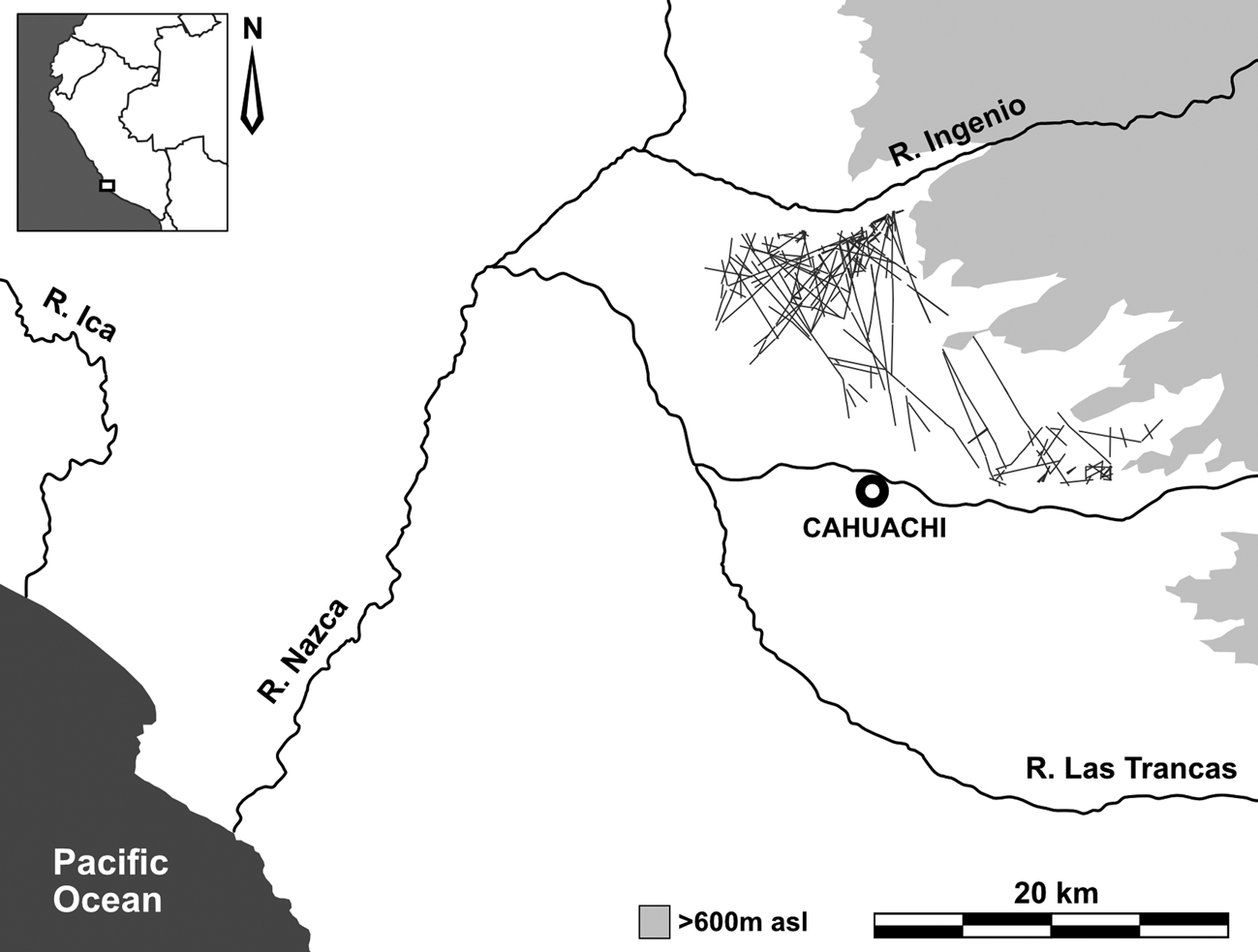
The Nasca geoglyphs are mainly found within the Rio Grande de Nazca drainage (and several adjacent valleys), located on the south coast of what is now Peru (see Figure 1). Although the geoglyphs seem to have been produced for over a millennium at least, the most intense phase of their creation was during the Early Intermediate Period (c. ad 1–700) (Silverman & Browne Reference Silverman and Browne1991; Silverman & Proulx Reference Silverman and Proulx2002, 174–5). The vast majority of the geoglyphs on the Pampa de Nazca are geometric, taking the form of straight lines and trapezoids; however a small portion of the total corpus, particularly a group of about 30, are clearly iconic in form. At least half of those are zoomorphic, including multiple species of bird, a fish, a monkey, a lizard, a dog, a spider and several killer whales—while others appear to represent local plant species, such as the huarango tree (Silverman & Proulx Reference Silverman and Proulx2002, 170). It is something of a myth that the Nasca Lines are invisible from the ground and could only be seen with the advent of aerial photography in the twentieth century. In fact the geoglyphs are typically quite visible on the surface, and some of the iconic examples can be viewed from nearby high points on the landscape (Proulx Reference Proulx, Silverman and Isbell2008, 581). But from the perspective of someone standing in the vicinity of the iconic geoglyphs on the Pampa de Nazca itself, the overall perspective is significantly distorted from a near-ground observation point (Silverman & Proulx Reference Silverman and Proulx2002, 180). One does not need to be airborne to see them, but it certainly makes it easier to make out their complete forms, especially with respect to the iconic motifs.
Map of the Nazca region. The general distribution of the Nasca Lines on the Pampa de Nazca is indicated.

Two points about the Nasca iconic geoglyphs are particularly important for my broader argument. The first is that after being made, they were not static images to be left in pristine isolation. Instead they were the foci of ongoing ritual activities, which likely took the form of group processions (Aveni Reference Aveni and Aveni1990b; Ruggles & Saunders Reference Ruggles and Saunders2012; Urton Reference Urton and Aveni1990). Nasca pottery is often found in association with the lines, some of which appears to have been deliberately smashed (Clarkson Reference Clarkson and Aveni1990, 140). The art historian W.J.T. Mitchell (Reference Mitchell2005) has argued that there are no purely visual media, since the other senses are always deployed to some degree. This would have been true for the Nasca geoglyphs insofar as they were apprehended through tactile experiences like construction and walking, just as much as they were viewed as icons (Aveni Reference Aveni and Aveni1990b, 37). On this point it is worth noting that since the earliest days of their scientific study, analogies have been drawn between the Nasca Lines and the ceques of the Incas (e.g. Mejía Xesspe Reference Mejía Xesspe1940). The ceques were a body of 41 or 42 lines that emanated from the Inca capital of Cuzco, and which were ritually marked in procession at certain times during the calendrical cycle (see Bauer Reference Bauer1998). Anthony Aveni (Reference Aveni and Aveni1990b, 43–87) has developed the most explicit comparison between the Nasca Lines and the ceques of the Incas, demonstrating that just as the Cusco ceques extend outwards from a central node, the lineal Nasca geoglyphs were laid out in a similar fashion. Aveni (Reference Aveni and Aveni1990a, vii) refers to this spatial patterning as ‘radiality’, which he regards as a specifically Andean way of structuring sacred space.
But as Bauer (Reference Bauer1998, 150) points out, one significant divergence between the two cases is that the Nasca Lines represent a multicentric spatial order (with over 60 distinct focal nodes, or ‘line centres’), whereas the Inca ceques were unambiguously ‘monocentric’, emanating solely from the Qorikancha temple complex in downtown Cusco. Another key difference lies in the fact that the ceque lines of the Inca were much more ‘imaginary’ constructs than were the Nasca Lines. In fact only the nodal shrines (or huacas) sited along the Inca ceques were materially elaborated in any visible form, with no formal paths laid out on the ground itself. Consequently, there is absolutely nothing in the Inca ceque system that compares with the representational character of the iconic Nasca geoglyphs. Whereas the ceque lines of the Incas were only intended to be walked, the Nasca glyphs were clearly made to be both walked and seen.
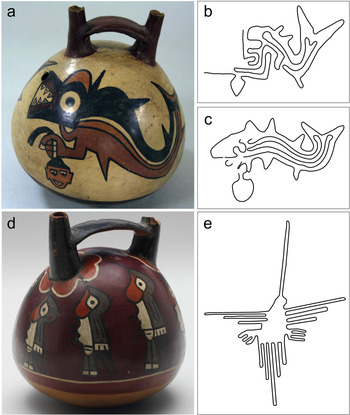
It is here that I arrive at my second point: the people interacting with the iconic Nasca geoglyphs would already have been quite familiar with the images through other media (Isbell Reference Isbell1978; Reinhard Reference Reinhard, Saunders and Montmollin1988). In other words, the figurative glyphs (especially the zoomorphs) were commonly represented in textiles and on painted ceramics, sometimes with precisely the same icons being produced. Parallels have also been drawn with petroglyphs in the Nazca region, leading to the suggestion that in the beginning, geoglyphs were an attempt to produce ‘rock art’ on a much grander scale (Lambers Reference Lambers2006). Good examples of this multimedia tendency are seen in Figure 2 with respect to the Mythical Killer Whale and the hummingbird, icons which often appear in both ceramic and geoglyphic media. So although processants would not have been able to perceive the iconic glyphs without distortion, they would have known precisely what they should look like. All the images were already familiar, then, albeit at the more manageable scale of textile and ceramic iconography. In that sense the Nasca geoglyphs were doubly iconic. They resembled living plant and animal species, but they also resembled the images of those species that circulated through more portable material culture. The experience of the glyphs would thus have entailed a contrast between the ideal representation that existed in the mind's eye and the distorted or imperfect view that could be achieved on the ground. In their study of a particularly labyrinthine (non-iconic) geoglyph cluster on the Pampa, Ruggles and Saunders (Reference Ruggles and Saunders2012, 1130) note that walking back and forth would have been ‘constantly disorienting’ for the processant. Similarly, trying to view an iconic image that should be recognizable, but which one cannot properly see due to its excessive scale, seems to be another way through which the Nasca geoglyphs made a virtue out of ritualized disorientation.
(a) Nasca vessel with a depiction of the Mythical Killer Whale and (b–c) the same image represented in two Nasca geoglyphs; (d) Nasca vessel depicting several hummingbirds and (e) the same animal depicted in a Nasca geoglyph. (Photographs: courtesy of the Metropolitan Museum of Art, New York.)

What, then, is the point of creating icons that were clearly a focus of intense ritual activity, but which were deliberately designed to offer each individual viewer a limited, partial or distorted perspective of the whole icon? In global perspective, this is actually a rather unusual way to experience iconography. Consider the contrasting case of the typical iconographic representations in an Orthodox or Catholic church (of Christ, the Virgin Mary, or one of the saints). Here the often life-sized divine image is placed in a visually prominent location, such as an altar, where the whole congregation can see it during mass. In a Salvationist religion, where each person is individually damned or saved, the aim is to foster one-to-one relations between the believer and the divinity through the latter's iconographic incarnation. Thus every worshipper looks directly upon the countenance of God or the saint (especially their eyes) and experiences the divine presence for themselves (Morgan Reference Morgan2012, 92). This is a highly individualistic mode of relating to an icon. For each worshipper, it appears that the deity is looking right at them. It is a practice entirely appropriate for a religion where each person is possessed of an immortal soul, and must be personally saved through his or her unique relationship to God.
The Nasca approach to the icon as manifest in the figurative geoglyphs points to a quite different logic. Even if a group of processing persons were to be distributed across different parts of the geoglyph, there is simply no ideal (terrestrial) vantage point for viewing it, and all possible perspectives would be equally distorted, albeit each in a slightly different way. Moreover, no one can be any ‘closer’ to the icon than anyone else, negating any potential for spatial hierarchy (unlike church icons). As one stands on top of an image on a planar surface, accurate perception is inversely related to scale. The larger the image, the more the lines that comprise it recede into the horizontal distance, becoming increasingly foreshortened and compressed—thereby increasing the distortion from the perspective of the viewing subject. Thus there are no ‘good pews’ in the case of the Nasca lines. It is almost as if the point of the iconic geoglyphs was to highlight the limitations of the individual human perspective. So rather than trying to capture the attention of some supernatural being looking down from on high—or extraterrestrials, as per some of the more outlandish interpretations—perhaps the imperfect view of the human processant was precisely the point. The geoglyphs force the human observer to contend with the partiality and limits of their own subjectivity. On this point we might also bear in mind the earlier discussion of how disorientation also seems to have been a deliberate aim within the overall design of geoglyphs. Thus there is a continuous gap, or tension, between the imagined image that one knows is there, and the real image that one is struggling to see.
It is a laborious way of viewing something, which bears some comparison with Weismantel's (Reference Weismantel and Watts2013) interpretation of the subterranean monoliths as Chavín. Yet the Nasca geoglyphs were not concealed underground, nor were they placed in cramped locations where only one or two individuals could hope to interact with them at a time. Here, it is also interesting to consider the figurative geoglyphs as icons that can better be experienced at an aggregate level, rather than individually. In other words, multiple individuals, positioned at different points around a geoglyph would have been able to visualize all of it collectively. No one person can view the entire image, but a group of people can—by sharing a series of complementary and overlapping, yet all still unique perspectives. It is a mode of ritual engagement that highlights the communal perspective at the expense of the individual, while simultaneously underscoring the finite and fragmentary nature of singular human experience. Although it is somewhat alien to Western perspectives, perhaps we need to imagine a ritual iconography where a shared understanding of the image was promoted and individualistic awareness was incompatible with the overall intent. And here I think we can begin to see something of the ‘metaphysics’ underpinning the Nasca geoglyph tradition, which seems markedly different from the more ‘priestly’ iconographic materialities of churches and temples. Just as a Tibetan mandala can be read as an object lesson in the fleetingness of beautiful things, the Nasca geoglyph created a ritual experience which valorized communal over individual perception. The icon was only fully seen through the eyes of the group acting in concert, rather than by any one person.
Anarchism and constitutionalism: placing the geoglyph in history
The distinctive political context of the Nasca Period is the key to understanding why the geoglyph phenomenon became so prominent at this time, and why it afterwards underwent a decline. The most important site during the Early Nasca era (c. ad 1–400) was Cahuachi (Orefici Reference Orefici2012; Silverman Reference Silverman1993), a pilgrimage centre with around 40 terraced platform mounds, all located within a monumental core about 25 ha in size (Silverman Reference Silverman1993). After several centuries of prominence, the site seems to have been partially abandoned sometime around ad 400, although mortuary activities persisted at several associated cemetery complexes for centuries thereafter (Schreiber & Rojas Reference Schreiber and Rojas2003, 16–17). But even at its height, Cahuachi was not an urban zone, despite providing a place where people from across the Nasca domain often congregated, probably for some form of regular ‘pilgrimage’ events (Silverman Reference Silverman1993, 300–317).
Interestingly, although Cahuachi was undoubtedly a ‘centre’, its internal structure does not exhibit all that much evidence for centralized authority (Silverman Reference Silverman and Aveni1990, 211). Some of the structures were evidently grander than others, but the 40 or so monumental platforms seem to imply a mosaic of broadly coeval socio-political entities. It has been suggested that many of the smaller monumental platforms were associated with specific kin groups, perhaps similar to the later Andean ayllu (Silverman Reference Silverman and Aveni1990, 231–6). Here we might contrast the Nasca with their Moche contemporaries to the north (see Silverman Reference Silverman and Aveni1990, 227), who certainly did live in urban communities and whose ritual activities were focused on singular monumental complexes that towered above the rest of the urban landscape (e.g. the Huaca del Sol). Moreover, the Cahuachi platforms are largely constructed from modified natural hills, which would have required much less labour in comparison with the massive adobe huacas built by the Moche. Although individual kin groups surely remained a structuring element in Moche society, there is little evidence for a desire to preserve or recognize their autonomy in public ritual spaces. This is effectively the opposite of the picture we see at Cahuachi, and presumably the reason the site had 40 ceremonial mounds rather than just one. Following Silverman (Reference Silverman and Aveni1990; Reference Silverman1993), I would suggest this pattern implies a relatively weak centralizing impulse and an active desire to hold multiple social groups within a kind of ‘balance of power’. The alternative—allowing one group to form a ruling stratum and subsume all major ritual activities under its supreme authority—was apparently not the path taken by the Nasca.
Moreover, despite clear signs pointing to the widespread sharing of iconography and ritual space, there is little evidence for social stratification during the Early Nasca Period (Silverman & Proulx Reference Silverman and Proulx2002, 243–9; Vaughn Reference Vaughn2006; Reference Vaughn2009). The rural communities of the Nasca were largely autonomous in their subsistence activities, and in material terms, it was mainly the ceremonial use of polychrome ceramics that bound the Nasca world together (Vaughn Reference Vaughn2005; Reference Vaughn2009). Nor does access to these decorated vessels seem to have been particularly restricted to any one social group, since they were widely distributed across settlements of all sizes (Vaughn Reference Vaughn2005). One can therefore think of the Early Nasca as typified by high levels of ritual integration, but with only limited political centralization and wealth differentiation. That said, the very existence of Cahuachi does imply a desire for some degree of centralization—why else construct the various platforms at a single location? But even so, the limited form of concentrated power we see at Cahuachi offers an interesting contrast with the Nasca geoglyphs themselves. It is almost as if there was a necessary balance to be struck, between the centripetal force exerted by Cahuachi and the radically decentralized and dispersed ceremonial activity represented in the Pampa geoglyphs. And here it is useful to emphasize that the period of Cahuachi's emergence as a pilgrimage site coincides with the first period of intense geoglyph production. In Silverman's (Reference Silverman1993, 318) excavations at Cahuachi, over half of the pottery sherds uncovered were from the Nasca 3 period (c. ad 200–400)—and in her separate study of the surface ceramics associated with geoglyphs along the River Ingenio, the first period which showed a major peak was also Nasca 3 (Silverman & Browne Reference Silverman and Browne1991, 218–19). My argument then is that these two phenomena (i.e. Cahuachi and the Pampa geoglyphs) were not just related to each other; but that they reflected ritual activities organized around the two opposing principles of centralization and decentralization. Thus the Pampa geoglyphs and the site of Cahuachi were deliberately intended to counterbalance each other in the overall constitution of the Early Nazca ceremonial order.
As was mentioned above, not only are the Nazca lines markedly multicentric, the 60-plus focal points were also non-contemporaneous. All chronological analyses agree that the lines were produced over several centuries, rather than as a synchronically planned landscape. So it seems new radial centres were continually rising and falling, with no focal point on the Pampa being able to dominate for very long. Indeed, as a ritual landscape, the Pampa de Nazca was about as multipolar as it is possible to conceive. The very scale of the Pampa itself (around 220 sq. km) would also have inhibited surveillance and control severely, especially when compared to Cahauchi. The existence of walls within Cahuachi's monumental core is likely to reflect some desire to restrict access to the platform mounds, but how could anyone have hoped to control ceremonial activities on the Pampa itself? If we think of the ritual spaces of the Moche cities as classically hierarchical, the material fabric of Cahuachi speaks to a much more heterarchical order (Silverman Reference Silverman2002, 13–14), where multiple social groups existed in a state of relative balance (see Crumley Reference Crumley2005). But if heterarchy is the more appropriate term for Cahuachi, then the Pampa geoglyphs go even further, and seem positively anarchist. Anarchism, it should be remembered, is not a state of disorder, but a social milieu built on principles such as decentralization and local autonomy (Angelbeck & Grier Reference Angelbeck and Grier2012, 551–3).
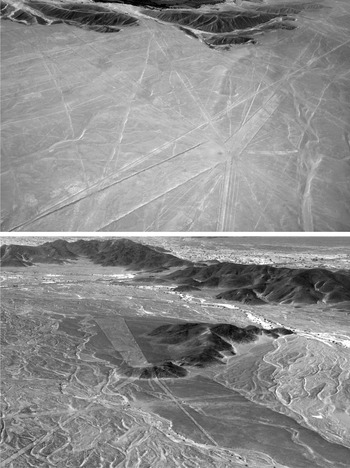
I would add to this that anarchist forms of organization are often characterized by constant spatial reconfiguration: an active process of preventing ‘centres’ from crystallizing for very long before a new focal point emerges. All such foci are intended as temporary, and as soon as one emerges, it is already in the process of being supplanted. This kind of spatial flux is precisely what we see on the Pampa de Nazca, which bears some similarity to what the anarchist writer Hakim Bey (Reference Bey1991) has called the ‘Temporary Autonomous Zone’. Indeed, we could describe Cahuachi as a kind of persistent hub, which sharply contrasts with the geoglyphs on the Pampa—a sequence of fleeting centres, none of which were ever meant to last for very long (see Figure 3). Thus the ritual activities on the Pampa reflect not so much the shared control of ritual space, but an uncontrollable ritual space. And this difference between Cahuachi and the geoglyphs is fundamentally one of media, rather than message. Note that virtually all of the iconography found in the geoglyphs was also represented in the polychrome Nasca ceramics used at Cahuachi. Throughout the ancient Andes, polychrome vessels were the medium par excellence for ritual performances with a centralizing and hierarchical bent, something well illustrated in Tamara Bray's (Reference Bray2018) recent study of Inca pottery. For the Incas and many of their predecessors, to hold power was also to hold the physical vessels that made such power possible. Geoglyphs are a different kind of medium however, and are (literally) ungraspable in a way that pots are not.
Two geoglyph ‘line centres’ on the Pampa de Nazca. (Note: photographic contrasts have been digitally enhanced.)

One of the possible functions of art is to facilitate ‘protest and resistance’ and to convey ‘unsanctioned, counter-authoritarian’ content (see DeMarrais & Robb Reference DeMarrais and Robb2013: 18). Yet despite having used the term ‘anarchist’ with respect to the Nasca geoglyphs, this does not necessarily mean they were a vehicle for resistance, or were meant to be truly disruptive with respect to the wider social order. It is true that anarchism is often an antagonistic political stance in societies dominated by hierarchical politics (such as our own), but in more egalitarian communities anarchist politics is actually quite normative. Thus the relationship between anarchism and centralization is not necessarily one of existential conflict (see Graeber Reference Graeber2004, 36). One way to evaluate whether resistance is the intended sentiment is to look at the content itself, since unsanctioned media often convey ‘deviant’ messages with respect to dominant social orders—graffiti, pirate radio and the dark web being obvious examples. On this point, it is interesting that the content of the Nasca geoglyphs was not particularly divergent from what we see in contemporary ceramics. Thus the geoglyphs were intended to facilitate a very different kind of ritual activity in comparison to what was occurring at Cahuachi, but not to convey a radically different iconographic message. So instead of resistance, which implies an implacable antagonism and a lack of shared identity, this appears more akin to ‘constitutional reform’, similar to when modern liberal democracies have created legislatures and courts to balance the growing power of their executive branches. Obviously an elected legislature would be an anachronism in the Nasca case, but that does not mean there could be no local ‘equivalent’. Indeed, this is what I suggest the geoglyphs effectively were. They comprised a much less controllable medium for ritual activities than the polychrome ceramics at Cahuachi, and thus effected a redistribution and rebalancing of ceremonial power in the context of the Nasca world.
It is a common assumption in social evolutionist thought that political centralization and decentralization operate on a simple sliding scale. In reality, centralization and decentralization often emerge in tandem. In this vein, several archaeologists have explored ‘dialectical’ approaches to the study of ancient politics (e.g. Crumley Reference Crumley, Patterson and Gailey1987; Marquardt Reference Marquardt1992). From such a perspective, it is not necessary to categorize societies as either centralized or decentralized—instead centralization and decentralization can co-exist in a state of dialectical tension (see Angelbeck Reference Angelbeck, Currás and Sastre2019). Similarly, Wengrow and Graeber (Reference Wengrow and Graeber2015) argue that Upper Palaeolithic communities were neither fundamentally egalitarian nor hierarchical, but consciously shifted between these two modes according to seasonal rhythms. I believe something comparable occurred in the Early Nasca Period, with the broader community actively working to curb emergent ritual centralization by introducing a more anarchic counterbalance. However, this is not to suggest that the Nasca were wholly antagonistic towards the centralizing forces represented by Cahuachi. Clearly they desired ritual centralization to some degree, but at the same time sought to temper it with a very different form of ritual activity (i.e. geoglyphs).
This balancing act is a phenomenon I call ‘constitutionalism’. Constitutionalism is essentially a practice whereby the various political institutions within a society are organized along different and competing principles, so that each restrains the excesses of the others. To give a modern example, in the United States Congress, there are two senators for each state, irrespective of their very different populations. But in the House of Representatives, each state's delegation is numerically proportional to its population. Two contradictory principles are thus being enacted here: 1) the United States is a union of 50 states, and 2) the United States is a single nation of all its citizens. But this contradiction is very much by design, since the goal is to balance one governing principle against the other. Another example might be the co-existence of monarchical institutions and popular assemblies in the city-states of ancient Mesopotamia (Evans Reference Evans1958), so that decisions are arrived at through a mixture of autocratic and consensual means. Some degree of constitutionalism probably exists in all human societies, but clearly there is much variation.
A theory of constitutionalism also allows us to conceptualize anarchism in a non-teleological fashion, where the goal is not the revolutionary overthrow of centralized power, but to act against it as a moderating counterweight. It is a self-congratulatory myth of Western political philosophy that such ‘checks and balances’ were invented by Graeco-Roman city-states and then later revived by their modern European descendants. In reality, virtually all societies seek methods to counteract the accumulation of power by centralizing elites—albeit with varying degrees of success (Blanton & Fargher Reference Blanton and Fargher2016; Yoffee Reference Yoffee2005). Moreover, we are analytically predisposed to misrecognize such changes, given the conceptual baggage that comes with concepts like ‘religion’. Thus the fact that the geoglyphs represented a radical rebalancing in the power dynamics of ancient Nasca society is obscured, through the application of dehistoricizing labels like ‘sacred landscape’. To the Western analyst, sacred landscapes typically connote timelessness and the dead hand of tradition, not conscious processes of political reform.
The final phase of the story involves the major organizational changes that occurred throughout the Nazca region after c. ad 400. In general, the Middle and Late Nasca periods (c. ad 400–700) are viewed as times of increased political ‘fragmentation’, with few (if any) centralizing or integrating institutions serving the broader Nasca domain (Conlee Reference Conlee2014, 237–8). The final chronological spike in geoglyph-related activity seems to occur at the very beginning of this period (i.e. Nasca 5: Silverman & Browne Reference Silverman and Browne1991, 218), suggesting that the geoglyphs remained popular for about a century after Cahuachi began to decline—before declining themselves. The key point here is that the unusual coincidence of large-scale regional integration through ceremonialism and the persistence of autonomous and relatively egalitarian communities did not re-emerge following its Early Nasca heyday. If the geoglyphs were initially a response to the desire to strike a balance between centralization and anarchism, it makes sense that such a distinct ritual medium was the product of the unique political circumstances of the first half of the first millennium ad. None of this is to suggest that the geoglyphs lost all importance to Nasca communities in later periods, or ceased to be made entirely, but the impetus to create them was no longer as strongly felt. Certainly the Inca and Wari empires found little use for the medium, despite surely becoming familiar with the geoglyphs following their conquests in the Nazca region. By contrast, polychrome ceramics were very compatible with Inca and Wari imperialism.
In this article, I have focused mainly on the Pampa geoglyphs, due to their integration with, and immediate proximity to, the site of Cahuachi. However, geoglyphs are a common feature across much of the Andean coasts, especially southern Peru and northern Chile. The Palpa drainage lies to the north of the Pampa de Nazca, some 30 km distant from Cahuachi, and also exhibits a landscape densely inscribed with geoglyphs. The socio-political relationship between the Palpa communities and the ceremonial centre of Cahuachi remains unclear. However, the Palpa Lines clearly emerged within the same broader geoglyph tradition as the Nasca Lines, and are comprised of a similar mixture of linear glyphs and trapezoids, accompanied by figurative icons. Still, there are clear differences in terms of content. Whereas the figurative geoglyphs on the Pampa are generally zoomorphic, at Palpa there is much a stronger tendency towards anthropomorphic representations (Lambers Reference Lambers2006). Possibly this difference in content indicates that the community that created the Palpa lines saw itself as distinct from their immediate neighbours to the south. The Palpa geoglyphs are also situated on hillsides, which makes them more generally visible than the Pampa geoglyphs. However, this may be a topographic limitation more than anything else—there is very little flat terrain available in the Palpa drainage.
Both the Palpa and Pampa geoglyph clusters show a very similar chronological pattern. As several recent studies have emphasized (Isla & Reindel Reference Isla and Reindel2005; Lambers Reference Lambers2006), geoglyph production at Palpa was concentrated in the Early and Middle Nasca Periods, and almost completely ceased after ad 600. Moreover, several settlements from the Late Intermediate Period (c. ad 1000–1450) appear to have been sited on top of older geoglyphs, partially destroying them in the process (Isla & Reindel Reference Isla and Reindel2005, 66). Thus the integrity of the geoglyphs seems to have been of limited importance to the Late Intermediate Period societies of the region. Across the Andes, the Late Intermediate Period was typified by political ‘balkanization’ and increased physical violence (e.g. Arkush & Tung Reference Arkush and Tung2013). In Palpa specifically, there is evidence of multiple fortified sites during this time, probably reflecting a more conflict-ridden geopolitical order (Isla & Reindel Reference Isla and Reindel2005, 64–5). Although I have characterized geoglyphs as an anarchist mode of ritual expression, this does not mean they are associated with all decentralized communities. After all, many hunter-gatherer societies could reasonably be called anarchist, but few, if any, made geoglyphs. The point here is that geoglyphs seem particularly relevant in contexts where large-scale regional integration is occurring, not so much at the level of subsistence or political organization, but certainly in terms of ritual. Such integration typified the Nazca and Palpa regions in the Early Intermediate Period, where shared ceremony and iconography clearly united many thousands of people, a process in which geoglyphs apparently played a vital part. In the more fractured periods that followed, not only were geoglyphs not made, they appear to have been subject to almost ‘iconoclastic’ acts of destruction.
Conclusions
As recently emphasized by DeMarrais and Robb (Reference DeMarrais and Robb2013), art literally ‘makes society’ and is always and irreducibly material culture. I take this to mean that art is not merely a reflection of society, but an active constituent of it. Thus it produces the political terrain as much as it is a product of it. I have adopted a similar premise here, with the exception that I have substituted the term media for art. Of course, every instance of art must have a medium, and the difference is largely one of analytical framing. In particular it shifts the focus away from the more traditional topic of content and towards the material means of its expression. One advantage of adopting a media approach is that it underscores the necessity of a multi-media analysis. In other words, media always exist in relation to other media, and this interaction can take a variety of forms, such as competition, complementarity and in some cases even replacement. The very terms ‘new media’ and ‘old media’ imply different mediation technologies that are simultaneously jostling for the same space. Sometimes the term ‘media ecologies’ is used to describe this phenomenon (e.g. Fuller Reference Fuller2005), and it is a phrasing I find remarkably apt. In fact I am not sure it is even really a metaphor. Like an invasive species, online clouds and flash drives have caused the near extinction of their predecessors: audio cassettes, VHS tapes and CDs. And this is because all of these media occupy a largely identical ecological niche, insofar as they support the portability and storage of data. Printed books, however, have not disappeared, even when faced with the rise of electronic reading devices, and the obvious reason for this is that books are not purely (perhaps not even primarily) a means of storing information. Books also perform very important aesthetic functions in the home, particularly as a signal of their (middle-class) occupants’ cultural capital. So within our modern media ecosystem, the printed book has yet to encounter a sufficiently potent competitor to displace it from its particular niche.
Chronologically speaking, the Nasca geoglyphs were a new medium, which emerged alongside the more established media of their time—mainly polychrome ceramics, but also textiles and petroglyphs. They were also a new medium in the social sense, insofar as they had a transformative impact upon the communities that produced them. As I have already discussed, the impact of new media is inextricably bound up with their material properties. Sometimes these transformations have a ‘democratizing’ effect, by which I mean that they either extend access to a wider audience, or they limit the capacity for elites to restrict such access (as seen with the printing press, for example). The geoglyphs had an equally transformative effect on ancient Nasca society, offering a more anarchic and decentralized medium for conveying the iconographic content that had previously been concentrated in portable objects. But to continue with our ecological framing, the new geoglyphic medium was not in competition with ceramics and textiles; instead, it seems to have grown in tandem with them. This was therefore a complementary rather than competitive relationship, with the geoglyphs and the polychromes fulfilling the Nasca population's desire for both anarchic and heterarchical modes of ritual performance. I have presented this transformation as akin to a process of constitutional reform. Obviously, we are not talking about a written constitution here, but then I do not see this as strictly necessary. Even in the case of the Roman Republic there was no written constitution, only a collection of customs, conventions and institutions relevant to the differential distribution and exercise of power (Tatum Reference Tatum and Balot2009). If we are going to permit ancient Greeks and Romans their ‘constitutions’, even when they were not written down, then it is difficult to see why the term cannot be extended to other relevant cases. Moreover, there already exists a scholarly tradition of thinking about Native constitutions in the Americas, especially the ‘oral constitution’ of the Haudenosaunee (Iroquois Confederacy), which may even have influenced theories of governance in the nascent United States (see Miller Reference Miller2015).
The overarching goal of this article has been to situate the geoglyph medium within history. Why did geoglyphs traditions emerge when and where they did? Why are geoglyphs concentrated in certain regions of the globe, such as the Americas? Why did the most hierarchical societies (i.e. states and empires) seldom, if ever, make geoglyphs? Why did certain geoglyph traditions cease, despite having endured for centuries? Indeed, when we consider that all the geoglyph traditions in the Americas emerged quite late in prehistory, then the idea that they are simply iterations of ‘sacred landscapes’ is a profoundly insufficient interpretation, and effectively denies their historical and political context. Various archaeologists have recently sought to expand our theoretical vocabulary in order to capture the diversity of ancient politics, using terms like heterarchy, anarchism, collective action and so on (for a review, see DeMarrais & Earle Reference DeMarrais and Earle2017). Although the relationship between hierarchy and religion has been endlessly examined within the discipline (e.g. the supposedly ‘theocratic’ nature of archaic states), we still lack accounts of how material religion is expressed in more heterarchical or anarchist contexts. This strikes me as serious theoretical lacuna.
In this article I have focused on the ancient Nasca, but this is not intended to imply that all other geoglyph traditions are simply repetitions of the same story. Every historical case is obviously unique, and needs to be examined with due attention to its specificities. Yet we should not shy away from identifying broader patterns where they exist. For instance, with the rise of the Mississippian cultures of North America, the centuries-old tradition of effigy mounds effectively ceased. Instead, we see a florescence in the building of pyramids (i.e. monumental earthen mounds) that literally elevated certain individuals above the masses (Cobb Reference Cobb2003). Moreover, it is widely agreed that the Mississippians were organized along much more hierarchical lines than their Woodland predecessors. That being the case, the fact that the Mississippians chose pyramids as the landscape foci for their collective rituals, rather than effigy mounds, is surely not coincidental. Indeed, if you were to list all the societies that built pyramids in the ancient Americas, and all those that made geoglyphs, you would find virtually no overlap between the two. There is something materially distinct about geoglyphs which makes them more likely to be produced in so-called ‘middle-range’ contexts. We are habituated to thinking of iconography as an inherently political phenomenon, but precisely the same is true of the media through which it is conveyed.
Acknowledgements
The research presented in this article was generously supported through funding from the Isaac Newton Trust (16.08c) and the Leverhulme Trust (ECF-2016-618). Several people, including Elizabeth DeMarrais, Adam S. Green, Oliver Harris and two anonymous reviewers, provided useful feedback on earlier versions of the manuscript. All faults remain my own.