Disaster medicine and public health share similar concerns but do so at different scales and with somewhat different ethical imperatives. As a medical specialty, those engaged in disaster medicine focus on the treatment of persons and the immediate necessities of patient care. Public health practitioners concentrate on patient communities and thus on injury and illness as broadly communal rather than individual challenges.
The “lessons learned” from the 2014 West African Ebola epidemic are thus somewhat different for each of these perspectives.Reference Liu 1 The medical focus has largely been on the necessities of care for expanding, affected populations and barriers during outbreaks to adequate patient care. This has meant, for many commentators and researchers, better drug trial protocols and the need for more aggressive treatments that will permit “embedding research in [future] outbreak response.”Reference Lang 2 The emphasis in this literature has been on the potential for new “game changing” vaccines and other pharmacological treatments in the event of similar future epidemics.Reference Koch 3
The public health imperative is related but distinct. How can an outbreak best be identified and then contained as facilities for treatment are developed to serve already affected populations? Containing the disease usually means restricting the mobility of symptomatic, and secondarily potentially infected, persons. This may require the quarantine of entire communities, as Donna Barbisch and coauthors noted in a recent article in this journal.Reference Barbisch, Koenig and Shih 4 As those authors explained, there is a long history and ample legal precedent for strategies of isolation—“the separation of symptomatic infected individuals”—and for containment—barriers to group travel and trade as a way of preventing disease diffusion. But, Barbisch and coauthors, continue, these traditional strategies raise modern questions both of efficacy (does it work?) and of the ethical propriety of restricting liberties during a period of disease activity.
This article builds upon their work, recasting the discussion of isolation and quarantine in public health as a problem in spatial ethics. By their very nature, isolation and quarantine procedures—which are “social distancing” processes—are spatially grounded responses designed to separate persons and communities exposed to infectious diseases from other potentially susceptible populations. 5 Historically, the imposition of spatial barriers at varying scales has been justified where a principle of “greater good” outweighs that of individual autonomy. Seen in this way, questions about isolation and containment protocols—their appropriateness being tied to their efficiencies—are geographic at heart. Thus, in this review, isolation and containment are described as spatial programs that are not simply ethically permissible but crucial to the identification and containment of potentially expansive disease events, and thus to public health and medicine.Reference Burkle 6 In effect, the focus is on diseases in place, and in space, rather than in the person or targeted population.
QUARANTINE
Quarantine began in the 14th century as both a noun (quaranta) and then a verb describing the 40 days of isolation imposed by Venetian officials on vessels from areas where plague was reportedly active.Reference Rosen 7 Based on the belief that plague somehow was transported from place to place by travelers and their goods, the idea of local, regional, or national barriers to association with persons from infected areas became a reflexive official response into the 19th century. The idea of quarantine expanded to include, at one scale, the isolation of communities within a region or nation and, at a still greater scale, the isolation of infected persons and their families in their homes or in designated sites distancing them from the general population. Examples of the first include the home quarantine of persons suspected of plague,Reference Defoe 8 and in the second case, the creation of separate communities for persons with Hansen’s disease.Reference Daws 9
In the absence of demonstrably effective vaccines or treatments, containment programs were thus typically employed at various scales in programs whose goals are well described by geographer Peter Haggett.Reference Haggett 10 While based on a 20th century, mathematical understanding of disease diffusion,Reference Bailey 11 the different procedures he described were frequently deployed for centuries.Reference Koch 12
Local elimination seeks to break the chain of disease transmission in a town or village experiencing an outbreak. If the source of the disease was believed to be a local contaminant (food or water), the source was removed from the consumption supply chain. If the infection was believed to be spread interpersonally, symptomatic persons (and their families) were isolated in hopes of limiting disease diffusion. During the Great Plague of 1665 in London, for example, plague victims and their patients were quarantined in their homes, their doors marked with red crosses.Reference Tomalin 13
Defensive containment involves spatial barriers to prohibit the introduction of disease carriers to disease-free areas. The Venetian quarantine of ships from infected areas seeking to enter its harbors is the classic example. The inverse of this strategy is offensive containment, which seeks to limit the spread of an infection from “hot spots” within a generally disease-free district or country. There are, here, obvious similarities to local elimination, although the circumstances and scale of its assignment are somewhat different. Tine’s ring-control containment strategy to combat a British bovine foot-and-mouth outbreak exemplified this approach.Reference Tine 14 While described here as if discrete, in practice, these varying containment strategies often were employed simultaneously.
Various spatial containment approaches support, in the main, the protocols of disaster triage in its focus on the needs and protection of at-risk populations rather than solely on the care of symptomatic patients.Reference Koenig 15 The needs (and rights) of individual patients, while important, become from this perspective ethically and practically secondary to the health needs and protection of at-risk populations. It is not too much to suggest that public health management presents a fundamentally spatial approach to disease incidence. Provision of supplies for residents in quarantine, housing for patients, location of field hospitals, and burial sites: all are spatially grounded, broadly conceived responses to expansive disease events.
Bari, Italy: Combined Strategies
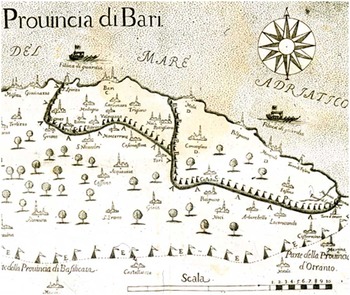
Until the 19th century, defensive and offensive spatial strategies typically were enacted whenever an outbreak threatened expansion. Perhaps the most complete historical example, recently reviewed in this journal,Reference Koch 16 was Fillipo Arrieta’s program of disease containment and treatment during the 1690–1692 plague years in Bari, Italy.Reference Arrieta 17 In response to a plague outbreak, Arrieta, the province’s royal auditor, mounted a series of interlocking containment strategies enforced by military personnel to enforce containment programs at 3 scales: national, provincial, and urban.Reference Koch 16
These included (Figure 1) a national blockade of foreign vessels (defensive containment), troop encampments deployed to stop regional travel between Bari and plague-free neighboring provinces (offensive regional containment), and encampments around cities where plague had yet to appear (defensive-local). There were, in addition, troop placements isolating towns and villages where plague was active (local quarantine). Within these zones of isolation and quarantine, Arrieta was responsible for ensuring the availability of facilities for the care of the sick, burial programs for those who died, and at least minimal support of populations quarantined but not yet ill. It did his liege no service if plague was controlled but those living in isolation or quarantined starved to death as a result.
In a Response to a 1690 Plague Epidemic, the Provincial Auditor Implemented a Multistage Containment Strategy That Included Naval Quarantine and Defensive and Offensive Military Containment Fields in His Province.

Similar if less comprehensive strategies were employed by British officials during the plague year 1665. In that instance, a national quarantine of foreign ships was enacted but local travel in England was not forcibly restricted. Symptomatic patients and their families were restricted by edict to their homes with only burial crews, physicians, and priests permitted entry. Special burial sites were created, as were “pest houses” where symptomatic patients could be taken. The result was well described in Daniel DeFoe’s A Journal of the Plague Year Reference Defoe 8 based on both his memories of the 17th century epidemic and later experience during a plague outbreak in France early in the 19th century.Reference Sutherland 18
Until the mid-19th century, disaster medicine was primarily based on public health strategies of regional containment and the isolation of both patients and their families. Programs of containment and isolation were carried out by governments whose primary ethical duty was assumed to be to protect, as much as possible, the general population. The operative principle was a “greatest good” principle ordering the protection of subject populations over the individual freedoms and rights of any single citizen. Public responsibilities included not only edict-directed programs of offensive and defensive containment but also the ordering of isolation hospitals and the burial of the dead. Because there was no public health service, care of patients was left to physicians and to religious charities. Neither the autonomy of persons to unfettered mobility nor the rights of trading companies to unrestricted commerce were seen as relevant in the face of a communal disease threat.
Cholera
A fundamental change occurred immediately before the first cholera epidemic in Great Britain. In 1831 the Central Board of Health proclaimed a defensive containment strategy requiring the quarantine of ships from countries where cholera was then active.Reference Marks and Beatty 19 “The board abandoned those propositions, however, in the face of fierce opposition from those who feared the economic consequences of diminished trade and travel.”Reference Koch 20 That opposition was supported by the unnamed authors of an article in The Lancet reviewing the international progress of “blue cholera: from 1819 to 1831.” 21
The authors “rejoiced at this salutary change [in official policy] and congratulate the British nation on its escape from that visitation [quarantine affecting trade], worse than pestilence.” They argued that, practically, quarantine would be ineffective in preventing the spread of cholera from Europe to Great Britain. But even if containment measures could be proven to be successful, they argued, the result would be financially ruinous to merchants and traders and thus far worse than the disease itself. The Lancet authors therefore introduced a new principle in which protection of public health was secondary to the protection of a region or nation’s economic health. Under this doctrine, the first ethical responsibility of governments was the maintenance of commerce rather than the health of resident populations. Following the cholera epidemic of 1831 to 1834, quarantine and any but very local isolation of symptomatic persons was rarely employed. In effect, the greater public good was redefined as an economic rather than a humanist standard of public health.
EBOLA
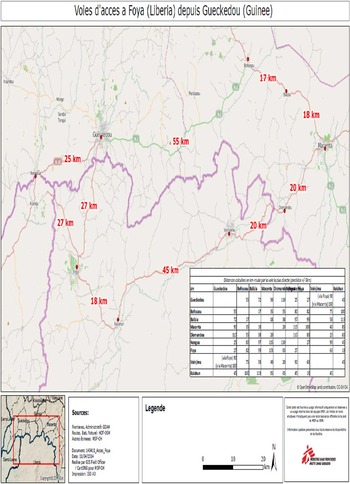
“In March 2014, Ebola virus (EV) was discovered to be the etiologic agent behind an outbreak of a highly lethal disease that had begun in the nation of Guinea in December 2013.”Reference Toner and Adalja 22 The index case was a child in Guéckédou prefecture, an ethnic, Kissi-speaking region whose members regularly traveled between villages located across a largely unsupervised, tri-nation border (Figure 2). March 23, 2014, the World Health Organization was informed of a rapidly evolving Ebola outbreak in both Guinea’s Guéckédou and Macenta prefectures.Reference Donnelly and Dye 23 In that month Switzerland-based members of Médecins Sans Frontières dispatched teams to assist local personnel to the region, one where clinical and public health resources were limited.Reference Luge 24 Other international agencies, including the Red Cross, the World Health Organization, and the US Centers for Disease Control and Prevention, joined in the effort to contain what was believed to be a localized outbreak of this disease.
General Travel Ranges From the Prefectural Capital Guéckédou to Other Locations in the Largely Unpatrolled, Tri-nation Border Region. Source: Médecins Sans Frontières Logistics Department, 2014.Reference Luge 24

In May 2014, however, the outbreak expanded to include Kissi-speaking villages in neighboring rural districts in Guinea, Sierra Leone, and then, in June, to the Lofa district in Liberia.Reference Donnelly and Dye 23 Into the summer the number of cases increased rapidly across the tri-national boarder area as what had been assumed to be a series of localized and thus containable rural outbreaks coalesced into a regional epidemic. The loci of infection shifted from rural villages to the capital cities of Conakry, Guinea (2009 population 1.67 million); Freetown, Sierra Leone (2010 population 1.2 million); and Monrovia, Liberia (2009 population approximately 1 million).
Planning began in August 2014 for a “cordon sanitaire” restricting the travel potential of persons seeking to enter or leave affected areas. The last such closure occurred, one writer said, when borders between Poland and Russia were closed in 1918 to prevent the spread of typhus.Reference McNeil 25 As in Arrieta’s 17th century program, military troops were used in West Africa to attempt to close internal roads in Liberia and Sierra Leone. As the epidemic expanded, attempts were made to isolate whole communities in major cities to assess the extent of the epidemic, find those who were ill, remove the corpses of the deceased, and limit the potential for disease expansion. The ethical propriety of these broader isolation and containment program was questioned. “It has a lot of potential to go poorly if it’s not done with an ethical approach,” an official at the Centers for Disease Control and Prevention told reporters.Reference McNeil 25 What that ethic might be was, however, unstated. What was clear was that restrictions on travel and trade were assumed to be ethically (and at another scale economically) onerous. “As soon as cases are under control, one should dial back the restriction.”
The invocation of a defensive quarantine isolating areas of disease activity was not only supported by military personnel but justified in military terms. As one British military official told The Daily Mail (UK) in October 2014, “From a military perspective Ebola is like a biological warfare attack and should be countered accordingly. There needs to be a clampdown on human movement inside Sierra Leone and possibly to and from the country.”Reference Nicol 26 Just as individual liberties can be restricted in wartime, so too, in other words, public health required a wartime ethic of communal necessity in its battle with an expansive viral entity. Individual freedoms could be, during this “biological warfare attack,” restricted where public health protections were advanced as necessary.
Spatial strategies
In effect, a program of spatial containment was instituted under a “greater good” ethic of general protection as the primary ethical principal rather than one asserting the primacy of individual liberty. This shifted priorities from those of individual patients to communities at risk. “In large-scale communicable disease events (endemics, epidemics, and pandemics), the goal of triage becomes successfully identifying and treating primary infections and preventing secondary infections.”Reference Burkle and Burkle 27 In triage, the immediate needs (and rights) of some patients are ethically secondary to those of the at-risk community. As is sometimes the case in “large-scale communicable disease events,” the susceptible population was redefined in this case from one narrowly specific (affected patient families or neighborhoods) to the regional population at large. While care of infected persons remained a medical priority, the imposition of militarily enforced quarantines was a public health measure meant to prevent the further expansion of the “enemy,” the Ebola virus.
Medicine and Public Health: Perspectives
In retrospect and after the fact, it appears that the evolution of this disease event from a coalescence of local outbreaks into a regional epidemic occurred at least in part because early treatment approaches were focused on the needs of symptomatic patients in rural villages rather than the potential for disease expansion throughout the tri-nation border region. As a result, established intra-village travel patterns, and their potential for viral dissemination, were not investigated adequately. As new outbreaks in different villages occurred, the potential for viral diffusion from rural areas to major cities in the affected countries was similarly overlooked.
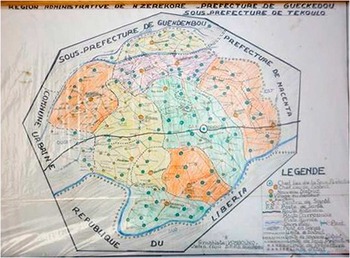
This can be assumed based on the absence in either the popular or professional literature of discussion of the potential for disease diffusion across the tri-nation border area into the summer of 2014. Also, both regional political and clinical experts later would express surprise that the original outbreak expanded through regional travel across the tri-nation region, and in each from rural to urban settings.Reference Sack, Fink and Belluck 28 Spatially, the mapping was of the location of patients in villages rather than the travel patterns of village members in the region. In retrospect, a narrow medical focus on the immediate needs of patients overshadowed a public health perspective focused upon the potential expansion of the infection (Figure 3).
In March 2014 Maps For Confronting the Ebola Outbreak in Guéckédou Prefecture Were Lacking and the Médecins Sans Frontières Epidemiological Team Included a GIS Specialist Who Drew 109 Maps in Less Than 2 Months. Source: Médecins Sans Frontières Logistics Department, 2014.Reference Luge 24

Once Ebola had progressed from rural border villages to the capital cities of Guinea, Liberia, and Sierra Leone, the ability to identify and locate let alone treat the exponentially increasing number of exposed persons diminished rapidly. Attempts at containment during the urban phase of the epidemic were therefore problematic at best. In autumn 2014 attempts at 3-day urban quarantines to permit house-to-house inspections were resisted by Conakry and Freetown residents. Some fled their homes prior to the short-term quarantine periods, whereas others who remained in their homes broke quarantine to find food for their families. Most citizens understood the necessity of containment but as a father of 9 children told reporters, “I want to go find something for my children to eat.”Reference Roy-Macaulay 29
International Quarantine
As the number of West African deaths increased through the fall of 2014, some argued that defensive quarantine strategies should be enacted by European and American governments whose officials feared Ebola might migrate to their countries. International health officials argued international quarantine programs were unnecessary—the viral transmission rate is relatively low—and likely would be ineffective. As The Lancet authors had argued in the 1830s, international officials in 2014 worried that quarantine and travel embargos would be financially ruinous for affected nations. Independently, some international airlines unilaterally ceased flights to affected countries, however, and in some countries returning health workers were subject to home quarantine and repeated medical testing for a period of 21 days, the assumed incubation period. Individual liberties were curtailed, in these cases, under a public health ethic of “greater good” as a primary ethic overriding individual rights of mobility.
By late 2014 and into 2015 West African countries independently enacted a series of defensive and offensive isolation fields in an effort to stem transmission in national populations that, by that time, were seen as generally susceptible. Across late winter and early spring in 2015, periodic 3-day “shut-downs” of affected cities were enacted to facilitate the identification of infected persons. Where new cases were identified, stronger local isolation protocols were employed.Reference O’Carroll 30 National troops monitored border areas where unsupervised travel previously had been the norm.
DISCUSSION
In 2015 the literature on “lessons learned” has expanded rapidly. Much of it has focused on the genomic sequencing of viruses and their identificationReference Carroll, Matthews and Hiscox 31 during new disease outbreaks and on the potential for the rapid development of new vaccines in the event of future epidemic outbreaks.Reference Koch 3 Other research streams have sought to identify the ecology in which Ebola, and by extension other similar viruses, may be expected.Reference Pigott, Goulding and Myne 32 While valuable, in a period of rapid bacterial and viral evolution (HIV/AIDS, MERS, SARS, etc), and from the perspective of this article, that focus misses the point both for specialists in disaster medicine and those engaged in public health preparedness. In the best of circumstances, one in which the bacterium or virus is well understood, it can take at least 12 to 18 months to develop a workable vaccine. Even then, it may be years before an effective prophylaxis or vaccine is available. Here one may think of dengue fever, malaria, or tuberculosis as examples. In circumstances where the bacterium or virus is largely unstudied, the identification of effective treatment protocols and eventually vaccines to inoculate populations may require decades of research. For those treating patients, that futurity fails in the face of immediate need.
What is required, therefore, is a set of spatial protocols that from the start quickly identify areas of disease activity with the goal of preventing diffusion at a scale maximizing the potential for treatment. In effect, this demands a public health perspective be immediately employed during an infectious disease outbreak. To limit the scale of an infectious event, the normal range of local travel by patients and their cohorts must be understood from the start. It can then be mapped to define a broadly susceptible population at obvious potential risk. Where prophylactic measures are available they then may be deployed across areas in which offensive protocols are engaged. Public health planning can be begun prior to the onset of symptoms in at-risk populations. In aggressively attempting to limit disease spread, resources are freed for the specialist in disaster medicine whose focus is patient treatment.
Just as this means a shift in focus from the local to the regional, it means a reordering of our ethical priorities. In recent decades medicine has adopted an ethical standard that advances individual autonomy as a dominant and indeed principal virtue.Reference Beauchamp and Childress 33 Even in the face of epidemic disease we are chary of limiting the freedoms of persons and, of course, of traders. The Lancet authors’ insistence that economic consequences should take precedence over health consequences remains for some, today, a priority. In advising against quarantine during the fall of 2014, for example World Health Organization officials argued that it not only was unnecessary medically but would adversely affect local economies. The conclusion here is that the principle of “greater good” serves better as a primary ethic governing public health preparedness and disaster medicine generally.
CONCLUSION
The goal of this article has been to recast the lessons learned from the 2015 Ebola epidemic in spatial terms as a way of understanding how a local outbreak became a regional epidemic with pandemic potential. The argument is not that public health is more important than disaster medicine. Nor is it that the two are distinct. Rather, the lesson is that every potentially infectious disease must be seen in a greater than local frame. In advancing a spatial perspective, one that sees disease in terms of populations at different scales, a communal ethic of “greater good” is invoked as necessary for the containment of a potentially expansive infectious event.
It is important to insist that none of this is to be construed as a criticism of the extraordinary efforts of national and international personnel who, beginning in March 2014, struggled to treat West African Ebola patients in Guinea, Liberia, Sierra Leone, and elsewhere. Nurses, physicians, and support workers from a congress of international agencies expended extraordinary and sometimes heroic efforts in the face of an extremely dangerous virus with a frighteningly high mortality. Some have criticized the failure of one or another organization to act with sufficient speed or to recognize the potential of a small, rural outbreak to become a regional epidemic with pandemic potential. After the fact and from a distance it is easy to see what is obscured in the immediacy of a complex program of treatment.
The best compliment that can be paid to those who have labored in the battle with Ebola is to understand the means by which future outbreaks of this or other infectious diseases can be first identified and then contained. The first and most important lesson of the 2014 epidemic may be that it is far easier to contain an outbreak than a broadly national epidemic. Once infectious bacteria or viruses are introduced into large urban populations, their containment becomes more difficult. Thus, localized outbreaks need to be seen as potential epidemics and the means by which susceptible persons are identified by using the broadest spatial parameters.
Certainly, eradication of bacterial and viral diseases is a goal. So, too, is the rapid provision of drugs that will lessen the effect of this or that specific bacterium or virus. But where those are either unavailable or unknown, more traditional protocols of containment coupled with the best possible treatment protocols possible must be the priority. One advantage of defensive and offensive strategies in an outbreak is that, when enacted early on and in local communities, the risk boundaries they enact encourage the focus of available resources both where immediately needed and in areas of potential disease expansion. In the recent epidemic the imposition of containment schemes in major cities was not necessarily accompanied by social support.Reference McNeil 25 The populations were large and supplies were limited. Earlier containment in local villages would have permitted greater attention both to the containment of the disease and the needs of those whose mobility was restricted.
In this overview, there is neither space nor time to provide a detailed consideration of the algorithms and protocols by which containment zones can be identified or their structures modified to reflect the realities of a specific bacterial or viral incursion. The spatial structure of a zoonotic disease will be different from the spatial structure of one that is airborne or waterborne. The emphasis here has instead been on the idea of containment and quarantine as necessary and ethically acceptable strategies. Their inaction will depend on the nature of the disease event, the resources available for its description, and the means by which control programs can be instituted.
Acknowledgment
The author thanks the anonymous peer reviewers for insightful comments that assisted in the preparation of this manuscript.