Introduction
Southern Patagonia including Tierra del Fuego is the southernmost region bearing trees and shrubs on Earth, and epiphytic lichens growing here are thus at the southern limit of their distribution. Only Antarctica, with no epiphytes, is further south, and the distance to similar climates and vegetation in New Zealand is more than 7000 km. The Teloschistaceae of southern Patagonia have been critically studied during the past decades (Lumbsch et al. Reference Lumbsch, Ahti, Altermann, de Paz G, Aptroot, Arup, Bárcenas Peña, Bawingan, Benatti and Betancourt2011; Søchting & Sancho Reference Søchting and Sancho2012; Søchting et al. Reference Søchting, Søgaard and Elix2014, Reference Søchting, Søgaard, Sancho, Frödén and Arup2016, Reference Søchting, Søgaardl, Sancho and Arup2021). Recently, an extensive catalogue of lichen species known from Navarino Island in Tierra del Fuego was published (Etayo et al. Reference Etayo, Sancho, Gómez-Bolea, Søchting, Aguirres and Rozzi2021), but Teloschistaceae on twigs were only superficially treated at the time. It might be expected that the biogeographical history of the southern continents could result in a high degree of endemism among twig lichens, therefore we decided to focus particularly on Teloschistaceae on twigs and thin branches of trees and shrubs. Results from the whole Southern Hemisphere show very little overlap between the twig species composition in Tasmania/New Zealand and Patagonia. Therefore this paper focuses on Patagonian species, and the New Zealand species will be dealt with in a forthcoming paper.
Twigs and thin branches often host a diverse and characteristic lichen community (Degelius Reference Degelius1964, Reference Degelius1978; Ott et al. Reference Ott, Schröder and Jahns2000), but in the industrialized and agricultural world twig lichens often suffer from being exposed to low air quality (Larsen et al. Reference Larsen, Wolseley, Søchting and Chimonides2009). In southern Patagonia, including Tierra del Fuego, and in the Falkland Islands, the air is, however, generally clean and lichens thrive on both living and dead twigs. For this study, twigs were intensively collected by the first author during recent decades. The two very common species Austroplaca thisbe sp. nov. and Marchantiana pyramus sp. nov. are proposed as new to science, together with the less frequent M. ramulicola sp. nov. Molecular analyses were carried out to disclose the generic structure of the genus Marchantiana and its relationship with the neighbouring genus Yoshimuria, but a more comprehensive study of the genus will be published in a forthcoming paper based on species from Australia and New Zealand. The field studies also revealed new distribution data for Blastenia circumpolaris Søchting et al. and Marchantiana asserigena (J. Lahm) Søchting & Arup.
Material and Methods
Material
Twigs with lichens were collected in southern Patagonia, mainly in Tierra del Fuego but also on the Falkland Islands. Phorophytes were mostly Berberis, Chiliotrichum, Nothofagus, Ribes and the parasitic Misodendrum on Nothofagus. Cited specimens collected by U. Søchting and M. Z. Søgaard were deposited in C.
Morphology and anatomy
Macroscopic descriptions are based on observations made with an Olympus SZH dissecting microscope with an Olympus OM-D camera. Sections were made by hand or with a Reichert-Jung Cryostat 2800 Frigocut E microtome and studied with a Leitz Orthoplan microscope. All measurements were made on material mounted in water. Spores were measured outside the asci and measurements are given as the mean (x̄) and standard deviation (SD) of ‘n’ measurements, with minimum and maximum measurements in parentheses.
Secondary chemistry
Secondary metabolites were identified and quantified using HPLC according to Søchting (Reference Søchting1997); thallus and apothecia were analyzed separately. The relative composition of the secondary compounds was calculated based on absorbance at 270 nm, according to Søchting (Reference Søchting1997). All yellow, orange or reddish-pigmented parts are K+ purple.
Molecular analyses
PCR amplification was carried out on DNA extracts or using direct PCR following Arup et al. (Reference Arup, Vondrák and Halıcı2015). Amplifications were made of the internal transcribed spacer regions (nrITS) and the large subunit (nrLSU) of the nuclear ribosomal RNA genes, and the small subunit of the mitochondrial ribosomal RNA gene (mtSSU). Primers for amplification were ITS1F (Gardes & Bruns Reference Gardes and Bruns1993), ITS4 (White et al. Reference White, Bruns, Lee, Taylor, Innis, Gelfand, Sninsky and White1990), AL1R (Döring et al. Reference Döring, Clerc, Grube and Wedin2000), LR5 or LR6 (Vilgalys & Hester Reference Vilgalys and Hester1990), mrSSU1 (Zoller et al. Reference Zoller, Scheidegger and Sperisen1999) and mrSSU7 (Zhou & Stanosz Reference Zhou and Stanosz2001). The PCR parameters included an initial hold at 94 °C for 5 min, then denaturation at 94 °C for 1 min, annealing at 50 or 54 °C (mtSSU) or 53–56 °C (nrITS and nrLSU) for 1 min, decreasing 1 °C per cycle for the first six of the 39 cycles (touchdown), and an extension at 72 °C for 3 min.
Sequence alignment
Two different alignments were prepared, one for a combined analysis of the genes nrITS, nrLSU and mtSSU and one alignment of only nrITS sequences. The combined analysis included 72 sequences from most genera of the subfamily Caloplacoideae and the ITS alignment included 29 sequences of the genus Marchantiana. Xanthoria parietina (L.) Th. Fr. from subfamily Xanthorioideae was used as outgroup for the first analysis and Xanthopeltis rupicola R. Sant. for the ITS analysis. The sequencing was carried out by Macrogen Inc. (the Netherlands), using the same primers as for the PCR. The two resulting strands were assembled using CLC Main Workbench 4.1.2™ or Geneious v. 11.1.5. Subsequent alignments were performed in Geneious v. 11.1.15 using the MAFFT option (auto) and adjusted manually. Unalignable ends, introns in all the aligned genes and ambiguously aligned parts were excluded from the alignment. Sequences have been submitted to GenBank as indicated in Table 1. The alignments of the three different genes were first analyzed separately to check for incongruence between genes. A conflict between the datasets was assumed to be significant if two different relationships were both supported with posterior probabilities ≥ 0.95.
Sequences from species of Teloschistaceae, newly produced (in bold) or downloaded from GenBank used in the analyses.

Phylogenetic analysis
Phylogenetic relationships were inferred using maximum likelihood (ML) as implemented in IQ-TREE (Nguyen et al. Reference Nguyen, Schmidt, von Haeseler and Minh2015) and Bayesian tree inference was carried out using Markov chain Monte Carlo (MCMC) as implemented in MrBayes v. 3.2 (Ronquist et al. Reference Ronquist, Teslenko, van der Mark, Ayres, Darling, Höhna, Larget, Liu, Suchard and Huelsenbeck2012). In the combined analysis, the three included genes were treated as separate partitions. A suitable likelihood model for each of the genes was selected, using BIC as implemented in the software jModelTest v. 2.1.4 (Guindon & Gascuel Reference Guindon and Gascuel2003; Darriba et al. Reference Darriba, Taboada, Doallo and Posada2012), evaluating only the 24 models available in MrBayes (Ronquist et al. Reference Ronquist, Teslenko, van der Mark, Ayres, Darling, Höhna, Larget, Liu, Suchard and Huelsenbeck2012). For the concatenated dataset, the SYM + I + G model was found to be optimal for the nrITS dataset and GTR + I + G for both the nrLSU and the mtSSU datasets. For the pure nrITS dataset, the evolutionary model SYM + G was found to be optimal. The parameters used in the analyses followed those of Arup et al. (Reference Arup, Søchting and Frödén2013), except for the branch length prior that was set to an exponential with mean 1/10. No molecular clock was assumed. Three parallel runs with 20 000 000 generations starting with a random tree and employing six simultaneous chains were executed, five of which were incrementally heated with a temperature of 0.10. Analyses were diagnosed every 1000 generations in the last 50% of the tree sample and automatically halted when convergence was reached. Convergence was defined as a standard deviation of splits (of frequency 0.1) between runs below 0.01. Every 2000th tree was sampled. A majority-rule consensus tree was constructed from the post-burn-in tree samples. The consensus trees were visualized using FigTree v. 1.4.4 and redrawn in Adobe Illustrator. The maximum likelihood analyses used the same evolutionary models as those used in the Bayesian analyses. Branch support values were computed via 1000 non-parametric bootstrap replicates.
Results
We generated 28 new nrITS sequences, three new nrLSU sequences and five new mtSSU sequences for this study. The alignment for the first analysis consisted of 73 terminals of 2082 aligned nucleotide sites, of which 543 were parsimony-informative. The nrITS partition consisted of 502 sites (260 informative), the nrLSU partition of 768 sites (137 informative) and the mtSSU partition of 812 sites (146 informative). The Bayesian analysis halted after 1 280 000 generations and a 50% majority-rule tree with posterior probabilities is shown in Fig. 1. The second analysis of only nrITS data consisted of 30 terminals of 533 sites, of which 121 were parsimony-informative. This analysis halted after 2 060 000 generations and the 50% majority-rule tree with posterior probabilities is shown above the branches in Fig. 2. The maximum likelihood and Bayesian analyses yielded very similar trees and so only the Bayesian trees are shown. Bootstrap values are shown under the branches in the same figure.
Majority-rule consensus tree based on a Bayesian MCMC analysis of a combined dataset of the nrITS, nrLSU and mtSSU genes showing the position of Marchantiana s. lat. Branches with posterior probabilities ≥ 0.95 are shown in bold. Posterior probabilities ≥ 0.95 are shown above the branches and bootstrap values ≥ 75 are shown below the branches.

Majority-rule consensus tree based on a Bayesian MCMC analysis of ITS data of Marchantiana. Branches with posterior probabilities ≥ 0.95 are shown in bold. Posterior probabilities ≥ 0.95 are shown above the branches and bootstrap values ≥ 75 are shown below the branches. New species are marked with *.

The analysis of the combined three-gene alignment (Fig. 1) recovers all genera recognized in the subfamily Caloplacoideae by Arup et al. (Reference Arup, Søchting and Frödén2013). The tree also includes many of the genera as supported monophyletic clades proposed in subsequent papers concerning the subfamily: Lacrima, Obscuroplaca, Oceanoplaca and Sucioplaca (Bungartz et al. Reference Bungartz, Søchting and Arup2020, Reference Bungartz, Søchting and Arup2021), Marchantiana and Yoshimuria (Kondratyuk et al. Reference Kondratyuk, Kärnefelt, Thell, Elix, Kim, Jeong, Yu, Kondratiuk and Hur2014), Jasonhuria, Loekoesia and Olegblumia (Kondratyuk et al. Reference Kondratyuk, Lökös, Kim, Kondratiuk, Jeong, Jang, Oh and Hur2015), Fauriea (Kondratyuk et al. (Reference Kondratyuk, Lökös, Kim, Kondratiuk, Jeong, Jang, Oh, Wang and Hur2016), Gintarasiella (Kondratyuk et al. (Reference Kondratyuk, Lökös, Upreti, Nayaka, Mishra, Ravera, Jeong, Jang, Park and Hur2017), Upretia (Kondratyuk et al. Reference Kondratyuk, Persson, Hansson, Mishra, Nayaka, Liu, Hur and Thell2018) and Lendemeriella (Kondratyuk et al. Reference Kondratyuk, Lökös, Farkas, Kärnefelt, Thell, Yamamoto and Hur2020). It also recovers Pyrenodesmia as monophyletic sister to the recently resurrected genus Kuettlingeria and the newly described Sanguineodiscus (Vondrák et al. Reference Vondrák, Frolov, Košnar, Arup, Veselská, Halıcı, Maliček and Søchting2020).
Yoshimuria appears as monophyletic and is supported in the tree as sister to another strongly supported clade that includes the type of the genus Marchantiana, but this position lacks support. A third, fully supported clade, included here in Marchantiana, holds a sister position to these two genera. These three clades seem closely related to one another with strong or rather strong support (PP = 0.984 and BS = 82).
In the combined analyses, Gintarasiella aggregata (Kantvilas & S. Y. Kondr.) S. Y. Kondr. & Hur, type of that genus, is found within the genus Variospora with full support. However, this position is based only on part of an nrITS sequence (5.8S and partial ITS2) and nrLSU data, and should therefore be considered preliminary with confirmation required using more data.
The analysis of the dataset containing only nrITS sequences (Fig. 2) shows the internal relationship of the two newly proposed species, M. ramulicola and M. pyramus, and related species of the clade. The new species and M. epibrya are monophyletic and well supported, whereas M. subpyracea appears as monophyletic except for one sequence at the base of the clade which is not supported as part of the clade.
Discussion
In accordance with Wilk et al. (Reference Wilk, Pabijan, Saługa, Gaya and Lücking2021), the genus Marchantiana is shown here to belong to the subfamily Caloplacoideae. In the combined analysis, the two paraphyletic clades of Marchantiana form a supported clade together with Yoshimuria. From a purely genetic perspective it would be possible to either unite all three genera into one or treat them as three independent genera. The two clades, treated here as Marchantiana, show great similarities in morphology, ecology and distribution. They are mainly small species with small apothecia and a thin or inconspicuous thallus, all but one (M. epibrya) grow on bark, often twigs, and they are mainly distributed in the Southern Hemisphere (Patagonia, Australia and New Zealand), with only M. asserigena seeming to have migrated to Europe in the Northern Hemisphere (Søchting & Arup Reference Søchting and Arup2018). The species of the genus Yoshimuria on the other hand occur in South-East Asia, are saxicolous, and have a well-developed thallus with rather large apothecia. Thus, it seems logical to recognize two genera rather than three or one. This hypothesis can be assessed using the AU test as implemented in IQ-TREE (Shimodaira Reference Shimodaira2002), where the null hypothesis is that a tree where the two branches of Marchantiana form one monophyletic clade with Yoshimuria outside of it is significantly worse (P < 0.05) than the tree presented in Fig. 1. Such a test, forcing Marchantiana to be monophyletic, returned a P-value of 0.5, which means that a tree with Marchantiana as monophyletic cannot be rejected. This makes sense since the branch including Marchantiana in a strict sense and Yoshimuria is not supported. We therefore recognize Marchantiana in the wider sense and describe the new species within this genus.
Taxonomy
Austroplaca thisbe Søchting & Arup sp. nov.
MycoBank No.: MB 848021
Similar to Austroplaca sibirica (H. Magn.) Søchting & Arup but molecularly distinct and growing on twigs instead of detritus. Thallus crustose, inconspicuous; apothecia zeorine to biatorine, yellow; ascospores polardiblastic, 13.5 × 7.5 μm, septum 5 μm; on twigs in Patagonia.
Type: Chile, XII Región de Magellanes y de la Antártica Chilena, Beagle Channel, Seno Pia IV, 54.710°S, 69.696°W, 5 m, on dead twigs of Misodendrum on Nothofagus antarctica, 15 December 2009, U. Søchting 11317 (C—holotype; LD—isotype).
(Fig. 3)
Austroplaca thisbe (U. Søchting 11272,2b), with one apothecium of Marchantiana pyramus (marked with arrow). Scale = 0.5 mm. In colour online.

Thallus crustose, inconspicuous.
Apothecia regular, vivid yellow, zeorine to biatorine, dispersed to mostly aggregated, sessile, never immersed or erumpent, constricted at base, 0.2–0.5 mm diam.; disc flat, with fine epipsamma, vivid yellow; thalline margin where present excluded, discontinuous, thin; proper margin distinct, c. 50 μm thick, concolorous or slightly brighter than disc, initially prominent, when older ±level with disc; thalline exciple cortex poorly differentiated; true exciple fan-shaped, laterally up to c. 50 μm; hypothecium very thin; hymenium 50–70 μm; paraphyses simple to apically branched, c. 1.5 μm thick, terminal cells moniliform, up to 3 μm thick. Asci clavate, with 8 spores. Ascospores ellipsoid, polardiblastic, (11.5)13.3 ± 1.2(14.5) × (6)7.6 ± 0.7(8) μm, length/width ratio 1.8 ± 0.1, septum (4)4.9 ± 0.4(5.5) μm, length/septum ratio 2.7 ± 0.3 (n = 8).
Chemistry
Chemosyndrome A of Søchting (Reference Søchting1997): 6–10% teloschistin, 0–5% fallacinal, 0–4% parietinic acid and 85–90% parietin (n = 3).
Etymology
Austroplaca thisbe is named after Thisbe, the love of Pyramus in Ovid's classic play ‘Metamorphoses’. It very often grows together with Marchantiana pyramus (Fig. 3).
Ecology and distribution
In Nothofagus forest, grassland and alpine heathland on living or dead twigs and occasionally rough bark. Phorophytes include Berberis, Nothofagus and its parasite Misodendrum. It is often associated with Marchantiana pyramus (see above). So far reported only from Chile but is expected to also occur in Argentina.
Notes
Austroplaca thisbe was included as sequence Austroplaca 9 in Arup et al. (Reference Arup, Søchting and Frödén2013). The species is molecularly well delimited and located at the base of the genus Austroplaca, where it is sister species to Austroplaca sibirica. They are morphologically very similar but are well separated by their ITS sequences and their different habitats and distribution; A. thisbe grows on bark and A. sibirica grows on dead plant material, bones, lignum and dead Peltigera sp. (Søchting & Arup Reference Søchting and Arup2021).
Austroplaca thisbe may be mistaken for an Athallia but so far no molecular analysis has confirmed the presence of epiphytic Athallia species in Patagonia, even though it was suggested by Etayo et al. (Reference Etayo, Sancho, Gómez-Bolea, Søchting, Aguirres and Rozzi2021).
Additional specimens examined
Chile: XI Región Aisén: c. 5 km along the road from Coyhaique to Coyhaique Alto, on dead twigs of Berberis sp. in open, exposed pastureland, 2001, P. Frödén 1550 (LD). XII Región de Magellanes y de la Antártica Chilena: Cueva de Miledon, 51.5611°S, 72.6160°W, 145 m, dead Berberis twigs, 2018, U. Søchting 12684; Morro Chico, 100 km N of Punta Arenas, basaltic rock of old volcano in steppe, 52.0575°S, 71.4212°W, 195 m, dead twigs of Berberis, 2015, U. Søchting 12366, 12674; 45 km SW of Punta Arenas, Reserva National Laguna Parrillar, 53.4070°S, 71.2616°W, 300 m, base of Nothofagus sp. by lake shore, rough bark, 2005, U. Søchting 10144; Province Última Esparanza, Parque Nacíonal Torres del Paine, 51.0494°S, 72.9367°W, 169 m, bush (Berberis cf.), 2008, M. Z. Søgaard 35, 39; Parque Nacíonal Torres del Paine, tracks from Lago Grey, 51.1222°S, 073.1242°W, twigs, 2008, M. Z. Søgaard 46; Parque Nacional Torres del Paine, Mirador Lago Nordenskjold, halfway between Laguna Larga and Laguna Mellizas, 51.05°S, 72.92°W, 200 m, dry, sun-exposed, dead twigs of Discaria chacaye, 1997, A. Elvebakk 97:448 (TROM); Torres del Paine, 51.1278° S, 73.1426°W, dead twigs, 2018, U. Søchting 12690; Rio Serrano, 51.18°S, 72.95°W, dead bark of Salix sp., 2005, U. Søchting 10442,1; 20 km S of Puerto Natales, 51.9417°S, 72.3881°W, 100–200 m, twigs of bush, 2008, M. Z. Søgaard 27a; Hosteria Cabo San Isidro, 53.7822°S, 70.9737°W, 2 m, dead Nothofagus betuloides trunk on beach, 2009, U. Søchting 11351; Seno Almirantazgo, 54.703°S, 69.332°W, 25 m, old dead twigs of Misodendrum, 2009, U. Søchting 11287; Beagle Channel, Seno Pia, west arm, shore of fjord, 54.7897°S, 69.6946°W, 1 m, twigs of Chiliotrichum hanging over the sea, 2 m from the sea, 2015, U. Søchting 11308; Cabo Hyades, Bahia Yendegaia, 54.9158°S, 68.7137°W, 1 m, dead twigs of Berberis, 2015, U. Søchting 12316; Isla Navarino, 30 km WNW of Puerto Williams, Wulaia, 55.0467°S, 68.1467°W, 2 m, twigs of Berberis sp., 2005, U. Søchting 10336; Isla Navarino, Puerto Williams around the airport, pasture on beach, 54.9291°S, 67.6372°W, 7 m, dead Berberis twigs, 2015, U. Søchting 12226; 37 km W of Puerto Williams, Caleta Honde, 54.93°S, 68.28°W, 5 m, dead Chiliotrichum, 2005, U. Søchting 10179; 20 km W of Puerto Williams, Caleta Mejillones, 54.9067°S, 68.1180°W, 5 m, Berberis twigs, 2005, U. Søchting 10189; Laguna Amarga, 50.9783°S, 72.78°W, 990 m, twigs, 2005, U. Søchting 10443; 2 km E of Puerto Navarino, 54.9270°S, 68.2756°W, 0.5 m, dead twigs of Berberis, 2015, U. Søchting 12333.
Blastenia circumpolaris Søchting, Frödén & Arup
(Fig. 4)
Blastenia circumpolaris (U. Søchting 11296). Scale = 1 mm. In colour online.

Notes
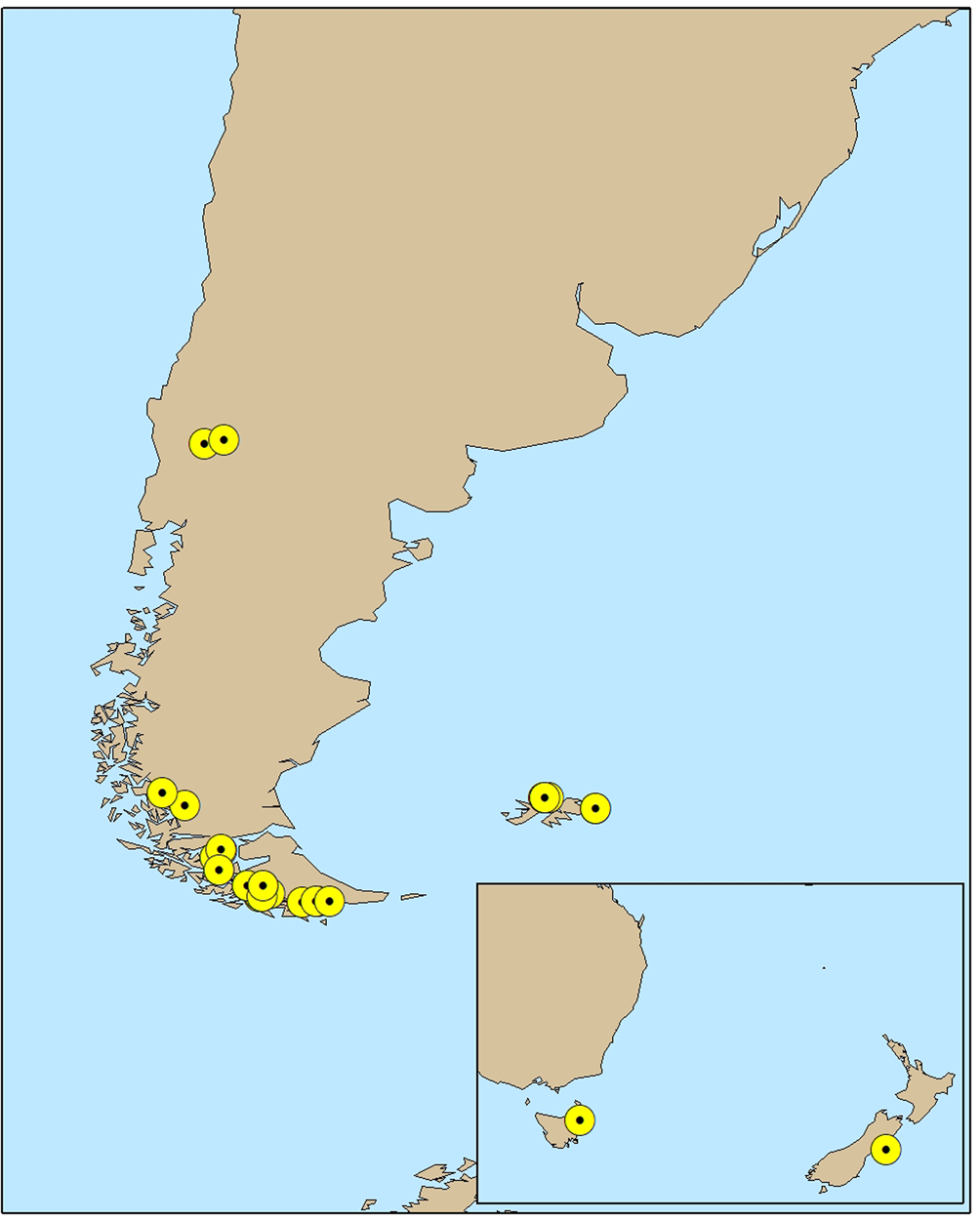
Blastenia circumpolaris was originally described as Caloplaca wilsonii S. Y. Kondr. et al. from Australia (Kondratyuk et al. Reference Kondratyuk, Kärnefelt, Thell, Elix, Kim, Kondratiuk and Hur2009) but was transferred to Blastenia by Arup et al. (Reference Arup, Søchting and Frödén2013). It is an extremely common epiphyte in Tierra del Fuego, where it is found as dispersed thalli with characteristic orange-brown soralia on the bark of Nothofagus in particular. It also colonizes twigs, where it forms thalli with just a small number of soralia; fertile specimens are found only rarely. In the Falkland Islands, Tasmania and New Zealand, it is much less frequent. Its currently known distribution outside mainland Australia is shown in Fig. 5.
Distribution map of Blastenia circumpolaris occurring outside the Australian mainland. In colour online.

Specimens studied
Argentina: Provincia de Santa Cruz: Rio Turbida at border post NE of Puerto Natales, 51.5635°S, 72.3483°E, 620 m, 2005, U. Søchting 10425.—Australia: Tasmania: North-East Tasmania, 15 km S of St Helens, Shelley Point, Eucalyptus regrowth forest by coast, 41.435°S, 148.274°E, 5 m, live bark, 2011, U. Søchting 11627.—Chile: Región del Biobio: Alto Bio Bio, 38.635°S, 70.96°W, 2012, R. Vargas 3708 (C). IX Región del Araucania: Malleco Province, Parque Nacional Conguillio, Sector Melipeuco, Sendero las Vertientes, 38.7669°S, 71.6344°W, bark of Nothofagus, 2011, R. Vargas (C). XII Región de Magellanes y de la Antártica Chilena: Parque Nacíonal Torres del Paine, walk from Lago Grey, 51.1181°S, 73.1419°W, trunk of dead Nothofagus, 2008, M. Z. Søgaard 55; 10 km north of Punta Arenas, 53.1403°S, 74.0544°W, living Nothofagus, 2008, M. Z. Søgaard 63, 65; 45 km SW of Punta Arenas, Reserva National Laguna Parillar, 53.4161°S, 71.2614°W, base of Nothofagus by lake shore, 2005, U. Søchting 10142, 10143; Seno Almirantazgo, Ainsworth Bay, 54.420°S, 69.562°W, dead Chillotrichum, 2009, U. Søchting 11272; 1 m, dead Berberis twigs, U. Søchting 11273; ibid., 54.703°S, 69.332°W, 25 m, bark of dead twigs of Nothofagus antarctica, 2009, U. Søchting 11288; ibid., 54.432°S, 70.118°W, 1 m, dead twigs of Pernettya mucronulata, 2009, U. Søchting 11296; ibid., 54.432°S, 70.118°W, 1 m, dead twigs of Berberis, 2009, U. Søchting 11297; Hosteria Cabo San Isidro, 53.7822°S, 70.9737°W, bark of Nothofagus betuloides on beach, 2009, U. Søchting 11350, 11357; Beagle Channel, Seno Pia, 54.780°S, 69.590°W, 3 m, dead Misodendrum on Nothofagus antarctica, 2009, U. Søchting 11312b; ibid., 54.772°S, 69.606°W, 20 m, old trunk of Nothofagus betuloides, 2009, U. Søchting 11314; ibid., 54.719°S, 69.705°W, 2 m, old Nothofagus betuloides, 2009, U. Søchting 11319; ibid., 54.772°S, 69.606°W, 20 m, old trunk of Nothofagus betuloides, 2009, U. Søchting 11314; ibid., 54.7634°S, 69.6028°W, 98 m, old trunk of Nothofagus betuloides, 2015, U. Søchting 12282; ibid., 54.7942°S, 69.6987°W, 1 m, dead twigs of Nothofagus betuloides overhanging the sea, 2015, U. Søchting 12306; Isla Navarino, 30 km W of Puerto Williams, Caleta José, 55.008°S, 68.174°W, 2 m, dry bark of Nothofagus betuloides, 2005, U. Søchting 10372; 7 km SW of Puerto Williams, Valle Róbalo, 54.9528°S, 67.6386°W, 240 m, trunk of Nothofagus betuloides, 2005, U. Søchting 10152; ibid., 54.9614°S, 67.1933°W, 2 m, dead Nothofagus, 2008, M. Z. Søgaard 74.—New Zealand: South Island: Canterbury, 1 km N of Akaroa, volcanic outcrops in pasture, 43.7973°S, 173.0274°E, 742 m, rotten wood, 2012, U. Søchting 11989.—Falkland Islands: East Island: Gipsy Bay, outcrops in heathland, 51.7042°S, 57.9165°W, dead Bolax cushions, 2018, U. Søchting 12606; ibid., dead Empetrum twigs, U. Søchting 12605. Pebble Island: pebbles on protected beach, 51.3039°S, 59.6032°W, rotten wood, 2018, U. Søchting 12663; ibid., 51.3095°S, 59.6123°W, dead Empetrum twigs, 2018, U. Søchting 12653; ibid., 51.3090°S, 59.4721°W, driftwood on beach, 2018, U. Søchting 12662.
Marchantiana asserigena (J. Lahm) Søchting & Arup
Notes
The very insignificant species Marchantiana asserigena has recently been shown to be fairly common in Denmark and Norway (Søchting & Fröberg Reference Søchting and Fröberg2003; Søchting & Arup Reference Søchting and Arup2018; Tønsberg et al. Reference Tønsberg, Palice and Timdal2021), but it has also been found in Sweden, Italy, France, Germany, Austria and the British Isles. Based on morphology, secondary chemistry and ITS data, it was identified from the Falkland Islands where it grew in similar habitats to those in the Northern Hemisphere, namely very thin twigs of dwarf shrubs. It is the first proven record from the Southern Hemisphere but it may have a much wider distribution.
Specimen studied
Falkland Islands: East Island: Gipsy Bay, 51.6765°S, 57.8101°W, 26 m, heathland, dead Empetrum twigs, 2018, U. Søchting 12604.
The molecular phylogeny (Fig. 2), combined with distribution and secondary chemistry, place Marchantiana pyramus in a sister position to Marchantiana epibrya, which is combined here into the genus Marchantiana as:
Marchantiana epibrya (Kantvilas & Søchting) Søchting & Arup comb. nov.
MycoBank No: MB 848017
Basionym: Caloplaca epibrya Kantvilas & Søchting, Kanunnah 6, 110 (2013) (MycoBank No.: MB 805211).
Based on the molecular data (Fig. 1), Caloplaca queenslandica is combined into Marchantiana as:
Marchantiana queenslandica (Kalb, S. Y. Kondr., Elix & Kärnefelt) Arup & Søchting comb. nov.
MycoBank No.: MB 848018
Basionym: Caloplaca queenslandica Kalb et al., Australas. Lichenol. 66, 35 (2010) (MycoBank No.: MB 548337).
Marchantiana pyramus Søchting & Arup sp. nov.
MycoBank No.: MB 848019
Thallus crustose, inconspicuous; similar to Marchantiana ramulicola, but apothecia orange and C+ red due to dominance of the anthraquinone emodin; ascospores polardiblastic, 12 × 5.5 μm, septum 5 μm; on twigs in Patagonia.
Type: Chile, XII Región de Magellanes y de la Antártica Chilena, Seno Almirantazgo, Ainsworth Bay, 54.420°S, 69.562°W, 1 m, dead Chiliotrichum, 6 December 2009, Søchting 11272.2a (C—holotype; LD—isotype).
(Fig. 6)
Marchantiana pyramus (U. Søchting 10178). Scale = 0.5 mm. In colour online.

Thallus inconspicuous or smooth, thin and whitish.
Apothecia regular, biatorine, mostly few together and dispersed, sessile, 0.3–0.4 mm diam.; disc flat, orange, only slightly darker than the exciple, with coarse epipsamma; proper margin regular, orange, often brownish near the disc, eventually sometimes almost black at the surface, 30–50 μm thick, almost level with disc; true exciple fan-shaped, laterally up to c. 40 μm, close to surface with tissue of elongated cells, 3 × 10 μm; hymenium c. 60 μm; paraphyses simple to poorly branched, 1.5–2 μm thick, terminal cells up to 3 μm thick. Asci clavate, 8-spored. Ascospores polardiblastic, (10)12 ± 1.2(15) × (4.5)5.3 ± 0.4(6) μm, length/width ratio 2.3 ± 0.3, septum (3.5)4.8 ± 0.6(6) μm, length/septum ratio 2.6 ± 0.4 (n = 22).
Chemistry
Chemosyndrome named here as E3: emodin 20–60%, with oxidation products citreorosein 30–50%, emodinal 20–30% and emodinic acid 15–40%. Thallus K−; apothecia K+ purple and C+ dark reddish.
Etymology
The epithet commemorates the mythological person Pyramus, appearing in Ovid's classic play ‘Metamorphoses’ with his beloved Thisbe, whose name is used in this paper for a new Austroplaca species, very often growing intricately together with M. pyramus (see below and Fig. 3).
Ecology and distribution
Marchantiana pyramus grows on thin branches of shrubs and on twigs of Nothofagus. It is very common in southern Patagonia, both along the coast and inland. Often associated with Austroplaca thisbe (Fig. 3). In the Falkland Islands it grew on dead twigs of dwarf bushes. It has not been recorded from Tasmania or New Zealand.
Notes
Marchantiana pyramus shares its morphology and ecology with most of the other species in the genus Marchantiana, particularly with M. asserigena, which also occurs in the Northern Hemisphere.
Additional specimens studied
Chile: XII Región de Magellanes y de la Antártica Chilena: Parque Nacíonal Torres del Paine, walk from Lago Grey, 51.1181°S, 73.1419°W, branch of Ribes, 2008, M. Z. Søgaard 57b; 20 km S of Puerto Natales, twig of Berberis, M. Z. Søgaard 58; Provinzia Ultima Esperanza, 20 km S of Puerto Natales, on twigs of Berberis, 2008, M. Z. Søgaard 27b, 28; Seno Otway, 100 m from the sea, 53.0936°S, 71.3365°W, 1 m, dead stems of Empetrum, 2018, U. Søchting 12667; Montes Admiral, 52.0111°S, 72.3682°W, dead Berberis twigs, 2018, Søchting 12698; Hosteria Cabo San Isidro, 53.7822°S, 70.9737°W, 2 m, dead Ribes, 2009, U. Søchting 11363, 11369, 11372; Beagle Channel, Cabo Hyades, Bahia Yendegaia, 54.9158°S, 68.7137°W, 1 m, dead twigs of Nothofagus, 2015, U. Søchting 12317; Seno Pia, 54.780°S, 69.590°W, 3 m, dead Misodendrum on Nothofagus antarctica, 2009, U. Søchting 11312a; Isla Navarino, Puerto Williams around the airport, 54.9269°S, 67.6177°W, 9 m, Berberis twig, 2015, U. Søchting 12241; 37 km W of Puerto Williams, Caleta Honde, 54.93°S, 68.28°W, 5 m, dead Chiliotrichum, 2005, U. Søchting 10178; ibid., 54.92°S, 68.23°W, 10 m, dead twigs of Pernettya, 2015, U. Søchting 12340.—Falkland Islands: East Falkland: Gypsy Cove, 51.674340°S, 57.808660°W, 10 m, Bolax on cliff top, 2015, A.M. Fryday 11279 (C, MSC). Pebble Island: maritime rocks and pebbles on shore, 51.3094°S, 59.6124°W, 40 m, dead Empetrum stem, 2018, U. Søchting 12654.
Marchantiana ramulicola Søchting & Arup sp. nov.
MycoBank No.: MB 848020
Thallus crustose, inconspicuous; similar to Marchantiana pyramus but apothecia more olive and C− due to chemosyndrome A dominated by parietin; ascospores polardiblastic, 13 × 8 μm, septum 4.5 μm; on twigs in Patagonia.
Type: Chile, XII Region de Magellanes y de la Antártica Chilena, Hosteria Cabo San Isidro, 53.7822°S, 70.9737°W, 2 m, dead twigs of Chiliotrichum, 17 December 2009, U. Søchting 11377 (C—holotype; LD—isotype).
(Fig. 7)
Marchantiana ramulicola (U. Søchting 11377). Scale = 0.5 mm. In colour online.

Thallus inconspicuous or smooth, thin and greyish, on smooth bark with a blackish hypothallus.
Apothecia regular, biatorine, dispersed to aggregated, initially immersed, eventually sessile and restricted at the base, 0.2–0.4 mm diam.; disc flat, yellow to dark orange, with coarse epipsamma; proper margin regular, olive in outer part, with a brighter yellow tinge near the disc, c. 50 μm thick, initially sometimes urniform, inflated below and constricted above, prominent, with a sharp edge towards the disc; true exciple fan-shaped, laterally up to c. 40 μm; hypothecium very thin, c. 15 μm; hymenium c. 60 μm; paraphyses mostly simple, c. 1.5 μm thick, terminal cells slightly thickened, up to 3 μm. Asci clavate, 8-spored. Ascospores (10.5)13.1 ± 1.3(15) × (6.5)7.8 ± 0.8(10) μm, length/width ratio 1.7 ± 0.2, septum (3.5)4.6 ± 0.5(5) μm, length/septum ratio 2.9 ± 0.4 (n = 20).
Chemistry
Chemosyndrome A of Søchting (Reference Søchting1997): 6–10% teloschistin, 0–5% fallacinal, 0–4% parietinic acid and 85–90% parietin (n = 3).
Etymology
The epithet refers to the preferred growth on thin twigs.
Ecology and distribution
The species grows on thin, dead branches and twigs of, for example, Chiliotrichum and Fuchsia. It is so far known only from two localities in southern Chile.
Additional specimens studied
Chile: XII Región de Magellanes y Antártica Chilena: Seno Almirantazgo, 54.432°S, 70.118°W, 1 m, dead twigs of Chiliotrichum, 2009, U. Søchting 11295; Beagle Channel, Seno Pia, west arm, shore of fjord, 54.7897°S, 69.6946°W, 2 m from the sea, 1 m, twigs of Chiliotrichum hanging over the sea, 2015, U. Søchting 12308; Hosteria Cabo San Isidro, 53.7822°S, 70.9737°W, 2 m, dead twigs, 2009, U. Søchting 11353, 11367.
Based on the molecular results Caloplaca subpyracea (Nyl.) Zahlbr. from New Zealand is combined into Marchantiana:
Marchantiana subpyracea (Nyl.) Søchting & Arup comb. nov.
MycoBank No.: MB 848016
Basionym: Lecanora subpyracea Nyl. Lich. Nov. Zel., 59 (1888) (MycoBank No.: MB 389373); type: New Zealand, sine loco, 1867, Charles Knight (H–NYL 29847—lectotype selected here, MBT 10014522).
Acknowledgements
Saara Velmala and Leena Myllys, Helsinki, were instrumental in determining the identity of Marchantiana subpyracea and António José Calado, Aveiro (Portugal), gave invaluable nomenclature advice. Bjørn Hermansen produced the distribution map. We are grateful to all. Fieldwork in Patagonia was supported by the Spanish grant CTM2015-64728-C2-1-R (MINECO/FEDER, UE) and the Carlsberg Foundation (2008_01_0645).
Author ORCIDs
Ulrik Søchting, 0000-0001-7122-9425; Leo G. Sancho, 0000-0002-4751-7475; Ulf Arup 0000-0001-6612-8099.