

1. Introduction
Early works on knot tabulation, motivated by Kelvin’s vortex theory, can be traced back as early as the 19th century. To date, all prime knots up to 16 crossings are classified [Reference Conway5, Reference Hoste, Thistlethwaite and Weeks9]. Knot tabulation has been further generalised to other contexts in recent years. [Reference Moriuchi23] and [Reference Moriuchi25] tabulate prime theta curves and handcuff graphs up to seven crossings, and based on this, [Reference Ishii, Kishimoto, Moriuchi and Suzuki13] subsequently enumerates all irreducible handlebody knots of genus two up to six crossings. The primary goal of knot tabulation is to classify embedded objects by their complexity. At the same time it provides abundant examples, allowing us to better understand knot properties, such as topology and symmetry of knot complements.
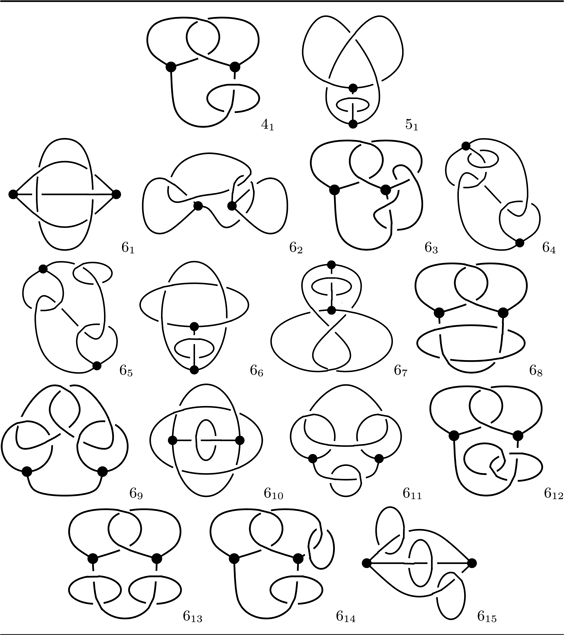
The aim of this paper is to extend the classification of handlebody knots of genus two in [Reference Ishii, Kishimoto, Moriuchi and Suzuki13] (see also [Reference Ishii, Kishimoto and Ozawa14, Reference Lee and Lee19]) to handlebody links with
 $n > 1$
components having total genus
 $n + 1$
(Table 1); we call such a handlebody link an (n,1)-handlebody link; it consists of exactly one genus two handlebody and
 $n-1$
solid tori. Our classification theorem is based on classifications of minimal diagrams and of not necessarily connected spatial graphs with small crossing number (compare with [
Reference Moriuchi23, Reference Moriuchi24
]).
Non-split, irreducible handlebody links up to six crossings

While the chirality of some handlebody knots in [Reference Ishii, Kishimoto, Moriuchi and Suzuki13] is hard to detect [Reference Ishii and Iwakiri11, Reference Ishii, Kishimoto and Ozawa14, Reference Lee and Lee19, Reference Motto26], and remains unknown for some of them [Reference Ishii, Iwakiri, Jang and Oshiro12], the chirality of all handlebody links in Table 1 can be determined. The investigation also reveals that complements of handlebody links can behave quite differently; there are irreducible (n,1)-handlebody links,
 $n>2$
, with
 $\partial$
-reducible complements, a phenomenon not occurring with handlebody knots of genus two (see [
Reference Tsukui33
] and Remark 3·3). The following theorems summarise the main results of the paper.
Theorem 1·1. Table 1 enumerates all non-splitFootnote
1
, irreducibleFootnote
2
 $(n, 1)$
-handlebody links, up to ambient isotopy and mirror image, by their minimal diagrams, up to six crossings.
 $4_1$
and
 $5_1$
in Table 1 are the only non-split, irreducible (n,1)-handlebody links with four and five crossings, respectively. Among the 15 handlebody links with six crossings, some of them have
 $n>2$
components. We remark that
 $6_5$
in Table 1 represents the famous figure eight puzzle devised by Stewart Coffin [
Reference Botermans and Van Delft3
]. Thus, its unsplittability implies the impossibility of solving the puzzle (Remark 3·2). Also,
 $(6_2,6_4)$
and
 $(6_{11},6_{14})$
are pairs of inequivalent handlebody links with homeomorphic complements.
Our task with respect to Table 1 is two-fold: we need to show firstly that there is no extraneous entry, that is, all entries in the table:
-
U.1 represent non-split handlebody links,
-
U.2 represent irreducible handlebody links,
-
U.3 are mutually inequivalent, up to mirror image,
-
U.4 attain minimal crossing numbers,
and secondly that the table is complete; namely, no missing handlebody links exist with crossing number
 $c\leq 6$
.
In Section 3 we prove U.1-U.3, making use of invariants such as the linking number [Reference Mizusawa22], irreducibility criteria [Reference Bellettini, Paolini and Wang2], and the Kitano–Suzuki invariant [Reference Kitano and Suzuki16] (Theorems 3·2, 3·7, and 3·1, respectively). We prove the completeness of Table 1 by exhausting all—except for those obviously non-minimal—diagrams of non-split, irreducible (n,1)-handlebody links up to six crossings (Section 4).
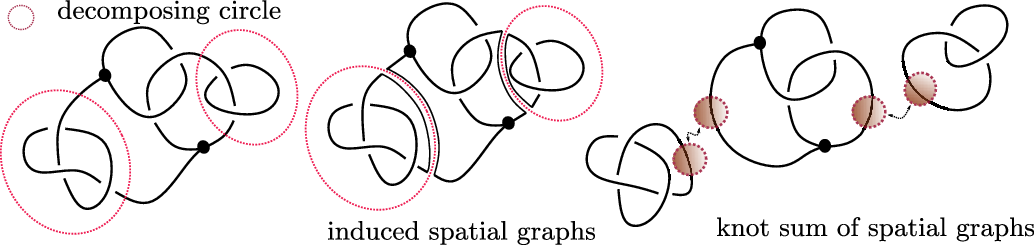
Observe that the underlying plane graph of a diagram of a non-split, irreducible (n,1)-handlebody link necessarily has edge connectivity 2 or 3. For the sake of simplicity, we say a diagram has connectivity e if its underlying plane graph has edge connectivity e. Diagrams with connectivity 3 up to six crossings are generated by a computer code (Appendix A), whereas handlebody links represented by diagrams with connectivity 2 are recovered by employing the knot sum—the order-2 vertex connected sum—of spatial graphs [Reference Moriuchi23]. In more detail, a minimal diagram D with connectivity 2 can be decomposed by decomposing circlesFootnote 3 into simpler tangle diagrams, each of which induces a spatial graph that admits a minimal diagram with connectivity 3 or 4, as illustrated in Figure 1·1. This decomposition allows us to recover the handlebody link represented by D by performing the knot sum between prime links and a spatial graph that admits a minimal diagram with connectivity 3.
Decomposing a minimal diagram with connectivity 2.

Once a list containing all possible minimal diagrams of non-split, irreducible handlebody links is produced, we examine each entry on the list manually (Appendix A), and show that it either is non-minimal or represents a handlebody link ambient isotopic to one in Table 1 with the same crossing number, up to mirror image. This proves the completeness, and also implies U.4 by induction on crossing number.
Theorem 1·2.
 $5_1$
,
 $6_3$
,
 $6_6$
,
 $6_7$
,
 $6_8$
,
 $6_{10}$
are the only chiral handlebody links in Table 1.
The proof of Theorem 1·2 occupies Section 5·2, and the main tool is Theorem 5·2, where we prove a uniqueness result for decomposition of non-split, irreducible handlebody links with no genus
 $g>2$
component, in terms of order-2 connected sum (Definition 5·1). A unique decomposition theorem in a more general form for handlebody knots of arbitrary genus is given in [
Reference Koda and Ozawa17
, appendix B] (see also [
Reference Ishii, Kishimoto and Ozawa14
]).
Theorem 1·3. Table 5 enumerates all non-split, reducible
 $(n, 1)$
-handlebody links up to six crossings, up to ambient isotopy and mirror image.
Theorem 1·3 follows from the irreducibility of handlebody links in Table 1 and a uniqueness factorisation theorem (Theorem 6·1) for non-split, reducible (n,1)-handlebody links in terms of order-1 connected sum (Definition 6·1).
The structure of the paper is the following. Basic properties of handlebody links are reviewed in Section 2. Uniqueness, unsplittability, and irreducibility of handlebody links in Table 1 are examined in Section 3. The completeness of Table 1 is discussed in Section 4. Section 5 introduces the notion of decomposable handlebody links, and uses it to examine the chirality of handlebody links in Table 1. A classification of non-split, reducible handlebody links up to six crossings is given in Section 6. Section 7 concludes the paper with a discussion of questions arising from the work. In the appendix we include an analysis on the output of the code available at http://dmf.unicatt.it/paolini/handlebodylinks/.
Throughout the paper we work in the
 $\operatorname{PL}$
category; for the illustrative purposes, the drawings often appear smooth. In the case of 3-dimensional submanifolds in
 $\mathbb S^3$
, the
 $\operatorname{PL}$
category is equivalent to the smooth category due to [Reference Brown4, theorem 5], [Reference Hirsch and Mazur8, theorems 7·1, 7·4], [Reference Munkres27, theorems 8·8, 9·6, 10·9].
2. Preliminaries
2.1. Handlebody links and spatial graphs
Definition 2·1 (Embeddings in
 $\mathbb S^3$
). A handlebody link HL (resp. a spatial graph G) is an embedding of finitely many handlebodies of positive genus (resp. a finite graphFootnote
4
) in the oriented 3-sphere
 $\mathbb S^3$
.
The genus of a handlebody link is the sum of the genera of its components; a spatial graph is trivalent if the underlying graph is trivalent (each vertex has degree 3). By a slight abuse of notation, we also use HL (resp. G) to denote the image of the embedding in
 $\mathbb S^3$
. The mirror image of HL (resp. G) is denoted by
 $r\textrm{HL}$
(resp.
 $r\textrm{G}$
).
Definition 2·2 (Equivalence). Two handlebody links HL,
 $\textrm{HL}^{\prime}$
(resp. spatial graphs
 $\textrm{G},\textrm{G}^{\prime}$
) are equivalent if they are ambient isotopic; they are equivalent up to mirror image if HL (resp. G) is equivalent to
 $\textrm{HL}^{\prime}$
or
 $r\textrm{HL}^{\prime}$
(resp.
 $\textrm{G}^{\prime}$
or
 $r\textrm{G}^{\prime}$
).
A regular neighbourhood of a spatial graph defines a handlebody link, up to equivalence [
Reference Rourke and Sanderson30
, 3·24], and a spine of a handlebody link HL is a spatial graph
 $\textrm{G}\subset \textrm{HL}$
such that HL is a regular neighbourhood of G [
Reference Ishii10
]. Here we are mainly concerned with trivalent spines.
Lemma 2·1. Every handlebody link admits a (trivalent) spine.
Proof. It suffices to prove the connected case. Suppose
 $\operatorname{HK}$
is a handlebody knot of genus g, and
 $\{D_1,\ldots,D_{3g-3}\}$
is a set of disjoint incompressible disks in
 $\operatorname{HK}$
such that the complement of the tubular neighbourhoods
 $N(D_i)$
of
 $D_i$
in
 $\operatorname{HK}$
consists of 3-balls
 $B_i,i=1,\ldots, 2(g-1)$
, each of which intersects with
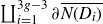 $\coprod_{i=1}^{3g-3} \partial \overline{N(D_i)}$
at three disks. Note that such a disk system always exists.
Let disks
 $D_{i1},D_{i2}, D_{i3}$
be components of
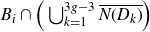 $B_i\cap \Big(\bigcup_{k=1}^{3g-3} \overline{N(D_k)}\Big)$
, and choose points
 $v_{i1},v_{i2},v_{i3}$
in the interior of
 $D_{i1},D_{i2}, D_{i3}$
and a point
 $v_i$
in the interior of
 $B_i$
. Then, joining
 $v_i$
to
 $v_{ij}$
by a path for each j gives us a trivalent vertex. Repeat the construction for every i, and then glue the
 $v_{ij}$
together so that the vertices
 $v_{ij}$
and
 $v_{i^{\prime}j^{\prime}}$
are identified if they are in the same
 $\overline{N(D_k)}$
, for some k. This way, we obtain a connected trivalent spine of
 $\operatorname{HK}$
with
 $2(g-1)$
trivalent vertices.
In general, a trivalent spine of a n-component handlebody link of genus g has
 $2(g-n) = 2t$
trivalent vertices, and we call such a handlebody link a (n, t)-handlebody link. This paper is primarily concerned with the case
 $t=1$
.
2.2. Diagrams
Let
 $\mathbb S^k=\mathbb R^k \cup \infty$
. Without loss of generality, it may be assumed handlebody links or spatial graphs are away from
 $\infty$
.
Definition 2·3 (Regular projection). A regular projection of a spatial graph G is a projection
 $\pi:\mathbb S^3\setminus\infty\rightarrow\mathbb S^2\setminus\infty$
such that the set
 $\pi^{-1}(x) \cap \textrm{G}$
is finite with its cardinality
 $\#(\pi^{-1}(x) \cap \textrm{G})\leq 2$
for any
 $x\in \mathbb S^2\setminus\infty$
, and no 0-simplex of the polygonal subset G of
 $\mathbb S^3$
is in the preimage of a double point, a double point being a point
 $x \in \mathbb S^2\setminus\infty$
with
 $\#(\pi^{-1}(x) \cap \textrm{G}) = 2$
.
As with the case of knots, up to ambient isotopy, every spatial graph admits a regular projection: the idea is to choose a vector v neither parallel to a 1-simplex in the polygonal subset
 $\textrm{G}\subset \mathbb{R}^3=\mathbb S^3\setminus \infty$
nor in a plane containing a 0-simplex and a 1-simplex or two 1-simplices; then isotopy G slightly to remove those points x with
 $\#\pi_v^{-1}(x)\cap \textrm{G}>2$
, where
 $\pi_v$
is the projection onto the plane normal to v.
Definition 2·4 (Diagram of a spatial graph). A diagram of a spatial graph G is the image of a regular projection of G with relative height information added to each double point.
The convention is to make breaks in the line corresponding to the strand passing underneath; thus each double point becomes a crossing of the diagram.
Definition 2·5 (Diagram of a handlebody link). A diagram of a handlebody link HL is a diagram of a spine of HL.
A diagram of G (resp. HL) is trivalent if it is obtained from a regular projection of a trivalent spatial graph (resp. spine).
Definition 2·6 (Crossing number). The crossing number c(D) of a diagram D of a handlebody link HL (resp. of a spatial graph G) is the number of crossings in D. The crossing number
 $c(\textrm{HL})$
of HL (resp.
 $c(\textrm{G})$
of G) is the minimum of the set
 \begin{equation*}\{ c(D)\mid D \, \text{a diagram of HL (resp. $\textrm{G})$}\}.\end{equation*}
Definition 2·7 (Minimal diagram). A minimal diagram D of a handlebody link HL (resp. of a spatial graph G) is a diagram of HL (resp. G) with
 $c(D) =c(\textrm{HL})$
(resp.
 $c(D)=c(\textrm{G})$
).
Every multi-valent vertex in a minimal diagram D can be replaced with some trivalent vertices by the inverse of the contraction move [ Reference Ishii10 , figure 1] without changing the crossing number, so for a handlebody link (resp. a spatial graph) there always exists a trivalent minimal diagram. From now on, we use the term “a diagram” to refer to a trivalent diagram of either a spatial graph or a handlebody link.
Now, regarding each crossing in a diagram as a quadrivalent vertex, we obtain a plane graph, a finite graph embedded in the 2-sphere. If we work backwards, and start with a plane graph having only trivalent and quadrivalent vertices, we can produce diagrams by replacing quadrivalent vertices with under- or over-crossings. If the plane graph has 2t trivalent vertices and c quadrivalent vertices, then from it we can recover
 $2^{c-1}$
diagrams, up to mirror image. In particular, a c-crossing (n, t)-handlebody link can be recovered from one of these plane graphs. Therefore, if one can enumerate all plane graphs with 2t trivalent vertices and up to c quadrivalent vertices, then one can recover all (n, t)-handlebody links up to c crossings.
2.3. Moves
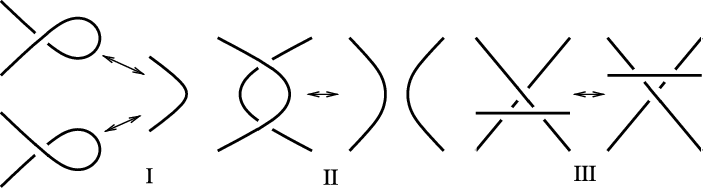
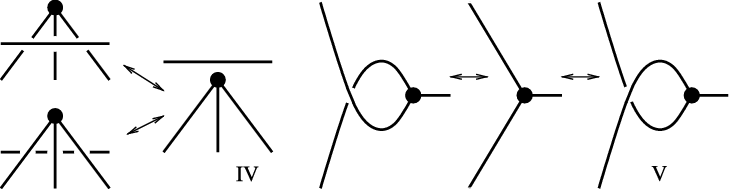
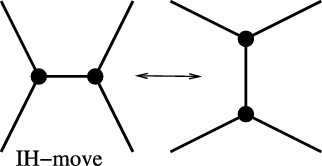
Definition 2·8 (Moves). Local changes in a diagram depicted in Fig. 2·1 and Fig. 2·2 are called generalised Reidemeister moves, and the local change in Fig. 2·3 is called an IH-move.
Classical Reidemeister moves of type I, II, III.

Reidemeister moves IV and V involve a trivalent vertex.

The IH-move.

Note that spines of equivalent handlebody links might be inequivalent as spatial graphs; indeed, the following holds.
Theorem 2·2 ([ Reference Kauffman15 , theorem 2·1], [ Reference Yetter35 ]). Two trivalent spatial graphs are equivalent if and only if their diagrams are related by a finite sequence of generalised Reidemeister moves.
Theorem 2·3 ([ Reference Ishii10 , corollary 2]). Two handlebody links are equivalent if and only if their trivalent diagrams are related by a finite sequence of generalised Reidemeister moves and IH-moves.
When analysing the data from the code (Section 4 and Appendix A), we adopt the convention: a diagram is called IH-minimal if the number of crossings cannot be reduced by generalised Reidemeister moves and IH moves, that is, “minimal” as a diagram of a handlebody link, and a diagram is called R-minimal if the number of crossings cannot be reduced by generalised Reidemeister moves, that is, “minimal” as a diagram of a spatial graph.
2.4 Non-split, irreducible handlebody links
Definition 2·9 (Edge-connectivity of a graph). The edge-connectivity of a graph is the minimum number of edges whose deletion disconnects the graph.
Definition 2·10 (Connectivity of a diagram). A diagram has connectivity e if its underlying plane graph has edge-connectivity e.
Definition 2·11 (Split handlebody link). A handlebody link HL is split if there exists a 2-sphere
 $\mathfrak S\subset \mathbb S^3$
such that
 $\mathfrak S\cap \textrm{HL}=\emptyset$
and both components of the complement
 $\overline{\mathbb S^3\setminus {\mathfrak S}}$
have non-trivial intersection with HL.
Definition 2·12 (Reducible handlebody link). A handlebody link HL is reducible if its complement admits a 2-sphere
 $\mathfrak S$
such that
 $\mathfrak S\cap \textrm{HL}$
is an incompressible disk in HL; otherwise it is irreducible.
Note that
 $\mathfrak S$
in Definition 2·12 factorises HL into two handlebody links, each of which is called a factor of the factorisation of HL.
A diagram with connectivity 0 (resp. connectivity 1) represents a split (resp. reducible) handlebody link, so only diagrams with connectivity greater than 1 are of interest to us; on the other hand, the connectivity of a diagram of a (n, t)-handlebody link with
 $t>0$
cannot exceed 3.
Now, we recall the order-2 vertex connected sum between spatial graphs [
Reference Moriuchi23
] for producing handlebody links represented by minimal diagrams with connectivity 2. A trivial ball-arc pair of a spatial graph G is a 3-ball B with
 $\textrm{G}\cap B$
a trivial tangle in B; it is oriented if an orientation of
 $\textrm{G}\cap B$
is given.
Definition 2·13 (Knot sum). Given two spatial graphs
 $\textrm{G}_1,\textrm{G}_2$
with oriented trivial ball-arc pairs
 $B_1,B_2$
of
 $\textrm{G}_1,\textrm{G}_2$
, respectively, their order-2 vertex connected sum
 $(\textrm{G}_1,B_1)\#(\textrm{G}_2,B_2)$
is a spatial graph obtained by removing the interiors of
 $B_1,B_2$
and gluing the resulting manifolds
 $\overline{\mathbb S^3\setminus {B_1}}$
and
 $\overline{\mathbb S^3\setminus {B_2}}$
by an orientation-reserving homeomorphism
 \begin{equation*}h\,:\,\Big(\partial \Big(\overline{\mathbb S^3\setminus {B_1}}\Big),\partial\big(\textrm{G}_1\cap B_1\big)\Big)\longrightarrow \Big(\partial \Big(\overline{\mathbb S^3\setminus {B_2}}\Big),\partial \big(\textrm{G}_2\cap B_2\big)\Big).\end{equation*}
The notation
 $\textrm{G}_1\#\textrm{G}_2$
denotes the set of order-2 vertex connected sums of
 $\textrm{G}_1,\textrm{G}_2$
with all possible trivial ball-arc pairs.
Since an order-2 vertex connected sum depends only on the edges of
 $\textrm{G}_1,\textrm{G}_2$
intersecting with
 $B_1,B_2$
and their orientations,
 $\textrm{G}_1\# \textrm{G}_2$
is a finite set.
3. Uniqueness, non-splittability, and irreducibility
Recall that, given a finite group
 $\mathsf{G}$
, the Kitano–Suzuki invariant
 $ks_{\mathsf{G}}(\textrm{HL})$
of a handlebody link HL is the number of conjugate classes of homomorphisms from
 $\pi_1\big(\overline{\mathbb S^3\setminus {\textrm{HL}}}\big)$
to
 $\mathsf{G}$
[
Reference Kitano and Suzuki16
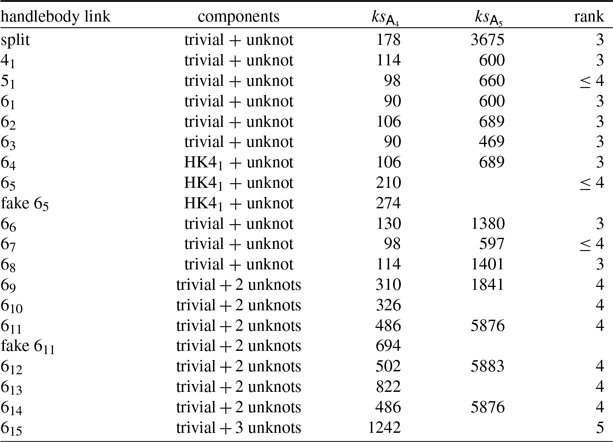
]. Table 2 lists the invariants
 $ks_{\mathsf{A}_4}(\textrm{HL})$
and
 $ks_{\mathsf{A}_5}(\textrm{HL})$
of each handlebody link HL in Table 1, as well as an upper bound of the rank of
 $\pi_1\big(\overline{\mathbb S^3\setminus {\textrm{HL}}}\big)$
computed by Appcontour [
Reference Paolini28
], where
 $\mathsf{A}_k$
is the alternating group on k letters.
Kitano–Suzuki invariant for entries in Table 1
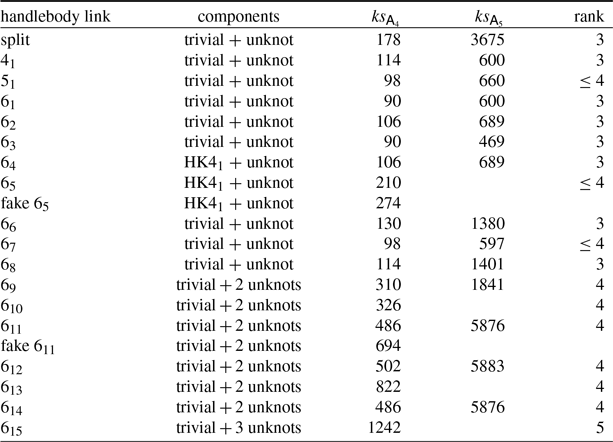
The entry “split” refers to the split handlebody link
 $\operatorname{HL}$
given by a trivial handlebody knot and an unknotted solid torus; the entry “fake
 $6_5$
” is the split handlebody link consisting of the handlebody knot
 $\operatorname{HK}4_1$
, Ishii–Kishimoto–Suzuki–Moriuchi’s
 $4_1$
in [
Reference Ishii, Kishimoto, Moriuchi and Suzuki13
], and an unknotted solid torus; the entry “fake
 $6_{11}$
” is
 $6_{11}$
in Table 1 with one of the bottom crossings reversed, thus making the lower solid torus component split off.
Theorem 3·1 (Uniqueness). Entries in Table 1 are all inequivalent.
Proof. All entries in Table 1 except for the pairs
 $(6_2,6_4)$
and
 $(6_{11},6_{14})$
are distinguished by comparing their
 $ks_{\mathsf{A}_4}$
- and
 $ks_{\mathsf{A}_5}$
-invariants (shown in Table 2). On the other hand,
 $6_2$
and
 $6_4$
cannot be equivalent because the removal of the “unknot” component produces inequivalent handlebody knots: one being trivial, the other being
 $\operatorname{HK}4_1$
. Similarly, one can distinguish
 $6_{11}$
and
 $6_{14}$
by removing the solid torus component having a non-trivial linking number with the genus two handlebody component [
Reference Mizusawa22
] in each of them, and observing that, for
 $6_{14}$
, the resulting handlebody link is
 $4_1$
, whereas for
 $6_{11}$
, we get the trivial split handlebody link.
Remark 3·1. The pairs
 $(6_2, 6_4)$
and
 $(6_{11}, 6_{14})$
in fact have homeomorphic complements, and hence the fundamental group cannot discriminate. Fig. 3·1 and 3·2 illustrate how to obtain the complements of
 $6_2$
and
 $6_{11}$
from
 $6_4$
and
 $6_{14}$
, respectively, via twisting (indicated by arrows).
 $6_2$
and
 $6_4$
have homeomorphic complements.

 $6_{11}$
and
 $6_{14}$
have homeomorphic complements.

Remark 3·2.
 $6_5$
viewed as a diagram of a spatial graph is the notorious figure eight puzzle devised by Stewart Coffin [
Reference Botermans and Van Delft3
]. The goal of the puzzle is to free the circle component from the knotted handcuff graph, i.e. to obtain the fake
 $6_5$
as a spatial graph. The impossibility of solving the puzzle then follows from computing
 $ks_{\mathsf{A}_4}(\bullet )$
of
 $6_5$
and fake
 $6_5$
(Table 2). See [
Reference Bertuccioni1, Reference Melvin21
] for other proofs of this.
Theorem 3·2 (Unsplittability). Entries in Table 1 are all unsplittable.
Proof. In most cases
 $(5_1,6_1,6_2,6_3,6_4,6_7,6_9,6_{10})$
unsplittability follows by computing the linking number [
Reference Mizusawa22
] between pairs of components of a handlebody link. There are a few cases where the linking number vanishes, and we deal with these cases by computing the
 $ks_{\mathsf{A}_4}$
- and
 $ks_{\mathsf{A}_5}$
-invariants of the corresponding split handlebody links (Table 2).
If
 $6_5$
were split, then
 $6_5$
would be equivalent to the fake
 $6_5$
but this is not possible by Table 2. In the case of
 $4_1$
,
 $6_6$
,
 $6_8$
, if any of them were split, than it would be equivalent to “split” in Table 2, but that is not the case. A similar argument can be applied to
 $6_{11}$
and
 $6_{14}$
: if one of them were split, it would be equivalent to the fake
 $6_{11}$
, in contradiction to Table 2. Lastly, we observe that
 $6_{12}$
and
 $6_{13}$
are non-split, for otherwise
 $4_1$
would be split.
Below we recall the irreducibility test developed in [ Reference Bellettini, Paolini and Wang2 ]. An r-generator link is a link whose knot group, the fundamental group of its complement, is of rank r.
Lemma 3·3. If the trivial knot is a factor of some factorisation of a reducible
 $(n, 1)$
-handlebody link HL, then
 \begin{equation}12 \mid ks_{\mathsf{A}_4}(\textrm{HL})+6\cdot 3^n+2\cdot 4^n\quad {\textrm{and}}\quad 60 \mid ks_{\mathsf{A}_5}(\textrm{HL})+14\cdot 4^n+19\cdot 3^n +22\cdot 5^n.\end{equation}
Lemma 3·4. If a
 $2$
-generator knot is factor of some factorisation of a reducible
 $(n, 1)$
-handlebody link HL, then
 \begin{equation}12+24p \mid ks_{\mathsf{A}_4}(\textrm{HL})+(6+16p)\cdot 3^n+ (2+6p)\cdot 4^n,{\textrm{where}\ p=0\ \textrm{or}\ 1}.\end{equation}
Lemma 3·5. If a
 $2$
-component,
 $2$
-generator link is a factor of some factorisation of a reducible
 $(n, 1)$
-handlebody link HL, then
 \begin{equation}48+24p \mid ks_{\mathsf{A}_4}(\textrm{HL})+(26+16p)\cdot 3^{n-1} + (8+6p)\cdot 4^{n-1},{\textrm{where}\ p=0,1,2,3\ \textrm{or}\ 4.}\end{equation}
From the above lemmas, one derives the following irreducibility test (see [ Reference Bellettini, Paolini and Wang2 ] for more details), making use of the Grushko theorem [ Reference Grushko7 ].
Corollary 3·6 (Irreducibility test). A
 $3$
-generator
 $(2,1)$
-handlebody link is irreducible if it fails to satisfy (3·1); a
 $4$
-generator
 $(2,1)$
-handlebody link is irreducible if it fails to satisfy (3·2); a
 $4$
-generator
 $(3,1)$
-handlebody link or a
 $5$
-generator
 $(4,1)$
-handlebody link is irreducible if it fails to satisfy (3·1) and (3·3).
Theorem 3·7 (Irreducibility). Entries in Table 1 are irreducible.
Proof. Corollary 3·6, together with Table 2, shows that all but
 $6_9$
,
 $6_{12}$
are irreducible. The irreducibility of
 $6_{12}$
and
 $6_9$
follows from computing the linking number between each pair of components in each of them. Specifically, if
 $6_{12}$
(resp.
 $6_9$
) is reducible, then either the trivial knot or a 2-generator 2-component link is a factor of some factorisation of
 $6_{12}$
(resp.
 $6_9$
). For
 $6_{12}$
, the former case is not possible by (3·1); the latter impossible too, for otherwise the two solid torus components would have a trivial linking number. The same argument implies that
 $6_9$
cannot have a 2-generator 2-component link as a factor, and the trivial knot cannot be its factor either, since the homomorphism of integral homology
 \begin{equation*}H_1(V_1)\oplus H_1(V_2) \longrightarrow H_1\big(\overline{\mathbb S^3\setminus {W}}\big)\end{equation*}
is onto, where
 $V_1, V_2$
are the solid torus components, and W the genus two component.
Remark 3·3. The complement of
 $6_9$
is in fact
 $\partial$
-reducible; one can see this by performing the twist operation, indicated by the arrow in Fig. 3·3(a), where it shows that its complement is homeomorphic to the complement of the order-1 connected sum (Definition 6·1) between two Hopf links (Fig. 3·3(a), right). The same argument implies that Fig. 3·3(b) is an irreducible
 $(m+3,1)$
-handlebody link with
 $\partial$
-reducible complement,
 $m\geq 0$
.
Irreducible handlebody links with a
 $\partial$
-reducible complement.

4. Completeness
This section discusses completeness of Table 1. Recall first that a minimal diagram of a non-split, irreducible handlebody link has either connectivity 2 or 3. IH-minimal diagrams with connectivity 3 are obtained from a software code, and handlebody links represented by IH-minimal diagrams with connectivity 2 are recovered by knot sum of spatial graphs.
4.1. Minimal diagrams with connectivity
 $3$

We consider plane graphs with two trivalent vertices and up to six quadrivalent vertices satisfying the properties:
-
(i) each of them has edge-connectivity 3 as an abstract graph;
-
(ii) their double arcs can only connect two quadrivalent vertices as abstract graphs; and
-
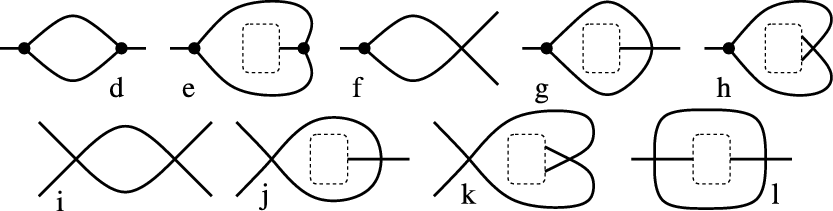
(iii) their double arcs only form a “bigon” (a polygon with two sides; the case ‘i’ in Fig. 4·1) as plane graphs.
Fig. 4·1.Possible configurations for loops and double arcs.

The reason of considering only double arcs connecting two quadrivalent vertices with a bigon configuration is because all the other cases lead to either non-R-minimal diagrams or diagrams with connectivity less than 3 (see Fig. 4·1, where “d, e, f, g, h” illustrate those double arcs connecting at least one trivalent vertex and “j, k, l” those connecting two quadrivalent vertices with a non-bigon configuration).
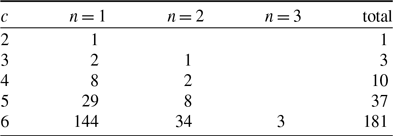
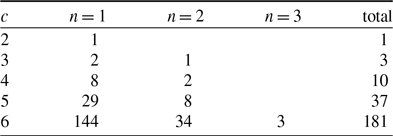
We enumerate such plane graphs by the software code, and then recover diagrams from these plane graphs by adding an over- or under-crossing to each quadrivalent vertex. Note that the number (n in Table 3) of components of the associated spatial graphs is independent of how over/under-crossings are chosen. To provide a glimpse of how the code works, we record in Table 3 the number of such plane graphs with c quadrivalent vertices for each n. To recover (n,1)-handlebody links with
 $n>1$
represented by IH-minimal diagrams with connectivity 3, we need to consider the cases with
 $n>1$
in Table 3. On the other hand, to produce (n,1)-handlebody links represented by IH-minimal diagrams with connectivity 2, spatial graphs admitting an R-minimal diagram with connectivity 3 up to 4 crossings are required; thus all cases with
 $c\leq 4$
have to be examined.
Plane graphs given by the code
IH-minimal diagrams. We examine IH-minimality of diagrams produced by plane graphs with
 $n\geq 2$
, and discard those obviously not IH-minimal. This excludes all diagrams produced by the code up to 5 crossings (Table 7), but for diagrams with 6 crossings, some diagrams are potentially IH-minimal: they represent handlebody links
 $6_1$
,
 $6_2$
,
 $6_3$
or
 $6_9$
in Table 1.
Lemma 4·1. An IH-minimal diagram with connectivity
 $3$
has crossing number
 $c\geq 6$
, and if
 $c=6$
, it represents a handlebody link equivalent to
 $6_1$
,
 $6_2$
,
 $6_3$
or
 $6_9$
, up to mirror image.
Note that we cannot conclude diagrams of
 $6_1, 6_2, 6_3$
and
 $6_9$
in Table 1 are IH-minimal yet, as they might admit diagrams with connectivity 2 and fewer crossings.
R-minimal diagrams. To produce minimal diagrams with connectivity 2 up to 6 crossings, we need R-minimal diagrams up to 4 crossings. Inspecting R-minimality of diagrams produced by the code (Table 6) gives us the following lemma.
Lemma 4·2. An R-minimal diagram with connectivity
 $3$
and crossing number less than
 $5$
represents one of the spatial graphs in Table 4, up to mirror image.
Spatial graphs up to four crossings

4.2 Minimal diagrams with connectivity
$2$

Recall a diagram D with 2-connectivity can be decomposed into finitely many simpler tangle diagrams such that each associated diagram of spatial graphs has connectivity 3 or 4 (Figure 1·1). Furthermore, if D is R-minimal, each induced spatial graph diagram is also R-minimal. In particular, an IH-minimal diagram with connectivity 2 can be recovered by performing the order-2 vertex connected sum between spatial graphs admitting a minimal diagram with connectivity
 $k>2$
. Since we are interested in (n,1)-handlebody links, only one summand is a spatial graph with two trivalent vertices, and the rest are links admitting a minimal diagram with connectivity 4. Note that the simplest minimal diagram with connectivity 4 represents the Hopf link, and since we only consider minimal diagrams up to 6 crossings, there are at most three link summands. Thus, IH-minimal diagrams with connectivity 2 can be recovered by considering the seven possible configurations below:

where G is a spatial graph admitting a minimal diagram with connectivity 3, and
 $\textrm{L}_i$
is a link admitting a minimal diagram with connectivity 4. In general it is not known if a minimal diagram with connectivity 4 always represents a prime link; it is the case, however, when crossing number is less than 5. In fact, there are only four minimal diagrams with connectivity 4 up to 4 crossings, and they represent the Hopf link, the trefoil knot, the figure eight, and Solomon’s knot (L4a1), respectively.
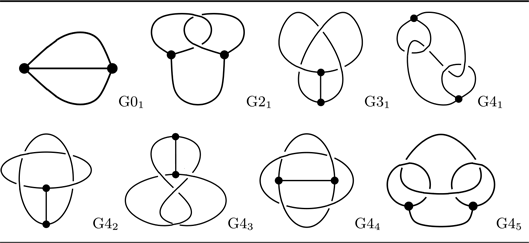
Cases 4 through 7 are easily dealt with since G must have no crossings, and hence it is the trivial theta curve
 $\textrm{G} 0_1$
, and thus each
 $\textrm{L}_i$
is necessarily the Hopf link, so the knot sums actually consist in ‘inserting a ring’ somewhere to the result of the previous knot sums. To produce irreducible handlebody links there is only one possibility, that is, adding one Hopf link to each of the three arcs of the trivial theta curve, and this gives us entry
 $6_{15}$
in Table 1.
Cases 2 and 3 force G to have 2 crossings at most. It cannot have zero crossing (
 $\textrm{G} 0_1$
), for otherwise, it produces only reducible handlebody links. On the other hand, there is no R-minimal diagram with 1 crossing, and one R-minimal diagram with 2 crossings, this is,
 $\textrm{G} 2_1$
in Table 4 (Moriuchi’s
 $2_1$
in [
Reference Moriuchi24
]).
Now, to add two Hopf links to
 $\textrm{G} 2_1$
, namely to place two rings successively, we observe that one of them must be placed around the connecting arc of the handcuff graph by irreducibility. The second ring can be placed in three inequivalent ways, which yield entries
 $6_{12}$
,
 $6_{13}$
and
 $6_{14}$
of Table 1.
Case 1 is more complicated, and we divided it into subcases based on the crossing number
 $c\,:\!=\,c(\textrm{G})$
. The case
 $c = 0$
is immediately excluded by irreducibility, so three possibilities remain:
 $c \in \{2,3,4\}$
.
Subcase
 $c(\textrm{G}) = 2$
. G is necessarily
 $\textrm{G} 2_1$
in Table 4, and L cannot be a knot. Since the crossing number of L cannot exceed 4, L is either L2a1 (Hopf link) or L4a1 (Solomon’s knot). In either case, L is to be added to the connecting arc of the handcuff graph to produce irreducible handlebody links, yielding entries
 $4_1$
and
 $6_8$
in Table 1.
Subcase
 $c(\textrm{G}) = 3$
. G is necessarily
 $\textrm{G} 3_1$
(Moriuchi’s theta curve
 $3_1$
in [
Reference Moriuchi23
]), so L cannot be a knot, and hence is the Hopf link. There is only one place to add L by irreducibility, and this leads to entry
 $5_1$
in Table 1.
Subcase
 $c(\textrm{G}) = 4$
. In this case, L has to be the Hopf link; and there are five possible spatial graphs for G, namely
 $\textrm{G} 4_1$
,
 $\textrm{G} 4_2$
,
 $\textrm{G} 4_3$
,
 $\textrm{G} 4_4$
, and
 $\textrm{G} 4_5$
:
-
(i) for
$\textrm{G} 4_1$
in Table 4 (Moriuchi’s non-prime handcuff graph
$2_1 \#_3 2_1$
[
Reference Moriuchi25
]), there are two inequivalent ways to add L which produce entries
$6_4$
and
$6_5$
; -
(ii) for
$\textrm{G} 4_2$
and
$\textrm{G} 4_3$
in Table 4 (Moriuchi’s prime handcuff graph
$4_1$
[
Reference Moriuchi24
] and prime theta-curve
$4_1$
[
Reference Moriuchi23
], respectively), there is only one way to add the Hopf link in each case because of irreducibility, and this gives
$6_6$
,
$6_7$
in Table 1, respectively; -
(iii) for
$\textrm{G} 4_4$
and
$\textrm{G} 4_5$
in Table 4, again by irreducibility, there is only one way to add the Hopf link in each case, which result in
$6_{10}$
and
$6_{11}$
in Table 1, respectively.


We summarise the above discussion in the following:
Lemma 4·3. A non-split, irreducible handlebody link admitting an IH-minimal diagram with connectivity
 $2$
and crossing number
 $c\leq 6$
is equivalent, up to mirror image, to one of the following handlebody links:
 \begin{equation} 4_1, 5_2, 6_4, 6_5, 6_6, 6_7, 6_8, 6_{10}, 6_{11}, 6_{12}, 6_{13}, 6_{14}.\end{equation}
By Lemma 4·1, if any of (4·1) admits an IH-minimal diagram with connectivity 3, it is equivalent to one of
 $6_1,6_2,6_3$
,
 $6_9$
, while by Lemma 4·1 if
 $6_1,6_2,6_3$
or
 $6_9$
admits an IH-minimal diagram with connectivity 2 and less than 6 crossings, it is equivalent to
 $4_1$
or
 $5_1$
, but neither situation can happen by Theorem 3·1.
Corollary 4·4. Diagrams in Table 1 are all IH-minimal.
5. Chirality
5.1. Decomposable links
Here we consider order-2 connected sums of handlebody-link-disk pairs; compare with Definition 6·1. A handlebod-link-disk pair is a handlebody link HL with an oriented incompressible disk
 $D\subset \textrm{HL}$
. A trivial knot with a meridian disk is regarded as a trivial handlebody-link-disk pair.
Definition 5·1 (Order-2 connected sum). Given two handlebody-link-disk pairs
 $(\textrm{HL}_1,D_1)$
,
 $(\textrm{HL}_2,D_2)$
the order-2 connected sum
 $(\textrm{HL}_1,D_1)\#(\textrm{HL}_2,D_2)$
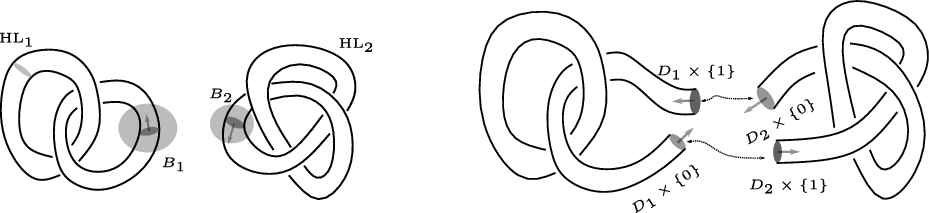
is obtained as follows: choose for each i a 3-ball neighbourhood
 $B_i$
of
 $D_i$
in
 $\mathbb S^3$
with
 ${B_i}\cap \textrm{HL}_i$
a tubular neighbourhood
 $N(D_i)$
of
 $D_i$
in
 $\textrm{HL}_i$
. Next, identify
 $\overline{N(D_i)}$
with
 $D_i\times [0,1]$
via the orientation of
 $D_i$
. Then
 $(\textrm{HL}_1,D_1)\#(\textrm{HL}_2,D_2)$
is given by removing
 ${B_i}$
and gluing the resulting manifolds via an orientation-reversing homeomorphism:
 \begin{equation*}h\,:\, \partial \big(\overline{\mathbb S^3\setminus {B_1}}\big) \longrightarrow \partial \big(\overline{\mathbb S^3\setminus {B_2}}\big)\quad{\textrm{with}\ h(D_1\times\{j\})=D_2\times\{k\}, k\equiv j+1\ \textrm{mod}\ 2}.\end{equation*}
A handlebody link is decomposable if it is equivalent to an order-2 connected sum of some non-trivial handlebody-link-disk pairs.
Lemma 5·1. Given a non-split, irreducible handlebody link HL, HL is decomposable if and only if
 $\overline{\mathbb S^3\setminus {\textrm{HL}}}$
admits an incompressible,
 $\partial$
-incompressible annulus A with
 $\partial A$
inessential in HL.
Proof. This follows from the definition of (
 $\partial$
-) incompressibility.
The “
 $\partial$
-incompressible” above can be replaced with “non-boundary parallel” in view of the irreducibility of HL.
Definition 5·2. A properly embedded annulus A in
 $\overline{\mathbb S^3\setminus {\textrm{HL}}}$
is a decomposing annulus of HL (resp. of
 $(\textrm{HL},D)$
) if A is incompressible and
 $\partial$
-incompressible (with
 $A\cap \partial D=\emptyset$
), and
 $\partial A$
is inessential in HL.
Theorem 5·2. Given a non-split, irreducible handlebody link HL with no component of
 $\operatorname{HL}$
having genus
 $g\geq 2$
, suppose A, A′ are decomposing annuli inducing
 \begin{equation}\textrm{HL}\simeq \left(\textrm{HL}_1,D_1\right)\#\left(\textrm{HL}_2,D_2\right), \;\textrm{HL}\simeq \left(\textrm{HL}^{\prime}_1,D^{\prime}_1\right)\# \left(\textrm{HL}^{\prime}_2,D^{\prime}_2\right), {\textrm{respectively}},\end{equation}
and
 $(\textrm{HL}_i,D_i),i=1,2$
, admit no decomposing annulus. Then A and A′ are isotopic, in the sense that there exists an ambient isotopy
 $f_t:\mathbb S^3\rightarrow \mathbb S^3$
fixing
 $\operatorname{HL}$
with
 $f_1(A)=A^{\prime}$
.
Proof. Note first that if A, A
′ are disjoint, then the assumption implies that they must be parallel and hence isotopic. Suppose
 $A\cap A^{\prime} \neq \emptyset$
. Then we isotopy A such that the number of components of
 $A\cap A^{\prime}$
is minimised.
Claim: any circle or arc in
 $A\cap A^{\prime}$
is essential in both A and A
′. Observe first that a circle component C or an arc component l of
 $A\cap A^{\prime}$
is either essential in both A and A
′ or inessential in both A and A
′ by the incompressibility and
 $\partial$
-incompressibility of A and A
′.
Suppose C is inessential in both A and A
′, and is innermost in A
′. Then C bounds disks D, D
′ in A, A
′, respectively. Since HL is non-split,
 $D\cup D^{\prime}$
bounds a 3-ball B in
 $\overline{\mathbb S^3\setminus {\textrm{HL}}}$
. Isotopy D across B to D
′ induces a new annulus A isotopic to the original one with
 $A \cap A^{\prime}$
having less components, contradicting the minimality.
Suppose l is inessential in both A and A
′ and an innermost arc in A
′. Then l cuts off a disk D
′ from A
′ and a disk D from A. Let
 $\hat{D}\,:\!=\,D\cup D^{\prime}$
. If
 $\partial \hat{D}$
is inessential, then we can remove the intersection l by isotopying A across the ball bounded by
 $\hat{D}$
and the disk bounded by
 $\partial \hat{D}$
in
 $\partial \operatorname{HL}$
, contradicting the minimality.
If
 $\partial \hat{D}$
is essential, then isotopying
 $\hat{D}$
, we can disjoin
 $\hat{D}$
from A. Now, it may be assumed that
 $D_1$
is in a genus one component of
 $\operatorname{HL}_1$
, and hence
 $D_2$
is in a component of
 $\operatorname{HL}_2$
with genus
 $g \leq 2$
. Since
 $\partial \hat{D}$
is essential,
 $\hat{D}$
has to be in a genus two component of
 $\operatorname{HL}_2$
containing
 $D_2$
. Because
 $\partial\hat{D}\cap D_2=\emptyset$
, if
 $\partial \hat{D}$
is essential on the boundary of the embedded solid torus
 $\big(\textrm{HL}_2\setminus N(D_2)\big)\subset\mathbb S^3$
,
 $\partial \hat{D}$
would be its longitude, where
 $N(D_2)$
is a tubular neighbourhood of
 $D_2$
, disjoint from
 $\hat{D}$
, in
 $\operatorname{HL}_2$
. Particularly,
 $\textrm{HL}_2$
and therefore HL would be reducible, a contradiction. On the other hand, if
 $\partial \hat{D}$
bounds a disk on
 $\partial \big(\textrm{HL}_2\setminus N(D_2)\big)$
that contains some components of
 $\partial\overline{N(D_2)}$
, then
 $\partial \hat{D}$
is inessential in
 $\textrm{HL}_2$
, and hence in HL, again contradicting the irreducibility of HL.
The claim is proved, and
 $A \cap A^{\prime}$
contains either essential circles or essential arcs.
No essential circles. Suppose C is an essential circle, and a closest circle to
 $\partial A^{\prime}$
. Let R
′ be the annulus cut off by C from A
′ with
 $A\cap R^{\prime}=C$
and R an annulus cut off by C from A. We isotopy the incompressible annulus
 $\hat{R}\,:\!=\,R\cup R^{\prime}$
away from A. Since components of
 $\partial \hat{R}$
are inessential in
 $\operatorname{HL}$
, by the assumption,
 $\hat{R}$
is either parallel to A or boundary-parallel. In the former case, replacing A with R leads to a contradiction since
 $R\cap A^{\prime}$
has less components than
 $A\cap A^{\prime}$
. In the latter case, isotopying R through the solid torus V bounded by
 $\hat{R}$
and the part of
 $\partial \textrm{HL}$
parallel to
 $\hat{R}$
gives a new A isotopic to the original one but with less components in
 $A\cap A^{\prime}$
, contradicting the minimality.
No essential arcs. Suppose
 $l_1$
is an essential arc. Then choose the essential arc
 $l_2$
next to
 $l_1$
in A
′ such that the disk D
′ cut off by
 $l_1,l_2$
from A
′ has
 $D^{\prime}\cap A=l_1\cup l_2$
and is on the side of A containing components of
 $\operatorname{HL}_1$
. Let D be a disk cut off by
 $l_1,l_2$
from A. It may be assumed, by pushing D away from A, that
 $D\cup D^{\prime}$
is disjoint from A, and hence is on the genus one complement of
 $\operatorname{HL}_1$
containing
 $D_1$
. Since
 $\hat{A}\,:\!=\,D\cup D^{\prime}$
is disjoint from
 $D_1$
, it is necessarily an annulus, for if it were a Möbius band, we would get a non-orientable surface embedded in
 $\mathbb S^3$
. Furthermore, each component of
 $\partial \hat{A}$
is necessarily inessential in
 $\operatorname{HL}_1$
, so it either bounds a meridian disk or is inessential in
 $\partial \operatorname{HL}_1$
. Note also it cannot be the case that one component of
 $\partial \hat{A}$
is essential in
 $\partial\operatorname{HL}_1$
and the other inessential by the irreducibility of
 $\operatorname{HL}$
. Suppose both components are inessential in
 $\partial \operatorname{HL}_1$
. Then
 $\hat{A}$
, together with disks on
 $\partial \operatorname{HL}_1$
bounded by
 $\partial \hat{A}$
, bounds a 3-ball, with which we can isotopy A to remove the intersection
 $l_1,l_2$
, contradicting the minimality. Suppose both components bound meridian disks in
 $\operatorname{HL}_1$
. Then
 $\tilde{A}=D^c\cup D^{\prime}$
has
 $\partial \tilde{A}$
inessential in
 $\partial \operatorname{HL}_1$
, where
 $D^c=\overline{A\setminus D}$
. Thus we reduce it to the previous case.
5.2. Chirality
We divide the proof of Theorem 1·2 into two lemmas.
Lemma 5·3. All handlebody links except for
 $5_1$
,
 $6_3$
,
 $6_6$
,
 $6_7$
,
 $6_8$
,
 $6_{10}$
in Table 1 are achiral.
Proof. An equivalence between
 $6_2$
and r
 $6_2$
is depicted in Figure 5·2; the chirality of the other handlebody links are easy to see.
Knot sum of handlebody-link-disk pairs

 $6_2$
and
 $r6_2$
.

Lemma 5·4.
 $5_1$
,
 $6_3$
,
 $6_6$
,
 $6_7$
,
 $6_8$
,
 $6_{10}$
in Table 1 are chiral.
Proof. Recall that, given a handlebody link HL, if HL and
 $r\textrm{HL}$
are equivalent, then there is an orientation-reversing self-homeomorphism of
 $\mathbb S^3$
sending HL to HL.
Observe that each of
 $5_1, 6_6, 6_8, 6_{10}$
admits an obvious decomposing annulus satisfying conditions in Theorem 5·2; particularly the annulus in each of them is unique. Their chirality then follows readily from the fact that torus links are chiral.
To see chirality of
 $6_3$
, we observe that, given a (2,1)-handlebody link HL, any self-homeomorphism of
 $\mathbb S^3$
preserving HL sends the meridian m and the preferred longitude l of the circle component to
 $m^{\pm 1}$
and
 $l^{\pm 1}$
, respectively. In particular, any isomorphism on knot groups induced by such a homeomorphism sends the conjugacy class of
 $m\cdot l $
in
 $\pi_1\big(\overline{\mathbb S^3\setminus {\textrm{HL}}}\big)$
to the conjugacy class of
 $m\cdot l$
,
 $m^{-1}\cdot l$
,
 $m\cdot l^{-1}$
or
 $m^{-1}\cdot l^{-1}$
, depending on whether the homeomorphism is orientation-preserving.
Let N be the number of conjugacy classes of homomorphisms from
 $\pi_1\big(\overline{\mathbb S^3\setminus {\textrm{HL}}}\big)$
to a finite group
 $\mathsf{G}$
that sends
 $m\cdot l$
(and hence
 $m^{-1} \cdot l^{-1} $
) to 1, and rN the number of conjugacy classes of homomorphisms from
 $\pi_1\big(\overline{\mathbb S^3\setminus {\textrm{HL}}}\big)$
to
 $\mathsf{G}$
that sends
 $m\cdot l^{-1}$
(and hence
 $m^{-1}\cdot l$
) to 1. Now, if HL and its mirror image
 $r\textrm{HL}$
are equivalent, then
 $N=rN$
. This is however not the case with
 $6_3$
; when
 $\mathsf{G}=A_5$
, we have
 $(N,rN)=(77,111)$
as computed by [
Reference Paolini28
].
In the case of
 $6_7$
, by Theorem 5·2 every self-homeomorphism f of
 $\mathbb S^3$
sending
 $6_7$
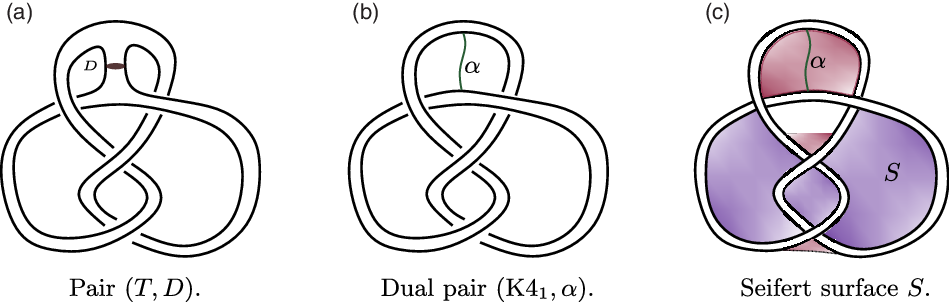
to itself induces a self-homeomorphism f sending the handlebody-knot-disk pair (T, D) in Figure 5.3(a) to itself, or equivalently sending the (fattened) figure eight with an arc
 $(\operatorname{K4_1},\alpha)$
in Figure 5·3(b) to itself, where
 $\alpha$
is the dual one-simplex to D.
figure 5·3

Let S be a minimal Seifert surface of the figure eight (Figure 5·3(c)) containing the arc
 $\alpha$
, and
 $D_+,D_-$
be two disjoint meridian disks containing
 $\partial \alpha$
, respectively. By the standard covering space argument [
Reference Rolfsen29
], one can assume
 $f(\partial S)\cap (D_+\cup D_-)=\partial \alpha=\partial f(\alpha)$
, and hence we can further isotope f so that
 $f(N(\alpha))=N(\alpha)$
for some tubular neighbourhood
 $N(\alpha)$
of
 $\alpha$
in S.
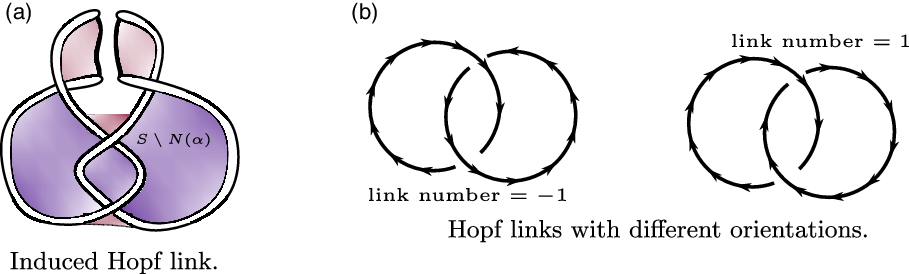
Both complements
 $S\setminus N(\alpha)$
and
 $f(S)\setminus N(\alpha)$
are Seifert surfaces of the induced Hopf link (Figure 5·4(a)), and up to ambient isotopy, the Hopf link only admits two minimal Seifert surfaces, among which only one is compatible with
 $N(\alpha)$
. Thus
 $S\setminus N(\alpha)$
and
 $f(S)\setminus N(\alpha)$
are ambient isotopic. Now if f is orientation-reversing, it implies the two oriented Hopf links in Figure 5·4(b) are ambient isotopic, contradicting their link numbers.
figure 5·4

6. Reducible handlebody links
In this section, we show that Table 5 classifies, up to ambient isotopy and mirror image, all non-split, reducible (n,1)-handlebody links up to six crossings (Theorem 1·3). We begin by considering the order-1 connected sum for handlebody links.
Reducible links with up to six crossings

6.1. Order-
$1$
connected sum

A handlebody-link-component pair
 $(\textrm{HL},h)$
is a handlebody link HL with a selected component h of HL.
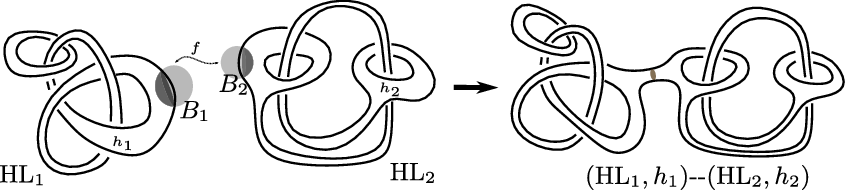
Definition 6·1 (Order-1 connected sum). Let
 $(\textrm{HL}_1,h_1)$
and
 $(\textrm{HL}_2,h_2)$
be two handlebody-link-component pairs. Then their order-1 connected sum
 $(\textrm{HL}_1,h_1)$
--
 $(\textrm{HL}_2,h_2)$
is given by removing the interior of a 3-ball
 $B_1$
(resp.
 $B_2$
) in
 $\mathbb S^3$
with
 $B_1\cap \partial \textrm{HL}_1= B_1\cap \partial h_1$
(resp.
 $B_2\cap \partial \textrm{HL}_2= B_2\cap \partial h_2$
) a 2-disk, and then gluing the resulting 3-manifolds
 $\overline{\mathbb S^3\setminus {B_1}}$
,
 $\overline{\mathbb S^3\setminus {B_2}}$
via an orientation-reversing homeomorphism
 $f:(\partial B_1,(\partial B_1)\cap h_1)\rightarrow(\partial B_2,(\partial B_2)\cap h_2)$
. We use
 $\textrm{HL}_1$
--
 $\textrm{HL}_2$
to denote the set of order-1 connected sums between
 $\textrm{HL}_1,\textrm{HL}_2$
with all possible selected components.
The following generalises the case of handlebody knots in [ Reference Tsukui33 , theorem 2].
Theorem 6·1 (Uniqueness). Given a non-split, reducible
 $(n, 1)$
-handlebody link HL, if
 $\textrm{HL}\simeq \left(\textrm{HL}_1,h_1\right)\text{- -} \left(\textrm{HL}_2,h_2\right)$
, and
 $\textrm{HL}\simeq \left(\textrm{HL}^{\prime}_1,h^{\prime}_1\right)\text{- -} \left(\textrm{HL}^{\prime}_2,h^{\prime}_2\right)$
, then
 $\left(\textrm{HL}_i,h_i\right)\simeq \left(\textrm{HL}^{\prime}_i,h^{\prime}_i\right)$
,
 $i=1,2$
, up to reordering.
Proof. Note first that, since HL is non-split and reducible,
 $\textrm{HL}_i, \textrm{HL}^{\prime}_i$
,
 $i=1,2$
, are non-split, and
 $\pi_1\big(\overline{\mathbb S^3\setminus {\textrm{HL}}}\big)$
is a non-trivial free product
 $\mathsf{G}_1\ast \mathsf{G}_2$
, where
 $\mathsf{G}_i$
is the knot group of
 $\textrm{HL}_i$
,
 $i=1,2$
.
Let D and D
′ be the separating disks in
 $\overline{\mathbb S^3\setminus {\textrm{HL}}}$
given by the factorisations
 $\textrm{HL}\simeq (\textrm{HL}_1,h_1)\text{- -} (\textrm{HL}_2,h_2)$
and
 $\textrm{HL}\simeq \left(\textrm{HL}^{\prime}_1,h^{\prime}_1\right)\text{- -} \left(\textrm{HL}^{\prime}_2,h^{\prime}_2\right)$
, respectively. Suppose neither
 $\mathsf{G}_1$
nor
 $\mathsf{G}_2$
is isomorphic to
 $\mathbb{Z}$
. Then, up to isotopy,
 $D^{\prime}\cap D=\emptyset$
by the innermost circle/arc argument.
Suppose one of
 $\mathsf{G}_i,i=1,2$
, say
 $\mathsf{G}_1$
, is isomorphic to
 $\mathbb{Z}$
, that is,
 $\textrm{HL}_1$
is a trivial solid torus in
 $\mathbb S^3$
. Then
 $\mathsf{G}_2$
must be non-cyclic, since
 $n>1$
. Let
 $D_l$
be the disk bounded by the longitude of
 $\textrm{HL}_1$
, and isotope
 $D,D_l$
so that the number n (resp.
 $n_l$
) of components of
 $D^{\prime}\cap D$
(resp.
 $D^{\prime}\cap D_l$
) is minimized.
Claim:
 $n_l=0$
. Note first that the minimality implies that
 $D^{\prime}\cap D_l$
contains no circle components. Now, consider a tubular neighbourhood
 $N(D_l)$
of
 $D_l$
in
 $\overline{\mathbb S^3\setminus {\operatorname{HL}}}$
small enough such that
 $\overline{N(D_l)}\cap D=\emptyset$
and
 $\overline{N(D_l)}\cap D^{\prime}$
are some disks, each of which intersects
 $D_l^+$
(resp.
 $D_l^-$
) at exactly one arc on its boundary, where
 $D_l^{\pm}\subset \partial\overline{N(D_l)}$
are proper disks in
 $\overline{\mathbb S^3\setminus {\operatorname{HL}}}$
parallel to
 $D_l$
. The claim then follows once we have shown that
 $N(D_l)$
can be isotopied away from D
′.
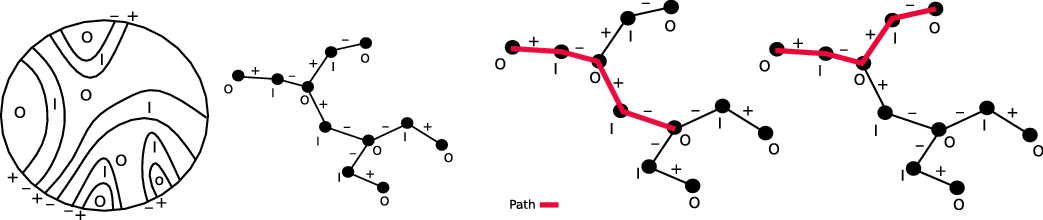
To see this, we construct a labelled tree
 $\Upsilon$
from the complement of the intersection
 $D^{\prime}\cap D_l^\pm$
in D
′, where
 $D^\pm_l\,:\!=\,D_l^+\cup D_l^-$
. Regard each component of
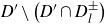 $D^{\prime}\setminus\big(D^{\prime}\cap D^\pm_l\big)$
as a node in
 $\Upsilon$
, and each arc in
 $D^{\prime} \cap D_l^\pm$
as an edge in
 $\Upsilon$
connecting the two nodes representing the components of
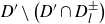 $D^{\prime}\setminus \big( D^{\prime}\cap D^\pm_l\big)$
whose closures intersect at the arc. Since each arc in
 $D^{\prime}\cap D^\pm_l$
cuts D
′ into two,
 $\Upsilon$
is a tree. The first two figures from the left in Figure 6·2 illustrate the construction.
Order-1 connected sum of
 $(\textrm{HL}_1,h_1)$
--
 $(\textrm{HL}_2,h_2)$
.

 $h(D_l)$
and
 $\Upsilon$
.

We label nodes and edges of
 $\Upsilon$
as follows: a node is labelled with I if the corresponding component of
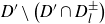 $D^{\prime}\setminus \big(D^{\prime}\cap D^\pm_l\big)$
is inside
 $N(D_l)$
; otherwise the node is labelled with O. An edge of
 $\Upsilon$
is labelled with
 $+$
if the corresponding component of
 $D^{\prime}\cap D^\pm_l$
is in
 $D_l^+$
; otherwise, it is labelled with a minus sign.
The labelling on
 $\Upsilon$
has the following properties: (a) adjacent nodes have different labels; (b) a node with label I is bivalent, and the two adjacent edges are labelled with
 $+$
and
 $-$
, respectively, whereas a node labelled with O could be multi-valent; (c) a one-valent node corresponds to an innermost arc in D
′, and always has label O.
Consider a maximal path
 $\Gamma\subset \Upsilon$
starting from a one-valent node and with the property that adjacent edges of
 $\Gamma$
have different labels. Then the other end point of the path must be labelled with O and it is either a one-valent node of
 $\Upsilon$
or a multi-valent node with all adjacent edges having the same label; the two figures from the right in Figure 6·2 illustrate two possible maximal paths.
Without loss of generality, we may assume that the adjacent edge of the starting one-valent node of
 $\Gamma$
is labelled with
 $+$
. Denote the closure of the corresponding component of
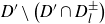 $ D^{\prime} \setminus \big( D^{\prime}\cap D^\pm_l\big)$
by
 $D_\Gamma^s$
. Then
 $\partial D_\Gamma^s$
bounds a disk T on
 $\partial (\textrm{HL} \cup \overline{N(D_l)})$
. If
 $T\cap D_l^-=\emptyset$
, then
 $D_\Gamma^s\cap D=\emptyset$
and hence
 $T\cap D=\emptyset$
by the minimality of n; however, if it were the case, one could reduce
 $n_l$
by isotopying
 $D_l$
across the 3-ball bounded by
 $D_\Gamma^s$
and T. Hence T must contain
 $D_l^-$
. Since the adjacent edge of the starting node is labelled with
 $+$
, adjacent edges of the end node of
 $\Gamma$
in
 $\Upsilon$
are labeled with
 $-$
. Denote by
 $D_\Gamma^e$
the closure of the component corresponding to the end node. Then
 $\partial D_\Gamma^e$
bounds a disk in
 $\partial (\textrm{HL} \cup \overline{N(D_l)})$
that is contained in T and has no intersection with
 $D_l^+$
. Particularly,
 $D_\Gamma^e\cap D=\emptyset$
by the minimality of n, and there is an arc in
 $\partial D_\Gamma^e$
cutting a disk D
′′ off
 $\overline{T\setminus D_l^-}$
with
 $D^{\prime\prime}\cap D^{\prime}=D^{\prime\prime}\cap D=\emptyset$
, so one can slide
 $N(D_l)$
over D
′′ (Figure 6·3) to decrease
 $n_l$
, a contradiction.
Sliding over
 $D^{\prime\prime}$
.

Consequently, such a path
 $\Gamma$
cannot exist, but this can happen only if
 $\Upsilon$
is empty. The claim is thus proved. It implies that
 $\textrm{HL}_1,\textrm{HL}^{\prime}_1$
are trivial solid tori in
 $\mathbb S^3$
, and
 $\textrm{HL}_2$
,
 $\textrm{HL}^{\prime}_2$
are equivalent to
 $\overline{N(D_l)}\cup \textrm{HL}$
.
6.2. Non-split, reducible handlebody links
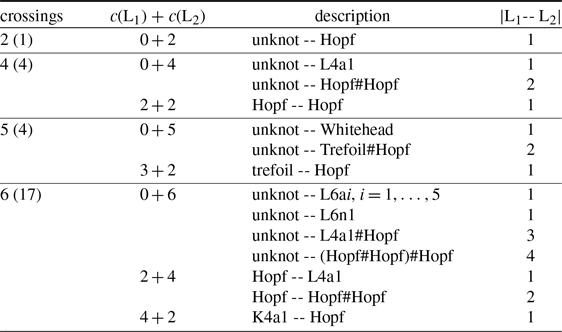
Table 5 lists all non-split, reducible (n,1)-handlebody links obtained by performing order-1 connected sum on pairs of links
 $(\textrm{L}_1,\textrm{L}_2)$
with crossing numbers
 $(c_1,c_2)$
and
 $c_1+c_2\leq 6$
, the notation
 $\textrm{L}\bullet a \bullet $
or
 $\textrm{L}\bullet n \bullet $
refers to links in the Thistlethwaite link table. Since
 $n>1$
, one of
 $\textrm{L}_1$
,
 $\textrm{L}_2$
is a link with more than one component, and by convention we let
 $\textrm{L}_2$
be the factor. The number in parentheses indicates the total number of inequivalent reducible handlebody links of the given crossing number. By Theorem 6·1, isotopy types of
 $\textrm{L}_1$
and
 $\textrm{L}_2$
with selected components determine the isotopy type of the resulting handlebody link in
 $\textrm{L}_1$
--
 $\textrm{L}_2$
. Thus there are no duplicates in Table 5.
On the other hand, by Lemmas 4·1 and 4·3 and Theorem 3·7, minimal diagrams of non-split, reducible (n,1)-handlebody links up to 6 crossings cannot have connectivity
 $k>1$
. This shows the completeness of Table 5.
7. Perspectives
Our classification of non-split (n,1)-handlebody links, and [ Reference Ishii, Kishimoto, Moriuchi and Suzuki13 ], provide examples that shed light on several interesting properties of (n,1)-handlebody links. Here we collect some questions arising from the study.
Crossing number.
The result in Section 6 implies that every handlebody link in Table 5 admits a minimal diagram with connectivity 1; not all their minimal diagrams have connectivity 1 though. Thus we ask the following question.
Question 7·1. Does every non-split, reducible handlebody link always admit a minimal diagram with connectivity 1?
An affirmative answer to Question 7·1, together with Theorem 6·1 and [ Reference Tsukui32 , theorem 2], implies the additivity of crossing number, a reminiscence of a one-hundred years old problem in knot theory (see [ Reference Lackenby18, Reference Malyutin20 ] and references therein).
 $$\matrix{
{{\rm{C}\small\text{ONJECTURE}}\;7.2} \hfill & {If({\rm{H}}{{\rm{L}}_1},{h_1}){\rm{- -}}({\rm{H}}{{\rm{L}}_2},{h_2})\,is\,an\,(n,1) - handlebody{\rm{ }}\,link,{\rm{ }}then} \hfill \cr
{} \hfill & {c(({\rm{H}}{{\rm{L}}_1},{h_1}){\rm{- -}}({\rm{H}}{{\rm{L}}_{\rm{2}}},{h_{\rm{2}}}))\,{\rm{ = }}\,c({\rm{H}}{{\rm{L}}_{\rm{1}}}){\rm{ + }}\,c({\rm{H}}{{\rm{L}}_{\rm{2}}}).} \hfill \cr
} $$
Decomposability.
Decomposability is reflected in the connectivity of minimal diagrams in most examples here; in general one may ask the following question.
Question 7·3. Does every minimal diagram of a non-split, irreducible, decomposable handlebody link have connectivity 2?
A positive answer to Question 7·3 implies that
 $6_1$
,
 $6_2$
,
 $6_3$
and
 $6_9$
in Table 1 are indecomposable. As Question 7·3 is expected to be hard, easier methods might be required to determine indecomposability.
Problem 7·4. Find computable criteria for indecomposability of handlebody links.
Handlebody link complement.
The question of whether irreducibility of a handlebody link implies
 $\partial$
-irreducibility of its complement has been studied in several situations. In the case of handlebody knots of genus two, this is always true [
Reference Tsukui33
, theorem 1], whereas for handlebody knots of genus
 $g>2$
, there are counterexamples [
Reference Suzuki31
, example 5·5], [
Reference Tsukui33
, section 5]. Now, Remark 3·3 provides counterexamples in the case of non-split, irreducible (n,1)-handlebody links with
 $n>2$
. We ask whether
 $n=2$
is the largest n for such a phenomenon to happen.
Question 7·5. Is the complement of a non-split, irreducible (2,1)-handlebody link always
 $\partial$
-irreducible?
Appendix A. Output of the code
A.1 Minimal diagrams from the code
The software code used in the paper exhaustively enumerates 3-edge-connected plane graphs with two trivalent vertices and q quadrivalent vertices,
 $0< q\leq 6$
, without double arcs that form a non-bigon. Note that the trivial theta curve is the only 3-edge-connected plane graph without quadrivalent vertices. The output of the code is examined and summarized in Table 3, while the detailed list is available on http://dmf.unicatt.it/paolini/handlebodylinks/, where each plane graph is described by its adjacent matrix together with a fixed ordering (clockwise or counterclockwise) of the edges adjacent to every vertex, as determined by the planar embedding.
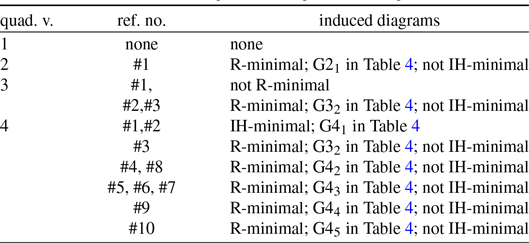
A.1.1 Four crossings or less
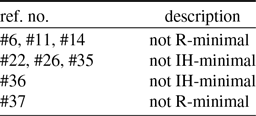
In Table 6, we analyse the output of the code up to 4 quadrivalent vertices, where the column “quad. v.” lists the number of quadrivalent vertices and “ref. no.” the reference number of each plane graph in the output of the code. The column “induced diagrams” describes minimality of diagrams induced by each plane graph. Most induced diagrams are not minimal, and we record their isotopy types as special graphs or handlebody links, up to mirror image. No IH-minimal diagram with more than one component is found in this case.
Diagrams with up to 4 crossings

A.1.2 Five and six crossing cases
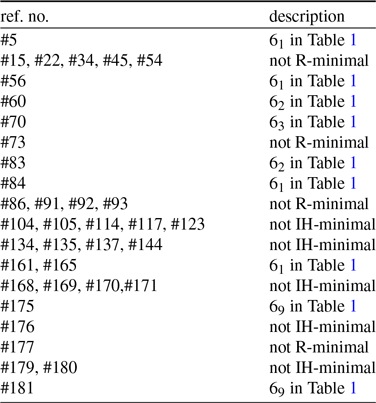
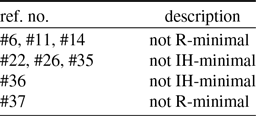
In the 5 crossing case, the code finds 8 plane graphs with more than one components, out of a total of 37 planar embeddings. Table 7 records the analysis for their induced diagrams; none of them gives IH-minimal diagrams. In the 6 crossing case, out of 181 plane graphs, 37 induces diagrams with more than one components. Table 8 records the minimality of their induced diagrams.
Diagrams with 5 crossings
Diagrams with 6 crossings

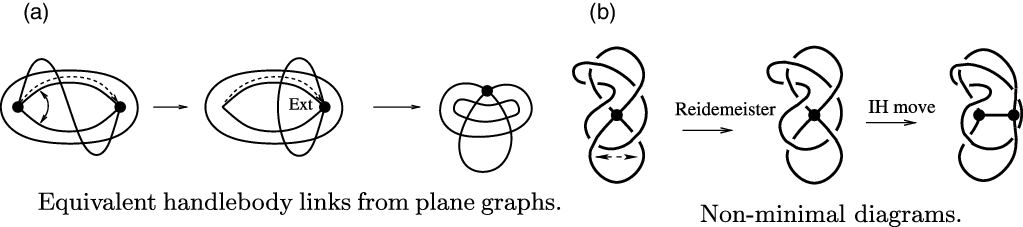
Figure A·1. exemplifies how the analysis is done. Figure A·1(a) shows how the diagrams induced by Plane Graph #5 are equivalent to those by #161 and #165 in the case of 6 crossings, and Figure A·1(b) explains non-minimality of diagrams induced by Plane Graphs #168, #169, #170, #171.
Examples of the analysis.

A.1.3 Inequivalent planar embeddings
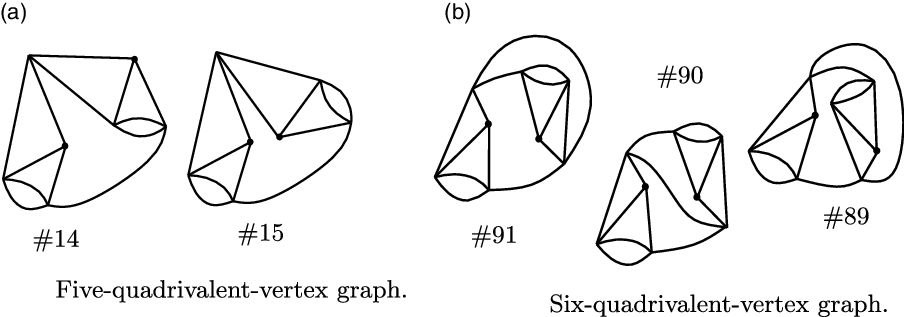
As a side remark, Figure A·2 illustrates two examples of abstract graphs with inequivant planar embeddings: one with five quadrivalent vertices and the other with six. Note that the abstract graphs have vertex connectivity 2, consistent with the Whitney uniqueness theorem [ Reference Whitney34 ].
Inequivalent planar embeddings.

Acknowledgements
The first author benefits from the support of the GNAMPA (Gruppo Nazionale per l’Analisi Matematica, la Probabilità e le loro Applicazioni) of INdAM (Istituto Nazionale di Alta Matematica). The second author benefits from the support of the Swiss National Science Foundation Professorship grant PP00P2_179110/1. The fourth author gratefully acknowledges the support from National Center of Theoretical Sciences during the preparation of the manuscript.