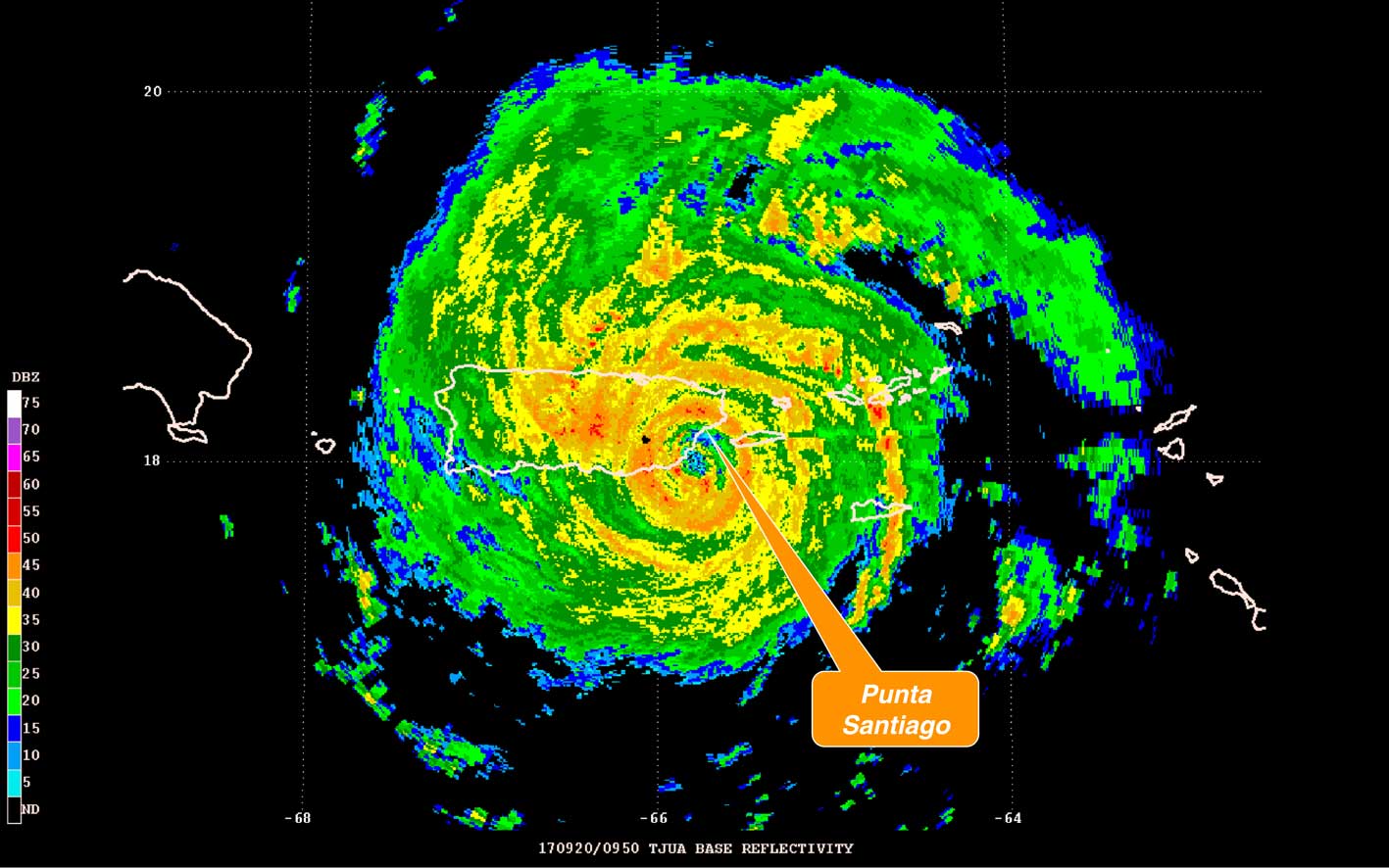
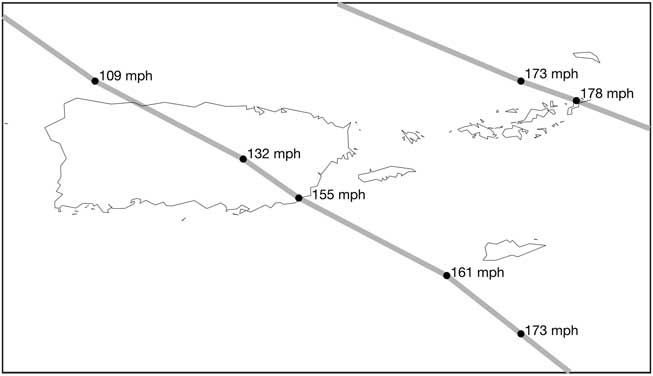
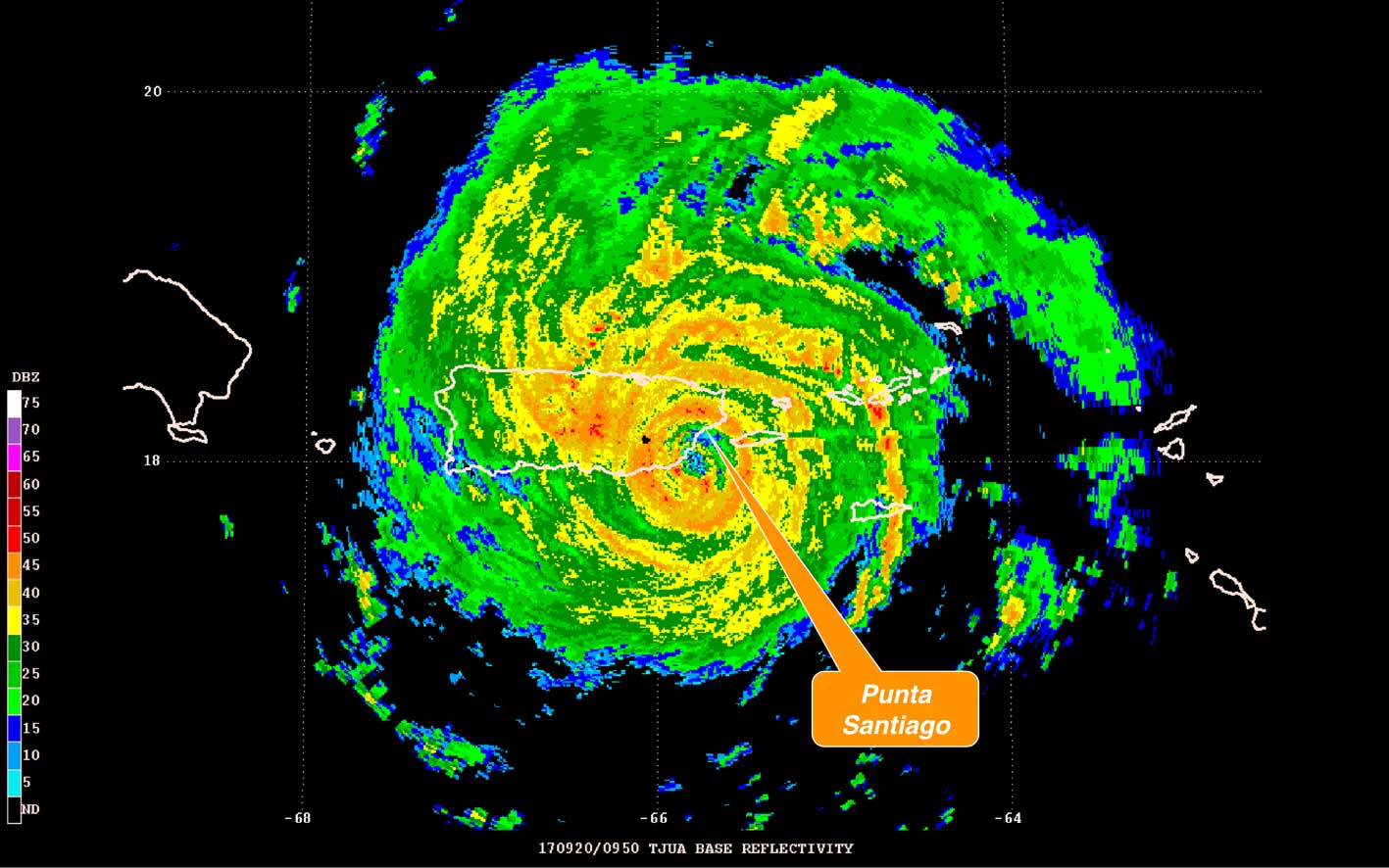
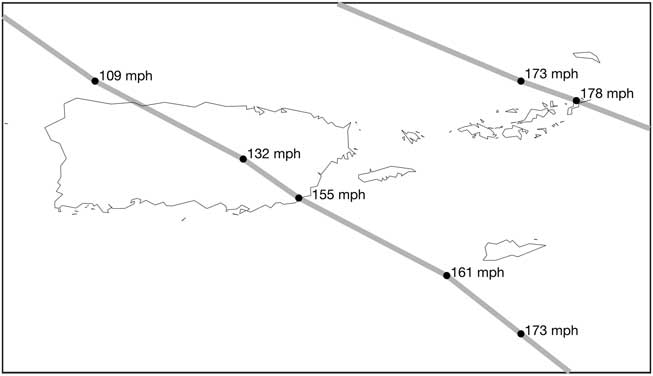
During the 2017 Atlantic basin hurricane season, Puerto Rico experienced multiple storm strikes. Hurricane Irma passed just north of the island on September 6, bringing tropical storm force winds and triggering widespread power outages. Two weeks later, on September 20, Hurricane Maria made landfall along the southeast coastline of Puerto Rico as a strong Category 4 hurricane. Maria then traversed the entire length of the island diagonally (Figures 1 and 2).Reference Patch, Penny and Berg 1 Many marginalized communities close to the point of storm entry, including Punta Santiago, sustained extreme structural damage and crippling disruption of infrastructure that led to a domino effect of predicaments.
Radar image of Hurricane Maria on 20 September, just before landfall in Puerto Rico. This was the last image from the radar, which was based in San Juan, before it was destroyedReference Patch, Penny and Berg 1 .
Tracks of Major Hurricanes Maria and Irma Near Puerto Rico
Puerto Rico’s population experienced potentially traumatic exposures to extreme storm hazards during the passage of Maria.Reference Shultz and Galea 2 , Reference Shultz, Kossin and Shepherd 3 One of the most devastating storm-related stressors was the island-wide collapse of the power grid, leaving many Puerto Ricans without electricity for 6 months or longer.Reference Shultz, Kossin and Shepherd 3
The duration and severity of impact-phase trauma exposures and postimpact hardships may lead to worsened mental and physical health.Reference Shultz and Galea 2 Maria’s catastrophic landfall, and the severity, as well as duration, of adversities that followed, prompted us to assess the community needs and mental health symptoms of a marginalized community—Punta Santiago, one of Puerto Rico’s hardest-hit coastal towns—6 months after the storm.
METHODS
Study Design
A cross-sectional, interviewer-administered survey was conducted with a stratified random sample of households throughout Punta Santiago to characterize population demographics and residents’ needs vis-à-vis storm damage and infrastructure disruption. Investigators also assessed the prevalence and severity of symptoms of major depression, generalized anxiety disorder (GAD), and posttraumatic stress disorder (PTSD).
Community Description
The hard-hit southeast coastal community selected for study was Punta Santiago (population of 4964 in 2010), located in the Humacao municipality. 4 Punta Santiago is a relatively remote community located roughly 70 kilometers from San Juan. Punta Santiago has an elderly population with a median age of 41.6 years. 4 According to 2016 estimates, 43.9% of the Punta Santiago population was below the poverty line, a rate that is 3 times higher than the United States national average 5 of 12.7%. The poverty rate for children under the age of 18 was 68.2% (2010 data). 4
No estimates exist for numbers of physicians, dentists, mental health professionals, or other health providers per 100 000 residents. However, the marginalized community of Punta Santiago faces significant and compounding barriers to care that were exacerbated post-Maria. These include pervasive poverty, damaged health care infrastructure, a shrinking healthcare workforce, low rates of health insurance coverage, and geographic remoteness from large cities. 5 , Reference Perreira, Peters and Lallemand 6 This was underscored by the low prioritization of Punta Santiago to receive electrical power restoration following Hurricane Maria.
Sampling Strategy
Punta Santiago’s approximately 2000 households are distributed into 3 neighborhoods: Las Parcelas, Verde Mar, and Villa Palmira. We first developed a sampling frame to facilitate household selection in proportion to the distribution of households across neighborhoods. Next, we randomly sampled households within each neighborhood. Finally, we interviewed one adult household member (age 18 or older) from each selected household.
Participants
Seventy-four participants (32 men, 42 women) were enrolled and consented; all self-identified as Puerto Rican. The sample reflected the representation of neighborhoods within Punta Santiago: 44 participants (59.5% of the sample) were from Las Parcelas, 27 (36.5%) were from Verde Mar, and 3 (4.1%) were from Villa Palmira. Thirty (40.5%) self-identified as retired, reflecting Punta Santiago’s relatively elderly population. All 74 participants completed the 3 mental health scales, and 70 completed the needs assessment survey.
Assessments
Two survey instruments were administered to each participant. These included (1) a survey indexing household and community needs and (2) measures of mental health symptoms. As part of the first survey, a community needs assessment, respondents were asked about availability of electrical power, clean water, food, health care, and transportation; degree of damage and loss to home and possessions; financial security; impacts on jobs, schools, and health; and emergency (FEMA) and nonemergency government aid (social security, food stamps). The second survey included validated scales to assess symptoms of major depression, GAD, and PTSD.
The PHQ-9 assesses symptoms of major depressive disorder.Reference Kroenke, Spitzer and Williams 7 The PHQ-9 consists of 9 questions relating to symptoms of depression, each rated on a 0-3 scale. Scores of 0-4 are considered to be subclinical, 5-9 are mild but not clinically significant, 10-14 are moderate, and 15-27 are severe. Moderate and severe symptom levels are classified as clinically significant.
The GAD-7 assesses GAD symptoms.Reference Spitzer, Kroenke and Williams 8 The GAD-7 consists of seven questions relating to symptoms of GAD, each rated on a 0-3 scale. Scores of 0-4 are subclinical, 5-9 are mild but not clinically significant, 10-14 are moderate, and 15-21 are severe. Moderate and severe symptom levels are classified as clinically significant.
The PCL-C assesses PTSD symptoms.Reference Weathers and Ford 9 The PCL-C is comprised of 17 questions relating to symptoms of PTSD, each rated on a 1-5 scale. Scores of 17-21 are considered subclinical, 22-43 are mild but not clinically significant, 44-49 are moderate, and 50-85 are severe. Moderate and severe symptom levels are classified as clinically significant.
RESULTS
Basic Necessities and Essential Services (n=70)
Electrical Power
At 6 months, power was restored to only 10% of households in our sample. No homes that we visited in Las Parcelas had power at the time of survey.
Water
Additional work by our research team indicated that the water supply throughout Punta Santiago showed evidence of fecal contamination and was unsafe for drinking.Reference Ajami, Rodriguez and Ferré 10 At 6 months, the primary source of drinking water was bottled water for two-thirds of the sample (66.2%). For those who used tap water, 54.3% did not treat water before consumption (17.1% boiled water, 28.6% used a filter).
Food
Almost half (47.1%) of the respondents reported that their primary means of obtaining food in the last week was from food stamps or donations from aid groups or a local church. Ten percent (10.0%) indicated they had insufficient food for the next 3 days.
Housing Damage
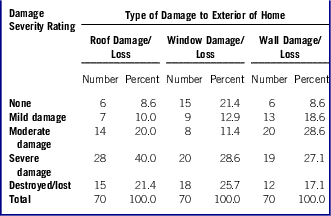
About half of participants (52.9%) believed their homes to be currently unsafe for habitation. Six in ten (61.4%) reported severe roof damage or complete roof loss. Corresponding percentages for severe damage/complete loss of windows and walls were 54.3% and 44.3%, respectively (see Table 1). Among participants who reported structural damage, by 6 months post-hurricane, 32.8% had partially repaired or replaced their roofs, 32.8% had repaired windows, and 46.9% had repaired walls.
Structural Damage to Exterior of Home

Loss/Damage to Possessions
Six in ten (60.8%) participants lost all personal belongings as a result of Maria. The majority of participants reported total loss of clothing (72.9%), irreplaceable loss or damage to furniture (74.3%), and loss or destruction of kitchen appliances (77.1%). Among participants reporting loss of possessions, 73.8% had replaced some clothing but only 12.5% had repaired or replaced all lost furniture and only 7.8% had repaired or replaced kitchen appliances at 6 months.
Transportation
Among residents who owned a car, 60% reported that their vehicle was completely destroyed or was inoperable due to wind damage and saltwater submersion, with 20% reporting no current available form of transportation.
Schools
The local elementary school was closed for 3 months after the hurricane. Six months after the storm, the school was operating only during morning hours and closed at noon due to lack of power. The local high school was closed for 1 month after the storm, provided half-day sessions for 3 months, and was open full-time at the time the survey was conducted. Due to lack of electrical power, classes were held outdoors with no operable technology (computers, printers).
Economic Indicators
Prior to Maria, Punta Santiago was considered a low socioeconomic status community. Average reported income was below the poverty line, with 66% of respondents reporting that they were unemployed or retired, and 83% receiving some form of federal support (eg, social security, food stamps). Maria worsened the town’s already precarious economic situation. As a direct consequence of Maria, there was a 20% drop in employment. Among those who continued working, mean income decreased by 37%.
Physical Health Indicators
Forty percent of respondents reported that at least 1 household member was living with a chronic illness that would be life-threatening without access to appropriate medications and health care. Survey participants living with a diagnosed chronic illness indicated worsening of symptoms following Maria. A pilot study of indoor air quality conducted in 12 Punta Santiago homes reported elevated levels of mold, bacteria, fungi, and viruses.Reference Colgan, Ferré and Westbrook 11 Poor housing conditions post-Maria, such as mold infestations, were associated with a three-fold increase in asthma episodes, itchy eye, dry cough, and shortness of breath, among other health conditions.Reference Colgan, Ferré and Westbrook 11
Symptom Levels for Common Mental Disorders (n=74)
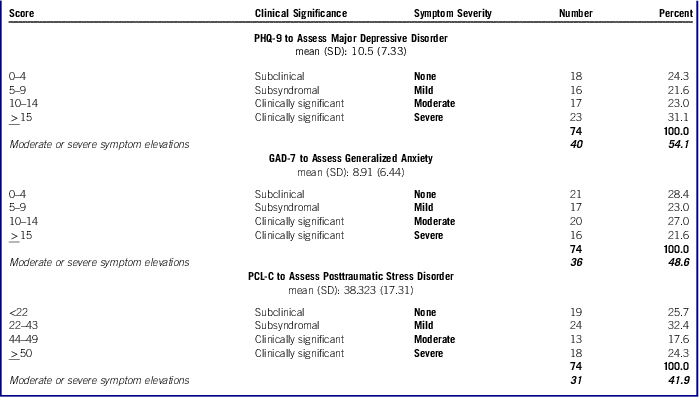
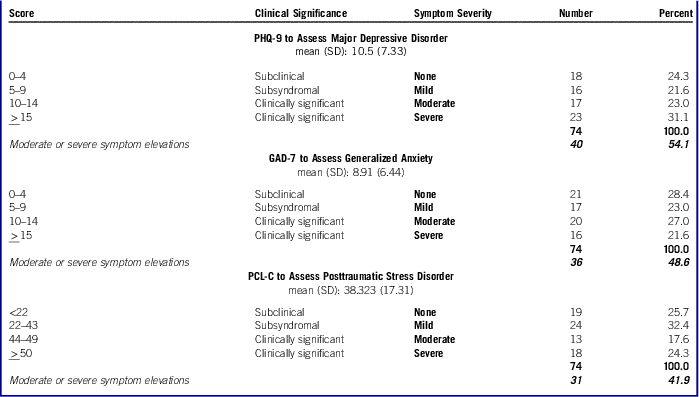
Two-thirds (66.2%) of study participants received a score in the clinically significant range for at least 1 of the 3 mental disorders examined (see Table 2). For major depression, 54.1% of respondents had clinically significant symptom elevations, including 31.1% with severe scores. For GAD, 48.6% had clinically significant symptom elevations. A significant gender difference (t=2.13, P<.05) in GAD-7 scores was found. Women (M=10.2; SD=6.7) scored higher than men (M=7.2, SD=5.7). For PTSD, 41.9% of respondents had clinically significant symptom elevations, including 24.3% in the severe range. Compared to other participants in the sample, participants from households with a family member living with a potentially life-threatening illness had significantly higher symptom levels for GAD and PTSD (anxiety, t=2.47, P<.05; PTSD, t=2.17, P<.05).
Common Mental Disorder Symptom Levels (n=74)
DISCUSSION
The 2017 hurricane season left an unprecedented mark.Reference Shultz, Kossin and Shepherd 3 , Reference Kossin, Hall and Knutson 12 The town of Punta Santiago, Puerto Rico, sustained the full “ground zero” effects of Hurricane Maria’s landfall on September 20, 2017. For many residents, evacuation away from the storm’s path was not an option. Because a hurricane’s strongest winds are located off the right front quadrant as the storm approaches, Punta Santiago was bombarded with ferocious, sustained winds just below Category 5 strength, with winds gusting to Category 5. The town’s shoreline was pounded by powerful wave action as the center of the storm made landfall. Punta Santiago received substantial flooding due to rainfall and storm surge. The flooding stressed the sewage system. Contaminated water flooded into residents’ homes as well as into the local water supply. As a result, many residents experienced a range of adverse health conditions.
The months following the storm were marked by unrelenting hardships. More than half of the households that we sampled experienced severe to catastrophic structural damage. Punta Santiago was left largely without power for many months. The water supply remained contaminated at the time our needs assessment was conducted in March 2018. Living in severely damaged homes without electricity subjected residents to severe heat and humidity and to vector-borne disease risks. Schools were closed for months and later reopened only for part of the day or with classes held outdoors.
Most people’s lives were severely disrupted, resulting in clinically elevated mental health symptom levels for two-thirds of participants 6 months after the storm. Elevated rates of PTSD symptoms were likely related to direct exposure to the hurricane and its aftermath.Reference Tracy, Norris and Galea 13 Major depression and GAD may have resulted from life-changing resource losses and ongoing daily adversities that were clearly observable during the field experience.Reference Tracy, Norris and Galea 13 , Reference Goldman and Galea 14
Comparable results were found on mental health scales in a previous study of Hurricane Katrina evacuees at 12 months post-hurricane. This study classified the severity of impact-phase exposures and also catalogued additional poststorm traumas. PTSD symptoms, for instance, were present in about 33% of the sample.Reference Lajoie, Sprang and McKinney 15
Study Limitations
Study limitations include the small sample size, the limited resources available for conducting research within a postdisaster environment, and the constraints of the study design. However, despite the small sample size, we were able to document the degree of post-hurricane devastation, the extremity of deleterious health and living conditions, and high levels of psychopathology.
With our cross-sectional, single-group design, causality cannot be determined. The study team did not gather information regarding physical and behavioral health status prior to the hurricanes. However, we conducted a post-hoc examination of the 2016 data from the CDC’s Behavioral Risk Factor Surveillance System (BRFSS).
According to the BRFSS, the 2016 prevalence of depression in Puerto Rico was 18.2%, similar to the United States national prevalence of 17.4%. 16 The prevalence of depression in our sample was 54.1%, fully three times higher than this 2016 island-wide baseline. While not all depression can be attributed to the encounter with Hurricane Maria, this underscores that a considerable burden of new-onset depression—and by extension, GAD and PTSD—is likely to have occurred due to the traumatic impact phase exposures and poststorm adversities in Punta Santiago.
Regarding chronic disease indicators, the prevalence of coronary heart disease, myocardial infarction, diabetes, and lifetime asthma in Puerto Rico is notably higher than the median prevalence of these conditions for all of the states in the United States combined. 16 Punta Santiago’s relatively elderly population, with a median age that is 6 years older than the median for Puerto Rico, is likely to experience a considerable disease burden. Long-term power outages, prolonged heat exposure, lack of refrigeration, food insecurity, and disrupted health care access may have worsened the health of the frail elderly and persons with underlying chronic conditions in Punta Santiago and throughout Puerto Rico.
In conclusion, our results indicate that Hurricane Maria’s effects on Punta Santiago were multidimensional, and we recommend an interdisciplinary and holistic model for recovery. All dimensions of daily life must be targeted in comprehensive recovery efforts. The storm’s impact includes severe mental and physical health problems as well as structural damage, loss of work, lack of transportation, financial insecurity, inability to educate children effectively, contaminated water supply, and food insecurity. Very importantly, our findings provide a case example that is congruent with recent analyses projecting a many-fold greater death toll in Puerto Rico compared to the official figure—and indicating a disproportionate fatality rate in “remote” areas distant from large metropolitan areas. 17
To our knowledge, the present study is the first published needs assessment conducted in a Puerto Rican low-income community following Maria. Similar assessments are needed in other communities on the island. We hope that our study will elucidate the ongoing postdisaster hardships faced by disadvantaged communities and that our results will lead to more work in this direction.