Introduction
Chelates are a special group of complex compounds which have been known to researchers for more than eight decades. These are heterocyclic compounds in which the metal ion is bound to two or more atoms of spatially oriented functional groups on the same ligand, building hales. The most stable complexes have a structure of five-member and six-member rings, and the stability of the chelate compared to the analogous complexes with dithiocarbamate ligands, is known as the chelating effect (Stanaćev et al., Reference STANAĆEV, KOVČIN and PERIĆ2004).
The biological activity of the metal is determined by the physical and chemical properties, and their position in the periodic table. The elements of the fourth period are biologically active, and the presence of d-electrons gives them a strong tendency towards the formation of biologically active complexes - chelates. The formation of the chelates is performed in the digestive tract during digestion, between transition metals (Fe, Zn, Cu, Mn, Co, Mo) and organic compounds whose structures are electron donating atoms N, O and S. Complex formation is carried out by hybridisation of electrons from both electronic sources (metal and ligand) in s, p and d orbitals, resulting in a new hybridised orbitals. The link between sulphur and metals in contrast to nitrogen and oxygen can be very strong, and the ionisation potential of the chelate is very small. Such compounds are ineffective in diet, and in some cases toxicities they accumulate in the tissues.
Protein digestion and their products are useful, particularly for amino acids, which build chelates with metal with the typical structure of five-member rings. From the group of chelates, those especially characteristic are the ones of copper salts of amino acids, blue in colour and which crystallize well and are often used for the separation and identification of amino acids (Kessler et al., Reference KESSLER, MOREL, DUFEY and STERN2001; Ferket et al., Reference FERKET, OVIEDO-RONDON, MENTE, BOHORQUEZ, SANTOS, GRIMES, RICHARDS, DIBNER and FELTS2009; Huang et al., Reference HUANG, LU, LI, LUO and LIU2009). Basically all the feeds used in the nutrition contain certain amounts of the chelate, regardless of the specific added products. Such substances such as proteins, amino acids, peptides, starch and cellulose, citric and oxalic acids and other organic compounds e.g. EDTA, have chelating properties and affect the metabolism of microelements. The key role of these compounds is to form soluble complexes and prevent metal insolubility in the weak alkaline digestive tract (O'Donoghue et al., Reference DONOGHUE, BROPY, RATH and BOLAND1995; Du et al., Reference DU, HEMKEN and HARMON1996; Adamović et al., Reference ADAMOVIĆ, JOVANOVIĆ, STOIČEVIĆ, RADOVANOVIĆ, SRETENOVIĆ, PAVLIĆEVIĆ and VUKIĆ-VRANJEŠ1997).
Chelates are the most useful forms of metal and ligand interactions of the organism. In them, the activity of metal is increased by 105 to 107 with the respect to the ionic state (Chernavina, Reference CHERNAVINA1970; Georgievski et al., Reference GEORGIEVSKI, ANNENKOV and SAMOKHIN1982). Benefits of the chelates include greater physical stability, which reduces the separation of microelements and vitamins in feed oxidation and increases their digestibility. Transition metal complexes are octahedral with the exception of Cu++ which forms a twisted octahedron and thus achieves maximum stability.
Mineral requirements
Contents of microelements in nutrition often do not match the needs of the animals for several reasons:
• A change in the genetic potential towards animals with higher productivity.
• Low level of microelements in feeds.
• Knowledge of feed manufacturers about the importance of micronutrients in metabolism, reproduction, maintenance of animal health and production.
Therefore, in conditions of intensive production it is essential to give the complete feed with added minerals. The importance of microelements in animal feed has been known for the last sixty years. Initial knowledge was limited to the application of inorganic sources, and low utilisation of minerals to address the increasing concentration in the feed, which often resulted in an overdose or unnecessary excretion (Guo et al., Reference GUO, HENRY, HOLWERDA, CAO, LITTELL, MILES and AMMERMAN2001; Manangi et al., Reference MANANGI, HAMPTON, FISHER, RICHARDS, VAZQUEZ-ANON and CHRISTENSEN2010).
Today, chelate-mineral proteinates are used as feed additives, compounds and minerals, and amino acids or oligopeptides that are associated with better utilisation of minerals for animals compared to inorganic sources. The normal microelement requirements of animals have been determined, as for most nutrients, on the basis of experimental studies. In determining the requirements, the main criteria are the age, gender, body weight, intensity of production, type of diet and level of feed consumption (Dibner, Reference DIBNER2005; Dibner et al., Reference DIBNER, RICHARDS, KITCHELL and QUIROZ2007).
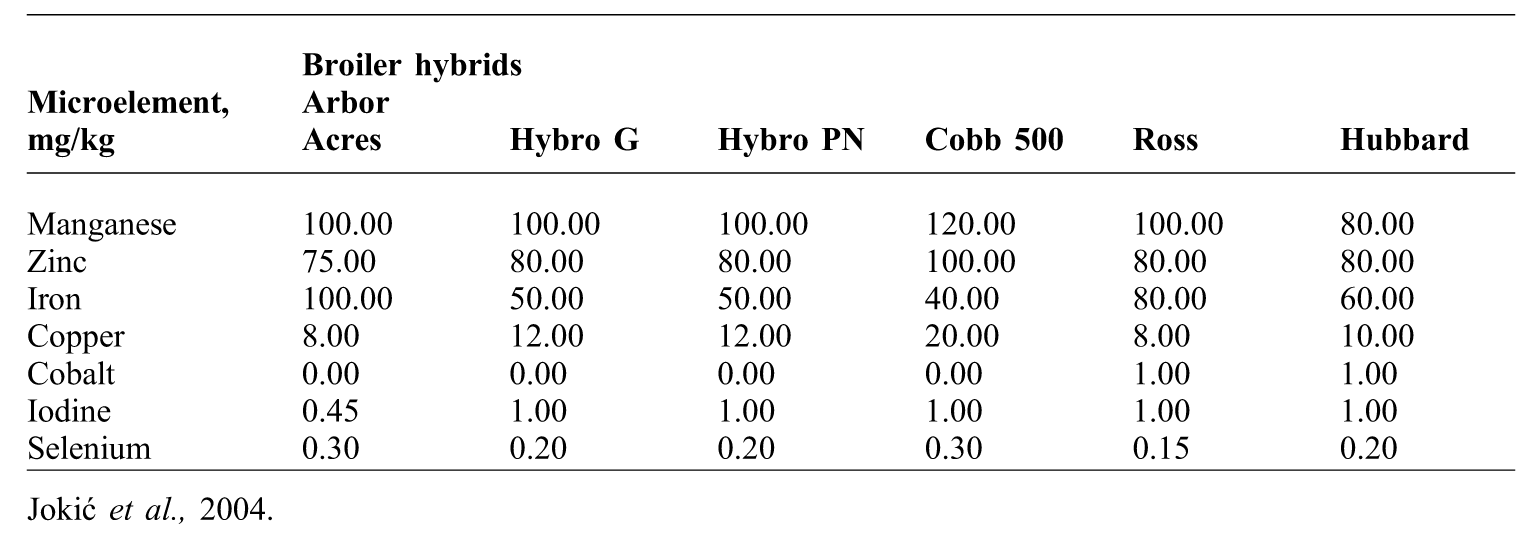
However, worldwide there are still major differences in the recommendations for specific micronutrients. A summary of specific recommendations for different broiler hybrids (Jokić et al., Reference KOVČIN and JOKSIMOVIĆ-TODOROVIĆ2004) is given in Table 1. Recommended amounts of microelements differ according to literature sources. Deviations occur as a result of different amounts of trace elements in the soil, and thus in plants and feed materials.
Micronutrient recommendations for a complete feed mixture, mg/kg.

Jokić et al., 2004.
In addition to providing the animal with minerals, it is necessary to implement the appropriate production technology used for mineral premixes (Adamović et al., Reference ADAMOVIĆ, JOVANOVIĆ, STOIČEVIĆ, RADOVANOVIĆ, SRETENOVIĆ, PAVLIĆEVIĆ and VUKIĆ-VRANJEŠ1997). This is especially important because insufficient microelements will cause deficits and adverse effects in the expression of reproductive potential and preservation of animal health. The addition of larger amounts of some microelements, in relation to the optimal needs or allowable amounts can have a variety of negative consequences, and, ultimately, a toxic outcome. This is particularly true for heavy metals (e.g. lead, cadmium, and mercury).
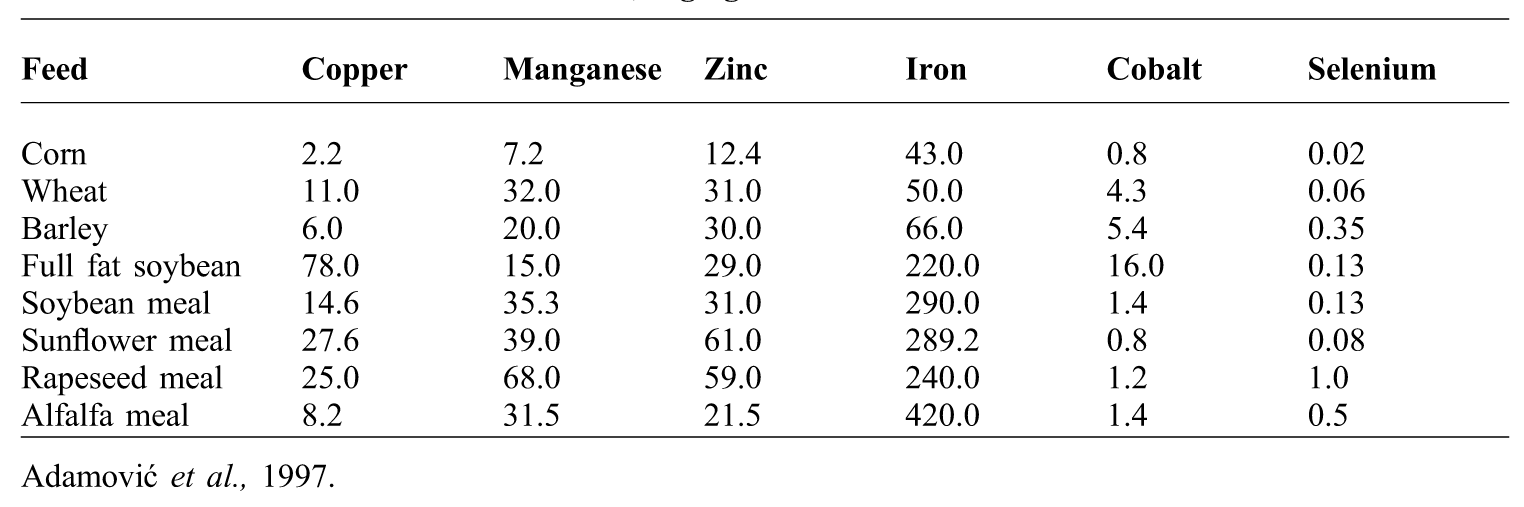
The problem in determining the optimal concentration of microelements is their interactions with each, whereby increases in one microelement may cause deficit in another. Natural nutrients are the best way of supplying animals with microelements. They are the form found in plants as compared to other sources, and have the highest availability and utilisation. Important microelement content in the feed are shown in Table 2.
Presence of microelements in feed, mg/kg.
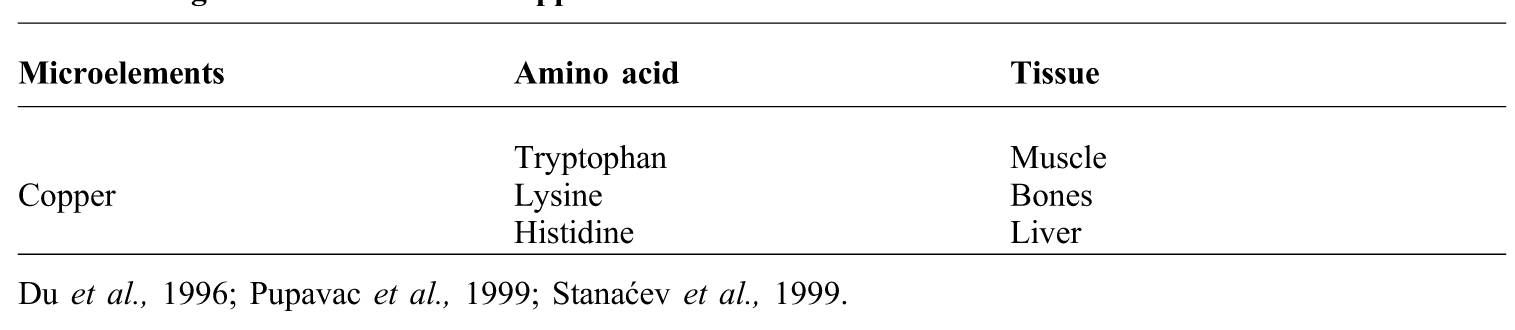
Use of mineral proteinates has a targeted impact on specific functions and enzyme systems in the body, because they are absorbed intact. After absorption, the fate of the mineral depends on the amino acid or peptide to which it is bound. Since different tissues and enzyme systems have different requirements for amino acids, mineral binding to specific amino acid or peptide with synthetic chelates increases the chance that the corresponding microelement is transported to a specific tissue or enzyme system (Table 3).
Targeted tissues of some copper chelates.
Du et al., Reference DU, HEMKEN and HARMON1996; Pupavac et al., Reference PUPAVAC, SINOVEC and JERKOVIĆ1999; Stanaćev et al., Reference STANAĆEV, KOVČIN and SAVIĆ1999.
Synthetic chelates
Research indicates that microelements, in the form of inorganic compounds, are gradually being replaced with chelates or EDTA compounds, which are already on the market, which are added to feed. The efficiency depends on stability constants of the individual chelate (Kratzer et al., Reference KRATZER, ALLRED, DAVIS, MARSHALL and VOHRA1959; Georgievski et al., Reference GEORGIEVSKI, ANNENKOV and SAMOKHIN1982; Brown and Zeringue, Reference BROWN and ZERINGUE1994). If the stability constant of the complex is higher than the constant of the complex formed between micronutrients and feed components, and lower than the constants of the complex in the tissues of the animal, the chelate will be effective.
The original chelates had too high stability constants and were practically useless (Rao et al., Reference RAO, PRAKASH, KUMARI, RAJU and PANDA2013). Newer versions are copies of natural compounds of chelates that occur in the body and feed materials, and proteins, peptides and amino acids ligands are used for their synthesis. Synthetic chelates must be compatible with the body to absorb, and their stability must be maintained at a certain pH (Reddy et al., Reference REDDY, DWIVEDI and DE WAYNE ASHMED1992; Brown and Zeringue, Reference BROWN and ZERINGUE1994; Huang et al., Reference HUANG, LU, LI, LUO and LIU2009; Manangi et al., Reference MANANGI, HAMPTON, FISHER, RICHARDS, VAZQUEZ-ANON and CHRISTENSEN2010).
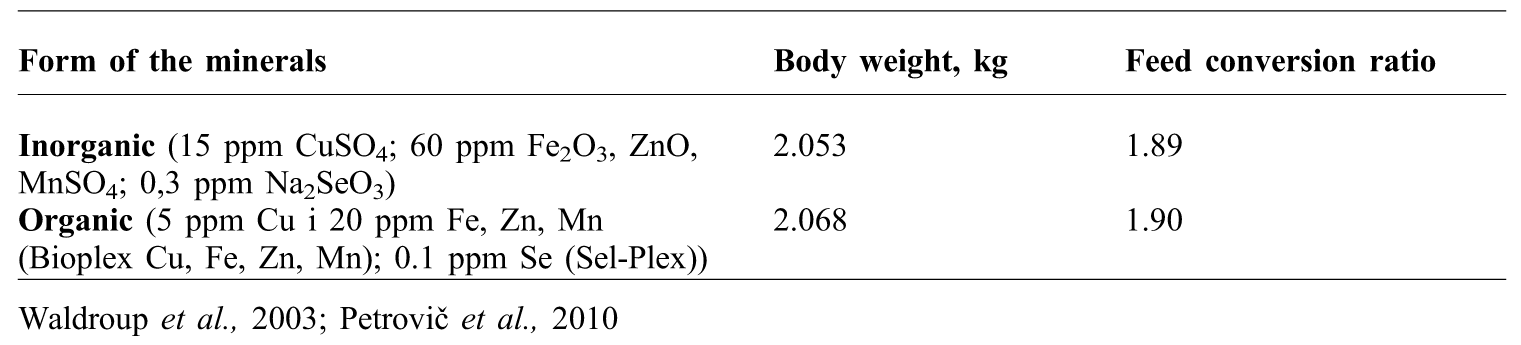
Research to examine the possibility of including significantly lower levels of minerals, with the introduction of organically bound forms in broilers, showed no significant differences, indicating that the significantly lower levels of organic minerals have a positive influence on the production performance of broiler chickens (Table 4). Today, the most commonly used chelates are for Fe, Zn, Cu, Mn and Co, and experimental results confirm the hypothesis that chelates in the diet increases the absorption and digestibility of microelements, which reflects an increase in growth, reproductive efficiency of animals and meat quality.
Effect of organic and inorganic minerals on broiler chickens performance from 42 days of age.
Waldroup et al., Reference WALDROUP, FRITTS and YAN2003; Petrovič et al., Reference PETROVIČ, NOLLET and KOVAČ2010
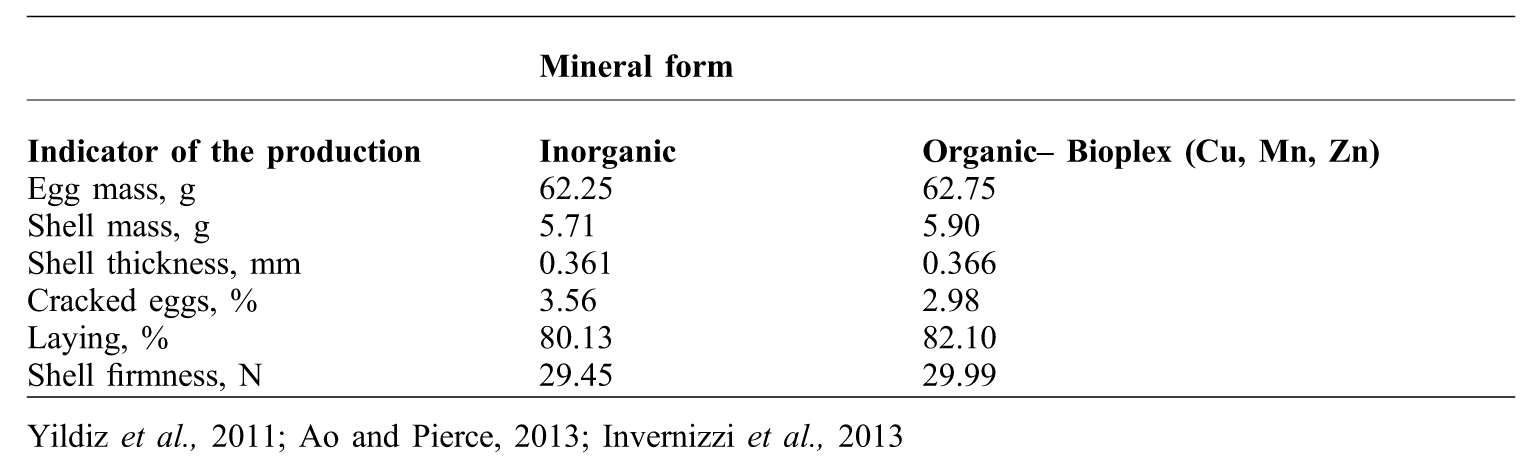
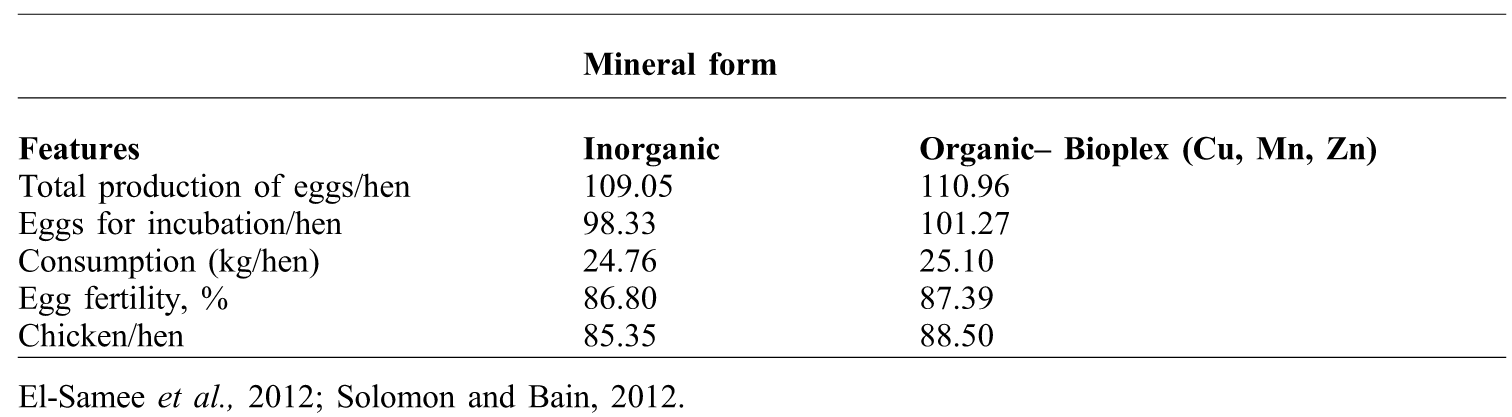
Beside broiler chickens, organic minerals have found an application in the diet of laying hens and parent flocks with a significant improvement on performance (Tables 5 and 6).
Influence of inorganic forms of microelements and Bioplex on shell quality and capacity of laying hens.
Yildiz et al., Reference YILDIZ, CUFADAR and OLGUN2011; Ao and Pierce, Reference AO and PIERCE2013; Invernizzi et al., Reference INVERNIZZI, AGAZZI, FERRONI, REBUCCI, FANELLI and BALDI2013
Influence of inorganic forms of microelements and Bioplex on production parameters of heavy line parent.
El-Samee et al., Reference EL-SAMEE, EL-WARDANY, ALI and ABO-EL-AZAB2012; Solomon and Bain, Reference SOLOMON and BAIN2012.
Based on these results it can be concluded that the use of organic minerals improves the performance and has a significant economic impact throughout the production period.
Conclusions
Based on the brief data presented it can be concluded that the use of chelated forms of minerals in poultry nutrition is now established as a better alternative to inorganic sources, as they can be used at lower levels with a positive impact on performance. Since the knowledge of the usage of chelated forms of minerals compared to inorganic forms in the diet of animals is still limited, further research in this area is needed.
Acknowledgments
The paper is part of the projects TR 31033 and III 46012, funded by the Ministry of Science and Technology of the Republic of Serbia.