Introduction
The goal of this article is to contribute to the development of a new research agenda on fiscal consolidation. Our contention is that the politics underpinning the choice of budget consolidation strategies, including preferences between expenditure-based and revenue-based measures, has been systematically overlooked in the mainstream literature, which is largely dominated by economists. There is an established literature on the economic and political determinants of fiscal adjustments, which seeks to explain the choices governments make as between reducing expenditures and raising revenues. This conventional approach is based on segmenting episodes of fiscal change into discrete time segments, and seeks to establish causal relationships obtaining across a large number of observations. We argue that this approach has two limitations. First, the dynamic features of government strategy are overlooked: choices are made under constraints that are shaped to a considerable degree by the consequences of past choices. A focus on pathways rather than episodes of adjustment is more suited to capturing what Pierson terms ‘politics in time’ (Pierson Reference Pierson2004). Second, it simplifies the causal complexity involved in understanding historically embedded decision making. The variety of factors shaping the choices made between expenditure-based and revenue-based fiscal consolidation strategies risks being lost from sight. For both these reasons, a comparative case-study approach is better suited to explaining ‘politics in time’. We propose an alternative approach to explaining variation in fiscal consolidation strategies and outcomes, highlighting some omitted variables in the existing literature. We show the value of this approach in a theoretically guided comparative case study analysis of the experiences of Ireland and Greece, gaining additional explanatory leverage through the related cases of Britain and Spain. This structured, focused comparison leads to a re-evaluation of some of the key findings that have become influential not only in academic analysis but also in contemporary policy prescription.
Rethinking fiscal consolidation
Margaret Levi claimed that a key challenge in comparative research is developing a political economy that is both economic and political: the challenge is to bring politics to the fore in political economy analysis (Levi, Reference Levi2000). This section starts by providing a critical assessment of the established and highly influential literature on budget consolidation. We then set out a more political, nuanced way of thinking about fiscal policy making.
A body of research on the economics and politics of fiscal policy emerged in the 1990s, in response to the macroeconomic imbalances accumulated in the 1970s and 1980s. This distinctive research programme was driven by both positive and normative considerations. On the positive side, researchers sought to understand the actual sources of deficits and debt accumulation. On the normative side, they attempted to frame the policy agenda by substantiating the most effective ways of cutting down deficits. Four major lines of research can be identified. The first looked at the politico-institutional sources of public deficits and accumulated debts (Roubini and Sachs, Reference Roubini and Sachs1989; Grilli et al., Reference Grilli, Masciandaro and Tabellini1991; Alesina and Perotti, Reference Alesina and Perotti1995b). The second studied the macroeconomic and political effects of different patterns of fiscal consolidation, focusing on the ‘composition’ of adjustment policies (Alesina and Ardagna, Reference Alesina and Ardagna1998; Alesina et al., Reference Alesina, Perotti and Tavares1998). The third strand of research explored whether alternative fiscal institutions lead to distinctive fiscal policy outcomes (Poterba and von Hagen, Reference Poterba and von Hagen1999; Debrun et al., Reference Debrun, Moulin, Turrini, Ayuso-i-Casals and Kumar2008). The fourth, consolidating and expanding on this dynamic research programme, examined the economic, political, and institutional determinants shaping governments’ choice of fiscal adjustment strategies (Mulas-Granados, Reference Mulas-Granados2003; Hallerberg et al., Reference Hallerberg, Strauch and von Hagen2007, Reference Hallerberg, Strauch and von Hagen2009).
In an explicit effort to move beyond conventional economic analyses of public finance, this literature has claimed to look at the political nature of economic policy, including the institutional incentives governing the decision-making process. Specifically, the main focus has been on institutional fragmentation, modelled in terms of coalition as opposed to single-party government, and federal or sub-national as opposed to unitary state powers. Institutional fragmentation is seen to predispose countries to deficits. The accumulation of large public debts is said to be concentrated among countries characterized by representative as opposed to majoritarian democracies, and among countries with fractionalized party systems. Short-lived governments result in suboptimal policies. Non-majoritarian governments are more likely to choose revenue-based adjustments, which in turn are expected to be less sustainable and less effective (Poterba, Reference Poterba1994; Poterba and von Hagen, Reference Poterba and von Hagen1999; Milesi-Ferretti et al., Reference Milesi-Ferretti, Perotti and Rostagno2002; Gali and Perotti, Reference Gali and Perotti2003; Persson and Tabellini, Reference Persson and Tabellini2003: Ch 6 and 8; Cheibub, Reference Cheibub2006; Fabrizio and Mody, Reference Fabrizio and Mody2006).
The explanation as to why the institutional fragmentation of decision making might make countries deficit prone is generally cast in terms of a common-pool problem (Weingast et al., Reference Weingast, Shepsle and Johnsen1981). In the context of large, fragmented and heterogeneous coalitions, interest groups that benefit from particular strands of public spending have more incentives to free ride on others’ contributions, which leads to high deficits and the accumulation of debt. Fragmented governments find it harder to oppose selective interests (Roubini and Sachs, Reference Roubini and Sachs1989; Poterba, Reference Poterba1994; Perotti and Kontopoulos, Reference Perotti and Kontopoulos2002; Fabrizio and Mody, Reference Fabrizio and Mody2006).
Building on the arguments of political economists such as Carles Boix and Geoff Garrett, the economist Carlos Mulas-Granados added a distinctively political variable in arguing that government partisanship makes a difference, modelled with reference to the seat share in government of parties designated as right or left (Garrett, Reference Grett1998; Boix, Reference Boix2003; Mulas-Granados, Reference Mulas-Granados2003). Conservative or right-wing governments are said to focus on cutting primary spending, social transfers and public wages as well as public investment, and on using these savings to fund cuts in direct taxation for business and individuals. Therefore they tend to prefer expenditure-based adjustments. Left-wing governments are reluctant to cut public capital formation spending programmes, so they tend to favour revenue-increasing strategies of deficit reduction (Roubini and Sachs, Reference Roubini and Sachs1989; Grilli et al., Reference Grilli, Masciandaro and Tabellini1991; Alesina and Perotti, Reference Alesina and Perotti1995b; Mulas-Granados, Reference Mulas-Granados2006; Castles, Reference Castles2007a, Reference Castlesb).
The economic starting conditions under which governments undertake fiscal consolidation efforts are also said to make a difference. Analysts have identified the independent effects of factors such as the cyclical position of the domestic economy and the government’s monetary policy stance (Freitag and Sciarini, Reference Freitag and Sciarini2001; von Hagen et al., Reference von Hagen, Hallitt and Strauch2002; McNamara, Reference McNamara2003).
The way these various factors link together – the coherence of a government’s strategy – also makes a difference to the sustainability of government commitment to fiscal consolidation. Hallerberg et al. (Reference Hallerberg, Strauch and von Hagen2007, Reference Hallerberg, Strauch and von Hagen2009) suggest that different approaches to budget making would be appropriate depending on the degree of fragmentation as well as the partisan composition of government. Mulas-Granados argues that strategies of adjustment are a function of the combined effects of the fragmentation of decision making, the ideology of party in government, and the timing of elections (Mulas-Granados, Reference Mulas-Granados2003, Reference Mulas-Granados2006).
The composition of fiscal consolidation is also said to be significant in accounting for the scale and sustainability of deficit reduction efforts. Fiscal consolidation based on spending cuts is said to be more sustainable because it is more likely to generate growth. The logic is grounded in non-Keynesian effects: whereas a Keynesian analysis would suggest that growth is a function of aggregate demand, this approach suggests that the principal driver of growth is private investor confidence. Government commitment to control deficits in order to maintain low inflation is said to generate credibility, and investors overcome their reluctance to invest. Alesina and others also argued that the political costs to governments arising from expenditure cuts are minimal (Alesina et al., Reference Alesina, Perotti and Tavares1998: 198). But these arguments have been contested: the electoral cost of imposing fiscal consolidation can be considerable, depending not only on the political construction of the nature of the problem but also on the speed of resumption of growth (Mulas-Granados, Reference Mulas-Granados2004). A strategy based on revenue raising can have successful outcomes over time (Mulas-Granados, Reference Mulas-Granados2003: 19–20, 34–35). As we shall argue later, the conditions under which a quick return to growth might be expected as a result of undertaking fiscal consolidation are very different under Economic and Monetary Union since 2000 than they were during the 1980s and 1990s.
Not surprisingly perhaps, the case for fiscal adjustment based on expenditure cuts has been popular in epistemic communities committed to small government (Giavazzi and Pagano, Reference Giavazzi and Pagano1990; McDermott and Wescott, Reference McDermott and Wescott1996; Perotti, Reference Perotti1996; Alesina and Ardagna, Reference Alesina and Ardagna1998; Dellepiane-Avellaneda, Reference Dellepiane-Avellaneda2014). Indeed, the fiscal constraints expected to be institutionalized by the Stability and Growth Pact were positively welcomed by, among others, Alesina and Ardagna (Reference Alesina and Ardagna1998), who wrote: ‘hopefully, the Stability Pact will force serious welfare reforms’ (p. 517).
In short, a well-established literature has identified several important explanatory variables driving not only the accumulation of deficits and debts, but also the timing, size and composition of consolidation strategy. The main variables are economic starting conditions, institutional fragmentation, and government partisanship. Much of the classic literature on fiscal consolidation has been contributed by economists, and most of it uses quantitative techniques of analysis in order to establish the link between their key explanatory variables and policy choices and outcomes. But these approaches are problematic, not least because they have seriously constrained (and sometimes biased) the way of conceptualizing and measuring the specifically political processes of fiscal consolidation (Dellepiane-Avellaneda, Reference Dellepiane-Avellaneda2010).
The conventional approach to analysing fiscal consolidation is to break countries’ experiences into multiple discrete episodes, measured in terms of change in the fiscal situation between one time period and the next (Alesina and Perotti, Reference Alesina and Perotti1995a; Perotti, Reference Perotti1998; Mulas-Granados, Reference Mulas-Granados2006; Hallerberg et al., Reference Hallerberg, Strauch and von Hagen2007). The effect of this approach is to treat political decision making as a series of static and episodic events that can be isolated from each other without loss of meaning, such that episodes of fiscal consolidation can be abstracted from the contextual environment without loss. It brings in a further assumption that the explanatory variables used to account for the patterns identified are similarly static and invariant in meaning.
What are thereby lost from view are four important features of the politics of fiscal policy. The first is that decision making is strongly path dependent, and decisions at time t are already conditioned by the decisions made at time t−1. By extension, decisions made at time t+1, for example, may well be conditioned not only by intermediate policy experiences between times t and t+1, but also by longer-term consequences of events at time t−1. This implies a need for more nuanced assessment than might be possible by simply extracting events at times t−1, t, and t+1 as stand-alone episodes. The second consideration is that while an episodic treatment of political decisions does not encounter the statistical and technical problems associated with pooling time-series analysis, it shares some of the limitations inherent in reliance on multiple regression analysis. Chief among these is the methodological requirement in hypothesis testing of this sort to isolate causal variables, to focus on measurable interactions, and to simplify controlling factors (Shalev, Reference Shalev2007). It has difficulty with complex interactions, interdependencies, co-causation, and the relevance of pre-requisite conditions. Complex causation is notoriously difficult to model successfully. Such modelling is also open to the possibility of there being missing variables that have not been adequately theorized or empirically specified. But identifying complex causation becomes indispensable when the object of interest is causes of effects, rather than effects of causes (Mahoney and Goertz, Reference Mahoney and Goertz2006: 41–49).
A third consideration is that the specification of episodes of fiscal consolidation itself is problematic. Small changes to the parameters of the definition of what is to count as fiscal ‘improvement’ may change the dependent variable quite a lot, and the literature demonstrates a good deal of inconsistency about when precisely the supposed episodes of fiscal consolidation occurred. Because episodes are generally defined in terms of primary budget balance in relation to gross domestic product (GDP), rapid growth in the denominator may shrink the stated deficit without implying any fiscal contraction, thus distorting the data. Similarly, under recessionary conditions, major efforts at fiscal adjustment may result in little visible change in ratios. We suggest therefore that any identification of episodes must be alert to the underlying politics of fiscal effort, since it is the effort itself that requires deployment of often considerable resources of political capital, organizational mobilization, and policy coordination (Kumar et al., Reference Kumar, Leigh and Plekhanov2007; Mauro, Reference Mauro2011; Dellepiane-Avellaneda and Hardiman, Reference Dellepiane-Avellaneda and Hardiman2014).
Finally, explanatory variables are also subject to distortion as a result of extracting them from their context, and indeed these too are prone to change over time to a greater degree than the dominant strategy based on regression analysis might suggest. For example, the partisan composition of government is usually modelled through a count of the seat share in government of parties of the left and right. But not only may the meaning of ‘left’ and ‘right’ vary across countries, depending on their interplay with other social cleavages. Even within a single country, the meaning of partisanship can change depending on the party’s stance and the policy environment. Consider, for example, the shifts in the British Labour Party’s policy stance under Blair, or the differences between Thatcher and Cameron’s stewardship of the Conservative Party (Allen and Bartle, Reference Allen and Bartle2010).
An alternative approach to analysing the politics of fiscal consolidation would take seriously the dynamics of political choice under constraint, where the constraints emanate from embedded features of the society and the international as well as the domestic political economy; where choices at one time-period condition the decision set at the next time period; and where the framing of decision making may have altered either because the nature of the problem is now construed differently, or because the actors themselves – with no change of identity or name – have changed their priorities.
All of these conditions may be summarized, as Paul Pierson has proposed, as aspects of ‘politics in time’ (Pierson, Reference Pierson2004). Decision making takes place in a dynamic context, and we need to attend to a wide range of factors that may change from one moment to the next. Furthermore, we need to be sensitive not only to institutions conceived as isolated variables, but to ‘institutional fields’, in which actors and institutions interact with one another in complex ways, and the politics of feasible choice may be quite complex (Pierson and Skocpol, Reference Pierson and Skocpol2002: 695–696; Pierson, Reference Pierson2004: 133–135).
Budgetary politics is not only a function of institutional design or of technical incentives and constraints. It is also at the heart of politics itself (Skocpol, Reference Skocpol1985; Levi, Reference Levi1988; Steinmo, Reference Steinmo1993). How the fiscal bargain is struck between those who pay and those who benefit is the very stuff of democracy. The conditions for making successful cost-cutting and revenue-boosting adjustments are more complex than conventional accounts suggest. Drawing on political economy literature, we believe that three important dimensions of politics have been overlooked by conventional large-N analytical strategies (Gourevitch, Reference Gourevitch1986; Hall, Reference Hall2012).
First, going beyond institutional fragmentation, we need to consider the profile of interest representation and the capacity of governments to build effective coalitions to implement their preferred strategy. A narrow measure of institutional fragmentation has been taken as a proxy for the capacity of government not only to make coherent decisions but also to implement them effectively. But policy commitment depends on the government’s capacity to ensure follow through, and the nature of state-society linkages is central to this (Weiss, Reference Weiss1998).
Second, going beyond partisanship, we need to consider the role of embedded ideologies, that is, the governing ideas that condition policy learning and shape perceptions of which strategy is most acceptable. As we noted above, policy preferences of parties of the left or right cannot be assumed to be consistent over time. And furthermore, policy-making routines tend to be based on broadly shared policy paradigms that are slow to change (Blyth, Reference Blyth2013; Hall, Reference Hall2013). But change they do, in response to new policy discourses disseminated across epistemic communities, and these can have a further feedback effect on policy preferences and priorities (Gilardi, Reference Gilardi2010; Dellepiane-Avellaneda, Reference Dellepiane-Avellaneda2014).
Third, going beyond identification of initial economic starting conditions, we need to understand the structure of the economy that underpins commitment to a particular growth strategy, and the constraints upon domestic economic policy choices that originate in the international political economy. In particular, the reform incentives stemming from deepening European integration, especially in the context of compliance with the Maastricht Treaty requirements, profoundly shaped many countries’ orientations towards fiscal adjustment during the 1990s (Ferrera and Gualmini, Reference Ferrera and Gualmini2004; Hodson, Reference Hodson2011).
Case selection
Our objective in this paper is to engage with the existing literature, so following both Perotti and Mulas-Granados, we start by using changes in the cyclically adjusted primary budget deficit in European countries as our indicator of fiscal consolidation (Perotti, Reference Perotti1996; Mulas-Granados, Reference Mulas-Granados2006). Rather than undertake a pooled quantitative analysis of causal variables, we engage in a structured, focused case-study approach to comparison (George and Bennett, Reference George and Bennett2005: 67–72). We are interested not only in exploring contrasts between selected cases, but also in exploiting the opportunity to analyse within-case variation over time. While the case study approach can be used for exploratory and heuristic purposes as a precursor to designing large-N quantitative investigation, case study research can also enable a different research strategy, which is to investigate in depth the complex interactions between the variables of interest (Geddes, Reference Geddes2003: 129; Gerring, Reference Gerring2007; Featherstone, Reference Featherstone2011: 212).
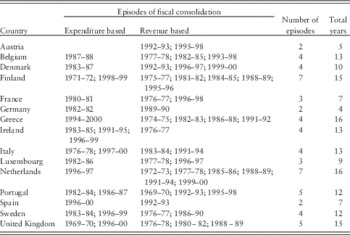
Looking at the cross-national profile of budget deficits, we note that most European countries experienced large deficits during the 1980s, and that they had converged on a balanced-budget equilibrium by 2000. But the profile of convergence – the route they took – shows a good deal of variation. Mulas-Granados demonstrates that while some countries, notably Ireland, show a clear preference for expenditure-based adjustments, others such as Austria and Greece tended to rely on revenue-based consolidations (Mulas-Granados, Reference Mulas-Granados2006). European countries display what we might call a non-convergent convergence, as Table 1 below shows (European Commission, 2000; von Hagen et al., Reference von Hagen, Hallitt and Strauch2002; McNamara, Reference McNamara2003: 333). Countries achieved a similar end-point by different means.
Episodes of fiscal adjustment in the European Union, 1970–2000

Mulas-Granados (Reference Mulas-Granados2006).
Categorization of episodes is often disputed. While Mulas-Granados suggests that countries such as Greece and Ireland enforced expenditure-based consolidations during the 1990s, von Hagen et al. (Reference von Hagen, Hallitt and Strauch2002) identify revenue-led adjustments. The European Commission suggests that Denmark implemented an expenditure-based retrenchment during the late 1980s, while Mulas-Granados claims that the adjustment was revenue-led (von Hagen et al., Reference von Hagen, Hallitt and Strauch2002; Mulas-Granados, Reference Mulas-Granados2006). Ireland’s well-known expenditure-based adjustment in the period 1987–89 is not captured by Mulas-Granados’s methodology (Mulas-Granados, Reference Mulas-Granados2006). These diverse interpretations arise from trying to link discretionary policy choices to short-term fluctuations in the structural components of the budget. This suggests that a more nuanced approach is required in which episodes are related to one another and viewed as outcomes of governments’ strategic choices.
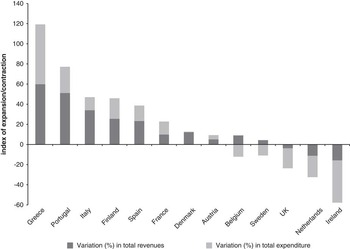
Mulas-Granados defines ‘strategy type’ as the sum of the average variation of cyclically adjusted revenues and cyclically adjusted primary expenditures (Mulas-Granados, Reference Mulas-Granados2006). The intuition is that the higher the value of the strategy type, the more expansionary is the effect of the government’s strategy on the total size of the government budget. We can apply this thinking to assess countries’ overall fiscal trajectories during the whole era of the trajectory of stabilization.
Figure 1 summarizes the expansion or contraction of the public sector across European countries between 1980 and 2000. This reveals that at one end of the scale, Ireland is the most pronounced case of public sector contractionary strategy, and at the other end, Greece is the outstanding case of public sector expansionary strategy. Ireland has relied mainly on an expenditure-cutting fiscal stabilization strategy, while Greece has sought to bridge deficits principally by raising taxation.
Expansion or contraction of public spending and revenues, 1980–2000.

These cases give us two paradigmatic or ideal-type cases, showing different patterns of fiscal consolidation. There is significant variation on the outcome of interest. They are also ‘substantively important’ cases, in Goertz and Mahoney’s terms, because they have each generated a substantial volume of commentary, in which Ireland is assumed to model the most commendable profile of fiscal adjustment, and Greece the most problematic (Mahoney and Goertz, Reference Mahoney and Goertz2006: 184–185). Ireland has been taken as an exemplary case of ‘expansionary fiscal contraction’ in the 1980s, and the poster child for austerity politics after the 2008 crisis (Giavazzi and Pagano, Reference Giavazzi and Pagano1990; Trichet, Reference Trichet2010). In contrast, the Greek experience became a byword for poor fiscal management (European Commission, 2010; Featherstone, Reference Featherstone2011).
We also seek to gain theoretical leverage through an additional strategy of pairwise comparison between cases that exhibit strong similarities. We seek to control for the two most striking differences between Ireland and Greece: that is, economic structure or ‘varieties of capitalism’, and also political system or ‘models of democracy’. We therefore choose two countries that are ‘most similar’ to our two cases of interest. Britain is compared with Ireland, and Spain is compared with Greece, providing relatively similar contexts, but variations in outcomes between each pair. Britain and Ireland share many similarities in that both are ‘liberal market economies’, and both feature parliamentary systems on the Westminster model (Lijphart, Reference Lijphart1999; Hall and Soskice, Reference Hall and Soskice2001). Spain, like Greece, is a ‘mixed market economy’, and also experienced a transition from authoritarian rule to democracy in the 1970s (Gunther et al., Reference Gunther, Diamandouros and Sotiropoulos2006; Molina and Rhodes, Reference Molina and Rhodes2007). These pairwise comparisons are grounded in contrasting strategies of fiscal consolidation, expenditure based as opposed to revenue based.
Ireland and expenditure-based adjustment, 1980–2000
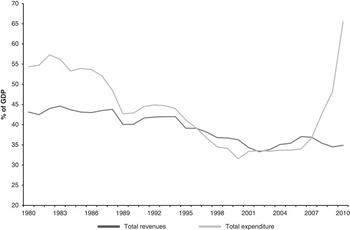
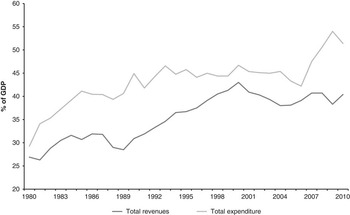
Although scholars disagree on the precise phasing of fiscal adjustment periods in Ireland between 1980 and 2000, they do agree on the overall profile. Alesina and Ardagna identify reliance on expenditure-related adjustments in 1983, 1984, 1987, 1988, and 1989; Mulas-Granados classes three fiscal adjustment periods (1983–85, 1991–95, and 1996–99) based principally on expenditure cuts (Alesina and Ardagna, Reference Alesina and Ardagna1998: 497, 515; Mulas-Granados, Reference Mulas-Granados2006: 21, 28). As in other OECD countries, the high deficits of the 1980s were reduced significantly by 2000. Like the majority of Eurozone member states, Ireland then displays several years in which a fiscal balance is maintained and very little infringement of the Stability and Growth Pact 3% deficit rule occurs, profiled in Figure 2. With the onset of the international economic crisis in 2008, Ireland’s fiscal balance worsened suddenly: we shall return to this topic at the end of the paper.
Revenue and expenditure trends in Ireland, 1980–2010.

The ratio of public spending to GDP in Ireland decreased substantially between 1985 and 2000, from 53% to 32%, accompanied by a steady decline of structural revenues from 43% to 35% of GDP. As a result, Ireland’s fiscal stance improved by around 12 points of GDP (European Commission, 2000). Ireland’s starting position during the 1980s was even worse than these EU figures suggest though, if one considers that the gap between GDP and gross national product (GNP) has tended to be large in Ireland, due to the scale of transfer pricing and profit repatriation associated with the large foreign-owned sector, particularly in manufacturing. Thus total government expenditure stood at 55.7% of GNP in 1985, and the exchequer deficit was 12.3%. As the balance was recorded at 3.5% in 2000, this implies an improvement of almost 16 points of GNP (Department of Finance, 2012: 4, 5, 12). This experience makes Ireland’s one of the most successful instances of fiscal consolidation.
However, a detailed case-study analysis suggests that much of what we thought we knew is somewhat less convincing upon closer inspection. It is far from clear that Ireland was an unequivocal case of expenditure-based adjustment in any case, if we widen the timeline to include the longer period 1983–89: tax increases in the earlier period reduced the scale of the spending-based adjustment required in the later period (Hardiman, Reference Hardiman2014).
Explanations of how fiscal consolidation was undertaken that are based on conventional analysis of institutional fragmentation and partisanship encounter some difficulty in the Irish case. It is true that the Irish government system is highly centralized, and the Irish parliamentary executive can exercise a great deal of autonomy relative to the legislature, since compared with other European systems, there are few veto points to government action (Döring, Reference Döring1995). Yet a succession of governments between 1981 and 1987 found it difficult to address budgetary issues systematically. Partisan differences do not adequately account for the relative successes of implementing policy, for governments during this period were formed first by the largest single party Fianna Fáil (in 1982), broadly characterized as centre-right or perhaps populist, and then by a coalition between the centre-right Fine Gael and the centre-left Labour Party (1983–87). This latter government undertook spending cuts in 1983–84, and taxes, especially incomes taxes, were allowed to rise sharply in mid-decade, so some progress was made in reducing the deficit between 1985 and 1987 (Hardiman, Reference Hardiman2014). These measures were electorally unpopular, especially for Labour voters, because unemployment was already high, and the tax base was perceived as unduly narrow (McCarthy and Tansey, Reference McCarthy and Tansey1996; Hardiman, Reference Hardiman2004).
We may indeed invoke political fragmentation (i.e. a shaky minority government) to account for government problems in addressing deficits in the early 1980s; and yet we must explain how it was that a minority Fianna Fáil government was able to introduce a more decisive set of policy measures after it took power in mid-1987. We may call upon partisan explanations to account for the problems encountered by the coalition government of 1983–87 to take decisive action, since the ideological distance between Fine Gael and Labour generated tensions over how best to tackle the crisis (Hallerberg et al., Reference Hallerberg, Strauch and von Hagen2007: 345). But we must then account for how the incoming Fianna Fáil government was able to break the policy log-jam which it had also experienced in earlier years. For only in 1987–88 did Ireland record a decline, not only in government expenditure relative to GNP, but in both nominal and real terms. This period marked the beginning of a sustained trend towards reducing the exchequer deficit.
Three additional explanatory variables help us account for variation in government capacity to address fiscal deficits over time. First, what made it possible for Fianna Fáil to introduce strong expenditure-cutting measures after 1987 was the negotiation of a tripartite pay pact between the trade union movement, the employers’ federations, and government. Initially this was a short-term crisis management measure, but increasingly improved its value as a coordinating mechanism (Hardiman, Reference Hardiman2002; Teague and Donaghey, Reference Teague and Donaghey2009; Regan, Reference Regan2012a). Enacting these measures in parliament was also made much easier by the commitment of Fine Gael not to oppose the budgetary priorities to which it was already committed in broad terms. But the fiscal reform package which included cuts in headline personal tax rates, combined with extensive base-broadening measures, would not have been undertaken, and would not have been possible without risking inflation, in the absence of wage moderation agreements (Barry, Reference Barry2009). The unions traded wage restraint for tax cuts, in deals that resulted in steady increases in disposable income (Hardiman, Reference Hardiman2006). The renegotiation of similar social partnership deals in subsequent years meant that a low-tax, service-poor equilibrium became embedded in Irish political economy as the engine of growth and employment creation (Barry, Reference Barry2007).
Second, economic ideas can be said to have played a significant role in changing the policy options available to successive governments. The turn towards collective problem solving which was facilitated through social pacts was put at the service of a new emphasis on expenditure cuts as the preferred strategy for addressing deficits. Professional economists had long been advocating such measures. Fianna Fáil in opposition had opposed them energetically when the Fine Gael-Labour coalition had attempted them. But now, Fianna Fáil completely reversed its prior stance, and undertook even more severe cuts to both capital and current spending programmes than those proposed by the previous government (McCarthy, Reference McCarthy2009, Reference McCarthy2010). The case for curbing public spending commitments acquired the status of received opinion (Bradley, Reference Bradley2000). The low-tax model and the FDI-based growth strategy were viewed as linked, and neither the Labour Party nor the trade union movement felt able to challenge this policy mix fundamentally (Antoniades, Reference Antoniades2010).
Third, the situation of Ireland in the wider international political economy helps explain change in policy choice and policy implementation, without which Ireland’s presumed experience of ‘expansionary fiscal contraction’ cannot be fully understood. It is indeed true that a sudden drop in inflation and an unexpected growth upturn took place between 1987 and 1989. But the sources of growth did not primarily flow from a rise in private sector investment stemming from a boost to their confidence, as the orthodox analysis would have it. Rather, a sharp devaluation of the Irish pound in 1986 gave Irish goods and services a sudden competitive edge, while inflation was held in check by social partnership. In addition, a sudden upturn of growth in the international economy generated a significant increase in demand for Irish exports (Honohan, Reference Honohan1992; Barry and Devereux, Reference Barry and Devereux1995). Thus it was not the fiscal contraction that caused the expansion, but the expansionary conditions that enabled government to legitimate the severe measures required to reduce the public deficit.
All the policy priorities noted here – negotiating social pacts, accepting market-conforming solutions to economic performance, and maintaining export competitiveness in a growth-oriented international environment – produced broad cross-party commitment to the Maastricht Treaty priorities after 1992. These priorities shaped each government’s strategies over time, despite some differences in policy emphasis, depending on whether Labour took part in government (with Fianna Fáil between 1992 and 1994, and with Fine Gael between 1994 and 1997), or whether government was formed by a coalition of Fianna Fáil and the small market-liberal Progressive Democrats (from 1997 to 2011) (Roche, Reference Roche2009).
A brief comparison with Britain adds credibility to the analysis set out here. Both countries are liberal market economies. In both, a fragmented trade union structure made wage management during the 1970s highly conflictual. Both countries attempted strong fiscal stabilization measures after 1980. But the profile of adjustment in Britain is rather different, as Figure 3 below shows.
Revenue and expenditure trends in the United Kingdom, 1980–2010.

Britain adopted both revenue-based and expenditure-based adjustments (Alesina and Ardagna, Reference Alesina and Ardagna1998: 497; Mulas-Granados, Reference Mulas-Granados2006: 28). But what is striking is the uneven trajectory over time. This is only in part explained by changes of government: the Conservative Party held power until 1997, and the Labour Party in government thereafter had pre-committed itself to the same spending targets as the Conservatives in order to increase its electoral credibility and to maintain the confidence of the financial markets. Britain has featured governments of long duration, the absence of coalitions, and a non-fragmented decision-making process. Yet a trend towards a stop-go policy style is apparent; so is a profile of mixed reliance on spending reductions and revenue increases. Britain shows an unusual pattern regarding partisanship, as Table 1 illustrates, since the Conservatives implemented two revenue-based adjustments during the 1980s and the Labour Party introduced a spending-based correction during the 1990s.
Our three explanatory variables contribute to explaining these anomalies. First, the structure of interest representation had developed along contrasting paths. In the 1970s, both Ireland and Britain had well-organized but poorly coordinated trade union movements. Ireland moved from the mid-1980s towards government-led coordination efforts, while Britain moved in the opposite direction towards a strategy of labour disorganization (Crouch, Reference Crouch2000; Traxler et al., Reference Traxler, Blaschke and Kittel2001). Trade unions in Britain could exert only weak political influence, which left central government with a relatively free hand (Bieler, Reference Bieler2008). British governments did not need to rely on effective social interlocutors, which increased the autonomy of government in its strategic options.
Second, however, the dominant ideas about appropriate fiscal adjustment strategy were more strongly contested, both among professional economists and electorally. The historical inheritance of higher levels of social protection and welfare state institutions meant that gravitation towards a low-revenue equilibrium was not possible. Mrs Thatcher’s governments attempted to curtail spending on education, the NHS, and transfer payments; but despite her electoral successes, public opinion proved resistant to these core provisions being dismantled (Rhodes, Reference Rhodes2000). But the dispiriting experience of repeated electoral losses between 1979 and 1997 drove the Labour Party to undertake not only organizational modernization, but also radical modification of many policy commitments, in a bid to reposition itself more favourably with the electorate. From its origins as a left of centre party, New Labour came to adopt many elements of neo-classical economic orthodoxies, which made it possible for it to accommodate an expenditure-driven adjustment by the late 1990s (Hay, Reference Hay1999).
Third, Britain’s large economy, still relatively strongly based in manufacture at this point, was not closely aligned with the business cycles of continental Europe. Chancellor Gordon Brown was determined to keep Britain outside the Maastricht process and never to relinquish control over sterling. The newly independent Bank of England took over inflation targeting after 1997. Paradoxically, this generated market confidence in Labour’s economic management capabilities such that the government was enabled to engage in more expansionary fiscal policy (Dellepiane-Avellaneda, Reference Dellepiane-Avellaneda2013). The British government was still relatively free to mix strategies of revenue and expenditure-based consolidation.
Greece and revenue-based adjustment, 1980–2000
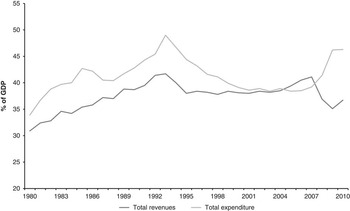
In contrast to Ireland, Greece can be regarded as a paradigmatic case of revenue-based consolidation. As Table 1 indicates, three out of four of the episodes of fiscal adjustment that Greece underwent in the post-authoritarian era were based on increasing structural revenues (Mulas-Granados, Reference Mulas-Granados2006: 28). Public spending increased by almost 60% between 1980 and 2000, funded by a revolution in the revenue-raising capacities of the state. Total revenues increased by more than 15 points of GDP.
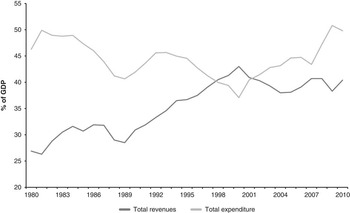
And yet, as Figure 4 shows, under successive Greek governments, spending consistently outstripped revenues. Periodic measures to implement fiscal discipline were mostly based on increasing revenues and the sale of state assets, rather than on cuts to primary spending. At the time of the transition to democracy in 1974, public services in Greece were poorly developed: the drive to expand welfare provision explains much of the impetus to increase spending. But consolidation measures proved difficult to institutionalize stably. The average public deficit between 1970 and 2000 was second only to Italy’s among the EU15 (Mulas-Granados, Reference Mulas-Granados2006: 28).
Revenue and expenditures trends in Greece, 1980–2010.

Conventional explanations of Greece’s fiscal profile involving institutional fragmentation and government partisanship take us part of the way towards understanding the dynamics of revenue and spending. The newly democratizing state in the 1970s inherited a weak administrative capacity and fragmented and politicized economic interests. The primary task of the first administrations after 1974 was to establish political as well as economic stabilization. The governments of the 1970s, formed by the conservative New Democracy and led by Kostantinos Karamanlis, and the PASOK socialist governments of Andreas Papandreou during the 1980s, presided over the expansion of the public sector, including the provision of of new services such as the national health system in 1984. But the state structures through which these new services were delivered made it particularly difficult to maintain control over expenditure or to ensure that programmatic expansion was supported by relevant revenue streams. The Greek political executive is neither weak nor unstable, since the design of the electoral system gives a seat bonus to the strongest party, and the restraining powers of the legislature are relatively weak (Farrell, Reference Farrell2011). The brakes on new spending are limited; conversely, if government chooses to implement consolidation measures, its authority is not in question (Lijphart, Reference Lijphart1999; Müller and Strøm, Reference Müller and Strøm2000; Döring, Reference Döring2001).
The problem lies rather with the system of policy implementation (Peters and Pierre, Reference Peters and Pierre2004; Featherstone, Reference Featherstone2011). Government departments are not under the strong centralized control of overarching ministries; rather, they are organized into a variety of offices and agencies whose responsibilities can overlap, diverge, or even conflict with one another. A gap can emerge between the process of taking decisions at government level and ensuring the implementation of the ensuing policy, in which lines of accountability are easily blurred (Sotiropoulos, Reference Sotiropoulos1998; Laffan, Reference Laffan2006). The bureaucratic structure also requires a complex system of budget authorizations. Political control over expenditure commitments has been beset by organizational obstacles. The tax administration system of the 1970s and 1980s was weak and inefficient.
During the 1970s and 1980s, political incentives to engage in administrative reform were weak. Electoral support for parties had been based on building up support among discrete sections of the electorate, and consolidating it through the exercise of special privileges and access to patronage networks (Gunther et al., Reference Gunther, Diamandouros and Sotiropoulos2006; Mitsopoulos and Pelagidis, Reference Mitsopoulos and Pelagidis2010). A cluster of protected groups and veto players therefore held sway over government decision making: Featherstone reports that some 70 discrete professions were still subject to ‘closed-shop’ protections in 2011 (Featherstone, Reference Featherstone2011: 206). The economic inefficiency and political corruption that led Greece to perform badly in many international rankings are rooted in these structural features of state organization and political mobilization. These patterns were embedded in PASOK’s mode of governance: it held power for most of the post-authoritarian period in Greece until 2011, with the exception of the years 1974–80, 1989–93, and 2004–07.
In the late 1980s PASOK, this time led by Kostas Simitis, faced a new set of political economy constraints, both domestic and international. The accumulated debt burdens of the 1980s forced a new attempt at fiscal stabilization. Greece committed to the Maastricht convergence criteria in 1992, adopting an external impetus to achieve domestic reform. PASOK embraced ‘Europeanization’ as a source of a modernizing and technocratic approach to policy making. This unique combination of external conditionality and commitment to domestic reform facilitated a short period of cost-based adjustment.
However, the reform effort proved both inefficient at meeting numerical targets, and unsustainable once external conditionality softened (Blavoukos and Pagoulatos, Reference Blavoukos and Pagoulatos2008b). Relatively little progress was made in driving this through into systematic reform of the administrative system. Indeed, one of the principal resources of the modern state, a reliable source of official statistics, was spectacularly lacking in Greece until very recently. Greece had appeared, from its own statistical reports submitted to Eurostat, to have qualified for the conditions governing Monetary Union by 1999 (aided, it has been reported, by some creative accounting on the part of Goldman Sachs) (Story et al., Reference Story, Landon and Schwartz2010). Despite some scepticism among the European elite, the claims were not too closely probed. But this oversight proved catastrophic when PASOK, upon resuming power in the wake of international crisis in 2009, after 5 years in opposition, exposed an enormous discrepancy between reported and actual fiscal performance, an announcement which precipitated not only Greece but the Eurozone itself into a new wave of crisis (Kouretas and Vlamis, Reference Kouretas and Vlamis2010; Featherstone, Reference Featherstone2011; Lyrintzis, Reference Lyrintzis2011).
However, the limits of PASOK’s brief reform drive of the late 1980s and early 1990s and the persistence of fiscal indiscipline require us to look beyond the institutional features of the state itself, and to consider the broader pattern of state-society relationships, the role of ideas in shaping policy preferences, and the international political economy context.
First, social pacts of any sort are difficult in Greece, because neither the trade union movement nor the principal employers’ associations has a strong base in their respective constituencies of support. Private sector unionization is weak, and the public sector unions have engaged actively in rent seeking and securing special benefits for selected groups. There is little capacity for engaging in cross-sectoral or ‘encompassing’ representation or strategic negotiation with government. Social pacts of a sort were concluded in 1997 and 2000, but these were weak and short-lived. Business interests have functioned to a large degree as the voice of big industry, and the small and medium enterprise sector in which employment is concentrated is poorly organized. Both unionized sectors and business interests prefer to perpetuate bilateral patronage-based understandings with government in what has been termed ‘disjointed corporatism’ (Lavdas, Reference Lavdas2005; Tsarouhas, Reference Tsarouhas2008).
Interest representation is therefore intimately connected with party preferences and state-controlled privileges, and ‘impartiality’ plays a very limited role in public administration (Rothstein and Teorell, Reference Rothstein and Teorell2008). State-society relations in Greece feature ‘systemic weaknesses’ (Featherstone, Reference Featherstone2005: 223). Drawing on Michel Crozier’s term for France in the 1960s (Crozier, Reference Crozier1967), Greece might be seen as a ‘blocked society’, that is, a society stifled by the top-down imposition of bureaucratic regulation, featuring polarized social interests across which neither coordination nor compromise is easily achieved. Economic policy making was constrained by ‘the reproduction of a pattern of power relations relying on a weak and asymmetrically penetrated state apparatus’ (Lavdas, Reference Lavdas2005: 309). Given these conditions, it is perhaps hardly surprising that the reforming and modernizing impetus of the process of ‘Europeanization’ made relatively little headway (Featherstone and Papadimitriou, Reference Featherstone and Papadimitriou2008; Blavoukos and Pagoulatos, Reference Blavoukos and Pagoulatos2008a, Reference Blavoukos and Pagoulatosb; Tsarouhas, Reference Tsarouhas2008). Governments were obliged to undertake fiscal consolidation measures without the legitimating support of union and employer consent. This left open the further risk of populist lobbying from potentially disadvantaged sectors, which in turn reinforced a politically destabilizing clientelism, as governments sought to shore up their electoral support base (Sotiropoulos, Reference Sotiropoulos1993; Gunther et al., Reference Gunther, Diamandouros and Sotiropoulos2006).
Second, the role of ideas in shaping expectations and explaining policy merits consideration. Associated with the strong electoral support for PASOK before the crisis, the dominant policy stance among political and official circles has favoured an activist state; this is reinforced by the political benefits that were shown to flow from pursuing spending in a highly clientelist manner. Both spending and tax-collecting can be shown to be inefficient, patchy, and inegalitarian for much the same reasons. The discourse governing ‘globalization’ became much more highly politicized in Greece than in Ireland, since market liberalization risks destabilizing key political bargains (Antoniades, Reference Antoniades2010: 150).
Third, Greece’s situation in the international political economy provides the broader context for fully understanding the drive towards public sector expansion and the primacy of revenue raising over expenditure cuts in fiscal stabilization efforts. Greece was one of the relatively poorer EU member states, and relatively much less open. Economic openness (i.e. exports and imports as a proportion of GDP), hovering around 50% over time, was relatively low (and not unlike the levels seen in the much larger Spanish economy); its trade balance in goods and services stood at about −8% of GDP in the 1970s, and −12% by 1990. The incentives to engage actively in domestic changes driven by the process of European integration were not strongly driven by the domestic economic structure. As a late industrializer, Greece continued to be much less closely integrated into the international economy than Ireland throughout the period under consideration. The one phase during which meaningful fiscal reform was undertaken, during the late 1980s and early 1990s, was made possible by the effects of the external disciplining obligations entailed by the Maastricht Treaty, which reinforced Simitis’s domestic reform commitments (Blavoukos and Pagoulatos, Reference Blavoukos and Pagoulatos2008b). However, the quid pro quo which PASOK entered into with the unions to meet targets during the 1990s, through trading wage restraint for expanded public entitlements, delivered inflation control but at the expense of building up large public spending commitments, a much bigger problem for the longer term.
Post-authoritarian stabilization policies need not take this form, as a brief comparison between Greece and Spain reveals. These countries share common economic development patterns, welfare state profiles, processes of modernization through Europeanization, and a Southern European political culture. Despite these similarities, the two countries have undertaken contrasting policy paths in many areas. Here again, we find that while explanations grounded in institutional coherence and partisanship are relevant, additional explanatory power is gained by considering the consensus-seeking capabilities of party politics and interest intermediation, the role of ideas, and the international context of domestic political economy.
As Figure 5 shows, Spain also followed a revenue-raising approach to reducing fiscal deficits, motivated by a similar wish to expand welfare and other services from a low base after the fall of the Franco dictatorship.
Revenue and expenditures trends in Spain, 1980–2010.

However, the impetus to meet the conditions of the Maastricht convergence criteria for membership of the Euro brought about a more fundamental reorientation of the public finances during the 1990s (Blavoukos and Pagoulatos, Reference Blavoukos and Pagoulatos2008b; Ongaro, Reference Ongaro2010). This was overseen by a considerably less fragmented institutional state apparatus than in Greece (despite ongoing campaigns for increased political autonomy in the regions). The pressures of increasing European integration did not fundamentally alter the structural features of the Spanish public administration which, as in Greece, featured a complex system of departments and agencies; but it brought about significant changes in administrative practices and improvements in the capacity to formulate and implement policy coherently (Parrado, Reference Parrado2008; Gallego and Barzelay, Reference Gallego and Barzelay2010)
The political parties in Spain had been reconstituted and legitimated in a manner that enabled them to manage a stable democratic transition, a commitment that was deepened by their response to the failed army coup attempt of February 1981. The Socialists (PSOE) had held office for longer than the parties of the right (1982–96 and 2004–11), but alternation of power, and the periodic incumbency of the conservative Partido Popular (PP) (under Aznar, 1994–2004, and Rajoy since 2011), helped consolidate a greater degree of bureaucratic independence from political domination than in Greece. The long spells of rule by PSOE featured a strong commitment to building up the welfare state, and to funding public infrastructural investments (Boix, Reference Boix1998). Deficit management by the PP (1996–2000) was clearly expenditure based: partisan preference is important in accounting for policy choice. PSOE also made determined efforts to converge on the new economic orthodoxy of austerity and market liberalization in the run-up to the Maastricht deadline (Pagoulatos, Reference Pagoulatos2004). Deficit management under the PSOE (1992–94, see Table 1) avoided cuts to either current or capital spending; hence the impetus to deepen and extend the revenue yield of the reformed tax administration system.
And yet this does not fully account for either the profile or the outcome of deficit management policy in Spain, where the contrast with the Greek experience is striking in relation to our three additional explanatory variables: social pacts and state-society linkages; the role of ideas; and the international context of the country’s political economy.
First, both the representation of unions and the employers’ associations are more fully mobilized and more firmly grounded in their potential support base than in Greece. Spain was able to manage the transition to ‘modern’ class and interest-based civil society organization, even though similarly characterized by separate partisan affiliations. Early in the democratic transition process, centre-right prime minister Suarez engaged unions and employers in a consultative process that resulted in the economically and politically stabilizing Moncloa Pact of 1978. This provided a template on which to build subsequent tripartite and bipartite social pacts (FitzGerald and Hore, Reference FitzGerald and Hore2002; Avdagic et al., Reference Avdagic, Rhodes and Visser2005; Molina and Rhodes, Reference Molina and Rhodes2011). The ‘pactista’ experience helped build support within the wage-bargaining institutions for the disciplines needed to qualify for membership of the Euro (Pérez-Díaz, Reference Pérez-Díaz1993; Pérez, Reference Pérez2000). Even during spells of PP government, wage coordination remained high (Visser, Reference Visser2013). As in Ireland, the core political executive in Spain can exercise a good deal of political autonomy; as in Ireland, industrial relations are not strongly institutionalized (Chari and Heywood, Reference Chari and Heywood2009: 34–35, Hardiman et al., Reference Hardiman, Regan and Shayne2012). But pact-building, led by government, enhanced government capacity for effective policy making and implementation. Both inflation control and restraint of public spending were managed successfully, in contrast with the Greek experience.
Second, the role of ideas in shaping the range of feasible options was also different in Greece and in Spain. Greek government circles encountered relatively few domestic or external constraints to their high-spending economic policy preferences during the 1980s. In contrast, the prevailing belief structures in Spain created the conditions for a strong endorsement of the European project. This further strengthened the commitment to administrative modernization and the prevalence of technocratic criteria in budget formation (Pagoulatos, Reference Pagoulatos2004).
Third, Spain’s situation in the international political economy helps explain its profile of fiscal adjustment in that, as a relatively large economy with a high degree of internal trade dependence, the dominant strategy of increased spending on public investment and expansion of the welfare state, supported by revenue increases, generated growth multipliers that would not so easily be secured in a more open economy. Spain’s domestic political economy, which like Greece’s experienced a late and large outflow from agriculture from the 1960s on, was nevertheless more diversified than Greece’s, with a stronger tradition of industrial development. This in turn helps explain the greater stability of economic concertation in Spain.
The new context of fiscal austerity since 2008
Since the emergence of the global financial crisis in 2008, the crisis in the Eurozone has re-focused attention on fiscal deficits. Ireland and Greece were the countries with the worst combined debt and deficit experience by 2010. (Ireland’s recorded deficit in 2010 was −32.4% because of the government had assumed for rescuing the banks; but the public component of the deficit alone, at over 12% GDP, would also have qualified it as a particularly poor performer.)
The rationale for austerity measures in the Eurozone periphery is grounded in the policy learning derived from the fiscal consolidation programmes of the 1980s and 1990s: deficits originate in mismanagement of public finances; deficit reduction should be tackled quickly; cuts to expenditure programmes are the most effective means of doing so; this will create the conditions for resumption of growth.
A full assessment of the politics of fiscal retrenchment during the current crisis is beyond the scope of this paper. But there is now a growing literature to suggest that the policy inferences drawn from the earlier period may not be so relevant now, and that the circumstances favouring expansionary outcomes from fiscal retrenchment at the present time are far from favourable. Indeed, some authors most associated with establishing the conventional wisdom have questioned its applicability to current circumstances: Perotti and Giavazzi have both issued grave warnings; although Alesina’s views on the need for fast action and the preferability of spending cuts to tax increases seem unchanged (Alesina and Perotti, Reference Alesina and Perotti2010; Giavazzi, Reference Giavazzi2010; Perotti, Reference Perotti2011; Alesina and Giavazzi, Reference Alesina and Giavazzi2012).
Four factors stand out as different this time. First, within the Eurozone, countries cannot devalue to regain a competitive advantage, and this was a key element in many successful consolidations in the past (Alesina and Ardagna, Reference Alesina and Ardagna1998: 516, Kumar et al., Reference Kumar, Leigh and Plekhanov2007; IMF, 2012b). Second, the demand-suppressing effect of retrenchment under conditions of recession risks intensifying the downturn to a degree which, as the IMF noted in 2012, had previously been under-estimated (Blanchard et al., Reference Blanchard, Dell’Ariccia and Mauro2010; Krugman, Reference Krugman2009; IMF, 2012a). Third, the current crisis is no ordinary recession, but is the consequence of a massive financial crash, and the private sector is likely to take some time to deleverage. Thus government commitment to spending cuts cannot produce the expected effects of boosting investor confidence (Reinhart and Rogoff, Reference Reinhart and Rogoff2009; Giavazzi, Reference Giavazzi2010; Rajan, Reference Rajan2010). And fourth, in the most distressed countries, the cost to governments of rescuing failing banks imposes an especially heavy burden on the public finances. In effect, this has pushed the cost of adjustment from the private to the public sector, increasing the risk that public debt obligations may be too onerous to sustain (Münchau, Reference Münchau2011).
The approach we have used to analyse the earlier phase of fiscal consolidation may also be applied to post-2008 conditions. We may gain analytical insight by considering ‘politics in time’, and by attending to the additional explanatory variables already elaborated above.
Ireland’s early commitment to tough budgets in response to crisis conditions was based disproportionately on spending cuts. Ireland did not have a strong left-right division on these issues. The consensus of professional economic opinion that spending cuts were essential carried weight with all the main parties, as the domestic policy mistakes during the 2000s became more evident (Dellepiane-Avellaneda and Hardiman, Reference Dellepiane-Avellaneda and Hardiman2012a). The discourse of globalization, of Ireland as a business-friendly environment, combined with policy learning from the 1980s, legitimated a strategy based on cutting public expenditure (Smith and Hay, Reference Smith and Hay2008; McCarthy, Reference McCarthy2009, Reference McCarthy2010; Antoniades, Reference Antoniades2010; Dellepiane-Avellaneda and Hardiman, Reference Dellepiane-Avellaneda and Hardiman2010, Reference Dellepiane-Avellaneda and Hardiman2012b). By the end of 2009, the government was unable to build support among the social partners for the scale of cuts it wished to impose. The weakly institutionalized social partnership proved easy to dismantle. However, government still sought to bring the public sector unions on board (Teague and Donaghey, Reference Teague and Donaghey2009; Stafford, Reference Stafford2010; Regan, Reference Regan2012b). Despite unemployment at 15%, and growing household hardships resulting from cuts in transfers and entitlements as well as from debt servicing burdens, the strategy based primarily on severe expenditure cuts was deeply resented but not subject to serious political challenge.
The Greek experience of fiscal management during the 2000s shows a marked contrast. Greece did not run a fiscal balance, let alone a fiscal surplus, during these years. Once it had gained access to the Euro, the incentives to engage in further consolidation of the public finances were very weak. Greek public finances stabilized during the 2000s at a high but inefficient tax equilibrium that combined weak tax compliance with a poorly designed tax regime. Together, these features had many distortionary effects on economic activity. As in Ireland, domestic policy failures were reinforced by perverse external incentives (Arghyrou and Tsoulakas, Reference Arghyrou and Tsoulakas2010; Featherstone, Reference Featherstone2011; Lyrintzis, Reference Lyrintzis2011; Porzecanski, Reference Porzecanski2012). Once Greece was obliged to accept the EU-IMF loan programme in May 2010, it was no longer free to choose a preference for tax increases over spending cuts. Greece embarked on massive expenditure-led fiscal consolidation, among the toughest ever attempted: the total primary budget deficit was reduced by 8.2 percentage points of GDP between 2010 and 2011 which in cyclically adjusted terms amounted to 11 points (Pagoulatos, Reference Pagoulatos2012). And yet, in addition to the extreme difficulties of making adjustments in recession, with a steep debt overhand, deeper problems of political feasibility and economic sustainability also persisted.
Implications and conclusions
This paper has argued that conventional analyses of fiscal consolidation, based on segmenting episodes and analysing them as discrete observations, are less than satisfactory. They fail to capture the dynamic and path-dependent evolution of fiscal consolidation strategies. We argue for a new approach to fiscal consolidation that locates politics in time: much can be gained by looking at pathways to consolidation rather than episodes of change. This paper has put forward the elements of a renewed research programme on fiscal consolidation, in which we show how case-study analysis can make a valuable contribution to the existing comparative literature. What we most need to understand is the politics of fiscal choice, that is, the political conditions underlying ‘fiscal adjustment plans’, as Mauro notes (Mauro, Reference Mauro2011: xvi). We wish to renew interest in the core issues of political economy, including the roles of interests and ideas, the domestic politics underpinning the legitimation of fiscal adjustment policies, and the changing context of the international political economy.
Our case studies point towards four conclusions.
First, the politics of interest intermediation is important in securing stable consolidation. In instances where it was possible to secure the legitimacy of wage moderation through social pacts, cost-based adjustment proved more durable, as in Ireland and Spain during the 1990s and 2000s. Britain’s governance mechanisms were more unbalanced, as they relied more heavily on links with employer and financial interests than with the representation of union interests. Where interest intermediation was weakly institutionalized, politicized and conflictual, as in Greece, the destabilizing potential was significant. States featuring ‘embedded autonomy’ of the public administration are generally held to have more effective policy implementation – that is, when the links between political executive, public bureaucracy, and organized interests, are sufficiently well established to generate good consultative and information-sharing networks, but when the state institutions are also sufficiently insulated in their decision-making capacity to prevent capture by veto players (Evans, Reference Evans1995; Weiss, Reference Weiss1998; Pierre and Peters, Reference Pierre and Peters2005).
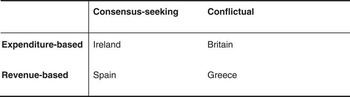
We may therefore identify two government approaches to social dialogue. A consensus-oriented approach involves constructing coalitions with organized interests on issues of fiscal consolidation, either directly related to pay bargaining agreements, or in a more indirect form of social pacting. In contrast, a conflictual model involves the risk of regular confrontation with hostile sectors of opinion in the society; or it may entail policy implementation without direct consultation with or involvement by organized labour. Either way, it involves a mode of economic governance that depends more heavily on top-down ‘hierarchy’ than on more negotiated or networked forms of governance (Kooiman, Reference Kooiman2003; Goetz, Reference Goetz2008; Bell and Hindmoor, Reference Bell and Hindmoor2009). Figure 6 summarizes the analytical schema.
Typology of fiscal adjustment strategies.

These strategies do not predict whether governments will adopt revenue- or expenditure-based strategies of adjustment: in our case studies, Spain fell into the consensus-seeking category, while Greece and Britain fell into the conflictual category. But the typology suggests that the fit between government strategy and social interests may be more important than previously recognized in explaining outcomes. It also points towards the importance of the emergent research agenda analysing variations in the capacity of wage-setting institutions to manage economic adjustment strategies in the wake of the global financial crisis (Johnston and Hancke, Reference Johnston and Hancke2009; Scharpf, Reference Scharpf2011; Avdagic et al., Reference Avdagic, Rhodes and Visser2011; Avdagic and Salardi, Reference Avdagic and Salardi2013).
Second, changes in the ideas and policy paradigms in official circles condition governments’ perceptions of feasible policy options. These change over time in each country, but they are not uniform at any one time, and may be the subject of contestation and factional competition within governing parties themselves. Irish political circles, having experienced partisan conflict over the need for expenditure cuts during the 1980s, thereafter adopted a widely legitimated view of the need for expenditure-restraining priorities, which endured into the very different context of the global financial crisis after 2008. In Britain, in contrast, the Labour Party underwent a long-drawn-out adjustment of its ideological orientation, such that its initial commitment in 1997 was to implement the Conservative Party’s budget projections. In Greece, priorities and objectives originating in wider European debates did not secure a legitimate foothold. This resulted in a higher level of ideological contestation over policy options than elsewhere. Spanish policy debates, by comparison, featured a coherent account of the Europeanizing and modernizing process, consistent with a revenue increasing but fiscally prudent strategy.
Third, we argue that the international dimension has been underestimated in conventional analyses of the politics of fiscal consolidation. The option of devaluation to ease a consolidation strategy proved crucial for both economic and political reasons in the era before European Monetary Union. EU disciplining influence reinforced domestic incentives to comply with EMU targets before 1999. This combination of internal disciplines and external sanctions loosened unexpectedly after 2000, as the unintended consequences of cheap credit in the periphery, and the weak sanctioning powers of the Stability and Growth Pact, became apparent. The manner in which national economies are embedded in the international economic system shapes their evolving development models and growth strategies, in ways that are rarely conceptualized let alone modelled in conventional analyses.
Finally, we have shown that the lessons from successful consolidations for the crisis in the period from 2008 onward are less straightforward than often suggested. Without the option of devaluation, the pain of adjustment may be both politically and economically unmanageable. While governments may be able to stall people’s expectations as long as crisis is believed to be unavoidable, it is far from clear that sustained austerity can be legitimated in the long run without domestic political stability coming under severe stress (Mair, Reference Mair2009; O’Rourke, Reference O’Rourke2011; Hall, Reference Hall2012; Dellepiane-Avellaneda and Hardiman, Reference Dellepiane-Avellaneda and Hardiman2014).
The older fiscal consolidation literature of the 1990s and 2000s overlooked core issues in domestic political economy, including the role of interest representation, political legitimacy, and policy contestation. Without bringing politics back into the frame – including the new politics of multi-level economic governance – the analysis of credibility and efficacy in fiscal consolidation policies is unlikely to deliver plausible policy advice.
Acknowledgements
An early version of this work was presented at the ECPR General Conference in Reykjavik in 2011. The authors are grateful to the panel organizers and participants in those discussions, and to a number of other colleagues, including Alejandro Bonvecchi, Mark Hallerberg, Christopher Hood, Lotte Jensen, Martin Lodge, Francesco Stolfi, and to the anonymous EPSR reviewers, for their helpful comments.